Home Birth
Caitlin Baeder
Katie Burden
Intro
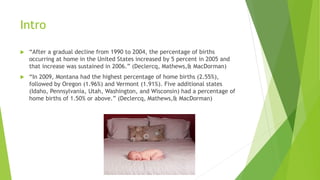
 “After a gradual decline from 1990 to 2004, the percentage of births
occurring at home in the United States increased by 5 percent in 2005 and
that increase was sustained in 2006.” (Declercq, Mathews,& MacDorman)
 “In 2009, Montana had the highest percentage of home births (2.55%),
followed by Oregon (1.96%) and Vermont (1.91%). Five additional states
(Idaho, Pennsylvania, Utah, Washington, and Wisconsin) had a percentage of
home births of 1.50% or above.” (Declercq, Mathews,& MacDorman)
History
 1900: “…almost all U.S. births occurred outside a hospital (the vast majority of which
occurred at home).” (Feldhusen)
 1915: Dr. Joseph DeLee published paper that stated he “believed childbirth was not a
normal function and that midwives had no place in childbirth.” (Feldhusen)
 1940-1950: The quantity of U.S. births occurring outside of a hospital “fell to 44 percent.”
By the 1950’s 88% of births occurred in hospitals. (Feldhusen)
 1969: “…the percentage of births occurring outside a hospital had declined to 1 percent
and has remained at approximately this level up to the present day.” (Feldhusen)
 1989: “…revision of the U.S. Standard Certificate of Birth provided additional detail for
out-of-hospital births and allowed us to distinguish between births at home, in a birthing
center, or other specified location.” (Feldhusen)
Family and Community Effects
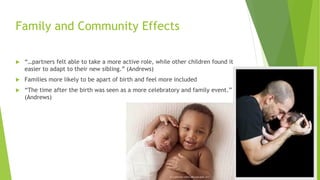
 “…partners felt able to take a more active role, while other children found it
easier to adapt to their new sibling.” (Andrews)
 Families more likely to be apart of birth and feel more included
 “The time after the birth was seen as a more celebratory and family event.”
(Andrews)
Financial Aspect
 Year 1915: “The American Association of Labor Legislation drafted the first
bill for health insurance…would pay for medical costs, sick pay, maternity
benefits and a death benefit.” (Howell)
 “When compared to the cost of a normal, vaginal hospital birth (between
$8,000- $13,000 or more), a home birth is a small fraction of that ($2,000-
3000) and is inexpensive for the amount and quality of care received.”
(Howell)
 Don’t assume home birth won’t be covered under your insurance! ASK!!!
Associated Problems
 “Of every 1,000 babies born at home with a midwife attending, 1.6 lacked a
pulse and weren't breathing five minutes after birth...For hospital births with
a doctor, the rate was 0.16 per 1,000 infants.” (Seppa)
 “Women lose time racing to a hospital...it's often difficult to play 'beat the
clock' to save the baby.” (Seppa)
 “…inadequate care of midwives, which was described in one case as
disorganized, another as too focused on discussion of fear of labor,
inadequate hand washing…” (Jannsen, Henderson, Vedam)
 “I had a long and difficult labor. I felt exhausted, not empowered. I don’t
know how I could have felt differently. It was so painful.” (Jannsen,
Henderson, Vedam)
Associated Benefits
 “…increased their confidence and led to feelings of mastery over the labor and
birth.” (Andrews)
 “Women expressed a feeling of being supported and cared for, special, and
important. At times they characterized it as feeling treasured, or having a
spiritual or healing experience (44 responses).” (Janssen, Henderson, Vedam)
 “…women stressed that they received adequate information about the birth
(54 responses).” (Janssen, Henderson, Vedam)
 “…believed that their midwife would respond to their calls for information and
assistance at any time (33 responses), which further enhanced their confidence
in their ability to handle their early labor and postpartum periods.” (Jannsen,
Henderson, Vedam)
Conclusion…
 Have the first birth at a hospital, then decide if home birth is for you!
 Make sure transportation to a hospital is readily available for the birth
Sources
 Declercq, E., Mathews, T., & MacDorman, M. (2012, January 26). Home Births in
the United States, 1990–2009. Retrieved February 8, 2015, from
http://www.cdc.gov/nchs/data/databriefs/db84.htm
 Feldhusen, A. (n.d.). The History of Midwifery and Childbirth in America: A Time
LinePrepared by Adrian E. Feldhusen, Traditional Midwife. Retrieved February 8,
2015, from http://www.midwiferytoday.com/articles/timeline.asp
 Home birth experience 2: births /postnatal reflections. Andrews, Allison. British
Journal of Midwifery. Sept 2004, Vol. 12 Issue 9, p552-557. 6p.
 Howell, A. (n.d.). New Moon Midwifery. Retrieved February 8, 2015, from
http://newmoonmidwifery.com/faq/
 Body & brain: Home births more risky than hospital deliveries. Seppa, Nathan.
Science News. 10/19/2013, Vol. 184 Issue 8, p14-14. 1p.
 The Experience of Planned Home Birth: Views of the First 500 Women. Janssen,
Patricia A, Henderson, Angela D., Vedam, Saraswathi. Birth: Issues in Perinatal
Care. Dec2009, Vol. 36 Issue 4, p297-304. 8p.

Home+Birth

  • 1.
  • 2.
    Intro  “After agradual decline from 1990 to 2004, the percentage of births occurring at home in the United States increased by 5 percent in 2005 and that increase was sustained in 2006.” (Declercq, Mathews,& MacDorman)  “In 2009, Montana had the highest percentage of home births (2.55%), followed by Oregon (1.96%) and Vermont (1.91%). Five additional states (Idaho, Pennsylvania, Utah, Washington, and Wisconsin) had a percentage of home births of 1.50% or above.” (Declercq, Mathews,& MacDorman)
  • 3.
    History  1900: “…almostall U.S. births occurred outside a hospital (the vast majority of which occurred at home).” (Feldhusen)  1915: Dr. Joseph DeLee published paper that stated he “believed childbirth was not a normal function and that midwives had no place in childbirth.” (Feldhusen)  1940-1950: The quantity of U.S. births occurring outside of a hospital “fell to 44 percent.” By the 1950’s 88% of births occurred in hospitals. (Feldhusen)  1969: “…the percentage of births occurring outside a hospital had declined to 1 percent and has remained at approximately this level up to the present day.” (Feldhusen)  1989: “…revision of the U.S. Standard Certificate of Birth provided additional detail for out-of-hospital births and allowed us to distinguish between births at home, in a birthing center, or other specified location.” (Feldhusen)
  • 4.
    Family and CommunityEffects  “…partners felt able to take a more active role, while other children found it easier to adapt to their new sibling.” (Andrews)  Families more likely to be apart of birth and feel more included  “The time after the birth was seen as a more celebratory and family event.” (Andrews)
  • 5.
    Financial Aspect  Year1915: “The American Association of Labor Legislation drafted the first bill for health insurance…would pay for medical costs, sick pay, maternity benefits and a death benefit.” (Howell)  “When compared to the cost of a normal, vaginal hospital birth (between $8,000- $13,000 or more), a home birth is a small fraction of that ($2,000- 3000) and is inexpensive for the amount and quality of care received.” (Howell)  Don’t assume home birth won’t be covered under your insurance! ASK!!!
  • 6.
    Associated Problems  “Ofevery 1,000 babies born at home with a midwife attending, 1.6 lacked a pulse and weren't breathing five minutes after birth...For hospital births with a doctor, the rate was 0.16 per 1,000 infants.” (Seppa)  “Women lose time racing to a hospital...it's often difficult to play 'beat the clock' to save the baby.” (Seppa)  “…inadequate care of midwives, which was described in one case as disorganized, another as too focused on discussion of fear of labor, inadequate hand washing…” (Jannsen, Henderson, Vedam)  “I had a long and difficult labor. I felt exhausted, not empowered. I don’t know how I could have felt differently. It was so painful.” (Jannsen, Henderson, Vedam)
  • 7.
    Associated Benefits  “…increasedtheir confidence and led to feelings of mastery over the labor and birth.” (Andrews)  “Women expressed a feeling of being supported and cared for, special, and important. At times they characterized it as feeling treasured, or having a spiritual or healing experience (44 responses).” (Janssen, Henderson, Vedam)  “…women stressed that they received adequate information about the birth (54 responses).” (Janssen, Henderson, Vedam)  “…believed that their midwife would respond to their calls for information and assistance at any time (33 responses), which further enhanced their confidence in their ability to handle their early labor and postpartum periods.” (Jannsen, Henderson, Vedam)
  • 8.
    Conclusion…  Have thefirst birth at a hospital, then decide if home birth is for you!  Make sure transportation to a hospital is readily available for the birth
  • 9.
    Sources  Declercq, E.,Mathews, T., & MacDorman, M. (2012, January 26). Home Births in the United States, 1990–2009. Retrieved February 8, 2015, from http://www.cdc.gov/nchs/data/databriefs/db84.htm  Feldhusen, A. (n.d.). The History of Midwifery and Childbirth in America: A Time LinePrepared by Adrian E. Feldhusen, Traditional Midwife. Retrieved February 8, 2015, from http://www.midwiferytoday.com/articles/timeline.asp  Home birth experience 2: births /postnatal reflections. Andrews, Allison. British Journal of Midwifery. Sept 2004, Vol. 12 Issue 9, p552-557. 6p.  Howell, A. (n.d.). New Moon Midwifery. Retrieved February 8, 2015, from http://newmoonmidwifery.com/faq/  Body & brain: Home births more risky than hospital deliveries. Seppa, Nathan. Science News. 10/19/2013, Vol. 184 Issue 8, p14-14. 1p.  The Experience of Planned Home Birth: Views of the First 500 Women. Janssen, Patricia A, Henderson, Angela D., Vedam, Saraswathi. Birth: Issues in Perinatal Care. Dec2009, Vol. 36 Issue 4, p297-304. 8p.