The Paschal Triduum
Celebrating the Great Mystery of our Faith
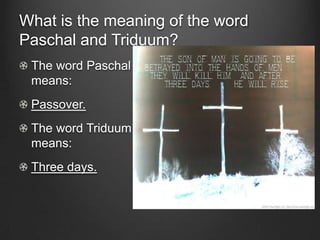
What is the meaning of the word
Paschal and Triduum?
 The word Paschal
 means:
 Passover.
 The word Triduum
 means:
 Three days.
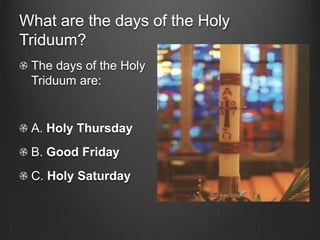
What are the days of the Holy
Triduum?
 The days of the Holy
 Triduum are:


 A. Holy Thursday
 B. Good Friday
 C. Holy Saturday
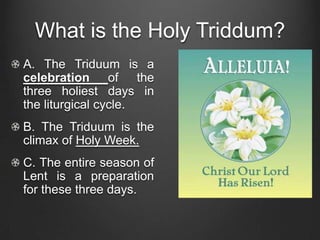
What is the Holy Triddum?
A. The Triduum is a
celebration of the
three holiest days in
the liturgical cycle.
B. The Triduum is the
climax of Holy Week.
C. The entire season of
Lent is a preparation
for these three days.
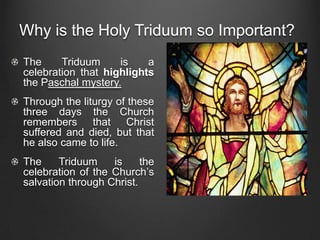
Why is the Holy Triduum so Important?
The     Triduum     is    a
celebration that highlights
the Paschal mystery.
Through the liturgy of these
three days the Church
remembers that Christ
suffered and died, but that
he also came to life.
The     Triduum    is     the
celebration of the Church’s
salvation through Christ.
What is the connection between Lent
and the Easter Triduum?
The forty days of Lent are a time
of spiritual preparation for these
three holy days.


Lent’s     renewal     through
prayer, fasting and almsgiving
helps us prepare to understand
the meaning of each of these
three holy days.
What does the Holy Triduum remember
and celebrate?
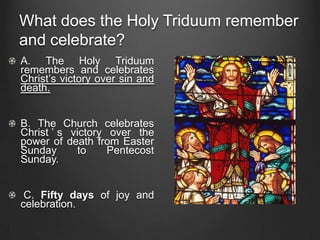
A. The Holy Triduum
remembers and celebrates
Christ’s victory over sin and
death.


B. The Church celebrates
Christ ’ s victory over the
power of death from Easter
Sunday      to     Pentecost
Sunday.


 C. Fifty days of joy and
celebration.
How are the days of the Holy Triduum
counted?
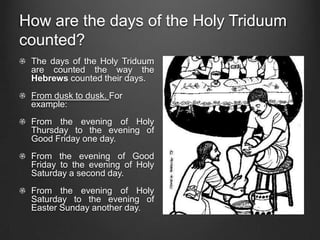
 The days of the Holy Triduum
 are counted the way the
 Hebrews counted their days.
 From dusk to dusk. For
 example:
 From the evening of Holy
 Thursday to the evening of
 Good Friday one day.
 From the evening of Good
 Friday to the evening of Holy
 Saturday a second day.
 From the evening of Holy
 Saturday to the evening of
 Easter Sunday another day.
The Holy Triduum
Lent officially ends on Holy
Thursday.

The Holy Triduum begins on
the evening of Holy Thursday.

On Holy Thursday there is only
one mass.

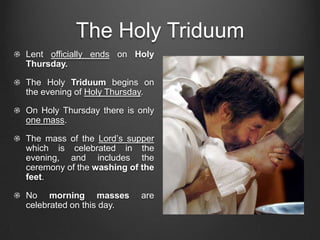
The mass of the Lord’s supper
which is celebrated in the
evening, and includes the
ceremony of the washing of the
feet.

No morning masses         are
celebrated on this day.
Holy Thursday
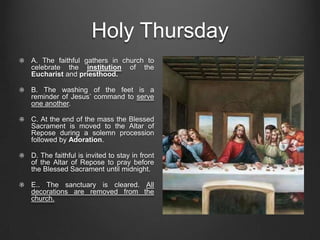
A. The faithful gathers in church to
celebrate the institution of the
Eucharist and priesthood.

B. The washing of the feet is a
reminder of Jesus’ command to serve
one another.

C. At the end of the mass the Blessed
Sacrament is moved to the Altar of
Repose during a solemn procession
followed by Adoration.

D. The faithful is invited to stay in front
of the Altar of Repose to pray before
the Blessed Sacrament until midnight.

E.. The sanctuary is cleared. All
decorations are removed from the
church.
Good Friday
A. This is a holy day of fasting
and abstinence.

B. Is the only day in the liturgical
calendar that a mass is not
celebrated.

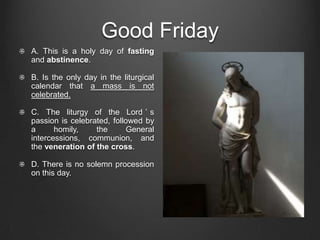
C. The liturgy of the Lord ’ s
passion is celebrated, followed by
a      homily,    the      General
intercessions, communion, and
the veneration of the cross.

D. There is no solemn procession
on this day.
What is the veneration of the
Cross?
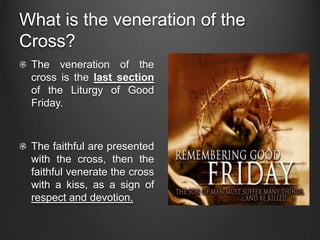
 The veneration of the
 cross is the last section
 of the Liturgy of Good
 Friday.


 The faithful are presented
 with the cross, then the
 faithful venerate the cross
 with a kiss, as a sign of
 respect and devotion.
Holy Saturday Easter Vigil
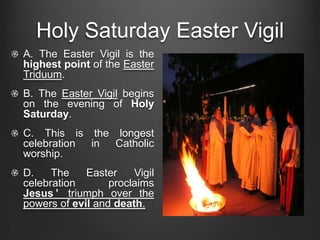
A. The Easter Vigil is the
highest point of the Easter
Triduum.
B. The Easter Vigil begins
on the evening of Holy
Saturday.
C. This is the longest
celebration in Catholic
worship.
D.    The    Easter    Vigil
celebration       proclaims
Jesus ’ triumph over the
powers of evil and death.
Easter Vigil
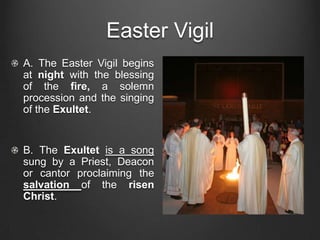
A. The Easter Vigil begins
at night with the blessing
of the fire, a solemn
procession and the singing
of the Exultet.


B. The Exultet is a song
sung by a Priest, Deacon
or cantor proclaiming the
salvation of the risen
Christ.
Easter Vigil
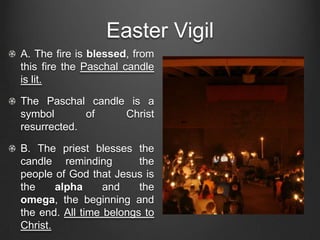
A. The fire is blessed, from
this fire the Paschal candle
is lit.

The Paschal candle is a
symbol       of   Christ
resurrected.

B. The priest blesses the
candle reminding         the
people of God that Jesus is
the     alpha     and    the
omega, the beginning and
the end. All time belongs to
Christ.
Easter Vigil
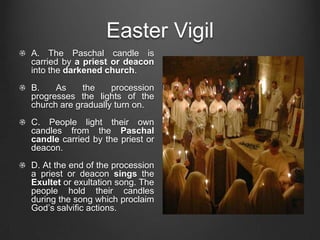
A. The Paschal candle is
carried by a priest or deacon
into the darkened church.
B.    As     the    procession
progresses the lights of the
church are gradually turn on.
C. People light their own
candles from the Paschal
candle carried by the priest or
deacon.
D. At the end of the procession
a priest or deacon sings the
Exultet or exultation song. The
people hold their candles
during the song which proclaim
God’s salvific actions.
Easter Vigil
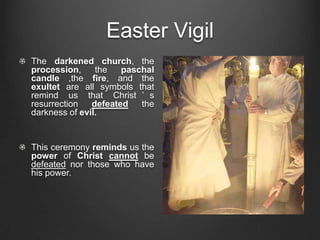
The darkened church, the
procession,     the   paschal
candle ,the fire, and the
exultet are all symbols that
remind us that Christ ’ s
resurrection   defeated   the
darkness of evil.


This ceremony reminds us the
power of Christ cannot be
defeated nor those who have
his power.
Easter Vigil
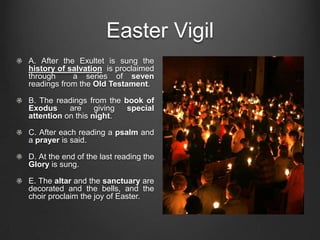
A. After the Exultet is sung the
history of salvation is proclaimed
through     a series of seven
readings from the Old Testament.

B. The readings from the book of
Exodus     are     giving special
attention on this night.

C. After each reading a psalm and
a prayer is said.

D. At the end of the last reading the
Glory is sung.

E. The altar and the sanctuary are
decorated and the bells, and the
choir proclaim the joy of Easter.
Easter Vigil
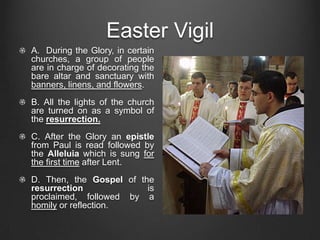
A. During the Glory, in certain
churches, a group of people
are in charge of decorating the
bare altar and sanctuary with
banners, linens, and flowers.
B. All the lights of the church
are turned on as a symbol of
the resurrection.
C. After the Glory an epistle
from Paul is read followed by
the Alleluia which is sung for
the first time after Lent.
D. Then, the Gospel of the
resurrection             is
proclaimed, followed by a
homily or reflection.
Easter Vigil
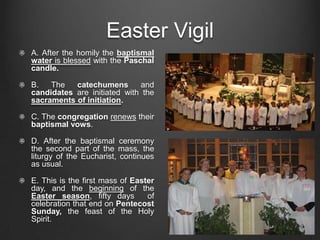
A. After the homily the baptismal
water is blessed with the Paschal
candle.

B.   The   catechumens       and
candidates are initiated with the
sacraments of initiation.

C. The congregation renews their
baptismal vows.

D. After the baptismal ceremony
the second part of the mass, the
liturgy of the Eucharist, continues
as usual.

E. This is the first mass of Easter
day, and the beginning of the
Easter season, fifty days        of
celebration that end on Pentecost
Sunday, the feast of the Holy
Spirit.
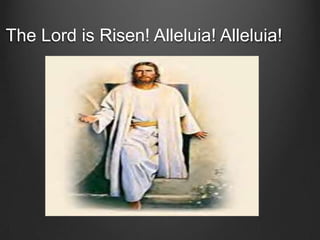
The Lord is Risen! Alleluia! Alleluia!

Easter triduum

  • 1.
    The Paschal Triduum Celebratingthe Great Mystery of our Faith
  • 2.
    What is themeaning of the word Paschal and Triduum? The word Paschal means: Passover. The word Triduum means: Three days.
  • 3.
    What are thedays of the Holy Triduum? The days of the Holy Triduum are: A. Holy Thursday B. Good Friday C. Holy Saturday
  • 4.
    What is theHoly Triddum? A. The Triduum is a celebration of the three holiest days in the liturgical cycle. B. The Triduum is the climax of Holy Week. C. The entire season of Lent is a preparation for these three days.
  • 5.
    Why is theHoly Triduum so Important? The Triduum is a celebration that highlights the Paschal mystery. Through the liturgy of these three days the Church remembers that Christ suffered and died, but that he also came to life. The Triduum is the celebration of the Church’s salvation through Christ.
  • 6.
    What is theconnection between Lent and the Easter Triduum? The forty days of Lent are a time of spiritual preparation for these three holy days. Lent’s renewal through prayer, fasting and almsgiving helps us prepare to understand the meaning of each of these three holy days.
  • 7.
    What does theHoly Triduum remember and celebrate? A. The Holy Triduum remembers and celebrates Christ’s victory over sin and death. B. The Church celebrates Christ ’ s victory over the power of death from Easter Sunday to Pentecost Sunday. C. Fifty days of joy and celebration.
  • 8.
    How are thedays of the Holy Triduum counted? The days of the Holy Triduum are counted the way the Hebrews counted their days. From dusk to dusk. For example: From the evening of Holy Thursday to the evening of Good Friday one day. From the evening of Good Friday to the evening of Holy Saturday a second day. From the evening of Holy Saturday to the evening of Easter Sunday another day.
  • 9.
    The Holy Triduum Lentofficially ends on Holy Thursday. The Holy Triduum begins on the evening of Holy Thursday. On Holy Thursday there is only one mass. The mass of the Lord’s supper which is celebrated in the evening, and includes the ceremony of the washing of the feet. No morning masses are celebrated on this day.
  • 10.
    Holy Thursday A. Thefaithful gathers in church to celebrate the institution of the Eucharist and priesthood. B. The washing of the feet is a reminder of Jesus’ command to serve one another. C. At the end of the mass the Blessed Sacrament is moved to the Altar of Repose during a solemn procession followed by Adoration. D. The faithful is invited to stay in front of the Altar of Repose to pray before the Blessed Sacrament until midnight. E.. The sanctuary is cleared. All decorations are removed from the church.
  • 11.
    Good Friday A. Thisis a holy day of fasting and abstinence. B. Is the only day in the liturgical calendar that a mass is not celebrated. C. The liturgy of the Lord ’ s passion is celebrated, followed by a homily, the General intercessions, communion, and the veneration of the cross. D. There is no solemn procession on this day.
  • 12.
    What is theveneration of the Cross? The veneration of the cross is the last section of the Liturgy of Good Friday. The faithful are presented with the cross, then the faithful venerate the cross with a kiss, as a sign of respect and devotion.
  • 13.
    Holy Saturday EasterVigil A. The Easter Vigil is the highest point of the Easter Triduum. B. The Easter Vigil begins on the evening of Holy Saturday. C. This is the longest celebration in Catholic worship. D. The Easter Vigil celebration proclaims Jesus ’ triumph over the powers of evil and death.
  • 14.
    Easter Vigil A. TheEaster Vigil begins at night with the blessing of the fire, a solemn procession and the singing of the Exultet. B. The Exultet is a song sung by a Priest, Deacon or cantor proclaiming the salvation of the risen Christ.
  • 15.
    Easter Vigil A. Thefire is blessed, from this fire the Paschal candle is lit. The Paschal candle is a symbol of Christ resurrected. B. The priest blesses the candle reminding the people of God that Jesus is the alpha and the omega, the beginning and the end. All time belongs to Christ.
  • 16.
    Easter Vigil A. ThePaschal candle is carried by a priest or deacon into the darkened church. B. As the procession progresses the lights of the church are gradually turn on. C. People light their own candles from the Paschal candle carried by the priest or deacon. D. At the end of the procession a priest or deacon sings the Exultet or exultation song. The people hold their candles during the song which proclaim God’s salvific actions.
  • 17.
    Easter Vigil The darkenedchurch, the procession, the paschal candle ,the fire, and the exultet are all symbols that remind us that Christ ’ s resurrection defeated the darkness of evil. This ceremony reminds us the power of Christ cannot be defeated nor those who have his power.
  • 18.
    Easter Vigil A. Afterthe Exultet is sung the history of salvation is proclaimed through a series of seven readings from the Old Testament. B. The readings from the book of Exodus are giving special attention on this night. C. After each reading a psalm and a prayer is said. D. At the end of the last reading the Glory is sung. E. The altar and the sanctuary are decorated and the bells, and the choir proclaim the joy of Easter.
  • 19.
    Easter Vigil A. Duringthe Glory, in certain churches, a group of people are in charge of decorating the bare altar and sanctuary with banners, linens, and flowers. B. All the lights of the church are turned on as a symbol of the resurrection. C. After the Glory an epistle from Paul is read followed by the Alleluia which is sung for the first time after Lent. D. Then, the Gospel of the resurrection is proclaimed, followed by a homily or reflection.
  • 20.
    Easter Vigil A. Afterthe homily the baptismal water is blessed with the Paschal candle. B. The catechumens and candidates are initiated with the sacraments of initiation. C. The congregation renews their baptismal vows. D. After the baptismal ceremony the second part of the mass, the liturgy of the Eucharist, continues as usual. E. This is the first mass of Easter day, and the beginning of the Easter season, fifty days of celebration that end on Pentecost Sunday, the feast of the Holy Spirit.
  • 21.
    The Lord isRisen! Alleluia! Alleluia!