HOBBIT
Overview of Big Data Benchmarking
Erik Mannens, Gayane Sedrakyan
Horizon 2020
GA No 688227
01/12/2015 – 30/11/2018
HOBBIT - H2020 European project that aims
creating a holistic big linked data benchmarking platform for
European companies that will allow them to:
 assess the fitness of existing solutions for their purposes,
and for scientific community supporting research and development
of big data benchmarking methods, tools and algorithms.
Project coordinator: Axel Ngonga (InfAI)
HOBBIT Project goals
Big data has become a major force of
innovation
New engines with increasing features for
managing big datasets
 There is lack of means of comparability among such
engines
 Measuring performance of traditional databases is
well-understood, there are no clear performance
definitions or metrics for comparing big data
systems
Big Data Benchmarking
The main objectives of HOBBIT are:
Building a generic platform with a family of industry-relevant
benchmarks,
Implementing a generic evaluation for the Big Linked Data (BLD) value
chain,
Providing periodic benchmarking results including diagnostics for
further improvement of BLD processing tools,
(Co-)Organizing challenges and events to gather benchmarking results
as well as industry-relevant KPIs and datasets,
Supporting companies and academics during the creation of new
challenges or the evaluation of tools.
 After its completion contributing to best practices and standardization
in the field by generalizing knowledge and standards from HOBBIT
expertise
HOBBIT Project goals
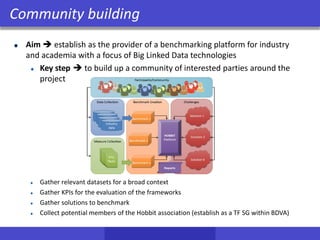
Aim  establish as the provider of a benchmarking platform for industry
and academia with a focus of Big Linked Data technologies
Key step  to build up a community of interested parties around the
project
Gather relevant datasets for a broad context
Gather KPIs for the evaluation of the frameworks
Gather solutions to benchmark
Collect potential members of the Hobbit association (establish as a TF SG within BDVA)
Community building
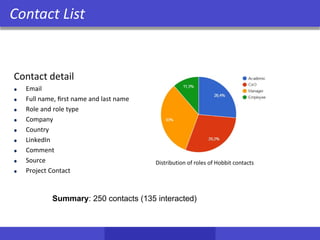
Contact detail
Email
Full name, first name and last name
Role and role type
Company
Country
LinkedIn
Comment
Source
Project Contact
Contact List
Distribution of roles of Hobbit contacts
Summary: 250 contacts (135 interacted)
Geographic distribution
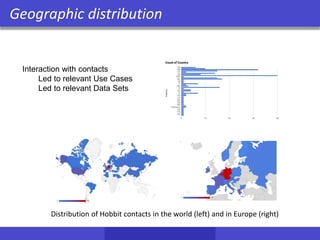
Distribution of Hobbit contacts in the world (left) and in Europe (right)
Interaction with contacts
Led to relevant Use Cases
Led to relevant Data Sets
Strategy for requirements elicitation
A survey method has been used to ensure the alignment of
the outcomes with real needs of the clientele we target
Collected requirements still being used as guidelines for
• Improving the architecture of the HOBBIT platform
• Developing and improving the benchmarks
• Implementing and reporting KPIs
Requirements elicitation & datasets gathering
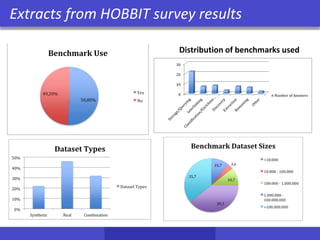
Distribution of benchmarks used
Extracts from HOBBIT survey results
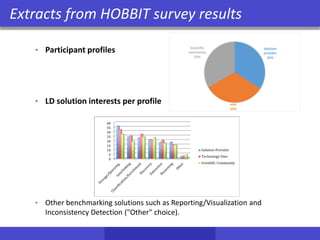
• Participant profiles
• LD solution interests per profile
• Other benchmarking solutions such as Reporting/Visualization and
Inconsistency Detection ("Other" choice).
Extracts from HOBBIT survey results
Solution
provider
34%
Technology
user
33%
Scientific
community
33%
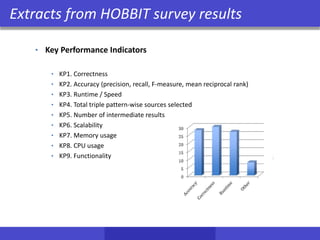
• Key Performance Indicators
• KP1. Correctness
• KP2. Accuracy (precision, recall, F-measure, mean reciprocal rank)
• KP3. Runtime / Speed
• KP4. Total triple pattern-wise sources selected
• KP5. Number of intermediate results
• KP6. Scalability
• KP7. Memory usage
• KP8. CPU usage
• KP9. Functionality
Extracts from HOBBIT survey results
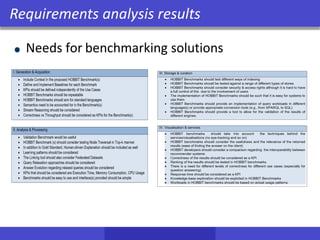
Needs for benchmarking solutions
Requirements analysis results
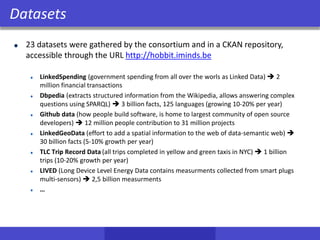
23 datasets were gathered by the consortium and in a CKAN repository,
accessible through the URL http://hobbit.iminds.be
LinkedSpending (government spending from all over the worls as Linked Data)  2
million financial transactions
Dbpedia (extracts structured information from the Wikipedia, allows answering complex
questions using SPARQL)  3 billion facts, 125 languages (growing 10-20% per year)
Github data (how people build software, is home to largest community of open source
developers)  12 million people contribution to 31 million projects
LinkedGeoData (effort to add a spatial information to the web of data-semantic web) 
30 billion facts (5-10% growth per year)
TLC Trip Record Data (all trips completed in yellow and green taxis in NYC)  1 billion
trips (10-20% growth per year)
LIVED (Long Device Level Energy Data contains measurments collected from smart plugs
multi-sensors)  2,5 billion measurments
…
Datasets
Use cases
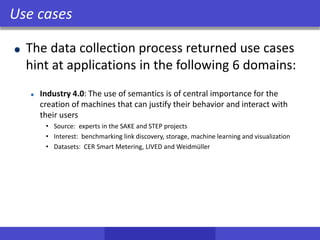
The data collection process returned use cases
hint at applications in the following 6 domains:
Industry 4.0: The use of semantics is of central importance for the
creation of machines that can justify their behavior and interact with
their users
• Source: experts in the SAKE and STEP projects
• Interest: benchmarking link discovery, storage, machine learning and visualization
• Datasets: CER Smart Metering, LIVED and Weidmüller
Use cases
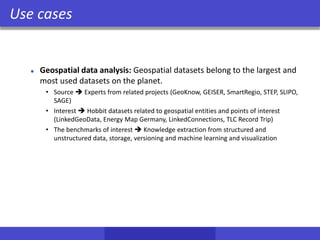
Geospatial data analysis: Geospatial datasets belong to the largest and
most used datasets on the planet.
• Source  Experts from related projects (GeoKnow, GEISER, SmartRegio, STEP, SLIPO,
SAGE)
• Interest  Hobbit datasets related to geospatial entities and points of interest
(LinkedGeoData, Energy Map Germany, LinkedConnections, TLC Record Trip)
• The benchmarks of interest  Knowledge extraction from structured and
unstructured data, storage, versioning and machine learning and visualization
Use cases
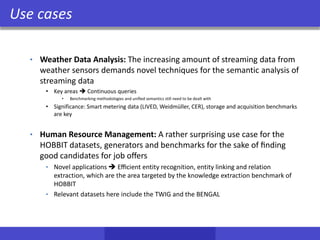
• Weather Data Analysis: The increasing amount of streaming data from
weather sensors demands novel techniques for the semantic analysis of
streaming data
• Key areas  Continuous queries
• Benchmarking methodologies and unified semantics still need to be dealt with
• Significance: Smart metering data (LIVED, Weidmüller, CER), storage and acquisition benchmarks
are key
• Human Resource Management: A rather surprising use case for the
HOBBIT datasets, generators and benchmarks for the sake of finding
good candidates for job offers
• Novel applications  Efficient entity recognition, entity linking and relation
extraction, which are the area targeted by the knowledge extraction benchmark of
HOBBIT
• Relevant datasets here include the TWIG and the BENGAL
Use cases
• Enterprise Search: Searching through streams of ever changing data is
of central importance for data-driven companies
• Use cases: Federated search across several datasets (see projects DIESEL8 and
WDAqua9) to search on mobile devices (e.g., project QAMEL10)
• Datasets: The QALD 6, DBpedia, BioASQ, MESH and BENGAL
• Benchmarks: Knowledge acquisition
• European societal challenges: Through our collaboration with
BigDataEurope, we were able to gather use cases for HOBBIT for seven
of the societal challenges formulated by the European Union (i.e.,
health, food and agriculture, energy, transport, climate, social sciences
and security)
• Benchmarks: For example, the CER Smart Metering data and the data storage and
knowledge benchmarks are of central importance for the energy domain while
LinkedConnections and all other transport datasets are relevant for the transport
societal challenge
Generalizedknowledgefromexpertise
Topics:Benchmarkingcategorization,purposesforuse,
designprinciples,developmentmethodologies,
technologiesand standards
Businesscase:to beofferedastutorials
Following slides borrowed from the
benchmarking tutorial by
Irini Fundulaki
Institute of Computer Science – FORTH, Greece
Anastasios Kementsietsidis
Google Research, USA
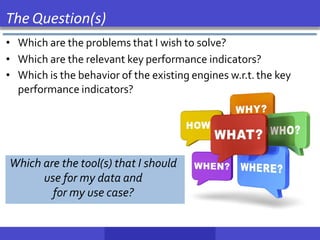
The Question(s)
• Which are the problems that I wish to solve?
• Which are the relevant key performance indicators?
• Which is the behavior of the existing engines w.r.t. the key
performance indicators?
Which are the tool(s) that I should
use for my data and
for my use case?
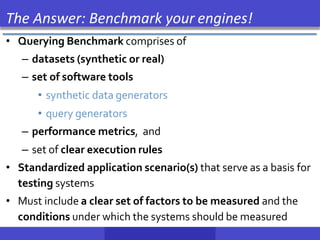
The Answer: Benchmark your engines!
• Querying Benchmark comprises of
– datasets (synthetic or real)
– set of software tools
• synthetic data generators
• query generators
– performance metrics, and
– set of clear execution rules
• Standardized application scenario(s) that serve as a basis for
testing systems
• Must include a clear set of factors to be measured and the
conditions under which the systems should be measured
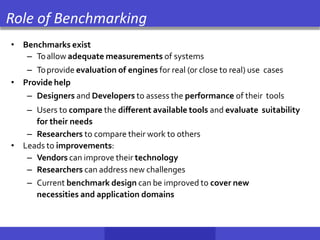
• Benchmarks exist
– Toallow adequate measurements of systems
– Toprovide evaluation of engines for real (or close to real) use cases
• Provide help
– Designers and Developers to assess the performance of their tools
– Users to compare the different available tools and evaluate suitability
for their needs
– Researchers to compare their work to others
• Leads to improvements:
– Vendors can improve their technology
– Researchers can address new challenges
– Current benchmark design can be improved to cover new
necessities and application domains
Role of Benchmarking
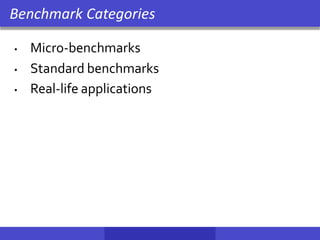
• Micro-benchmarks
• Standard benchmarks
• Real-life applications
Benchmark Categories
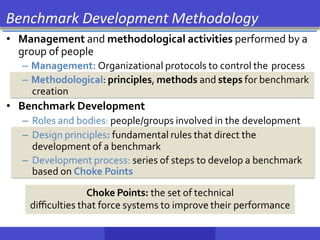
• Management and methodological activities performed by a
group of people
– Management: Organizational protocols to control the process
– Methodological: principles, methods and steps for benchmark
creation
• Benchmark Development
– Roles and bodies: people/groups involved in the development
– Design principles: fundamental rules that direct the
development of a benchmark
– Development process: series of steps to develop a benchmark
based on Choke Points
Benchmark Development Methodology
Choke Points: the set of technical
difficulties that force systems to improve their performance
Benchmark Components
• Datasets
• The raw material of the benchmark against which the workload
will be evaluated
• Synthetic & Real Datasets
Synthetic: Produced with a data generator (that hopefully
produced data with interesting characteristics)
Real: Widely used datasets from a domain of interest
• QueryWorkload
• Sets of queries and/or updates to evaluate the system with
• Metrics
• The performance metric(s) that determine the systems behavior
Linked data
using the Web to connect related data that wasn't
previously linked, or
using the Web to lower the barriers to linking data
currently linked using other methods.
 recommended best practice for exposing, sharing,
and connecting pieces of data, information, and
knowledge on the Semantic Web using URIs and RDF
Following standards
• Resource Description Framework (RDF)
• W3C standard to representWeb data andmetadata
• generic and simple graph based model
• information from heterogeneous sources merges
naturally:
– resources with the same URI denote the same non-information
resource (leading to the Linked DataCloud)
• structure is added using schema languages
and is represented as RDF triples
• Web browsers use URIs to retrieve information
Adding Semantics to RDF
• RDF is a generic, abstract data model for describing resources
in the form of triples
• RDF does not provide ways of defining classes, properties,
constraints
• W3C Standard SchemaLanguages
– RDFVocabulary Description Language (RDF Schema-
RDFS) to define schema vocabularies
– OntologyWeb Language (OWL) to define ontologies
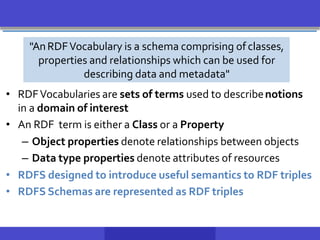
• RDFVocabularies are sets of terms used to describenotions
in a domain of interest
• An RDF term is either a Class or a Property
– Object properties denote relationships between objects
– Data type properties denote attributes of resources
• RDFS designed to introduce useful semantics to RDF triples
• RDFS Schemas are represented as RDF triples
"AnRDFVocabulary is a schema comprising of classes,
properties and relationships which can be used for
describing data and metadata"
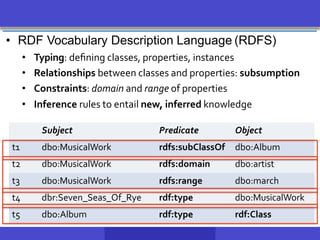
• RDF Vocabulary Description Language (RDFS)
• Typing: defining classes, properties, instances
• Relationships between classes and properties: subsumption
• Constraints: domain and range of properties
• Inference rules to entail new, inferred knowledge
Subject Predicate Object
t1 dbo:MusicalWork rdfs:subClassOf dbo:Album
t2 dbo:MusicalWork rdfs:domain dbo:artist
t3 dbo:MusicalWork rdfs:range dbo:march
t4 dbr:Seven_Seas_Of_Rye rdf:type dbo:MusicalWork
t5 dbo:Album rdf:type rdf:Class
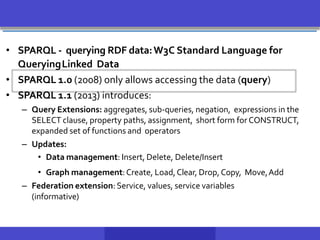
• SPARQL - querying RDF data:W3C Standard Language for
QueryingLinked Data
• SPARQL 1.0 (2008) only allows accessing the data (query)
• SPARQL 1.1 (2013) introduces:
– Query Extensions: aggregates, sub-queries, negation, expressions in the
SELECT clause, property paths, assignment, short form for CONSTRUCT,
expanded set of functions and operators
– Updates:
• Data management: Insert, Delete, Delete/Insert
• Graph management:Create, Load,Clear, Drop,Copy, Move,Add
– Federation extension:Service, values, service variables
(informative)
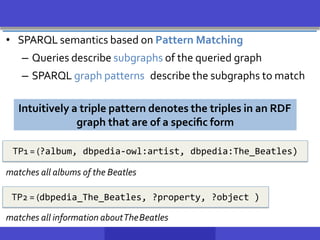
• SPARQL semantics based on Pattern Matching
– Queries describe subgraphs of the queried graph
– SPARQL graph patterns describe the subgraphs to match
Intuitively a triple pattern denotes the triples in an RDF
graph that are of a specific form
TP1 = (?album, dbpedia-owl:artist, dbpedia:The_Beatles)
TP2 = (dbpedia_The_Beatles, ?property, ?object )
matches all albums of the Beatles
matches all information aboutTheBeatles
Storing and Querying RDF data
• Schema agnostic
– triples are stored in a large triple table where the attributes are
(subject, predicate and object) - “Monolithic” triple-stores
– But it can get a bit more efficient
Subject Predicate Object
t1 dbr:Seven_Seas_Of_Rye rdf:type dbo:MusicalWork
t2 dbr:Starman_(song) rdf:type dbo:MusicalWork
t3 dbr:Seven_Seas_Of_Rye dbo:artist dbo:Queen
id URI/Literal
1 dbr:Seven_Seas_Of_Rye
2 dbr:Starman_(song)
3 dbo:MusicalWork
4 dbo:Queen
5 dbo:artist
6 rdf:type
Subject Predicate Object
1 6 3
2 6 3
1 5 4
RDF-3X maintains 6 indexes, namely, SPO, SOP,OSP,OPS, PSO,
POS.Toavoid storage overhead, indexes are compressed! [NW09]
Storing and Querying RDF data
• schema aware:
– one table is created per property with subject and object attributes (Property
Tables [Wilkinson06])
sing theperformanceof RDFEngines
Subject Predicate Object
ID1 type BookType
ID1 title “XYZ”
ID1 author “Fox,Joe”
ID1 copyright “2001”
ID2 type CDType
ID2 title “ABC”
ID2 artist “Orr,Tim”
ID2 copyright “1985”
ID2 language “French”
ID3 type BookType
ID3 title “MNO”
ID3 language “English”
ID4 type DVDType
ID4 title “DEF”
ID5 type CDType
ID5 title “GHI”
ID5 copyright “1995”
ID6 type BookType
ID6 copyright “2004”
Subject Type Title copyright
ID1 BookType “XYZ” “2001”
ID2 CDType “ABC” “1985”
ID3 BookType “MNO” NULL
ID4 DVDType “DEF” NULL
ID5 CDType “GHI” “1995”
ID6 BookType NULL “2004”
Subject Predicate Object
ID1 author “Fox,Joe”
ID2 artist “Orr,Tim”
ID2 language “French”
ID3
Subject Title Author copyright
ID1 “XYZ” “Fox,Joe” “2001”
ID3 “MNO” NULL NULL
ID6 NULL NULL “2004”
Subject Title artist copyright
ID2 “ABC” “Orr,Tim” “1985”
ID5 “GHI” NULL “1985”
Subject Predicate Object
ID2 language “French”
ID3 language “English”
ID4 type DVDType
ID4 title “DEF”
Booktype
CDType
Property-classTable
Subject Object
… …
… …
language “English”
Clustered PropertyTable
Multi-ValueP
Storing and Querying RDF data
• Vertically partitioned RDF [AMM+07]
Subject Predicate Object
ID1 type BookType
ID1 title “XYZ”
ID1 author “Fox,Joe”
ID1 copyright “2001”
ID2 type CDType
ID2 title “ABC”
ID2 artist “Orr,Tim”
ID2 copyright “1985”
ID2 language “French”
ID3 type BookType
ID3 title “MNO”
ID3 language “English”
ID4 type DVDType
ID4 title “DEF”
ID5 type CDType
ID5 title “GHI”
ID5 copyright “1995”
ID6 type BookType
ID6 copyright “2004”
Subject Object
ID1 “XYZ”
ID2 “ABC”
ID3 “MNO”
ID4 “DEF”
ID5 “GHI”
Subject Object
ID2 “Orr,Tim”
ID1 “Fox,Joe”
Subject Object
ID2 “French”
ID3 “English”
type
title
copyright
Subject Object Subject Object
ID1 BookType ID1 “2001”
ID2 CDType ID2 “1985”
ID3 BookType ID5 “1995”
ID4 DVDType ID6 “2004”
ID5 CDType author
Subject ObjectID6 BookType
artist
language
Togetthemostoutofthisparticular
decomposition,acolumn-oriented
DBMSisrecommended.
Comparison of Storage Techniques[BDK+13]
movie released
Google Android
subject predicate object
Larry Page born “1973”
Larry Page founder Google
Google HQ “MTV”
Google employees 50,000
Google industry Internet
Google industry Software
Google industry Hardware
Google developer Android
Triplestore
person born founder
Larry Page “1973 Google
Type-oriented store
company HQ employees
Google “MTV” 50,000
subject predicate object
Google industry Internet
Google industry Software
Google industry Hardware
Predicate-oriented store
subject object subject object
Larry Page “1973” Google “MTV”
born
founder
HQ
employees
industry
sample graph
“MTV”
50,000
Larry Page
Google
“1973”
industtry
Internet
Software
Hardware
Schema does not
change on updates
Schema might
change on updates
Columnsare
overloaded
Traditional relational
column treatment
Static mix of overloaded
and normal columns
developer
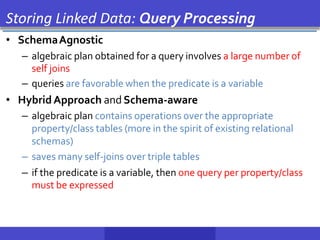
Storing Linked Data: Query Processing
• SchemaAgnostic
– algebraic plan obtained for a query involves a large number of
self joins
– queries are favorable when the predicate is a variable
• HybridApproach and Schema-aware
– algebraic plan contains operations over the appropriate
property/class tables (more in the spirit of existing relational
schemas)
– saves many self-joins over triple tables
– if the predicate is a variable, then one query per property/class
must be expressed
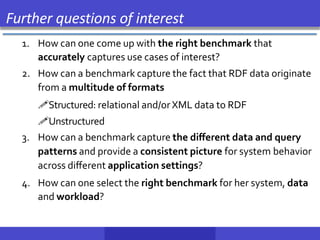
Further questions of interest
1. How can one come up with the right benchmark that
accurately captures use cases of interest?
2. How can a benchmark capture the fact that RDF data originate
from a multitude of formats
Structured: relational and/orXML data to RDF
Unstructured
3. How can a benchmark capture the different data and query
patterns and provide a consistent picture for system behavior
across different application settings?
4. How can one select the right benchmark for her system, data
and workload?
Much more to be found in the series of HOBBIT
tutorials in
https://www.slideshare.net/hobbit_project
If interested to include your company in
HOBBIT contact list please contact
GAYANE.SEDRAKYAN@UGENT.BE
This work was supported by grants from the EU H2020 Framework Programme
provided for the project HOBBIT (GA no. 688227).

Hobbit project overview presented at EBDVF 2017

  • 1.
    HOBBIT Overview of BigData Benchmarking Erik Mannens, Gayane Sedrakyan Horizon 2020 GA No 688227 01/12/2015 – 30/11/2018
  • 2.
    HOBBIT - H2020European project that aims creating a holistic big linked data benchmarking platform for European companies that will allow them to:  assess the fitness of existing solutions for their purposes, and for scientific community supporting research and development of big data benchmarking methods, tools and algorithms. Project coordinator: Axel Ngonga (InfAI) HOBBIT Project goals
  • 3.
    Big data hasbecome a major force of innovation New engines with increasing features for managing big datasets  There is lack of means of comparability among such engines  Measuring performance of traditional databases is well-understood, there are no clear performance definitions or metrics for comparing big data systems Big Data Benchmarking
  • 4.
    The main objectivesof HOBBIT are: Building a generic platform with a family of industry-relevant benchmarks, Implementing a generic evaluation for the Big Linked Data (BLD) value chain, Providing periodic benchmarking results including diagnostics for further improvement of BLD processing tools, (Co-)Organizing challenges and events to gather benchmarking results as well as industry-relevant KPIs and datasets, Supporting companies and academics during the creation of new challenges or the evaluation of tools.  After its completion contributing to best practices and standardization in the field by generalizing knowledge and standards from HOBBIT expertise HOBBIT Project goals
  • 5.
    Aim  establishas the provider of a benchmarking platform for industry and academia with a focus of Big Linked Data technologies Key step  to build up a community of interested parties around the project Gather relevant datasets for a broad context Gather KPIs for the evaluation of the frameworks Gather solutions to benchmark Collect potential members of the Hobbit association (establish as a TF SG within BDVA) Community building
  • 6.
    Contact detail Email Full name,first name and last name Role and role type Company Country LinkedIn Comment Source Project Contact Contact List Distribution of roles of Hobbit contacts Summary: 250 contacts (135 interacted)
  • 7.
    Geographic distribution Distribution ofHobbit contacts in the world (left) and in Europe (right) Interaction with contacts Led to relevant Use Cases Led to relevant Data Sets
  • 8.
    Strategy for requirementselicitation A survey method has been used to ensure the alignment of the outcomes with real needs of the clientele we target Collected requirements still being used as guidelines for • Improving the architecture of the HOBBIT platform • Developing and improving the benchmarks • Implementing and reporting KPIs Requirements elicitation & datasets gathering
  • 9.
    Distribution of benchmarksused Extracts from HOBBIT survey results
  • 10.
    • Participant profiles •LD solution interests per profile • Other benchmarking solutions such as Reporting/Visualization and Inconsistency Detection ("Other" choice). Extracts from HOBBIT survey results Solution provider 34% Technology user 33% Scientific community 33%
  • 11.
    • Key PerformanceIndicators • KP1. Correctness • KP2. Accuracy (precision, recall, F-measure, mean reciprocal rank) • KP3. Runtime / Speed • KP4. Total triple pattern-wise sources selected • KP5. Number of intermediate results • KP6. Scalability • KP7. Memory usage • KP8. CPU usage • KP9. Functionality Extracts from HOBBIT survey results
  • 12.
    Needs for benchmarkingsolutions Requirements analysis results
  • 13.
    23 datasets weregathered by the consortium and in a CKAN repository, accessible through the URL http://hobbit.iminds.be LinkedSpending (government spending from all over the worls as Linked Data)  2 million financial transactions Dbpedia (extracts structured information from the Wikipedia, allows answering complex questions using SPARQL)  3 billion facts, 125 languages (growing 10-20% per year) Github data (how people build software, is home to largest community of open source developers)  12 million people contribution to 31 million projects LinkedGeoData (effort to add a spatial information to the web of data-semantic web)  30 billion facts (5-10% growth per year) TLC Trip Record Data (all trips completed in yellow and green taxis in NYC)  1 billion trips (10-20% growth per year) LIVED (Long Device Level Energy Data contains measurments collected from smart plugs multi-sensors)  2,5 billion measurments … Datasets
  • 14.
    Use cases The datacollection process returned use cases hint at applications in the following 6 domains: Industry 4.0: The use of semantics is of central importance for the creation of machines that can justify their behavior and interact with their users • Source: experts in the SAKE and STEP projects • Interest: benchmarking link discovery, storage, machine learning and visualization • Datasets: CER Smart Metering, LIVED and Weidmüller
  • 15.
    Use cases Geospatial dataanalysis: Geospatial datasets belong to the largest and most used datasets on the planet. • Source  Experts from related projects (GeoKnow, GEISER, SmartRegio, STEP, SLIPO, SAGE) • Interest  Hobbit datasets related to geospatial entities and points of interest (LinkedGeoData, Energy Map Germany, LinkedConnections, TLC Record Trip) • The benchmarks of interest  Knowledge extraction from structured and unstructured data, storage, versioning and machine learning and visualization
  • 16.
    Use cases • WeatherData Analysis: The increasing amount of streaming data from weather sensors demands novel techniques for the semantic analysis of streaming data • Key areas  Continuous queries • Benchmarking methodologies and unified semantics still need to be dealt with • Significance: Smart metering data (LIVED, Weidmüller, CER), storage and acquisition benchmarks are key • Human Resource Management: A rather surprising use case for the HOBBIT datasets, generators and benchmarks for the sake of finding good candidates for job offers • Novel applications  Efficient entity recognition, entity linking and relation extraction, which are the area targeted by the knowledge extraction benchmark of HOBBIT • Relevant datasets here include the TWIG and the BENGAL
  • 17.
    Use cases • EnterpriseSearch: Searching through streams of ever changing data is of central importance for data-driven companies • Use cases: Federated search across several datasets (see projects DIESEL8 and WDAqua9) to search on mobile devices (e.g., project QAMEL10) • Datasets: The QALD 6, DBpedia, BioASQ, MESH and BENGAL • Benchmarks: Knowledge acquisition • European societal challenges: Through our collaboration with BigDataEurope, we were able to gather use cases for HOBBIT for seven of the societal challenges formulated by the European Union (i.e., health, food and agriculture, energy, transport, climate, social sciences and security) • Benchmarks: For example, the CER Smart Metering data and the data storage and knowledge benchmarks are of central importance for the energy domain while LinkedConnections and all other transport datasets are relevant for the transport societal challenge
  • 18.
  • 19.
    Following slides borrowedfrom the benchmarking tutorial by Irini Fundulaki Institute of Computer Science – FORTH, Greece Anastasios Kementsietsidis Google Research, USA
  • 20.
    The Question(s) • Whichare the problems that I wish to solve? • Which are the relevant key performance indicators? • Which is the behavior of the existing engines w.r.t. the key performance indicators? Which are the tool(s) that I should use for my data and for my use case?
  • 21.
    The Answer: Benchmarkyour engines! • Querying Benchmark comprises of – datasets (synthetic or real) – set of software tools • synthetic data generators • query generators – performance metrics, and – set of clear execution rules • Standardized application scenario(s) that serve as a basis for testing systems • Must include a clear set of factors to be measured and the conditions under which the systems should be measured
  • 22.
    • Benchmarks exist –Toallow adequate measurements of systems – Toprovide evaluation of engines for real (or close to real) use cases • Provide help – Designers and Developers to assess the performance of their tools – Users to compare the different available tools and evaluate suitability for their needs – Researchers to compare their work to others • Leads to improvements: – Vendors can improve their technology – Researchers can address new challenges – Current benchmark design can be improved to cover new necessities and application domains Role of Benchmarking
  • 23.
    • Micro-benchmarks • Standardbenchmarks • Real-life applications Benchmark Categories
  • 24.
    • Management andmethodological activities performed by a group of people – Management: Organizational protocols to control the process – Methodological: principles, methods and steps for benchmark creation • Benchmark Development – Roles and bodies: people/groups involved in the development – Design principles: fundamental rules that direct the development of a benchmark – Development process: series of steps to develop a benchmark based on Choke Points Benchmark Development Methodology Choke Points: the set of technical difficulties that force systems to improve their performance
  • 25.
    Benchmark Components • Datasets •The raw material of the benchmark against which the workload will be evaluated • Synthetic & Real Datasets Synthetic: Produced with a data generator (that hopefully produced data with interesting characteristics) Real: Widely used datasets from a domain of interest • QueryWorkload • Sets of queries and/or updates to evaluate the system with • Metrics • The performance metric(s) that determine the systems behavior
  • 26.
    Linked data using theWeb to connect related data that wasn't previously linked, or using the Web to lower the barriers to linking data currently linked using other methods.  recommended best practice for exposing, sharing, and connecting pieces of data, information, and knowledge on the Semantic Web using URIs and RDF Following standards
  • 27.
    • Resource DescriptionFramework (RDF) • W3C standard to representWeb data andmetadata • generic and simple graph based model • information from heterogeneous sources merges naturally: – resources with the same URI denote the same non-information resource (leading to the Linked DataCloud) • structure is added using schema languages and is represented as RDF triples • Web browsers use URIs to retrieve information
  • 28.
    Adding Semantics toRDF • RDF is a generic, abstract data model for describing resources in the form of triples • RDF does not provide ways of defining classes, properties, constraints • W3C Standard SchemaLanguages – RDFVocabulary Description Language (RDF Schema- RDFS) to define schema vocabularies – OntologyWeb Language (OWL) to define ontologies
  • 29.
    • RDFVocabularies aresets of terms used to describenotions in a domain of interest • An RDF term is either a Class or a Property – Object properties denote relationships between objects – Data type properties denote attributes of resources • RDFS designed to introduce useful semantics to RDF triples • RDFS Schemas are represented as RDF triples "AnRDFVocabulary is a schema comprising of classes, properties and relationships which can be used for describing data and metadata"
  • 30.
    • RDF VocabularyDescription Language (RDFS) • Typing: defining classes, properties, instances • Relationships between classes and properties: subsumption • Constraints: domain and range of properties • Inference rules to entail new, inferred knowledge Subject Predicate Object t1 dbo:MusicalWork rdfs:subClassOf dbo:Album t2 dbo:MusicalWork rdfs:domain dbo:artist t3 dbo:MusicalWork rdfs:range dbo:march t4 dbr:Seven_Seas_Of_Rye rdf:type dbo:MusicalWork t5 dbo:Album rdf:type rdf:Class
  • 31.
    • SPARQL -querying RDF data:W3C Standard Language for QueryingLinked Data • SPARQL 1.0 (2008) only allows accessing the data (query) • SPARQL 1.1 (2013) introduces: – Query Extensions: aggregates, sub-queries, negation, expressions in the SELECT clause, property paths, assignment, short form for CONSTRUCT, expanded set of functions and operators – Updates: • Data management: Insert, Delete, Delete/Insert • Graph management:Create, Load,Clear, Drop,Copy, Move,Add – Federation extension:Service, values, service variables (informative)
  • 32.
    • SPARQL semanticsbased on Pattern Matching – Queries describe subgraphs of the queried graph – SPARQL graph patterns describe the subgraphs to match Intuitively a triple pattern denotes the triples in an RDF graph that are of a specific form TP1 = (?album, dbpedia-owl:artist, dbpedia:The_Beatles) TP2 = (dbpedia_The_Beatles, ?property, ?object ) matches all albums of the Beatles matches all information aboutTheBeatles
  • 33.
    Storing and QueryingRDF data • Schema agnostic – triples are stored in a large triple table where the attributes are (subject, predicate and object) - “Monolithic” triple-stores – But it can get a bit more efficient Subject Predicate Object t1 dbr:Seven_Seas_Of_Rye rdf:type dbo:MusicalWork t2 dbr:Starman_(song) rdf:type dbo:MusicalWork t3 dbr:Seven_Seas_Of_Rye dbo:artist dbo:Queen id URI/Literal 1 dbr:Seven_Seas_Of_Rye 2 dbr:Starman_(song) 3 dbo:MusicalWork 4 dbo:Queen 5 dbo:artist 6 rdf:type Subject Predicate Object 1 6 3 2 6 3 1 5 4 RDF-3X maintains 6 indexes, namely, SPO, SOP,OSP,OPS, PSO, POS.Toavoid storage overhead, indexes are compressed! [NW09]
  • 34.
    Storing and QueryingRDF data • schema aware: – one table is created per property with subject and object attributes (Property Tables [Wilkinson06]) sing theperformanceof RDFEngines Subject Predicate Object ID1 type BookType ID1 title “XYZ” ID1 author “Fox,Joe” ID1 copyright “2001” ID2 type CDType ID2 title “ABC” ID2 artist “Orr,Tim” ID2 copyright “1985” ID2 language “French” ID3 type BookType ID3 title “MNO” ID3 language “English” ID4 type DVDType ID4 title “DEF” ID5 type CDType ID5 title “GHI” ID5 copyright “1995” ID6 type BookType ID6 copyright “2004” Subject Type Title copyright ID1 BookType “XYZ” “2001” ID2 CDType “ABC” “1985” ID3 BookType “MNO” NULL ID4 DVDType “DEF” NULL ID5 CDType “GHI” “1995” ID6 BookType NULL “2004” Subject Predicate Object ID1 author “Fox,Joe” ID2 artist “Orr,Tim” ID2 language “French” ID3 Subject Title Author copyright ID1 “XYZ” “Fox,Joe” “2001” ID3 “MNO” NULL NULL ID6 NULL NULL “2004” Subject Title artist copyright ID2 “ABC” “Orr,Tim” “1985” ID5 “GHI” NULL “1985” Subject Predicate Object ID2 language “French” ID3 language “English” ID4 type DVDType ID4 title “DEF” Booktype CDType Property-classTable Subject Object … … … … language “English” Clustered PropertyTable Multi-ValueP
  • 35.
    Storing and QueryingRDF data • Vertically partitioned RDF [AMM+07] Subject Predicate Object ID1 type BookType ID1 title “XYZ” ID1 author “Fox,Joe” ID1 copyright “2001” ID2 type CDType ID2 title “ABC” ID2 artist “Orr,Tim” ID2 copyright “1985” ID2 language “French” ID3 type BookType ID3 title “MNO” ID3 language “English” ID4 type DVDType ID4 title “DEF” ID5 type CDType ID5 title “GHI” ID5 copyright “1995” ID6 type BookType ID6 copyright “2004” Subject Object ID1 “XYZ” ID2 “ABC” ID3 “MNO” ID4 “DEF” ID5 “GHI” Subject Object ID2 “Orr,Tim” ID1 “Fox,Joe” Subject Object ID2 “French” ID3 “English” type title copyright Subject Object Subject Object ID1 BookType ID1 “2001” ID2 CDType ID2 “1985” ID3 BookType ID5 “1995” ID4 DVDType ID6 “2004” ID5 CDType author Subject ObjectID6 BookType artist language Togetthemostoutofthisparticular decomposition,acolumn-oriented DBMSisrecommended.
  • 36.
    Comparison of StorageTechniques[BDK+13] movie released Google Android subject predicate object Larry Page born “1973” Larry Page founder Google Google HQ “MTV” Google employees 50,000 Google industry Internet Google industry Software Google industry Hardware Google developer Android Triplestore person born founder Larry Page “1973 Google Type-oriented store company HQ employees Google “MTV” 50,000 subject predicate object Google industry Internet Google industry Software Google industry Hardware Predicate-oriented store subject object subject object Larry Page “1973” Google “MTV” born founder HQ employees industry sample graph “MTV” 50,000 Larry Page Google “1973” industtry Internet Software Hardware Schema does not change on updates Schema might change on updates Columnsare overloaded Traditional relational column treatment Static mix of overloaded and normal columns developer
  • 37.
    Storing Linked Data:Query Processing • SchemaAgnostic – algebraic plan obtained for a query involves a large number of self joins – queries are favorable when the predicate is a variable • HybridApproach and Schema-aware – algebraic plan contains operations over the appropriate property/class tables (more in the spirit of existing relational schemas) – saves many self-joins over triple tables – if the predicate is a variable, then one query per property/class must be expressed
  • 38.
    Further questions ofinterest 1. How can one come up with the right benchmark that accurately captures use cases of interest? 2. How can a benchmark capture the fact that RDF data originate from a multitude of formats Structured: relational and/orXML data to RDF Unstructured 3. How can a benchmark capture the different data and query patterns and provide a consistent picture for system behavior across different application settings? 4. How can one select the right benchmark for her system, data and workload?
  • 39.
    Much more tobe found in the series of HOBBIT tutorials in https://www.slideshare.net/hobbit_project If interested to include your company in HOBBIT contact list please contact GAYANE.SEDRAKYAN@UGENT.BE
  • 40.
    This work wassupported by grants from the EU H2020 Framework Programme provided for the project HOBBIT (GA no. 688227).