   
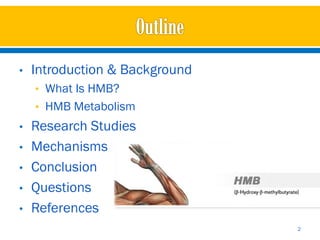
•   Introduction & Background
    • What Is HMB?
    • HMB Metabolism
•   Research Studies
•   Mechanisms
•   Conclusion
•   Questions
•   References
                                2
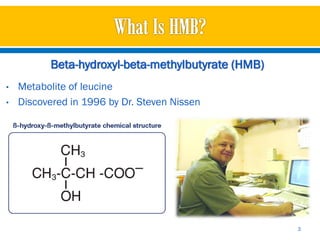
Beta-hydroxyl-beta-methylbutyrate (HMB)
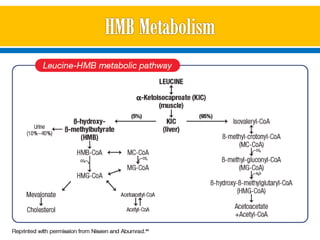
•   Metabolite of leucine
•   Discovered in 1996 by Dr. Steven Nissen


                                                    3
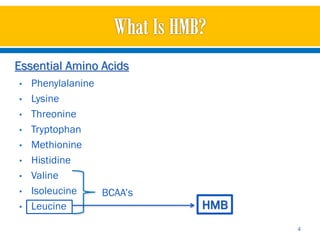
Essential Amino Acids
•   Phenylalanine
•   Lysine
•   Threonine
•   Tryptophan
•   Methionine
•   Histidine
•   Valine
•   Isoleucine    BCAA’s
•   Leucine                HMB
                                 4
5
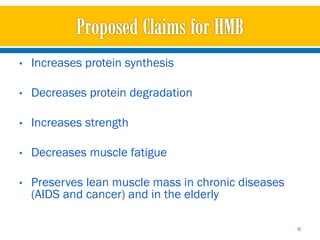
•   Increases protein synthesis

•   Decreases protein degradation

•   Increases strength

•   Decreases muscle fatigue

•   Preserves lean muscle mass in chronic diseases
    (AIDS and cancer) and in the elderly

                                                     6
7
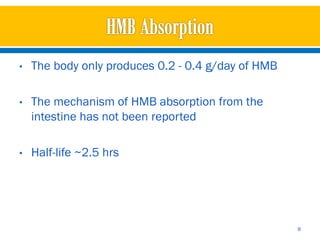
•   The body only produces 0.2 - 0.4 g/day of HMB

•   The mechanism of HMB absorption from the
    intestine has not been reported

•   Half-life ~2.5 hrs


                                                    8
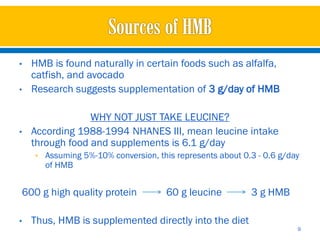
•   HMB is found naturally in certain foods such as alfalfa,
    catfish, and avocado
•   Research suggests supplementation of 3 g/day of HMB

                 WHY NOT JUST TAKE LEUCINE?
•   According 1988-1994 NHANES III, mean leucine intake
    through food and supplements is 6.1 g/day
    • Assuming 5%-10% conversion, this represents about 0.3 - 0.6 g/day
       of HMB


600 g high quality protein           60 g leucine         3 g HMB

•   Thus, HMB is supplemented directly into the diet
                                                                      9
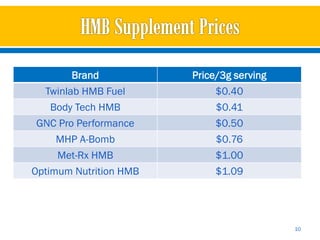
Brand           Price/3g serving
  Twinlab HMB Fuel           $0.40
    Body Tech HMB            $0.41
 GNC Pro Performance         $0.50
     MHP A-Bomb              $0.76
     Met-Rx HMB              $1.00
Optimum Nutrition HMB        $1.09


                                           10
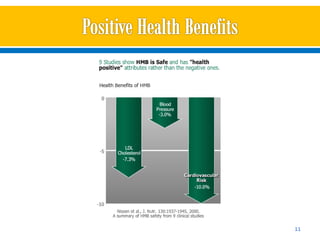
11
   12   
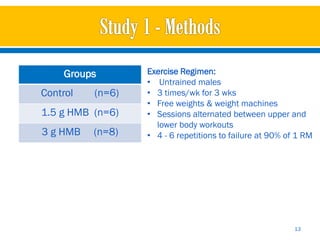
Groups        Exercise Regimen:
                  • Untrained males
Control   (n=6)   • 3 times/wk for 3 wks
                  • Free weights & weight machines
1.5 g HMB (n=6)   • Sessions alternated between upper and
                    lower body workouts
3 g HMB   (n=8)   • 4 - 6 repetitions to failure at 90% of 1 RM


                                                          13
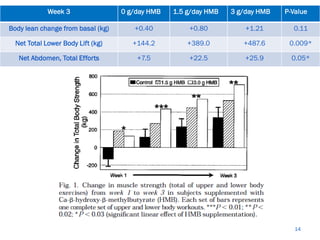
Week 3                0 g/day HMB   1.5 g/day HMB   3 g/day HMB   P-Value

Body lean change from basal (kg)      +0.40          +0.80           +1.21       0.11

  Net Total Lower Body Lift (kg)      +144.2         +389.0         +487.6      0.009*

   Net Abdomen, Total Efforts          +7.5          +22.5           +25.9       0.05*


                                                                                  14
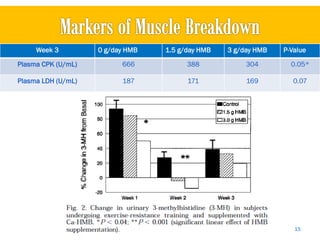
Week 3         0 g/day HMB   1.5 g/day HMB   3 g/day HMB   P-Value

Plasma CPK (U/mL)         666           388            304        0.05*

Plasma LDH (U/mL)         187           171            169         0.07


                                                                   15
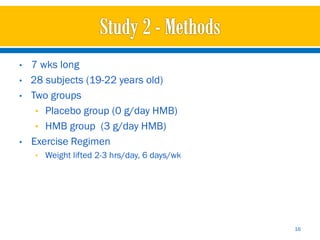
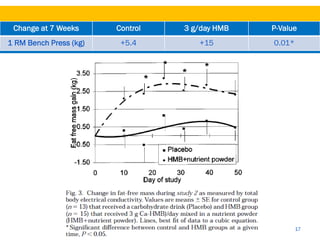
•   7 wks long
•   28 subjects (19-22 years old)
•   Two groups
     • Placebo group (0 g/day HMB)
     • HMB group (3 g/day HMB)
•   Exercise Regimen
    • Weight lifted 2-3 hrs/day, 6 days/wk


                                             16
Change at 7 Weeks      Control   3 g/day HMB   P-Value
1 RM Bench Press (kg)    +5.4        +15        0.01*


                                                        17
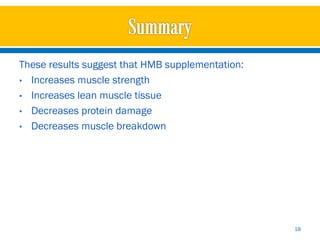
These results suggest that HMB supplementation:
• Increases muscle strength
• Increases lean muscle tissue
• Decreases protein damage
• Decreases muscle breakdown


                                                  18
   19   
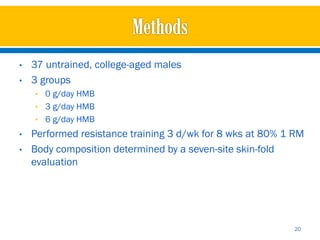
•   37 untrained, college-aged males
•   3 groups
    • 0 g/day HMB
    • 3 g/day HMB
    • 6 g/day HMB
•   Performed resistance training 3 d/wk for 8 wks at 80% 1 RM
•   Body composition determined by a seven-site skin-fold
    evaluation


                                                           20
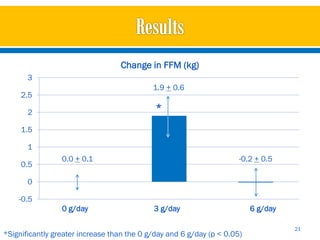
Change in FFM (kg)
       3
                                            1.9 + 0.6
     2.5

       2                                     *
     1.5

       1
                 0.0 + 0.1                                            -0.2 + 0.5
     0.5

       0

    -0.5
                 0 g/day                    3 g/day                       6 g/day

                                                                                    21
*Significantly greater increase than the 0 g/day and 6 g/day (p < 0.05)
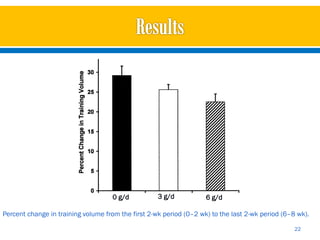
0 g/d           3 g/d           6 g/d

Percent change in training volume from the first 2-wk period (0–2 wk) to the last 2-wk period (6–8 wk).

                                                                                                  22
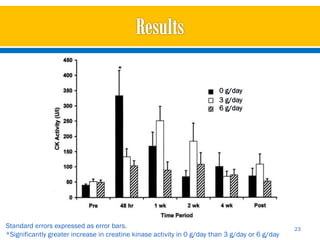
0 g/day
                                                                         3 g/day
                                                                         6 g/day


Standard errors expressed as error bars.                                                         23
*Significantly greater increase in creatine kinase activity in 0 g/day than 3 g/day or 6 g/day
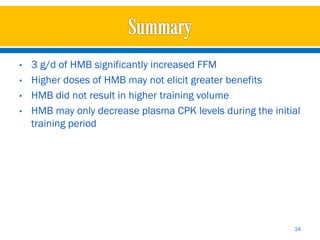
•   3 g/d of HMB significantly increased FFM
•   Higher doses of HMB may not elicit greater benefits
•   HMB did not result in higher training volume
•   HMB may only decrease plasma CPK levels during the initial
    training period


                                                            24
Ransone J, Neighbors K, Lefavi R, Chromiak J. (2003) The effect of beta-hydroxy
  beta-methylbutyrate on muscular strength and body composition in
         collegiate football players. J Strength Cond Res. 17(1):34-9.
                                   25   
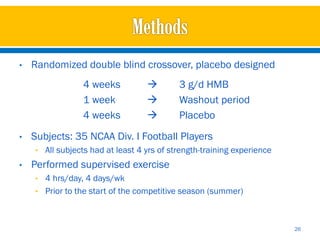
•   Randomized double blind crossover, placebo designed
                 4 weeks                  3 g/d HMB
                 1 week                   Washout period
                 4 weeks                  Placebo
•   Subjects: 35 NCAA Div. I Football Players
    • All subjects had at least 4 yrs of strength-training experience
•   Performed supervised exercise
    • 4 hrs/day, 4 days/wk
    • Prior to the start of the competitive season (summer)


                                                                        26
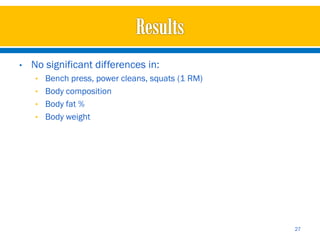
•   No significant differences in:
    • Bench press, power cleans, squats (1 RM)
    • Body composition
    • Body fat %
    • Body weight


                                                 27
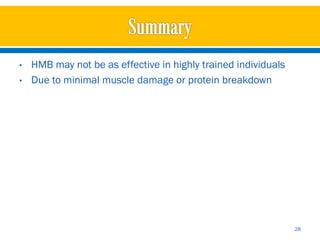
•   HMB may not be as effective in highly trained individuals
•   Due to minimal muscle damage or protein breakdown


                                                                28
Vukovich MD, Dreifort GD. (2001) Effect of beta-hydroxy beta-methylbutyrate
      on the onset of blood lactate accumulation and V(O)(2) peak in
         endurance-trained cyclists. J Strength Cond Res. 15(4):491-7.
                                  29   
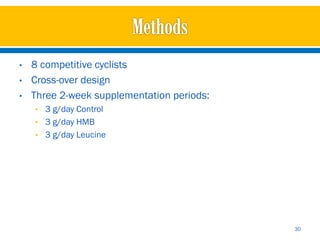
•   8 competitive cyclists
•   Cross-over design
•   Three 2-week supplementation periods:
    • 3 g/day Control
    • 3 g/day HMB
    • 3 g/day Leucine


                                            30
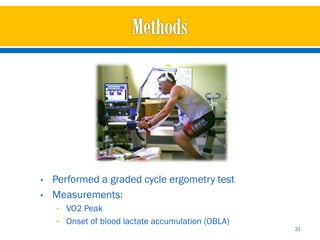
•   Performed a graded cycle ergometry test
•   Measurements:
    • VO2 Peak
    • Onset of blood lactate accumulation (OBLA)
                                                   31
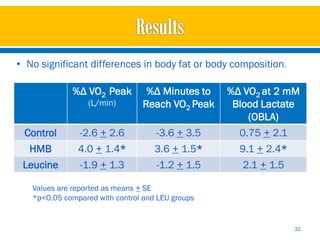
• No significant differences in body fat or body composition.

             %Δ VO2 Peak          %Δ Minutes to   %Δ VO2 at 2 mM
                  (L/min)        Reach VO2 Peak    Blood Lactate
                                                      (OBLA)
 Control       -2.6 + 2.6           -3.6 + 3.5      0.75 + 2.1
  HMB          4.0 + 1.4*           3.6 + 1.5*      9.1 + 2.4*
 Leucine       -1.9 + 1.3           -1.2 + 1.5       2.1 + 1.5

   Values are reported as means + SE
   *p<0.05 compared with control and LEU groups


                                                                 32
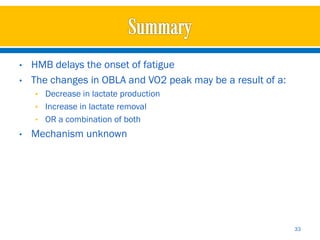
•   HMB delays the onset of fatigue
•   The changes in OBLA and VO2 peak may be a result of a:
    • Decrease in lactate production
    • Increase in lactate removal
    • OR a combination of both
•   Mechanism unknown


                                                             33
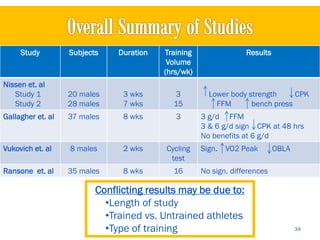
Study         Subjects    Duration   Training                Results
                                           Volume
                                          (hrs/wk)
Nissen et. al
   Study 1         20 males     3 wks       3          Lower body strength     CPK
   Study 2         28 males     7 wks       15           FFM       bench press
Gallagher et. al   37 males     8 wks        3       3 g/d FFM
                                                     3 & 6 g/d sign CPK at 48 hrs
                                                     No benefits at 6 g/d
Vukovich et. al    8 males      2 wks     Cycling    Sign.   VO2 Peak       OBLA
                                           test
Ransone et. al     35 males     8 wks       16       No sign. differences

                          Conflicting results may be due to:
                            •Length of study
                            •Trained vs. Untrained athletes
                            •Type of training                                      34
        


    35
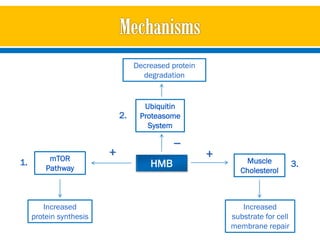
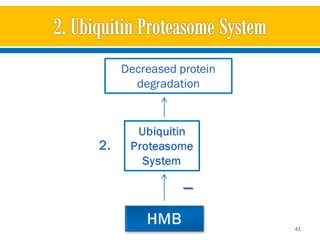
Decreased protein
                                    degradation


                                    Ubiquitin
                             2.    Proteasome
                                     System
                                             _
          mTOR
                         +                            +
1.                                    HMB                    Muscle            3.
         Pathway                                            Cholesterol


        Increased                                            Increased
     protein synthesis                                    substrate for cell
                                                          membrane repair
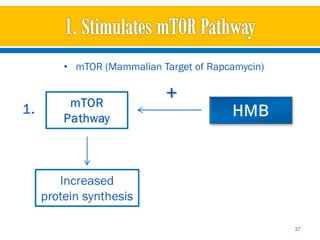
• mTOR (Mammalian Target of Rapcamycin)


                                          37
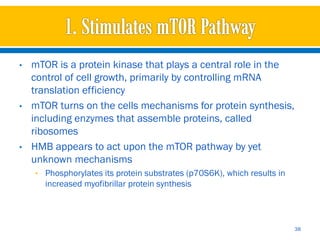
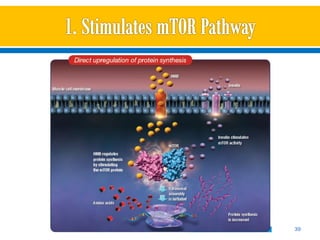
•   mTOR is a protein kinase that plays a central role in the
    control of cell growth, primarily by controlling mRNA
    translation efficiency
•   mTOR turns on the cells mechanisms for protein synthesis,
    including enzymes that assemble proteins, called
    ribosomes
•   HMB appears to act upon the mTOR pathway by yet
    unknown mechanisms
    • Phosphorylates its protein substrates (p70S6K), which results in
       increased myofibrillar protein synthesis


                                                                         38
39
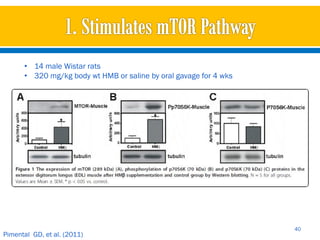
• 14 male Wistar rats
      • 320 mg/kg body wt HMB or saline by oral gavage for 4 wks


                                                                   40
Pimental GD, et al. (2011)
41
• The UPS is responsible for seeking and destroying damaged
  or faulty proteins
• UPS activity is increased in conditions of exacerbated muscle
  catabolism, such as exercise
• Thus, inhibition of the UPS, could explain the attenuation of
  muscle protein losses observed during treatment with HMB


                                                              42
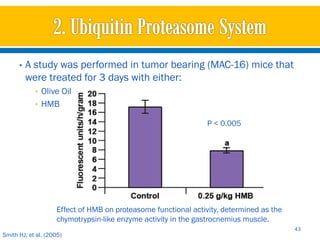
•   A study was performed in tumor bearing (MAC-16) mice that
          were treated for 3 days with either:
            • Olive Oil
            • HMB

                                                                P < 0.005


                    Effect of HMB on proteasome functional activity, determined as the
                    chymotrypsin-like enzyme activity in the gastrocnemius muscle.
                                                                                         43
Smith HJ, et al. (2005)
44
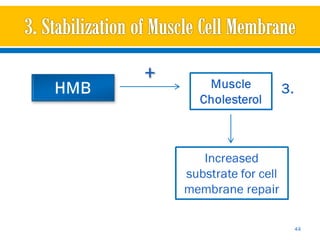
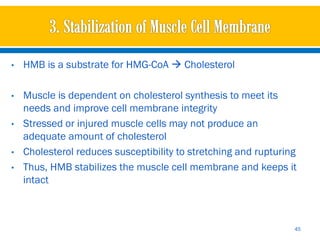
•   HMB is a substrate for HMG-CoA  Cholesterol

•   Muscle is dependent on cholesterol synthesis to meet its
    needs and improve cell membrane integrity
•   Stressed or injured muscle cells may not produce an
    adequate amount of cholesterol
•   Cholesterol reduces susceptibility to stretching and rupturing
•   Thus, HMB stabilizes the muscle cell membrane and keeps it
    intact


                                                                 45
•   Female studies
•   Long-term effects
•   Negative side effects


                            46
•   HMB has been shown to:
    • Improve anaerobic capacity
    • Improve aerobic capacity
    • Improve body composition and increase lean body
      mass
    • Decrease fatigue


                                                   47
48
•   Zanchi NE, Gerlinger RF, Geuimaraes-Ferriera L, de Siqueira Filho MA, Felitti V, Lira FS,
    Seelaender M, Lancha AH Jr. (2011) HMB supplementation: clinical and athletic performance-
    related effects and mechanisms of action. Amino Acids. 40(4):1015-25.
•   Nissen S, Sharp R, et al. (1996) Effect of leucine metabolite beta-hydroxy-beta-methylbutyrate on
    muscle metabolism during resistance-exercise training. J Appl Physiol. 81(5):2095-104.
•   Wilson GJ, Wilson JM, Manninen AH. (2008) Effects of beta-hydroxy-beta-methylbutyrate (HMB)
    on exercise performance and body composition across varying levels of age, sex, and training
    experience: A review. Nutr Metab (Lond). 3;5:1.
•   Gallagher PM, Carrithers JA, et al. (2000) Beta-hydroxy-beta-methylbutyrate ingestion, Part I:
    effects on strength and fat free mass. Med Sci Sports Exerc. 32(12):2109-15.
•   Vukovich MD, Dreifort GD. (2001) Effect of beta-hydroxy beta-methylbutyrate on the onset of
    blood lactate accumulation and V(O)(2) peak in endurance-trained cyclists. J Strength Cond Res.
    15(4):491-7.
•   Smith HJ, Mukerji P, Tisdale MJ. (2005) Attenuation of proteasome-induced proteolysis in skeletal
    muscle by {beta}-hydroxy-{beta}-methylbutyrate in cancer-induced muscle loss. Cancer Res.
    1;65(1):277-83.
•   Ransone J, Neighbors K, Lefavi R, Chromiak J. (2003) The effect of beta-hydroxy beta-
    methylbutyrate on muscular strength and body composition in collegiate football players. J
    Strength Cond Res. 17(1):34-9.
                                                                                                49

Hmb seminar presentation pdf

  • 1.
  • 2.
    Introduction & Background • What Is HMB? • HMB Metabolism • Research Studies • Mechanisms • Conclusion • Questions • References 2
  • 3.
    Beta-hydroxyl-beta-methylbutyrate (HMB) • Metabolite of leucine • Discovered in 1996 by Dr. Steven Nissen 3
  • 4.
    Essential Amino Acids • Phenylalanine • Lysine • Threonine • Tryptophan • Methionine • Histidine • Valine • Isoleucine BCAA’s • Leucine HMB 4
  • 5.
  • 6.
    Increases protein synthesis • Decreases protein degradation • Increases strength • Decreases muscle fatigue • Preserves lean muscle mass in chronic diseases (AIDS and cancer) and in the elderly 6
  • 7.
  • 8.
    The body only produces 0.2 - 0.4 g/day of HMB • The mechanism of HMB absorption from the intestine has not been reported • Half-life ~2.5 hrs 8
  • 9.
    HMB is found naturally in certain foods such as alfalfa, catfish, and avocado • Research suggests supplementation of 3 g/day of HMB WHY NOT JUST TAKE LEUCINE? • According 1988-1994 NHANES III, mean leucine intake through food and supplements is 6.1 g/day • Assuming 5%-10% conversion, this represents about 0.3 - 0.6 g/day of HMB 600 g high quality protein 60 g leucine 3 g HMB • Thus, HMB is supplemented directly into the diet 9
  • 10.
    Brand Price/3g serving Twinlab HMB Fuel $0.40 Body Tech HMB $0.41 GNC Pro Performance $0.50 MHP A-Bomb $0.76 Met-Rx HMB $1.00 Optimum Nutrition HMB $1.09 10
  • 11.
  • 12.
    12 
  • 13.
    Groups Exercise Regimen: • Untrained males Control (n=6) • 3 times/wk for 3 wks • Free weights & weight machines 1.5 g HMB (n=6) • Sessions alternated between upper and lower body workouts 3 g HMB (n=8) • 4 - 6 repetitions to failure at 90% of 1 RM 13
  • 14.
    Week 3 0 g/day HMB 1.5 g/day HMB 3 g/day HMB P-Value Body lean change from basal (kg) +0.40 +0.80 +1.21 0.11 Net Total Lower Body Lift (kg) +144.2 +389.0 +487.6 0.009* Net Abdomen, Total Efforts +7.5 +22.5 +25.9 0.05* 14
  • 15.
    Week 3 0 g/day HMB 1.5 g/day HMB 3 g/day HMB P-Value Plasma CPK (U/mL) 666 388 304 0.05* Plasma LDH (U/mL) 187 171 169 0.07 15
  • 16.
    7 wks long • 28 subjects (19-22 years old) • Two groups • Placebo group (0 g/day HMB) • HMB group (3 g/day HMB) • Exercise Regimen • Weight lifted 2-3 hrs/day, 6 days/wk 16
  • 17.
    Change at 7Weeks Control 3 g/day HMB P-Value 1 RM Bench Press (kg) +5.4 +15 0.01* 17
  • 18.
    These results suggestthat HMB supplementation: • Increases muscle strength • Increases lean muscle tissue • Decreases protein damage • Decreases muscle breakdown 18
  • 19.
    19 
  • 20.
    37 untrained, college-aged males • 3 groups • 0 g/day HMB • 3 g/day HMB • 6 g/day HMB • Performed resistance training 3 d/wk for 8 wks at 80% 1 RM • Body composition determined by a seven-site skin-fold evaluation 20
  • 21.
    Change in FFM(kg) 3 1.9 + 0.6 2.5 2 * 1.5 1 0.0 + 0.1 -0.2 + 0.5 0.5 0 -0.5 0 g/day 3 g/day 6 g/day 21 *Significantly greater increase than the 0 g/day and 6 g/day (p < 0.05)
  • 22.
    0 g/d 3 g/d 6 g/d Percent change in training volume from the first 2-wk period (0–2 wk) to the last 2-wk period (6–8 wk). 22
  • 23.
    0 g/day 3 g/day 6 g/day Standard errors expressed as error bars. 23 *Significantly greater increase in creatine kinase activity in 0 g/day than 3 g/day or 6 g/day
  • 24.
    3 g/d of HMB significantly increased FFM • Higher doses of HMB may not elicit greater benefits • HMB did not result in higher training volume • HMB may only decrease plasma CPK levels during the initial training period 24
  • 25.
    Ransone J, NeighborsK, Lefavi R, Chromiak J. (2003) The effect of beta-hydroxy beta-methylbutyrate on muscular strength and body composition in collegiate football players. J Strength Cond Res. 17(1):34-9.  25 
  • 26.
    Randomized double blind crossover, placebo designed 4 weeks  3 g/d HMB 1 week  Washout period 4 weeks  Placebo • Subjects: 35 NCAA Div. I Football Players • All subjects had at least 4 yrs of strength-training experience • Performed supervised exercise • 4 hrs/day, 4 days/wk • Prior to the start of the competitive season (summer) 26
  • 27.
    No significant differences in: • Bench press, power cleans, squats (1 RM) • Body composition • Body fat % • Body weight 27
  • 28.
    HMB may not be as effective in highly trained individuals • Due to minimal muscle damage or protein breakdown 28
  • 29.
    Vukovich MD, DreifortGD. (2001) Effect of beta-hydroxy beta-methylbutyrate on the onset of blood lactate accumulation and V(O)(2) peak in endurance-trained cyclists. J Strength Cond Res. 15(4):491-7.  29 
  • 30.
    8 competitive cyclists • Cross-over design • Three 2-week supplementation periods: • 3 g/day Control • 3 g/day HMB • 3 g/day Leucine 30
  • 31.
    Performed a graded cycle ergometry test • Measurements: • VO2 Peak • Onset of blood lactate accumulation (OBLA) 31
  • 32.
    • No significantdifferences in body fat or body composition. %Δ VO2 Peak %Δ Minutes to %Δ VO2 at 2 mM (L/min) Reach VO2 Peak Blood Lactate (OBLA) Control -2.6 + 2.6 -3.6 + 3.5 0.75 + 2.1 HMB 4.0 + 1.4* 3.6 + 1.5* 9.1 + 2.4* Leucine -1.9 + 1.3 -1.2 + 1.5 2.1 + 1.5 Values are reported as means + SE *p<0.05 compared with control and LEU groups 32
  • 33.
    HMB delays the onset of fatigue • The changes in OBLA and VO2 peak may be a result of a: • Decrease in lactate production • Increase in lactate removal • OR a combination of both • Mechanism unknown 33
  • 34.
    Study Subjects Duration Training Results Volume (hrs/wk) Nissen et. al Study 1 20 males 3 wks 3 Lower body strength CPK Study 2 28 males 7 wks 15 FFM bench press Gallagher et. al 37 males 8 wks 3 3 g/d FFM 3 & 6 g/d sign CPK at 48 hrs No benefits at 6 g/d Vukovich et. al 8 males 2 wks Cycling Sign. VO2 Peak OBLA test Ransone et. al 35 males 8 wks 16 No sign. differences Conflicting results may be due to: •Length of study •Trained vs. Untrained athletes •Type of training 34
  • 35.
     35
  • 36.
    Decreased protein degradation Ubiquitin 2. Proteasome System _ mTOR + + 1. HMB Muscle 3. Pathway Cholesterol Increased Increased protein synthesis substrate for cell membrane repair
  • 37.
    • mTOR (MammalianTarget of Rapcamycin) 37
  • 38.
    mTOR is a protein kinase that plays a central role in the control of cell growth, primarily by controlling mRNA translation efficiency • mTOR turns on the cells mechanisms for protein synthesis, including enzymes that assemble proteins, called ribosomes • HMB appears to act upon the mTOR pathway by yet unknown mechanisms • Phosphorylates its protein substrates (p70S6K), which results in increased myofibrillar protein synthesis 38
  • 39.
  • 40.
    • 14 maleWistar rats • 320 mg/kg body wt HMB or saline by oral gavage for 4 wks 40 Pimental GD, et al. (2011)
  • 41.
  • 42.
    • The UPSis responsible for seeking and destroying damaged or faulty proteins • UPS activity is increased in conditions of exacerbated muscle catabolism, such as exercise • Thus, inhibition of the UPS, could explain the attenuation of muscle protein losses observed during treatment with HMB 42
  • 43.
    A study was performed in tumor bearing (MAC-16) mice that were treated for 3 days with either: • Olive Oil • HMB P < 0.005 Effect of HMB on proteasome functional activity, determined as the chymotrypsin-like enzyme activity in the gastrocnemius muscle. 43 Smith HJ, et al. (2005)
  • 44.
  • 45.
    HMB is a substrate for HMG-CoA  Cholesterol • Muscle is dependent on cholesterol synthesis to meet its needs and improve cell membrane integrity • Stressed or injured muscle cells may not produce an adequate amount of cholesterol • Cholesterol reduces susceptibility to stretching and rupturing • Thus, HMB stabilizes the muscle cell membrane and keeps it intact 45
  • 46.
    Female studies • Long-term effects • Negative side effects 46
  • 47.
    HMB has been shown to: • Improve anaerobic capacity • Improve aerobic capacity • Improve body composition and increase lean body mass • Decrease fatigue 47
  • 48.
  • 49.
    Zanchi NE, Gerlinger RF, Geuimaraes-Ferriera L, de Siqueira Filho MA, Felitti V, Lira FS, Seelaender M, Lancha AH Jr. (2011) HMB supplementation: clinical and athletic performance- related effects and mechanisms of action. Amino Acids. 40(4):1015-25. • Nissen S, Sharp R, et al. (1996) Effect of leucine metabolite beta-hydroxy-beta-methylbutyrate on muscle metabolism during resistance-exercise training. J Appl Physiol. 81(5):2095-104. • Wilson GJ, Wilson JM, Manninen AH. (2008) Effects of beta-hydroxy-beta-methylbutyrate (HMB) on exercise performance and body composition across varying levels of age, sex, and training experience: A review. Nutr Metab (Lond). 3;5:1. • Gallagher PM, Carrithers JA, et al. (2000) Beta-hydroxy-beta-methylbutyrate ingestion, Part I: effects on strength and fat free mass. Med Sci Sports Exerc. 32(12):2109-15. • Vukovich MD, Dreifort GD. (2001) Effect of beta-hydroxy beta-methylbutyrate on the onset of blood lactate accumulation and V(O)(2) peak in endurance-trained cyclists. J Strength Cond Res. 15(4):491-7. • Smith HJ, Mukerji P, Tisdale MJ. (2005) Attenuation of proteasome-induced proteolysis in skeletal muscle by {beta}-hydroxy-{beta}-methylbutyrate in cancer-induced muscle loss. Cancer Res. 1;65(1):277-83. • Ransone J, Neighbors K, Lefavi R, Chromiak J. (2003) The effect of beta-hydroxy beta- methylbutyrate on muscular strength and body composition in collegiate football players. J Strength Cond Res. 17(1):34-9. 49