Advantages of Personal Health
Records
HLST 4320 Group 5
Dan Villamayor
Outline
Case Summary
Personal Health Records explained
Types of Personal Health Records
Policy and Adoption
Examples
Benefits
Ethical Consideration
Conclusion
Case Summary
Evaluate policy, implementation, address patient and caregivers experience
National Health Service (NHS) developed HealthSpace based on Kaiser
Permanente’s My Health Manager model
Widely successful: 2.4 million members, 10% reduction in physician visits, reduced
phone calls
HealthSpace goals:
empower patients
personalize care
reduce NHS costs
improve overall quality of care
Case Summary
HealthSpace initial rollout included two account levels:
Basic
enter values only e.g. blood pressure readings, record health appointments
Advanced
access to summary records, book appointments, manage overall health, email securely
with physician (via Communicator)
Participant are not representative of the population
Total: 56 patients (21 opened basic account)
20 suffered from chronic illness(s) (Diabetes) - was not initially using HealthSpace
15 opened advanced accounts
Case Summary
Results:
Basic account:
no added benefit as physicians or caregivers could continue to maintain health records
self-manage with tools already in place, e.g. blood glucose diaries, smart phone apps
complex registration
accessibility and usability
additional factors: major familial stress, living in adverse conditions etc
Advanced account:
registration straightforward
Communicator seen as an added bonus by some
accessibility and usability
Case Summary
Outcomes:
flaws in design and implementation poorly executed therefore leading to low adoption
practiced exclusion
policy makers assumed patients were technologically savvy
not well received by the people of England as seen by the data
173, 000 people in England created basic accounts
2.4 million received invitations to open advanced accounts
49% of those had completed the first step - downloaded forms
16% submitted forms for processing
13% fully activated advance account
PHRs must be inclusive, and patient-centric in its design
(Greenhalgh et al., 2010)
What Exactly is a Personal Health Record?
● Records that you access and maintain as a patient
● ‘’Patient-centric’’ records
■ custodianship under owner of PHR
■ this can be the patient or a family member
● Interfacing with clinician-held records (EHR)
● Can be Complete or Partial
■ Complete: ALL relevant health information over that person’s lifetime
■ Partial: health information pertaining to more specific parameters (records of blood pressure
taken over a period of time)
Information in a Personal Health Record
● Personal record of appointments
● Interaction with physician (emails and consultations)
● Any previous interactions/interventions with various health care services
● Information on medication
● Health indicators:
■ blood pressure
■ glucose levels
■ stress/anxiety
Types of Personal Health Records
Institution Centered or Stand alone PHRs:
Managed in physician offices
Paper records
Electronic - Centralized with access through online portals
Self- Managed PHRs:
Managed by patients
Allows patients to record, track and edit information about their health
Linked PHRs:
Managed by patients
Integration between personally controlled PHR and primary care EHR
Policy and Adoption
The adoption of PHRs in the United States:
The government has implemented policies aimed at increasing the adoption of PHRs
The Health Insurance Portability and Accountability Act (HIPAA) states that individuals must be
granted access to their health records if they request it
President George W. Bush set a goal in April 2004
The Office of the National Coordinator for Health Information Technology (ONC) was created and
was later funded by the Health Information Technology for Economic and Clinical Health
(HITECH) Act of 2009
The American Reinvestment and Recovery Act of 2009 authorized the Centers for Medicare and
Medicaid Services (CMS) to provide financial incentives for adoption of EHRs and PHRs
Existing Personal Health Records
● Examples of Existing Personal Health Records:
Veterans Health Administration (VHA) launched its PHR called My HealtheVet (MHV) in 2003
Between 2004 and 2010, Kaiser Permanente (KP) which the largest managed care provider in the U.S.
implemented a system-wide EHR called KP Health Connect with its PHR called My Health
Manager
Microsoft launched its web-based PHR platform, HealthVault in 2007
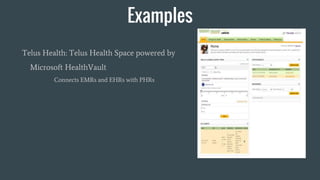
Examples
Telus Health: Telus Health Space powered by
Microsoft HealthVault
Connects EMRs and EHRs with PHRs
Benefits: Preventive Care
● Many people are suffering from possible preventable diseases such as heart
attacks, strokes, cancer etc.
● Clinical preventive services can be defined as:
■ screening tests
■ immunizations
■ counselling
■ preventive medications
● PHR preventive responsibilities:
■ when services are ready
■ when to renew medication
■ scheduling examinations
■ daily and weekly health progress
Benefits: Self- Management
● Patients can assess their own symptoms and illnesses at the palm of their hands
● Increases self-assurance and responsibility to manage their own health and well-being
■ simple to complex self- management approaches
■ asthma and diabetes are shown to be significantly self-manageable
● Many self-monitoring tools such as:
■ care plans
■ symptom graphing
■ instructive and motivational feedback
● Ownership of information solely belongs to the patient
■ increases privacy and any outside parties trying to access must have consent
directly from the owner of PHR
Benefits: Disease Management
Electronic communication with healthcare provider
Manage multiple conditions
Refill prescriptions
Easy access to medication lists
Access to diabetes-specific preventative care reminders
High-quality diabetes-related educational content
over 12-month period:
96% of users reviewed lab orders
94% read messages from providers
91% reviewed lab results
(Tenforde et al., 2012)
Amanda Box Case (2013)
To Conclude
Full ownership and custodianship to owner of the PHR
increases privacy and confidentiality
Patients have the opportunity and power to manage their health information
Helps patients stay informed about their health to:
prevent illness
manage current and pre-existing conditions
Access to health providers and medical experts
reduces time spent waiting for results and travelling to physician's office
reduces cost

HLST 4320 Group 5

  • 1.
    Advantages of PersonalHealth Records HLST 4320 Group 5 Dan Villamayor
  • 2.
    Outline Case Summary Personal HealthRecords explained Types of Personal Health Records Policy and Adoption Examples Benefits Ethical Consideration Conclusion
  • 3.
    Case Summary Evaluate policy,implementation, address patient and caregivers experience National Health Service (NHS) developed HealthSpace based on Kaiser Permanente’s My Health Manager model Widely successful: 2.4 million members, 10% reduction in physician visits, reduced phone calls HealthSpace goals: empower patients personalize care reduce NHS costs improve overall quality of care
  • 4.
    Case Summary HealthSpace initialrollout included two account levels: Basic enter values only e.g. blood pressure readings, record health appointments Advanced access to summary records, book appointments, manage overall health, email securely with physician (via Communicator) Participant are not representative of the population Total: 56 patients (21 opened basic account) 20 suffered from chronic illness(s) (Diabetes) - was not initially using HealthSpace 15 opened advanced accounts
  • 5.
    Case Summary Results: Basic account: noadded benefit as physicians or caregivers could continue to maintain health records self-manage with tools already in place, e.g. blood glucose diaries, smart phone apps complex registration accessibility and usability additional factors: major familial stress, living in adverse conditions etc Advanced account: registration straightforward Communicator seen as an added bonus by some accessibility and usability
  • 6.
    Case Summary Outcomes: flaws indesign and implementation poorly executed therefore leading to low adoption practiced exclusion policy makers assumed patients were technologically savvy not well received by the people of England as seen by the data 173, 000 people in England created basic accounts 2.4 million received invitations to open advanced accounts 49% of those had completed the first step - downloaded forms 16% submitted forms for processing 13% fully activated advance account PHRs must be inclusive, and patient-centric in its design (Greenhalgh et al., 2010)
  • 7.
    What Exactly isa Personal Health Record? ● Records that you access and maintain as a patient ● ‘’Patient-centric’’ records ■ custodianship under owner of PHR ■ this can be the patient or a family member ● Interfacing with clinician-held records (EHR) ● Can be Complete or Partial ■ Complete: ALL relevant health information over that person’s lifetime ■ Partial: health information pertaining to more specific parameters (records of blood pressure taken over a period of time)
  • 8.
    Information in aPersonal Health Record ● Personal record of appointments ● Interaction with physician (emails and consultations) ● Any previous interactions/interventions with various health care services ● Information on medication ● Health indicators: ■ blood pressure ■ glucose levels ■ stress/anxiety
  • 9.
    Types of PersonalHealth Records Institution Centered or Stand alone PHRs: Managed in physician offices Paper records Electronic - Centralized with access through online portals Self- Managed PHRs: Managed by patients Allows patients to record, track and edit information about their health Linked PHRs: Managed by patients Integration between personally controlled PHR and primary care EHR
  • 10.
    Policy and Adoption Theadoption of PHRs in the United States: The government has implemented policies aimed at increasing the adoption of PHRs The Health Insurance Portability and Accountability Act (HIPAA) states that individuals must be granted access to their health records if they request it President George W. Bush set a goal in April 2004 The Office of the National Coordinator for Health Information Technology (ONC) was created and was later funded by the Health Information Technology for Economic and Clinical Health (HITECH) Act of 2009 The American Reinvestment and Recovery Act of 2009 authorized the Centers for Medicare and Medicaid Services (CMS) to provide financial incentives for adoption of EHRs and PHRs
  • 11.
    Existing Personal HealthRecords ● Examples of Existing Personal Health Records: Veterans Health Administration (VHA) launched its PHR called My HealtheVet (MHV) in 2003 Between 2004 and 2010, Kaiser Permanente (KP) which the largest managed care provider in the U.S. implemented a system-wide EHR called KP Health Connect with its PHR called My Health Manager Microsoft launched its web-based PHR platform, HealthVault in 2007
  • 12.
    Examples Telus Health: TelusHealth Space powered by Microsoft HealthVault Connects EMRs and EHRs with PHRs
  • 13.
    Benefits: Preventive Care ●Many people are suffering from possible preventable diseases such as heart attacks, strokes, cancer etc. ● Clinical preventive services can be defined as: ■ screening tests ■ immunizations ■ counselling ■ preventive medications ● PHR preventive responsibilities: ■ when services are ready ■ when to renew medication ■ scheduling examinations ■ daily and weekly health progress
  • 14.
    Benefits: Self- Management ●Patients can assess their own symptoms and illnesses at the palm of their hands ● Increases self-assurance and responsibility to manage their own health and well-being ■ simple to complex self- management approaches ■ asthma and diabetes are shown to be significantly self-manageable ● Many self-monitoring tools such as: ■ care plans ■ symptom graphing ■ instructive and motivational feedback ● Ownership of information solely belongs to the patient ■ increases privacy and any outside parties trying to access must have consent directly from the owner of PHR
  • 15.
    Benefits: Disease Management Electroniccommunication with healthcare provider Manage multiple conditions Refill prescriptions Easy access to medication lists Access to diabetes-specific preventative care reminders High-quality diabetes-related educational content over 12-month period: 96% of users reviewed lab orders 94% read messages from providers 91% reviewed lab results (Tenforde et al., 2012)
  • 16.
  • 17.
    To Conclude Full ownershipand custodianship to owner of the PHR increases privacy and confidentiality Patients have the opportunity and power to manage their health information Helps patients stay informed about their health to: prevent illness manage current and pre-existing conditions Access to health providers and medical experts reduces time spent waiting for results and travelling to physician's office reduces cost

Editor's Notes

  • #8 http://infowayconnects.infoway-inforoute.ca/2011/04/07/emr-ehr-and-phr-why-all-the-confusion/
  • #9 http://www.ehealthontario.on.ca/en/ehrs
  • #14 Prevention can save a life or stop an illness before it spreads or gets worse
  • #15 Ties into preventive care, as they go hand in hand to benefit PHR.