
HL7 SURVIVAL
GUIDE
CHAPTER 6
A publication of
A supplement to the HL7 Survival Guide, available at
http://caristix.com/blog/category/hl7-survival-guide/
WWW.CARISTIX.COM SHARE THE SLIDE
DECK
HL7 SURVIVAL GUIDE CHAPTER 6
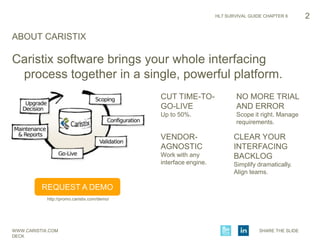
Caristix software brings your whole interfacing
process together in a single, powerful platform.
2
ABOUT CARISTIX
VENDOR-
AGNOSTIC
Work with any
interface engine.
NO MORE TRIAL
AND ERROR
Scope it right. Manage
requirements.
CUT TIME-TO-
GO-LIVE
Up to 50%.
CLEAR YOUR
INTERFACING
BACKLOG
Simplify dramatically.
Align teams.
REQUEST A DEMO
http://promo.caristix.com/demo/
WWW.CARISTIX.COM SHARE THE SLIDE
DECK
CHAPTER 6: Interfacing Artifacts: HL7 Conformance Profiles or
Interface Specifications
WWW.CARISTIX.COM SHARE THE SLIDE
DECK
HL7 SURVIVAL GUIDE CHAPTER 6
The first 5 chapters have helped you thing strategically about
your interfacing project.
4
Dive into the nitty-gritty of what you need in
an interface specification and/or HL7 profile.
An interface specification should list:
WWW.CARISTIX.COM SHARE THE SLIDE
DECK
HL7 SURVIVAL GUIDE CHAPTER 6
1. Interface name
How do you refer to your interface in your integration environment? Devise a
naming system for easy name recognition and tracking.
2. Source or destination system name and version
System versions (and even product names) change over time. Make sure
you’ve got a way to track this in your spec.
3. Message types used in the interface
A message type is essentially a trigger event, such as patient admission, lab
request, lab results available, new appointment, etc. Focus on the ones you
need for your interface.
4. Message definitions including segments, fields, data types
You need a list of the segments, fields, and data types used in each message
type.
5. Segment and field attributes
These are optionality, repeatability, data type associated with a field, field
length, tables associated with field.
5
Interface Specification
WWW.CARISTIX.COM SHARE THE SLIDE
DECK
HL7 SURVIVAL GUIDE CHAPTER 6
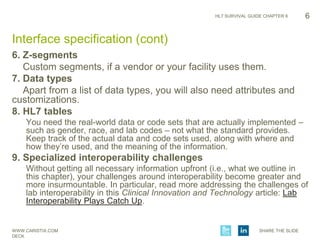
6. Z-segments
Custom segments, if a vendor or your facility uses them.
7. Data types
Apart from a list of data types, you will also need attributes and
customizations.
8. HL7 tables
You need the real-world data or code sets that are actually implemented –
such as gender, race, and lab codes – not what the standard provides.
Keep track of the actual data and code sets used, along with where and
how they’re used, and the meaning of the information.
9. Specialized interoperability challenges
Without getting all necessary information upfront (i.e., what we outline in
this chapter), your challenges around interoperability become greater and
more insurmountable. In particular, read more addressing the challenges of
lab interoperability in this Clinical Innovation and Technology article: Lab
Interoperability Plays Catch Up.
6
Interface specification (cont)
WWW.CARISTIX.COM SHARE THE SLIDE
DECK
HL7 SURVIVAL GUIDE CHAPTER 6 7
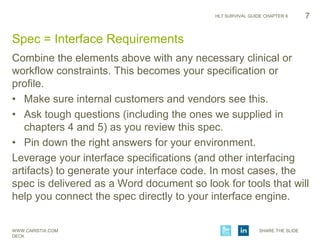
Spec = Interface Requirements
Combine the elements above with any necessary clinical or
workflow constraints. This becomes your specification or
profile.
• Make sure internal customers and vendors see this.
• Ask tough questions (including the ones we supplied in
chapters 4 and 5) as you review this spec.
• Pin down the right answers for your environment.
Leverage your interface specifications (and other interfacing
artifacts) to generate your interface code. In most cases, the
spec is delivered as a Word document so look for tools that will
help you connect the spec directly to your interface engine.
WWW.CARISTIX.COM SHARE THE SLIDE
DECK
HL7 SURVIVAL GUIDE CHAPTER 6
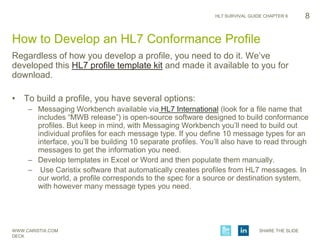
Regardless of how you develop a profile, you need to do it. We’ve
developed this HL7 profile template kit and made it available to you for
download.
• To build a profile, you have several options:
– Messaging Workbench available via HL7 International (look for a file name that
includes “MWB release”) is open-source software designed to build conformance
profiles. But keep in mind, with Messaging Workbench you’ll need to build out
individual profiles for each message type. If you define 10 message types for an
interface, you’ll be building 10 separate profiles. You’ll also have to read through
messages to get the information you need.
– Develop templates in Excel or Word and then populate them manually.
– Use Caristix software that automatically creates profiles from HL7 messages. In
our world, a profile corresponds to the spec for a source or destination system,
with however many message types you need.
8
How to Develop an HL7 Conformance Profile
WWW.CARISTIX.COM SHARE THE SLIDE
DECK
HL7 SURVIVAL GUIDE CHAPTER 6
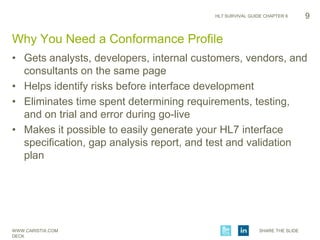
• Gets analysts, developers, internal customers, vendors, and
consultants on the same page
• Helps identify risks before interface development
• Eliminates time spent determining requirements, testing,
and on trial and error during go-live
• Makes it possible to easily generate your HL7 interface
specification, gap analysis report, and test and validation
plan
9
Why You Need a Conformance Profile
WWW.CARISTIX.COM SHARE THE SLIDE
DECK
HL7 SURVIVAL GUIDE CHAPTER 6
Without an interface spec customized to your requirements,
– You’ll be stuck implementing a generic interface. The last thing you
can afford is to dedicate those resources to testing. But that’s what
you’ll find yourself doing if you go with a generic spec.
– After all, your interface will likely be buggy when it goes live because
your true requirements weren’t gathered up-front.
– As a result, you’ll find yourself bogged down with extensive
troubleshooting after go-live, especially when you run into issues with
clinical workflows because the interface doesn’t work as expected
and clinicians report a lack of data, orders, lab results, and/or
medication as a result.
10
The Dangers of a Missing Interface Specification
WWW.CARISTIX.COM SHARE THE SLIDE
DECK
HL7 SURVIVAL GUIDE CHAPTER 6
• HL7 conformance profiles (also known as profiles or interface
specifications). HL7 profiles should at a minimum provide a list of
messages, segments (including z-segments), fields, data types,
and typical code sets or data.
• Gap analysis between systems to connect. Gap analysis sets
the scope of the interfacing project. Read more about gap
analysis in this Caristix white paper.
• Test scenarios. Vendors typically provide you with a boilerplate
validation guide to ensure the interface works as expected.
ensure that your organization’s clinical workflows are covered.
Make sure the guide covers real-life and specific scenarios you
encounter in your environment.
11
Demand These Deliverables
WWW.CARISTIX.COM SHARE THE SLIDE
DECK
HL7 SURVIVAL GUIDE CHAPTER 6
Don’t take any chances – create those profiles. Get started
with our HL7 Profile Kit.
12
HL7 Profile Kit
WWW.CARISTIX.COM SHARE THE SLIDE
DECK
HL7 SURVIVAL GUIDE CHAPTER 6
• Chapter 7 in the HL7 Survival Guide
• Interfacing Artifacts:Gap Analysis
– Once you have profiles for your source and destination
systems, you’ll need to capture a list of all the gaps
between the two systems. The next chapters walk you
through that process. Learn more in Chapter 7.
– Blog link: http://caristix.com/blog/2012/11/hl7-survival-
guide-chapter-7/
– Slide deck on Slideshare: coming soon.
13
UP NEXT: CHAPTER 7
WWW.CARISTIX.COM SHARE THE SLIDE
DECK
HL7 SURVIVAL GUIDE CHAPTER 6
Is a recommendation unclear?
Disagree with something we said?
Let us know! We thrive on feedback.
Contact Us
support@caristix.com
1-877-872-0027
14
QUESTIONS? FEEDBACK?
© Caristix 2013. All rights reserved.

HL7 Survival Guide - Chapter 6 – Interfacing Artifacts: HL7 Conformance Profiles and Interface Specifications

  • 1.
    HL7 SURVIVAL GUIDE CHAPTER 6 Apublication of A supplement to the HL7 Survival Guide, available at http://caristix.com/blog/category/hl7-survival-guide/
  • 2.
    WWW.CARISTIX.COM SHARE THESLIDE DECK HL7 SURVIVAL GUIDE CHAPTER 6 Caristix software brings your whole interfacing process together in a single, powerful platform. 2 ABOUT CARISTIX VENDOR- AGNOSTIC Work with any interface engine. NO MORE TRIAL AND ERROR Scope it right. Manage requirements. CUT TIME-TO- GO-LIVE Up to 50%. CLEAR YOUR INTERFACING BACKLOG Simplify dramatically. Align teams. REQUEST A DEMO http://promo.caristix.com/demo/
  • 3.
    WWW.CARISTIX.COM SHARE THESLIDE DECK CHAPTER 6: Interfacing Artifacts: HL7 Conformance Profiles or Interface Specifications
  • 4.
    WWW.CARISTIX.COM SHARE THESLIDE DECK HL7 SURVIVAL GUIDE CHAPTER 6 The first 5 chapters have helped you thing strategically about your interfacing project. 4 Dive into the nitty-gritty of what you need in an interface specification and/or HL7 profile. An interface specification should list:
  • 5.
    WWW.CARISTIX.COM SHARE THESLIDE DECK HL7 SURVIVAL GUIDE CHAPTER 6 1. Interface name How do you refer to your interface in your integration environment? Devise a naming system for easy name recognition and tracking. 2. Source or destination system name and version System versions (and even product names) change over time. Make sure you’ve got a way to track this in your spec. 3. Message types used in the interface A message type is essentially a trigger event, such as patient admission, lab request, lab results available, new appointment, etc. Focus on the ones you need for your interface. 4. Message definitions including segments, fields, data types You need a list of the segments, fields, and data types used in each message type. 5. Segment and field attributes These are optionality, repeatability, data type associated with a field, field length, tables associated with field. 5 Interface Specification
  • 6.
    WWW.CARISTIX.COM SHARE THESLIDE DECK HL7 SURVIVAL GUIDE CHAPTER 6 6. Z-segments Custom segments, if a vendor or your facility uses them. 7. Data types Apart from a list of data types, you will also need attributes and customizations. 8. HL7 tables You need the real-world data or code sets that are actually implemented – such as gender, race, and lab codes – not what the standard provides. Keep track of the actual data and code sets used, along with where and how they’re used, and the meaning of the information. 9. Specialized interoperability challenges Without getting all necessary information upfront (i.e., what we outline in this chapter), your challenges around interoperability become greater and more insurmountable. In particular, read more addressing the challenges of lab interoperability in this Clinical Innovation and Technology article: Lab Interoperability Plays Catch Up. 6 Interface specification (cont)
  • 7.
    WWW.CARISTIX.COM SHARE THESLIDE DECK HL7 SURVIVAL GUIDE CHAPTER 6 7 Spec = Interface Requirements Combine the elements above with any necessary clinical or workflow constraints. This becomes your specification or profile. • Make sure internal customers and vendors see this. • Ask tough questions (including the ones we supplied in chapters 4 and 5) as you review this spec. • Pin down the right answers for your environment. Leverage your interface specifications (and other interfacing artifacts) to generate your interface code. In most cases, the spec is delivered as a Word document so look for tools that will help you connect the spec directly to your interface engine.
  • 8.
    WWW.CARISTIX.COM SHARE THESLIDE DECK HL7 SURVIVAL GUIDE CHAPTER 6 Regardless of how you develop a profile, you need to do it. We’ve developed this HL7 profile template kit and made it available to you for download. • To build a profile, you have several options: – Messaging Workbench available via HL7 International (look for a file name that includes “MWB release”) is open-source software designed to build conformance profiles. But keep in mind, with Messaging Workbench you’ll need to build out individual profiles for each message type. If you define 10 message types for an interface, you’ll be building 10 separate profiles. You’ll also have to read through messages to get the information you need. – Develop templates in Excel or Word and then populate them manually. – Use Caristix software that automatically creates profiles from HL7 messages. In our world, a profile corresponds to the spec for a source or destination system, with however many message types you need. 8 How to Develop an HL7 Conformance Profile
  • 9.
    WWW.CARISTIX.COM SHARE THESLIDE DECK HL7 SURVIVAL GUIDE CHAPTER 6 • Gets analysts, developers, internal customers, vendors, and consultants on the same page • Helps identify risks before interface development • Eliminates time spent determining requirements, testing, and on trial and error during go-live • Makes it possible to easily generate your HL7 interface specification, gap analysis report, and test and validation plan 9 Why You Need a Conformance Profile
  • 10.
    WWW.CARISTIX.COM SHARE THESLIDE DECK HL7 SURVIVAL GUIDE CHAPTER 6 Without an interface spec customized to your requirements, – You’ll be stuck implementing a generic interface. The last thing you can afford is to dedicate those resources to testing. But that’s what you’ll find yourself doing if you go with a generic spec. – After all, your interface will likely be buggy when it goes live because your true requirements weren’t gathered up-front. – As a result, you’ll find yourself bogged down with extensive troubleshooting after go-live, especially when you run into issues with clinical workflows because the interface doesn’t work as expected and clinicians report a lack of data, orders, lab results, and/or medication as a result. 10 The Dangers of a Missing Interface Specification
  • 11.
    WWW.CARISTIX.COM SHARE THESLIDE DECK HL7 SURVIVAL GUIDE CHAPTER 6 • HL7 conformance profiles (also known as profiles or interface specifications). HL7 profiles should at a minimum provide a list of messages, segments (including z-segments), fields, data types, and typical code sets or data. • Gap analysis between systems to connect. Gap analysis sets the scope of the interfacing project. Read more about gap analysis in this Caristix white paper. • Test scenarios. Vendors typically provide you with a boilerplate validation guide to ensure the interface works as expected. ensure that your organization’s clinical workflows are covered. Make sure the guide covers real-life and specific scenarios you encounter in your environment. 11 Demand These Deliverables
  • 12.
    WWW.CARISTIX.COM SHARE THESLIDE DECK HL7 SURVIVAL GUIDE CHAPTER 6 Don’t take any chances – create those profiles. Get started with our HL7 Profile Kit. 12 HL7 Profile Kit
  • 13.
    WWW.CARISTIX.COM SHARE THESLIDE DECK HL7 SURVIVAL GUIDE CHAPTER 6 • Chapter 7 in the HL7 Survival Guide • Interfacing Artifacts:Gap Analysis – Once you have profiles for your source and destination systems, you’ll need to capture a list of all the gaps between the two systems. The next chapters walk you through that process. Learn more in Chapter 7. – Blog link: http://caristix.com/blog/2012/11/hl7-survival- guide-chapter-7/ – Slide deck on Slideshare: coming soon. 13 UP NEXT: CHAPTER 7
  • 14.
    WWW.CARISTIX.COM SHARE THESLIDE DECK HL7 SURVIVAL GUIDE CHAPTER 6 Is a recommendation unclear? Disagree with something we said? Let us know! We thrive on feedback. Contact Us support@caristix.com 1-877-872-0027 14 QUESTIONS? FEEDBACK? © Caristix 2013. All rights reserved.