FHIR® is the registered trademark of HL7 and is used with the permission of HL7. The Flame Design mark is the registered trademark of HL7 and is used with the permission of HL7.
Amsterdam, 15-17 November | @fhir_furore | #fhirdevdays17 | www.fhirdevdays.com
FHIR Workflow
Lloyd McKenzie, Gevity Consulting
Who am I?
• Name: Lloyd McKenzie
• Company: Gevity
• Background:
• One of FHIR’s 3 initial editors
• Co-chair FMG & FHIR Infrastructure
• Co-chair HL7 Modeling & Methodology
• Heavily involved in HL7 and healthcare exchange for last 17 years (v2, v3,
CDA, etc.)
• Lead for the FHIR Workflow project
• lmckenzie@gevityinc.com
Workflow project started after R2 publication
• Order & OrderResponse resources were confusing & badly named
• Inconsistencies in similar resources, particularly various “Request”
resources
• No way to represent “please suspend” or other types of requests
• Need to support asking for partial fulfillment
• Problems managing proposal/plan/order
• 7-8 other issues
What is “Workflow”?
• We used the banner “workflow” to represent the effort to solve all of
these issues
• Our use of the term may be broader than what you’re used to
• Doesn’t necessarily involve tracking of status/progress
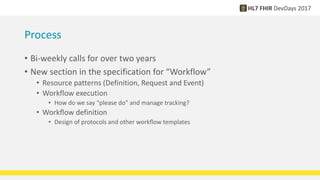
Process
• Bi-weekly calls for over two years
• New section in the specification for “Workflow”
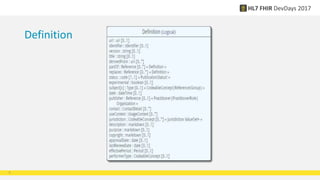
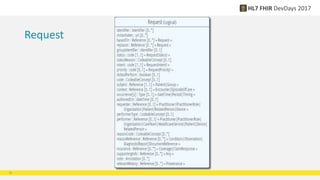
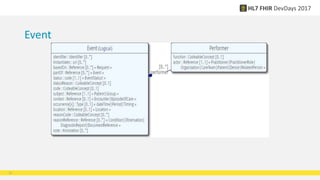
• Resource patterns (Definition, Request and Event)
• Workflow execution
• How do we say “please do” and manage tracking?
• Workflow definition
• Design of protocols and other workflow templates
Patterns
6
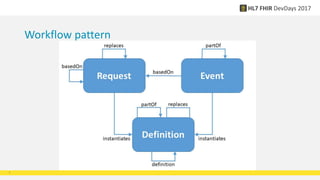
Workflow pattern
7
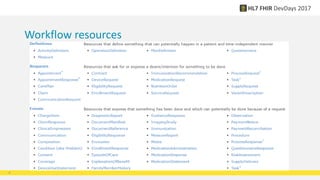
Workflow resources
8
Definition
9
Request
10
Event
11
Adherence to patterns
• Patterns are patterns, not rules
• Some elements may not be relevant in all resources
• Some elements may be “extensions” for some resources
• Some elements may use domain-specific names
• Some elements may constrain data types, cardinalities or simplify structures
• Focus is keeping simple things simple
• Look for alignment where we don’t have reason to be distinct
12
Future of patterns
• Right now, we ask workgroups to “try” to follow patterns and to
include hand-wavy mappings
• Now have a report showing where misalignment exists
• In the future, may:
• make mappings more formal
• expose patterns in reference implementations (interfaces)
13
Getting stuff done
14
Scenario
• Pharmacy is sent two prescriptions
• Both are active
• Both are for a patient that uses the pharmacy
• Both are digitally signed
• One is “to be filled”
• One is “for your information”
• Use in drug-drug interaction checking
• How do we distinguish desired behavior?
15
Request vs. Task
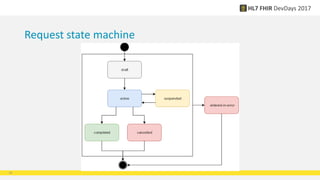
• Request represents intention/authorization
• Request does not (by itself) represent “request to act”
• i.e. Everyone who sees a MedicationRequest doesn’t start counting
pills/injecting the patient
• Even if the request “has your name on it”
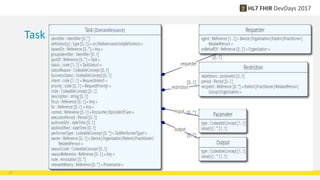
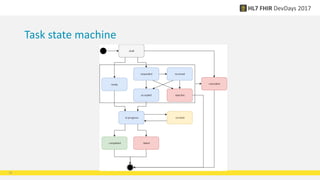
• Task lets you say “please do X”
• Please fulfill; Please change status; Please tell me current progress; etc.
16
Task
17
Request state machine
18
Task state machine
19
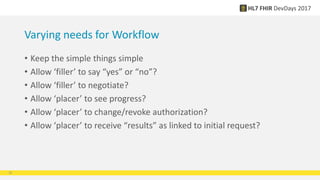
Varying needs for Workflow
• Keep the simple things simple
• Allow ‘filler’ to say “yes” or “no”?
• Allow ‘filler’ to negotiate?
• Allow ‘placer’ to see progress?
• Allow ‘placer’ to change/revoke authorization?
• Allow ‘placer’ to receive “results” as linked to initial request?
20
Workflow patterns
• Exemplary, not exhaustive
• Each pattern contains:
• What are the steps of the pattern
• What benefits does the pattern provide
• What are the limitations
• Recommendations for use of this pattern
21
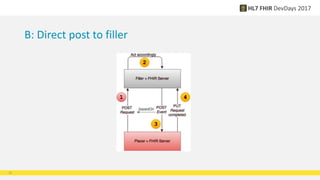
B: Direct post to filler
22
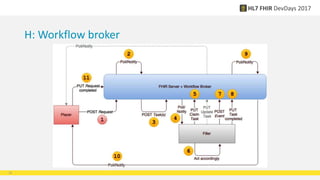
H: Workflow broker
23
Workflow Updates
• Revamped patterns based on feedback
• Use PractitionerRole instead of “onBehalfOf” pattern
• Improved some names
• “partOf“ rather than “parent”, “instantiates” rather than “definition”
• Added Event.location
• Made Event.notDone into a status, added statusReason in place of
notDoneReason
• Add additional resources to choices (e.g. CareTeam to performer)
24
Current state
25
Workflow Updates
• Introduced a new ExampleScenario resource
• Allows describing a full workflow
• Example:
• http://zeora.net/blog/mma/examplescenario-mma1-scenario.html
• Developed reports to identify misalignment with workflow patterns
• Continued to work through example scenarios with lab
26
What’s next?
• Try to get all artifacts aligned by publication of R4
• Support publishing ExampleScenarios in both the main publication
and implementation guides
• Try to have at least one ExampleScenario for each FHIR focal area
• Eventually try to have a few for each workflow pattern
• Continue to exercise at connectathons
• Are you doing something workflow related at DevDays? Come talk to me 
• Continue to improve/clarify documentation
• Suggestions/volunteers welcome
27
Questions?
http://hl7.org/fhir/workflow.html
lmckenzie@gevityinc.com
28

Furore devdays 2017 - workflow

  • 1.
    FHIR® is theregistered trademark of HL7 and is used with the permission of HL7. The Flame Design mark is the registered trademark of HL7 and is used with the permission of HL7. Amsterdam, 15-17 November | @fhir_furore | #fhirdevdays17 | www.fhirdevdays.com FHIR Workflow Lloyd McKenzie, Gevity Consulting
  • 2.
    Who am I? •Name: Lloyd McKenzie • Company: Gevity • Background: • One of FHIR’s 3 initial editors • Co-chair FMG & FHIR Infrastructure • Co-chair HL7 Modeling & Methodology • Heavily involved in HL7 and healthcare exchange for last 17 years (v2, v3, CDA, etc.) • Lead for the FHIR Workflow project • lmckenzie@gevityinc.com
  • 3.
    Workflow project startedafter R2 publication • Order & OrderResponse resources were confusing & badly named • Inconsistencies in similar resources, particularly various “Request” resources • No way to represent “please suspend” or other types of requests • Need to support asking for partial fulfillment • Problems managing proposal/plan/order • 7-8 other issues
  • 4.
    What is “Workflow”? •We used the banner “workflow” to represent the effort to solve all of these issues • Our use of the term may be broader than what you’re used to • Doesn’t necessarily involve tracking of status/progress
  • 5.
    Process • Bi-weekly callsfor over two years • New section in the specification for “Workflow” • Resource patterns (Definition, Request and Event) • Workflow execution • How do we say “please do” and manage tracking? • Workflow definition • Design of protocols and other workflow templates
  • 6.
  • 7.
  • 8.
  • 9.
  • 10.
  • 11.
  • 12.
    Adherence to patterns •Patterns are patterns, not rules • Some elements may not be relevant in all resources • Some elements may be “extensions” for some resources • Some elements may use domain-specific names • Some elements may constrain data types, cardinalities or simplify structures • Focus is keeping simple things simple • Look for alignment where we don’t have reason to be distinct 12
  • 13.
    Future of patterns •Right now, we ask workgroups to “try” to follow patterns and to include hand-wavy mappings • Now have a report showing where misalignment exists • In the future, may: • make mappings more formal • expose patterns in reference implementations (interfaces) 13
  • 14.
  • 15.
    Scenario • Pharmacy issent two prescriptions • Both are active • Both are for a patient that uses the pharmacy • Both are digitally signed • One is “to be filled” • One is “for your information” • Use in drug-drug interaction checking • How do we distinguish desired behavior? 15
  • 16.
    Request vs. Task •Request represents intention/authorization • Request does not (by itself) represent “request to act” • i.e. Everyone who sees a MedicationRequest doesn’t start counting pills/injecting the patient • Even if the request “has your name on it” • Task lets you say “please do X” • Please fulfill; Please change status; Please tell me current progress; etc. 16
  • 17.
  • 18.
  • 19.
  • 20.
    Varying needs forWorkflow • Keep the simple things simple • Allow ‘filler’ to say “yes” or “no”? • Allow ‘filler’ to negotiate? • Allow ‘placer’ to see progress? • Allow ‘placer’ to change/revoke authorization? • Allow ‘placer’ to receive “results” as linked to initial request? 20
  • 21.
    Workflow patterns • Exemplary,not exhaustive • Each pattern contains: • What are the steps of the pattern • What benefits does the pattern provide • What are the limitations • Recommendations for use of this pattern 21
  • 22.
    B: Direct postto filler 22
  • 23.
  • 24.
    Workflow Updates • Revampedpatterns based on feedback • Use PractitionerRole instead of “onBehalfOf” pattern • Improved some names • “partOf“ rather than “parent”, “instantiates” rather than “definition” • Added Event.location • Made Event.notDone into a status, added statusReason in place of notDoneReason • Add additional resources to choices (e.g. CareTeam to performer) 24
  • 25.
  • 26.
    Workflow Updates • Introduceda new ExampleScenario resource • Allows describing a full workflow • Example: • http://zeora.net/blog/mma/examplescenario-mma1-scenario.html • Developed reports to identify misalignment with workflow patterns • Continued to work through example scenarios with lab 26
  • 27.
    What’s next? • Tryto get all artifacts aligned by publication of R4 • Support publishing ExampleScenarios in both the main publication and implementation guides • Try to have at least one ExampleScenario for each FHIR focal area • Eventually try to have a few for each workflow pattern • Continue to exercise at connectathons • Are you doing something workflow related at DevDays? Come talk to me  • Continue to improve/clarify documentation • Suggestions/volunteers welcome 27
  • 28.

Editor's Notes

  • #4 Inconsistencies – names, data types, cardinalities, state machines