Association of Private Care Providers
Håkan Tenelius
This is Vårdföretagarna
•2000 member companies
•93 000 employees
•600 healthcare member companies
•a party in collective agreements
•strive for freedom of choice and to
demonstrate to the public the importance
of variety in care provision
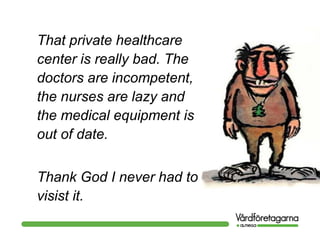
That private healthcare
center is really bad. The
doctors are incompetent,
the nurses are lazy and
the medical equipment is
out of date.
Thank God I never had to
visist it.
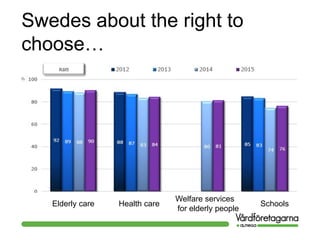
Swedes about the right to
choose…
Elderly care Health care
Welfare services
for elderly people
Schools
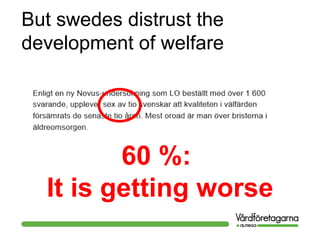
But swedes distrust the
development of welfare
60 %:
It is getting worse
Two principal models…
…for exposing publicly financed activities to competition:
• The contract model involves activities undertaken by actors
being purchased in accordance with the provisions of the
Public Procurement Act.
• The choice system may be used when exposing individual
services to competition.
The choice system means that competition takes place in the
market, as opposed to competition over the market.
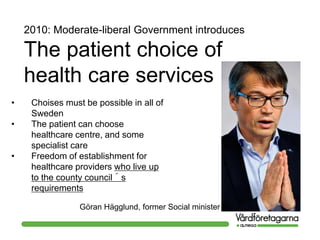
2010: Moderate-liberal Government introduces
The patient choice of
health care services
• Choises must be possible in all of
Sweden
• The patient can choose
healthcare centre, and some
specialist care
• Freedom of establishment for
healthcare providers who live up
to the county council´s
requirements
Göran Hägglund, former Social minister
Why the reform?
•Good care, but low accessibility
•Lack of patient power
•Few innovations
•Lack of doctors with competence in
general medicine
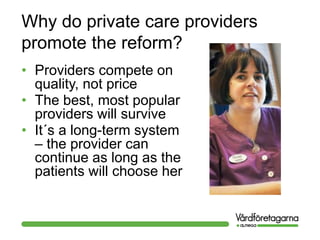
Why do private care providers
promote the reform?
• Providers compete on
quality, not price
• The best, most popular
providers will survive
• It´s a long-term system
– the provider can
continue as long as the
patients will choose her
What was the outcome?
•200 new healthcare centers
• Better accessability
•Patients like the new alternatives
•Easier to attract general medicine doctors
•Innovations - att least a few
•More care to the same cost
•Equal care for all?
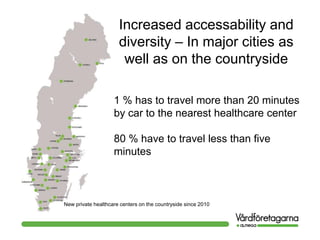
Increased accessability and
diversity – In major cities as
well as on the countryside
New private healthcare centers on the countryside since 2010
1 % has to travel more than 20 minutes
by car to the nearest healthcare center
80 % have to travel less than five
minutes
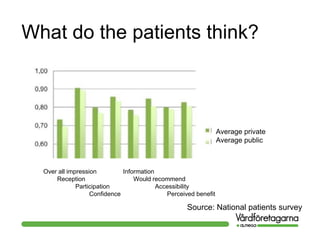
What do the patients think?
Over all impression
Reception
Participation
Confidence
Information
Would recommend
Accessibility
Perceived benefit
Average private
Average public
Source: National patients survey
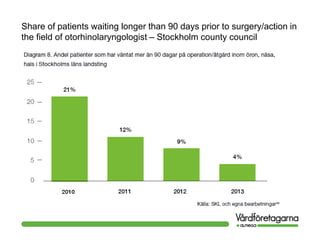
Share of patients waiting longer than 90 days prior to surgery/action in
the field of otorhinolaryngologist – Stockholm county council
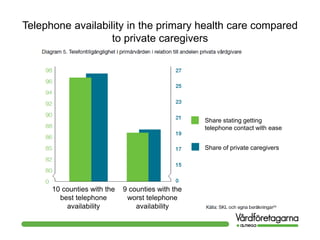
Telephone availability in the primary health care compared
to private caregivers
Share stating getting
telephone contact with ease
Share of private caregivers
10 counties with the
best telephone
availability
9 counties with the
worst telephone
availability
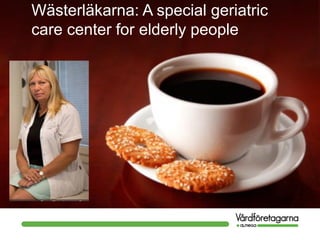
Wästerläkarna: A special geriatric
care center for elderly people
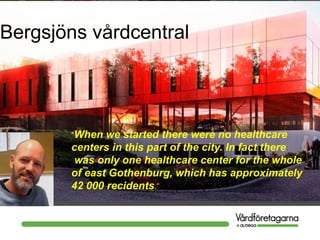
Bergsjöns vårdcentral
”When we started there were no healthcare
centers in this part of the city. In fact there
was only one healthcare center for the whole
of east Gothenburg, which has approximately
42 000 recidents.”
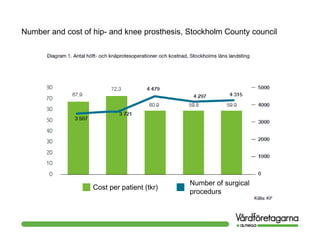
Number and cost of hip- and knee prosthesis, Stockholm County council
Cost per patient (tkr)
Number of surgical
procedurs
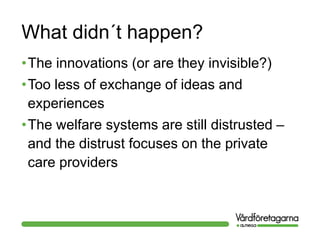
What didn´t happen?
•The innovations (or are they invisible?)
•Too less of exchange of ideas and
experiences
•The welfare systems are still distrusted –
and the distrust focuses on the private
care providers
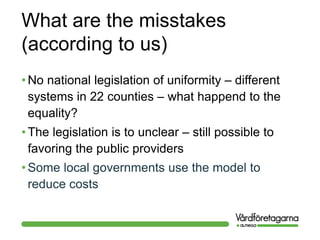
What are the misstakes
(according to us)
• No national legislation of uniformity – different
systems in 22 counties – what happend to the
equality?
• The legislation is to unclear – still possible to
favoring the public providers
• Some local governments use the model to
reduce costs
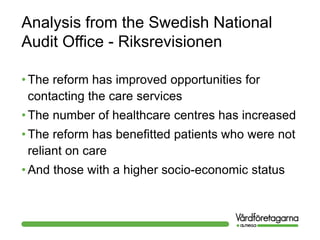
Analysis from the Swedish National
Audit Office - Riksrevisionen
• The reform has improved opportunities for
contacting the care services
• The number of healthcare centres has increased
• The reform has benefitted patients who were not
reliant on care
• And those with a higher socio-economic status
…was critised by resarchers
Anders Anell and Clas Rehnberg:
• The opinion was based on a selective choice of
results an references
• The reform represents a positive development in
several aspects – increased accessibility, greater
freedom of choice, more confidence among
patients and an interest in new establishments
…but the Audit Office suggests
• Make the county council´s patient choice system
more alike across Sweden
• Make the financing system as simple as
possible, focusing on ethical principles of
healthcare
• Do not formulate primary healthcare mandates
too broadly and make mandates more uniform
The future
•The Government and the Left Party: Let
the county councils decide themselves
whether they should apply the reform.
•The Parliament: No such government bill is
desired.
Tack så mycket!
hakan.tenelius@almega.se
www.vardforetagarna.se

Håkan Tenelius Almega 190315

  • 1.
    Association of PrivateCare Providers Håkan Tenelius
  • 2.
    This is Vårdföretagarna •2000member companies •93 000 employees •600 healthcare member companies •a party in collective agreements •strive for freedom of choice and to demonstrate to the public the importance of variety in care provision
  • 3.
    That private healthcare centeris really bad. The doctors are incompetent, the nurses are lazy and the medical equipment is out of date. Thank God I never had to visist it.
  • 4.
    Swedes about theright to choose… Elderly care Health care Welfare services for elderly people Schools
  • 5.
    But swedes distrustthe development of welfare 60 %: It is getting worse
  • 6.
    Two principal models… …forexposing publicly financed activities to competition: • The contract model involves activities undertaken by actors being purchased in accordance with the provisions of the Public Procurement Act. • The choice system may be used when exposing individual services to competition. The choice system means that competition takes place in the market, as opposed to competition over the market.
  • 7.
    2010: Moderate-liberal Governmentintroduces The patient choice of health care services • Choises must be possible in all of Sweden • The patient can choose healthcare centre, and some specialist care • Freedom of establishment for healthcare providers who live up to the county council´s requirements Göran Hägglund, former Social minister
  • 8.
    Why the reform? •Goodcare, but low accessibility •Lack of patient power •Few innovations •Lack of doctors with competence in general medicine
  • 9.
    Why do privatecare providers promote the reform? • Providers compete on quality, not price • The best, most popular providers will survive • It´s a long-term system – the provider can continue as long as the patients will choose her
  • 10.
    What was theoutcome? •200 new healthcare centers • Better accessability •Patients like the new alternatives •Easier to attract general medicine doctors •Innovations - att least a few •More care to the same cost •Equal care for all?
  • 11.
    Increased accessability and diversity– In major cities as well as on the countryside New private healthcare centers on the countryside since 2010 1 % has to travel more than 20 minutes by car to the nearest healthcare center 80 % have to travel less than five minutes
  • 12.
    What do thepatients think? Over all impression Reception Participation Confidence Information Would recommend Accessibility Perceived benefit Average private Average public Source: National patients survey
  • 13.
    Share of patientswaiting longer than 90 days prior to surgery/action in the field of otorhinolaryngologist – Stockholm county council
  • 14.
    Telephone availability inthe primary health care compared to private caregivers Share stating getting telephone contact with ease Share of private caregivers 10 counties with the best telephone availability 9 counties with the worst telephone availability
  • 15.
    Wästerläkarna: A specialgeriatric care center for elderly people
  • 16.
    Bergsjöns vårdcentral ”When westarted there were no healthcare centers in this part of the city. In fact there was only one healthcare center for the whole of east Gothenburg, which has approximately 42 000 recidents.”
  • 17.
    Number and costof hip- and knee prosthesis, Stockholm County council Cost per patient (tkr) Number of surgical procedurs
  • 18.
    What didn´t happen? •Theinnovations (or are they invisible?) •Too less of exchange of ideas and experiences •The welfare systems are still distrusted – and the distrust focuses on the private care providers
  • 19.
    What are themisstakes (according to us) • No national legislation of uniformity – different systems in 22 counties – what happend to the equality? • The legislation is to unclear – still possible to favoring the public providers • Some local governments use the model to reduce costs
  • 20.
    Analysis from theSwedish National Audit Office - Riksrevisionen • The reform has improved opportunities for contacting the care services • The number of healthcare centres has increased • The reform has benefitted patients who were not reliant on care • And those with a higher socio-economic status
  • 21.
    …was critised byresarchers Anders Anell and Clas Rehnberg: • The opinion was based on a selective choice of results an references • The reform represents a positive development in several aspects – increased accessibility, greater freedom of choice, more confidence among patients and an interest in new establishments
  • 22.
    …but the AuditOffice suggests • Make the county council´s patient choice system more alike across Sweden • Make the financing system as simple as possible, focusing on ethical principles of healthcare • Do not formulate primary healthcare mandates too broadly and make mandates more uniform
  • 23.
    The future •The Governmentand the Left Party: Let the county councils decide themselves whether they should apply the reform. •The Parliament: No such government bill is desired.
  • 24.