Get paid what you’ve earned
Secure a “reliant on beneficiary” clause1
Set time limits on recoupments2
Understand your fee schedule3
Understand termination criteria4
Have an appeals process, in writing5
Know your payers’ business terms, in writing6
Are you ready for the future?7
$
Payer contracting
Ensure your practice is set up for success – a strong bottom line is built
on a foundation of solid payer contracting. This is where revenue
cycle management starts. If you don’t fully understand your payer
terms or don’t have them in writing, you’ve set yourself back in 2015
and beyond. We’ll show you why (and how).
In this eBook, we’ll talk about some of the important terms to
consider in your existing health plan contracts – as well as what you
need to look for in contracts you’re preparing to sign or re-negotiate.
It’s not uncommon for payers to refuse to negotiate fees, but don’t give
up. If they won’t budge on fees, negotiate terms. Contract terms you
should scrutinize include timely filing deadlines, recoupments, and
terminations. See how getting your payer terms in writing, and
conducting intelligent payer contract monitoring, helps provide
the fuel you need for better revenue outcomes.
Today, good revenue cycle management is
critical to practice success. Every penny
counts, but they don’t always come easily.
Each day can bring a new battle to get paid
what you’ve earned – and the sustainability
of your multi-million dollar practice depends
on whether you prevail.
1
CHAPTER
Secure a “reliant on
beneficiary” clause
Because sometimes you’ll get the wrong patient insurance
information and you won’t realize it until months after filing
your claim. Perhaps the patient came in through the hospital
emergency room and there was a breakdown in communication.
Whatever the case, having the wrong information about the
patient’s coverage can become a huge problem for you
down the road.
A clause in your contract stating that you’re reliant on the
patient to provide accurate information about his or her
coverage protects you in the event that your claim gets
denied based on coverage – and you only learn the correct
information about his or her insurance weeks or even months
later. Prevent a situation where you have to write those
claim fees off.
How can you avoid
taking a loss when
the patient provides
incorrect insurance
information?
It’s important to include a clause in your payer
contract stating that you are reliant on the beneficiary
(the patient) to present coverage.
WHY?
2
CHAPTER
Set time limits
on recoupments
Make sure you’re in a position to dispute “recoupment,”
a common practice in which the payer requests (or
just takes) its money back by reducing a remittance
for another beneficiary. Known for taking place months—
if not years—later, these recoupments can be incredibly
frustrating for medical practices.
In your contract, set a recoupment time limit based
on your applicable state law – or set your own limit,
which should be no longer than 12 months after
the remittance. Additional contract terms to include
are notification requirements and time limits on
conducting post-payment audits.
No carrier…may…impose a
retroactive denial of payment
on any claim…relating to the
provision of health care services
that was submitted within 90
days of the last date of service…
unless the carrier…has provided…
in writing notice of the intent
to…impose such a retroactive
denial of payment; [and] not
more than 12 months have
elapsed since the last date of
service; [and the] retroactive
denial of payment must be
completed…within 18 months
of the last date of service.
What’s your recoupment
time limit?
Here’s an example from the
state of Georgia’s guidelines:
“
“
About half of the states in the U.S. have some
sort of guideline for recoupment that insurers
must follow.
Check with your state
insurance commissioner:
3
CHAPTER
Understand your
fee schedule
Know what you should be paid
Determine your fee schedule (the allowed amounts)
by procedure code, for each payer. It’s critical to
know these amounts; on some claims, you may need
to request payment from two or even three sources:
the payer, the guarantor, and possibly, a secondary
payer. So, understand the total price you’re allowed
to collect, monitor remittances by payer, and conduct
payer audits periodically to make sure you are
consistently paid correctly.
How do you get this information?
Ask your payer for this data. Call the health plan and
request your fee schedule. Given the volume of CPT®
codes, you might hear some baffled silence on the
other end of the phone line. However, what you really
need to understand is the schedule for the procedure
codes you commonly use. That number is likely
somewhere in the much more manageable range of
50 to 150 codes. Even if you only receive 80% of them
in writing, it’s better than 0%.
Some states have laws that support your right to
this knowledge and legally obligate payers to share
fee schedules in writing. Consider ways to incorporate
the payer’s disclosure of its fee schedules – and
requirements for notification of changes in your contract.
As a provider you should be
aware of discounts for multiple
procedures. It is common to
see 100%, 50%, or 25% for
reimbursement when you perform
three procedures. Plus, you
can negotiate reimbursements.
What to do with this information
Once you get this information, it’s great business
intelligence to load it into your practice management
system, and monitor it. Don’t just assess transactions
here or there – evaluate each and every line item
that is paid to ensure that you’re being paid what you’ve
earned.
When choosing a practice management system, look for
one that can fully automate this process and is accredited
for meeting top standards.
(NextGen Healthcare was first to achieve accreditation
from the electronic healthcare network accreditation
commission (EHNAC) in January 2015. See our press
release for more information: http://www.nextgen.com/
About-NextGen/Newsroom.)
Determine pricing based
on place of service and
modifiers. You need to
understand that business
intelligence in order to
ensure accurate, complete
reimbursement.
4
CHAPTER
Understand termination
criteria
X
As networks become narrower, hospitals and doctors are increasingly
cut out of contracts. Understand payer termination criteria to avoid being
stripped of your enrollment and removed from the health plan’s roster.
A payer will always propose contract termination terms in its favor.
Don’t agree to every term. Start reviewing them carefully. Propose
new ones if you feel your practice is at a disadvantage.
Review the notice of termination clause. At minimum, it should be
delivered in writing no less than 90 days before the effective date. This
gives both parties fair warning to end the relationship. Make sure you
also tie termination to a change in fee schedule; it doesn’t mean you
will reject a fee schedule change, but at least you’ll have 90 (or more)
days to consider other options.
Make sure every contract has an end date. Avoid an “evergreen
provision,” which means the contract automatically renews for another
period (typically one to three years) at the same terms (if you don’t give
notice to terminate). While you may still want a relationship with the
payer, contract renewal should be a golden opportunity to negotiate
for better prices or terms.
Avoid evergreen provisions; instead, choose to
enforce your right to terminate the contract.
Understand how termination works
5
CHAPTER
Have an appeals process,
in writing
Make sure your payer contract includes an appeals
process — one that spells out how the initial appeal
will be adjudicated, as well as further appeals. A clearly
defined appeals process saves time – and headaches –
when you decide to fight a payment decision.
Ask the payer to agree in writing to a timeframe for the
claims appeals process. Request a copy of the forms and
attachments required to appeal a claim. These details will
allow your business office to establish an efficient denials
management process.
When submitting an appeal, ask the payer to appoint a
reviewer who is an expert in your specialty. Unless you
ask, you’ll find that those experts are rarely present for
the first appeal, but can be critical to your achieving a
subsequent review. Familiarize yourself with the payer’s
protocols to understand your options if your first appeal
is turned down. Don’t give up; most payers have multiple
levels of appeals and a grievance process if you disagree
with the outcome.
Make a compelling case in your appeal. Develop a professional
letter that references the claim number, date of service,
and patient; and then, briefly describe the claim in question.
Next, describe why the claim should have been paid.
If the denial is based on medical necessity, for example,
describe the patient benefits of the service. Bolster your
argument with objective evidence supporting your case
from your specialty society and/or medical literature. If
applicable, identify a government payer that reimburses
for the service in question. Where appropriate, quote from
the payer’s own marketing materials, such as its declaration
to provide the best medical care for its beneficiaries.
Finally, copy and attach the section of your coding manual
that supports your position.
Build an appeals process into your contracts
6
CHAPTER
Know your payers’
business terms, in writing
It may seem self-evident, but when you make changes
with the payer on your contract, ensure they give it to you
in writing. Your practice could rely on that piece of paper
to stay in business. Have the information readily available
and know the terms. Maintain copies of each contract,
with an electronic “tickler” that alerts you when to
re-negotiate. Don’t try for a “blanket” increase. Be smart;
negotiate increases on the most frequently performed
procedures. You’ll see material financial benefits.
Procure any changes to
contract terms in writing
Items to consider negotiating
out of your contracts include:
“All products” clauses. You don’t want to be bound to
honor the fee schedules and administrative terms of all
the other insurance products the payer may choose to
sell in your market area. Several states have outlawed
these clauses; even if your state doesn’t have an all-products
ban, at least propose a prohibition in your contract.
Alerts. Because payers make frequent adjustments to fee
schedules, ask for a clause in your contracts that requires
the payer to alert you, in writing, 60 days prior to making
any fee schedule changes. Also, ask that fee schedule
changes be treated as a termination of the contract unless
both parties agree otherwise in writing.
Definitions of key terms. Imprecise terms such as “medical
necessity,” “clean claim,” “prompt payment,” and
“reasonable notice” are a prescription for lengthy and
disruptive appeals unless you demand clear definitions
are written into the contract.
1
2
3
7
CHAPTER
Are you ready for
the future?
With healthcare moving from volume to value-based payments,
you must be prepared for the next wave of reimbursement.
Bundled payments can incorporate reimbursement for
the patient’s entire course of care, including facility and
professional fees. If you become involved in a bundled
payment arrangement, recognize how you’ll be paid for
your component of the services. Put the financial arrangement
in writing, and then closely monitor payments from the
insurance company – or whichever entity is responsible for
the financial distribution.
Formerly referred to as per member per month (PMPM) pay-
ments under capitation arrangements, care coordination fees
pay practices a small, but consistent amount of money each
month to manage the care of their patients.
Involvement in a risk pool means the payer reserves a share
of your contracted reimbursement rate, then pays you an
additional amount from those withheld funds if designated
quality and/or cost metrics are achieved. Understanding the
“contracted rate” has never before been so important, as
is identifying how the withheld amount is determined – and
paid out.
In a shared savings arrangement, you are paid a bonus
based on the variance between actual and budgeted costs
– sometimes with quality metrics incorporated; the reward
is for managing a patient’s care at a less-than-expected
cost. In the business office, it’s critical to identify which
services fall under such an arrangement.
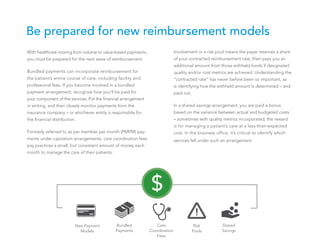
Be prepared for new reimbursement models
$
New Payment
Models
Bundled
Payments
Care
Coordination
Fees
Risk
Pools
Shared
Savings
Next steps
(nerves of steel may be required)
Watch your payers – and your
business – like a hawk
As we’ve seen, thorough contract monitoring is essential
to ensure optimal financial outcomes. Bottom line, at every
turn, you’ve got to watch your business, and watch your rev-
enue cycle, like a hawk.
Make sure you have that business intelligence to run your
practice successfully. Verify that your payments are correct.
If they are not, contact the payer. Look for trends, put them
in writing, and submit them to your provider representative.
If you don’t receive a response, submit a complaint to the
payer’s attorney and a copy to their medical director.
Then, start going up the chain (even bringing in the
insurance commissioner at the state) – and contact your
state medical society.
You have to be your own advocate to make sure you are
paid what you’ve earned. As a first line of defense, intelligent
payer contract monitoring provides the infrastructure you
need for successful revenue outcomes.
Track denied claims — by dollar and type — so you can
compare data on a quarterly basis. Monitoring reimburse-
ments and denials helps you to review contracts to judge
their true contribution to your practice’s bottom line.
Use your practice management system to compare your
expected contracted payment rates with actual payments.
To keep the tracking process from becoming a burden, fo-
cus on contracts that account for the bulk of your practice’s
revenue.
Loading those rates into the system may take time but it
will pay off by alerting you to unannounced changes in fees,
covered services, and more. As payments are posted, the
system or the staff monitoring it should highlight any claims
where payment differs from the contracted amounts. Payers
should be contacted promptly to re-adjudicate claims that
have incorrect payments. Be watchful also for settlements
where no contractual adjustments are made — being paid
at 100 percent of your charge; it may indicate that you are
actually charging less than the payer’s allowable rate – and
could be leaving money on the table.
EDU48-4/15
Take the Next Step.
To learn more about payer contracting strategies
and being paid what you’ve earned, contact us
at 314-989-0300 or info@nextgen.com.
www.nextgen.com/rcm
NextGen Healthcare Information Systems, LLC, a wholly owned subsidiary of Quality
Systems, Inc., provides integrated clinical, financial and connectivity solutions for
ambulatory, inpatient, and dental provider organizations.
For more information, please visit nextgen.com and qsii.com.
Copyright © 2015 NextGen Healthcare Information Systems, LLC. All rights reserved.
NextGen is a registered trademark of QSI Management, LLC, an affiliate of NextGen
Healthcare Information Systems, LLC. All other names and marks are the property of
their respective owners.
NextGen Healthcare Information Systems, LLC
795 Horsham Road, Horsham, PA 19044
p: 215.657.7010 | f: 215.657.7011
insidesales@nextgen.com | nextgen.com
nextgen.com/rcm
For more information about NextGen®
solutions,
please contact us at www.nextgen.com/contact.

RCM

  • 1.
    Get paid whatyou’ve earned Secure a “reliant on beneficiary” clause1 Set time limits on recoupments2 Understand your fee schedule3 Understand termination criteria4 Have an appeals process, in writing5 Know your payers’ business terms, in writing6 Are you ready for the future?7 $ Payer contracting
  • 2.
    Ensure your practiceis set up for success – a strong bottom line is built on a foundation of solid payer contracting. This is where revenue cycle management starts. If you don’t fully understand your payer terms or don’t have them in writing, you’ve set yourself back in 2015 and beyond. We’ll show you why (and how). In this eBook, we’ll talk about some of the important terms to consider in your existing health plan contracts – as well as what you need to look for in contracts you’re preparing to sign or re-negotiate. It’s not uncommon for payers to refuse to negotiate fees, but don’t give up. If they won’t budge on fees, negotiate terms. Contract terms you should scrutinize include timely filing deadlines, recoupments, and terminations. See how getting your payer terms in writing, and conducting intelligent payer contract monitoring, helps provide the fuel you need for better revenue outcomes. Today, good revenue cycle management is critical to practice success. Every penny counts, but they don’t always come easily. Each day can bring a new battle to get paid what you’ve earned – and the sustainability of your multi-million dollar practice depends on whether you prevail.
  • 3.
    1 CHAPTER Secure a “relianton beneficiary” clause
  • 4.
    Because sometimes you’llget the wrong patient insurance information and you won’t realize it until months after filing your claim. Perhaps the patient came in through the hospital emergency room and there was a breakdown in communication. Whatever the case, having the wrong information about the patient’s coverage can become a huge problem for you down the road. A clause in your contract stating that you’re reliant on the patient to provide accurate information about his or her coverage protects you in the event that your claim gets denied based on coverage – and you only learn the correct information about his or her insurance weeks or even months later. Prevent a situation where you have to write those claim fees off. How can you avoid taking a loss when the patient provides incorrect insurance information? It’s important to include a clause in your payer contract stating that you are reliant on the beneficiary (the patient) to present coverage. WHY?
  • 5.
  • 6.
    Make sure you’rein a position to dispute “recoupment,” a common practice in which the payer requests (or just takes) its money back by reducing a remittance for another beneficiary. Known for taking place months— if not years—later, these recoupments can be incredibly frustrating for medical practices. In your contract, set a recoupment time limit based on your applicable state law – or set your own limit, which should be no longer than 12 months after the remittance. Additional contract terms to include are notification requirements and time limits on conducting post-payment audits. No carrier…may…impose a retroactive denial of payment on any claim…relating to the provision of health care services that was submitted within 90 days of the last date of service… unless the carrier…has provided… in writing notice of the intent to…impose such a retroactive denial of payment; [and] not more than 12 months have elapsed since the last date of service; [and the] retroactive denial of payment must be completed…within 18 months of the last date of service. What’s your recoupment time limit? Here’s an example from the state of Georgia’s guidelines: “ “ About half of the states in the U.S. have some sort of guideline for recoupment that insurers must follow. Check with your state insurance commissioner:
  • 7.
  • 8.
    Know what youshould be paid Determine your fee schedule (the allowed amounts) by procedure code, for each payer. It’s critical to know these amounts; on some claims, you may need to request payment from two or even three sources: the payer, the guarantor, and possibly, a secondary payer. So, understand the total price you’re allowed to collect, monitor remittances by payer, and conduct payer audits periodically to make sure you are consistently paid correctly. How do you get this information? Ask your payer for this data. Call the health plan and request your fee schedule. Given the volume of CPT® codes, you might hear some baffled silence on the other end of the phone line. However, what you really need to understand is the schedule for the procedure codes you commonly use. That number is likely somewhere in the much more manageable range of 50 to 150 codes. Even if you only receive 80% of them in writing, it’s better than 0%. Some states have laws that support your right to this knowledge and legally obligate payers to share fee schedules in writing. Consider ways to incorporate the payer’s disclosure of its fee schedules – and requirements for notification of changes in your contract. As a provider you should be aware of discounts for multiple procedures. It is common to see 100%, 50%, or 25% for reimbursement when you perform three procedures. Plus, you can negotiate reimbursements.
  • 9.
    What to dowith this information Once you get this information, it’s great business intelligence to load it into your practice management system, and monitor it. Don’t just assess transactions here or there – evaluate each and every line item that is paid to ensure that you’re being paid what you’ve earned. When choosing a practice management system, look for one that can fully automate this process and is accredited for meeting top standards. (NextGen Healthcare was first to achieve accreditation from the electronic healthcare network accreditation commission (EHNAC) in January 2015. See our press release for more information: http://www.nextgen.com/ About-NextGen/Newsroom.) Determine pricing based on place of service and modifiers. You need to understand that business intelligence in order to ensure accurate, complete reimbursement.
  • 10.
  • 11.
    As networks becomenarrower, hospitals and doctors are increasingly cut out of contracts. Understand payer termination criteria to avoid being stripped of your enrollment and removed from the health plan’s roster. A payer will always propose contract termination terms in its favor. Don’t agree to every term. Start reviewing them carefully. Propose new ones if you feel your practice is at a disadvantage. Review the notice of termination clause. At minimum, it should be delivered in writing no less than 90 days before the effective date. This gives both parties fair warning to end the relationship. Make sure you also tie termination to a change in fee schedule; it doesn’t mean you will reject a fee schedule change, but at least you’ll have 90 (or more) days to consider other options. Make sure every contract has an end date. Avoid an “evergreen provision,” which means the contract automatically renews for another period (typically one to three years) at the same terms (if you don’t give notice to terminate). While you may still want a relationship with the payer, contract renewal should be a golden opportunity to negotiate for better prices or terms. Avoid evergreen provisions; instead, choose to enforce your right to terminate the contract. Understand how termination works
  • 12.
    5 CHAPTER Have an appealsprocess, in writing
  • 13.
    Make sure yourpayer contract includes an appeals process — one that spells out how the initial appeal will be adjudicated, as well as further appeals. A clearly defined appeals process saves time – and headaches – when you decide to fight a payment decision. Ask the payer to agree in writing to a timeframe for the claims appeals process. Request a copy of the forms and attachments required to appeal a claim. These details will allow your business office to establish an efficient denials management process. When submitting an appeal, ask the payer to appoint a reviewer who is an expert in your specialty. Unless you ask, you’ll find that those experts are rarely present for the first appeal, but can be critical to your achieving a subsequent review. Familiarize yourself with the payer’s protocols to understand your options if your first appeal is turned down. Don’t give up; most payers have multiple levels of appeals and a grievance process if you disagree with the outcome. Make a compelling case in your appeal. Develop a professional letter that references the claim number, date of service, and patient; and then, briefly describe the claim in question. Next, describe why the claim should have been paid. If the denial is based on medical necessity, for example, describe the patient benefits of the service. Bolster your argument with objective evidence supporting your case from your specialty society and/or medical literature. If applicable, identify a government payer that reimburses for the service in question. Where appropriate, quote from the payer’s own marketing materials, such as its declaration to provide the best medical care for its beneficiaries. Finally, copy and attach the section of your coding manual that supports your position. Build an appeals process into your contracts
  • 14.
  • 15.
    It may seemself-evident, but when you make changes with the payer on your contract, ensure they give it to you in writing. Your practice could rely on that piece of paper to stay in business. Have the information readily available and know the terms. Maintain copies of each contract, with an electronic “tickler” that alerts you when to re-negotiate. Don’t try for a “blanket” increase. Be smart; negotiate increases on the most frequently performed procedures. You’ll see material financial benefits. Procure any changes to contract terms in writing Items to consider negotiating out of your contracts include: “All products” clauses. You don’t want to be bound to honor the fee schedules and administrative terms of all the other insurance products the payer may choose to sell in your market area. Several states have outlawed these clauses; even if your state doesn’t have an all-products ban, at least propose a prohibition in your contract. Alerts. Because payers make frequent adjustments to fee schedules, ask for a clause in your contracts that requires the payer to alert you, in writing, 60 days prior to making any fee schedule changes. Also, ask that fee schedule changes be treated as a termination of the contract unless both parties agree otherwise in writing. Definitions of key terms. Imprecise terms such as “medical necessity,” “clean claim,” “prompt payment,” and “reasonable notice” are a prescription for lengthy and disruptive appeals unless you demand clear definitions are written into the contract. 1 2 3
  • 16.
    7 CHAPTER Are you readyfor the future?
  • 17.
    With healthcare movingfrom volume to value-based payments, you must be prepared for the next wave of reimbursement. Bundled payments can incorporate reimbursement for the patient’s entire course of care, including facility and professional fees. If you become involved in a bundled payment arrangement, recognize how you’ll be paid for your component of the services. Put the financial arrangement in writing, and then closely monitor payments from the insurance company – or whichever entity is responsible for the financial distribution. Formerly referred to as per member per month (PMPM) pay- ments under capitation arrangements, care coordination fees pay practices a small, but consistent amount of money each month to manage the care of their patients. Involvement in a risk pool means the payer reserves a share of your contracted reimbursement rate, then pays you an additional amount from those withheld funds if designated quality and/or cost metrics are achieved. Understanding the “contracted rate” has never before been so important, as is identifying how the withheld amount is determined – and paid out. In a shared savings arrangement, you are paid a bonus based on the variance between actual and budgeted costs – sometimes with quality metrics incorporated; the reward is for managing a patient’s care at a less-than-expected cost. In the business office, it’s critical to identify which services fall under such an arrangement. Be prepared for new reimbursement models $ New Payment Models Bundled Payments Care Coordination Fees Risk Pools Shared Savings
  • 18.
    Next steps (nerves ofsteel may be required) Watch your payers – and your business – like a hawk As we’ve seen, thorough contract monitoring is essential to ensure optimal financial outcomes. Bottom line, at every turn, you’ve got to watch your business, and watch your rev- enue cycle, like a hawk. Make sure you have that business intelligence to run your practice successfully. Verify that your payments are correct. If they are not, contact the payer. Look for trends, put them in writing, and submit them to your provider representative. If you don’t receive a response, submit a complaint to the payer’s attorney and a copy to their medical director. Then, start going up the chain (even bringing in the insurance commissioner at the state) – and contact your state medical society. You have to be your own advocate to make sure you are paid what you’ve earned. As a first line of defense, intelligent payer contract monitoring provides the infrastructure you need for successful revenue outcomes. Track denied claims — by dollar and type — so you can compare data on a quarterly basis. Monitoring reimburse- ments and denials helps you to review contracts to judge their true contribution to your practice’s bottom line. Use your practice management system to compare your expected contracted payment rates with actual payments. To keep the tracking process from becoming a burden, fo- cus on contracts that account for the bulk of your practice’s revenue. Loading those rates into the system may take time but it will pay off by alerting you to unannounced changes in fees, covered services, and more. As payments are posted, the system or the staff monitoring it should highlight any claims where payment differs from the contracted amounts. Payers should be contacted promptly to re-adjudicate claims that have incorrect payments. Be watchful also for settlements where no contractual adjustments are made — being paid at 100 percent of your charge; it may indicate that you are actually charging less than the payer’s allowable rate – and could be leaving money on the table.
  • 19.
    EDU48-4/15 Take the NextStep. To learn more about payer contracting strategies and being paid what you’ve earned, contact us at 314-989-0300 or info@nextgen.com. www.nextgen.com/rcm NextGen Healthcare Information Systems, LLC, a wholly owned subsidiary of Quality Systems, Inc., provides integrated clinical, financial and connectivity solutions for ambulatory, inpatient, and dental provider organizations. For more information, please visit nextgen.com and qsii.com. Copyright © 2015 NextGen Healthcare Information Systems, LLC. All rights reserved. NextGen is a registered trademark of QSI Management, LLC, an affiliate of NextGen Healthcare Information Systems, LLC. All other names and marks are the property of their respective owners. NextGen Healthcare Information Systems, LLC 795 Horsham Road, Horsham, PA 19044 p: 215.657.7010 | f: 215.657.7011 insidesales@nextgen.com | nextgen.com nextgen.com/rcm For more information about NextGen® solutions, please contact us at www.nextgen.com/contact.