ACCESS Bălţi


IN GOD WE TRUST
   The history of money begins with the first
    minting of coinage in the seventh century BC.
  Money in early history:
blood-money
bride-money
barter


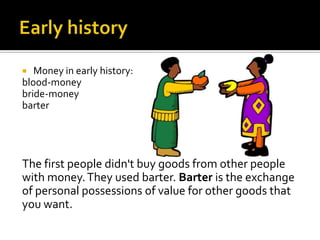
The first people didn't buy goods from other people
with money. They used barter. Barter is the exchange
of personal possessions of value for other goods that
you want.
   This kind of exchange started at the beginning of
    humankind and is still used today. From 9,000-6,000
    B.C., livestock was often used as a unit of exchange.
 Money in stone ages
 Shells
 Feathers
 Pears
(But usings the most rare)

At about 1200 B.C. in China, cowry shells became the
first medium of exchange, or money. The cowry has
served as money throughout history even to the
middle of this century.
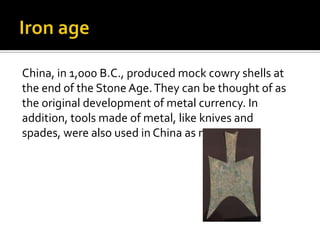
China, in 1,000 B.C., produced mock cowry shells at
the end of the Stone Age. They can be thought of as
the original development of metal currency. In
addition, tools made of metal, like knives and
spades, were also used in China as money.
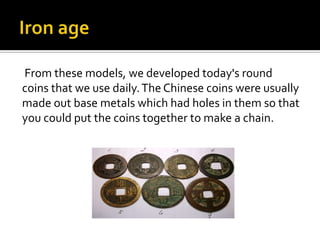
From these models, we developed today's round
coins that we use daily. The Chinese coins were usually
made out base metals which had holes in them so that
you could put the coins together to make a chain.
Gradually peoples reach ideas of one form of
one universal standard .
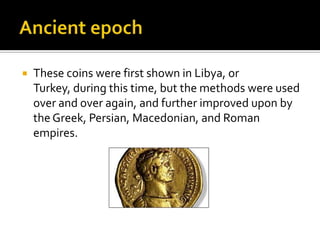
   At about 500 B.C., pieces of silver were the earliest
    coins. Eventually in time they took the appearance
    of today and were imprinted with numerous gods
    and emperors to mark their value.
   These coins were first shown in Libya, or
    Turkey, during this time, but the methods were used
    over and over again, and further improved upon by
    the Greek, Persian, Macedonian, and Roman
    empires.
   Danes in Ireland using noses with money. Yes yes
    noses!
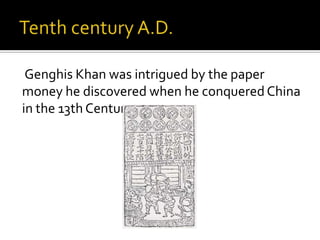
Genghis Khan was intrigued by the paper
money he discovered when he conquered China
in the 13th Century.
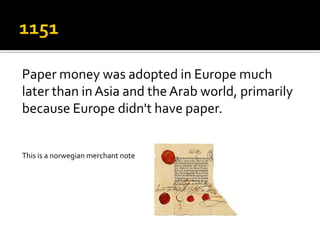
Paper money was adopted in Europe much
later than in Asia and the Arab world, primarily
because Europe didn't have paper.


This is a norwegian merchant note
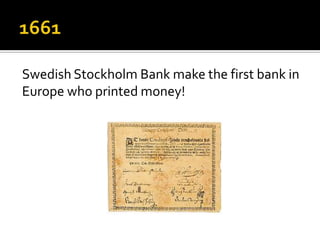
Swedish Stockholm Bank make the first bank in
Europe who printed money!
This is an example of early continental
currency, issued by the U.S. colonists when
they first broke from Britain.
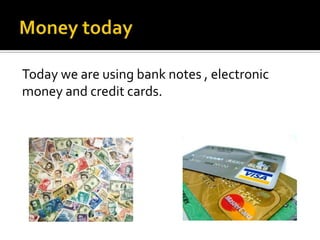
Today we are using bank notes , electronic
money and credit cards.
History ofmoney
History ofmoney
History ofmoney
History ofmoney
History ofmoney

History ofmoney

  • 1.
  • 2.
    The history of money begins with the first minting of coinage in the seventh century BC.
  • 3.
     Moneyin early history: blood-money bride-money barter The first people didn't buy goods from other people with money. They used barter. Barter is the exchange of personal possessions of value for other goods that you want.
  • 4.
    This kind of exchange started at the beginning of humankind and is still used today. From 9,000-6,000 B.C., livestock was often used as a unit of exchange.
  • 5.
     Money instone ages  Shells  Feathers  Pears (But usings the most rare) At about 1200 B.C. in China, cowry shells became the first medium of exchange, or money. The cowry has served as money throughout history even to the middle of this century.
  • 6.
    China, in 1,000B.C., produced mock cowry shells at the end of the Stone Age. They can be thought of as the original development of metal currency. In addition, tools made of metal, like knives and spades, were also used in China as money.
  • 7.
    From these models,we developed today's round coins that we use daily. The Chinese coins were usually made out base metals which had holes in them so that you could put the coins together to make a chain.
  • 8.
    Gradually peoples reachideas of one form of one universal standard .
  • 9.
    At about 500 B.C., pieces of silver were the earliest coins. Eventually in time they took the appearance of today and were imprinted with numerous gods and emperors to mark their value.
  • 10.
    These coins were first shown in Libya, or Turkey, during this time, but the methods were used over and over again, and further improved upon by the Greek, Persian, Macedonian, and Roman empires.
  • 11.
    Danes in Ireland using noses with money. Yes yes noses!
  • 12.
    Genghis Khan wasintrigued by the paper money he discovered when he conquered China in the 13th Century.
  • 13.
    Paper money wasadopted in Europe much later than in Asia and the Arab world, primarily because Europe didn't have paper. This is a norwegian merchant note
  • 14.
    Swedish Stockholm Bankmake the first bank in Europe who printed money!
  • 15.
    This is anexample of early continental currency, issued by the U.S. colonists when they first broke from Britain.
  • 16.
    Today we areusing bank notes , electronic money and credit cards.