How, When and Where
Synopsis
1. Introduction
2. Meaning
3. Caste system
4. Character name James Rennel
5. Britannica/ East India Company
6. History is referred to as a span of
time.
7. Criteria to select a set of dates
8. Warren Hastings
9. Criteria to periodise
10. Prior to British Rule
11. Classification of Indian history
12. Time notation
13. Change of modern period to
colonial
Introduction to History
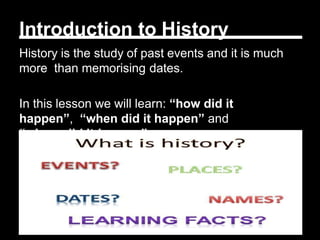
History is the study of past events and it is much
more than memorising dates.
In this lesson we will learn: “how did it
happen”, “when did it happen” and
“where did it happen”.
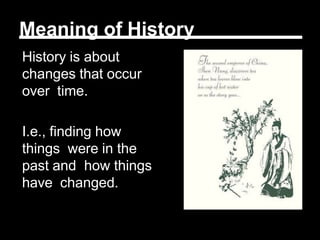
Meaning of History
History is about
changes that occur
over time.
I.e., finding how
things were in the
past and how things
have changed.
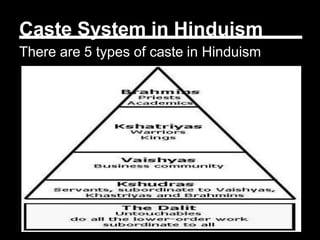
Caste System in Hinduism
There are 5 types of caste in Hinduism
James Rennel
He was born on Dec 3, 1742 in
England and died on March 29,
1830.
He was the leading British
Geographer of his time. He
constructed the first nearly
accurate map of India.
He joined East India Company
and became Surveyor General
of Bengal (1764-77)
Britannica/East India Company
English company formed for the exploitation of
trade with East and Southeast Asia and India.
Incorporated by Royal Charter on December 31,
1600.
Started as a monopolistic trading body, the
company became involved in politics and acted
as an agent of British imperialism in India from the
early-18th century to the mid-19th century.
The activities of the company in China in the
19th century also served as a catalyst for the
expansion of British influence there.
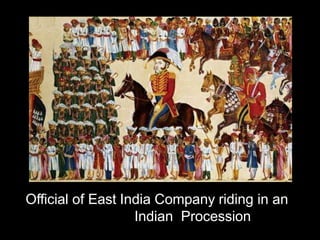
Official of East India Company riding in an
Indian Procession
History is Referred to Span of
Time
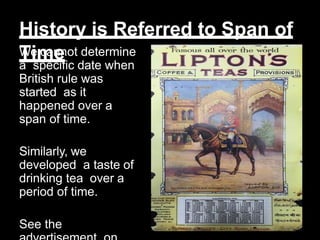
We cannot determine
a specific date when
British rule was
started as it
happened over a
span of time.
Similarly, we
developed a taste of
drinking tea over a
period of time.
See the
Past versus present state of
history
Earlier history was associated with string of dates.
This was because history used to keep a track of
battles and big events.
At present, history is a wider concept which
includes ‘how’ and ‘what’ concepts.
For example, how people earned their livelihood,
what did they produce, and eat? Etc.
Criteria to select a set of dates
Dates become important when we assume
that a particular set of events are important.
Most of the history in India was written by
British historians. These historians started
writing with the rule of first Governor-General,
Warren Hastings and ended with the last
Viceroy, Lord Mountbatten.
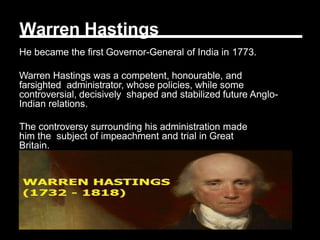
Warren Hastings
He became the first Governor-General of India in 1773.
Warren Hastings was a competent, honourable, and
farsighted administrator, whose policies, while some
controversial, decisively shaped and stabilized future Anglo-
Indian relations.
The controversy surrounding his administration made
him the subject of impeachment and trial in Great
Britain.
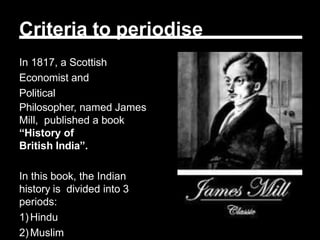
Criteria to periodise
In 1817, a Scottish
Economist and
Political
Philosopher, named James
Mill, published a book
“History of
British India”.
In this book, the Indian
history is divided into 3
periods:
1)Hindu
2)Muslim
Prior to British Rule
Before Britishers took over India, there were Hindu
and Muslims rulers who used to exploit India.
Furthermore, India strongly believed in: caste
systems, multiple religions, superstitions, etc.
James Mill felt that only British rule could civilise
India and teach them manners, arts and laws.
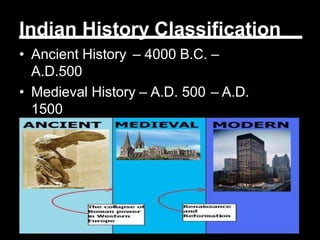
Indian History Classification
• Ancient History – 4000 B.C. –
A.D.500
• Medieval History – A.D. 500 – A.D.
1500
• Modern History – A.D. 1500 –
Present
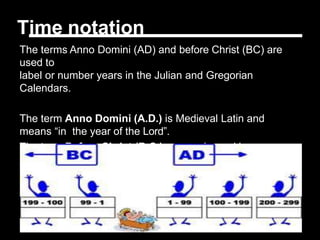
Time notation
The terms Anno Domini (AD) and before Christ (BC) are
used to
label or number years in the Julian and Gregorian
Calendars.
The term Anno Domini (A.D.) is Medieval Latin and
means “in the year of the Lord”.
The term Before Christ (B.C.) an epoch used in
dating years prior to the estimated birth of Jesus.
Modern period changed to
Colonial
Modern period is related to growth of all the forces of
modernism. But under the British rule, people were
not getting modernised. Therefore the name
changed to Colonial period.
When the subjugation of one country by another
leads to political, economic, social and cultural
changes this is the process of Colonisation.
Sources of writing history
Sources that historians use in writing about last 250
years on Indian history includes:
1) Official records of the British Administration - For
British, the act of writing was crucial. So every plan,
policy agreement was in writing. This led to
administrative culture of memos, noting and reports.
British also kept all the documents preserved in the
record room which was attached to all administrative
institutions. Moreover these documents were written
by calligraphists, who specialised in the art of
beautiful writing.
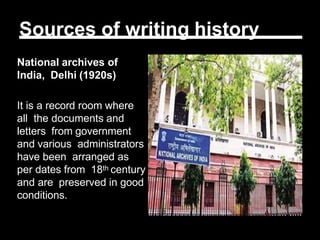
Sources of writing history
National archives of
India, Delhi (1920s)
It is a record room where
all the documents and
letters from government
and various administrators
have been arranged as
per dates from 18th century
and are preserved in good
conditions.
Sources of writing history
2) Conducting surveys - Conducting surveys
was common under colonial administration.
The British believed that a country had to be
properly known before it could be effectively
administered.
By the early 19th century, detailed surveys were
being carried out to map the entire country.
For Example: forest survey, zoological survey,
etc.
What official records do not
tell
1)Records do not tell what other people in the
country felt.
2)Only dairies of people, travellers,
autobiographies of important personalities can tell
about literate people.
3)No record of the history is available for the
Tribals, peasants, workers or the poor.
Any Question?
Thank You!
Let us see this vedeo clip.
https://www.youtube.com/watch?v=FHCz2WdfWKY

History ch 1 ppt

  • 1.
  • 2.
    Synopsis 1. Introduction 2. Meaning 3.Caste system 4. Character name James Rennel 5. Britannica/ East India Company 6. History is referred to as a span of time. 7. Criteria to select a set of dates 8. Warren Hastings 9. Criteria to periodise 10. Prior to British Rule 11. Classification of Indian history 12. Time notation 13. Change of modern period to colonial
  • 3.
    Introduction to History Historyis the study of past events and it is much more than memorising dates. In this lesson we will learn: “how did it happen”, “when did it happen” and “where did it happen”.
  • 4.
    Meaning of History Historyis about changes that occur over time. I.e., finding how things were in the past and how things have changed.
  • 5.
    Caste System inHinduism There are 5 types of caste in Hinduism
  • 6.
    James Rennel He wasborn on Dec 3, 1742 in England and died on March 29, 1830. He was the leading British Geographer of his time. He constructed the first nearly accurate map of India. He joined East India Company and became Surveyor General of Bengal (1764-77)
  • 7.
    Britannica/East India Company Englishcompany formed for the exploitation of trade with East and Southeast Asia and India. Incorporated by Royal Charter on December 31, 1600. Started as a monopolistic trading body, the company became involved in politics and acted as an agent of British imperialism in India from the early-18th century to the mid-19th century. The activities of the company in China in the 19th century also served as a catalyst for the expansion of British influence there.
  • 8.
    Official of EastIndia Company riding in an Indian Procession
  • 9.
    History is Referredto Span of Time We cannot determine a specific date when British rule was started as it happened over a span of time. Similarly, we developed a taste of drinking tea over a period of time. See the
  • 10.
    Past versus presentstate of history Earlier history was associated with string of dates. This was because history used to keep a track of battles and big events. At present, history is a wider concept which includes ‘how’ and ‘what’ concepts. For example, how people earned their livelihood, what did they produce, and eat? Etc.
  • 11.
    Criteria to selecta set of dates Dates become important when we assume that a particular set of events are important. Most of the history in India was written by British historians. These historians started writing with the rule of first Governor-General, Warren Hastings and ended with the last Viceroy, Lord Mountbatten.
  • 12.
    Warren Hastings He becamethe first Governor-General of India in 1773. Warren Hastings was a competent, honourable, and farsighted administrator, whose policies, while some controversial, decisively shaped and stabilized future Anglo- Indian relations. The controversy surrounding his administration made him the subject of impeachment and trial in Great Britain.
  • 13.
    Criteria to periodise In1817, a Scottish Economist and Political Philosopher, named James Mill, published a book “History of British India”. In this book, the Indian history is divided into 3 periods: 1)Hindu 2)Muslim
  • 14.
    Prior to BritishRule Before Britishers took over India, there were Hindu and Muslims rulers who used to exploit India. Furthermore, India strongly believed in: caste systems, multiple religions, superstitions, etc. James Mill felt that only British rule could civilise India and teach them manners, arts and laws.
  • 15.
    Indian History Classification •Ancient History – 4000 B.C. – A.D.500 • Medieval History – A.D. 500 – A.D. 1500 • Modern History – A.D. 1500 – Present
  • 16.
    Time notation The termsAnno Domini (AD) and before Christ (BC) are used to label or number years in the Julian and Gregorian Calendars. The term Anno Domini (A.D.) is Medieval Latin and means “in the year of the Lord”. The term Before Christ (B.C.) an epoch used in dating years prior to the estimated birth of Jesus.
  • 17.
    Modern period changedto Colonial Modern period is related to growth of all the forces of modernism. But under the British rule, people were not getting modernised. Therefore the name changed to Colonial period. When the subjugation of one country by another leads to political, economic, social and cultural changes this is the process of Colonisation.
  • 18.
    Sources of writinghistory Sources that historians use in writing about last 250 years on Indian history includes: 1) Official records of the British Administration - For British, the act of writing was crucial. So every plan, policy agreement was in writing. This led to administrative culture of memos, noting and reports. British also kept all the documents preserved in the record room which was attached to all administrative institutions. Moreover these documents were written by calligraphists, who specialised in the art of beautiful writing.
  • 19.
    Sources of writinghistory National archives of India, Delhi (1920s) It is a record room where all the documents and letters from government and various administrators have been arranged as per dates from 18th century and are preserved in good conditions.
  • 20.
    Sources of writinghistory 2) Conducting surveys - Conducting surveys was common under colonial administration. The British believed that a country had to be properly known before it could be effectively administered. By the early 19th century, detailed surveys were being carried out to map the entire country. For Example: forest survey, zoological survey, etc.
  • 21.
    What official recordsdo not tell 1)Records do not tell what other people in the country felt. 2)Only dairies of people, travellers, autobiographies of important personalities can tell about literate people. 3)No record of the history is available for the Tribals, peasants, workers or the poor.
  • 22.
    Any Question? Thank You! Letus see this vedeo clip. https://www.youtube.com/watch?v=FHCz2WdfWKY