SLIDESMANIA.COM
SLIDESMANIA.COM
Historical
Foundation
SLIDESMANIA.COM
SLIDESMANIA.COM
Presented by
Barrozo, Clariza Joy M.
Chavez, Amiel Joseph B.
Dianca, Ahmnah M.
Maala, Ana May M.
Malonzo, Janelle Elise Y.
Nicolas, Alecks M.
Perez, Paula Lynne M.
Punla, Richelle L.
Punzalan, Ryan Homer V.
Reyes, Camilo III M.
SLIDESMANIA.COM
SLIDESMANIA.COM
Contents
Curriculum theorists and how they view
curriculum from a historical perspective.
Historical Foundations of Curriculum
HISTORICAL – LEGAL PERSPECTIVE OF
THE PHILIPPINE EDUCATIONAL SYSTEM
01
02
03
SLIDESMANIA.COM
01
Curriculum theorists and how they view
curriculum from a historical perspective.
we will talk about this first…
SLIDESMANIA.COM
SLIDESMANIA.COM
(1876- 1956)
Franklin
Bobbit
-Curriculum science emphasizes students’ needs.
-The curriculum prepares students for adult life.
SLIDESMANIA.COM
SLIDESMANIA.COM
(1875-1952)
Werret
Charters
- Listing of objectives and matching these with
corresponding activities ensures that the content or
subject matter is related to objectives.
- Subject matter and the activities are planned by the
teacher.
SLIDESMANIA.COM
SLIDESMANIA.COM
(1886-1960)
Harold Rugg
-Develop the whole child.
-Emphasized social studies and the teacher plans
curriculum in advance.
SLIDESMANIA.COM
SLIDESMANIA.COM
(1901-1989)
Hollis
Caswell
-Organized knowledge and learner’s interest.
-Believes that curriculum is a set of experiences.
-Subject matter is developed around social functions
and learners’ interests.
SLIDESMANIA.COM
SLIDESMANIA.COM
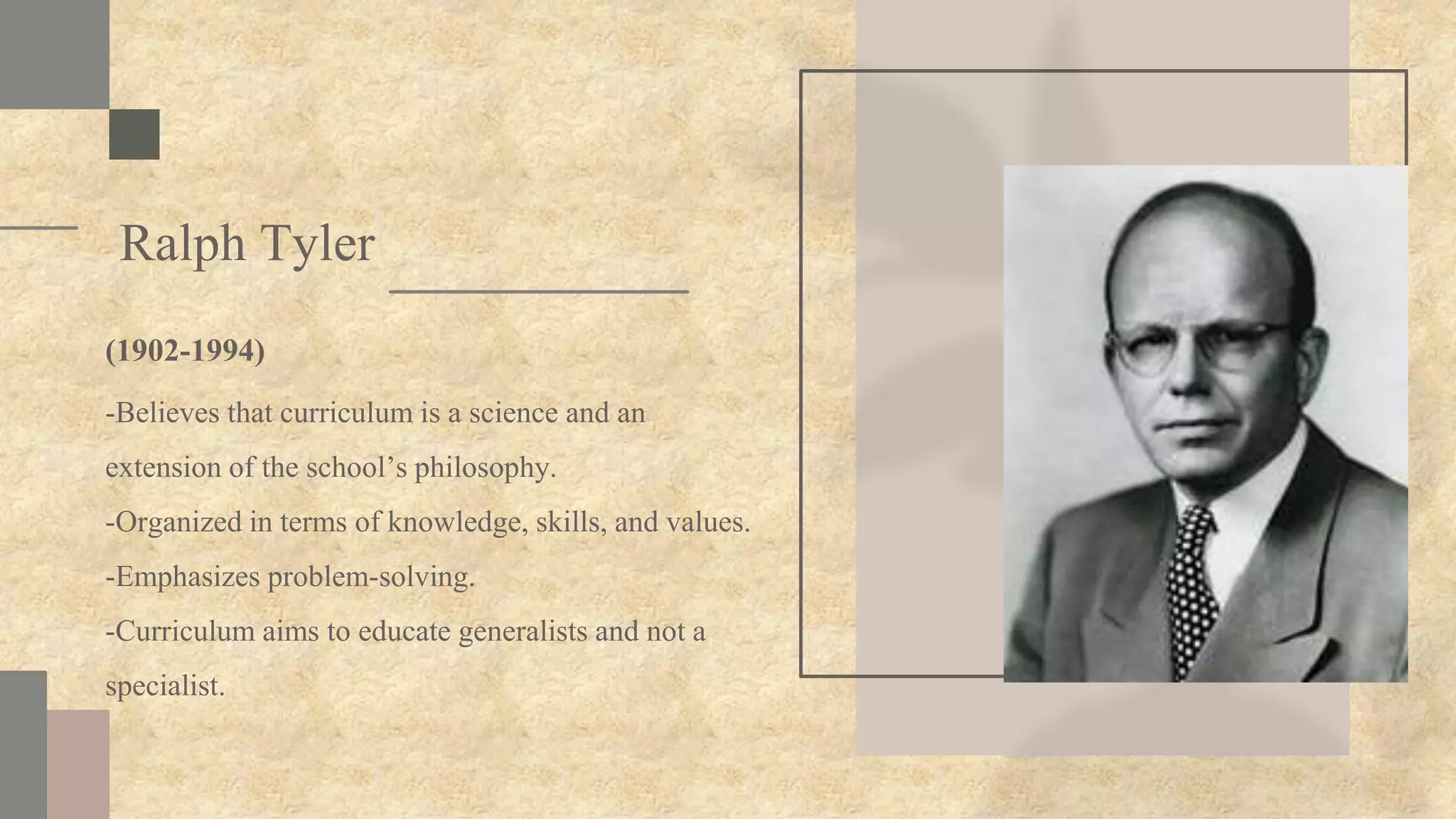
(1902-1994)
Ralph Tyler
-Believes that curriculum is a science and an
extension of the school’s philosophy.
-Organized in terms of knowledge, skills, and values.
-Emphasizes problem-solving.
-Curriculum aims to educate generalists and not a
specialist.
SLIDESMANIA.COM
02
Historical Foundations of Curriculum
Let’s proceed to…
SLIDESMANIA.COM
Early Christian
Education
The curriculum of the early Christian schools
comprised the teaching of discipline, church
doctrine, moral standards, Christian theology,
science, mathematics, and astronomy
SLIDESMANIA.COM
The
Renaissance
-Increase request for knowledge and thirst for
adventure ‘humanistic schools’.
-Emphasized the study of man as a prerequisite to
understanding man’s role and contribution to
society.
SLIDESMANIA.COM
The
Renaissance
H.G.Good (1960) states that the university then
developed faculties to cater for:
Studies in liberal arts
Law studies
Medicine
Theology
SLIDESMANIA.COM
The
Reformation
Ignatius of Loyola developed an expanded and
advanced curriculum as a counter-movement to
the reformation in Jesuit schools. (Cubberley
1968)
SLIDESMANIA.COM
The Scientific
Movement
-Sixteenth-century
-Francis Bacon led to the philosophy of realism,
which has three district phases, with various
curriculum implications.
Humanistic Realism.
Social Realism.
Sense Realism.
SLIDESMANIA.COM
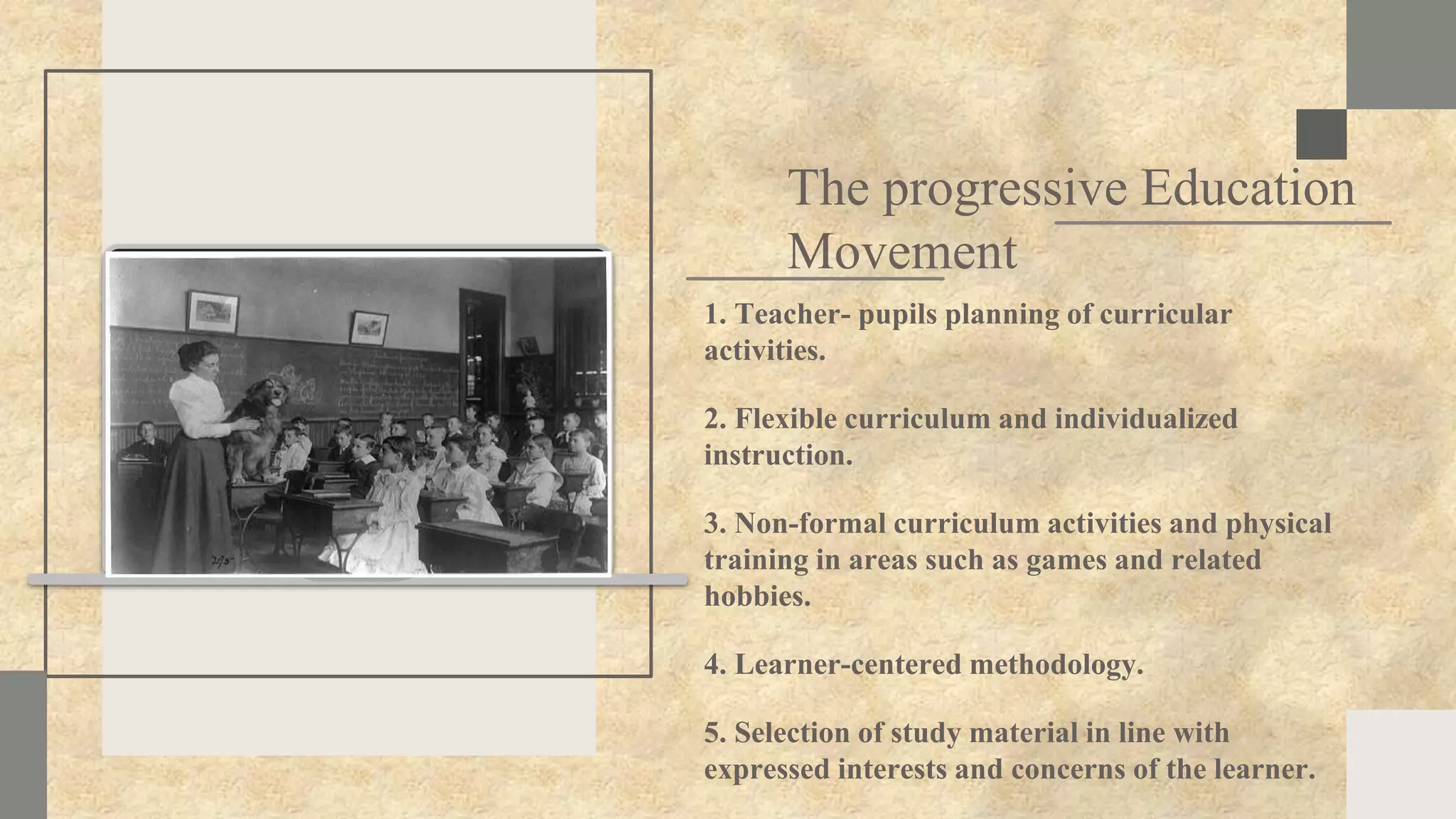
The progressive Education
Movement
-Advocates of the progressive movement.
-Emphasized five approaches to the
teaching/learning process.
SLIDESMANIA.COM
The progressive Education
Movement
1. Teacher- pupils planning of curricular
activities.
2. Flexible curriculum and individualized
instruction.
3. Non-formal curriculum activities and physical
training in areas such as games and related
hobbies.
4. Learner-centered methodology.
5. Selection of study material in line with
expressed interests and concerns of the learner.
SLIDESMANIA.COM
03
HISTORICAL – LEGAL
PERSPECTIVE OF THE
PHILIPPINE EDUCATIONAL
SYSTEM
And last…
SLIDESMANIA.COM
This is where you section ends. Duplicate this set of slides as many times you need to go over all your sections.
SLIDESMANIA.COM
This is where you section ends. Duplicate this set of slides as many times you need to go over all your sections.
SLIDESMANIA.COM
Do you have any questions?
thank you!

Historical Foundation.pptx