Hip Pointer
Emily Carda & Holly Zimmer
Definition:
A hip pointer is a
contusion (bruise) on
the pelvis caused by
direct blow to the iliac
crest.
Preventions
o Maintaining excellent
flexibility, strength and
endurance of the hip, pelvis and
lower back muscles may
prevent some hip pointers.
o For athletes it is important to
wear proper padding to prevent
a traumatic blow.
o Most, however, are the
unfortunate result of significant
contact and are not preventable
Causes:
 Hip pointer injuries
usually occur in contact
sports, from a collision,
or from falling directly
onto the hip.
 Hip pointers injuries can
occur in contact sports
such as football or
hockey. It may also be
caused by a fall onto the
hip in sports such as
soccer or skiing.
Diagnosis
o Hip pointers present with a
history of a contact injury in
the area.
o Pain and tenderness along
the crest of pelvis is also seen.
o The patient may walk with a
limp and have difficulty
moving the hip away from the
body against resistance. X-
rays are taken to rule out
fractures.
Signs/Symptoms
* Severe pain on upper, outside part of the
iliac crest
* Tenderness in the top area of your hip
* Pain with activity
* Swelling
* Bruising
* Soreness
* Muscle spasms
* Decreased range of motion
* Limp/abnormal gait
General Treatment
Physical examination in a person with a suspected hip
pointer should include:
- Abdominal examination to exclude trauma to intra-
abdominal organs
- Visual inspection
- Palpation
- Passive and active ROM assessment
- Sensory testing
- Gait analysis
General Treatment continued…
Hip pointers may be treated with:
* Rest
* Nonsteroidal antiinflammatory
drugs (NSAIDs)
* Ice
* For severe pain, your doctor may
inject a steroid directly into your
hip
Physical Therapy
o On average it takes 1 to 3 weeks to recover from a
hip pointer.
o In more serious cases of hip pointer, the hit can be
so severe that a fracture of the bone results. While
the treatment may not change, a fracture will likely
cause a delay in healing and more painful
symptoms.
o A physical therapist may be recommended to help
you regain mobility and build muscle strength.
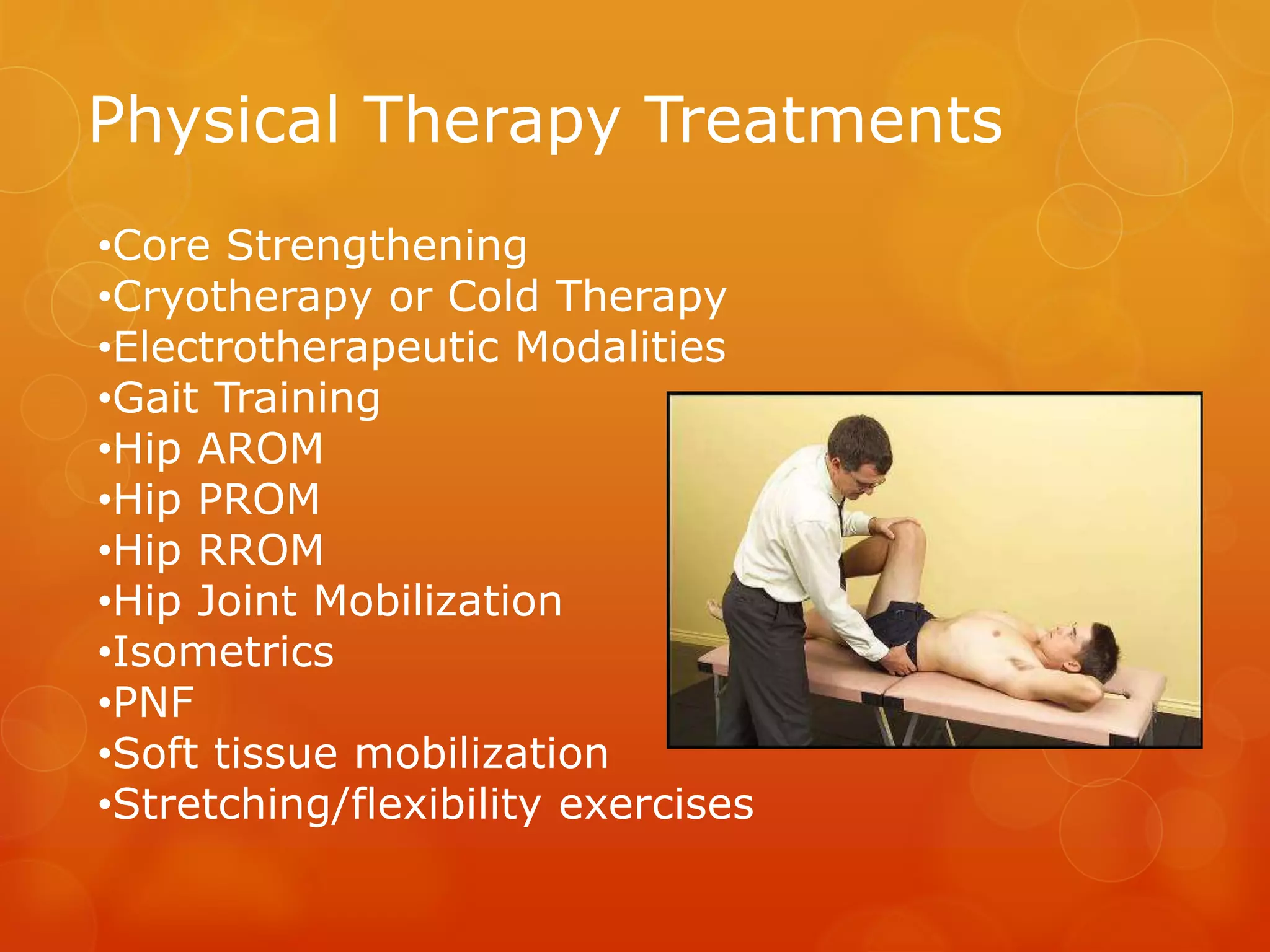
Physical Therapy Treatments
•Core Strengthening
•Cryotherapy or Cold Therapy
•Electrotherapeutic Modalities
•Gait Training
•Hip AROM
•Hip PROM
•Hip RROM
•Hip Joint Mobilization
•Isometrics
•PNF
•Soft tissue mobilization
•Stretching/flexibility exercises
Possible Treatment Goals
•Improve Fitness
•Improve Function
•Improve Muscle Strength and Power
•Increase Oxygen to Tissues
•Improve Proprioception
•Improve Range of Motion
•Self-care of Symptoms
Muscles involved in Hip
Pointers
Sartorious
Rectus Femoris
Abdominals
Tensor Fascia Lata
Sartorious
 The sartorious is a muscle that has its origin at the
anterior superior iliac spine on the iliac crest.
 Injury to the sartorious is the most common cause
of hip pointer.
 The sartorious muscle helps with:
• Abduction
• Lateral/External rotation
• Hip flexion
• Knee Flexion
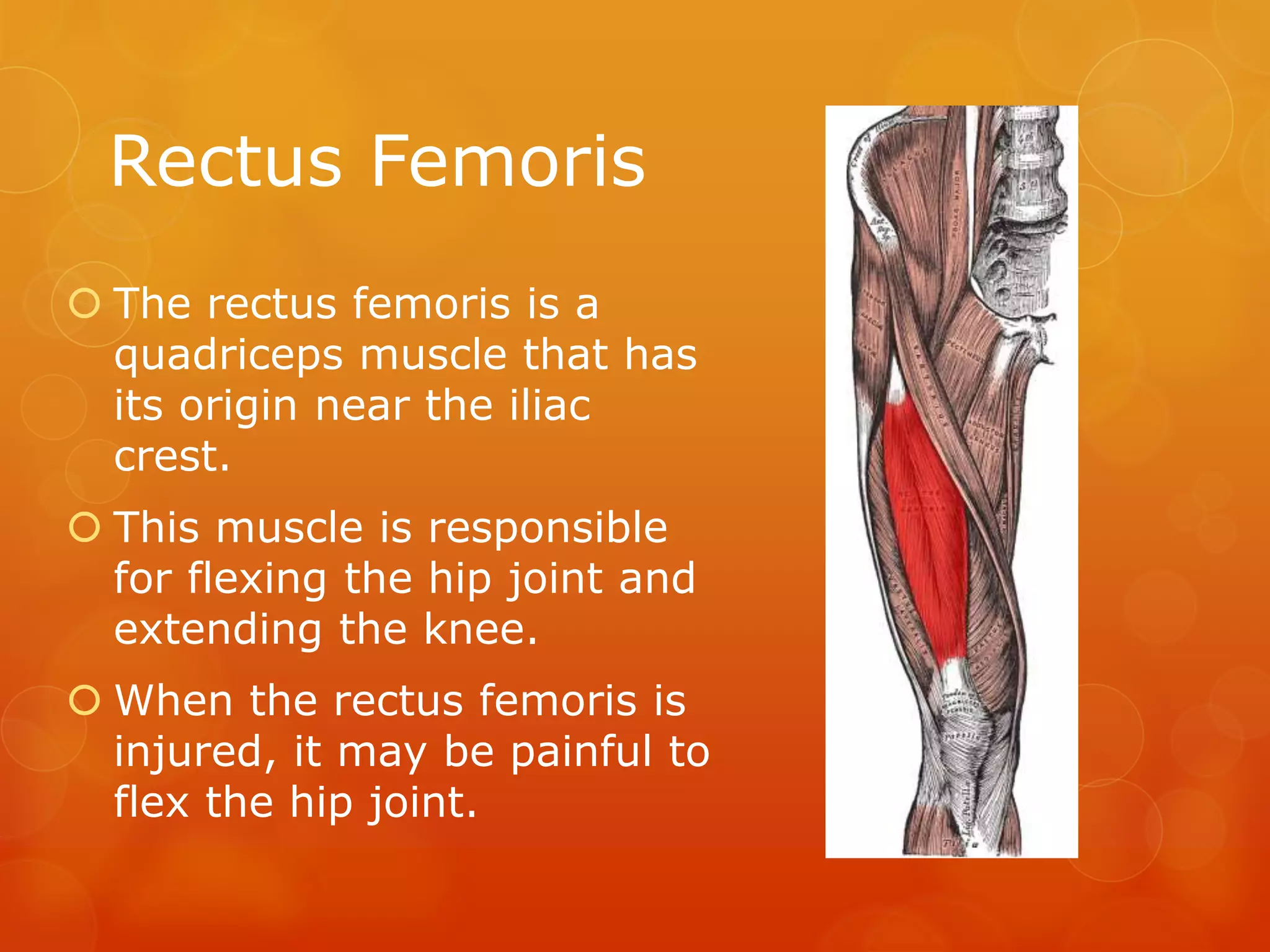
Rectus Femoris
 The rectus femoris is a
quadriceps muscle that has
its origin near the iliac
crest.
 This muscle is responsible
for flexing the hip joint and
extending the knee.
 When the rectus femoris is
injured, it may be painful to
flex the hip joint.
Tensor Fascia Lata
 The tensor fascia lata is
a gluteal muscle that has
its origin at the anterior
superior iliac spine and
on the anterior part of
the iliac crest.
 It is responsible for
abducting, flexing and
medially/internally
rotating the femur.
 When the tensor fascia
lata is bruised, moving
the hip can be painful.
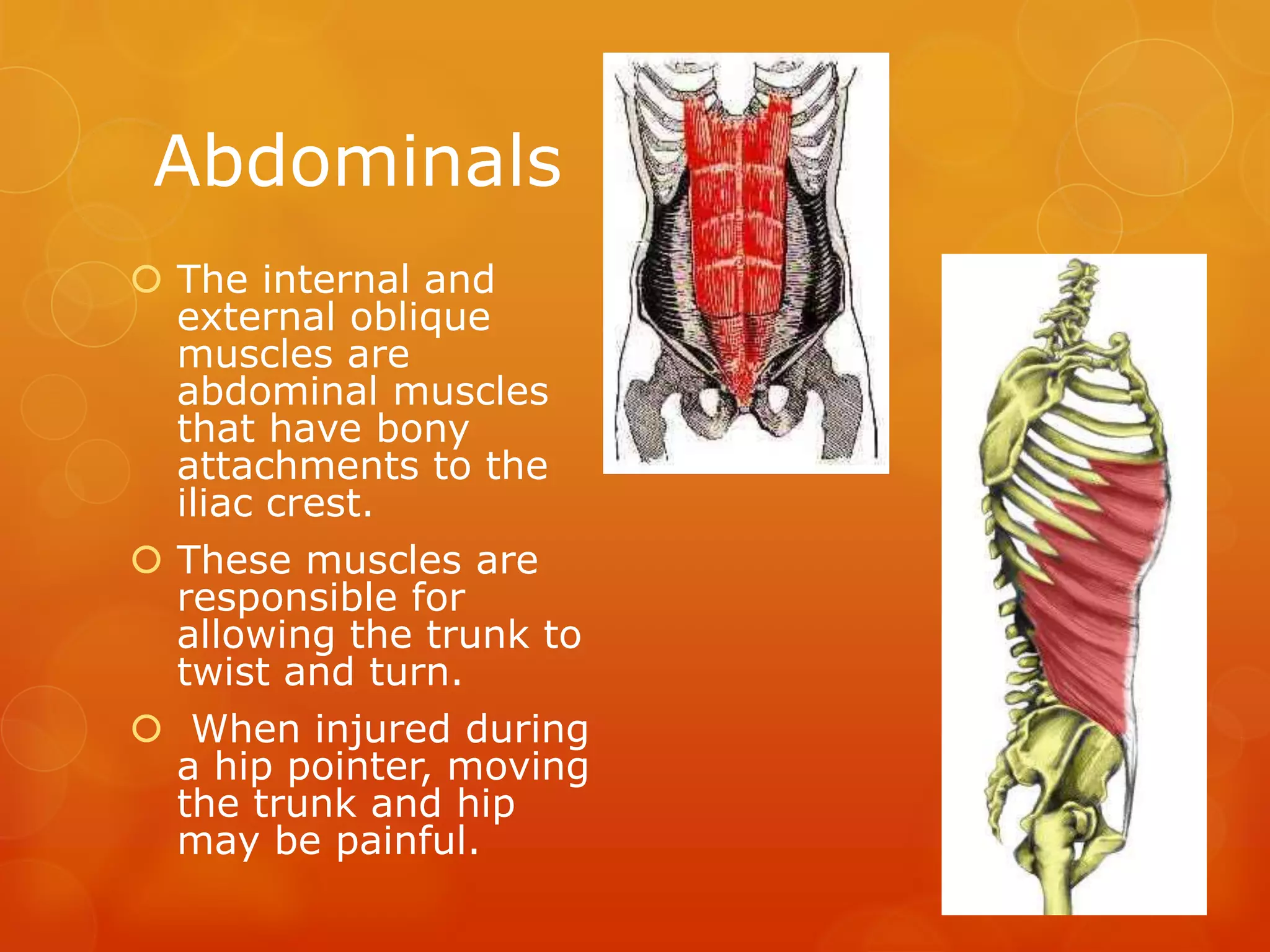
Abdominals
 The internal and
external oblique
muscles are
abdominal muscles
that have bony
attachments to the
iliac crest.
 These muscles are
responsible for
allowing the trunk to
twist and turn.
 When injured during
a hip pointer, moving
the trunk and hip
may be painful.
Bibliography
 29, Brown June. "Hip Injuries | Injury/Pain | Core Knowledge |
Core Performance." Core Performance | Powered by Athletes'
Performance. 29 June 2009. Web. 22 Nov. 2010.
<http://www.coreperformance.com/knowledge/injury-pain/hip-
injuries.html>.
 Waryasz, Gregory. "Hip Pointer Injuries | LIVESTRONG.COM."
LIVESTRONG.COM - Health, Fitness, Lifestyle | LIVESTRONG.COM.
12 May 2010. Web. 22 Nov. 2010.
<http://www.livestrong.com/article/121671-hip-pointer-injuries/>.
 Martinez, John M. "Hip Pointer: EMedicine Sports Medicine." EMedicine -
Medical Reference. 6 Mar. 2009. Web. 19 Nov. 2010.
<http://emedicine.medscape.com/article/87322-overview>.
 Kellicker, Patricia. "Hip Pointers - EmpowHER.com." Women's Health
and Wellness Information, Tips - EmpowHER.com - Improving Health,
Changing Lives. Nov. 2008. Web. 22 Nov. 2010.
<http://www.empowher.com/media/reference/hip-pointers>.

Hip pointer presentation em and holly[1]

  • 1.
  • 2.
    Definition: A hip pointeris a contusion (bruise) on the pelvis caused by direct blow to the iliac crest.
  • 3.
    Preventions o Maintaining excellent flexibility,strength and endurance of the hip, pelvis and lower back muscles may prevent some hip pointers. o For athletes it is important to wear proper padding to prevent a traumatic blow. o Most, however, are the unfortunate result of significant contact and are not preventable
  • 4.
    Causes:  Hip pointerinjuries usually occur in contact sports, from a collision, or from falling directly onto the hip.  Hip pointers injuries can occur in contact sports such as football or hockey. It may also be caused by a fall onto the hip in sports such as soccer or skiing.
  • 5.
    Diagnosis o Hip pointerspresent with a history of a contact injury in the area. o Pain and tenderness along the crest of pelvis is also seen. o The patient may walk with a limp and have difficulty moving the hip away from the body against resistance. X- rays are taken to rule out fractures.
  • 6.
    Signs/Symptoms * Severe painon upper, outside part of the iliac crest * Tenderness in the top area of your hip * Pain with activity * Swelling * Bruising * Soreness * Muscle spasms * Decreased range of motion * Limp/abnormal gait
  • 7.
    General Treatment Physical examinationin a person with a suspected hip pointer should include: - Abdominal examination to exclude trauma to intra- abdominal organs - Visual inspection - Palpation - Passive and active ROM assessment - Sensory testing - Gait analysis
  • 8.
    General Treatment continued… Hippointers may be treated with: * Rest * Nonsteroidal antiinflammatory drugs (NSAIDs) * Ice * For severe pain, your doctor may inject a steroid directly into your hip
  • 9.
    Physical Therapy o Onaverage it takes 1 to 3 weeks to recover from a hip pointer. o In more serious cases of hip pointer, the hit can be so severe that a fracture of the bone results. While the treatment may not change, a fracture will likely cause a delay in healing and more painful symptoms. o A physical therapist may be recommended to help you regain mobility and build muscle strength.
  • 10.
    Physical Therapy Treatments •CoreStrengthening •Cryotherapy or Cold Therapy •Electrotherapeutic Modalities •Gait Training •Hip AROM •Hip PROM •Hip RROM •Hip Joint Mobilization •Isometrics •PNF •Soft tissue mobilization •Stretching/flexibility exercises
  • 11.
    Possible Treatment Goals •ImproveFitness •Improve Function •Improve Muscle Strength and Power •Increase Oxygen to Tissues •Improve Proprioception •Improve Range of Motion •Self-care of Symptoms
  • 12.
    Muscles involved inHip Pointers Sartorious Rectus Femoris Abdominals Tensor Fascia Lata
  • 13.
    Sartorious  The sartoriousis a muscle that has its origin at the anterior superior iliac spine on the iliac crest.  Injury to the sartorious is the most common cause of hip pointer.  The sartorious muscle helps with: • Abduction • Lateral/External rotation • Hip flexion • Knee Flexion
  • 14.
    Rectus Femoris  Therectus femoris is a quadriceps muscle that has its origin near the iliac crest.  This muscle is responsible for flexing the hip joint and extending the knee.  When the rectus femoris is injured, it may be painful to flex the hip joint.
  • 15.
    Tensor Fascia Lata The tensor fascia lata is a gluteal muscle that has its origin at the anterior superior iliac spine and on the anterior part of the iliac crest.  It is responsible for abducting, flexing and medially/internally rotating the femur.  When the tensor fascia lata is bruised, moving the hip can be painful.
  • 16.
    Abdominals  The internaland external oblique muscles are abdominal muscles that have bony attachments to the iliac crest.  These muscles are responsible for allowing the trunk to twist and turn.  When injured during a hip pointer, moving the trunk and hip may be painful.
  • 17.
    Bibliography  29, BrownJune. "Hip Injuries | Injury/Pain | Core Knowledge | Core Performance." Core Performance | Powered by Athletes' Performance. 29 June 2009. Web. 22 Nov. 2010. <http://www.coreperformance.com/knowledge/injury-pain/hip- injuries.html>.  Waryasz, Gregory. "Hip Pointer Injuries | LIVESTRONG.COM." LIVESTRONG.COM - Health, Fitness, Lifestyle | LIVESTRONG.COM. 12 May 2010. Web. 22 Nov. 2010. <http://www.livestrong.com/article/121671-hip-pointer-injuries/>.  Martinez, John M. "Hip Pointer: EMedicine Sports Medicine." EMedicine - Medical Reference. 6 Mar. 2009. Web. 19 Nov. 2010. <http://emedicine.medscape.com/article/87322-overview>.  Kellicker, Patricia. "Hip Pointers - EmpowHER.com." Women's Health and Wellness Information, Tips - EmpowHER.com - Improving Health, Changing Lives. Nov. 2008. Web. 22 Nov. 2010. <http://www.empowher.com/media/reference/hip-pointers>.

Editor's Notes

  • #3 The term hip pointer is somewhat confusing. It can refer to a deep bruise of the muscle and bone, a small chip fracture or even a complete break. Typically, however, this term refers to a severe bruise and not a fracture.
  • #4 Here you are looking at two different types of padding an athlete may wear that can help in preventing a hip pointer.
  • #7 Typically, the patient presents with the sudden onset of hip pain in the iliac crest or greater trochanteric region after sustaining trauma. If you have any of these symptoms do not assume it is due to a hip pointer. These may be caused by other conditions. But these are a few things you may see if you have a hip pointer: * Severe pain on upper, outside part of the iliac crest * Tenderness in the top area of your hip * Pain with activity * Swelling * Bruising * Soreness * Muscle spasms * Decreased range of motion  pain can limit range of motion (ROM) at the hip joint and/or rotation of the trunk if the abdominal musculature is involved * Limp/abnormal gait As you can see in the photo, the patient has severe bruising right around the iliac crest region along with some swelling.
  • #9 Rest - Rest 24-48 hours to prevent further damage. A hip pointer needs time to heal itself. Ice - Apply ice packs for 15-20 minutes, 3-4 times a day for the first 24-72 hours, but don’t apply ice directly to the skin. 
  • #11 Core Strengthening Cryotherapy or Cold Therapy – ice massage Electrotherapeutic Modalities Gait Training Hip AROM  Hip PROM  Hip ROM should be performed in all directions (flexion/extension, internal/external rotation, abduction/adduction) Hip RROM  Hip Joint Mobilization Isometrics PNF Soft tissue mobilization Stretching/flexibility exercises - standing hamstring stretch, the quad stretch, trunk rotation and double knee to chest stretch will help maintain good range of motion and strength of the hip.
  • #13 These muscles are muscles that need to be look at for strengthening and stretching in treatments with a hip pointer patient.
  • #14 A hip pointer injury involving the sartorious muscle can make moving the hip painful.