Pelvis, Hip and Thigh
Pathologies
Competencies in Athletic Training
SEATA Athletic Training Student Symposium
Dr. Patricia M. Tripp, ATC, LAT, CSCS
Clinical Associate Professor &
Director, AT Program
Key Points to Consider…
• Static and Dynamic Clinical Anatomy
• Angle of Inclination, Angle of Torsion and
Osteo/Arthrokinematics
• Postural Screening and Observational Gait
Analysis and Core Engagement
• Kinetic Chain Linking [Hip-Pelvis Motion
Patterns CKC]
• Specialized Assessment Techniques
• Lower Quarter Screen
What we will cover…
• Clinical Anatomy - Review
• Biomechanical Factors
• Clinical Examination of the
Pelvis, Hip and Thigh
• Pathologies and Related
Specialized Tools/Tests
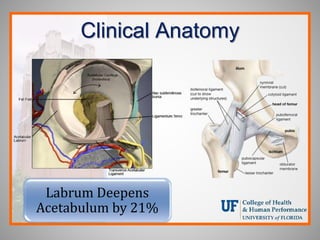
Clinical Anatomy
Clinical Anatomy
Labrum Deepens
Acetabulum by 21%
Clinical Anatomy
Spin = Same Direction
as Motion
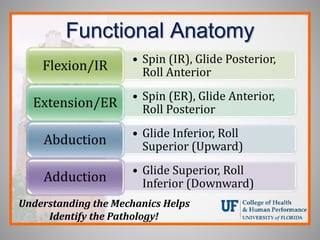
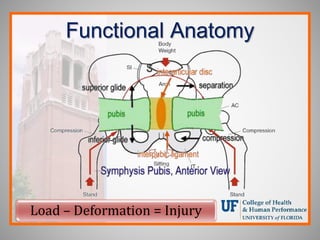
Functional Anatomy
• Spin (IR), Glide Posterior,
Roll Anterior
Flexion/IR
• Spin (ER), Glide Anterior,
Roll Posterior
Extension/ER
• Glide Inferior, Roll
Superior (Upward)
Abduction
• Glide Superior, Roll
Inferior (Downward)
Adduction
Understanding the Mechanics Helps
Identify the Pathology!
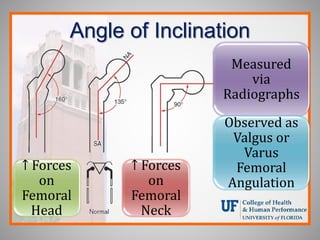
Angle of Inclination
Measured
via
Radiographs
Observed as
Valgus or
Varus
Femoral
Angulation
↑ Forces
on
Femoral
Head
↑ Forces
on
Femoral
Neck
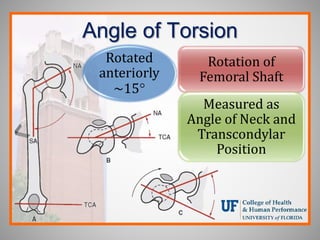
Angle of Torsion
Rotation of
Femoral Shaft
Measured as
Angle of Neck and
Transcondylar
Position
Rotated
anteriorly
~15
Structural vs. Compensatory
• Toe Out Gait Pattern – Reduced IROT at Hip
Structural
Alignment between
Femur and
Acetabulum/Pelvis
• Greater than 12°-
15° degree
Anterior
Relationship
[Anteversion]
Decreased
Anterior Femur
Head/Neck -
Condyles Alignment
• “Twisting of
Femur”
compensates for
Posterior
Femoral Head
position
Structural vs. Compensatory
• Toe In Gait Pattern – Reduced EROT at Hip
Structural Alignment
between Femur and
Acetabulum/Pelvis
• Less than 12°-15°
degree Anterior
Relationship
[Retroversion]
Increased Anterior
Femur Head/Neck -
Condyles Alignment
• “Twisting of
Femur”
compensates for
Anterior Femoral
Head position
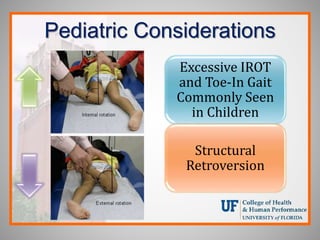
Pediatric Considerations
Excessive IROT
and Toe-In Gait
Commonly Seen
in Children
Structural
Retroversion
Include Postural
Assessment and Gait
Observational Analysis
Muscle Activity – Gait
1. Flexibility – Necessary for Efficient Shock
Absorption (Stance)
2. Stability – Necessary for Efficient
Propulsion (Stance and Swing)
3. Full ROM – Necessary for Efficient
Muscular Reponses (Stance and Swing)
4. Concentric and Eccentric Strength –
Efficient Shock Absorption and Forward
Movement (Stance and Swing)
Synergistic Motion
Hip Flexion/Internal
Rotation and
Posterior Pelvic
Tilting
Hip
Extension/External
Rotation and
Anterior Pelvic
Tilting
Walking Gait Muscle
Mechanics
Stance Phase of Gait - Eccentric Control of
Pelvis and Shock Absorption (Thigh),
Flexibility of Hip Flexors Required for
Efficiency
Swing Phase of Gait – Stability and Strength
for Toe Clearance and Limb Advancement,
Eccentric Hamstring Control Lower Leg
Functional Anatomy
Load – Deformation = Injury
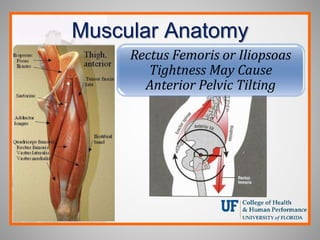
Muscular Anatomy
Rectus Femoris or Iliopsoas
Tightness May Cause
Anterior Pelvic Tilting
Muscular Function
Lower Cross
Syndrome
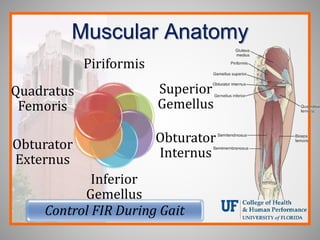
Muscular Anatomy
Piriformis
Superior
Gemellus
Obturator
Internus
Inferior
Gemellus
Obturator
Externus
Quadratus
Femoris
Control FIR During Gait
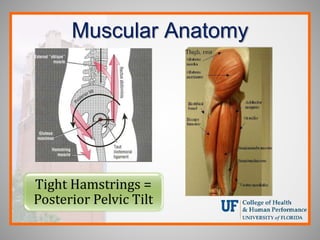
Muscular Anatomy
Tight Hamstrings =
Posterior Pelvic Tilt
Engaging the Core (TA)
Fascial Connection
Between Iliopsoas
and Diaphragm
Engaging the Transverse
Yoga and Pilates®
Postures
Primary Hip Bursae
 Friction
Between Gluteus
Maximus and
Bony
Prominences
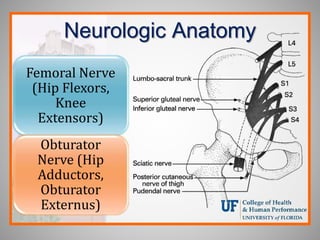
Neurologic Anatomy
Femoral Nerve
(Hip Flexors,
Knee
Extensors)
Obturator
Nerve (Hip
Adductors,
Obturator
Externus)
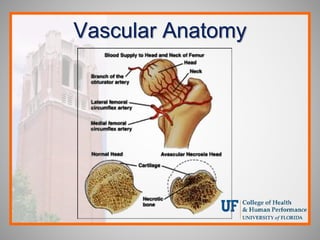
Vascular Anatomy
CLINICAL EXAMINATION
OF THE PELVIS, HIP AND
THIGH
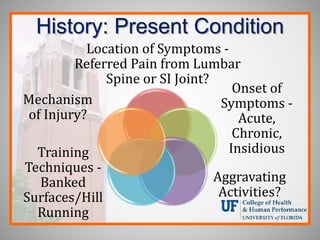
History: Present Condition
Location of Symptoms -
Referred Pain from Lumbar
Spine or SI Joint?
Onset of
Symptoms -
Acute,
Chronic,
Insidious
Aggravating
Activities?
Training
Techniques -
Banked
Surfaces/Hill
Running
Mechanism
of Injury?
Inspection
Postural
Assessment
Gait Analysis
Running Gait
Analysis
Functional
Movement
Screening
Deformity or
Defect
HP
Height
[Leg
Length,
Long-Sit
Test]
Atrophy?
Ecchymosis
Swelling
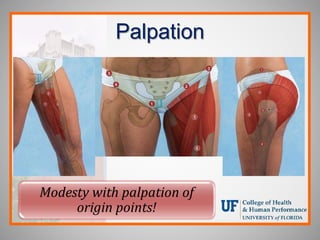
Palpation
Modesty with palpation of
origin points!
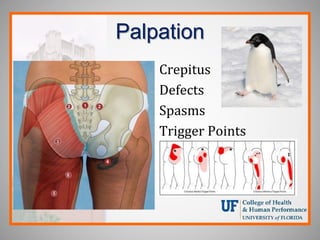
Palpation
• Crepitus
• Defects
• Spasms
• Trigger Points
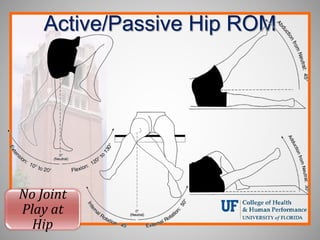
Active/Passive Hip ROM
No Joint
Play at
Hip
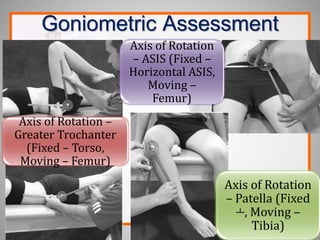
Goniometric Assessment
Axis of Rotation –
Greater Trochanter
(Fixed – Torso,
Moving – Femur)
Axis of Rotation
– ASIS (Fixed –
Horizontal ASIS,
Moving –
Femur)
Axis of Rotation
– Patella (Fixed
┴, Moving –
Tibia)
MMT (Eccentric) Hip
Hip Flexion: Iliopsoas
Knee Extended:
Quadriceps + Iliopsoas
FABER: Sartorius
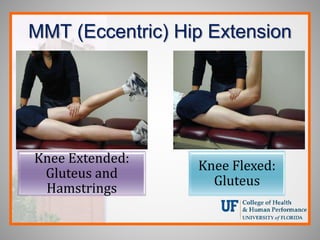
MMT (Eccentric) Hip Extension
Knee Extended:
Gluteus and
Hamstrings
Knee Flexed:
Gluteus
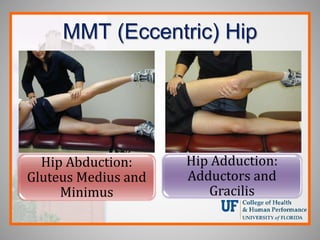
MMT (Eccentric) Hip
Hip Abduction:
Gluteus Medius and
Minimus
Hip Adduction:
Adductors and
Gracilis
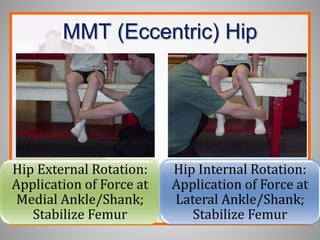
MMT (Eccentric) Hip
Hip External Rotation:
Application of Force at
Medial Ankle/Shank;
Stabilize Femur
Hip Internal Rotation:
Application of Force at
Lateral Ankle/Shank;
Stabilize Femur
Specialized Tests and
Examination Techniques
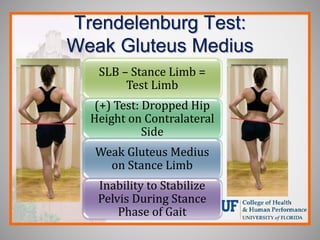
Trendelenburg Test:
Weak Gluteus Medius
SLB – Stance Limb =
Test Limb
(+) Test: Dropped Hip
Height on Contralateral
Side
Weak Gluteus Medius
on Stance Limb
Inability to Stabilize
Pelvis During Stance
Phase of Gait
Thomas Test – Muscle Length
Implications
•Hip Flexion –
Iliopsoas Tightness
•Knee Extension –
Rectus Femoris
Tightness
•Hip Abduction – IT
Band Tightness
Ely’s Test – Muscle Length
Prone Passive Knee
Flexion: (+) Test:
Hip Flexion
Implications:
Tight/Shortened
Rectus Femoris
[Anterior Pelvic
Tilting]
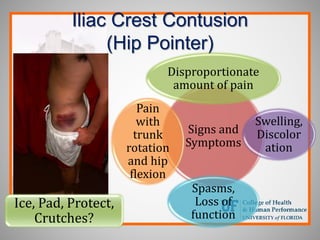
Iliac Crest Contusion
(Hip Pointer)
Signs and
Symptoms
Disproportionate
amount of pain
Swelling,
Discolor
ation
Spasms,
Loss of
function
Pain
with
trunk
rotation
and hip
flexion
Ice, Pad, Protect,
Crutches?
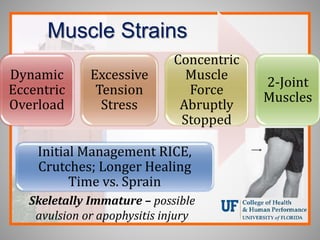
Muscle Strains
Dynamic
Eccentric
Overload
Excessive
Tension
Stress
Concentric
Muscle
Force
Abruptly
Stopped
2-Joint
Muscles
Initial Management RICE,
Crutches; Longer Healing
Time vs. Sprain
Skeletally Immature – possible
avulsion or apophysitis injury
Rectus Femoris
(Quadriceps) Strain
• Contraction/Dynamic
Overload
• Pain with Activation
and Stretching
Palpable Defect, Ecchymosis,
Swelling, Gait Changes
depend on Grade I-III
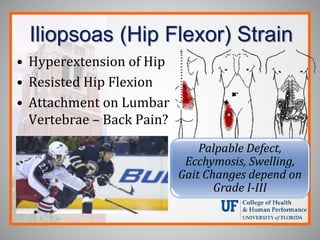
Iliopsoas (Hip Flexor) Strain
• Hyperextension of Hip
• Resisted Hip Flexion
• Attachment on Lumbar
Vertebrae – Back Pain?
Palpable Defect,
Ecchymosis, Swelling,
Gait Changes depend on
Grade I-III
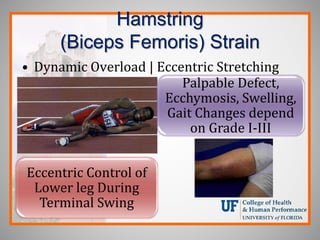
Hamstring
(Biceps Femoris) Strain
• Dynamic Overload | Eccentric Stretching
Palpable Defect,
Ecchymosis, Swelling,
Gait Changes depend
on Grade I-III
Eccentric Control of
Lower leg During
Terminal Swing
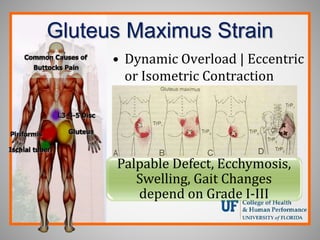
Gluteus Maximus Strain
• Dynamic Overload | Eccentric
or Isometric Contraction
Palpable Defect, Ecchymosis,
Swelling, Gait Changes
depend on Grade I-III
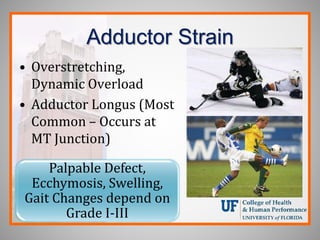
Adductor Strain
• Overstretching,
Dynamic Overload
• Adductor Longus (Most
Common – Occurs at
MT Junction)
Palpable Defect,
Ecchymosis, Swelling,
Gait Changes depend on
Grade I-III
Thigh Contusion
Direct Trauma (Acute)
• Muscle Fiber Death
Signs and Symptoms
• Pain, Loss of Function,
Ecchymosis, Swelling,
ROM Restrictions,
Spasm
Management
• RICE, Crutches 24hrs?
Complication
• Myositis Ossificans
24hrs post-
injury = critical
Ice on Stretch
(>120°) =
Faster RTP
Pediatric Considerations
Legg-Calvé-Perthes
Disease (LCP)
• Flattening of Femoral
Head;  Hip IROT and
Abduction (Avascular
Necrosis; ages 3-12)
Slipped Capital
Femoral Epiphysis
(SCFE)
• Excessive Hip EROT
and Restricted or
Painful Hip IROT (♂,
ages 10-15)
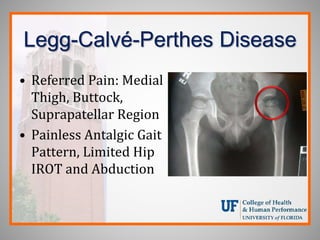
Legg-Calvé-Perthes Disease
• Referred Pain: Medial
Thigh, Buttock,
Suprapatellar Region
• Painless Antalgic Gait
Pattern, Limited Hip
IROT and Abduction
Slipped Captial Femoral
Epiphysis
Common in Boys,
Typically Unilateral
(20% Bilateral)
Anteversion of Hip,
Toe-Out Gait
(EROT),  IROT
Clinical
Management:
Surgical Fixation
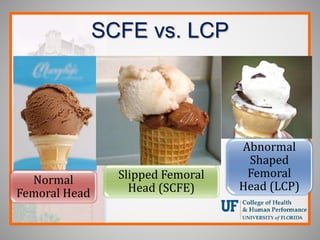
SCFE vs. LCP
Normal
Femoral Head
Slipped Femoral
Head (SCFE)
Abnormal
Shaped
Femoral
Head (LCP)
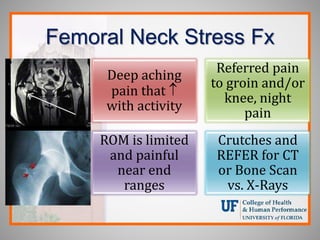
Femoral Neck Stress Fx
Deep aching
pain that 
with activity
Referred pain
to groin and/or
knee, night
pain
ROM is limited
and painful
near end
ranges
Crutches and
REFER for CT
or Bone Scan
vs. X-Rays
Femoral Neck Stress Fx
Superior
Femoral Neck
Stress Fractures
“Tension-Side”
Inferior
Femoral Neck
Stress Fractures
“Compression –
Side”
FABER Test
• Intra-articular
Pathology
• Anterior or
Deep
Hip/Groin Pain
Reported
• Pincer FAI –
Pain with EROT
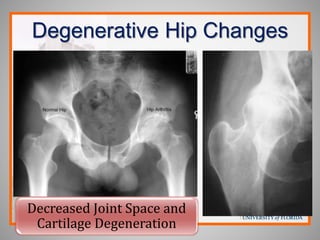
Degenerative Hip Changes
Decreased Joint Space and
Cartilage Degeneration
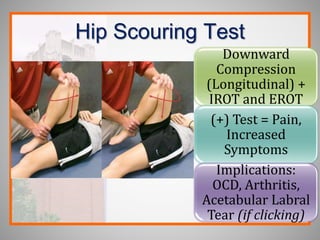
Hip Scouring Test
Downward
Compression
(Longitudinal) +
IROT and EROT
(+) Test = Pain,
Increased
Symptoms
Implications:
OCD, Arthritis,
Acetabular Labral
Tear (if clicking)
C-Sign and Log Roll Test
“Groin Pain” and (+) “C” Sign and Pain with
Log Roll Test [Intra-articular Pathology]
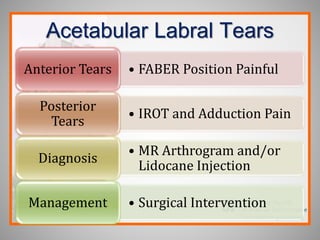
Acetabular Labral Tears
• FABER Position Painful
Anterior Tears
• IROT and Adduction Pain
Posterior
Tears
• MR Arthrogram and/or
Lidocane Injection
Diagnosis
• Surgical Intervention
Management
Labral Tears
Right Hip
Labral “Clock”
Sagittal T1 Weighted MR
Arthrogram – Labral
Separation from Acetabulum
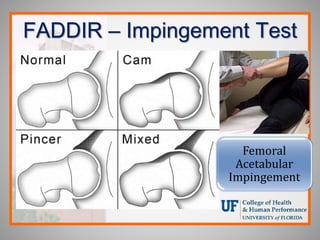
FADDIR – Impingement Test
Femoral
Acetabular
Impingement
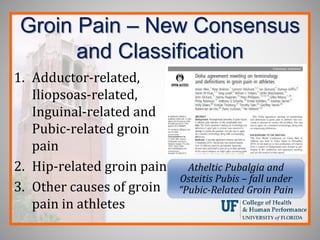
Groin Pain – New Consensus
and Classification
1. Adductor-related,
Iliopsoas-related,
Inguinal-related and
Pubic-related groin
pain
2. Hip-related groin pain
3. Other causes of groin
pain in athletes
Atheltic Pubalgia and
Osteitis Pubis – fall under
“Pubic-Related Groin Pain
Groin Stress Biomechanics
Cutting/ twisting at high
speeds
Shear forces transmitted to
pubic symphysis
Common among Soccer,
Hockey, Football
Pubic-Related Groin Pain
MRI Referral –
Edema Pubic
Rami
Pelvic Floor
Reconstruction
Surgery [6
Weeks RTP]
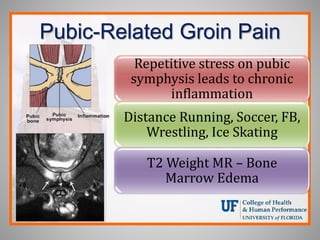
Pubic-Related Groin Pain
Repetitive stress on pubic
symphysis leads to chronic
inflammation
Distance Running, Soccer, FB,
Wrestling, Ice Skating
T2 Weight MR – Bone
Marrow Edema
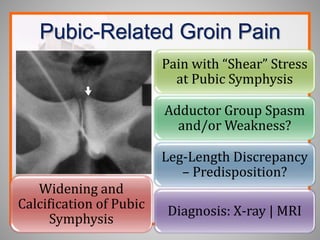
Pubic-Related Groin Pain
Pain with “Shear” Stress
at Pubic Symphysis
Adductor Group Spasm
and/or Weakness?
Leg-Length Discrepancy
– Predisposition?
Diagnosis: X-ray | MRI
Widening and
Calcification of Pubic
Symphysis
Copenhagen Hip and Groin
Outcome Score (HAGOS)
1. Pain
2. Symptoms
3. Physical function in ADLs
4. Physical Sport and Recreation Function
5. Participation in Physical Activities
6. Hip and/or Groin-Related Quality of Life
HAGOS Intraclass Correlation
Coefficients (ICC) ranging from 0.82-0.91
for the six subscales
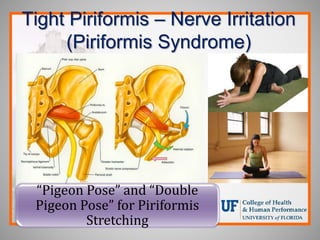
Tight Piriformis – Nerve Irritation
(Piriformis Syndrome)
“Pigeon Pose” and “Double
Pigeon Pose” for Piriformis
Stretching
Snapping Hip Syndrome
(Coxa Saltans)
External - IT
Band/Gluteus Maximus
Internal - Iliopsoas
Tendon (Lateral Shift
with Flexion, Medial
Shift with Extension)
FABER with Extension/IR
Moving from a FABER position into Extension
and IROT – Snapping Hip of Iliopsoas
[Lesser Trochanter]
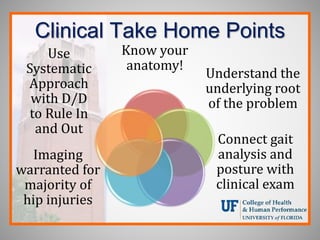
Clinical Take Home Points
Know your
anatomy!
Understand the
underlying root
of the problem
Connect gait
analysis and
posture with
clinical exam
Imaging
warranted for
majority of
hip injuries
Use
Systematic
Approach
with D/D
to Rule In
and Out

Pelvis, Hip and Thigh Pathologies.pptx