©2008 HIMSS Analytics, LLC.
The Premier EMR Adoption Assessment Tool
HIMSS Analytics, the authoritative source on EMR Adoption trends, devised the EMR Adoption Model (EMRAM) to
track EMR progress at hospitals and health systems. The EMRAM scores hospitals in the HIMSS Analytics 	
Database on their progress in completing the 8 stages to creating a paperless patient record environment.
Hospital executives that participate in HIMSS Analytics’ Annual Study can access their EMRAM score and 	
compare it to similar facilities (by bed size, patient days, etc.) as well as compare their score to their state’s
average score.
Visit www.himssanalytics.org for the country’s most recent
EMR Adoption Model scores.
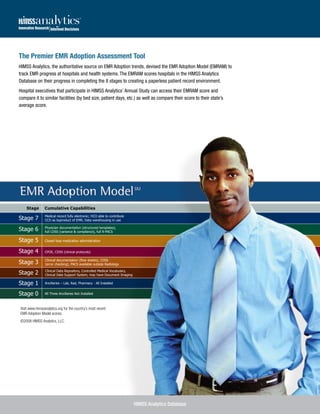
Medical record fully electronic; HCO able to contribute
CCD as byproduct of EMR; Data warehousing in use
Physician documentation (structured templates),
full CDSS (variance & compliance), full R-PACS
Closed loop medication administration
CPOE, CDSS (clinical protocols)
Clinical documentation (flow sheets), CDSS
(error checking), PACS available outside Radiology
Clinical Data Repository, Controlled Medical Vocabulary,
Clinical Data Support System, may have Document Imaging
Ancillaries – Lab, Rad, Pharmacy - All Installed
All Three Ancillaries Not Installed
Stage 7
Stage 6
Stage 5
Stage 4
Stage 3
Stage 2
Stage 1
Stage 0
Stage Cumulative Capabilities
HIMSS Analytics Database
EMR Adoption Model Structure Ensures Objectivity
	 •	 All application capabilities within each stage must be operational before that stage can be achieved.
	 •	 All lower stages must have been achieved before a higher level is considered as achieved.  
	 •	 A hospital can achieve Stages 3-6 if it has met all of the application requirements for a single patient care 	 	
		 service (e.g. single nursing floor, cardiology service).
	 •	 Using the rules above, additional points are given for the implementation of applications in stages higher 	 	
		 than the one fully achieved by the healthcare organization. In this fashion, other implementation paths than 		
	 	 those prescribed by the stages can be taken into consideration for correlation with quality and 	 	 	
		 financial research.
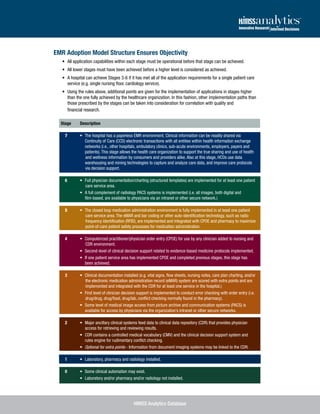
Stage	 Description
	 7	 •	 The hospital has a paperless EMR environment. Clinical information can be readily shared via 	 	
	 	 	 Continuity of Care (CCD) electronic transactions with all entities within health information exchange
	 	 	 networks (i.e., other hospitals, ambulatory clinics, sub-acute environments, employers, payers and
			 patients). This stage allows the health care organization to support the true sharing and use of health 	
	 	 	 	and wellness information by consumers and providers alike. Also at this stage, HCOs use data 	 	
			 warehousing and mining technologies to capture and analyze care data, and improve care protocols 	
				via decision support.
	 6	 •	 Full physician documentation/charting (structured templates) are implemented for at least one patient 	
				care service area.
	 	 •	 A full complement of radiology PACS systems is implemented (i.e. all images, both digital and 	 	
	 	 	 film-based, are available to physicians via an intranet or other secure network.)
	 5	 •	 The closed loop medication administration environment is fully implemented in at least one patient 	
	 	 	 	care service area. The eMAR and bar coding or other auto-identification technology, such as radio 	
	 	 	 	frequency identification (RFID), are implemented and integrated with CPOE and pharmacy to maximize 	
	 	 	 	point-of-care patient safety processes for medication administration.
	 4	 •	 Computerized practitioner/physician order entry (CPOE) for use by any clinician added to nursing and 	
	 	 	 	CDR environment.
	 	 •	 Second-level of clinical decision support related to evidence-based medicine protocols implemented.
	 	 •	 If one patient service area has implemented CPOE and completed previous stages, this stage has 		
			 been achieved.
	 3	 •	 Clinical documentation installed (e.g. vital signs, flow sheets, nursing notes, care plan charting, and/or 	
				the electronic medication administration record (eMAR) system are scored with extra points and are 	
	 	 	 	implemented and integrated with the CDR for at least one service in the hospital.)
	 	 •	 First level of clinician decision support is implemented to conduct error checking with order entry (i.e. 	
	 	 	 	drug/drug, drug/food, drug/lab, conflict checking normally found in the pharmacy).
	 	 •	 Some level of medical image access from picture archive and communication systems (PACS) is 	 	
			 available for access by physicians via the organization’s intranet or other secure networks.
	 2	 •	 Major ancillary clinical systems feed data to clinical data repository (CDR) that provides physician 		
			 access for retrieving and reviewing results.
	 	 •	 CDR contains a controlled medical vocabulary (CMV) and the clinical decision support system and 		
			 rules engine for rudimentary conflict checking.
	 	 •	 Optional for extra points - Information from document imaging systems may be linked to the CDR.  
	 1	 •	 Laboratory, pharmacy and radiology installed.  
	 0	 •	 Some clinical automation may exist.
	 	 •	 Laboratory and/or pharmacy and/or radiology not installed.
HIMSS Analytics Database
About HIMSS Analytics
HIMSS Analytics is a wholly owned not-for-profit subsidiary of the Healthcare Information and Management Systems
Society (HIMSS). The company collects and analyzes healthcare information related to IT processes and environments,
products, IS department composition and costs, IS department management metrics, healthcare trends and purchase-
related decisions. HIMSS Analytics delivers high quality products, services and analytical expertise to healthcare
delivery organizations, healthcare IT companies, state governments, financial companies, pharmaceutical companies,
and consulting firms.
Please contact us for more information on our products and services.
866-546-2900
info@himssanalytics.org
www.himssanalytics.org

HIMSS EMRAM US 2008

  • 1.
    ©2008 HIMSS Analytics,LLC. The Premier EMR Adoption Assessment Tool HIMSS Analytics, the authoritative source on EMR Adoption trends, devised the EMR Adoption Model (EMRAM) to track EMR progress at hospitals and health systems. The EMRAM scores hospitals in the HIMSS Analytics Database on their progress in completing the 8 stages to creating a paperless patient record environment. Hospital executives that participate in HIMSS Analytics’ Annual Study can access their EMRAM score and compare it to similar facilities (by bed size, patient days, etc.) as well as compare their score to their state’s average score. Visit www.himssanalytics.org for the country’s most recent EMR Adoption Model scores. Medical record fully electronic; HCO able to contribute CCD as byproduct of EMR; Data warehousing in use Physician documentation (structured templates), full CDSS (variance & compliance), full R-PACS Closed loop medication administration CPOE, CDSS (clinical protocols) Clinical documentation (flow sheets), CDSS (error checking), PACS available outside Radiology Clinical Data Repository, Controlled Medical Vocabulary, Clinical Data Support System, may have Document Imaging Ancillaries – Lab, Rad, Pharmacy - All Installed All Three Ancillaries Not Installed Stage 7 Stage 6 Stage 5 Stage 4 Stage 3 Stage 2 Stage 1 Stage 0 Stage Cumulative Capabilities HIMSS Analytics Database
  • 2.
    EMR Adoption ModelStructure Ensures Objectivity • All application capabilities within each stage must be operational before that stage can be achieved. • All lower stages must have been achieved before a higher level is considered as achieved. • A hospital can achieve Stages 3-6 if it has met all of the application requirements for a single patient care service (e.g. single nursing floor, cardiology service). • Using the rules above, additional points are given for the implementation of applications in stages higher than the one fully achieved by the healthcare organization. In this fashion, other implementation paths than those prescribed by the stages can be taken into consideration for correlation with quality and financial research. Stage Description 7 • The hospital has a paperless EMR environment. Clinical information can be readily shared via Continuity of Care (CCD) electronic transactions with all entities within health information exchange networks (i.e., other hospitals, ambulatory clinics, sub-acute environments, employers, payers and patients). This stage allows the health care organization to support the true sharing and use of health and wellness information by consumers and providers alike. Also at this stage, HCOs use data warehousing and mining technologies to capture and analyze care data, and improve care protocols via decision support. 6 • Full physician documentation/charting (structured templates) are implemented for at least one patient care service area. • A full complement of radiology PACS systems is implemented (i.e. all images, both digital and film-based, are available to physicians via an intranet or other secure network.) 5 • The closed loop medication administration environment is fully implemented in at least one patient care service area. The eMAR and bar coding or other auto-identification technology, such as radio frequency identification (RFID), are implemented and integrated with CPOE and pharmacy to maximize point-of-care patient safety processes for medication administration. 4 • Computerized practitioner/physician order entry (CPOE) for use by any clinician added to nursing and CDR environment. • Second-level of clinical decision support related to evidence-based medicine protocols implemented. • If one patient service area has implemented CPOE and completed previous stages, this stage has been achieved. 3 • Clinical documentation installed (e.g. vital signs, flow sheets, nursing notes, care plan charting, and/or the electronic medication administration record (eMAR) system are scored with extra points and are implemented and integrated with the CDR for at least one service in the hospital.) • First level of clinician decision support is implemented to conduct error checking with order entry (i.e. drug/drug, drug/food, drug/lab, conflict checking normally found in the pharmacy). • Some level of medical image access from picture archive and communication systems (PACS) is available for access by physicians via the organization’s intranet or other secure networks. 2 • Major ancillary clinical systems feed data to clinical data repository (CDR) that provides physician access for retrieving and reviewing results. • CDR contains a controlled medical vocabulary (CMV) and the clinical decision support system and rules engine for rudimentary conflict checking. • Optional for extra points - Information from document imaging systems may be linked to the CDR. 1 • Laboratory, pharmacy and radiology installed. 0 • Some clinical automation may exist. • Laboratory and/or pharmacy and/or radiology not installed. HIMSS Analytics Database
  • 3.
    HIMSS Analytics Database AboutHIMSS Analytics HIMSS Analytics is a wholly owned not-for-profit subsidiary of the Healthcare Information and Management Systems Society (HIMSS). The company collects and analyzes healthcare information related to IT processes and environments, products, IS department composition and costs, IS department management metrics, healthcare trends and purchase- related decisions. HIMSS Analytics delivers high quality products, services and analytical expertise to healthcare delivery organizations, healthcare IT companies, state governments, financial companies, pharmaceutical companies, and consulting firms. Please contact us for more information on our products and services. 866-546-2900 info@himssanalytics.org www.himssanalytics.org