HILL PALACEThripunithura
01 NOVEMBER 2017 LAKSHMI S , MALAVIKA SURESH , MIDHUN GEORGE , RAMEEZ LAL
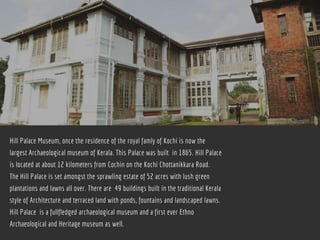
Hill Palace Museum, once the residence of the royal famly of Kochi is now the
largest Archaeological museum of Kerala. This Palace was built  in 1865. Hill Palace
is located at about 12 kilometers from Cochin on the Kochi Chottanikkara Road.
The Hill Palace is set amongst the sprawling estate of 52 acres with lush green
plantations and lawns all over. There are  49 buildings built in the traditional Kerala
style of Architecture and terraced land with ponds, fountains and landscaped lawns.
Hill Palace  is a fullfledged archaeological museum and a first ever Ethno
Archaeological and Heritage museum as well.
Complex
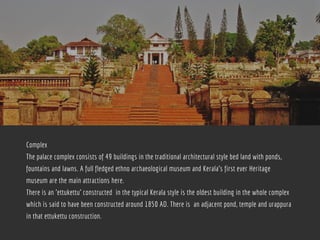
The palace complex consists of 49 buildings in the traditional architectural style bed land with ponds,
fountains and lawns. A full fledged ethno archaeological museum and Kerala's first ever Heritage
museum are the main attractions here.
There is an 'ettukettu' constructed  in the typical Kerala style is the oldest building in the whole complex
which is said to have been constructed around 1850 AD. There is  an adjacent pond, temple and urappura
in that ettukettu construction.
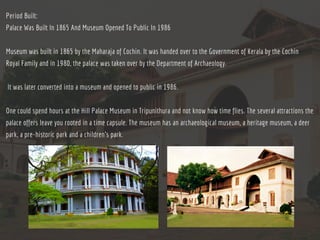
Period Built:
Palace Was Built In 1865 And Museum Opened To Public In 1986
Museum was built in 1865 by the Maharaja of Cochin. It was handed over to the Government of Kerala by the Cochin
Royal Family and in 1980, the palace was taken over by the Department of Archaeology.
 It was later converted into a museum and opened to public in 1986.
One could spend hours at the Hill Palace Museum in Tripunithura and not know how time flies. The several attractions the
palace offers leave you rooted in a time capsule. The museum has an archaeological museum, a heritage museum, a deer
park, a pre-historic park and a children’s park.
Items on display in the 1865
European style palace.
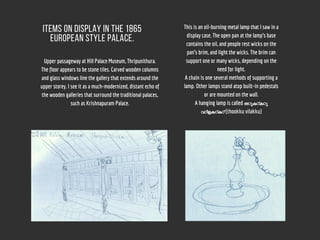
Upper passageway at Hill Palace Museum, Thripunithura.
The floor appears to be stone tiles. Carved wooden columns
and glass windows line the gallery that extends around the
upper storey. I see it as a much-modernized, distant echo of
the wooden galleries that surround the traditional palaces,
such as Krishnapuram Palace.
This is an oil-burning metal lamp that I saw in a
display case. The open pan at the lamp’s base
contains the oil, and people rest wicks on the
pan’s brim, and light the wicks. The brim can
support one or many wicks, depending on the
need for light.
A chain is one several methods of supporting a
lamp. Other lamps stand atop built-in pedestals
or are mounted on the wall.
A hanging lamp is called ത◌ൂക◌്ക◌ു
വ◌ിളക◌്ക◌് (thookku vilakku)
aRCHITECTURE
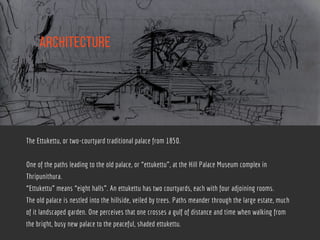
The Ettukettu, or two-courtyard traditional palace from 1850.
One of the paths leading to the old palace, or “ettukettu”, at the Hill Palace Museum complex in
Thripunithura.
“Ettukettu” means “eight halls”. An ettukettu has two courtyards, each with four adjoining rooms.
The old palace is nestled into the hillside, veiled by trees. Paths meander through the large estate, much
of it landscaped garden. One perceives that one crosses a gulf of distance and time when walking from
the bright, busy new palace to the peaceful, shaded ettukettu.
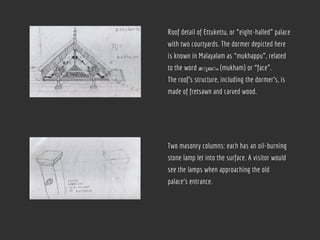
Roof detail of Ettukettu, or “eight-halled” palace
with two courtyards. The dormer depicted here
is known in Malayalam as “mukhappu”, related
to the word മ◌ുഖ◌ം (mukham) or “face”.
The roof’s structure, including the dormer’s, is
made of fretsawn and carved wood.
Two masonry columns: each has an oil-burning
stone lamp let into the surface. A visitor would
see the lamps when approaching the old
palace’s entrance.
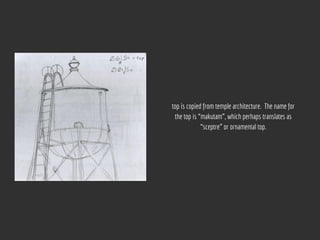
top is copied from temple architecture.  The name for
the top is “makutam”, which perhaps translates as
“sceptre” or ornamental top.
Paliam gallery in the museum contains the collections donated by the
Paliyathachan's family. Paliyathachan's were hereditary Prime
Ministers to the Cochin Maharaja’s for a long period. This gallery was
opened in 1991.  The gallery of cabinet Hall displays royal furniture's
including the 'Simhasana' (the throne or the king's chair).
There is also a Folklore and Folk Arts Gallery at the Hill Palace
Museum featuring some old musical instruments and clay models.
And if you are interested in big-sized exhibits, walk into the gallery
for chariots at the Hill Palace Museum. Here, you will come across
displays of horse-drawn coaches imported from England and
formerly used by the Maharajas of Travancore.
THANKYOU

Hill palace

  • 1.
    HILL PALACEThripunithura 01 NOVEMBER2017 LAKSHMI S , MALAVIKA SURESH , MIDHUN GEORGE , RAMEEZ LAL
  • 2.
    Hill Palace Museum,once the residence of the royal famly of Kochi is now the largest Archaeological museum of Kerala. This Palace was built  in 1865. Hill Palace is located at about 12 kilometers from Cochin on the Kochi Chottanikkara Road. The Hill Palace is set amongst the sprawling estate of 52 acres with lush green plantations and lawns all over. There are  49 buildings built in the traditional Kerala style of Architecture and terraced land with ponds, fountains and landscaped lawns. Hill Palace  is a fullfledged archaeological museum and a first ever Ethno Archaeological and Heritage museum as well.
  • 3.
    Complex The palace complexconsists of 49 buildings in the traditional architectural style bed land with ponds, fountains and lawns. A full fledged ethno archaeological museum and Kerala's first ever Heritage museum are the main attractions here. There is an 'ettukettu' constructed  in the typical Kerala style is the oldest building in the whole complex which is said to have been constructed around 1850 AD. There is  an adjacent pond, temple and urappura in that ettukettu construction.
  • 4.
    Period Built: Palace WasBuilt In 1865 And Museum Opened To Public In 1986 Museum was built in 1865 by the Maharaja of Cochin. It was handed over to the Government of Kerala by the Cochin Royal Family and in 1980, the palace was taken over by the Department of Archaeology.  It was later converted into a museum and opened to public in 1986. One could spend hours at the Hill Palace Museum in Tripunithura and not know how time flies. The several attractions the palace offers leave you rooted in a time capsule. The museum has an archaeological museum, a heritage museum, a deer park, a pre-historic park and a children’s park.
  • 5.
    Items on displayin the 1865 European style palace. Upper passageway at Hill Palace Museum, Thripunithura. The floor appears to be stone tiles. Carved wooden columns and glass windows line the gallery that extends around the upper storey. I see it as a much-modernized, distant echo of the wooden galleries that surround the traditional palaces, such as Krishnapuram Palace. This is an oil-burning metal lamp that I saw in a display case. The open pan at the lamp’s base contains the oil, and people rest wicks on the pan’s brim, and light the wicks. The brim can support one or many wicks, depending on the need for light. A chain is one several methods of supporting a lamp. Other lamps stand atop built-in pedestals or are mounted on the wall. A hanging lamp is called ത◌ൂക◌്ക◌ു വ◌ിളക◌്ക◌് (thookku vilakku)
  • 6.
    aRCHITECTURE The Ettukettu, ortwo-courtyard traditional palace from 1850. One of the paths leading to the old palace, or “ettukettu”, at the Hill Palace Museum complex in Thripunithura. “Ettukettu” means “eight halls”. An ettukettu has two courtyards, each with four adjoining rooms. The old palace is nestled into the hillside, veiled by trees. Paths meander through the large estate, much of it landscaped garden. One perceives that one crosses a gulf of distance and time when walking from the bright, busy new palace to the peaceful, shaded ettukettu.
  • 7.
    Roof detail ofEttukettu, or “eight-halled” palace with two courtyards. The dormer depicted here is known in Malayalam as “mukhappu”, related to the word മ◌ുഖ◌ം (mukham) or “face”. The roof’s structure, including the dormer’s, is made of fretsawn and carved wood. Two masonry columns: each has an oil-burning stone lamp let into the surface. A visitor would see the lamps when approaching the old palace’s entrance.
  • 8.
    top is copiedfrom temple architecture.  The name for the top is “makutam”, which perhaps translates as “sceptre” or ornamental top.
  • 9.
    Paliam gallery inthe museum contains the collections donated by the Paliyathachan's family. Paliyathachan's were hereditary Prime Ministers to the Cochin Maharaja’s for a long period. This gallery was opened in 1991.  The gallery of cabinet Hall displays royal furniture's including the 'Simhasana' (the throne or the king's chair). There is also a Folklore and Folk Arts Gallery at the Hill Palace Museum featuring some old musical instruments and clay models. And if you are interested in big-sized exhibits, walk into the gallery for chariots at the Hill Palace Museum. Here, you will come across displays of horse-drawn coaches imported from England and formerly used by the Maharajas of Travancore.
  • 10.