Unit 3: Cellular Energetics
Cellular Respiration and
Photosynthesis
Chapter 9: Cellular Respiration and
Fermentation
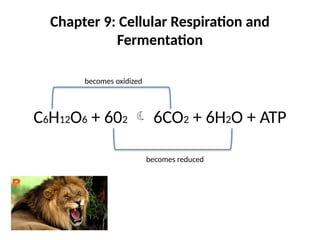
C6H12O6 + 602  6CO2 + 6H2O + ATP
becomes oxidized
becomes reduced
Chapter 9: Cellular Respiration and
Fermentation
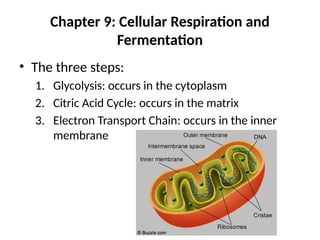
• The three steps:
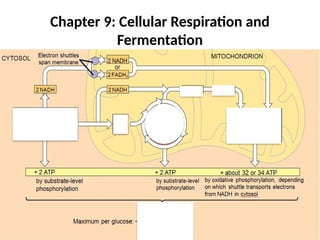
1. Glycolysis: occurs in the cytoplasm
2. Citric Acid Cycle: occurs in the matrix
3. Electron Transport Chain: occurs in the inner
membrane
Chapter 9: Cellular Respiration and
Fermentation
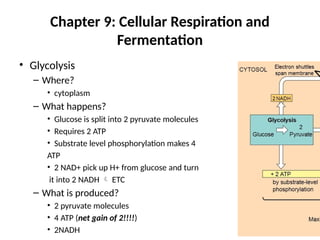
• Glycolysis
– Where?
• cytoplasm
– What happens?
• Glucose is split into 2 pyruvate molecules
• Requires 2 ATP
• Substrate level phosphorylation makes 4
ATP
• 2 NAD+ pick up H+ from glucose and turn
it into 2 NADH  ETC
– What is produced?
• 2 pyruvate molecules
• 4 ATP (net gain of 2!!!!)
• 2NADH
Chapter 9: Cellular Respiration and
Fermentation
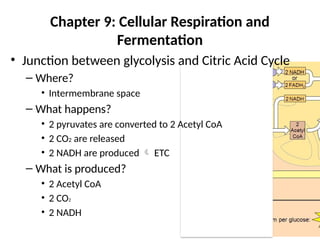
• Junction between glycolysis and Citric Acid Cycle
– Where?
• Intermembrane space
– What happens?
• 2 pyruvates are converted to 2 Acetyl CoA
• 2 CO2 are released
• 2 NADH are produced  ETC
– What is produced?
• 2 Acetyl CoA
• 2 CO2
• 2 NADH
Chapter 9: Cellular Respiration and
Fermentation
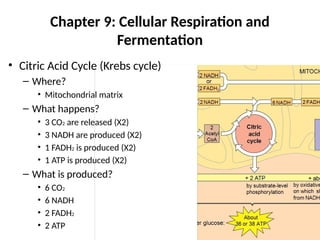
• Citric Acid Cycle (Krebs cycle)
– Where?
• Mitochondrial matrix
– What happens?
• 3 CO2 are released (X2)
• 3 NADH are produced (X2)
• 1 FADH2 is produced (X2)
• 1 ATP is produced (X2)
– What is produced?
• 6 CO2
• 6 NADH
• 2 FADH2
• 2 ATP
Chapter 9: Cellular Respiration and
Fermentation
• Electron Transport Chain
– Where?
• Inner membrane space
– What happens?
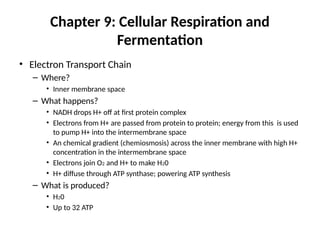
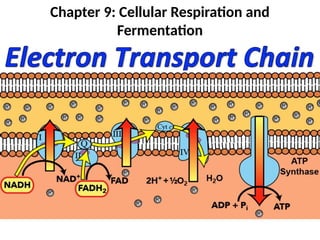
• NADH drops H+ off at first protein complex
• Electrons from H+ are passed from protein to protein; energy from this is used
to pump H+ into the intermembrane space
• An chemical gradient (chemiosmosis) across the inner membrane with high H+
concentration in the intermembrane space
• Electrons join O2 and H+ to make H20
• H+ diffuse through ATP synthase; powering ATP synthesis
– What is produced?
• H20
• Up to 32 ATP
Chapter 9: Cellular Respiration and
Fermentation
Chapter 9: Cellular Respiration and
Fermentation
Chapter 9: Cellular Respiration and
Fermentation
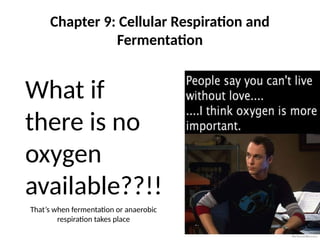
What if
there is no
oxygen
available??!!
That’s when fermentation or anaerobic
respiration takes place
Chapter 9: Cellular Respiration and
Fermentation
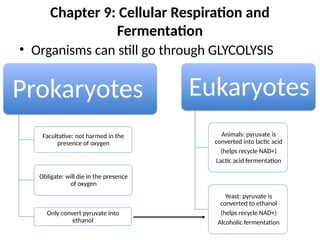
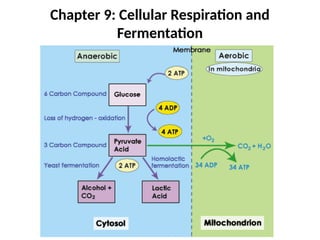
• Organisms can still go through GLYCOLYSIS
Prokaryotes
Facultative: not harmed in the
presence of oxygen
Obligate: will die in the presence
of oxygen
Only convert pyruvate into
ethanol
Eukaryotes
Animals: pyruvate is
converted into lactic acid
(helps recycle NAD+)
Lactic acid fermentation
Yeast: pyruvate is
converted to ethanol
(helps recycle NAD+)
Alcoholic fermentation
Chapter 9: Cellular Respiration and
Fermentation
Chapter 9: Cellular Respiration and
Fermentation
Controlling cellular respiration
• Why?
– Cells don’t waste energy with overproduction
• How?
– NEGATIVE FEEDBACK!
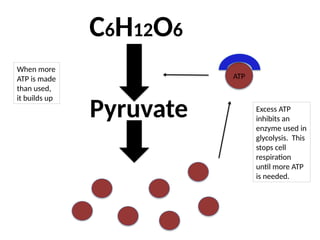
C6H12O6
Pyruvate
ATP
When more
ATP is made
than used,
it builds up
Excess ATP
inhibits an
enzyme used in
glycolysis. This
stops cell
respiration
until more ATP
is needed.
Chapter 10: Photosynthesis
• Who?
– Autotrophs (plants, photosynthetic protists,
cyanobacteria)
• What?
– Converting solar energy (sunlight) to chemical
energy (carbohydrates)
• How?
– 6CO2 + 12H2O  C6H12O6 + 6H2O +6O2
Chapter 10: Photosynthesis
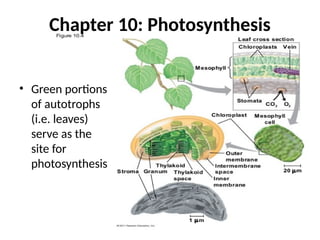
• Green portions
of autotrophs
(i.e. leaves)
serve as the
site for
photosynthesis
Chapter 10: Photosynthesis
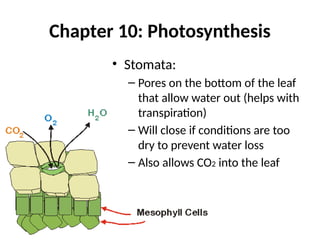
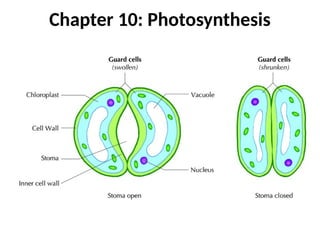
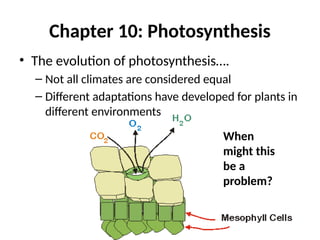
• Stomata:
– Pores on the bottom of the leaf
that allow water out (helps with
transpiration)
– Will close if conditions are too
dry to prevent water loss
– Also allows CO2 into the leaf
Chapter 10: Photosynthesis
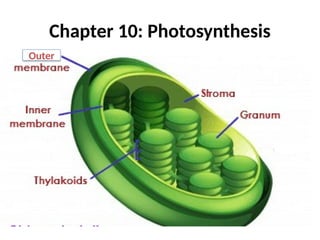
Outer
Chapter 10: Photosynthesis
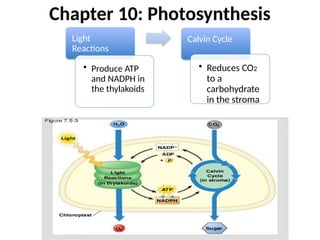
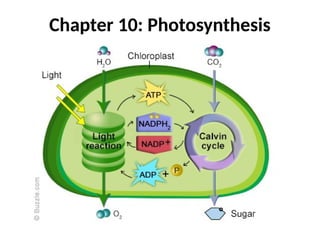
Light
Reactions
• Produce ATP
and NADPH in
the thylakoids
Calvin Cycle
• Reduces CO2
to a
carbohydrate
in the stroma
Chapter 10: Photosynthesis
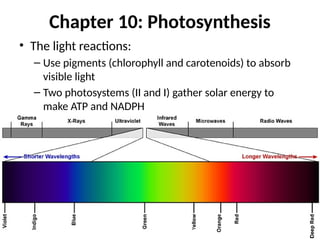
• The light reactions:
– Use pigments (chlorophyll and carotenoids) to absorb
visible light
– Two photosystems (II and I) gather solar energy to
make ATP and NADPH
Chapter 10: Photosynthesis
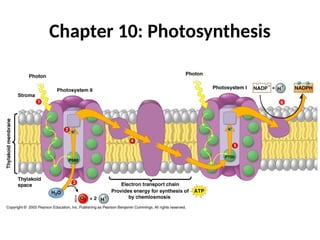
• Photosystem II (P680)
– Electrons in chlorophyll are excited by sunlight
– The excited electrons are captured by a primary
electron acceptor
– Water splits in order to replenish the lost electrons;
releasing oxygen
– These electrons enter an electron transport chain
creating a H+ gradient
– The result?
• ATP is produced!!!!
Chapter 10: Photosynthesis
• Photosystem I (P700)
– As sunlight excites the second photosystem, a new
set of electrons enter another electron transport
chain
– Electrons from PSII replenish these
– Newly energized electrons pass to NADP+
– The result?
• NADPH is produced!
Chapter 10: Photosynthesis
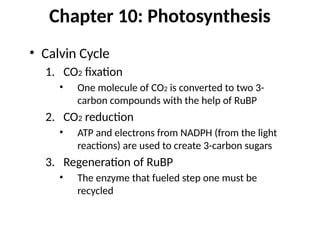
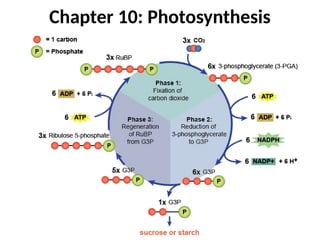
• Calvin Cycle
1. CO2 fixation
• One molecule of CO2 is converted to two 3-
carbon compounds with the help of RuBP
2. CO2 reduction
• ATP and electrons from NADPH (from the light
reactions) are used to create 3-carbon sugars
3. Regeneration of RuBP
• The enzyme that fueled step one must be
recycled
Chapter 10: Photosynthesis
Work with a partner to complete the graphic
organizer in your note packet.
Chapter 10: Photosynthesis
• The evolution of photosynthesis….
– Not all climates are considered equal
– Different adaptations have developed for plants in
different environments
When
might this
be a
problem?
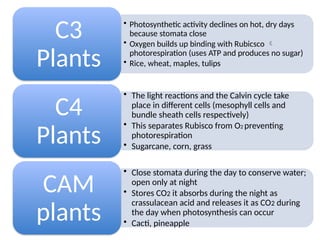
• Photosynthetic activity declines on hot, dry days
because stomata close
• Oxygen builds up binding with Rubicsco 
photorespiration (uses ATP and produces no sugar)
• Rice, wheat, maples, tulips
C3
Plants
• The light reactions and the Calvin cycle take
place in different cells (mesophyll cells and
bundle sheath cells respectively)
• This separates Rubisco from O2 preventing
photorespiration
• Sugarcane, corn, grass
C4
Plants
• Close stomata during the day to conserve water;
open only at night
• Stores CO2 it absorbs during the night as
crassulacean acid and releases it as CO2 during
the day when photosynthesis can occur
• Cacti, pineapple
CAM
plants

High School Biology Unit 3 Cellular Energetics

  • 1.
    Unit 3: CellularEnergetics Cellular Respiration and Photosynthesis
  • 2.
    Chapter 9: CellularRespiration and Fermentation C6H12O6 + 602  6CO2 + 6H2O + ATP becomes oxidized becomes reduced
  • 3.
    Chapter 9: CellularRespiration and Fermentation • The three steps: 1. Glycolysis: occurs in the cytoplasm 2. Citric Acid Cycle: occurs in the matrix 3. Electron Transport Chain: occurs in the inner membrane
  • 4.
    Chapter 9: CellularRespiration and Fermentation • Glycolysis – Where? • cytoplasm – What happens? • Glucose is split into 2 pyruvate molecules • Requires 2 ATP • Substrate level phosphorylation makes 4 ATP • 2 NAD+ pick up H+ from glucose and turn it into 2 NADH  ETC – What is produced? • 2 pyruvate molecules • 4 ATP (net gain of 2!!!!) • 2NADH
  • 5.
    Chapter 9: CellularRespiration and Fermentation • Junction between glycolysis and Citric Acid Cycle – Where? • Intermembrane space – What happens? • 2 pyruvates are converted to 2 Acetyl CoA • 2 CO2 are released • 2 NADH are produced  ETC – What is produced? • 2 Acetyl CoA • 2 CO2 • 2 NADH
  • 6.
    Chapter 9: CellularRespiration and Fermentation • Citric Acid Cycle (Krebs cycle) – Where? • Mitochondrial matrix – What happens? • 3 CO2 are released (X2) • 3 NADH are produced (X2) • 1 FADH2 is produced (X2) • 1 ATP is produced (X2) – What is produced? • 6 CO2 • 6 NADH • 2 FADH2 • 2 ATP
  • 7.
    Chapter 9: CellularRespiration and Fermentation • Electron Transport Chain – Where? • Inner membrane space – What happens? • NADH drops H+ off at first protein complex • Electrons from H+ are passed from protein to protein; energy from this is used to pump H+ into the intermembrane space • An chemical gradient (chemiosmosis) across the inner membrane with high H+ concentration in the intermembrane space • Electrons join O2 and H+ to make H20 • H+ diffuse through ATP synthase; powering ATP synthesis – What is produced? • H20 • Up to 32 ATP
  • 8.
    Chapter 9: CellularRespiration and Fermentation
  • 9.
    Chapter 9: CellularRespiration and Fermentation
  • 10.
    Chapter 9: CellularRespiration and Fermentation What if there is no oxygen available??!! That’s when fermentation or anaerobic respiration takes place
  • 11.
    Chapter 9: CellularRespiration and Fermentation • Organisms can still go through GLYCOLYSIS Prokaryotes Facultative: not harmed in the presence of oxygen Obligate: will die in the presence of oxygen Only convert pyruvate into ethanol Eukaryotes Animals: pyruvate is converted into lactic acid (helps recycle NAD+) Lactic acid fermentation Yeast: pyruvate is converted to ethanol (helps recycle NAD+) Alcoholic fermentation
  • 12.
    Chapter 9: CellularRespiration and Fermentation
  • 13.
    Chapter 9: CellularRespiration and Fermentation Controlling cellular respiration • Why? – Cells don’t waste energy with overproduction • How? – NEGATIVE FEEDBACK!
  • 14.
    C6H12O6 Pyruvate ATP When more ATP ismade than used, it builds up Excess ATP inhibits an enzyme used in glycolysis. This stops cell respiration until more ATP is needed.
  • 15.
    Chapter 10: Photosynthesis •Who? – Autotrophs (plants, photosynthetic protists, cyanobacteria) • What? – Converting solar energy (sunlight) to chemical energy (carbohydrates) • How? – 6CO2 + 12H2O  C6H12O6 + 6H2O +6O2
  • 16.
    Chapter 10: Photosynthesis •Green portions of autotrophs (i.e. leaves) serve as the site for photosynthesis
  • 17.
    Chapter 10: Photosynthesis •Stomata: – Pores on the bottom of the leaf that allow water out (helps with transpiration) – Will close if conditions are too dry to prevent water loss – Also allows CO2 into the leaf
  • 18.
  • 19.
  • 20.
    Chapter 10: Photosynthesis Light Reactions •Produce ATP and NADPH in the thylakoids Calvin Cycle • Reduces CO2 to a carbohydrate in the stroma
  • 21.
    Chapter 10: Photosynthesis •The light reactions: – Use pigments (chlorophyll and carotenoids) to absorb visible light – Two photosystems (II and I) gather solar energy to make ATP and NADPH
  • 22.
    Chapter 10: Photosynthesis •Photosystem II (P680) – Electrons in chlorophyll are excited by sunlight – The excited electrons are captured by a primary electron acceptor – Water splits in order to replenish the lost electrons; releasing oxygen – These electrons enter an electron transport chain creating a H+ gradient – The result? • ATP is produced!!!!
  • 23.
    Chapter 10: Photosynthesis •Photosystem I (P700) – As sunlight excites the second photosystem, a new set of electrons enter another electron transport chain – Electrons from PSII replenish these – Newly energized electrons pass to NADP+ – The result? • NADPH is produced!
  • 24.
  • 25.
    Chapter 10: Photosynthesis •Calvin Cycle 1. CO2 fixation • One molecule of CO2 is converted to two 3- carbon compounds with the help of RuBP 2. CO2 reduction • ATP and electrons from NADPH (from the light reactions) are used to create 3-carbon sugars 3. Regeneration of RuBP • The enzyme that fueled step one must be recycled
  • 26.
  • 27.
  • 28.
    Work with apartner to complete the graphic organizer in your note packet.
  • 29.
    Chapter 10: Photosynthesis •The evolution of photosynthesis…. – Not all climates are considered equal – Different adaptations have developed for plants in different environments When might this be a problem?
  • 30.
    • Photosynthetic activitydeclines on hot, dry days because stomata close • Oxygen builds up binding with Rubicsco  photorespiration (uses ATP and produces no sugar) • Rice, wheat, maples, tulips C3 Plants • The light reactions and the Calvin cycle take place in different cells (mesophyll cells and bundle sheath cells respectively) • This separates Rubisco from O2 preventing photorespiration • Sugarcane, corn, grass C4 Plants • Close stomata during the day to conserve water; open only at night • Stores CO2 it absorbs during the night as crassulacean acid and releases it as CO2 during the day when photosynthesis can occur • Cacti, pineapple CAM plants

Editor's Notes

  • #8 https://www.youtube.com/watch?v=VER6xW_r1vc Electron transport chain music video
  • #27 https://www.youtube.com/watch?v=wJDlxp17rY4