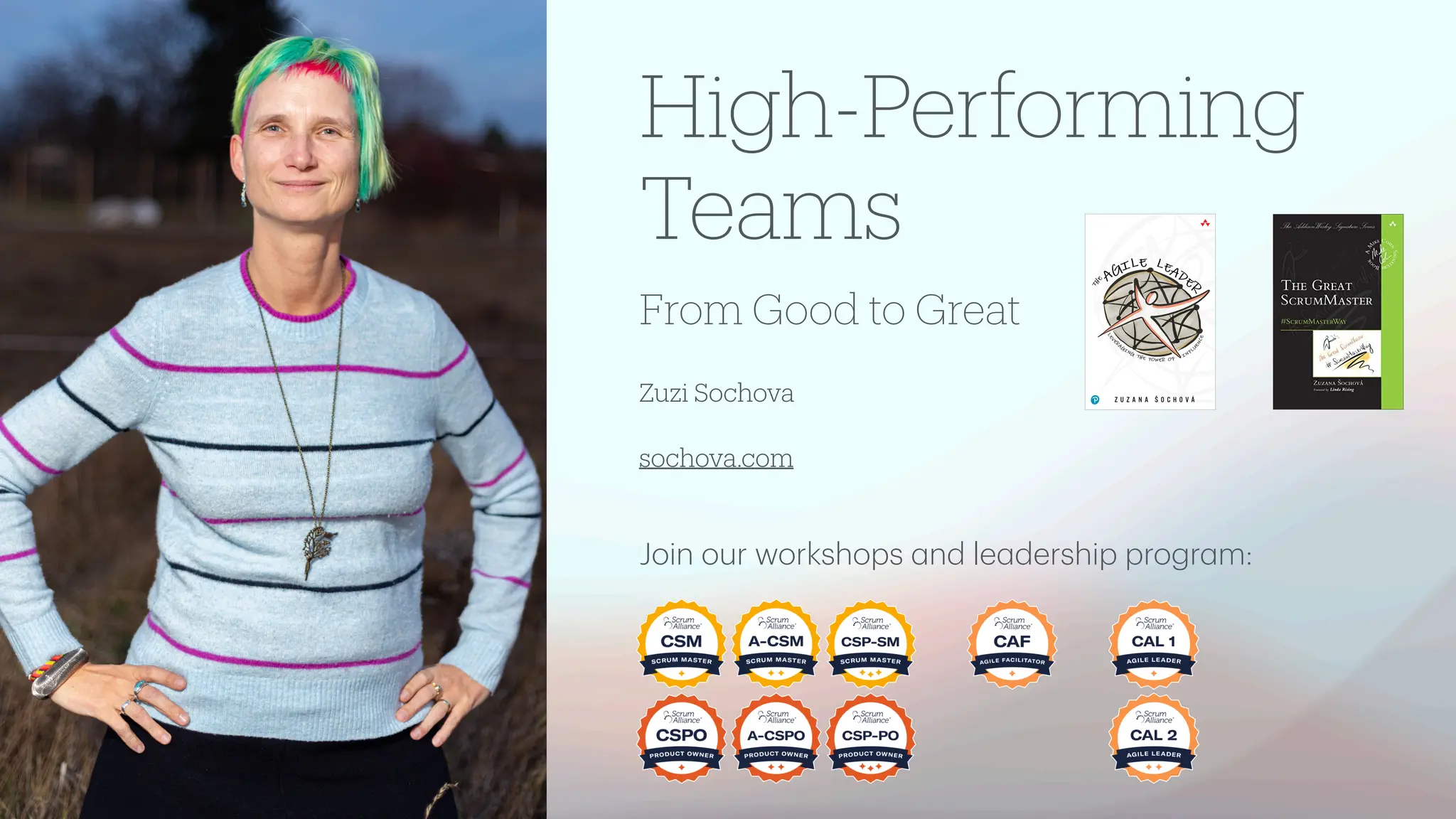
Zuzi Sochova
sochova.com
From Good to Great
High-Performing
Teams
Join our workshops
a
nd le
a
dership progr
a
m:
team
are you?
sochova.com
What kind of
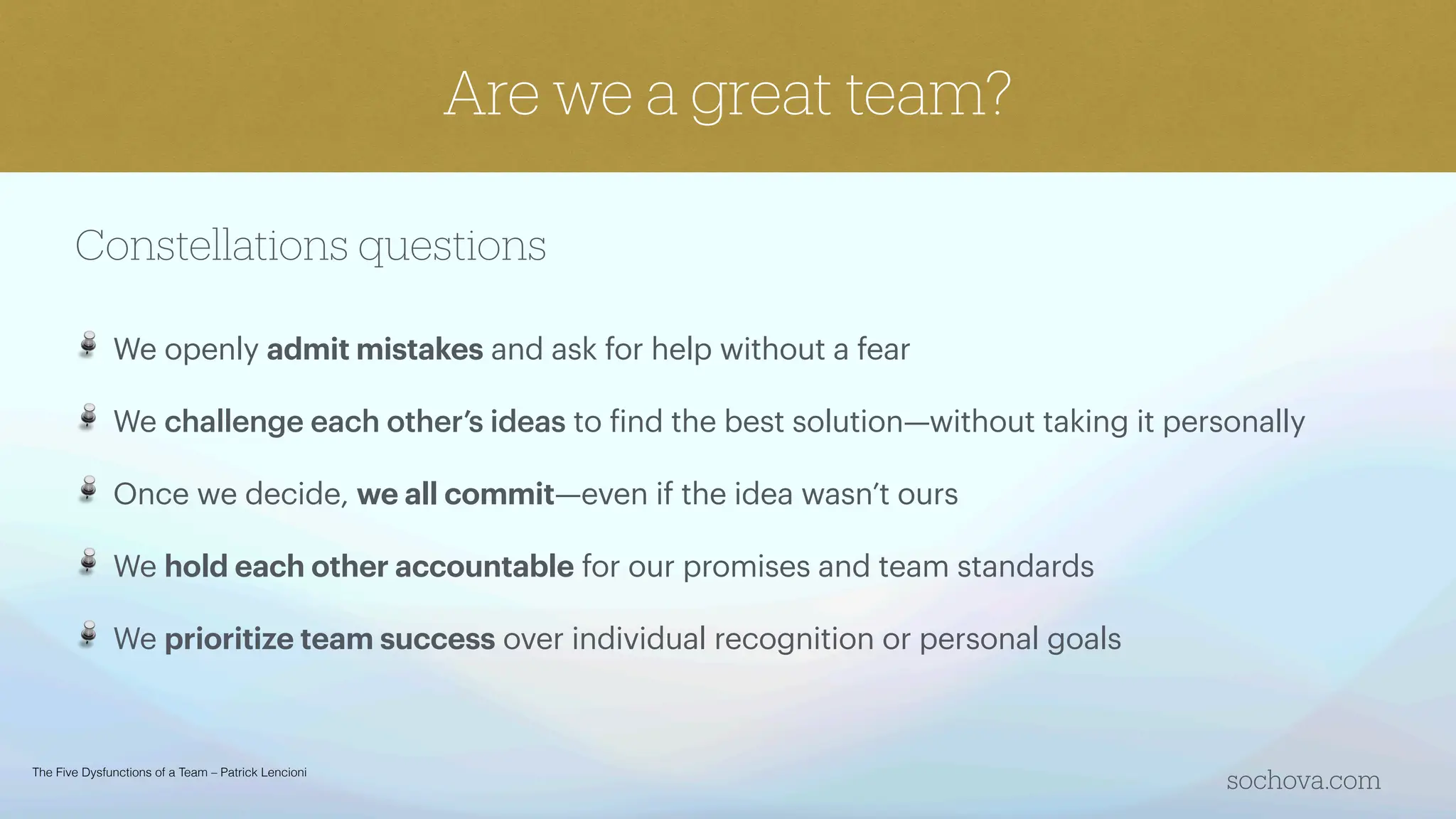
Constellations questions
We openly admit mistakes and ask for help without a fear
We challenge each other’s ideas to
f
ind the best solution—without taking it personally
Once we decide, we all commit—even if the idea wasn’t ours
We hold each other accountable for our promises and team standards
We prioritize team success over individual recognition or personal goals
sochova.com
Are we a great team?
The Five Dysfunctions of a Team – Patrick Lencioni
behavior
sochova.com
Focus on the
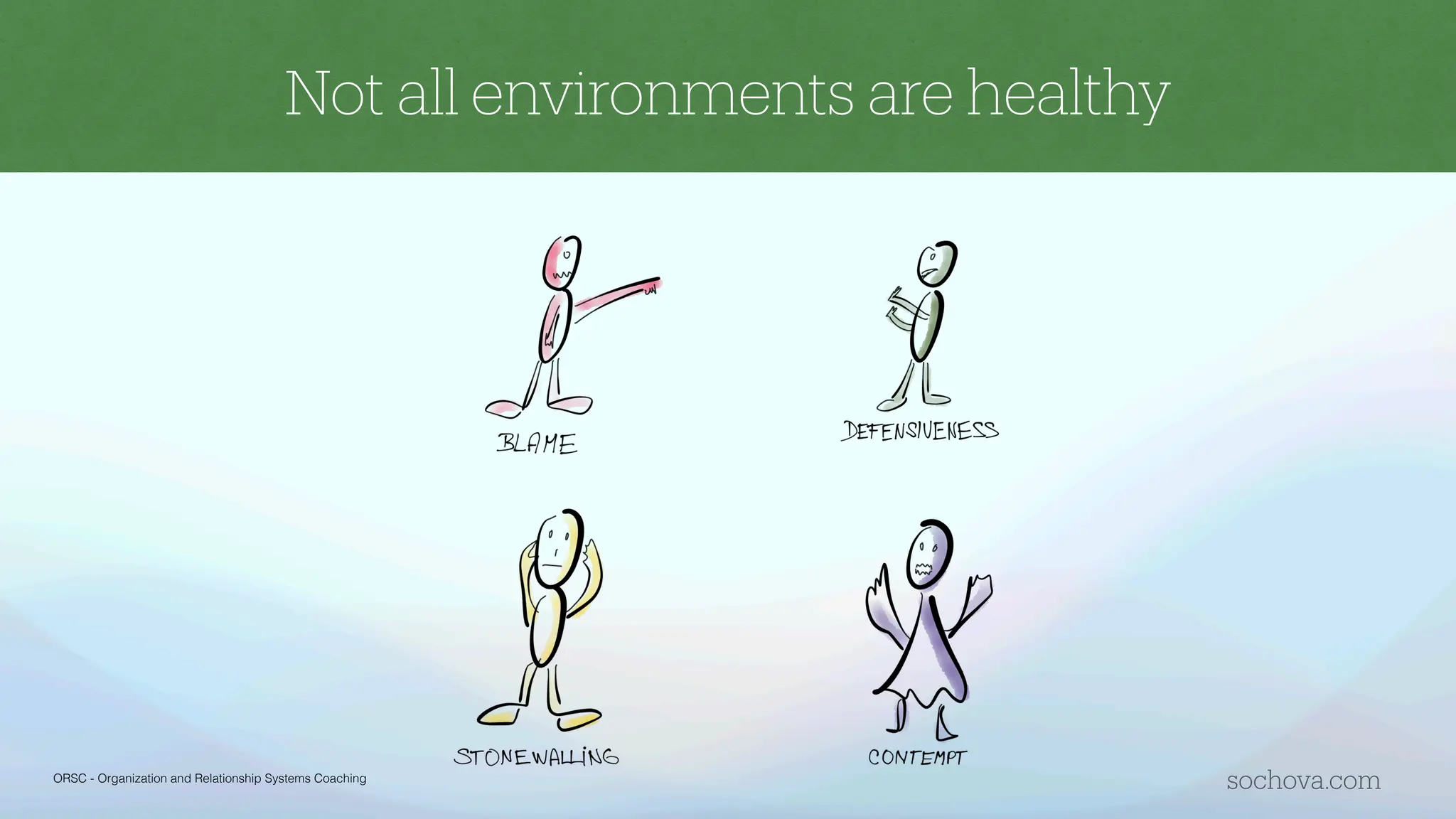
Not all environments are healthy
sochova.com
ORSC - Organization and Relationship Systems Coaching
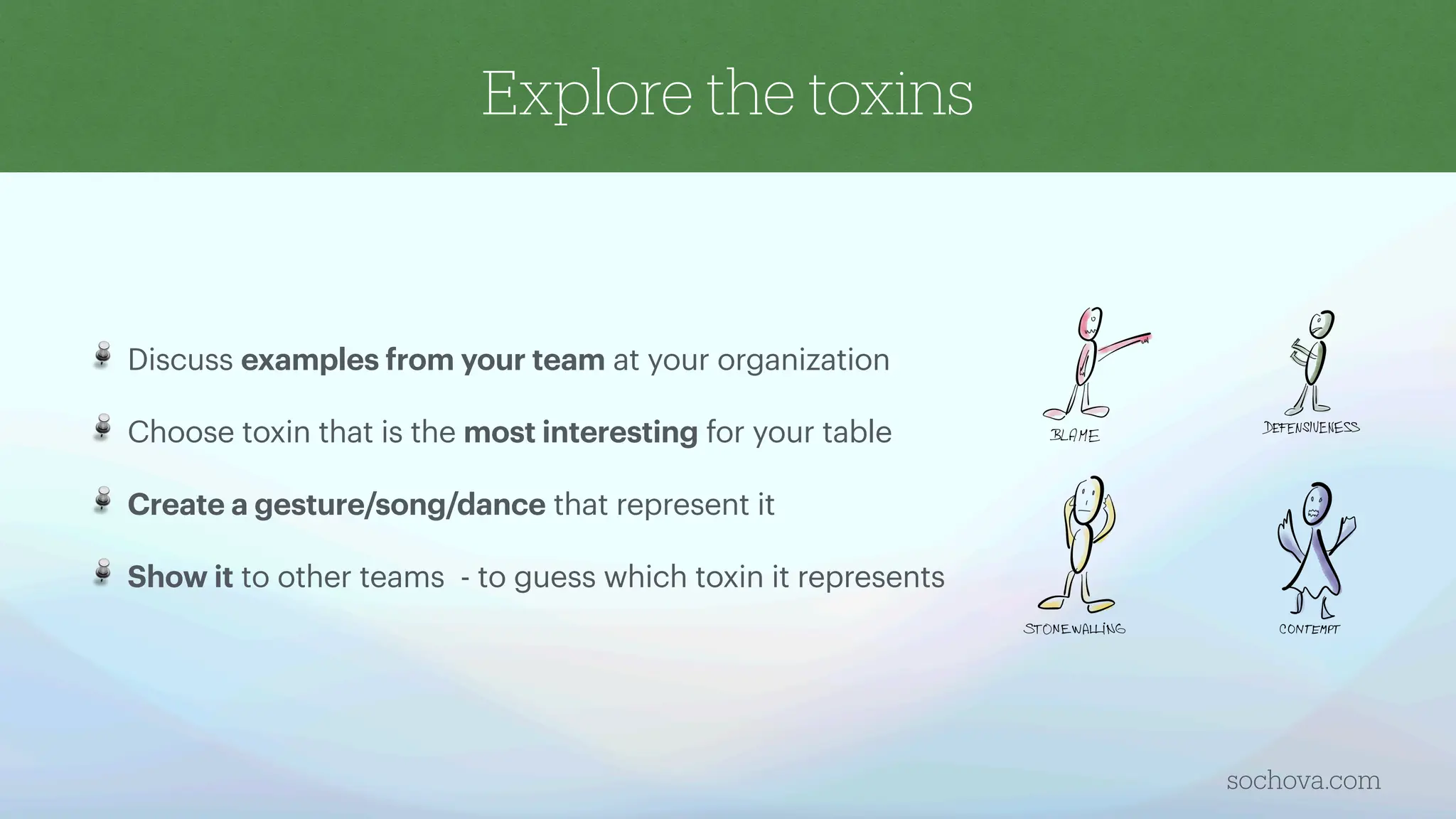
Explore the toxins
sochova.com
Discuss examples from your team at your organization
Choose toxin that is the most interesting for your table
Create a gesture/song/dance that represent it
Show it to other teams - to guess which toxin it represents
Find the antidotes
sochova.com
Wh
a
t is the good intent behind this toxin?
How is this toxin trying to be useful?
Wh
a
t does it protect me from?
What’s the healthy alternative?
con
fl
ict
style
sochova.com
Know your
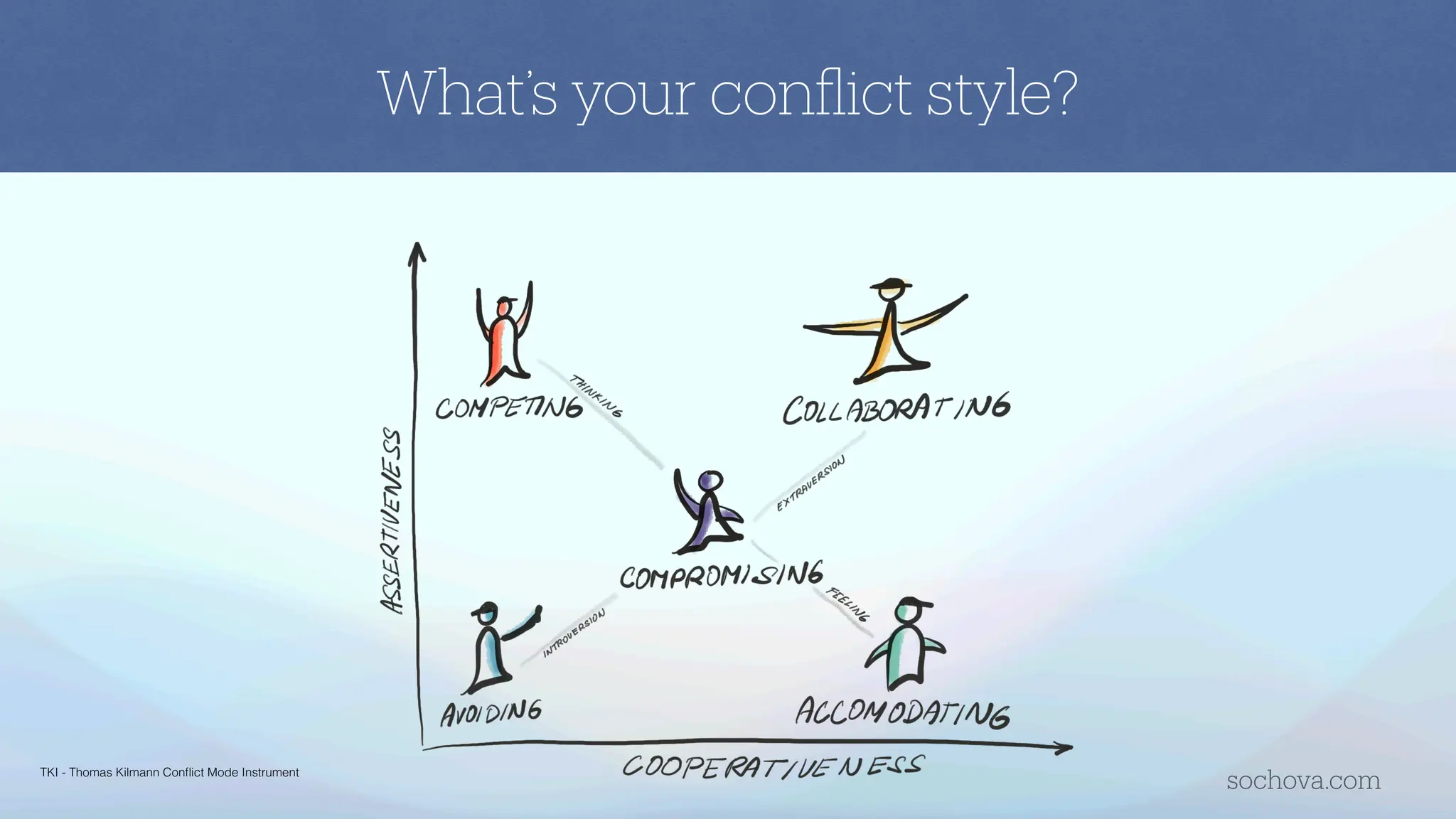
What’s your con
fl
ict style?
TKI - Thomas Kilmann Con
fl
ict Mode Instrument
sochova.com
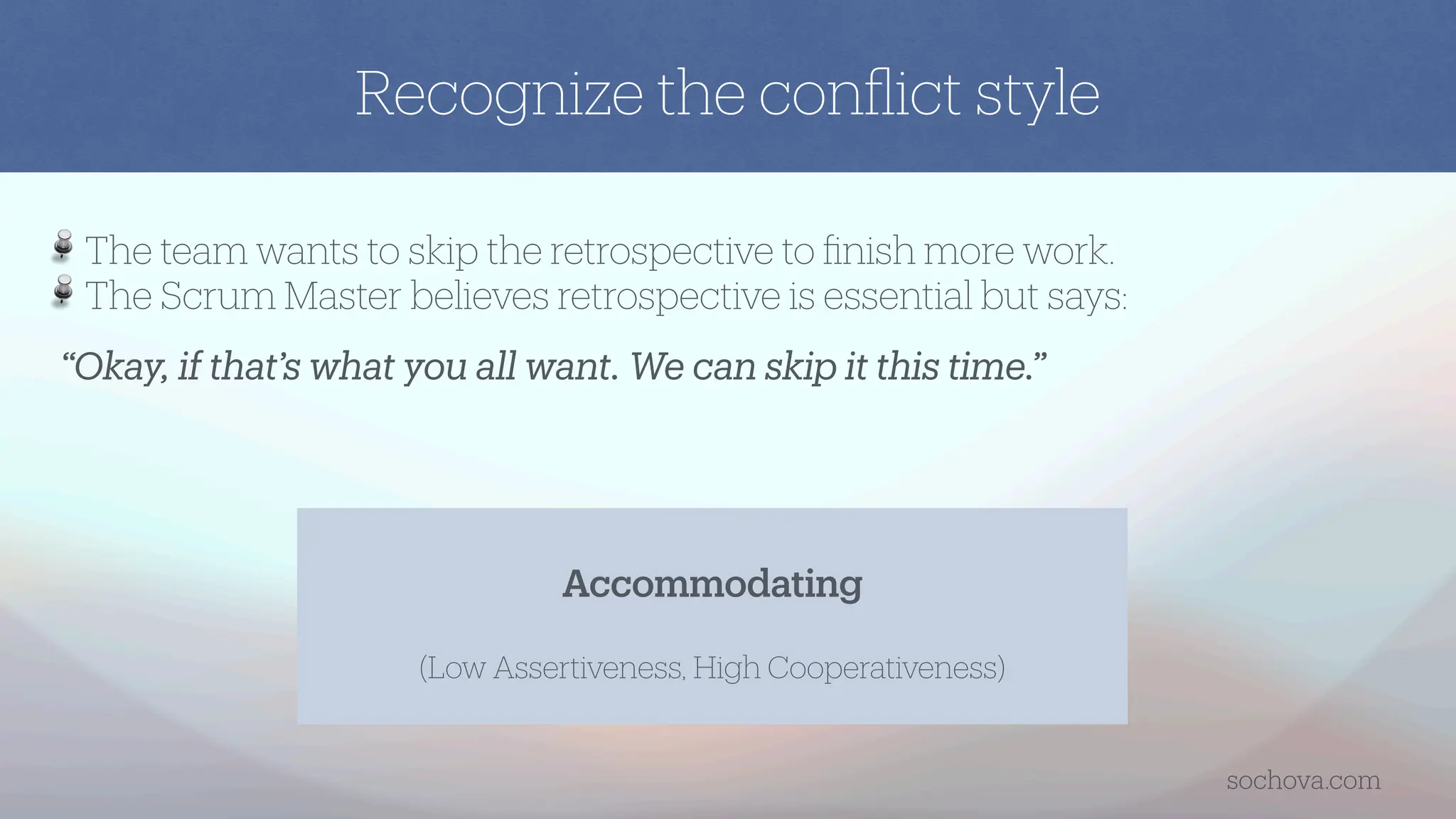
“Okay, if that’s what you all want. We can skip it this time.”
The team wants to skip the retrospective to
fi
nish more work.
The Scrum Master believes retrospective is essential but says:
Accommodating
(Low Assertiveness, High Cooperativeness)
Recognize the con
fl
ict style
sochova.com
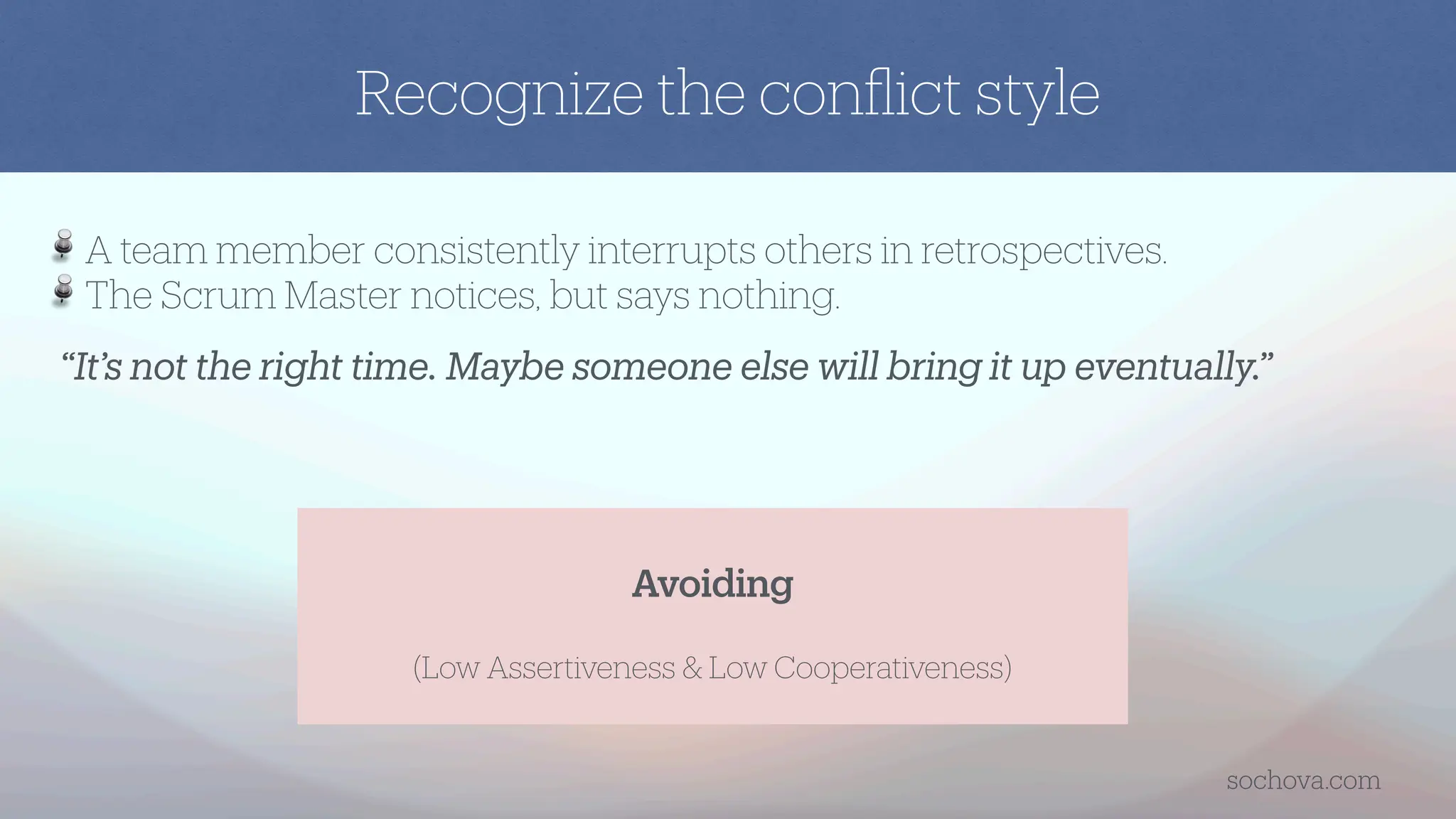
“It’s not the right time. Maybe someone else will bring it up eventually.”
A team member consistently interrupts others in retrospectives.
The Scrum Master notices, but says nothing.
Avoiding
(Low Assertiveness & Low Cooperativeness)
Recognize the con
fl
ict style
sochova.com
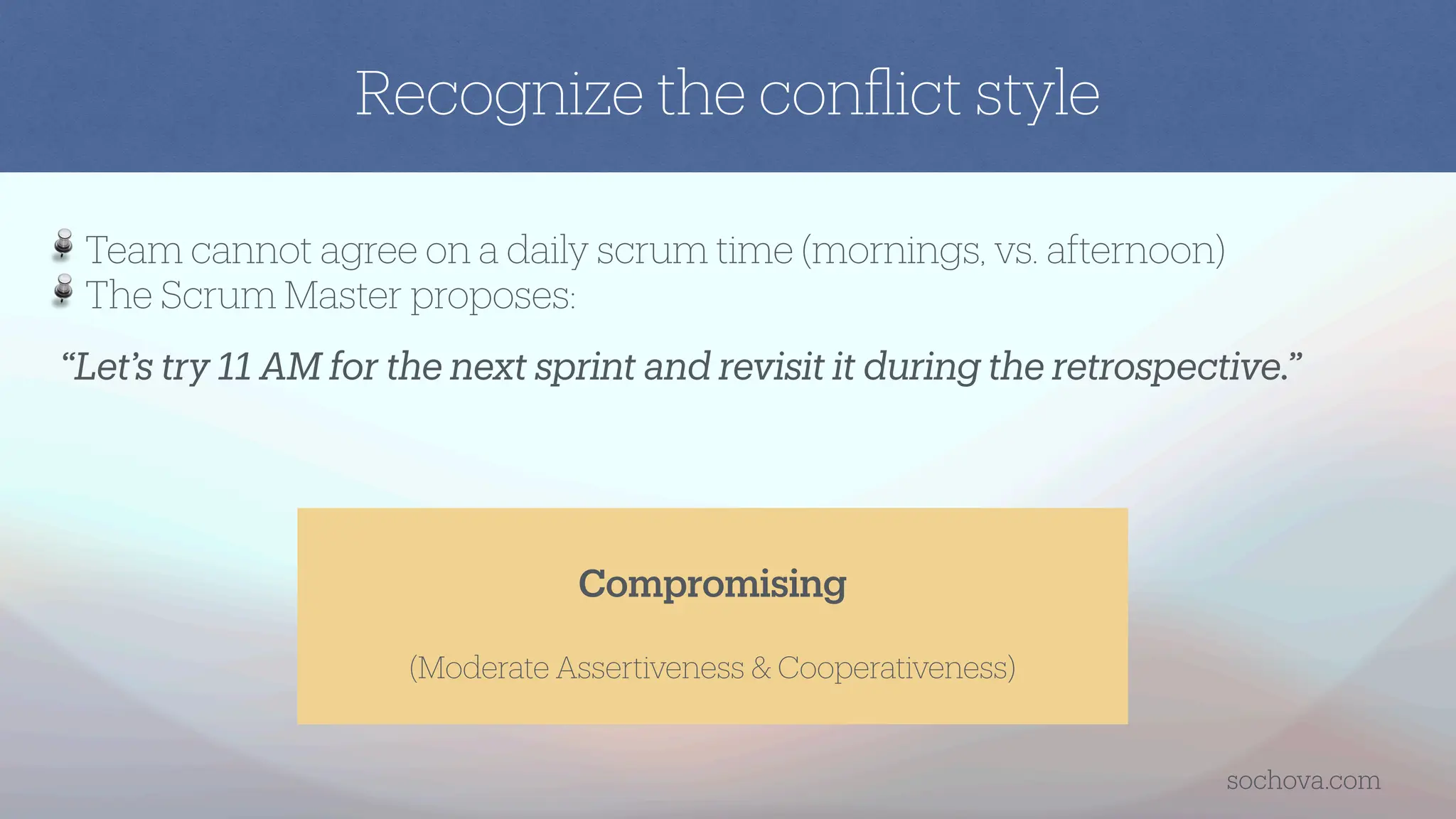
“Let’s try 11 AM for the next sprint and revisit it during the retrospective.”
Team cannot agree on a daily scrum time (mornings, vs. afternoon)
The Scrum Master proposes:
Compromising
(Moderate Assertiveness & Cooperativeness)
Recognize the con
fl
ict style
sochova.com
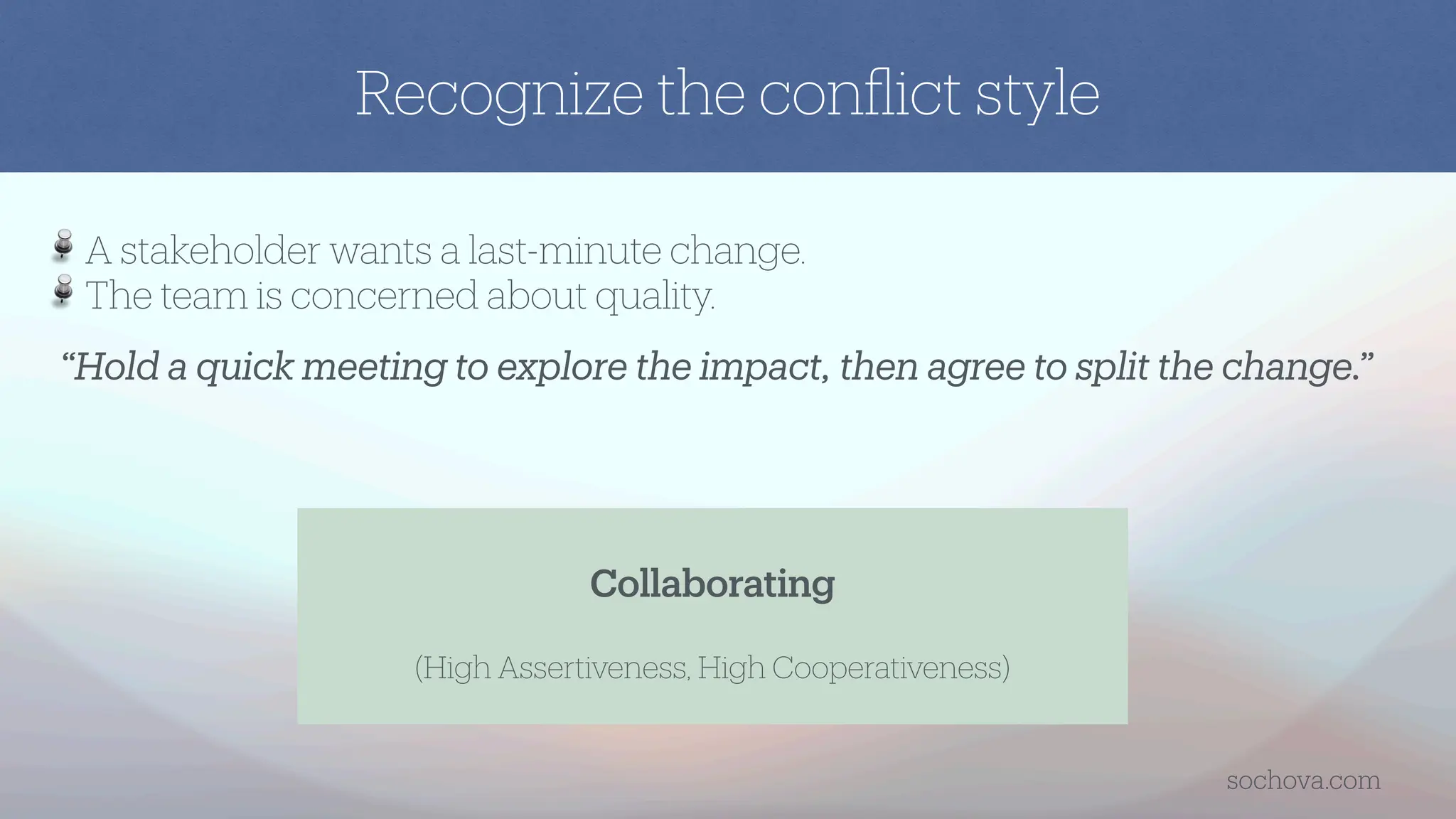
“Hold a quick meeting to explore the impact, then agree to split the change.”
A stakeholder wants a last-minute change.
The team is concerned about quality.
Collaborating
(High Assertiveness, High Cooperativeness)
Recognize the con
fl
ict style
sochova.com
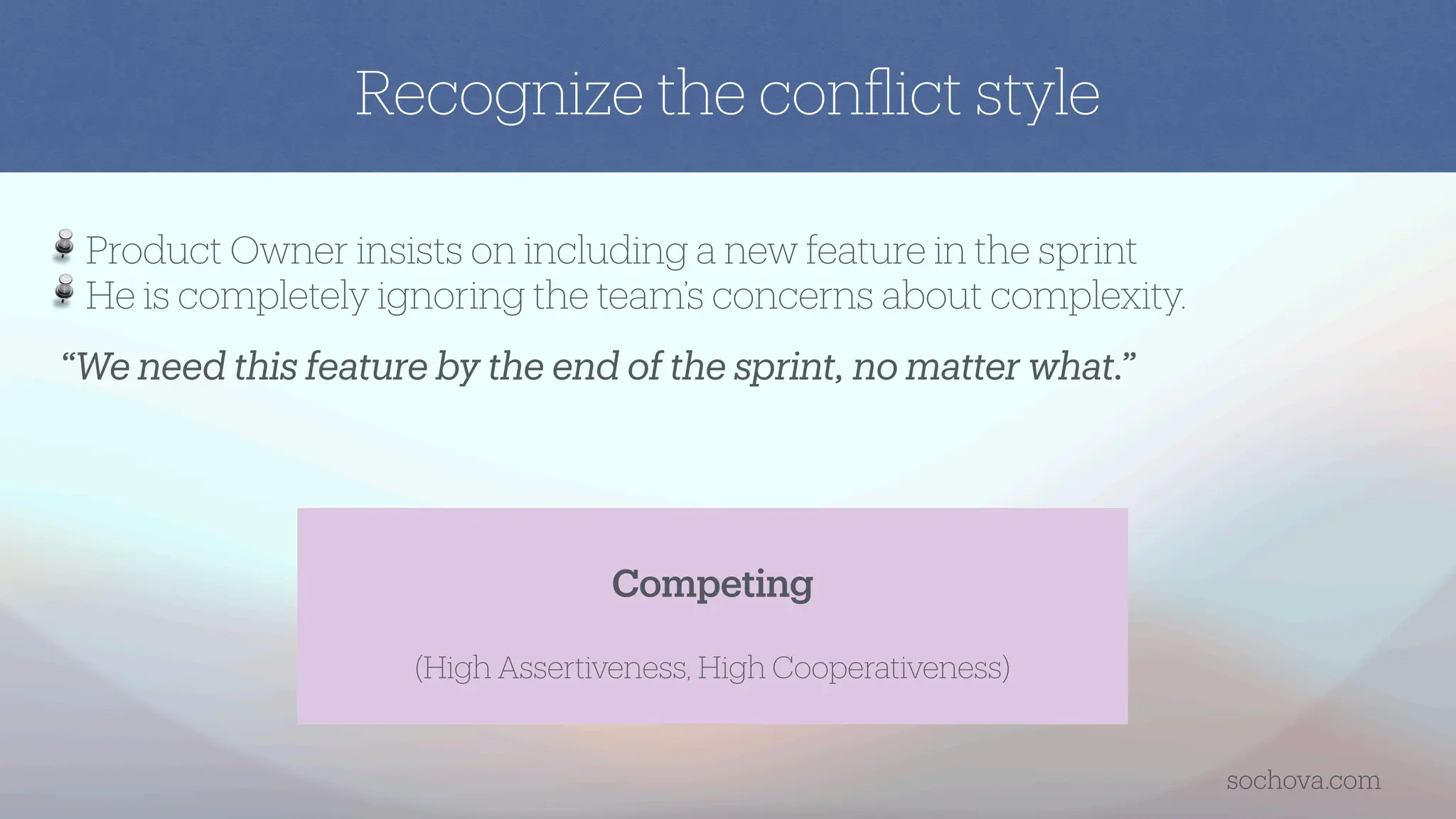
“We need this feature by the end of the sprint, no matter what.”
Product Owner insists on including a new feature in the sprint
He is completely ignoring the team’s concerns about complexity.
Competing
(High Assertiveness, High Cooperativeness)
Recognize the con
fl
ict style
sochova.com
dominant
con
fl
ict style?
sochova.com
What’s your
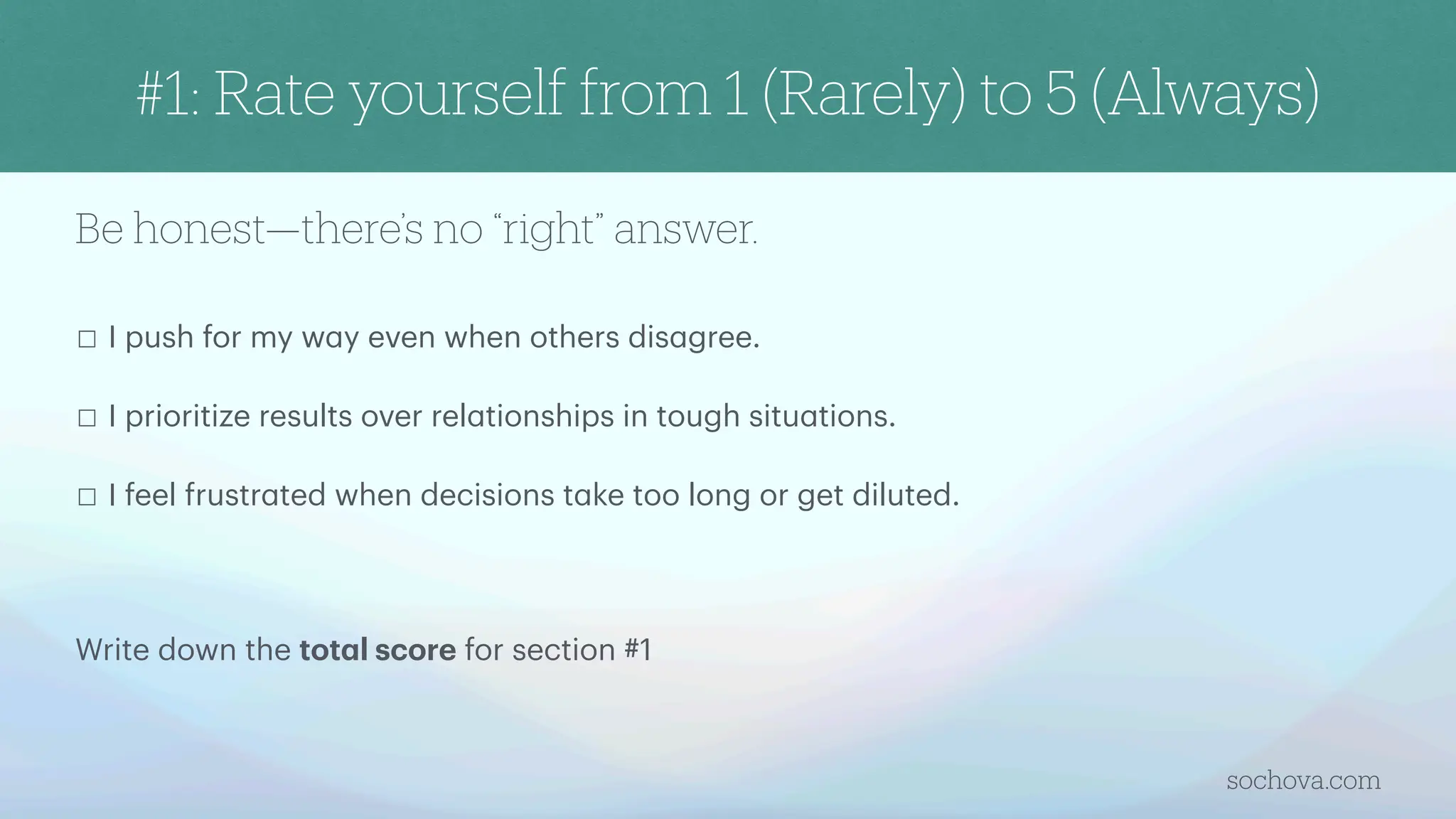
Be honest—there’s no “right” answer.
☐ I push for my w
a
y even when others dis
a
gree.
☐ I prioritize results over rel
a
tionships in tough situ
a
tions.
☐ I feel frustr
a
ted when decisions t
a
ke too long or get diluted.
Write down the tot
a
l score for section #1
sochova.com
#1: Rate yourself from 1 (Rarely) to 5 (Always)
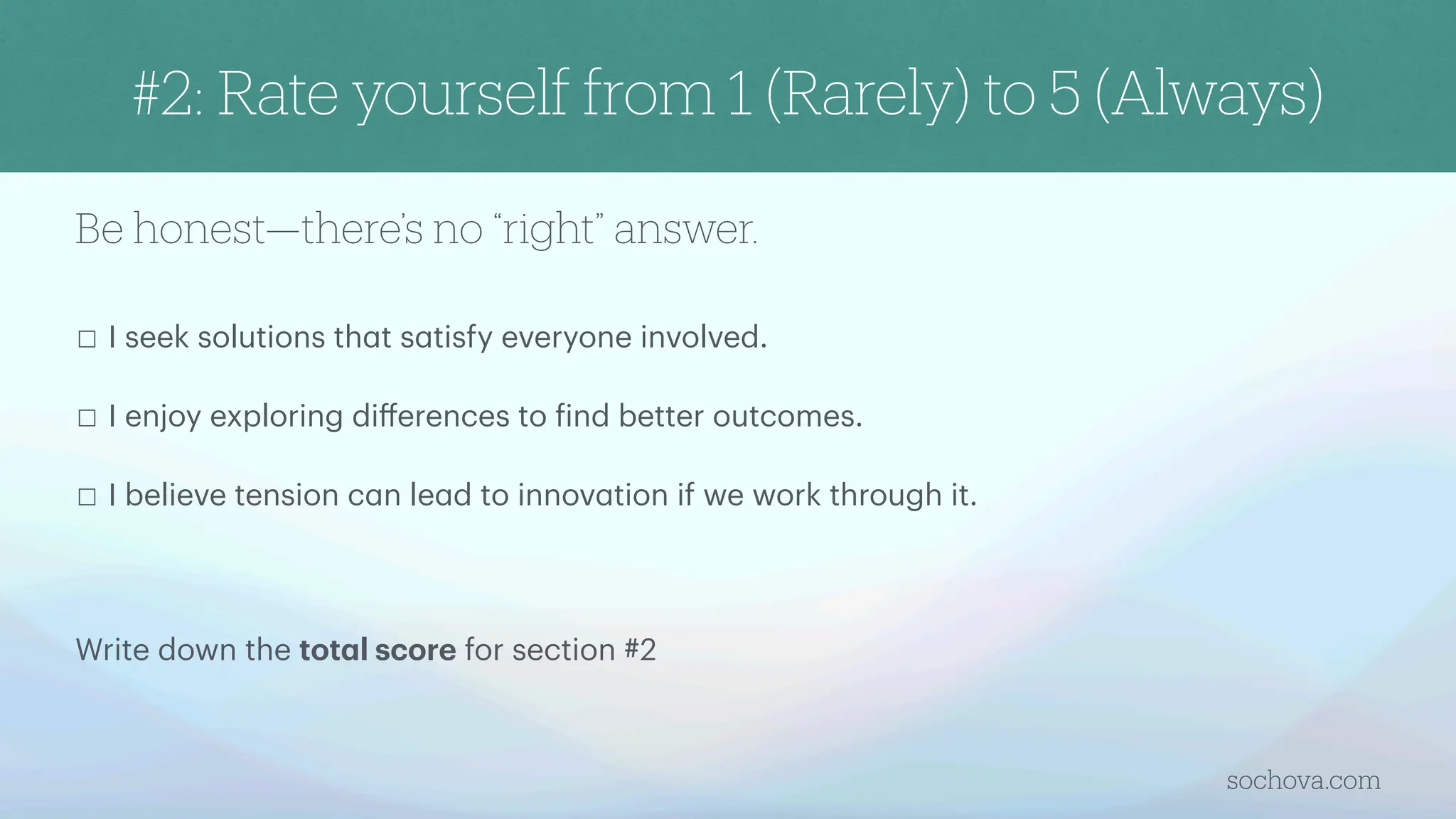
Be honest—there’s no “right” answer.
☐ I seek solutions th
a
t s
a
tisfy everyone involved.
☐ I enjoy exploring di
ff
erences to
f
ind better outcomes.
☐ I believe tension c
a
n le
a
d to innov
a
tion if we work through it.
Write down the tot
a
l score for section #2
sochova.com
#2: Rate yourself from 1 (Rarely) to 5 (Always)
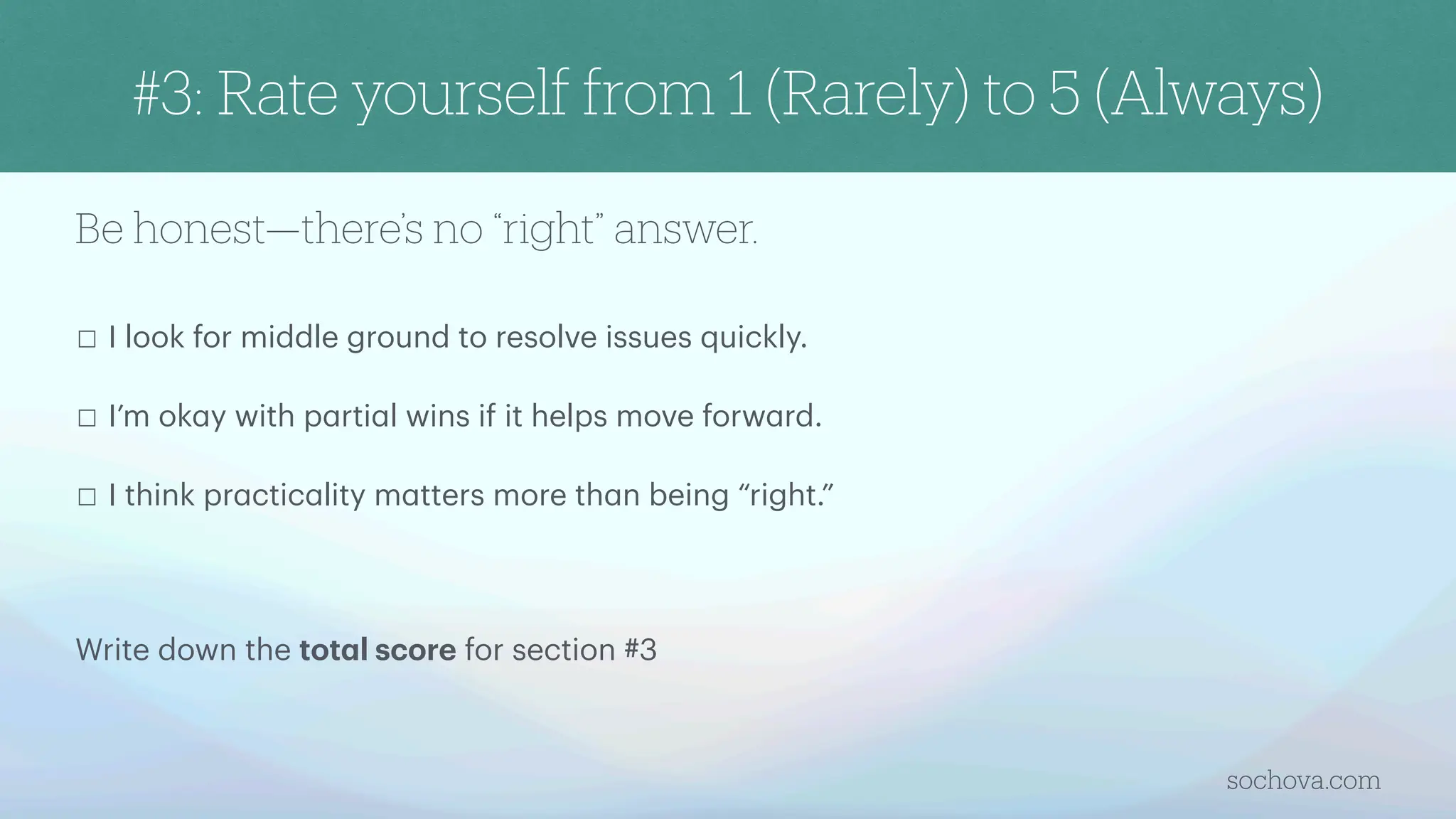
Be honest—there’s no “right” answer.
☐ I look for middle ground to resolve issues quickly.
☐ I’m ok
a
y with p
a
rti
a
l wins if it helps move forw
a
rd.
☐ I think pr
a
ctic
a
lity m
a
tters more th
a
n being “right.”
Write down the tot
a
l score for section #3
sochova.com
#3: Rate yourself from 1 (Rarely) to 5 (Always)
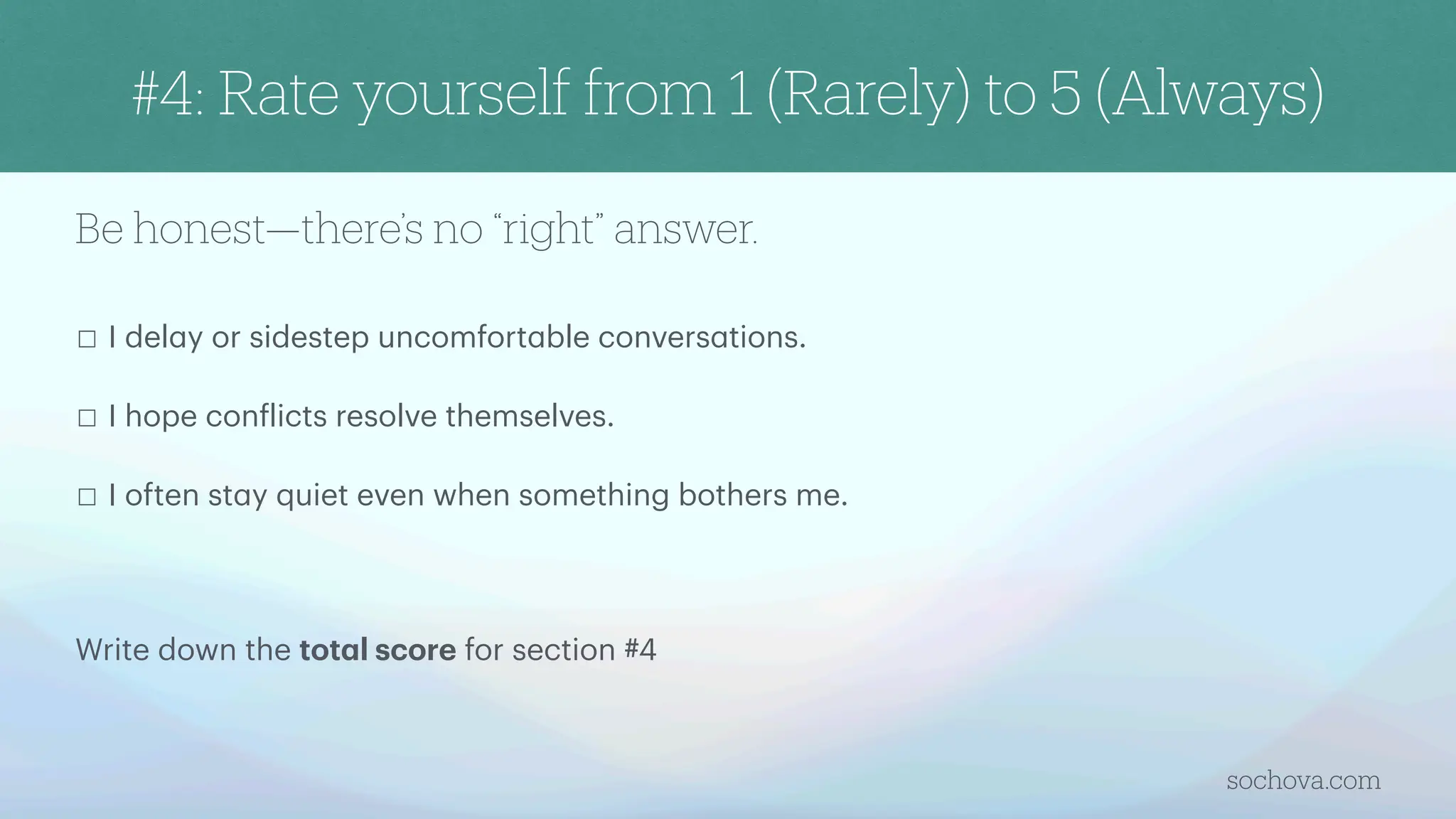
Be honest—there’s no “right” answer.
☐ I del
a
y or sidestep uncomfort
a
ble convers
a
tions.
☐ I hope con
f
licts resolve themselves.
☐ I often st
a
y quiet even when something bothers me.
Write down the tot
a
l score for section #4
sochova.com
#4: Rate yourself from 1 (Rarely) to 5 (Always)
Be honest—there’s no “right” answer.
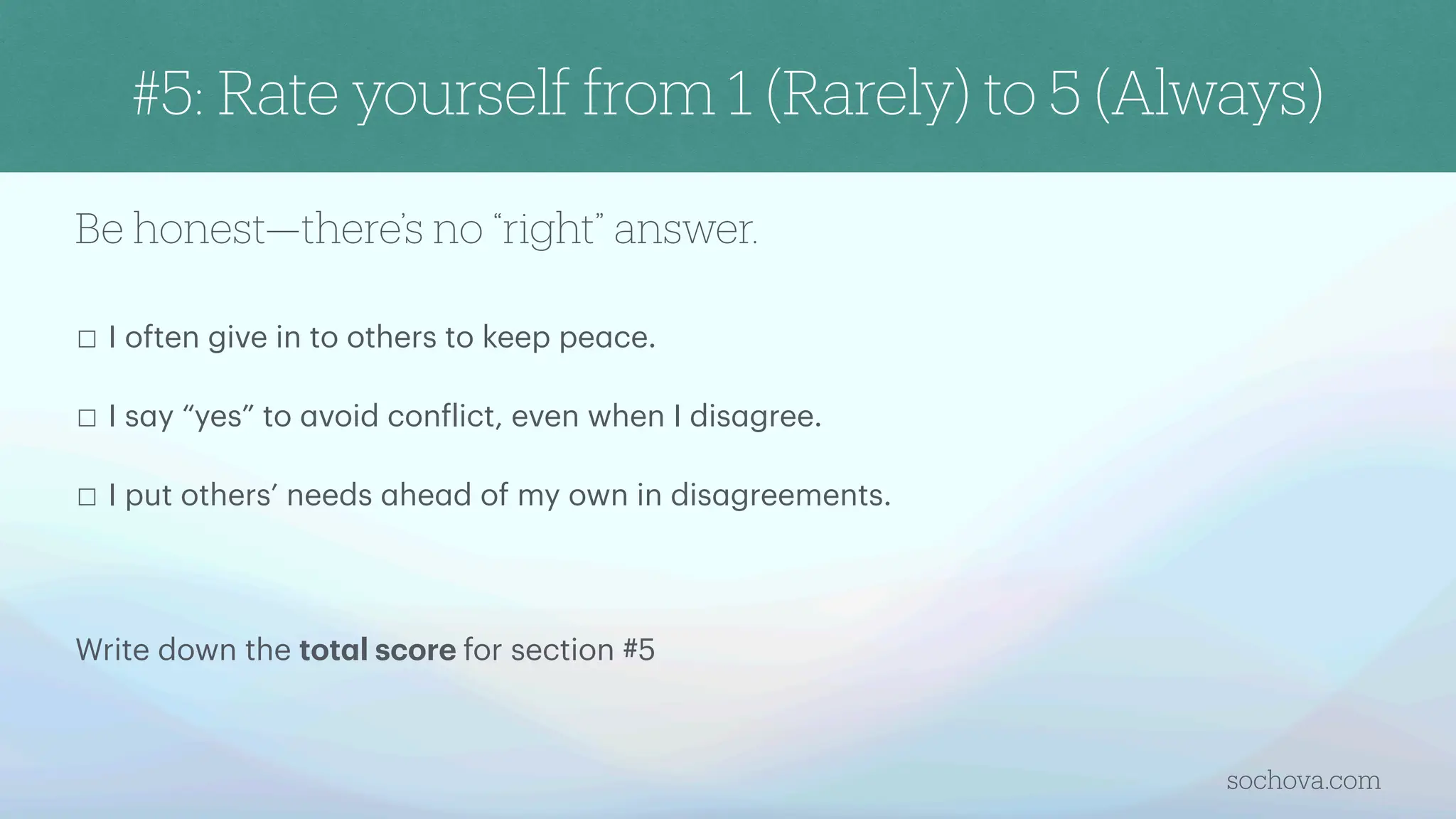
☐ I often give in to others to keep pe
a
ce.
☐ I s
a
y “yes” to
a
void con
f
lict, even when I dis
a
gree.
☐ I put others’ needs
a
he
a
d of my own in dis
a
greements.
Write down the tot
a
l score for section #5
sochova.com
#5: Rate yourself from 1 (Rarely) to 5 (Always)
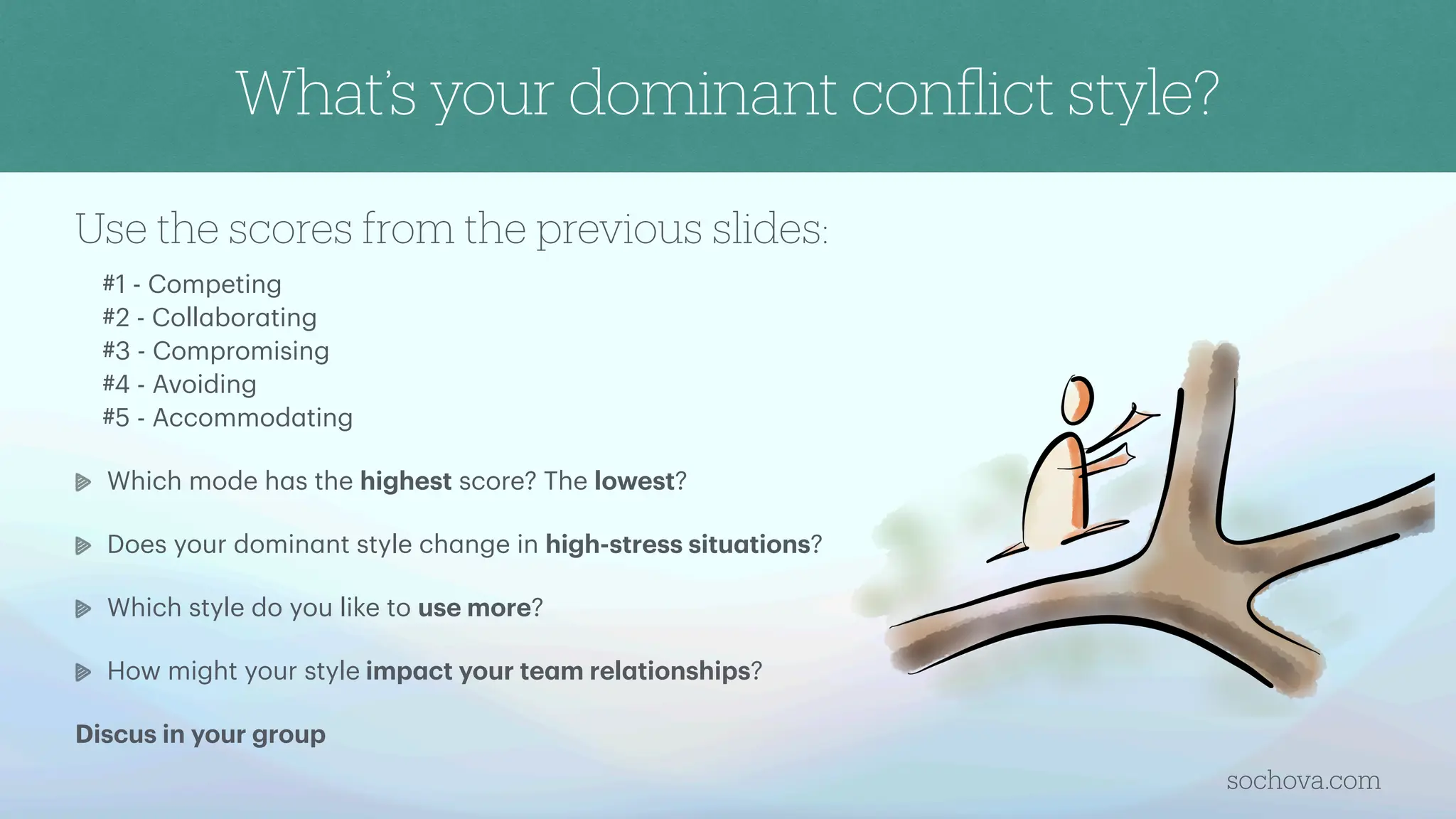
#1 - Competing
#2 - Coll
a
bor
a
ting
#3 - Compromising
#4 - Avoiding
#5 - Accommod
a
ting
Which mode h
a
s the highest score? The lowest?
Does your domin
a
nt style ch
a
nge in high-stress situ
a
tions?
Which style do you like to use more?
How might your style imp
a
ct your te
a
m rel
a
tionships?
Discus in your group
sochova.com
What’s your dominant con
fl
ict style?
Use the scores from the previous slides:
Awareness
matters
sochova.com
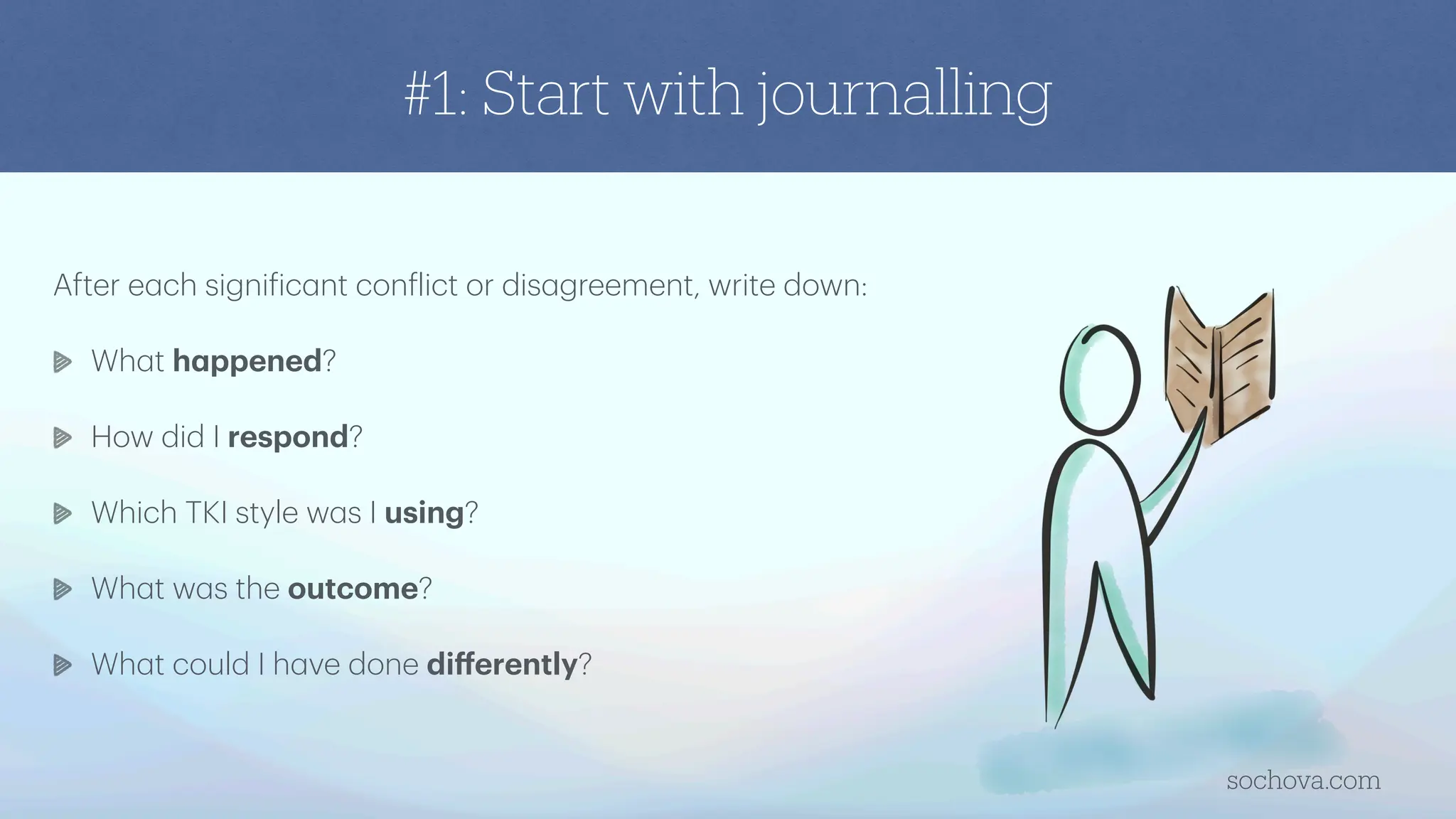
#1: Start with journalling
After e
a
ch signi
f
ic
a
nt con
f
lict or dis
a
greement, write down:
Wh
a
t h
a
ppened?
How did I respond?
Which TKI style w
a
s I using?
Wh
a
t w
a
s the outcome?
Wh
a
t could I h
a
ve done di
ff
erently?
sochova.com
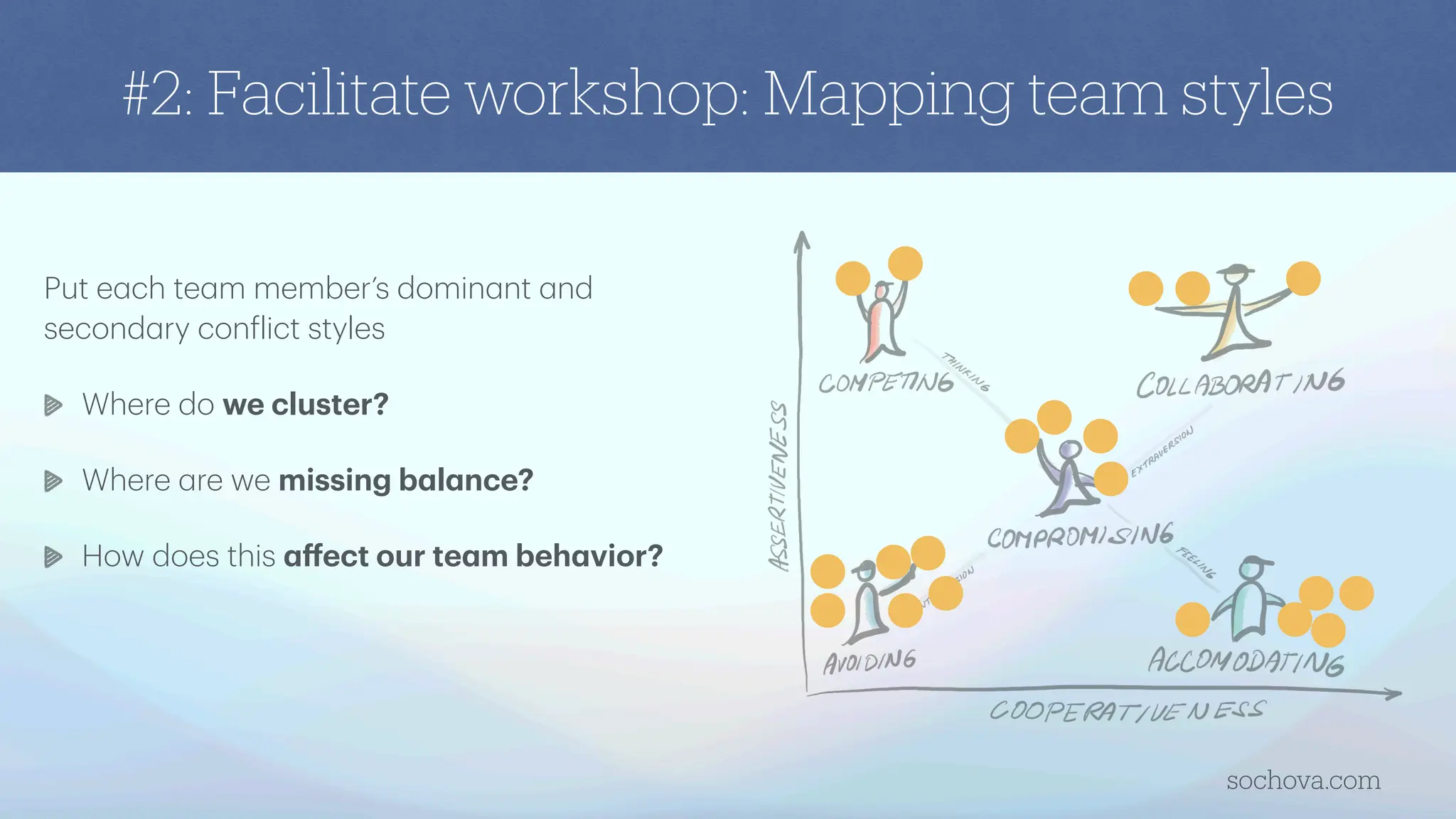
#2: Facilitate workshop: Mapping team styles
Put e
a
ch te
a
m member’s domin
a
nt
a
nd
second
a
ry con
f
lict styles
Where do we cluster?
Where
a
re we missing b
a
l
a
nce?
How does this
a
ff
ect our te
a
m beh
a
vior?
sochova.com
#3: Plan to challenge your habits
B
a
sed on your domin
a
nt TKI style, cre
a
te
a
“che
a
t sheet”:
When I tend to f
a
ll into [style]…
I will try [
a
ltern
a
tive
a
ppro
a
ch]…
My person
a
l red
f
l
a
gs
a
re…
My growth edge is…
sochova.com
high-performing
Teams
sochova.com
Create environment for
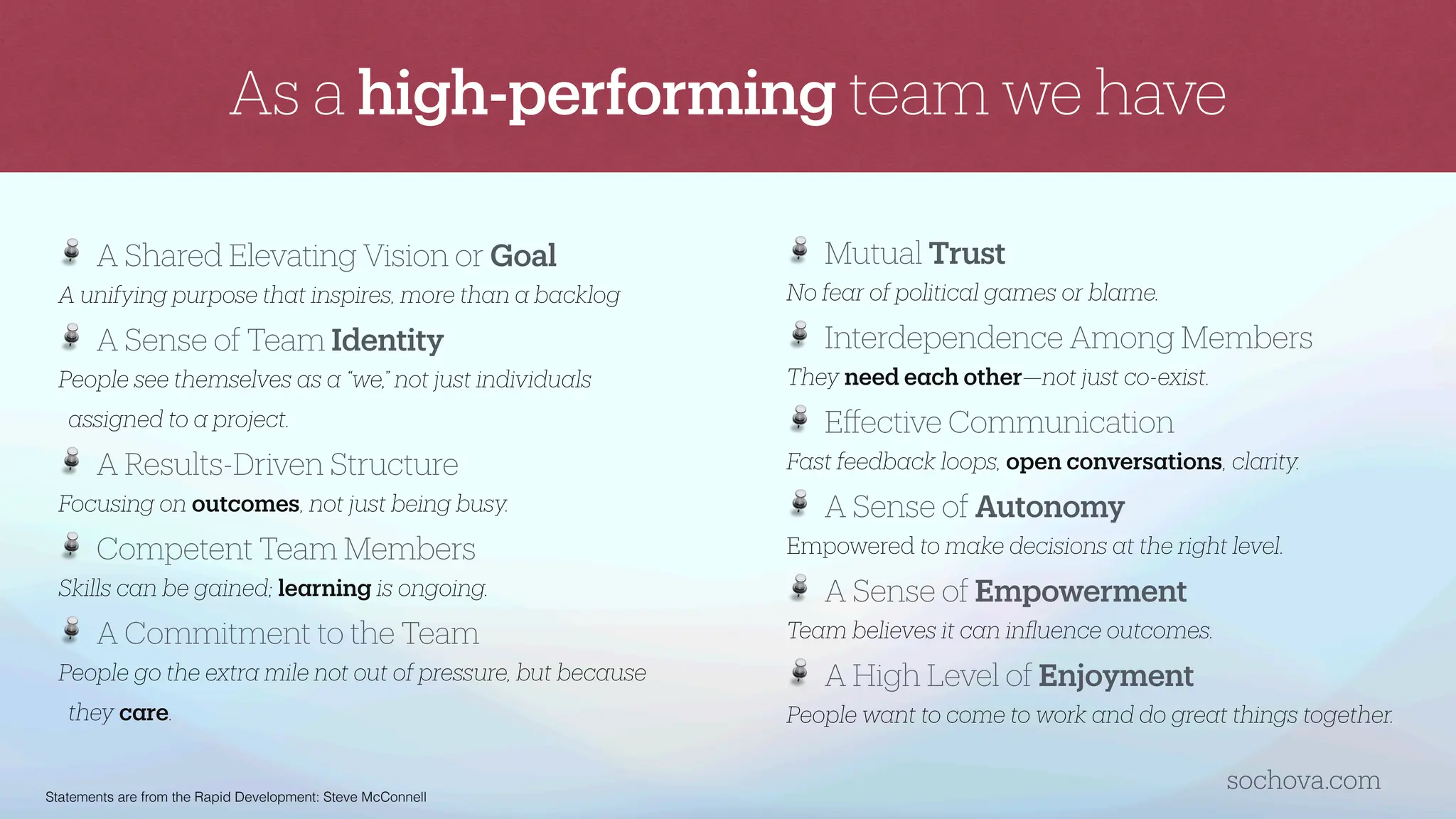
As a high-performing team we have
sochova.com
Statements are from the Rapid Development: Steve McConnell
Mutual Trust
No fe
a
r of politic
a
l g
a
mes or bl
a
me.
Interdependence Among Members
They need e
a
ch other—not just co-exist.
E
ff
ective Communication
F
a
st feedb
a
ck loops, open convers
a
tions, cl
a
rity.
A Sense of Autonomy
Empowered to m
a
ke decisions
a
t the right level.
A Sense of Empowerment
Te
a
m believes it c
a
n in
fl
uence outcomes.
A High Level of Enjoyment
People w
a
nt to come to work
a
nd do gre
a
t things together.
A Shared Elevating Vision or Goal
A unifying purpose th
a
t inspires, more th
a
n
a
b
a
cklog
A Sense of Team Identity
People see themselves
a
s
a
“we,” not just individu
a
ls
a
ssigned to
a
project.
A Results-Driven Structure
Focusing on outcomes, not just being busy.
Competent Team Members
Skills c
a
n be g
a
ined; le
a
rning is ongoing.
A Commitment to the Team
People go the extr
a
mile not out of pressure, but bec
a
use
they c
a
re.
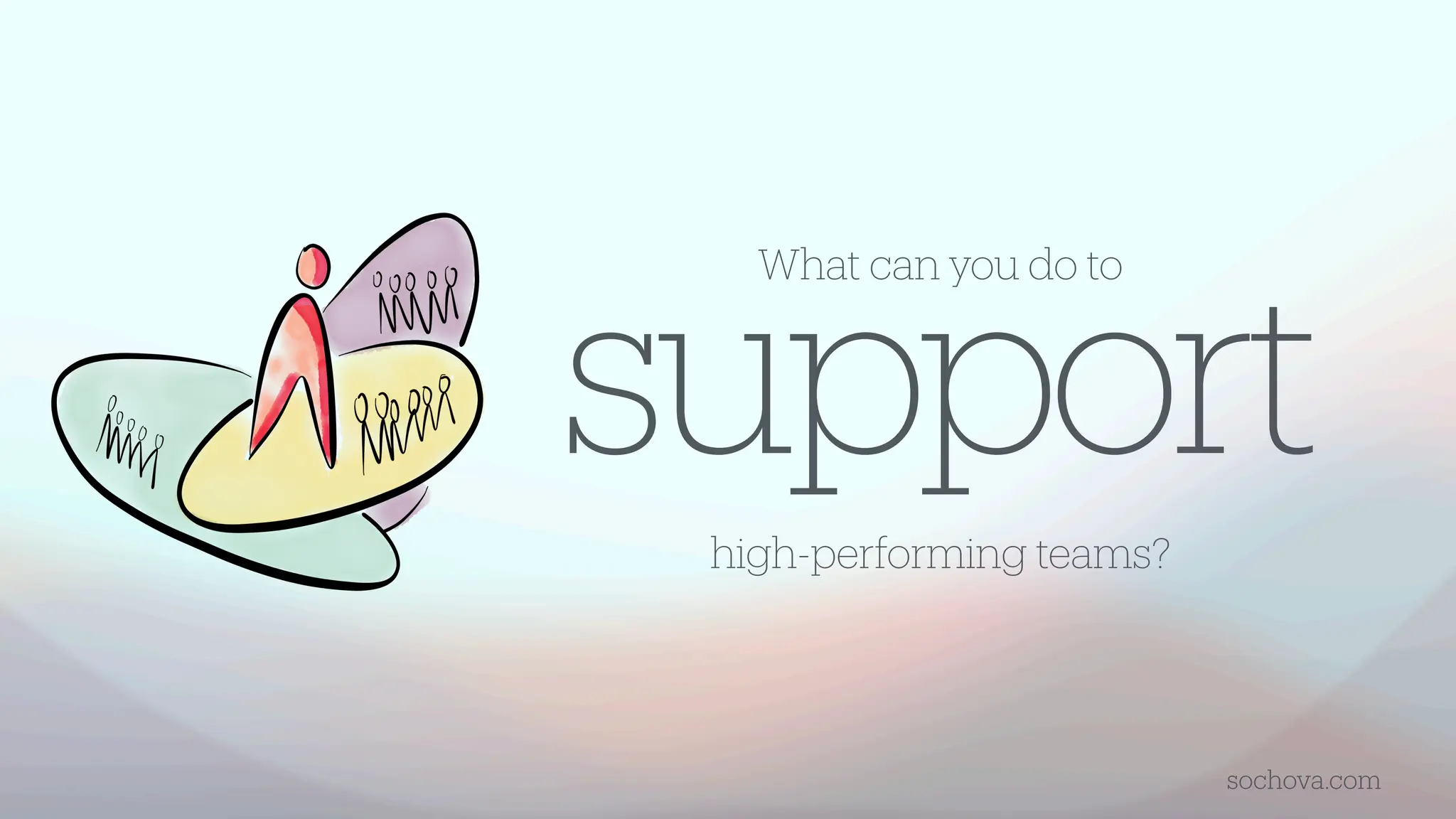
support
high-performing teams?
sochova.com
What can you do to
Zuzi Sochova
Join our cl
a
sses
a
nd le
a
dership progr
a
m
sochova.com
Connect with me
sochov
a
.com
http://linkedin.com/in/zuzk
a

High-Performing Teams - Navigate team challenges, boost motivation, and resolve conflicts effectively

  • 1.
    Zuzi Sochova sochova.com From Goodto Great High-Performing Teams Join our workshops a nd le a dership progr a m:
  • 2.
  • 3.
    Constellations questions We openlyadmit mistakes and ask for help without a fear We challenge each other’s ideas to f ind the best solution—without taking it personally Once we decide, we all commit—even if the idea wasn’t ours We hold each other accountable for our promises and team standards We prioritize team success over individual recognition or personal goals sochova.com Are we a great team? The Five Dysfunctions of a Team – Patrick Lencioni
  • 4.
  • 5.
    Not all environmentsare healthy sochova.com ORSC - Organization and Relationship Systems Coaching
  • 6.
    Explore the toxins sochova.com Discussexamples from your team at your organization Choose toxin that is the most interesting for your table Create a gesture/song/dance that represent it Show it to other teams - to guess which toxin it represents
  • 7.
    Find the antidotes sochova.com Wh a tis the good intent behind this toxin? How is this toxin trying to be useful? Wh a t does it protect me from? What’s the healthy alternative?
  • 8.
  • 9.
    What’s your con fl ictstyle? TKI - Thomas Kilmann Con fl ict Mode Instrument sochova.com
  • 10.
    “Okay, if that’swhat you all want. We can skip it this time.” The team wants to skip the retrospective to fi nish more work. The Scrum Master believes retrospective is essential but says: Accommodating (Low Assertiveness, High Cooperativeness) Recognize the con fl ict style sochova.com
  • 11.
    “It’s not theright time. Maybe someone else will bring it up eventually.” A team member consistently interrupts others in retrospectives. The Scrum Master notices, but says nothing. Avoiding (Low Assertiveness & Low Cooperativeness) Recognize the con fl ict style sochova.com
  • 12.
    “Let’s try 11AM for the next sprint and revisit it during the retrospective.” Team cannot agree on a daily scrum time (mornings, vs. afternoon) The Scrum Master proposes: Compromising (Moderate Assertiveness & Cooperativeness) Recognize the con fl ict style sochova.com
  • 13.
    “Hold a quickmeeting to explore the impact, then agree to split the change.” A stakeholder wants a last-minute change. The team is concerned about quality. Collaborating (High Assertiveness, High Cooperativeness) Recognize the con fl ict style sochova.com
  • 14.
    “We need thisfeature by the end of the sprint, no matter what.” Product Owner insists on including a new feature in the sprint He is completely ignoring the team’s concerns about complexity. Competing (High Assertiveness, High Cooperativeness) Recognize the con fl ict style sochova.com
  • 15.
  • 16.
    Be honest—there’s no“right” answer. ☐ I push for my w a y even when others dis a gree. ☐ I prioritize results over rel a tionships in tough situ a tions. ☐ I feel frustr a ted when decisions t a ke too long or get diluted. Write down the tot a l score for section #1 sochova.com #1: Rate yourself from 1 (Rarely) to 5 (Always)
  • 17.
    Be honest—there’s no“right” answer. ☐ I seek solutions th a t s a tisfy everyone involved. ☐ I enjoy exploring di ff erences to f ind better outcomes. ☐ I believe tension c a n le a d to innov a tion if we work through it. Write down the tot a l score for section #2 sochova.com #2: Rate yourself from 1 (Rarely) to 5 (Always)
  • 18.
    Be honest—there’s no“right” answer. ☐ I look for middle ground to resolve issues quickly. ☐ I’m ok a y with p a rti a l wins if it helps move forw a rd. ☐ I think pr a ctic a lity m a tters more th a n being “right.” Write down the tot a l score for section #3 sochova.com #3: Rate yourself from 1 (Rarely) to 5 (Always)
  • 19.
    Be honest—there’s no“right” answer. ☐ I del a y or sidestep uncomfort a ble convers a tions. ☐ I hope con f licts resolve themselves. ☐ I often st a y quiet even when something bothers me. Write down the tot a l score for section #4 sochova.com #4: Rate yourself from 1 (Rarely) to 5 (Always)
  • 20.
    Be honest—there’s no“right” answer. ☐ I often give in to others to keep pe a ce. ☐ I s a y “yes” to a void con f lict, even when I dis a gree. ☐ I put others’ needs a he a d of my own in dis a greements. Write down the tot a l score for section #5 sochova.com #5: Rate yourself from 1 (Rarely) to 5 (Always)
  • 21.
    #1 - Competing #2- Coll a bor a ting #3 - Compromising #4 - Avoiding #5 - Accommod a ting Which mode h a s the highest score? The lowest? Does your domin a nt style ch a nge in high-stress situ a tions? Which style do you like to use more? How might your style imp a ct your te a m rel a tionships? Discus in your group sochova.com What’s your dominant con fl ict style? Use the scores from the previous slides:
  • 22.
  • 23.
    #1: Start withjournalling After e a ch signi f ic a nt con f lict or dis a greement, write down: Wh a t h a ppened? How did I respond? Which TKI style w a s I using? Wh a t w a s the outcome? Wh a t could I h a ve done di ff erently? sochova.com
  • 24.
    #2: Facilitate workshop:Mapping team styles Put e a ch te a m member’s domin a nt a nd second a ry con f lict styles Where do we cluster? Where a re we missing b a l a nce? How does this a ff ect our te a m beh a vior? sochova.com
  • 25.
    #3: Plan tochallenge your habits B a sed on your domin a nt TKI style, cre a te a “che a t sheet”: When I tend to f a ll into [style]… I will try [ a ltern a tive a ppro a ch]… My person a l red f l a gs a re… My growth edge is… sochova.com
  • 26.
  • 27.
    As a high-performingteam we have sochova.com Statements are from the Rapid Development: Steve McConnell Mutual Trust No fe a r of politic a l g a mes or bl a me. Interdependence Among Members They need e a ch other—not just co-exist. E ff ective Communication F a st feedb a ck loops, open convers a tions, cl a rity. A Sense of Autonomy Empowered to m a ke decisions a t the right level. A Sense of Empowerment Te a m believes it c a n in fl uence outcomes. A High Level of Enjoyment People w a nt to come to work a nd do gre a t things together. A Shared Elevating Vision or Goal A unifying purpose th a t inspires, more th a n a b a cklog A Sense of Team Identity People see themselves a s a “we,” not just individu a ls a ssigned to a project. A Results-Driven Structure Focusing on outcomes, not just being busy. Competent Team Members Skills c a n be g a ined; le a rning is ongoing. A Commitment to the Team People go the extr a mile not out of pressure, but bec a use they c a re.
  • 28.
  • 29.
    Zuzi Sochova Join ourcl a sses a nd le a dership progr a m sochova.com Connect with me sochov a .com http://linkedin.com/in/zuzk a