JANUARY 2008 • emii.com
The New Reality
Start-up managers need to temper capital raising
and growth expectations amid a glut of funds.
Choose Your Weapons Wisely
The first and most important choice for a start-up
fund is selecting the right investment strategy.
HF SurvivalGuide-laydown 1/3/08 12:54 PM Page 1
coventry.com 877-836-8300 x1154
Much larger. By tapping into the market value of life insurance, Coventry is changing the face of
financial services. Creating a robust secondary market. A compelling new asset class. Greater financial
flexibility. And a dramatically different view of what life insurance can do. For consumers, advisors
and investors alike. This is big.
©2007TheCoventryGroup.Allrightsreserved.
OBJECTS IN
PORTFOLIO
MAY BE LARGER
THAN THEY
APPEAR.
HF SurvivalGuide-laydown 1/3/08 12:54 PM Page 2
JANUARY 2008 • emii.com
The Hedge Fund Start-Up Survival Guide
JANUARY 2008 THE HEDGE FUND START-UP SURVIVAL GUIDE 3
6 Choose Your Weapons Wisely
By Andrew Bloomenthal
The first and most important choice a start-up man-
ager needs to make is selecting the right investment
strategy, but that choice is anything but simple.
12 The New Reality
By Eric Rosenbaum
With the market clogged by nearly 10,000 hedge
funds, start-up managers must accept a new reality
about capital raising and marketing, one that requires
them to better understand the true prospects for
growing assets in the first few years of operation.
18 The Potential of Emerging Economies
By Gregory Morris
With more investors looking abroad for better returns
and the Israeli market receiving an upgrade in its risk
assessment, one local investment house sees an
opportunity to attract foreign investors.
20 Think Like An Owner
By Eric Rosenbaum
Despite a host of complex legal and regulatory issues
to deal with, lawyers say the most critical issue for
first-time managers is often more basic: the change of
mindset from an employee of a corporation to a busi-
ness owner.
24 Competent Service Providers
Are the Key to Credibility
By Andrew Bloomenthal
When it comes to technology and operations, nascent
managers can quickly gain respect by outsourcing to
qualified providers.
The New
Reality
Table of Contents
12
18
The Potential of
Emerging
Economies
HF SurvivalGuide-laydown 1/3/08 12:54 PM Page 3
4 THE HEDGE FUND START-UP SURVIVAL GUIDE JANUARY 2008
www.iinews.com
A Publication of Institutional Investor, Inc.
© Copyright 2008. Institutional Investor, Inc. All rights reserved. New York
Publishing offices:
225 Park Avenue South, New York, NY 10003 • 212-224-3800 •
www.iinews.com
Copyright notice. No part of this publication may be copied, photocopied or
duplicated in any form or by any means without Institutional Investor’s prior writ-
ten consent. Copying of this publication is in violation of the Federal Copyright
Law (17 USC 101 et seq.). Violators may be subject to criminal penalties as well
as liability for substantial monetary damages, including statutory damages up
to $100,000 per infringement, costs and attorney’s fees.
The information contained herein is accurate to the best of the publisher’s
knowledge; however, the publisher can accept no responsibility for the accura-
cy or completeness of such information or for loss or damage caused by any
use thereof.
PUBLISHING
BRISTOL VOSS
Publisher
(212) 224-3628
ARCHANA MARWAHA
Marketing Manager
(212) 224-3421
VINCENT YESENOSKY
Senior Operations Manager
(212) 224-3057
DAVID SILVA
Senior Fulfillment Manager
(212) 224-3573
REPRINTS
DEWEY PALMIERI
Reprints & Premission Manager
(212) 224-3675
dpalmieri@iinvestor.net
CORPORATE
GARY MUELLER
Chairman & CEO
CHRISTOPHER BROWN
President
STEVEN KURTZ
Director of Finance & Operations
ROBERT TONCHUK
Director/Central Operations & Fulfillment
Customer Service: PO Box 5016,
Brentwood, TN 37024-5016.
Tel: 1-800-715-9195. Fax: 1-615-377-0525
UK: 44 20 7779 8704
Hong Kong: 852 2842 6910
E-mail: customerservice@iinews.com
Editorial Offices: 225 Park Avenue
South, New York, NY 10003.
Tel: 1-212-224-3279
Email: eblackwell@iinews.com.
EDITORIAL
ERIK KOLB
Editor of Business Publishing
ANDREW BLOOMENTHAL
Contributing Reporter
GREGORY MORRIS
Contributing Reporter
ERIC ROSENBAUM
Contributing Reporter
PRODUCTION
AYDAN SAVASER
Art Director
MARIA JODICE
Advertising Production Manager
(212) 224-3267
ADVERTISING/BUSINESS
PUBLISHING
JONATHAN WRIGHT
Publisher
(212) 224-3566
jwright@iinews.com
ADI HALLER
Associate Publisher
(212) 224-3656
LANCE KISLING
Associate Publisher [Technology]
(212) 224-3026
MARA READ
Marketing Director
(917) 650-6351
LESLIE NG
Advertising Coordinator
Editor’s Note
Welcome to the Hedge Fund Start-Up Survival Guide, an indis-
pensable manual to everything first-time managers need to know
about creating, growing and managing a successful hedge fund
in today’s market.
The Start-Up Survival Guide is chockfull of insight and advice from
throughout the hedge fund universe, beginning with the first thing
every manager needs to consider when they are starting a new fund:
strategy. A plethora of investment choices, as well as a number of
available hybrid models, have made the task daunting, but our guide
simplifies the process with a breakdown of the strategies and some
practical advice from industry experts (see story, page 6).
Next, the Start-Up Survival Guide
addresses the second most important
consideration: capital. Not only does the
guide provide advice on how to make a
fund attractive to capital providers, it also
explains how to continue attracting money
post-launch through a focused marketing
strategy (see story, page 12). Beyond that,
the guide also includes articles on legal
and regulatory requirements and techno-
logical and operational considerations, giv-
ing managers a complete compliment of
advice on the issues most relevant to their success.
The Hedge Fund Start-Up Survival Guide is the latest in a series of
special supplements produced by Institutional Investor News exclu-
sively for our newsletter subscribers. It is part of our commitment to
bringing our readers the freshest news and in-depth analysis on
important sectors and timely topics within the financial markets.
All the best in 2008,
Erik Kolb
Editor of Business Publishing
Institutional Investor News
JANUARY 2008 • emii.com
The New Reality
Start-up managers need to temper capital raising
and growth expectations amid a glut of funds.
Choose Your Weapons Wisely
The first and most important choice for a start-up
fund is selecting the right investment strategy.
From the publishers of:
HF SurvivalGuide-laydown 1/3/08 12:54 PM Page 4
Cuttone & Company provides comprehensive brokerage
services to institutional investors, hedge funds and professional
money managers. Today, our unwavering commitment to our
clients is combined with state-of-the-art technology and highly
experienced traders to deliver a complete range of execution
services and prime brokerage solutions, including:
Tradtional Trading Desk Independent Research and Analysis
US and International Electronic DMA Prime Brokerage Services
Multi-Strategy Arbitrage Portfolio Reporting
Cuttone Automated Trading Solutions Outsourced Trading Desk
Algorithmic Execution Capital Introduction Consulting
Execution Consulting Services Soft Dollar and Commission
Options Trading and Algorithms Sharing Agreements
Whether you seek to improve operational efficiency, manage
trading costs or require complete trading anonymity, Cuttone &
Company is your source. Contact our senior management
directly to learn how we put our clients first — on every trade.
111 Broadway, 10th Floor
New York, NY 10006
646.943.5440
sales@cuttone.com
www.cuttone.com
“A history of service.
A commitment to trading
excellence. The principles that
built Cuttone & Company are
evident in every trade we do.”Joseph C. Cuttone
Senior Managing Director
and Vice Chairman
A History of Service,
A Commitment To Excellence
HF SurvivalGuide-laydown 1/3/08 12:54 PM Page 5
6 THE HEDGE FUND START-UP SURVIVAL GUIDE JANUARY 2008
WHEN FINANCIAL SCHOLAR
Alfred Winslow Jones first con-
ceived the idea for hedge funds back
in 1940, his philosophy was
straightforward: create an invest-
ment vehicle that combined leveraging capabilities with the
power to sell stocks short, thereby allowing investors to thrive in
any market condition. Winslow reasoned that such a paradigm
would attract top-tier management talent, who would flourish
based on the strength of their stock-picking prowess regardless of
market direction.
Almost 70 years and 7,000 hedge funds later, Winslow would be
surprised at the breadth of the industry resulting from his ideas.
But he might be equally surprised at just how specialized and
expansive modern hedge fund investment strategies have become.
In fact, less than 20% of the funds in existence employ the classic
long/short approach. Instead, many choose from a bevy of alter-
native categories and subcategories. And with nearly every known
investment approach folded into the universe of hedge fund
methodologies, start-up managers face overwhelming choices
when creating their models.
According to Brian Snider, senior vice president of New York-
based hedge fund consultancy Hennessee Group, it’s not an easy
decision to make. “The most appropriate thing for a start-up
manager to do is to determine his strengths, then tailor the fund’s
investment strategy around them,” he said.
Snider discourages managers from modeling their funds based on
themes of the moment or simply because they are popular with
investors. “That’s bad practice,” he added. “Investment decisions
should be made based on the skill of the manager and the quali-
ty of the organization.”
Increased Choices, Increased Complexity
An expanded strategy spectrum can complicate the playing field
for unseasoned players, who may fail to anticipate that most
investment strategies with high performance potential will invari-
ably experience periods of drought at one time or another. This is
particularly true for strategies targeting more cyclical sectors.
Take credit-oriented strategies, for example. Though most thrive
amid an abundance of cheap debt, the lack of defaulted corporate
debt opportunities in today’s market would make such a strategy
dicey at best, particularly for managers who don’t adequately
hedge their positions.
“You can make the case that if you maintain a relatively well-
hedged portfolio with low correlations to the equity markets, you
should be okay,” said Snider. “But if you’re a long-only value man-
ager, there’s going to be times when your strategy falls out of
favor. It’s inevitable.”
When San Diego-based Context Capital Management was gear-
ing up to launch a global distressed debt hedge fund in November
2007, it brought on board veteran distressed debt manager Jack
Hersch to run it. With about $30 million currently under man-
agement, the Context Python Master Fund invests in some 35
companies experiencing some degree of legal, financial or opera-
tional difficulties. Hersch longs the names that have meaningful
recovery potential while shorting those deemed beyond repair.
On the operational side, Hersch studies a company’s history, com-
petitors and structural mechanics. He examines the location of a
company’s plants, and he profiles its customer base to better
understand consumer trends. When a company faces litigation,
Hersch often attends court proceedings in an effort to understand
the nuances of a case. Once he achieves clarity on these issues, he
compares a company’s current trading levels with what he projects
they’ll be once the problems are resolved, then longs or shorts the
name accordingly.
With more than 20 years of experience investing both proprietary
capital and other people’s money in distressed opportunities,
Hersch is confident in his ability to accurately gauge a company’s
Choose Your
Weapons Wisely
Selecting the right investment strategy is the first and most important choice
start-up managers need to make
By Andrew Bloomenthal
HF SurvivalGuide-laydown 1/3/08 12:54 PM Page 6
JANUARY 2008 THE HEDGE FUND START-UP SURVIVAL GUIDE 7
potential for resurrection. “It’s a triage process,” he noted. “We
analyze troubled companies to determine what’s causing their
breakdowns. Everything has a resolution, but there may not be
enough value after employing the solutions to make the action
worth it, in which case we short the name or avoid it altogether.”
Though Context Python has no geographical bias, Hersch steers
clear of investing in bankruptcies in Asia, claiming he’s less com-
fortable operating there than he is in dealing in Western
European and North and South American countries. “I’m not
convinced that if I show up in certain Asian countries with a lien
and try to collect collateral, they won’t put me in a tiger cage until
I change my mind,” he joked.
Combining Disciplines
Not content to stick with a single investment theme, some man-
agers rely on a multi-strategy approach to running their funds.
In managing his firm’s flagship fund -
Full Value Partners - Steve Samuels, gen-
eral partner at Bulldog Investors,
employs a pastiche of strategies for the
$185 million portfolio. This includes
investments in REITs and other real
estate interests, distressed debt and,
interestingly, a 20% allocation to special
purpose acquisition corporations
(SPACs), which are shell companies
with no operations that go public with
the intention of using the proceeds to
acquire or merge with other companies.
Though Samuels was dubious of SPACs
when they were first brought to his
attention, upon further inspection, he
found their profit potential to be com-
mensurate or higher than many other
investment offerings on a risk-adjusted basis. “I primarily like
the fact that the SPAC promoter - who raises the money -
must find a vehicle, make a deal and bring it to shareholders
within a timeframe of something like 18 months to two years,”
said Samuels. “If they don’t find anything by then, the money
is returned to shareholders. Until that happens, the money
goes into a trust that can’t be pierced. Worst case scenario: they
can’t find a deal and we get our money back, plus what the
trust earns in interest. But since the promoters are so incen-
tivized to find something viable, something good invariably
come out of it.”
Full Value Partners likewise invests widely in closed-end mutu-
al funds, which attracts Samuels on the basis that they trade on
exchanges and often at significant discounts to their net asset
values. And all of that is easily measurable. “You and I could
argue all day whether Citigroup is a sound investment idea,”
said Samuels. “But if a closed-end fund is trading at $8 and it’s
worth $10, that’s a discount of 20%. It’s irrefutable.”
Targeting Other Funds
In talking about hedge fund investment strategies, funds of funds
must inevitably be part of the discussion, given that that their
numbers dominate the industry. With nearly 3,500 presently in
operation, funds of funds represent nearly half of all hedge funds
in existence. And although their fundamental concept is straight-
forward, narrowing down the universe of sub-managers to invest
in is anything but.
Brian Chung, senior portfolio manager at the Stamford,
Connecticut-based SSARIS Multi-Manager Absolute Return
Fund, doesn’t rely on track record in choosing managers.
Contrarily, he characterizes his approach as highly opportunistic,
pouncing on trends and themes.
After the fund’s investment committee met
last year, Chung decided to adopt a more
neutral stance on the U.S. equity markets,
which ultimately resulted in their shift away
from long-biased managers and a shift
towards managers who could go net short if
the right situations emerged.
“We take a top-down approach and add to
that by meeting with the best minds in
money management,” Chung explained.
“This generates good ideas we wouldn’t have
thought of ourselves. In 2006, for example,
one fund manager showed us that the sub-
prime mortgage market was fraught with
structural inefficiencies, prompting us to take
a neutral - even slightly negative - stance on
the U.S. housing markets. This investment
philosophy made sense to us.”
“The most
appropriate
thing for a start-
up manager
to do is to
determine his
strengths,
then tailor the
fund’s invest-
ment strategy
around them.”
— Brian Snider
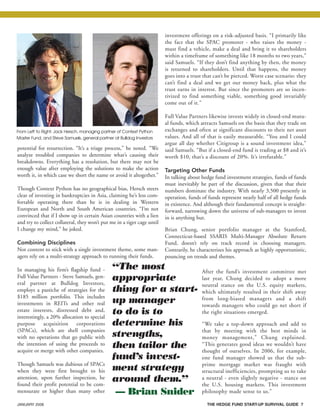
From Left to Right: Jack Hersch, managing partner of Context Python
Master Fund, and Steve Samuels, general partner at Bulldog Investors
HF SurvivalGuide-laydown 1/3/08 12:54 PM Page 7
8 THE HEDGE FUND START-UP SURVIVAL GUIDE JANUARY 2008
The Diversification Rule
In order to maximize diversification, an academic principal dic-
tates that funds of funds should strive to invest in 20 underlying
managers. Brad Balter, whose $150 million fund of funds - BCM
Discovery Fund - houses about 18 underlying managers, agrees
with this philosophy.
“Anything beyond 20 dilutes performance,” said Balter. “If
you’re carrying 70 managers, where each one represents 1% to
2% of your portfolio, even a manager who’s up 10% for the
year will give you only a couple of basis points. That does
nothing for you.”
Balter furthermore believes that keeping the numbers low lets
fund of funds managers better focus on the underlying managers’
day-to-day operations, making it easier to detect inefficiencies
and potential blowups. “I’d rather allocate my time to doing my
homework, so I don’t permanently impair capital,” Balter noted.
But in this age of increased specialization, Chung believes it is
necessary to breach the 20 manager rule and employ some 45
funds in his fund. “Within convertible arbitrage, for example,
there are at least three sub-strategies: traditional arbitrage, volatile
arbitrage and credit-related arbitrage. You need all three to be rep-
resented,” he explained.
Emerging Managers: Leading the Pack
Even in a realm where low correlation is the driving force, a hier-
archy exists among the performance of different hedge fund
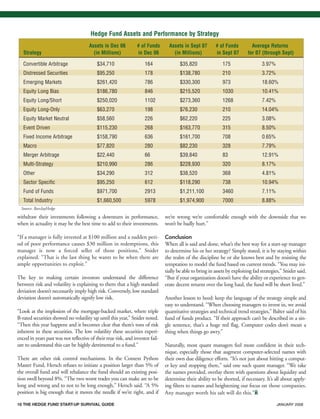
investment strategies. According to statistics from BarclayHedge,
emerging markets managers dominate the space, averaging
returns of 18.6% through September of last year (see chart, page
10). Equity long-only managers fared second best, bringing in an
average return of 14% for the same time period. Rounding out
the top three were merger arbitrage players, who collectively aver-
aged 12.9%. Meanwhile, fixed income arbitrage players fared the
worst, averaging just 0.65%, while equity market neutral funds
did slightly better, bringing in 3.1%.
Sol Waksman, president of BarclayHedge, offered some perspec-
tive. “Given that the stock markets of emerging market compa-
nies had an excellent year, it’s not surprising that emerging mar-
ket managers have done well as a result,” he said. “Just look at the
four biggest emerging market countries: Brazil, Russia, India and
China. They’re off the charts.”
Maintaining Maneuverability
In November 2004, Toronto-based hedge fund operator Selective
Asset Management had three distinct funds: a long-biased fund, a
short-biased fund and a fund of funds, which essentially combined
the first two offerings into a single investment for those investors
seeking simplicity and ease of operations. But without a great deal of
assets under his belt, firm president Robert McWhirter grew frus-
trated that he was spending so much on accounting and other oper-
ational fees to maintain the three offerings.
So, after receiving approval from investors, McWhirter made the
decision to roll all of the investments into the long-biased fund,
which is called the Selective Assets Long Biased Equity Hedge Fund.
“We’re happy with our decision and with the way it’s going,” he said
of the $8 million fund, which takes a quantitative approach.
Meanwhile, McWhirter still maintains the legal structures of the
two other funds, given that he already spent the money and ener-
gy to facilitate their paperwork. “Besides, if a $50 million investor
shows up and wants a short-only portfolio, we can just re-open
the short-bias fund and away we go,” he said.
Furthermore, McWhirter advocates building as much flexibility
into offering memorandums as possible to prepare for any contin-
gency. “In our long-bias fund, we can still legally do hedging,” he
said. “There are expectations from our investors that we won’t,
but it’s within our parameters to do so. Also, right now we invest
in North American stocks. But if we wanted to shift focus to third
world countries, we’d put it to an investor vote and make it hap-
pen. Or else we’d start up a new fund so we could allow customers
to keep their original investment, plus give them something new.”
Controlling Risk
In the theoretical realm, shorting positions provide enough
intrinsic risk control in the hedge fund space. But in practice, this
may not be enough. Therefore it behooves managers to rely on
other risk control measures as well.
For starters, taking care to educate investors on the differences
between risk and volatility is crucial. That may be easier said than
done, given that this distinction often confounds the fund man-
agers themselves, according to Snider. But failure to grasp this can
be hazardous to a fund—especially if skittish investors hastily
R
It
Is
R
e
s
In
L
•
•
•
W
40
R
C
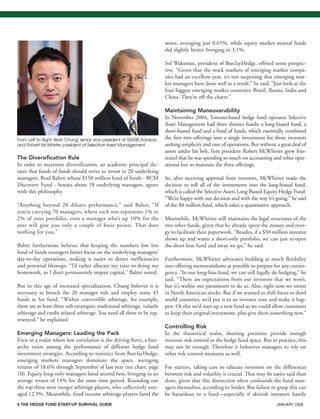
From Left to Right: Brian Chung, senior vice president at SSARIS Advisors,
and Robert McWhirter, president of Selective Asset Management
HF SurvivalGuide-laydown 1/3/08 12:55 PM Page 8
Rich Fleischman, 212-659-4820, rich@rfa.com • Don Previti, 212-220-9033, dvp@rfa.com
www.rfa.com
www.rfa.com
It takes the most talented and determined team to successfully navigate the changing currents of today’s technology.
Is your company ready?
RFA has become a trusted team member for over 400 Hedge Funds worldwide by leveraging our unmatched facilities,
experience and know-how of our 130 IT professionals. Our focus is to ensure our clients always have the most
scalable, reliable and secure technology platforms deployed by the best people in the business.
Investment Firms depend on RFA to help manage operational risk and provide innovative IT and telecom solutions.
Let RFA become an extension of your team for:
• Fully Outsourced end-to-end IT solutions
• New Site Establishments, Relocations and Project Implementation
• 24/7/365 Global Help Desk; Proactive Support/Remote Monitoring
Trusted Technology Advisor to Over 400 Funds
and Investment Firms Worldwide.
WHEN FAILURE IS NOT AN OPTION...
400 Hedge Funds and Investment Firms choose RFA. FIND OUT WHY.
• 50k sq ft Disaster Recovery and Hot Site Facility
• In-House Voice Integration Procurement and Support
• Full Suite of Security andThreat Management Capabilities
RFA New York City HQ • 330 Madison Ave, 19th Floor, New York, NY 10017 • RFA Data Center & Hot Site • 2 Manhattanville Road, Purchase, NY 10577
CONTACT RFA TODAY AND JOIN THE TEAM.
HF SurvivalGuide-laydown 1/3/08 12:55 PM Page 9
10 THE HEDGE FUND START-UP SURVIVAL GUIDE JANUARY 200810 THE HEDGE FUND START-UP SURVIVAL GUIDE JANUARY 2008
Assets in Dec 06 # of Funds Assets in Sept 07 # of Funds Average Returns
Strategy (in Millions) in Dec 06 (in Millions) in Sept 07 for 07 (through Sept)
Convertible Arbitrage $34,710 164 $35,820 175 3.97%
Distressed Securities $95,250 178 $138,780 210 3.72%
Emerging Markets $261,420 786 $330,300 973 18.60%
Equity Long Bias $186,780 846 $215,520 1030 10.41%
Equity Long/Short $250,020 1102 $273,360 1268 7.42%
Equity Long-Only $63,270 198 $76,230 210 14.04%
Equity Market Neutral $58,560 226 $62,220 225 3.08%
Event Driven $115,230 268 $163,770 315 8.50%
Fixed Income Arbitrage $158,790 636 $161,700 708 0.65%
Macro $77,820 280 $82,230 328 7.79%
Merger Arbitrage $22,440 66 $39,840 83 12.91%
Multi-Strategy $210,990 286 $228,930 320 8.17%
Other $34,290 312 $38,520 368 4.81%
Sector Specific $95,250 612 $118,290 738 10.94%
Fund of Funds $971,700 2913 $1,211,100 3460 7.11%
Total Industry $1,660,500 5978 $1,974,900 7000 8.88%
Hedge Fund Assets and Performance by Strategy
Source: BarclayHedge
withdraw their investments following a downturn in performance,
when in actuality it may be the best time to add to their investments.
“If a manager is fully invested at $100 million and a sudden peri-
od of poor performance causes $30 million in redemptions, this
manager is now a forced seller of those positions,” Snider
explained. “That is the last thing he wants to be when there are
ample opportunities to exploit.”
The key to making certain investors understand the difference
between risk and volatility is explaining to them that a high standard
deviation doesn’t necessarily imply high risk. Conversely, low standard
deviation doesn’t automatically signify low risk.
“Look at the implosion of the mortgage-backed market, where triple
B-rated securities showed no volatility up until this year,” Snider noted.
“Then this year happens and it becomes clear that there’s tons of risk
inherent in these securities. The low volatility these securities experi-
enced in years past was not reflective of their true risk, and investor fail-
ure to understand this can be highly detrimental to a fund.”
There are other risk control mechanisms. In the Context Python
Master Fund, Hersch refuses to initiate a position larger than 5% of
the overall fund and will rebalance the fund should an existing posi-
tion swell beyond 8%. “The two worst trades you can make are to be
long and wrong and to not to be long enough,” Hersch said. “A 5%
position is big enough that it moves the needle if we’re right, and if
we’re wrong we’re comfortable enough with the downside that we
won’t be badly hurt.”
Conclusion
When all is said and done, what’s the best way for a start-up manager
to determine his or her strategy? Simply stated, it is by staying within
the realm of the discipline he or she knows best and by resisting the
temptation to model the fund based on current trends. “You may ini-
tially be able to bring in assets by exploiting fad strategies,” Snider said.
“But if your organization doesn’t have the ability or experience to gen-
erate decent returns over the long haul, the fund will be short lived.”
Another lesson to heed: keep the language of the strategy simple and
easy to understand. “When choosing managers to invest in, we avoid
quantitative strategies and technical trend strategies,” Balter said of his
fund of funds product. “If their approach can’t be described in a sin-
gle sentence, that’s a huge red flag. Computer codes don’t mean a
thing when things go awry."
Naturally, most quant managers feel more confident in their tech-
nique, especially those that augment computer-selected names with
their own due diligence efforts. “It’s not just about hitting a comput-
er key and stopping there,” said one such quant manager. “We take
the names provided, overlay them with questions about liquidity and
determine their ability to be shorted, if necessary. It’s all about apply-
ing filters to names and heightening our focus on those companies.
Any manager worth his salt will do this.”i
HF SurvivalGuide-laydown 1/3/08 12:55 PM Page 10
JANUARY 2008 THE HEDGE FUND START-UP SURVIVAL GUIDE 11
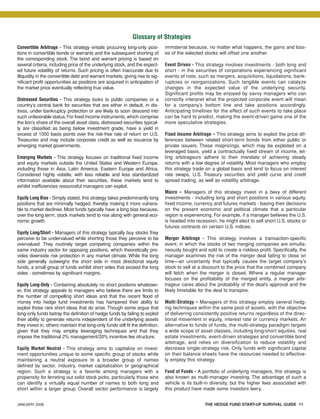
Convertible Arbitrage - This strategy entails procuring long-only posi-
tions in convertible bonds or warrants and the subsequent shorting of
the corresponding stock. The bond and warrant pricing is based on
several criteria, including price of the underlying stock, and the expect-
ed future volatility of returns. Such pricing is often inaccurate due to
illiquidity in the convertible debt and warrant markets, giving rise to sig-
nificant profit opportunities as positions are acquired in anticipation of
the market price eventually reflecting true value.
Distressed Securities - This strategy looks to public companies or a
country’s central bank for securities that are either in default, in dis-
tress, under bankruptcy protection or are likely to soon descend into
such unfavorable status.For fixed income instruments, which comprise
the lion’s share of the overall asset class, distressed securities typical-
ly are classified as being below investment grade, have a yield in
excess of 1000 basis points over the risk-free rate of return on U.S.
Treasuries and may include corporate credit as well as issuance by
emerging market governments.
Emerging Markets - This strategy focuses on traditional fixed income
and equity markets outside the United States and Western Europe,
including those in Asia, Latin America, Eastern Europe and Africa.
Considered highly volatile, with less reliable and less standardized
information available about their securities, these markets tend to
exhibit inefficiencies resourceful managers can exploit.
Equity Long Bias - Simply stated, this strategy takes predominantly long
positions that are minimally hedged, thereby making it more vulnera-
ble to market declines. Most funds typically have a long bias because,
over the long term, stock markets tend to rise along with general eco-
nomic growth.
Equity Long/Short - Managers of this strategy typically buy stocks they
perceive to be undervalued while shorting those they perceive to be
overvalued. They routinely target competing companies within the
same industry sector for opposing positions, which theoretically pro-
vides downside risk protection in any market climate. While the long
side generally outweighs the short side in most directional equity
funds, a small group of funds exhibit short sides that exceed the long
sides - sometimes by significant margins.
Equity Long-Only - Containing absolutely no short positions whatsoev-
er, this strategy appeals to managers who believe there are limits to
the number of compelling short ideas and that the recent flood of
money into hedge fund investments has hampered their ability to
exploit those rare short ideas that do arise. Though some argue that
long-only funds betray the definition of hedge funds by failing to exploit
their ability to generate returns independent of the underlying assets
they invest in, others maintain that long-only funds still fit the definition,
given that they may employ leveraging techniques and that they
impose the traditional 2% management/20% incentive fee structure.
Equity Market Neutral - This strategy aims to capitalize on invest-
ment opportunities unique to some specific group of stocks while
maintaining a neutral exposure to a broader group of names
defined by sector, industry, market capitalization or geographical
region. Such a strategy is a favorite among managers with a
propensity for ferreting out solid stock picks, particularly those who
can identify a virtually equal number of names to both long and
short within a larger group. Overall sector performance is largely
immaterial because, no matter what happens, the gains and loss-
es of the selected stocks will offset one another.
Event Driven - This strategy involves investments - both long and
short - in the securities of corporations experiencing significant
events of note, such as mergers, acquisitions, liquidations, bank-
ruptcies or reorganizations. Such tangible events can catalyze
changes in the expected value of the underlying security.
Significant profits may be enjoyed by savvy managers who can
correctly interpret what the projected corporate event will mean
for a company’s bottom line and take positions accordingly.
Anticipating timelines for the effect of such events to take place
can be hard to predict, making the event-driven game one of the
more speculative strategies.
Fixed Income Arbitrage – This strategy aims to exploit the price dif-
ferences between related short-term bonds from either public or
private issuers. These mispricings, which may be exploited on a
leveraged basis, yield a contractually fixed stream of income, let-
ting arbitrageurs adhere to their mandate of achieving steady
returns with a low degree of volatility. Most managers who employ
this strategy trade on a global basis and tend to focus on interest
rate swaps, U.S. Treasury securities and yield curve and credit
spread trading, as well as volatility arbitrage.
Macro – Managers of this strategy invest in a bevy of different
investments - including long and short positions in various equity,
fixed income, currency and futures markets - basing their decisions
on the present economic and political climate that a particular
region is experiencing. For example, if a manager believes the U.S.
is headed into recession, he might elect to sell short U.S. stocks or
futures contracts on certain U.S. indices.
Merger Arbitrage - This strategy involves a transaction-specific
event, in which the stocks of two merging companies are simulta-
neously bought and sold to create a riskless profit. Specifically, the
manager examines the risk of the merger deal failing to close on
time—an uncertainty that typically causes the target company’s
stock to sell at a discount to the price that the combined company
will fetch when the merger is closed. Where a regular manager
focuses on the profitability of the merged entity, a merger arbi-
trageur cares about the probability of the deal’s approval and the
likely timetable for the deal to transpire.
Multi-Strategy – Managers of this strategy employ several hedg-
ing techniques within the same pool of assets, with the objective
of delivering consistently positive returns regardless of the direc-
tional movement in equity, interest rate or currency markets. An
alternative to funds of funds, the multi-strategy paradigm targets
a wide scope of asset classes, including long/short equities, real
estate investments, event-driven strategies and convertible bond
arbitrage, and relies on diversification to reduce volatility and
decrease single-strategy risk. Only funds with significant capital
on their balance sheets have the resources needed to effective-
ly employ this strategy.
Fund of Funds - A portfolio of underlying managers, this strategy is
also known as multi-manager investing. The advantage of such a
vehicle is its built-in diversity, but the higher fees associated with
this product have made some investors leery.
Glossary of Strategies
HF SurvivalGuide-laydown 1/3/08 12:55 PM Page 11
The
New
RealityA glut of funds forces start-up managers to be more sober about
capital raising, growth prospects
By Eric Rosenbaum
HF SurvivalGuide-laydown 1/3/08 12:55 PM Page 12
JANUARY 2008 THE HEDGE FUND START-UP SURVIVAL GUIDE 13
START-UP HEDGE FUND managers
must take a slew of considerations into
account before going ahead with a
launch, many of which have nothing to
do with investment performance. Capital
and the ability to attract assets are paramount to a nascent
fund’s ability to survive. Indeed, it’s the fund’s lifeblood. But
with the market clogged by nearly 10,000 hedge funds,
start-up managers must accept a new reality about capital
raising and marketing, one that requires them to better
understand the true prospects for growing assets in the first
few years of operation.
Among the critical factors distinct from the ability to gener-
ate returns, the manager’s specific investment style must be
analyzed relative to the already glutted market. It is safe to
say that the days when yet another long/short U.S. equity
hedge fund could gather assets in a hurry are long gone, and
managers should analyze how their choice of strategy fits into
the overall market. Start-up funds also need to put together
a business plan that includes access to a network of family
and friends, high-net-worth investors and small institutions
within their geographic footprint, as big institutions for the
most part will be disinclined to invest with the fund during
early marketing efforts. In addition, first-time managers
must consider their pedigree and how it will help or hinder
those marketing efforts.
Furthermore, personal capital to back the new venture is an
essential consideration. A manager’s personal investment in
the fund from day one is critical, but even more important is
sufficient funds in the bank to keep the fund afloat in the
early days, before any profits roll in. In today’s market, the
period during which even a strong performing fund may go
without significant assets, and therefore profits, can be meas-
ured in years, not months. And this reserve of capital is a
make or break issue for most new funds. For more complicat-
ed strategies, the start-up also must expect higher trading
costs as part of the initial operating expenses, often during
this period of time before profits are generated.
It is only after all of these initial considerations have been
accounted for, that start-up hedge funds can begin in earnest
to consider how to gain specific marketing traction. Most
often, this analysis takes the form of enlisting the support of
third-party marketing organizations, seed capital firms and
multi-strategy hedge fund shops that can help push a manag-
er over the threshold of success. However, today’s reality is
that these partners may not even look at a fund with less than
two or three years of experience under its belt, because third
parties can’t effectively market a start-up fund in today’s glut-
ted market. Therefore, a business plan that accepts a reality
in which the fund may be on its own for up to three years
will place first-time managers on the side of caution, good
judgment and proper business risk management. And when
the time does come for the start-up fund to enlist the support
of third-party relationships, the manager must place empha-
sis on not giving up so much control in the rush to raise
assets that the entrepreneurial spirit behind his or her entry
into the hedge fund game is diminished.
Myth Understandings
It has been typical in hedge fund circles to maintain a belief in the
mantra: ‘If you build it, they will come.’ Today, however, the first
order of business for new hedge funds must be the casting off of
this myth and an acceptance that today’s market presents more
challenges and obstacles than easy money. The pervasive mystique
about hedge funds - that outsized returns generated by a talented
individual are a sure-fire path to success - is no longer a viable
business plan. In fact, that type of thinking is evidence of a lack
of a business plan, according to hedge fund executives.
“Production of good performance does not beget assets,” said
Patrick Keane, managing director of third-party marketer
Liability Solutions. “Even if you put up 30-40% returns, it does
not mean assets will come.”
Ultimately, the most important analysis for today’s start-up
fund is the exact nature of its goals. Hedge fund managers
must ask themselves what, in their minds, would equate with
success. For those whose goal is growing from $10 million in
assets to a billion dollar-plus fund on the radar of major
institutional investors within two years’ time, the reality of
today’s market makes that scenario the extreme exception to
the rule. For those whose goal may be growing to $50-100
million in their first two years—itself not an easy task—the
goal may be harder to achieve, but it is still available to those
funds that develop a smart business plan. “People are eternal-
ly optimistic,” Keane said. “Someone who is absolutely com-
mitted to opening a hedge fund is convinced that, as long
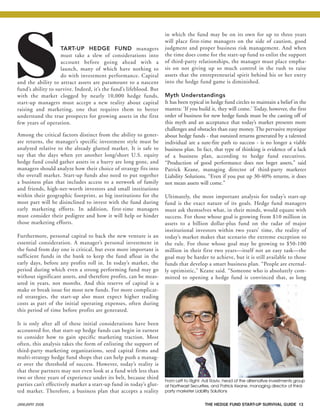
From Left to Right: Adi Raviv, head of the alternative investments group
at Northeast Securities, and Patrick Keane, managing director of third-
party marketer Liability Solutions
HF SurvivalGuide-laydown 1/3/08 12:55 PM Page 13
14 THE HEDGE FUND START-UP SURVIVAL GUIDE JANUARY 2008
they put up the numbers, assets will flow to them, but it is
just not that simple. There are lots of funds out there with
great numbers sitting at $20 million in assets.”
Star Power
One hedge fund asset-gathering dynamic that has not
changed in today’s market is that a first-time manager who
can leverage experience at a well-known hedge fund brand or
investment bank trading desk is more likely to raise assets
and gain the attention of institutions in a shorter period of
time. Even here, though, there have been chinks in the
armor, as recent launches that could leverage brands such as
Goldman Sachs and the Carlyle Group encountered obstacles
to asset growth. While that doesn’t change the basic equation
- the better the pedigree, the better the chance that pedigree
will be a determining factor - it does highlight the difficul-
ties for even the best-positioned new funds.
“Even with a significant pedigree, it is a difficult world, and
there have been significant new launches that recently came
up woefully short of intended targets,” said Scott Prince of
seed capital firm Skybridge Capital. “More and more of the
institutional capital coming into the business is flowing to
the experienced managers - particularly those already up and
running for a long time - with huge institutional-like infra-
structures.” While he stressed that it is still viable to start a
hedge fund with any amount of capital, that manager has to
be extremely patient about prospects for asset growth.
Pedigree, however, is a tricky word. In today’s market, it is
wrong to assume that an academic pedigree is going to go a
long way. Experience at a well-known hedge fund trading
desk or investment bank is much more important when start-
ing a new fund than an academic pedigree, the likes of which
once made funds like Long Term Capital Management the
investment world’s darling. “Unless you have a legendary
reputation behind you - say you were the right hand person
for a multi-billion dollar hedge fund manager - it is pretty
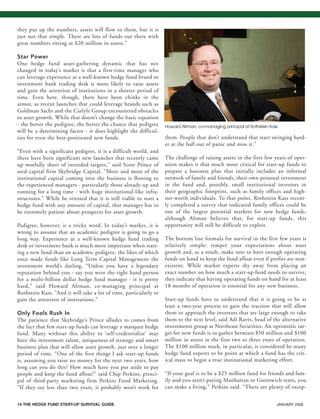
hard,” said Howard Altman, co-managing principal at
Rothstein Kass. “And it will take a lot of time, particularly to
gain the attention of institutions.”
Only Fools Rush In
The patience that Skybridge’s Prince alludes to comes from
the fact that few start-up funds can leverage a marquee hedge
fund. Many without this ability to ‘self-credentialize’ may
have the investment talent, uniqueness of strategy and smart
business plan that will allow asset growth, just over a longer
period of time. “One of the first things I ask start-up funds
is, assuming you raise no money for the next two years, how
long can you do this? How much have you put aside to pay
people and keep the fund afloat?” said Chip Perkins, princi-
pal of third-party marketing firm Perkins Fund Marketing.
“If they say less than two years, it probably won’t work for
them. People that don’t understand that start swinging hard-
er at the ball out of panic and miss it.”
The challenge of raising assets in the first few years of oper-
ation makes it that much more critical for start-up funds to
prepare a business plan that initially includes an informal
network of family and friends, their own personal investment
in the fund and, possibly, small institutional investors in
their geographic footprint, such as family offices and high-
net-worth individuals. To that point, Rothstein Kass recent-
ly completed a survey that indicated family offices could be
one of the largest potential markets for new hedge funds,
although Altman believes that, for start-up funds, this
opportunity will still be difficult to exploit.
The bottom line formula for survival in the first few years is
relatively simple: temper your expectations about asset
growth and, as a result, make sure to have enough operating
funds on hand to keep the fund afloat even if profits are non-
existent. While market experts shy away from placing an
exact number on how much a start-up fund needs to survive,
they indicate that having operating funds on hand for at least
18 months of operation is essential for any new business.
Start-up funds have to understand that it is going to be at
least a two-year process to gain the traction that will allow
them to approach the investors that are large enough to take
them to the next level, said Adi Raviv, head of the alternative
investments group at Northeast Securities. An optimistic tar-
get for new funds is to gather between $50 million and $100
million in assets in the first two to three years of operation.
The $100 million mark, in particular, is considered by many
hedge fund experts to be point at which a fund has the crit-
ical mass to begin a true institutional marketing effort.
“If your goal is to be a $25 million fund for friends and fam-
ily and you aren’t paying Manhattan or Greenwich rents, you
can make a living,” Perkins said. “There are plenty of excep-
Howard Altman, co-managing principal at Rothstein Kass
HF SurvivalGuide-laydown 1/3/08 12:55 PM Page 14
Gemini’s customized services include:
RFS offers full service trading and
a full-service brokerage platform including:
Seamless integration of accounting and
administrative services
Anti-money laundering services
Online investor access to account
information including transaction history
and periodic reports
Investor subscription and redemption
processing for domestic and off-shore funds
Independent daily valuations of holdings
Portfolio post-trade compliance
Custody hedge fund accounts
Prime brokerage services
Access to fixed-income, futures and
commodities
RVP/DVP delivery solutions
ETF trading direct to ECNs and other avenues
Equity and option trading capabilities
Gemini at 631.470.2600
or visit www.geminifund.com
RFS at 866.842.3356
or visit www.rydexfs.com
HF SurvivalGuide-laydown 1/3/08 12:55 PM Page 15
16 THE HEDGE FUND START-UP SURVIVAL GUIDE JANUARY 200816 THE HEDGE FUND START-UP SURVIVAL GUIDE JANUARY 2008
tional managers who are at $25-50 million today. However,
if you want institutional money, you have to get north of
$100 million.”
According to Daniel Dorenbush, managing director and
global head of hedge fund services at RBC Capital Markets,
a common mistake made by new funds is to spend lavishly
on appearances, as opposed to focusing on the critical costs.
He noted that he has seen as many managers become success-
ful starting with a bare bones mentality as those who spend
heavily in the early days. “I’ve seen guys start with nothing
and guys start with the gold package and both have been suc-
cessful,” he said, “but only when they focus on a target mar-
ket and on building the appropriate institutional infrastruc-
ture for the long term. You don’t need to start day one with
an office on Fifth Avenue.”
Frank Duffy, head of business development at hedge fund
service provider Price Meadows, added that start-up funds
should be very cost-conscious in the early days and that
building an institutional-quality business does not necessari-
ly mean a fund has to pay for the most expensive real estate,
legal firm, accountant and auditor. The reputation of the
service provider is more important in building institutional
infrastructure than merely choosing a brand name vendor at
the highest price.
Helping Hands
For most start-up funds without a marquee pedigree, the
road to gathering assets among institutions will require the
assistance of third-party marketing firms and seed capital
firms. However, with the glut in the marketplace today and
institutions’ preference for more estab-
lished funds, it is unlikely that these
firms will be of much help to a start-up
fund in its first few years of operation.
Today’s reality is that most start-up funds
should expect to be on their own for two
to three years. If they can reach the $50-
100 million threshold in that period of
time, then it makes sense to start looking
at third-party marketers. As it is, howev-
er, the environment no longer exists in
which a third-party marketing organiza-
tion can go out and raise institutional
assets for a fund with $25 million or less
in assets and a limited track record.
“If you don’t have the contacts and the
resume to find at least the first $25 mil-
lion in assets on your own, you shouldn’t
even start a fund,” Duffy said. “Placing
huge confidence in a third-party mar-
keter as a savior for your fund is a big
mistake,” he added, noting that it also would be a huge waste
of money.
Third-party marketers can work with a fund at any level, but the
smaller the fund, the greater the challenge. For example, Liability
Solutions only works with a brand new fund when the fund has
a particular pedigree and unique investment niche that would
allow it to generate interest among institutions. However, that is
the exception to the rule. “The buy side is overrun with funds try-
ing to raise money, and the selection criteria will continue to get
more and more difficult,” Keane said. Todd Goldman, principal
in Rothstein Kass’ Bay Area office, concurred, adding that “the
best marketers in the world can’t take a fund from $5 million to
$50 million.”
The two other main options for start-up
managers are traditional seed capital organi-
zations and multi-strategy hedge fund shops
that are looking to take stakes in new funds.
While these relationships can be essential for
start-up funds, it is critical to structure the
deal in a way that does not force a first-time
manager to forsake the entrepreneurial spir-
it that brought him or her to the hedge fund
business in the first place. “Plenty of seed
groups will give money to a $10 million guy
if he is willing to give up a huge percentage
of the business,” Perkins said. “Unless you
have $100 million, these seeders have you
over a barrel.”
Nonetheless, because third-party mar-
keters are not a realistic option for the
first two to three years of operation and
because a start-up fund most likely can’t
reach the $100 million threshold on its own,
seeding arrangements are critical. “If you
“If you don’t
have the con-
tacts and the
resume to find
at least the
first $25 million
in assets on
your own, you
shouldn’t even
start a fund.”
— Frank Duffy
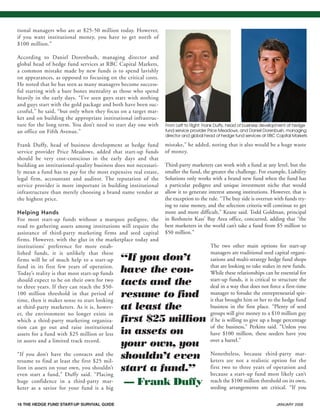
From Left to Right: Frank Duffy, head of business development at hedge
fund service provider Price Meadows, and Daniel Dorenbush, managing
director and global head of hedge fund services at RBC Capital Markets
HF SurvivalGuide-laydown 1/3/08 12:56 PM Page 16
JANUARY 2008 THE HEDGE FUND START-UP SURVIVAL GUIDE 17
don’t have a legendary background or come into the game
extremely well connected with investors at a large institution, it is
really hard to be successful without the help of a seeding firm
today,” Altman said.
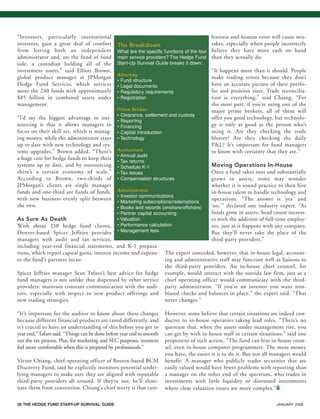
While many start-up funds worry about giving up the keys to
the house when signing seed agreements, Altman emphasized
that a seed organization should not just be viewed as a wal-
let. The best seeders are strategic partners that are positioned
to help a start-up manager build a viable, long-term business
with an institutional-quality infrastructure and not just pro-
vide some upfront cash, he explained. Furthermore, good
seed organizations know it is not in their best interest to kill
the entrepreneurial spirit of nascent hedge fund managers, so
this hesitation should not be difficult to overcome through
arms-length negotiations.
As the market becomes more saturated and third-party mar-
keters find it more difficult to take brand new funds to insti-
tutions, seed organizations are evolving to meet the needs of
start-up funds. One example of a seed organization that is
bridging the traditional seed model with a private equity
fund approach is Skybridge Capital. Skybridge will place
between $25 million to $50 million of its capital in a group
of eight to 10 funds in exchange for a percentage of the man-
agement and incentive fees during a three-year lockup.
However, Skybridge provides more than just the initial capi-
tal push. It performs full-time marketing on behalf of its
fund of funds, as well as operational support. For many start-
up funds that do not have the time or expertise in marketing,
this model can be very beneficial.
“The smaller you are in terms of fund assets, the longer the
time frame in which to grow your business,” Prince said. “We
can help by creating institutional legitimization for start-up
funds and accelerating the fundraising effort,” he added, not-
ing that most first-time managers do not have the expertise,
time and resources to go on road shows targeting the high-
net-worth and family office markets.
In its first fund of funds, Skybridge raised four times the
amount of money it provided in seed capital from outside
investors. For example, a manager that Skybridge funded
with $50 million at the beginning of 2007 had raised a total
of $250 million by year-end. For its purposes, the pedigree of
the individual can be among the most important factors,
which is why Skybridge focuses on talent that is coming out
of an investment bank or larger hedge fund. It also will help
managers who have not yet left the bank or hedge fund for
which they currently work to start up their funds.
Many big multi-strategy funds that already see large asset
flows and have full-fledged marketing arms are now serving a
similar role for start-up funds: bringing them under their
umbrella and leveraging their existing institutional market-
ing infrastructure. However, hedge fund executives caution
first-time managers about actually becoming part of a multi-
strategy fund shop. “It is best for a start-up fund to attempt
to attract an allocation from a multi-strategy fund rather
than actually join the shop,” said Raviv. “It is difficult if you
are actually within the multi-strategy hedge fund to reconcile
its needs with your desire to run your own fund and build
your own brand and track record.”
For their part, third-party marketers don’t have an invest-
ment in the underlying fund, according to Prince.
Furthermore, the cost of hiring a seasoned full-time marketer
would be prohibitive, as well as the fact that there is a scarci-
ty of that talent available to start-up funds. Therefore,
Skybridge believes its model combining the seed capital with
marketing creates greater institutional legitimacy. “Capital
alone has become somewhat commoditized,” he added.
Stable Start-ups
Whether a start-up fund decides to go it alone or work with
a seed capital firm, a third-party marketer or a multi-strate-
gy hedge fund manager, the final lesson for new managers is
that marketing is an ongoing process. According to hedge
fund executives, one of the classic mistakes made by new
funds is to believe that their initial investors will be perma-
nent investors. As in any asset gathering business, it is the
‘stickiness’ of assets that allows a viable long-term business
model to be built. In the hedge fund context, this means that
start-up managers must constantly be in the mindset of
replenishing assets.
Initial investors may have needs that change over time and
investment boards may reshape investment policy, leading to
redemptions. Furthermore, if funds are not careful in the
rush to raise assets, they may attract too much capital from
‘fast money.’ For example, many hedge fund marketers
believe that funds of funds move in and out of single strate-
gy funds rapidly, either due to the tactical nature of their
investment allocation or the pursuit of the style du jour. A
start-up manager that is too reliant on funds of funds as an
investor base - or any one client type, for that matter - may
place itself at a high risk of mass redemptions. It is important
for new funds, and any partner organizations, to develop a
diverse investor composition so that assets remain stable.
“I don’t necessarily believe that funds of funds are faster
money than other investor types, but you do need to have a
good balance between investor types and remember that mar-
keting is a 24/7 job,” Keane said. An investor base will
change over time, and those changes will not necessarily be a
related to a fund’s investment performance, but rather to the
complex nature of today’s investor base. “No investor is for-
ever,” he added. i
HF SurvivalGuide-laydown 1/3/08 12:56 PM Page 17
18 THE HEDGE FUND START-UP SURVIVAL GUIDE JANUARY 2008
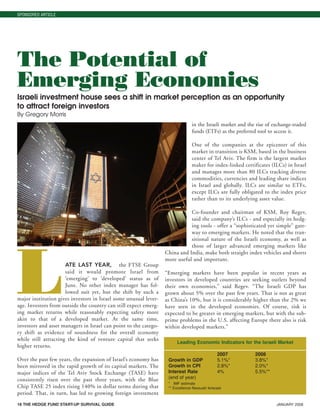
LATE LAST YEAR, the FTSE Group
said it would promote Israel from
‘emerging’ to ‘developed’ status as of
June. No other index manager has fol-
lowed suit yet, but the shift by such a
major institution gives investors in Israel some unusual lever-
age. Investors from outside the country can still expect emerg-
ing market returns while reasonably expecting safety more
akin to that of a developed market. At the same time,
investors and asset managers in Israel can point to the catego-
ry shift as evidence of soundness for the overall economy
while still attracting the kind of venture capital that seeks
higher returns.
Over the past few years, the expansion of Israel’s economy has
been mirrored in the rapid growth of its capital markets. The
major indices of the Tel Aviv Stock Exchange (TASE) have
consistently risen over the past three years, with the Blue
Chip TASE 25 index rising 140% in dollar terms during that
period. That, in turn, has led to growing foreign investment
in the Israeli market and the rise of exchange-traded
funds (ETFs) as the preferred tool to access it.
One of the companies at the epicenter of this
market in transition is KSM, based in the business
center of Tel Aviv. The firm is the largest market
maker for index-linked certificates (ILCs) in Israel
and manages more than 80 ILCs tracking diverse
commodities, currencies and leading share indices
in Israel and globally. ILCs are similar to ETFs,
except ILCs are fully obligated to the index price
rather than to its underlying asset value.
Co-founder and chairman of KSM, Roy Regev,
said the company’s ILCs - and especially its hedg-
ing tools - offer a “sophisticated yet simple” gate-
way to emerging markets. He noted that the tran-
sitional nature of the Israeli economy, as well as
those of larger advanced emerging markets like
China and India, make both straight index vehicles and shorts
more useful and important.
“Emerging markets have been popular in recent years as
investors in developed countries are seeking outlets beyond
their own economies,” said Regev. “The Israeli GDP has
grown about 5% over the past few years. That is not as great
as China’s 10%, but it is considerably higher than the 2% we
have seen in the developed economies. Of course, risk is
expected to be greater in emerging markets, but with the sub-
prime problems in the U.S. affecting Europe there also is risk
within developed markets.”
SPONSORED ARTICLE
The Potential of
Emerging Economies
Israeli investment house sees a shift in market perception as an opportunity
to attract foreign investors
By Gregory Morris
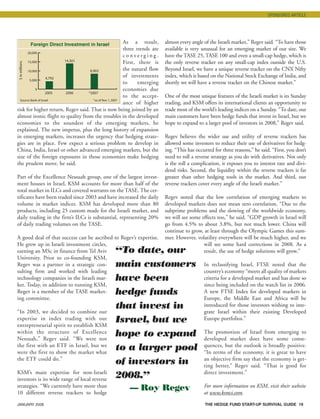
Leading Economic Indicators for the Israeli Market
2007 2008
Growth in GDP 5.1%* 3.8%*
Growth in CPI 2.8%* 2.0%*
Interest Rate 4% 5.5%**
(end of year)
* IMF estimate
** Excellence Nessuah forecast
HF SurvivalGuide-laydown 1/3/08 12:57 PM Page 18
JANUARY 2008 THE HEDGE FUND START-UP SURVIVAL GUIDE 19
As a result,
three trends are
c o n v e r g i n g .
First, there is
the natural flow
of investments
to emerging
economies due
to the accept-
ance of higher
risk for higher return, Regev said. That is now being joined by an
almost ironic flight to quality from the troubles in the developed
economies to the soundest of the emerging markets, he
explained. The new impetus, plus the long history of expansion
in emerging markets, increases the urgency that hedging strate-
gies are in place. Few expect a serious problem to develop in
China, India, Israel or other advanced emerging markets, but the
size of the foreign exposures in those economies make hedging
the prudent move, he said.
Part of the Excellence Nessuah group, one of the largest invest-
ment houses in Israel, KSM accounts for more than half of the
total market in ILCs and covered warrants on the TASE. The cer-
tificates have been traded since 2003 and have increased the daily
volume in market indices. KSM has developed more than 80
products, including 25 custom made for the Israeli market, and
daily trading in the firm’s ILCs is substantial, representing 20%
of daily trading volumes on the TASE.
A good deal of that success can be ascribed to Regev’s expertise.
He grew up in Israeli investment circles,
earning an MSc in finance from Tel Aviv
University. Prior to co-founding KSM,
Regev was a partner in a strategic con-
sulting firm and worked with leading
technology companies in the Israeli mar-
ket. Today, in addition to running KSM,
Regev is a member of the TASE market-
ing committee.
“In 2003, we decided to combine our
expertise in index trading with our
entrepreneurial spirit to establish KSM
within the structure of Excellence
Nessuah,” Regev said. “We were not
the first with an ETF in Israel, but we
were the first to show the market what
the ETF could do.”
KSM’s main expertise for non-Israeli
investors is its wide range of local reverse
strategies. “We currently have more than
10 different reverse trackers to hedge
almost every angle of the Israeli market,” Regev said. “To have those
available is very unusual for an emerging market of our size. We
have the TASE 25, TASE 100 and even a small-cap hedge, which is
the only reverse tracker on any small-cap index outside the U.S.
Beyond Israel, we have a unique reverse tracker on the CNX Nifty
index, which is based on the National Stock Exchange of India, and
shortly we will have a reverse tracker on the Chinese market.”
One of the most unique features of the Israeli market is its Sunday
trading, and KSM offers its international clients an opportunity to
trade most of the world’s leading indices on a Sunday. “To date, our
main customers have been hedge funds that invest in Israel, but we
hope to expand to a larger pool of investors in 2008,” Regev said.
Regev believes the wider use and utility of reverse trackers has
allowed some investors to reduce their use of derivatives for hedg-
ing. “This has occurred for three reasons,” he said. “First, you don’t
need to roll a reverse strategy as you do with derivatives. Not only
is the roll a complication, it exposes you to interest rate and divi-
dend risks. Second, the liquidity within the reverse trackers is far
greater than other hedging tools in the market. And third, our
reverse trackers cover every angle of the Israeli market.”
Regev noted that the low correlation of emerging markets to
developed markets does not mean zero correlation. “Due to the
subprime problems and the slowing of the worldwide economy,
we will see some effects too,” he said. “GDP growth in Israel will
go from 4.5% to about 3.8%, but not much lower. China will
continue to grow, at least through the Olympic Games this sum-
mer. However, volatility everywhere will be much higher, and we
will see some hard corrections in 2008. As a
result, the use of hedge solutions will grow.”
In reclassifying Israel, FTSE noted that the
country’s economy “meets all quality of markets
criteria for a developed market and has done so
since being included on the watch list in 2006.
A new FTSE Index for developed markets in
Europe, the Middle East and Africa will be
introduced for those investors wishing to inte-
grate Israel within their existing Developed
Europe portfolios.”
The promotion of Israel from emerging to
developed market does have some conse-
quences, but the outlook is broadly positive.
“In terms of the economy, it is great to have
an objective firm say that the economy is get-
ting better,” Regev said. “That is good for
direct investment.”
For more information on KSM, visit their website
at www.ksmci.com.
“To date, our
main customers
have been
hedge funds
that invest in
Israel, but we
hope to expand
to a larger pool
of investors in
2008.”
— Roy Regev
SPONSORED ARTICLE
$inmillions
0
5,000
10,000
15,000
20,000
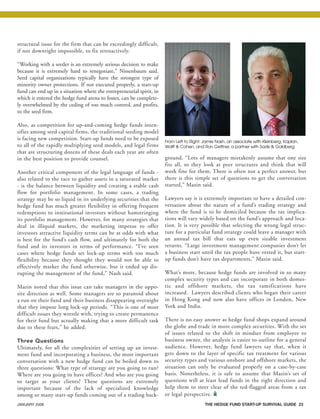
Foreign Direct Investment in Israel
2005 2006 *2007
Source:Bank of Israel *as of Nov 1,2007
4,792
14,301
8,902
HF SurvivalGuide-laydown 1/3/08 12:57 PM Page 19
20 THE HEDGE FUND START-UP SURVIVAL GUIDE JANUARY 2008
THE BEST PART OF creating a new
hedge fund may be the entrepreneurial
spirit of the endeavor, yet that very
mindset can result in a host of legal
headaches for funds not careful from
the outset. While there are a plethora of legal complexities
related to the tax implications of the fund structure and advi-
sor incorporation that fill legal tomes longer than any hedge
fund manager could ever want to understand on their own,
lawyers say the most critical issue for first-time managers is
often more basic: the change of mindset from an employee of
a corporation to a business owner.
Prior to starting up their new hedge funds, most managers
were traders at an investment bank or junior managers and
analysts at an established hedge fund. Therefore, lawyers
stress that, while these managers may be investment geniuses
and whizzes with complex derivatives, their biggest legal
issue is transitioning into the mindset of running a business
on their own.
“Most new managers are largely clueless when it comes to
regulatory issues and structuring concerns,” said George
Mazin, partner in charge of the hedge fund practice at
Dechert. “They know how to put in buy and sell orders, but
everything else has been done for them.”
Case in point, many traders come out of a bank or larger
hedge fund where they were part of a team, and they start
advertising the performance of that team as if it was their
own, placing it up on web sites or in marketing materials.
This is the type of basic mistake that is obvious to lawyers
and seems as if it should be obvious to hedge fund managers,
but often it is not because they have never had to concern
themselves with running their own business. The good news
from the standpoint of hedge fund lawyers is that legal and
regulatory risk are two risks that funds can actually have con-
trol over and can do a lot to minimize. In other words, while
minimizing these risks will never make a fund a lot of money,
it may very well save the fund a lot of money when consid-
ered from a more nuanced, long-term perspective.
David Nissenbaum, a partner at Schulte Roth & Zabel, said
the number one issue for new hedge funds is to make sure
they understand what it means to operate as a fiduciary. By
law, this means they have to act in the best interest of
investors, and that is very different from the environment
most new managers come from, working for an investment
bank or hedge fund shop that has been the fiduciary assum-
ing all of the risk related to managing clients’ assets. The
fiduciary responsibilities under investment law are unique
and distinct from the environment in which these traders
have come up. “When you are the fiduciary yourself, your
thinking has to be permeated by much more careful analysis,
whether it is related to making a trade, hiring a service
provider or managing pools of money on behalf of multiple
clients,” Nissenbaum said.
Furthermore, when a trader, analyst or junior manager is
working for a larger institution, all of the reputation risk also
is at the level of the corporation. Proper understanding of
reputation risk and client trust is a critical mindset shift for
new funds. All of the decisions made by hedge fund man-
agers - from their approach to client disclosures to due dili-
gence on investments and service providers - circle back to
the heart of the risks of starting up your own investment
business. “Many new managers don’t fully realize that even if
they are doing the same type of trading they were doing at
another fund or investment bank, it is completely different
in the context of their own shop,” Nissenbaum said.
The fiduciary equation also means preparing yourself for
investor challenges unrelated to actual fraud. Ron Geffner, a
partner with Sadis & Goldberg, explained that one of the key
Think Like
An Owner
Having a start-up mindset can place first-time managers in a legal minefield
By Eric Rosenbaum
HF SurvivalGuide-laydown 1/3/08 12:57 PM Page 20
JANUARY 2008 THE HEDGE FUND START-UP SURVIVAL GUIDE 21
initial components of shifting the mindset of start-up fund
managers is getting them to understand that legal challenges
are likely when investors lose money. This is not limited to
cases in which the manager has committed securities fraud,
but also cases in which a manager may have a bad stretch of
performance or made overly aggressive bets. Traders do not
come out of a background where they have had to assume
this risk themselves and, as a result, it is critical to prepare
the hedge fund for times when investors may try to legally
attack it in response to poor performance.
Pre-Nups for Start-ups
Beyond the shift of the legal and reputational burden away
from a large corporation to the start-up
fund, another critical aspect of forming
a hedge fund business is settling on an
appropriate operating structure for key
personnel and an appropriate structure
for relationships with third-party mar-
keting firms and seed capital providers.
Lawyers stress that these are decisions
that many first-time managers will not
be at all familiar with, but if they are
not dealt with in a proactive way, they
can come back to haunt the fund with
a vengeance.
Structuring the hedge fund in the con-
text of long-term business planning
probably has changed the most in recent
years. Before the last decade, hedge
funds were most often synonymous with
the individual managers, and therefore
there was no real exit strategy put in
place from a legal perspective. Over the
past few years, as large institutions have
gobbled up hedge fund shops—most notably the watershed
deal by JPMorgan for Highbridge Capital Management—the
issue of exit strategies has become a critical part of the legal
framework for new funds, and not an issue that can be easi-
ly tackled retroactively. As institutions remain as hungry as
ever for alternative investment acquisitions, deciding on an
ownership structure that is prepared for the long-term future
of key personnel is increasingly important. Furthermore, as
competition for hedge fund talent is intense, deciding on an
exit strategy for key personnel at the firm, as well as the firm
as a whole, also is an important issue on the legal checklist
from day one.
“The most prevalent issue for start-up funds launched by
more than one individual is that they fail to execute a well
thought out agreement among principals and, in the event of
a divorce, don’t know how to extricate themselves,” Geffner
said. “There is a misconception out there that these legal
documents are boilerplate. They are not, and you can’t go
back and easily modify them either.”
Not long ago, it was just the year-to-year income of key
personnel that hedge funds had to be concerned with, but
now they are following the path of the brokerage industry
two generations ago, with various legal approaches to part-
nerships, participation in firm equity and the need to pre-
pare for the exit of senior managers, as well as the potential
sale or merger of the firm. Lawyers stressed that not proac-
tively dealing with these issues at the time of structuring
the business often means having to buy out officials, and
that is never profitable. “No one wants
to be part of these back-end divorces,
and it can be nasty from the perspective
of your investors as well,” said Jamie
Nash, an associate with Kleinberg,
Kaplan, Wolff & Cohen.
Seeds of Discontent?
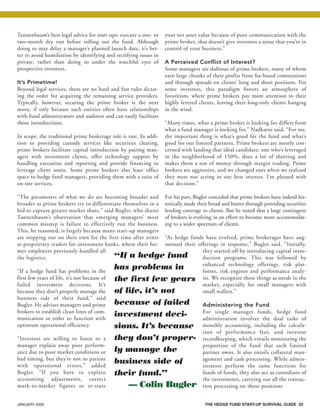
In today’s saturated hedge fund market,
start-up funds also are more and more
dependent on the support of third-party
marketers and various types of seed capi-
tal organizations in order to grow assets.
The days of the proverbial garage-run
hedge fund growing to billions of dollars
on the strength of investment perform-
ance alone are a distant memory. From a
legal perspective, this means that start-up
funds have to spend a good deal of time
settling on the legal nature of their rela-
tionships with third-parties, in particular,
with seed capital organizations. And if
not dealt with proactively, this is another
From Left to Right: George Mazin, partner in charge of the hedge
fund practice at Dechert, and David Nissenbaum, a partner at
Schulte Roth & Zabel
“There is a mis-
conception out
there that these
legal docu-
ments are boil-
erplate. They
are not, and
you can’t go
back and easily
modify them
either.”
— Ron Geffner
HF SurvivalGuide-laydown 1/3/08 12:57 PM Page 21
Navigating the hedge fund world can be difficult...
Alternative Investment News can help
Alternative Investment News (AIN) is the premier global
news service providing intelligence on hedge funds,hedge
funds of funds and private equity funds ... bringing you
breaking news and analysis on the fast-growing institu-
tional market for alternative investments.
Delivering ideas and information to help expand your busi-
ness, AIN keeps you aware of alternative investment
searches and new fund launches... all on the exclusive web-
site,daily email and weekly print edition.
STAY AHEAD OFTHE COMPETITION -
READ Alternative Investment News
Get a FreeTrialToday at
www.iialternatives.com/freetrial
HF SurvivalGuide-laydown 1/3/08 12:58 PM Page 22
JANUARY 2008 THE HEDGE FUND START-UP SURVIVAL GUIDE 23
structural issue for the firm that can be exceedingly difficult,
if not downright impossible, to fix retroactively.
“Working with a seeder is an extremely serious decision to make
because it is extremely hard to renegotiate,” Nissenbaum said.
Seed capital organizations typically have the strongest type of
minority owner protections. If not executed properly, a start-up
fund can end up in a situation where the entrepreneurial spirit, in
which it entered the hedge fund arena to foster, can be complete-
ly overwhelmed by the ceding of too much control, and profits,
to the seed firm.
Also, as competition for up-and-coming hedge funds inten-
sifies among seed capital firms, the traditional seeding model
is facing new competition. Start-up funds need to be exposed
to all of the rapidly multiplying seed models, and legal firms
that are structuring dozens of these deals each year are often
in the best position to provide counsel.
Another critical component of the legal language of funds -
also related to the race to gather assets in a saturated market
- is the balance between liquidity and creating a stable cash
flow for portfolio management. In some cases, a trading
strategy may be so liquid in its underlying securities that the
hedge fund has much greater flexibility in offering frequent
redemptions to institutional investors without hamstringing
its portfolio management. However, for many strategies that
deal in illiquid markets, the marketing impetus to offer
investors attractive liquidity terms can be at odds with what
is best for the fund’s cash flow, and ultimately for both the
fund and its investors in terms of performance. “I’ve seen
cases where hedge funds set lock-up terms with too much
flexibility because they thought they would not be able to
effectively market the fund otherwise, but it ended up dis-
rupting the management of the fund,” Nash said.
Mazin noted that this issue can take managers in the oppo-
site direction as well. Some managers are so paranoid about
a run on their fund and their business disappearing overnight
that they impose long lock-up periods. “This is one of most
difficult issues they wrestle with, trying to create permanence
for their fund but actually making that a more difficult task
due to these fears,” he added.
Three Questions
Ultimately, for all the complexities of setting up an invest-
ment fund and incorporating a business, the most important
conversation with a new hedge fund can be boiled down to
three questions: What type of strategy are you going to run?
Where are you going to have offices? And who are you going
to target as your clients? These questions are extremely
important because of the lack of specialized knowledge
among so many start-up funds coming out of a trading back-
ground. “Lots of managers mistakenly assume that one size
fits all, so they look at peer structures and think that will
work fine for them. There is often not a perfect answer, but
there is this simple set of questions to get the conversation
started,” Mazin said.
Lawyers say it is extremely important to have a detailed con-
versation about the nature of a fund’s trading strategy and
where the fund is to be domiciled because the tax implica-
tions will vary widely based on the fund’s approach and loca-
tion. It is very possible that selecting the wrong legal struc-
ture for a particular fund strategy could leave a manager with
an annual tax bill that eats up even sizable investment
returns. “Large investment management companies don’t let
a business start until the tax people have vetted it, but start-
up funds don’t have tax departments,” Mazin said.
What’s more, because hedge funds are involved in so many
complex security types and can incorporate in both domes-
tic and offshore markets, the tax ramifications have
increased. Lawyers described clients who began their career
in Hong Kong and now also have offices in London, New
York and India.
There is no easy answer as hedge fund shops expand around
the globe and trade in more complex securities. With the set
of issues related to the shift in mindset from employee to
business owner, the analysis is easier to outline for a general
audience. However, hedge fund lawyers say that, when it
gets down to the layer of specific tax treatment for various
security types and various onshore and offshore markets, the
situation can only be evaluated properly on a case-by-case
basis. Nonetheless, it is safe to assume that Mazin’s set of
questions will at least lead funds in the right direction and
help them to steer clear of the red-flagged areas from a tax
or legal perspective. i
From Left to Right: Jamie Nash, an associate with Kleinberg, Kaplan,
Wolff & Cohen, and Ron Geffner, a partner with Sadis & Goldberg
HF SurvivalGuide-laydown 1/3/08 12:58 PM Page 23
24 THE HEDGE FUND START-UP SURVIVAL GUIDE JANUARY 2008
IN THE REAL ESTATE world, an old cliché
dictates that the preeminent success factor is
location. In the realm of technology and oper-
ations for start-up hedge fund managers, the
issue of chief importance is credibility. And in
the minds of prospective investors, nothing injects credibili-
ty like the comfort of knowing a manager has aligned with a
team of competent third-party service providers. Without a
qualified attorney, auditor, fund administrator and prime
broker squarely in place, a manager’s ability to raise capital
and achieve smooth execution is severely impaired.
“These services require outsourcing for one main reason:
there are more institutional investors interested in hedge
funds than ever before,” said Colin Bugler, managing direc-
tor and head of global prime brokerage at RBC Capital
Markets. “From an operational perspective, the minimum
standards institutional investors will accept are vastly higher
than what high-net-worth individuals and private clients
demand. So if a manager wants allocation from a pension
fund or other institutional player, they better raise the bar
and become more institutional in nature themselves.”
Long Arm of the Law
While each of the aforementioned third-party disciplines are
unequivocally vital to the start-up process, procedurally
speaking, the journey begins by procuring legal expertise.
After all, document creation must precede all else. Or as one
industry expert succinctly put it, “You’re nothing without an
offering memorandum.”
Manoj Nadkarni, a hedge fund manager with the
Washington-based ChipInvestor Group, relies on outside
council to articulate strategy and manage investor expecta-
tions in his offering documents, especially given that his sec-
tor-specific fund strays significantly from the typical
long/short model. “With regards to risk, the dynamics of sec-
tor funds are different,” Nadkarni said. “The more explicitly
you explain this from the onset, the better off you are with
regard to retaining investors in the future, particularly if
there are draw-down periods.”
Michael Tannenbaum, founding partner at the law firm of
Tannenbaum Helpern Syracuse & Hirschtritt, concurred
that clarity with disclosure documents is critical. But his
experience tells him that the lion’s share of the trouble most
start-up managers encounter has more to with daily infra-
structural difficulties than anything else.
“The operational risk associated with building infrastruc-
ture goes beyond the ability to trade properly and assess
the markets,” Tannenbaum said. “It has to do with the
day-to-day business operations: paying rent, paying the
lighting bill, making sure the technology is up to scratch.
These are the below-the-investment-line issues that make
or break a manager.”
Competent Service Providers
Are the Key to Credibility
When it comes to technology and operations, nascent managers
can quickly gain respect by outsourcing to qualified providers
By Andrew Bloomenthal
From Left to Right: Michael Tannenbaum, founding partner at
Tannenbaum Helpern Syracuse & Hirschtritt, and Manoj Nadkarni,
fund manager at ChipInvestor Group
HF SurvivalGuide-laydown 1/3/08 12:58 PM Page 24
JANUARY 2008 THE HEDGE FUND START-UP SURVIVAL GUIDE 25
Tannenbaum’s best legal advice for start-ups: execute a one- to
two-month dry run before rolling out the fund. Although
doing so may delay a manager’s planned launch date, it’s bet-
ter to avoid humiliation by identifying and rectifying issues in
private, rather than doing so under the watchful eyes of
prospective investors.
It’s Primetime!
Beyond legal services, there are no hard and fast rules dictat-
ing the order for acquiring the remaining service providers.
Typically, however, securing the prime broker is the next
move, if only because such entities often have relationships
with fund administrators and auditors and can easily facilitate
those introductions.
In scope, the traditional prime brokerage role is vast. In addi-
tion to providing custody services like securities clearing,
prime brokers facilitate capital introduction by pairing man-
agers with investment clients, offer technology support by
handling execution and reporting and provide financing to
leverage client assets. Some prime brokers also lease office
space to hedge fund managers, providing them with a suite of
on-site services.
“The parameters of what we do are becoming broader and
broader as prime brokers try to differentiate themselves in a
bid to capture greater market share,” said Bugler, who shares
Tannenbaum’s observation that emerging managers’ most
common misstep is failure to effectively run the business.
This, he reasoned, is largely because many start-up managers
are stepping out on their own for the first time after stints
as proprietary traders for investment banks, where their for-
mer employers previously handled all
the logistics.
“If a hedge fund has problems in the
first few years of life, it’s not because of
failed investment decisions. It’s
because they don’t properly manage the
business side of their fund,” said
Bugler. He advises managers and prime
brokers to establish clean lines of com-
munication in order to function with
optimum operational efficiency.
“Investors are willing to listen to a
manager explain away poor perform-
ance due to poor market conditions or
bad timing, but they’re not so patient
with operational errors,” added
Bugler. “If you have to explain
accounting adjustments, correct
mark-to-market figures or re-state
your net asset value because of poor communication with the
prime broker, that doesn’t give investors a sense that you’re in
control of your business.”
A Perceived Conflict of Interest?
Some managers are dubious of prime brokers, many of whom
earn large chunks of their profits from fee-based commissions
and through spreads on clients’ long and short positions. For
some investors, this paradigm fosters an atmosphere of
favoritism, where prime brokers pay more attention to their
highly levered clients, leaving their long-only clients hanging
in the wind.
“Many times, what a prime broker is looking for differs from
what a fund manager is looking for,” Nadkarni said. “For me,
the important thing is what’s good for the fund and what’s
good for our limited partners. Prime brokers are mostly con-
cerned with landing that ideal candidate: one who’s leveraged
in the neighborhood of 150%, does a lot of shorting and
makes them a ton of money through margin trading. Prime
brokers are aggressive, and we changed ours when we realized
they were not acting in our best interest. I’m pleased with
that decision.”
For his part, Bugler conceded that prime brokers have indeed his-
torically made their bread and butter through providing securities
lending coverage to clients. But he noted that a large contingent
of brokers is evolving in an effort to become more accommodat-
ing to a wider spectrum of clients.
“As hedge funds have evolved, prime brokerages have aug-
mented their offerings in response,” Bugler said. “Initially,
they started off by introducing capital intro-
duction programs. This was followed by
enhanced technology offerings, risk plat-
forms, risk engines and performance analy-
sis. We recognize these things as needs in the
market, especially for small managers with
small wallets.”
Administering the Fund
For single manager funds, hedge fund
administration involves the dual tasks of
monthly accounting, including the calcula-
tion of performance fees, and investor
recordkeeping, which entails monitoring the
proportion of the fund that each limited
partner owns. It also entails collateral man-
agement and cash processing. While admin-
istrators perform the same functions for
funds of funds, they also act as custodians of
the investments, carrying out all the transac-
tion processing on those positions.
“If a hedge fund
has problems in
the first few years
of life, it’s not
because of failed
investment deci-
sions. It’s because
they don’t proper-
ly manage the
business side of
their fund.”
— Colin Bugler
HF SurvivalGuide-laydown 1/3/08 12:58 PM Page 25
26 THE HEDGE FUND START-UP SURVIVAL GUIDE JANUARY 2008
“Investors, particularly institutional
investors, gain a great deal of comfort
from having both an independent
administrator and, on the fund of fund
side, a custodian holding all of the
investment assets,” said Elliott Brown,
global product manager at JPMorgan
Hedge Fund Services, which services
more the 240 funds with approximately
$85 billion in combined assets under
management.
“I’d say the biggest advantage to out-
sourcing is that it allows managers to
focus on their skill set, which is manag-
ing money, while the administrator stays
up to date with new technology and sys-
tems upgrades,” Brown added. “There’s
a huge cost for hedge funds to keep their
systems up to date, and by outsourcing
there’s a certain economy of scale.”
According to Brown, two-thirds of
JPMorgan’s clients are single manager
funds and one-third are funds of funds,
with new business evenly split between
the two.
As Sure As Death
With about 250 hedge fund clients,
Denver-based Spicer Jeffries provides
managers with audit and tax services,
including year-end financial statements, and K-1 prepara-
tions, which report capital gains, interest income and expens-
es the fund’s partners incur.
Spicer Jeffries manager Sean Tafaro’s best advice for hedge
fund managers is not unlike that dispensed by other service
providers: maintain constant communication with the audi-
tors, especially with respect to new product offerings and
new trading strategies.
“It’s important for the auditor to know about these changes
because different financial products are taxed differently, and
it’s crucial to have an understanding of this before you get to
year end,”Tafaro said. “Things can be done before year end to smooth
out the tax process. Plus, for marketing and SEC purposes, investors
feel more comfortable when this is prepared by professionals.”
Victor Chiang, chief operating officer of Boston-based BCM
Discovery Fund, said he explicitly monitors potential under-
lying managers to make sure they are aligned with reputable
third-party providers all around. If they’re not, he’ll elimi-
nate them from contention. Chiang’s chief worry is that care-
lessness and human error will cause mis-
takes, especially when people incorrectly
believe they have more cash on hand
than they actually do.
“It happens more than it should. People
make trading errors because they don’t
have an accurate picture of their portfo-
lio and position sizes. Trade reconcilia-
tion is everything,” said Chiang. “For
the most part, if you’re using one of the
major prime brokers, all of them will
offer you good technology, but technolo-
gy is only as good as the person who’s
using it. Are they checking the trade
blotter? Are they checking the daily
P&L? It’s important for fund managers
to know with certainty that they are.”
Moving Operations In-House
Once a fund takes root and substantially
grows in assets, some may wonder
whether it is sound practice to then hire
in-house talent to handle technology and
operations. “The answer is ‘yes’ and
‘no,’” declared one industry expert. “As
funds grow in assets, head count increas-
es with the addition of full-time employ-
ees, just as it happens with any company.
But they’ll never take the place of the
third-party providers.”
The expert conceded, however, that in-house legal, account-
ing and administrative staff may function well as liaisons to
the third-party providers. An in-house chief counsel, for
example, would interact with the outside law firm, just as a
chief operating officer would communicate with the third-
party administrator. “If you’re an investor you want non-
biased checks and balances in place,” the expert said. “That
never changes.”
However, some believe that certain situations are indeed con-
ducive to in-house operators taking lead roles. “There’s no
question that, when the assets under management rise, you
can get by with in-house staff in certain situations,” said one
proponent of such action. “The fund can hire in-house coun-
sel, even in-house computer programmers. The more money
you have, the easier it is to do it. But not all managers would
benefit. A manager who publicly trades securities that are
easily valued would have fewer problems with reporting than
a manager on the other end of the spectrum, who trades in
investments with little liquidity or distressed instruments
where clear valuation issues are more complex.”i
The Breakdown
What are the specific functions of the four
main service providers? The Hedge Fund
Start-Up Survival Guide breaks it down:
Attorney
• Fund structure
• Legal documents
• Regulatory requirements
• Registration
Prime Broker
• Clearance, settlement and custody
• Reporting
• Financing
• Capital introduction
• Technology
Accountant
• Annual audit
• Tax returns
• Schedule K-1
• Tax issues
• Compensation structures
Administrator
• Investor communications
• Marketing subscriptions/redemptions
• Books and records (onshore/offshore)
• Partner capital accounting
• Valuation
• Performance calculation
• Management fees
HF SurvivalGuide-laydown 1/3/08 12:58 PM Page 26
©2007 The Bear Stearns Companies Inc. All rights reserved. Bear Stearns®
and A Great Deal Depends on Working With The Right People®
are registered trademarks of The Bear Stearns Companies Inc. (BSCI). A culture of service.
A tradition of strength.SM
is a service mark of The Bear Stearns Companies Inc. Prime Brokerage Services is a business unit of the Global Equities division of Bear, Stearns & Co. Inc. (BS & Co.). Prime brokerage services are offered in
the United States by BS&Co. and outside of the United States by Bear, Stearns International Limited (BSIL). Clearing and custody services are provided by Bear, Stearns Securities Corp. (BSSC). BS&Co., a direct subsidiary of BSCI,
is a United States registered broker-dealer and a member of the NYSE, NASD and SIPC. BSSC, a guaranteed subsidiary of BS&Co., is a United States registered broker-dealer and a member of the NYSE, NASD and SIPC. BSIL, an
indirect subsidiary of BSCI, is authorized and regulated by the United Kingdom Financial Services Authority. Sources: (1) and (2) Lipper HedgeWorldService Provider Directory & Guide, 2006/2007 edition. Results are from a survey of
1700 Institutional investors and based on three primary factors, scores, respondent comments and number of responses. Respondents were asked to rate participants in the following areas, Client Service, Securities Lending, Financing,
Reporting, Technology, Operations and Capital introduction. (3) Global League Table 2007, Global Custodian Prime Brokerage Survey
It takes both to be a leader in Prime Brokerage.
#
1Prime Broker by Assets
of US Funds1
Lipper HedgeWorld, 2006/2007
#
2Prime Broker for all Funds2
Lipper HedgeWorld,
2006/2007
A culture of service.
A tradition of strength.SM
2007 GLOBAL CUSTODIAN PRIME BROKERAGE SURVEY
3
■ Funds over $1 billion
■
Multi-strategy Funds
■
Single strategy Funds
■ European Funds
■ Funds under $100 million
Top Ratings
■
Client Services
■
Operations
■
Consulting
■ Financing
■ Securities Lending
■
Reporting
■
Technology
Global Best in Class Awards
P R I M E B R O K E R A G E S E R V I C E S
HF SurvivalGuide-laydown 1/3/08 12:58 PM Page 27
We Speak
Your Language.
DISTRESSED SECURITIES, EMERGING MARKETS, FUND STRUCTURING, ALPHA, WALL STRE
OFFSHORE REPORTING REQUIREMENTS, TRANSPARENCY, CFTC, DEFERRALS, PRIVATE EQU
SUSTAINABLE OPERATIONS, ALTERNATIVE INVESTMENTS, U.S. TREASURY, SEC, CUSTODY
ANALYSIS, HYPE, INVESTORS, MASTER-FEEDER, COMPLIANCE, MANAGED FUTURES, PER
You shouldn’t take any chances when it comes to the audit, tax and consulting services for your funds.
Rothstein Kass’ Financial Services Group has been serving the financial services industry for over 30 years
and provides services for private equity funds, hedge funds, fund of funds, broker-dealers and registered
investment advisors.
Both start-ups and established entities benefit from Rothstein Kass’ highly specialized and expert staff that
is dedicated to the alternative asset industry. Our task is not only to provide audit and tax services, but also
to act as a sounding board on issues impacting your business, so you can focus on your core competency of
money management.
Rothstein Kass is consistently ranked as one of the top accounting firm service providers for hedge funds by
Institutional Investor’s Alpha magazine, which is a reflection of our commitment to client service. To find out
more about what Rothstein Kass can do for you, contact Howard Altman, Co-Managing Principal, at 212.997.0500
or haltman@rkco.com.
Beverly Hills
Dallas
Denver
Grand Cayman
New York
Roseland
San Francisco
Walnut Creek
www.rkco.com
HF SurvivalGuide-laydown 1/3/08 12:58 PM Page 28

HF Survival Guide 08

  • 1.
    JANUARY 2008 •emii.com The New Reality Start-up managers need to temper capital raising and growth expectations amid a glut of funds. Choose Your Weapons Wisely The first and most important choice for a start-up fund is selecting the right investment strategy. HF SurvivalGuide-laydown 1/3/08 12:54 PM Page 1
  • 2.
    coventry.com 877-836-8300 x1154 Muchlarger. By tapping into the market value of life insurance, Coventry is changing the face of financial services. Creating a robust secondary market. A compelling new asset class. Greater financial flexibility. And a dramatically different view of what life insurance can do. For consumers, advisors and investors alike. This is big. ©2007TheCoventryGroup.Allrightsreserved. OBJECTS IN PORTFOLIO MAY BE LARGER THAN THEY APPEAR. HF SurvivalGuide-laydown 1/3/08 12:54 PM Page 2
  • 3.
    JANUARY 2008 •emii.com The Hedge Fund Start-Up Survival Guide JANUARY 2008 THE HEDGE FUND START-UP SURVIVAL GUIDE 3 6 Choose Your Weapons Wisely By Andrew Bloomenthal The first and most important choice a start-up man- ager needs to make is selecting the right investment strategy, but that choice is anything but simple. 12 The New Reality By Eric Rosenbaum With the market clogged by nearly 10,000 hedge funds, start-up managers must accept a new reality about capital raising and marketing, one that requires them to better understand the true prospects for growing assets in the first few years of operation. 18 The Potential of Emerging Economies By Gregory Morris With more investors looking abroad for better returns and the Israeli market receiving an upgrade in its risk assessment, one local investment house sees an opportunity to attract foreign investors. 20 Think Like An Owner By Eric Rosenbaum Despite a host of complex legal and regulatory issues to deal with, lawyers say the most critical issue for first-time managers is often more basic: the change of mindset from an employee of a corporation to a busi- ness owner. 24 Competent Service Providers Are the Key to Credibility By Andrew Bloomenthal When it comes to technology and operations, nascent managers can quickly gain respect by outsourcing to qualified providers. The New Reality Table of Contents 12 18 The Potential of Emerging Economies HF SurvivalGuide-laydown 1/3/08 12:54 PM Page 3
  • 4.
    4 THE HEDGEFUND START-UP SURVIVAL GUIDE JANUARY 2008 www.iinews.com A Publication of Institutional Investor, Inc. © Copyright 2008. Institutional Investor, Inc. All rights reserved. New York Publishing offices: 225 Park Avenue South, New York, NY 10003 • 212-224-3800 • www.iinews.com Copyright notice. No part of this publication may be copied, photocopied or duplicated in any form or by any means without Institutional Investor’s prior writ- ten consent. Copying of this publication is in violation of the Federal Copyright Law (17 USC 101 et seq.). Violators may be subject to criminal penalties as well as liability for substantial monetary damages, including statutory damages up to $100,000 per infringement, costs and attorney’s fees. The information contained herein is accurate to the best of the publisher’s knowledge; however, the publisher can accept no responsibility for the accura- cy or completeness of such information or for loss or damage caused by any use thereof. PUBLISHING BRISTOL VOSS Publisher (212) 224-3628 ARCHANA MARWAHA Marketing Manager (212) 224-3421 VINCENT YESENOSKY Senior Operations Manager (212) 224-3057 DAVID SILVA Senior Fulfillment Manager (212) 224-3573 REPRINTS DEWEY PALMIERI Reprints & Premission Manager (212) 224-3675 dpalmieri@iinvestor.net CORPORATE GARY MUELLER Chairman & CEO CHRISTOPHER BROWN President STEVEN KURTZ Director of Finance & Operations ROBERT TONCHUK Director/Central Operations & Fulfillment Customer Service: PO Box 5016, Brentwood, TN 37024-5016. Tel: 1-800-715-9195. Fax: 1-615-377-0525 UK: 44 20 7779 8704 Hong Kong: 852 2842 6910 E-mail: customerservice@iinews.com Editorial Offices: 225 Park Avenue South, New York, NY 10003. Tel: 1-212-224-3279 Email: eblackwell@iinews.com. EDITORIAL ERIK KOLB Editor of Business Publishing ANDREW BLOOMENTHAL Contributing Reporter GREGORY MORRIS Contributing Reporter ERIC ROSENBAUM Contributing Reporter PRODUCTION AYDAN SAVASER Art Director MARIA JODICE Advertising Production Manager (212) 224-3267 ADVERTISING/BUSINESS PUBLISHING JONATHAN WRIGHT Publisher (212) 224-3566 jwright@iinews.com ADI HALLER Associate Publisher (212) 224-3656 LANCE KISLING Associate Publisher [Technology] (212) 224-3026 MARA READ Marketing Director (917) 650-6351 LESLIE NG Advertising Coordinator Editor’s Note Welcome to the Hedge Fund Start-Up Survival Guide, an indis- pensable manual to everything first-time managers need to know about creating, growing and managing a successful hedge fund in today’s market. The Start-Up Survival Guide is chockfull of insight and advice from throughout the hedge fund universe, beginning with the first thing every manager needs to consider when they are starting a new fund: strategy. A plethora of investment choices, as well as a number of available hybrid models, have made the task daunting, but our guide simplifies the process with a breakdown of the strategies and some practical advice from industry experts (see story, page 6). Next, the Start-Up Survival Guide addresses the second most important consideration: capital. Not only does the guide provide advice on how to make a fund attractive to capital providers, it also explains how to continue attracting money post-launch through a focused marketing strategy (see story, page 12). Beyond that, the guide also includes articles on legal and regulatory requirements and techno- logical and operational considerations, giv- ing managers a complete compliment of advice on the issues most relevant to their success. The Hedge Fund Start-Up Survival Guide is the latest in a series of special supplements produced by Institutional Investor News exclu- sively for our newsletter subscribers. It is part of our commitment to bringing our readers the freshest news and in-depth analysis on important sectors and timely topics within the financial markets. All the best in 2008, Erik Kolb Editor of Business Publishing Institutional Investor News JANUARY 2008 • emii.com The New Reality Start-up managers need to temper capital raising and growth expectations amid a glut of funds. Choose Your Weapons Wisely The first and most important choice for a start-up fund is selecting the right investment strategy. From the publishers of: HF SurvivalGuide-laydown 1/3/08 12:54 PM Page 4
  • 5.
    Cuttone & Companyprovides comprehensive brokerage services to institutional investors, hedge funds and professional money managers. Today, our unwavering commitment to our clients is combined with state-of-the-art technology and highly experienced traders to deliver a complete range of execution services and prime brokerage solutions, including: Tradtional Trading Desk Independent Research and Analysis US and International Electronic DMA Prime Brokerage Services Multi-Strategy Arbitrage Portfolio Reporting Cuttone Automated Trading Solutions Outsourced Trading Desk Algorithmic Execution Capital Introduction Consulting Execution Consulting Services Soft Dollar and Commission Options Trading and Algorithms Sharing Agreements Whether you seek to improve operational efficiency, manage trading costs or require complete trading anonymity, Cuttone & Company is your source. Contact our senior management directly to learn how we put our clients first — on every trade. 111 Broadway, 10th Floor New York, NY 10006 646.943.5440 sales@cuttone.com www.cuttone.com “A history of service. A commitment to trading excellence. The principles that built Cuttone & Company are evident in every trade we do.”Joseph C. Cuttone Senior Managing Director and Vice Chairman A History of Service, A Commitment To Excellence HF SurvivalGuide-laydown 1/3/08 12:54 PM Page 5
  • 6.
    6 THE HEDGEFUND START-UP SURVIVAL GUIDE JANUARY 2008 WHEN FINANCIAL SCHOLAR Alfred Winslow Jones first con- ceived the idea for hedge funds back in 1940, his philosophy was straightforward: create an invest- ment vehicle that combined leveraging capabilities with the power to sell stocks short, thereby allowing investors to thrive in any market condition. Winslow reasoned that such a paradigm would attract top-tier management talent, who would flourish based on the strength of their stock-picking prowess regardless of market direction. Almost 70 years and 7,000 hedge funds later, Winslow would be surprised at the breadth of the industry resulting from his ideas. But he might be equally surprised at just how specialized and expansive modern hedge fund investment strategies have become. In fact, less than 20% of the funds in existence employ the classic long/short approach. Instead, many choose from a bevy of alter- native categories and subcategories. And with nearly every known investment approach folded into the universe of hedge fund methodologies, start-up managers face overwhelming choices when creating their models. According to Brian Snider, senior vice president of New York- based hedge fund consultancy Hennessee Group, it’s not an easy decision to make. “The most appropriate thing for a start-up manager to do is to determine his strengths, then tailor the fund’s investment strategy around them,” he said. Snider discourages managers from modeling their funds based on themes of the moment or simply because they are popular with investors. “That’s bad practice,” he added. “Investment decisions should be made based on the skill of the manager and the quali- ty of the organization.” Increased Choices, Increased Complexity An expanded strategy spectrum can complicate the playing field for unseasoned players, who may fail to anticipate that most investment strategies with high performance potential will invari- ably experience periods of drought at one time or another. This is particularly true for strategies targeting more cyclical sectors. Take credit-oriented strategies, for example. Though most thrive amid an abundance of cheap debt, the lack of defaulted corporate debt opportunities in today’s market would make such a strategy dicey at best, particularly for managers who don’t adequately hedge their positions. “You can make the case that if you maintain a relatively well- hedged portfolio with low correlations to the equity markets, you should be okay,” said Snider. “But if you’re a long-only value man- ager, there’s going to be times when your strategy falls out of favor. It’s inevitable.” When San Diego-based Context Capital Management was gear- ing up to launch a global distressed debt hedge fund in November 2007, it brought on board veteran distressed debt manager Jack Hersch to run it. With about $30 million currently under man- agement, the Context Python Master Fund invests in some 35 companies experiencing some degree of legal, financial or opera- tional difficulties. Hersch longs the names that have meaningful recovery potential while shorting those deemed beyond repair. On the operational side, Hersch studies a company’s history, com- petitors and structural mechanics. He examines the location of a company’s plants, and he profiles its customer base to better understand consumer trends. When a company faces litigation, Hersch often attends court proceedings in an effort to understand the nuances of a case. Once he achieves clarity on these issues, he compares a company’s current trading levels with what he projects they’ll be once the problems are resolved, then longs or shorts the name accordingly. With more than 20 years of experience investing both proprietary capital and other people’s money in distressed opportunities, Hersch is confident in his ability to accurately gauge a company’s Choose Your Weapons Wisely Selecting the right investment strategy is the first and most important choice start-up managers need to make By Andrew Bloomenthal HF SurvivalGuide-laydown 1/3/08 12:54 PM Page 6
  • 7.
    JANUARY 2008 THEHEDGE FUND START-UP SURVIVAL GUIDE 7 potential for resurrection. “It’s a triage process,” he noted. “We analyze troubled companies to determine what’s causing their breakdowns. Everything has a resolution, but there may not be enough value after employing the solutions to make the action worth it, in which case we short the name or avoid it altogether.” Though Context Python has no geographical bias, Hersch steers clear of investing in bankruptcies in Asia, claiming he’s less com- fortable operating there than he is in dealing in Western European and North and South American countries. “I’m not convinced that if I show up in certain Asian countries with a lien and try to collect collateral, they won’t put me in a tiger cage until I change my mind,” he joked. Combining Disciplines Not content to stick with a single investment theme, some man- agers rely on a multi-strategy approach to running their funds. In managing his firm’s flagship fund - Full Value Partners - Steve Samuels, gen- eral partner at Bulldog Investors, employs a pastiche of strategies for the $185 million portfolio. This includes investments in REITs and other real estate interests, distressed debt and, interestingly, a 20% allocation to special purpose acquisition corporations (SPACs), which are shell companies with no operations that go public with the intention of using the proceeds to acquire or merge with other companies. Though Samuels was dubious of SPACs when they were first brought to his attention, upon further inspection, he found their profit potential to be com- mensurate or higher than many other investment offerings on a risk-adjusted basis. “I primarily like the fact that the SPAC promoter - who raises the money - must find a vehicle, make a deal and bring it to shareholders within a timeframe of something like 18 months to two years,” said Samuels. “If they don’t find anything by then, the money is returned to shareholders. Until that happens, the money goes into a trust that can’t be pierced. Worst case scenario: they can’t find a deal and we get our money back, plus what the trust earns in interest. But since the promoters are so incen- tivized to find something viable, something good invariably come out of it.” Full Value Partners likewise invests widely in closed-end mutu- al funds, which attracts Samuels on the basis that they trade on exchanges and often at significant discounts to their net asset values. And all of that is easily measurable. “You and I could argue all day whether Citigroup is a sound investment idea,” said Samuels. “But if a closed-end fund is trading at $8 and it’s worth $10, that’s a discount of 20%. It’s irrefutable.” Targeting Other Funds In talking about hedge fund investment strategies, funds of funds must inevitably be part of the discussion, given that that their numbers dominate the industry. With nearly 3,500 presently in operation, funds of funds represent nearly half of all hedge funds in existence. And although their fundamental concept is straight- forward, narrowing down the universe of sub-managers to invest in is anything but. Brian Chung, senior portfolio manager at the Stamford, Connecticut-based SSARIS Multi-Manager Absolute Return Fund, doesn’t rely on track record in choosing managers. Contrarily, he characterizes his approach as highly opportunistic, pouncing on trends and themes. After the fund’s investment committee met last year, Chung decided to adopt a more neutral stance on the U.S. equity markets, which ultimately resulted in their shift away from long-biased managers and a shift towards managers who could go net short if the right situations emerged. “We take a top-down approach and add to that by meeting with the best minds in money management,” Chung explained. “This generates good ideas we wouldn’t have thought of ourselves. In 2006, for example, one fund manager showed us that the sub- prime mortgage market was fraught with structural inefficiencies, prompting us to take a neutral - even slightly negative - stance on the U.S. housing markets. This investment philosophy made sense to us.” “The most appropriate thing for a start- up manager to do is to determine his strengths, then tailor the fund’s invest- ment strategy around them.” — Brian Snider From Left to Right: Jack Hersch, managing partner of Context Python Master Fund, and Steve Samuels, general partner at Bulldog Investors HF SurvivalGuide-laydown 1/3/08 12:54 PM Page 7
  • 8.
    8 THE HEDGEFUND START-UP SURVIVAL GUIDE JANUARY 2008 The Diversification Rule In order to maximize diversification, an academic principal dic- tates that funds of funds should strive to invest in 20 underlying managers. Brad Balter, whose $150 million fund of funds - BCM Discovery Fund - houses about 18 underlying managers, agrees with this philosophy. “Anything beyond 20 dilutes performance,” said Balter. “If you’re carrying 70 managers, where each one represents 1% to 2% of your portfolio, even a manager who’s up 10% for the year will give you only a couple of basis points. That does nothing for you.” Balter furthermore believes that keeping the numbers low lets fund of funds managers better focus on the underlying managers’ day-to-day operations, making it easier to detect inefficiencies and potential blowups. “I’d rather allocate my time to doing my homework, so I don’t permanently impair capital,” Balter noted. But in this age of increased specialization, Chung believes it is necessary to breach the 20 manager rule and employ some 45 funds in his fund. “Within convertible arbitrage, for example, there are at least three sub-strategies: traditional arbitrage, volatile arbitrage and credit-related arbitrage. You need all three to be rep- resented,” he explained. Emerging Managers: Leading the Pack Even in a realm where low correlation is the driving force, a hier- archy exists among the performance of different hedge fund investment strategies. According to statistics from BarclayHedge, emerging markets managers dominate the space, averaging returns of 18.6% through September of last year (see chart, page 10). Equity long-only managers fared second best, bringing in an average return of 14% for the same time period. Rounding out the top three were merger arbitrage players, who collectively aver- aged 12.9%. Meanwhile, fixed income arbitrage players fared the worst, averaging just 0.65%, while equity market neutral funds did slightly better, bringing in 3.1%. Sol Waksman, president of BarclayHedge, offered some perspec- tive. “Given that the stock markets of emerging market compa- nies had an excellent year, it’s not surprising that emerging mar- ket managers have done well as a result,” he said. “Just look at the four biggest emerging market countries: Brazil, Russia, India and China. They’re off the charts.” Maintaining Maneuverability In November 2004, Toronto-based hedge fund operator Selective Asset Management had three distinct funds: a long-biased fund, a short-biased fund and a fund of funds, which essentially combined the first two offerings into a single investment for those investors seeking simplicity and ease of operations. But without a great deal of assets under his belt, firm president Robert McWhirter grew frus- trated that he was spending so much on accounting and other oper- ational fees to maintain the three offerings. So, after receiving approval from investors, McWhirter made the decision to roll all of the investments into the long-biased fund, which is called the Selective Assets Long Biased Equity Hedge Fund. “We’re happy with our decision and with the way it’s going,” he said of the $8 million fund, which takes a quantitative approach. Meanwhile, McWhirter still maintains the legal structures of the two other funds, given that he already spent the money and ener- gy to facilitate their paperwork. “Besides, if a $50 million investor shows up and wants a short-only portfolio, we can just re-open the short-bias fund and away we go,” he said. Furthermore, McWhirter advocates building as much flexibility into offering memorandums as possible to prepare for any contin- gency. “In our long-bias fund, we can still legally do hedging,” he said. “There are expectations from our investors that we won’t, but it’s within our parameters to do so. Also, right now we invest in North American stocks. But if we wanted to shift focus to third world countries, we’d put it to an investor vote and make it hap- pen. Or else we’d start up a new fund so we could allow customers to keep their original investment, plus give them something new.” Controlling Risk In the theoretical realm, shorting positions provide enough intrinsic risk control in the hedge fund space. But in practice, this may not be enough. Therefore it behooves managers to rely on other risk control measures as well. For starters, taking care to educate investors on the differences between risk and volatility is crucial. That may be easier said than done, given that this distinction often confounds the fund man- agers themselves, according to Snider. But failure to grasp this can be hazardous to a fund—especially if skittish investors hastily R It Is R e s In L • • • W 40 R C From Left to Right: Brian Chung, senior vice president at SSARIS Advisors, and Robert McWhirter, president of Selective Asset Management HF SurvivalGuide-laydown 1/3/08 12:55 PM Page 8
  • 9.
    Rich Fleischman, 212-659-4820,rich@rfa.com • Don Previti, 212-220-9033, dvp@rfa.com www.rfa.com www.rfa.com It takes the most talented and determined team to successfully navigate the changing currents of today’s technology. Is your company ready? RFA has become a trusted team member for over 400 Hedge Funds worldwide by leveraging our unmatched facilities, experience and know-how of our 130 IT professionals. Our focus is to ensure our clients always have the most scalable, reliable and secure technology platforms deployed by the best people in the business. Investment Firms depend on RFA to help manage operational risk and provide innovative IT and telecom solutions. Let RFA become an extension of your team for: • Fully Outsourced end-to-end IT solutions • New Site Establishments, Relocations and Project Implementation • 24/7/365 Global Help Desk; Proactive Support/Remote Monitoring Trusted Technology Advisor to Over 400 Funds and Investment Firms Worldwide. WHEN FAILURE IS NOT AN OPTION... 400 Hedge Funds and Investment Firms choose RFA. FIND OUT WHY. • 50k sq ft Disaster Recovery and Hot Site Facility • In-House Voice Integration Procurement and Support • Full Suite of Security andThreat Management Capabilities RFA New York City HQ • 330 Madison Ave, 19th Floor, New York, NY 10017 • RFA Data Center & Hot Site • 2 Manhattanville Road, Purchase, NY 10577 CONTACT RFA TODAY AND JOIN THE TEAM. HF SurvivalGuide-laydown 1/3/08 12:55 PM Page 9
  • 10.
    10 THE HEDGEFUND START-UP SURVIVAL GUIDE JANUARY 200810 THE HEDGE FUND START-UP SURVIVAL GUIDE JANUARY 2008 Assets in Dec 06 # of Funds Assets in Sept 07 # of Funds Average Returns Strategy (in Millions) in Dec 06 (in Millions) in Sept 07 for 07 (through Sept) Convertible Arbitrage $34,710 164 $35,820 175 3.97% Distressed Securities $95,250 178 $138,780 210 3.72% Emerging Markets $261,420 786 $330,300 973 18.60% Equity Long Bias $186,780 846 $215,520 1030 10.41% Equity Long/Short $250,020 1102 $273,360 1268 7.42% Equity Long-Only $63,270 198 $76,230 210 14.04% Equity Market Neutral $58,560 226 $62,220 225 3.08% Event Driven $115,230 268 $163,770 315 8.50% Fixed Income Arbitrage $158,790 636 $161,700 708 0.65% Macro $77,820 280 $82,230 328 7.79% Merger Arbitrage $22,440 66 $39,840 83 12.91% Multi-Strategy $210,990 286 $228,930 320 8.17% Other $34,290 312 $38,520 368 4.81% Sector Specific $95,250 612 $118,290 738 10.94% Fund of Funds $971,700 2913 $1,211,100 3460 7.11% Total Industry $1,660,500 5978 $1,974,900 7000 8.88% Hedge Fund Assets and Performance by Strategy Source: BarclayHedge withdraw their investments following a downturn in performance, when in actuality it may be the best time to add to their investments. “If a manager is fully invested at $100 million and a sudden peri- od of poor performance causes $30 million in redemptions, this manager is now a forced seller of those positions,” Snider explained. “That is the last thing he wants to be when there are ample opportunities to exploit.” The key to making certain investors understand the difference between risk and volatility is explaining to them that a high standard deviation doesn’t necessarily imply high risk. Conversely, low standard deviation doesn’t automatically signify low risk. “Look at the implosion of the mortgage-backed market, where triple B-rated securities showed no volatility up until this year,” Snider noted. “Then this year happens and it becomes clear that there’s tons of risk inherent in these securities. The low volatility these securities experi- enced in years past was not reflective of their true risk, and investor fail- ure to understand this can be highly detrimental to a fund.” There are other risk control mechanisms. In the Context Python Master Fund, Hersch refuses to initiate a position larger than 5% of the overall fund and will rebalance the fund should an existing posi- tion swell beyond 8%. “The two worst trades you can make are to be long and wrong and to not to be long enough,” Hersch said. “A 5% position is big enough that it moves the needle if we’re right, and if we’re wrong we’re comfortable enough with the downside that we won’t be badly hurt.” Conclusion When all is said and done, what’s the best way for a start-up manager to determine his or her strategy? Simply stated, it is by staying within the realm of the discipline he or she knows best and by resisting the temptation to model the fund based on current trends. “You may ini- tially be able to bring in assets by exploiting fad strategies,” Snider said. “But if your organization doesn’t have the ability or experience to gen- erate decent returns over the long haul, the fund will be short lived.” Another lesson to heed: keep the language of the strategy simple and easy to understand. “When choosing managers to invest in, we avoid quantitative strategies and technical trend strategies,” Balter said of his fund of funds product. “If their approach can’t be described in a sin- gle sentence, that’s a huge red flag. Computer codes don’t mean a thing when things go awry." Naturally, most quant managers feel more confident in their tech- nique, especially those that augment computer-selected names with their own due diligence efforts. “It’s not just about hitting a comput- er key and stopping there,” said one such quant manager. “We take the names provided, overlay them with questions about liquidity and determine their ability to be shorted, if necessary. It’s all about apply- ing filters to names and heightening our focus on those companies. Any manager worth his salt will do this.”i HF SurvivalGuide-laydown 1/3/08 12:55 PM Page 10
  • 11.
    JANUARY 2008 THEHEDGE FUND START-UP SURVIVAL GUIDE 11 Convertible Arbitrage - This strategy entails procuring long-only posi- tions in convertible bonds or warrants and the subsequent shorting of the corresponding stock. The bond and warrant pricing is based on several criteria, including price of the underlying stock, and the expect- ed future volatility of returns. Such pricing is often inaccurate due to illiquidity in the convertible debt and warrant markets, giving rise to sig- nificant profit opportunities as positions are acquired in anticipation of the market price eventually reflecting true value. Distressed Securities - This strategy looks to public companies or a country’s central bank for securities that are either in default, in dis- tress, under bankruptcy protection or are likely to soon descend into such unfavorable status.For fixed income instruments, which comprise the lion’s share of the overall asset class, distressed securities typical- ly are classified as being below investment grade, have a yield in excess of 1000 basis points over the risk-free rate of return on U.S. Treasuries and may include corporate credit as well as issuance by emerging market governments. Emerging Markets - This strategy focuses on traditional fixed income and equity markets outside the United States and Western Europe, including those in Asia, Latin America, Eastern Europe and Africa. Considered highly volatile, with less reliable and less standardized information available about their securities, these markets tend to exhibit inefficiencies resourceful managers can exploit. Equity Long Bias - Simply stated, this strategy takes predominantly long positions that are minimally hedged, thereby making it more vulnera- ble to market declines. Most funds typically have a long bias because, over the long term, stock markets tend to rise along with general eco- nomic growth. Equity Long/Short - Managers of this strategy typically buy stocks they perceive to be undervalued while shorting those they perceive to be overvalued. They routinely target competing companies within the same industry sector for opposing positions, which theoretically pro- vides downside risk protection in any market climate. While the long side generally outweighs the short side in most directional equity funds, a small group of funds exhibit short sides that exceed the long sides - sometimes by significant margins. Equity Long-Only - Containing absolutely no short positions whatsoev- er, this strategy appeals to managers who believe there are limits to the number of compelling short ideas and that the recent flood of money into hedge fund investments has hampered their ability to exploit those rare short ideas that do arise. Though some argue that long-only funds betray the definition of hedge funds by failing to exploit their ability to generate returns independent of the underlying assets they invest in, others maintain that long-only funds still fit the definition, given that they may employ leveraging techniques and that they impose the traditional 2% management/20% incentive fee structure. Equity Market Neutral - This strategy aims to capitalize on invest- ment opportunities unique to some specific group of stocks while maintaining a neutral exposure to a broader group of names defined by sector, industry, market capitalization or geographical region. Such a strategy is a favorite among managers with a propensity for ferreting out solid stock picks, particularly those who can identify a virtually equal number of names to both long and short within a larger group. Overall sector performance is largely immaterial because, no matter what happens, the gains and loss- es of the selected stocks will offset one another. Event Driven - This strategy involves investments - both long and short - in the securities of corporations experiencing significant events of note, such as mergers, acquisitions, liquidations, bank- ruptcies or reorganizations. Such tangible events can catalyze changes in the expected value of the underlying security. Significant profits may be enjoyed by savvy managers who can correctly interpret what the projected corporate event will mean for a company’s bottom line and take positions accordingly. Anticipating timelines for the effect of such events to take place can be hard to predict, making the event-driven game one of the more speculative strategies. Fixed Income Arbitrage – This strategy aims to exploit the price dif- ferences between related short-term bonds from either public or private issuers. These mispricings, which may be exploited on a leveraged basis, yield a contractually fixed stream of income, let- ting arbitrageurs adhere to their mandate of achieving steady returns with a low degree of volatility. Most managers who employ this strategy trade on a global basis and tend to focus on interest rate swaps, U.S. Treasury securities and yield curve and credit spread trading, as well as volatility arbitrage. Macro – Managers of this strategy invest in a bevy of different investments - including long and short positions in various equity, fixed income, currency and futures markets - basing their decisions on the present economic and political climate that a particular region is experiencing. For example, if a manager believes the U.S. is headed into recession, he might elect to sell short U.S. stocks or futures contracts on certain U.S. indices. Merger Arbitrage - This strategy involves a transaction-specific event, in which the stocks of two merging companies are simulta- neously bought and sold to create a riskless profit. Specifically, the manager examines the risk of the merger deal failing to close on time—an uncertainty that typically causes the target company’s stock to sell at a discount to the price that the combined company will fetch when the merger is closed. Where a regular manager focuses on the profitability of the merged entity, a merger arbi- trageur cares about the probability of the deal’s approval and the likely timetable for the deal to transpire. Multi-Strategy – Managers of this strategy employ several hedg- ing techniques within the same pool of assets, with the objective of delivering consistently positive returns regardless of the direc- tional movement in equity, interest rate or currency markets. An alternative to funds of funds, the multi-strategy paradigm targets a wide scope of asset classes, including long/short equities, real estate investments, event-driven strategies and convertible bond arbitrage, and relies on diversification to reduce volatility and decrease single-strategy risk. Only funds with significant capital on their balance sheets have the resources needed to effective- ly employ this strategy. Fund of Funds - A portfolio of underlying managers, this strategy is also known as multi-manager investing. The advantage of such a vehicle is its built-in diversity, but the higher fees associated with this product have made some investors leery. Glossary of Strategies HF SurvivalGuide-laydown 1/3/08 12:55 PM Page 11
  • 12.
    The New RealityA glut offunds forces start-up managers to be more sober about capital raising, growth prospects By Eric Rosenbaum HF SurvivalGuide-laydown 1/3/08 12:55 PM Page 12
  • 13.
    JANUARY 2008 THEHEDGE FUND START-UP SURVIVAL GUIDE 13 START-UP HEDGE FUND managers must take a slew of considerations into account before going ahead with a launch, many of which have nothing to do with investment performance. Capital and the ability to attract assets are paramount to a nascent fund’s ability to survive. Indeed, it’s the fund’s lifeblood. But with the market clogged by nearly 10,000 hedge funds, start-up managers must accept a new reality about capital raising and marketing, one that requires them to better understand the true prospects for growing assets in the first few years of operation. Among the critical factors distinct from the ability to gener- ate returns, the manager’s specific investment style must be analyzed relative to the already glutted market. It is safe to say that the days when yet another long/short U.S. equity hedge fund could gather assets in a hurry are long gone, and managers should analyze how their choice of strategy fits into the overall market. Start-up funds also need to put together a business plan that includes access to a network of family and friends, high-net-worth investors and small institutions within their geographic footprint, as big institutions for the most part will be disinclined to invest with the fund during early marketing efforts. In addition, first-time managers must consider their pedigree and how it will help or hinder those marketing efforts. Furthermore, personal capital to back the new venture is an essential consideration. A manager’s personal investment in the fund from day one is critical, but even more important is sufficient funds in the bank to keep the fund afloat in the early days, before any profits roll in. In today’s market, the period during which even a strong performing fund may go without significant assets, and therefore profits, can be meas- ured in years, not months. And this reserve of capital is a make or break issue for most new funds. For more complicat- ed strategies, the start-up also must expect higher trading costs as part of the initial operating expenses, often during this period of time before profits are generated. It is only after all of these initial considerations have been accounted for, that start-up hedge funds can begin in earnest to consider how to gain specific marketing traction. Most often, this analysis takes the form of enlisting the support of third-party marketing organizations, seed capital firms and multi-strategy hedge fund shops that can help push a manag- er over the threshold of success. However, today’s reality is that these partners may not even look at a fund with less than two or three years of experience under its belt, because third parties can’t effectively market a start-up fund in today’s glut- ted market. Therefore, a business plan that accepts a reality in which the fund may be on its own for up to three years will place first-time managers on the side of caution, good judgment and proper business risk management. And when the time does come for the start-up fund to enlist the support of third-party relationships, the manager must place empha- sis on not giving up so much control in the rush to raise assets that the entrepreneurial spirit behind his or her entry into the hedge fund game is diminished. Myth Understandings It has been typical in hedge fund circles to maintain a belief in the mantra: ‘If you build it, they will come.’ Today, however, the first order of business for new hedge funds must be the casting off of this myth and an acceptance that today’s market presents more challenges and obstacles than easy money. The pervasive mystique about hedge funds - that outsized returns generated by a talented individual are a sure-fire path to success - is no longer a viable business plan. In fact, that type of thinking is evidence of a lack of a business plan, according to hedge fund executives. “Production of good performance does not beget assets,” said Patrick Keane, managing director of third-party marketer Liability Solutions. “Even if you put up 30-40% returns, it does not mean assets will come.” Ultimately, the most important analysis for today’s start-up fund is the exact nature of its goals. Hedge fund managers must ask themselves what, in their minds, would equate with success. For those whose goal is growing from $10 million in assets to a billion dollar-plus fund on the radar of major institutional investors within two years’ time, the reality of today’s market makes that scenario the extreme exception to the rule. For those whose goal may be growing to $50-100 million in their first two years—itself not an easy task—the goal may be harder to achieve, but it is still available to those funds that develop a smart business plan. “People are eternal- ly optimistic,” Keane said. “Someone who is absolutely com- mitted to opening a hedge fund is convinced that, as long From Left to Right: Adi Raviv, head of the alternative investments group at Northeast Securities, and Patrick Keane, managing director of third- party marketer Liability Solutions HF SurvivalGuide-laydown 1/3/08 12:55 PM Page 13
  • 14.
    14 THE HEDGEFUND START-UP SURVIVAL GUIDE JANUARY 2008 they put up the numbers, assets will flow to them, but it is just not that simple. There are lots of funds out there with great numbers sitting at $20 million in assets.” Star Power One hedge fund asset-gathering dynamic that has not changed in today’s market is that a first-time manager who can leverage experience at a well-known hedge fund brand or investment bank trading desk is more likely to raise assets and gain the attention of institutions in a shorter period of time. Even here, though, there have been chinks in the armor, as recent launches that could leverage brands such as Goldman Sachs and the Carlyle Group encountered obstacles to asset growth. While that doesn’t change the basic equation - the better the pedigree, the better the chance that pedigree will be a determining factor - it does highlight the difficul- ties for even the best-positioned new funds. “Even with a significant pedigree, it is a difficult world, and there have been significant new launches that recently came up woefully short of intended targets,” said Scott Prince of seed capital firm Skybridge Capital. “More and more of the institutional capital coming into the business is flowing to the experienced managers - particularly those already up and running for a long time - with huge institutional-like infra- structures.” While he stressed that it is still viable to start a hedge fund with any amount of capital, that manager has to be extremely patient about prospects for asset growth. Pedigree, however, is a tricky word. In today’s market, it is wrong to assume that an academic pedigree is going to go a long way. Experience at a well-known hedge fund trading desk or investment bank is much more important when start- ing a new fund than an academic pedigree, the likes of which once made funds like Long Term Capital Management the investment world’s darling. “Unless you have a legendary reputation behind you - say you were the right hand person for a multi-billion dollar hedge fund manager - it is pretty hard,” said Howard Altman, co-managing principal at Rothstein Kass. “And it will take a lot of time, particularly to gain the attention of institutions.” Only Fools Rush In The patience that Skybridge’s Prince alludes to comes from the fact that few start-up funds can leverage a marquee hedge fund. Many without this ability to ‘self-credentialize’ may have the investment talent, uniqueness of strategy and smart business plan that will allow asset growth, just over a longer period of time. “One of the first things I ask start-up funds is, assuming you raise no money for the next two years, how long can you do this? How much have you put aside to pay people and keep the fund afloat?” said Chip Perkins, princi- pal of third-party marketing firm Perkins Fund Marketing. “If they say less than two years, it probably won’t work for them. People that don’t understand that start swinging hard- er at the ball out of panic and miss it.” The challenge of raising assets in the first few years of oper- ation makes it that much more critical for start-up funds to prepare a business plan that initially includes an informal network of family and friends, their own personal investment in the fund and, possibly, small institutional investors in their geographic footprint, such as family offices and high- net-worth individuals. To that point, Rothstein Kass recent- ly completed a survey that indicated family offices could be one of the largest potential markets for new hedge funds, although Altman believes that, for start-up funds, this opportunity will still be difficult to exploit. The bottom line formula for survival in the first few years is relatively simple: temper your expectations about asset growth and, as a result, make sure to have enough operating funds on hand to keep the fund afloat even if profits are non- existent. While market experts shy away from placing an exact number on how much a start-up fund needs to survive, they indicate that having operating funds on hand for at least 18 months of operation is essential for any new business. Start-up funds have to understand that it is going to be at least a two-year process to gain the traction that will allow them to approach the investors that are large enough to take them to the next level, said Adi Raviv, head of the alternative investments group at Northeast Securities. An optimistic tar- get for new funds is to gather between $50 million and $100 million in assets in the first two to three years of operation. The $100 million mark, in particular, is considered by many hedge fund experts to be point at which a fund has the crit- ical mass to begin a true institutional marketing effort. “If your goal is to be a $25 million fund for friends and fam- ily and you aren’t paying Manhattan or Greenwich rents, you can make a living,” Perkins said. “There are plenty of excep- Howard Altman, co-managing principal at Rothstein Kass HF SurvivalGuide-laydown 1/3/08 12:55 PM Page 14
  • 15.
    Gemini’s customized servicesinclude: RFS offers full service trading and a full-service brokerage platform including: Seamless integration of accounting and administrative services Anti-money laundering services Online investor access to account information including transaction history and periodic reports Investor subscription and redemption processing for domestic and off-shore funds Independent daily valuations of holdings Portfolio post-trade compliance Custody hedge fund accounts Prime brokerage services Access to fixed-income, futures and commodities RVP/DVP delivery solutions ETF trading direct to ECNs and other avenues Equity and option trading capabilities Gemini at 631.470.2600 or visit www.geminifund.com RFS at 866.842.3356 or visit www.rydexfs.com HF SurvivalGuide-laydown 1/3/08 12:55 PM Page 15
  • 16.
    16 THE HEDGEFUND START-UP SURVIVAL GUIDE JANUARY 200816 THE HEDGE FUND START-UP SURVIVAL GUIDE JANUARY 2008 tional managers who are at $25-50 million today. However, if you want institutional money, you have to get north of $100 million.” According to Daniel Dorenbush, managing director and global head of hedge fund services at RBC Capital Markets, a common mistake made by new funds is to spend lavishly on appearances, as opposed to focusing on the critical costs. He noted that he has seen as many managers become success- ful starting with a bare bones mentality as those who spend heavily in the early days. “I’ve seen guys start with nothing and guys start with the gold package and both have been suc- cessful,” he said, “but only when they focus on a target mar- ket and on building the appropriate institutional infrastruc- ture for the long term. You don’t need to start day one with an office on Fifth Avenue.” Frank Duffy, head of business development at hedge fund service provider Price Meadows, added that start-up funds should be very cost-conscious in the early days and that building an institutional-quality business does not necessari- ly mean a fund has to pay for the most expensive real estate, legal firm, accountant and auditor. The reputation of the service provider is more important in building institutional infrastructure than merely choosing a brand name vendor at the highest price. Helping Hands For most start-up funds without a marquee pedigree, the road to gathering assets among institutions will require the assistance of third-party marketing firms and seed capital firms. However, with the glut in the marketplace today and institutions’ preference for more estab- lished funds, it is unlikely that these firms will be of much help to a start-up fund in its first few years of operation. Today’s reality is that most start-up funds should expect to be on their own for two to three years. If they can reach the $50- 100 million threshold in that period of time, then it makes sense to start looking at third-party marketers. As it is, howev- er, the environment no longer exists in which a third-party marketing organiza- tion can go out and raise institutional assets for a fund with $25 million or less in assets and a limited track record. “If you don’t have the contacts and the resume to find at least the first $25 mil- lion in assets on your own, you shouldn’t even start a fund,” Duffy said. “Placing huge confidence in a third-party mar- keter as a savior for your fund is a big mistake,” he added, noting that it also would be a huge waste of money. Third-party marketers can work with a fund at any level, but the smaller the fund, the greater the challenge. For example, Liability Solutions only works with a brand new fund when the fund has a particular pedigree and unique investment niche that would allow it to generate interest among institutions. However, that is the exception to the rule. “The buy side is overrun with funds try- ing to raise money, and the selection criteria will continue to get more and more difficult,” Keane said. Todd Goldman, principal in Rothstein Kass’ Bay Area office, concurred, adding that “the best marketers in the world can’t take a fund from $5 million to $50 million.” The two other main options for start-up managers are traditional seed capital organi- zations and multi-strategy hedge fund shops that are looking to take stakes in new funds. While these relationships can be essential for start-up funds, it is critical to structure the deal in a way that does not force a first-time manager to forsake the entrepreneurial spir- it that brought him or her to the hedge fund business in the first place. “Plenty of seed groups will give money to a $10 million guy if he is willing to give up a huge percentage of the business,” Perkins said. “Unless you have $100 million, these seeders have you over a barrel.” Nonetheless, because third-party mar- keters are not a realistic option for the first two to three years of operation and because a start-up fund most likely can’t reach the $100 million threshold on its own, seeding arrangements are critical. “If you “If you don’t have the con- tacts and the resume to find at least the first $25 million in assets on your own, you shouldn’t even start a fund.” — Frank Duffy From Left to Right: Frank Duffy, head of business development at hedge fund service provider Price Meadows, and Daniel Dorenbush, managing director and global head of hedge fund services at RBC Capital Markets HF SurvivalGuide-laydown 1/3/08 12:56 PM Page 16
  • 17.
    JANUARY 2008 THEHEDGE FUND START-UP SURVIVAL GUIDE 17 don’t have a legendary background or come into the game extremely well connected with investors at a large institution, it is really hard to be successful without the help of a seeding firm today,” Altman said. While many start-up funds worry about giving up the keys to the house when signing seed agreements, Altman emphasized that a seed organization should not just be viewed as a wal- let. The best seeders are strategic partners that are positioned to help a start-up manager build a viable, long-term business with an institutional-quality infrastructure and not just pro- vide some upfront cash, he explained. Furthermore, good seed organizations know it is not in their best interest to kill the entrepreneurial spirit of nascent hedge fund managers, so this hesitation should not be difficult to overcome through arms-length negotiations. As the market becomes more saturated and third-party mar- keters find it more difficult to take brand new funds to insti- tutions, seed organizations are evolving to meet the needs of start-up funds. One example of a seed organization that is bridging the traditional seed model with a private equity fund approach is Skybridge Capital. Skybridge will place between $25 million to $50 million of its capital in a group of eight to 10 funds in exchange for a percentage of the man- agement and incentive fees during a three-year lockup. However, Skybridge provides more than just the initial capi- tal push. It performs full-time marketing on behalf of its fund of funds, as well as operational support. For many start- up funds that do not have the time or expertise in marketing, this model can be very beneficial. “The smaller you are in terms of fund assets, the longer the time frame in which to grow your business,” Prince said. “We can help by creating institutional legitimization for start-up funds and accelerating the fundraising effort,” he added, not- ing that most first-time managers do not have the expertise, time and resources to go on road shows targeting the high- net-worth and family office markets. In its first fund of funds, Skybridge raised four times the amount of money it provided in seed capital from outside investors. For example, a manager that Skybridge funded with $50 million at the beginning of 2007 had raised a total of $250 million by year-end. For its purposes, the pedigree of the individual can be among the most important factors, which is why Skybridge focuses on talent that is coming out of an investment bank or larger hedge fund. It also will help managers who have not yet left the bank or hedge fund for which they currently work to start up their funds. Many big multi-strategy funds that already see large asset flows and have full-fledged marketing arms are now serving a similar role for start-up funds: bringing them under their umbrella and leveraging their existing institutional market- ing infrastructure. However, hedge fund executives caution first-time managers about actually becoming part of a multi- strategy fund shop. “It is best for a start-up fund to attempt to attract an allocation from a multi-strategy fund rather than actually join the shop,” said Raviv. “It is difficult if you are actually within the multi-strategy hedge fund to reconcile its needs with your desire to run your own fund and build your own brand and track record.” For their part, third-party marketers don’t have an invest- ment in the underlying fund, according to Prince. Furthermore, the cost of hiring a seasoned full-time marketer would be prohibitive, as well as the fact that there is a scarci- ty of that talent available to start-up funds. Therefore, Skybridge believes its model combining the seed capital with marketing creates greater institutional legitimacy. “Capital alone has become somewhat commoditized,” he added. Stable Start-ups Whether a start-up fund decides to go it alone or work with a seed capital firm, a third-party marketer or a multi-strate- gy hedge fund manager, the final lesson for new managers is that marketing is an ongoing process. According to hedge fund executives, one of the classic mistakes made by new funds is to believe that their initial investors will be perma- nent investors. As in any asset gathering business, it is the ‘stickiness’ of assets that allows a viable long-term business model to be built. In the hedge fund context, this means that start-up managers must constantly be in the mindset of replenishing assets. Initial investors may have needs that change over time and investment boards may reshape investment policy, leading to redemptions. Furthermore, if funds are not careful in the rush to raise assets, they may attract too much capital from ‘fast money.’ For example, many hedge fund marketers believe that funds of funds move in and out of single strate- gy funds rapidly, either due to the tactical nature of their investment allocation or the pursuit of the style du jour. A start-up manager that is too reliant on funds of funds as an investor base - or any one client type, for that matter - may place itself at a high risk of mass redemptions. It is important for new funds, and any partner organizations, to develop a diverse investor composition so that assets remain stable. “I don’t necessarily believe that funds of funds are faster money than other investor types, but you do need to have a good balance between investor types and remember that mar- keting is a 24/7 job,” Keane said. An investor base will change over time, and those changes will not necessarily be a related to a fund’s investment performance, but rather to the complex nature of today’s investor base. “No investor is for- ever,” he added. i HF SurvivalGuide-laydown 1/3/08 12:56 PM Page 17
  • 18.
    18 THE HEDGEFUND START-UP SURVIVAL GUIDE JANUARY 2008 LATE LAST YEAR, the FTSE Group said it would promote Israel from ‘emerging’ to ‘developed’ status as of June. No other index manager has fol- lowed suit yet, but the shift by such a major institution gives investors in Israel some unusual lever- age. Investors from outside the country can still expect emerg- ing market returns while reasonably expecting safety more akin to that of a developed market. At the same time, investors and asset managers in Israel can point to the catego- ry shift as evidence of soundness for the overall economy while still attracting the kind of venture capital that seeks higher returns. Over the past few years, the expansion of Israel’s economy has been mirrored in the rapid growth of its capital markets. The major indices of the Tel Aviv Stock Exchange (TASE) have consistently risen over the past three years, with the Blue Chip TASE 25 index rising 140% in dollar terms during that period. That, in turn, has led to growing foreign investment in the Israeli market and the rise of exchange-traded funds (ETFs) as the preferred tool to access it. One of the companies at the epicenter of this market in transition is KSM, based in the business center of Tel Aviv. The firm is the largest market maker for index-linked certificates (ILCs) in Israel and manages more than 80 ILCs tracking diverse commodities, currencies and leading share indices in Israel and globally. ILCs are similar to ETFs, except ILCs are fully obligated to the index price rather than to its underlying asset value. Co-founder and chairman of KSM, Roy Regev, said the company’s ILCs - and especially its hedg- ing tools - offer a “sophisticated yet simple” gate- way to emerging markets. He noted that the tran- sitional nature of the Israeli economy, as well as those of larger advanced emerging markets like China and India, make both straight index vehicles and shorts more useful and important. “Emerging markets have been popular in recent years as investors in developed countries are seeking outlets beyond their own economies,” said Regev. “The Israeli GDP has grown about 5% over the past few years. That is not as great as China’s 10%, but it is considerably higher than the 2% we have seen in the developed economies. Of course, risk is expected to be greater in emerging markets, but with the sub- prime problems in the U.S. affecting Europe there also is risk within developed markets.” SPONSORED ARTICLE The Potential of Emerging Economies Israeli investment house sees a shift in market perception as an opportunity to attract foreign investors By Gregory Morris Leading Economic Indicators for the Israeli Market 2007 2008 Growth in GDP 5.1%* 3.8%* Growth in CPI 2.8%* 2.0%* Interest Rate 4% 5.5%** (end of year) * IMF estimate ** Excellence Nessuah forecast HF SurvivalGuide-laydown 1/3/08 12:57 PM Page 18
  • 19.
    JANUARY 2008 THEHEDGE FUND START-UP SURVIVAL GUIDE 19 As a result, three trends are c o n v e r g i n g . First, there is the natural flow of investments to emerging economies due to the accept- ance of higher risk for higher return, Regev said. That is now being joined by an almost ironic flight to quality from the troubles in the developed economies to the soundest of the emerging markets, he explained. The new impetus, plus the long history of expansion in emerging markets, increases the urgency that hedging strate- gies are in place. Few expect a serious problem to develop in China, India, Israel or other advanced emerging markets, but the size of the foreign exposures in those economies make hedging the prudent move, he said. Part of the Excellence Nessuah group, one of the largest invest- ment houses in Israel, KSM accounts for more than half of the total market in ILCs and covered warrants on the TASE. The cer- tificates have been traded since 2003 and have increased the daily volume in market indices. KSM has developed more than 80 products, including 25 custom made for the Israeli market, and daily trading in the firm’s ILCs is substantial, representing 20% of daily trading volumes on the TASE. A good deal of that success can be ascribed to Regev’s expertise. He grew up in Israeli investment circles, earning an MSc in finance from Tel Aviv University. Prior to co-founding KSM, Regev was a partner in a strategic con- sulting firm and worked with leading technology companies in the Israeli mar- ket. Today, in addition to running KSM, Regev is a member of the TASE market- ing committee. “In 2003, we decided to combine our expertise in index trading with our entrepreneurial spirit to establish KSM within the structure of Excellence Nessuah,” Regev said. “We were not the first with an ETF in Israel, but we were the first to show the market what the ETF could do.” KSM’s main expertise for non-Israeli investors is its wide range of local reverse strategies. “We currently have more than 10 different reverse trackers to hedge almost every angle of the Israeli market,” Regev said. “To have those available is very unusual for an emerging market of our size. We have the TASE 25, TASE 100 and even a small-cap hedge, which is the only reverse tracker on any small-cap index outside the U.S. Beyond Israel, we have a unique reverse tracker on the CNX Nifty index, which is based on the National Stock Exchange of India, and shortly we will have a reverse tracker on the Chinese market.” One of the most unique features of the Israeli market is its Sunday trading, and KSM offers its international clients an opportunity to trade most of the world’s leading indices on a Sunday. “To date, our main customers have been hedge funds that invest in Israel, but we hope to expand to a larger pool of investors in 2008,” Regev said. Regev believes the wider use and utility of reverse trackers has allowed some investors to reduce their use of derivatives for hedg- ing. “This has occurred for three reasons,” he said. “First, you don’t need to roll a reverse strategy as you do with derivatives. Not only is the roll a complication, it exposes you to interest rate and divi- dend risks. Second, the liquidity within the reverse trackers is far greater than other hedging tools in the market. And third, our reverse trackers cover every angle of the Israeli market.” Regev noted that the low correlation of emerging markets to developed markets does not mean zero correlation. “Due to the subprime problems and the slowing of the worldwide economy, we will see some effects too,” he said. “GDP growth in Israel will go from 4.5% to about 3.8%, but not much lower. China will continue to grow, at least through the Olympic Games this sum- mer. However, volatility everywhere will be much higher, and we will see some hard corrections in 2008. As a result, the use of hedge solutions will grow.” In reclassifying Israel, FTSE noted that the country’s economy “meets all quality of markets criteria for a developed market and has done so since being included on the watch list in 2006. A new FTSE Index for developed markets in Europe, the Middle East and Africa will be introduced for those investors wishing to inte- grate Israel within their existing Developed Europe portfolios.” The promotion of Israel from emerging to developed market does have some conse- quences, but the outlook is broadly positive. “In terms of the economy, it is great to have an objective firm say that the economy is get- ting better,” Regev said. “That is good for direct investment.” For more information on KSM, visit their website at www.ksmci.com. “To date, our main customers have been hedge funds that invest in Israel, but we hope to expand to a larger pool of investors in 2008.” — Roy Regev SPONSORED ARTICLE $inmillions 0 5,000 10,000 15,000 20,000 Foreign Direct Investment in Israel 2005 2006 *2007 Source:Bank of Israel *as of Nov 1,2007 4,792 14,301 8,902 HF SurvivalGuide-laydown 1/3/08 12:57 PM Page 19
  • 20.
    20 THE HEDGEFUND START-UP SURVIVAL GUIDE JANUARY 2008 THE BEST PART OF creating a new hedge fund may be the entrepreneurial spirit of the endeavor, yet that very mindset can result in a host of legal headaches for funds not careful from the outset. While there are a plethora of legal complexities related to the tax implications of the fund structure and advi- sor incorporation that fill legal tomes longer than any hedge fund manager could ever want to understand on their own, lawyers say the most critical issue for first-time managers is often more basic: the change of mindset from an employee of a corporation to a business owner. Prior to starting up their new hedge funds, most managers were traders at an investment bank or junior managers and analysts at an established hedge fund. Therefore, lawyers stress that, while these managers may be investment geniuses and whizzes with complex derivatives, their biggest legal issue is transitioning into the mindset of running a business on their own. “Most new managers are largely clueless when it comes to regulatory issues and structuring concerns,” said George Mazin, partner in charge of the hedge fund practice at Dechert. “They know how to put in buy and sell orders, but everything else has been done for them.” Case in point, many traders come out of a bank or larger hedge fund where they were part of a team, and they start advertising the performance of that team as if it was their own, placing it up on web sites or in marketing materials. This is the type of basic mistake that is obvious to lawyers and seems as if it should be obvious to hedge fund managers, but often it is not because they have never had to concern themselves with running their own business. The good news from the standpoint of hedge fund lawyers is that legal and regulatory risk are two risks that funds can actually have con- trol over and can do a lot to minimize. In other words, while minimizing these risks will never make a fund a lot of money, it may very well save the fund a lot of money when consid- ered from a more nuanced, long-term perspective. David Nissenbaum, a partner at Schulte Roth & Zabel, said the number one issue for new hedge funds is to make sure they understand what it means to operate as a fiduciary. By law, this means they have to act in the best interest of investors, and that is very different from the environment most new managers come from, working for an investment bank or hedge fund shop that has been the fiduciary assum- ing all of the risk related to managing clients’ assets. The fiduciary responsibilities under investment law are unique and distinct from the environment in which these traders have come up. “When you are the fiduciary yourself, your thinking has to be permeated by much more careful analysis, whether it is related to making a trade, hiring a service provider or managing pools of money on behalf of multiple clients,” Nissenbaum said. Furthermore, when a trader, analyst or junior manager is working for a larger institution, all of the reputation risk also is at the level of the corporation. Proper understanding of reputation risk and client trust is a critical mindset shift for new funds. All of the decisions made by hedge fund man- agers - from their approach to client disclosures to due dili- gence on investments and service providers - circle back to the heart of the risks of starting up your own investment business. “Many new managers don’t fully realize that even if they are doing the same type of trading they were doing at another fund or investment bank, it is completely different in the context of their own shop,” Nissenbaum said. The fiduciary equation also means preparing yourself for investor challenges unrelated to actual fraud. Ron Geffner, a partner with Sadis & Goldberg, explained that one of the key Think Like An Owner Having a start-up mindset can place first-time managers in a legal minefield By Eric Rosenbaum HF SurvivalGuide-laydown 1/3/08 12:57 PM Page 20
  • 21.
    JANUARY 2008 THEHEDGE FUND START-UP SURVIVAL GUIDE 21 initial components of shifting the mindset of start-up fund managers is getting them to understand that legal challenges are likely when investors lose money. This is not limited to cases in which the manager has committed securities fraud, but also cases in which a manager may have a bad stretch of performance or made overly aggressive bets. Traders do not come out of a background where they have had to assume this risk themselves and, as a result, it is critical to prepare the hedge fund for times when investors may try to legally attack it in response to poor performance. Pre-Nups for Start-ups Beyond the shift of the legal and reputational burden away from a large corporation to the start-up fund, another critical aspect of forming a hedge fund business is settling on an appropriate operating structure for key personnel and an appropriate structure for relationships with third-party mar- keting firms and seed capital providers. Lawyers stress that these are decisions that many first-time managers will not be at all familiar with, but if they are not dealt with in a proactive way, they can come back to haunt the fund with a vengeance. Structuring the hedge fund in the con- text of long-term business planning probably has changed the most in recent years. Before the last decade, hedge funds were most often synonymous with the individual managers, and therefore there was no real exit strategy put in place from a legal perspective. Over the past few years, as large institutions have gobbled up hedge fund shops—most notably the watershed deal by JPMorgan for Highbridge Capital Management—the issue of exit strategies has become a critical part of the legal framework for new funds, and not an issue that can be easi- ly tackled retroactively. As institutions remain as hungry as ever for alternative investment acquisitions, deciding on an ownership structure that is prepared for the long-term future of key personnel is increasingly important. Furthermore, as competition for hedge fund talent is intense, deciding on an exit strategy for key personnel at the firm, as well as the firm as a whole, also is an important issue on the legal checklist from day one. “The most prevalent issue for start-up funds launched by more than one individual is that they fail to execute a well thought out agreement among principals and, in the event of a divorce, don’t know how to extricate themselves,” Geffner said. “There is a misconception out there that these legal documents are boilerplate. They are not, and you can’t go back and easily modify them either.” Not long ago, it was just the year-to-year income of key personnel that hedge funds had to be concerned with, but now they are following the path of the brokerage industry two generations ago, with various legal approaches to part- nerships, participation in firm equity and the need to pre- pare for the exit of senior managers, as well as the potential sale or merger of the firm. Lawyers stressed that not proac- tively dealing with these issues at the time of structuring the business often means having to buy out officials, and that is never profitable. “No one wants to be part of these back-end divorces, and it can be nasty from the perspective of your investors as well,” said Jamie Nash, an associate with Kleinberg, Kaplan, Wolff & Cohen. Seeds of Discontent? In today’s saturated hedge fund market, start-up funds also are more and more dependent on the support of third-party marketers and various types of seed capi- tal organizations in order to grow assets. The days of the proverbial garage-run hedge fund growing to billions of dollars on the strength of investment perform- ance alone are a distant memory. From a legal perspective, this means that start-up funds have to spend a good deal of time settling on the legal nature of their rela- tionships with third-parties, in particular, with seed capital organizations. And if not dealt with proactively, this is another From Left to Right: George Mazin, partner in charge of the hedge fund practice at Dechert, and David Nissenbaum, a partner at Schulte Roth & Zabel “There is a mis- conception out there that these legal docu- ments are boil- erplate. They are not, and you can’t go back and easily modify them either.” — Ron Geffner HF SurvivalGuide-laydown 1/3/08 12:57 PM Page 21
  • 22.
    Navigating the hedgefund world can be difficult... Alternative Investment News can help Alternative Investment News (AIN) is the premier global news service providing intelligence on hedge funds,hedge funds of funds and private equity funds ... bringing you breaking news and analysis on the fast-growing institu- tional market for alternative investments. Delivering ideas and information to help expand your busi- ness, AIN keeps you aware of alternative investment searches and new fund launches... all on the exclusive web- site,daily email and weekly print edition. STAY AHEAD OFTHE COMPETITION - READ Alternative Investment News Get a FreeTrialToday at www.iialternatives.com/freetrial HF SurvivalGuide-laydown 1/3/08 12:58 PM Page 22
  • 23.
    JANUARY 2008 THEHEDGE FUND START-UP SURVIVAL GUIDE 23 structural issue for the firm that can be exceedingly difficult, if not downright impossible, to fix retroactively. “Working with a seeder is an extremely serious decision to make because it is extremely hard to renegotiate,” Nissenbaum said. Seed capital organizations typically have the strongest type of minority owner protections. If not executed properly, a start-up fund can end up in a situation where the entrepreneurial spirit, in which it entered the hedge fund arena to foster, can be complete- ly overwhelmed by the ceding of too much control, and profits, to the seed firm. Also, as competition for up-and-coming hedge funds inten- sifies among seed capital firms, the traditional seeding model is facing new competition. Start-up funds need to be exposed to all of the rapidly multiplying seed models, and legal firms that are structuring dozens of these deals each year are often in the best position to provide counsel. Another critical component of the legal language of funds - also related to the race to gather assets in a saturated market - is the balance between liquidity and creating a stable cash flow for portfolio management. In some cases, a trading strategy may be so liquid in its underlying securities that the hedge fund has much greater flexibility in offering frequent redemptions to institutional investors without hamstringing its portfolio management. However, for many strategies that deal in illiquid markets, the marketing impetus to offer investors attractive liquidity terms can be at odds with what is best for the fund’s cash flow, and ultimately for both the fund and its investors in terms of performance. “I’ve seen cases where hedge funds set lock-up terms with too much flexibility because they thought they would not be able to effectively market the fund otherwise, but it ended up dis- rupting the management of the fund,” Nash said. Mazin noted that this issue can take managers in the oppo- site direction as well. Some managers are so paranoid about a run on their fund and their business disappearing overnight that they impose long lock-up periods. “This is one of most difficult issues they wrestle with, trying to create permanence for their fund but actually making that a more difficult task due to these fears,” he added. Three Questions Ultimately, for all the complexities of setting up an invest- ment fund and incorporating a business, the most important conversation with a new hedge fund can be boiled down to three questions: What type of strategy are you going to run? Where are you going to have offices? And who are you going to target as your clients? These questions are extremely important because of the lack of specialized knowledge among so many start-up funds coming out of a trading back- ground. “Lots of managers mistakenly assume that one size fits all, so they look at peer structures and think that will work fine for them. There is often not a perfect answer, but there is this simple set of questions to get the conversation started,” Mazin said. Lawyers say it is extremely important to have a detailed con- versation about the nature of a fund’s trading strategy and where the fund is to be domiciled because the tax implica- tions will vary widely based on the fund’s approach and loca- tion. It is very possible that selecting the wrong legal struc- ture for a particular fund strategy could leave a manager with an annual tax bill that eats up even sizable investment returns. “Large investment management companies don’t let a business start until the tax people have vetted it, but start- up funds don’t have tax departments,” Mazin said. What’s more, because hedge funds are involved in so many complex security types and can incorporate in both domes- tic and offshore markets, the tax ramifications have increased. Lawyers described clients who began their career in Hong Kong and now also have offices in London, New York and India. There is no easy answer as hedge fund shops expand around the globe and trade in more complex securities. With the set of issues related to the shift in mindset from employee to business owner, the analysis is easier to outline for a general audience. However, hedge fund lawyers say that, when it gets down to the layer of specific tax treatment for various security types and various onshore and offshore markets, the situation can only be evaluated properly on a case-by-case basis. Nonetheless, it is safe to assume that Mazin’s set of questions will at least lead funds in the right direction and help them to steer clear of the red-flagged areas from a tax or legal perspective. i From Left to Right: Jamie Nash, an associate with Kleinberg, Kaplan, Wolff & Cohen, and Ron Geffner, a partner with Sadis & Goldberg HF SurvivalGuide-laydown 1/3/08 12:58 PM Page 23
  • 24.
    24 THE HEDGEFUND START-UP SURVIVAL GUIDE JANUARY 2008 IN THE REAL ESTATE world, an old cliché dictates that the preeminent success factor is location. In the realm of technology and oper- ations for start-up hedge fund managers, the issue of chief importance is credibility. And in the minds of prospective investors, nothing injects credibili- ty like the comfort of knowing a manager has aligned with a team of competent third-party service providers. Without a qualified attorney, auditor, fund administrator and prime broker squarely in place, a manager’s ability to raise capital and achieve smooth execution is severely impaired. “These services require outsourcing for one main reason: there are more institutional investors interested in hedge funds than ever before,” said Colin Bugler, managing direc- tor and head of global prime brokerage at RBC Capital Markets. “From an operational perspective, the minimum standards institutional investors will accept are vastly higher than what high-net-worth individuals and private clients demand. So if a manager wants allocation from a pension fund or other institutional player, they better raise the bar and become more institutional in nature themselves.” Long Arm of the Law While each of the aforementioned third-party disciplines are unequivocally vital to the start-up process, procedurally speaking, the journey begins by procuring legal expertise. After all, document creation must precede all else. Or as one industry expert succinctly put it, “You’re nothing without an offering memorandum.” Manoj Nadkarni, a hedge fund manager with the Washington-based ChipInvestor Group, relies on outside council to articulate strategy and manage investor expecta- tions in his offering documents, especially given that his sec- tor-specific fund strays significantly from the typical long/short model. “With regards to risk, the dynamics of sec- tor funds are different,” Nadkarni said. “The more explicitly you explain this from the onset, the better off you are with regard to retaining investors in the future, particularly if there are draw-down periods.” Michael Tannenbaum, founding partner at the law firm of Tannenbaum Helpern Syracuse & Hirschtritt, concurred that clarity with disclosure documents is critical. But his experience tells him that the lion’s share of the trouble most start-up managers encounter has more to with daily infra- structural difficulties than anything else. “The operational risk associated with building infrastruc- ture goes beyond the ability to trade properly and assess the markets,” Tannenbaum said. “It has to do with the day-to-day business operations: paying rent, paying the lighting bill, making sure the technology is up to scratch. These are the below-the-investment-line issues that make or break a manager.” Competent Service Providers Are the Key to Credibility When it comes to technology and operations, nascent managers can quickly gain respect by outsourcing to qualified providers By Andrew Bloomenthal From Left to Right: Michael Tannenbaum, founding partner at Tannenbaum Helpern Syracuse & Hirschtritt, and Manoj Nadkarni, fund manager at ChipInvestor Group HF SurvivalGuide-laydown 1/3/08 12:58 PM Page 24
  • 25.
    JANUARY 2008 THEHEDGE FUND START-UP SURVIVAL GUIDE 25 Tannenbaum’s best legal advice for start-ups: execute a one- to two-month dry run before rolling out the fund. Although doing so may delay a manager’s planned launch date, it’s bet- ter to avoid humiliation by identifying and rectifying issues in private, rather than doing so under the watchful eyes of prospective investors. It’s Primetime! Beyond legal services, there are no hard and fast rules dictat- ing the order for acquiring the remaining service providers. Typically, however, securing the prime broker is the next move, if only because such entities often have relationships with fund administrators and auditors and can easily facilitate those introductions. In scope, the traditional prime brokerage role is vast. In addi- tion to providing custody services like securities clearing, prime brokers facilitate capital introduction by pairing man- agers with investment clients, offer technology support by handling execution and reporting and provide financing to leverage client assets. Some prime brokers also lease office space to hedge fund managers, providing them with a suite of on-site services. “The parameters of what we do are becoming broader and broader as prime brokers try to differentiate themselves in a bid to capture greater market share,” said Bugler, who shares Tannenbaum’s observation that emerging managers’ most common misstep is failure to effectively run the business. This, he reasoned, is largely because many start-up managers are stepping out on their own for the first time after stints as proprietary traders for investment banks, where their for- mer employers previously handled all the logistics. “If a hedge fund has problems in the first few years of life, it’s not because of failed investment decisions. It’s because they don’t properly manage the business side of their fund,” said Bugler. He advises managers and prime brokers to establish clean lines of com- munication in order to function with optimum operational efficiency. “Investors are willing to listen to a manager explain away poor perform- ance due to poor market conditions or bad timing, but they’re not so patient with operational errors,” added Bugler. “If you have to explain accounting adjustments, correct mark-to-market figures or re-state your net asset value because of poor communication with the prime broker, that doesn’t give investors a sense that you’re in control of your business.” A Perceived Conflict of Interest? Some managers are dubious of prime brokers, many of whom earn large chunks of their profits from fee-based commissions and through spreads on clients’ long and short positions. For some investors, this paradigm fosters an atmosphere of favoritism, where prime brokers pay more attention to their highly levered clients, leaving their long-only clients hanging in the wind. “Many times, what a prime broker is looking for differs from what a fund manager is looking for,” Nadkarni said. “For me, the important thing is what’s good for the fund and what’s good for our limited partners. Prime brokers are mostly con- cerned with landing that ideal candidate: one who’s leveraged in the neighborhood of 150%, does a lot of shorting and makes them a ton of money through margin trading. Prime brokers are aggressive, and we changed ours when we realized they were not acting in our best interest. I’m pleased with that decision.” For his part, Bugler conceded that prime brokers have indeed his- torically made their bread and butter through providing securities lending coverage to clients. But he noted that a large contingent of brokers is evolving in an effort to become more accommodat- ing to a wider spectrum of clients. “As hedge funds have evolved, prime brokerages have aug- mented their offerings in response,” Bugler said. “Initially, they started off by introducing capital intro- duction programs. This was followed by enhanced technology offerings, risk plat- forms, risk engines and performance analy- sis. We recognize these things as needs in the market, especially for small managers with small wallets.” Administering the Fund For single manager funds, hedge fund administration involves the dual tasks of monthly accounting, including the calcula- tion of performance fees, and investor recordkeeping, which entails monitoring the proportion of the fund that each limited partner owns. It also entails collateral man- agement and cash processing. While admin- istrators perform the same functions for funds of funds, they also act as custodians of the investments, carrying out all the transac- tion processing on those positions. “If a hedge fund has problems in the first few years of life, it’s not because of failed investment deci- sions. It’s because they don’t proper- ly manage the business side of their fund.” — Colin Bugler HF SurvivalGuide-laydown 1/3/08 12:58 PM Page 25
  • 26.
    26 THE HEDGEFUND START-UP SURVIVAL GUIDE JANUARY 2008 “Investors, particularly institutional investors, gain a great deal of comfort from having both an independent administrator and, on the fund of fund side, a custodian holding all of the investment assets,” said Elliott Brown, global product manager at JPMorgan Hedge Fund Services, which services more the 240 funds with approximately $85 billion in combined assets under management. “I’d say the biggest advantage to out- sourcing is that it allows managers to focus on their skill set, which is manag- ing money, while the administrator stays up to date with new technology and sys- tems upgrades,” Brown added. “There’s a huge cost for hedge funds to keep their systems up to date, and by outsourcing there’s a certain economy of scale.” According to Brown, two-thirds of JPMorgan’s clients are single manager funds and one-third are funds of funds, with new business evenly split between the two. As Sure As Death With about 250 hedge fund clients, Denver-based Spicer Jeffries provides managers with audit and tax services, including year-end financial statements, and K-1 prepara- tions, which report capital gains, interest income and expens- es the fund’s partners incur. Spicer Jeffries manager Sean Tafaro’s best advice for hedge fund managers is not unlike that dispensed by other service providers: maintain constant communication with the audi- tors, especially with respect to new product offerings and new trading strategies. “It’s important for the auditor to know about these changes because different financial products are taxed differently, and it’s crucial to have an understanding of this before you get to year end,”Tafaro said. “Things can be done before year end to smooth out the tax process. Plus, for marketing and SEC purposes, investors feel more comfortable when this is prepared by professionals.” Victor Chiang, chief operating officer of Boston-based BCM Discovery Fund, said he explicitly monitors potential under- lying managers to make sure they are aligned with reputable third-party providers all around. If they’re not, he’ll elimi- nate them from contention. Chiang’s chief worry is that care- lessness and human error will cause mis- takes, especially when people incorrectly believe they have more cash on hand than they actually do. “It happens more than it should. People make trading errors because they don’t have an accurate picture of their portfo- lio and position sizes. Trade reconcilia- tion is everything,” said Chiang. “For the most part, if you’re using one of the major prime brokers, all of them will offer you good technology, but technolo- gy is only as good as the person who’s using it. Are they checking the trade blotter? Are they checking the daily P&L? It’s important for fund managers to know with certainty that they are.” Moving Operations In-House Once a fund takes root and substantially grows in assets, some may wonder whether it is sound practice to then hire in-house talent to handle technology and operations. “The answer is ‘yes’ and ‘no,’” declared one industry expert. “As funds grow in assets, head count increas- es with the addition of full-time employ- ees, just as it happens with any company. But they’ll never take the place of the third-party providers.” The expert conceded, however, that in-house legal, account- ing and administrative staff may function well as liaisons to the third-party providers. An in-house chief counsel, for example, would interact with the outside law firm, just as a chief operating officer would communicate with the third- party administrator. “If you’re an investor you want non- biased checks and balances in place,” the expert said. “That never changes.” However, some believe that certain situations are indeed con- ducive to in-house operators taking lead roles. “There’s no question that, when the assets under management rise, you can get by with in-house staff in certain situations,” said one proponent of such action. “The fund can hire in-house coun- sel, even in-house computer programmers. The more money you have, the easier it is to do it. But not all managers would benefit. A manager who publicly trades securities that are easily valued would have fewer problems with reporting than a manager on the other end of the spectrum, who trades in investments with little liquidity or distressed instruments where clear valuation issues are more complex.”i The Breakdown What are the specific functions of the four main service providers? The Hedge Fund Start-Up Survival Guide breaks it down: Attorney • Fund structure • Legal documents • Regulatory requirements • Registration Prime Broker • Clearance, settlement and custody • Reporting • Financing • Capital introduction • Technology Accountant • Annual audit • Tax returns • Schedule K-1 • Tax issues • Compensation structures Administrator • Investor communications • Marketing subscriptions/redemptions • Books and records (onshore/offshore) • Partner capital accounting • Valuation • Performance calculation • Management fees HF SurvivalGuide-laydown 1/3/08 12:58 PM Page 26
  • 27.
    ©2007 The BearStearns Companies Inc. All rights reserved. Bear Stearns® and A Great Deal Depends on Working With The Right People® are registered trademarks of The Bear Stearns Companies Inc. (BSCI). A culture of service. A tradition of strength.SM is a service mark of The Bear Stearns Companies Inc. Prime Brokerage Services is a business unit of the Global Equities division of Bear, Stearns & Co. Inc. (BS & Co.). Prime brokerage services are offered in the United States by BS&Co. and outside of the United States by Bear, Stearns International Limited (BSIL). Clearing and custody services are provided by Bear, Stearns Securities Corp. (BSSC). BS&Co., a direct subsidiary of BSCI, is a United States registered broker-dealer and a member of the NYSE, NASD and SIPC. BSSC, a guaranteed subsidiary of BS&Co., is a United States registered broker-dealer and a member of the NYSE, NASD and SIPC. BSIL, an indirect subsidiary of BSCI, is authorized and regulated by the United Kingdom Financial Services Authority. Sources: (1) and (2) Lipper HedgeWorldService Provider Directory & Guide, 2006/2007 edition. Results are from a survey of 1700 Institutional investors and based on three primary factors, scores, respondent comments and number of responses. Respondents were asked to rate participants in the following areas, Client Service, Securities Lending, Financing, Reporting, Technology, Operations and Capital introduction. (3) Global League Table 2007, Global Custodian Prime Brokerage Survey It takes both to be a leader in Prime Brokerage. # 1Prime Broker by Assets of US Funds1 Lipper HedgeWorld, 2006/2007 # 2Prime Broker for all Funds2 Lipper HedgeWorld, 2006/2007 A culture of service. A tradition of strength.SM 2007 GLOBAL CUSTODIAN PRIME BROKERAGE SURVEY 3 ■ Funds over $1 billion ■ Multi-strategy Funds ■ Single strategy Funds ■ European Funds ■ Funds under $100 million Top Ratings ■ Client Services ■ Operations ■ Consulting ■ Financing ■ Securities Lending ■ Reporting ■ Technology Global Best in Class Awards P R I M E B R O K E R A G E S E R V I C E S HF SurvivalGuide-laydown 1/3/08 12:58 PM Page 27
  • 28.
    We Speak Your Language. DISTRESSEDSECURITIES, EMERGING MARKETS, FUND STRUCTURING, ALPHA, WALL STRE OFFSHORE REPORTING REQUIREMENTS, TRANSPARENCY, CFTC, DEFERRALS, PRIVATE EQU SUSTAINABLE OPERATIONS, ALTERNATIVE INVESTMENTS, U.S. TREASURY, SEC, CUSTODY ANALYSIS, HYPE, INVESTORS, MASTER-FEEDER, COMPLIANCE, MANAGED FUTURES, PER You shouldn’t take any chances when it comes to the audit, tax and consulting services for your funds. Rothstein Kass’ Financial Services Group has been serving the financial services industry for over 30 years and provides services for private equity funds, hedge funds, fund of funds, broker-dealers and registered investment advisors. Both start-ups and established entities benefit from Rothstein Kass’ highly specialized and expert staff that is dedicated to the alternative asset industry. Our task is not only to provide audit and tax services, but also to act as a sounding board on issues impacting your business, so you can focus on your core competency of money management. Rothstein Kass is consistently ranked as one of the top accounting firm service providers for hedge funds by Institutional Investor’s Alpha magazine, which is a reflection of our commitment to client service. To find out more about what Rothstein Kass can do for you, contact Howard Altman, Co-Managing Principal, at 212.997.0500 or haltman@rkco.com. Beverly Hills Dallas Denver Grand Cayman New York Roseland San Francisco Walnut Creek www.rkco.com HF SurvivalGuide-laydown 1/3/08 12:58 PM Page 28