OCT 2012 | perenews.com
FOR THE WORLD’S PRIVATE REAL ESTATE MARKETS
Sponsors:
AMP Capital
APN Property Group
Lend Lease
Macquarie Capital
Supporter:
AMB Capital Partners
The 2012 Guide to
Private Real Estate
Investing In Australia
A special supplement to PERE magazine
apngroup.com.au
+61 (03) 8656 1000
Offices | Melbourne, Singapore, London
APN has brought together a seasoned
management team, each with over 30 years’
Australian and global real estate experience.
As markets become more complex, the
need for a specialist local real estate partner
is more important than ever.
APN brings a rare depth of understanding
of Australian commercial real estate.
Coupled with an intensely disciplined
investment approach,APN ’s professionals
can identify deep value opportunities that
deliver strong risk-adjusted returns.
Over three
decades of
Australian
real estate
experience
A specialist real estate
investment manager
An Aus-some
opportunity
Private equity real estate firms are always in search of the next great opportu-
nity, whether it is a niche property type or an overlooked market. The current
economic climate around the globe makes that search all the more important,
as the usual investment destinations – the US, Europe and Japan – all face
limited growth prospects, if any, over the coming years. Meanwhile, once-hot
emerging markets like China and India are confronting slowing growth, as
well as a unique set of challenges all their own.
So where is an opportunistic firm to turn? Perhaps it is worth considering
Australia.
Beginning on p. 4, PERE offers readers a lay of the land with an overview of
the opportunity in the land down under. As first movers like The Blackstone
Group, Morgan Stanley Real Estate Investing and LaSalle Investment Man-
agement have discovered, the domestic fund management industry presents
a great opportunity to establish a presence in the market, often at a notable
discount to the value of the firm’s assets under management. Furthermore,
such an investment offers the opportunity to tap into Australia’s growing su-
perannuation market, which currently is the fourth largest pension market
in the world.
Still, don’t take our word for it. See what executive at some of Australia’s
leading domestic real estate firms have to say in PERE’s exclusive roundtable.
Starting on p. 14, we delve into such issues as what makes Australia so at-
tractive, the level of interest among institutional investors, the prospects for
raising capital and where future opportunities lie.
For further insight from those on the ground, check out the various expert
commentaries from real estate investment and fund management firms like
Lend Lease, AMP Capital, Macquarie Capital and APN Property Group. Be-
tween them, they explore such topics as the growth and stability offered by
Australia and its real estate markets, how global institutions are driving the
investment wave, the benefits of partnering with local operators and the rela-
tive opportunity presented by secondary locations and assets.
As a final touch, we have included profiles of some of the largest institu-
tional real estate investors in Australia dispersed throughout the guide. From
AustralianSuper and UniSuper to AGEST and Future Fund, we offer details
on assets under management, a breakdown of the existing real estate alloca-
tion and investment appetite going forward, all courtesy of PERE Connect.
Overall, we hope the 2012 Guide to Private Real Estate Investing in Aus-
tralia provides a timely snapshot of the country’s real estate markets today, as
well as identifying the opportunity for private equity real estate firms.
Enjoy,
Erik Kolb
Senior Editor, Real Estate
PERE and PERENews.com
erik.k@peimedia.com
Editor’s Letter
THE 2012 GUIDE TO PRIVATE REAL ESTATE INVESTING IN AUSTRALIA | PERE 1
Table of Contents
	14	 Real attraction
	 AMP Capital examines how Australia’s real estate markets have
attracted the interest of foreign investors amid uncertain global
growth and stability.
	25	 In search of value
	 With the gap between prime and secondary commercial real
estate yields in Australia widening, APN Property Group
explains how experienced managers can deliver strong risk-
adjusted returns with sustainable income by capturing the
opportunity in secondary locations.
	 4	 Hunting parties
	 Australia’s cash-strapped listed sector has left a gap for foreign
private equity real estate players to exploit.
By Florence Chong
Built to suit
Two executives at global
construction and development
giant Lend Lease explain the
benefits of investing in Australia,
as well as the home-field advantage
the firm has enjoyed.
By James Comtois
LPs in Oz
PERE Connect provides details on
Australia’s largest institutional real
estate investors. Profiles continue
on pages 28-29 and 34-36.
8
10
Private equity goes
walkabout
Although opportunities in
Australia currently are core in
nature, that hasn’t stopped private
equity real estate players from
forming ventures in the hopes of
reaping future rewards.
By Erik Kolb
Surfing the Aussie wave
Macquarie Capital examines how
global institutional investors are
driving the hunt for real estate
down under.
17
30
Senior Editor, Real Estate
Erik Kolb +1 646 380 6194, erik.k@peimedia.com
Editor, PERE
Robin Marriott +44 20 7566 5452, robin.m@peimedia.com
Editor, PERENews.com
Jonathan Brasse +44 20 7566 4278, jonathan.b@peimedia.com
Reporter
James Comtois +1 646 545 3322, james.c@peimedia.com
Reporter
Evelyn Lee +1 646 545 4428, evelyn.l@peimedia.com
Design & Production Manager
Ethan Byun +1 212 633 2906, ethan.b@peimedia.com
Published By
PEI
New York
3 East 28th Street, 7th Floor
New York, NY 10016
+1 212 645 1919
Fax: +1 212 633 2904
London
Second Floor, Sycamore House,
Sycamore Street
London EC1Y 0SG
+44 20 7566 5444
Fax: +44 20 7566 5455
Hong Kong
14/F, Onfem Tower
29 Wyndham Street
Central
Hong Kong
Editorial Director
Philip Borel +44 20 7566 5434, philip.b@peimedia.com
Co-founder
Richard O’Donohoe +44 20 7566 5430, richard.o@peimedia.com
Co-founder
David Hawkins +44 20 7566 5440, david.h@peimedia.com
Group Managing Director
Tim McLoughlin +44 20 7566 5436, tim.m@peimedia.com
VP Conferences
Arleen Buckley +1 212 633 1454, arleen.b@peimedia.com
Advertising Manager
Nick Hayes +44 20 7566 5448, nick.h@peimedia.com
Data Sales
Neil Golub +1 212 937 0384, neil.g@peimedia.com
Annual Subscription
US/RoW $1695; UK £825; EU €1095.
PEIMedia.com/PERE
North America: +1 212 645 1919
Europe and RoW: +44 20 7566 5444
subscriptions@peimedia.com
Reprints
Fran Hobson +44 20 7566 5444, fran.h@peimedia.com
Printed by
Hobbs the Printers Ltd
Brunel Road, Totton,
Hampshire SO40 3WX
United Kingdom
www.hobbs.uk.com
PERE is published 10 times a year.
ISSN 1558-7177
©PEI Media 2012
No statement made in this magazine is to be construed as a recommendation
to buy or sell securities. Neither this publication nor any part of it may be
reproduced or transmitted in any form or by any means, electronic or me-
chanical, including photocopying, recording, or by any information storage
or retrieval system, without the prior permission of the publisher. While ev-
ery effort has been made to ensure its accuracy, the publisher and contribu-
tors accept no responsibility for the accuracy of the content in this magazine.
Readers should also be aware that external contributors may represent firms
that may have an interest in companies and/or their securities mentioned in
their contributions herein.
Paper
FSC®
C020438
MIX
®
2 PERE | THE 2012 GUIDE TO PRIVATE REAL ESTATE INVESTING IN AUSTRALIA
Market Overview
F
or potential investors, Australia em-
bodies an unusual contradiction. Despite boasting the
world’s fourth largest pension system with A$1.4 trillion
(US$1.46 trillion) in superannuation funds, its own investors
seem reluctant to fund domestic real estate companies.
A handful of the largest property groups pose an excep-
tion. Otherwise, however, many of Australia’s listed and
privately-owned real estate companies remain cash-starved
some three years after the global financial crisis of 2008 and
2009. Indeed, difficulty in obtaining financing for some of
these smaller firms, combined with fear of the debt burden
of others, has deterred mergers and property acquisitions in
Australia post-2007.
The upshot is that Australia has become a fertile hunting
group for offshore private equity real estate firms. In fact,
foreign – mostly US – private equity real estate groups today
control Australian real estate with a collective value estimated
at $13.5 billion, according to published information on com-
pleted deals.
MorganStanleyRealEstateInvesting(MSREI),
the private equity real estate investment arm of
Morgan Stanley, made its entry into Australia at
the peak of the market in 2007, with the A$4 bil-
lion acquisition of Investa Property Group.
Others, which came after the global financial
crisis, have purchased platforms and operators
at a fraction of their peak values. These were dis-
tressed sales as a result of either high debt bur-
dens or partnerships on the brink of collapse.
Let’s make a deal
A classic case of a distressed sale is that of JPM-
organ which, according to those familiar with the transaction,
paid a token price for a 50 percent stake in retirement village
business Meridien Retirement Living, taking a debt burden off
the hands of AMP Capital, one of Australia’s most venerable
investment managers, in 2010. According to those sources,
AMP took a “serious haircut” to free itself of an investment that
no longer suited its investment strategy.
In the transaction, JPMorgan issued A$95 million in con-
vertible notes to reduce debt and provide working capital for
Meridien, since renamed Retire Australia. Retire Australia
currently owns 25 retirement villages along Australia’s eastern
seaboard, valuing them at around A$700 million.
While perhaps not as good as the JPMorgan/Meridien deal,
other firms such as The Blackstone Group, Forum Partners and
LaSalle Investment Management have bought fund manage-
ment platforms in Australia at considerably less than the value
of these businesses.
Chicago-based LaSalle looked through a list of 15 firms
before deciding to acquire the fund management business of
Brisbane-based Trinity Property Group for A$19 million last
year. LaSalle’s strategy is to turn the business into one of Aus-
tralia’s top 10 fund managers, hopefully with total assets under
management reaching A$5 billion within a few years.
Indeed, such is the promise of Australia that LaSalle will
relocate its Asia chief executive Philip Ling to the land down
under, where he will run the firm’s Asia-Pacific business as well
as focus on growing its fund management platform organically
and through acquisitions in Australia (see LaSalle heads down
under, page 6).
Meanwhile, MSREI made up for the peak pricing paid for In-
vesta by acquiring Orchard Funds Management for A$45 mil-
lion last year. The Melbourne-based manager oversees a range
of assets, including infrastructure and childcare facilities, val-
ued at A$1.1 billion and held in 11 trusts.
MSREI also has been active in acquiring several real estate
loan portfolios from Australian subsidiaries of Lloyds Bank,
including an A$700 million portfolio and another $1.9 billion
package jointly with Blackstone. Goldman Sachs also has been
active in buying commercial real estate debt from
subsidiaries of Lloyds Bank.
In total, almost $4.3 billion in real estate loan
portfolios were auctioned to the highest bidder
in several tranches over the past year for between
34 cents and 40 cents in the dollar. Others play-
ers, such as Varde Partners, Pacific Alliance and
Fortress Investment Group, competed but ulti-
mately missed out on acquiring the distressed
real estate debt.
Aussie dollars
While the bargain-basement price of some of
these operators and platforms is certainly an at-
traction, the real honeypot comes in two guises – the attrac-
tiveness of Australia as a high-yielding investment destination
and, more importantly, the opportunity to raise funds from
Australia to invest elsewhere.
Morgan Stanley’s head of real estate investing in Asia, Hoke
Slaughter, told a conference audience in Sydney in March that
Australia is the firm’s third biggest destination in Asia. While
not putting a figure on Australia in particular, he noted that the
overall region accounts for 41 percent of the firm’s real estate
investment worldwide, which totals A$38 billion. In this cycle,
however, MSREI’s focus is not on shiny office towers, but rather
debt and recapitalization opportunities.
Since MSREI took control in 2007, Investa has become one
of the largest office owners and managers in Australia, with a
portfolio valued at more than A$8.6 billion. Having weathered
the financial storms of 2008 and 2009, the business refinanced
this year via a $1.9 billion credit facility, described as the single
largest refinancing package in Australia since 2007. In addi-
tion, it has successfully taken over management of the listed
Investa Office Fund, formerly the ING Office Fund, with active
Hunting parties
Australia’s cash-strapped listed sector has left a gap for foreign private equity real
estate players to exploit. By Florence Chong
Treacy: assessing the market
4 PERE | THE 2012 GUIDE TO PRIVATE REAL ESTATE INVESTING IN AUSTRALIA
plans to grow that vehicle.
Slaughter describes Orchard, now renamed Arena Invest-
ment Management, as a classic “recap play” that can become a
growth platform to take advantage of other distressed oppor-
tunities in retail fund management. Over the past 12 months,
MSREI has signed around A$200 million in contracts and
funding commitments with the platform and is completing the
proposed rights offerings and associated debt financings for
two of Arena’s bigger funds. And, following its recapitalisation,
the trusts, which had frozen distributions since 2008, restarted
dividend payment to some 10,000 small investors.
Most private equity real estate firms like Blackstone, manag-
er of $51 billion in real estate equity globally, like the economic
fundamentals of Australia. Stuart Grant, one of
Blackstone’s three senior managing directors
running the group’s interests in the Asia-Pacific
region, says: “We like Australia’s low unemploy-
ment and low government debt levels. We also
like Australia’s links to China, which we believe
will continue to enjoy strong long-term growth.”
Grant told PERE that a key attraction on the
property side has been Australia’s low vacancy
rate and lack of new supply. Consequently, the
global private equity and real estate behemoth
has invested A$400 million in equity in Australia
over the last year, giving it control over some A$1
billion worth of Australian real estate ranging
from office buildings to retirement villages.
Although Blackstone executives have been flying in and out
of Australia for several years, the firm did not seal its first deal
with an Australian company until 2011, when it paid A$9.4 bil-
lion for Melbourne-based Centro Property Group’s portfolio of
588 shopping centres in the United States. Within weeks of the
Centro deal, Blackstone entered negotiations to buy the former
high-flying Valad Property Group, which owned fund man-
agement platforms in Europe and Australia.
The acquisition of Valad for A$640 million raises an inter-
esting question in itself. Why pick a debt-stricken company
like Valad?
“The firm saw a situation where it could fix the problem and
benefit from the upside,” says Grant. “Valad’s problem was that
it was over-extended.”
Valad’smostprizedassetisadatedofficebuilding,GoldField
House, which commands a panoramic view of the Sydney Op-
era House and Sydney Harbour Bridge. Blackstone currently is
working through the option of retaining Gold Field House as
an office building or tearing it down for a billion-dollar ultra-
luxury apartment block.
The New York-based manager continues to scout for more
acquisitions in Australia, with more funds available from
Blackstone Real Estate Partners VII, which has raised some $13
billion to invest globally.
More new entrants
Another new market player is Forum Partners,
which, like Blackstone, took a circuitous route to
Australia. It became involved with an Australian
firm in Japan before making its first investment
in Australia itself.
Forum chief executive Russell Platt says he first
came to Australia following a refinancing deal
with an Australian-managed real estate invest-
ment trust, Galileo Japan Trust. It was through
visits related to Galileo that he came across the
listed minnow Viento Group, which owns a single
property trust. Earlier this year, Forum bought
Viento’s fund management business to use as a
launching pad into the Australian market.
Like its global peers, the long-term focus of
Forum Partners in Australia is on the funds management
business and capitalising on Australia’s A$1.4 trillion superan-
nuation pool. The firm has since acquired Denison Fund Man-
agement, a firm known for its ability to turn around assets, to
manage the former Viento property trust, now branded under
the Denison name. Denison also is hoping to secure manage-
ment rights to an unlisted vehicle, the 360 Capital Industrial
Property Trust, and is fighting for unitholder approval.
“We have no fixed allocation or limit for Australia,” says
Platt. “In fact, Australia will become a bigger part of our port-
folio than we perhaps suspected when we entered this market a
couple of years ago.”
One particularly attractive opportunity in Australia, Platt
Yankees down under
A number of US-based private equity real estate firms have been snapping up real estate
operators and fund management platform in Australia
Firm Target Value of Assets Transaction Value When
The Blackstone Group Valad Property Group A$780* A$694 August 2011
Morgan Stanley Real Estate Investing Investa Property Group A$8,600 A$4,000 May 2007
Orchard Funds Management A$1,000 A$213** December 2011
Retire Australia A$700 A$142.5 June 2012
JPMorgan Meridien Retirement Living A$800 A$95 October 2010
LaSalle Investment Management Trinity Funds Management A$580 A$19 November 2011
Forum Partners Denison Funds Management A$147 N/A June 2012
*Australian portion only **$13m for management rights plus a series of recapitalisations amounting to $200m Source:publishedinformation
Platt: sees more opportunity
than expected
THE 2012 GUIDE TO PRIVATE REAL ESTATE INVESTING IN AUSTRALIA | PERE 5
This month, Philip Ling, chief executive officer of Asia-Pa-
cific at LaSalle Investment Management, will relocate from
Singapore to Australia, where he will drive the growth of
the firm’s Australian operations.
The move signifies the growing importance of Austra-
lia as a fund management market within the Asia-Pacific
region and a key destination for high-yielding real estate
investment. Ling will continue to run LaSalle’s overall Asia
business from Australia.
Haydn Stephens, regional director for corpo-
rate strategy and transactions in Australia, told
PERE that the arrival of Ling will provide the im-
petus to ramp up the firm’s Australian business.
Ling is the architect of LaSalle’s Australian ex-
pansion and his focus will be to increase funds
under management and to tap into Australia’s
growing superannuation pool, which is set to
grow even faster when the compulsory employ-
er contribution rises from 9 percent to 12 percent
next July.
Asked if it has been difficult to penetrate Australia’s con-
servativesuperannuationfundsector,Stephenssays:“We’d
like to think that we have been on the ground for a long
time and have developed relationships with Australia’s su-
perannuation funds.” It also has the benefit of the network
of the former management of Trinity Property Group.
Indeed, last July, LaSalle took over the fund manage-
ment platform of Trinity, as well as its staff. The firm man-
aged to retain all of Trinity’s existing investors and even
attracted a new investor to its first club-style investment
in April, Stephens notes. Four Australian superannuation
funds invested in LaSalle Australia Club Investments Trust,
which acquired a bulky goods retail centre, Home Hub
Hills, in Castle Hill in Sydney’s northwest for A$178.5 million.
Until Ling’s arrival, however, Stephens notes that the
business will continue to be in “a bit of a hiatus” following
the departure of Trinity chief executive Steve Leigh. Leigh
left mid-year to head up the Queensland Investment Cor-
poration.
“Over the next six to 12 months, we will start to focus
on launching new funds in the club space,” Ste-
phens says. “We see opportunities on a weekly
basis, but they are not as compelling as the
Home Hub transaction.”
Stephens also notes that there are “a handful”
of platforms that LaSalle would like to own, and
it is keeping an eye on opportunities to make ac-
quisitions.
Currently, LaSalle has A$3 billion under man-
agement in Australia, including its $1.6 billion
Asia Property Fund – a joint venture with PruPIM,
the investment arm of Prudential Group, that is
due to be wound up by the end of the year – and its S$600
million LaSalle Australia Core Fund. The firm also has allo-
cated capital from its $3 billion LaSalle Asia Opportunity
Fund III to invest in Australian blue-chip office buildings
and hotels. Additionally, that fund has invested in residen-
tial joint venture projects with three Australian develop-
ment groups to build apartments with a total end value of
around A$800 million over the next five years.
LaSalle currently is raising capital for its latest pan-Asia
offering, LaSalle Asia Opportunity Fund IV, in Australia, the
Middle East, Europe and the US. The firm expects to hold a
first closing before the end of the year.
Ling: moving to reflect
LaSalle’s new focus
LaSalle heads down under
The Chicago-based real estate investment firm is moving its head of Asia-Pacific from
Singapore to Australia to grow the firm’s activities in the market
notes, is to provide financing to struggling, as well as to grow-
ing, small- to medium-sized private and listed real estate com-
panies. “We can fill the gap between very conservative senior
debt and expensive and scarce equity,” he says. “That is the
space we see as our playground… where we feel most at home.”
Platt says this is an approach that has produced considerable
success in Asia. Forum has provided financing for roughly 100
such companies in many countries, including China, and has
nurtured three small Chinese developers – one of which is now
listed on the New York Stock Exchange and the others on the
Singapore and Hong Kong exchanges.
Another newcomer to Australia is MGPA. The global prop-
erty fund manager, whose link to Australia is through its joint
venture partner, the Macquarie Group, set up an office in Syd-
ney in August and has appointed Hamish MacDonald as head
of Australian operation.
Simon Treacy, MPGA chief executive, says: “It’s early days
in assessing the market and getting a better understanding of
the property fundamentals, particularly the shape and pace of
demand in the office sector. At a time when capital is getting
scarce, we sense our timing is quite good. That said, we have
time and money and therefore are happy to sit on a rock and
pick off the opportunities where we see attractive pricing.”
Treacy told PERE that a vast amount of capital in Australia is
focusing on core assets. As a result, “we see an opportunity in
the buy-fix-sell strategy for offices in the major central business
districts,” he says.
Meanwhile, Aviva Investors, the asset management arm of
the British insurance giant, plans to increase its exposure to
Australian real estate. Having successfully launched its Aus-
tralian Logistics Fund, the firm has done a deal with Australia’s
Mirvac Group, a large diversified listed property company, to
buy most of its large industrial properties. Those assets, which
are worth $400 million, will seed that fund.
Aviva perceives a window of opportunity that may not last
long, as listed property trusts return to the market with their
share prices continuing to improve and the gap between their
trading price and their net asset backing closing rapidly.
Market Overview
6 PERE | THE 2012 GUIDE TO PRIVATE REAL ESTATE INVESTING IN AUSTRALIA
W
ith global institutional investors
becoming more selective and skittish about where to
invest their capital, how does Australia stack up as a
place to invest, particularly when it comes to real estate?
Well, if you ask the folks at Lend Lease, they’ll tell you Aus-
tralia is a great place in which to invest. In fact, according to the
Australian construction and development giant, global inves-
tors are now more enthusiastic than ever to invest in Australia.
Of course, Lend Lease has good reason to be confident. In
July, it was announced that the firm teamed up with the Canada
Pension Plan Investment Board (CPPIB) to develop the Inter-
national Towers Sydney at Barangaroo, a massive 1.78 million-
square-foot scheme that has attracted total eq-
uity commitments of approximately A$2 billion
($2 billion; €1.66 billion). As part of the project,
the venture will build and develop two premium-
grade office towers, as well as retail space, by late
2015 or early 2016.
With CPPIB committing half of the capital
needed for the ambitious Barangaroo project, not
only does it mark the Canadian pension system’s
first direct office investment in Australia, it also
makes the investment its largest single real estate
outlay in the world to date. Furthermore, accord-
ing to Lend Lease, we can expect to see more
core investment and development deals like this
within the market.
Transparent, diversified and stable
Tarun Gupta, group head of investment management at Lend
Lease, tells PERE that “Australia remains a very attractive place
for real estate investment and has been for some time.” That is
partly because Australia “provides a transparent, diversified
and stable real estate operating environment.”
Stability really is the key for Australia. Global investors have
been increasing their allocations to the Asia-Pacific region of
late, in particular to countries like Australia and Japan. Gupta
is quick to point out that “countries like Australia and Japan
offer [investors] a stable return environment compared to other
higher-risk countries in the region.”
Indeed, there are plenty of recent examples underlining the
global interest. In August, the National Pension Service (NPS)
of Korea acquired a 50 percent stake in an Australian logistics
property portfolio from listed property company and fund
manager DEXUS Property Group in a transaction valuing the
assets at A$360 million.
Also in August, PERE reported that the real estate division
of Colonial First State Global Asset Management (CFSGAM)
had held a first closing on more than A$520 million in equity
commitments from six domestic institutional investors for its
CFSGAM Enhanced Retail Fund (CERF), a retail real estate
fund targeting investments in sub-regional and
neighbourhood shopping centres across Austra-
lia. Although the capital haul already exceeds the
vehicle’s original target of A$500 million, fund-
raising is not yet finished.
Meanwhile, in June, PERE revealed that the
Employees Provident Fund had acquired an ini-
tial A$400 million worth of Australian logistics
properties from the Goodman Group. Further-
more, the Malaysian pension plans to invest fur-
ther with the listed logistics giant to the tune of
another A$500 million.
“The issue of yields is a relevant one for interna-
tional investors going into Australia,” says Robert
Hattersley, group chief investment officer for investment man-
agement at Lend Lease. “They’re certainly attractive for equity
real estate investors compared to other countries in the Asia-
Pacific region.”
From Lend Lease’s standpoint, the three traditional com-
mercial property types — retail, office and industrial — cur-
rently appear to be successful at attracting international capital
for different reasons. For example, retail, particularly the prime
core retail, is seeing strong demand from investors because of
the availability of assets that usually are rarely sold. Good wages
and employment growth in Australia remain positive drivers
for the office segment, which is positioned for a cyclical up-
swing. Industrial properties, meanwhile, are attractive because
Built to suit
Two executives at global construction and development giant Lend Lease explain
the benefits of investing in Australia, as well as the home-field advantage the firm
has enjoyed. By James Comtois
International Towers Sydney at
Barangaroo: a Lend Lease project
Hattersley: yields are a draw
Keynote Interview | Lend Lease
8 PERE | THE 2012 GUIDE TO PRIVATE REAL ESTATE INVESTING IN AUSTRALIA
of high yields and strong GDP growth.
Risk-averse mentality
In today’s real estate investment landscape, there’s definitely
an appetite for development within Australia, provided it’s not
high-risk and the opportunity leads to ownership of core assets.
In fact, Lend Lease points out that foreign LPs are willing to
enter into development deals on the continent, even ground-up
deals, if they provide access to leading prime assets. However,
very few – if any – of them are particularly keen to enter into
speculative projects.
In terms of global investors looking to bring their capital to
Australia, one major change that Lend Lease has seen is the in-
creased desire to team up with local operators. In the last few
years, international investors have gravitated towards seeking
real estate operators as partners and have focused on forming
and maintaining strategic relationships with groups that have,
as Gupta puts it, “asset-creation capabilities.”
The development of International Towers is a perfect example
of such a strategic relationship – as well as a high-profile sign
that global investors are interested in participating in ground-
up construction deals. Indeed, the project reveals that LPs want
to invest in Australia, provided they can partner
with an operator with boots on the ground. Being
a local developer, Lend Lease is perfectly situated
for the current environment.
Ultimately, however, investor appetite is solely
for core real estate. When it comes to speculative
construction, where the investor or developer is
taking an opportunistic approach, Gupta warns
that there’s not a great deal of appetite for such
projects. “In fact,” he adds, “there are hardly any
investors looking for that kind of deal.”
A great deal of this is due to Australia still ex-
periencing a slow recovery from the global finan-
cial crisis. Although the economy is heading to-
wards an upswing, many parties are still not quite
ready to engage in opportunistic construction deals, even if the
local partner is experienced and savvy.
“Coming out of the last cycle, there’s still a risk-averse mental-
ity amongst banks, investors and developers,” says Hattersley.
Raising capital
Lend Lease’s position as a developer and operator of real estate
on top of being a fund manager has served the firm well of late.
In fact, its hands-on real estate knowledge has provided the firm
with a major advantage when it comes to seeking capital from
offshore investors.
Gupta points out that, in the last two-and-a-half years, Lend
Lease has raised approximately A$4 billion in equity, a large
amount of which has come from international investors. And,
in the past 12 months, the firm has launched four funds in Aus-
tralia and Singapore, co-investing in each them. That has added
to LPs’ confidence in the firm.
“We’ve enjoyed continued support from our 150-strong in-
vestor base, with many pensions and sovereign wealth funds in-
vesting in our platform,” says Hattersley. “More than 70 of those
are invested here in Australia.”
However, that doesn’t mean that the fundraising environ-
ment isn’t without challenges. After all, as a recent report from
The Townsend Group showed, there’s a plethora of global funds
currently in the market, which means that most won’t be able to
reach their targets.
“It’s been a challenging period of fundraising,” Hattersley ad-
mits. “Investors are not supporting blind raisings.” Indeed, he
adds that, although Lend Lease has enjoyed strong fundraising
activity over the last two-and-a-half years, the “vast majority of
fundraisings” within Australia - as well as at Lend Lease - “have
been either deal-led or substantially seeded.”
Although Lend Lease has seen success with many of its tradi-
tional commingled vehicles, due in part to them having “strong
levels of liquidity,” Gupta notes that the most successful funds
in Australia recently have had ‘club-like’ structures. “The gen-
eral trend is to a preference towards club-like products,” he says.
“However, many of our flagship commingled products have
been operating for more than 20 years.”
Gupta believes that Lend Lease’s operational skills are a large
part of why the firm continues to be so successful in attracting
capital from investors. “We’re not just an allocator of capital,
we’re a developer and manager, and that attracts investors,” he
says. “Also, we have a pipeline of deals.”
Plans for 2013
Lend Lease looks as though it will continue to be
busy now and for the foreseeable future. As it cur-
rently stands, the firm has a fairly deep pipeline of
opportunities, both at home and abroad, which
the firm plans to pursue with its capital partners.
“We are continually looking at opportunities
in the market, as well as asset creation opportuni-
ties,” says Hattersley. “We rely on capital partners
in assisting the funding of these real estate out-
comes.”
In addition to the International Towers proj-
ect, Lend Lease continues to be active elsewhere
in Australia and throughout the rest of the globe. As a result,
the firm plans to continue to augment its operations globally.
In August, it was announced that Lend Lease had appointed Si-
mon Hipperson, an infrastructure expert formerly with Kohl-
berg Kravis Roberts, to fill the vacant spot of chief executive of-
ficer for Europe, the Middle East and Africa.
Not surprisingly, Lend Lease also is active in the fundrais-
ing game, currently raising equity for three funds as part of its
A$6.5 billion Australian Prime Property Fund series. Those
capital raisings include a retail fund with a A$1 billion develop-
ment pipeline, an office fund with exposure to the International
Towers project and a logistics fund. In total, the firm is targeting
more than A$500 million in commitments, with offshore in-
vestors getting a rare opportunity to access these sector-leading
funds, which historically have targeted domestic investors.
So, from Lend Lease’s perspective, even though foreign inves-
tors are not yet looking towards Australia as a place for oppor-
tunistic real estate investments, the continent is a prime spot for
core development with stable returns, particularly when com-
pared to the rest of the Asia-Pacific region. And the executives
at Lend Lease couldn’t be more optimistic about the future.
Gupta: sees a move
to ‘club-like’ structures
THE 2012 GUIDE TO PRIVATE REAL ESTATE INVESTING IN AUSTRALIA | PERE 9
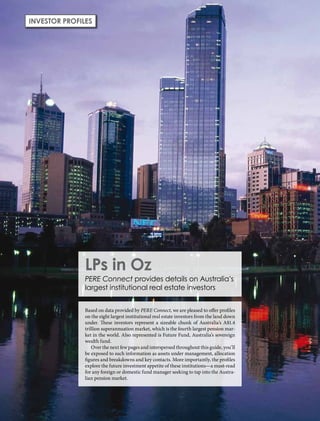
LPs in Oz
PERE Connect provides details on Australia’s
largest institutional real estate investors
Based on data provided by PERE Connect, we are pleased to offer profiles
on the eight largest institutional real estate investors from the land down
under. These investors represent a sizeable chunk of Australia’s A$1.4
trillion superannuation market, which is the fourth largest pension mar-
ket in the world. Also represented is Future Fund, Australia’s sovereign
wealth fund.
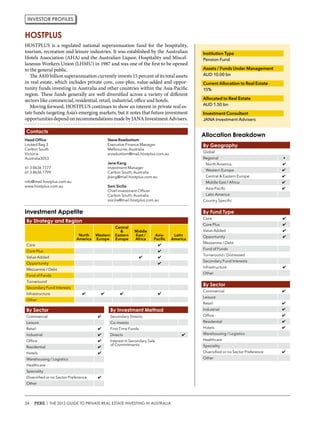
Over the next few pages and interspersed throughout this guide, you’ll
be exposed to such information as assets under management, allocation
figures and breakdowns and key contacts. More importantly, the profiles
explore the future investment appetite of these institutions—a must-read
for any foreign or domestic fund manager seeking to tap into the Austra-
lian pension market.
Investor Profiles
Established in 2006 as a result of an Act passed by the Australian Government,
Australia Future Fund makes investments for the Australian government’s long-
term financial position, the returns from which can then be used by govern-
ments to meet the cost of public sector superannuation liabilities in the future.
Australia Future Fund is permitted to invest in Australian and international
listed and unlisted real estate. In November 2008, the sovereign wealth fund cit-
ed a long-term target of 30 percent for its combined real estate and infrastructure
allocation.
As of August 2012, Australia Future Fund has an allocation of roughly 8 per-
cent to real estate investments. The sovereign wealth fund will consider invest-
ments in most sectors and geographies, depending on its selected investment
managers and provided that the risks are acceptable.
Head Office
Locked Bag 20010
Melbourne
Victoria
Australia3001
61 3 8656 6400
61 3 8656 6500
contact@futurefund.gov.au
www.futurefund.gov.au
Barry Brakey
Investment Director, Real Estate
Melbourne, Australia
61 3 8656 6438
barry.brakey@futurefund.gov.au
David Neal
Chief Investment Officer
Melbourne, Australia
david.neal@futurefund.gov.au
Institution Type
Sovereign Wealth Fund
Assets / Funds Under Management
AUD 78 bn
Current Allocation to Real Estate
8%
Allocated to Real Estate
AUD 6.5 bn
By Geography
Global
Regional •
North America ✔
Western Europe ✔
Central & Eastern Europe ✔
Middle East / Africa
Asia-Pacific ✔
Latin America ✔
Country Specific
By Sector
Commercial
Leisure
Retail ✔
Industrial ✔
Office ✔
Residential ✔
Hotels ✔
Warehousing / Logistics
Healthcare ✔
Speciality
Diversified or no Sector Preference ✔
Other
By Sector
Commercial
Leisure
Retail ✔
Industrial ✔
Office ✔
Residential ✔
Hotels ✔
Warehousing / Logistics
Healthcare ✔
Speciality
Diversified or no Sector Preference ✔
Other
By Strategy and Region
North
America
Western
Europe
Central
&
Eastern
Europe
Middle
East /
Africa
Asia-
Pacific
Latin
America
Core ✔ ✔ ✔ ✔ ✔ ✔
Core Plus ✔ ✔ ✔ ✔ ✔ ✔
Value Added ✔ ✔ ✔ ✔ ✔ ✔
Opportunity ✔ ✔ ✔ ✔ ✔ ✔
Mezzanine / Debt ✔ ✔ ✔ ✔ ✔ ✔
Fund of Funds ✔ ✔ ✔ ✔ ✔ ✔
Turnaround ✔ ✔ ✔ ✔ ✔ ✔
Secondary Fund Interests ✔ ✔ ✔ ✔ ✔ ✔
Infrastructure
Other
By Fund Type
Core
Core Plus
Value Added ✔
Opportunity
Mezzanine / Debt
Fund of Funds
Turnaround / Distressed
Secondary Fund Interests
Infrastructure ✔
Other
By Investment Method
Secondary Directs
Co-invests ✔
First Time Funds
Directs
Interest in Secondary Sale
of Commitments
Australia Future Fund
Allocation Breakdown
Investment Appetite
Contacts
Investor profiles
THE 2012 GUIDE TO PRIVATE REAL ESTATE INVESTING IN AUSTRALIA | PERE 11
The Australia Post Superannuation Scheme is a self-funding government busi-
ness enterprise established in 1825. The pension covers Australia Post employ-
ees, employees of some associated employers and their spouses.
Australia Post Superannuation is an active investor in alternative assets that
include private equity, private real estate and infrastructure funds. It first in-
vested in private real estate funds in 1992 and has since invested across a wide
diversity of sectors with a global geographic exposure. An average of $500 mil-
lion is set aside for commitments annually, although this amount is subject to
change from year to year.
As of June 2012, 31 percent of Australia Post Superannuation’s market return
portfolio is allocated to private market real estate.
Head Office
APSS
Locked Bag A5005
Sydney
New South Wales
Australia1235
61 1300 360 373
61 2 9372 6288
www.apss.com.au
Angus McKenzie
Managing Director, Fund Investments
Sydney, Australia
angus.mckenzie@austpost.com.au	
Graeme John
Managing Director
Sydney, Australia
Stephen Milburn-Pyle
General Manager
Sydney, Australia
stephen.milburn-pyle@austpost.com.au
Institution Type
Pension Fund
Assets / Funds Under Management
AUD 6.01 bn
Current Allocation to Real Estate
31%
Target Allocation to Real Estate
30%
Allocated to Real Estate
AUD 1.86 bn
Year First Invested in Real Estate
1992
Investment Consultant
Quentin Ayers
By Geography
Global •
Regional •
North America ✔
Western Europe ✔
Central & Eastern Europe ✔
Middle East / Africa ✔
Asia-Pacific ✔
Latin America ✔
Country Specific •
By Sector
Commercial ✔
Leisure ✔
Retail ✔
Industrial ✔
Office ✔
Residential ✔
Hotels ✔
Warehousing / Logistics ✔
Healthcare ✔
Speciality
Diversified or no Sector Preference ✔
Other
By Sector
Commercial ✔
Leisure ✔
Retail ✔
Industrial ✔
Office ✔
Residential ✔
Hotels ✔
Warehousing / Logistics ✔
Healthcare ✔
Speciality
Diversified or no Sector Preference ✔
Other
By Strategy and Region
North
America
Western
Europe
Central
&
Eastern
Europe
Middle
East /
Africa
Asia-
Pacific
Latin
America
Core ✔ ✔ ✔ ✔ ✔ ✔
Core Plus ✔ ✔ ✔ ✔ ✔ ✔
Value Added ✔ ✔ ✔ ✔ ✔ ✔
Opportunity ✔ ✔ ✔ ✔ ✔ ✔
Mezzanine / Debt
Fund of Funds
Turnaround
Secondary Fund Interests
Infrastructure
Other
By Fund Type
Core ✔
Core Plus ✔
Value Added ✔
Opportunity ✔
Mezzanine / Debt
Fund of Funds
Turnaround / Distressed
Secondary Fund Interests
Infrastructure
Other ✔
By Investment Method
Secondary Directs
Co-invests
First Time Funds
Directs ✔
Interest in Secondary Sale
of Commitments
Contacts
Australia Post Superannuation Scheme
Investment Appetite
Allocation Breakdown
Investor profiles
12 PERE | THE 2012 GUIDE TO PRIVATE REAL ESTATE INVESTING IN AUSTRALIA
The Australian Government Employees Superannuation Trust (AGEST) is fo-
cused solely on managing superannuation savings for Commonwealth, ACT
and Northern Territory government employees who are not eligible to join other
government superannuation funds, as well as for employees of a number of pri-
vatised government agencies. Non-government employers also can contribute to
AGEST if one of their employees already is a member.
With approximately AUD$4.7 billion in total assets, AGEST allocates about
8.3 percent to real estate. The superannuation is known to be an active investor
in real estate, with unlisted fund investments generally well-diversified across all
regions and sectors. Some of the investment managers used to manage AGEST’s
private real estate portfolio include AEW, Dexus, Fortius and ISPT.
Head Office
Locked Bag 20
4 Riverside Quay
Carlton
Wollongong
NSW
Australia 2500
61 2 4298 6011
61 2 4253 6108
mtaasuper@mtaasuper.com.au
www.mtaasuper.com.au
Richard Friend
Senior Manager - Investments
Wollongong, Australia
richard.friend@agest.com.au
Cath Bowtell
Chief Executive Officer
Wollongong, Australia
cath.bowtell@agest.com.au
Anthony Beamish
Operations Manager
Wollongong, Australia
anthony.beamish@agest.com.au
Institution Type
Pension Fund
Assets / Funds Under Management
AUD 4.70 bn
Allocation to Alternatives
19.2%
Current Allocation to Real Estate
8.3%
Allocation Range for Real Estate
Min 5% - Max 13%
Allocated to Real Estate
AUD 0.39 bn
Investment Consultant
Frontier Investment Consulting
By Geography
Global •
Regional •
North America ✔
Western Europe ✔
Central & Eastern Europe ✔
Middle East / Africa ✔
Asia-Pacific ✔
Latin America ✔
Country Specific •
By Sector
Commercial ✔
Leisure
Retail ✔
Industrial ✔
Office ✔
Residential ✔
Hotels ✔
Warehousing / Logistics ✔
Healthcare
Speciality
Diversified or no Sector Preference ✔
Other
By Sector
Commercial ✔
Leisure
Retail ✔
Industrial ✔
Office ✔
Residential ✔
Hotels ✔
Warehousing / Logistics ✔
Healthcare
Speciality
Diversified or no Sector Preference ✔
Other
By Strategy and Region
North
America
Western
Europe
Central
&
Eastern
Europe
Middle
East /
Africa
Asia-
Pacific
Latin
America
Core ✔
Core Plus ✔ ✔ ✔
Value Added ✔
Opportunity ✔
Mezzanine / Debt
Fund of Funds ✔ ✔ ✔ ✔ ✔ ✔
Turnaround
Secondary Fund Interests
Infrastructure ✔ ✔ ✔
Other
By Fund Type
Core ✔
Core Plus ✔
Value Added ✔
Opportunity ✔
Mezzanine / Debt
Fund of Funds ✔
Turnaround / Distressed
Secondary Fund Interests
Infrastructure ✔
Other
By Investment Method
Secondary Directs
Co-invests
First Time Funds
Directs ✔
Interest in Secondary Sale
of Commitments
Contacts
Australian Government Employees Super Trust
Investment Appetite
Allocation Breakdown
THE 2012 GUIDE TO PRIVATE REAL ESTATE INVESTING IN AUSTRALIA | PERE 13
I
n a post-financial crises environment,
investors around the world clearly are focused on markets
that can offer solid yield and stability amid a backdrop of
global uncertainty. Therefore, it is not surprising that Austra-
lian bonds and commercial real estate now have the focus of the
world’s capital, as the market’s tangible growth prospects and
access to Asia are accelerating interest in investment.
Not just a natural resources story, Australia currently is see-
ing the highest level of foreign investment into commercial real
estate since the 1980s, part of a broad-based flow of capital that
has increased since the financial crisis. In the global context, the
Australian commercial real estate investment proposition now
looks more attractive than it did one year ago, raising the pros-
pects of firmer prices in the near future.
Sudden interest
From 2010 to 2011, international investors accounted for 20 per-
cent to 25 percent of commercial real estate purchases, a sub-
stantial rise over the long-term average of 10 percent, according
to CBRE. The magnitude of this rise is starkly highlighted in the
graphic below.
This trend has not been exclusive to real estate. There has
been a sharp rise in capital invested in most of the other major
asset classes as well. For example:
•	 In share markets, international investors now own 40 per-
cent of the shares on the Australian stock exchange, ac-
cording to the Reserve Bank of Australia. This is the high-
est level of foreign ownership in a decade.
•	 In bond markets, foreigners now own 80 percent of the
Australian government bonds on issue, a record high, ac-
cording to the Reserve Bank. Foreigners held 50 percent to
60 percent of these bonds before the global financial crisis.
•	 The Australian dollar has risen to levels not seen since
1982, as demand for Australian-denominated assets rises
from foreign public and private investors.
Clearly, the world has changed since the global financial
crisis. The global investment climate remains constantly chal-
lenged and will likely do so until sovereign debt issues and
consumer deleveraging get resolved, which will take years. We
clearly see that more and more investors are starting to “give up
on the growth story” as the reality dawns that Europe, the US
and the UK are not going to recovery quickly. In addition, more
are taking the view that listed markets are going to be volatile
until there are clear signs of recovery.
From a macro perspective, there is a growing realisation that
investments that offer yield and stability are what you want in a
low growth, more volatile climate. Australia fits the bill perfect-
ly for that style of investing, particularly higher yielding assets
such as bonds and commercial real estate, hence the fund flow.
The pursuit of yield
In the current environment, Australia’s higher yielding invest-
ment markets have placed the country in a strong competitive
position to attract foreign capital, which it has done. However,
Australia’s investment proposition is now even better than it
was one year ago.
Most of the core property markets across the globe have seen
yields fall substantially over the past two years. This is due to the
flight of capital into the largest most liquid property markets in
the world, but it also is due to a widening spread to fixed interest
given the very low interest rate environment offshore and the
global investment thematics mentioned earlier.
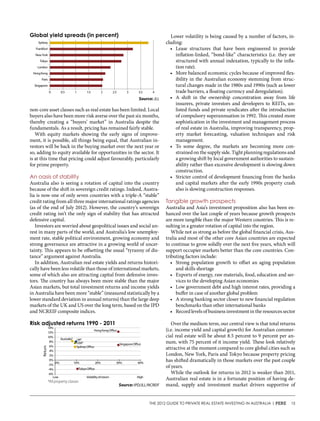
So far in Australia, however, bond markets have reflected
the increased demand for product in pricing, but real estate
hasn’t. Australian 10-year government bond yields have aver-
aged about 4 percent since the second or third quarter of 2011,
and the indexed bond yield (after inflation) has fallen 160 basis
points. Meanwhile, property yields have tracked sideways. As
a result, property yield spreads to bonds are now at their wid-
est point since property research data was first collected in the
early 1970s, and Australia now has one of the highest spreads in
the developed world.
Why hasn’t Australia seen firmer prices just like the rest of
the world? Australian commercial real estate is sitting at an al-
most 400 basis point premium to Australian 10-year govern-
ment bonds, which in turn are about 150 basis points higher
than equivalent US/UK/European paper. This spread is almost
double that of Singapore, which is similarly rated triple-A, and
Australia’s office markets are in better shape than the Singapore
office market.
The main reason for the disparity is that Australian domestic
investors’ appetite for property has weakened over the past year.
This has nothing to do with fundamentals, but more to do with
the asset allocation strategies of the Australian superannuation
sector and general buyer nervousness.
Australian pension funds have one of the highest allocations
to equities of any country in the 2011 OECD Pension Funds in
Focus survey. Given the volatility in equity markets, capital for
Real attraction
Australia’s real estate markets have attracted the interest of foreign investors amid
uncertain global growth and stability. By Michael Kingcott
Sponsored Article | AMP Capital
Annual real estate purchases by foreigners
Source: JLL
Industrial
1989
1990
1991 1993 1995
1992 1994 1996
1997
1998
1999 2001 2003
2000 2002 2004
2005 2007 2009 2011
$3,000m
$2,500m
$2,000m
$1,500m
$1,000m
-$1,000m
-$1,500m
-$2,000m
$500m
0
-$500m
2006 2008 2010
Retail
Office
14 PERE | THE 2012 GUIDE TO PRIVATE REAL ESTATE INVESTING IN AUSTRALIA
non-core asset classes such as real estate has been limited. Local
buyers also have been more risk averse over the past six months,
thereby creating a “buyers’ market” in Australia despite the
fundamentals. As a result, pricing has remained fairly stable.
With equity markets showing the early signs of improve-
ment, it is possible, all things being equal, that Australian in-
vestors will be back in the buying market over the next year or
so, adding to equity available for opportunities in the sector. It
is at this time that pricing could adjust favourably, particularly
for prime property.
An oasis of stability
Australia also is seeing a rotation of capital into the country
because of the shift in sovereign credit ratings. Indeed, Austra-
lia is now one of only seven countries with a triple-A “stable”
credit rating from all three major international ratings agencies
(as of the end of July 2012). However, the country’s sovereign
credit rating isn’t the only sign of stability that has attracted
defensive capital.
Investors are worried about geopolitical issues and social un-
rest in many parts of the world, and Australia’s low unemploy-
ment rate, stable political environment, growing economy and
strong governance are attractive in a growing world of uncer-
tainty. This appears to be offsetting the usual “tyranny of dis-
tance” argument against Australia.
In addition, Australian real estate yields and returns histori-
cally have been less volatile than those of international markets,
some of which also are attracting capital from defensive inves-
tors. The country has always been more stable than the major
Asian markets, but total investment returns and income yields
in Australia have been more “stable” (measured statistically by a
lower standard deviation in annual returns) than the large deep
markets of the UK and US over the long term, based on the IPD
and NCREIF composite indices.
Lower volatility is being caused by a number of factors, in-
cluding:
•	 Lease structures that have been engineered to provide
inflation-linked, “bond-like” characteristics (i.e. they are
structured with annual indexation, typically to the infla-
tion rate).
•	 More balanced economic cycles because of improved flex-
ibility in the Australian economy stemming from struc-
tural changes made in the 1980s and 1990s (such as lower
trade barriers, a floating currency and deregulation).
•	 A shift in the ownership concentration away from life
insurers, private investors and developers to REITs, un-
listed funds and private syndicates after the introduction
of compulsory superannuation in 1992. This created more
sophistication in the investment and management process
of real estate in Australia, improving transparency, prop-
erty market forecasting, valuation techniques and risk
management.
•	 To some degree, the markets are becoming more con-
strained on the supply side. Tight planning regulations and
a growing shift by local government authorities to sustain-
ability rather than excessive development is slowing down
construction.
•	 Stricter control of development financing from the banks
and capital markets after the early 1990s property crash
also is slowing construction responses.
Tangible growth prospects
Australia and Asia’s investment proposition also has been en-
hanced over the last couple of years because growth prospects
are more tangible than the major Western countries. This is re-
sulting in a greater rotation of capital into the region.
While not as strong as before the global financial crisis, Aus-
tralia and most of the other core Asian countries are expected
to continue to grow solidly over the next five years, which will
support occupier markets better than the core countries. Con-
tributing factors include:
•	 Strong population growth to offset an aging population
and skills shortage
•	 Exports of energy, raw materials, food, education and ser-
vices to the developing Asian economies
•	 Low government debt and high interest rates, providing a
buffer in case of another global problem
•	 A strong banking sector closer to new financial regulation
benchmarks than other international banks
•	 Record levels of business investment in the resources sector
Over the medium term, our central view is that total returns
(i.e. income yield and capital growth) for Australian commer-
cial real estate will be about 8.5 percent to 9 percent per an-
num, with 75 percent of it income yield. These look relatively
attractive at the moment compared to core global cities such as
London, New York, Paris and Tokyo because property pricing
has shifted dramatically in those markets over the past couple
of years.
While the outlook for returns in 2012 is weaker than 2011,
Australian real estate is in a fortunate position of having de-
mand, supply and investment market drivers supportive of
Global yield spreads (in percent)
Source: JLL
2.5 3 3.5 40
Sydney
Frankfurt
NewYork
Tokyo
London
HongKong
Paris
Singapore
0.5 1 1.5 2
Risk adjusted returns 1990 - 2011
Source: IPD/JLL/NCREIF
*All property classes
14%
HongKongOffice
Australia* UK*
USA*
SydneyOffice
SingaporeOffice
TokyoOffice
6%
8%
10%
12%
4%
2%
0%
-2%
-4%
-6%
Low High
10%0% 20%
Volatilityofreturn
30% 40%
Return
THE 2012 GUIDE TO PRIVATE REAL ESTATE INVESTING IN AUSTRALIA | PERE 15
steady property value growth over the medium term and hasn’t
been repriced like the offshore markets. These include:
•	 Positive macroeconomic drivers such as population
growth, productivity improvements, services demand, ex-
ports to Asia and mining investment supporting occupier
markets
•	 Vacancy rates towards the lower end of international peers
•	 Tight town planning controls, regulating or delaying new
construction
•	 Compulsory superannuation, providing regular invest-
ment capital flow into commercial property, now aided by
increasing amounts of foreign capital
•	 One of the most institutionally owned property markets
in the world, underpinning values
Economic growth of 3.5 percent per annum will provide a
boost to current tenant demand trends (Australia’s economy
has grown just 2 percent per annum since 2007). The mining
boom has caused a two-speed economy to the benefit of Perth
and Brisbane, although stronger economic growth and a slowly
improving global environment will be more positive for Syd-
ney and Melbourne moving forward (circa 60 percent of the
commercial property market is located in these cities).
Secondly, like the rest of the world, construction rates have
fallen dramatically since the financial crisis because of tight-
er financing. This means the prospects for undersupply (and
rental/value growth) are quite tangible in Australia. According
to the Australian Bureau of Statistics and ANZ Bank, building
approvals have fallen 58 percent for the office sector, 40 percent
for industrial and 12 percent for retail since the financial crisis.
The prospects for undersupply are most acute in the office and
industrial sectors, hence these markets have the strongest re-
turn prospects in the short term.
Given the shift in pricing offshore, Australia’s outright in-
vestment proposition is now one of the more attractive in the
world, adding to the yield and defensiveness story. This is gen-
erating more interest from offshore investors worried about
prices falling/stagnating in the major global cities or still too
scared to go up the risk curve in those regions because of per-
sistently weak economic fundamentals.
Not without risk
Australia’s investment proposition at the moment is quite com-
pelling but, like all things, there are risks. Some of the key risks
to the Australian investment story, most of which are fairly well
mitigated, include:
1.	Another financial crisis. Australian real estate arguably
is in better shape than 2008. Deleveraging risk is consider-
ably less, discount rates have reverted back to long-term
benchmarks and construction is much less than in 2008.
The government and Reserve Bank have the capacity to
stimulate the economy, unlike many countries offshore.
Our modelling suggests the downside risk to prime values
is likely to be just 5 percent to 10 percent – about half the
fall of the global financial crisis.
2.	China enters an extended period of slow growth. This is
probably not likely, owing to the levers the Chinese gov-
ernment has to maintain a growth rate at or above the
stated 7 percent per annum target. Interest rates and the
Australian dollar will fall, which will improve Australia’s
competitiveness. This will be a great benefit to Sydney and
Melbourne, where 60 percent of Australia’s commercial
real estate stock is based, but bad news for resource-based
cities such as Perth and Brisbane.
3.	Too much capital, not enough stock. Given all the capital
signals, there is a risk that pricing could rise substantially
or more capital is directed to development, fuelling a con-
struction cycle. This has the potential of adding volatility to
the investment returns over our base case for the next five
years. This has both positive and negative connotations.
4.	Currency volatility. The Reserve Bank of Australia is de-
liberating whether to start reducing interest rates to take
pressure off the high Australian dollar.
Conclusion
Quite clearly, the world has changed and investors are now tar-
geting assets and locations that provide yield and stability more
than they were before the financial crisis. Australian bonds and
commercial real estate fit that criteria and have benefited from
greater fund flow.
Australia’s investment proposition is now getting even better
as international property markets have repriced. This is likely
to increase capital flow into Australia and lead to higher prices
once Australian investors return to the investment market in
greater numbers in the near future.
About the Author:
Michael Kingcott is head of property research and investment
strategy for AMP Capital. He and his team monitor and fore-
cast domestic and international property markets and guide in-
vestment strategy for AMP Capital’s property funds. He can be
reached at +61 2 9257 1639 or via email at michael.kingcott@
ampcapital.com.
About the Firm:
AMP Capital is a leading investment house with more than
$124 billion in funds under management. The firm provides cli-
ents with contemporary solutions in fixed income, equities and
multi-asset portfolios, offering particular strength in real estate
and infrastructure in the Asia-Pacific region. With a 50-year
history in real estate, AMP Capital is Australia’s largest unlisted
real estate fund manager and the third largest across the Asia-
Pacific region.
GDP growth forecasts (2013-2017)
Source: IMF
Germany
0 1 2 3
Percentperannum
4 5 6
Japan
France
Canada
UK
USA
Australia
Israel
Estonia
Korea
Singapore
HongKong
Taiwan
Sponsored Article | AMP Capital
16 PERE | THE 2012 GUIDE TO PRIVATE REAL ESTATE INVESTING IN AUSTRALIA
The wizards of Oz
Four real estate professionals dissect one of the hottest investment
markets in the world at the moment - Australia
Roundtable | Australia
Photography by The Corporate Photo Agency
Roundtable | Australia
Private equity goes walkabout
Although opportunities in Australia currently are core in nature, that hasn’t
stopped private equity real estate players from forming ventures in the
hopes of reaping future rewards. By Erik Kolb
(L to R) Joel Cann, Laurence Parisi, Brett Robson and Warwick Petschack
O
f the world’s seven continents, Australia historically
has vied with Africa for the second lowest level of in-
vestment interest by private equity real estate firms.
Over the past two years, however, that dynamic has changed as
interest in Australia has increased significantly.
In April 2011, The Blackstone Group bought Valad Property
Group, an Australian and European real estate investment
firm, for about $227 million, plus the assumption of $655 mil-
lion in debt. LaSalle Investment Management and Morgan
Stanley Real Estate Investing quickly followed later that year
with the purchases of Trinity Funds Management and Orchard
Funds Management, respectively.
In addition, large global institutional investors have begun
to take notice of the property markets down under, making
large direct investments or forming investment partnerships
of their own. Just a few months ago, the $161.6 billion Canada
Pension Plan Investment Board (CPPIB) invested $1 billion in
Sydney’s Barangaroo South Project.
On the back of all this activity and interest, PERE trav-
eled to Sydney at the end of August to speak with some of
the market’s players and get a better sense of what is driving
that interest. Participating in the roundtable were Warwick
Petschack of AMP Capital, Laurence Parisi of APN Property
Group, Brett Robson of Macquarie Capital and Joel Cann of
AMB Capital Partners.
Sitting in a boardroom on the top floor of AMP Capital’s
headquarters with a spectacular view of Sydney Harbour, the
four executives discussed such topics as why Australia is such
an attractive investment destination, which property types and
cities are generating the most interest from investors, the op-
portunities for both domestic and global private equity real
estate players and the prospects for raising commingled funds
in the market. Most importantly, they pointed out where the
future opportunities lie.
Market of the moment
“Australia’s economic fundamentals are driving investment
from around the world,” says Petschack. “Despite the global fi-
nancial crisis a few years back, Australia currently has a stable
government, low inflation and low unemployment. It certainly
paints a good picture when you compare it to other markets.”
That said, Australia is not immune from developments
in the rest of the world, particularly in Europe, notes Parisi.
“Things have started to slow a bit – consumer confidence, busi-
ness confidence, the strong Aussie dollar. A few of these things
have started to weigh on some people’s view.”
Still, Australia is “probably the best relative bet globally at
the moment,” says Cann. “That may change, depending on the
future of the Australian dollar. The question now is whether
the ABC economies of Australia, Brazil and Canada are going
through structural economic change, which will make them
less volatile, or having a moment in the sun – as Australia is –
and will continue to remain highly cyclical.”
When it comes to property, Robson emphasizes that it is
The Australian roundtable: dissecting the opportunity for global investors
Roundtable | Australia
20 PERE | THE 2012 GUIDE TO PRIVATE REAL ESTATE INVESTING IN AUSTRALIA
important to note that Australian yields have lagged the rest
of the world, particularly for prime real estate. “While you
saw prime yields firm really quickly in the gateway markets of
Hong Kong, Manhattan, London and Paris, yields in Australia
haven’t really firmed,” he says. “Now that margins have come
back and the base rates have dropped substantially, it feels like
the relative yield spread for Australia to other major markets
is artificially high. In fact, the spread between property yields
and bond yields in Australia is at an all-time historic peak.”
Petschack, however, cautions that, although the yield spread
is a consistent story across Australia, different cities are at
slightly different stages of the cycle. “Sydney’s facing a signifi-
cant amount of supply with Barangaroo and the other projects.
Brisbane and Perth are seeing good growth in tenant demand,
and Melbourne, like Sydney, is suffering from a deteriorating
financial services sector.”
Fundamentally, though, Australia is an easy market to get
your head around. “It’s not like going to the US, where there
are more than 50 markets and every market’s got submar-
kets,” Robson says. “Here, there are a couple of big metro-
politan areas and, whether it’s retail, industrial or office, any
one partner can probably get you well invested in any sector
around the country.”
Stress but not distressed
Distressed assets are not a big market in Australia, unlike in
Europe or the US, where commercial property values fell by
as much as 40 percent or more in the wake of the global fi-
nancial crisis.
“On a relative basis, Australia’s had very little distress,”
Cann argues. “The banks are lending and refinancing good
sponsors. I don’t see that happening automatically in Europe,
where banks are turning their backs on some long-term rela-
tionships.”
Perhaps that is due to the level of institutionalization of
real estate in Australia, where more than 70 percent of all in-
vestment-grade real estate is securitized, either listed or non-
listed. “It’s already in the hands of fairly sophisticated own-
ers with fairly reasonable longer-term investment horizons,”
Robson explains. “It doesn’t necessarily mean that people
won’t over-leverage, but it does mean there’s generally a little
bit more discipline.”
Despite the apparent benefits, such transparency actually
works against AMB Capital Partners. “As an owner, we rely
upon distortion or inefficiencies in the market, which we ac-
tively look for and take advantage of,” says Cann. “Jones Lang
LaSalle ranks, and probably will continue to rank, Australia
as the most transparent real estate market in the world for the
conceivable future. So, in that sense, it’s very hard for me to
make money – at least, that’s what I tell my board!”
Still, a two-speed economy remains in Australia, powered
by the varying fortunes of the resources-driven states and the
services-driven states. “Personally, I’d be hesitant about doing
something in Perth because a lot of the demand’s driven by
mining, which has two phases,” Robson says. “In the invest-
ment phase, you need a lot of people in offices to get the project
up and running. Once you’re in production, you don’t need a
lot of people, except at the mine site.”
Where Robson does see an opportunity, on a purely total re-
turn basis, is residential land. “There are no buyers in that mar-
ket, but it’s just a matter of time before it is on the upswing,” he
says. “And when it goes, you’re going to have a really low cost
base and the margins will be quite attractive.”
Petschack adds that “the real distress has been in debt-ridden
land and select residential markets in Southeast Queensland,
where an oversupply at the upper end of the market has been
felt hard. The rest of the nation, though, can’t build enough
housing stock to keep up with population growth. Demand
may have softened, but rental levels are increasing. So, assum-
ing economic conditions remain favourable, I think that resi-
dential distress is a short-term phenomenon, with very specific
Warwick Petschack
Fund manager, opportunity funds
AMP Capital
Petschack has over 22 years of real
estate experience in Australia, 14 of
them with AMP Capital. He joined the
firm’s opportunistic fund team in 2003
and has assisted in the investment
and asset management for its fourth, fifth and sixth private
equity real estate funds, which raised more than A$500
million in equity. Prior to that, he was a property manager at
Macquarie Centre, one of AMP Capital’s major regional shop-
ping centers.
Robson: the best opportunity is residential land
THE 2012 GUIDE TO PRIVATE REAL ESTATE INVESTING IN AUSTRALIA | PERE 21
Cann: sees selective opportunity in development
Roundtable | Australia
distress in the Southeast Queensland market, but even that can
bounce back quickly.”
While legacy real estate funds have not been a source of
distressed assets in Australia, Robson notes that Macquarie
Capital has recapitalized a few vehicles over the last couple of
years. “They were not reaching the end of their life, but their
base reflected investors from a decade ago that were seeking
liquidity,” he explains.
For example, Macquarie Capital worked with Colonial First
State’s retail fund, which had legacy-type life investors in it, as
well as some pensions with fairly small stakes. “What we were
able to do is bring in a pair of investors to recap the whole ve-
hicle,” Robson says. “It was $1.1 billion of assets, and CPPIB
and Future Fund put in roughly $750 million to take out the
majority of the capital.”
Hot deals
Although a few high-profile transactions have set the pace
for the market, not every deal is a home run. “What you are
seeing is a differentiation between prime opportunities and
secondary ones,” Robson observes. “Centro Property Group
put a reasonably attractive portfolio together, and it was really
well sought after. One asset in particular was highly sought
after, and that deal got done quickly ahead of the timetable.
The firm later put Roselands and Bankstown on the market–
not actually bad assets per se, but just a little bit more complex
in terms of the next phase of their life – and the market hasn’t
jumped on those.”
For Cann, who doesn’t trade in large assets or follow the pre-
mium office market very closely, the biggest deal this year been
the entire REIT market. “The index has been fundamentally
re-rated, and there are reasons for it,” he says. “The net tangible
asset gap has been closed or virtually eliminated and, in some
cases, companies are now trading at a premium.”
Cann notes that there also are selective opportunities in
development. “We like only very particular parts of the de-
velopment market, specifically Eastern Seaboard residential
schemes with between 30 and 50 apartments and gross reve-
nues between A$20 million and A$30 million. For us, the key is
creating supply that we know is going to be bought and having
banks willing to stand behind the deal.”
Petschack says AMP Capital also has invested in residential
apartments. “For the right proponents with the right develop-
ments, debt is available to fund construction. Construction
costs actually are quite competitive in the current market and,
given the current undersupply in housing, we see value in de-
veloping in select areas.”
Robson counters that true private equity real estate invest-
ment in Australia is actually pretty tough because it focuses
on opportunistic investments rather than core and more than
90 percent of all domestic pension money is invested in core
private funds. “Still, if you looked more at just the bigger in-
stitutions, they’re more than happy to develop long-term core
assets, and that’s a big shift globally. The develop-to-core strat-
egy is probably one of the biggest shifts we’ve seen because the
world is slightly long capital– it’s short prime assets, long capi-
tal and that’s the reality.”
APN Property Group is involved in such a development
at the moment – a brand new, 20,000-square-meter A-grade
office tower fully leased to Westpac Bank. “The GPT Group’s
wholesale office fund recently bought it and is funding it
through construction,” Parisi notes. “So, again, I think they
are open to development, but it is on a very selective basis and
needs to be de-risked.”
AMP Capital also has been packaging such a develop-
ment site in Brisbane’s CBD office market. “Opportunistic
funds that take on development sites, eliminate key risks and
package them for sale to core investors will be rewarded,”
Petschack adds.
Cann notes that such projects are not exposed to significant
development risk, at least not in the traditional sense. “It’s ef-
fectively monopolizing situations by being a capital partner to
quality businesses or funding on an asset-by-asset basis and
securing a position on an almost entirely de-risked basis. It’s
not multi-faceted development risk.”
Laurence Parisi
Chief operating officer
APN Property Group
Parisi joined APN Property Group in
February as chief operating officer.
Prior to that, he was the head of real
estate research at Citi Investment
Research and was responsible for
managing the Australian real estate investment trust team.
He also worked for Credit Suisse covering the A-REIT sector
and spent several years with the APN’s real estate securities
team, where he was responsible for sector research and
managing various property funds.
22 PERE | THE 2012 GUIDE TO PRIVATE REAL ESTATE INVESTING IN AUSTRALIA
Institutional interest
Perhaps the biggest shift in real estate investing coming out of
the economic downturn is that global capital has dominated
transactions in every major market around the globe. For
example, Robson estimates that about 75 percent of all office
transactions in London since the financial crisis have been for-
eign capital. “Looking at Australia, I feel like it’s all been for-
eign capital over the past two years or so,” he adds.
The reasons for that may be as simple as scale and resources.
“Most foreign investors have dedicated resources to invest in
Australia, and the sophistication in terms of the deals they can
do and the size of the cheques they can write is just different,”
Robson says.
One big shift in the mindset of such global investors is that
Australia is now viewed as part of Asia. “When they are com-
ing to Asia, many look to first build a core base, and a good
number are doing that in Australia,” Robson says. “The diverse
weight of capital coming to Asia isn’t going to slow, and Aus-
tralia increasingly will become the first port of call.”
In terms of foreign players, there are three big players invest-
ing around the world – the Abu Dhabi Investment Authority
(ADIA), the Government of Singapore Investment Corpora-
tion (GIC) and CPPIB. “Because these investors have large ded-
icated teams, they’ll participate in a deal like the Charter Hall
Office REIT, for example, because of their ability to analyze
and actually execute a public to private transaction,” Robson
explains. “The domestic guys just don’t have the investment ca-
pacity or the manpower.”
Cann suggests that, in terms of foreign activity, Australia
will become less attractive and another market or group of
markets will start to draw such investors away. “Australia’s
having its moment in the sun, but that will change, and for-
eign capital will always turn its attention to the best potential
sources of risk and return. As for the first wave of foreign insti-
tutions, I see that they could be full of Australia, so investment
teams will transition from origination and execution into the
asset management phase of current investments.”
Unfazed, Robson says: “The one thing about those foreign
investors is that they don’t come all the way to Australia to
make one investment. They’re going to drop $1 billion or more
when they come.” Still, he notes that there’s other groups of
new investors he’s already speaking with to replace current in-
vestors should they actually have had their fill.
Without naming names, Robson reckons that the next layer
of high-growth institutional capital will come from the Middle
East and Asia. “When you look at the Middle East today, it’s
just the United Arab Emirates, and the rest of the Middle East
hasn’t really invested much into Australia,” he says. “Similarly,
there are clear leaders in Korea. So once the National Pension
Service of Korea or Korea Investment Corporation has invest-
ed into Australia, as they have, you would expect a lot of the
next tier of Korean investors to follow as well.”
Europe also is expected to come calling. “You’ve got to have a
pretty pessimistic view of the likely return you’re going to get-
ting from European investments,” says Robson. “Those inves-
tors generally are heavily European-focused, but they are now
looking to diversify into growth markets and, in several cases,
have significant unspent capital to invest into global real estate.
I would expect part of that capital to find its way to Asia and
Australia at some point.”
In it to win it
Among private equity real estate players, a few American firms
have recognized the market’s potential and set up shop in Aus-
tralia. “There’s no doubt raising capital gets a lot easier when
you have a local relationship versus a fly-in/fly-out relation-
ship,” says Robson. “It’s a big trend, with Blackstone, LaSalle,
Morgan Stanley and Forum Partners all buying platforms, but
I’m not sure it’s going to help them raise capital. What it might
do is give them access to other opportunities.”
Cann agrees. “By its very definition, those platform invest-
ments are short-term capital,” he says. “They are designed to
achieve maximum return over a two- to three-year period,
then that capital will leave again. If markets are efficient, capi-
tal will move. From an asset allocation point of view, Australia
is a good bet for now, but it is a tiny real estate market. Once big
Brett Robson
Executive director
Macquarie Capital
Robson is the global head of Macqua-
rie Capital’s real estate private capital
markets business, which has closed
on $36 billion in equity commitments
since 2003. He has more than 20 years
of experience, including nine years in corporate finance with
Macquarie and 12 years of direct real estate experience with
Lend Lease spanning roles across fund, asset and develop-
ment management.
Petschack: sees domestic investors returning to funds
THE 2012 GUIDE TO PRIVATE REAL ESTATE INVESTING IN AUSTRALIA | PERE 23
Roundtable | Australia
players get exposed, a second wave of capital follows and may
find it very hard to deploy.”
Robson cited a recent survey that found the average alloca-
tion to real estate at Australian pension schemes has increased
by 1 percent in the past year to 10.5 percent. “In the fourth big-
gest pension market of the world, a 1 percent move in alloca-
tion to real estate is actually a lot of money,” he says. “Com-
pound that with 12 percent growth each year, and that is a lot
of assets to be purchased.”
However, among Australia’s pension plans, an allocation to
opportunistic real estate is fundamentally a foreign allocation.
“Pension boards are very conservative, and I’m not sure that
anyone would pursue that type of strategy today,” Cann says.
“When you have higher returning alternatives, like the Austra-
lian REIT market (a 17 percent to 20 percent return this year),
it’s difficult to justify asking for such an allocation because
your board will point you to lost domestic opportunities.”
As for the global opportunity funds coming to Australia,
Cann thinks a lot of them are going to leave disappointed. “I
see a clear mismatch between the required returns of these
global opportunity fund players and what they will be able to
achieve,” he says.
While opportunistic strategies may not be an option, that
doesn’t mean all funds will suffer. “All the big core manag-
ers are trying to raise capital, although it’s smaller amounts
of around A$150 million to A$250 million,” Robson notes.
“They probably will achieve that over a 12- to 18-month period
because the domestic pension allocation is going to increase.
Still, getting a new fund raised is pretty hard. Colonial raised a
blind-pool shopping-center fund, but it took two years.”
Petschack sees domestic investors returning to investment
programmes, having been overweight to property in recent
years. “I expect a greater move to core property funds, where
there remain good risk-adjusted returns relative to other in-
vestments, although sound opportunistic strategies also are
available to pursue for the right investor,” he says.
Looking forward
The big opportunity Robson sees going forward is the round
of M&A coming among the big listed trusts in Australia. “You
are seeing a changing of the guard at the CEO level, and all of
these trusts will require capital partners to help fund develop-
ment and M&A deals. As an advisory house, we’ve helped to
privatize two big REITs already, and the next thing we expect
to be doing is helping some of these capital sources partner up
to participate in the M&A and development cycles. So, it will
be offshore capital for domestic groups.”
Parisi sees growth coming from expanding APN’s pres-
ence in Asia-Pacific through its strategic partnership with
Singapore-based ARA Asset Management. “Australia really
is cemented as part of the Asian story, and our relationship
with ARA will help us develop the real estate securities side
of the business, offering Asia-Pacific mandates,” he says. “Do-
mestically, we’re seeing a number of opportunities by moving
slightly up the risk curve to core-plus and value-added op-
portunities.”
Cann says AMB Capital Partners will look to diversify away
from Australia. “We’re long Australia and have enjoyed mid- to
high 20 percent returns over the life of our business, which is
approaching two years of operations, but we see growth op-
portunities offshore, as well as our ongoing need to diversify.
So our plan is, by the end of next year, to be invested in Eu-
rope and possibly one other market. Those markets are deeper,
broader and have a lot more opportunities than Australia.”
In fact, Cann notes that his firm has been a net seller in Aus-
tralia over the last 12 months. “For example, we have been in
and out of a value-added position in Sydney for the former as-
set of a large A-REIT. With that disposal programme at an end,
we’re cashed up and focused elsewhere.”
Petschack notes that AMP Capital has a number of assets
with development capacity in its retail and office portfolios,
which present significant opportunities for new capital. “We’re
focusing on developing those opportunities for investors, as
well as continuing to build upon our Singapore-listed REIT
and other opportunities in the pan-Asian market.”
Joel Cann
Managing director
AMB Capital Partners
Cann is managing director of AMB
Capital Partners, a property-focused
private equity business based in
Sydney, as well as a non-executive di-
rector of 360 Capital Property Group.
His career in property spans more than 20 years, including
almost 15 years in investment management, having held
senior positions domestically and internationally with ING
Real Estate, Pramerica Real Estate Investors, JPMorgan and
Aberdeen Property Investors.
Parisi: starting to look up the risk curve a bit
24 PERE | THE 2012 GUIDE TO PRIVATE REAL ESTATE INVESTING IN AUSTRALIA
Sponsored Article | APN Property Group
A
ustralia, like the rest of the developed
world, is in a low growth environment despite its ‘safe-
haven’ status. The European debt crisis and sluggish US
growth continue to pose very real threats to the deleveraging
process. Asia, in turn, is reducing its growth prospects, which
will rein in Australia’s resource-led economy, further fuelling
weak consumer sentiment and a high savings ratio, compounded
by declining home prices. Commodity prices, the terms of trade
and the Australian dollar also are peaking close to historical
highs, resulting in squeezed margins for the manufacturing and
tourism sectors.
Despite the downside risks, both offshore and domestically,
the Reserve Bank of Australia expects the economy to achieve
on-trend growth of circa 3 percent over the medium term and
Australian commercial real estate fundamentals remain sound
– low vacancy, a limited supply pipeline and moderate demand.
Prime assets in particular are continuing to experience mod-
est downward pressure on yields and record-low vacancy that
should bode well for demand spilling over to secondary markets.
Nevertheless, the persistent appetite for core defensive strate-
gies has led to secondary locations and non-core commercial real
estate being largely overlooked by most institutional investors.
Recent transaction volumes have been driven by domestic and
international institutional fund managers and A-REITs that rec-
ognise markets have stabilised since the global financial crisis,
but the growing gap between prime and secondary asset pricing
has failed to reflect this.
Offshore investors have acquired close to one-third of Austra-
lia’s prime-grade assets traded in 2011 and the first half of 2012.
In addition, Australian superannuation funds – the fourth larg-
est pension pool in the world – are forecast to almost double their
investment in privately owned property to A$35 billion over the
next two years, according to a Russell Investments survey con-
ducted earlier this year. This will exacerbate an existing scarcity
of Australian prime real estate, compress yields and raise prices.
As a result, a two-tiered real estate market has emerged.
Analysing the opportunity
An analysis of historical investment yields in the Melbourne
CBD office versus Melbourne St Kilda Road office markets illus-
trates the opportunity that currently exists in what is considered
a fringe location. Melbourne CBD office yields (as measured by
Jones Lang LaSalle) currently are in line with their long-term
historical average, but Melbourne St Kilda Road office yields
remain well above theirs, despite being one of the most cost ef-
fective office markets in Austrailia and the underlying property
fundamentals of each market being comparable.
In search of value
The gap between prime and secondary commercial real estate yields in Australia
is widening. Experienced managers can deliver strong risk-adjusted returns with
sustainable income by capturing the opportunity in secondary locations.
By David Blight
Blight: sees opportunity
in secondary locations
Melbourne CBD, St Kilda prime office yields
Source: APN, Jones Lang LaSalle
9.00%
2002Q12002Q32003Q12003Q32004Q12004Q32005Q12005Q32006Q12006Q32007Q12007Q32008Q12008Q32009Q12009Q32010Q12010Q32011Q12011Q32012Q12012Q2
6.00%
8.50%
6.50%
8.00%
7.00%
7.50%
MelbourneCBD Melbourneavg StKildaRd StKildaRdavg
“The persistent appetite for
core defensive strategies
has led to secondary
locations and non-core
commercial real estate
being largely overlooked by
most institutional investors.”
THE 2012 GUIDE TO PRIVATE REAL ESTATE INVESTING IN AUSTRALIA | PERE 25
Sponsored Article | APN Property Group
APN believes that the St Kilda Road precinct offers a
compelling cyclical buying opportunity. Yield and vacancy
analysis over the last cycle highlights the inherent value that
currently exists in secondary locations such as the St Kilda
Road office market. The analysis looks at the growth period of
first quarter 2003 to fourth quarter 2007, the downturn that
included the global financial crisis from fourth quarter 2007
to first quarter 2010 and the early stages of a recovery from
first quarter 2010 to second quarter 2012.
Relative to the Melbourne CBD office market, St Kilda
Road has experienced limited yield compression since the
first quarter of 2010 and yields remain well above their long-
term average. Over the same period, vacancy has increased
marginally in the St Kilda Road market, albeit at less than
half the growth rate of vacancy than the Melbourne CBD.
Analysis of the St Kilda Road historical and forecast supply
versus net absorption further highlights the attractiveness
of the market. There has been a steady contraction in sup-
ply since the mid-2000s due to stock withdrawal, primarily
for residential conversion, while net absorption has remained
largely positive, despite the impact of the global financial cri-
sis. Importantly, supply is forecast to contract further and net
absorption is expected to remain positive, which is likely to
underpin rental growth and asset values going forward.
A replacement cost analysis that uses recent land sales evi-
dence in Melbourne’s St Kilda Road market, overlayed with
construction costs and fit-out contributions, implies a total
replacement cost for an A-grade office tower would average
$6,900 per square metre. Relative to recent asset sales on
a value per square metre of circa $3,700, an inefficiency of
circa $3,200 per square metre exists, implying an investor
currently can gain access to A-grade real estate in secondary
locations well below replacement cost. While there are many
variables that may potentially influence this equation, it nev-
ertheless illustrates the inherent value currently available.
Income accounts for roughly 75 percent of the total return
shown by IPD data over a 25-year time horizon. To illustrate
the point, we consider two investments: Investment A, a
prime office asset in a prime location offering an initial yield
of 6.5 percent per annum and income growth of 3 percent
per annum; and Investment B, a prime asset in a secondary
location offering a high yield of 9 percent per annum with
no income growth. In both instances, we have assumed no
movement in capitalisation rates.
The analysis proves that a higher-yielding asset with no
growth in cash flows offers a higher internal rate of return
over a 10-year period, with Investment A delivering 9 percent
relative to Investment B at 8.7 percent. This highlights the
importance cash flows should be given in any core real estate
investment. In fact, the income generated from Investment B
takes about 12 years to reach the same level of income gener-
ated by Investment A at the outset.
In addition to secondary office markets, APN sees oppor-
tunities to capitalise on market mispricing in the asset price
range of $50 million to $80 million coupled with active asset
management in:
•	 Convenience-based neighbourhood shopping centres
with strong anchor tenants that dominate their catch-
ment area
•	 In-fill secondary warehouse stock that lends itself to fu-
ture redevelopment and/ or caters to the increasing de-
mand from online retailers
•	 Alternative property types, such as health and storage.
Melbourne office yield and vacancy analysis
Melbourne
Prime Yield (avg)
Yield
Movement Vacancy (avg)
Q1-03 - Q4-07 7.26% -23% 8.1%
Q4-07 - Q1-10 7.15% 29% 5.2%
Q1-10 - Q2-12 7.36% -7.9% 6.2%
St Kilda Road Yield (avg)
Yield
Movement Vacancy (avg)
Q4-04 - Q4-07 7.39% -18% 8.2%
Q4-07 - Q1-10 7.89% 25% 8.5%
Q1-10 - Q2-12 8.58% -1.4% 9.0%
Source: APN, Jones Lang LaSalle
Source: APN, Savills
St Kilda replacement cost analysis
Land (sqm) 2,500
NLA (sqm) 8,000
GFA (sqm) 10,000
Land value ($ per sqm land) 5,000 12,500,000
Construction cost ($ per sqm
GFA)
3,500 35,000,000
Tenant incentive ($ per sqm NLA)* 1,000 8,000,000
Total replacement cost 55,500,000
$ per sqm NLA 6,938
*basedona10-yearleaseat$300persquaremetreperannumnet,fixed
4%increasesanda25%incentive
St Kilda office supply versus net absorption
Source: APN, Jones Lang LaSalle
30,000
-30,000
-40,000
20,000
-20,000
10,000
-10,000
0
20,000
Forecast
NewSupply Netabsorption
2001 2002 2003 2004 2005 2006 2007 2008 2009 2010 2011 2012 2013 2014
-10,000
-15,000
15,000
-5,000
10,000
0
5,000
26 PERE | THE 2012 GUIDE TO PRIVATE REAL ESTATE INVESTING IN AUSTRALIA
Locating the opportunity
Supporting the view that A-grade assets in secondary locations may provide
more room for yield compression over the medium to longer term, the follow-
ing table highlights the 10 secondary markets in Australia where current yields
offer the largest positive spreads to their respective long-term average yields. In
other words, this is where improvement in capital value is most likely.
Creating value by identifying mispricing, coupled with active asset man-
agement and development to improve value, is more compelling than it has
been for a long time. The current market presents a rare opportunity to deliver
solid income and capital growth, which is unlikely to be matched by prime
defensive product.
APN has identified numerous opportunities that can be purchased at or be-
low replacement cost with sustainable initial cash flows. In addition, leverage,
used sensibly, is expected to enhance returns from the low to mid-teens. This
cyclical opportunity calls for sound judgement and skill, a disciplined and pa-
tient approach and local on-the-ground expertise.
About the Author
David Blight is group managing director of APN Property Group. He is respon-
sible for leading and setting the strategic direction of the firm, as well as overseeing
all activities across the business, including its private and public funds. He can be
reached at +61 3 8656 1050 or via email at dblight@apngroup.com.au.
About the Firm
APN Property Group is a leading real estate investment manager based in Aus-
tralia. It actively invests in, develops and manages real estate and real estate se-
curities on behalf of institutions, superannuation funds and high-net-worth and
individual investors.
As a boutique asset manager, APN’s focus is on delivering superior investment
performance and outstanding service. Since 1996, it has delivered innovative real
estate investment products and services and currently manages more than $2.1
billion in investor funds.
Source: APN, Jones Lang LaSalle
Australia’s ‘best value’ real estate markets
Sector Market Long-term average return Return in Q2 2012 Spread
Office Melbourne fringe 8.05 9.63 1.58
Industrial Sydney Outer South West 9.33 10.88 1.55
Retail Sydney bulky goods 9.98 11.25 1.27
Office Sydney South 8.22 9.38 1.16
Industrial Sydney Outer North West 9.5 10.38 0.88
Office Chatswood 9.53 10.25 0.72
Industrial Sydney North 9.71 10.38 0.67
Retail South East Queensland bulky goods 9.93 10.50 0.57
Retail Perth bulky goods 9.48 10.00 0.52
Industrial Sydney Inner West 9.68 10.13 0.45
“The current market presents
a rare opportunity to deliver
solid income and capital
growth, which is unlikely
to be matched by prime
defensive product.”
THE 2012 GUIDE TO PRIVATE REAL ESTATE INVESTING IN AUSTRALIA | PERE 27
Investor profiles
AustralianSuper, one of the largest industry superannuation funds in Australia,
was established in 2006 through the merger of Australian Retirement Fund and
the Superannuation Trust of Australia. In February 2010, AustralianSuper won
the tender for MasterSuper, and the transfer of all members and assets to Austra-
lianSuper was completed by July.
In an attempt to further diversify its portfolio investment, AustralianSuper re-
cently added a large number of new fund managers but awarded relatively small
mandates on average. These include the addition of 25 new private equity man-
agers, 19 new infrastructure managers and 15 managers to its property portfolio.
AustralianSuper currently manages over AUD42 million worth of assets and
allocates 10.6 percent of its total assets to real estate, with a long-term target al-
location of 12 percent.
Head Office
Level 33, 50 Lonsdale Street
Melbourne
Victoria
Australia3000
61 3 8663 1699
61 3 8648 3999
corporate@australiansuper.com
www.australiansuper.com
Mark Delaney
Deputy Chief Executive & Chief Investments
Officer
Melbourne, Australia
mdelaney@australiansuper.com
Terry Charalambous
Investment Manager
Melbourne, Australia
61 3 8648 3995
tcharalambous@australiansuper.com
Innes McKeand
Head of Equities
Melbourne, Australia
imckeand@australiansuper.com
Institution Type
Pension Fund
Assets / Funds Under Management
AUD 42.00 bn
Current Allocation to Real Estate
10%
Target Allocation to Real Estate
12%
Allocated to Real Estate
AUD 4.20 bn
Year First Invested in Real Estate
1994
Investment Consultant
Frontier Investment Consulting
By Geography
Global •
Regional •
North America ✔
Western Europe ✔
Central & Eastern Europe ✔
Middle East / Africa ✔
Asia-Pacific ✔
Latin America ✔
Country Specific •
Australia, Japan, New Zealand
By Sector
Commercial ✔
Leisure
Retail ✔
Industrial ✔
Office ✔
Residential ✔
Hotels ✔
Warehousing / Logistics ✔
Healthcare
Speciality ✔
Diversified or no Sector Preference ✔
Other
By Sector
Commercial ✔
Leisure
Retail ✔
Industrial ✔
Office ✔
Residential ✔
Hotels ✔
Warehousing / Logistics ✔
Healthcare
Speciality ✔
Diversified or no Sector Preference ✔
Other
By Strategy and Region
North
America
Western
Europe
Central
&
Eastern
Europe
Middle
East /
Africa
Asia-
Pacific
Latin
America
Core ✔ ✔ ✔ ✔ ✔ ✔
Core Plus ✔ ✔ ✔ ✔ ✔ ✔
Value Added ✔ ✔ ✔ ✔ ✔ ✔
Opportunity ✔ ✔ ✔ ✔ ✔ ✔
Mezzanine / Debt ✔ ✔ ✔ ✔ ✔ ✔
Fund of Funds
Turnaround
Secondary Fund Interests
Infrastructure ✔ ✔ ✔ ✔ ✔ ✔
Other
By Fund Type
Core ✔
Core Plus ✔
Value Added ✔
Opportunity ✔
Mezzanine / Debt ✔
Fund of Funds
Turnaround / Distressed
Secondary Fund Interests
Infrastructure ✔
By Investment Method
Secondary Directs
Co-invests ✔
First Time Funds ✔
Directs ✔
Contacts
AustralianSuper
Investment Appetite
Allocation Breakdown
28 PERE | THE 2012 GUIDE TO PRIVATE REAL ESTATE INVESTING IN AUSTRALIA
The Emergency Services Superannuation (ESS) was established in 1986 with the
aim to provide superannuation benefits for emergency services employees in the
state of Victoria. The pension’s governing body is the board, which is responsible
for the day-to-day administration of contributions and benefits, the collection of
contributions and other assets due to the fund, as well as the management and
investment of assets. In financial year 2006-2007, ESS was integrated with the
State Superannuation Fund and the combined entity was renamed the Emer-
gency Services & State Super (ESS Super).
In 2011, ESS had an allocation of 7.9 percent to property investments with a
long-term strategic allocation of 7 percent to the asset class, while the State Su-
per’s actual allocation was 7.8 percent with a target of 8 percent. Together with
accumulation products, ESS Super’s overall allocation to property is 7.64 per-
cent. ESS Super invests directly in real estate via listed and unlisted vehicles and
is especially interested in the office, retail and industrial sectors. Its investment
portfolio indicates a broad geographic investment appetite with particular inter-
ests in Asia-Pacific and Europe.
Head Office
Level 16, 140 William Street
Melbourne
Victoria
Australia3000
61 3 8684 4444
info@esssuper.com.au
www.esssuper.com.au
Peter Laity
Head of Investments
Melbourne, Australia
61 3 8684 4670
peter.laity@esssuper.com.au
Mark Puli
Chief Executive Officer
Melbourne, Australia
Alan Mollison
Chief Financial Officer
Melbourne, Australia
Institution Type
Pension Fund
Assets / Funds Under Management
AUD 16.88 bn
Current Allocation to Real Estate
7.64%
Target Allocation to Real Estate
7%
Allocated to Real Estate
AUD 1.29 bn
Investment Consultant
Towers Watson
By Geography
Global •
Regional •
North America ✔
Western Europe ✔
Central & Eastern Europe ✔
Middle East / Africa ✔
Asia-Pacific ✔
Latin America ✔
Country Specific •
By Sector
Commercial ✔
Leisure ✔
Retail ✔
Industrial ✔
Office ✔
Residential ✔
Hotels ✔
Warehousing / Logistics
Healthcare
Speciality
Diversified or no Sector Preference ✔
Other
By Sector
Commercial ✔
Leisure ✔
Retail ✔
Industrial ✔
Office ✔
Residential ✔
Hotels ✔
Warehousing / Logistics
Healthcare
Speciality
Diversified or no Sector Preference ✔
Other
By Strategy and Region
North
America
Western
Europe
Central
&
Eastern
Europe
Middle
East /
Africa
Asia-
Pacific
Latin
America
Core ✔
Core Plus ✔
Value Added ✔ ✔ ✔
Opportunity
Mezzanine / Debt
Fund of Funds ✔ ✔ ✔ ✔ ✔ ✔
Turnaround
Secondary Fund Interests
Infrastructure
Other
By Fund Type
Core ✔
Core Plus ✔
Value Added ✔
Opportunity
Mezzanine / Debt
Fund of Funds ✔
Turnaround / Distressed
Secondary Fund Interests
Infrastructure
Other
By Investment Method
Secondary Directs
Co-invests
First Time Funds
Directs ✔
Interest in Secondary Sale
of Commitments
Emergency Services & State Super
Allocation Breakdown
Investment Appetite
Contacts
THE 2012 GUIDE TO PRIVATE REAL ESTATE INVESTING IN AUSTRALIA | PERE 29
A
ustralia is increasingly featured on
the investment radar of some of the largest and most
savvy real estate investors in the world. Certainly, the
top investment themes for Australia are well known – a well-
managed and resilient economy, a transparent and accessible
real estate market, a safe-haven from European market tur-
moil and a commodity sector that is fuelling rapid develop-
ment in emerging Asia.
The story, however, runs deeper than just that. What makes
Australia an investment destination of choice during this
phase of the cycle relates to a number of other factors as well.
The key enticement is attractive pricing, with Australian real
estate trailing the more aggressive rebounds seen in other
comparable markets globally. Indeed, this mismatch between
robust economic and market fundamentals and lagging price
recovery is proving to be a key draw for cross-border inves-
tors sifting the world looking for relative value.
Several factors are at work here, relating to higher costs of
local debt, sidelined domestic buyers and the skew towards
mining investment. As these factors continue to change in
late 2012 and beyond, the local real estate market landscape
will change with it. Lower costs of debt, the return of A-REIT
buying and the rebalancing of the economy from mining in-
vestment to mining output, consumer spending and other
investments will support the next phase of the real estate up-
swing in Australia. Meanwhile, longer term growth in com-
pulsory retirement savings will outpace the pool of domestic
assets by a wide margin – a factor that will squeeze the do-
mestic market before A-REITs make another foray offshore.
This article outlines in more detail the investment thesis
underlying the recent inflows into Australian real estate,
ranging from the economic outlook and real estate market
fundamentals to the specific types of investor strategies and
opportunities that are being realised in this landscape.
Not just a mining story
The Australian economy is in exceptionally good shape. Real
GDP growth of 3.7 percent per annum for the second quarter
of 2012 is holding above long-term averages. Indeed, Austra-
lia is one of the few places where consensus forecasts for 2012
GDP growth are being progressively upgraded, in contrast to
the dramatic markdowns occurring, not just in Europe, but
across most markets.
Popular notions that Australian growth is all about mining
Surfing the Aussie wave
Macquarie Capital examines how global institutional investors are driving the
hunt for real estate down under. By Rod Cornish and Bruce Wan
Sponsored Article | Macquarie Capital
1980 1985 1990 1995 2000 2005 2010 2015
average
last
Australian
recession
Asian
financial
crisis
Endof
dotcom
bubble
Global
financial
crisis
IMF
forecast
6%
10%
2%
-2%
Australian real GDP growth
30 PERE | THE 2012 GUIDE TO PRIVATE REAL ESTATE INVESTING IN AUSTRALIA
do not stand up to scrutiny. Certainly, the mining industry is
behind the tremendous surge in investment and construction.
However, mining and support services (7 percent of GDP)
and construction (8 percent of GDP) are modest parts of the
economy – and services still dominate (58 percent of GDP).
From a growth perspective, mining (3rd) and construction
(6th) still ranks behind finance (1st) and professional services
(2nd) as the biggest drivers of growth over the past year.
Proven resilience
Australia is still the poster child for economic managers. The
economy is moving into its 20th year of expansion, with no
recession through deep global and regional downturns in-
cluding the Asian financial crisis (1997-98), the dot-com bust
(2001-03) and the global financial crisis (2008-09). This is not
to say that Australia is immune from future shocks, but there
is now a long track record of good management during peri-
ods of disruption and uncertainty.
There are good reasons behind this economic resilience.
One key factor is the broader mix of trading partners, widen-
ing from the US and Japan to progressively include China,
India and broader Asia. Another reason is good economic
management, with the economy being very sensitive to policy
changes. Deep rate cuts were the key behind relatively shal-
low economic downturns in the past, and deep rate cuts (125
basis points since late 2011) are now having the same impact.
Moreover, net government debt in Australia is enviably low
(8 percent of GDP in 2011), well short of major peers like the
UK (78 percent), the US (80 percent) and Japan (127 percent).
There still is room for more fiscal and monetary stimulus in
the event of another downturn, without resorting to uncon-
ventional balance sheet measures.
Importantly, the Australian banking system remains in a
healthy state. In a highly concentrated market, the big four
banks now account for 80 percent of the housing loan market.
These banking majors all hold AA- credit ratings and are in-
cluded among Global Finance’s 25 safest banks. Market capi-
talisation reflects their firm standing, with all four now in the
top 20 bracket globally – Commonwealth Bank’s market cap
is now on par with that of Citigroup and Bank of America.
According to the regulator APRA, bank asset performance
still is improving from global financial crisis levels – non-
performing assets are down to 1.5 percent, impairments are
at 1.1 percent and nonperforming housing loans are trending
down to 0.7 percent.
Pricing lags fundamentals
Following a synchronised real estate market downturn in
2009, the global recovery in commercial real estate has been
relatively staggered. The usual suspects led the way this up-
swing, with London, Manhattan and Hong Kong as the early
movers again, followed by other US and European gateways
and the major trading/financial hubs of Asia. As with prior
cycles, Australian commercial markets have trailed the pric-
ing recovery, despite a relatively shallow economic slowdown
and robust market fundamentals.
Ultimately, it is this discrepancy between firm market fun-
damental drivers and the relatively modest improvement in
pricing that is drawing the entry of a number of major for-
eign investors into the Australian market. For this cycle,
prime office capitalisation rate compression so far for Syd-
ney (25 basis points) and Melbourne (60 basis points) mark-
edly trails the more aggressive improvements in London (200
basis points), Manhattan (230 basis points) and Hong Kong
(260 basis points).
High borrowing costs previously were a key factor behind
this lagging recovery. Once it became clear that Australia
would avoid a recession, emergency interest rate settings were
reversed, giving way to a sharp rate tightening cycle in 2009
and 2010 at a time when G3 interest rates remained near zero
(and negative in real terms). With that, Australian costs of
debt became some of the highest in the developed world –
stymying a more aggressive recovery in pricing.
Market upswing gathering pace
For Australia, that interest rate hurdle is now quickly fading.
With the cuts in local rates and the global rally in bonds, all-
in costs for real estate debt now have fallen to around 5.6 per-
cent (five-year swaps of 3.4 percent and margin spreads of 2.2
percent). Importantly, borrowing costs now sit below prime
asset yields like regional shopping centres (6 percent to 6.5
percent), CBD office (7 percent to 8 percent) and industrial (8
percent to 9 percent). In other words, the investment case for
a broad range of asset classes are stacking up, even before ac-
counting for any expected increase in rental gains and firm-
ing of cap rates into the future.
The mix of real estate buyers and sellers also is changing to
be more supportive of a market uplift. For a long time, the tra-
ditional buyers of core real estate have been the big A-REITs
and wholesale funds. With the enforced deleveraging during
the global financial crisis and share prices below net tangible
assets (NTA), A-REITs effectively were sidelined from dilu-
tive acquisitions. Lower equity prices also tied up wholesale
funds from real estate acquisition through the denominator
effect. This largely left foreign capital – offshore sovereign
wealth funds and major pension plans – as the only large-
ticket real estate buyers in recent years.
With more A-REIT share prices reverting to NTA and
2%
Tokyo
HongKong
ParisCBD
Singapore
Manhattan
Sydney
London
WashingtonDC
Chicago
Melbourne
CapRate
AtLast
CyclePeak
CapRate
Compression
ThisCycle
4% 6% 8%
Office cap rate compression this cycle
THE 2012 GUIDE TO PRIVATE REAL ESTATE INVESTING IN AUSTRALIA | PERE 31
beyond and further reduction in borrowing costs, domestic
buyers again are setting up for acquisition and portfolio ex-
pansion (after a three-year shopping hiatus, this process is
proving harder than most managers remembered). All up,
competition for prime core assets is now intensifying again,
with sustained appetite from foreign capital now set against
re-energised domestic buyers.
What and where to buy
Australian office markets are moving through a soft patch
in 2012, following an upswing since 2010. The key drivers of
the sector – global business conditions – have been hard hit
by European market jitters, which have weighed on leasing
and hiring decisions. Leading indicators suggest that the up-
swing remains intact and likely to run for another three to
four years given previous cycles. By market, Perth is likely to
see better near-term gains given resource sector demand and
low vacancies – but fade with speculative supply, poor rental
affordability and a slowing commodities cycle. Longer term,
outlooks for Sydney and Melbourne are more soundly based,
given the expected business sector recovery, tighter supply
and better rental affordability.
The residential market is making its predicted recovery,
a trend again foreshadowed by lower mortgage rates. Home
prices already are on the rise in Sydney and Perth, and recov-
ery is broadening to other centres. Affordability is shaping
up well, given lower prices, lower rates and higher incomes.
By market, demand-supply balance is expected to be better
in Sydney (given limited building) but less so in Melbourne
(given plentiful construction). The market cycle is likely to
fade in Perth (as commodity prices cool) and trail in Brisbane
(due to a soft local economy and migration) by two years.
Australian shopping centres will benefit from the gradual
uplift in retail spending, sustained growth in household in-
comes and lower mortgage repayments. The move to online
shopping will be a persistent drag on sales for some years,
impacting more on sub-regional and bulky goods segments
exposed to import substitution. Rental gains will be more
muted this cycle as a result. By class, larger quality region-
al centres (and sub-regionals with development potential)
are expected to perform better, given stronger capacity to
draw customers, select tenants and sustain rental growth.
Neighbourhood centres look to be resilient given their skew
towards grocery sales. Bulky good centres are expected to
trail given the lag from the housing cycle and an abundant
supply pipeline.
The Australian industrial cycle is expected to emerge from
its mid-cycle pause, as the key drivers of domestic demand
and logistics activity lift in response to lower interest rates.
Already, industrial tenant demand is lagging the stronger
pace of economic activity, in contrast to historical trends.
Other leading signals also are on the rise, from the recov-
ery in the housing market to the stronger trend emerging in
pre-commitment rents. Investor preference for this sector
remains firmly fixed on prime assets in key capital city trans-
port nodes.
ABCs for global investors
Investor discussions continually highlight a focus on the
ABCs – the markets of Australia, Brazil and Canada – as po-
tential investment destinations. A common theme for these
markets is the exposure to rapid growth in China and other
emerging regions, typically through the bulk commodities/
energy sectors. Moreover, investors still are showing a clear
preference for indirect growth exposures, rather than direct
investment into China and India, due to mandate limits and
risk appetites. Australia represents a deep, transparent and
secure investment region with stability of governance, reg-
ulatory and legal systems, relative to the more challenging
tasks of investing in China and India and finding the right
opportunities and partners.
In this market context, we have seen Australia become
more elevated as a destination of choice. Indeed, allocations
are being raised, while Asian mandates are broadened to in-
clude Australia. Some of the largest institutional investors in
the world are now highly active and consciously overweight
in Australia in their global allocations. The initial influx of
European, Middle Eastern, East Asian and Canadian funds
into core assets is being followed by stronger interest from
other global institutions.
In many respects, the robust transparency of the Austra-
lian real estate market is marking it as an important waypoint
for cross-border investors. For some, Australia represents its
first real estate entry point into Asia. For others, Australia
represents its first real estate investment abroad.
Meanwhile, foreigners are an increasingly sought-after
source of new capital, accounting for 40 percent of all Aus-
Sponsored Article | Macquarie Capital
9%
8%
7%
6%
5%
4%
1980 1984
23%vacancyrate
buysignal
sellsignal
1988 1992 1996 2000 2004 2008 2012 2016
forecast
Sydney prime office yields
1988
6%
3.9
3.7
3.6
London HongKong
NewYork
SydneyCBD
2.6
3%
-6%
-9%
0%
-3%
1992 1996 2000 2004 2008 2012
Prime office yield spreads over 10y bonds
32 PERE | THE 2012 GUIDE TO PRIVATE REAL ESTATE INVESTING IN AUSTRALIA
tralian commercial real estate transactions during the first
half of 2012. In comparison, of the A$13 billion in external
equity that Macquarie Capital has raised for Australian pri-
vate equity real estate transactions since 2003, approximate-
ly 60 percent has been sourced from foreign institutional
investors.
Searching for the right partner
A prominent market trend is the shift from fund investments
towards a more select club of like-minded private equity
investors, which can exercise greater decision-making ca-
pacity. To some extent, this trend is driven by a number of
major institutional funds facing a rapid inflow of sovereign
wealth funds or pensions, with limited time and resources
for deployment, thus seeking greater efficiency from larger
but more selective investments into identified markets and
segments.
Macquarie estimates that close to A$15 billion has been
invested in private capital transactions since 2010, with al-
most half of this in club or joint venture structures. With this
trend, the pool of potential investors shortens and the search
for capital partners becomes a familiar matching of like-
minded institutions. For these investors, the holding periods
are long (five-plus years), the return targets are relatively con-
servative (9 percent) and the equity cheques are larger (A$200
million to A$500 million or more), often with the potential
for upscaling or platform replication in other regions.
Meanwhile, domestic partners of this type are in short sup-
ply. Given the fragmentation of the Australian pension sec-
tor, many lack the scale and resources to participate. Out of
more than 100 pension plans, only four manage more than
A$40 billion in AUM and around 20 manage more than A$10
billion in AUM. Certainly, these trends speak of an ongoing
role for large-ticket foreign capital for some time. Indeed, A-
REITs are receptive to new capital, with approximately half of
the listed managers having a stated strategy to broaden capi-
tal partnering relationships.
Unlocking value
Private capital increasingly is a key catalyst in unlocking
value in Australian real estate. Global institutional investors
are helping to transform the A-REIT sector initially through
privatisations, by unlocking value in listed vehicles that per-
sistently trade below NTA.
As Macquarie has proven, this fundamental mismatch be-
tween listed and actual real estate value can be successfully
realised through A-REIT privatisations. Examples include
the A$2.6 billion privatisation of ING Industrial Fund by a
Goodman Group-led consortium in 2011 and the A$1.9 bil-
lion privatisation of Charter Hall Office REIT in 2012.
All that said, other ways to realise undervalued real estate
still work just fine. Large global pension plans and sovereign
wealth funds continue to support landmark Australian real
estate transactions. Among these is the A$1.1 billion re-
structuring and recapitalisation of DPIF Retail to form the
CFSGAM Property Retail Partnership, which saw a A$750
million investment by the Canada Pension Plan Investment
Board and the Australian Future Fund.
All up, the Australian real estate market remains highly
securitised, with around 70 percent of institutional-grade as-
sets sitting in listed and unlisted vehicles – one of the highest
in the world. In our view, opportunities to unlock value from
fund structures still exist in Australia and to varying degrees
abroad, given the mix of sub-scale listed vehicles trading be-
low NTA. As more listed structures revert above NTA, we see
a shift in focus from securing core fund assets to value-added
developments and potential M&A opportunities.
The squeeze is still on
Alongside strong foreign interest in Australian real estate is
the persistent underlying demand from Australia’s large and
growing pension system. Australia is the fourth largest pen-
sion market in the world, with total pension assets of approx-
imately US$1.3 trillion. Fund growth is driven by earnings
growth, plus the mandatory contribution schemes of 9 per-
cent for every employee. The legislated increase in mandatory
contributions to 12 percent by July 2019 will provide a further
boost to investment funds that need to be deployed.
On a typical allocation target of 10 percent into real estate,
growth in earnings and contributions alone would mean
A$40 billion in new domestic capital earmarked for real
estate over the next two years. This pace of investment will
increase further as mandatory contributions rise this de-
cade. The resulting equation is fairly simple – the supply of
domestic real estate (7 percent per annum) will not match
the future demand from domestic pension funds (12 percent
per annum). Out of these structural trends, two themes are
certain, leading initially to increased demand for domestic
real estate assets – underpinning the next phase of the mar-
ket recovery – before domestic funds again reach for overseas
markets several years down the track.
About the Authors:
Rod Cornish and Bruce Wan are directors of real estate strat-
egy at Macquarie Capital. The team is responsible for provid-
ing macro real estate research, economic and strategic advice
to Macquarie Capital clients, including major global investors,
sovereign wealth funds, listed real estate trusts, boards and un-
listed investment and development funds. They can be reached
via email at mcaparestrat@macquarie.com.
About the Firm:
Macquarie Group is a leading provider of banking, financial,
advisory, investment and funds management services. Its glob-
al operations include offices in the world’s major financial cen-
tres. Macquarie Capital provides advisory and capital-raising
services to corporate and government clients involved in public
mergers and acquisitions, private treaty acquisitions and di-
vestments, debt and equity fundraising and corporate restruc-
turing. Macquarie Capital’s real estate team has a specialist
focus on partnering private institutional capital with expert
real estate operators.
THE 2012 GUIDE TO PRIVATE REAL ESTATE INVESTING IN AUSTRALIA | PERE 33
HOSTPLUS is a regulated national superannuation fund for the hospitality,
tourism, recreation and leisure industries. It was established by the Australian
Hotels Association (AHA) and the Australian Liquor, Hospitality and Miscel-
laneous Workers Union (LHMU) in 1987 and was one of the first to be opened
to the general public.
The A$10 billion superannuation currently invests 15 percent of its total assets
in real estate, which includes private core, core-plus, value-added and oppor-
tunity funds investing in Australia and other countries within the Asia-Pacific
region. These funds generally are well diversified across a variety of different
sectors like commercial, residential, retail, industrial, office and hotels.
Moving forward, HOSTPLUS continues to show an interest in private real es-
tate funds targeting Asia’s emerging markets, but it notes that future investment
opportunities dependonrecommendationsmadebyJANAInvestmentAdvisers.
Head Office
Locked Bag 3
Carlton South
Victoria
Australia3053
61 3 8636 7777
61 3 8636 7799
info@mail.hostplus.com.au
www.hostplus.com.au
Steve Rowbottom
Executive Finance Manager
Melbourne, Australia
srowbottom@mail.hostplus.com.au
Jane Kang
Investment Manager
Carlton South, Australia
jkang@mail.hostplus.com.au
Sam Sicilia
Chief Investment Officer
Carlton South, Australia
ssicilia@mail.hostplus.com.au
Institution Type
Pension Fund
Assets / Funds Under Management
AUD 10.00 bn
Current Allocation to Real Estate
15%
Allocated to Real Estate
AUD 1.50 bn
Investment Consultant
JANA Investment Advisers
By Geography
Global
Regional •
North America ✔
Western Europe ✔
Central & Eastern Europe ✔
Middle East / Africa ✔
Asia-Pacific ✔
Latin America
Country Specific
By Sector
Commercial ✔
Leisure
Retail ✔
Industrial ✔
Office ✔
Residential ✔
Hotels ✔
Warehousing / Logistics
Healthcare
Speciality
Diversified or no Sector Preference ✔
Other
By Sector
Commercial ✔
Leisure
Retail ✔
Industrial ✔
Office ✔
Residential ✔
Hotels ✔
Warehousing / Logistics
Healthcare
Speciality
Diversified or no Sector Preference ✔
Other
By Strategy and Region
North
America
Western
Europe
Central
&
Eastern
Europe
Middle
East /
Africa
Asia-
Pacific
Latin
America
Core ✔
Core Plus ✔
Value Added ✔ ✔
Opportunity ✔
Mezzanine / Debt
Fund of Funds
Turnaround
Secondary Fund Interests
Infrastructure ✔ ✔ ✔ ✔
Other
By Fund Type
Core ✔
Core Plus ✔
Value Added ✔
Opportunity ✔
Mezzanine / Debt
Fund of Funds
Turnaround / Distressed
Secondary Fund Interests
Infrastructure ✔
Other
By Investment Method
Secondary Directs
Co-invests
First Time Funds
Directs ✔
Interest in Secondary Sale
of Commitments
HOSTPLUS
Allocation Breakdown
Investment Appetite
Contacts
Investor profiles
34 PERE | THE 2012 GUIDE TO PRIVATE REAL ESTATE INVESTING IN AUSTRALIA
The Motor Trades Association of Australia (MTAA) Superannuation Fund is
one of Australia’s largest funds for the motor trades and allied industries; anyone
can join, including self-employed people, spouses and the general public. The
superannuation was established in 1989 and to this day is “run only to benefit
members.” As of June 2011, MTAA maintained total assets of AUD 6.2 billion.
MTAA Super is known to be a major investor in government property. The
pension also has made commitments of approximately 13.3 percent of total in-
vestments to private real estate funds, including mezzanine, value-added and
opportunity funds managed by such GPs as Beacon Capital Partners, Blackstone
Real Estate Advisors, Macquarie Capital Partners and Gresham Property.
Head Office
Level 5
477 Pitt Street
Sydney
New South Wales
Australia2000
61 2 9375 7888
mtaasuper@mtaasuper.com.au
www.mtaasuper.com.au
Phil Brown
Director of Investments
Canberra, Australia
philb@mtaasuper.com.au
Susanna Gorogh
Portfolio Manager
Sydney, Australia
Merinda Woodburn
Finance Officer
Sydney, Australia
Institution Type
Pension Fund
Assets / Funds Under Management
AUD 6.20 bn
Allocation to Alternatives
42%
Current Allocation to Real Estate
13.3%
Allocated to Real Estate
AUD 0.82 bn
Investment Consultant
Access Capital Advisers
By Geography
Global •
Regional •
North America ✔
Western Europe ✔
Central & Eastern Europe ✔
Middle East / Africa ✔
Asia-Pacific ✔
Latin America ✔
Country Specific •
By Sector
Commercial
Leisure
Retail ✔
Industrial
Office ✔
Residential ✔
Hotels
Warehousing / Logistics ✔
Healthcare
Speciality ✔
Diversified or no Sector Preference ✔
Other ✔
By Sector
Commercial
Leisure
Retail ✔
Industrial
Office ✔
Residential ✔
Hotels
Warehousing / Logistics ✔
Healthcare
Speciality ✔
Diversified or no Sector Preference ✔
Other ✔
By Strategy and Region
North
America
Western
Europe
Central
&
Eastern
Europe
Middle
East /
Africa
Asia-
Pacific
Latin
America
Core
Core Plus
Value Added ✔ ✔ ✔
Opportunity ✔ ✔ ✔ ✔ ✔ ✔
Mezzanine / Debt ✔
Fund of Funds
Turnaround
Secondary Fund Interests
Infrastructure
Other
By Fund Type
Core
Core Plus
Value Added ✔
Opportunity ✔
Mezzanine / Debt ✔
Fund of Funds
Turnaround / Distressed
Secondary Fund Interests
Infrastructure
Other
By Investment Method
Secondary Directs
Co-invests ✔
First Time Funds ✔
Directs ✔
Interest in Secondary Sale
of Commitments
MTAA Superannuation Fund
Allocation Breakdown
Investment Appetite
Contacts
THE 2012 GUIDE TO PRIVATE REAL ESTATE INVESTING IN AUSTRALIA | PERE 35
UniSuper is the superannuation fund dedicated to all professionals working in
the higher education and research sector. With more than 470,000 member ac-
counts and AUD 29 billion in total assets, UniSuper is one of Australia’s largest
industry funds and was one of the first superannuations to venture into the do-
mestic private equity arena in Australia.
Unisuper has allocated approximately 7 percent to real estate investments,
such include both listed and unlisted funds. The superannuation has invested
mainly in core unlisted property funds in the Asia-Pacific region with AMP
Capital Investors, Lend Lease, Colonial First State, Goodman Property Inves-
tors, GPT Fund Management and the Industry Superannuation Property Trust.
Head Office
Level 35
385 Bourke Street
Melbourne
Victoria
Australia3004
61 3 9910 6290
61 3 9910 6141
enquiry@unisuper.com.au
www.unisuper.com.au
Terry McCredden
Chief Executive Officer
Melbourne, Australia
unisuper.ceo@unisuper.
com.au
Sandra Lee
Senior Investment Analyst
Melbourne, Australia
John Pearce
Chief Investment Officer
Melbourne, Australia
Ryan Bass
Senior Analyst, Real Estate
Melbourne, Australia
Dharmendra Dayabhai
Head of Portfolio Analysis
and Implementation
Melbourne, Australia
Kent Robbins
Head of Property and Private
Markets
Melbourne, Australia
Institution Type
Pension Fund
Assets / Funds Under Management
AUD 29.00 bn
Allocation to Alternatives
11%
Current Allocation to Real Estate
7%
Allocated to Real Estate
AUD 2.03 bn
By Geography
Global
Regional
North America
Western Europe
Central & Eastern Europe
Middle East / Africa
Asia-Pacific ✔
Latin America
Country Specific •
By Sector
Commercial ✔
Leisure
Retail ✔
Industrial ✔
Office ✔
Residential
Hotels ✔
Warehousing / Logistics
Healthcare
Speciality
Diversified or no Sector Preference ✔
Other
By Sector
Commercial ✔
Leisure
Retail ✔
Industrial ✔
Office ✔
Residential
Hotels ✔
Warehousing / Logistics
Healthcare
Speciality
Diversified or no Sector Preference ✔
Other
By Strategy and Region
North
America
Western
Europe
Central
&
Eastern
Europe
Middle
East /
Africa
Asia-
Pacific
Latin
America
Core ✔
Core Plus ✔
Value Added
Opportunity ✔
Mezzanine / Debt
Fund of Funds
Turnaround
Secondary Fund Interests
Infrastructure
Other
By Fund Type
Core ✔
Core Plus ✔
Value Added
Opportunity ✔
Mezzanine / Debt
Fund of Funds
Turnaround / Distressed
Secondary Fund Interests
Infrastructure
Other
By Investment Method
Secondary Directs ✔
Co-invests ✔
First Time Funds ✔
Directs ✔
Interest in Secondary Sale
of Commitments
UniSuper
Allocation Breakdown
Investment Appetite
Contacts
Investor profiles
36 PERE | THE 2012 GUIDE TO PRIVATE REAL ESTATE INVESTING IN AUSTRALIA
Back for its sixth year, PERE Summit:
Asia 2013 will gather leading private
real estate investment professionals
and institutional investors from across
APAC and the globe in Hong Kong.
More than 360 delegates from 18
countries attended the summit in
2012 to discuss the most pressing
topics facing the industry.
Don’t miss this opportunity to
network with the leaders in Asian
private real estate markets.
REGISTER NOW FOR THE SUPER EARLY BIRD DISCOUNT AND SAVE US$900.
SUMMIT: ASIA 2013
27-28 February | Conrad Hotel, Hong Kong
CO SPONSOR:LEAD SPONSOR:
Phone
+852 2153 3240
Email
iris.m@peimedia.com
Online
www.peimedia.com/pereasia13
Jonathan Gray
Global Head of
Real Estate,
Blackstone
Vincent H. S. Lo
Chairman,
Shui On Land Limited
www.peimedia.com/pereasia13
BOOK YOUR PLACE TODAY
KEYNOTE SPEAKERS:
REGISTER NOW FOR THE SUPER EARLY BIRD
DISCOUNT AND SAVE US$900
Macquarie Capital is not an authorized deposit-taking institution for the purposes of the Banking Act 1959 (Commonwealth of Australia). Its obligations do not represent deposits or other liabilities of Macquarie Bank
Limited ABN 46 008 583 542 (MBL). MBL does not guarantee or otherwise provide assurance in respect of the obligations of these entities.
macquarie.com/repcm
More
access...
Access a world of real estate opportunities with Macquarie Capital
Sometimes more really is more. With 50 real
estate executives in nine global locations,
Macquarie Capital has more professionals
in more places. For our clients, that means
more relationships, more insight, and more
access to high quality, innovative investment
opportunities from around the world.
Our specialist focus is on partnering the
world’s leading institutional investors with
expert real estate operators. Since 2003,
Macquarie Capital has secured $US36 billion
in equity commitments to fund 87 private
equity real estate transactions. These include
clubs, joint ventures, PIPE, recapitalisations,
privatisations, and primary and secondary
fund raisings.
It’s a good reason to talk to Macquarie and
discover how we can help you do more.

2012 Aussie Supplement

  • 1.
    OCT 2012 |perenews.com FOR THE WORLD’S PRIVATE REAL ESTATE MARKETS Sponsors: AMP Capital APN Property Group Lend Lease Macquarie Capital Supporter: AMB Capital Partners The 2012 Guide to Private Real Estate Investing In Australia A special supplement to PERE magazine
  • 2.
    apngroup.com.au +61 (03) 86561000 Offices | Melbourne, Singapore, London APN has brought together a seasoned management team, each with over 30 years’ Australian and global real estate experience. As markets become more complex, the need for a specialist local real estate partner is more important than ever. APN brings a rare depth of understanding of Australian commercial real estate. Coupled with an intensely disciplined investment approach,APN ’s professionals can identify deep value opportunities that deliver strong risk-adjusted returns. Over three decades of Australian real estate experience A specialist real estate investment manager
  • 3.
    An Aus-some opportunity Private equityreal estate firms are always in search of the next great opportu- nity, whether it is a niche property type or an overlooked market. The current economic climate around the globe makes that search all the more important, as the usual investment destinations – the US, Europe and Japan – all face limited growth prospects, if any, over the coming years. Meanwhile, once-hot emerging markets like China and India are confronting slowing growth, as well as a unique set of challenges all their own. So where is an opportunistic firm to turn? Perhaps it is worth considering Australia. Beginning on p. 4, PERE offers readers a lay of the land with an overview of the opportunity in the land down under. As first movers like The Blackstone Group, Morgan Stanley Real Estate Investing and LaSalle Investment Man- agement have discovered, the domestic fund management industry presents a great opportunity to establish a presence in the market, often at a notable discount to the value of the firm’s assets under management. Furthermore, such an investment offers the opportunity to tap into Australia’s growing su- perannuation market, which currently is the fourth largest pension market in the world. Still, don’t take our word for it. See what executive at some of Australia’s leading domestic real estate firms have to say in PERE’s exclusive roundtable. Starting on p. 14, we delve into such issues as what makes Australia so at- tractive, the level of interest among institutional investors, the prospects for raising capital and where future opportunities lie. For further insight from those on the ground, check out the various expert commentaries from real estate investment and fund management firms like Lend Lease, AMP Capital, Macquarie Capital and APN Property Group. Be- tween them, they explore such topics as the growth and stability offered by Australia and its real estate markets, how global institutions are driving the investment wave, the benefits of partnering with local operators and the rela- tive opportunity presented by secondary locations and assets. As a final touch, we have included profiles of some of the largest institu- tional real estate investors in Australia dispersed throughout the guide. From AustralianSuper and UniSuper to AGEST and Future Fund, we offer details on assets under management, a breakdown of the existing real estate alloca- tion and investment appetite going forward, all courtesy of PERE Connect. Overall, we hope the 2012 Guide to Private Real Estate Investing in Aus- tralia provides a timely snapshot of the country’s real estate markets today, as well as identifying the opportunity for private equity real estate firms. Enjoy, Erik Kolb Senior Editor, Real Estate PERE and PERENews.com erik.k@peimedia.com Editor’s Letter THE 2012 GUIDE TO PRIVATE REAL ESTATE INVESTING IN AUSTRALIA | PERE 1
  • 4.
    Table of Contents 14 Real attraction AMP Capital examines how Australia’s real estate markets have attracted the interest of foreign investors amid uncertain global growth and stability. 25 In search of value With the gap between prime and secondary commercial real estate yields in Australia widening, APN Property Group explains how experienced managers can deliver strong risk- adjusted returns with sustainable income by capturing the opportunity in secondary locations. 4 Hunting parties Australia’s cash-strapped listed sector has left a gap for foreign private equity real estate players to exploit. By Florence Chong Built to suit Two executives at global construction and development giant Lend Lease explain the benefits of investing in Australia, as well as the home-field advantage the firm has enjoyed. By James Comtois LPs in Oz PERE Connect provides details on Australia’s largest institutional real estate investors. Profiles continue on pages 28-29 and 34-36. 8 10 Private equity goes walkabout Although opportunities in Australia currently are core in nature, that hasn’t stopped private equity real estate players from forming ventures in the hopes of reaping future rewards. By Erik Kolb Surfing the Aussie wave Macquarie Capital examines how global institutional investors are driving the hunt for real estate down under. 17 30 Senior Editor, Real Estate Erik Kolb +1 646 380 6194, erik.k@peimedia.com Editor, PERE Robin Marriott +44 20 7566 5452, robin.m@peimedia.com Editor, PERENews.com Jonathan Brasse +44 20 7566 4278, jonathan.b@peimedia.com Reporter James Comtois +1 646 545 3322, james.c@peimedia.com Reporter Evelyn Lee +1 646 545 4428, evelyn.l@peimedia.com Design & Production Manager Ethan Byun +1 212 633 2906, ethan.b@peimedia.com Published By PEI New York 3 East 28th Street, 7th Floor New York, NY 10016 +1 212 645 1919 Fax: +1 212 633 2904 London Second Floor, Sycamore House, Sycamore Street London EC1Y 0SG +44 20 7566 5444 Fax: +44 20 7566 5455 Hong Kong 14/F, Onfem Tower 29 Wyndham Street Central Hong Kong Editorial Director Philip Borel +44 20 7566 5434, philip.b@peimedia.com Co-founder Richard O’Donohoe +44 20 7566 5430, richard.o@peimedia.com Co-founder David Hawkins +44 20 7566 5440, david.h@peimedia.com Group Managing Director Tim McLoughlin +44 20 7566 5436, tim.m@peimedia.com VP Conferences Arleen Buckley +1 212 633 1454, arleen.b@peimedia.com Advertising Manager Nick Hayes +44 20 7566 5448, nick.h@peimedia.com Data Sales Neil Golub +1 212 937 0384, neil.g@peimedia.com Annual Subscription US/RoW $1695; UK £825; EU €1095. PEIMedia.com/PERE North America: +1 212 645 1919 Europe and RoW: +44 20 7566 5444 subscriptions@peimedia.com Reprints Fran Hobson +44 20 7566 5444, fran.h@peimedia.com Printed by Hobbs the Printers Ltd Brunel Road, Totton, Hampshire SO40 3WX United Kingdom www.hobbs.uk.com PERE is published 10 times a year. ISSN 1558-7177 ©PEI Media 2012 No statement made in this magazine is to be construed as a recommendation to buy or sell securities. Neither this publication nor any part of it may be reproduced or transmitted in any form or by any means, electronic or me- chanical, including photocopying, recording, or by any information storage or retrieval system, without the prior permission of the publisher. While ev- ery effort has been made to ensure its accuracy, the publisher and contribu- tors accept no responsibility for the accuracy of the content in this magazine. Readers should also be aware that external contributors may represent firms that may have an interest in companies and/or their securities mentioned in their contributions herein. Paper FSC® C020438 MIX ® 2 PERE | THE 2012 GUIDE TO PRIVATE REAL ESTATE INVESTING IN AUSTRALIA
  • 6.
    Market Overview F or potentialinvestors, Australia em- bodies an unusual contradiction. Despite boasting the world’s fourth largest pension system with A$1.4 trillion (US$1.46 trillion) in superannuation funds, its own investors seem reluctant to fund domestic real estate companies. A handful of the largest property groups pose an excep- tion. Otherwise, however, many of Australia’s listed and privately-owned real estate companies remain cash-starved some three years after the global financial crisis of 2008 and 2009. Indeed, difficulty in obtaining financing for some of these smaller firms, combined with fear of the debt burden of others, has deterred mergers and property acquisitions in Australia post-2007. The upshot is that Australia has become a fertile hunting group for offshore private equity real estate firms. In fact, foreign – mostly US – private equity real estate groups today control Australian real estate with a collective value estimated at $13.5 billion, according to published information on com- pleted deals. MorganStanleyRealEstateInvesting(MSREI), the private equity real estate investment arm of Morgan Stanley, made its entry into Australia at the peak of the market in 2007, with the A$4 bil- lion acquisition of Investa Property Group. Others, which came after the global financial crisis, have purchased platforms and operators at a fraction of their peak values. These were dis- tressed sales as a result of either high debt bur- dens or partnerships on the brink of collapse. Let’s make a deal A classic case of a distressed sale is that of JPM- organ which, according to those familiar with the transaction, paid a token price for a 50 percent stake in retirement village business Meridien Retirement Living, taking a debt burden off the hands of AMP Capital, one of Australia’s most venerable investment managers, in 2010. According to those sources, AMP took a “serious haircut” to free itself of an investment that no longer suited its investment strategy. In the transaction, JPMorgan issued A$95 million in con- vertible notes to reduce debt and provide working capital for Meridien, since renamed Retire Australia. Retire Australia currently owns 25 retirement villages along Australia’s eastern seaboard, valuing them at around A$700 million. While perhaps not as good as the JPMorgan/Meridien deal, other firms such as The Blackstone Group, Forum Partners and LaSalle Investment Management have bought fund manage- ment platforms in Australia at considerably less than the value of these businesses. Chicago-based LaSalle looked through a list of 15 firms before deciding to acquire the fund management business of Brisbane-based Trinity Property Group for A$19 million last year. LaSalle’s strategy is to turn the business into one of Aus- tralia’s top 10 fund managers, hopefully with total assets under management reaching A$5 billion within a few years. Indeed, such is the promise of Australia that LaSalle will relocate its Asia chief executive Philip Ling to the land down under, where he will run the firm’s Asia-Pacific business as well as focus on growing its fund management platform organically and through acquisitions in Australia (see LaSalle heads down under, page 6). Meanwhile, MSREI made up for the peak pricing paid for In- vesta by acquiring Orchard Funds Management for A$45 mil- lion last year. The Melbourne-based manager oversees a range of assets, including infrastructure and childcare facilities, val- ued at A$1.1 billion and held in 11 trusts. MSREI also has been active in acquiring several real estate loan portfolios from Australian subsidiaries of Lloyds Bank, including an A$700 million portfolio and another $1.9 billion package jointly with Blackstone. Goldman Sachs also has been active in buying commercial real estate debt from subsidiaries of Lloyds Bank. In total, almost $4.3 billion in real estate loan portfolios were auctioned to the highest bidder in several tranches over the past year for between 34 cents and 40 cents in the dollar. Others play- ers, such as Varde Partners, Pacific Alliance and Fortress Investment Group, competed but ulti- mately missed out on acquiring the distressed real estate debt. Aussie dollars While the bargain-basement price of some of these operators and platforms is certainly an at- traction, the real honeypot comes in two guises – the attrac- tiveness of Australia as a high-yielding investment destination and, more importantly, the opportunity to raise funds from Australia to invest elsewhere. Morgan Stanley’s head of real estate investing in Asia, Hoke Slaughter, told a conference audience in Sydney in March that Australia is the firm’s third biggest destination in Asia. While not putting a figure on Australia in particular, he noted that the overall region accounts for 41 percent of the firm’s real estate investment worldwide, which totals A$38 billion. In this cycle, however, MSREI’s focus is not on shiny office towers, but rather debt and recapitalization opportunities. Since MSREI took control in 2007, Investa has become one of the largest office owners and managers in Australia, with a portfolio valued at more than A$8.6 billion. Having weathered the financial storms of 2008 and 2009, the business refinanced this year via a $1.9 billion credit facility, described as the single largest refinancing package in Australia since 2007. In addi- tion, it has successfully taken over management of the listed Investa Office Fund, formerly the ING Office Fund, with active Hunting parties Australia’s cash-strapped listed sector has left a gap for foreign private equity real estate players to exploit. By Florence Chong Treacy: assessing the market 4 PERE | THE 2012 GUIDE TO PRIVATE REAL ESTATE INVESTING IN AUSTRALIA
  • 7.
    plans to growthat vehicle. Slaughter describes Orchard, now renamed Arena Invest- ment Management, as a classic “recap play” that can become a growth platform to take advantage of other distressed oppor- tunities in retail fund management. Over the past 12 months, MSREI has signed around A$200 million in contracts and funding commitments with the platform and is completing the proposed rights offerings and associated debt financings for two of Arena’s bigger funds. And, following its recapitalisation, the trusts, which had frozen distributions since 2008, restarted dividend payment to some 10,000 small investors. Most private equity real estate firms like Blackstone, manag- er of $51 billion in real estate equity globally, like the economic fundamentals of Australia. Stuart Grant, one of Blackstone’s three senior managing directors running the group’s interests in the Asia-Pacific region, says: “We like Australia’s low unemploy- ment and low government debt levels. We also like Australia’s links to China, which we believe will continue to enjoy strong long-term growth.” Grant told PERE that a key attraction on the property side has been Australia’s low vacancy rate and lack of new supply. Consequently, the global private equity and real estate behemoth has invested A$400 million in equity in Australia over the last year, giving it control over some A$1 billion worth of Australian real estate ranging from office buildings to retirement villages. Although Blackstone executives have been flying in and out of Australia for several years, the firm did not seal its first deal with an Australian company until 2011, when it paid A$9.4 bil- lion for Melbourne-based Centro Property Group’s portfolio of 588 shopping centres in the United States. Within weeks of the Centro deal, Blackstone entered negotiations to buy the former high-flying Valad Property Group, which owned fund man- agement platforms in Europe and Australia. The acquisition of Valad for A$640 million raises an inter- esting question in itself. Why pick a debt-stricken company like Valad? “The firm saw a situation where it could fix the problem and benefit from the upside,” says Grant. “Valad’s problem was that it was over-extended.” Valad’smostprizedassetisadatedofficebuilding,GoldField House, which commands a panoramic view of the Sydney Op- era House and Sydney Harbour Bridge. Blackstone currently is working through the option of retaining Gold Field House as an office building or tearing it down for a billion-dollar ultra- luxury apartment block. The New York-based manager continues to scout for more acquisitions in Australia, with more funds available from Blackstone Real Estate Partners VII, which has raised some $13 billion to invest globally. More new entrants Another new market player is Forum Partners, which, like Blackstone, took a circuitous route to Australia. It became involved with an Australian firm in Japan before making its first investment in Australia itself. Forum chief executive Russell Platt says he first came to Australia following a refinancing deal with an Australian-managed real estate invest- ment trust, Galileo Japan Trust. It was through visits related to Galileo that he came across the listed minnow Viento Group, which owns a single property trust. Earlier this year, Forum bought Viento’s fund management business to use as a launching pad into the Australian market. Like its global peers, the long-term focus of Forum Partners in Australia is on the funds management business and capitalising on Australia’s A$1.4 trillion superan- nuation pool. The firm has since acquired Denison Fund Man- agement, a firm known for its ability to turn around assets, to manage the former Viento property trust, now branded under the Denison name. Denison also is hoping to secure manage- ment rights to an unlisted vehicle, the 360 Capital Industrial Property Trust, and is fighting for unitholder approval. “We have no fixed allocation or limit for Australia,” says Platt. “In fact, Australia will become a bigger part of our port- folio than we perhaps suspected when we entered this market a couple of years ago.” One particularly attractive opportunity in Australia, Platt Yankees down under A number of US-based private equity real estate firms have been snapping up real estate operators and fund management platform in Australia Firm Target Value of Assets Transaction Value When The Blackstone Group Valad Property Group A$780* A$694 August 2011 Morgan Stanley Real Estate Investing Investa Property Group A$8,600 A$4,000 May 2007 Orchard Funds Management A$1,000 A$213** December 2011 Retire Australia A$700 A$142.5 June 2012 JPMorgan Meridien Retirement Living A$800 A$95 October 2010 LaSalle Investment Management Trinity Funds Management A$580 A$19 November 2011 Forum Partners Denison Funds Management A$147 N/A June 2012 *Australian portion only **$13m for management rights plus a series of recapitalisations amounting to $200m Source:publishedinformation Platt: sees more opportunity than expected THE 2012 GUIDE TO PRIVATE REAL ESTATE INVESTING IN AUSTRALIA | PERE 5
  • 8.
    This month, PhilipLing, chief executive officer of Asia-Pa- cific at LaSalle Investment Management, will relocate from Singapore to Australia, where he will drive the growth of the firm’s Australian operations. The move signifies the growing importance of Austra- lia as a fund management market within the Asia-Pacific region and a key destination for high-yielding real estate investment. Ling will continue to run LaSalle’s overall Asia business from Australia. Haydn Stephens, regional director for corpo- rate strategy and transactions in Australia, told PERE that the arrival of Ling will provide the im- petus to ramp up the firm’s Australian business. Ling is the architect of LaSalle’s Australian ex- pansion and his focus will be to increase funds under management and to tap into Australia’s growing superannuation pool, which is set to grow even faster when the compulsory employ- er contribution rises from 9 percent to 12 percent next July. Asked if it has been difficult to penetrate Australia’s con- servativesuperannuationfundsector,Stephenssays:“We’d like to think that we have been on the ground for a long time and have developed relationships with Australia’s su- perannuation funds.” It also has the benefit of the network of the former management of Trinity Property Group. Indeed, last July, LaSalle took over the fund manage- ment platform of Trinity, as well as its staff. The firm man- aged to retain all of Trinity’s existing investors and even attracted a new investor to its first club-style investment in April, Stephens notes. Four Australian superannuation funds invested in LaSalle Australia Club Investments Trust, which acquired a bulky goods retail centre, Home Hub Hills, in Castle Hill in Sydney’s northwest for A$178.5 million. Until Ling’s arrival, however, Stephens notes that the business will continue to be in “a bit of a hiatus” following the departure of Trinity chief executive Steve Leigh. Leigh left mid-year to head up the Queensland Investment Cor- poration. “Over the next six to 12 months, we will start to focus on launching new funds in the club space,” Ste- phens says. “We see opportunities on a weekly basis, but they are not as compelling as the Home Hub transaction.” Stephens also notes that there are “a handful” of platforms that LaSalle would like to own, and it is keeping an eye on opportunities to make ac- quisitions. Currently, LaSalle has A$3 billion under man- agement in Australia, including its $1.6 billion Asia Property Fund – a joint venture with PruPIM, the investment arm of Prudential Group, that is due to be wound up by the end of the year – and its S$600 million LaSalle Australia Core Fund. The firm also has allo- cated capital from its $3 billion LaSalle Asia Opportunity Fund III to invest in Australian blue-chip office buildings and hotels. Additionally, that fund has invested in residen- tial joint venture projects with three Australian develop- ment groups to build apartments with a total end value of around A$800 million over the next five years. LaSalle currently is raising capital for its latest pan-Asia offering, LaSalle Asia Opportunity Fund IV, in Australia, the Middle East, Europe and the US. The firm expects to hold a first closing before the end of the year. Ling: moving to reflect LaSalle’s new focus LaSalle heads down under The Chicago-based real estate investment firm is moving its head of Asia-Pacific from Singapore to Australia to grow the firm’s activities in the market notes, is to provide financing to struggling, as well as to grow- ing, small- to medium-sized private and listed real estate com- panies. “We can fill the gap between very conservative senior debt and expensive and scarce equity,” he says. “That is the space we see as our playground… where we feel most at home.” Platt says this is an approach that has produced considerable success in Asia. Forum has provided financing for roughly 100 such companies in many countries, including China, and has nurtured three small Chinese developers – one of which is now listed on the New York Stock Exchange and the others on the Singapore and Hong Kong exchanges. Another newcomer to Australia is MGPA. The global prop- erty fund manager, whose link to Australia is through its joint venture partner, the Macquarie Group, set up an office in Syd- ney in August and has appointed Hamish MacDonald as head of Australian operation. Simon Treacy, MPGA chief executive, says: “It’s early days in assessing the market and getting a better understanding of the property fundamentals, particularly the shape and pace of demand in the office sector. At a time when capital is getting scarce, we sense our timing is quite good. That said, we have time and money and therefore are happy to sit on a rock and pick off the opportunities where we see attractive pricing.” Treacy told PERE that a vast amount of capital in Australia is focusing on core assets. As a result, “we see an opportunity in the buy-fix-sell strategy for offices in the major central business districts,” he says. Meanwhile, Aviva Investors, the asset management arm of the British insurance giant, plans to increase its exposure to Australian real estate. Having successfully launched its Aus- tralian Logistics Fund, the firm has done a deal with Australia’s Mirvac Group, a large diversified listed property company, to buy most of its large industrial properties. Those assets, which are worth $400 million, will seed that fund. Aviva perceives a window of opportunity that may not last long, as listed property trusts return to the market with their share prices continuing to improve and the gap between their trading price and their net asset backing closing rapidly. Market Overview 6 PERE | THE 2012 GUIDE TO PRIVATE REAL ESTATE INVESTING IN AUSTRALIA
  • 10.
    W ith global institutionalinvestors becoming more selective and skittish about where to invest their capital, how does Australia stack up as a place to invest, particularly when it comes to real estate? Well, if you ask the folks at Lend Lease, they’ll tell you Aus- tralia is a great place in which to invest. In fact, according to the Australian construction and development giant, global inves- tors are now more enthusiastic than ever to invest in Australia. Of course, Lend Lease has good reason to be confident. In July, it was announced that the firm teamed up with the Canada Pension Plan Investment Board (CPPIB) to develop the Inter- national Towers Sydney at Barangaroo, a massive 1.78 million- square-foot scheme that has attracted total eq- uity commitments of approximately A$2 billion ($2 billion; €1.66 billion). As part of the project, the venture will build and develop two premium- grade office towers, as well as retail space, by late 2015 or early 2016. With CPPIB committing half of the capital needed for the ambitious Barangaroo project, not only does it mark the Canadian pension system’s first direct office investment in Australia, it also makes the investment its largest single real estate outlay in the world to date. Furthermore, accord- ing to Lend Lease, we can expect to see more core investment and development deals like this within the market. Transparent, diversified and stable Tarun Gupta, group head of investment management at Lend Lease, tells PERE that “Australia remains a very attractive place for real estate investment and has been for some time.” That is partly because Australia “provides a transparent, diversified and stable real estate operating environment.” Stability really is the key for Australia. Global investors have been increasing their allocations to the Asia-Pacific region of late, in particular to countries like Australia and Japan. Gupta is quick to point out that “countries like Australia and Japan offer [investors] a stable return environment compared to other higher-risk countries in the region.” Indeed, there are plenty of recent examples underlining the global interest. In August, the National Pension Service (NPS) of Korea acquired a 50 percent stake in an Australian logistics property portfolio from listed property company and fund manager DEXUS Property Group in a transaction valuing the assets at A$360 million. Also in August, PERE reported that the real estate division of Colonial First State Global Asset Management (CFSGAM) had held a first closing on more than A$520 million in equity commitments from six domestic institutional investors for its CFSGAM Enhanced Retail Fund (CERF), a retail real estate fund targeting investments in sub-regional and neighbourhood shopping centres across Austra- lia. Although the capital haul already exceeds the vehicle’s original target of A$500 million, fund- raising is not yet finished. Meanwhile, in June, PERE revealed that the Employees Provident Fund had acquired an ini- tial A$400 million worth of Australian logistics properties from the Goodman Group. Further- more, the Malaysian pension plans to invest fur- ther with the listed logistics giant to the tune of another A$500 million. “The issue of yields is a relevant one for interna- tional investors going into Australia,” says Robert Hattersley, group chief investment officer for investment man- agement at Lend Lease. “They’re certainly attractive for equity real estate investors compared to other countries in the Asia- Pacific region.” From Lend Lease’s standpoint, the three traditional com- mercial property types — retail, office and industrial — cur- rently appear to be successful at attracting international capital for different reasons. For example, retail, particularly the prime core retail, is seeing strong demand from investors because of the availability of assets that usually are rarely sold. Good wages and employment growth in Australia remain positive drivers for the office segment, which is positioned for a cyclical up- swing. Industrial properties, meanwhile, are attractive because Built to suit Two executives at global construction and development giant Lend Lease explain the benefits of investing in Australia, as well as the home-field advantage the firm has enjoyed. By James Comtois International Towers Sydney at Barangaroo: a Lend Lease project Hattersley: yields are a draw Keynote Interview | Lend Lease 8 PERE | THE 2012 GUIDE TO PRIVATE REAL ESTATE INVESTING IN AUSTRALIA
  • 11.
    of high yieldsand strong GDP growth. Risk-averse mentality In today’s real estate investment landscape, there’s definitely an appetite for development within Australia, provided it’s not high-risk and the opportunity leads to ownership of core assets. In fact, Lend Lease points out that foreign LPs are willing to enter into development deals on the continent, even ground-up deals, if they provide access to leading prime assets. However, very few – if any – of them are particularly keen to enter into speculative projects. In terms of global investors looking to bring their capital to Australia, one major change that Lend Lease has seen is the in- creased desire to team up with local operators. In the last few years, international investors have gravitated towards seeking real estate operators as partners and have focused on forming and maintaining strategic relationships with groups that have, as Gupta puts it, “asset-creation capabilities.” The development of International Towers is a perfect example of such a strategic relationship – as well as a high-profile sign that global investors are interested in participating in ground- up construction deals. Indeed, the project reveals that LPs want to invest in Australia, provided they can partner with an operator with boots on the ground. Being a local developer, Lend Lease is perfectly situated for the current environment. Ultimately, however, investor appetite is solely for core real estate. When it comes to speculative construction, where the investor or developer is taking an opportunistic approach, Gupta warns that there’s not a great deal of appetite for such projects. “In fact,” he adds, “there are hardly any investors looking for that kind of deal.” A great deal of this is due to Australia still ex- periencing a slow recovery from the global finan- cial crisis. Although the economy is heading to- wards an upswing, many parties are still not quite ready to engage in opportunistic construction deals, even if the local partner is experienced and savvy. “Coming out of the last cycle, there’s still a risk-averse mental- ity amongst banks, investors and developers,” says Hattersley. Raising capital Lend Lease’s position as a developer and operator of real estate on top of being a fund manager has served the firm well of late. In fact, its hands-on real estate knowledge has provided the firm with a major advantage when it comes to seeking capital from offshore investors. Gupta points out that, in the last two-and-a-half years, Lend Lease has raised approximately A$4 billion in equity, a large amount of which has come from international investors. And, in the past 12 months, the firm has launched four funds in Aus- tralia and Singapore, co-investing in each them. That has added to LPs’ confidence in the firm. “We’ve enjoyed continued support from our 150-strong in- vestor base, with many pensions and sovereign wealth funds in- vesting in our platform,” says Hattersley. “More than 70 of those are invested here in Australia.” However, that doesn’t mean that the fundraising environ- ment isn’t without challenges. After all, as a recent report from The Townsend Group showed, there’s a plethora of global funds currently in the market, which means that most won’t be able to reach their targets. “It’s been a challenging period of fundraising,” Hattersley ad- mits. “Investors are not supporting blind raisings.” Indeed, he adds that, although Lend Lease has enjoyed strong fundraising activity over the last two-and-a-half years, the “vast majority of fundraisings” within Australia - as well as at Lend Lease - “have been either deal-led or substantially seeded.” Although Lend Lease has seen success with many of its tradi- tional commingled vehicles, due in part to them having “strong levels of liquidity,” Gupta notes that the most successful funds in Australia recently have had ‘club-like’ structures. “The gen- eral trend is to a preference towards club-like products,” he says. “However, many of our flagship commingled products have been operating for more than 20 years.” Gupta believes that Lend Lease’s operational skills are a large part of why the firm continues to be so successful in attracting capital from investors. “We’re not just an allocator of capital, we’re a developer and manager, and that attracts investors,” he says. “Also, we have a pipeline of deals.” Plans for 2013 Lend Lease looks as though it will continue to be busy now and for the foreseeable future. As it cur- rently stands, the firm has a fairly deep pipeline of opportunities, both at home and abroad, which the firm plans to pursue with its capital partners. “We are continually looking at opportunities in the market, as well as asset creation opportuni- ties,” says Hattersley. “We rely on capital partners in assisting the funding of these real estate out- comes.” In addition to the International Towers proj- ect, Lend Lease continues to be active elsewhere in Australia and throughout the rest of the globe. As a result, the firm plans to continue to augment its operations globally. In August, it was announced that Lend Lease had appointed Si- mon Hipperson, an infrastructure expert formerly with Kohl- berg Kravis Roberts, to fill the vacant spot of chief executive of- ficer for Europe, the Middle East and Africa. Not surprisingly, Lend Lease also is active in the fundrais- ing game, currently raising equity for three funds as part of its A$6.5 billion Australian Prime Property Fund series. Those capital raisings include a retail fund with a A$1 billion develop- ment pipeline, an office fund with exposure to the International Towers project and a logistics fund. In total, the firm is targeting more than A$500 million in commitments, with offshore in- vestors getting a rare opportunity to access these sector-leading funds, which historically have targeted domestic investors. So, from Lend Lease’s perspective, even though foreign inves- tors are not yet looking towards Australia as a place for oppor- tunistic real estate investments, the continent is a prime spot for core development with stable returns, particularly when com- pared to the rest of the Asia-Pacific region. And the executives at Lend Lease couldn’t be more optimistic about the future. Gupta: sees a move to ‘club-like’ structures THE 2012 GUIDE TO PRIVATE REAL ESTATE INVESTING IN AUSTRALIA | PERE 9
  • 12.
    LPs in Oz PEREConnect provides details on Australia’s largest institutional real estate investors Based on data provided by PERE Connect, we are pleased to offer profiles on the eight largest institutional real estate investors from the land down under. These investors represent a sizeable chunk of Australia’s A$1.4 trillion superannuation market, which is the fourth largest pension mar- ket in the world. Also represented is Future Fund, Australia’s sovereign wealth fund. Over the next few pages and interspersed throughout this guide, you’ll be exposed to such information as assets under management, allocation figures and breakdowns and key contacts. More importantly, the profiles explore the future investment appetite of these institutions—a must-read for any foreign or domestic fund manager seeking to tap into the Austra- lian pension market. Investor Profiles
  • 13.
    Established in 2006as a result of an Act passed by the Australian Government, Australia Future Fund makes investments for the Australian government’s long- term financial position, the returns from which can then be used by govern- ments to meet the cost of public sector superannuation liabilities in the future. Australia Future Fund is permitted to invest in Australian and international listed and unlisted real estate. In November 2008, the sovereign wealth fund cit- ed a long-term target of 30 percent for its combined real estate and infrastructure allocation. As of August 2012, Australia Future Fund has an allocation of roughly 8 per- cent to real estate investments. The sovereign wealth fund will consider invest- ments in most sectors and geographies, depending on its selected investment managers and provided that the risks are acceptable. Head Office Locked Bag 20010 Melbourne Victoria Australia3001 61 3 8656 6400 61 3 8656 6500 contact@futurefund.gov.au www.futurefund.gov.au Barry Brakey Investment Director, Real Estate Melbourne, Australia 61 3 8656 6438 barry.brakey@futurefund.gov.au David Neal Chief Investment Officer Melbourne, Australia david.neal@futurefund.gov.au Institution Type Sovereign Wealth Fund Assets / Funds Under Management AUD 78 bn Current Allocation to Real Estate 8% Allocated to Real Estate AUD 6.5 bn By Geography Global Regional • North America ✔ Western Europe ✔ Central & Eastern Europe ✔ Middle East / Africa Asia-Pacific ✔ Latin America ✔ Country Specific By Sector Commercial Leisure Retail ✔ Industrial ✔ Office ✔ Residential ✔ Hotels ✔ Warehousing / Logistics Healthcare ✔ Speciality Diversified or no Sector Preference ✔ Other By Sector Commercial Leisure Retail ✔ Industrial ✔ Office ✔ Residential ✔ Hotels ✔ Warehousing / Logistics Healthcare ✔ Speciality Diversified or no Sector Preference ✔ Other By Strategy and Region North America Western Europe Central & Eastern Europe Middle East / Africa Asia- Pacific Latin America Core ✔ ✔ ✔ ✔ ✔ ✔ Core Plus ✔ ✔ ✔ ✔ ✔ ✔ Value Added ✔ ✔ ✔ ✔ ✔ ✔ Opportunity ✔ ✔ ✔ ✔ ✔ ✔ Mezzanine / Debt ✔ ✔ ✔ ✔ ✔ ✔ Fund of Funds ✔ ✔ ✔ ✔ ✔ ✔ Turnaround ✔ ✔ ✔ ✔ ✔ ✔ Secondary Fund Interests ✔ ✔ ✔ ✔ ✔ ✔ Infrastructure Other By Fund Type Core Core Plus Value Added ✔ Opportunity Mezzanine / Debt Fund of Funds Turnaround / Distressed Secondary Fund Interests Infrastructure ✔ Other By Investment Method Secondary Directs Co-invests ✔ First Time Funds Directs Interest in Secondary Sale of Commitments Australia Future Fund Allocation Breakdown Investment Appetite Contacts Investor profiles THE 2012 GUIDE TO PRIVATE REAL ESTATE INVESTING IN AUSTRALIA | PERE 11
  • 14.
    The Australia PostSuperannuation Scheme is a self-funding government busi- ness enterprise established in 1825. The pension covers Australia Post employ- ees, employees of some associated employers and their spouses. Australia Post Superannuation is an active investor in alternative assets that include private equity, private real estate and infrastructure funds. It first in- vested in private real estate funds in 1992 and has since invested across a wide diversity of sectors with a global geographic exposure. An average of $500 mil- lion is set aside for commitments annually, although this amount is subject to change from year to year. As of June 2012, 31 percent of Australia Post Superannuation’s market return portfolio is allocated to private market real estate. Head Office APSS Locked Bag A5005 Sydney New South Wales Australia1235 61 1300 360 373 61 2 9372 6288 www.apss.com.au Angus McKenzie Managing Director, Fund Investments Sydney, Australia angus.mckenzie@austpost.com.au Graeme John Managing Director Sydney, Australia Stephen Milburn-Pyle General Manager Sydney, Australia stephen.milburn-pyle@austpost.com.au Institution Type Pension Fund Assets / Funds Under Management AUD 6.01 bn Current Allocation to Real Estate 31% Target Allocation to Real Estate 30% Allocated to Real Estate AUD 1.86 bn Year First Invested in Real Estate 1992 Investment Consultant Quentin Ayers By Geography Global • Regional • North America ✔ Western Europe ✔ Central & Eastern Europe ✔ Middle East / Africa ✔ Asia-Pacific ✔ Latin America ✔ Country Specific • By Sector Commercial ✔ Leisure ✔ Retail ✔ Industrial ✔ Office ✔ Residential ✔ Hotels ✔ Warehousing / Logistics ✔ Healthcare ✔ Speciality Diversified or no Sector Preference ✔ Other By Sector Commercial ✔ Leisure ✔ Retail ✔ Industrial ✔ Office ✔ Residential ✔ Hotels ✔ Warehousing / Logistics ✔ Healthcare ✔ Speciality Diversified or no Sector Preference ✔ Other By Strategy and Region North America Western Europe Central & Eastern Europe Middle East / Africa Asia- Pacific Latin America Core ✔ ✔ ✔ ✔ ✔ ✔ Core Plus ✔ ✔ ✔ ✔ ✔ ✔ Value Added ✔ ✔ ✔ ✔ ✔ ✔ Opportunity ✔ ✔ ✔ ✔ ✔ ✔ Mezzanine / Debt Fund of Funds Turnaround Secondary Fund Interests Infrastructure Other By Fund Type Core ✔ Core Plus ✔ Value Added ✔ Opportunity ✔ Mezzanine / Debt Fund of Funds Turnaround / Distressed Secondary Fund Interests Infrastructure Other ✔ By Investment Method Secondary Directs Co-invests First Time Funds Directs ✔ Interest in Secondary Sale of Commitments Contacts Australia Post Superannuation Scheme Investment Appetite Allocation Breakdown Investor profiles 12 PERE | THE 2012 GUIDE TO PRIVATE REAL ESTATE INVESTING IN AUSTRALIA
  • 15.
    The Australian GovernmentEmployees Superannuation Trust (AGEST) is fo- cused solely on managing superannuation savings for Commonwealth, ACT and Northern Territory government employees who are not eligible to join other government superannuation funds, as well as for employees of a number of pri- vatised government agencies. Non-government employers also can contribute to AGEST if one of their employees already is a member. With approximately AUD$4.7 billion in total assets, AGEST allocates about 8.3 percent to real estate. The superannuation is known to be an active investor in real estate, with unlisted fund investments generally well-diversified across all regions and sectors. Some of the investment managers used to manage AGEST’s private real estate portfolio include AEW, Dexus, Fortius and ISPT. Head Office Locked Bag 20 4 Riverside Quay Carlton Wollongong NSW Australia 2500 61 2 4298 6011 61 2 4253 6108 mtaasuper@mtaasuper.com.au www.mtaasuper.com.au Richard Friend Senior Manager - Investments Wollongong, Australia richard.friend@agest.com.au Cath Bowtell Chief Executive Officer Wollongong, Australia cath.bowtell@agest.com.au Anthony Beamish Operations Manager Wollongong, Australia anthony.beamish@agest.com.au Institution Type Pension Fund Assets / Funds Under Management AUD 4.70 bn Allocation to Alternatives 19.2% Current Allocation to Real Estate 8.3% Allocation Range for Real Estate Min 5% - Max 13% Allocated to Real Estate AUD 0.39 bn Investment Consultant Frontier Investment Consulting By Geography Global • Regional • North America ✔ Western Europe ✔ Central & Eastern Europe ✔ Middle East / Africa ✔ Asia-Pacific ✔ Latin America ✔ Country Specific • By Sector Commercial ✔ Leisure Retail ✔ Industrial ✔ Office ✔ Residential ✔ Hotels ✔ Warehousing / Logistics ✔ Healthcare Speciality Diversified or no Sector Preference ✔ Other By Sector Commercial ✔ Leisure Retail ✔ Industrial ✔ Office ✔ Residential ✔ Hotels ✔ Warehousing / Logistics ✔ Healthcare Speciality Diversified or no Sector Preference ✔ Other By Strategy and Region North America Western Europe Central & Eastern Europe Middle East / Africa Asia- Pacific Latin America Core ✔ Core Plus ✔ ✔ ✔ Value Added ✔ Opportunity ✔ Mezzanine / Debt Fund of Funds ✔ ✔ ✔ ✔ ✔ ✔ Turnaround Secondary Fund Interests Infrastructure ✔ ✔ ✔ Other By Fund Type Core ✔ Core Plus ✔ Value Added ✔ Opportunity ✔ Mezzanine / Debt Fund of Funds ✔ Turnaround / Distressed Secondary Fund Interests Infrastructure ✔ Other By Investment Method Secondary Directs Co-invests First Time Funds Directs ✔ Interest in Secondary Sale of Commitments Contacts Australian Government Employees Super Trust Investment Appetite Allocation Breakdown THE 2012 GUIDE TO PRIVATE REAL ESTATE INVESTING IN AUSTRALIA | PERE 13
  • 16.
    I n a post-financialcrises environment, investors around the world clearly are focused on markets that can offer solid yield and stability amid a backdrop of global uncertainty. Therefore, it is not surprising that Austra- lian bonds and commercial real estate now have the focus of the world’s capital, as the market’s tangible growth prospects and access to Asia are accelerating interest in investment. Not just a natural resources story, Australia currently is see- ing the highest level of foreign investment into commercial real estate since the 1980s, part of a broad-based flow of capital that has increased since the financial crisis. In the global context, the Australian commercial real estate investment proposition now looks more attractive than it did one year ago, raising the pros- pects of firmer prices in the near future. Sudden interest From 2010 to 2011, international investors accounted for 20 per- cent to 25 percent of commercial real estate purchases, a sub- stantial rise over the long-term average of 10 percent, according to CBRE. The magnitude of this rise is starkly highlighted in the graphic below. This trend has not been exclusive to real estate. There has been a sharp rise in capital invested in most of the other major asset classes as well. For example: • In share markets, international investors now own 40 per- cent of the shares on the Australian stock exchange, ac- cording to the Reserve Bank of Australia. This is the high- est level of foreign ownership in a decade. • In bond markets, foreigners now own 80 percent of the Australian government bonds on issue, a record high, ac- cording to the Reserve Bank. Foreigners held 50 percent to 60 percent of these bonds before the global financial crisis. • The Australian dollar has risen to levels not seen since 1982, as demand for Australian-denominated assets rises from foreign public and private investors. Clearly, the world has changed since the global financial crisis. The global investment climate remains constantly chal- lenged and will likely do so until sovereign debt issues and consumer deleveraging get resolved, which will take years. We clearly see that more and more investors are starting to “give up on the growth story” as the reality dawns that Europe, the US and the UK are not going to recovery quickly. In addition, more are taking the view that listed markets are going to be volatile until there are clear signs of recovery. From a macro perspective, there is a growing realisation that investments that offer yield and stability are what you want in a low growth, more volatile climate. Australia fits the bill perfect- ly for that style of investing, particularly higher yielding assets such as bonds and commercial real estate, hence the fund flow. The pursuit of yield In the current environment, Australia’s higher yielding invest- ment markets have placed the country in a strong competitive position to attract foreign capital, which it has done. However, Australia’s investment proposition is now even better than it was one year ago. Most of the core property markets across the globe have seen yields fall substantially over the past two years. This is due to the flight of capital into the largest most liquid property markets in the world, but it also is due to a widening spread to fixed interest given the very low interest rate environment offshore and the global investment thematics mentioned earlier. So far in Australia, however, bond markets have reflected the increased demand for product in pricing, but real estate hasn’t. Australian 10-year government bond yields have aver- aged about 4 percent since the second or third quarter of 2011, and the indexed bond yield (after inflation) has fallen 160 basis points. Meanwhile, property yields have tracked sideways. As a result, property yield spreads to bonds are now at their wid- est point since property research data was first collected in the early 1970s, and Australia now has one of the highest spreads in the developed world. Why hasn’t Australia seen firmer prices just like the rest of the world? Australian commercial real estate is sitting at an al- most 400 basis point premium to Australian 10-year govern- ment bonds, which in turn are about 150 basis points higher than equivalent US/UK/European paper. This spread is almost double that of Singapore, which is similarly rated triple-A, and Australia’s office markets are in better shape than the Singapore office market. The main reason for the disparity is that Australian domestic investors’ appetite for property has weakened over the past year. This has nothing to do with fundamentals, but more to do with the asset allocation strategies of the Australian superannuation sector and general buyer nervousness. Australian pension funds have one of the highest allocations to equities of any country in the 2011 OECD Pension Funds in Focus survey. Given the volatility in equity markets, capital for Real attraction Australia’s real estate markets have attracted the interest of foreign investors amid uncertain global growth and stability. By Michael Kingcott Sponsored Article | AMP Capital Annual real estate purchases by foreigners Source: JLL Industrial 1989 1990 1991 1993 1995 1992 1994 1996 1997 1998 1999 2001 2003 2000 2002 2004 2005 2007 2009 2011 $3,000m $2,500m $2,000m $1,500m $1,000m -$1,000m -$1,500m -$2,000m $500m 0 -$500m 2006 2008 2010 Retail Office 14 PERE | THE 2012 GUIDE TO PRIVATE REAL ESTATE INVESTING IN AUSTRALIA
  • 17.
    non-core asset classessuch as real estate has been limited. Local buyers also have been more risk averse over the past six months, thereby creating a “buyers’ market” in Australia despite the fundamentals. As a result, pricing has remained fairly stable. With equity markets showing the early signs of improve- ment, it is possible, all things being equal, that Australian in- vestors will be back in the buying market over the next year or so, adding to equity available for opportunities in the sector. It is at this time that pricing could adjust favourably, particularly for prime property. An oasis of stability Australia also is seeing a rotation of capital into the country because of the shift in sovereign credit ratings. Indeed, Austra- lia is now one of only seven countries with a triple-A “stable” credit rating from all three major international ratings agencies (as of the end of July 2012). However, the country’s sovereign credit rating isn’t the only sign of stability that has attracted defensive capital. Investors are worried about geopolitical issues and social un- rest in many parts of the world, and Australia’s low unemploy- ment rate, stable political environment, growing economy and strong governance are attractive in a growing world of uncer- tainty. This appears to be offsetting the usual “tyranny of dis- tance” argument against Australia. In addition, Australian real estate yields and returns histori- cally have been less volatile than those of international markets, some of which also are attracting capital from defensive inves- tors. The country has always been more stable than the major Asian markets, but total investment returns and income yields in Australia have been more “stable” (measured statistically by a lower standard deviation in annual returns) than the large deep markets of the UK and US over the long term, based on the IPD and NCREIF composite indices. Lower volatility is being caused by a number of factors, in- cluding: • Lease structures that have been engineered to provide inflation-linked, “bond-like” characteristics (i.e. they are structured with annual indexation, typically to the infla- tion rate). • More balanced economic cycles because of improved flex- ibility in the Australian economy stemming from struc- tural changes made in the 1980s and 1990s (such as lower trade barriers, a floating currency and deregulation). • A shift in the ownership concentration away from life insurers, private investors and developers to REITs, un- listed funds and private syndicates after the introduction of compulsory superannuation in 1992. This created more sophistication in the investment and management process of real estate in Australia, improving transparency, prop- erty market forecasting, valuation techniques and risk management. • To some degree, the markets are becoming more con- strained on the supply side. Tight planning regulations and a growing shift by local government authorities to sustain- ability rather than excessive development is slowing down construction. • Stricter control of development financing from the banks and capital markets after the early 1990s property crash also is slowing construction responses. Tangible growth prospects Australia and Asia’s investment proposition also has been en- hanced over the last couple of years because growth prospects are more tangible than the major Western countries. This is re- sulting in a greater rotation of capital into the region. While not as strong as before the global financial crisis, Aus- tralia and most of the other core Asian countries are expected to continue to grow solidly over the next five years, which will support occupier markets better than the core countries. Con- tributing factors include: • Strong population growth to offset an aging population and skills shortage • Exports of energy, raw materials, food, education and ser- vices to the developing Asian economies • Low government debt and high interest rates, providing a buffer in case of another global problem • A strong banking sector closer to new financial regulation benchmarks than other international banks • Record levels of business investment in the resources sector Over the medium term, our central view is that total returns (i.e. income yield and capital growth) for Australian commer- cial real estate will be about 8.5 percent to 9 percent per an- num, with 75 percent of it income yield. These look relatively attractive at the moment compared to core global cities such as London, New York, Paris and Tokyo because property pricing has shifted dramatically in those markets over the past couple of years. While the outlook for returns in 2012 is weaker than 2011, Australian real estate is in a fortunate position of having de- mand, supply and investment market drivers supportive of Global yield spreads (in percent) Source: JLL 2.5 3 3.5 40 Sydney Frankfurt NewYork Tokyo London HongKong Paris Singapore 0.5 1 1.5 2 Risk adjusted returns 1990 - 2011 Source: IPD/JLL/NCREIF *All property classes 14% HongKongOffice Australia* UK* USA* SydneyOffice SingaporeOffice TokyoOffice 6% 8% 10% 12% 4% 2% 0% -2% -4% -6% Low High 10%0% 20% Volatilityofreturn 30% 40% Return THE 2012 GUIDE TO PRIVATE REAL ESTATE INVESTING IN AUSTRALIA | PERE 15
  • 18.
    steady property valuegrowth over the medium term and hasn’t been repriced like the offshore markets. These include: • Positive macroeconomic drivers such as population growth, productivity improvements, services demand, ex- ports to Asia and mining investment supporting occupier markets • Vacancy rates towards the lower end of international peers • Tight town planning controls, regulating or delaying new construction • Compulsory superannuation, providing regular invest- ment capital flow into commercial property, now aided by increasing amounts of foreign capital • One of the most institutionally owned property markets in the world, underpinning values Economic growth of 3.5 percent per annum will provide a boost to current tenant demand trends (Australia’s economy has grown just 2 percent per annum since 2007). The mining boom has caused a two-speed economy to the benefit of Perth and Brisbane, although stronger economic growth and a slowly improving global environment will be more positive for Syd- ney and Melbourne moving forward (circa 60 percent of the commercial property market is located in these cities). Secondly, like the rest of the world, construction rates have fallen dramatically since the financial crisis because of tight- er financing. This means the prospects for undersupply (and rental/value growth) are quite tangible in Australia. According to the Australian Bureau of Statistics and ANZ Bank, building approvals have fallen 58 percent for the office sector, 40 percent for industrial and 12 percent for retail since the financial crisis. The prospects for undersupply are most acute in the office and industrial sectors, hence these markets have the strongest re- turn prospects in the short term. Given the shift in pricing offshore, Australia’s outright in- vestment proposition is now one of the more attractive in the world, adding to the yield and defensiveness story. This is gen- erating more interest from offshore investors worried about prices falling/stagnating in the major global cities or still too scared to go up the risk curve in those regions because of per- sistently weak economic fundamentals. Not without risk Australia’s investment proposition at the moment is quite com- pelling but, like all things, there are risks. Some of the key risks to the Australian investment story, most of which are fairly well mitigated, include: 1. Another financial crisis. Australian real estate arguably is in better shape than 2008. Deleveraging risk is consider- ably less, discount rates have reverted back to long-term benchmarks and construction is much less than in 2008. The government and Reserve Bank have the capacity to stimulate the economy, unlike many countries offshore. Our modelling suggests the downside risk to prime values is likely to be just 5 percent to 10 percent – about half the fall of the global financial crisis. 2. China enters an extended period of slow growth. This is probably not likely, owing to the levers the Chinese gov- ernment has to maintain a growth rate at or above the stated 7 percent per annum target. Interest rates and the Australian dollar will fall, which will improve Australia’s competitiveness. This will be a great benefit to Sydney and Melbourne, where 60 percent of Australia’s commercial real estate stock is based, but bad news for resource-based cities such as Perth and Brisbane. 3. Too much capital, not enough stock. Given all the capital signals, there is a risk that pricing could rise substantially or more capital is directed to development, fuelling a con- struction cycle. This has the potential of adding volatility to the investment returns over our base case for the next five years. This has both positive and negative connotations. 4. Currency volatility. The Reserve Bank of Australia is de- liberating whether to start reducing interest rates to take pressure off the high Australian dollar. Conclusion Quite clearly, the world has changed and investors are now tar- geting assets and locations that provide yield and stability more than they were before the financial crisis. Australian bonds and commercial real estate fit that criteria and have benefited from greater fund flow. Australia’s investment proposition is now getting even better as international property markets have repriced. This is likely to increase capital flow into Australia and lead to higher prices once Australian investors return to the investment market in greater numbers in the near future. About the Author: Michael Kingcott is head of property research and investment strategy for AMP Capital. He and his team monitor and fore- cast domestic and international property markets and guide in- vestment strategy for AMP Capital’s property funds. He can be reached at +61 2 9257 1639 or via email at michael.kingcott@ ampcapital.com. About the Firm: AMP Capital is a leading investment house with more than $124 billion in funds under management. The firm provides cli- ents with contemporary solutions in fixed income, equities and multi-asset portfolios, offering particular strength in real estate and infrastructure in the Asia-Pacific region. With a 50-year history in real estate, AMP Capital is Australia’s largest unlisted real estate fund manager and the third largest across the Asia- Pacific region. GDP growth forecasts (2013-2017) Source: IMF Germany 0 1 2 3 Percentperannum 4 5 6 Japan France Canada UK USA Australia Israel Estonia Korea Singapore HongKong Taiwan Sponsored Article | AMP Capital 16 PERE | THE 2012 GUIDE TO PRIVATE REAL ESTATE INVESTING IN AUSTRALIA
  • 19.
    The wizards ofOz Four real estate professionals dissect one of the hottest investment markets in the world at the moment - Australia Roundtable | Australia
  • 20.
    Photography by TheCorporate Photo Agency Roundtable | Australia
  • 21.
    Private equity goeswalkabout Although opportunities in Australia currently are core in nature, that hasn’t stopped private equity real estate players from forming ventures in the hopes of reaping future rewards. By Erik Kolb (L to R) Joel Cann, Laurence Parisi, Brett Robson and Warwick Petschack
  • 22.
    O f the world’sseven continents, Australia historically has vied with Africa for the second lowest level of in- vestment interest by private equity real estate firms. Over the past two years, however, that dynamic has changed as interest in Australia has increased significantly. In April 2011, The Blackstone Group bought Valad Property Group, an Australian and European real estate investment firm, for about $227 million, plus the assumption of $655 mil- lion in debt. LaSalle Investment Management and Morgan Stanley Real Estate Investing quickly followed later that year with the purchases of Trinity Funds Management and Orchard Funds Management, respectively. In addition, large global institutional investors have begun to take notice of the property markets down under, making large direct investments or forming investment partnerships of their own. Just a few months ago, the $161.6 billion Canada Pension Plan Investment Board (CPPIB) invested $1 billion in Sydney’s Barangaroo South Project. On the back of all this activity and interest, PERE trav- eled to Sydney at the end of August to speak with some of the market’s players and get a better sense of what is driving that interest. Participating in the roundtable were Warwick Petschack of AMP Capital, Laurence Parisi of APN Property Group, Brett Robson of Macquarie Capital and Joel Cann of AMB Capital Partners. Sitting in a boardroom on the top floor of AMP Capital’s headquarters with a spectacular view of Sydney Harbour, the four executives discussed such topics as why Australia is such an attractive investment destination, which property types and cities are generating the most interest from investors, the op- portunities for both domestic and global private equity real estate players and the prospects for raising commingled funds in the market. Most importantly, they pointed out where the future opportunities lie. Market of the moment “Australia’s economic fundamentals are driving investment from around the world,” says Petschack. “Despite the global fi- nancial crisis a few years back, Australia currently has a stable government, low inflation and low unemployment. It certainly paints a good picture when you compare it to other markets.” That said, Australia is not immune from developments in the rest of the world, particularly in Europe, notes Parisi. “Things have started to slow a bit – consumer confidence, busi- ness confidence, the strong Aussie dollar. A few of these things have started to weigh on some people’s view.” Still, Australia is “probably the best relative bet globally at the moment,” says Cann. “That may change, depending on the future of the Australian dollar. The question now is whether the ABC economies of Australia, Brazil and Canada are going through structural economic change, which will make them less volatile, or having a moment in the sun – as Australia is – and will continue to remain highly cyclical.” When it comes to property, Robson emphasizes that it is The Australian roundtable: dissecting the opportunity for global investors Roundtable | Australia 20 PERE | THE 2012 GUIDE TO PRIVATE REAL ESTATE INVESTING IN AUSTRALIA
  • 23.
    important to notethat Australian yields have lagged the rest of the world, particularly for prime real estate. “While you saw prime yields firm really quickly in the gateway markets of Hong Kong, Manhattan, London and Paris, yields in Australia haven’t really firmed,” he says. “Now that margins have come back and the base rates have dropped substantially, it feels like the relative yield spread for Australia to other major markets is artificially high. In fact, the spread between property yields and bond yields in Australia is at an all-time historic peak.” Petschack, however, cautions that, although the yield spread is a consistent story across Australia, different cities are at slightly different stages of the cycle. “Sydney’s facing a signifi- cant amount of supply with Barangaroo and the other projects. Brisbane and Perth are seeing good growth in tenant demand, and Melbourne, like Sydney, is suffering from a deteriorating financial services sector.” Fundamentally, though, Australia is an easy market to get your head around. “It’s not like going to the US, where there are more than 50 markets and every market’s got submar- kets,” Robson says. “Here, there are a couple of big metro- politan areas and, whether it’s retail, industrial or office, any one partner can probably get you well invested in any sector around the country.” Stress but not distressed Distressed assets are not a big market in Australia, unlike in Europe or the US, where commercial property values fell by as much as 40 percent or more in the wake of the global fi- nancial crisis. “On a relative basis, Australia’s had very little distress,” Cann argues. “The banks are lending and refinancing good sponsors. I don’t see that happening automatically in Europe, where banks are turning their backs on some long-term rela- tionships.” Perhaps that is due to the level of institutionalization of real estate in Australia, where more than 70 percent of all in- vestment-grade real estate is securitized, either listed or non- listed. “It’s already in the hands of fairly sophisticated own- ers with fairly reasonable longer-term investment horizons,” Robson explains. “It doesn’t necessarily mean that people won’t over-leverage, but it does mean there’s generally a little bit more discipline.” Despite the apparent benefits, such transparency actually works against AMB Capital Partners. “As an owner, we rely upon distortion or inefficiencies in the market, which we ac- tively look for and take advantage of,” says Cann. “Jones Lang LaSalle ranks, and probably will continue to rank, Australia as the most transparent real estate market in the world for the conceivable future. So, in that sense, it’s very hard for me to make money – at least, that’s what I tell my board!” Still, a two-speed economy remains in Australia, powered by the varying fortunes of the resources-driven states and the services-driven states. “Personally, I’d be hesitant about doing something in Perth because a lot of the demand’s driven by mining, which has two phases,” Robson says. “In the invest- ment phase, you need a lot of people in offices to get the project up and running. Once you’re in production, you don’t need a lot of people, except at the mine site.” Where Robson does see an opportunity, on a purely total re- turn basis, is residential land. “There are no buyers in that mar- ket, but it’s just a matter of time before it is on the upswing,” he says. “And when it goes, you’re going to have a really low cost base and the margins will be quite attractive.” Petschack adds that “the real distress has been in debt-ridden land and select residential markets in Southeast Queensland, where an oversupply at the upper end of the market has been felt hard. The rest of the nation, though, can’t build enough housing stock to keep up with population growth. Demand may have softened, but rental levels are increasing. So, assum- ing economic conditions remain favourable, I think that resi- dential distress is a short-term phenomenon, with very specific Warwick Petschack Fund manager, opportunity funds AMP Capital Petschack has over 22 years of real estate experience in Australia, 14 of them with AMP Capital. He joined the firm’s opportunistic fund team in 2003 and has assisted in the investment and asset management for its fourth, fifth and sixth private equity real estate funds, which raised more than A$500 million in equity. Prior to that, he was a property manager at Macquarie Centre, one of AMP Capital’s major regional shop- ping centers. Robson: the best opportunity is residential land THE 2012 GUIDE TO PRIVATE REAL ESTATE INVESTING IN AUSTRALIA | PERE 21
  • 24.
    Cann: sees selectiveopportunity in development Roundtable | Australia distress in the Southeast Queensland market, but even that can bounce back quickly.” While legacy real estate funds have not been a source of distressed assets in Australia, Robson notes that Macquarie Capital has recapitalized a few vehicles over the last couple of years. “They were not reaching the end of their life, but their base reflected investors from a decade ago that were seeking liquidity,” he explains. For example, Macquarie Capital worked with Colonial First State’s retail fund, which had legacy-type life investors in it, as well as some pensions with fairly small stakes. “What we were able to do is bring in a pair of investors to recap the whole ve- hicle,” Robson says. “It was $1.1 billion of assets, and CPPIB and Future Fund put in roughly $750 million to take out the majority of the capital.” Hot deals Although a few high-profile transactions have set the pace for the market, not every deal is a home run. “What you are seeing is a differentiation between prime opportunities and secondary ones,” Robson observes. “Centro Property Group put a reasonably attractive portfolio together, and it was really well sought after. One asset in particular was highly sought after, and that deal got done quickly ahead of the timetable. The firm later put Roselands and Bankstown on the market– not actually bad assets per se, but just a little bit more complex in terms of the next phase of their life – and the market hasn’t jumped on those.” For Cann, who doesn’t trade in large assets or follow the pre- mium office market very closely, the biggest deal this year been the entire REIT market. “The index has been fundamentally re-rated, and there are reasons for it,” he says. “The net tangible asset gap has been closed or virtually eliminated and, in some cases, companies are now trading at a premium.” Cann notes that there also are selective opportunities in development. “We like only very particular parts of the de- velopment market, specifically Eastern Seaboard residential schemes with between 30 and 50 apartments and gross reve- nues between A$20 million and A$30 million. For us, the key is creating supply that we know is going to be bought and having banks willing to stand behind the deal.” Petschack says AMP Capital also has invested in residential apartments. “For the right proponents with the right develop- ments, debt is available to fund construction. Construction costs actually are quite competitive in the current market and, given the current undersupply in housing, we see value in de- veloping in select areas.” Robson counters that true private equity real estate invest- ment in Australia is actually pretty tough because it focuses on opportunistic investments rather than core and more than 90 percent of all domestic pension money is invested in core private funds. “Still, if you looked more at just the bigger in- stitutions, they’re more than happy to develop long-term core assets, and that’s a big shift globally. The develop-to-core strat- egy is probably one of the biggest shifts we’ve seen because the world is slightly long capital– it’s short prime assets, long capi- tal and that’s the reality.” APN Property Group is involved in such a development at the moment – a brand new, 20,000-square-meter A-grade office tower fully leased to Westpac Bank. “The GPT Group’s wholesale office fund recently bought it and is funding it through construction,” Parisi notes. “So, again, I think they are open to development, but it is on a very selective basis and needs to be de-risked.” AMP Capital also has been packaging such a develop- ment site in Brisbane’s CBD office market. “Opportunistic funds that take on development sites, eliminate key risks and package them for sale to core investors will be rewarded,” Petschack adds. Cann notes that such projects are not exposed to significant development risk, at least not in the traditional sense. “It’s ef- fectively monopolizing situations by being a capital partner to quality businesses or funding on an asset-by-asset basis and securing a position on an almost entirely de-risked basis. It’s not multi-faceted development risk.” Laurence Parisi Chief operating officer APN Property Group Parisi joined APN Property Group in February as chief operating officer. Prior to that, he was the head of real estate research at Citi Investment Research and was responsible for managing the Australian real estate investment trust team. He also worked for Credit Suisse covering the A-REIT sector and spent several years with the APN’s real estate securities team, where he was responsible for sector research and managing various property funds. 22 PERE | THE 2012 GUIDE TO PRIVATE REAL ESTATE INVESTING IN AUSTRALIA
  • 25.
    Institutional interest Perhaps thebiggest shift in real estate investing coming out of the economic downturn is that global capital has dominated transactions in every major market around the globe. For example, Robson estimates that about 75 percent of all office transactions in London since the financial crisis have been for- eign capital. “Looking at Australia, I feel like it’s all been for- eign capital over the past two years or so,” he adds. The reasons for that may be as simple as scale and resources. “Most foreign investors have dedicated resources to invest in Australia, and the sophistication in terms of the deals they can do and the size of the cheques they can write is just different,” Robson says. One big shift in the mindset of such global investors is that Australia is now viewed as part of Asia. “When they are com- ing to Asia, many look to first build a core base, and a good number are doing that in Australia,” Robson says. “The diverse weight of capital coming to Asia isn’t going to slow, and Aus- tralia increasingly will become the first port of call.” In terms of foreign players, there are three big players invest- ing around the world – the Abu Dhabi Investment Authority (ADIA), the Government of Singapore Investment Corpora- tion (GIC) and CPPIB. “Because these investors have large ded- icated teams, they’ll participate in a deal like the Charter Hall Office REIT, for example, because of their ability to analyze and actually execute a public to private transaction,” Robson explains. “The domestic guys just don’t have the investment ca- pacity or the manpower.” Cann suggests that, in terms of foreign activity, Australia will become less attractive and another market or group of markets will start to draw such investors away. “Australia’s having its moment in the sun, but that will change, and for- eign capital will always turn its attention to the best potential sources of risk and return. As for the first wave of foreign insti- tutions, I see that they could be full of Australia, so investment teams will transition from origination and execution into the asset management phase of current investments.” Unfazed, Robson says: “The one thing about those foreign investors is that they don’t come all the way to Australia to make one investment. They’re going to drop $1 billion or more when they come.” Still, he notes that there’s other groups of new investors he’s already speaking with to replace current in- vestors should they actually have had their fill. Without naming names, Robson reckons that the next layer of high-growth institutional capital will come from the Middle East and Asia. “When you look at the Middle East today, it’s just the United Arab Emirates, and the rest of the Middle East hasn’t really invested much into Australia,” he says. “Similarly, there are clear leaders in Korea. So once the National Pension Service of Korea or Korea Investment Corporation has invest- ed into Australia, as they have, you would expect a lot of the next tier of Korean investors to follow as well.” Europe also is expected to come calling. “You’ve got to have a pretty pessimistic view of the likely return you’re going to get- ting from European investments,” says Robson. “Those inves- tors generally are heavily European-focused, but they are now looking to diversify into growth markets and, in several cases, have significant unspent capital to invest into global real estate. I would expect part of that capital to find its way to Asia and Australia at some point.” In it to win it Among private equity real estate players, a few American firms have recognized the market’s potential and set up shop in Aus- tralia. “There’s no doubt raising capital gets a lot easier when you have a local relationship versus a fly-in/fly-out relation- ship,” says Robson. “It’s a big trend, with Blackstone, LaSalle, Morgan Stanley and Forum Partners all buying platforms, but I’m not sure it’s going to help them raise capital. What it might do is give them access to other opportunities.” Cann agrees. “By its very definition, those platform invest- ments are short-term capital,” he says. “They are designed to achieve maximum return over a two- to three-year period, then that capital will leave again. If markets are efficient, capi- tal will move. From an asset allocation point of view, Australia is a good bet for now, but it is a tiny real estate market. Once big Brett Robson Executive director Macquarie Capital Robson is the global head of Macqua- rie Capital’s real estate private capital markets business, which has closed on $36 billion in equity commitments since 2003. He has more than 20 years of experience, including nine years in corporate finance with Macquarie and 12 years of direct real estate experience with Lend Lease spanning roles across fund, asset and develop- ment management. Petschack: sees domestic investors returning to funds THE 2012 GUIDE TO PRIVATE REAL ESTATE INVESTING IN AUSTRALIA | PERE 23
  • 26.
    Roundtable | Australia playersget exposed, a second wave of capital follows and may find it very hard to deploy.” Robson cited a recent survey that found the average alloca- tion to real estate at Australian pension schemes has increased by 1 percent in the past year to 10.5 percent. “In the fourth big- gest pension market of the world, a 1 percent move in alloca- tion to real estate is actually a lot of money,” he says. “Com- pound that with 12 percent growth each year, and that is a lot of assets to be purchased.” However, among Australia’s pension plans, an allocation to opportunistic real estate is fundamentally a foreign allocation. “Pension boards are very conservative, and I’m not sure that anyone would pursue that type of strategy today,” Cann says. “When you have higher returning alternatives, like the Austra- lian REIT market (a 17 percent to 20 percent return this year), it’s difficult to justify asking for such an allocation because your board will point you to lost domestic opportunities.” As for the global opportunity funds coming to Australia, Cann thinks a lot of them are going to leave disappointed. “I see a clear mismatch between the required returns of these global opportunity fund players and what they will be able to achieve,” he says. While opportunistic strategies may not be an option, that doesn’t mean all funds will suffer. “All the big core manag- ers are trying to raise capital, although it’s smaller amounts of around A$150 million to A$250 million,” Robson notes. “They probably will achieve that over a 12- to 18-month period because the domestic pension allocation is going to increase. Still, getting a new fund raised is pretty hard. Colonial raised a blind-pool shopping-center fund, but it took two years.” Petschack sees domestic investors returning to investment programmes, having been overweight to property in recent years. “I expect a greater move to core property funds, where there remain good risk-adjusted returns relative to other in- vestments, although sound opportunistic strategies also are available to pursue for the right investor,” he says. Looking forward The big opportunity Robson sees going forward is the round of M&A coming among the big listed trusts in Australia. “You are seeing a changing of the guard at the CEO level, and all of these trusts will require capital partners to help fund develop- ment and M&A deals. As an advisory house, we’ve helped to privatize two big REITs already, and the next thing we expect to be doing is helping some of these capital sources partner up to participate in the M&A and development cycles. So, it will be offshore capital for domestic groups.” Parisi sees growth coming from expanding APN’s pres- ence in Asia-Pacific through its strategic partnership with Singapore-based ARA Asset Management. “Australia really is cemented as part of the Asian story, and our relationship with ARA will help us develop the real estate securities side of the business, offering Asia-Pacific mandates,” he says. “Do- mestically, we’re seeing a number of opportunities by moving slightly up the risk curve to core-plus and value-added op- portunities.” Cann says AMB Capital Partners will look to diversify away from Australia. “We’re long Australia and have enjoyed mid- to high 20 percent returns over the life of our business, which is approaching two years of operations, but we see growth op- portunities offshore, as well as our ongoing need to diversify. So our plan is, by the end of next year, to be invested in Eu- rope and possibly one other market. Those markets are deeper, broader and have a lot more opportunities than Australia.” In fact, Cann notes that his firm has been a net seller in Aus- tralia over the last 12 months. “For example, we have been in and out of a value-added position in Sydney for the former as- set of a large A-REIT. With that disposal programme at an end, we’re cashed up and focused elsewhere.” Petschack notes that AMP Capital has a number of assets with development capacity in its retail and office portfolios, which present significant opportunities for new capital. “We’re focusing on developing those opportunities for investors, as well as continuing to build upon our Singapore-listed REIT and other opportunities in the pan-Asian market.” Joel Cann Managing director AMB Capital Partners Cann is managing director of AMB Capital Partners, a property-focused private equity business based in Sydney, as well as a non-executive di- rector of 360 Capital Property Group. His career in property spans more than 20 years, including almost 15 years in investment management, having held senior positions domestically and internationally with ING Real Estate, Pramerica Real Estate Investors, JPMorgan and Aberdeen Property Investors. Parisi: starting to look up the risk curve a bit 24 PERE | THE 2012 GUIDE TO PRIVATE REAL ESTATE INVESTING IN AUSTRALIA
  • 27.
    Sponsored Article |APN Property Group A ustralia, like the rest of the developed world, is in a low growth environment despite its ‘safe- haven’ status. The European debt crisis and sluggish US growth continue to pose very real threats to the deleveraging process. Asia, in turn, is reducing its growth prospects, which will rein in Australia’s resource-led economy, further fuelling weak consumer sentiment and a high savings ratio, compounded by declining home prices. Commodity prices, the terms of trade and the Australian dollar also are peaking close to historical highs, resulting in squeezed margins for the manufacturing and tourism sectors. Despite the downside risks, both offshore and domestically, the Reserve Bank of Australia expects the economy to achieve on-trend growth of circa 3 percent over the medium term and Australian commercial real estate fundamentals remain sound – low vacancy, a limited supply pipeline and moderate demand. Prime assets in particular are continuing to experience mod- est downward pressure on yields and record-low vacancy that should bode well for demand spilling over to secondary markets. Nevertheless, the persistent appetite for core defensive strate- gies has led to secondary locations and non-core commercial real estate being largely overlooked by most institutional investors. Recent transaction volumes have been driven by domestic and international institutional fund managers and A-REITs that rec- ognise markets have stabilised since the global financial crisis, but the growing gap between prime and secondary asset pricing has failed to reflect this. Offshore investors have acquired close to one-third of Austra- lia’s prime-grade assets traded in 2011 and the first half of 2012. In addition, Australian superannuation funds – the fourth larg- est pension pool in the world – are forecast to almost double their investment in privately owned property to A$35 billion over the next two years, according to a Russell Investments survey con- ducted earlier this year. This will exacerbate an existing scarcity of Australian prime real estate, compress yields and raise prices. As a result, a two-tiered real estate market has emerged. Analysing the opportunity An analysis of historical investment yields in the Melbourne CBD office versus Melbourne St Kilda Road office markets illus- trates the opportunity that currently exists in what is considered a fringe location. Melbourne CBD office yields (as measured by Jones Lang LaSalle) currently are in line with their long-term historical average, but Melbourne St Kilda Road office yields remain well above theirs, despite being one of the most cost ef- fective office markets in Austrailia and the underlying property fundamentals of each market being comparable. In search of value The gap between prime and secondary commercial real estate yields in Australia is widening. Experienced managers can deliver strong risk-adjusted returns with sustainable income by capturing the opportunity in secondary locations. By David Blight Blight: sees opportunity in secondary locations Melbourne CBD, St Kilda prime office yields Source: APN, Jones Lang LaSalle 9.00% 2002Q12002Q32003Q12003Q32004Q12004Q32005Q12005Q32006Q12006Q32007Q12007Q32008Q12008Q32009Q12009Q32010Q12010Q32011Q12011Q32012Q12012Q2 6.00% 8.50% 6.50% 8.00% 7.00% 7.50% MelbourneCBD Melbourneavg StKildaRd StKildaRdavg “The persistent appetite for core defensive strategies has led to secondary locations and non-core commercial real estate being largely overlooked by most institutional investors.” THE 2012 GUIDE TO PRIVATE REAL ESTATE INVESTING IN AUSTRALIA | PERE 25
  • 28.
    Sponsored Article |APN Property Group APN believes that the St Kilda Road precinct offers a compelling cyclical buying opportunity. Yield and vacancy analysis over the last cycle highlights the inherent value that currently exists in secondary locations such as the St Kilda Road office market. The analysis looks at the growth period of first quarter 2003 to fourth quarter 2007, the downturn that included the global financial crisis from fourth quarter 2007 to first quarter 2010 and the early stages of a recovery from first quarter 2010 to second quarter 2012. Relative to the Melbourne CBD office market, St Kilda Road has experienced limited yield compression since the first quarter of 2010 and yields remain well above their long- term average. Over the same period, vacancy has increased marginally in the St Kilda Road market, albeit at less than half the growth rate of vacancy than the Melbourne CBD. Analysis of the St Kilda Road historical and forecast supply versus net absorption further highlights the attractiveness of the market. There has been a steady contraction in sup- ply since the mid-2000s due to stock withdrawal, primarily for residential conversion, while net absorption has remained largely positive, despite the impact of the global financial cri- sis. Importantly, supply is forecast to contract further and net absorption is expected to remain positive, which is likely to underpin rental growth and asset values going forward. A replacement cost analysis that uses recent land sales evi- dence in Melbourne’s St Kilda Road market, overlayed with construction costs and fit-out contributions, implies a total replacement cost for an A-grade office tower would average $6,900 per square metre. Relative to recent asset sales on a value per square metre of circa $3,700, an inefficiency of circa $3,200 per square metre exists, implying an investor currently can gain access to A-grade real estate in secondary locations well below replacement cost. While there are many variables that may potentially influence this equation, it nev- ertheless illustrates the inherent value currently available. Income accounts for roughly 75 percent of the total return shown by IPD data over a 25-year time horizon. To illustrate the point, we consider two investments: Investment A, a prime office asset in a prime location offering an initial yield of 6.5 percent per annum and income growth of 3 percent per annum; and Investment B, a prime asset in a secondary location offering a high yield of 9 percent per annum with no income growth. In both instances, we have assumed no movement in capitalisation rates. The analysis proves that a higher-yielding asset with no growth in cash flows offers a higher internal rate of return over a 10-year period, with Investment A delivering 9 percent relative to Investment B at 8.7 percent. This highlights the importance cash flows should be given in any core real estate investment. In fact, the income generated from Investment B takes about 12 years to reach the same level of income gener- ated by Investment A at the outset. In addition to secondary office markets, APN sees oppor- tunities to capitalise on market mispricing in the asset price range of $50 million to $80 million coupled with active asset management in: • Convenience-based neighbourhood shopping centres with strong anchor tenants that dominate their catch- ment area • In-fill secondary warehouse stock that lends itself to fu- ture redevelopment and/ or caters to the increasing de- mand from online retailers • Alternative property types, such as health and storage. Melbourne office yield and vacancy analysis Melbourne Prime Yield (avg) Yield Movement Vacancy (avg) Q1-03 - Q4-07 7.26% -23% 8.1% Q4-07 - Q1-10 7.15% 29% 5.2% Q1-10 - Q2-12 7.36% -7.9% 6.2% St Kilda Road Yield (avg) Yield Movement Vacancy (avg) Q4-04 - Q4-07 7.39% -18% 8.2% Q4-07 - Q1-10 7.89% 25% 8.5% Q1-10 - Q2-12 8.58% -1.4% 9.0% Source: APN, Jones Lang LaSalle Source: APN, Savills St Kilda replacement cost analysis Land (sqm) 2,500 NLA (sqm) 8,000 GFA (sqm) 10,000 Land value ($ per sqm land) 5,000 12,500,000 Construction cost ($ per sqm GFA) 3,500 35,000,000 Tenant incentive ($ per sqm NLA)* 1,000 8,000,000 Total replacement cost 55,500,000 $ per sqm NLA 6,938 *basedona10-yearleaseat$300persquaremetreperannumnet,fixed 4%increasesanda25%incentive St Kilda office supply versus net absorption Source: APN, Jones Lang LaSalle 30,000 -30,000 -40,000 20,000 -20,000 10,000 -10,000 0 20,000 Forecast NewSupply Netabsorption 2001 2002 2003 2004 2005 2006 2007 2008 2009 2010 2011 2012 2013 2014 -10,000 -15,000 15,000 -5,000 10,000 0 5,000 26 PERE | THE 2012 GUIDE TO PRIVATE REAL ESTATE INVESTING IN AUSTRALIA
  • 29.
    Locating the opportunity Supportingthe view that A-grade assets in secondary locations may provide more room for yield compression over the medium to longer term, the follow- ing table highlights the 10 secondary markets in Australia where current yields offer the largest positive spreads to their respective long-term average yields. In other words, this is where improvement in capital value is most likely. Creating value by identifying mispricing, coupled with active asset man- agement and development to improve value, is more compelling than it has been for a long time. The current market presents a rare opportunity to deliver solid income and capital growth, which is unlikely to be matched by prime defensive product. APN has identified numerous opportunities that can be purchased at or be- low replacement cost with sustainable initial cash flows. In addition, leverage, used sensibly, is expected to enhance returns from the low to mid-teens. This cyclical opportunity calls for sound judgement and skill, a disciplined and pa- tient approach and local on-the-ground expertise. About the Author David Blight is group managing director of APN Property Group. He is respon- sible for leading and setting the strategic direction of the firm, as well as overseeing all activities across the business, including its private and public funds. He can be reached at +61 3 8656 1050 or via email at dblight@apngroup.com.au. About the Firm APN Property Group is a leading real estate investment manager based in Aus- tralia. It actively invests in, develops and manages real estate and real estate se- curities on behalf of institutions, superannuation funds and high-net-worth and individual investors. As a boutique asset manager, APN’s focus is on delivering superior investment performance and outstanding service. Since 1996, it has delivered innovative real estate investment products and services and currently manages more than $2.1 billion in investor funds. Source: APN, Jones Lang LaSalle Australia’s ‘best value’ real estate markets Sector Market Long-term average return Return in Q2 2012 Spread Office Melbourne fringe 8.05 9.63 1.58 Industrial Sydney Outer South West 9.33 10.88 1.55 Retail Sydney bulky goods 9.98 11.25 1.27 Office Sydney South 8.22 9.38 1.16 Industrial Sydney Outer North West 9.5 10.38 0.88 Office Chatswood 9.53 10.25 0.72 Industrial Sydney North 9.71 10.38 0.67 Retail South East Queensland bulky goods 9.93 10.50 0.57 Retail Perth bulky goods 9.48 10.00 0.52 Industrial Sydney Inner West 9.68 10.13 0.45 “The current market presents a rare opportunity to deliver solid income and capital growth, which is unlikely to be matched by prime defensive product.” THE 2012 GUIDE TO PRIVATE REAL ESTATE INVESTING IN AUSTRALIA | PERE 27
  • 30.
    Investor profiles AustralianSuper, oneof the largest industry superannuation funds in Australia, was established in 2006 through the merger of Australian Retirement Fund and the Superannuation Trust of Australia. In February 2010, AustralianSuper won the tender for MasterSuper, and the transfer of all members and assets to Austra- lianSuper was completed by July. In an attempt to further diversify its portfolio investment, AustralianSuper re- cently added a large number of new fund managers but awarded relatively small mandates on average. These include the addition of 25 new private equity man- agers, 19 new infrastructure managers and 15 managers to its property portfolio. AustralianSuper currently manages over AUD42 million worth of assets and allocates 10.6 percent of its total assets to real estate, with a long-term target al- location of 12 percent. Head Office Level 33, 50 Lonsdale Street Melbourne Victoria Australia3000 61 3 8663 1699 61 3 8648 3999 corporate@australiansuper.com www.australiansuper.com Mark Delaney Deputy Chief Executive & Chief Investments Officer Melbourne, Australia mdelaney@australiansuper.com Terry Charalambous Investment Manager Melbourne, Australia 61 3 8648 3995 tcharalambous@australiansuper.com Innes McKeand Head of Equities Melbourne, Australia imckeand@australiansuper.com Institution Type Pension Fund Assets / Funds Under Management AUD 42.00 bn Current Allocation to Real Estate 10% Target Allocation to Real Estate 12% Allocated to Real Estate AUD 4.20 bn Year First Invested in Real Estate 1994 Investment Consultant Frontier Investment Consulting By Geography Global • Regional • North America ✔ Western Europe ✔ Central & Eastern Europe ✔ Middle East / Africa ✔ Asia-Pacific ✔ Latin America ✔ Country Specific • Australia, Japan, New Zealand By Sector Commercial ✔ Leisure Retail ✔ Industrial ✔ Office ✔ Residential ✔ Hotels ✔ Warehousing / Logistics ✔ Healthcare Speciality ✔ Diversified or no Sector Preference ✔ Other By Sector Commercial ✔ Leisure Retail ✔ Industrial ✔ Office ✔ Residential ✔ Hotels ✔ Warehousing / Logistics ✔ Healthcare Speciality ✔ Diversified or no Sector Preference ✔ Other By Strategy and Region North America Western Europe Central & Eastern Europe Middle East / Africa Asia- Pacific Latin America Core ✔ ✔ ✔ ✔ ✔ ✔ Core Plus ✔ ✔ ✔ ✔ ✔ ✔ Value Added ✔ ✔ ✔ ✔ ✔ ✔ Opportunity ✔ ✔ ✔ ✔ ✔ ✔ Mezzanine / Debt ✔ ✔ ✔ ✔ ✔ ✔ Fund of Funds Turnaround Secondary Fund Interests Infrastructure ✔ ✔ ✔ ✔ ✔ ✔ Other By Fund Type Core ✔ Core Plus ✔ Value Added ✔ Opportunity ✔ Mezzanine / Debt ✔ Fund of Funds Turnaround / Distressed Secondary Fund Interests Infrastructure ✔ By Investment Method Secondary Directs Co-invests ✔ First Time Funds ✔ Directs ✔ Contacts AustralianSuper Investment Appetite Allocation Breakdown 28 PERE | THE 2012 GUIDE TO PRIVATE REAL ESTATE INVESTING IN AUSTRALIA
  • 31.
    The Emergency ServicesSuperannuation (ESS) was established in 1986 with the aim to provide superannuation benefits for emergency services employees in the state of Victoria. The pension’s governing body is the board, which is responsible for the day-to-day administration of contributions and benefits, the collection of contributions and other assets due to the fund, as well as the management and investment of assets. In financial year 2006-2007, ESS was integrated with the State Superannuation Fund and the combined entity was renamed the Emer- gency Services & State Super (ESS Super). In 2011, ESS had an allocation of 7.9 percent to property investments with a long-term strategic allocation of 7 percent to the asset class, while the State Su- per’s actual allocation was 7.8 percent with a target of 8 percent. Together with accumulation products, ESS Super’s overall allocation to property is 7.64 per- cent. ESS Super invests directly in real estate via listed and unlisted vehicles and is especially interested in the office, retail and industrial sectors. Its investment portfolio indicates a broad geographic investment appetite with particular inter- ests in Asia-Pacific and Europe. Head Office Level 16, 140 William Street Melbourne Victoria Australia3000 61 3 8684 4444 info@esssuper.com.au www.esssuper.com.au Peter Laity Head of Investments Melbourne, Australia 61 3 8684 4670 peter.laity@esssuper.com.au Mark Puli Chief Executive Officer Melbourne, Australia Alan Mollison Chief Financial Officer Melbourne, Australia Institution Type Pension Fund Assets / Funds Under Management AUD 16.88 bn Current Allocation to Real Estate 7.64% Target Allocation to Real Estate 7% Allocated to Real Estate AUD 1.29 bn Investment Consultant Towers Watson By Geography Global • Regional • North America ✔ Western Europe ✔ Central & Eastern Europe ✔ Middle East / Africa ✔ Asia-Pacific ✔ Latin America ✔ Country Specific • By Sector Commercial ✔ Leisure ✔ Retail ✔ Industrial ✔ Office ✔ Residential ✔ Hotels ✔ Warehousing / Logistics Healthcare Speciality Diversified or no Sector Preference ✔ Other By Sector Commercial ✔ Leisure ✔ Retail ✔ Industrial ✔ Office ✔ Residential ✔ Hotels ✔ Warehousing / Logistics Healthcare Speciality Diversified or no Sector Preference ✔ Other By Strategy and Region North America Western Europe Central & Eastern Europe Middle East / Africa Asia- Pacific Latin America Core ✔ Core Plus ✔ Value Added ✔ ✔ ✔ Opportunity Mezzanine / Debt Fund of Funds ✔ ✔ ✔ ✔ ✔ ✔ Turnaround Secondary Fund Interests Infrastructure Other By Fund Type Core ✔ Core Plus ✔ Value Added ✔ Opportunity Mezzanine / Debt Fund of Funds ✔ Turnaround / Distressed Secondary Fund Interests Infrastructure Other By Investment Method Secondary Directs Co-invests First Time Funds Directs ✔ Interest in Secondary Sale of Commitments Emergency Services & State Super Allocation Breakdown Investment Appetite Contacts THE 2012 GUIDE TO PRIVATE REAL ESTATE INVESTING IN AUSTRALIA | PERE 29
  • 32.
    A ustralia is increasinglyfeatured on the investment radar of some of the largest and most savvy real estate investors in the world. Certainly, the top investment themes for Australia are well known – a well- managed and resilient economy, a transparent and accessible real estate market, a safe-haven from European market tur- moil and a commodity sector that is fuelling rapid develop- ment in emerging Asia. The story, however, runs deeper than just that. What makes Australia an investment destination of choice during this phase of the cycle relates to a number of other factors as well. The key enticement is attractive pricing, with Australian real estate trailing the more aggressive rebounds seen in other comparable markets globally. Indeed, this mismatch between robust economic and market fundamentals and lagging price recovery is proving to be a key draw for cross-border inves- tors sifting the world looking for relative value. Several factors are at work here, relating to higher costs of local debt, sidelined domestic buyers and the skew towards mining investment. As these factors continue to change in late 2012 and beyond, the local real estate market landscape will change with it. Lower costs of debt, the return of A-REIT buying and the rebalancing of the economy from mining in- vestment to mining output, consumer spending and other investments will support the next phase of the real estate up- swing in Australia. Meanwhile, longer term growth in com- pulsory retirement savings will outpace the pool of domestic assets by a wide margin – a factor that will squeeze the do- mestic market before A-REITs make another foray offshore. This article outlines in more detail the investment thesis underlying the recent inflows into Australian real estate, ranging from the economic outlook and real estate market fundamentals to the specific types of investor strategies and opportunities that are being realised in this landscape. Not just a mining story The Australian economy is in exceptionally good shape. Real GDP growth of 3.7 percent per annum for the second quarter of 2012 is holding above long-term averages. Indeed, Austra- lia is one of the few places where consensus forecasts for 2012 GDP growth are being progressively upgraded, in contrast to the dramatic markdowns occurring, not just in Europe, but across most markets. Popular notions that Australian growth is all about mining Surfing the Aussie wave Macquarie Capital examines how global institutional investors are driving the hunt for real estate down under. By Rod Cornish and Bruce Wan Sponsored Article | Macquarie Capital 1980 1985 1990 1995 2000 2005 2010 2015 average last Australian recession Asian financial crisis Endof dotcom bubble Global financial crisis IMF forecast 6% 10% 2% -2% Australian real GDP growth 30 PERE | THE 2012 GUIDE TO PRIVATE REAL ESTATE INVESTING IN AUSTRALIA
  • 33.
    do not standup to scrutiny. Certainly, the mining industry is behind the tremendous surge in investment and construction. However, mining and support services (7 percent of GDP) and construction (8 percent of GDP) are modest parts of the economy – and services still dominate (58 percent of GDP). From a growth perspective, mining (3rd) and construction (6th) still ranks behind finance (1st) and professional services (2nd) as the biggest drivers of growth over the past year. Proven resilience Australia is still the poster child for economic managers. The economy is moving into its 20th year of expansion, with no recession through deep global and regional downturns in- cluding the Asian financial crisis (1997-98), the dot-com bust (2001-03) and the global financial crisis (2008-09). This is not to say that Australia is immune from future shocks, but there is now a long track record of good management during peri- ods of disruption and uncertainty. There are good reasons behind this economic resilience. One key factor is the broader mix of trading partners, widen- ing from the US and Japan to progressively include China, India and broader Asia. Another reason is good economic management, with the economy being very sensitive to policy changes. Deep rate cuts were the key behind relatively shal- low economic downturns in the past, and deep rate cuts (125 basis points since late 2011) are now having the same impact. Moreover, net government debt in Australia is enviably low (8 percent of GDP in 2011), well short of major peers like the UK (78 percent), the US (80 percent) and Japan (127 percent). There still is room for more fiscal and monetary stimulus in the event of another downturn, without resorting to uncon- ventional balance sheet measures. Importantly, the Australian banking system remains in a healthy state. In a highly concentrated market, the big four banks now account for 80 percent of the housing loan market. These banking majors all hold AA- credit ratings and are in- cluded among Global Finance’s 25 safest banks. Market capi- talisation reflects their firm standing, with all four now in the top 20 bracket globally – Commonwealth Bank’s market cap is now on par with that of Citigroup and Bank of America. According to the regulator APRA, bank asset performance still is improving from global financial crisis levels – non- performing assets are down to 1.5 percent, impairments are at 1.1 percent and nonperforming housing loans are trending down to 0.7 percent. Pricing lags fundamentals Following a synchronised real estate market downturn in 2009, the global recovery in commercial real estate has been relatively staggered. The usual suspects led the way this up- swing, with London, Manhattan and Hong Kong as the early movers again, followed by other US and European gateways and the major trading/financial hubs of Asia. As with prior cycles, Australian commercial markets have trailed the pric- ing recovery, despite a relatively shallow economic slowdown and robust market fundamentals. Ultimately, it is this discrepancy between firm market fun- damental drivers and the relatively modest improvement in pricing that is drawing the entry of a number of major for- eign investors into the Australian market. For this cycle, prime office capitalisation rate compression so far for Syd- ney (25 basis points) and Melbourne (60 basis points) mark- edly trails the more aggressive improvements in London (200 basis points), Manhattan (230 basis points) and Hong Kong (260 basis points). High borrowing costs previously were a key factor behind this lagging recovery. Once it became clear that Australia would avoid a recession, emergency interest rate settings were reversed, giving way to a sharp rate tightening cycle in 2009 and 2010 at a time when G3 interest rates remained near zero (and negative in real terms). With that, Australian costs of debt became some of the highest in the developed world – stymying a more aggressive recovery in pricing. Market upswing gathering pace For Australia, that interest rate hurdle is now quickly fading. With the cuts in local rates and the global rally in bonds, all- in costs for real estate debt now have fallen to around 5.6 per- cent (five-year swaps of 3.4 percent and margin spreads of 2.2 percent). Importantly, borrowing costs now sit below prime asset yields like regional shopping centres (6 percent to 6.5 percent), CBD office (7 percent to 8 percent) and industrial (8 percent to 9 percent). In other words, the investment case for a broad range of asset classes are stacking up, even before ac- counting for any expected increase in rental gains and firm- ing of cap rates into the future. The mix of real estate buyers and sellers also is changing to be more supportive of a market uplift. For a long time, the tra- ditional buyers of core real estate have been the big A-REITs and wholesale funds. With the enforced deleveraging during the global financial crisis and share prices below net tangible assets (NTA), A-REITs effectively were sidelined from dilu- tive acquisitions. Lower equity prices also tied up wholesale funds from real estate acquisition through the denominator effect. This largely left foreign capital – offshore sovereign wealth funds and major pension plans – as the only large- ticket real estate buyers in recent years. With more A-REIT share prices reverting to NTA and 2% Tokyo HongKong ParisCBD Singapore Manhattan Sydney London WashingtonDC Chicago Melbourne CapRate AtLast CyclePeak CapRate Compression ThisCycle 4% 6% 8% Office cap rate compression this cycle THE 2012 GUIDE TO PRIVATE REAL ESTATE INVESTING IN AUSTRALIA | PERE 31
  • 34.
    beyond and furtherreduction in borrowing costs, domestic buyers again are setting up for acquisition and portfolio ex- pansion (after a three-year shopping hiatus, this process is proving harder than most managers remembered). All up, competition for prime core assets is now intensifying again, with sustained appetite from foreign capital now set against re-energised domestic buyers. What and where to buy Australian office markets are moving through a soft patch in 2012, following an upswing since 2010. The key drivers of the sector – global business conditions – have been hard hit by European market jitters, which have weighed on leasing and hiring decisions. Leading indicators suggest that the up- swing remains intact and likely to run for another three to four years given previous cycles. By market, Perth is likely to see better near-term gains given resource sector demand and low vacancies – but fade with speculative supply, poor rental affordability and a slowing commodities cycle. Longer term, outlooks for Sydney and Melbourne are more soundly based, given the expected business sector recovery, tighter supply and better rental affordability. The residential market is making its predicted recovery, a trend again foreshadowed by lower mortgage rates. Home prices already are on the rise in Sydney and Perth, and recov- ery is broadening to other centres. Affordability is shaping up well, given lower prices, lower rates and higher incomes. By market, demand-supply balance is expected to be better in Sydney (given limited building) but less so in Melbourne (given plentiful construction). The market cycle is likely to fade in Perth (as commodity prices cool) and trail in Brisbane (due to a soft local economy and migration) by two years. Australian shopping centres will benefit from the gradual uplift in retail spending, sustained growth in household in- comes and lower mortgage repayments. The move to online shopping will be a persistent drag on sales for some years, impacting more on sub-regional and bulky goods segments exposed to import substitution. Rental gains will be more muted this cycle as a result. By class, larger quality region- al centres (and sub-regionals with development potential) are expected to perform better, given stronger capacity to draw customers, select tenants and sustain rental growth. Neighbourhood centres look to be resilient given their skew towards grocery sales. Bulky good centres are expected to trail given the lag from the housing cycle and an abundant supply pipeline. The Australian industrial cycle is expected to emerge from its mid-cycle pause, as the key drivers of domestic demand and logistics activity lift in response to lower interest rates. Already, industrial tenant demand is lagging the stronger pace of economic activity, in contrast to historical trends. Other leading signals also are on the rise, from the recov- ery in the housing market to the stronger trend emerging in pre-commitment rents. Investor preference for this sector remains firmly fixed on prime assets in key capital city trans- port nodes. ABCs for global investors Investor discussions continually highlight a focus on the ABCs – the markets of Australia, Brazil and Canada – as po- tential investment destinations. A common theme for these markets is the exposure to rapid growth in China and other emerging regions, typically through the bulk commodities/ energy sectors. Moreover, investors still are showing a clear preference for indirect growth exposures, rather than direct investment into China and India, due to mandate limits and risk appetites. Australia represents a deep, transparent and secure investment region with stability of governance, reg- ulatory and legal systems, relative to the more challenging tasks of investing in China and India and finding the right opportunities and partners. In this market context, we have seen Australia become more elevated as a destination of choice. Indeed, allocations are being raised, while Asian mandates are broadened to in- clude Australia. Some of the largest institutional investors in the world are now highly active and consciously overweight in Australia in their global allocations. The initial influx of European, Middle Eastern, East Asian and Canadian funds into core assets is being followed by stronger interest from other global institutions. In many respects, the robust transparency of the Austra- lian real estate market is marking it as an important waypoint for cross-border investors. For some, Australia represents its first real estate entry point into Asia. For others, Australia represents its first real estate investment abroad. Meanwhile, foreigners are an increasingly sought-after source of new capital, accounting for 40 percent of all Aus- Sponsored Article | Macquarie Capital 9% 8% 7% 6% 5% 4% 1980 1984 23%vacancyrate buysignal sellsignal 1988 1992 1996 2000 2004 2008 2012 2016 forecast Sydney prime office yields 1988 6% 3.9 3.7 3.6 London HongKong NewYork SydneyCBD 2.6 3% -6% -9% 0% -3% 1992 1996 2000 2004 2008 2012 Prime office yield spreads over 10y bonds 32 PERE | THE 2012 GUIDE TO PRIVATE REAL ESTATE INVESTING IN AUSTRALIA
  • 35.
    tralian commercial realestate transactions during the first half of 2012. In comparison, of the A$13 billion in external equity that Macquarie Capital has raised for Australian pri- vate equity real estate transactions since 2003, approximate- ly 60 percent has been sourced from foreign institutional investors. Searching for the right partner A prominent market trend is the shift from fund investments towards a more select club of like-minded private equity investors, which can exercise greater decision-making ca- pacity. To some extent, this trend is driven by a number of major institutional funds facing a rapid inflow of sovereign wealth funds or pensions, with limited time and resources for deployment, thus seeking greater efficiency from larger but more selective investments into identified markets and segments. Macquarie estimates that close to A$15 billion has been invested in private capital transactions since 2010, with al- most half of this in club or joint venture structures. With this trend, the pool of potential investors shortens and the search for capital partners becomes a familiar matching of like- minded institutions. For these investors, the holding periods are long (five-plus years), the return targets are relatively con- servative (9 percent) and the equity cheques are larger (A$200 million to A$500 million or more), often with the potential for upscaling or platform replication in other regions. Meanwhile, domestic partners of this type are in short sup- ply. Given the fragmentation of the Australian pension sec- tor, many lack the scale and resources to participate. Out of more than 100 pension plans, only four manage more than A$40 billion in AUM and around 20 manage more than A$10 billion in AUM. Certainly, these trends speak of an ongoing role for large-ticket foreign capital for some time. Indeed, A- REITs are receptive to new capital, with approximately half of the listed managers having a stated strategy to broaden capi- tal partnering relationships. Unlocking value Private capital increasingly is a key catalyst in unlocking value in Australian real estate. Global institutional investors are helping to transform the A-REIT sector initially through privatisations, by unlocking value in listed vehicles that per- sistently trade below NTA. As Macquarie has proven, this fundamental mismatch be- tween listed and actual real estate value can be successfully realised through A-REIT privatisations. Examples include the A$2.6 billion privatisation of ING Industrial Fund by a Goodman Group-led consortium in 2011 and the A$1.9 bil- lion privatisation of Charter Hall Office REIT in 2012. All that said, other ways to realise undervalued real estate still work just fine. Large global pension plans and sovereign wealth funds continue to support landmark Australian real estate transactions. Among these is the A$1.1 billion re- structuring and recapitalisation of DPIF Retail to form the CFSGAM Property Retail Partnership, which saw a A$750 million investment by the Canada Pension Plan Investment Board and the Australian Future Fund. All up, the Australian real estate market remains highly securitised, with around 70 percent of institutional-grade as- sets sitting in listed and unlisted vehicles – one of the highest in the world. In our view, opportunities to unlock value from fund structures still exist in Australia and to varying degrees abroad, given the mix of sub-scale listed vehicles trading be- low NTA. As more listed structures revert above NTA, we see a shift in focus from securing core fund assets to value-added developments and potential M&A opportunities. The squeeze is still on Alongside strong foreign interest in Australian real estate is the persistent underlying demand from Australia’s large and growing pension system. Australia is the fourth largest pen- sion market in the world, with total pension assets of approx- imately US$1.3 trillion. Fund growth is driven by earnings growth, plus the mandatory contribution schemes of 9 per- cent for every employee. The legislated increase in mandatory contributions to 12 percent by July 2019 will provide a further boost to investment funds that need to be deployed. On a typical allocation target of 10 percent into real estate, growth in earnings and contributions alone would mean A$40 billion in new domestic capital earmarked for real estate over the next two years. This pace of investment will increase further as mandatory contributions rise this de- cade. The resulting equation is fairly simple – the supply of domestic real estate (7 percent per annum) will not match the future demand from domestic pension funds (12 percent per annum). Out of these structural trends, two themes are certain, leading initially to increased demand for domestic real estate assets – underpinning the next phase of the mar- ket recovery – before domestic funds again reach for overseas markets several years down the track. About the Authors: Rod Cornish and Bruce Wan are directors of real estate strat- egy at Macquarie Capital. The team is responsible for provid- ing macro real estate research, economic and strategic advice to Macquarie Capital clients, including major global investors, sovereign wealth funds, listed real estate trusts, boards and un- listed investment and development funds. They can be reached via email at mcaparestrat@macquarie.com. About the Firm: Macquarie Group is a leading provider of banking, financial, advisory, investment and funds management services. Its glob- al operations include offices in the world’s major financial cen- tres. Macquarie Capital provides advisory and capital-raising services to corporate and government clients involved in public mergers and acquisitions, private treaty acquisitions and di- vestments, debt and equity fundraising and corporate restruc- turing. Macquarie Capital’s real estate team has a specialist focus on partnering private institutional capital with expert real estate operators. THE 2012 GUIDE TO PRIVATE REAL ESTATE INVESTING IN AUSTRALIA | PERE 33
  • 36.
    HOSTPLUS is aregulated national superannuation fund for the hospitality, tourism, recreation and leisure industries. It was established by the Australian Hotels Association (AHA) and the Australian Liquor, Hospitality and Miscel- laneous Workers Union (LHMU) in 1987 and was one of the first to be opened to the general public. The A$10 billion superannuation currently invests 15 percent of its total assets in real estate, which includes private core, core-plus, value-added and oppor- tunity funds investing in Australia and other countries within the Asia-Pacific region. These funds generally are well diversified across a variety of different sectors like commercial, residential, retail, industrial, office and hotels. Moving forward, HOSTPLUS continues to show an interest in private real es- tate funds targeting Asia’s emerging markets, but it notes that future investment opportunities dependonrecommendationsmadebyJANAInvestmentAdvisers. Head Office Locked Bag 3 Carlton South Victoria Australia3053 61 3 8636 7777 61 3 8636 7799 info@mail.hostplus.com.au www.hostplus.com.au Steve Rowbottom Executive Finance Manager Melbourne, Australia srowbottom@mail.hostplus.com.au Jane Kang Investment Manager Carlton South, Australia jkang@mail.hostplus.com.au Sam Sicilia Chief Investment Officer Carlton South, Australia ssicilia@mail.hostplus.com.au Institution Type Pension Fund Assets / Funds Under Management AUD 10.00 bn Current Allocation to Real Estate 15% Allocated to Real Estate AUD 1.50 bn Investment Consultant JANA Investment Advisers By Geography Global Regional • North America ✔ Western Europe ✔ Central & Eastern Europe ✔ Middle East / Africa ✔ Asia-Pacific ✔ Latin America Country Specific By Sector Commercial ✔ Leisure Retail ✔ Industrial ✔ Office ✔ Residential ✔ Hotels ✔ Warehousing / Logistics Healthcare Speciality Diversified or no Sector Preference ✔ Other By Sector Commercial ✔ Leisure Retail ✔ Industrial ✔ Office ✔ Residential ✔ Hotels ✔ Warehousing / Logistics Healthcare Speciality Diversified or no Sector Preference ✔ Other By Strategy and Region North America Western Europe Central & Eastern Europe Middle East / Africa Asia- Pacific Latin America Core ✔ Core Plus ✔ Value Added ✔ ✔ Opportunity ✔ Mezzanine / Debt Fund of Funds Turnaround Secondary Fund Interests Infrastructure ✔ ✔ ✔ ✔ Other By Fund Type Core ✔ Core Plus ✔ Value Added ✔ Opportunity ✔ Mezzanine / Debt Fund of Funds Turnaround / Distressed Secondary Fund Interests Infrastructure ✔ Other By Investment Method Secondary Directs Co-invests First Time Funds Directs ✔ Interest in Secondary Sale of Commitments HOSTPLUS Allocation Breakdown Investment Appetite Contacts Investor profiles 34 PERE | THE 2012 GUIDE TO PRIVATE REAL ESTATE INVESTING IN AUSTRALIA
  • 37.
    The Motor TradesAssociation of Australia (MTAA) Superannuation Fund is one of Australia’s largest funds for the motor trades and allied industries; anyone can join, including self-employed people, spouses and the general public. The superannuation was established in 1989 and to this day is “run only to benefit members.” As of June 2011, MTAA maintained total assets of AUD 6.2 billion. MTAA Super is known to be a major investor in government property. The pension also has made commitments of approximately 13.3 percent of total in- vestments to private real estate funds, including mezzanine, value-added and opportunity funds managed by such GPs as Beacon Capital Partners, Blackstone Real Estate Advisors, Macquarie Capital Partners and Gresham Property. Head Office Level 5 477 Pitt Street Sydney New South Wales Australia2000 61 2 9375 7888 mtaasuper@mtaasuper.com.au www.mtaasuper.com.au Phil Brown Director of Investments Canberra, Australia philb@mtaasuper.com.au Susanna Gorogh Portfolio Manager Sydney, Australia Merinda Woodburn Finance Officer Sydney, Australia Institution Type Pension Fund Assets / Funds Under Management AUD 6.20 bn Allocation to Alternatives 42% Current Allocation to Real Estate 13.3% Allocated to Real Estate AUD 0.82 bn Investment Consultant Access Capital Advisers By Geography Global • Regional • North America ✔ Western Europe ✔ Central & Eastern Europe ✔ Middle East / Africa ✔ Asia-Pacific ✔ Latin America ✔ Country Specific • By Sector Commercial Leisure Retail ✔ Industrial Office ✔ Residential ✔ Hotels Warehousing / Logistics ✔ Healthcare Speciality ✔ Diversified or no Sector Preference ✔ Other ✔ By Sector Commercial Leisure Retail ✔ Industrial Office ✔ Residential ✔ Hotels Warehousing / Logistics ✔ Healthcare Speciality ✔ Diversified or no Sector Preference ✔ Other ✔ By Strategy and Region North America Western Europe Central & Eastern Europe Middle East / Africa Asia- Pacific Latin America Core Core Plus Value Added ✔ ✔ ✔ Opportunity ✔ ✔ ✔ ✔ ✔ ✔ Mezzanine / Debt ✔ Fund of Funds Turnaround Secondary Fund Interests Infrastructure Other By Fund Type Core Core Plus Value Added ✔ Opportunity ✔ Mezzanine / Debt ✔ Fund of Funds Turnaround / Distressed Secondary Fund Interests Infrastructure Other By Investment Method Secondary Directs Co-invests ✔ First Time Funds ✔ Directs ✔ Interest in Secondary Sale of Commitments MTAA Superannuation Fund Allocation Breakdown Investment Appetite Contacts THE 2012 GUIDE TO PRIVATE REAL ESTATE INVESTING IN AUSTRALIA | PERE 35
  • 38.
    UniSuper is thesuperannuation fund dedicated to all professionals working in the higher education and research sector. With more than 470,000 member ac- counts and AUD 29 billion in total assets, UniSuper is one of Australia’s largest industry funds and was one of the first superannuations to venture into the do- mestic private equity arena in Australia. Unisuper has allocated approximately 7 percent to real estate investments, such include both listed and unlisted funds. The superannuation has invested mainly in core unlisted property funds in the Asia-Pacific region with AMP Capital Investors, Lend Lease, Colonial First State, Goodman Property Inves- tors, GPT Fund Management and the Industry Superannuation Property Trust. Head Office Level 35 385 Bourke Street Melbourne Victoria Australia3004 61 3 9910 6290 61 3 9910 6141 enquiry@unisuper.com.au www.unisuper.com.au Terry McCredden Chief Executive Officer Melbourne, Australia unisuper.ceo@unisuper. com.au Sandra Lee Senior Investment Analyst Melbourne, Australia John Pearce Chief Investment Officer Melbourne, Australia Ryan Bass Senior Analyst, Real Estate Melbourne, Australia Dharmendra Dayabhai Head of Portfolio Analysis and Implementation Melbourne, Australia Kent Robbins Head of Property and Private Markets Melbourne, Australia Institution Type Pension Fund Assets / Funds Under Management AUD 29.00 bn Allocation to Alternatives 11% Current Allocation to Real Estate 7% Allocated to Real Estate AUD 2.03 bn By Geography Global Regional North America Western Europe Central & Eastern Europe Middle East / Africa Asia-Pacific ✔ Latin America Country Specific • By Sector Commercial ✔ Leisure Retail ✔ Industrial ✔ Office ✔ Residential Hotels ✔ Warehousing / Logistics Healthcare Speciality Diversified or no Sector Preference ✔ Other By Sector Commercial ✔ Leisure Retail ✔ Industrial ✔ Office ✔ Residential Hotels ✔ Warehousing / Logistics Healthcare Speciality Diversified or no Sector Preference ✔ Other By Strategy and Region North America Western Europe Central & Eastern Europe Middle East / Africa Asia- Pacific Latin America Core ✔ Core Plus ✔ Value Added Opportunity ✔ Mezzanine / Debt Fund of Funds Turnaround Secondary Fund Interests Infrastructure Other By Fund Type Core ✔ Core Plus ✔ Value Added Opportunity ✔ Mezzanine / Debt Fund of Funds Turnaround / Distressed Secondary Fund Interests Infrastructure Other By Investment Method Secondary Directs ✔ Co-invests ✔ First Time Funds ✔ Directs ✔ Interest in Secondary Sale of Commitments UniSuper Allocation Breakdown Investment Appetite Contacts Investor profiles 36 PERE | THE 2012 GUIDE TO PRIVATE REAL ESTATE INVESTING IN AUSTRALIA
  • 39.
    Back for itssixth year, PERE Summit: Asia 2013 will gather leading private real estate investment professionals and institutional investors from across APAC and the globe in Hong Kong. More than 360 delegates from 18 countries attended the summit in 2012 to discuss the most pressing topics facing the industry. Don’t miss this opportunity to network with the leaders in Asian private real estate markets. REGISTER NOW FOR THE SUPER EARLY BIRD DISCOUNT AND SAVE US$900. SUMMIT: ASIA 2013 27-28 February | Conrad Hotel, Hong Kong CO SPONSOR:LEAD SPONSOR: Phone +852 2153 3240 Email iris.m@peimedia.com Online www.peimedia.com/pereasia13 Jonathan Gray Global Head of Real Estate, Blackstone Vincent H. S. Lo Chairman, Shui On Land Limited www.peimedia.com/pereasia13 BOOK YOUR PLACE TODAY KEYNOTE SPEAKERS: REGISTER NOW FOR THE SUPER EARLY BIRD DISCOUNT AND SAVE US$900
  • 40.
    Macquarie Capital isnot an authorized deposit-taking institution for the purposes of the Banking Act 1959 (Commonwealth of Australia). Its obligations do not represent deposits or other liabilities of Macquarie Bank Limited ABN 46 008 583 542 (MBL). MBL does not guarantee or otherwise provide assurance in respect of the obligations of these entities. macquarie.com/repcm More access... Access a world of real estate opportunities with Macquarie Capital Sometimes more really is more. With 50 real estate executives in nine global locations, Macquarie Capital has more professionals in more places. For our clients, that means more relationships, more insight, and more access to high quality, innovative investment opportunities from around the world. Our specialist focus is on partnering the world’s leading institutional investors with expert real estate operators. Since 2003, Macquarie Capital has secured $US36 billion in equity commitments to fund 87 private equity real estate transactions. These include clubs, joint ventures, PIPE, recapitalisations, privatisations, and primary and secondary fund raisings. It’s a good reason to talk to Macquarie and discover how we can help you do more.