WILLIAM WILBERFORCE
HEROESHEROESFROM HISTORY:
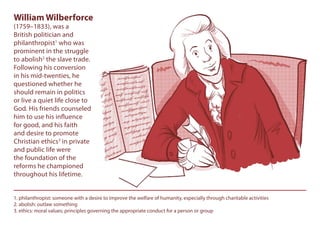
William Wilberforce
(1759–1833), was a
British politician and
philanthropist1
who was
prominent in the struggle
to abolish2
the slave trade.
Following his conversion
in his mid-twenties, he
questioned whether he
should remain in politics
or live a quiet life close to
God. His friends counseled
him to use his influence
for good, and his faith
and desire to promote
Christian ethics3
in private
and public life were
the foundation of the
reforms he championed
throughout his lifetime.
1. philanthropist: someone with a desire to improve the welfare of humanity, especially through charitable activities
2. abolish: outlaw something
3. ethics: moral values; principles governing the appropriate conduct for a person or group
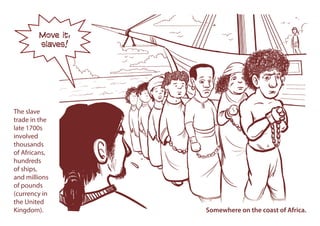
The slave
trade in the
late 1700s
involved
thousands
of Africans,
hundreds
of ships,
and millions
of pounds
(currency in
the United
Kingdom). Somewhere on the coast of Africa.
Move it,
slaves!
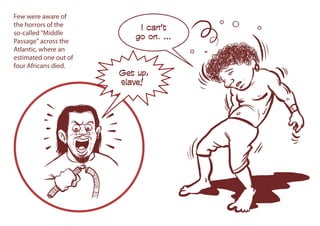
Few were aware of
the horrors of the
so-called "Middle
Passage" across the
Atlantic, where an
estimated one out of
four Africans died.
I can’t
go on. …
Get up,
slave!
No… Master …
Please…
I’ll show
you!
Wilberforce was aware, and he was deeply disturbed.
No… Master …
Please…
Stop!
Whew.
It was only
a dream. …
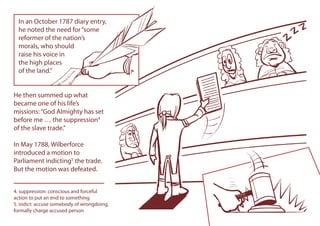
He then summed up what
became one of his life’s
missions:“God Almighty has set
before me … the suppression4
of the slave trade.”
In May 1788, Wilberforce
introduced a motion to
Parliament indicting5
the trade.
But the motion was defeated.
4. suppression: conscious and forceful
action to put an end to something
5. indict: accuse somebody of wrongdoing,
formally charge accused person
In an October 1787 diary entry,
he noted the need for“some
reformer of the nation’s
morals, who should
raise his voice in
the high places
of the land.”
In an October 1787 diary entry,
he noted the need for“some
reformer of the nation’s
morals, who should
raise his voice in
the high places
of the land.”
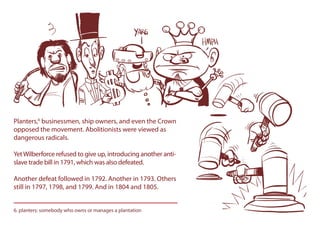
Planters,6
businessmen, ship owners, and even the Crown
opposed the movement. Abolitionists were viewed as
dangerous radicals.
YetWilberforce refused to give up, introducing another anti-
slave trade bill in 1791, which was also defeated.
Another defeat followed in 1792. Another in 1793. Others
still in 1797, 1798, and 1799. And in 1804 and 1805.
6. planters: somebody who owns or manages a plantation
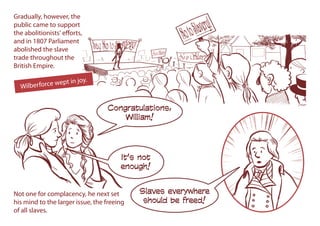
Gradually, however, the
public came to support
the abolitionists' efforts,
and in 1807 Parliament
abolished the slave
trade throughout the
British Empire.
Congratulations,
William!
Slaves everywhere
should be freed!
It’s not
enough!
Wilberforce wept in joy.
Not one for complacency, he next set
his mind to the larger issue, the freeing
of all slaves.
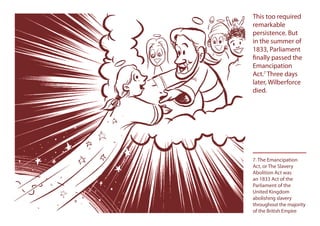
This too required
remarkable
persistence. But
in the summer of
1833, Parliament
finally passed the
Emancipation
Act.7
Three days
later, Wilberforce
died.
7. The Emancipation
Act, or The Slavery
Abolition Act was
an 1833 Act of the
Parliament of the
United Kingdom
abolishing slavery
throughout the majority
of the British Empire
This too required
in the summer of
finally passed thefinally passed the
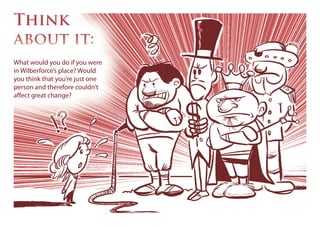
Think
about it:about it:about it:
What would you do if you were
in Wilberforce’s place? Would
you think that you’re just one
person and therefore couldn’t
affect great change?
Or would you believe that with God on your side nothing is impossible?
Wilberforce was just one man, but with God’s anointing, he changed the world of his day. If God could
use Wilberforce to make such a difference and change countless hearts and lives, imagine the special
plan and purpose the Lord has for your life!
S&S link: Christian Life and Faith: Great Men and Women of God-2b
Contributed byTomoko Matsuoka, compiled from various online sources. Illustrated by MJ. Designed by Stefan Merour.
Copyright © 2010 by The Family International
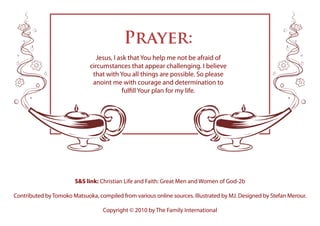
Prayer:
Jesus, I ask that You help me not be afraid of
circumstances that appear challenging. I believe
that with You all things are possible. So please
anoint me with courage and determination to
fulfill Your plan for my life.

Heroes from History: William Wilberforce

  • 1.
  • 2.
    William Wilberforce (1759–1833), wasa British politician and philanthropist1 who was prominent in the struggle to abolish2 the slave trade. Following his conversion in his mid-twenties, he questioned whether he should remain in politics or live a quiet life close to God. His friends counseled him to use his influence for good, and his faith and desire to promote Christian ethics3 in private and public life were the foundation of the reforms he championed throughout his lifetime. 1. philanthropist: someone with a desire to improve the welfare of humanity, especially through charitable activities 2. abolish: outlaw something 3. ethics: moral values; principles governing the appropriate conduct for a person or group
  • 3.
    The slave trade inthe late 1700s involved thousands of Africans, hundreds of ships, and millions of pounds (currency in the United Kingdom). Somewhere on the coast of Africa. Move it, slaves!
  • 4.
    Few were awareof the horrors of the so-called "Middle Passage" across the Atlantic, where an estimated one out of four Africans died. I can’t go on. … Get up, slave!
  • 5.
  • 6.
    Wilberforce was aware,and he was deeply disturbed. No… Master … Please… Stop! Whew. It was only a dream. …
  • 7.
    He then summedup what became one of his life’s missions:“God Almighty has set before me … the suppression4 of the slave trade.” In May 1788, Wilberforce introduced a motion to Parliament indicting5 the trade. But the motion was defeated. 4. suppression: conscious and forceful action to put an end to something 5. indict: accuse somebody of wrongdoing, formally charge accused person In an October 1787 diary entry, he noted the need for“some reformer of the nation’s morals, who should raise his voice in the high places of the land.” In an October 1787 diary entry, he noted the need for“some reformer of the nation’s morals, who should raise his voice in the high places of the land.”
  • 8.
    Planters,6 businessmen, ship owners,and even the Crown opposed the movement. Abolitionists were viewed as dangerous radicals. YetWilberforce refused to give up, introducing another anti- slave trade bill in 1791, which was also defeated. Another defeat followed in 1792. Another in 1793. Others still in 1797, 1798, and 1799. And in 1804 and 1805. 6. planters: somebody who owns or manages a plantation
  • 9.
    Gradually, however, the publiccame to support the abolitionists' efforts, and in 1807 Parliament abolished the slave trade throughout the British Empire. Congratulations, William! Slaves everywhere should be freed! It’s not enough! Wilberforce wept in joy. Not one for complacency, he next set his mind to the larger issue, the freeing of all slaves.
  • 10.
    This too required remarkable persistence.But in the summer of 1833, Parliament finally passed the Emancipation Act.7 Three days later, Wilberforce died. 7. The Emancipation Act, or The Slavery Abolition Act was an 1833 Act of the Parliament of the United Kingdom abolishing slavery throughout the majority of the British Empire This too required in the summer of finally passed thefinally passed the
  • 11.
    Think about it:about it:aboutit: What would you do if you were in Wilberforce’s place? Would you think that you’re just one person and therefore couldn’t affect great change?
  • 12.
    Or would youbelieve that with God on your side nothing is impossible? Wilberforce was just one man, but with God’s anointing, he changed the world of his day. If God could use Wilberforce to make such a difference and change countless hearts and lives, imagine the special plan and purpose the Lord has for your life!
  • 13.
    S&S link: ChristianLife and Faith: Great Men and Women of God-2b Contributed byTomoko Matsuoka, compiled from various online sources. Illustrated by MJ. Designed by Stefan Merour. Copyright © 2010 by The Family International Prayer: Jesus, I ask that You help me not be afraid of circumstances that appear challenging. I believe that with You all things are possible. So please anoint me with courage and determination to fulfill Your plan for my life.