Iain Wheeldon
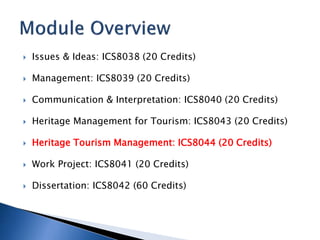
 Issues & Ideas: ICS8038 (20 Credits) 
 Management: ICS8039 (20 Credits) 
 Communication & Interpretation: ICS8040 (20 Credits) 
 Heritage Management for Tourism: ICS8043 (20 Credits) 
 Heritage Tourism Management: ICS8044 (20 Credits) 
 Work Project: ICS8041 (20 Credits) 
 Dissertation: ICS8042 (60 Credits)
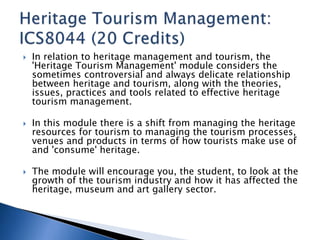
 In relation to heritage management and tourism, the 
'Heritage Tourism Management' module considers the 
sometimes controversial and always delicate relationship 
between heritage and tourism, along with the theories, 
issues, practices and tools related to effective heritage 
tourism management. 
 In this module there is a shift from managing the heritage 
resources for tourism to managing the tourism processes, 
venues and products in terms of how tourists make use of 
and 'consume' heritage. 
 The module will encourage you, the student, to look at the 
growth of the tourism industry and how it has affected the 
heritage, museum and art gallery sector.
 It takes account of the opportunities and threats posed by 
tourism to the ‘heritage industry’ and considers 
international and national policies, charters and legislation 
regarding heritage tourism. 
 The module addresses the differing requirements of local, 
national, and international tourism and questions if all of 
these can be addressed by the same facilities and 
approaches. 
 It discusses the affect that varied tourism strategies have 
on the interpretation of heritage sites.
 It notes that heritage agencies and individual sites are 
becoming increasingly reliant upon tourist revenue to 
survive and maintain their programmes of conservation 
and formal education. 
 However, at the same time, the increase in tourist 
numbers threatens the ambience of sites and, in some 
cases, their very fabric. 
 This leads into coverage of a range of key issues related to 
the practice and processes of heritage tourism 
management.
 The module will consider the different challenges and 
opportunities faced by heritage tourism managers in the 
field in different geographical locations, including the 
differences between managing resources in urban and 
rural contexts, and how best to respond to these. 
 It will introduce the key elements of heritage tourism 
management planning and processes, the variable use of 
heritage sites, and the effective engagement with 
stakeholders and communities. 
 The module will also consider the roles of risk assessment, 
and monitoring and evaluation in heritage tourism 
management.
 Topics to be covered in the module include: 
 1) defining heritage tourism and understanding the links 
between heritage and tourism; 
 2) histories of heritage tourism management, the development of 
heritage tourism organisations and agencies, and, current 
situations, challenges and policies; 
 3) key issues and the different types of heritage tourism; 
 4) heritage tourism development as a process, needing planning 
and management, which involves different stakeholder groups;
 5) understanding heritage tourisms in relation to World 
Heritage Sites, urban and rural environments, and, in 
relation to specific sites, buildings and institutions; 
 6) different tourist consumers and marketing for these 
different groups, packaging heritage tourism tours and 
products, and, customer care; 
 7) understanding impacts from tourism, and, balancing 
conservation, community needs and access; and, 
 8) considering appropriate ways forward internationally, 
nationally and locally.
 The module will introduce you to a range of theories and 
practices through the online material and activities. 
 You will also be provided with a case study that should 
help you to contextualise and think about the use of the 
theories and practices within an actual context. 
 The module topics, learning material, activities and case 
studies should provide you with enough information to 
explore examples from your own country. 
 You will be expected to visit heritage sites, museums and 
galleries near you and critically examine and evaluate 
them against what you have learnt in the module.
 This module can be taken as a stand-alone credit-bearing 
module, or it can be used as a 'building block', via the 
Credit Accumulation and Transfer Scheme (CATS) 
regulations at Newcastle University, towards building a 
postgraduate qualification in Heritage Management and 
Tourism.
For more information on this module, including 
detailed information about 
 Module Aims, 
 Outline of Syllabus, 
 Learning Outcomes, 
 Graduate Skills Framework, 
 Teaching & Assessment Methods, 
 Please visit; 
http://www.ncl.ac.uk/module-catalogue/ 
module.php?code=ICS8044

Heritage Tourism Management

  • 1.
  • 2.
     Issues &Ideas: ICS8038 (20 Credits)  Management: ICS8039 (20 Credits)  Communication & Interpretation: ICS8040 (20 Credits)  Heritage Management for Tourism: ICS8043 (20 Credits)  Heritage Tourism Management: ICS8044 (20 Credits)  Work Project: ICS8041 (20 Credits)  Dissertation: ICS8042 (60 Credits)
  • 3.
     In relationto heritage management and tourism, the 'Heritage Tourism Management' module considers the sometimes controversial and always delicate relationship between heritage and tourism, along with the theories, issues, practices and tools related to effective heritage tourism management.  In this module there is a shift from managing the heritage resources for tourism to managing the tourism processes, venues and products in terms of how tourists make use of and 'consume' heritage.  The module will encourage you, the student, to look at the growth of the tourism industry and how it has affected the heritage, museum and art gallery sector.
  • 4.
     It takesaccount of the opportunities and threats posed by tourism to the ‘heritage industry’ and considers international and national policies, charters and legislation regarding heritage tourism.  The module addresses the differing requirements of local, national, and international tourism and questions if all of these can be addressed by the same facilities and approaches.  It discusses the affect that varied tourism strategies have on the interpretation of heritage sites.
  • 5.
     It notesthat heritage agencies and individual sites are becoming increasingly reliant upon tourist revenue to survive and maintain their programmes of conservation and formal education.  However, at the same time, the increase in tourist numbers threatens the ambience of sites and, in some cases, their very fabric.  This leads into coverage of a range of key issues related to the practice and processes of heritage tourism management.
  • 6.
     The modulewill consider the different challenges and opportunities faced by heritage tourism managers in the field in different geographical locations, including the differences between managing resources in urban and rural contexts, and how best to respond to these.  It will introduce the key elements of heritage tourism management planning and processes, the variable use of heritage sites, and the effective engagement with stakeholders and communities.  The module will also consider the roles of risk assessment, and monitoring and evaluation in heritage tourism management.
  • 7.
     Topics tobe covered in the module include:  1) defining heritage tourism and understanding the links between heritage and tourism;  2) histories of heritage tourism management, the development of heritage tourism organisations and agencies, and, current situations, challenges and policies;  3) key issues and the different types of heritage tourism;  4) heritage tourism development as a process, needing planning and management, which involves different stakeholder groups;
  • 8.
     5) understandingheritage tourisms in relation to World Heritage Sites, urban and rural environments, and, in relation to specific sites, buildings and institutions;  6) different tourist consumers and marketing for these different groups, packaging heritage tourism tours and products, and, customer care;  7) understanding impacts from tourism, and, balancing conservation, community needs and access; and,  8) considering appropriate ways forward internationally, nationally and locally.
  • 9.
     The modulewill introduce you to a range of theories and practices through the online material and activities.  You will also be provided with a case study that should help you to contextualise and think about the use of the theories and practices within an actual context.  The module topics, learning material, activities and case studies should provide you with enough information to explore examples from your own country.  You will be expected to visit heritage sites, museums and galleries near you and critically examine and evaluate them against what you have learnt in the module.
  • 10.
     This modulecan be taken as a stand-alone credit-bearing module, or it can be used as a 'building block', via the Credit Accumulation and Transfer Scheme (CATS) regulations at Newcastle University, towards building a postgraduate qualification in Heritage Management and Tourism.
  • 11.
    For more informationon this module, including detailed information about  Module Aims,  Outline of Syllabus,  Learning Outcomes,  Graduate Skills Framework,  Teaching & Assessment Methods,  Please visit; http://www.ncl.ac.uk/module-catalogue/ module.php?code=ICS8044