Herceptin : a new cancer treatment Cancer, there are many types of cancers; all involve uncontrolled cell division following changes to the cell DNA, usually the cell division leads to the production of a tumour. The growth of tumours can be very slow and hard to detect. Many cancers can spread an so can come back even after apparently successful treatment What is can cancer: is a class of  diseases   in which a group of  cells  display the traits  of  uncontrolled growth   What changes could occur to the DNA: causes errors in the replication of the DNA chain  What is a tumour: is a lump or mass of cells
Herceptin : a new cancer treatment Cancer, there are many types of cancers; all involve uncontrolled cell division following changes to the cell DNA, usually the cell division leads to the production of a tumour. The growth of tumours can be very slow and hard to detect. Many cancers can spread an so can come back even after apparently successful treatment. Explain how can spread? They spread to other locations in the body via lymph or blood systems
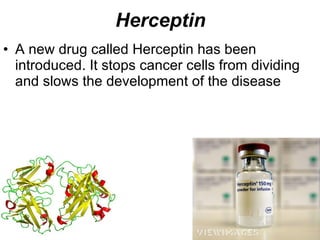
Herceptin A new drug called Herceptin has been introduced. It stops cancer cells from dividing and slows the development of the disease
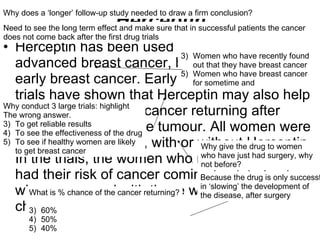
Herceptin Herceptin has been used to treat women with advanced breast cancer, but not those with early breast cancer. Early results from 3 large trials have shown that Herceptin may also help to reduce the risk of cancer returning after surgery to remove the tumour. All women were given chemotherapy, with or without Herceptin. In the trials, the women who received Herceptin had their risk of cancer coming back halved, when compared with those who received chemotherapy alone What do we mean by advanced? Women who have recently found out that they have breast cancer Women who have breast cancer  for sometime and  Why conduct 3 large trials: highlight The wrong answer. To get reliable results To see the effectiveness of the drug To see if healthy women are likely to get breast cancer Why give the drug to women who have just had surgery, why not before? What is % chance of the cancer returning? 60% 50% 40% Why does a ‘longer’ follow-up study needed to draw a firm conclusion? Because the drug is only successful  in ‘slowing’ the development of  the disease, after surgery Need to see the long term effect and make sure that in successful patients the cancer does not come back after the first drug trials
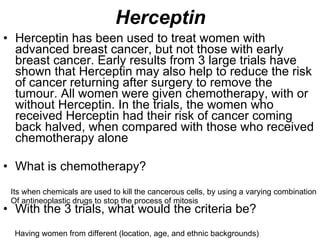
Herceptin Herceptin has been used to treat women with advanced breast cancer, but not those with early breast cancer. Early results from 3 large trials have shown that Herceptin may also help to reduce the risk of cancer returning after surgery to remove the tumour. All women were given chemotherapy, with or without Herceptin. In the trials, the women who received Herceptin had their risk of cancer coming back halved, when compared with those who received chemotherapy alone What is chemotherapy? With the 3 trials, what would the criteria be? Its when chemicals are used to kill the cancerous cells, by using a varying combination Of antineoplastic drugs to stop the process of mitosis Having women from different (location, age, and ethnic backgrounds)
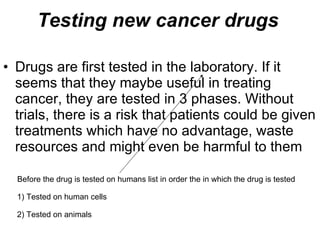
Testing new cancer drugs Drugs are first tested in the laboratory. If it seems that they maybe useful in treating cancer, they are tested in 3 phases. Without trials, there is a risk that patients could be given treatments which have no advantage, waste resources and might even be harmful to them Before the drug is tested on humans list in order the in which the drug is tested 1) Tested on human cells 2) Tested on animals
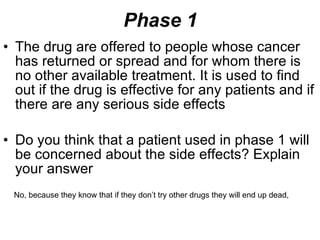
Phase 1 The drug are offered to people whose cancer has returned or spread and for whom there is no other available treatment. It is used to find out if the drug is effective for any patients and if there are any serious side effects Do you think that a patient used in phase 1 will be concerned about the side effects? Explain your answer No, because they know that if they don’t try other drugs they will end up dead,
Phase 1 The drug are offered to people whose cancer has returned or spread and for whom there is no other available treatment. It is used to find out if the drug is effective for any patients and if there are any serious side effects. What are side effects? The good effects from the drug The bad effects from the drug
Phase 2 The trials use a greater number of patients with cancers at an earlier stage. The aim is to find out which kind of cancers can be treated and the percentage of patients for whom it will work well. Why try the drugs on different types of cancer patients Which kind of percentage do you think the drug manufacturers  To see if the drug can be used on other types of cancers 50% or more
Phase 3 These trials compare the effectiveness of the new drug with the existing treatments. These are large trials involving hundreds or thousands of patients. Scientists measure how many years the patients survive without the disease coming back and how the patients quality of life is affected. They also monitor occurrence of side effects  What’s the point of testing the drug with other drugs on the market? Why do the trials need to see how long a patients survives without the cancer coming back? What do they mean ‘quality of life’? Explain what are side effects To see if the drug is better or worse than other similar drugs To make sure that they are completely recovered from the disease To make sure you can do the same things (work, play, etc) before you had a disease,  After you were treated with the disease  Other bad symptoms that occur due to you taking the drug
Which drug should be used? If a drug passes all 3 trials, it will be granted a licence and can be used in health care. Herceptin is licensed for treatment of advanced breast cancer but not for use in women with early breast cancer Why is the licence so ‘specific’ to be used in a particular circumstance? So it cannot be used on any other type of cancer and it will be useless to use it on a Patient who has just been diagnosed with having breast cancer
Continue  Cost analysis of Herceptin concluded that it is a promising but very expensive drug. Herceptin is more expensive than other drugs used to treat cancer but could prove to have long term economic benefits Explain what they mean by ‘cost analysis’ of Herceptin? Why is the drug ‘economically benefit’ in the long term, but not in the short term?  How much it cost to develop the drug from the ‘start’ to the ‘finish’ Because the cost can be recovered many years in the future, from the patients earnings
Continued  Once the drugs have been licensed, NICE (the National Institute for Health and Clinical Excellence) decides whether or not to recommend their use by the NHS, NICE evaluates the evidence that a drug works and decides if it provides value for money. Once a drug is recommended, then the NHS must ensure that it is available to those people it could help. When evaluating the drug what do you think the ‘NICE’ organisation will want to see from the drug company from their trials? Explain the term ‘value for money’ in regards to the drug? What will the NHS do if they cannot provide the drug for everyone? They will want to see ( the long term effects, effectiveness, cost,)  To see if spending the money will be worth it They will have to assess each patients case on it merits

Herceptin

  • 1.
    Herceptin : anew cancer treatment Cancer, there are many types of cancers; all involve uncontrolled cell division following changes to the cell DNA, usually the cell division leads to the production of a tumour. The growth of tumours can be very slow and hard to detect. Many cancers can spread an so can come back even after apparently successful treatment What is can cancer: is a class of  diseases   in which a group of  cells  display the traits of  uncontrolled growth What changes could occur to the DNA: causes errors in the replication of the DNA chain What is a tumour: is a lump or mass of cells
  • 2.
    Herceptin : anew cancer treatment Cancer, there are many types of cancers; all involve uncontrolled cell division following changes to the cell DNA, usually the cell division leads to the production of a tumour. The growth of tumours can be very slow and hard to detect. Many cancers can spread an so can come back even after apparently successful treatment. Explain how can spread? They spread to other locations in the body via lymph or blood systems
  • 3.
    Herceptin A newdrug called Herceptin has been introduced. It stops cancer cells from dividing and slows the development of the disease
  • 4.
    Herceptin Herceptin hasbeen used to treat women with advanced breast cancer, but not those with early breast cancer. Early results from 3 large trials have shown that Herceptin may also help to reduce the risk of cancer returning after surgery to remove the tumour. All women were given chemotherapy, with or without Herceptin. In the trials, the women who received Herceptin had their risk of cancer coming back halved, when compared with those who received chemotherapy alone What do we mean by advanced? Women who have recently found out that they have breast cancer Women who have breast cancer for sometime and Why conduct 3 large trials: highlight The wrong answer. To get reliable results To see the effectiveness of the drug To see if healthy women are likely to get breast cancer Why give the drug to women who have just had surgery, why not before? What is % chance of the cancer returning? 60% 50% 40% Why does a ‘longer’ follow-up study needed to draw a firm conclusion? Because the drug is only successful in ‘slowing’ the development of the disease, after surgery Need to see the long term effect and make sure that in successful patients the cancer does not come back after the first drug trials
  • 5.
    Herceptin Herceptin hasbeen used to treat women with advanced breast cancer, but not those with early breast cancer. Early results from 3 large trials have shown that Herceptin may also help to reduce the risk of cancer returning after surgery to remove the tumour. All women were given chemotherapy, with or without Herceptin. In the trials, the women who received Herceptin had their risk of cancer coming back halved, when compared with those who received chemotherapy alone What is chemotherapy? With the 3 trials, what would the criteria be? Its when chemicals are used to kill the cancerous cells, by using a varying combination Of antineoplastic drugs to stop the process of mitosis Having women from different (location, age, and ethnic backgrounds)
  • 6.
    Testing new cancerdrugs Drugs are first tested in the laboratory. If it seems that they maybe useful in treating cancer, they are tested in 3 phases. Without trials, there is a risk that patients could be given treatments which have no advantage, waste resources and might even be harmful to them Before the drug is tested on humans list in order the in which the drug is tested 1) Tested on human cells 2) Tested on animals
  • 7.
    Phase 1 Thedrug are offered to people whose cancer has returned or spread and for whom there is no other available treatment. It is used to find out if the drug is effective for any patients and if there are any serious side effects Do you think that a patient used in phase 1 will be concerned about the side effects? Explain your answer No, because they know that if they don’t try other drugs they will end up dead,
  • 8.
    Phase 1 Thedrug are offered to people whose cancer has returned or spread and for whom there is no other available treatment. It is used to find out if the drug is effective for any patients and if there are any serious side effects. What are side effects? The good effects from the drug The bad effects from the drug
  • 9.
    Phase 2 Thetrials use a greater number of patients with cancers at an earlier stage. The aim is to find out which kind of cancers can be treated and the percentage of patients for whom it will work well. Why try the drugs on different types of cancer patients Which kind of percentage do you think the drug manufacturers To see if the drug can be used on other types of cancers 50% or more
  • 10.
    Phase 3 Thesetrials compare the effectiveness of the new drug with the existing treatments. These are large trials involving hundreds or thousands of patients. Scientists measure how many years the patients survive without the disease coming back and how the patients quality of life is affected. They also monitor occurrence of side effects What’s the point of testing the drug with other drugs on the market? Why do the trials need to see how long a patients survives without the cancer coming back? What do they mean ‘quality of life’? Explain what are side effects To see if the drug is better or worse than other similar drugs To make sure that they are completely recovered from the disease To make sure you can do the same things (work, play, etc) before you had a disease, After you were treated with the disease Other bad symptoms that occur due to you taking the drug
  • 11.
    Which drug shouldbe used? If a drug passes all 3 trials, it will be granted a licence and can be used in health care. Herceptin is licensed for treatment of advanced breast cancer but not for use in women with early breast cancer Why is the licence so ‘specific’ to be used in a particular circumstance? So it cannot be used on any other type of cancer and it will be useless to use it on a Patient who has just been diagnosed with having breast cancer
  • 12.
    Continue Costanalysis of Herceptin concluded that it is a promising but very expensive drug. Herceptin is more expensive than other drugs used to treat cancer but could prove to have long term economic benefits Explain what they mean by ‘cost analysis’ of Herceptin? Why is the drug ‘economically benefit’ in the long term, but not in the short term? How much it cost to develop the drug from the ‘start’ to the ‘finish’ Because the cost can be recovered many years in the future, from the patients earnings
  • 13.
    Continued Oncethe drugs have been licensed, NICE (the National Institute for Health and Clinical Excellence) decides whether or not to recommend their use by the NHS, NICE evaluates the evidence that a drug works and decides if it provides value for money. Once a drug is recommended, then the NHS must ensure that it is available to those people it could help. When evaluating the drug what do you think the ‘NICE’ organisation will want to see from the drug company from their trials? Explain the term ‘value for money’ in regards to the drug? What will the NHS do if they cannot provide the drug for everyone? They will want to see ( the long term effects, effectiveness, cost,) To see if spending the money will be worth it They will have to assess each patients case on it merits