With inspiration from
Sir Peter Carr:
making change happen
from within
Helen Bevan
@HelenBevan
#SirPeterCarr
Themes from Sir Peter Carr
• Making improvement happen
from inside the system
• An outward mindset: share and
learn
• Working inter-dependently
rather than independently
• Working together with shared
purpose
3 |
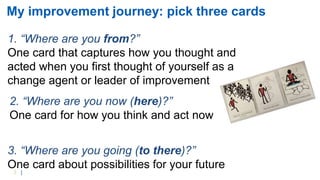
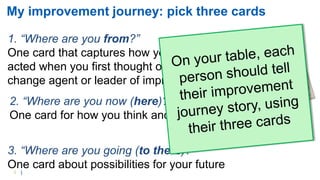
My improvement journey: pick three cards
2. “Where are you now (here)?”
One card for how you think and act now
3. “Where are you going (to there)?”
One card about possibilities for your future
1. “Where are you from?”
One card that captures how you thought and
acted when you first thought of yourself as a
change agent or leader of improvement
4 |
My improvement journey: pick three cards
2. “Where are you now (here)?”
One card for how you think and act now
3. “Where are you going (to there)?”
One card about possibilities for your future
1. “Where are you from?”
One card that captures how you thought and
acted when you first thought of yourself as a
change agent or leader of improvement
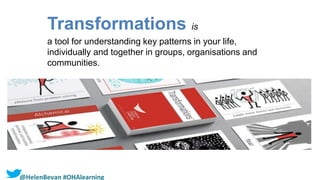
Transformations is
a tool for understanding key patterns in your life,
individually and together in groups, organisations and
communities.
@HelenBevan #OHAlearning
6 |
As I have gone through life, I have found difficulty
with the concept of a divine maker. At times though,
there have been some pretty bizarre “rocks” thrown
at me that might persuasively argue for the
existence of the devil
Sir Peter often challenged the status
quo and often found it tough
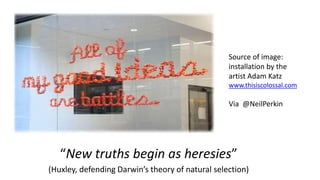
“New truths begin as heresies”
(Huxley, defending Darwin’s theory of natural selection)
Source of image:
installation by the
artist Adam Katz
www.thisiscolossal.com
Via @NeilPerkin
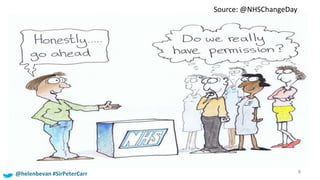
Source: @NHSChangeDay
8@helenbevan #SirPeterCarr
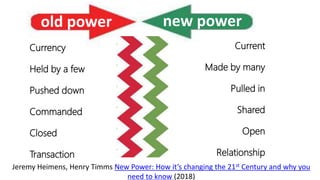
Jeremy Heimens, Henry Timms New Power: How it’s changing the 21st Century and why you
need to know (2018)
new power
Current
Made by many
Pulled in
Shared
Open
Relationship
old power
Currency
Held by a few
Pushed down
Commanded
Closed
Transaction
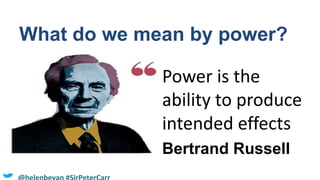
What do we mean by power?
Power is the
ability to produce
intended effects
Bertrand Russell
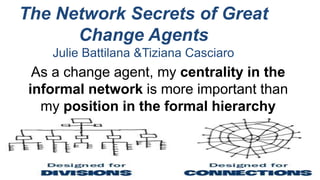
The Network Secrets of Great
Change Agents
Julie Battilana &Tiziana Casciaro
As a change agent, my centrality in the
informal network is more important than
my position in the formal hierarchy
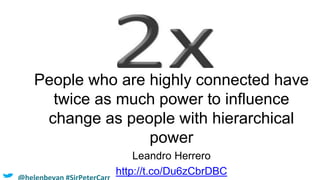
People who are highly connected have
twice as much power to influence
change as people with hierarchical
power
Leandro Herrero
http://t.co/Du6zCbrDBC
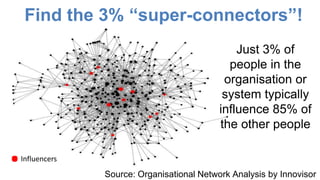
Find the 3% “super-connectors”!
Source: Organisational Network Analysis by Innovisor
Just 3% of
people in the
organisation or
system typically
influence 85% of
the other people
.Influencers
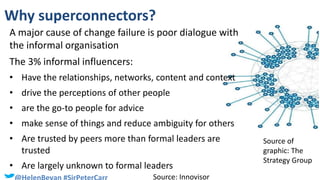
Why superconnectors?
A major cause of change failure is poor dialogue with
the informal organisation
The 3% informal influencers:
• Have the relationships, networks, content and context
• drive the perceptions of other people
• are the go-to people for advice
• make sense of things and reduce ambiguity for others
• Are trusted by peers more than formal leaders are
trusted
• Are largely unknown to formal leaders
Source: Innovisor
Source of
graphic: The
Strategy Group
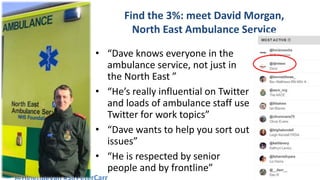
Find the 3%: meet David Morgan,
North East Ambulance Service
• “Dave knows everyone in the
ambulance service, not just in
the North East ”
• “He’s really influential on Twitter
and loads of ambulance staff use
Twitter for work topics”
• “Dave wants to help you sort out
issues”
• “He is respected by senior
people and by frontline”
Sources
Innovisor Evidence-based change
McKinsey Tapping the power of hidden influencers
Mike Klein Internal influencers: actionable and no longer optional
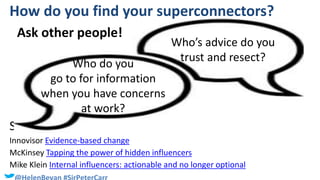
How do you find your superconnectors?
Ask other people!
Who do you
go to for information
when you have concerns
at work?
Who’s advice do you
trust and resect?
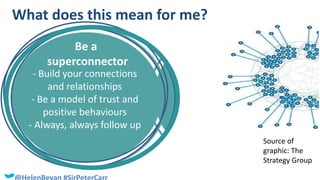
What does this mean for me?
- Build your connections
and relationships
- Be a model of trust and
positive behaviours
- Always, always follow up
Be a
superconnector
Source of
graphic: The
Strategy Group
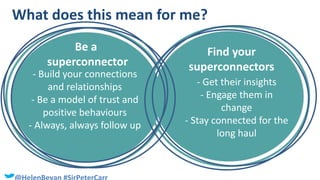
What does this mean for me?
- Build your connections
and relationships
- Be a model of trust and
positive behaviours
- Always, always follow up
Be a
superconnector
- Get their insights
- Engage them in
change
- Stay connected for the
long haul
Find your
superconnectors
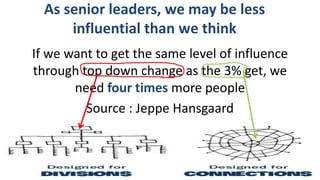
As senior leaders, we may be less
influential than we think
If we want to get the same level of influence
through top down change as the 3% get, we
need four times more people
Source : Jeppe Hansgaard
On their own, laws, processes and
structures are not enough
In my view, the law had to be balanced in its
construction of rights and obligations,
providing for and bearing on all sides
equally…The law had to provide open and
equal access.
Sir Peter Carr
Tomorrow’s management
systems will need to value
diversity, dissent and
divergence as highly as
conformance, consensus
and cohesion.”
Gary Hamel
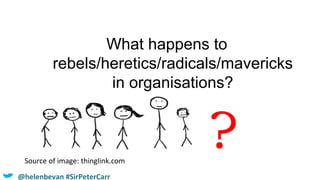
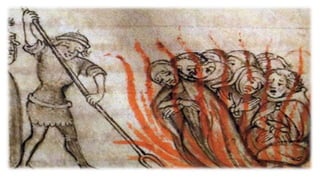
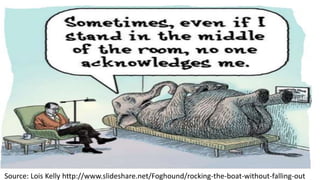
What happens to
rebels/heretics/radicals/mavericks
in organisations?
Source of image: thinglink.com
?
@helenbevan #SirPeterCarr
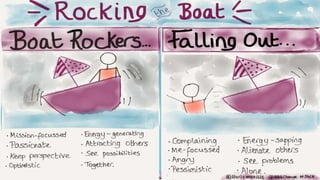
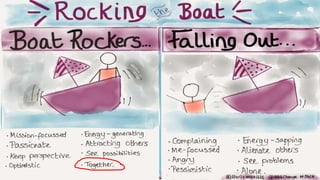
Source: Lois Kelly http://www.slideshare.net/Foghound/rocking-the-boat-without-falling-out
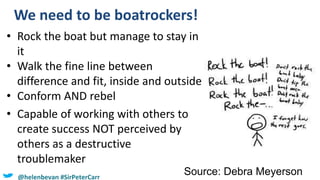
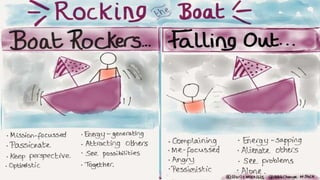
We need to be boatrockers!
Source: Debra Meyerson
• Rock the boat but manage to stay in
it
• Walk the fine line between
difference and fit, inside and outside
• Conform AND rebel
• Capable of working with others to
create success NOT perceived by
others as a destructive
troublemaker
@helenbevan #SirPeterCarr
Source: adapted from Rebels at Work
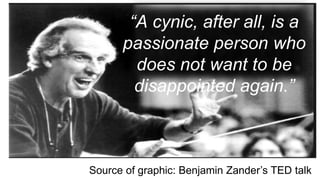
“A cynic, after all, is a
passionate person who
does not want to be
disappointed again.”
Source of graphic: Benjamin Zander’s TED talk
Source of image: Tord the Meme
by Marley Bryn
The world feels
terrible if I
choose to
distrust it
Marcella Bremer
Source: adapted from Rebels at Work
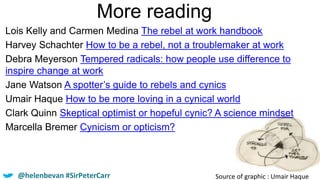
More reading
Source of graphic : Umair Haque
Lois Kelly and Carmen Medina The rebel at work handbook
Harvey Schachter How to be a rebel, not a troublemaker at work
Debra Meyerson Tempered radicals: how people use difference to
inspire change at work
Jane Watson A spotter’s guide to rebels and cynics
Umair Haque How to be more loving in a cynical world
Clark Quinn Skeptical optimist or hopeful cynic? A science mindset
Marcella Bremer Cynicism or opticism?
@helenbevan #SirPeterCarr
32 |
In the long
history of humankind
(and animal kind too)
those who learned
to collaborate and improvise
most effectively
have prevailed.
Charles Darwin
World Café Sessions
Learn from our finalists
34
World Café Sessions
How this will work:
• Each finalist team has a table
• Each World Cafe session lasts
nine minutes
• Allow time for conversation
• Get around five tables in the next
50 minutes
Working inter-dependently, not
independently
We did not change the world in our hectic activity with the
[City Action Teams]. One the other hand, we did generate
a lot of jobs, promoted a wide range of new opportunities
and put in place some helpful permanent facilities. More
than that we demonstrated the benefits of
interdepartmental co-ordination and the best way in which
central and local government could work together to
promote economic regeneration.
Sir Peter Carr
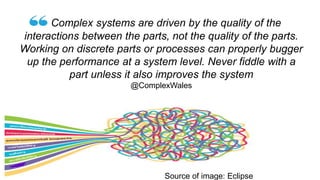
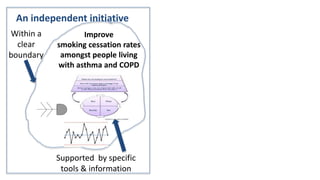
Complex systems are driven by the quality of the
interactions between the parts, not the quality of the parts.
Working on discrete parts or processes can properly bugger
up the performance at a system level. Never fiddle with a
part unless it also improves the system
@ComplexWales
Source of image: Eclipse
An independent initiative
Supported by specific
tools & information
Within a
clear
boundary
Improve
smoking cessation rates
amongst people living
with asthma and COPD
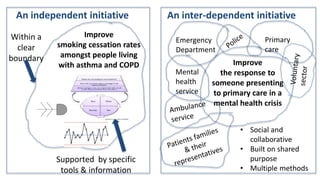
An independent initiative An inter-dependent initiative
Improve
the response to
someone presenting
to primary care in a
mental health crisis
Primary
care
Emergency
Department
Mental
health
service
Supported by specific
tools & information
• Social and
collaborative
• Built on shared
purpose
• Multiple methods
Within a
clear
boundary
Improve
smoking cessation rates
amongst people living
with asthma and COPD
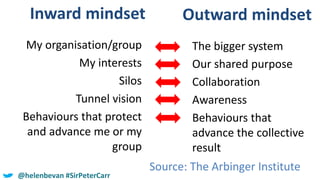
My organisation/group
My interests
Silos
Tunnel vision
Behaviours that protect
and advance me or my
group
The bigger system
Our shared purpose
Collaboration
Awareness
Behaviours that
advance the collective
result
Inward mindset Outward mindset
Source: The Arbinger Institute
@helenbevan #SirPeterCarr
The power of shared purpose
If major changes [are undertaken] in the
institutions, in processes and functions…then
[all services] have to be enjoined in that
cultural development and change at the same
pace.
Sir Peter Carr
Why shared purpose?
[Shared] purpose goes way deeper
than vision and mission; it goes right into
your gut and taps some part of your primal
self. I believe that if you can bring people with
similar primal-purposes together and get
them all marching in the same direction,
amazing things can be achieved.
Seth Carguilo
@HelenBevan #SirPeterCarr
Improvement is
anchored in purpose
@HelenBevan #SirPeterCarr
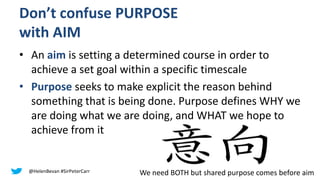
Don’t confuse PURPOSE
with AIM
• An aim is setting a determined course in order to
achieve a set goal within a specific timescale
• Purpose seeks to make explicit the reason behind
something that is being done. Purpose defines WHY we
are doing what we are doing, and WHAT we hope to
achieve from it
@HelenBevan #SirPeterCarr We need BOTH but shared purpose comes before aim
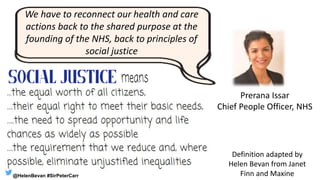
We have to reconnect our health and care
actions back to the shared purpose at the
founding of the NHS, back to principles of
social justice
Prerana Issar
Chief People Officer, NHS
Definition adapted by
Helen Bevan from Janet
Finn and Maxine@HelenBevan #SirPeterCarr
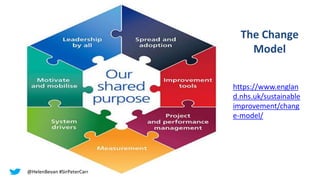
The Change
Model
https://www.englan
d.nhs.uk/sustainable
improvement/chang
e-model/
@HelenBevan #SirPeterCarr
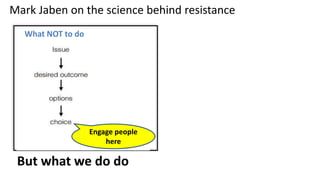
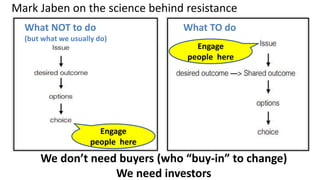
Mark Jaben on the science behind resistance
What NOT to do
But what we do do
Engage people
here
Mark Jaben on the science behind resistance
What NOT to do
(but what we usually do)
We don’t need buyers (who “buy-in” to change)
We need investors
What TO do
Engage
people here
Engage
people here
Leaders are “signal generators”
As a leader, think of yourself as a “signal generator” whose
words and actions are constantly being scrutinised and
interpreted, especially by those below you [in the
organisational system]
What an organisation’s leaders pay close attention to and
shower with time — not what they say — will provide the
best clues about its culture.
Source of image:
vintage-radio.com
@HelenBevan #SirPeterCarr
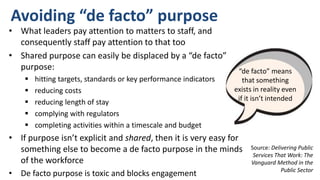
Avoiding “de facto” purpose
Source: Delivering Public
Services That Work: The
Vanguard Method in the
Public Sector
• What leaders pay attention to matters to staff, and
consequently staff pay attention to that too
• Shared purpose can easily be displaced by a “de facto”
purpose:
 hitting targets, standards or key performance indicators
 reducing costs
 reducing length of stay
 complying with regulators
 completing activities within a timescale and budget
• If purpose isn’t explicit and shared, then it is very easy for
something else to become a de facto purpose in the minds
of the workforce
• De facto purpose is toxic and blocks engagement
“de facto” means
that something
exists in reality even
if it isn’t intended
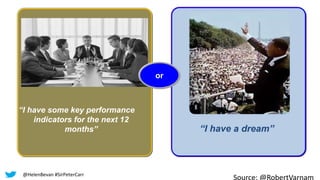
“I have some key performance
indicators for the next 12
months”
or
“I have a dream”
Source: @RobertVarnam@HelenBevan #SirPeterCarr
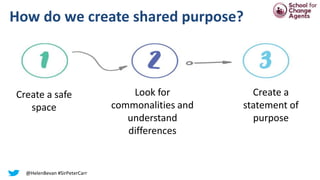
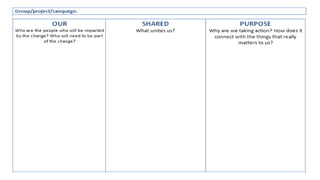
How do we create shared purpose?
Create a safe
space
Look for
commonalities and
understand
differences
Create a
statement of
purpose
@HelenBevan #SirPeterCarr
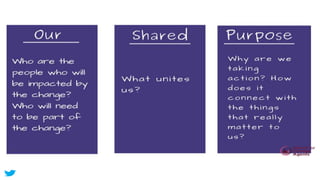
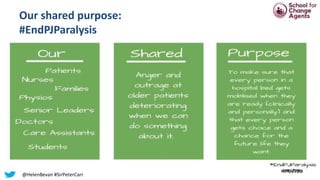
Our shared purpose:
#EndPJParalysis
@HelenBevan #SirPeterCarr
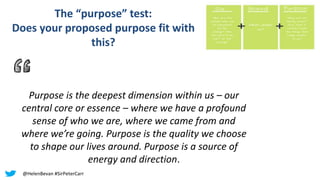
Purpose is the deepest dimension within us – our
central core or essence – where we have a profound
sense of who we are, where we came from and
where we’re going. Purpose is the quality we choose
to shape our lives around. Purpose is a source of
energy and direction.
The “purpose” test:
Does your proposed purpose fit with
this?
@HelenBevan #SirPeterCarr
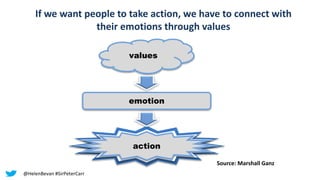
If we want people to take action, we have to connect with
their emotions through values
action
values
emotion
Source: Marshall Ganz
@HelenBevan #SirPeterCarr
Change starts with me
After 60 years of public service
I now remain as restless and unsettled as ever I
was in my teens and still in search of the next
challenge.
I fear it will remain ever so
Sir Peter Carr
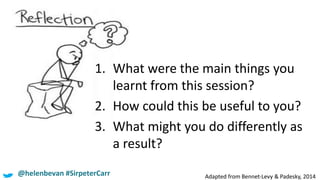
1. What were the main things you
learnt from this session?
2. How could this be useful to you?
3. What might you do differently as
a result?
Adapted from Bennet‐Levy & Padesky, 2014@helenbevan #SirpeterCarr
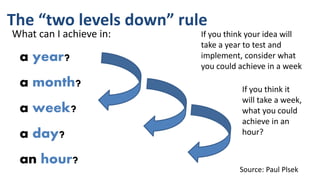
The “two levels down” rule
What can I achieve in:
a year?
a month?
a week?
a day?
an hour?
If you think your idea will
take a year to test and
implement, consider what
you could achieve in a week
If you think it
will take a week,
what you could
achieve in an
hour?
Source: Paul Plsek

Masterclass: the Sir Peter Carr Partnership Awards

  • 1.
    With inspiration from SirPeter Carr: making change happen from within Helen Bevan @HelenBevan #SirPeterCarr
  • 2.
    Themes from SirPeter Carr • Making improvement happen from inside the system • An outward mindset: share and learn • Working inter-dependently rather than independently • Working together with shared purpose
  • 3.
    3 | My improvementjourney: pick three cards 2. “Where are you now (here)?” One card for how you think and act now 3. “Where are you going (to there)?” One card about possibilities for your future 1. “Where are you from?” One card that captures how you thought and acted when you first thought of yourself as a change agent or leader of improvement
  • 4.
    4 | My improvementjourney: pick three cards 2. “Where are you now (here)?” One card for how you think and act now 3. “Where are you going (to there)?” One card about possibilities for your future 1. “Where are you from?” One card that captures how you thought and acted when you first thought of yourself as a change agent or leader of improvement
  • 5.
    Transformations is a toolfor understanding key patterns in your life, individually and together in groups, organisations and communities. @HelenBevan #OHAlearning
  • 6.
    6 | As Ihave gone through life, I have found difficulty with the concept of a divine maker. At times though, there have been some pretty bizarre “rocks” thrown at me that might persuasively argue for the existence of the devil Sir Peter often challenged the status quo and often found it tough
  • 7.
    “New truths beginas heresies” (Huxley, defending Darwin’s theory of natural selection) Source of image: installation by the artist Adam Katz www.thisiscolossal.com Via @NeilPerkin
  • 8.
  • 9.
    Jeremy Heimens, HenryTimms New Power: How it’s changing the 21st Century and why you need to know (2018) new power Current Made by many Pulled in Shared Open Relationship old power Currency Held by a few Pushed down Commanded Closed Transaction
  • 10.
    What do wemean by power? Power is the ability to produce intended effects Bertrand Russell
  • 11.
    The Network Secretsof Great Change Agents Julie Battilana &Tiziana Casciaro As a change agent, my centrality in the informal network is more important than my position in the formal hierarchy
  • 12.
    People who arehighly connected have twice as much power to influence change as people with hierarchical power Leandro Herrero http://t.co/Du6zCbrDBC
  • 13.
    Find the 3%“super-connectors”! Source: Organisational Network Analysis by Innovisor Just 3% of people in the organisation or system typically influence 85% of the other people .Influencers
  • 14.
    Why superconnectors? A majorcause of change failure is poor dialogue with the informal organisation The 3% informal influencers: • Have the relationships, networks, content and context • drive the perceptions of other people • are the go-to people for advice • make sense of things and reduce ambiguity for others • Are trusted by peers more than formal leaders are trusted • Are largely unknown to formal leaders Source: Innovisor Source of graphic: The Strategy Group
  • 15.
    Find the 3%:meet David Morgan, North East Ambulance Service • “Dave knows everyone in the ambulance service, not just in the North East ” • “He’s really influential on Twitter and loads of ambulance staff use Twitter for work topics” • “Dave wants to help you sort out issues” • “He is respected by senior people and by frontline”
  • 16.
    Sources Innovisor Evidence-based change McKinseyTapping the power of hidden influencers Mike Klein Internal influencers: actionable and no longer optional How do you find your superconnectors? Ask other people! Who do you go to for information when you have concerns at work? Who’s advice do you trust and resect?
  • 17.
    What does thismean for me? - Build your connections and relationships - Be a model of trust and positive behaviours - Always, always follow up Be a superconnector Source of graphic: The Strategy Group
  • 18.
    What does thismean for me? - Build your connections and relationships - Be a model of trust and positive behaviours - Always, always follow up Be a superconnector - Get their insights - Engage them in change - Stay connected for the long haul Find your superconnectors
  • 19.
    As senior leaders,we may be less influential than we think If we want to get the same level of influence through top down change as the 3% get, we need four times more people Source : Jeppe Hansgaard
  • 20.
    On their own,laws, processes and structures are not enough In my view, the law had to be balanced in its construction of rights and obligations, providing for and bearing on all sides equally…The law had to provide open and equal access. Sir Peter Carr
  • 21.
    Tomorrow’s management systems willneed to value diversity, dissent and divergence as highly as conformance, consensus and cohesion.” Gary Hamel
  • 22.
    What happens to rebels/heretics/radicals/mavericks inorganisations? Source of image: thinglink.com ? @helenbevan #SirPeterCarr
  • 24.
    Source: Lois Kellyhttp://www.slideshare.net/Foghound/rocking-the-boat-without-falling-out
  • 25.
    We need tobe boatrockers! Source: Debra Meyerson • Rock the boat but manage to stay in it • Walk the fine line between difference and fit, inside and outside • Conform AND rebel • Capable of working with others to create success NOT perceived by others as a destructive troublemaker @helenbevan #SirPeterCarr
  • 26.
    Source: adapted fromRebels at Work
  • 27.
    “A cynic, afterall, is a passionate person who does not want to be disappointed again.” Source of graphic: Benjamin Zander’s TED talk
  • 28.
    Source of image:Tord the Meme by Marley Bryn The world feels terrible if I choose to distrust it Marcella Bremer
  • 29.
    Source: adapted fromRebels at Work
  • 30.
    Source: adapted fromRebels at Work
  • 31.
    More reading Source ofgraphic : Umair Haque Lois Kelly and Carmen Medina The rebel at work handbook Harvey Schachter How to be a rebel, not a troublemaker at work Debra Meyerson Tempered radicals: how people use difference to inspire change at work Jane Watson A spotter’s guide to rebels and cynics Umair Haque How to be more loving in a cynical world Clark Quinn Skeptical optimist or hopeful cynic? A science mindset Marcella Bremer Cynicism or opticism? @helenbevan #SirPeterCarr
  • 32.
    32 | In thelong history of humankind (and animal kind too) those who learned to collaborate and improvise most effectively have prevailed. Charles Darwin
  • 33.
    World Café Sessions Learnfrom our finalists
  • 34.
    34 World Café Sessions Howthis will work: • Each finalist team has a table • Each World Cafe session lasts nine minutes • Allow time for conversation • Get around five tables in the next 50 minutes
  • 35.
    Working inter-dependently, not independently Wedid not change the world in our hectic activity with the [City Action Teams]. One the other hand, we did generate a lot of jobs, promoted a wide range of new opportunities and put in place some helpful permanent facilities. More than that we demonstrated the benefits of interdepartmental co-ordination and the best way in which central and local government could work together to promote economic regeneration. Sir Peter Carr
  • 36.
    Complex systems aredriven by the quality of the interactions between the parts, not the quality of the parts. Working on discrete parts or processes can properly bugger up the performance at a system level. Never fiddle with a part unless it also improves the system @ComplexWales Source of image: Eclipse
  • 37.
    An independent initiative Supportedby specific tools & information Within a clear boundary Improve smoking cessation rates amongst people living with asthma and COPD
  • 38.
    An independent initiativeAn inter-dependent initiative Improve the response to someone presenting to primary care in a mental health crisis Primary care Emergency Department Mental health service Supported by specific tools & information • Social and collaborative • Built on shared purpose • Multiple methods Within a clear boundary Improve smoking cessation rates amongst people living with asthma and COPD
  • 39.
    My organisation/group My interests Silos Tunnelvision Behaviours that protect and advance me or my group The bigger system Our shared purpose Collaboration Awareness Behaviours that advance the collective result Inward mindset Outward mindset Source: The Arbinger Institute @helenbevan #SirPeterCarr
  • 40.
    The power ofshared purpose If major changes [are undertaken] in the institutions, in processes and functions…then [all services] have to be enjoined in that cultural development and change at the same pace. Sir Peter Carr
  • 41.
    Why shared purpose? [Shared]purpose goes way deeper than vision and mission; it goes right into your gut and taps some part of your primal self. I believe that if you can bring people with similar primal-purposes together and get them all marching in the same direction, amazing things can be achieved. Seth Carguilo @HelenBevan #SirPeterCarr
  • 42.
    Improvement is anchored inpurpose @HelenBevan #SirPeterCarr
  • 43.
    Don’t confuse PURPOSE withAIM • An aim is setting a determined course in order to achieve a set goal within a specific timescale • Purpose seeks to make explicit the reason behind something that is being done. Purpose defines WHY we are doing what we are doing, and WHAT we hope to achieve from it @HelenBevan #SirPeterCarr We need BOTH but shared purpose comes before aim
  • 44.
    We have toreconnect our health and care actions back to the shared purpose at the founding of the NHS, back to principles of social justice Prerana Issar Chief People Officer, NHS Definition adapted by Helen Bevan from Janet Finn and Maxine@HelenBevan #SirPeterCarr
  • 45.
  • 46.
    Mark Jaben onthe science behind resistance What NOT to do But what we do do Engage people here
  • 47.
    Mark Jaben onthe science behind resistance What NOT to do (but what we usually do) We don’t need buyers (who “buy-in” to change) We need investors What TO do Engage people here Engage people here
  • 48.
    Leaders are “signalgenerators” As a leader, think of yourself as a “signal generator” whose words and actions are constantly being scrutinised and interpreted, especially by those below you [in the organisational system] What an organisation’s leaders pay close attention to and shower with time — not what they say — will provide the best clues about its culture. Source of image: vintage-radio.com @HelenBevan #SirPeterCarr
  • 49.
    Avoiding “de facto”purpose Source: Delivering Public Services That Work: The Vanguard Method in the Public Sector • What leaders pay attention to matters to staff, and consequently staff pay attention to that too • Shared purpose can easily be displaced by a “de facto” purpose:  hitting targets, standards or key performance indicators  reducing costs  reducing length of stay  complying with regulators  completing activities within a timescale and budget • If purpose isn’t explicit and shared, then it is very easy for something else to become a de facto purpose in the minds of the workforce • De facto purpose is toxic and blocks engagement “de facto” means that something exists in reality even if it isn’t intended
  • 50.
    “I have somekey performance indicators for the next 12 months” or “I have a dream” Source: @RobertVarnam@HelenBevan #SirPeterCarr
  • 51.
    How do wecreate shared purpose? Create a safe space Look for commonalities and understand differences Create a statement of purpose @HelenBevan #SirPeterCarr
  • 53.
  • 55.
    Purpose is thedeepest dimension within us – our central core or essence – where we have a profound sense of who we are, where we came from and where we’re going. Purpose is the quality we choose to shape our lives around. Purpose is a source of energy and direction. The “purpose” test: Does your proposed purpose fit with this? @HelenBevan #SirPeterCarr
  • 56.
    If we wantpeople to take action, we have to connect with their emotions through values action values emotion Source: Marshall Ganz @HelenBevan #SirPeterCarr
  • 57.
  • 58.
    After 60 yearsof public service I now remain as restless and unsettled as ever I was in my teens and still in search of the next challenge. I fear it will remain ever so Sir Peter Carr
  • 59.
    1. What werethe main things you learnt from this session? 2. How could this be useful to you? 3. What might you do differently as a result? Adapted from Bennet‐Levy & Padesky, 2014@helenbevan #SirpeterCarr
  • 60.
    The “two levelsdown” rule What can I achieve in: a year? a month? a week? a day? an hour? If you think your idea will take a year to test and implement, consider what you could achieve in a week If you think it will take a week, what you could achieve in an hour? Source: Paul Plsek

Editor's Notes

  • #51 Link below http://www.bbc.co.uk/news/magazine-23790147 http://www.bbc.co.uk/learningzone/clips/martin-luther-king-i-have-a-dream-pt-1-2/1293.html With the brooding statue of Abraham Lincoln peering down at him, King began by telling protesters that their presence in the symbolic shadow of the "great emancipator" offered proof of the marvellous new militancy sweeping the country. For too long, he complained, black Americans had been exiles in their own land, "crippled by the manacles of segregation and the chains of discrimination". The whirlwinds of revolt would continue to shake the very foundations of the country: "And those who hope that the Negro needed to blow off steam and will now be content will have a rude awakening if the nation returns to business as normal," King said. It would be fatal for the nation "to overlook the urgency of the moment and to underestimate the determination of the Negro". “He's good - he's damned good” Kennedy on King Wearied by the suffocating heat, the crowd's initial response was muted. The speech was not going well. "Tell 'em about the dream, Martin," shouted Mahalia Jackson, referring to a rhetorical riff that King had used several times before, but which had not made it into his prepared speech because aides insisted he needed fresh material. But King decided to cast aside his prepared notes, and launched extemporaneously into the refrain for which he will forever be remembered. "I have a dream that one day this nation will rise up and live out the true meaning of its creed," he shouted, his out-stretched right arm reaching towards the sky. Soon he was hitting his rhythm, invigorated by the chants and cries of the crowd. "Dream on!" they shouted. "Dream on!" With his voice thundering down the Mall, King imagined a future in which his children could "live in a nation where they will not be judged by the colour of their skin but by the content of their character". Then he reached his impassioned finale. King asked the crowd to yell so it was heard the world over Watching at the White House, the president was riveted. Like so many Americans, it was the first time he had heard the 34-year-old preacher deliver a speech in its entirety - the first time he had taken its measure, listened to its cadence. "He's good," Kennedy told one of his advisors. "He's damned good." The aide was struck, however, that the president seemed impressed more by the quality of King's performance rather than the power of his message.
  • #57 So Emotions help us understand what we value in the world. Why did the story of Alice work ? So why was this story powerful? Why do we respond differently when we hear about Alice rather than when we see the policy data and financial balance sheet? So public narrative when used intentionally for a purpose to connect with others to move to action is a powerful skills set and leadership gift. When we hear stories that make us feel a certain way those stories remind us of our core values. We experience our values through emotions. Then we are prepared to take action on those values. Through our emotions we are more likely to take action Research by Martha Nussbaum a Moral philosopher, tells us that people who have a damaged (a-mig-da- la) Amygadla the part of the brain which controls emotions, when faced with decisions can come up with many options from which to choose but cannot make a decision because the decision rests upon judgements of value. If we cannot feel emotion we cannot experience values that orient us to the choices we must make Shortly we will be thinking about the lived experiences that have moved you to action…we’ll be drawing on those a few minutes as you start to craft your own stories.