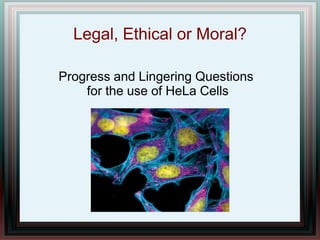
Legal, Ethical or Moral?
Progress and Lingering Questions
for the use of HeLa Cells
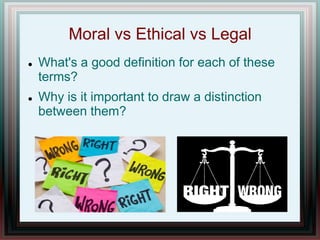
Moral vs Ethical vs Legal
 What's a good definition for each of these
terms?
 Why is it important to draw a distinction
between them?
Definitions
 Moral: private, personal
interactions
 Ethics: professional
interactions
 Law: society as a whole
 How are they
developed?
 What are the
consequences for
breaking these codes?
Example
 1. Someone kills his business partner
Examples
 2. Married CEO has an affair with his
neighbor
Examples
 3. Plagiarism of a term paper
Examples
 4. Speeding
Examples
 5. Drinking
HeLa moral issues
• Is it moral to use human genetic material for
testing?
• Is it moral to clone human genetic material
or combine it cross-species?
• What moral obligation to we have to the rest
of society to allow our bodies to be used?
HeLa moral issues
• Are genetic tests for disease moral? In
adults? In unborn babies?
• Is it moral for people to profit from the
development or sale of human genetic
material?
• What moral responsibility do we have to
ensure people have access to health care?
Education?
HeLa ethical issues
• Ongoing changes and updates—as recent
at 2011 for the DHHS
• March 2013, German scientists published
genome sequence of HeLa line; no family
consent
• Genetic information can be stigmatizing—
Alzheimer’s, bipolar disorder, breast cancer
• Employers/health ins. cannot use information,
but life insurance, disability coverage etc. can
HeLa ethical issues
As Francis S. Collins, director of the National
Institutes of Health, says: “This latest HeLa
situation really shows us that our policy is lagging
years and maybe decades behind the science. It’s
time to catch up.” The regulations governing this
sort of research were written in the 1970s, long
before anyone imagined what you could learn from
a bit of DNA. They are largely based on the now
outdated belief that if samples are “anonymized”
(i.e., your name is removed), there’s no need to get
consent before using them in research.
HeLa ethical issues
The problem, says Yaniv Erlich, a fellow at the
Whitehead Institute for Biomedical Research, is
that anonymity vanishes when it comes to DNA:
“People don’t realize it’s impossible to hide genetic
information once it’s out there.” He and his
colleagues recently proved that it’s possible to use
online public databases to find the identities of
people whose anonymous DNA samples had been
sequenced and published online. Yet researchers
aren’t required to tell you that there is no guarantee
that a genome, once sequenced, will stay private
or anonymous.
HeLa ethical issues
• What is informed consent? How informed is
informed? What role does progeny play?
• Should patients’ anonymity be protected? Is
this possible in the genetic age?
• Is it ethical for corporations to patent and
profit from the development or sale of
human genetic material?
HeLa legal issues
• What body parts can be sold? What can’t?
• Ex. Blood, kidney, sperm/eggs
• At what point does our legal ownership of
our body parts cease?
• What right to legally-protected privacy do we
have?
• Ex. HIPPA
• Can people patent human body
parts/genetic information?
• Ex. June 2013 Supreme Court case
HeLa legal issues
• How can we ensure public policy catches up
with the scientific changes, changes in
public opinion, and changes in ethical
standards?
• What are appropriate punishments for
people who violate laws concerning medical
ethics/genetic privacy?
• How do we enforce US laws among
international scientific teams?

HeLa: Moral, Ethical and Legal questions

  • 1.
    Legal, Ethical orMoral? Progress and Lingering Questions for the use of HeLa Cells
  • 2.
    Moral vs Ethicalvs Legal  What's a good definition for each of these terms?  Why is it important to draw a distinction between them?
  • 3.
    Definitions  Moral: private,personal interactions  Ethics: professional interactions  Law: society as a whole  How are they developed?  What are the consequences for breaking these codes?
  • 4.
    Example  1. Someonekills his business partner
  • 5.
    Examples  2. MarriedCEO has an affair with his neighbor
  • 6.
  • 7.
  • 8.
  • 10.
    HeLa moral issues •Is it moral to use human genetic material for testing? • Is it moral to clone human genetic material or combine it cross-species? • What moral obligation to we have to the rest of society to allow our bodies to be used?
  • 11.
    HeLa moral issues •Are genetic tests for disease moral? In adults? In unborn babies? • Is it moral for people to profit from the development or sale of human genetic material? • What moral responsibility do we have to ensure people have access to health care? Education?
  • 12.
    HeLa ethical issues •Ongoing changes and updates—as recent at 2011 for the DHHS • March 2013, German scientists published genome sequence of HeLa line; no family consent • Genetic information can be stigmatizing— Alzheimer’s, bipolar disorder, breast cancer • Employers/health ins. cannot use information, but life insurance, disability coverage etc. can
  • 13.
    HeLa ethical issues AsFrancis S. Collins, director of the National Institutes of Health, says: “This latest HeLa situation really shows us that our policy is lagging years and maybe decades behind the science. It’s time to catch up.” The regulations governing this sort of research were written in the 1970s, long before anyone imagined what you could learn from a bit of DNA. They are largely based on the now outdated belief that if samples are “anonymized” (i.e., your name is removed), there’s no need to get consent before using them in research.
  • 14.
    HeLa ethical issues Theproblem, says Yaniv Erlich, a fellow at the Whitehead Institute for Biomedical Research, is that anonymity vanishes when it comes to DNA: “People don’t realize it’s impossible to hide genetic information once it’s out there.” He and his colleagues recently proved that it’s possible to use online public databases to find the identities of people whose anonymous DNA samples had been sequenced and published online. Yet researchers aren’t required to tell you that there is no guarantee that a genome, once sequenced, will stay private or anonymous.
  • 15.
    HeLa ethical issues •What is informed consent? How informed is informed? What role does progeny play? • Should patients’ anonymity be protected? Is this possible in the genetic age? • Is it ethical for corporations to patent and profit from the development or sale of human genetic material?
  • 16.
    HeLa legal issues •What body parts can be sold? What can’t? • Ex. Blood, kidney, sperm/eggs • At what point does our legal ownership of our body parts cease? • What right to legally-protected privacy do we have? • Ex. HIPPA • Can people patent human body parts/genetic information? • Ex. June 2013 Supreme Court case
  • 17.
    HeLa legal issues •How can we ensure public policy catches up with the scientific changes, changes in public opinion, and changes in ethical standards? • What are appropriate punishments for people who violate laws concerning medical ethics/genetic privacy? • How do we enforce US laws among international scientific teams?