Education for
Sustainable
Development
It opens an awareness of a
globalizing/shrinking world.
It nurtures higher cognitive and
interpersonal skills/values/
attitudes for problem-
finding/solving.Globalization affirms the human
right to education, providing
Education for All (EFA).
More encompassing, education for
globalization gives the capacity for
change as required for “world
citizenship” in a new human order.
Education for Sustainable Developm
•Its integrative and
critical role in sustaining
man’s capacity for future
changes.
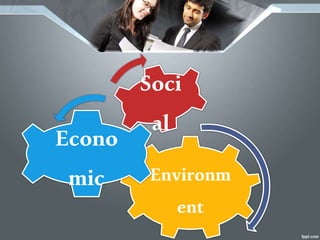
The Three Components
Environm
ent
Econo
mic
Soci
al
Society
Society – an
understanding of
social institutions and
their role in charge and
development as well as
democratic and
Environment – an
awareness of the
resources and fragility of
the physical
environment and the
effects on its human
activity and decisions.
Economy
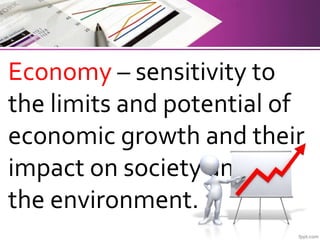
Economy – sensitivity to
the limits and potential of
economic growth and their
impact on society and on
the environment.
Affects Sustainability Pl
Implementation – an
educated citizenry is
vital to implementing
informal and
sustainable
development.
Decision Making – good
community based
decisions which will
affect social, economic,
and environmental well-
being also depend on
Quality
of Life –
educatio
n is also
central
to
improvin
g quality
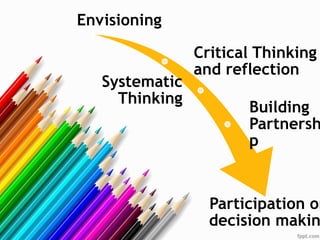
Envisioning
Critical Thinking
and reflection
Systematic
Thinking
Building
Partnersh
p
Participation on
decision makin
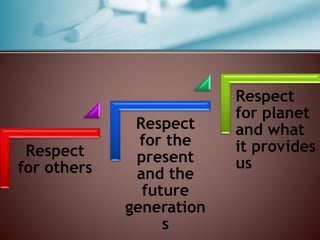
Respect
for others
Respect
for the
present
and the
future
generation
s
Respect
for planet
and what
it provides
us
DESD breaks
down traditional
schemes and
promotes:
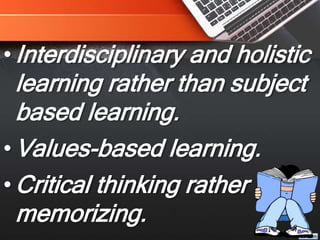
•Interdisciplinary and holistic
learning rather than subject
based learning.
•Values-based learning.
•Critical thinking rather than
memorizing.
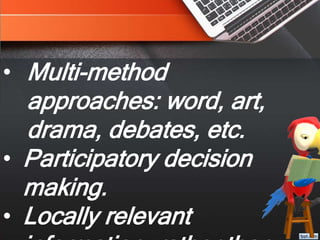
• Multi-method
approaches: word, art,
drama, debates, etc.
• Participatory decision
making.
• Locally relevant
4 key
objects:
•Facilitating networking,
and collaboration
stakeholders of ESD.
•Fostering greater quality
of teaching and learning
of environmental topics.
•Supporting countries in
achieving their millennium
development goals through
ESD efforts.
•Providing countries with
new opportunities and form
Major thrust of
ESD
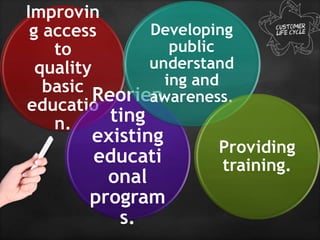
Improvin
g access
to
quality
basic
educatio
n.
Reorien
ting
existing
educati
onal
program
s.
Developing
public
understand
ing and
awareness.
Providing
training.
Key action
themes of
ESD
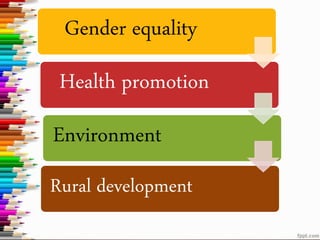
Gender equality
Health promotion
Environment
Rural development
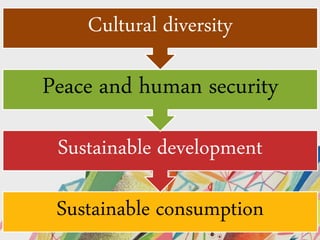
Sustainable consumption
Sustainable development
Peace and human security
Cultural diversity
ESD as the right attitude
to globalization
•Optimist globalists see only
the boon of globalizing
influences in terms of
improved quality of life,
higher living standards, and
greater social cohesion and
•Pessimist globalists see
dark side of globalization
with dominant First World
Countries imposing their
own economic and political
agenda on the world.
•Traditional globalists
take a safe ground
feeling indifferent to
change, saying the
effects of globalization
need to be
•Transformation
globalists who would
not stand and wait but
take a proactive
stand.
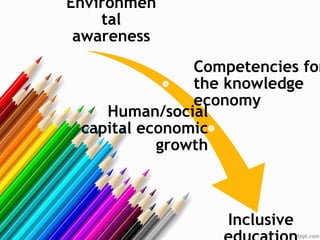
4 dimensions of ESD
Environmen
tal
awareness
Competencies for
the knowledge
economy
Human/social
capital economic
growth
Inclusive
Guidelines for
Effectively
Incorporated
ESD into the
curricula
•Decide the theme
to ensure
programs fit the
environmental,
social, and
economic
• Ensure
educators/administrat
ors understand the
concept of
sustainability and are
familiar with its
principles; that they
distinguish between
• Use the UNESCO
design criteria for ESD
program evaluation:
relevance and
appropriateness,
based on local needs/
perceptions/condition
s, lifelong endeavor,
addresses context/
deals with the
well-being of
realms of
sustainability, not
imported from
another
culture/region,
not “one size fits
all, but created to
Guidelines set for teachers
1. Acknowledge their
key role as
cornerstones of
effective ESD
programs and co-
developers of the
2. Understand
the cross-
cutting and
multi-
disciplinary
3. Avoid
overloading the
curriculum and to
solely link ESC to
one or two
4. Be open
to diverse
learning
strategies.
5. Appreciate the
importance of multi-
stakeholders
partnerships
working together to
solve shared
problems.
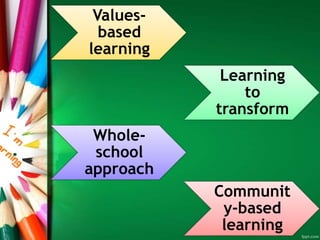
4 modes for ESD
teaching-learning
Values-
based
learning
Learning
to
transform
Whole-
school
approach
Communit
y-based
learning
PRIMER ON
EDUCATIO
N FOR
SUSTAINAB
LE
DEVELOPM
Why is there a need for Education for
Sustainable Development? (ESD)
What is the purpose of the UN
Decade of Education for Sustainable
Development?
What did the decade come
about?
What were initial
actions for the decade?
What were the eventual activities at
all levels/all sectors of education?
What is sustainable
development?
What is the plan of
implementation from the
world’s summit on ESD?
What is the scope of
ESD?
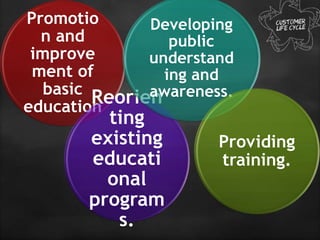
4 Major thrust of E
Promotio
n and
improve
ment of
basic
education
Reorien
ting
existing
educati
onal
program
s.
Developing
public
understand
ing and
awareness.
Providing
training.
How is ESD related to
international educational
priorities?
What are the keys
themes of ESD?
Key action
themes in ESD
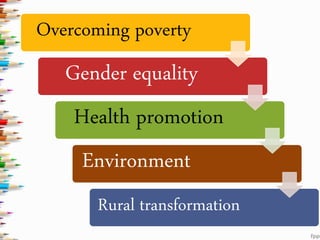
Overcoming poverty
Gender equality
Health promotion
Environment
Rural transformation
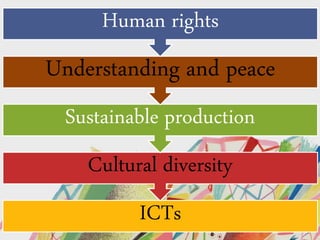
ICTs
Cultural diversity
Sustainable production
Understanding and peace
Human rights
How can ESD improve the quality
of education?
Thank you very
much!!

Social dimension