HEDONIC ADAPTATION: CAN WE BE HAPPIER?
OUTLINE What is happiness? What factors contribute to our happiness? Architecture of sustainable happiness Hedonic Treadmill Lottery Winners and Accident Victims Limitations, Revisions Affective Forecasting Happiness Interventions
WHAT IS HAPPINESS? Synonyms Subjective well-being Related to Optimism Self-esteem Indirect - three primary components: Positive affect (moods and emotions) (frequent) Negative affect (infrequent) Life satisfaction (high) Direct - global, subjective assessment Likely not equivalent to a sum of recent levels of affect and satisfaction with life Lyubomirsky, Sheldon, Schkade (2005)
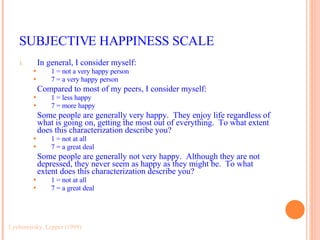
SUBJECTIVE HAPPINESS SCALE In general, I consider myself: 1 = not a very happy person 7 = a very happy person Compared to most of my peers, I consider myself: 1 = less happy 7 = more happy Some people are generally very happy.  They enjoy life regardless of what is going on, getting the most out of everything.  To what extent does this characterization describe you? 1 = not at all 7 = a great deal Some people are generally not very happy.  Although they are not depressed, they never seem as happy as they might be.  To what extent does this characterization describe you? 1 = not at all 7 = a great deal Lyubomirsky, Lepper (1999)
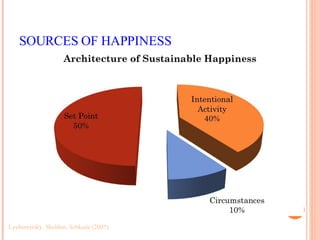
SOURCES OF HAPPINESS Lyubomirsky, Sheldon, Schkade (2005)
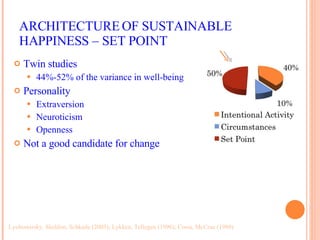
ARCHITECTURE OF SUSTAINABLE HAPPINESS – SET POINT Twin studies  44%-52% of the variance in well-being Personality Extraversion Neuroticism Openness Not a good candidate for change Lyubomirsky, Sheldon, Schkade (2005); Lykken, Tellegen (1996); Costa, McCrae (1980)
QUIZ What % become clinically depressed in their lifetime? What % report life satisfaction above neutral? What % of mental patients report a positive emotional balance (more + than – feelings)? Which of the following groups report a negative emotional balance (more – than + feelings)? Poor African-Americans Unemployed men Elderly people Severely, multiply handicapped people Lyubomirsky, Sheldon, Schkade (2005); Seligman (2002)
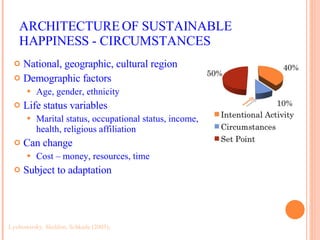
ARCHITECTURE OF SUSTAINABLE HAPPINESS - CIRCUMSTANCES National, geographic, cultural region Demographic factors Age, gender, ethnicity Life status variables Marital status, occupational status, income, health, religious affiliation Can change Cost – money, resources, time Subject to adaptation Lyubomirsky, Sheldon, Schkade (2005);
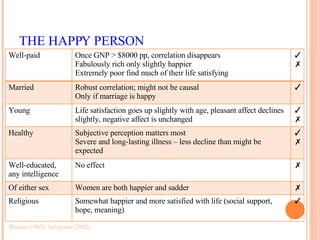
THE HAPPY PERSON Wilson (1967); Seligman (2002) Well-paid Once GNP > $8000 pp, correlation disappears Fabulously rich only slightly happier Extremely poor find much of their life satisfying ✓✗ Married Robust correlation; might not be causal Only if marriage is happy ✓ Young Life satisfaction goes up slightly with age, pleasant affect declines slightly, negative affect is unchanged ✓✗ Healthy Subjective perception matters most Severe and long-lasting illness – less decline than might be expected ✓✗ Well-educated, any intelligence No effect ✗ Of either sex Women are both happier and sadder ✗ Religious Somewhat happier and more satisfied with life (social support, hope, meaning) ✓
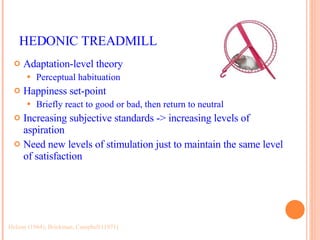
HEDONIC TREADMILL Adaptation-level theory Perceptual habituation Happiness set-point Briefly react to good or bad, then return to neutral Increasing subjective standards -> increasing levels of aspiration Need new levels of stimulation just to maintain the same level of satisfaction Helson (1964); Brickman, Campbell (1971)
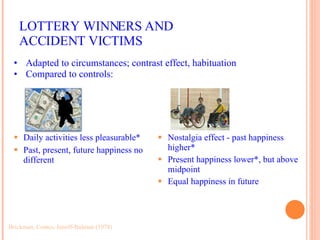
LOTTERY WINNERS AND ACCIDENT VICTIMS Daily activities less pleasurable* Past, present, future happiness no different Brickman, Coates, Janoff-Bulman (1978) Nostalgia effect - past happiness higher* Present happiness lower*, but above midpoint Equal happiness in future  Adapted to circumstances; contrast effect, habituation Compared to controls:
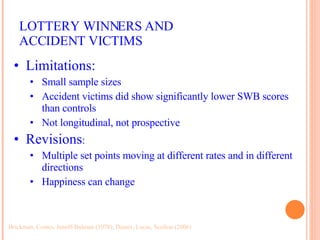
LOTTERY WINNERS AND ACCIDENT VICTIMS Brickman, Coates, Janoff-Bulman (1978); Diener, Lucas, Scollon (2006) Limitations: Small sample sizes Accident victims did show significantly lower SWB scores than controls Not longitudinal, not prospective Revisions : Multiple set points moving at different rates and in different directions Happiness can change
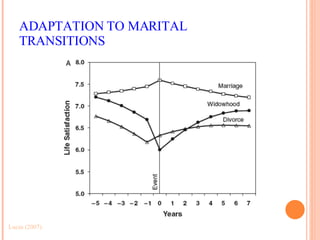
ADAPTATION TO MARITAL TRANSITIONS Lucas (2007)
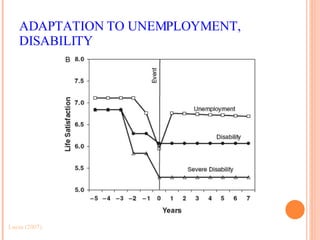
ADAPTATION TO UNEMPLOYMENT, DISABILITY Lucas (2007)
AFFECTIVE FORECASTING Predicting our affective reactions to an event Make choices based on these predictions Accurate at predicting valence Impact bias - often overestimate intensity and duration Immune neglect– unaware of our psychological immune system Wilson, Gilbert (2005); Gilbert, Wilson, Pinel, Blumberg, Wheatley (1998)
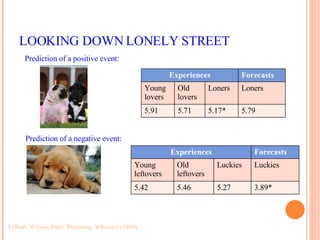
LOOKING DOWN LONELY STREET Gilbert, Wilson, Pinel, Blumberg, Wheatley (1998) Prediction of a positive event: Prediction of a negative event: Experiences Forecasts Young lovers Old lovers Loners Loners 5.91 5.71 5.17* 5.79 Experiences Forecasts Young leftovers Old leftovers Luckies Luckies 5.42 5.46 5.27 3.89*
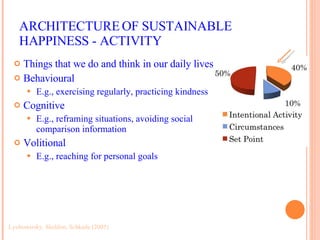
ARCHITECTURE OF SUSTAINABLE HAPPINESS - ACTIVITY Things that we do and think in our daily lives Behavioural E.g., exercising regularly, practicing kindness Cognitive E.g., reframing situations, avoiding social comparison information Volitional E.g., reaching for personal goals Lyubomirsky, Sheldon, Schkade (2005)
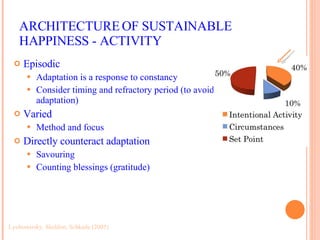
ARCHITECTURE OF SUSTAINABLE HAPPINESS - ACTIVITY Episodic Adaptation is a response to constancy Consider timing and refractory period (to avoid adaptation) Varied Method and focus Directly counteract adaptation Savouring Counting blessings (gratitude) Lyubomirsky, Sheldon, Schkade (2005)
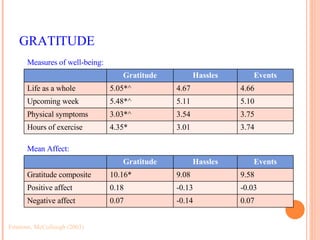
GRATITUDE Emmons, McCullough (2003) Mean Affect: Measures of well-being: Gratitude Hassles Events Gratitude composite 10.16* 9.08 9.58 Positive affect 0.18 -0.13 -0.03 Negative affect 0.07 -0.14 0.07 Gratitude Hassles Events Life as a whole 5.05*^ 4.67 4.66 Upcoming week 5.48*^ 5.11 5.10 Physical symptoms 3.03*^ 3.54 3.75 Hours of exercise 4.35* 3.01 3.74
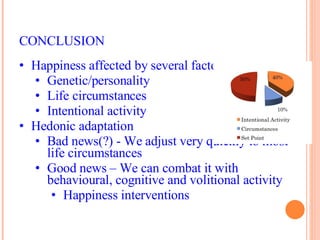
CONCLUSION Happiness affected by several factors: Genetic/personality Life circumstances Intentional activity Hedonic adaptation Bad news(?) - We adjust very quickly to most life circumstances Good news – We can combat it with behavioural, cognitive and volitional activity  Happiness interventions
DISCUSSION What do you think of the model?  Can you think of factors that are missing? Are you surprised at the small slice for life circumstances?  Are there particular things that you would have expected to have a larger effect? Do you think winning the lottery would make you happier? Do you think there are ways to spend lottery winnings that could lead to lasting increases in happiness? Are there life events you might expect to be linked to permanent increases/decreases in happiness? Do you think it makes sense to attempt to increase your day-to-day well-being?

Hedonic adaptation: Can we be happier?

  • 1.
  • 2.
    OUTLINE What ishappiness? What factors contribute to our happiness? Architecture of sustainable happiness Hedonic Treadmill Lottery Winners and Accident Victims Limitations, Revisions Affective Forecasting Happiness Interventions
  • 3.
    WHAT IS HAPPINESS?Synonyms Subjective well-being Related to Optimism Self-esteem Indirect - three primary components: Positive affect (moods and emotions) (frequent) Negative affect (infrequent) Life satisfaction (high) Direct - global, subjective assessment Likely not equivalent to a sum of recent levels of affect and satisfaction with life Lyubomirsky, Sheldon, Schkade (2005)
  • 4.
    SUBJECTIVE HAPPINESS SCALEIn general, I consider myself: 1 = not a very happy person 7 = a very happy person Compared to most of my peers, I consider myself: 1 = less happy 7 = more happy Some people are generally very happy. They enjoy life regardless of what is going on, getting the most out of everything. To what extent does this characterization describe you? 1 = not at all 7 = a great deal Some people are generally not very happy. Although they are not depressed, they never seem as happy as they might be. To what extent does this characterization describe you? 1 = not at all 7 = a great deal Lyubomirsky, Lepper (1999)
  • 5.
    SOURCES OF HAPPINESSLyubomirsky, Sheldon, Schkade (2005)
  • 6.
    ARCHITECTURE OF SUSTAINABLEHAPPINESS – SET POINT Twin studies 44%-52% of the variance in well-being Personality Extraversion Neuroticism Openness Not a good candidate for change Lyubomirsky, Sheldon, Schkade (2005); Lykken, Tellegen (1996); Costa, McCrae (1980)
  • 7.
    QUIZ What %become clinically depressed in their lifetime? What % report life satisfaction above neutral? What % of mental patients report a positive emotional balance (more + than – feelings)? Which of the following groups report a negative emotional balance (more – than + feelings)? Poor African-Americans Unemployed men Elderly people Severely, multiply handicapped people Lyubomirsky, Sheldon, Schkade (2005); Seligman (2002)
  • 8.
    ARCHITECTURE OF SUSTAINABLEHAPPINESS - CIRCUMSTANCES National, geographic, cultural region Demographic factors Age, gender, ethnicity Life status variables Marital status, occupational status, income, health, religious affiliation Can change Cost – money, resources, time Subject to adaptation Lyubomirsky, Sheldon, Schkade (2005);
  • 9.
    THE HAPPY PERSONWilson (1967); Seligman (2002) Well-paid Once GNP > $8000 pp, correlation disappears Fabulously rich only slightly happier Extremely poor find much of their life satisfying ✓✗ Married Robust correlation; might not be causal Only if marriage is happy ✓ Young Life satisfaction goes up slightly with age, pleasant affect declines slightly, negative affect is unchanged ✓✗ Healthy Subjective perception matters most Severe and long-lasting illness – less decline than might be expected ✓✗ Well-educated, any intelligence No effect ✗ Of either sex Women are both happier and sadder ✗ Religious Somewhat happier and more satisfied with life (social support, hope, meaning) ✓
  • 10.
    HEDONIC TREADMILL Adaptation-leveltheory Perceptual habituation Happiness set-point Briefly react to good or bad, then return to neutral Increasing subjective standards -> increasing levels of aspiration Need new levels of stimulation just to maintain the same level of satisfaction Helson (1964); Brickman, Campbell (1971)
  • 11.
    LOTTERY WINNERS ANDACCIDENT VICTIMS Daily activities less pleasurable* Past, present, future happiness no different Brickman, Coates, Janoff-Bulman (1978) Nostalgia effect - past happiness higher* Present happiness lower*, but above midpoint Equal happiness in future Adapted to circumstances; contrast effect, habituation Compared to controls:
  • 12.
    LOTTERY WINNERS ANDACCIDENT VICTIMS Brickman, Coates, Janoff-Bulman (1978); Diener, Lucas, Scollon (2006) Limitations: Small sample sizes Accident victims did show significantly lower SWB scores than controls Not longitudinal, not prospective Revisions : Multiple set points moving at different rates and in different directions Happiness can change
  • 13.
    ADAPTATION TO MARITALTRANSITIONS Lucas (2007)
  • 14.
    ADAPTATION TO UNEMPLOYMENT,DISABILITY Lucas (2007)
  • 15.
    AFFECTIVE FORECASTING Predictingour affective reactions to an event Make choices based on these predictions Accurate at predicting valence Impact bias - often overestimate intensity and duration Immune neglect– unaware of our psychological immune system Wilson, Gilbert (2005); Gilbert, Wilson, Pinel, Blumberg, Wheatley (1998)
  • 16.
    LOOKING DOWN LONELYSTREET Gilbert, Wilson, Pinel, Blumberg, Wheatley (1998) Prediction of a positive event: Prediction of a negative event: Experiences Forecasts Young lovers Old lovers Loners Loners 5.91 5.71 5.17* 5.79 Experiences Forecasts Young leftovers Old leftovers Luckies Luckies 5.42 5.46 5.27 3.89*
  • 17.
    ARCHITECTURE OF SUSTAINABLEHAPPINESS - ACTIVITY Things that we do and think in our daily lives Behavioural E.g., exercising regularly, practicing kindness Cognitive E.g., reframing situations, avoiding social comparison information Volitional E.g., reaching for personal goals Lyubomirsky, Sheldon, Schkade (2005)
  • 18.
    ARCHITECTURE OF SUSTAINABLEHAPPINESS - ACTIVITY Episodic Adaptation is a response to constancy Consider timing and refractory period (to avoid adaptation) Varied Method and focus Directly counteract adaptation Savouring Counting blessings (gratitude) Lyubomirsky, Sheldon, Schkade (2005)
  • 19.
    GRATITUDE Emmons, McCullough(2003) Mean Affect: Measures of well-being: Gratitude Hassles Events Gratitude composite 10.16* 9.08 9.58 Positive affect 0.18 -0.13 -0.03 Negative affect 0.07 -0.14 0.07 Gratitude Hassles Events Life as a whole 5.05*^ 4.67 4.66 Upcoming week 5.48*^ 5.11 5.10 Physical symptoms 3.03*^ 3.54 3.75 Hours of exercise 4.35* 3.01 3.74
  • 20.
    CONCLUSION Happiness affectedby several factors: Genetic/personality Life circumstances Intentional activity Hedonic adaptation Bad news(?) - We adjust very quickly to most life circumstances Good news – We can combat it with behavioural, cognitive and volitional activity Happiness interventions
  • 21.
    DISCUSSION What doyou think of the model? Can you think of factors that are missing? Are you surprised at the small slice for life circumstances? Are there particular things that you would have expected to have a larger effect? Do you think winning the lottery would make you happier? Do you think there are ways to spend lottery winnings that could lead to lasting increases in happiness? Are there life events you might expect to be linked to permanent increases/decreases in happiness? Do you think it makes sense to attempt to increase your day-to-day well-being?

Editor's Notes

  • #2 What is it? What are its implications on pursuing lasting changes in happiness