International Research Journal of Engineering and Technology (IRJET) e-ISSN: 2395-0056
Volume: 10 Issue: 02 | Feb 2023 www.irjet.net p-ISSN: 2395-0072
© 2023, IRJET | Impact Factor value: 8.226 | ISO 9001:2008 Certified Journal | Page 592
Heart Failure Prediction using Different MachineLearning Techniques
Prof. Pritesh Patil1, Rohit Bharmal2, Shravani Ghadge3, Dhanashri Gundal4, Ankita Kawade5
1Prof. Information Technology, AISSMS Institution of Information Technology, Pune, Maharashtra, India
2Student, Information Technology, AISSMS Institution of Information Technology, Pune, Maharashtra, India
3Student, Information Technology, AISSMS Institution of Information Technology, Pune, Maharashtra, India
4Student, Information Technology, AISSMS Institution of Information Technology, Pune, Maharashtra, India
5Student, Information Technology, AISSMS Institution of Information Technology, Pune,Maharashtra, India
---------------------------------------------------------------------***---------------------------------------------------------------------
Abstract - A heart disease is a type of condition that affects
the heart and blood vessels. It can also be referred to as
cardiovascular disease. Getting the right diagnosis and
treatment of heart disease is very important in order to
improve the quality of healthcare. Clinical data analysis faces
a significant problem when predicting cardiovascular disease.
The current situation of applying conventional approaches in
practically the whole medical field is being revolutionized
and changed by Machine Learning, the Internet of Things
(IoT), Artificial Intelligence, and Big Data. With the use of
machine learning (ML), it has been possible to make
predictions and judgments from the vast amount of data
generated by the healthcare sector. In this paper, we present
several Machine Learning models and attain the best model
to improve the precision of cardiovascular disease prediction.
Different feature selection techniques and many well-known
strategies are used to improve the accuracy.
Key Words: Machine Learning, Artificial Intelligence,
Cardiovascular Disease, Feature Selection, Heart Disease
Prediction
1.INTRODUCTION
A number of contributing risk factors, namely diabetes, high
blood pressure, excessive cholesterol, an irregular pulse rate,
and many other factors make it challenging to diagnose heart
disease(HD). The severity of cardiac disease in humans has
been determined using various data mining and neural
network techniques. Several Classifiers namely Random
Forest, K-Nearest Neighbour(KNN), Logistic Regression
and Naïve Bayes Since cardiac illness has a complex
character, it requires cautious management. Failure to do so
could harm the heart or result in premature death. To
identify different types of metabolic syndromes, data
mining and the perspective of medical research are
employed. Heart disease prediction and data analysis both
greatly benefit from data mining with classification. HD is
often diagnosed by a doctor after reviewing the patient's
medical history, the results of their physical exam, and any
concerning symptoms. However, the results of this method
of diagnosis do not reliably identify heart disease patients.
Additionally, analysis is costly and computationally
challenging. To tackle these problems, a non-invasive
diagnosis system based on classifiers of machine learning
(ML) must be created. To identify the best-suited
machine learning model we compare the accuracies of
different classification models and find out the best fit
model with the best accuracy. Due to the dimensionality
constraint, it is required to reduce the dimensionality of
data for a variety of learning tasks. The choice of features
has a significant impact on a variety of applications,
including making buildings simpler, improving learning
outcomes, and producing clear and comprehensible data.
Due to the large amount of dimensions in big data,
selecting features from it is a difficult task that leads to
significant issues. Additionally, there are difficulties
choosing features for structured, heterogeneous, and
streaming data, as well as problems with scalability and
stability. The feature selection issues must be overcome
for large data analytics.
On the other hand, effective machine learning requires an
appropriate model. Naturally, a strong machine learning
model is one that excels both on data that isn't seen during
training (otherwise, the model would only learn the
training data) and on data that hasn't been seen before. To
test every classifier using data, and discover that they
correctly classify 50% of the cases on average. Additionally,
when a model is trained and tested on a dataset, adequate
cross-validation methodologies and performance
evaluation criteria are essential.
In the paper, the sections are structured as follows.
The literature related to the problem has been discussed
in Section 2. In Section 3 the System Architecture is
discussed. In Section 4 the Research Methodologies which
consist of Data Set, Data Collection, and Preprocessing along
with classification Techniques are discussed. The
Theoretical and mathematical knowledge of feature
selection and classification algorithms are discussed in
detail. Further, the Conclusion and the Future Scope of the
study have been discussed in detail in Sections 5 and 6
respectively. The last section consists of acknowledgment
and references which made this study possible.
International Research Journal of Engineering and Technology (IRJET) e-ISSN: 2395-0056
Volume: 10 Issue: 02 | Feb 2023 www.irjet.net p-ISSN: 2395-0072
© 2023, IRJET | Impact Factor value: 8.226 | ISO 9001:2008 Certified Journal | Page 593
2. LITERATURE SURVEY
Researchers have proposed a number of machine learning-
based diagnosis techniques to detect Various Diseases in the
literature review. In order to demonstrate the significance
of the suggested work, this research study offers multiple
machine learning-based diagnosis approaches that are
currently being used. "Intelligent Machine Learning
Approach for Effective Recognition of Diabetes in E-
Healthcare Using Clinical Data", is a paper published by A. U.
Haq, J. P. Li, J. Khan, M. H. Memon, S. Nazir, S. Ahmad, G. A.
Khan, and A. Ali. In this paper, they have proposed a diabetes
diagnosis system utilizing machine learning techniques. On
the diabetic data set, a clinical dataset created from a
patient's clinical history, the proposed method has been
tested. For the selection of highly significant features, they
have also presented a filtering technique based on the
Decision Tree (Iterative Dichotomiser algorithm). Ada Boost
and Random Forest, two ensemble learning algorithms,
have also been employed for feature selection, and also
comparison of the performance of the classifier with
wrapper-based feature selection approaches is done.
In "Optimal Multi-Stage Arrhythmia Classification Approach",
a paper published by J. Zheng et al., The 12-lead surface ECG-
based multi-stage arrhythmia classification algorithm has
been refined to reach the accuracy performance level of
qualified cardiologists. A revolutionary feature extraction
technique, a three-step noise reduction stage, and an ideal
classification model with precisely calibrated
hyperparameters make up the new methodology. On patients
with no other cardiac conditions, the best method—which
included a a unique feature extraction approach using the
Low Band Pass filter, Robust LOESS, Non-Local Means
smoothing, and average scores of the observed variable of
ratios of interval lengths and magnitudes of peaks and
valleys has attained a very high accuracy.
In "A novel integrated diagnosis method for breast cancer
detection" a paper by A. U. Haq, J. Li, M. H. Memon, J. Khan,
and S. U. Din, Support vector machine, a type of machine
learning model, has been used to categorize breast cancer
patients into malignant and benign groups. They have
employed Chi-square and Minimal Redundancy Maximum
Relevance algorithms to choose more pertinent features from
the breast cancer dataset in an effort to improve the method's
classification performance. The model is trained and tested
using the training/testing splitting technique. Additionally,
performance assessment metrics have been used to examine
the model's performance. The experimental findings showed
that on the subset of features chosen by the Minimal
Redundancy Maximal Relevance feature selection approach,
the classifier support vector machine had the best
classification performance. When compared to the Minimal
Redundancy Maximal Relevance algorithm, the support
vector machine performed poorly on features chosen by the
Chi-square feature selection approach. They concluded from
the study of the experimental data that the performance
of the integrated system based on Minimal Redundancy
Maximal Relevance and Support Vector Machines is high
because more appropriate features were chosen, leading
tovery high accuracy.
In "A new method of assessing cardiac autonomic function
and its comparison with spectral analysis and coefficient of
variation of R-R interval" a paper by M Toichi 1, T Sugiura,
T Murai, A Sengoku Ten healthy participants participated
in a pharmacological experiment to test a novel non-linear
technique for measuring cardiac autonomic function. Each of
the novel approaches used the Lorenz plot, spectral analysis,
and coefficient of variation to examine the R-R interval data
collected under a control condition, in the autonomic
blockade by atropine, and in the blockade by propranolol.
With the help of their methodology, they were able to
derive two measurements, the cardiac sympathetic and
vagal indices, which represent the vagal and sympathetic
systems separately. Compared to the indices derived by the
other two approaches, these two were determined to be
more trustworthy. They projected that this method will
eventually be more accurate and practical for the non-
invasive measurement of short-term cardiac autonomic
function.
In "A New Automatic Identification Method of Heart Failure
Using Improved Support Vector Machine Based on Duality
Optimization Technique" a paper published by Gamal G. N.
Geweid(Member, IEEE), and Mahmoud A. Abdallah, For
detection of Heart Disease using ECG signals, a new
automatic technique utilizing an upgraded support vector
machine model was put forth. This is especially pertinent
to ECG signals for the diagnosis of HFD as the initial step in
treating and caring for patients generally and specifically
those with early heart disease to increase their chance of
survival as a whole. In order to detect HFD in ECG data, a
hybrid strategy combining dual SVM and a nonparametric
algorithm is presented in this study. This hybrid approach
improves the precision and reliability of early heart failure
classes' identification and diagnosis. To create two SVM
models, the nonparametric approach is used to train the
SVM and its dual. The dual problem offers a second
perspective that is sometimes better and more
straightforward than the initial Problem. This feature
compares the outputs of the SVM model and those of the
dual SVM model in order to identify heart failure disease in
ECG signals. When compared to other algorithms to which
the study refers, experiments demonstrate that the hybrid
technique generates good results, is more effective, and
boosts the accuracy of Heart failure disease identification
with reasonable accuracy of 94.97%.
3. SYSTEM ARCHITECTURE
Dataset collection is the act of gathering information
containing patient specifics. The method of selecting
characteristics chooses the relevant qualities for heart
International Research Journal of Engineering and Technology (IRJET) e-ISSN: 2395-0056
Volume: 10 Issue: 02 | Feb 2023 www.irjet.net p-ISSN: 2395-0072
© 2023, IRJET | Impact Factor value: 8.226 | ISO 9001:2008 Certified Journal | Page 594
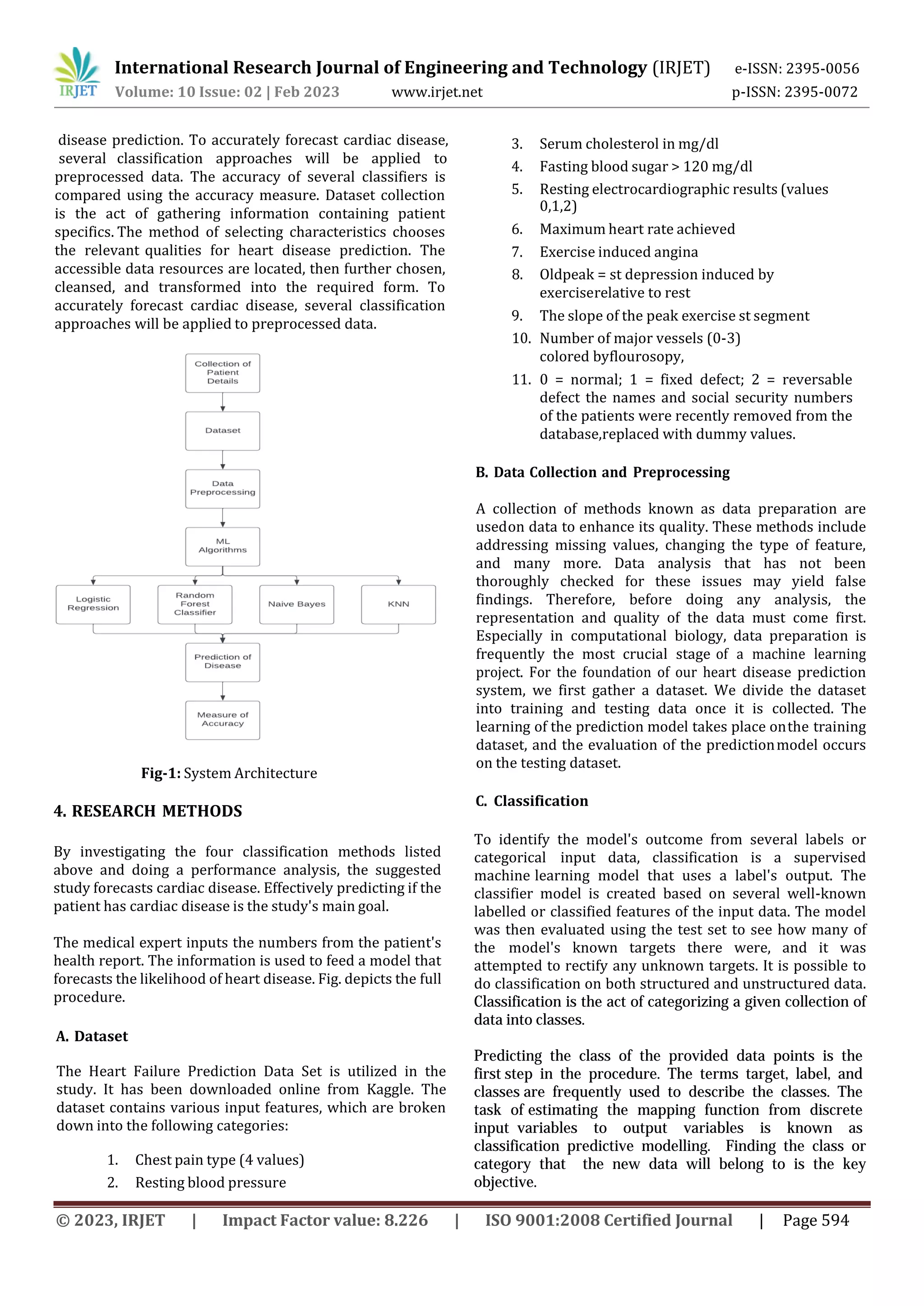
Fig-1: System Architecture
4. RESEARCH METHODS
By investigating the four classification methods listed
above and doing a performance analysis, the suggested
study forecasts cardiac disease. Effectively predicting if the
patient has cardiac disease is the study's main goal.
The medical expert inputs the numbers from the patient's
health report. The information is used to feed a model that
forecasts the likelihood of heart disease. Fig. depicts the full
procedure.
A. Dataset
The Heart Failure Prediction Data Set is utilized in the
study. It has been downloaded online from Kaggle. The
dataset contains various input features, which are broken
down into the following categories:
0,1,2)
6. Maximum heart rate achieved
7. Exercise induced angina
8. Oldpeak = st depression induced by
exerciserelative to rest
9. The slope of the peak exercise st segment
10. Number of major vessels (0-3)
colored byflourosopy,
11. 0 = normal; 1 = fixed defect; 2 = reversable
defect the names and social security numbers
of the patients were recently removed from the
database,replaced with dummy values.
B. Data Collection and Preprocessing
A collection of methods known as data preparation are
usedon data to enhance its quality. These methods include
addressing missing values, changing the type of feature,
and many more. Data analysis that has not been
thoroughly checked for these issues may yield false
findings. Therefore, before doing any analysis, the
representation and quality of the data must come first.
Especially in computational biology, data preparation is
frequently the most crucial stage of a machine learning
project. For the foundation of our heart disease prediction
system, we first gather a dataset. We divide the dataset
into training and testing data once it is collected. The
learning of the prediction model takes place onthe training
dataset, and the evaluation of the predictionmodel occurs
on the testing dataset.
C. Classification
disease prediction. To accurately forecast cardiac disease,
several classification approaches will be applied to
preprocessed data. The accuracy of several classifiers is
compared using the accuracy measure. Dataset collection
is the act of gathering information containing patient
specifics. The method of selecting characteristics chooses
the relevant qualities for heart disease prediction. The
accessible data resources are located, then further chosen,
cleansed, and transformed into the required form. To
accurately forecast cardiac disease, several classification
approaches will be applied to preprocessed data.
1. Chest pain type (4 values)
2. Resting blood pressure
3. Serum cholesterol in mg/dl
4. Fasting blood sugar > 120 mg/dl
5. Resting electrocardiographic results (values
To identify the model's outcome from several labels or
categorical input data, classification is a supervised
machine learning model that uses a label's output. The
classifier model is created based on several well-known
labelled or classified features of the input data. The model
was then evaluated using the test set to see how many of
the model's known targets there were, and it was
attempted to rectify any unknown targets. It is possible to
do classification on both structured and unstructured data.
Classification is the act of categorizing a given collection of
data into classes.
Predicting the class of the provided data points is the
first step in the procedure. The terms target, label, and
classes are frequently used to describe the classes. The
task of estimating the mapping function from discrete
input variables to output variables is known as
classification predictive modelling. Finding the class or
category that the new data will belong to is the key
objective.
International Research Journal of Engineering and Technology (IRJET) e-ISSN: 2395-0056
Volume: 10 Issue: 02 | Feb 2023 www.irjet.net p-ISSN: 2395-0072
 Logistic Regression
Graph-1: Logistic Regression Graph
This method involves analyzing a collection of data that
includes a dependent variable and one or more
independentvariables in order to forecast the result of a
binary variable, which has only two possible
possibilities. The dependent variable's nature is
categorical. The independent variables are known as
predictors, while the dependent variable is also known
as the target variable. In a specific version of linear
regression called logistic regression, we can only
predict the result of a categorical variable. By means of
the log function, it forecasts the likelihood of the event.
In orderto forecast the category value, we employ the
Sigmoid function or curve. The result (win or lose) is
determined by the threshold value.
Sigmoid function: p = 1 / 1 + e-y
Logistic Regression equation:
p = 1 / 1 + e-(β0 + β1X1 + β2X2 …. + βnXn)
A strong statistical analysis method is regression
analysis. Ina data collection, a dependent variable that
interests us is utilized to forecast the values of other
independent variables. Regression is something that we
frequently encounter in an intuitive way.
 Random Forest Classifier
result by considering one or more independent
variables. Since the variable being used to quantify, it is
a dichotomous variable, the output will only have two
possible possibilities.
It is a machine learning classification algorithm that
selects a
variable and a set of independentfactors. In comparison
to other binary classification techniques like the closest
neighbour, it performs better because it unbiasedly
describes the contributing factors classification.
The goal of logistic regression is to
identify the relationship that best fits the dependent
Both classification and regression techniques employ
Random Forest algorithms. In order to generate
predictions, it builds a tree for the data. Using Random
Forest on huge datasets generate the same outcome
from the missing values. Samples produced by the
Classifier can store a decision tree so you may utilize it
later. Additional information can be obtained by making a
forecast after creating a random forest by using a classifier
developed in thefirst random forest stage.
Fig-2: Random Forest Classifier
Using random forest algorithm, we can obtain accuracy
High Accuracy for prediction of heart disease.
 Naïve Bayes
The family of straightforward "probabilistic
classifiers" known as "Naive Bayes Classifiers" in
statistics is based on the application of Bayes' theorem
with strong (naive) independent assumptions
between the features. Although they are some of the
simplest Bayesian network models, they may achieve
high levels of accuracy when combined with kernel
density estimation. Naive Bayes classifiers are very
scalable since the number of parameters needed is
linear in the number of variables (features/predictors)
in a learning job. When compared to many other types
of classifiers, maximum-likelihood training can be
performed in linear time by evaluating a closed-form
expression as opposed to being costly approximated
iteratively. In the statistics literature, naïve Bayes
classification models go by the titles simple Bayes and
independent Bayes.
© 2023, IRJET | Impact Factor value: 8.226 | ISO 9001:2008 Certified Journal | Page 595
International Research Journal of Engineering and Technology (IRJET) e-ISSN: 2395-0056
Volume: 10 Issue: 02 | Feb 2023 www.irjet.net p-ISSN: 2395-0072
Fig-3: Naïve Bayes Formula
 K-Nearest Neighbors
KNN is a lazily supervised machine learning technique
that uses distance measurements to predict and
categorize unknown data from known data. The distance
metric is used to determine the distance between each
point in the training data and each point in the testing
data. Fundamentally, the k-nearest neighbour classifier
depends on a distance metric. The more accurately that
metric captures label similarity, the more accurate the
classification. The Minkowski distance is the most
popular option which is :
dist(x,z)=(d∑r=1|xr−zr|p)1/p.
With k-NN, all computation is postponed until after the
function has been evaluated and the function is only
locallyapproximated. Since this technique depends on
distance for classification, normalizing the training
data can significantly increase accuracy if the features
reflect several physical units or have distinct sizes.
Assigning weights to neighbor contributions may be a
helpful strategy for both classification and regression,
making the closer neighbours contribute more to the
average than thefarther neighbours.As an illustration,
a typical weighting method assigns each neighbour a
weight of 1/d, where d isthe distance between the
neighbours.
5. CONCLUSION
The long-term saving of human lives and the early
detection of irregularities in heart problems will be
made possible by identifying the processing of raw
healthcare data of heart information. To process the raw
data and deliver a fresh and original insight into heart
disease, machine learning techniques were applied in
this study. Prediction of heart disease is difficult and
crucial in the medical industry. However, if the disease
6. FUTURE WORK
is discovered in its early stages and preventative
measures are implemented as soon as feasible, the
fatality rate can be significantly reduced. In this Study,
Various Machine Learning Algorithms have been studied and
analyzed. This Study will help us obtain the best
Machine Learning Model for Efficient Heart Disease
Prediction with the most accuracy. Our study's use of
feature selection algorithms to identify the right
features that improve classification accuracy and
reduce the diagnosis system's processing time is
another novel component. We'll put additional feature
selection algorithms as well as optimization
algorithms in the future to increase a prediction
system's ability to diagnose Heart Disease.
In the future work, More machine learning classification
algorithms and data pretreatment approaches may be
used in subsequent works to provide outcomes.
In light of the fact that more data equals more accurate
results, it follows that a large amount of data will result in
better prediction. Since the patient may not always
have time to visit the doctor, this issue can be resolved by
creating a website or smartphone application with a
graphical user interface. This website streamlines the
prediction process and allows patients to access the
results at home by simply entering their risk factors.
ACKNOWLEDGMENT
First and Foremost, We are thankful to our college
AISSMS Institute of Information Technology and the
Engineering Department and our Guide Mr. Pritesh Patil,
Associate Professor, AISSMS Institute of Information
Technology. A special word of gratitude to Dr. Meenakshi
Thalor, Head of Department, Information Technology
and Engineering Department, AISSMS IOIT college of
Engineering, for her continuous guidance and support for
our project work.
REFERENCES
[1] C. for Disease Control and Prevention, “FastStats, ”
Deaths and mortality, Cdc.gov, May 2017, Accessed: Mar.
23, 2021. [Online]. Available: https:
//www.cdc.gov/nchs/fastats/deaths.htm
[2] A. U. Haq, J. P. Li, J. Khan, M. H. Memon, S. Nazir, S.
Ahmad,G. A. Khan, and A. Ali, ‘‘Intelligent machine
learning approach for effective recognition of diabetes
in E- healthcare using clinical data,’’ Sensors, vol. 20,
no. 9, p. 2649, May 2020.
© 2023, IRJET | Impact Factor value: 8.226 | ISO 9001:2008 Certified Journal | Page 596
International Research Journal of Engineering and Technology (IRJET) e-ISSN: 2395-0056
Volume: 10 Issue: 02 | Feb 2023 www.irjet.net p-ISSN: 2395-0072
[3] C. for Disease Control and Prevention, “Atrialfibrillation|
cdc.gov, ” Centers for Disease Control and Prevention,
May 2020, Accessed: Mar, 23, 2021. [Online]. Available:
https://www.cdc.gov/heartdisease/atrial_
fibrillation.htm
[4] Z. D. G. Ary, L. Goldberger, and A. Shvilkin, “QRS
Complex- an overview | ScienceDirect Topics„ ”
Sciencedirect.com, Goldberger’s clinical electro
cardiography, 2017, Accessed: Mar. 23, 2021. [Online].
Available: https:
//www.sciencedirect.com/topics/medicine-and-
dentistry/qrs-compleM. Young, The Technical Writer’s
Handbook. Mill Valley, CA: University Science, 1989.
[5] A. U. Haq, J. Li, M. H. Memon, J. Khan, and S. U. Din, ‘‘A
novel integrated diagnosis method for breast cancer
detection, ’’ J. Intell. Fuzzy Syst., vol. 38, no. 2, pp. 2383–
2398, 2020.
[6] P. Virtanen et al., “SciPy 1.0: Fundamental algorithms for
scientific computing in python,” Nature Methods, vol. 17,
pp. 261–272, 2020.
[7] J. Zheng et al., “Optimal multi-stage
arrhythmia classification approach,” Sci. Rep., vol. 10,
no. 1, pp. 1– 17, 2020
[8] “Tian Chi-ECG-abnormal-event-prediction, ”GitHub,
2019. [Online]. Available:
https://github.com/NingAnMe/TianChi- ECG-abnormal-
event prediction. Tianchi Hefei High-Tech Cup Ecg
Human-Machine Intelligence Competition, 2019.
[9] Alivecor, Inc., Alivecor.com, 2020, Accessed: Mar.
23,2021. [Online]. Available: https://www.alivecor.com/#
BIOGRAPHIES
Prof. Pritesh Patil
Information Technology
Professor
AISSMS Institute of
Information Technology
Dhanashri Gundal
BE IT Student
AISSMS Institute of
Information Technology
Shravani Ghadge
BE IT Student
AISSMS Institute of
Information Technology
Ankita Kawade
BE IT Student
AISSMS Institute of Information
Technology
Rohit Bharmal
BE IT Student
AISSMS Institute of Information
Technology
© 2023, IRJET | Impact Factor value: 8.226 | ISO 9001:2008 Certified Journal | Page 597

Heart Failure Prediction using Different MachineLearning Techniques

  • 1.
    International Research Journalof Engineering and Technology (IRJET) e-ISSN: 2395-0056 Volume: 10 Issue: 02 | Feb 2023 www.irjet.net p-ISSN: 2395-0072 © 2023, IRJET | Impact Factor value: 8.226 | ISO 9001:2008 Certified Journal | Page 592 Heart Failure Prediction using Different MachineLearning Techniques Prof. Pritesh Patil1, Rohit Bharmal2, Shravani Ghadge3, Dhanashri Gundal4, Ankita Kawade5 1Prof. Information Technology, AISSMS Institution of Information Technology, Pune, Maharashtra, India 2Student, Information Technology, AISSMS Institution of Information Technology, Pune, Maharashtra, India 3Student, Information Technology, AISSMS Institution of Information Technology, Pune, Maharashtra, India 4Student, Information Technology, AISSMS Institution of Information Technology, Pune, Maharashtra, India 5Student, Information Technology, AISSMS Institution of Information Technology, Pune,Maharashtra, India ---------------------------------------------------------------------***--------------------------------------------------------------------- Abstract - A heart disease is a type of condition that affects the heart and blood vessels. It can also be referred to as cardiovascular disease. Getting the right diagnosis and treatment of heart disease is very important in order to improve the quality of healthcare. Clinical data analysis faces a significant problem when predicting cardiovascular disease. The current situation of applying conventional approaches in practically the whole medical field is being revolutionized and changed by Machine Learning, the Internet of Things (IoT), Artificial Intelligence, and Big Data. With the use of machine learning (ML), it has been possible to make predictions and judgments from the vast amount of data generated by the healthcare sector. In this paper, we present several Machine Learning models and attain the best model to improve the precision of cardiovascular disease prediction. Different feature selection techniques and many well-known strategies are used to improve the accuracy. Key Words: Machine Learning, Artificial Intelligence, Cardiovascular Disease, Feature Selection, Heart Disease Prediction 1.INTRODUCTION A number of contributing risk factors, namely diabetes, high blood pressure, excessive cholesterol, an irregular pulse rate, and many other factors make it challenging to diagnose heart disease(HD). The severity of cardiac disease in humans has been determined using various data mining and neural network techniques. Several Classifiers namely Random Forest, K-Nearest Neighbour(KNN), Logistic Regression and Naïve Bayes Since cardiac illness has a complex character, it requires cautious management. Failure to do so could harm the heart or result in premature death. To identify different types of metabolic syndromes, data mining and the perspective of medical research are employed. Heart disease prediction and data analysis both greatly benefit from data mining with classification. HD is often diagnosed by a doctor after reviewing the patient's medical history, the results of their physical exam, and any concerning symptoms. However, the results of this method of diagnosis do not reliably identify heart disease patients. Additionally, analysis is costly and computationally challenging. To tackle these problems, a non-invasive diagnosis system based on classifiers of machine learning (ML) must be created. To identify the best-suited machine learning model we compare the accuracies of different classification models and find out the best fit model with the best accuracy. Due to the dimensionality constraint, it is required to reduce the dimensionality of data for a variety of learning tasks. The choice of features has a significant impact on a variety of applications, including making buildings simpler, improving learning outcomes, and producing clear and comprehensible data. Due to the large amount of dimensions in big data, selecting features from it is a difficult task that leads to significant issues. Additionally, there are difficulties choosing features for structured, heterogeneous, and streaming data, as well as problems with scalability and stability. The feature selection issues must be overcome for large data analytics. On the other hand, effective machine learning requires an appropriate model. Naturally, a strong machine learning model is one that excels both on data that isn't seen during training (otherwise, the model would only learn the training data) and on data that hasn't been seen before. To test every classifier using data, and discover that they correctly classify 50% of the cases on average. Additionally, when a model is trained and tested on a dataset, adequate cross-validation methodologies and performance evaluation criteria are essential. In the paper, the sections are structured as follows. The literature related to the problem has been discussed in Section 2. In Section 3 the System Architecture is discussed. In Section 4 the Research Methodologies which consist of Data Set, Data Collection, and Preprocessing along with classification Techniques are discussed. The Theoretical and mathematical knowledge of feature selection and classification algorithms are discussed in detail. Further, the Conclusion and the Future Scope of the study have been discussed in detail in Sections 5 and 6 respectively. The last section consists of acknowledgment and references which made this study possible.
  • 2.
    International Research Journalof Engineering and Technology (IRJET) e-ISSN: 2395-0056 Volume: 10 Issue: 02 | Feb 2023 www.irjet.net p-ISSN: 2395-0072 © 2023, IRJET | Impact Factor value: 8.226 | ISO 9001:2008 Certified Journal | Page 593 2. LITERATURE SURVEY Researchers have proposed a number of machine learning- based diagnosis techniques to detect Various Diseases in the literature review. In order to demonstrate the significance of the suggested work, this research study offers multiple machine learning-based diagnosis approaches that are currently being used. "Intelligent Machine Learning Approach for Effective Recognition of Diabetes in E- Healthcare Using Clinical Data", is a paper published by A. U. Haq, J. P. Li, J. Khan, M. H. Memon, S. Nazir, S. Ahmad, G. A. Khan, and A. Ali. In this paper, they have proposed a diabetes diagnosis system utilizing machine learning techniques. On the diabetic data set, a clinical dataset created from a patient's clinical history, the proposed method has been tested. For the selection of highly significant features, they have also presented a filtering technique based on the Decision Tree (Iterative Dichotomiser algorithm). Ada Boost and Random Forest, two ensemble learning algorithms, have also been employed for feature selection, and also comparison of the performance of the classifier with wrapper-based feature selection approaches is done. In "Optimal Multi-Stage Arrhythmia Classification Approach", a paper published by J. Zheng et al., The 12-lead surface ECG- based multi-stage arrhythmia classification algorithm has been refined to reach the accuracy performance level of qualified cardiologists. A revolutionary feature extraction technique, a three-step noise reduction stage, and an ideal classification model with precisely calibrated hyperparameters make up the new methodology. On patients with no other cardiac conditions, the best method—which included a a unique feature extraction approach using the Low Band Pass filter, Robust LOESS, Non-Local Means smoothing, and average scores of the observed variable of ratios of interval lengths and magnitudes of peaks and valleys has attained a very high accuracy. In "A novel integrated diagnosis method for breast cancer detection" a paper by A. U. Haq, J. Li, M. H. Memon, J. Khan, and S. U. Din, Support vector machine, a type of machine learning model, has been used to categorize breast cancer patients into malignant and benign groups. They have employed Chi-square and Minimal Redundancy Maximum Relevance algorithms to choose more pertinent features from the breast cancer dataset in an effort to improve the method's classification performance. The model is trained and tested using the training/testing splitting technique. Additionally, performance assessment metrics have been used to examine the model's performance. The experimental findings showed that on the subset of features chosen by the Minimal Redundancy Maximal Relevance feature selection approach, the classifier support vector machine had the best classification performance. When compared to the Minimal Redundancy Maximal Relevance algorithm, the support vector machine performed poorly on features chosen by the Chi-square feature selection approach. They concluded from the study of the experimental data that the performance of the integrated system based on Minimal Redundancy Maximal Relevance and Support Vector Machines is high because more appropriate features were chosen, leading tovery high accuracy. In "A new method of assessing cardiac autonomic function and its comparison with spectral analysis and coefficient of variation of R-R interval" a paper by M Toichi 1, T Sugiura, T Murai, A Sengoku Ten healthy participants participated in a pharmacological experiment to test a novel non-linear technique for measuring cardiac autonomic function. Each of the novel approaches used the Lorenz plot, spectral analysis, and coefficient of variation to examine the R-R interval data collected under a control condition, in the autonomic blockade by atropine, and in the blockade by propranolol. With the help of their methodology, they were able to derive two measurements, the cardiac sympathetic and vagal indices, which represent the vagal and sympathetic systems separately. Compared to the indices derived by the other two approaches, these two were determined to be more trustworthy. They projected that this method will eventually be more accurate and practical for the non- invasive measurement of short-term cardiac autonomic function. In "A New Automatic Identification Method of Heart Failure Using Improved Support Vector Machine Based on Duality Optimization Technique" a paper published by Gamal G. N. Geweid(Member, IEEE), and Mahmoud A. Abdallah, For detection of Heart Disease using ECG signals, a new automatic technique utilizing an upgraded support vector machine model was put forth. This is especially pertinent to ECG signals for the diagnosis of HFD as the initial step in treating and caring for patients generally and specifically those with early heart disease to increase their chance of survival as a whole. In order to detect HFD in ECG data, a hybrid strategy combining dual SVM and a nonparametric algorithm is presented in this study. This hybrid approach improves the precision and reliability of early heart failure classes' identification and diagnosis. To create two SVM models, the nonparametric approach is used to train the SVM and its dual. The dual problem offers a second perspective that is sometimes better and more straightforward than the initial Problem. This feature compares the outputs of the SVM model and those of the dual SVM model in order to identify heart failure disease in ECG signals. When compared to other algorithms to which the study refers, experiments demonstrate that the hybrid technique generates good results, is more effective, and boosts the accuracy of Heart failure disease identification with reasonable accuracy of 94.97%. 3. SYSTEM ARCHITECTURE Dataset collection is the act of gathering information containing patient specifics. The method of selecting characteristics chooses the relevant qualities for heart
  • 3.
    International Research Journalof Engineering and Technology (IRJET) e-ISSN: 2395-0056 Volume: 10 Issue: 02 | Feb 2023 www.irjet.net p-ISSN: 2395-0072 © 2023, IRJET | Impact Factor value: 8.226 | ISO 9001:2008 Certified Journal | Page 594 Fig-1: System Architecture 4. RESEARCH METHODS By investigating the four classification methods listed above and doing a performance analysis, the suggested study forecasts cardiac disease. Effectively predicting if the patient has cardiac disease is the study's main goal. The medical expert inputs the numbers from the patient's health report. The information is used to feed a model that forecasts the likelihood of heart disease. Fig. depicts the full procedure. A. Dataset The Heart Failure Prediction Data Set is utilized in the study. It has been downloaded online from Kaggle. The dataset contains various input features, which are broken down into the following categories: 0,1,2) 6. Maximum heart rate achieved 7. Exercise induced angina 8. Oldpeak = st depression induced by exerciserelative to rest 9. The slope of the peak exercise st segment 10. Number of major vessels (0-3) colored byflourosopy, 11. 0 = normal; 1 = fixed defect; 2 = reversable defect the names and social security numbers of the patients were recently removed from the database,replaced with dummy values. B. Data Collection and Preprocessing A collection of methods known as data preparation are usedon data to enhance its quality. These methods include addressing missing values, changing the type of feature, and many more. Data analysis that has not been thoroughly checked for these issues may yield false findings. Therefore, before doing any analysis, the representation and quality of the data must come first. Especially in computational biology, data preparation is frequently the most crucial stage of a machine learning project. For the foundation of our heart disease prediction system, we first gather a dataset. We divide the dataset into training and testing data once it is collected. The learning of the prediction model takes place onthe training dataset, and the evaluation of the predictionmodel occurs on the testing dataset. C. Classification disease prediction. To accurately forecast cardiac disease, several classification approaches will be applied to preprocessed data. The accuracy of several classifiers is compared using the accuracy measure. Dataset collection is the act of gathering information containing patient specifics. The method of selecting characteristics chooses the relevant qualities for heart disease prediction. The accessible data resources are located, then further chosen, cleansed, and transformed into the required form. To accurately forecast cardiac disease, several classification approaches will be applied to preprocessed data. 1. Chest pain type (4 values) 2. Resting blood pressure 3. Serum cholesterol in mg/dl 4. Fasting blood sugar > 120 mg/dl 5. Resting electrocardiographic results (values To identify the model's outcome from several labels or categorical input data, classification is a supervised machine learning model that uses a label's output. The classifier model is created based on several well-known labelled or classified features of the input data. The model was then evaluated using the test set to see how many of the model's known targets there were, and it was attempted to rectify any unknown targets. It is possible to do classification on both structured and unstructured data. Classification is the act of categorizing a given collection of data into classes. Predicting the class of the provided data points is the first step in the procedure. The terms target, label, and classes are frequently used to describe the classes. The task of estimating the mapping function from discrete input variables to output variables is known as classification predictive modelling. Finding the class or category that the new data will belong to is the key objective.
  • 4.
    International Research Journalof Engineering and Technology (IRJET) e-ISSN: 2395-0056 Volume: 10 Issue: 02 | Feb 2023 www.irjet.net p-ISSN: 2395-0072  Logistic Regression Graph-1: Logistic Regression Graph This method involves analyzing a collection of data that includes a dependent variable and one or more independentvariables in order to forecast the result of a binary variable, which has only two possible possibilities. The dependent variable's nature is categorical. The independent variables are known as predictors, while the dependent variable is also known as the target variable. In a specific version of linear regression called logistic regression, we can only predict the result of a categorical variable. By means of the log function, it forecasts the likelihood of the event. In orderto forecast the category value, we employ the Sigmoid function or curve. The result (win or lose) is determined by the threshold value. Sigmoid function: p = 1 / 1 + e-y Logistic Regression equation: p = 1 / 1 + e-(β0 + β1X1 + β2X2 …. + βnXn) A strong statistical analysis method is regression analysis. Ina data collection, a dependent variable that interests us is utilized to forecast the values of other independent variables. Regression is something that we frequently encounter in an intuitive way.  Random Forest Classifier result by considering one or more independent variables. Since the variable being used to quantify, it is a dichotomous variable, the output will only have two possible possibilities. It is a machine learning classification algorithm that selects a variable and a set of independentfactors. In comparison to other binary classification techniques like the closest neighbour, it performs better because it unbiasedly describes the contributing factors classification. The goal of logistic regression is to identify the relationship that best fits the dependent Both classification and regression techniques employ Random Forest algorithms. In order to generate predictions, it builds a tree for the data. Using Random Forest on huge datasets generate the same outcome from the missing values. Samples produced by the Classifier can store a decision tree so you may utilize it later. Additional information can be obtained by making a forecast after creating a random forest by using a classifier developed in thefirst random forest stage. Fig-2: Random Forest Classifier Using random forest algorithm, we can obtain accuracy High Accuracy for prediction of heart disease.  Naïve Bayes The family of straightforward "probabilistic classifiers" known as "Naive Bayes Classifiers" in statistics is based on the application of Bayes' theorem with strong (naive) independent assumptions between the features. Although they are some of the simplest Bayesian network models, they may achieve high levels of accuracy when combined with kernel density estimation. Naive Bayes classifiers are very scalable since the number of parameters needed is linear in the number of variables (features/predictors) in a learning job. When compared to many other types of classifiers, maximum-likelihood training can be performed in linear time by evaluating a closed-form expression as opposed to being costly approximated iteratively. In the statistics literature, naïve Bayes classification models go by the titles simple Bayes and independent Bayes. © 2023, IRJET | Impact Factor value: 8.226 | ISO 9001:2008 Certified Journal | Page 595
  • 5.
    International Research Journalof Engineering and Technology (IRJET) e-ISSN: 2395-0056 Volume: 10 Issue: 02 | Feb 2023 www.irjet.net p-ISSN: 2395-0072 Fig-3: Naïve Bayes Formula  K-Nearest Neighbors KNN is a lazily supervised machine learning technique that uses distance measurements to predict and categorize unknown data from known data. The distance metric is used to determine the distance between each point in the training data and each point in the testing data. Fundamentally, the k-nearest neighbour classifier depends on a distance metric. The more accurately that metric captures label similarity, the more accurate the classification. The Minkowski distance is the most popular option which is : dist(x,z)=(d∑r=1|xr−zr|p)1/p. With k-NN, all computation is postponed until after the function has been evaluated and the function is only locallyapproximated. Since this technique depends on distance for classification, normalizing the training data can significantly increase accuracy if the features reflect several physical units or have distinct sizes. Assigning weights to neighbor contributions may be a helpful strategy for both classification and regression, making the closer neighbours contribute more to the average than thefarther neighbours.As an illustration, a typical weighting method assigns each neighbour a weight of 1/d, where d isthe distance between the neighbours. 5. CONCLUSION The long-term saving of human lives and the early detection of irregularities in heart problems will be made possible by identifying the processing of raw healthcare data of heart information. To process the raw data and deliver a fresh and original insight into heart disease, machine learning techniques were applied in this study. Prediction of heart disease is difficult and crucial in the medical industry. However, if the disease 6. FUTURE WORK is discovered in its early stages and preventative measures are implemented as soon as feasible, the fatality rate can be significantly reduced. In this Study, Various Machine Learning Algorithms have been studied and analyzed. This Study will help us obtain the best Machine Learning Model for Efficient Heart Disease Prediction with the most accuracy. Our study's use of feature selection algorithms to identify the right features that improve classification accuracy and reduce the diagnosis system's processing time is another novel component. We'll put additional feature selection algorithms as well as optimization algorithms in the future to increase a prediction system's ability to diagnose Heart Disease. In the future work, More machine learning classification algorithms and data pretreatment approaches may be used in subsequent works to provide outcomes. In light of the fact that more data equals more accurate results, it follows that a large amount of data will result in better prediction. Since the patient may not always have time to visit the doctor, this issue can be resolved by creating a website or smartphone application with a graphical user interface. This website streamlines the prediction process and allows patients to access the results at home by simply entering their risk factors. ACKNOWLEDGMENT First and Foremost, We are thankful to our college AISSMS Institute of Information Technology and the Engineering Department and our Guide Mr. Pritesh Patil, Associate Professor, AISSMS Institute of Information Technology. A special word of gratitude to Dr. Meenakshi Thalor, Head of Department, Information Technology and Engineering Department, AISSMS IOIT college of Engineering, for her continuous guidance and support for our project work. REFERENCES [1] C. for Disease Control and Prevention, “FastStats, ” Deaths and mortality, Cdc.gov, May 2017, Accessed: Mar. 23, 2021. [Online]. Available: https: //www.cdc.gov/nchs/fastats/deaths.htm [2] A. U. Haq, J. P. Li, J. Khan, M. H. Memon, S. Nazir, S. Ahmad,G. A. Khan, and A. Ali, ‘‘Intelligent machine learning approach for effective recognition of diabetes in E- healthcare using clinical data,’’ Sensors, vol. 20, no. 9, p. 2649, May 2020. © 2023, IRJET | Impact Factor value: 8.226 | ISO 9001:2008 Certified Journal | Page 596
  • 6.
    International Research Journalof Engineering and Technology (IRJET) e-ISSN: 2395-0056 Volume: 10 Issue: 02 | Feb 2023 www.irjet.net p-ISSN: 2395-0072 [3] C. for Disease Control and Prevention, “Atrialfibrillation| cdc.gov, ” Centers for Disease Control and Prevention, May 2020, Accessed: Mar, 23, 2021. [Online]. Available: https://www.cdc.gov/heartdisease/atrial_ fibrillation.htm [4] Z. D. G. Ary, L. Goldberger, and A. Shvilkin, “QRS Complex- an overview | ScienceDirect Topics„ ” Sciencedirect.com, Goldberger’s clinical electro cardiography, 2017, Accessed: Mar. 23, 2021. [Online]. Available: https: //www.sciencedirect.com/topics/medicine-and- dentistry/qrs-compleM. Young, The Technical Writer’s Handbook. Mill Valley, CA: University Science, 1989. [5] A. U. Haq, J. Li, M. H. Memon, J. Khan, and S. U. Din, ‘‘A novel integrated diagnosis method for breast cancer detection, ’’ J. Intell. Fuzzy Syst., vol. 38, no. 2, pp. 2383– 2398, 2020. [6] P. Virtanen et al., “SciPy 1.0: Fundamental algorithms for scientific computing in python,” Nature Methods, vol. 17, pp. 261–272, 2020. [7] J. Zheng et al., “Optimal multi-stage arrhythmia classification approach,” Sci. Rep., vol. 10, no. 1, pp. 1– 17, 2020 [8] “Tian Chi-ECG-abnormal-event-prediction, ”GitHub, 2019. [Online]. Available: https://github.com/NingAnMe/TianChi- ECG-abnormal- event prediction. Tianchi Hefei High-Tech Cup Ecg Human-Machine Intelligence Competition, 2019. [9] Alivecor, Inc., Alivecor.com, 2020, Accessed: Mar. 23,2021. [Online]. Available: https://www.alivecor.com/# BIOGRAPHIES Prof. Pritesh Patil Information Technology Professor AISSMS Institute of Information Technology Dhanashri Gundal BE IT Student AISSMS Institute of Information Technology Shravani Ghadge BE IT Student AISSMS Institute of Information Technology Ankita Kawade BE IT Student AISSMS Institute of Information Technology Rohit Bharmal BE IT Student AISSMS Institute of Information Technology © 2023, IRJET | Impact Factor value: 8.226 | ISO 9001:2008 Certified Journal | Page 597