IEQ: Interior Environmental Quality
CET 160; Fall 2013
Sustainable Building Fundamentals
Guest Speaker: Marcel Harmon, PhD, PE, LEED-AP O+M
GENUINE | PROGRESSIVE | ADVOCATES
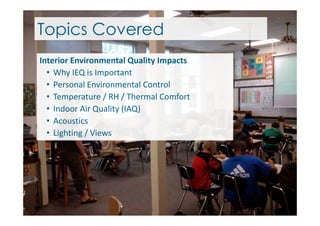
Interior Environmental Quality Impacts
• Why IEQ is Important
• Personal Environmental Control
• Temperature / RH / Thermal Comfort
• Indoor Air Quality (IAQ)
Topics Covered
• Indoor Air Quality (IAQ)
• Acoustics
• Lighting / Views
Poor IEQ Negatively Impacts Energy Performance
32
41
66
59
64
40
50
60
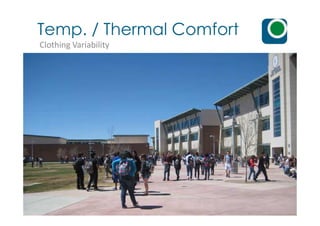
70
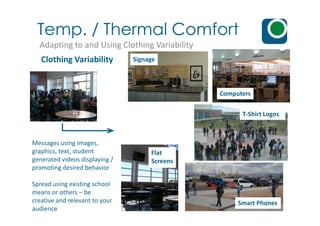
Why IEQ is Important
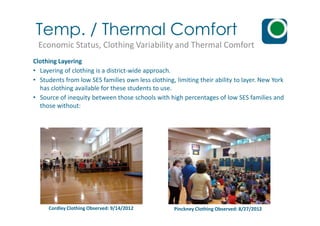
V. Sue Cleveland High School, Rio Rancho, NM
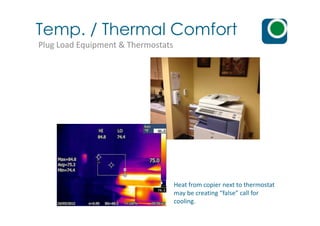
32
0
10
20
30
Design (energy
model)
Actual 2012-
2011
Target Finder
Average
Peer Group
Baseline Low
Peer Group
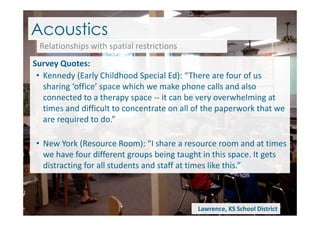
Baseline High
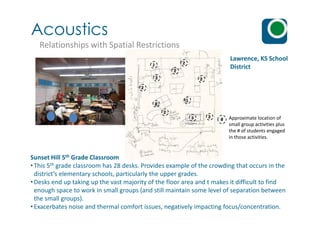
EUI
Why IEQ is Important
IEQ Impacts Productivity/Performance and Health
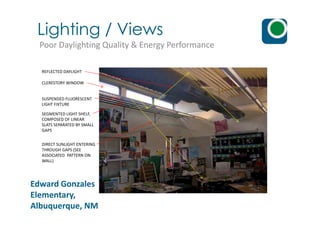
• A study of Chicago and Washington, DC schools found that better school
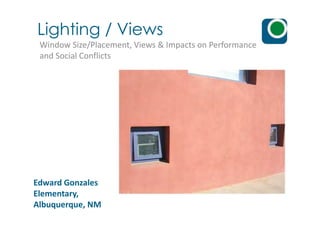
facilities can add 3 to 4 percentage points to a school’s standardized test
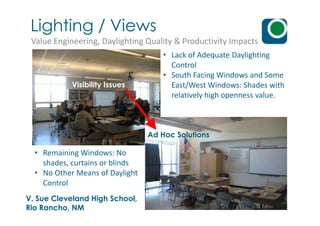
scores, even after controlling for demographic factors.
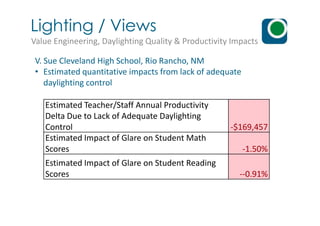
Schneider, Mark. “Public School Facilities and Teaching: Washington, DC and Chicago,”
November 2002. A Report Prepared for the Neighborhood Capital Budget Group (NCBG).
Available at: http://www.ncbg.org/press/press111302.htm.
• Based on actual improvements in design in green schools and based on a very
Kats, G. 2006 Greening America’s Schools: Costs and Benefits. Capital E. www.cap-e.com.
• Based on actual improvements in design in green schools and based on a very
substantial data set on productivity and test performance of healthier, more
comfortable study and learning environments, a 3-5% improvement in learning
ability and test scores in green schools appears reasonable and conservative.
We are designing 21st century
facilities for our stone-age
minds and bodies.
Our mental machinery and
Why IEQ is Important
We have stone age minds and bodies
Our mental machinery and
physiologies evolved for
exterior environmental input,
while growing up, learning
and living in small
communities.
Why IEQ is Important
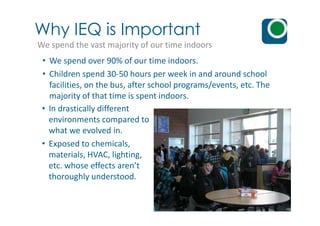
We spend the vast majority of our time indoors
• We spend over 90% of our time indoors.
• Children spend 30-50 hours per week in and around school
facilities, on the bus, after school programs/events, etc. The
majority of that time is spent indoors.
• In drastically different• In drastically different
environments compared to
what we evolved in.
• Exposed to chemicals,
materials, HVAC, lighting,
etc. whose effects aren’t
thoroughly understood.
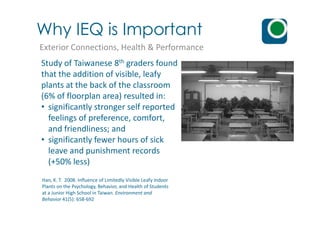
Exterior Connections, Health & Performance
Study of Taiwanese 8th graders found
that the addition of visible, leafy
plants at the back of the classroom
(6% of floorplan area) resulted in:
• significantly stronger self reported
feelings of preference, comfort,
Why IEQ is Important
feelings of preference, comfort,
and friendliness; and
• significantly fewer hours of sick
leave and punishment records
(+50% less)
Han, K. T. 2008. Influence of Limitedly Visible Leafy Indoor
Plants on the Psychology, Behavior, and Health of Students
at a Junior High School in Taiwan. Environment and
Behavior 41(5): 658-692
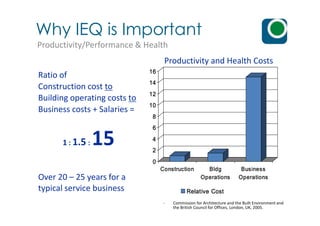
Ratio of
Construction cost to
Building operating costs to
Business costs + Salaries =
8888
10101010
12121212
14141414
16161616
Productivity and Health Costs
Why IEQ is Important
Productivity/Performance & Health
Business costs + Salaries =
1 : 1.5 : 15
Over 20 – 25 years for a
typical service business
- Commission for Architecture and the Built Environment and
the British Council for Offices, London, UK, 2005.
0000
2222
4444
6666
8888
ConstructionConstructionConstructionConstruction BldgBldgBldgBldg
OperationsOperationsOperationsOperations
BusinessBusinessBusinessBusiness
OperationsOperationsOperationsOperations
Relative CostRelative CostRelative CostRelative Cost
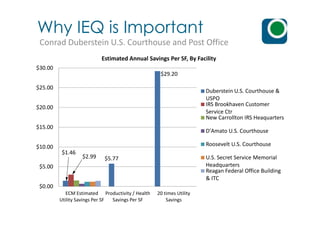
$29.20
$20.00
$25.00
$30.00
Estimated Annual Savings Per SF, By Facility
Duberstein U.S. Courthouse &
USPO
IRS Brookhaven Customer
Service Ctr
Conrad Duberstein U.S. Courthouse and Post Office
Why IEQ is Important
$1.46
$5.77$2.99
$0.00
$5.00
$10.00
$15.00
ECM Estimated
Utility Savings Per SF
Productivity / Health
Savings Per SF
20 times Utility
Savings
Service Ctr
New Carrollton IRS Heaquarters
D'Amato U.S. Courthouse
Roosevelt U.S. Courthouse
U.S. Secret Service Memorial
Headquarters
Reagan Federal Office Building
& ITC
Personal Control
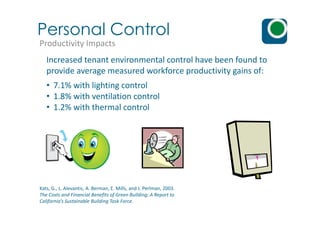
Increased tenant environmental control have been found to
provide average measured workforce productivity gains of:
• 7.1% with lighting control
• 1.8% with ventilation control
• 1.2% with thermal control
Productivity Impacts
Kats, G., L. Alevantis, A. Berman, E. Mills, and J. Perlman, 2003.
The Costs and Financial Benefits of Green Building: A Report to
California’s Sustainable Building Task Force.
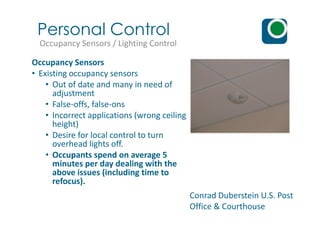
Occupancy Sensors
• Existing occupancy sensors
• Out of date and many in need of
adjustment
• False-offs, false-ons
• Incorrect applications (wrong ceiling
Personal Control
Occupancy Sensors / Lighting Control
Conrad Duberstein U.S. Post
Office & Courthouse
• Incorrect applications (wrong ceiling
height)
• Desire for local control to turn
overhead lights off.
• Occupants spend on average 5
minutes per day dealing with the
above issues (including time to
refocus).
Personal Control
Lighting Control
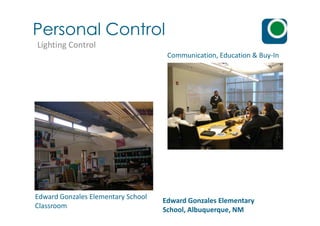
Communication, Education & Buy-In
Edward Gonzales Elementary School
Classroom
Edward Gonzales Elementary
School, Albuquerque, NM
Personal Control
Temperature Control & Thermal Comfort
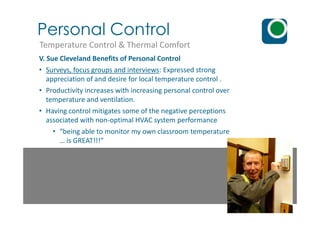
V. Sue Cleveland Benefits of Personal Control
• Surveys, focus groups and interviews: Expressed strong
appreciation of and desire for local temperature control .
• Productivity increases with increasing personal control over
temperature and ventilation.
• Having control mitigates some of the negative perceptions• Having control mitigates some of the negative perceptions
associated with non-optimal HVAC system performance
• “being able to monitor my own classroom temperature
… is GREAT!!!”
Personal Control
Temperature Control & Thermal Comfort
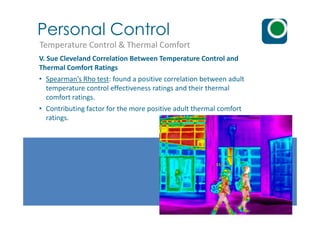
V. Sue Cleveland Correlation Between Temperature Control and
Thermal Comfort Ratings
• Spearman’s Rho test: found a positive correlation between adult
temperature control effectiveness ratings and their thermal
comfort ratings.
• Contributing factor for the more positive adult thermal comfort
ratings.ratings.
Temp. / Thermal Comfort
Impacts of Thermal Discomfort
• Energy Performance
• Productivity / Performance and Health
• Direct temperature impacts
• Thermal Comfort – Discomfort represented by non-
optimal temperature ranges have been shown to
decrease occupant performance / productivity on either
side of the optimal temperature range (68OF – 72OF) by
up to 9%.
• Wasted time contacting O&M
• Thermal comfort disputes
Source: Seppänen, O.,W. J. Fisk, and Q. H. Lei. 2006. Effect ofTemperature onTask Performance in Office Environment. Publication
No. LBNL-60946. Lawrence Berkeley National Laboratory , Berkeley,CA.
Source:Wargocki, P. and O. Seppänen, editors. 2006. Indoor Climate and Productivity in Offices, Guidebook No. 6. Rehva (Federation
of European Heating and Air-ConditioningAssociations), Brussels, Belgium.
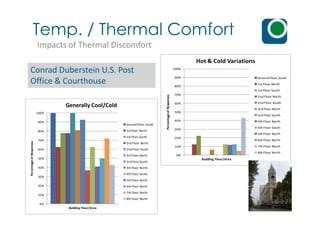
50%
60%
70%
80%
90%
100%
PercentageofResponses
Hot & Cold Variations
Ground Floor South
1stFloor North
1stFloor South
2nd Floor North
2nd Floor South
3rd Floor North
100%
Generally Cool/Cold
Conrad Duberstein U.S. Post
Office & Courthouse
Temp. / Thermal Comfort
Impacts of Thermal Discomfort
0%
10%
20%
30%
40%
50%
PercentageofResponses
Building Floor/Area
3rd Floor South
4th Floor North
4th Floor South
5th Floor North
6th Floor North
7th Floor North
8th Floor North
0%
10%
20%
30%
40%
50%
60%
70%
80%
90%
100%
PercentageofResponses
Building Floor/Area
Ground Floor South
1stFloor North
1stFloor South
2nd Floor North
2nd Floor South
3rd Floor North
3rd Floor South
4th Floor North
4th Floor South
5th Floor North
6th Floor North
7th Floor North
8th Floor North
• Productivity/performance loss due to temperature
variability: $67,500 annually.
• Productivity loss from contacting O&M: $825,000 annually.
Temp. / Thermal Comfort
Impacts of Thermal Discomfort
Conrad Duberstein U.S. Post
Office & Courthouse
• Thermal comfort conflicts: Estimated to equate to an
annual loss of $69,000 in productivity.
Temp. / Thermal Comfort
Impacts of Thermal Discomfort
Conrad Duberstein U.S. Post
Office & Courthouse
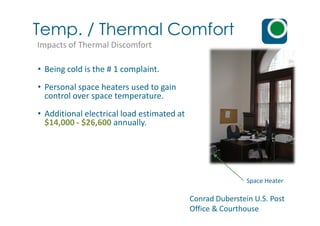
• Being cold is the # 1 complaint.
• Personal space heaters used to gain
control over space temperature.
• Additional electrical load estimated at
Temp. / Thermal Comfort
Impacts of Thermal Discomfort
• Additional electrical load estimated at
$14,000 - $26,600 annually.
Space Heater
Conrad Duberstein U.S. Post
Office & Courthouse
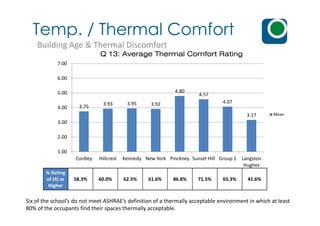
3.75
3.93 3.95 3.92
4.80
4.57
4.07
3.17
4.00
5.00
6.00
7.00
Q 13: Average Thermal Comfort Rating
Mean
Temp. / Thermal Comfort
Building Age & Thermal Discomfort
3.17
1.00
2.00
3.00
Cordley Hillcrest Kennedy New York Pinckney Sunset Hill Group 1 Langston
Hughes
Mean
% Rating
of (4) or
Higher
58.3% 60.0% 62.5% 61.6% 86.8% 71.5% 65.3% 41.6%
Six of the school’s do not meet ASHRAE’s definition of a thermally acceptable environment in which at least
80% of the occupants find their spaces thermally acceptable.
Temp. / Thermal Comfort
V. Sue Cleveland HS Thermal Comfort Ratings
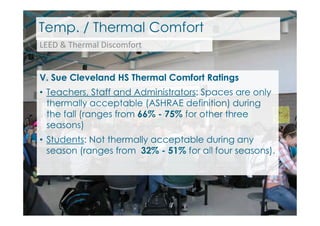
• Teachers, Staff and Administrators: Spaces are only
thermally acceptable (ASHRAE definition) during
the fall (ranges from 66% - 75% for other three
LEED & Thermal Discomfort
the fall (ranges from 66% - 75% for other three
seasons)
• Students: Not thermally acceptable during any
season (ranges from 32% - 51% for all four seasons).
Temp. / Thermal Comfort
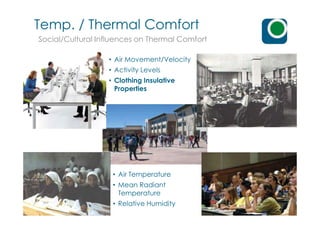
• Air Movement/Velocity
• Activity Levels
• Clothing Insulative
Properties
Social/Cultural Influences on Thermal Comfort
• Air Temperature
• Mean Radiant
Temperature
• Relative Humidity
Temp. / Thermal Comfort
Clothing Variability
Temp. / Thermal Comfort
Adapting to and Using Clothing Variability
Clothing Variability Signage
Computers
T-Shirt Logos
Flat
Screens
Smart Phones
T-Shirt Logos
Messages using images,
graphics, text, student
generated videos displaying /
promoting desired behavior
Spread using existing school
means or others – be
creative and relevant to your
audience
Temp. / Thermal Comfort
Economic Status, Clothing Variability and Thermal Comfort
Clothing Layering
• Layering of clothing is a district-wide approach.
• Students from low SES families own less clothing, limiting their ability to layer. New York
has clothing available for these students to use.
• Source of inequity between those schools with high percentages of low SES families and
those without:
Pinckney Clothing Observed: 8/27/2012Cordley Clothing Observed: 9/14/2012
Temp. / Thermal Comfort
Plug Load Equipment & Thermostats
Heat from copier next to thermostat
may be creating “false” call for
cooling.
U.S. Business IAQ Improvements:
• save up to $58 billion in lost sick time
• save additional $200 billion in worker
performance.
Indoor Air Quality (IAQ)
Savings to U.S. Businesses
performance.
- Fisk,W. G. 2000, Health and Productivity Gains from
Better Indoor Environments andTheir Relationship
with Building Energy Efficiency. Annual Review of
Energy and Environment 25(1):537-566. Later
updated for 2002 dollars.
Indoor Air Quality (IAQ)
Impacts
• Schools with high IAQ total scores and a high Healthy Greenness School
Index (GSI) were more likely to have high student attendance rates (36% and
22% respectively).
• Schools with well maintained air filters were also 42% more likely to have
good 4th grade academic performance.
Lin, S., C. Kielb, A. Orsini & N. Muscatiello The Evaluation of Green School Building
Attributes and Their Effect on the Health and Performance of Students and Teachers inAttributes and Their Effect on the Health and Performance of Students and Teachers in
New York State. Final Project Report - Proposal Number: #147 funded by the US Green
Building Council. http://www.usgbc.org/ShowFile.aspx?DocumentID=8627.
Illinois Healthy Schools Campaign, “Apparently Size Doesn’t Matter: Two Illinois School
Districts Show Successful IAQ Management.” School Health Watch, Summer 2003.
http://healthyschoolscampaign.org/news/newsletter/2003-summer_HSC-newsletter.pdf.
Also see: US Environmental Protection Agency. “IAQ Tools for Schools,” December 2000
(Second Edition). Available at: http://www.epa.gov/iaq/schools/.
• An analysis of two school districts in Illinois found that student attendance
rose by 5% after incorporating cost effective indoor air quality improvements.
Indoor Air Quality (IAQ)
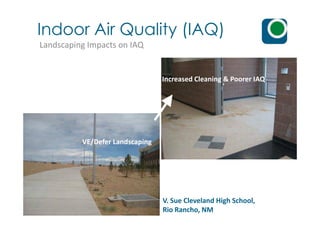
Landscaping Impacts on IAQ
Increased Cleaning & Poorer IAQ
VE/Defer Landscaping
V. Sue Cleveland High School,
Rio Rancho, NM
2.00
2.50
3.00
3.50
4.00
4.50
5.00
Indoor Air Quality (IAQ)
Construction Impacts on IAQ
Classroom Teacher: the trains leave their engines
[idling] and the smoke enters the classroom
Fall Winter Spring Summer
Teachers & Staff 3.30 3.22 3.67 3.63
Standard Deviation 1.42 1.39 0.87 1.06
0.50
1.00
1.50
2.00
Teachers/Admin/Staff average ratings of IAQ
in their primary classroom or work area
(standard deviation also shown)
Gap between screen frame and window
frame
4.67
4.43 4.43
5.25
5.00
6.00
7.00
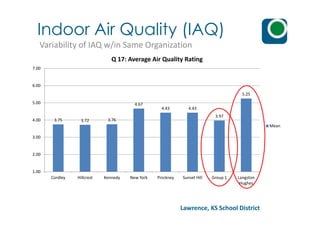
Q 17: Average Air Quality Rating
Indoor Air Quality (IAQ)
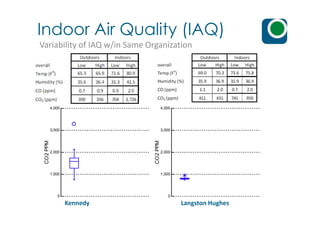
Variability of IAQ w/in Same Organization
Lawrence, KS School District
3.75 3.72 3.76
3.97
1.00
2.00
3.00
4.00
Cordley Hillcrest Kennedy New York Pinckney Sunset Hill Group 1 Langston
Hughes
Mean
• CO2 maximum of 1,000 ppm, and not exceeding the outdoor concentration
by more than about 650 ppm when the exterior outdoor CO2
concentration is 380 ppm.
• Based on studies linking CO2 levels above these limits to drowsiness,
lethargy, poor concentration, respiratory ailments, headaches, and other
negative health impacts.
Indoor Air Quality (IAQ)
ASHRAE Design Standards for Schools
negative health impacts.
• These negative impacts are not necessarily a direct result of the CO2 levels
found indoors (typically less than 5000 ppm), but the higher pollution rates
in general that occur as a result of not having enough outside air, or
adequate ventilation.
• ASHRAE ventilation requirements are intended to provide enough fresh air
to dilute interior pollutants, and the CO2 levels end up being a good way to
measure if you have adequate ventilation inside your buildings.
4,000 4,000
Indoor Air Quality (IAQ)
Variability of IAQ w/in Same Organization
0
1,000
2,000
3,000
CO2PPM
0
1,000
2,000
3,000
CO2PPM
Kennedy Langston Hughes
Acoustics
Impacts of Noise and Inaudibility
• Center for the Built Environment’s survey of 23,450 respondents
from 142 buildings found over 50% of cubicle occupants (30% of
private office occupants) expressed that acoustics impact their work.
Jensen, K. L., Arens, E., & Zagreus, L. (2005). Acoustical Quality in Office Workstations,
as Assessed by Occupant Surveys. Indoor Air, (pp. 2401-2405).
• When conversational noise was reduced and speech privacy• When conversational noise was reduced and speech privacy
increased,
• the ability of office workers to focus on tasks improved by 48%,
• performance of tasks relating to accuracy and memory
improved by 10% and
• the physical symptoms of stress such as high blood pressure and
increased heart rate were reduced by 27%
Sykes, D. M. (2004). Productivity: How Acoustics Affect Workers’ Performance In Offices
& Open Areas. Retrieved February 1, 2009, from Office Sound Masking Solutions, by
Speech Privacy Systems. www.speechprivacysystems.com/files/Productivity.pdf.
Acoustics
Julian Treasure: Why architects need to use their ears
• http://www.ted.com/talks/julian_treasure_why_architects_need_to_use_th
eir_ears.html
Acoustics
Standards / Recommendations & Impacts
American National Standards Institute (ANSI) S12.60-2002, Acoustical Performance Criteria,
Design Requirements and Guidelines for Schools standard
• Unoccupied classroom levels must not exceed 35 dBA
• The signal-to-noise ratio (the difference between the teacher's voice and the background
noise) should be at least +15 dB at the child's ears.
• Unoccupied classroom reverberation must not surpass 0.6 seconds in smaller classrooms
or 0.7 seconds in larger rooms.
World Health Organization (WHO, 1980)World Health Organization (WHO, 1980)
• recommends a background noise level lower than 45 db(A) for good speech intelligibility
--the ability to understand others.
ASHRAE
• suggests a noise level less than 45db(A) for open plan offices
Impacts
• Intelligibility, understanding and learning
• Focus and concentration
• Stress
• Voice strain
• Privacy
Acoustics
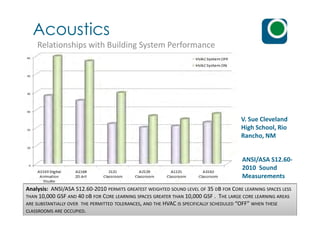
Relationships with Building System Performance
ANSI/ASA S12.60-
2010 Sound
Measurements
Analysis: ANSI/ASA S12.60-2010 PERMITS GREATEST WEIGHTED SOUND LEVEL OF 35 DB FOR CORE LEARNING SPACES LESS
THAN 10,000 GSF AND 40 DB FOR CORE LEARNING SPACES GREATER THAN 10,000 GSF . THE LARGE CORE LEARNING AREAS
ARE SUBSTANTIALLY OVER THE PERMITTED TOLERANCES, AND THE HVAC IS SPECIFICALLY SCHEDULED “OFF” WHEN THESE
CLASSROOMS ARE OCCUPIED.
V. Sue Cleveland
High School, Rio
Rancho, NM
Acoustics
Relationships to building system performance
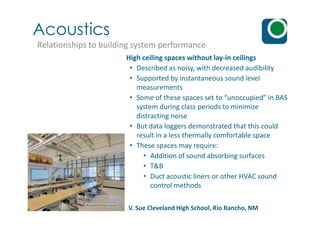
High ceiling spaces without lay-in ceilings
• Described as noisy, with decreased audibility
• Supported by instantaneous sound level
measurements
• Some of these spaces set to “unoccupied” in BAS
system during class periods to minimize
distracting noisedistracting noise
• But data loggers demonstrated that this could
result in a less thermally comfortable space
• These spaces may require:
• Addition of sound absorbing surfaces
• T&B
• Duct acoustic liners or other HVAC sound
control methods
V. Sue Cleveland High School, Rio Rancho, NM
Acoustics
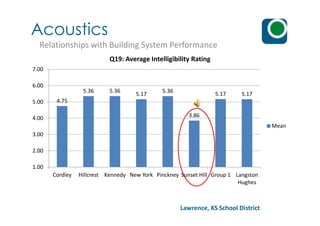
Relationships with Building System Performance
4.75
5.36 5.36
5.17
5.36
3.86
5.17 5.17
5.00
6.00
7.00
Q19: Average Intelligibility Rating
3.86
1.00
2.00
3.00
4.00
Cordley Hillcrest Kennedy New York Pinckney Sunset Hill Group 1 Langston
Hughes
Mean
Lawrence, KS School District
Acoustics
Relationships with spatial restrictions
Survey Quotes:
• Kennedy (Early Childhood Special Ed): “There are four of us
sharing ‘office’ space which we make phone calls and also
connected to a therapy space -- it can be very overwhelming at
times and difficult to concentrate on all of the paperwork that we
are required to do.”
• New York (Resource Room): “I share a resource room and at times
we have four different groups being taught in this space. It gets
distracting for all students and staff at times like this.”
Lawrence, KS School District
Acoustics
Relationships with Spatial Restrictions
2
1
2
2
2
2
2
2
2
Lawrence, KS School
District
Sunset Hill 5th Grade Classroom
•This 5th grade classroom has 28 desks. Provides example of the crowding that occurs in the
district’s elementary schools, particularly the upper grades.
•Desks end up taking up the vast majority of the floor area and t makes it difficult to find
enough space to work in small groups (and still maintain some level of separation between
the small groups).
•Exacerbates noise and thermal comfort issues, negatively impacting focus/concentration.
# Approximate location of
small group activities plus
the # of students engaged
in those activities.
2
23
Lighting / Views
Daylighting Impacts
Compared to little or no daylighting,
classrooms with appropriate
daylighting may increase the rate of
student learning by:
• 20% in math
• 26% in reading• 26% in reading
Heschong Mahone Group. 1999. Daylighting in Schools:
An Investigation into the Relationship Between Daylight
and Human Performance. Report submitted to Pacific Gas
and Electric. http://www.h-m-g.com.
Lighting / Views
View Impacts
28% of U.S. workers say they can’t see the outdoors from their work
space; they’re also 86% more likely to be actively disengaged than
those who have a view of the outside from their desk or station
Gallup
Workers in a Call Center were found to process calls 6% to 12% faster
when they had the best possible view versus those with no view.when they had the best possible view versus those with no view.
Heschong Mahone Group, Inc. (2003). Windows and offices: a study of student
performance and the indoor environment. California Energy Commission:
Sacramento, California.
Office workers were found to perform 10% to 25% better on tests of
mental function and memory recall when they had the best possible
view versus those with no view.
Heschong Mahone Group, Inc. (2003). Windows and offices: a study of student
performance and the indoor environment. California Energy Commission:
Sacramento, California.
CLERESTORY WINDOW
SEGMENTED LIGHT SHELF,
SUSPENDED FLUORESCENT
LIGHT FIXTURE
REFLECTED DAYLIGHT
Lighting / Views
Poor Daylighting Quality & Energy Performance
SEGMENTED LIGHT SHELF,
COMPOSED OF LINEAR
SLATS SEPARATED BY SMALL
GAPS
DIRECT SUNLIGHT ENTERING
THROUGH GAPS (SEE
ASSOCIATED PATTERN ON
WALL)
Edward Gonzales
Elementary,
Albuquerque, NM
Lighting / Views
Window Size/Placement, Views & Impacts on Performance
and Social Conflicts
Edward Gonzales
Elementary,
Albuquerque, NM
Visibility Issues
• Lack of Adequate Daylighting
Control
• South Facing Windows and Some
East/West Windows: Shades with
relatively high openness value.
Lighting / Views
Value Engineering, Daylighting Quality & Productivity Impacts
V. Sue Cleveland High School,
Rio Rancho, NM
Ad Hoc Solutions
• Remaining Windows: No
shades, curtains or blinds
• No Other Means of Daylight
Control
V. Sue Cleveland High School, Rio Rancho, NM
• Estimated quantitative impacts from lack of adequate
daylighting control
Estimated Teacher/Staff Annual Productivity
Delta Due to Lack of Adequate Daylighting
Lighting / Views
Value Engineering, Daylighting Quality & Productivity Impacts
Delta Due to Lack of Adequate Daylighting
Control -$169,457
Estimated Impact of Glare on Student Math
Scores -1.50%
Estimated Impact of Glare on Student Reading
Scores --0.91%
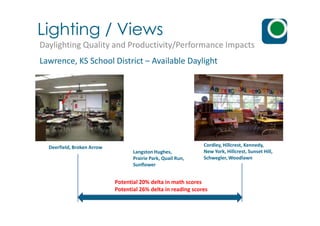
Lawrence, KS School District – Available Daylight
Lighting / Views
Daylighting Quality and Productivity/Performance Impacts
Deerfield, Broken Arrow Cordley, Hillcrest, Kennedy,
New York, Hillcrest, Sunset Hill,
Schwegler, Woodlawn
Langston Hughes,
Prairie Park, Quail Run,
Sunflower
Potential 20% delta in math scores
Potential 26% delta in reading scores
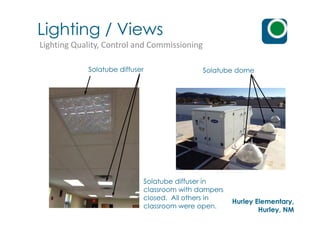
Solatube diffuser Solatube dome
Lighting / Views
Lighting Quality, Control and Commissioning
Solatube diffuser in
classroom with dampers
closed. All others in
classroom were open.
Hurley Elementary,
Hurley, NM
References
American National Standards Institute (ANSI) S12.60-2002, Acoustical Performance Criteria,
Design Requirements and Guidelines for Schools standard
http://www.asha.org/public/hearing/American-National-Standard-on-Classroom-Acoustics/
http://acousticalsociety.org/about_acoustics/acoustics_of_classrooms
Committee to Review and Assess the Health and Productivity Benefits of Green Schools
(National Research Council, 2006:65-66).
Heschong Mahone Group. 1999. Daylighting in Schools: An Investigation into the Relationship
Between Daylight and Human Performance. Report submitted to Pacific Gas and Electric.
http://www.h-m-g.com.
Illinois Healthy Schools Campaign, “Apparently Size Doesn’t Matter: Two Illinois School Districts
Show Successful IAQ Management.” School Health Watch, Summer 2003.
http://healthyschoolscampaign.org/news/newsletter/2003-summer_HSC-newsletter.pdf.
Also see: US Environmental Protection Agency. “IAQ Tools for Schools,” December 2000
(Second Edition). Available at: http://www.epa.gov/iaq/schools/.
Kanarek, R. (1997) Psychological Effects of Snacks and Altered Meal Frequency. British Journal
of Nutrition 77, Suppl. 1:S105-S120.
Kats, G. 2006 Greening America’s Schools: Costs and Benefits. Capital E. www.cap-e.com.
Kats, G., L. Alevantis, A. Berman, E. Mills, and J. Perlman, 2003. The Costs and Financial
Benefits of Green Building: A Report to California’s Sustainable Building Task Force.
References
Lin, S., C. Kielb, A. Orsini & N. Muscatiello The Evaluation of Green School Building Attributes
and Their Effect on the Health and Performance of Students and Teachers in New York State.
Final Project Report - Proposal Number: #147 funded by the US Green Building Council.
http://www.usgbc.org/ShowFile.aspx?DocumentID=8627.
Schneider, Mark. “Public School Facilities and Teaching: Washington, DC and Chicago,”
November 2002. A Report Prepared for the Neighborhood Capital Budget Group (NCBG).
Available at: http://www.ncbg.org/press/press111302.htm.
Smith, A. and A. Maben (1992) Effects of Sleep Deprivation, Lunch, and Personality on
Performance, Mood, and Cardiovascular Function. Physiology & Behavior 54:967-972
Treasure, J. Why architects need to use their ears. TED Talk
http://www.ted.com/talks/julian_treasure_why_architects_need_to_use_their_ears.html
USA Today Special Report: The Smokestack Effect - Toxicity and America’s Schools
http://content.usatoday.com/news/nation/environment/smokestack/index
Why Environmental Health Matters in Schools - EPA Webinar: 10/17/2012 -
https://esbuildings.webex.com/mw0307l/mywebex/default.do?siteurl=esbuildings.
Wilson, D. S. (2011) The Neighborhood Project: Using Evolution to Improve My City, One Block
at a Time. Hachette Book Group, New York, NY.
Wilson, D. S., D. Tumminelli O'Briena and A. Sesmac (2009) Human Prosociality From an
Evolutionary Perspective: Variation and Correlations at a City-Wide Scale. Evolution and
Human Behavior 30:190–200.

Sustainable building fundamentals class 2013

  • 1.
    IEQ: Interior EnvironmentalQuality CET 160; Fall 2013 Sustainable Building Fundamentals Guest Speaker: Marcel Harmon, PhD, PE, LEED-AP O+M GENUINE | PROGRESSIVE | ADVOCATES
  • 2.
    Interior Environmental QualityImpacts • Why IEQ is Important • Personal Environmental Control • Temperature / RH / Thermal Comfort • Indoor Air Quality (IAQ) Topics Covered • Indoor Air Quality (IAQ) • Acoustics • Lighting / Views
  • 3.
    Poor IEQ NegativelyImpacts Energy Performance 32 41 66 59 64 40 50 60 70 Why IEQ is Important V. Sue Cleveland High School, Rio Rancho, NM 32 0 10 20 30 Design (energy model) Actual 2012- 2011 Target Finder Average Peer Group Baseline Low Peer Group Baseline High EUI
  • 4.
    Why IEQ isImportant IEQ Impacts Productivity/Performance and Health • A study of Chicago and Washington, DC schools found that better school facilities can add 3 to 4 percentage points to a school’s standardized test scores, even after controlling for demographic factors. Schneider, Mark. “Public School Facilities and Teaching: Washington, DC and Chicago,” November 2002. A Report Prepared for the Neighborhood Capital Budget Group (NCBG). Available at: http://www.ncbg.org/press/press111302.htm. • Based on actual improvements in design in green schools and based on a very Kats, G. 2006 Greening America’s Schools: Costs and Benefits. Capital E. www.cap-e.com. • Based on actual improvements in design in green schools and based on a very substantial data set on productivity and test performance of healthier, more comfortable study and learning environments, a 3-5% improvement in learning ability and test scores in green schools appears reasonable and conservative.
  • 5.
    We are designing21st century facilities for our stone-age minds and bodies. Our mental machinery and Why IEQ is Important We have stone age minds and bodies Our mental machinery and physiologies evolved for exterior environmental input, while growing up, learning and living in small communities.
  • 6.
    Why IEQ isImportant We spend the vast majority of our time indoors • We spend over 90% of our time indoors. • Children spend 30-50 hours per week in and around school facilities, on the bus, after school programs/events, etc. The majority of that time is spent indoors. • In drastically different• In drastically different environments compared to what we evolved in. • Exposed to chemicals, materials, HVAC, lighting, etc. whose effects aren’t thoroughly understood.
  • 7.
    Exterior Connections, Health& Performance Study of Taiwanese 8th graders found that the addition of visible, leafy plants at the back of the classroom (6% of floorplan area) resulted in: • significantly stronger self reported feelings of preference, comfort, Why IEQ is Important feelings of preference, comfort, and friendliness; and • significantly fewer hours of sick leave and punishment records (+50% less) Han, K. T. 2008. Influence of Limitedly Visible Leafy Indoor Plants on the Psychology, Behavior, and Health of Students at a Junior High School in Taiwan. Environment and Behavior 41(5): 658-692
  • 8.
    Ratio of Construction costto Building operating costs to Business costs + Salaries = 8888 10101010 12121212 14141414 16161616 Productivity and Health Costs Why IEQ is Important Productivity/Performance & Health Business costs + Salaries = 1 : 1.5 : 15 Over 20 – 25 years for a typical service business - Commission for Architecture and the Built Environment and the British Council for Offices, London, UK, 2005. 0000 2222 4444 6666 8888 ConstructionConstructionConstructionConstruction BldgBldgBldgBldg OperationsOperationsOperationsOperations BusinessBusinessBusinessBusiness OperationsOperationsOperationsOperations Relative CostRelative CostRelative CostRelative Cost
  • 9.
    $29.20 $20.00 $25.00 $30.00 Estimated Annual SavingsPer SF, By Facility Duberstein U.S. Courthouse & USPO IRS Brookhaven Customer Service Ctr Conrad Duberstein U.S. Courthouse and Post Office Why IEQ is Important $1.46 $5.77$2.99 $0.00 $5.00 $10.00 $15.00 ECM Estimated Utility Savings Per SF Productivity / Health Savings Per SF 20 times Utility Savings Service Ctr New Carrollton IRS Heaquarters D'Amato U.S. Courthouse Roosevelt U.S. Courthouse U.S. Secret Service Memorial Headquarters Reagan Federal Office Building & ITC
  • 10.
    Personal Control Increased tenantenvironmental control have been found to provide average measured workforce productivity gains of: • 7.1% with lighting control • 1.8% with ventilation control • 1.2% with thermal control Productivity Impacts Kats, G., L. Alevantis, A. Berman, E. Mills, and J. Perlman, 2003. The Costs and Financial Benefits of Green Building: A Report to California’s Sustainable Building Task Force.
  • 11.
    Occupancy Sensors • Existingoccupancy sensors • Out of date and many in need of adjustment • False-offs, false-ons • Incorrect applications (wrong ceiling Personal Control Occupancy Sensors / Lighting Control Conrad Duberstein U.S. Post Office & Courthouse • Incorrect applications (wrong ceiling height) • Desire for local control to turn overhead lights off. • Occupants spend on average 5 minutes per day dealing with the above issues (including time to refocus).
  • 12.
    Personal Control Lighting Control Communication,Education & Buy-In Edward Gonzales Elementary School Classroom Edward Gonzales Elementary School, Albuquerque, NM
  • 13.
    Personal Control Temperature Control& Thermal Comfort V. Sue Cleveland Benefits of Personal Control • Surveys, focus groups and interviews: Expressed strong appreciation of and desire for local temperature control . • Productivity increases with increasing personal control over temperature and ventilation. • Having control mitigates some of the negative perceptions• Having control mitigates some of the negative perceptions associated with non-optimal HVAC system performance • “being able to monitor my own classroom temperature … is GREAT!!!”
  • 14.
    Personal Control Temperature Control& Thermal Comfort V. Sue Cleveland Correlation Between Temperature Control and Thermal Comfort Ratings • Spearman’s Rho test: found a positive correlation between adult temperature control effectiveness ratings and their thermal comfort ratings. • Contributing factor for the more positive adult thermal comfort ratings.ratings.
  • 15.
    Temp. / ThermalComfort Impacts of Thermal Discomfort • Energy Performance • Productivity / Performance and Health • Direct temperature impacts • Thermal Comfort – Discomfort represented by non- optimal temperature ranges have been shown to decrease occupant performance / productivity on either side of the optimal temperature range (68OF – 72OF) by up to 9%. • Wasted time contacting O&M • Thermal comfort disputes Source: Seppänen, O.,W. J. Fisk, and Q. H. Lei. 2006. Effect ofTemperature onTask Performance in Office Environment. Publication No. LBNL-60946. Lawrence Berkeley National Laboratory , Berkeley,CA. Source:Wargocki, P. and O. Seppänen, editors. 2006. Indoor Climate and Productivity in Offices, Guidebook No. 6. Rehva (Federation of European Heating and Air-ConditioningAssociations), Brussels, Belgium.
  • 16.
    50% 60% 70% 80% 90% 100% PercentageofResponses Hot & ColdVariations Ground Floor South 1stFloor North 1stFloor South 2nd Floor North 2nd Floor South 3rd Floor North 100% Generally Cool/Cold Conrad Duberstein U.S. Post Office & Courthouse Temp. / Thermal Comfort Impacts of Thermal Discomfort 0% 10% 20% 30% 40% 50% PercentageofResponses Building Floor/Area 3rd Floor South 4th Floor North 4th Floor South 5th Floor North 6th Floor North 7th Floor North 8th Floor North 0% 10% 20% 30% 40% 50% 60% 70% 80% 90% 100% PercentageofResponses Building Floor/Area Ground Floor South 1stFloor North 1stFloor South 2nd Floor North 2nd Floor South 3rd Floor North 3rd Floor South 4th Floor North 4th Floor South 5th Floor North 6th Floor North 7th Floor North 8th Floor North
  • 17.
    • Productivity/performance lossdue to temperature variability: $67,500 annually. • Productivity loss from contacting O&M: $825,000 annually. Temp. / Thermal Comfort Impacts of Thermal Discomfort Conrad Duberstein U.S. Post Office & Courthouse
  • 18.
    • Thermal comfortconflicts: Estimated to equate to an annual loss of $69,000 in productivity. Temp. / Thermal Comfort Impacts of Thermal Discomfort Conrad Duberstein U.S. Post Office & Courthouse
  • 19.
    • Being coldis the # 1 complaint. • Personal space heaters used to gain control over space temperature. • Additional electrical load estimated at Temp. / Thermal Comfort Impacts of Thermal Discomfort • Additional electrical load estimated at $14,000 - $26,600 annually. Space Heater Conrad Duberstein U.S. Post Office & Courthouse
  • 20.
    3.75 3.93 3.95 3.92 4.80 4.57 4.07 3.17 4.00 5.00 6.00 7.00 Q13: Average Thermal Comfort Rating Mean Temp. / Thermal Comfort Building Age & Thermal Discomfort 3.17 1.00 2.00 3.00 Cordley Hillcrest Kennedy New York Pinckney Sunset Hill Group 1 Langston Hughes Mean % Rating of (4) or Higher 58.3% 60.0% 62.5% 61.6% 86.8% 71.5% 65.3% 41.6% Six of the school’s do not meet ASHRAE’s definition of a thermally acceptable environment in which at least 80% of the occupants find their spaces thermally acceptable.
  • 21.
    Temp. / ThermalComfort V. Sue Cleveland HS Thermal Comfort Ratings • Teachers, Staff and Administrators: Spaces are only thermally acceptable (ASHRAE definition) during the fall (ranges from 66% - 75% for other three LEED & Thermal Discomfort the fall (ranges from 66% - 75% for other three seasons) • Students: Not thermally acceptable during any season (ranges from 32% - 51% for all four seasons).
  • 22.
    Temp. / ThermalComfort • Air Movement/Velocity • Activity Levels • Clothing Insulative Properties Social/Cultural Influences on Thermal Comfort • Air Temperature • Mean Radiant Temperature • Relative Humidity
  • 23.
    Temp. / ThermalComfort Clothing Variability
  • 24.
    Temp. / ThermalComfort Adapting to and Using Clothing Variability Clothing Variability Signage Computers T-Shirt Logos Flat Screens Smart Phones T-Shirt Logos Messages using images, graphics, text, student generated videos displaying / promoting desired behavior Spread using existing school means or others – be creative and relevant to your audience
  • 25.
    Temp. / ThermalComfort Economic Status, Clothing Variability and Thermal Comfort Clothing Layering • Layering of clothing is a district-wide approach. • Students from low SES families own less clothing, limiting their ability to layer. New York has clothing available for these students to use. • Source of inequity between those schools with high percentages of low SES families and those without: Pinckney Clothing Observed: 8/27/2012Cordley Clothing Observed: 9/14/2012
  • 26.
    Temp. / ThermalComfort Plug Load Equipment & Thermostats Heat from copier next to thermostat may be creating “false” call for cooling.
  • 27.
    U.S. Business IAQImprovements: • save up to $58 billion in lost sick time • save additional $200 billion in worker performance. Indoor Air Quality (IAQ) Savings to U.S. Businesses performance. - Fisk,W. G. 2000, Health and Productivity Gains from Better Indoor Environments andTheir Relationship with Building Energy Efficiency. Annual Review of Energy and Environment 25(1):537-566. Later updated for 2002 dollars.
  • 28.
    Indoor Air Quality(IAQ) Impacts • Schools with high IAQ total scores and a high Healthy Greenness School Index (GSI) were more likely to have high student attendance rates (36% and 22% respectively). • Schools with well maintained air filters were also 42% more likely to have good 4th grade academic performance. Lin, S., C. Kielb, A. Orsini & N. Muscatiello The Evaluation of Green School Building Attributes and Their Effect on the Health and Performance of Students and Teachers inAttributes and Their Effect on the Health and Performance of Students and Teachers in New York State. Final Project Report - Proposal Number: #147 funded by the US Green Building Council. http://www.usgbc.org/ShowFile.aspx?DocumentID=8627. Illinois Healthy Schools Campaign, “Apparently Size Doesn’t Matter: Two Illinois School Districts Show Successful IAQ Management.” School Health Watch, Summer 2003. http://healthyschoolscampaign.org/news/newsletter/2003-summer_HSC-newsletter.pdf. Also see: US Environmental Protection Agency. “IAQ Tools for Schools,” December 2000 (Second Edition). Available at: http://www.epa.gov/iaq/schools/. • An analysis of two school districts in Illinois found that student attendance rose by 5% after incorporating cost effective indoor air quality improvements.
  • 29.
    Indoor Air Quality(IAQ) Landscaping Impacts on IAQ Increased Cleaning & Poorer IAQ VE/Defer Landscaping V. Sue Cleveland High School, Rio Rancho, NM
  • 30.
    2.00 2.50 3.00 3.50 4.00 4.50 5.00 Indoor Air Quality(IAQ) Construction Impacts on IAQ Classroom Teacher: the trains leave their engines [idling] and the smoke enters the classroom Fall Winter Spring Summer Teachers & Staff 3.30 3.22 3.67 3.63 Standard Deviation 1.42 1.39 0.87 1.06 0.50 1.00 1.50 2.00 Teachers/Admin/Staff average ratings of IAQ in their primary classroom or work area (standard deviation also shown) Gap between screen frame and window frame
  • 31.
    4.67 4.43 4.43 5.25 5.00 6.00 7.00 Q 17:Average Air Quality Rating Indoor Air Quality (IAQ) Variability of IAQ w/in Same Organization Lawrence, KS School District 3.75 3.72 3.76 3.97 1.00 2.00 3.00 4.00 Cordley Hillcrest Kennedy New York Pinckney Sunset Hill Group 1 Langston Hughes Mean
  • 32.
    • CO2 maximumof 1,000 ppm, and not exceeding the outdoor concentration by more than about 650 ppm when the exterior outdoor CO2 concentration is 380 ppm. • Based on studies linking CO2 levels above these limits to drowsiness, lethargy, poor concentration, respiratory ailments, headaches, and other negative health impacts. Indoor Air Quality (IAQ) ASHRAE Design Standards for Schools negative health impacts. • These negative impacts are not necessarily a direct result of the CO2 levels found indoors (typically less than 5000 ppm), but the higher pollution rates in general that occur as a result of not having enough outside air, or adequate ventilation. • ASHRAE ventilation requirements are intended to provide enough fresh air to dilute interior pollutants, and the CO2 levels end up being a good way to measure if you have adequate ventilation inside your buildings.
  • 33.
    4,000 4,000 Indoor AirQuality (IAQ) Variability of IAQ w/in Same Organization 0 1,000 2,000 3,000 CO2PPM 0 1,000 2,000 3,000 CO2PPM Kennedy Langston Hughes
  • 34.
    Acoustics Impacts of Noiseand Inaudibility • Center for the Built Environment’s survey of 23,450 respondents from 142 buildings found over 50% of cubicle occupants (30% of private office occupants) expressed that acoustics impact their work. Jensen, K. L., Arens, E., & Zagreus, L. (2005). Acoustical Quality in Office Workstations, as Assessed by Occupant Surveys. Indoor Air, (pp. 2401-2405). • When conversational noise was reduced and speech privacy• When conversational noise was reduced and speech privacy increased, • the ability of office workers to focus on tasks improved by 48%, • performance of tasks relating to accuracy and memory improved by 10% and • the physical symptoms of stress such as high blood pressure and increased heart rate were reduced by 27% Sykes, D. M. (2004). Productivity: How Acoustics Affect Workers’ Performance In Offices & Open Areas. Retrieved February 1, 2009, from Office Sound Masking Solutions, by Speech Privacy Systems. www.speechprivacysystems.com/files/Productivity.pdf.
  • 35.
    Acoustics Julian Treasure: Whyarchitects need to use their ears • http://www.ted.com/talks/julian_treasure_why_architects_need_to_use_th eir_ears.html
  • 36.
    Acoustics Standards / Recommendations& Impacts American National Standards Institute (ANSI) S12.60-2002, Acoustical Performance Criteria, Design Requirements and Guidelines for Schools standard • Unoccupied classroom levels must not exceed 35 dBA • The signal-to-noise ratio (the difference between the teacher's voice and the background noise) should be at least +15 dB at the child's ears. • Unoccupied classroom reverberation must not surpass 0.6 seconds in smaller classrooms or 0.7 seconds in larger rooms. World Health Organization (WHO, 1980)World Health Organization (WHO, 1980) • recommends a background noise level lower than 45 db(A) for good speech intelligibility --the ability to understand others. ASHRAE • suggests a noise level less than 45db(A) for open plan offices Impacts • Intelligibility, understanding and learning • Focus and concentration • Stress • Voice strain • Privacy
  • 37.
    Acoustics Relationships with BuildingSystem Performance ANSI/ASA S12.60- 2010 Sound Measurements Analysis: ANSI/ASA S12.60-2010 PERMITS GREATEST WEIGHTED SOUND LEVEL OF 35 DB FOR CORE LEARNING SPACES LESS THAN 10,000 GSF AND 40 DB FOR CORE LEARNING SPACES GREATER THAN 10,000 GSF . THE LARGE CORE LEARNING AREAS ARE SUBSTANTIALLY OVER THE PERMITTED TOLERANCES, AND THE HVAC IS SPECIFICALLY SCHEDULED “OFF” WHEN THESE CLASSROOMS ARE OCCUPIED. V. Sue Cleveland High School, Rio Rancho, NM
  • 38.
    Acoustics Relationships to buildingsystem performance High ceiling spaces without lay-in ceilings • Described as noisy, with decreased audibility • Supported by instantaneous sound level measurements • Some of these spaces set to “unoccupied” in BAS system during class periods to minimize distracting noisedistracting noise • But data loggers demonstrated that this could result in a less thermally comfortable space • These spaces may require: • Addition of sound absorbing surfaces • T&B • Duct acoustic liners or other HVAC sound control methods V. Sue Cleveland High School, Rio Rancho, NM
  • 39.
    Acoustics Relationships with BuildingSystem Performance 4.75 5.36 5.36 5.17 5.36 3.86 5.17 5.17 5.00 6.00 7.00 Q19: Average Intelligibility Rating 3.86 1.00 2.00 3.00 4.00 Cordley Hillcrest Kennedy New York Pinckney Sunset Hill Group 1 Langston Hughes Mean Lawrence, KS School District
  • 40.
    Acoustics Relationships with spatialrestrictions Survey Quotes: • Kennedy (Early Childhood Special Ed): “There are four of us sharing ‘office’ space which we make phone calls and also connected to a therapy space -- it can be very overwhelming at times and difficult to concentrate on all of the paperwork that we are required to do.” • New York (Resource Room): “I share a resource room and at times we have four different groups being taught in this space. It gets distracting for all students and staff at times like this.” Lawrence, KS School District
  • 41.
    Acoustics Relationships with SpatialRestrictions 2 1 2 2 2 2 2 2 2 Lawrence, KS School District Sunset Hill 5th Grade Classroom •This 5th grade classroom has 28 desks. Provides example of the crowding that occurs in the district’s elementary schools, particularly the upper grades. •Desks end up taking up the vast majority of the floor area and t makes it difficult to find enough space to work in small groups (and still maintain some level of separation between the small groups). •Exacerbates noise and thermal comfort issues, negatively impacting focus/concentration. # Approximate location of small group activities plus the # of students engaged in those activities. 2 23
  • 42.
    Lighting / Views DaylightingImpacts Compared to little or no daylighting, classrooms with appropriate daylighting may increase the rate of student learning by: • 20% in math • 26% in reading• 26% in reading Heschong Mahone Group. 1999. Daylighting in Schools: An Investigation into the Relationship Between Daylight and Human Performance. Report submitted to Pacific Gas and Electric. http://www.h-m-g.com.
  • 43.
    Lighting / Views ViewImpacts 28% of U.S. workers say they can’t see the outdoors from their work space; they’re also 86% more likely to be actively disengaged than those who have a view of the outside from their desk or station Gallup Workers in a Call Center were found to process calls 6% to 12% faster when they had the best possible view versus those with no view.when they had the best possible view versus those with no view. Heschong Mahone Group, Inc. (2003). Windows and offices: a study of student performance and the indoor environment. California Energy Commission: Sacramento, California. Office workers were found to perform 10% to 25% better on tests of mental function and memory recall when they had the best possible view versus those with no view. Heschong Mahone Group, Inc. (2003). Windows and offices: a study of student performance and the indoor environment. California Energy Commission: Sacramento, California.
  • 44.
    CLERESTORY WINDOW SEGMENTED LIGHTSHELF, SUSPENDED FLUORESCENT LIGHT FIXTURE REFLECTED DAYLIGHT Lighting / Views Poor Daylighting Quality & Energy Performance SEGMENTED LIGHT SHELF, COMPOSED OF LINEAR SLATS SEPARATED BY SMALL GAPS DIRECT SUNLIGHT ENTERING THROUGH GAPS (SEE ASSOCIATED PATTERN ON WALL) Edward Gonzales Elementary, Albuquerque, NM
  • 45.
    Lighting / Views WindowSize/Placement, Views & Impacts on Performance and Social Conflicts Edward Gonzales Elementary, Albuquerque, NM
  • 46.
    Visibility Issues • Lackof Adequate Daylighting Control • South Facing Windows and Some East/West Windows: Shades with relatively high openness value. Lighting / Views Value Engineering, Daylighting Quality & Productivity Impacts V. Sue Cleveland High School, Rio Rancho, NM Ad Hoc Solutions • Remaining Windows: No shades, curtains or blinds • No Other Means of Daylight Control
  • 47.
    V. Sue ClevelandHigh School, Rio Rancho, NM • Estimated quantitative impacts from lack of adequate daylighting control Estimated Teacher/Staff Annual Productivity Delta Due to Lack of Adequate Daylighting Lighting / Views Value Engineering, Daylighting Quality & Productivity Impacts Delta Due to Lack of Adequate Daylighting Control -$169,457 Estimated Impact of Glare on Student Math Scores -1.50% Estimated Impact of Glare on Student Reading Scores --0.91%
  • 48.
    Lawrence, KS SchoolDistrict – Available Daylight Lighting / Views Daylighting Quality and Productivity/Performance Impacts Deerfield, Broken Arrow Cordley, Hillcrest, Kennedy, New York, Hillcrest, Sunset Hill, Schwegler, Woodlawn Langston Hughes, Prairie Park, Quail Run, Sunflower Potential 20% delta in math scores Potential 26% delta in reading scores
  • 49.
    Solatube diffuser Solatubedome Lighting / Views Lighting Quality, Control and Commissioning Solatube diffuser in classroom with dampers closed. All others in classroom were open. Hurley Elementary, Hurley, NM
  • 50.
    References American National StandardsInstitute (ANSI) S12.60-2002, Acoustical Performance Criteria, Design Requirements and Guidelines for Schools standard http://www.asha.org/public/hearing/American-National-Standard-on-Classroom-Acoustics/ http://acousticalsociety.org/about_acoustics/acoustics_of_classrooms Committee to Review and Assess the Health and Productivity Benefits of Green Schools (National Research Council, 2006:65-66). Heschong Mahone Group. 1999. Daylighting in Schools: An Investigation into the Relationship Between Daylight and Human Performance. Report submitted to Pacific Gas and Electric. http://www.h-m-g.com. Illinois Healthy Schools Campaign, “Apparently Size Doesn’t Matter: Two Illinois School Districts Show Successful IAQ Management.” School Health Watch, Summer 2003. http://healthyschoolscampaign.org/news/newsletter/2003-summer_HSC-newsletter.pdf. Also see: US Environmental Protection Agency. “IAQ Tools for Schools,” December 2000 (Second Edition). Available at: http://www.epa.gov/iaq/schools/. Kanarek, R. (1997) Psychological Effects of Snacks and Altered Meal Frequency. British Journal of Nutrition 77, Suppl. 1:S105-S120. Kats, G. 2006 Greening America’s Schools: Costs and Benefits. Capital E. www.cap-e.com. Kats, G., L. Alevantis, A. Berman, E. Mills, and J. Perlman, 2003. The Costs and Financial Benefits of Green Building: A Report to California’s Sustainable Building Task Force.
  • 51.
    References Lin, S., C.Kielb, A. Orsini & N. Muscatiello The Evaluation of Green School Building Attributes and Their Effect on the Health and Performance of Students and Teachers in New York State. Final Project Report - Proposal Number: #147 funded by the US Green Building Council. http://www.usgbc.org/ShowFile.aspx?DocumentID=8627. Schneider, Mark. “Public School Facilities and Teaching: Washington, DC and Chicago,” November 2002. A Report Prepared for the Neighborhood Capital Budget Group (NCBG). Available at: http://www.ncbg.org/press/press111302.htm. Smith, A. and A. Maben (1992) Effects of Sleep Deprivation, Lunch, and Personality on Performance, Mood, and Cardiovascular Function. Physiology & Behavior 54:967-972 Treasure, J. Why architects need to use their ears. TED Talk http://www.ted.com/talks/julian_treasure_why_architects_need_to_use_their_ears.html USA Today Special Report: The Smokestack Effect - Toxicity and America’s Schools http://content.usatoday.com/news/nation/environment/smokestack/index Why Environmental Health Matters in Schools - EPA Webinar: 10/17/2012 - https://esbuildings.webex.com/mw0307l/mywebex/default.do?siteurl=esbuildings. Wilson, D. S. (2011) The Neighborhood Project: Using Evolution to Improve My City, One Block at a Time. Hachette Book Group, New York, NY. Wilson, D. S., D. Tumminelli O'Briena and A. Sesmac (2009) Human Prosociality From an Evolutionary Perspective: Variation and Correlations at a City-Wide Scale. Evolution and Human Behavior 30:190–200.