Dr. Patricia A. Taiwo
Medical Sociologist, Department Of Sociology, Faculty Of The Social
Sciences, University Of Ibadan.
•This system of health care is synonymous
with
•Concepts like “western”, “Orthodox”
medicine
•Came to Nigeria as western initiative during
the period of colonization
•Has scientific underpinnings
 general practitioners,
 Obstetrics and gynaecology,
 Surgery,
 Paedetrics,
 psychiatry, nursing/midwifery, dentistry,
optometrics, orthopaedics e.t.c
 Some of these also have AOS within them e,g
neuro surgery
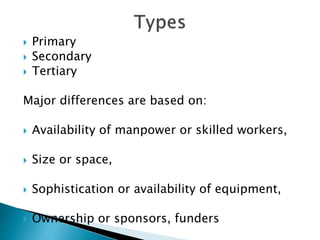
 Primary
 Secondary
 Tertiary
Major differences are based on:
 Availability of manpower or skilled workers,
 Size or space,
 Sophistication or availability of equipment,
 Ownership or sponsors, funders
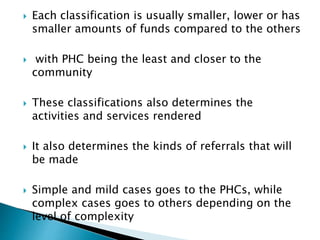
 Each classification is usually smaller, lower or has
smaller amounts of funds compared to the others
 with PHC being the least and closer to the
community
 These classifications also determines the
activities and services rendered
 It also determines the kinds of referrals that will
be made
 Simple and mild cases goes to the PHCs, while
complex cases goes to others depending on the
level of complexity
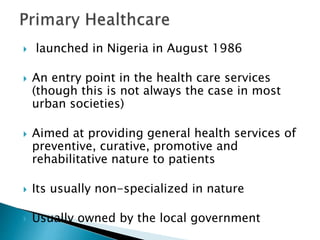
 launched in Nigeria in August 1986
 An entry point in the health care services
(though this is not always the case in most
urban societies)
 Aimed at providing general health services of
preventive, curative, promotive and
rehabilitative nature to patients
 Its usually non-specialized in nature
 Usually owned by the local government
 Usually closer to the community comprising:
 Primary Health care system comprises:
 Village aide,
 aid post,
 Dispensary and
 Health centre
 Village aide: a person with knowledge of modern
medicine, residing in the community, performs
the function of a health educator,
 some times on part-time shift and is usually
monitored or supervised by a mobile team from
dispensary, health centre or hospital
 depending on the supervisory body
 Aid post: usually an agreed place of meeting.
Town hall/market or village square,
 where health education, innoculation and the
likes occur.
 Dispensary: usually located in rural areas, run by
special assistant, nurse and/or midwife.
 Performs Out-patient services (sometimes with
provision few in-patients) and health education.
 Health centre:
 different from dispensary by scope of
activities,
 can be headed by a medical doctor or
assistant.
 Health centers are found in almost every local
government area in Nigeria if not all
 They provide personalized and community
services.

Personalized services :
 general curative services for out-patient,
 maternity care,
 family planning,
 immunization of under-5, consultative clinics,
 dental care,
 Mental home care visits
 limited in-patient services e.t.c
Community services:
 health education,
 supervision of housing and environmental
conditions,
 campaigns against communicable diseases,
 collection of statistics, e.t.c
 Usually higher in rank and more complex than PHCs
 Plays advisory roles
 Can be privately or publicly owned
 can house many medical experts of different specialty
depending on its size and level of funding
 Usually manned by physicians (majority of whom are
good practitioner
 Human resources aside doctors include nurses,
midwives, pharmacists, technicians, technologists,
laboratory assistants, accountants e.t.c
 Usually sophisticated and equipped e.g has
more beds spaces and more capacity for
admission rates
 Provides diagnostic, curative and
rehabilitative functions
 Can also provides custodial care and trainings
of health professionals
 They carry out both personalized and
community functions of PHCs
 more sophisticated, equipped and specialized
than secondary health care systems
 general hospitals and teaching hospitals
(owned by the state and federal respectively
in most cases)
 Run by consultants, specialists and
professors (especially in teaching hospitals)
 Perform specialized treatment along side
roles of secondary health care system and
PHCs
 Okafor (1986)
 To him, health care facilities can be classified
into:
 Lower order and Higher order
Lower order:
 handled routine and some cases very simple
health problems that do not require hospital
care,
 Cheaper to provide and more numerous than
hospitals
 Higher order:
 performs the functions of lower order
healthcare facilities
 other more sophisticated health facilities
 E.g a teaching hospital performs the
functions dispensary, clinic, maternity center,
health centre, general hospital
 and functions as a teaching hospital
Onokerhoraye (1981):
 classified into four categories:
 First categories: dispensaries, health centres,
maternity centres and health officers.
 Second Categories: general hospitals and
cottage.
 third category: teaching hospitals and specialist
hospital
 fourth category: specialized hospitals such as
dental clinics, mental health centres,
leprosariums and tuberculosis hospitals.

Modern health care systems

  • 1.
    Dr. Patricia A.Taiwo Medical Sociologist, Department Of Sociology, Faculty Of The Social Sciences, University Of Ibadan.
  • 2.
    •This system ofhealth care is synonymous with •Concepts like “western”, “Orthodox” medicine •Came to Nigeria as western initiative during the period of colonization •Has scientific underpinnings
  • 3.
     general practitioners, Obstetrics and gynaecology,  Surgery,  Paedetrics,  psychiatry, nursing/midwifery, dentistry, optometrics, orthopaedics e.t.c  Some of these also have AOS within them e,g neuro surgery
  • 4.
     Primary  Secondary Tertiary Major differences are based on:  Availability of manpower or skilled workers,  Size or space,  Sophistication or availability of equipment,  Ownership or sponsors, funders
  • 5.
     Each classificationis usually smaller, lower or has smaller amounts of funds compared to the others  with PHC being the least and closer to the community  These classifications also determines the activities and services rendered  It also determines the kinds of referrals that will be made  Simple and mild cases goes to the PHCs, while complex cases goes to others depending on the level of complexity
  • 6.
     launched inNigeria in August 1986  An entry point in the health care services (though this is not always the case in most urban societies)  Aimed at providing general health services of preventive, curative, promotive and rehabilitative nature to patients  Its usually non-specialized in nature  Usually owned by the local government
  • 7.
     Usually closerto the community comprising:  Primary Health care system comprises:  Village aide,  aid post,  Dispensary and  Health centre  Village aide: a person with knowledge of modern medicine, residing in the community, performs the function of a health educator,  some times on part-time shift and is usually monitored or supervised by a mobile team from dispensary, health centre or hospital  depending on the supervisory body
  • 8.
     Aid post:usually an agreed place of meeting. Town hall/market or village square,  where health education, innoculation and the likes occur.  Dispensary: usually located in rural areas, run by special assistant, nurse and/or midwife.  Performs Out-patient services (sometimes with provision few in-patients) and health education.
  • 9.
     Health centre: different from dispensary by scope of activities,  can be headed by a medical doctor or assistant.  Health centers are found in almost every local government area in Nigeria if not all  They provide personalized and community services. 
  • 10.
    Personalized services : general curative services for out-patient,  maternity care,  family planning,  immunization of under-5, consultative clinics,  dental care,  Mental home care visits  limited in-patient services e.t.c Community services:  health education,  supervision of housing and environmental conditions,  campaigns against communicable diseases,  collection of statistics, e.t.c
  • 11.
     Usually higherin rank and more complex than PHCs  Plays advisory roles  Can be privately or publicly owned  can house many medical experts of different specialty depending on its size and level of funding  Usually manned by physicians (majority of whom are good practitioner  Human resources aside doctors include nurses, midwives, pharmacists, technicians, technologists, laboratory assistants, accountants e.t.c
  • 12.
     Usually sophisticatedand equipped e.g has more beds spaces and more capacity for admission rates  Provides diagnostic, curative and rehabilitative functions  Can also provides custodial care and trainings of health professionals  They carry out both personalized and community functions of PHCs
  • 13.
     more sophisticated,equipped and specialized than secondary health care systems  general hospitals and teaching hospitals (owned by the state and federal respectively in most cases)  Run by consultants, specialists and professors (especially in teaching hospitals)  Perform specialized treatment along side roles of secondary health care system and PHCs
  • 14.
     Okafor (1986) To him, health care facilities can be classified into:  Lower order and Higher order Lower order:  handled routine and some cases very simple health problems that do not require hospital care,  Cheaper to provide and more numerous than hospitals
  • 15.
     Higher order: performs the functions of lower order healthcare facilities  other more sophisticated health facilities  E.g a teaching hospital performs the functions dispensary, clinic, maternity center, health centre, general hospital  and functions as a teaching hospital
  • 16.
    Onokerhoraye (1981):  classifiedinto four categories:  First categories: dispensaries, health centres, maternity centres and health officers.  Second Categories: general hospitals and cottage.  third category: teaching hospitals and specialist hospital  fourth category: specialized hospitals such as dental clinics, mental health centres, leprosariums and tuberculosis hospitals.