http://www.ftmeade.army.mil SOUNDOFF! February 5, 2015
Contents
	Health Promotion.......... 3	 Healthy Children....................6
	Army Wellness Center... 4	 Performance TRIAD..............7
	Master Resiliency.......... 5	 Strength Training....................8
Printed by The Baltimore Sun Co., LLC,
a private firm, in no way connected
with the Department of the Army.
Opinions expressed by the publisher
and writers herein are their own and
are not to be considered an official
expression by the Department of the
Army. The appearance of advertisers
in the publication does not constitute
an endorsement by the Department of
the Army of the products or services
advertised.
Soundoff!´
Special Section
Kimbrough Ambulatory Care Center
Sometimes it is difficult to know if and when
to seek medical help for acute health problems, so
having professional help at a moment’s notice is
invaluable.
The Military Health System’s Nurse Advice Line
for TRICARE beneficiaries does just that. Beneficia-
ries can call the NAL toll-free 24 hours a day, seven
days a week.
The NAL is a team of registered nurses who are
available to answer a variety of urgent health care
questions. They can help you decide whether self-care
is the best option, or if it is better to see a health care
provider.
A person will always be on the line to address
beneficiary concerns.
The NAL offers a variety of solutions for all
TRICARE beneficiaries. For pediatric issues, the
NAL will route the beneficiary to a pediatric nurse.
If follow-up is necessary or requested, the NAL will
call the beneficiary back to check the child’s status a
few hours later.
The NAL will make same-day appointments with
the beneficiary’s primary care manager for enrolled
TRICARE Prime beneficiaries to Military Treatment
Facilities. If a same-day appointment is not available,
the NAL will redirect the beneficiary to the closest
urgent care center, and advise the PCM that an urgent
care referral is needed so the patient does not have to
worry about paying any point of service co-pays.
All other TRICARE beneficiaries who are not
enrolled in an MTF will receive professional health
advice about their urgent health concern and when
to seek urgent care.
When calling the NAL, a customer service
representative will verify the beneficiary’s eligibil-
ity through the Defense Enrollment and Eligibility
Reporting System.
Beneficiaries with an acute health care concern
will be connected with a registered nurse who will
ask the beneficiary a series of standard questions to
determine the next steps and allow the NAL nurse to
provide the best advice possible.
Beneficiaries can still call their PCM or clinic, but
the NAL is another option for beneficiaries to access
the care they need in a timely fashion.
To access the NAL, dial 1-800-TRICARE (874-
2273), Option 1.
Tap into Kimbrough’s
TRICARE Nurse Advice Line
Commentary by Dr. (Col.) Michael J. Zapor
Kimbrough Ambulatory Care Center
Childhood immuni-
zations are important
because many potential-
ly fatal infections can be
prevented through vac-
cination.
Prior to the advent of
vaccines, infection was
one of the most com-
mon causes of death and
remains a common cause
of death in the underde-
veloped world.
I think many individuals in this country take for
granted that young people seldom die from infection and
that fatal epidemics are rare.
Consequently, some parents neglect or refuse to get
their children vaccinated citing concerns for side effects
from the vaccines. They also reason that because everyone
else is getting their kids vaccinated, their own children
won’t be exposed to infection.
Some opponents of vaccination also falsely believe
that these infections have been eradicated. For those
pathogens without a non-human reservoir, the only way
the pathogen can be sustained is to be transmitted from
person-to-person. Otherwise, once the host dies, so does
the pathogen.
Once enough people are vaccinated against the patho-
gen, it is not easily transmitted in a population and in
some cases such as smallpox, may disappear completely.
This is referred to as herd immunity.
The fraction of people who must be vaccinated to
prevent disease spread varies with each pathogen. But if
the percentage of vaccinated individuals falls below that
threshold, we see epidemics such as the current measles
outbreak linked to Disneyland.
As for diseases being eradicated in this country (elimi-
nating the need for vaccination), the ease of international
travel and fluid borders ensures that infectious diseases
are constantly reintroduced into our population. More-
over, some diseases such as influenza have reservoirs other
than humans.
Fortunately, few people in this country have seen
diseases like diphtheria, tetanus and rabies. As an Army
infectious disease doctor, I have witnessed these infections
in my travels overseas, and I’ve never considered not vac-
cinating my own children.
It’s also worth mentioning that the immunity conferred
by some vaccines wanes over time. Therefore, for some
vaccines, boosters are recommended for adults. Examples
include varicella (causative agent of chicken pox and
shingles), pneumococcal pneumonia, polio, tetanus and
pertussis (whooping cough).
A visit with one’s doctor can clarify which vaccines are
indicated and when.
Any medication or vaccine may be associated with side
effects. Vaccination is most commonly associated with
soreness at the vaccination site and maybe a low-grade
fever.
Live, attenuated vaccines such as yellow fever tend to
be more capable of causing a reaction than other vac-
cines, and patients may feel poorly for a day or so. For
the most part, any side effects associated with vaccines are
going to be mild, self-limited and can be treated symp-
tomatically with Tylenol and a warm compress.
Serious long-lasting complications are extremely rare
and are more likely to occur in severely immune-com-
promised individuals (such as AIDS patients or bone
marrow transplant patients). Some complications such as
the putative link between vaccines and autism are entirely
unsupported by the medical literature. While there cer-
tainly may be adverse reactions associated with any vac-
cine, the risk of vaccination is dwarfed by the benefit.
Combination vaccines are as safe as the individual
components, and these vaccines make for easier dosing
regimens. Examples include measles-mumps-rubella;
tetanus-diphtheria-acellular pertussis; and hepatitis A
and B.
Unfortunately, some infections (such as HIV and
malaria) are not easily prevented by vaccination. That
said, many infections are vaccine preventable, and we
each have a responsibility to ourselves, our children and
our communities to be diligent with respect to immuni-
zations.
Editor’s note: Zapor is deputy commander for Clinical
Services at Kimbrough Ambulatory Care Center and the
Fort Meade Medical Department Activity. He is board-
certified in both internal medicine and infectious disease.
Understanding the importance of immunizations
http://www.ftmeade.army.mil February 5, 2015 SOUNDOFF! 
Special Section
By Lisa R. Rhodes
Staff Writer
Fort Meade is standing up a Community
Health Promotion Team under the leader-
ship of Nicole Lowry, the garrison’s new
health promotion program assistant.
Lowry began her job in October and is
tasked with coordinating the installation’s
prevention and public health programs to
form and structure a CHPT.
Fort Meade’s focus in creating a CHPT
is part of the Army’s Ready and Resilient
Campaign, which aims to build upon the
mental, physical, emotional, behavioral and
spiritual resilience in service members, their
families and civilian employees to enhance
their ability to manage the rigors and chal-
lenges of a demanding profession, according
to the campaign’s website.
“One of the reasons why I’m so excited
about my new position here at Meade is that
my definition of health promotion aligns
perfectly with the holistic approach to health
that the Ready and Resilient Campaign
takes,” said Lowry. “Health is not simply
physical fitness or absence of disease.
“Rather, a person’s health refers to
strength and vigor in many realms: physi-
cal, spiritual, family, financial, mental, etc.
Health promotion then is education and
support aimed at all of these pillars.”
The garrison’s efforts in health promotion
formally began about five years ago with the
creation of a Community Health Promotion
Council. The council was formed by Ken-
neth Jones, former chief of Fort Meade’s
Army Substance Abuse Program, and Lt.
Col. Nancy Demetrician, former chief of
Preventive Medicine Services at Kimbrough
Ambulatory Care Center.
Its mission was to create a healthy and
more resilient Fort Meade community.
One of the council’s accomplishments,
under the leadership of Navy Cmdr. Marivic
Fields, former health promotion officer, was
the establishment of Fort Meade’s Army
Wellness Center.
Lowry has replaced Fields in leading the
garrison’s health promotion efforts. The
CHPC at Fort Meade will now be known
as the CHPT.
As she begins to structure Fort Meade’s
CHPT, Lowry also receives guidance from
Taleeta Jackson, the new health promotion
officer for the Military District of Washing-
ton. Jackson is Lowry’s supervisor.
Jackson, who was hired in November,
works as a special staff member to Maj.
Gen. Jeffrey S. Buchanan, commanding
general of MDW.
Jackson’s job is to facilitate the Commu-
nity Health Promotion Council for MDW
Garrison grows health promotion efforts
photo by philip h. jones
Taleeta Jackson (left), the new health promotion officer for the Military District of Washington, discusses with Nicole Lowry, Fort
Meade’s new health promotion program assistant, Fort Meade’s efforts to create and support a Community Health Promotion
Team. The effort is part of the Army’s Ready and Resilient Campaign.
and the Army’s Ready and Resilient Cam-
paign.
The Army’s requirements for health pro-
motion are outlined in Army Regulation
600-63, stipulating the establishment of the
CHPC.
“The CHPC is a multidisciplinary forum,
which provides a comprehensive and holistic
approach to health promotion and inte-
grates medical, unit and garrison programs
and services as outlined in the [Army] regu-
lation,” Jackson said.
“It is essential that agencies work together
to provide comprehensive, multidimensional
programs that reduce the impact of health
risks affecting the total force.”
Fort Meade’s CHPT, similar to the for-
mer CHPC, will have five working groups:
spiritual, social/environmental, physical fit-
ness, behavioral health and an installation
prevention team. There also will be unit
health-promotion teams that will work both
short- and long-term goals to support the
installation’s efforts to prevent and manage
high-risk behaviors.
Lowry said that in the long-term, the
CHPT will work with all 117 tenant orga-
nizations on post. Kimbrough Ambulatory
Care Center and the Army Wellness Center
already play pivotal roles as they make up
the majority of the physical fitness working
group.
Garrison Commander Col. Brian P. Foley
chaired the CHPT quarterly meeting Jan.
15. The Ready and Resilient Campaign’s
programs were reviewed and the structure
and goals of the CHPT teams were out-
lined.
“One overall goal that came down from
the colonel was to get the working groups
established and functioning,” Lowry said.
“The working groups are the foundation for
the Community Health Promotion Team.”
Jackson facilitated a CHPC meeting with
Buchanan on Jan. 26. The focus of the
meeting was for all MDW garrison leaders
to inform Buchanan about the progress
of health promotion at their installations,
review the Ready and Resilient Campaign
efforts within MDW, and hear his guidance
regarding the campaign and health promo-
tion.
As Lowry’s supervisor, Jackson helps
with the health promotion process. Along
with standing up the CHPT, Lowry and
Jackson worked together to provide input
and share best practices and lessons learned
during the meeting with Buchanan.
Jackson regularly visits Fort Meade and,
along with Lowry, meets with subject matter
experts on post in regard to standing up and
structuring the CHPT.
“The team here on the ground is very
receptive and supportive of what we are
trying to accomplish for our total force
here at Team Meade,” Jackson said. “Great
dialogue and feedback has been provided. I
plan to take this information forward as we
shape our CHPC.”
Editor’s note: Nicole Lowry, Fort Meade’s
new health promotion program assistant, can
be reached at 301-677-7907.
For more information, go to the Army’s
Ready and Resilient Campaign website at
www.army.mil/readyandresilient.
http://www.ftmeade.army.mil SOUNDOFF! February 5, 2015
Special Section
By Lisa R. Rhodes
Staff Writer
Fort Meade’s Army Wellness Center
begins the new year with a change in
leadership.
Jamie Valis, who served as director of
the center since its opening in Septem-
ber 2013, completed her tenure Jan. 8.
The center’s staff of four health
educators are sharing interim director
responsibilities until a new director is
hired.
Located in part of Building 4418 on
Llewellyn Avenue, the site of the Medal
of Honor Memorial Library, the AWC
operates under the Preventive Medicine
Services Division at Kimbrough Ambu-
latory Care Center.
The facility provides free, holistic
health services to help service mem-
bers, family members age 18 and older,
retirees and DoD civilians build and
sustain a healthy lifestyle and prevent
chronic diseases.
AWC is also part of Fort Meade’s
participation in DoD’s Healthy Base
Initiative, a demonstration project for
the Defense Department’s Operation
Live Well. Operation Live Well is aimed
at increasing the health and wellness
of the total force, including civilian
employees and family members.
As part of the yearlong demonstra-
tion project, Fort Meade, along with 13
other participating DoD installations
and sites, is being examined for its abil-
ity to create environments that enable
sustainable healthy lifestyles.
Best practices will be shared with
the military services for further use
throughout the armed forces.
Fort Meade is a pilot site to evaluate
initiatives to improve nutritional choic-
es, increase physical activity, reduce
obesity and decrease tobacco use.
During the past fiscal year, more
than 5,000 appointments were sched-
uled at AWC for standardized health
services, which include a health assess-
ment review (an analysis of a client’s
health issues, risk for disease and ability
to exercise safely); physical fitness test-
ing and exercise prescription; healthy
nutrition using metabolic testing to pro-
vide individualized strategies for weight
loss, gain or maintenance; stress man-
agement using biofeedback to reduce
stress; and tobacco education.
The center also offers general well-
ness education through classes on top-
ics such as healthy lifestyles, increased
Army Wellness Center serves community
resiliency and self-care; and tobacco
education using assessments to deter-
mine an individual’s readiness to
become tobacco-free.
Shane Murr, a health educator, also
works with two health promotion tech-
nicians. The staff provides the core
health services and follow-up.
AWC uses state-of-the-art equipment
for metabolic testing, including a BOD
POD to measure body composition. In
addition, there is a health assessment
room and biofeedback room.
The most popular service at the
center is the BOD POD, considered by
health experts to be one of the gold
standards for measuring body compo-
sition.
All clients are encouraged to com-
plete this assessment during their first
visit. Clients are advised to be reas-
sessed by the BOD POD every 30, 60
or 90 days, depending on their wellness
goals.
“The BOD POD is a great assess-
ment tool and validator that provides a
baseline for your goals,” Murr said.
In addition to its own standardized
programs, the AWC is in alignment
with the Army’s Performance Triad,
which emphasizes the importance of
physical activity, proper nutrition and
adequate sleep.
Editor’s note: To schedule an appoint-
ment at the Army Wellness Center, call
301-677-2006.
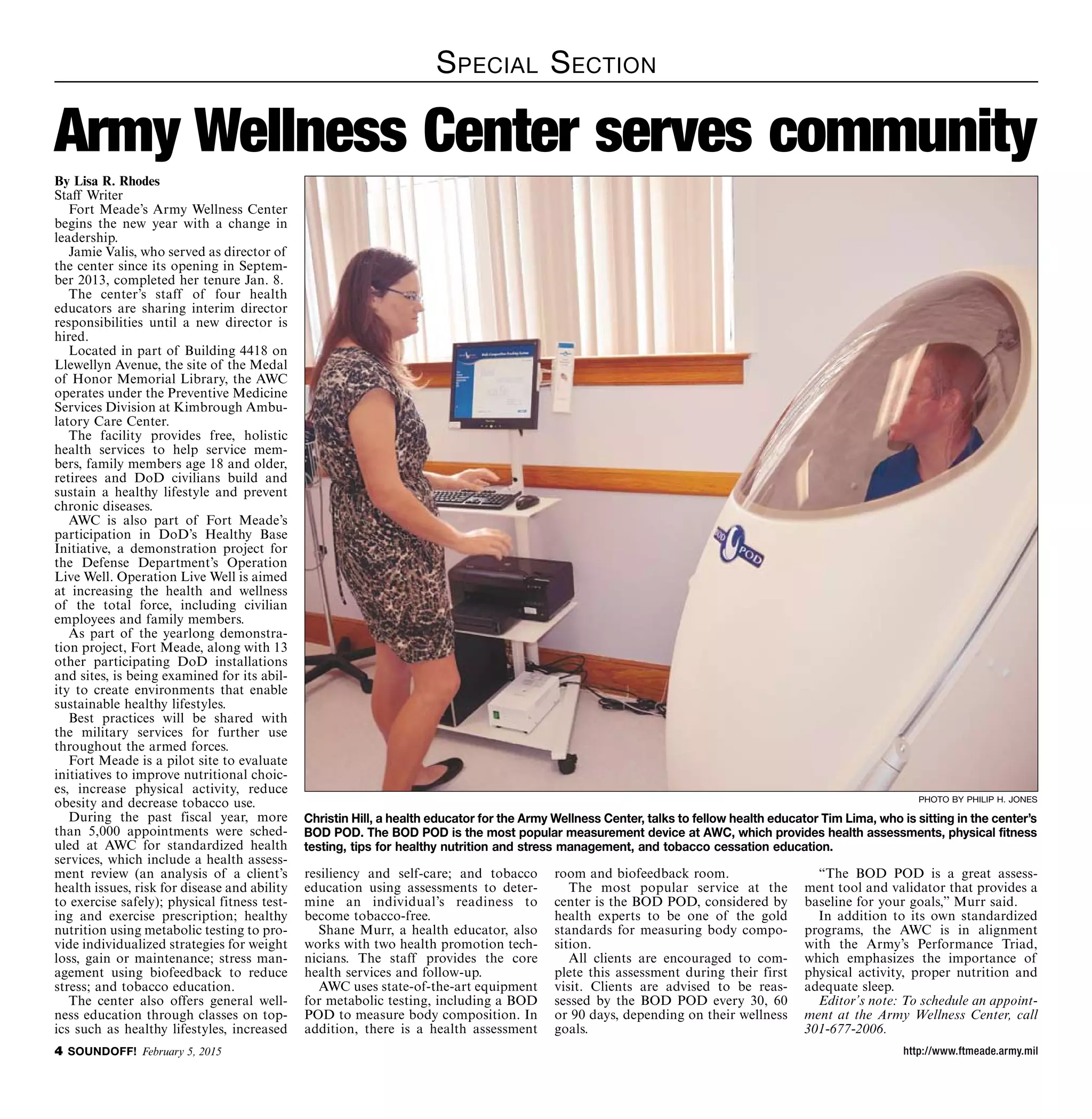
photo by philip h. jones
Christin Hill, a health educator for the Army Wellness Center, talks to fellow health educator Tim Lima, who is sitting in the center’s
BOD POD. The BOD POD is the most popular measurement device at AWC, which provides health assessments, physical fitness
testing, tips for healthy nutrition and stress management, and tobacco cessation education.
http://www.ftmeade.army.mil February 5, 2015 SOUNDOFF! 
Special Section
By Shari Rosen
Staff Writer
Military personnel face countless chal-
lenges that test their resiliency, said master
resiliency trainer Kariema Washington.
“Deployed Soldiers are exposed to a
wide range of stressors, from living in a
hostile environment for a lengthy period
of time to acute, traumatic events that
occur during combat — all of which can
lead to long-term psychological problems
like PTSD [post-traumatic stress disorder],
depression, substance abuse and even sui-
cide,”said Washington, noncommissioned
officer in charge of Perioperative Services
at Kimbrough Ambulatory Care Center.
Master resiliency trainers such as Wash-
ington encourage service members to
develop mechanisms in order to deal with
such stressors and develop resiliency.
“Think of a rubber band that you
stretch and release; it snaps back to its
original form,” said Nicole Lowry, health
promotion program assistant. “When we
lose our resiliency, we no longer snap
back to our original form. It is extremely
important that, having been pulled tight,
we can get back to our healthy starting
point.”
“The Road to Resilience,” a brochure
published by the American Psychological
Association, or APA, defines resiliency as
“the process of adapting well in the face
of adversity, trauma, tragedy, threats or
other significant sources of stress — such
as family and relationship problems, seri-
ous health problems, or workplace and
financial stressors.
“It means ‘bouncing back’ from dif-
ficult experiences.”
APA emphasizes that resilience is not a
trait that individuals are born with; rather,
it can be acquired through practice and by
building characteristics that help an indi-
vidual combat stressors and challenges.
“In my opinion, the major skills needed
to be resilient are mental toughness, self-
awareness and optimism,” Washington
said.
Some of the ways to develop resiliency,
according to APA, include: making con-
nections and building stable relationships,
accepting that change is a part of living,
taking decisive actions, keeping things in
perspective, and taking care of yourself,
both physically and mentally.
The RAND Center for Military Health
Policy Research states that individuals can
develop resiliency by utilizing skills such
as “positive coping,” defined as “the pro-
cess of managing taxing circumstances,
expending effort to solve personal and
interpersonal problems, and seeking to
reduce or tolerate stress or conflict includ-
ing active/pragmatic, problem-focused and
spiritual approaches to coping.”
Washington echoed this sentiment. She
said that on a daily basis, service members
can work to develop resiliency by “Hunt-
ing the Good Stuff,” or focusing on the
good things that happen each day, instead
of dwelling on the negative.
“ ‘Hunting the Good Stuff’ counters
the negativity bias, creates positive emo-
tion, and helps participants notice and
analyze what is good,” Washington said.
Kimbrough, APA and RAND also
emphasize the importance of maintaining
emotional ties and relationships that can
be characterized as supportive, close and
nurturing, as well as staying physically fit
in order to develop resiliency.
“Kimbrough has incorporated Wellness
Champions [health experts who work
to maximize wellness in the workplace]
who incorporate the tenets of the Perfor-
mance Triad [activity, nutrition and sleep]
in developing programs which will aid
the organization in becoming a healthier
workplace,” Washington said.
“We also work closely with the Army
Wellness Center to support our endeavors
[in promoting resiliency]. Over 80 staff
members have utilized their services.”
Editor’s note: For more information on
master resiliency training and developing
resiliency skills, call Kimbrough at 301-
677-8800 or the Army Wellness Center at
301-677-2006.
Forming the building blocks of resiliency
Photo by Dijon Rolle
Petty Officer 2nd Class Cassandra
Chamberlain performs a strength training
workout Friday afternoon at Gaffney
Fitness Center. Staying physically fit is
one of the key components of resiliency
along with building stable relationships
and taking decisive action.
By Shari Rosen
Staff Writer
People have a tendency to dwell on the
negative because it has a profound effect
on their self-esteem, said Taleeta Jackson,
health promotion officer at Fort McNair in
Washington, D.C.
The Army’s “Hunt the Good Stuff”
initiative tries to combat this negativity bias
by encouraging service members to focus on
the positive aspects of their everyday lives.
The Pentagon’s “Comprehensive Resil-
ience Module” reiterates this point, stating
that service members can have 99 positive
things happen, but it’s the one negative
aspect of the day that sticks with them and
they can’t let go.
“I believe the most important aspects
of the ‘Hunt the Good Stuff’ initiative are
threefold: looking for the good things that
have happened to us throughout our day
builds optimism, creates an environment
of hope and gives us a heightened sense of
realization of the good things that happen
to us in a world that seems to be overcome
with negativity,” said Jackson, who also
works as a master resiliency trainer.
The Pentagon details techniques such as
taking a few moments to write down three
good things that occur each day in order to
cultivate gratitude.
The module emphasizes that anything
can count as a good thing, including small
events or milestones, or even taking refuge
in nature.
“Some days I can write a list of the
things [I’m grateful for] with no problem,
and other days I struggle and have to think
outside the box,” Jackson said. “The key is
to remember that no matter how small or
big something is, it’s what it means to the
person that matters.”
In order to combat the negativity bias,
Jackson also suggests setting realistic goals
and remembering that people are not “one
size fits all” and cannot all have the same
‘Hunt the Good Stuff’ initiative combats negativity bias
skills and abilities.
In addition to altering one’s perspective
of the day, “Hunt the Good Stuff” can
also have healthy psychological and physi-
cal results.
“Physical [results] include better sleeping,
less tension, calmness,” Jackson said. “The
mental [effects] include a sense of belong-
ing, independence and sense of growth,
all of which are very positive effects to a
healthy mental and physical well-being.”
Editor’s note: For more information on the
initiative, Soldiers, families and DoD civilians
should call their local Comprehensive Soldier
and Family Fitness program manager or the
Army Wellness Center at 301-677-2006.
http://www.ftmeade.army.mil SOUNDOFF! February 5, 2015
Special Section
Story and photo by Dijon Rolle
Editor
There’s an old African proverb
that says “It takes a village to raise a
child.”
A collective effort can be just the
right approach to ensure our children
make healthy choices now and in the
future.
From infancy through adulthood,
children are constantly developing the
social, physical and mental habits that
will help shape the rest of their lives.
Not surprisingly, a lot of those habits
are learned early on from their parents,
friends, teachers, family members and
caregivers, especially in the areas of
nutrition, personal hygiene and physi-
cal activity.
“Proper nutrition is essential for ade-
quate brain development,” said Nissa
Lazenby-Wilson, field coordinator for
the Cooking Matters Commissary Tours
on Fort Meade.
The monthly tours, part of Fort
Meade’s Healthy Base Initiative and the
national “No Kid Hungry” campaign,
are designed to help military members
and their families maximize their food
budgets and make healthy, nutritional
choices.
“Eating nutritious foods not only
aids in cognitive and social develop-
ment, but can also delay the onset of
chronic diseases such as Type 2 diabetes,
hypertension and obesity,” Lazenby-
Wilson said. “Children make their food
preferences early in life, so introducing
healthy items like fruits and vegetables
within the first three years of life will
make a lasting impression.”
According to the “Let’s Move!” ini-
tiative founded by First Lady Michelle
Obama, “One of the major problems
facing kids today is childhood obesity.
Over the past three decades, childhood
obesity rates in America have tripled,
and currently, nearly one in three chil-
dren in America is overweight or obese.
The numbers are even higher in African-
American and Hispanic communities,
where nearly 40 percent of the children
are overweight or obese.”
To help combat the problem at home,
Lazenby-Wilson offers this advice:
• Children should be offered a vari-
ety of foods throughout the day, to
include items from the five food groups:
vegetables, fruits, whole grains, low-fat
dairy and lean protein.
• Make half their plate fruits and
vegetables, at least half whole grains, a
lean protein or protein alternative (such
as beans), and low-fat dairy.
“[The website] www.ChooseMyPlate.
gov gives excellent examples of what a
plate should look like,” she said.
Lazenby-Wilson noted that parents
and caregivers should also reduce the
amount of sugary beverages their child
consumes and watch portion sizes.
Another important developmental
area for children is personal hygiene.
Good personal hygiene helps fight the
spread of disease and infection in both
children and adults.
Children should be taught at an early
age such basics as how to correctly wash
their hands and brush their teeth, how
to bathe themselves with soap, and to
cover their mouth when sneezing.
“We are very stringent about hand
washing,” said Cassandra G. Franklin,
division chief for Fort Meade’s Child,
Youth and School Services. “You can go
into any one of our facilities and I can
guarantee in a room with 2- and 3-year-
olds, they know the procedure for hand
washing. They know how to lather and
make bubbles and turn off the faucet
with a paper towel.”
Children in the Child Development
Centers also brush their teeth after
every meal and snack, and all of the
meals and snacks served must meet
strict nutritional guidelines set by the
U.S. Department of Agriculture.
“Health is extremely important to our
children,” Franklin said. “Our intent
and goal here at Child, Youth and
School Services is to enhance all areas
of child development. So it’s important
that we receive children healthy every
day, as well as ensure that our environ-
ment and our programs are healthy so
that the children can thrive best.”
In addition, children should par-
ticipate in at least 60 minutes of age-
appropriate physical activity per day.
Most children can easily meet this goal
by playing outside during the day, par-
ticipating in team sports, jumping rope
and playing games with family members
and friends.
Raising healthy children
is a family affair
Children enrolled in the Fort Meade
CDCs go outside twice a day. CYSS
offers team sports throughout the year.
Here are some additional health tips
parents and caregivers can follow to help
their children perform at their best:
• Ensure children get adequate rest.
Children need roughly 10 hours of
sleep per night, while very young chil-
dren can benefit from taking naps dur-
ing the day. Set a consistent bedtime
each night and create a routine (bath,
brushing teeth, story time) to help chil-
dren wind down and prepare for sleep.
• Set time limits.
Set a limit on the amount of time
children spend on the Internet, watching
TV, playing video games or messaging
online. Computer software-based timers
are available that parents can install on
devices to temporarily or permanently
block or filter certain websites.
• Keep children smoke-free. Sec-
ond-hand smoke can worsen asthma
and other respiratory problems. Avoid
smoking around children or allowing
others to do so.
• Physical screenings
Ensure children receive regular medi-
cal checkups and remain up-to-date on
any recommended immunizations.
• Promote healthy habits.
Plan activities together such as a
family bike ride or walk after dinner,
and allow children to help shop for and
cook healthy meals. Set the example by
consistently modeling healthy behaviors
in front of your children such as hand
washing, teeth brushing, drinking water
and eating healthy snacks.
Editor’s note: Registration is now open
for CYSS spring sports (baseball, soft-
ball, tennis, lacrosse, basketball, track,
flag football and soccer).
To register for Youth Sports or for
more information, go to ftmeademwr.com
or call 301-677-1179.
For more information on healthy food
choices or recipes, visit www.cookingmat-
ters.org/recipes.
Spring, summer, fall or winter...
Get involved with Youth Sports on Fort Meade, call
301-677-1105/1146/1156/1179.
LaShawn Farley, Child, Youth and School Services program assistant, serves fresh
apple slices, crackers and milk to her class Friday morning at Child Development
Center III. All snacks and meals served at the facility must meet strict U.S. Department
of Agriculture nutritional guidelines.
http://www.ftmeade.army.mil February 5, 2015 SOUNDOFF! 
Special Section
By Lisa R. Rhodes
Staff Writer
A restful night’s sleep can mean the
difference between optimal health and
chronic disease.
The Army’s Ready and Resilient Cam-
paign encourages Soldiers, families, retirees
and Army civilian employees to develop the
“mental, physical, emotional, and behav-
ioral ability to face and cope with adversity,
adapt to change, recover, learn and grow
from setbacks,”according to the campaign’s
website.
As a result, the Army is focusing on three
components of health — sleep, activity and
nutrition — as part of the Performance
Triad. This triad emphasizes the basics of
proper health as the key to attaining and
maintaining a resilient Army.
Sheila Greaney, chief of the Integrated
Behavioral Health Department in Primary
Care at Kimbrough Ambulatory Care Cen-
ter, said proper sleep is critical.
“Chronic sleep deprivation may lead to
changes in mood or memory problems,”
Greaney said. “Depression and anxiety
may contribute to poor interactions with
family and co-workers. The ability to learn
and retain information is affected by getting
enough sleep.
“Insufficient sleep may make it more
difficult to lose weight, and may even con-
tribute to a service member gaining weight.
Other physical problems that may be related
to chronic sleep deprivation are hyperten-
sion, cardiovascular disease, diabetes and
stroke,” Greaney said.
Despite the importance of sleep, Army
research has shown that service members
often experience problems in getting ade-
quate rest and can suffer from other health
issues in conjunction with a lack of sleep.
Lt. Col. Vincent Mysliwiec, chief of Pul-
monary Critical Care Medicine and Sleep
Medicine Service at the Madigan Health-
care System in Tacoma, Wash., is a leading
expert in Army sleep research.
Last year, Mysliwiec and his colleagues
published a study in Sleep, the peer-
reviewed, scientific journal of the Associ-
ated Professional Sleep Societies, that found
a high prevalence of sleep disorders and a
high rate of short-sleep duration among
active-duty service members.
“While sleep deprivation is part of the
military culture, the high prevalence of
short-sleep duration in military person-
nel with sleep disorders was surprising,”
Mysliwiec said. “The potential risk of
increased accidents as well as long-term
clinical consequences of the short-sleep
Performance Triad emphasizes importance of sleep
duration and a sleep disorder in our popula-
tion is unknown.”
The study’s results showed that 85.1
percent of participants had a clinical sleep
disorder. Obstructive apnea was the most
frequent diagnosis at 51.2 percent, followed
by insomnia at 24.7 percent.
Participants’ self-reported sleep duration
was only 5.74 hours per night, while 41.8
percent reported sleeping five hours or less
per night.
Although individual sleep needs vary,
Mysliwiec said most adults need about
seven to eight hours of sleep to feel alert
and rested during the day.
“Soldiers perform strenuous tasks that
demand vigilance and focus,” Mysliwiec
said. “Lack of adequate sleep is known to
contribute to performance errors and inad-
equate recovery.”
In addition, the study showed that service
members with sleep disorders also suffered
from one or more medical conditions.
The most common service-related ill-
nesses were depression (22.6 percent), anxi-
ety (16.8 percent), post-traumatic stress
disorder (13.2 percent), and mild traumatic
brain injury (12.8 percent).
Nearly 25 percent of service members
were taking medications for pain. Par-
ticipants with PTSD were two times more
likely to have insomnia, and those with
depression or pain syndrome were 1.5 times
more likely to have insomnia.
“The other unique aspect is that military
personnel, irrespective of their sleep disor-
der, have short duration and sleepiness,”
Mysliwiec said. “This is not typically seen
in civilian patients.”
The causes of sleep disorders in Sol-
diers vary. For example, Mysliwiec said
that learned maladaptive sleep practices
in deployed settings, such as having to
wake up at all hours and 24-hour missions,
contribute to sleep disorders. Other causes
are: caffeine, mental health conditions, a
genetic disposition, medications and sub-
stance abuse.
Kimbrough’s IBHC program typically
treats people suffering from insomnia or
lifestyle issues that are disrupting their abil-
ity to feel rested. Obstructive apnea, narco-
lepsy, restless leg syndrome, sleep walking,
snoring and nightmares also are assessed in
Primary Care.
As part of the assessment, the clinicians
will determine if the disorder can be treated
in a primary care setting or at a specialty
clinic.
Greaney said that depending on the sleep
disorder, many patients are able to return
to a normal sleep cycle after completing
the program.
Fort Meade’s Army Wellness Center
offers the “Healthy Sleep Habits” class
Wednesdays at 11 a.m., by appointment, for
active-duty service members, family mem-
bers, retirees and DoD civilian employees.
The class focuses on the importance
of sleep, the science of sleep, methods for
achieving better quality of sleep, and posi-
tive steps to improve sleep.
“We have had a very positive response to
the class,” said Jamie Valis, former director
of AWC. “Clients walk away with specific
goals to assist them in improving their sleep
habits.”
Editor’s note: For more information on
sleep and other components of the Per-
formance Triad, go to armymedicine.mil/
Pages/performance-triad.aspx or call the
Army Wellness Center at 301-677-2006.
http://www.ftmeade.army.mil SOUNDOFF! February 5, 2015
By Shari Rosen
Staff Writer
To help Fort Meade community mem-
bers get in shape, Gaffney Fitness Center
is offering strength-training and personal-
training packages.
“If someone is interested, they just
come to Gaffney and sign up,” said Beth
Downs, sports specialist with the Director-
ate of Family and Morale, Welfare and
Recreation.
According to the American College of
Sports Medicine, or ACSM, “muscular
strength and endurance are components
of fitness that are necessary for optimal
well-being and quality of life.”
ACSM’s pamphlet “Resistance Training
For Health and Fitness” also recognizes
that as we age, we tend to lose lean muscle
mass. Resistance, as well as strength train-
ing, combats this loss by increasing mus-
cular fitness.
Fort Meade’s strength-training services
are contracted out to BodySpirit LLC.
“Strength training can help reduce inju-
ries, improve overall appearance, change
your mood and attitude — especially when
you see results,” said Craig Mitchell, per-
sonal trainer at BodySpirit LLC. “Strength
training can help improve your metabolism
and bone density, which we all need.”
Mitchell serves as the main liaison
between BodySpirit and Fort Meade.
“He seems to be really popular,” Downs
said. “A lot of people who are [training]
now didn’t realize we had [the program].
They saw Craig out there training, then
they approached him, talked about it and
kind of got into [strength training] that
way.”
Once an individual signs up for strength
training, he or she will be contacted by a
BodySpirit representative, who will provide
answers to specific questions about the
kind of training the individual is inter-
ested in.
“It’s been kind of a slow start, [but] the
people who have done [strength training]
are repeat customers,” said Lauren Wil-
liams, director of athletics, fitness and
aquatics at Gaffney Fitness Center.
Downs said BodySpirit offers a wide
variety of strength-training services, which
range from a micro-fit assessment to deter-
mine the individual’s overall health to 12
one-on-one training sessions.
“Having a personal training program
is a nice incentive for the customers who
are new and need a little guidance to get
to their workout and weight-loss goals,”
Williams said.
Fees range from $40 for a micro-fit
assessment to $600 for 12 one-on-one
training sessions.
“Something unique we do is two-on-one
— we call it couples [training],” Downs
said. “So if you’re not quite comfortable
just going by yourself, you and a friend can
split it and do it that way, too.”
A 60-minute couple session costs $100,
while six two-on-one training sessions are
$320.
Downs said that all training is conduct-
ed at Gaffney Fitness Center or Murphy
Field House. However, in nice weather,
Mitchell also utilizes the outdoor track
near Gaffney.
“He really tries to mix it up for what
you’re looking for,” Downs said.
Since the program’s start in January
2014, more than 30 strength-training pack-
ages have been sold.
“It’s really flexible depending on what
your goals are — if you’re looking more
for weight loss, or to become more com-
fortable in the gym and knowing your way
around,” Downs said. “It’s just good for
your health overall to keep you active.
“You don’t necessarily have to go out
and become a bodybuilder, but [train] just
enough to keep your body healthy and be
able to do the activities that you want to
do.”
Editor’s note: For more information on
strength training and to sign up for strength
training and personal training packages, call
Gaffney Fitness Center at 301-677-3716.
Gaffney is located at 6330 Broadfoot Road.
Office hours are by appointment only. Call
301-677-5822.
Gaffney’s services are open to all eli-
gible DoD ID cardholders including active-
duty service members, immediate family
members, Reservists, retirees, DoD civilian
employees and contractors.
Power Play
Strength-training services available at Gaffney
Special Section
Chris Hoffer performs strength training
exercises Jan. 23 at Gaffney Fitness
Center. The facility is open seven days
a week and houses a variety of free
weights and weight-training equipment.
Service members, DoD civilians,
dependents and contractors can use
Gaffney Fitness Center free of charge.
Photo by Dijon Rolle

Health Promotion Insert 2015

  • 2.
    http://www.ftmeade.army.mil SOUNDOFF! February5, 2015 Contents Health Promotion.......... 3 Healthy Children....................6 Army Wellness Center... 4 Performance TRIAD..............7 Master Resiliency.......... 5 Strength Training....................8 Printed by The Baltimore Sun Co., LLC, a private firm, in no way connected with the Department of the Army. Opinions expressed by the publisher and writers herein are their own and are not to be considered an official expression by the Department of the Army. The appearance of advertisers in the publication does not constitute an endorsement by the Department of the Army of the products or services advertised. Soundoff!´ Special Section Kimbrough Ambulatory Care Center Sometimes it is difficult to know if and when to seek medical help for acute health problems, so having professional help at a moment’s notice is invaluable. The Military Health System’s Nurse Advice Line for TRICARE beneficiaries does just that. Beneficia- ries can call the NAL toll-free 24 hours a day, seven days a week. The NAL is a team of registered nurses who are available to answer a variety of urgent health care questions. They can help you decide whether self-care is the best option, or if it is better to see a health care provider. A person will always be on the line to address beneficiary concerns. The NAL offers a variety of solutions for all TRICARE beneficiaries. For pediatric issues, the NAL will route the beneficiary to a pediatric nurse. If follow-up is necessary or requested, the NAL will call the beneficiary back to check the child’s status a few hours later. The NAL will make same-day appointments with the beneficiary’s primary care manager for enrolled TRICARE Prime beneficiaries to Military Treatment Facilities. If a same-day appointment is not available, the NAL will redirect the beneficiary to the closest urgent care center, and advise the PCM that an urgent care referral is needed so the patient does not have to worry about paying any point of service co-pays. All other TRICARE beneficiaries who are not enrolled in an MTF will receive professional health advice about their urgent health concern and when to seek urgent care. When calling the NAL, a customer service representative will verify the beneficiary’s eligibil- ity through the Defense Enrollment and Eligibility Reporting System. Beneficiaries with an acute health care concern will be connected with a registered nurse who will ask the beneficiary a series of standard questions to determine the next steps and allow the NAL nurse to provide the best advice possible. Beneficiaries can still call their PCM or clinic, but the NAL is another option for beneficiaries to access the care they need in a timely fashion. To access the NAL, dial 1-800-TRICARE (874- 2273), Option 1. Tap into Kimbrough’s TRICARE Nurse Advice Line Commentary by Dr. (Col.) Michael J. Zapor Kimbrough Ambulatory Care Center Childhood immuni- zations are important because many potential- ly fatal infections can be prevented through vac- cination. Prior to the advent of vaccines, infection was one of the most com- mon causes of death and remains a common cause of death in the underde- veloped world. I think many individuals in this country take for granted that young people seldom die from infection and that fatal epidemics are rare. Consequently, some parents neglect or refuse to get their children vaccinated citing concerns for side effects from the vaccines. They also reason that because everyone else is getting their kids vaccinated, their own children won’t be exposed to infection. Some opponents of vaccination also falsely believe that these infections have been eradicated. For those pathogens without a non-human reservoir, the only way the pathogen can be sustained is to be transmitted from person-to-person. Otherwise, once the host dies, so does the pathogen. Once enough people are vaccinated against the patho- gen, it is not easily transmitted in a population and in some cases such as smallpox, may disappear completely. This is referred to as herd immunity. The fraction of people who must be vaccinated to prevent disease spread varies with each pathogen. But if the percentage of vaccinated individuals falls below that threshold, we see epidemics such as the current measles outbreak linked to Disneyland. As for diseases being eradicated in this country (elimi- nating the need for vaccination), the ease of international travel and fluid borders ensures that infectious diseases are constantly reintroduced into our population. More- over, some diseases such as influenza have reservoirs other than humans. Fortunately, few people in this country have seen diseases like diphtheria, tetanus and rabies. As an Army infectious disease doctor, I have witnessed these infections in my travels overseas, and I’ve never considered not vac- cinating my own children. It’s also worth mentioning that the immunity conferred by some vaccines wanes over time. Therefore, for some vaccines, boosters are recommended for adults. Examples include varicella (causative agent of chicken pox and shingles), pneumococcal pneumonia, polio, tetanus and pertussis (whooping cough). A visit with one’s doctor can clarify which vaccines are indicated and when. Any medication or vaccine may be associated with side effects. Vaccination is most commonly associated with soreness at the vaccination site and maybe a low-grade fever. Live, attenuated vaccines such as yellow fever tend to be more capable of causing a reaction than other vac- cines, and patients may feel poorly for a day or so. For the most part, any side effects associated with vaccines are going to be mild, self-limited and can be treated symp- tomatically with Tylenol and a warm compress. Serious long-lasting complications are extremely rare and are more likely to occur in severely immune-com- promised individuals (such as AIDS patients or bone marrow transplant patients). Some complications such as the putative link between vaccines and autism are entirely unsupported by the medical literature. While there cer- tainly may be adverse reactions associated with any vac- cine, the risk of vaccination is dwarfed by the benefit. Combination vaccines are as safe as the individual components, and these vaccines make for easier dosing regimens. Examples include measles-mumps-rubella; tetanus-diphtheria-acellular pertussis; and hepatitis A and B. Unfortunately, some infections (such as HIV and malaria) are not easily prevented by vaccination. That said, many infections are vaccine preventable, and we each have a responsibility to ourselves, our children and our communities to be diligent with respect to immuni- zations. Editor’s note: Zapor is deputy commander for Clinical Services at Kimbrough Ambulatory Care Center and the Fort Meade Medical Department Activity. He is board- certified in both internal medicine and infectious disease. Understanding the importance of immunizations
  • 3.
    http://www.ftmeade.army.mil February 5,2015 SOUNDOFF! Special Section By Lisa R. Rhodes Staff Writer Fort Meade is standing up a Community Health Promotion Team under the leader- ship of Nicole Lowry, the garrison’s new health promotion program assistant. Lowry began her job in October and is tasked with coordinating the installation’s prevention and public health programs to form and structure a CHPT. Fort Meade’s focus in creating a CHPT is part of the Army’s Ready and Resilient Campaign, which aims to build upon the mental, physical, emotional, behavioral and spiritual resilience in service members, their families and civilian employees to enhance their ability to manage the rigors and chal- lenges of a demanding profession, according to the campaign’s website. “One of the reasons why I’m so excited about my new position here at Meade is that my definition of health promotion aligns perfectly with the holistic approach to health that the Ready and Resilient Campaign takes,” said Lowry. “Health is not simply physical fitness or absence of disease. “Rather, a person’s health refers to strength and vigor in many realms: physi- cal, spiritual, family, financial, mental, etc. Health promotion then is education and support aimed at all of these pillars.” The garrison’s efforts in health promotion formally began about five years ago with the creation of a Community Health Promotion Council. The council was formed by Ken- neth Jones, former chief of Fort Meade’s Army Substance Abuse Program, and Lt. Col. Nancy Demetrician, former chief of Preventive Medicine Services at Kimbrough Ambulatory Care Center. Its mission was to create a healthy and more resilient Fort Meade community. One of the council’s accomplishments, under the leadership of Navy Cmdr. Marivic Fields, former health promotion officer, was the establishment of Fort Meade’s Army Wellness Center. Lowry has replaced Fields in leading the garrison’s health promotion efforts. The CHPC at Fort Meade will now be known as the CHPT. As she begins to structure Fort Meade’s CHPT, Lowry also receives guidance from Taleeta Jackson, the new health promotion officer for the Military District of Washing- ton. Jackson is Lowry’s supervisor. Jackson, who was hired in November, works as a special staff member to Maj. Gen. Jeffrey S. Buchanan, commanding general of MDW. Jackson’s job is to facilitate the Commu- nity Health Promotion Council for MDW Garrison grows health promotion efforts photo by philip h. jones Taleeta Jackson (left), the new health promotion officer for the Military District of Washington, discusses with Nicole Lowry, Fort Meade’s new health promotion program assistant, Fort Meade’s efforts to create and support a Community Health Promotion Team. The effort is part of the Army’s Ready and Resilient Campaign. and the Army’s Ready and Resilient Cam- paign. The Army’s requirements for health pro- motion are outlined in Army Regulation 600-63, stipulating the establishment of the CHPC. “The CHPC is a multidisciplinary forum, which provides a comprehensive and holistic approach to health promotion and inte- grates medical, unit and garrison programs and services as outlined in the [Army] regu- lation,” Jackson said. “It is essential that agencies work together to provide comprehensive, multidimensional programs that reduce the impact of health risks affecting the total force.” Fort Meade’s CHPT, similar to the for- mer CHPC, will have five working groups: spiritual, social/environmental, physical fit- ness, behavioral health and an installation prevention team. There also will be unit health-promotion teams that will work both short- and long-term goals to support the installation’s efforts to prevent and manage high-risk behaviors. Lowry said that in the long-term, the CHPT will work with all 117 tenant orga- nizations on post. Kimbrough Ambulatory Care Center and the Army Wellness Center already play pivotal roles as they make up the majority of the physical fitness working group. Garrison Commander Col. Brian P. Foley chaired the CHPT quarterly meeting Jan. 15. The Ready and Resilient Campaign’s programs were reviewed and the structure and goals of the CHPT teams were out- lined. “One overall goal that came down from the colonel was to get the working groups established and functioning,” Lowry said. “The working groups are the foundation for the Community Health Promotion Team.” Jackson facilitated a CHPC meeting with Buchanan on Jan. 26. The focus of the meeting was for all MDW garrison leaders to inform Buchanan about the progress of health promotion at their installations, review the Ready and Resilient Campaign efforts within MDW, and hear his guidance regarding the campaign and health promo- tion. As Lowry’s supervisor, Jackson helps with the health promotion process. Along with standing up the CHPT, Lowry and Jackson worked together to provide input and share best practices and lessons learned during the meeting with Buchanan. Jackson regularly visits Fort Meade and, along with Lowry, meets with subject matter experts on post in regard to standing up and structuring the CHPT. “The team here on the ground is very receptive and supportive of what we are trying to accomplish for our total force here at Team Meade,” Jackson said. “Great dialogue and feedback has been provided. I plan to take this information forward as we shape our CHPC.” Editor’s note: Nicole Lowry, Fort Meade’s new health promotion program assistant, can be reached at 301-677-7907. For more information, go to the Army’s Ready and Resilient Campaign website at www.army.mil/readyandresilient.
  • 4.
    http://www.ftmeade.army.mil SOUNDOFF! February5, 2015 Special Section By Lisa R. Rhodes Staff Writer Fort Meade’s Army Wellness Center begins the new year with a change in leadership. Jamie Valis, who served as director of the center since its opening in Septem- ber 2013, completed her tenure Jan. 8. The center’s staff of four health educators are sharing interim director responsibilities until a new director is hired. Located in part of Building 4418 on Llewellyn Avenue, the site of the Medal of Honor Memorial Library, the AWC operates under the Preventive Medicine Services Division at Kimbrough Ambu- latory Care Center. The facility provides free, holistic health services to help service mem- bers, family members age 18 and older, retirees and DoD civilians build and sustain a healthy lifestyle and prevent chronic diseases. AWC is also part of Fort Meade’s participation in DoD’s Healthy Base Initiative, a demonstration project for the Defense Department’s Operation Live Well. Operation Live Well is aimed at increasing the health and wellness of the total force, including civilian employees and family members. As part of the yearlong demonstra- tion project, Fort Meade, along with 13 other participating DoD installations and sites, is being examined for its abil- ity to create environments that enable sustainable healthy lifestyles. Best practices will be shared with the military services for further use throughout the armed forces. Fort Meade is a pilot site to evaluate initiatives to improve nutritional choic- es, increase physical activity, reduce obesity and decrease tobacco use. During the past fiscal year, more than 5,000 appointments were sched- uled at AWC for standardized health services, which include a health assess- ment review (an analysis of a client’s health issues, risk for disease and ability to exercise safely); physical fitness test- ing and exercise prescription; healthy nutrition using metabolic testing to pro- vide individualized strategies for weight loss, gain or maintenance; stress man- agement using biofeedback to reduce stress; and tobacco education. The center also offers general well- ness education through classes on top- ics such as healthy lifestyles, increased Army Wellness Center serves community resiliency and self-care; and tobacco education using assessments to deter- mine an individual’s readiness to become tobacco-free. Shane Murr, a health educator, also works with two health promotion tech- nicians. The staff provides the core health services and follow-up. AWC uses state-of-the-art equipment for metabolic testing, including a BOD POD to measure body composition. In addition, there is a health assessment room and biofeedback room. The most popular service at the center is the BOD POD, considered by health experts to be one of the gold standards for measuring body compo- sition. All clients are encouraged to com- plete this assessment during their first visit. Clients are advised to be reas- sessed by the BOD POD every 30, 60 or 90 days, depending on their wellness goals. “The BOD POD is a great assess- ment tool and validator that provides a baseline for your goals,” Murr said. In addition to its own standardized programs, the AWC is in alignment with the Army’s Performance Triad, which emphasizes the importance of physical activity, proper nutrition and adequate sleep. Editor’s note: To schedule an appoint- ment at the Army Wellness Center, call 301-677-2006. photo by philip h. jones Christin Hill, a health educator for the Army Wellness Center, talks to fellow health educator Tim Lima, who is sitting in the center’s BOD POD. The BOD POD is the most popular measurement device at AWC, which provides health assessments, physical fitness testing, tips for healthy nutrition and stress management, and tobacco cessation education.
  • 5.
    http://www.ftmeade.army.mil February 5,2015 SOUNDOFF! Special Section By Shari Rosen Staff Writer Military personnel face countless chal- lenges that test their resiliency, said master resiliency trainer Kariema Washington. “Deployed Soldiers are exposed to a wide range of stressors, from living in a hostile environment for a lengthy period of time to acute, traumatic events that occur during combat — all of which can lead to long-term psychological problems like PTSD [post-traumatic stress disorder], depression, substance abuse and even sui- cide,”said Washington, noncommissioned officer in charge of Perioperative Services at Kimbrough Ambulatory Care Center. Master resiliency trainers such as Wash- ington encourage service members to develop mechanisms in order to deal with such stressors and develop resiliency. “Think of a rubber band that you stretch and release; it snaps back to its original form,” said Nicole Lowry, health promotion program assistant. “When we lose our resiliency, we no longer snap back to our original form. It is extremely important that, having been pulled tight, we can get back to our healthy starting point.” “The Road to Resilience,” a brochure published by the American Psychological Association, or APA, defines resiliency as “the process of adapting well in the face of adversity, trauma, tragedy, threats or other significant sources of stress — such as family and relationship problems, seri- ous health problems, or workplace and financial stressors. “It means ‘bouncing back’ from dif- ficult experiences.” APA emphasizes that resilience is not a trait that individuals are born with; rather, it can be acquired through practice and by building characteristics that help an indi- vidual combat stressors and challenges. “In my opinion, the major skills needed to be resilient are mental toughness, self- awareness and optimism,” Washington said. Some of the ways to develop resiliency, according to APA, include: making con- nections and building stable relationships, accepting that change is a part of living, taking decisive actions, keeping things in perspective, and taking care of yourself, both physically and mentally. The RAND Center for Military Health Policy Research states that individuals can develop resiliency by utilizing skills such as “positive coping,” defined as “the pro- cess of managing taxing circumstances, expending effort to solve personal and interpersonal problems, and seeking to reduce or tolerate stress or conflict includ- ing active/pragmatic, problem-focused and spiritual approaches to coping.” Washington echoed this sentiment. She said that on a daily basis, service members can work to develop resiliency by “Hunt- ing the Good Stuff,” or focusing on the good things that happen each day, instead of dwelling on the negative. “ ‘Hunting the Good Stuff’ counters the negativity bias, creates positive emo- tion, and helps participants notice and analyze what is good,” Washington said. Kimbrough, APA and RAND also emphasize the importance of maintaining emotional ties and relationships that can be characterized as supportive, close and nurturing, as well as staying physically fit in order to develop resiliency. “Kimbrough has incorporated Wellness Champions [health experts who work to maximize wellness in the workplace] who incorporate the tenets of the Perfor- mance Triad [activity, nutrition and sleep] in developing programs which will aid the organization in becoming a healthier workplace,” Washington said. “We also work closely with the Army Wellness Center to support our endeavors [in promoting resiliency]. Over 80 staff members have utilized their services.” Editor’s note: For more information on master resiliency training and developing resiliency skills, call Kimbrough at 301- 677-8800 or the Army Wellness Center at 301-677-2006. Forming the building blocks of resiliency Photo by Dijon Rolle Petty Officer 2nd Class Cassandra Chamberlain performs a strength training workout Friday afternoon at Gaffney Fitness Center. Staying physically fit is one of the key components of resiliency along with building stable relationships and taking decisive action. By Shari Rosen Staff Writer People have a tendency to dwell on the negative because it has a profound effect on their self-esteem, said Taleeta Jackson, health promotion officer at Fort McNair in Washington, D.C. The Army’s “Hunt the Good Stuff” initiative tries to combat this negativity bias by encouraging service members to focus on the positive aspects of their everyday lives. The Pentagon’s “Comprehensive Resil- ience Module” reiterates this point, stating that service members can have 99 positive things happen, but it’s the one negative aspect of the day that sticks with them and they can’t let go. “I believe the most important aspects of the ‘Hunt the Good Stuff’ initiative are threefold: looking for the good things that have happened to us throughout our day builds optimism, creates an environment of hope and gives us a heightened sense of realization of the good things that happen to us in a world that seems to be overcome with negativity,” said Jackson, who also works as a master resiliency trainer. The Pentagon details techniques such as taking a few moments to write down three good things that occur each day in order to cultivate gratitude. The module emphasizes that anything can count as a good thing, including small events or milestones, or even taking refuge in nature. “Some days I can write a list of the things [I’m grateful for] with no problem, and other days I struggle and have to think outside the box,” Jackson said. “The key is to remember that no matter how small or big something is, it’s what it means to the person that matters.” In order to combat the negativity bias, Jackson also suggests setting realistic goals and remembering that people are not “one size fits all” and cannot all have the same ‘Hunt the Good Stuff’ initiative combats negativity bias skills and abilities. In addition to altering one’s perspective of the day, “Hunt the Good Stuff” can also have healthy psychological and physi- cal results. “Physical [results] include better sleeping, less tension, calmness,” Jackson said. “The mental [effects] include a sense of belong- ing, independence and sense of growth, all of which are very positive effects to a healthy mental and physical well-being.” Editor’s note: For more information on the initiative, Soldiers, families and DoD civilians should call their local Comprehensive Soldier and Family Fitness program manager or the Army Wellness Center at 301-677-2006.
  • 6.
    http://www.ftmeade.army.mil SOUNDOFF! February5, 2015 Special Section Story and photo by Dijon Rolle Editor There’s an old African proverb that says “It takes a village to raise a child.” A collective effort can be just the right approach to ensure our children make healthy choices now and in the future. From infancy through adulthood, children are constantly developing the social, physical and mental habits that will help shape the rest of their lives. Not surprisingly, a lot of those habits are learned early on from their parents, friends, teachers, family members and caregivers, especially in the areas of nutrition, personal hygiene and physi- cal activity. “Proper nutrition is essential for ade- quate brain development,” said Nissa Lazenby-Wilson, field coordinator for the Cooking Matters Commissary Tours on Fort Meade. The monthly tours, part of Fort Meade’s Healthy Base Initiative and the national “No Kid Hungry” campaign, are designed to help military members and their families maximize their food budgets and make healthy, nutritional choices. “Eating nutritious foods not only aids in cognitive and social develop- ment, but can also delay the onset of chronic diseases such as Type 2 diabetes, hypertension and obesity,” Lazenby- Wilson said. “Children make their food preferences early in life, so introducing healthy items like fruits and vegetables within the first three years of life will make a lasting impression.” According to the “Let’s Move!” ini- tiative founded by First Lady Michelle Obama, “One of the major problems facing kids today is childhood obesity. Over the past three decades, childhood obesity rates in America have tripled, and currently, nearly one in three chil- dren in America is overweight or obese. The numbers are even higher in African- American and Hispanic communities, where nearly 40 percent of the children are overweight or obese.” To help combat the problem at home, Lazenby-Wilson offers this advice: • Children should be offered a vari- ety of foods throughout the day, to include items from the five food groups: vegetables, fruits, whole grains, low-fat dairy and lean protein. • Make half their plate fruits and vegetables, at least half whole grains, a lean protein or protein alternative (such as beans), and low-fat dairy. “[The website] www.ChooseMyPlate. gov gives excellent examples of what a plate should look like,” she said. Lazenby-Wilson noted that parents and caregivers should also reduce the amount of sugary beverages their child consumes and watch portion sizes. Another important developmental area for children is personal hygiene. Good personal hygiene helps fight the spread of disease and infection in both children and adults. Children should be taught at an early age such basics as how to correctly wash their hands and brush their teeth, how to bathe themselves with soap, and to cover their mouth when sneezing. “We are very stringent about hand washing,” said Cassandra G. Franklin, division chief for Fort Meade’s Child, Youth and School Services. “You can go into any one of our facilities and I can guarantee in a room with 2- and 3-year- olds, they know the procedure for hand washing. They know how to lather and make bubbles and turn off the faucet with a paper towel.” Children in the Child Development Centers also brush their teeth after every meal and snack, and all of the meals and snacks served must meet strict nutritional guidelines set by the U.S. Department of Agriculture. “Health is extremely important to our children,” Franklin said. “Our intent and goal here at Child, Youth and School Services is to enhance all areas of child development. So it’s important that we receive children healthy every day, as well as ensure that our environ- ment and our programs are healthy so that the children can thrive best.” In addition, children should par- ticipate in at least 60 minutes of age- appropriate physical activity per day. Most children can easily meet this goal by playing outside during the day, par- ticipating in team sports, jumping rope and playing games with family members and friends. Raising healthy children is a family affair Children enrolled in the Fort Meade CDCs go outside twice a day. CYSS offers team sports throughout the year. Here are some additional health tips parents and caregivers can follow to help their children perform at their best: • Ensure children get adequate rest. Children need roughly 10 hours of sleep per night, while very young chil- dren can benefit from taking naps dur- ing the day. Set a consistent bedtime each night and create a routine (bath, brushing teeth, story time) to help chil- dren wind down and prepare for sleep. • Set time limits. Set a limit on the amount of time children spend on the Internet, watching TV, playing video games or messaging online. Computer software-based timers are available that parents can install on devices to temporarily or permanently block or filter certain websites. • Keep children smoke-free. Sec- ond-hand smoke can worsen asthma and other respiratory problems. Avoid smoking around children or allowing others to do so. • Physical screenings Ensure children receive regular medi- cal checkups and remain up-to-date on any recommended immunizations. • Promote healthy habits. Plan activities together such as a family bike ride or walk after dinner, and allow children to help shop for and cook healthy meals. Set the example by consistently modeling healthy behaviors in front of your children such as hand washing, teeth brushing, drinking water and eating healthy snacks. Editor’s note: Registration is now open for CYSS spring sports (baseball, soft- ball, tennis, lacrosse, basketball, track, flag football and soccer). To register for Youth Sports or for more information, go to ftmeademwr.com or call 301-677-1179. For more information on healthy food choices or recipes, visit www.cookingmat- ters.org/recipes. Spring, summer, fall or winter... Get involved with Youth Sports on Fort Meade, call 301-677-1105/1146/1156/1179. LaShawn Farley, Child, Youth and School Services program assistant, serves fresh apple slices, crackers and milk to her class Friday morning at Child Development Center III. All snacks and meals served at the facility must meet strict U.S. Department of Agriculture nutritional guidelines.
  • 7.
    http://www.ftmeade.army.mil February 5,2015 SOUNDOFF! Special Section By Lisa R. Rhodes Staff Writer A restful night’s sleep can mean the difference between optimal health and chronic disease. The Army’s Ready and Resilient Cam- paign encourages Soldiers, families, retirees and Army civilian employees to develop the “mental, physical, emotional, and behav- ioral ability to face and cope with adversity, adapt to change, recover, learn and grow from setbacks,”according to the campaign’s website. As a result, the Army is focusing on three components of health — sleep, activity and nutrition — as part of the Performance Triad. This triad emphasizes the basics of proper health as the key to attaining and maintaining a resilient Army. Sheila Greaney, chief of the Integrated Behavioral Health Department in Primary Care at Kimbrough Ambulatory Care Cen- ter, said proper sleep is critical. “Chronic sleep deprivation may lead to changes in mood or memory problems,” Greaney said. “Depression and anxiety may contribute to poor interactions with family and co-workers. The ability to learn and retain information is affected by getting enough sleep. “Insufficient sleep may make it more difficult to lose weight, and may even con- tribute to a service member gaining weight. Other physical problems that may be related to chronic sleep deprivation are hyperten- sion, cardiovascular disease, diabetes and stroke,” Greaney said. Despite the importance of sleep, Army research has shown that service members often experience problems in getting ade- quate rest and can suffer from other health issues in conjunction with a lack of sleep. Lt. Col. Vincent Mysliwiec, chief of Pul- monary Critical Care Medicine and Sleep Medicine Service at the Madigan Health- care System in Tacoma, Wash., is a leading expert in Army sleep research. Last year, Mysliwiec and his colleagues published a study in Sleep, the peer- reviewed, scientific journal of the Associ- ated Professional Sleep Societies, that found a high prevalence of sleep disorders and a high rate of short-sleep duration among active-duty service members. “While sleep deprivation is part of the military culture, the high prevalence of short-sleep duration in military person- nel with sleep disorders was surprising,” Mysliwiec said. “The potential risk of increased accidents as well as long-term clinical consequences of the short-sleep Performance Triad emphasizes importance of sleep duration and a sleep disorder in our popula- tion is unknown.” The study’s results showed that 85.1 percent of participants had a clinical sleep disorder. Obstructive apnea was the most frequent diagnosis at 51.2 percent, followed by insomnia at 24.7 percent. Participants’ self-reported sleep duration was only 5.74 hours per night, while 41.8 percent reported sleeping five hours or less per night. Although individual sleep needs vary, Mysliwiec said most adults need about seven to eight hours of sleep to feel alert and rested during the day. “Soldiers perform strenuous tasks that demand vigilance and focus,” Mysliwiec said. “Lack of adequate sleep is known to contribute to performance errors and inad- equate recovery.” In addition, the study showed that service members with sleep disorders also suffered from one or more medical conditions. The most common service-related ill- nesses were depression (22.6 percent), anxi- ety (16.8 percent), post-traumatic stress disorder (13.2 percent), and mild traumatic brain injury (12.8 percent). Nearly 25 percent of service members were taking medications for pain. Par- ticipants with PTSD were two times more likely to have insomnia, and those with depression or pain syndrome were 1.5 times more likely to have insomnia. “The other unique aspect is that military personnel, irrespective of their sleep disor- der, have short duration and sleepiness,” Mysliwiec said. “This is not typically seen in civilian patients.” The causes of sleep disorders in Sol- diers vary. For example, Mysliwiec said that learned maladaptive sleep practices in deployed settings, such as having to wake up at all hours and 24-hour missions, contribute to sleep disorders. Other causes are: caffeine, mental health conditions, a genetic disposition, medications and sub- stance abuse. Kimbrough’s IBHC program typically treats people suffering from insomnia or lifestyle issues that are disrupting their abil- ity to feel rested. Obstructive apnea, narco- lepsy, restless leg syndrome, sleep walking, snoring and nightmares also are assessed in Primary Care. As part of the assessment, the clinicians will determine if the disorder can be treated in a primary care setting or at a specialty clinic. Greaney said that depending on the sleep disorder, many patients are able to return to a normal sleep cycle after completing the program. Fort Meade’s Army Wellness Center offers the “Healthy Sleep Habits” class Wednesdays at 11 a.m., by appointment, for active-duty service members, family mem- bers, retirees and DoD civilian employees. The class focuses on the importance of sleep, the science of sleep, methods for achieving better quality of sleep, and posi- tive steps to improve sleep. “We have had a very positive response to the class,” said Jamie Valis, former director of AWC. “Clients walk away with specific goals to assist them in improving their sleep habits.” Editor’s note: For more information on sleep and other components of the Per- formance Triad, go to armymedicine.mil/ Pages/performance-triad.aspx or call the Army Wellness Center at 301-677-2006.
  • 8.
    http://www.ftmeade.army.mil SOUNDOFF! February5, 2015 By Shari Rosen Staff Writer To help Fort Meade community mem- bers get in shape, Gaffney Fitness Center is offering strength-training and personal- training packages. “If someone is interested, they just come to Gaffney and sign up,” said Beth Downs, sports specialist with the Director- ate of Family and Morale, Welfare and Recreation. According to the American College of Sports Medicine, or ACSM, “muscular strength and endurance are components of fitness that are necessary for optimal well-being and quality of life.” ACSM’s pamphlet “Resistance Training For Health and Fitness” also recognizes that as we age, we tend to lose lean muscle mass. Resistance, as well as strength train- ing, combats this loss by increasing mus- cular fitness. Fort Meade’s strength-training services are contracted out to BodySpirit LLC. “Strength training can help reduce inju- ries, improve overall appearance, change your mood and attitude — especially when you see results,” said Craig Mitchell, per- sonal trainer at BodySpirit LLC. “Strength training can help improve your metabolism and bone density, which we all need.” Mitchell serves as the main liaison between BodySpirit and Fort Meade. “He seems to be really popular,” Downs said. “A lot of people who are [training] now didn’t realize we had [the program]. They saw Craig out there training, then they approached him, talked about it and kind of got into [strength training] that way.” Once an individual signs up for strength training, he or she will be contacted by a BodySpirit representative, who will provide answers to specific questions about the kind of training the individual is inter- ested in. “It’s been kind of a slow start, [but] the people who have done [strength training] are repeat customers,” said Lauren Wil- liams, director of athletics, fitness and aquatics at Gaffney Fitness Center. Downs said BodySpirit offers a wide variety of strength-training services, which range from a micro-fit assessment to deter- mine the individual’s overall health to 12 one-on-one training sessions. “Having a personal training program is a nice incentive for the customers who are new and need a little guidance to get to their workout and weight-loss goals,” Williams said. Fees range from $40 for a micro-fit assessment to $600 for 12 one-on-one training sessions. “Something unique we do is two-on-one — we call it couples [training],” Downs said. “So if you’re not quite comfortable just going by yourself, you and a friend can split it and do it that way, too.” A 60-minute couple session costs $100, while six two-on-one training sessions are $320. Downs said that all training is conduct- ed at Gaffney Fitness Center or Murphy Field House. However, in nice weather, Mitchell also utilizes the outdoor track near Gaffney. “He really tries to mix it up for what you’re looking for,” Downs said. Since the program’s start in January 2014, more than 30 strength-training pack- ages have been sold. “It’s really flexible depending on what your goals are — if you’re looking more for weight loss, or to become more com- fortable in the gym and knowing your way around,” Downs said. “It’s just good for your health overall to keep you active. “You don’t necessarily have to go out and become a bodybuilder, but [train] just enough to keep your body healthy and be able to do the activities that you want to do.” Editor’s note: For more information on strength training and to sign up for strength training and personal training packages, call Gaffney Fitness Center at 301-677-3716. Gaffney is located at 6330 Broadfoot Road. Office hours are by appointment only. Call 301-677-5822. Gaffney’s services are open to all eli- gible DoD ID cardholders including active- duty service members, immediate family members, Reservists, retirees, DoD civilian employees and contractors. Power Play Strength-training services available at Gaffney Special Section Chris Hoffer performs strength training exercises Jan. 23 at Gaffney Fitness Center. The facility is open seven days a week and houses a variety of free weights and weight-training equipment. Service members, DoD civilians, dependents and contractors can use Gaffney Fitness Center free of charge. Photo by Dijon Rolle