

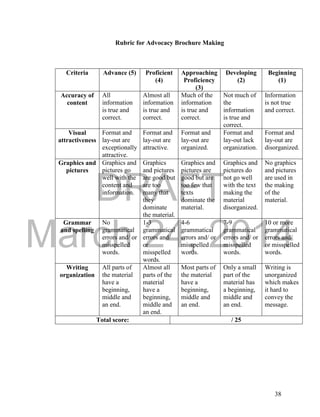
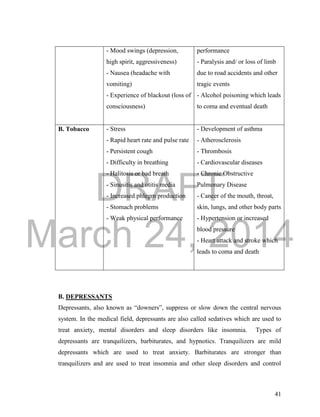
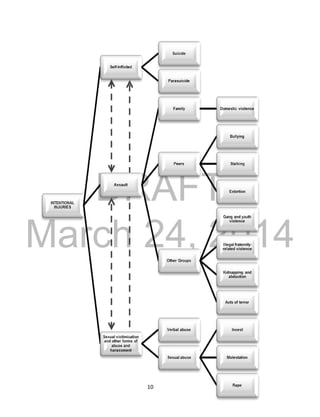
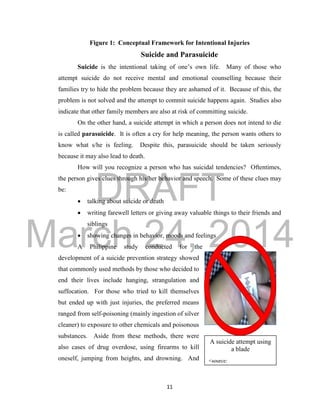
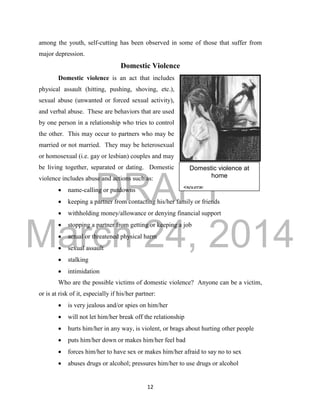
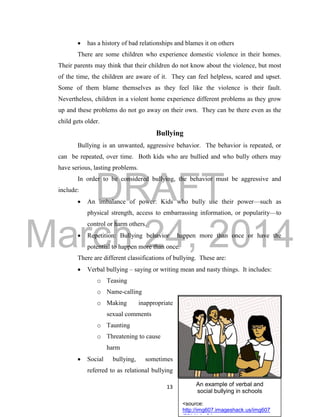
Compilation by Ben: r_borres@yahoo.com        


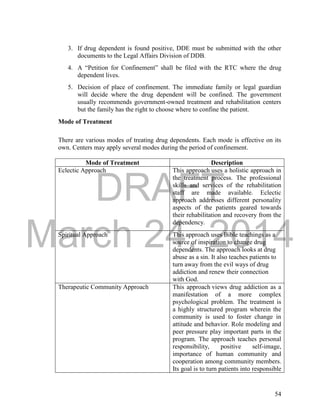
GRADE 9 
Learning Module 
 
HEALTH 
(Qtr 1 to 4) 
 
 
DRAFT
March 24, 2014
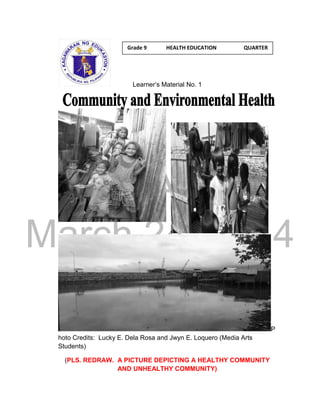
Learner’s Material No. 1
P
hoto Credits: Lucky E. Dela Rosa and Jwyn E. Loquero (Media Arts
Students)
(PLS. REDRAW. A PICTURE DEPICTING A HEALTHY COMMUNITY
AND UNHEALTHY COMMUNITY)
Grade 9 HEALTH EDUCATION QUARTER
1
DRAFT
March 24, 2014
INTRODUCTION
A healthy community reflects a sense of well being. It is the
foundation for achieving all other goals and is essential for a productive
society. Thus, it also helps in building our country’s economy and in
equipping our students to be healthier in order to learn and succeed
academically.
In this module you will encounter social issues and problems
involving the threats of community and environmental destruction. You will
be encouraged to get involved in programs advocating community and
environmental health. As a student, you can take part in maintaining and
promoting a healthful community and environment This module is designed
for you to reflect on how healthy your community and environment are, what
activities that adversely affect them and what you should do to sustain
community and environmental health.
In the first part of this material, you are given an overview of the unit
and concepts you will take up and the things they are expected to do.
In the pre-assessment, you will be asked to recall what you had
learned from meaningful experiences of your life relevant to environmental
destruction.
The varied competencies shall be your guide on what you are
expected to accomplish in this module.
These modules will discuss four (4) lessons, which are categorically
divided into four parts: What to Know, What to Process, What to
Understand and What to Transfer.
 LEARNING COMPETENCIES: At the end of this unit, the
learners should be able to:
1. explain the concept of community health
2. describe the characteristics of a healthy community
3. recognize the benefits of a healthy environment
4. identify the most pressing environmental problems
in the Philippines
5. analyze the impact of environmental problems on
people’s health
6. apply community development and program
planning skills to create effective and culturally
DRAFT
March 24, 2014
relevant communication strategies and interventions
to promote health
7. make decisions about buildings, businesses,
services, housing areas and other structures to
include in the environment of a healthy dream
community
PRE-ASSESSMENT
Choose the best answer from the options below.
Write the letter on the space provided before
each number.
_______1. Which best describes a community health program?
A. It maintains, protects and improves the health of all members
of the community through organized and sustained community
efforts.
B. It maintains and improves the health of all members of the
community through organized and sustained community
efforts.
C. It protects and improves the health of all members of the
community through organized and sustained community
efforts.
D. It maintains, protects and improves the health of all members
of the community
______2. Which does not describe a healthy community?
A. A clean and safe environment
B. An environment that meets everyone’s basic needs
C. An environment that promotes social harmony and actively
involves everyone
D. An environment that is fully aware of its daily opportunities.
______3. Which best describes the benefits of a healthy
environment?
A. Less disease, less health care costs
B. Active community involvement
C. More budget for health problems, increased supply of
medicines
D. More community projects for community development
DRAFT
March 24, 2014
________4. Which of the following problems is a leading cause of
environmental destruction?
A. Soil Erosion
B. Oil Spill
C. Illegal Mining
D. Deforestation
________5. What environmental problem reduces the ability of soil
to store water and
support plant growth?
A. Soil Erosion C. Illegal Mining
B. Oil Spill D. Deforestation
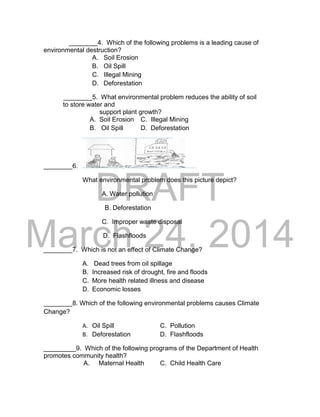
________6.
What environmental problem does this picture depict?
A. Water pollution
B. Deforestation
C. Improper waste disposal
D. Flashfloods
________7. Which is not an effect of Climate Change?
A. Dead trees from oil spillage
B. Increased risk of drought, fire and floods
C. More health related illness and disease
D. Economic losses
________8. Which of the following environmental problems causes Climate
Change?
A. Oil Spill C. Pollution
B. Deforestation D. Flashfloods
_________9. Which of the following programs of the Department of Health
promotes community health?
A. Maternal Health C. Child Health Care
DRAFT
March 24, 2014
B. Primary Health Care D. Control of Communicable
Diseases
_________10. Why do we need to ensure community health in planning for
community development?
A. To attain luxury of life
B. To keep the safety of the community
C. To live in a clean, safe and comfortable home
D. To maintain an enjoyable lifestyle
LESSON 1: THE CONCEPTS OF COMMUNITY AND
ENVIRONMENTAL HEALTH
OBJECTIVES
At the end of the lesson, the learners should be able to:
 explain the concept of community health and environmental
health
 describe the characteristics of a healthy community
PART 1 – WHAT TO KNOW
Activity 1: VENN DIAGRAM
This unit will introduce you to the concepts of a
community and environmental health, to make you be
aware of the importance of having a healthy
community. You will be asked to participate in a
series of activities involving health programs in your
community
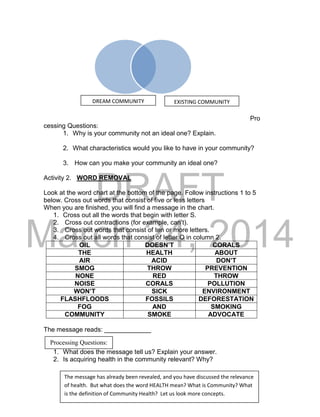
List down the different characteristics of your ideal/dream and existing
community in the diagram. In the space where the two circles meet, write their
similar characteristics.
DRAFT
March 24, 2014
Pro
cessing Questions:
1. Why is your community not an ideal one? Explain.
2. What characteristics would you like to have in your community?
3. How can you make your community an ideal one?
Activity 2. WORD REMOVAL
Look at the word chart at the bottom of the page. Follow instructions 1 to 5
below. Cross out words that consist of five or less letters
When you are finished, you will find a message in the chart.
1. Cross out all the words that begin with letter S.
2. Cross out contractions (for example, can’t).
3. Cross out words that consist of ten or more letters.
4. Cross out all words that consist of letter O in column 2.
OIL DOESN’T CORALS
THE HEALTH ABOUT
AIR ACID DON’T
SMOG THROW PREVENTION
NONE RED THROW
NOISE CORALS POLLUTION
WON’T SICK ENVIRONMENT
FLASHFLOODS FOSSILS DEFORESTATION
FOG AND SMOKING
COMMUNITY SMOKE ADVOCATE
The message reads: _____________
1. What does the message tell us? Explain your answer.
2. Is acquiring health in the community relevant? Why?
Processing Questions:
DREAM COMMUNITY EXISTING COMMUNITY
The message has already been revealed, and you have discussed the relevance
of health. But what does the word HEALTH mean? What is Community? What
is the definition of Community Health? Let us look more concepts.
DRAFT
March 24, 2014
This is what you need to know:
According to the World Health Organization, Health is a state of
complete physical, mental, and social well-being and not just the
absence of disease or infirmity. It lead to the ability to lead a socially
and economically productive life.”
Community is defined as a sociological group in a large place
sharing one environment. It therefore includes the individual and the
family.
Community Health is defined as the art and science of maintaining,
protecting and improving the health of all the members of the
community through organized and sustained community efforts.
Environmental Health comprises those aspects of human health
that are determined by physical, chemical, biological, social and
psychosocial factors in the surrounding environment.
According to the World Health Organization (2002), the
characteristics of a healthy community include:
1. A clean and safe physical environment
2. An environment that meets everyone’s basic needs
3. An environment that promotes social harmony and actively involves
everyone
4. An understanding of local health and environment issues
5. A community that participates in identifying local solutions to local
problems
6. A community whose members have access to varied experiences,
means of interaction and communication
7. Accessible and appropriate health services and facilities
8. The promotion and celebration of historical and cultural heritage
9. A diverse and innovative economy
10.A sustainable use of available resources for all
And read more!
You have now encountered concepts of community and environmental
health. Share what you have understood. Write on the board at least 3
keywords that expresses what you have learned.
DRAFT
March 24, 2014
Our government believes that a strong nation needs healthy citizenry.
In order to achieve this, the Department of Health promoted community
health with the partnership of community, barangay, government, and non-
governmental organizations through the program called Primary Health
Care.
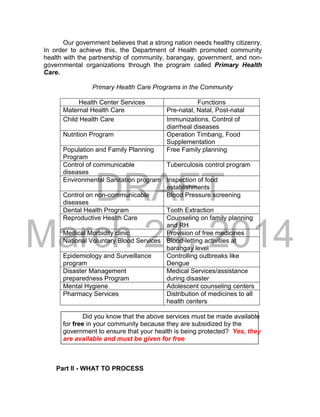
Primary Health Care Programs in the Community
Health Center Services Functions
Maternal Health Care Pre-natal, Natal, Post-natal
Child Health Care Immunizations, Control of
diarrheal diseases
Nutrition Program Operation Timbang, Food
Supplementation
Population and Family Planning
Program
Free Family planning
Control of communicable
diseases
Tuberculosis control program
Environmental Sanitation program Inspection of food
establishments
Control on non-communicable
diseases
Blood Pressure screening
Dental Health Program Tooth Extraction
Reproductive Health Care Counseling on family planning
and RH
Medical Morbidity clinic Provision of free medicines
National Voluntary Blood Services Blood-letting activities at
barangay level
Epidemiology and Surveillance
program
Controlling outbreaks like
Dengue
Disaster Management
preparedness Program
Medical Services/assistance
during disaster
Mental Hygiene Adolescent counseling centers
Pharmacy Services Distribution of medicines to all
health centers
Did you know that the above services must be made available
for free in your community because they are subsidized by the
government to ensure that your health is being protected? Yes, they
are available and must be given for free
Part II - WHAT TO PROCESS
DRAFT
March 24, 2014
Activity 3. THE HEALTH EXPERT
You are presently working at the
World Health Organization as a Health
Expert. A number of students will
interview you about community and
environmental health. Here are some of
the questions that you will be asked.
Write your response to each question on
the space provided.
1. How do you assess if your community is healthy? What are the
characteristics of a healthy community?
2. What are some of the benefits that we can enjoy with a healthy
community?
3. How do we maintain, protect, and preserve health amidst the rising
development of our community?
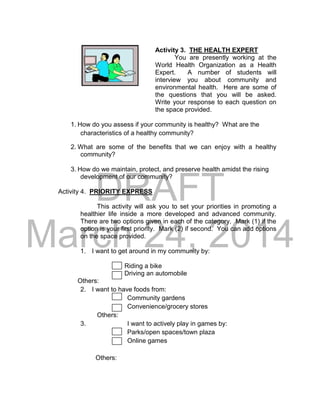
Activity 4. PRIORITY EXPRESS
This activity will ask you to set your priorities in promoting a
healthier life inside a more developed and advanced community.
There are two options given in each of the category. Mark (1) if the
option is your first priority. Mark (2) if second. You can add options
on the space provided.
1. I want to get around in my community by:
Riding a bike
Driving an automobile
Others:
2. I want to have foods from:
Community gardens
Convenience/grocery stores
Others:
3. I want to actively play in games by:
Parks/open spaces/town plaza
Online games
Others:
DRAFT
March 24, 2014
4. I want to have more chances to get to know my
neighbors through:
Social Networking
Active membership in youth organization
Others:
5. I want to live in a clean environment by:
Reducing the amount of refuse
Campaigning for a clean and green community
Others:
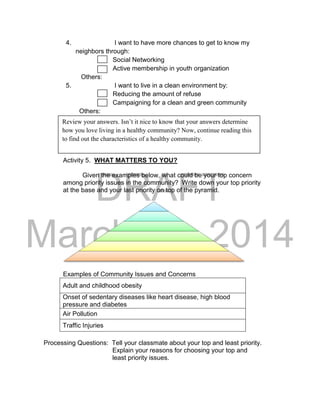
Activity 5. WHAT MATTERS TO YOU?
Given the examples below, what could be your top concern
among priority issues in the community? Write down your top priority
at the base and your last priority on top of the pyramid.
Examples of Community Issues and Concerns
Adult and childhood obesity
Onset of sedentary diseases like heart disease, high blood
pressure and diabetes
Air Pollution
Traffic Injuries
Processing Questions: Tell your classmate about your top and least priority.
Explain your reasons for choosing your top and
least priority issues.
Review your answers. Isn’t it nice to know that your answers determine
how you love living in a healthy community? Now, continue reading this
to find out the characteristics of a healthy community.
DRAFT
March 24, 2014
PART III -- WHAT TO UNDERSTAND
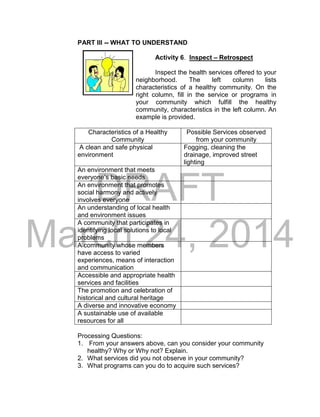
Activity 6. Inspect – Retrospect
I Inspect the health services offered to your
neighborhood. The left column lists
characteristics of a healthy community. On the
right column, fill in the service or programs in
your community which fulfill the healthy
community, characteristics in the left column. An
example is provided.
Characteristics of a Healthy
Community
Possible Services observed
from your community
A clean and safe physical
environment
Fogging, cleaning the
drainage, improved street
lighting
An environment that meets
everyone’s basic needs
An environment that promotes
social harmony and actively
involves everyone
An understanding of local health
and environment issues
A community that participates in
identifying local solutions to local
problems
A community whose members
have access to varied
experiences, means of interaction
and communication
Accessible and appropriate health
services and facilities
The promotion and celebration of
historical and cultural heritage
A diverse and innovative economy
A sustainable use of available
resources for all
Processing Questions:
1. From your answers above, can you consider your community
healthy? Why or Why not? Explain.
2. What services did you not observe in your community?
3. What programs can you do to acquire such services?
DRAFT
March 24, 2014
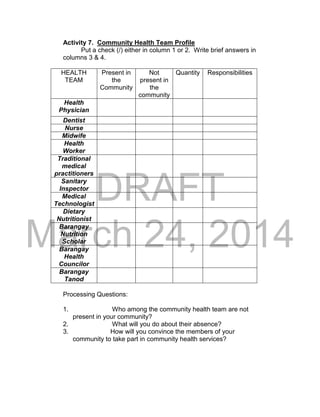
Activity 7. Community Health Team Profile
Put a check (/) either in column 1 or 2. Write brief answers in
columns 3 & 4.
HEALTH
TEAM
Present in
the
Community
Not
present in
the
community
Quantity Responsibilities
Health
Physician
Dentist
Nurse
Midwife
Health
Worker
Traditional
medical
practitioners
Sanitary
Inspector
Medical
Technologist
Dietary
Nutritionist
Barangay
Nutrition
Scholar
Barangay
Health
Councilor
Barangay
Tanod
Processing Questions:
1. Who among the community health team are not
present in your community?
2. What will you do about their absence?
3. How will you convince the members of your
community to take part in community health services?
DRAFT
March 24, 2014
PART IV-- WHAT TO TRANSFER
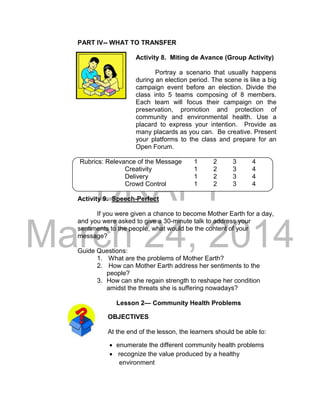
Activity 8. Miting de Avance (Group Activity)
Portray a scenario that usually happens
during an election period. The scene is like a big
campaign event before an election. Divide the
class into 5 teams composing of 8 members.
Each team will focus their campaign on the
preservation, promotion and protection of
community and environmental health. Use a
placard to express your intention. Provide as
many placards as you can. Be creative. Present
your platforms to the class and prepare for an
Open Forum.
Rubrics: Relevance of the Message 1 2 3 4
Creativity 1 2 3 4
Delivery 1 2 3 4
Crowd Control 1 2 3 4
Activity 9. Speech-Perfect
If you were given a chance to become Mother Earth for a day,
and you were asked to give a 30-minute talk to address your
sentiments to the people, what would be the content of your
message?
Guide Questions:
1. What are the problems of Mother Earth?
2. How can Mother Earth address her sentiments to the
people?
3. How can she regain strength to reshape her condition
amidst the threats she is suffering nowadays?
Lesson 2— Community Health Problems
OBJECTIVES
At the end of the lesson, the learners should be able to:
 enumerate the different community health problems
 recognize the value produced by a healthy
environment
DRAFT
March 24, 2014
PART 1—WHAT TO KNOW
Community health problems are common
nowadays with the rise in modern technology; people
neglect the importance of the basic need for safety. A
safe environment will ensure quality of life that will lead
to more productive citizen of the country. This lesson
will help you understand that one environment is
threatened by human activities and that you have a role
in wiping out community health problems.
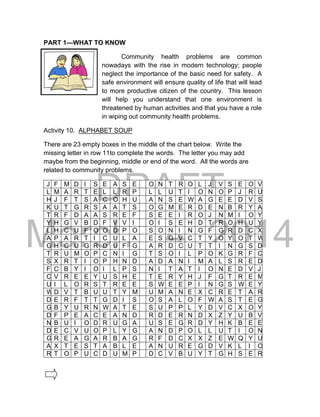
Activity 10. ALPHABET SOUP
There are 23 empty boxes in the middle of the chart below. Write the
missing letter in row 11to complete the words. The letter you may add
maybe from the beginning, middle or end of the word. All the words are
related to community problems.
J F M D I S E A S E O N T R O L J V S E O V
L M A R T E L L R P L L U T I O N O P J R U
H J F T S A C O H U A N S E W A G E E D V S
K U T G R S A A T S O G M E R D E N B R Y A
T R F D A A S R E F S E E I R O J N M I O Y
Y H G V B D F V V I O I S E H D T R O H U Y
L H C U F O O D P O S O N I N G F G R D C X
A P A R T I C U L A E S G V C T Y O Y O T W
G H C U G R D U F G A R D C U T T I N G S D
T R U M O P C N I G T S O I L P O K G R F C
S X R T I O P H N D A D A N I M A L S R E D
F C B Y I O I L P S N I T A T I O N E D V J
C V R E E Y U S H E T E R Y H J F G T R E M
U I L O R S T R E E S W E E P I N G S W E Y
W D V T B U U T Y M U M A N E X C R E T A R
D E R F T T G D I S O S A L O F W A S T E G
G B Y U R N W A T E S U P P L Y D V C X O Y
D F P E A C E A N D R D E R N D X Z Y U B V
N B U I O D R U G A U S E G R D Y H K B E E
D E C V U O P L Y G A N D P O L L U T I O N
G R E A G A R B A G R F D C X X Z E W Q Y U
A X T E S T A B L E A N U R E G D V K L I O
R T O P U C D U M P D C V B U Y T G H S E R
DRAFT
March 24, 2014
What words did you find? Use those words to create a
meaningful paragraph or statement to awaken mankind to the
problems of the environment.
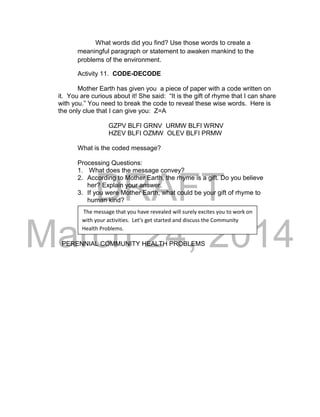
Activity 11. CODE-DECODE
Mother Earth has given you a piece of paper with a code written on
it. You are curious about it! She said: “It is the gift of rhyme that I can share
with you.” You need to break the code to reveal these wise words. Here is
the only clue that I can give you: Z=A
GZPV BLFI GRNV URMW BLFI WRNV
HZEV BLFI OZMW OLEV BLFI PRMW
What is the coded message?
Processing Questions:
1. What does the message convey?
2. According to Mother Earth, the rhyme is a gift. Do you believe
her? Explain your answer.
3. If you were Mother Earth, what could be your gift of rhyme to
human kind?
PERENNIAL COMMUNITY HEALTH PROBLEMS
The message that you have revealed will surely excites you to work on
with your activities. Let’s get started and discuss the Community
Health Problems.
DRAFT
March 24, 2014
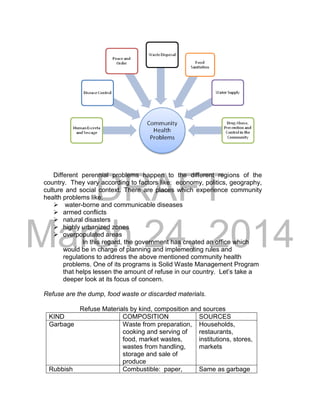
Different perennial problems happen to the different regions of the
country. They vary according to factors like: economy, politics, geography,
culture and social context. There are places which experience community
health problems like:
 water-borne and communicable diseases
 armed conflicts
 natural disasters
 highly urbanized zones
 overpopulated areas
In this regard, the government has created an office which
would be in charge of planning and implementing rules and
regulations to address the above mentioned community health
problems. One of its programs is Solid Waste Management Program
that helps lessen the amount of refuse in our country. Let’s take a
deeper look at its focus of concern.
Refuse are the dump, food waste or discarded materials.
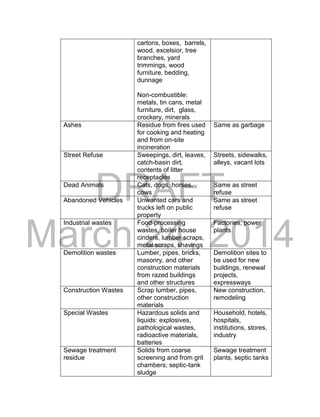
Refuse Materials by kind, composition and sources
KIND COMPOSITION SOURCES
Garbage Waste from preparation,
cooking and serving of
food, market wastes,
wastes from handling,
storage and sale of
produce
Households,
restaurants,
institutions, stores,
markets
Rubbish Combustible: paper, Same as garbage
DRAFT
March 24, 2014
cartons, boxes, barrels,
wood, excelsior, tree
branches, yard
trimmings, wood
furniture, bedding,
dunnage
Non-combustible:
metals, tin cans, metal
furniture, dirt, glass,
crockery, minerals
Ashes Residue from fires used
for cooking and heating
and from on-site
incineration
Same as garbage
Street Refuse Sweepings, dirt, leaves,
catch-basin dirt,
contents of litter
receptacles
Streets, sidewalks,
alleys, vacant lots
Dead Animals Cats, dogs, horses,
cows
Same as street
refuse
Abandoned Vehicles Unwanted cars and
trucks left on public
property
Same as street
refuse
Industrial wastes Food-processing
wastes, boiler house
cinders, lumber scraps,
metal scraps, shavings
Factories, power
plants
Demolition wastes Lumber, pipes, bricks,
masonry, and other
construction materials
from razed buildings
and other structures
Demolition sites to
be used for new
buildings, renewal
projects,
expressways
Construction Wastes Scrap lumber, pipes,
other construction
materials
New construction,
remodeling
Special Wastes Hazardous solids and
liquids: explosives,
pathological wastes,
radioactive materials,
batteries
Household, hotels,
hospitals,
institutions, stores,
industry
Sewage treatment
residue
Solids from coarse
screening and from grit
chambers; septic-tank
sludge
Sewage treatment
plants, septic tanks
DRAFT
March 24, 2014
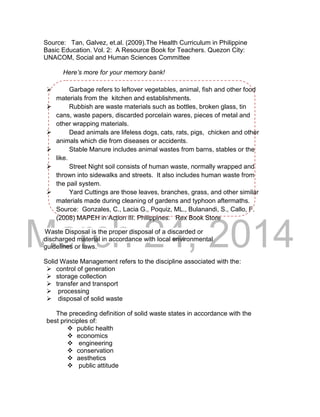
Source: Tan, Galvez, et.al. (2009).The Health Curriculum in Philippine
Basic Education. Vol. 2: A Resource Book for Teachers. Quezon City:
UNACOM, Social and Human Sciences Committee
Here’s more for your memory bank!
 Garbage refers to leftover vegetables, animal, fish and other food
materials from the kitchen and establishments.
 Rubbish are waste materials such as bottles, broken glass, tin
cans, waste papers, discarded porcelain wares, pieces of metal and
other wrapping materials.
 Dead animals are lifeless dogs, cats, rats, pigs, chicken and other
animals which die from diseases or accidents.
 Stable Manure includes animal wastes from barns, stables or the
like.
 Street Night soil consists of human waste, normally wrapped and
thrown into sidewalks and streets. It also includes human waste from
the pail system.
 Yard Cuttings are those leaves, branches, grass, and other similar
materials made during cleaning of gardens and typhoon aftermaths.
Source: Gonzales, C., Lacia G., Poquiz, ML., Bulanandi, S., Callo, F.
(2008) MAPEH in Action III. Philippines: Rex Book Store
Waste Disposal is the proper disposal of a discarded or
discharged material in accordance with local environmental
guidelines or laws.
Solid Waste Management refers to the discipline associated with the:
 control of generation
 storage collection
 transfer and transport
 processing
 disposal of solid waste
The preceding definition of solid waste states in accordance with the
best principles of:
 public health
 economics
 engineering
 conservation
 aesthetics
 public attitude
DRAFT
March 24, 2014
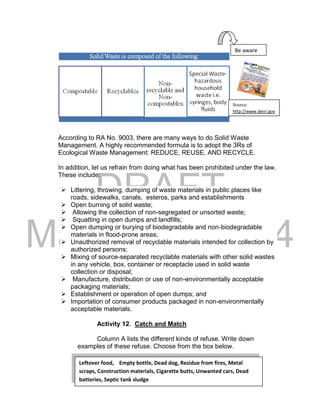
According to RA No. 9003, there are many ways to do Solid Waste
Management. A highly recommended formula is to adopt the 3Rs of
Ecological Waste Management: REDUCE, REUSE, AND RECYCLE.
In addition, let us refrain from doing what has been prohibited under the law.
These include:
 Littering, throwing, dumping of waste materials in public places like
roads, sidewalks, canals, esteros, parks and establishments
 Open burning of solid waste;
 Allowing the collection of non-segregated or unsorted waste;
 Squatting in open dumps and landfills;
 Open dumping or burying of biodegradable and non-biodegradable
materials in flood-prone areas;
 Unauthorized removal of recyclable materials intended for collection by
authorized persons;
 Mixing of source-separated recyclable materials with other solid wastes
in any vehicle, box, container or receptacle used in solid waste
collection or disposal;
 Manufacture, distribution or use of non-environmentally acceptable
packaging materials;
 Establishment or operation of open dumps; and
 Importation of consumer products packaged in non-environmentally
acceptable materials.
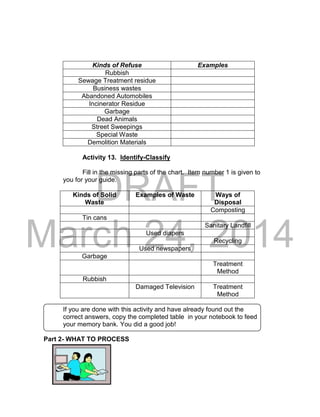
Activity 12. Catch and Match
Column A lists the different kinds of refuse. Write down
examples of these refuse. Choose from the box below.
Leftover food, Empty bottle, Dead dog, Residue from fires, Metal
scraps, Construction materials, Cigarette butts, Unwanted cars, Dead
batteries, Septic tank sludge
Source:
http://www.denr.gov
.ph/
Be aware
of this!
DRAFT
March 24, 2014
Kinds of Refuse Examples
Rubbish
Sewage Treatment residue
Business wastes
Abandoned Automobiles
Incinerator Residue
Garbage
Dead Animals
Street Sweepings
Special Waste
Demolition Materials
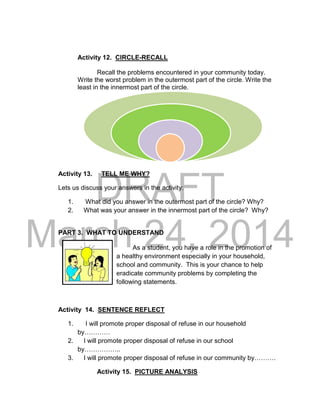
Activity 13. Identify-Classify
Fill in the missing parts of the chart. Item number 1 is given to
you for your guide.
Kinds of Solid
Waste
Examples of Waste Ways of
Disposal
Composting
Tin cans
Sanitary Landfill
Used diapers
Recycling
Used newspapers
Garbage
Treatment
Method
Rubbish
Damaged Television Treatment
Method
If you are done with this activity and have already found out the
correct answers, copy the completed table in your notebook to feed
your memory bank. You did a good job!
Part 2- WHAT TO PROCESS
DRAFT
March 24, 2014
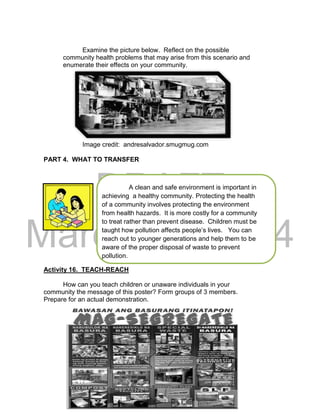
Activity 12. CIRCLE-RECALL
Recall the problems encountered in your community today.
Write the worst problem in the outermost part of the circle. Write the
least in the innermost part of the circle.
Activity 13. TELL ME WHY?
Lets us discuss your answers in the activity:
1. What did you answer in the outermost part of the circle? Why?
2. What was your answer in the innermost part of the circle? Why?
PART 3. WHAT TO UNDERSTAND
As a student, you have a role in the promotion of
a healthy environment especially in your household,
school and community. This is your chance to help
eradicate community problems by completing the
following statements.
Activity 14. SENTENCE REFLECT
1. I will promote proper disposal of refuse in our household
by…………
2. I will promote proper disposal of refuse in our school
by……………..
3. I will promote proper disposal of refuse in our community by……….
Activity 15. PICTURE ANALYSIS
DRAFT
March 24, 2014
Examine the picture below. Reflect on the possible
community health problems that may arise from this scenario and
enumerate their effects on your community.
Image credit: andresalvador.smugmug.com
PART 4. WHAT TO TRANSFER
A clean and safe environment is important in
achieving a healthy community. Protecting the health
of a community involves protecting the environment
from health hazards. It is more costly for a community
to treat rather than prevent disease. Children must be
taught how pollution affects people’s lives. You can
reach out to younger generations and help them to be
aware of the proper disposal of waste to prevent
pollution.
Activity 16. TEACH-REACH
How can you teach children or unaware individuals in your
community the message of this poster? Form groups of 3 members.
Prepare for an actual demonstration.
DRAFT
March 24, 2014
Photo Credit: http://www.denr.gov.ph/
Activity 17. SONG IRONY
The song, “Anak ng Pasig” is a reminder to all Filipinos that we
sometimes neglect our environment. People tend to satisfy their needs and
wants at the expense of our habitat.
The activity Song Irony is based from the song, “Anak ng Pasig”. Compose
the irony message of the song “Anak ng Pasig” using the same melody.
Turn the negative lyrics into something positive.
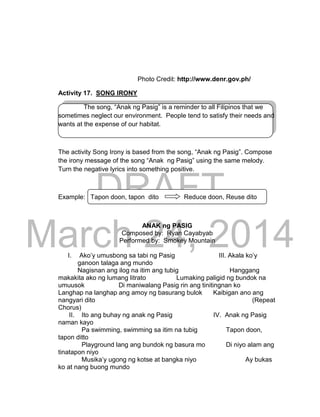
Example: Tapon doon, tapon dito Reduce doon, Reuse dito
ANAK ng PASIG
Composed by: Ryan Cayabyab
Performed by: Smokey Mountain
I. Ako’y umusbong sa tabi ng Pasig III. Akala ko’y
ganoon talaga ang mundo
Nagisnan ang ilog na itim ang tubig Hanggang
makakita ako ng lumang litrato Lumaking paligid ng bundok na
umuusok Di maniwalang Pasig rin ang tinitingnan ko
Langhap na langhap ang amoy ng basurang bulok Kaibigan ano ang
nangyari dito (Repeat
Chorus)
II. Ito ang buhay ng anak ng Pasig IV. Anak ng Pasig
naman kayo
Pa swimming, swimming sa itim na tubig Tapon doon,
tapon ditto
Playground lang ang bundok ng basura mo Di niyo alam ang
tinatapon niyo
Musika’y ugong ng kotse at bangka niyo Ay bukas
ko at nang buong mundo
DRAFT
March 24, 2014
Ruping Pablo Ondoy Sendo
ng
Yolanda Uring
Chorus: V.
Anak ng Pasig naman kayo Anak ng Pasig
naman kayo
Kalat doon, kalat dito May bukas pa
ang ating mundo
Natakpan na ang langit kong ito
Nilason din ang ilog ko
Processing Questions:
1. What did you feel upon changing the lyrics from negative to
positive?
2. What does your song convey?
Lesson 3. Environmental Problems in the Philippines
OBJECTIVES
At the end of the lesson, the learners should be able to:
 describe the environmental problems in the
Philippines
 analyze the impact of the environmental
problems on people’s health
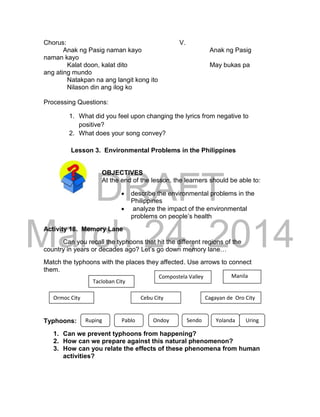
Activity 18. Memory Lane
Can you recall the typhoons that hit the different regions of the
country in years or decades ago? Let’s go down memory lane…
Match the typhoons with the places they affected. Use arrows to connect
them.
Typhoons:
1. Can we prevent typhoons from happening?
2. How can we prepare against this natural phenomenon?
3. How can you relate the effects of these phenomena from human
activities?
Ormoc City
Tacloban City
Cebu City
Compostela Valley
Cagayan de Oro City
Manila
City
DRAFT
March 24, 2014
Part 1. WHAT TO KNOW
Natural Resources and Biodiversity
explain why the Philippines is a rich country.
Putting our home into the rare list of nations
which have both a hotspot and mega diversity
area for over 6000 plant species and also
numerous animal species inhabited this area.
However, despite—or perhaps because of—
their richness and massive importance to the
environment and humans as well, the forests
face continuing destruction and possible
extinction.
This lesson will make you aware of the most pressing problems of
environment today and their effects on people’s health.
Let’s narrow them down:
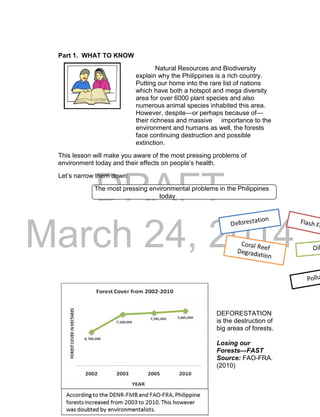
The most pressing environmental problems in the Philippines
today
DEFORESTATION
is the destruction of
big areas of forests.
Losing our
Forests—FAST
Source: FAO-FRA.
(2010)
DRAFT
March 24, 2014
 The Philippines is among the countries with the fastest loss of forest
cover around the world.
 It ranks 4th among the world’s top 10 most threatened forest hotspots
 If the 157, 400 ha per year rate of deforestation continues, our
remaining forest cover will be wiped out in less than 40 years.
http://www.dailymail.co.uk/news/article-
ILLEGAL MINING is defined as the extraction of valuable minerals or other
geological materials from the earth from an ore body, lode, vein, seam, or
reef, which forms the mineralized package of economic interest to the miner
in the absence of land rights, mining license, exploration or mineral
transportation permit or of any document that could legitimate the on-going
operations.
Here’s for your memory bank:
The Mining Act of 1995 aimed to help the domestic mining industry
regain its competitiveness by allowing companies (Contractors) to obtain an
exploration permit for a specific area for up to four years.
The Philippines is one of
the most highly
mineralized countries in
the world with a mineral
wealth estimated at US$
840 billion, of which most
of the mineral reserves are
still untapped.
Nickel takes the lead in H1 2013
Mines and Geosciences
Bureau, October 22, 2013
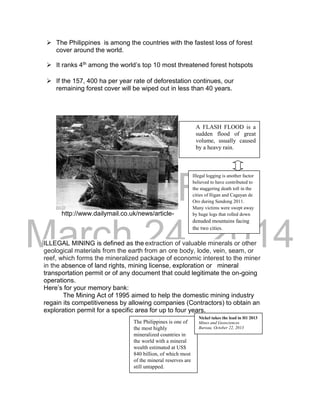
A FLASH FLOOD is a
sudden flood of great
volume, usually caused
by a heavy rain.
Illegal logging is another factor
believed to have contributed to
the staggering death toll in the
cities of Iligan and Cagayan de
Oro during Sendong 2011.
Many victims were swept away
by huge logs that rolled down
denuded mountains facing
the two cities.
DRAFT
March 24, 2014
Source:http://books.google.com.ph/books?id=nika34WTbEwC&pg=PA98&d
q=illegal+mining+act+in+the+philippines&hl=en&sa=X&ei=ajN7UoO2JYiMi
QeipICgCQ&ved=0CDMQ6AEwAQ#v=onepage&q=illegal%20mining%20ac
t%20in%20the%20philippines&f=false
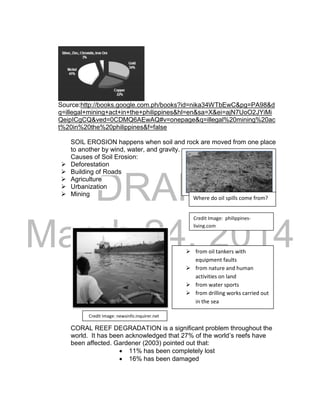
SOIL EROSION happens when soil and rock are moved from one place
to another by wind, water, and gravity.
Causes of Soil Erosion:
 Deforestation
 Building of Roads
 Agriculture
 Urbanization
 Mining
CORAL REEF DEGRADATION is a significant problem throughout the
world. It has been acknowledged that 27% of the world’s reefs have
been affected. Gardener (2003) pointed out that:
 11% has been completely lost
 16% has been damaged
Credit Image: philippines-
living.com
Credit Image: newsinfo.inquirer.net
Where do oil spills come from?
 from oil tankers with
equipment faults
 from nature and human
activities on land
 from water sports
 from drilling works carried out
in the sea
DRAFT
March 24, 2014
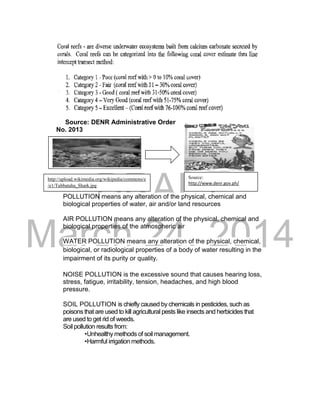
Source: DENR Administrative Order
No. 2013
POLLUTION means any alteration of the physical, chemical and
biological properties of water, air and/or land resources
AIR POLLUTION means any alteration of the physical, chemical and
biological properties of the atmospheric air
WATER POLLUTION means any alteration of the physical, chemical,
biological, or radiological properties of a body of water resulting in the
impairment of its purity or quality.
NOISE POLLUTION is the excessive sound that causes hearing loss,
stress, fatigue, irritability, tension, headaches, and high blood
pressure.
SOIL POLLUTION is chiefly caused by chemicals in pesticides, such as
poisons that are used to kill agricultural pests like insects and herbicides that
are used to get rid of weeds.
Soil pollution results from:
•Unhealthy methods of soil management.
•Harmful irrigation methods.
Source:
http://www.denr.gov.ph/
TRIVIA:
http://upload.wikimedia.org/wikipedia/commons/e
/e1/Tubbataha_Shark.jpg
DRAFT
March 24, 2014
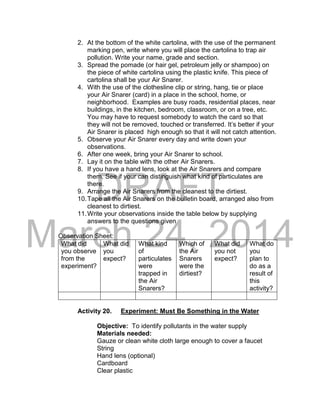
EFFECTS OF THE ENVIRONMENTAL PROBLEMS
Environmental
Problems
EFFECTS
Deforestation Soil erosion Landslides
Greenhouse effect Denuded upland
Silting of rivers and dams
Degraded watershed
Flooding
Destruction of corals along the coast
Flash Floods Causes of diseases such as Cholera and
other water borne diseases
Loss of life
Contamination of drinking water
Destruction of Sewage System
Destruction of dams and destruction of
levees
Soil Erosion Unproductive use of farmland
Difficulty in raising of livestock
Silting of artificial lakes
Loss of soil and vegetation which causes
climate changes
Oil Spill Suffocation of marine mammals
Death of trees from oil in roots
Coral Reef
Degradation
Loss of edible reef fish
Reduction of species diversity and richness
Alteration in the size structure of target
species
Illegal Mining Water poisoning of all the living things in it
Destruction of beautiful coral reefs
Barenness of land
Here’s what you need to know!
“Environmental Law: Pollution Control” is all about combating
pollution in the Philippine setting.
The following are pertinent laws adhering to environmental safety
and health protection:
P.D. 389 (P.D. 705) – The Forestry Reform Code
DRAFT
March 24, 2014
- codifies, updates and raises forestry laws in the country. It emphasizes the
sustainable utilization of forest resources.
P.D. 704 – Preservation of optimum productivity of fishery resources
through conservation and protection.
P.D. 1219 – Providing for the protection of coral ecosystems.
P.D. 1067 – Water Code of the Philippines
- adopts adequate measures to conserve and regulate the use of water in
commercial, industrial and residential areas. It also provides other policy
guidelines on water quality and management of water resources.
P.D. 463 – Amended the Mining Act of 1936. Requires all mining
leaseholders to comply with Pollution Control Laws and regulations and
provide for penalties for noncompliance.
P.D. 1251 – Imposes fines on tailings and mine wastes and the fund
generated is used to pay for the damages to land, agricultural crops, forests
products, aquatic resources and infrastructures caused by pollution for
mining operations.
P.D. 984 – The Pollution Control Law
P.D. 825 – Prohibits the improper disposal of garbage
P.D. 856 – Sanitation Code
- places the responsibility on the local government units for he solid waste
management in their area of production.
R.A. 8749 – Philippine Clean Air Act of 1999- provides for a comprehensive
air pollution control policy.
Part 2. WHAT TO PROCESS
To be able to find out something about the air we
breathe, follow the simple instructions below
Activity 19 : An Experiment: Snare that Air
Objective: Describe how polluted air is in different places
Materials needed:
1 white cartolina cut into ¼ size short bond paper
Pomade, hair gel, petroleum jelly, or shampoo
Plastic knife
Clothesline clip or string
Permanent marking pen (fine)
Masking tape
Hand lens (optional)
1. Do this activity on a dry day.
DRAFT
March 24, 2014
2. At the bottom of the white cartolina, with the use of the permanent
marking pen, write where you will place the cartolina to trap air
pollution. Write your name, grade and section.
3. Spread the pomade (or hair gel, petroleum jelly or shampoo) on
the piece of white cartolina using the plastic knife. This piece of
cartolina shall be your Air Snarer.
4. With the use of the clothesline clip or string, hang, tie or place
your Air Snarer (card) in a place in the school, home, or
neighborhood. Examples are busy roads, residential places, near
buildings, in the kitchen, bedroom, classroom, or on a tree, etc.
You may have to request somebody to watch the card so that
they will not be removed, touched or transferred. It’s better if your
Air Snarer is placed high enough so that it will not catch attention.
5. Observe your Air Snarer every day and write down your
observations.
6. After one week, bring your Air Snarer to school.
7. Lay it on the table with the other Air Snarers.
8. If you have a hand lens, look at the Air Snarers and compare
them. See if your can distinguish what kind of particulates are
there.
9. Arrange the Air Snarers from the cleanest to the dirtiest.
10.Tape all the Air Snarers on the bulletin board, arranged also from
cleanest to dirtiest.
11.Write your observations inside the table below by supplying
answers to the questions given
Observation Sheet:
What did
you observe
from the
experiment?
What did
you
expect?
What kind
of
particulates
were
trapped in
the Air
Snarers?
Which of
the Air
Snarers
were the
dirtiest?
What did
you not
expect?
What do
you
plan to
do as a
result of
this
activity?
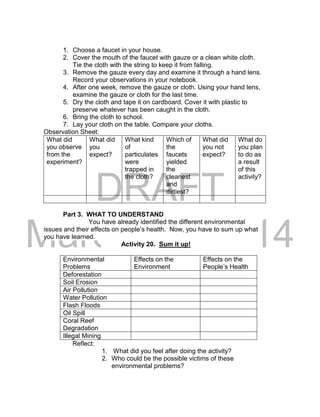
Activity 20. Experiment: Must Be Something in the Water
Objective: To identify pollutants in the water supply
Materials needed:
Gauze or clean white cloth large enough to cover a faucet
String
Hand lens (optional)
Cardboard
Clear plastic
DRAFT
March 24, 2014
1. Choose a faucet in your house.
2. Cover the mouth of the faucet with gauze or a clean white cloth.
Tie the cloth with the string to keep it from falling.
3. Remove the gauze every day and examine it through a hand lens.
Record your observations in your notebook.
4. After one week, remove the gauze or cloth. Using your hand lens,
examine the gauze or cloth for the last time.
5. Dry the cloth and tape it on cardboard. Cover it with plastic to
preserve whatever has been caught in the cloth.
6. Bring the cloth to school.
7. Lay your cloth on the table. Compare your cloths.
Observation Sheet:
What did
you observe
from the
experiment?
What did
you
expect?
What kind
of
particulates
were
trapped in
the cloth?
Which of
the
faucets
yielded
the
cleanest
and
dirtiest?
What did
you not
expect?
What do
you plan
to do as
a result
of this
activity?
Part 3. WHAT TO UNDERSTAND
You have already identified the different environmental
issues and their effects on people’s health. Now, you have to sum up what
you have learned.
Activity 20. Sum it up!
Environmental
Problems
Effects on the
Environment
Effects on the
People’s Health
Deforestation
Soil Erosion
Air Pollution
Water Pollution
Flash Floods
Oil Spill
Coral Reef
Degradation
Illegal Mining
Reflect:
1. What did you feel after doing the activity?
2. Who could be the possible victims of these
environmental problems?
DRAFT
March 24, 2014
3. Do people still have the chance to restore what was
lost in the environment?
4. After knowing the effects of these environmental
problems, does our environment still have
something to offer to humanity?
5. How can you explain the
destruction of the environment to
the young and innocent children?
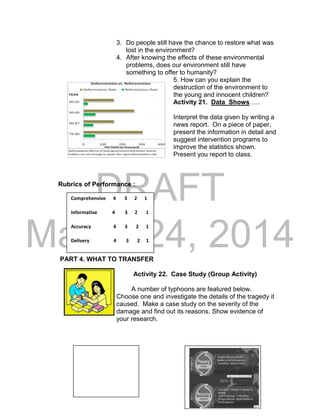
Activity 21. Data Shows…..
Interpret the data given by writing a
news report. On a piece of paper,
present the information in detail and
suggest intervention programs to
improve the statistics shown.
Present you report to class.
Rubrics of Performance :
PART 4. WHAT TO TRANSFER
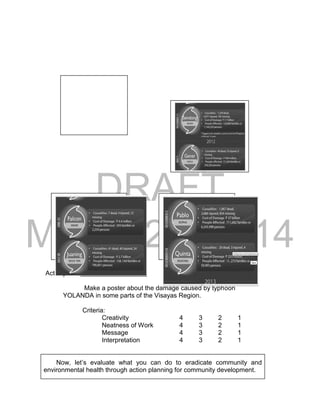
Activity 22. Case Study (Group Activity)
A number of typhoons are featured below.
Choose one and investigate the details of the tragedy it
caused. Make a case study on the severity of the
damage and find out its reasons. Show evidence of
your research.
Comprehensive 4 3 2 1
Informative 4 3 2 1
Accuracy 4 3 2 1
Delivery 4 3 2 1
DRAFT
March 24, 2014
Activity 23. PAINT ME A PICTURE
Make a poster about the damage caused by typhoon
YOLANDA in some parts of the Visayas Region.
Criteria:
Creativity 4 3 2 1
Neatness of Work 4 3 2 1
Message 4 3 2 1
Interpretation 4 3 2 1
Now, let’s evaluate what you can do to eradicate community and
environmental health through action planning for community development.
DRAFT
March 24, 2014
Lesson 4. Community Health Action Project
Implementation
Objective: At the end of this lesson, the learners
should be able to:
 apply community development and program
planning skills to create effective and culturally
relevant communication strategies and
interventions to promote health.
Part I. WHAT TO KNOW
As an aspiring young leader of your
community, you need to know how to make action plans towards community
development.
Here is what you need to know:
In this unit, you will be given the opportunity to design a program for
community development and employ planning skills. Before this, you will be
oriented on the possible ways to prevent community problems.
You will also be oriented on the existing remedial programs of your
community.
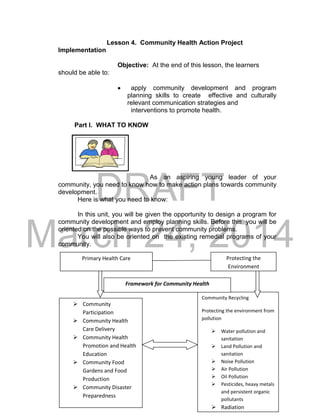
Primary Health Care Protecting the
Environment
 Community
Participation
 Community Health
Care Delivery
 Community Health
Promotion and Health
Education
 Community Food
Gardens and Food
Production
 Community Disaster
Preparedness
Community Recycling
Protecting the environment from
pollution
 Water pollution and
sanitation
 Land Pollution and
sanitation
 Noise Pollution
 Air Pollution
 Oil Pollution
 Pesticides, heavy metals
and persistent organic
pollutants
 Radiation
Framework for Community Health
DRAFT
March 24, 2014
Recall the problems of your community. Which problem needs the
most attention?
Activity 24. Think …
Have you already decided on an action plan appropriate to
your problem?
Answer: ____________________
Processing Questions:
1. What made you choose this community problem?
2. Is it already a big challenge to your community? Why?
How?
You must also know this:
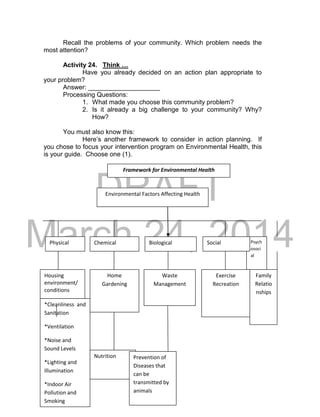
Here’s another framework to consider in action planning. If
you chose to focus your intervention program on Environmental Health, this
is your guide. Choose one (1).
MUST Know!
Framework for Environmental Health
Environmental Factors Affecting Health
Physical Psych
osoci
al
Chemical Biological Social
Housing
environment/
conditions
Home
Gardening
Waste
Management
Exercise
Recreation
Family
Relatio
nships
*Cleanliness and
Sanitation
*Ventilation
*Noise and
Sound Levels
*Lighting and
Illumination
*Indoor Air
Pollution and
Smoking
Nutrition Prevention of
Diseases that
can be
transmitted by
animals
DRAFT
March 24, 2014
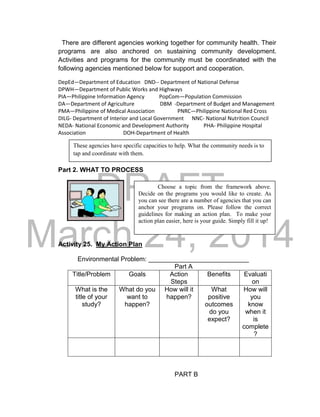
There are different agencies working together for community health. Their
programs are also anchored on sustaining community development.
Activities and programs for the community must be coordinated with the
following agencies mentioned below for support and cooperation.
DepEd—Department of Education DND-- Department of National Defense
DPWH—Department of Public Works and Highways
PIA—Philippine Information Agency PopCom—Population Commission
DA—Department of Agriculture DBM -Department of Budget and Management
PMA—Philippine of Medical Association PNRC—Philippine National Red Cross
DILG- Department of Interior and Local Government NNC- National Nutrition Council
NEDA- National Economic and Development Authority PHA- Philippine Hospital
Association DOH-Department of Health
Part 2. WHAT TO PROCESS
Activity 25. My Action Plan
Environmental Problem: ____________________________
Part A
Title/Problem Goals Action
Steps
Benefits Evaluati
on
What is the
title of your
study?
What do you
want to
happen?
How will it
happen?
What
positive
outcomes
do you
expect?
How will
you
know
when it
is
complete
?
PART B
These agencies have specific capacities to help. What the community needs is to
tap and coordinate with them.
Choose a topic from the framework above.
Decide on the programs you would like to create. As
you can see there are a number of agencies that you can
anchor your programs on. Please follow the correct
guidelines for making an action plan. To make your
action plan easier, here is your guide. Simply fill it up!
DRAFT
March 24, 2014
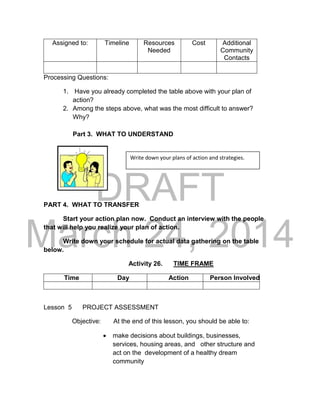
Assigned to: Timeline Resources
Needed
Cost Additional
Community
Contacts
Processing Questions:
1. Have you already completed the table above with your plan of
action?
2. Among the steps above, what was the most difficult to answer?
Why?
Part 3. WHAT TO UNDERSTAND
PART 4. WHAT TO TRANSFER
Start your action plan now. Conduct an interview with the people
that will help you realize your plan of action.
Write down your schedule for actual data gathering on the table
below.
Activity 26. TIME FRAME
Time Day Action Person Involved
Lesson 5 PROJECT ASSESSMENT
Objective: At the end of this lesson, you should be able to:
 make decisions about buildings, businesses,
services, housing areas, and other structure and
act on the development of a healthy dream
community
Write down your plans of action and strategies.
DRAFT
March 24, 2014
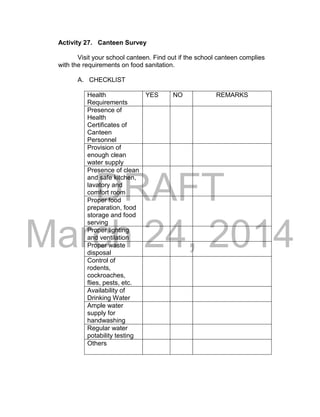
Activity 27. Canteen Survey
Visit your school canteen. Find out if the school canteen complies
with the requirements on food sanitation.
A. CHECKLIST
Health
Requirements
YES NO REMARKS
Presence of
Health
Certificates of
Canteen
Personnel
Provision of
enough clean
water supply
Presence of clean
and safe kitchen,
lavatory and
comfort room
Proper food
preparation, food
storage and food
serving
Proper lighting
and ventilation
Proper waste
disposal
Control of
rodents,
cockroaches,
flies, pests, etc.
Availability of
Drinking Water
Ample water
supply for
handwashing
Regular water
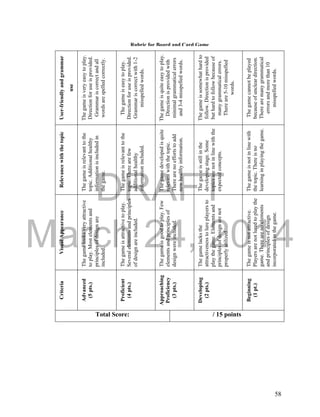
potability testing
Others
DRAFT
March 24, 2014
B.
1. Study the result of your survey.
2. How many items were complied with? Which items?
3. How many items were not complied with? Which items?
4. Write down your observations based on the survey.
5. Based on the result of your survey, what recommendations
or suggestions can you give to improve and maintain the
cleanliness and safety of the school canteen?
Suggested Activities:
1. Survey on the School’s Solid Waste Management Practice
2. Study on the Problems on the Drainage System of the
Barangay
3. Promulgate Laws for Proper Waste Disposal
4. Initiate a Signature Campaign Against Illegal Mining and
Coral Reef Degradation.
Your action plan will detail your involvement in protecting your
environment. The safety of the community is the primary concern
of the government, thus, the next lesson will introduce you to
Injury Prevention, Safety and First Aid.
But before your excitement leads you to a more wonderful
adventure, you are required to answer the summative test of this
quarter.
Link to the nearest NGO’s and GO’s for the support of this
program
Goodluck and Congratulations!
SUMMARY/SYNTHESIS
There are existing Philippine Laws that will protect our
environment from external factors. To name a few: Philippine
Clean Air Act, Philippine Water Act and Ecological Solid Waste
Management Act. These laws are implemented to protect our
environment.
In this module, you have learned the importance of having a
healthy community, thus, leading to the safety of every individual.
The concept of having an ideal community in the promotion of
Environmental Health. There are dangers around if we continue
DRAFT
March 24, 2014
to live threatening our surroundings. In fact, we have been
embedded through series of natural phenomena. Damages are
more obvious!
In this material, there are suggested activities that will guide a
Grade 9 student to be actively participating in the programs of the
government. By this, they can assess, even if in their own little
way they can make a difference.
Most of the activities highlighted on this material are geared
towards the awareness of every student that he/she has an
individual share of responsibility.
The action plan will definitely help students to take a deeper
understanding of their community by means of drawing strategic
plans to improve the safety of every individual.
There are varied formative assessments designed on this
module, anchored on the K to 12 curriculum, following the areas
on KPUP. There are 4 major categories: What to know, What to
Process, What to Understand and What to Transfer.
GLOSSARY
Air Pollution means any alteration of the physical, chemical and biological
properties of the atmospheric air, or any discharge thereto of any liquid,
gaseous or solid substances that will or is likely to create or to render the air
resources of the country harmful, detrimental, or injurious to public health,
safety or welfare or which will adversely affect their utilization for domestic,
commercial, industrial, agricultural, recreational, or other legitimate
purposes.
Community is defined as a sociological group in a large place sharing one
environment. It therefore includes the individual and the family.
Community Health is defined as the art and science of maintaining,
protecting and improving the health of all the members of the community
through organized and sustained community efforts.
Deforestation is the destruction of big areas of our forests
Environmental Health comprises those aspects of human health that are
determined by physical, chemical, biological, social and psychosocial
factors in the surrounding environment.
Flash Floods is a sudden flood of great volume, usually caused by a heavy
rain.
Garbage refers to leftover vegetables, animal and fish material food in
kitchen and establishments.
Health is a state of complete physical, mental, and social well-being and not
merely the absence of disease or infirmity, and the ability to lead a socially a
DRAFT
March 24, 2014
Illegal Mining is defined as the extraction of valuable minerals or other
geological materials from the earth from an ore body, lode, vein, seam, or
reef, which forms the mineralized package of economic interest to the miner
in the absence of land rights, mining license, exploration or mineral
transportation permit or of any document that could legitimate the on-going
operations and economically productive life.”
Noise Pollution is the excessive sound that causes hearing loss, stress,
fatigue, irritability, tension, headaches, and high blood pressures. Noise
pollution also causes accidents by preventing people from concentrating on
their present activities.
Primary Health Care an approached launched by the Department of Health
in promoting community health through the partnership of the community,
barangay, government organizations, and non-governmental organizations.
Pollution means any alteration of the physical, chemical and biological
properties of any water, air and/or land resources of the Philippines, or any
discharge thereto of any liquid, gaseous or solid wastes as will or is likely to
create or to render such water, air and land resources harmful, detrimental
or injurious to public health, safety or welfare or which will adversely affect
their utilization for domestic, commercial, industrial, agricultural, recreational
or other legitimate purposes.
Refuse are the dump, food waste or discarded materials.
Rubbish are waste materials such as bottles, broken glass, tin cans, waste
papers, discarded porcelain wares, pieces of metal and other wrapping
materials.
Soil Erosion—happens when soil and rock are moved from one place to
another by wind, water, and gravity.
Soil Pollution is chiefly caused by chemicals in pesticides, such as poisons
that are used to kill agricultural pests like insects and herbicides that are
used to get rid of weeds.
Solid Waste Management shall refer to the discipline associated with the
control of generation, storage, collection, transfer and transport, processing,
and disposal of solid waste in a manner that is in accord with the best
principles of public health, economics, engineering, conservation,
aesthetics, and other environmental considerations and that is also
responsive to public attitude.
Stable Manure includes animal from barns, stables or the likes.
DRAFT
March 24, 2014
Street Night soil consists of human waste, normally wrapped and thrown
into sidewalks and streets. It also includes human waste from the pail
system.
Waste Disposal- shall refer to the discharge, deposit, dumping, spilling,
leaking, or placing, of any solid waste into or any land.
Water Pollution- means any alteration of the physical, chemical, biological,
or radiological properties of a water body resulting in the impairment of its
purity or quality.
Yard Cuttings are those leaves, branches, grass, and other similar
materials produced during cleaning of gardens and afte typhoon r.
RESOURCES
Books:
Darilag, A., Vergara, L., De Leon, Z. (2007) Enjoy Life with PE and Health
Textbook. Philippines: Vibal Publishing.
Gonzales, C., Lacia G., Poquiz, ML., Bulanandi, S., Callo, F. (2008) MAPEH
in Action III. Philippines: Rex Book Store.
Tan, Galvez, et.al. (2009). The Health Curriculum in Philippine Basic
Education . Vol 2: A Resource Book for Teachers. Quezon City: UNACOM,
Social and Human Sciences Committee.
Tolentino, V., Seneres, C. , Mojica, A., Sedigo, A. (2008) Honing Your Skills
Through MAPEH II. Philippines: JO-ES Publishing House.
WEB SOURCES:
FAO. (2010). Trends in extent of forest 1990-2010. Retrieved
fromhttp://www.fao.org/forestry/fra/fra2010/en/.
Citizens’ Disaster Response Center. Philippine Disaster Report Disaster
Statistics 2009 and 2010.
The American Heritage® Dictionary of the English Language, Fourth Edition
copyright ©2000 by Houghton Mifflin Company. Updated in 2009. Published
by Houghton Mifflin Company. All rights reserved.
DRAFT
March 24, 2014
WHO. Preamble to the Constitution of the World Health Organization as
adopted by the International Health Conference, New York, 19-22 June
1946, and entered into force on 7 April 1948.
American Planning Association Policy Guide on Smart Growth, April 2002.
Available from
URL:http://www.planning.org/policy/guides/adopted/smartgrowth.htm
Andersen G, Borton J, Curran C, Dietrich A, Donlin J, Farquhar D, et al. The
built environment: is there a connection between sprawl and health? State
Health Notes 2002 May 6:3-5.
Planning Commissioners Journal. The sprawl guide. Planning
Commissioners Journal (no date). Available from
URL: http://www.plannersweb.com/sprawl/define.html
Forest Management Bureau statistics from 1990-2009 retrieved
from http://forestry.denr.gov.ph/.
Center for Environmental Concerns. (2008). Logged Out: The crisis created
by Philippine forestry policies.
Center for Environmental Concerns. (2011). State of the Philippine
Environment Report
Environmental Science for Social Change ESSC. (2010). Figuring Philippine
Forests. Retrieved from http://essc.org.ph/content/view/286/153/.
FAO-FRA. (2010). Area of forest affected by fire and other disturbances in
2005. Retrieved
fromhttp://foris.fao.org/static/data/fra2010/FRA2010Globaltables_English.xls
.
Conservation International. (2011). The World's 10 Most Threatened Forest
Hotspots. Retrieved
from http://www.conservation.org/newsroom/pressreleases/Pages/The-
Worlds-10-M....
FAO. (2010). Trends in extent of forest 1990-2010. Retrieved
fromhttp://www.fao.org/forestry/fra/fra2010/en/.
Citizens’ Disaster Response Center. Philippine Disaster Report Disaster
Statistics 2009 and 2010.
http://www.ncbi.nlm.nih.gov/pubmed/20840940
http://en.wikipedia.org/wiki/Flash_flood
DRAFT
March 24, 2014
http://www.cdc.gov/healthycommunitiesprogram/tools/change/downloads.ht
m
http://www.cdc.gov/healthycommunitiesprogram/tools/change/downloads.ht
m
https://www.google.com.ph/?gws_rd=cr&ei=wGJWUtn1BcaFlAXwtYGwAQ#
q=rubrics+for+drawing
http://course1.winona.edu/shatfield/air/saskhealthplan.pdf
http://mining.about.com/od/OperationsManagement/a/What-Is-Illegal-
Mining.htm
http://www.kalikasan.net/features/2011/06/05/where-are-trees-examining-
state-philippine-forests
http://www.emb.gov.ph/embgovph/Portals/38/IEC/R.A.%209003.PDF
http://www.emb.gov.ph/embgovph/Portals/38/IEC/irr.PDF
http://www.emb.gov.ph/Portal/
http://www.mgb.gov.ph/art.aspx?artid=490
http://www.lawphil.net/statutes/repacts/ra2004/ra_9275_2004.html
http://books.google.com.ph/books?id=NjE9Cnw24z8C&pg=PT125&dq=oil+s
pill+news+clips+in+the+philippines&hl=en&sa=X&ei=Ty97UtO6H7CSiAfLio
HYDg&ved=0CEEQ6AEwAA#v=onepage&q=oil%20spill%20news%20clips
%20in%20the%20philippines&f=false
http://www.emb.gov.ph/mmairshed/Policies/ra8749-clean%20air%20act.pdf
http://www.dailymail.co.uk/news/article-2077014/Philippines-flash-flood-
2011-Death-toll-rises-officials-continue-relief-operation.html
http://oilsplat.wordpress.com/about/
http://www.coastguard.gov.ph/index.php?option=com_content&id=105:presi
dential-decree-no984
http://www.cdc.gov/healthyplaces/factsheets/healthy_community_checklist.p
df
http://www.who.int/water_sanitation_health/dwq/smallcommunity/en/
http://www.who.int/water_sanitation_health/hygiene/en/
http://www.who.int/water_sanitation_health/diseases/en/
http://www.wpro.who.int/philippines/publications/20_years_ncd_prevention_
and_control_nd_philippines.pdf
DRAFT
March 24, 2014
1
Grade 9 Health Education
Quarter 2
LEARNER’S MATERIAL NO. 2
UNINTENTIONAL INJURY
PREVENTION, SAFETY AND
FIRST AID
DRAFT
March 24, 2014
2
INTRODUCTION
“Prevention is better than cure.” Practicing this principle advocates safety
awareness which is essential in achieving quality of life. But our immediate
environment poses danger to everyone. No place is considered safe not even in the
comfort of our homes. Accidents may happen to anybody at any place, at anytime.
Thus, taking the right safety measures greatly helps prevent accidents and injuries.
Nevertheless, when accidents happen, it is important to have the knowledge and skills
to deal with them. Having knowledge and skills on safety education and injury
prevention could help you, your loved ones and other people in your community
during emergency situations.
This learner’s material offers you a wide array of information that can start
you on the road to injury prevention. It focuses on the common unintentional injuries
that may happen at home, in your school, at work and even in recreational areas, and
analyzes why such injuries occur. In order to prevent or reduce the risks of these
serious injuries, you will learn the concepts and principles of safety education,
practice the habits of observing appropriate personal safety measures; and take
responsibility for your safety and that of others by performing appropriate skills and
knowledge in first aid procedure.
To facilitate learning and make it more interesting and enjoyable, various
learning aids and strategies are especially crafted just for you to expand and reinforce
your knowledge and skills about safety education.
Keep in mind that accidents and injuries can be a result of a situation, an
unsafe action or unsafe environment. You can do a lot to prevent injuries by
understanding the situation, being cautious and being aware of safety hazards in your
immediate environment.
The processes of developing awareness of immediate hazards and dangers,
equipping you with appropriate accident prevention skills to overcome these hazards,
and keeping everyone alive are components of safety education. Safety education is
important because living is more enjoyable when we are safe. Therefore, make safety
a vital part of life.
Always remember that if you want to live happily, you have to:
 do things safely
 reduce the risk of accidents
 reduce unnecessary risk taking
 develop safety consciousness at all times
DRAFT
March 24, 2014
3
Once you internalize safety awareness in your system, this influences you will
think and act with due regard for your safety and that of others as well.
OBJECTIVES
At the end of this module, you are expected to:
1. discuss the basics of first aid (principles, roles, responsibilities and
characteristics of a good first aider);
2. identify common unintentional injuries in the school setting;
3. assess emergency situations for unintentional injuries;
4. demonstrate the proper procedure in conducting basic life support(primary
and secondary survey of the victims);
5. demonstrate proper first aid procedure for common unintentional injuries;
6. discuss the importance of dressing and bandages;
7. show the different types of dressing and bandaging;
8. demonstrate appropriate bandaging techniques for unintentional injuries; and
9. demonstrate proper techniques in carrying and transporting victims of
unintentional injuries;
Good luck and have a “safe” journey ahead!
DRAFT
March 24, 2014
4
DIAGNOSTIC ASSESSMENT
Before you start, let us first check what you know about safety education and
first aid. Write your answers on your work/activity sheet.
Test I. Multiple Choice. Choose the letter of the correct answer.
1. What do you call the immediate care given to an injured person before the
arrival of a physician?
A. First Aid B. Intensive Care
C. Chest Compression D. Cardiopulmonary Resuscitation
2. Which is an objective of first aid?
A. To prolong life
B. To intensify suffering
C. To end the services of a physician
D. To bridge the gap between the victim and the physician
3. When a first aider does not alarm a victim, what characteristic does s/he
show?
A. gentleness C. resourcefulness
B. being observant D. tactfulness
4. What is the first thing to do in assessing an emergency situation?
A. Call for help
B. Survey if the scene is safe
C. Do a head-to-toe examination
D. Check the vital signs of the victim
5. When is primary survey of the victim done?
A. When the victim is conscious
B. During the survey of the scene
C. When the victim is unconscious
D. After the victim has regained consciousness
6. What sterile cloth is used to cover a wound?
A. bandage B. cold compress C. dressing D. hot compress
7. What is used to stop bleeding and provide support for immobilization of a
fracture?
A. bandage B. cold compress C. dressing D. hot compress
8. Which is a break in the continuity of the tissue in the body?
DRAFT
March 24, 2014
5
A. fracture B. laceration C. sprain D. wound
9. What open wound is caused by nails, needles and other pointed objects?
A. avulsion B. incision C. laceration D. puncture
10. Which is used to transport an unconscious victim who should not be lifted
due to serious injuries?
A. blanket drag B. chair drag C. hammock carry D. lover’s carry
Test II. Write TRUE if the statement is correct and FALSE if it is incorrect.
1. It is good to give food to an unconscious victim.
2. First aid takes the place of the services of a physician.
3. The victim is experiencing shock if his eyes are dilated.
4. The RICE method is used in treating sprains and strains.
5. Apply direct pressure to stop severe bleeding of a wound.
6. A good first aider informs the victim of the severity of the injury.
7. Immobilize the fractured part before taking a victim to the hospital.
8. Primary and secondary surveys of the victim are performed if the scene is not
safe.
9. The first consideration in transporting a victim is to identify the place where
the victim will be transferred.
10. Checking if something is blocking the airway of the victim is the last step in
doing primary survey of the victim.
The teacher shall facilitate the checking of answers.
How are your scores? Do they show that you are knowledgeable about safety
education and first aid? Or do they tell you otherwise? Refer to the interpretation
below.
Description Interpretation
20 Advanced You have adept knowledge and skills and may
independently study and perform the activities in this
module.
16-19 Proficient You have adept knowledge and skills and may study and
perform the activities in this module with a little guidance
from the teacher.
11-15 Approaching
Proficiency
You have the fundamental knowledge and skills and may
study and perform the activities in this module with a little
guidance from the teacher.
6-10 Developing You have the minimum knowledge and skills about safety
education and still need guidance and help from the
teacher.
0-5 Beginning You are still struggling with the basic knowledge and skills
about safety education and greatly need the guidance of
the teacher.
DRAFT
March 24, 2014
6
You may now proceed to the next activity.
DRAFT
March 24, 2014
7
PART I - WHAT TO KNOW
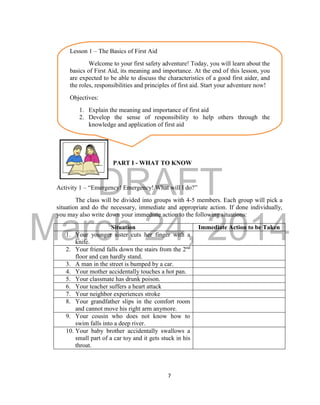
Activity 1 – “Emergency! Emergency! What will I do?”
The class will be divided into groups with 4-5 members. Each group will pick a
situation and do the necessary, immediate and appropriate action. If done individually,
you may also write down your immediate action to the following situations:
Situation Immediate Action to be Taken
1. Your younger sister cuts her finger with a
knife.
2. Your friend falls down the stairs from the 2nd
floor and can hardly stand.
3. A man in the street is bumped by a car.
4. Your mother accidentally touches a hot pan.
5. Your classmate has drunk poison.
6. Your teacher suffers a heart attack
7. Your neighbor experiences stroke
8. Your grandfather slips in the comfort room
and cannot move his right arm anymore.
9. Your cousin who does not know how to
swim falls into a deep river.
10. Your baby brother accidentally swallows a
small part of a car toy and it gets stuck in his
throat.
Lesson 1 – The Basics of First Aid
Welcome to your first safety adventure! Today, you will learn about the
basics of First Aid, its meaning and importance. At the end of this lesson, you
are expected to be able to discuss the characteristics of a good first aider, and
the roles, responsibilities and principles of first aid. Start your adventure now!
Objectives:
1. Explain the meaning and importance of first aid
2. Develop the sense of responsibility to help others through the
knowledge and application of first aid
DRAFT
March 24, 2014
8
Here is what you need to know…
Process Questions:
1. Who are victims of accidents? Where do accidents happen? Why do they happen?
2. Are these situations preventable? How?
3. What will you do if these happen?
4. Why do we need to give immediate action to an emergency situation?
Do you think you did the right action for each situation? Do not worry. As you go
on with this module, you will discover the proper ways of addressing those situations.
First Aid is an immediate and temporary care given to a person who suddenly gets
ill or injured. It includes self-help and home care if medical assistance is not available or
delayed. It can mean the difference between life and death in extreme cases. However,
we must know the limits of the first aid we can give because improper first aid can
actually do more harm than good in some instances. Anyone who gives first aid is a first
aider.
Roles of First Aid
1. It is a bridge that fills the gap between the victim and the physician.
2. It is not intended to compete with or to take the place of the services of the
physician.
3. It ends when the services of the physician begins.
Objectives of First Aid
1. To save lives
2. To prolong life
3. To alleviate suffering
4. To prevent further injury
Characteristics of a Good First Aider
1. Gentle-does not cause pain and panic
2. Observant-notices all signs
3. Resourceful-makes the best use of things at hand
4. Tactful- does not frighten the victim
5. Sympathetic- comforts and reassures the victim
Principles of First Aid
(Dos in Giving First Aid)
1. DO stay calm.
2. DO reassure and comfort the victim.
3. DO check for a medical bracelet
indicating a condition, such as epilepsy
or diabetes.
4. DO loosen any tight clothing.
5. DO keep the victim covered to reduce
shock
(Don’ts in Giving First Aid)
1. DON’T give food and drink to an
unconscious person.
2. DON’T move an injured person
unless you need to place him/her
in the recovery position.
DRAFT
March 24, 2014
9
PART TWO - WHAT TO PROCESS
Activity 2 – Organize Your Thoughts
The class will be divided into five groups and each group will be given an
information card. The task is to present the information through a creative graphical
organizer. You may follow the example below.
Process Questions:
1. What should we remember when giving first aid?
2. Why is it important to understand and follow the basics of first aid?
3. What is the ultimate goal in giving first aid?
Activity 3 – Figures of Speech
Choose one from the following words and compare it to anything, then defend
your answer.
Example: Injury is like a thief because it comes anytime.
First aid
First aider
To save life
Giving first aid
Staying calm
Being gentle
Being observant
A physician
Safety and prevention
Having a quality life
Process Questions:
1. If injuries happen at any time, at any place, to anybody, then what should we
do to prevent them?
2. If injuries happen at any time, at any place to anybody, then what should we
do if these happen?
3. What are the roles of a first aider during an emergency situation?
FIRST AID
DRAFT
March 24, 2014
10
Activity 4– “Is He a Good First Aider?”
Analyze the situations and answer the process questions that follow.
Student A is very relaxed in controlling the bleeding on her classmate’s finger.
Student B is insisting that her unconscious sister drink water.
Student C immediately brings her friend, who fell down the stairs, to the clinic.
Student D makes use of his clean handkerchief to tie his best friend’s bleeding
arm.
Student E speaks comforting words to her cousin who sprained his ankle while
playing basketball.
Process Questions:
1. Who among the students are good first aiders? Why?
2. Who among them are not good first aiders? Why?
3. What characteristics should a good first aider possess?
4. If you were a first aider, what would be your ultimate goal?
PART THREE - WHAT TO REFLECT ON AND
UNDERSTAND
Activity 5 – Complete Me
Complete the unfinished statements individually.
I can be a first aider because ______________________________________.
I will be a first aider because ______________________________________.
As a first aider, I will ____________________________________________.
Process Questions:
1. Why is first aid important?
2. Can we help others through our knowledge and skills in first aid? How?
DRAFT
March 24, 2014
11
Activity 6 – First Aider on the Go…
The person in the illustration is a first aider. Interpret it emphasizing the importance of
first aid to oneself and others.
Process Questions:
1. Why is having knowledge and skills in first aid important?
2. Can we help others through our knowledge and skills in first aid? How?
PART FOUR - WHAT TO TRANSFER
Activity 7–Act it Out!
The class will be divided into groups. Create a 2-3 minute pantomime showing a
good first aider helping in certain emergency situations at home, in school, on the road, at
an office or park.
Criteria for scoring: Quality, Realistic, Stage Performance and Teamwork
DRAFT
March 24, 2014
12
PART I - WHAT TO KNOW?
Study carefully Figure 1. It shows the procedure in assessing emergency situations.
Lesson 2 – Survey of the Scene and the Victims
Welcome to your second safety adventure! This will be a very exciting
safety adventure because you will know the proper procedures in assessing
emergency situations for unintentional injuries and in doing the primary and
secondary surveys of the victims. It is expected that at the end of this lesson,
you can confidently and properly demonstrate these procedures, applying the
principles of first aid and displaying characteristics of a first aider which you
have learned in the previous lesson.
Objectives:
1. Demonstrate properly the procedures in assessing emergency situations
2. Demonstrate properly the procedures in doing primary and secondary
survey of victims
DRAFT
March 24, 2014
13
Figure 1. Steps in Assessing Emergency Situations
(Source: The Health Curriculum in Philippine Basic Education, Vol. 2)
DRAFT
March 24, 2014
14
DRAFT
March 24, 2014
15
Here is what you need to know…
Activity 8 – Express your Queries
Do you understand the flow chart? If yes, congratulations! You have an in depth
background knowledge and skills in first aid. If you don’t, then list down on the table
below all the words and phrases that you do not understand or are confused about.
I don’t know anything about…. I am confused about…
Present your queries to the teacher. You may also ask a bonafide Red Cross
member, a para-medical practitioner like a nurse, a first aider, rescuer, health
professional, life guard or a physician in your school or community to discuss and
demonstrate the principles.
Listen attentively to the teacher or any invited person as he/she discusses and
demonstrates the proper procedures in assessing emergency situations and in doing basic
life support (primary and secondary surveys of the victims).
Vital signs are measures of various physiological statistics taken in order to assess
the most basic body functions. The act of taking vital signs normally entails
recording body temperature, pulse rate or heart rate, blood pressure, and respiratory rate.
Before, Airway, Breathing and Circulation (ABC) are mnemonics for essential
steps used by both medical professionals and lay persons such as first aiders when
dealing with a patient.
In 2010, the American Heart Association is rearranged the ABCs of
cardiopulmonary resuscitation (CPR) in its American Heart Association Guidelines for
Cardiopulmonary Resuscitation and Emergency Cardiovascular Care, published in
Circulation: Journal of the American Heart Association.
"For more than 40 years, CPR training has emphasized the ABCs of CPR, which
instructed people to open a victim's airway by tilting their head back, pinching the nose
and breathing into the victim's mouth, and only then giving chest compressions," said
Michael Sayre, M.D., co-author of the guidelines and chairman of the American Heart
Association's Emergency Cardiovascular Care (ECC) Committee. "This approach was
causing significant delays in starting chest compressions, which are essential for keeping
oxygen-rich blood circulating through the body. Changing the sequence from A-B-C to
C-A-B for adults and children allows all rescuers to begin chest compressions right
away."
DRAFT
March 24, 2014
16
Difference between signs and symptoms
Signs are details discovered by applying your senses – sight, touch, hearing and
smell during the course of the examination.
Example:
 Bleeding
 Swelling
 Deformities
Symptoms are sensations that the victim feels or experiences and may be able to describe.
Example:
 Nausea
 Vomiting
 Heat
 Impaired sensations
There are two ways to conduct physical examination when giving first aid:
1. Primary Survey
Primary survey of the victim is used when the victim is unconscious and to find
out and immediately treat life-threatening conditions.
a. Check for Consciousness
1. Ask the victim: “Hey, hey, are you okay?” while carefully shaking the
victim’s shoulder.
2. When there is no response, not even mumbles or groans, the victim is
unconscious and in need of immediate medical help.
b. Open the Airway
1. The victim’s unconsciousness maybe due to an obstruction in his/her airway.
It may also be caused by a narrowed airway making breathing impossible.
2. Find out if there is loss of muscular control in the throat area which allows the
tongue to slip back and block the throat.
3. Lift the chin and tilt the head of the victim (if the victim is an adult). This way
you will be able to lift the tongue from the back of the throat, leaving the
airway clear.
c. Check for Breathing
1. Put your face near the victim’s mouth and look, listen, and feel for
breathing. You should observe for:
 Chest movement, sound of breathing, or feel of breath on your
cheek
d. Check for Circulation
1. Locate pulse using your middle and index finger. Pulse indicates blood
circulation, which is essential for the heart and brain to function.
2. Poor blood circulation may be reflected on the pale color of the skin. This is
fatal.
3. To revive circulation, perform CPR immediately.
DRAFT
March 24, 2014
17
2. Secondary Survey
Secondary survey is used when the victim is conscious or has revived. It aims to
detect everything about the patient’s condition.
a. History Taking
SAMPLE PAIN is the mnemonic in order to perform the steps more easily.
S-ymptoms (the chief complaint of the patient)
A-llergy (find out if the victim is allergic to anything)
M-edication (what are the medicines s/he is currently taking)
P-revious illness (that may be related to the problem)
L-ast meal (only for those subject for operation)
E-vents prior to what happened
P-eriod of pain (How long? What started it?)
A-rea (Where is the pain coming from?)
I-ntensity
N-ullify (What stopped it?)
b. Checking for Vital Signs
A. Pulse rate
Steps in checking the pulse:
 Use your fingertips in getting the pulse. Follow the following procedure:
1. Place the finger tip over an artery where it either crosses a bone or lies
close to the skin.
2. Feel the pulsations as the pressure wave of blood causes the vessel
wall to expand – that is the pulse.
 The pulse rate may be taken in different points in the body like:
1. Brachial 5. Subclavian
2. Carotid 6. Axillary
3. Wrist 7. Femoral
4. Temporal
NO-NO in Getting Pulse Rate
 Never use your thumb; it has its own pulse.
 Do not palpate both the carotid arteries at the same time.
 Do not take the pulse when the victim is in sitting position.
Pulsations disappear as the victim is elevated to a sitting position.
 Never put too much pressure or massage the carotid. You may
disturb the heart’s electrical conduction system.
Normal Pulse Rate
60-70 Men
70-80 Women
80-90 Children over 7 years old
80-120 Children over 1-7 years old
110-130 Infants
DRAFT
March 24, 2014
18
B. Temperature
Guidelines in checking temperature:
 It is being important to monitor temperature in the case of stroke and high
fever.
 Body temperature is measured by using a thermometer within the:
1. Rectum (rectal)
2. Oral (mouth)
3. Axillary (armpit)
C. Respiration
Guidelines in checking respiration:
 Count the number of breaths per minute.
 A whistle sound or wheeze and difficulty in breathing may mean an
asthma attack.
 A gurgling or snoring noise and difficulty in breathing may mean that the
tongue, mucous or something else is stuck in the throat and does not let
enough air to get through.
*Between12-20 breaths per minute are normal for adults and older children;
40 breaths per minute are normal for babies.
D. Skin color
Guidelines in checking skin color:
 Skin color reflects the circulation of blood and the saturation of oxygen in
the blood.
 The presence of mucous around the mouth, inner eyelids, and nail beds is
a sign of poor blood circulation.
 A healthy skin that warm and pink because blood flows normally in the
blood vessels.
c. Head to Toe Examination
1. Head and neck
 Are there any lacerations or contusions in the area?
 Is there a presence of blood in the victim’s hair? If yes,
immediately find out where it is coming from.
 Is there any fluid in the victim’s nose, and ears? If so, the victim
has a skull fracture.
DRAFT
March 24, 2014
19
2.Eyes
 Pay close attention to the pupils.
Pupil Appearance Assessment
Dilated pupil State of shock
Very small pupils Poison or use of prohibited drugs
Different size Head injury that requires immediate
attention
Small and bright Pupils are reactive
No reaction DEATH
3. Chest
 Check for cuts, bruises, penetrations, and other impairments.
 If the victim feels pain while you apply pressure onto his/ her
chest, there could be a rib fracture.
4. Abdomen
 Does the victim’s abdomen hurt? Where is the pain coming from?
 Is his/ her abdomen tender?
 Did you feel any lumps? If yes, get immediate medical assistance.
5. Back
 Is there movement in the victim’s lower extremities?
 Is there sensation in these parts? If the answer is yes, do not move
the victim. Immobilize him/ her.
Top Ten things to do in case of emergency
1. Shout for HELP!
2. Survey the scene and assess the situation.
3. Determine if the accident warrants a visit to the nearest hospital or if simple
cleansing and band aid will do.
4. If you are certified in CPR and a victim needs it, begin CPR right away.
5. Stop the bleeding, if there is any.
6. Treat any symptoms of shock.
7. Look for the medical alert tag in every victim.
8. Seek trained medical assistance.
9. Never give anything by mouth to an unconscious victim.
10. Wait for medical professionals to arrive.
*ALWAYS LOOK FOR A MEDICAL ALERT TAG IN EVERY VICTIM.
DRAFT
March 24, 2014
20
.
EMERGENCY ACTION PRINCIPLES
Source: Red Cross Manual
DRAFT
March 24, 2014
21
After listening attentively and reading the information above, I am very sure that
you are now ready to demonstrate the procedure in assessing emergency situations and in
doing primary and secondary surveys of the victim.
PART TWO - WHAT TO PROCESS
Activity 9 - Let’s try this!
Go to your group and practice the procedures. Be ready to apply the proper
procedure to the situation that the teacher will give. Be sure to apply the previous lessons.
Your performance will be graded according to the following criteria: correctness of the
procedures and application of basics of first aid.
Process questions:
1. Why is it important to assess the situation first before proceeding to the primary
and secondary survey of the victim?
2. When should a primary survey of the victim be used?
3. When should a secondary survey of the victim be used?
How was your performance? I am sure it was great.
If the teacher gave you an unsatisfactory score, do not worry. You still have the
chance to do better in your next activities. Review the procedures above and try to check
which steps you are not very good at yet.
DRAFT
March 24, 2014
22
Activity 10– Share Your Heroism
Share with the class a real experience where you were able to help other people in
an emergency situation.
1. Have you experienced helping a person in an emergency situation?
2. How was it?
3. What did you do? Is it the same with what has been discussed?
4. How did you feel during and after helping the victim?
PART THREE - WHAT TO REFLECT ON AND
UNDERSTAND
Activity 11 – Rate Yourself
How well did you perform and participate in assessing emergency situations and
in doing primary and secondary surveys of the victims? Write your name and reason at
the right side of your chosen self-rating.
1. Why is it important to follow the proper procedures in assessing emergency
situations and in doing basic life support (primary and secondary survey of the
victim)?
DRAFT
March 24, 2014
23
Activity 12– Learning Outside
Interview a bonafide Red Cross member, a para-medical practitioner like a nurse,
first aider, rescuer, health professional, life guard or a physician. Gather information with
the use of the guide questions below. Present a summary of facts through a pamphlet,
editorial, newsletter, etc.
1. What is the first thing that they do in case of an emergency?
2. How do they prepare themselves for an emergency?
3. What do they consider in addressing emergency situations?
4. What trainings did they undergo?
5. Why did they choose their profession?
PART FOUR - WHAT TO TRANSFER
Activity 13 – Music is Good for Health
Compose a 4-line jazz chant in English, Filipino or your own dialect describing
the importance of having first aid and safety awareness.
Criteria: Relevance and Stage Performance
Example : First Aid ay kailangan
Upang emergency ay ating matugunan
Ngunit mas makakabuting, mag- ingat- ingat lang
Iwasan ang sakuna, katawan ay protektahan.
Lesson 3 – Dressing and Bandages
Welcome to your third safety adventure. This will be another and new
exciting trip where you will learn the different dressing and bandages used on
wounds and burns. It is expected that at the end of this lesson, you can explain
and properly demonstrates the bandaging techniques for some unintentional
injuries. Good luck again and have a “safety” journey!
Objectives:
1. Explain the purpose of dressing and bandages
2. Demonstrate the appropriate bandaging techniques for common
unintentional injuries
DRAFT
March 24, 2014
24
PART I - WHAT TO KNOW
Activity 14–Bonding with Dressing and Bandages
Examine the pictures.
1. Have you seen or used any of them? When?
2. Where?
3. What do you call them?
4. When do you use them?
Note to the illustrator: Redraw pictures and make them bigger
Activity 15 – Twist and Double Match
Arrange the scrambled letters in Column A to form words related to first aid. Connect
them to their correct definition or purpose in Column B, and to their pictures in Column
C.
Column A Column B Column C
DRAFT
March 24, 2014
25
Here is what you need to know…
1. SINGDERS A. a sterile cloth used to cover wounds a.
2. CLOD PRESSCOM B. used to reduce swelling b.
3. OLDC DAP C. can be used as cold compress c.
4. NABGADES D. used to apply pressure to stop bleeding d.
5. DOUNW E. the end of the bone is displaced e.
6. BRUN F. a broken bone f.
7. SPARINS G. ligaments are torn g. .
8. TRINSAS H. muscles are overstretched h.
9. FARCTERU I. caused by heat i.
10. LISDOCATION J. a cut in the skin j.
A dressing is a piece of sterile cloth that covers a wound to prevent
infection and/or to stop bleeding.
Techniques in Applying a Dressing
1. Wash hands and wear gloves, if possible.
2. Unwrap the dressing as close to the wound as possible. Be sure not to touch the
wound.
3. Skin is not sterile. If the dressing slips over the victim’s skin while you are trying
to position it, discard and use a fresh one.
4. Place the dressing over the wound.
5. Use a dressing that is large enough to extend at least 1 inch beyond the edges of
the wound.
6. If body tissue or organs are exposed, cover the wound with a dressing that will
stick.
7. Then secure the dressing with a bandage or adhesive tape.
Cold compress is used to reduce swelling and relieve pain, especially used
for sprains and strains. Cold packs can be used as cold compress. Hot
compress is also used to allow normal blood circulation. Cold and hot
compress are applied alternately for closed wounds or contusions.
DRAFT
March 24, 2014
26
Bandages are used to apply pressure to bleeding; for covering wounds and
burns; and providing support for immobilization for broken bones, sprains
and strains. There are three main types of bandages namely: triangular, ace
and tubular. Triangular bandage is made from cloth and can be used as
cold compress, padding, support for pressure, or support sling. Ace
bandage secures dressings in place. Tubular bandage is used to support
joints or hold dressings in place. Smaller tubular bandage is used for
finger injuries.
Figure 2 shows the parts of a triangular bandage.
Two Phases of Bandaging
A. An open phase bandaging is used for wounds on top and back of the head,
chest, back, hand, and foot, and as arm sling.
B. A cravat phase bandaging is used for wounds that need extra support like
wound on the eye, forehead, ear, cheek, jaw, shoulder, hip, arm, leg, elbow,
knee, and palm and for a sprained ankle. The narrower the cravat is, the
greater pressure it will give.
Figure 2. Parts of a Triangular Bandage
Figure 3. Phases of Bandaging
DRAFT
March 24, 2014
27
Techniques in Bandaging
1. Keep in mind the following:
a. Always use a square knot.
b. Keep the cloth sterile to avoid infection.
c. Always keep the ends.
2. Bandaging technique depends upon the size and location of the wound, your first
aid skills, and materials at hand.
3. Bandage firmly over bleeding and securely over the broken bone, not so tight so
as not to cut off blood circulation.
4. When wrapping bandages around the body, such as knees, ankles, neck, and small
back , use its natural hollows to slide the bandage gently into place.
5. Since most injuries swell, check regularly to ensure that the bandage is still
comfortable and that it remains firmly secured.
6. Secure the bandage with a tape, clips or a bow or square knot. Ensure that the
bandages, especially the knots, do not touch the skin.
How to do a square knot
Right over left and left over right (Figure 4)
Wounds
A wound is a break in the continuity of a tissue in the body. It may be closed in
which there is no break or damage in the skin. It is also called hematoma or contusions. A
wound may also be an open wound in which there is a break in the skin.
Kinds of Open Wounds
Puncture Abrasion Incision Laceration Avulsion
1. Puncture is a piercing wound caused by nails, needles and other pointed objects
2. Abrasion is caused by rubbing or scraping the skin against a rough surface.
3. Incision is a cut caused by knife, broken glass or any sharp object.
Figure 4. Making A Square Knot
DRAFT
March 24, 2014
28
4. Laceration is a blunt breaking or tearing of soft tissues usually resulting from
mishandling tools and other accidents.
5. Avulsion is a forcible tearing or partial tearing away of tissues.
How to Manage Wounds:
A. For management of hematoma, we use the mnemonic RICE:
1. Resting the injured part
2. Ice application
3. Compression
4. Elevation
B. First Aid for Open Wounds with Severe Bleeding
1. Wear gloves and remove or cut clothing as necessary to expose wound.
2. Control bleeding by applying direct pressure.
3. Elevate the injured part above the heart except for eye injury and wounds with
embedded object.
4. Cover wound with sterile dressing and bandage.
5. Care for shock.
6. Consult a physician immediately.
DRAFT
March 24, 2014
29
PART TWO - WHAT TO PROCESS
Activity 16 – Wound and Bandage
Choose from the pictures below the correct type of bandaging for to the specified
injuries.
1. An incision on a chest
2. An abrasion on a cheek
3. A puncture on a foot
4. A laceration on the arms
5. An avulsion on the head
Process questions:
1. Why should we use dressings and bandages on wounds?
2. Can we use any cloth as a dressing or bandage? Why and why not?
3. Aside from wounds, in what other injuries can we use dressings and
bandages?
4. Why is it necessary to apply the proper techniques on applying dressings and
bandages?
DRAFT
March 24, 2014
30
PART THREE - WHAT TO REFLECT AND UNDERSTAND
Activity 17 – Be Grateful and Resourceful
List down some materials at home or in school that can be used as dressings and
bandages. Write them in the box. Include their uses or importance.
Why should we use clean dressings and bandages?
PART FOUR - WHAT TO TRANSFER
Activity 18 – Bandaging Olympics
Your class will be having a bandaging contest. In this competition, you will be
grouped and given several injuries. Your task is to quickly apply the dressing and
bandage on the wounds. The group who dress so in shortest time with correct application
of dressings and bandages wins the game. Good luck!
DRAFT
March 24, 2014
31
PART I - WHAT TO KNOW
Activity 19 – “How Will You Bring Me to A Safe Place?”
An injured person needs your help. You are to bring her to a safe place. How are
you going to do that? Study the situations and determine the kind of transport that should
be used.
Lesson 4 – Carrying and Transporting an Injured Person
Welcome to your fourth safety adventure. At this stage, you will experience
different things. You will be challenged to analyze situations and use your muscular
strength and endurance to carry and transfer an injured person to a safer place. At the
end of this lesson, you are expected to demonstrate the proper techniques in carrying
and transporting the victims of unintentional injuries.
Objectives:
1. Identify the different types of carrying and transporting of an injured person
2. Demonstrate proper techniques in carrying and transporting an injured person
DRAFT
March 24, 2014
32
Different Kinds of Transport
Situations…
No. of
First
Aider
Available
Materials
Status of Injured Person Must Do Kind of
Transport
1 None Unconscious
Has no injury on arm, leg,
rib, neck and back
1 None Unconscious Pass underneath
a low structure
1 None Unconscious Transport the
victim up the
stairs
1 Malong Experiencing a very
serious injury and should
not be lifted
1 None Unconscious
Very small
1 None Unconscious
Fat
2 Classroom
chairs and
tables
Unconscious
No injury on neck, back or
pelvis
Carry the victim
down stairs
DRAFT
March 24, 2014
33
Here is what you need to know…
Questions:
1. In what emergency situations can we apply these transporting techniques?
Listen and observe carefully as the teacher discusses and demonstrates the
techniques so that you will be ready for the next activity.
Transporting an injured person to a safer place requires great care. A first aider
must undergo proper training. When doing this, a first aider must consider the following
factors:
a. Weight and height of the victim
b. Status of the victim (conscious or unconscious)
c. Environment (safe, floor is smooth, narrow or wide)
d. Special need considerations (injuries of the victims)
One-man Transport
Fireman’s Carry – the easiest way to transport a light and
smaller victim
Piggy Back – when the victim is conscious
2 None Unconscious
3 None Unconscious Injured person
will be carried
on his back or
face
3 None Unconscious First Aiders will
have to stay on
one side of the
injured person
Fireman’s Carry
Piggy Back
DRAFT
March 24, 2014
34
Pack Strap Carry - when the victim is smaller than the first aider
Shoulder Drag – used when the floor is
smooth, short distance transport
Fireman’s Drag or Tied-hands Crawl – used when first aider and
victim must crawl underneath a low structure
Blanket Drag – used when the victim is
seriously injured and should not be lifted.
Two-man Carry
Chair or Seat Carry – when there are two first aiders
and a chair is available
Pack Strap Carry
Shoulder Drag
Fireman’s Drag
Blanket Drag
Chair Carry
DRAFT
March 24, 2014
35
Three or More-Man Transport
Hammock Carry – when there are three first aiders
Bearer Alongside Carry – carriers will stay
on the uninjured side of the victim
Six Man Lift and Carry – when there are six first aiders
(Note to the illustrator: Copy the picture of “Bearer Alongside” and add 3 lifters
on the other side of the victim to make it six)
PART TWO - WHAT TO PROCESS
Activity 20 – Pick and Carry
The class will be divided into groups with 3-4 members. One from your group
will act as victim. The teacher has prepared strips of paper in which the different types of
carrying and transporting the victim are written. You will pick three and demonstrate the
proper techniques.
Process questions:
1. Which among the techniques do you find the easiest and the most difficult? Why?
2. What fitness components are needed by a first aider or rescuer in transporting a
victim to a safer place?
3. What are the things to consider in transporting a victim?
Hammock Carry
Bearer Alongside
DRAFT
March 24, 2014
36
PART THREE - WHAT TO REFLECT ON
AND UNDERSTAND
Activity 21 – Thinking of Others
If you were the SK Chairman of your barangay, will you offer First Aid skills-
training to the youth of your community? Why? How will you do this? Present an Action
Plan to the class with the following parts:
a. Goals/Target
b. Participants
c. Resource Person/Guest Speakers
d. Venue
e. Estimated Budget
f. Desired Outcomes
PART FOUR - WHAT TO TRANSFER
Activity 22 – Campaign for Safety
Create a slogan that will encourage people in the community to join in the First
Aid Movement.
Criteria: Relevance and Persuasiveness
Lesson 5 – First Aid for Common Unintentional Injuries
Welcome to your last safety adventure! This lesson will
culminate your exciting and significant journey as you learn the causes
and proper first aid procedures for common unintentional injuries. Your
knowledge, skills and understanding on this final stage will completely
prepare you to practice safety measures and help yourself, your family,
friends and your community during emergencies.
Objectives:
1. Identify common unintentional injuries in school
2. Demonstrate proper first aid procedures for common
unintentional injuries
DRAFT
March 24, 2014
37
Here is what you need to know…
PART I - WHAT TO KNOW
Activity 23 – Creative Presentation
The class will be divided into several groups. Each group will be assigned a
specific unintentional injury. Your group shall present your assigned topic in a creative
way but must address the guide questions given. Listen, observe attentively and
participate in the presentation of the other groups.
1. Where does the injury commonly happen?
2. What are the factors that contributed to the occurrence of the injury?
3. What are the proper procedures in giving first aid to the injury?
4. What are the ways to prevent the injury?
Suggested Presentations:
1. Gallery Walk
2. Game Show
3. Talk Show
4. Poem
5. Role Play
6. Graphical Presentation
7. Pantomime
8. Newscasting
9. Song Composition
10. Multimedia and Other Creative
Presentations
Note to the illustrator: lay out the following below pictures strategically to save
space and make the pictures bigger and clearer
FIRST AID FOR COMMON UNINTENTIONAL INJURIES
DRAFT
March 24, 2014
38
DRAFT
March 24, 2014
39
DRAFT
March 24, 2014
40
DRAFT
March 24, 2014
41
DRAFT
March 24, 2014
42
DRAFT
March 24, 2014
43
DRAFT
March 24, 2014
44
PART TWO - WHAT TO PROCESS
Activity 24 – Looking Back
Look at your answers once again in Activity 1 “Emergency! Emergency! What
Will I do?”
1. Did you do the proper first aid procedure for each injury?
2. Which injury were you confident in giving first aid? Why do say so?
3. Which injury were you not confident in giving first aid? Why do you say so?
PART THREE - WHAT TO REFLECT ON AND
UNDERSTAND
Activity 25 – First Aid Challenge
The class will be divided into five groups and will play “First Aid Challenge”.
Each group will go to five stations which contains a specific injury. The group shall
perform the proper first aid procedure. Each group will assign a different victim for each
station so that everyone will be given the chance to experience being a victim and a first
aider. Be sure to master all the first aid procedures and apply the principles of first aid
and emergency because you cannot proceed to the next station if your procedure is
wrong. The group with the shortest time to finish the challenge will get the highest score.
Good luck!!!
1. Did you enjoy the activity?
2. Why did you lose or win in the game?
3. What important thing did you learn in the game?
4. What are the common unintentional injuries that may happen in school?
5. Why is it important to give correct first aid?
Activity 26 – “Can I Be?”
1. Can a grade 9 student be a first aider? Why and how?
2. Can any member of your family be a first aider? Why and how?
3. Can an ordinary citizen in your community be a first aider? Why and how?
4. Can we all be first aiders? Why and how?
DRAFT
March 24, 2014
45
PART FOUR - WHAT TO TRANSFER
Choose one between the two activities.
Activity 27 – Fully Packed
Draw a cartoon/comic strip showing a person ready to help other people through
his/her knowledge and skills in first aid. Write or draw the things, qualities, information,
skills that s/he should have in applying first aid.
Criteria: Clarity, Completeness and Creativity
Activity 28 – “Let’s Go and Let’s Do!”
Performance Task though Role Playing, Pantomime or Dramatization
Scenario:
In one household, things are not properly arranged. Knives are put in a place
where children can easily reach. Fruit and vegetable peelings are not properly thrown.
Detergent bars and other laundry materials have no labels.
A child is playing in the living while the mother is cooking.
1. Present one injury that can possibly happen in the situation.
2. If you were in the situation when the injury happened, how are you going to
help the victim?
Criteria: Correctness of Procedures, Sincerity and Observance of Safety
SUMMARY/SYNTHESIS/FEEDBACK
Unintentional injuries cannot be avoided. It happens at any time, at any place to
anybody. We must therefore practice safety awareness at all times.
But when injuries happen, appropriate knowledge and skills of the proper
application on first aid could greatly help in alleviating pain, preventing further injury,
prolonging and even save lives.
GLOSSARY OF TERMS
DRAFT
March 24, 2014
46
Accident - any unexpected event causing injury
Airway - the passage of air in the body
Bandage - any sterile cloth used to cover a wound, stop bleeding or immobilize
bone injury
Choking - an injury in which a certain object is stuck in the throat
Circulation - the flow of blood
Cravat phase - folded triangular bandage
Direct pressure- a way of controlling bleeding in which compress or a bare hand is
pressed directly on the wound
Dislocation - a condition in which bones are partially or completely pulled out from its
position
Dressing - any sterile cloth used to cover a wound
Electrical burn- a burn occurring from the passage of electricity in the body
First aid - an initial treatment given to an injured person before the arrival of a
medical practitioner
First aider - a person giving first aid
Fracture -a break or crack in the bone
Heart attack - a sudden obstruction of the blood supply to parts of the heart muscle
Heat stroke - failure of the thermostat in the brain
Physician - a medical doctor
Open phase -unfolded triangular bandage
Poisoning -exposure or ingestion of toxic substances
Severe bleeding- serious bleeding that can cause blood loss
Shock -a life-threatening condition characterized by rapid pulse, paleness,
coldness, and sweating
Sprain -an injury to the ligaments, tendons and muscles due to overstretching,
over wrenching or sudden movement
Sterile - clean, germ-free
DRAFT
March 24, 2014
47
Strain - an injury to the ligaments, tendons and muscles due to overstretching,
overwrenching or sudden movement
Survey -an act of investigating or examining something
Thermostat - body temperature regulator
Transport - to move or transfer to another place
Unintentional injuries- injuries which are not expected; also known as accidents
Victim - the injured person
Vital signs -refers to the level of response, pulse, breathing and temperature of the
victim
Wound - a break in the continuity of the tissue or skin
REFERENCES
American Heart Association (2010). Guidelines for cardiopulmonary resuscitation and
emergency cardiovascular care. Journal of the American Heart Association.
Darilag, Agripino G., et.al. (2012). Enjoy life with P.E. and Health: Textbook for second
year. SD Publications, Inc.
Galvez Tan, Jaime Z., et.al. (2009). The health curriculum in Philippine basic education:
A resource book on health for teachers. Vol. 2. Pasay City: UNESCO, National
Commission of the Philippines, Social and Human Sciences Committee.
Santiago, Glinore B., et. al. (2004). MAPEH: A worktext in music, arts, physical
education and health. Manila: St. Augustine Publications, Inc.
St. John Ambulance Caring for Life, et.al. (2006). Pocket first aid. Revised Edition.
London: Dorling Kindersley Limited.
DRAFT
March 24, 2014
1
Grade 9 Health Education Quarter 3
LEARNER’S MATERIAL NO. 3
Draw something about drugs in the Philippines
DRAFT
March 24, 2014
2
INTRODUCTION
This learner’s material is designed to inform you about the present drug
scenario in the Philippines, the different classifications of drugs abuse and their
harmful short-term and long-term effects on the body. Common and informative
terms encountered in drug education are included. Signs and symptoms of drug use
and abuse among teenagers will also be tackled. You will also learn about the effects
of drug addiction to self, family, community and the country as a whole. Various
strategies and techniques presented in this learner’s material will help to prevent
substance use and abuse. Furthermore, this material provides you with a solid
knowledge from which you may gain more information about prevention,
intervention, and healthy alternatives to avoid substance use and abuse.
Before you go through this learning material, you need to answer the pre-
assessment which checks your prior knowledge, processing and understanding of the
topics. The learner’s material will have seven lessons. Each lesson contains the four
core parts of learning namely: Knowledge, Process, Understanding and Transfer. The
learner’s material will culminate with a product or performance assessment to check
your level of proficiency. Suggested media resources are given to further enhance
your growing mind.
Stay healthy and enjoy learning!
DRAFT
March 24, 2014
3
Let’s play ADD (Agree, Disagree, Don’t Know)
Start the game by staying behind a line with your classmates. The line can be a chalk
line or an adhesive tape. This game allows you to discuss topics about drugs that you
would rather not talk about. You will analyze your current values and express your
personal beliefs. You will also listen to your classmates and be able to get new and
exciting ideas.
How to play the game:
1. Choose a venue with free space. Your teacher will post the three signs
“Agree”, “Disagree” and “Don’t Know” beside each other facing your class.
2. Your teacher will read a statement to the class. You and your classmates will
decide if you agree, disagree or don’t know the answer.
3. Wait for the “Go!” signal before you go to the sign which suits your values,
beliefs and feelings. Avoid pushing and pulling.
4. Your teacher may want to ask you about your decision.
5. You can change your decision if you feel it is necessary.
6. Your teacher will proceed to the next statement until all statements have been
read.
7. Processing will follow.
Statements:
1. Drugs are not a concern in the Philippines!
2. Filipino males are more prone to drug use than females.
PRE-ASSESSMENT
DRAFT
March 24, 2014
4
3. Teenagers are in danger to drug use, misuse and abuse.
4. All medicines are drugs but not all drugs are medicines!
5. Drugs change the way the brain thinks and processes information.
6. There are many healthy alternatives to combat drug use and abuse.
7. Shabu is one of the commonly used and abused drugs in the Philippines.
8. Drug dependence is the state of physical and psychological dependence on
drugs by a person following its continuous use and abuse.
9. Drug abuse is the continuous use of a drug or several drugs other than their
specified purpose.
10. A drug is a substance which brings about mental, emotional, behavioral and
physiological changes to a person.
LINE
STUDENTS
K-W-L Chart
List ideas you know about the drug scenario in the Philippines. Write these in the K
(What I Know) column. List things you want to know in the W (Want to Know)
column. Do not write anything in the L (What I Learned) column yet.
K (What I Know) W (Want to Know) L (What I Learned)
AGREE DISAGREE DON’T KNOW
DRAFT
March 24, 2014
5
Quiz Time!
Your teacher will assess your prior knowledge, process and skills
on the current drug scenario in the Philippines. The score will not
be recorded. Write the answers in your notebook or activity sheet.
Supply the missing words
 Commonly abused drugs in the Philippines are __(1)__, __(2)__, and __(3)__.
 Filipino (4)__ are most vulnerable in experimenting and abusing drugs.
 __(5)__ are any substances or chemicals which when taken into the body have
psychological, emotional and behavioral effects on a person.
 Cigarettes and alcohol are classified under __(6)__ because smokers and
drinkers have a tendency to use drugs of abuse.
True or False. Write True is the statement is true and false if it is false.
____7. Stimulants, depressants, hallucinogens, narcotics and inhalants are drugs
of abuse.
____8. Teenagers who engage in drug use and abuse are prone to drop-out and
fail in their academic performance.
____9. Taking small amounts of drugs of abuse will not make a person an addict
in the long run.
____10. There are healthy and enjoyable things to do than taking drugs.
DRAFT
March 24, 2014
6
Lesson 1: Drug Scenario in the Philippines
Introduction
Lesson 1 presents the drug scenario in the Philippines. You will be provided with
information about the study conducted by the Dangerous Drugs Board. This is the
lead government agency which plans, establishes and initiates programs and projects
necessary to combat and reduce the illegal distribution, manufacture and sale of drugs
of abuse. You will also be introduced to basic terms used in the study of substance
use and abuse. Activities are provided to further develop knowledge, skills and
attitudes toward the topic.
OBJECTIVES
At the end of the lesson, you are expected to:
 Describe the drug scenario in the Philippines
 Explain the concepts of drug dependence, drug use, drug misuse and drug
abuse
 Conduct a survey in school or in the community about its present drug
scenario
 Create a box of information which includes all information who have learned,
gathered and processed
DRAFT
March 24, 2014
7
WHAT TO KNOW
Activity 1: Buzz Time!
Look at some of the headlines in the newspapers or electronic news, watch news on
television or listen to radio news program about drug-related crimes in the Philippines.
Have a buzz session with the class about the present drug scenario in the country.
Activity 2: Reading Time!
jcyap2013
In the year 2004, an estimate of 6.7
million drug users in the Philippines
was recorded by the Dangerous Drugs
Board (DDB). The “2008 National
Household Survey on the Nature and
Extent of Drug Abuse in the
Philippines” conducted by the same
agency revealed that there is a
downward trend in the number of drug
users down to 1.7 million users. The
decline may be associated with the
government’s intense efforts in
combating drugs. The following are the
reasons for the successful decline of
drug abuse in the country:
Add editorial cartoon on drug scenario
in the Philippines.
DRAFT
March 24, 2014
8
 Operations conducted by different law enforcing agencies like the Philippine
National Police (PNP), National Bureau of Investigation (NBI), Philippine
Drug Enforcement Agency (PDEA), Bureau of Customs and other law
enforcers have helped arrest local and international drug syndicate members,
traffickers, and destroy secret laboratories and warehouses.
 Strict implementation of policies under the “Dangerous Drugs Act of 2002”
like the compulsory drug test for application of driver’s license, entrance to
military service, application for firearms licensing, and others.
 Actualization of the Dangerous Drugs Board’s programs and projects in
partnership with other agencies like the Department of Education (DepEd),
Department of Social Welfare and Development (DSWD) and other local
government units (LGU) and non-government organizations (NGO).
These are positive efforts bearing fruits and achievements; however the government does
not rest on its laurels but rather creates more productive programs and projects to make
the country a drug-resistant society.
Profile of Filipino Drug Users
Profile Findings
Ratio of Users (male to female): 10:1
Mean Age: 28 years old
Civil Status: Single (58.2%)
Employment Status: Unemployed
Educational Attainment: High School level
Average Monthly Household Income: Php 16,290.80
Duration of Drug Use: 6 years and more
Residence: Urban areas
Nature of Drug Use: Poly-drug use (multiple drug use)
Common Drugs of Abuse Used: Shabu (1st
)
Marijuana (2nd
)
Inhalants (3rd
)
Source: “2008 National Household Survey on the Nature and Extent of Drug Abuse in the Philippines”
DRAFT
March 24, 2014
9
Common Concepts in Drug Education
The following are the usual words you will encounter in studying substance use and
abuse:
 Drugs are any substances or chemicals which when taken into the body either
though nasal, oral, transdermal or intravenous way have psychological,
emotional and behavioral effects on a person.
 Drugs of abuse are drugs commonly abused by users. In the Philippines the
three drugs of abuse are shabu, marijuana and inhalants.
 Drug dependence is a cluster of physiological, behavioral and cognitive
phenomena of variable intensity in which the use of a drug takes on a high
priority thereby creating a strong desire to take the substance.
 Drug misuse is the use of a substance incoherent or inconsistent with the
prescribed dosage or frequency of use.
 Drug Abuse is the use of a substance for non-medicinal purposes. Abuse
leads to organ damage like brain damage and liver damage, addiction and
troubled behavioral patterns.
 Drug tolerance is the condition of the body to adapt to the effects of
substances to the body thus requiring an even larger amount of the substance
to experience the same physiological and mental effect experienced when
taking the smaller dosage.
Use the following guide questions:
1. What is the Dangerous Drugs Board report all about? What is your personal
opinion?
2. What is the current drug scenario in your community and school?
3. What are the common terms related to drugs?
DRAFT
March 24, 2014
10
Activity 3: Key Drug Concepts
Fill in the necessary concepts about each term related to drugs. Add more tags if
necessary.
DRUGDRUG
DEPENDENCE
DRUGMISUSE
DRAFT
March 24, 2014
11
WHAT TO REFLECT AND UNDERSTAND
Activity 4: Ways Drugs of Abuse Enter the Body
Draw a silhouette of a man or woman’s figure. Show 4 ways by which drugs of abuse
enter the body.
WHAT TO PROCESS
Activity 5: What is your Choice?
Form a big circle. Your teacher will read out each statement below. How do you feel
after reading each statement? Do the double thumbs up and placed on your cheeks for
AGREE, cover your eyes for DISAGREE, and look up for UNDECIDED. Discuss
with each other and see if some will change their minds.
Statements:
 Smoking should be banned in public places.
 It is okay for students to use cigarettes and alcohol.
 Our law is too easy on teenagers caught using drugs.
 Advertising is causing teenagers to try alcoholic drinks.
 Severe penalties for drug use will stop people from using drugs.
 Parents should be held responsible for their children who are into drug use.
Activity 6: Reflection Time
Write an essay about the present drug scenario in the
Philippines. Include data and information including
common terms you have learned in class and have gathered
personally. Also include ways for the government and
society to combat drug syndicates and addiction. Limit your
essay to 150-200 words.
DRAFT
March 24, 2014
12
WHAT TO TRANSFER
Activity 7: Let’s Make a Box of Information
Now that you know the present drug scenario in the Philippines and the common
terms used in the study of substance use and abuse, show what you learned in a
creative way. You will create a box of information which will include:
 a map of your community
 pictures related to the topic
 information and data collected
The box of information can be made either of wood or cardboard. Creativity is
encouraged like the use of lights and sounds. The rubric on the next page will show
you how your information box will be graded.
DRAFT
March 24, 2014
13
Rubric for Box of Information
Total Score: /20
Criteria 4 points 3 points 2 points 1 point
Required
Elements
The material
includes all
required
elements as well
as additional
information.
All required
elements are
included in the
material.
All but one of
the required
elements are
included in the
material.
Several required
elements are
missing.
Labels
All items of
importance on
the material
have labels that
can be read
from at least 3
ft. away.
Almost all items
of importance on
the material have
labels that can be
read from at least
3 ft. away.
Few items of
importance on
the material
have labels that
can be read
from at least 3
ft. away.
Labels are too
small to view or
no important
items were
labeled.
Graphics -
Relevance
All graphics are
related to the
topic and easier
to understand.
All borrowed
graphics have a
source citation.
All graphics are
related to the
topic and most
are easier to
understand. Some
borrowed
graphics have a
source citation.
All graphics
relate to the
topic. One or
two borrowed
graphics have a
source citation.
Graphics do not
relate to the
topic or several
borrowed
graphics do not
have a source
citation.
Attractiveness The material is
exceptionally
attractive in
terms of design,
layout, and
neatness.
The material is
attractive in
terms of design,
layout, and
neatness.
The material is
acceptably
attractive
though it may
be a bit messy.
The material is
distractingly
messy or very
poorly
designed. It is
not attractive.
Grammar There are no
grammatical/
mechanical
errors in the
material.
There are 1-2
grammatical/
mechanical errors
in the material.
There are 3-4
grammatical/
mechanical
errors in the
material.
There are more
than 4
grammatical/
mechanical
errors in the
material.
DRAFT
March 24, 2014
14
Lesson 2: The Risk and Protective Factors of Using Drugs
Introduction
Lesson 2 gives the different risks and protective factors in substance use, abuse and
drug dependence. Risk factors are those that contribute to drug abuse. Protective
factors prevent drug use. You will be asked to discuss in depth these risk factors and
protective factors. You will also be asked to analyze different situations where you
might encounter these factors.
OBJECTIVES
At the end of the lesson, you are expected to:
 discuss risk and protective factors in substance use, abuse and drug
dependence
 analyze situations for the use and non-use of psychoactive substances
 state personal opinions about preventing drug use and abuse.
 write an essay about preventing drug use and abuse.
DRAFT
March 24, 2014
15
WHAT TO KNOW
Activity 8: Risk and Protective Factors
This activity will help you discuss the risk and protective factors regarding substance
use, abuse and dependence.
How to play the game:
1. Get markers/crayons and a short bond paper cut crosswise to be used as
metacards.
2. List a risk factor on one sheet. A risk factor is one that can result to using and
abusing drugs. Write legibly.
3. List a protective factor on the other sheet. A protective factor is one that
prevents you from using and abusing drugs. Write legibly.
4. Post the meta-cards for the risk factors on one side of the board and the meta-
cards for the protective factors on the other side.
5. After everybody has posted his/her meta-cards, your teacher will ask you
questions or clarify things.
6. Teacher feedback will follow.
Activity 9: Reading Time!
Risk and Protective Factors for Drug Use, Misuse, Abuse and Dependence
The use, misuse and abuse of drugs are the result of various factors surrounding a
person. These factors either increase or decrease the possibility of a person to use
drugs.
Risk factors are those influences which increase the chances of using, misusing and
abusing drugs. Protective factors, on the other hand, are those influences which
DRAFT
March 24, 2014
16
Community
School
Peer and
friends
Family
Personal
Domains of Life which Affect Drug Use and Abuse
decrease the chances of using, misusing and abusing drugs. According to studies,
protective factors counterbalance negative effects of risk factors. It is important to
understand that it does not necessarily mean that several risk factors present make a
person highly susceptible to drug use, misuse and abuse. Protective factors even if
few in number may be enough to work against the risk factors, more so if there are
several of these protective influences. These factors are composed of influences in
different domains of life.
Reference: www.drugabuse.gov
Below are the risk and protective factors in the use, misuse and abuse of drugs:
PERSONAL (Early Aggressive Behavior vs. Self-control)
Risk
Factors
 Use of drugs at an early age
 Risk taking behavior
 Experimentation
 Poor social skills and interaction
 Childhood problems
 Feelings of isolation
DRAFT
March 24, 2014
17
 History and patterns of drug use
 Attitudes toward drug use
 Poor parenting and child rearing
 Inconsistent family rules
 Poor family values
 Poor family ties
 Self-control behavior
 Good reasoning skills
 Excellent social skills
 Positive interaction with people
 Sense of belonging
FAMILY (Weak Parental Guidance vs. Strong Parental Guidance)
PEERS AND FRIENDS (Substance Abuse vs. Academic Excellence)
Risk
Factors
Protective
Factors
 Good communication with people
 Positive family relationship
 Clear and consistent family rules
 Strong family values
 Positive expectation to child’s success
in family, school and community
 Reliance on family for emotional
support
Risk
Factors
 Association with peers and friends known to use
gateway drugs (cigarettes and alcohol)
 Preference to stay with peers and friends than
with family
Protective
Factors
perrss
DRAFT
March 24, 2014
18
 Association with peers and friends who do not
use gateway drugs
 Formation of friendships
 Reliance on friends for emotional support
 Inviting friends at home to know the family
 Poor academic performance
 Lack of commitment to studies
 Poor attendance in school
 Involvement in fights and conflicts
 Good to excellent academic performance
 Joins extra-curricular activities and school
organizations
 Shows interest in attending classes
 Easy access to gateway drugs
 Poor community organization and
neighborhood relationship
 Poor implementation of community laws
 Negative attitudes which favor drug use
SCHOOL (Availability of Drugs vs. Strong Anti-Drug Policies)
COMMUNITY (Poverty vs. Strong Community Relationship)
Protective
Factors
Risk
Factors
Protective
Factors
Risk
Factors
DRAFT
March 24, 2014
19
 Strong community relationships
 Active and positive community programs,
projects and activities for the youth
 Positive attitude which combat drug use
 Strong community advocacy against
drugs
Reference: Risk Factors and Protective Factors. (October 2003). Retrieved November 8, 2013, from
http://www.drugabuse.gov/publications/preventing-drug-abuse-among-children-adolescents/chapter-1-risk-
factors-protective-factors/what-are-risk-factors
Reflect on the risk and protective factors you have just read. Share your ideas in class.
Activity 10: You be the Judge of It!
Read the editorial below and answer the questions on your notebook, answer sheet or
journal.
Though it seems that society is winning in the battle against illegal drug use
and abuse, I believe that we are still a long way from declaring victory in the battle.
Teenagers are still victimized by drug addiction. Everyone complains? But only a few
propose ways to completely stop drug use and abuse. The following are some
suggestions to stop this terrible and frightening habit.
First, the film industry should stop glamorizing drug addiction. Drug addicts
and drug pushers should not come out as heroes and saints in films and television
programs. They should realize that young people look up to these actors and actresses
and what they portray on camera is something that looks cool and good for the young
viewers. The government and the actors’ guild should come up with a law banning
the industry from showing drugs of all forms on television and film.
Second, the government should have strict laws and policies on drug
trafficking and possession of drugs and their paraphernalia. We should follow our
neighboring countries which include death penalties as sanction to drug traffickers.
Right now, the Philippines serve as a drop-off point for drugs coming from other
countries. Drug Laboratories have been discovered in residential houses and old
abandoned factories. Foreign members of syndicates have been caught and charged
by authorities. These are proofs that there is a need to review and revise our present
laws on drug abuse and trafficking.
Protective
Factors
DRAFT
March 24, 2014
20
Third, horrific videos of people dying from drug-related illnesses should be
used by the government as advocacy materials for students to see and know the real
deal about drug use and abuse. If students will understand the ugly truth about drugs
through these advocacies and they will no longer start to take drugs, then the
approach will be effective and the experience worthwhile.
There are still more ideas I can share with you regarding drug abuse
prevention but I think that these three suggestions are more than enough to change the
scenario. My parting words are to “think several times before acting out foolishly”.
- The Editor
_____________________________________________________________________
Questions:
1. What are the ideas of the editor to stop drug use, abuse and drug
trafficking. Summarize these ideas.
2. Do you think the ideas of the editor will be effective? Why or why not?
3. Do you have other ideas that might help stop drug use, abuse and
trafficking? Write one idea in each box.
DRAFT
March 24, 2014
21
WHAT TO PROCESS
Activity 11: Editorial Page
Write your own editorial page about your
thoughts in activity 10. Include your own
editorial cartoon.
Sample editorial page
WHAT TO REFLECT AND UNDERSTAND
Activity 12: Role Play
Devide the class into five groups. Think
of a play that showcases preventing risk
factors and strengthening protective
factors.
A rubric for this play will be discussed by
your teacher.
Insert a drawing of a boy and
a girl play-acting
______________
______________
______________
______________
_______________________
_______________________
_______________________
_______________________
_______________________
_______________________
_______________________
_______________________
_______________________
DRAFT
March 24, 2014
22
WHAT TO TRANSFER
The rubric below shows how your essay will be graded.
Rubric for Essay Writing
Criteria Advanced
(5 pts.)
Proficient
(4 pts.)
Approaching
Proficiency
(3 pts.)
Developing
(2 pts.)
Beginning
(1 pt.)
Content Content
surmounts
anticipation.
Treatment of
details is
advanced and
in-depth.
Content
reaches
expected
result.
Treatment of
details is of
good quality.
Content is near
the expected
result.
Treatment of
details with
some shallow
ideas.
Content is
beyond the
expected
result. Details
are in the
developing
phase and
very shallow.
Content is very
basic and lacks
in-depth
analysis.
Organization
and Style
The structure
of the essay is
highly
organized and
shows
coherence.
There is
variety in
style which
makes the
essay very
impressive.
The structure
of the essay is
organized and
coherence is
obvious.
There is
variety in
style which
makes the
essay
impressive.
The structure
of the essay is
somewhat
organized and
coherent.
There is
somehow a
variety in style
which makes
the essay good.
The structure
of the essay is
not too
organized and
coherent.
There is little
variety in
structure and
subject.
Structure is
unorganized
and not
coherent with
the topic.
There is no
variety in
structure and
subject matter.
Grammar There are no
grammatical
errors in the
There are
minimal
grammatical
There are some
grammatical
errors found in
There are
many errors
found in
Grammar lacks
order and
neatness. There
Activity 13: Let’s Do an Essay
Your teacher will give you several situations about drug
use and abuse which you may encounter in real life.
Choose one and write an essay about how you can
prevent or avoid such a situation. Write the activity in
your notebook or activity sheet. Limit your essay to 50-
100 words.
DRAFT
March 24, 2014
23
essay. errors in the
essay.
the essay. grammar.
Editing is
suggested.
are numerous
errors. Major
reconstruction
is suggested.
Spelling There are no
spelling errors
in the theme.
There are 1-3
errors in
spelling.
There are 4-6
errors in
spelling.
There are 7-
10 errors in
spelling.
There are more
than 10 errors
in spelling.
Total: /20
Lesson 3: Drugs of Abuse
Introduction
Lesson 3 deals with the classification of drugs of abuse. Learners will be able to
classify the drugs of abuse according to their effects on the body. Stresses that some
of these drugs of abuse also have their medical purposes but are highly addictive if
misused and abused. As a learner, you will be provided with information about the
topic. Activities are provided to assist you in developing your knowledge, skills and
attitudes about classifying drugs of abuse.
OBJECTIVES
At the end of the lesson, the learners are expected to:
 describe how drug of abuse are classified
 classify drugs of abuse according to their effects on the body
 produce a table flipchart of the classification of drugs and their effects on the
body
DRAFT
March 24, 2014
24
WHAT TO KNOW
Activity 14: Body Frisking
There are six dangerous drugs in the crossword puzzle below. They are written
horizontally, vertically, diagonally or in reverse. Find the words and write them on
your activity sheet or notebook.
S N E G O N I C U L L A H
S A H U N G A I C O S S A
G R E R I O P O P P T T L
U C L D A S D G N N O I L
R O P S Q Z X C A P Y M U
D S S Q W E R S R T Y U C
Y S A S D E S S C O O L I
A F D O S E F G O L U A N
W W R W R C V Y T M T N A
E A Q P W G F D I N H T T
T S E S E B N M C V U S I
A D S F D D T L S G N O O
G A G I N H A L A N T S N
Activity 15: Reading Time!
Classification of Drugs of Abuse
The Dangerous Drugs Board listed three major drugs of abuse in the Philippines.
These are methamphetamine hydrochloride or “shabu”, cannabis sativa or
“marijuana” and inhalants better known as “solvents”. These drugs of abuse are
included in the six classifications of drugs.
DRAFT
March 24, 2014
25
The six classifications of drugs are the following:
1. Gateway drugs
2. Depressant drugs
3. Stimulant drugs
Gateway drugs such as cigarettes and
alcohol are legal drugs that a non-drug user
might try, which can lead him/her to more
dangerous drugs such as marijuana and
shabu. Teenagers who engage in early
smoking and early drinking have a higher
chance of using and experimenting with
dangerous drugs of abuse.
Picture for gateway drugs
Depressant drugs slow down a person’s
central nervous system (CNS). The Central
nervous system includes the brain, spinal
cord and nerves. Doctors commonly
prescribe depressant drugs to help certain
persons to be less angry, less stressed or
tensed. Depressant drugs relax muscles and
nerves. These drugs also make patients feel
sleepy and light-headed. Depressant drugs
include alcohol, barbiturates and
tranquilizers.
Picture for depressant drugs
Stimulant drugs speed up a person's
central nervous system. Stimulant drugs
have the opposite effect of depressants.
Stimulants make a person’s energy
high. Negative effects of stimulants
include depression and tiredness.
Stimulants include amphetamines
which include shabu, caffeine, nicotine
and cocaine.
Picture for stimulant drugs
DRAFT
March 24, 2014
26
4. Narcotics
5. Hallucinogens
6. Inhalants
Narcotics are drugs which relieve pain
and induce sleepiness. In medicine,
these drugs are administered in
moderation to patients with mental
disorders and those in severe pain like
cancer. Narcotic drugs include cocaine,
heroin and marijuana. These drugs are
illicit and dangerous if taken.
Picture for narcotics
Hallucinogens are drugs which distorts
reality and facts. It affects all senses and
makes a user see, hear and feel things
that don’t exist in the time being. The
name hallucinogen came from the word
hallucination which is to perceive
illusions. Hallucinogens include lysergic
acid diethylamide, psilocybin obtained
from mushrooms and mescaline.
Picture for hallucinogens
Inhalants are found in ordinary
household chemical products and
anesthetics. It is readily available and
accessible to young children. Inhalant
intoxication is similar to the signs and
symptoms of alcohol intoxication. One
difference is the foul smell of chemicals
sniffed, inhaled or huffed by the user.
Continuous use and abuse leads to
delusions, brain damage, liver damage,
coma and death. Examples of household
products used as inhalants are acetone,
rugby or solvent, ordinary and spray
paint, cleaning fluids and air conditioner
fluid (Freon).
Picture for inhalants
DRAFT
March 24, 2014
27
WHAT TO PROCESS
Activity 16: The Drug Concept Map
After reading activity 15, copy the concept map below in your notebook or activity
sheet and add information to complete the map.
Harmful
Effects
ClassificationClassificationHarmful
Effects
Harmful
Effects
Harmful
Effects
Classification
ClassificationHarmful
Effects
Harmful
Effects
Classification
D
R
U
G
S
Classification
DRAFT
March 24, 2014
28
WHAT TO REFLECT AND UNDERSTAND
Activity 17: Relay Game
Instructions:
1. Form a team with six members.
2. Each member will make a meta-card. Write on each meta-card a class of drugs
of abuse. Write legibly. There will be six meta-cards per group.
- Meta-card 1: GATEWAY DRUGS
- Meta-card 2: DEPRESSANTS
- Meta-card 3: STIMULANTS
- Meta-card 4: NARCOTICS
- Meta-card 5: HALLUCINOGENS
- Meta-card 6: INHALANTS
3. Each group will form a line.
4. Your teacher will read a statement or phrase. If your meta-card is being
referred to, run to your circle. Wait for the signal “GO!” before running inside
the circle.
5. Once inside the circle, raise the meta-card up high.
6. Your teacher may inquire about your answers.
7. Your teacher will then give the correct answer and will briefly explain.
8. Your teacher will record the number of correct answers garnered by the team.
9. Return to your line when cued by your teacher.
TEAM1
TEAM2
TEAM3
TEAM4
TEAM5
TEAM6
DRAFT
March 24, 2014
29
WHAT TO TRANSFER
The rubric on the next page shows how your flipchart will be graded.
Activity 18: Let’s Make a Table Flipchart
Make a flipchart showing how drugs are classified and
how they affect the body. Ask your teacher to check your
draft. Print the chart using paper and old folders. Include
pictures to make your flipchart more attractive.
DRAFT
March 24, 2014
30
Rubric on Table Flipchart Making
Criteria Advance
(5 pts.)
Proficient
(4 pts.)
Approaching
Proficiency
(3 pts.)
Developing
(2 pts.)
Beginning
(1 pts.)
Accuracy of
content
All information
is true and
correct.
Almost all
information
is true and
correct.
Much of the
information is
true and correct.
Not much of
the
information
is true and
correct.
Information
is not true
and correct.
Visual
attractiveness
Format and lay-
out are very
attractive.
Format and
lay-out are
attractive.
Format and lay-
out are
organized.
Format and
lay-out lacks
organization..
Format and
lay-out are
disorganize
d.
Graphics and
pictures
Graphics and
pictures go well
with the content
and
information.
Graphics and
pictures are
good but are
too many
that they
dominate the
material.
Graphics and
pictures are
good but are too
few that texts
dominate the
material.
Graphics and
pictures do
not go well
with the text
making the
material
disorganized.
No graphics
and pictures
are used in
the making
of the
material.
Grammar and
spelling
No grammatical
errors and /or
misspelled
words.
1-3
grammatical
errors and/
or
misspelled
words.
4-6 grammatical
errors and/ or
misspelled
words.
7-9
grammatical
errors and/ or
misspelled
words.
10 or more
grammatica
l errors and/
or
misspelled
words.
Total score: / 20
DRAFT
March 24, 2014
31
Lesson 4: Myths, Misconceptions, Signs and Symptoms of
Drug Abuse
Introduction
Lesson 4, analyzes the different myths misconceptions about substance use and abuse.
You will learn to describe the signs and symptoms of drug use and abuse among
Filipino teenagers. You will be provided with information about the topics. Activities
are provided to further enhance your current knowledge, skills and attitudes toward
the said topics.
OBJECTIVES
At the end of this learning material, you are expected to:
 analyze myths and misconceptions about substance use and abuse
 describe signs and symptoms of possible substance use and abuse among
adolescents
 conduct an interview about myths, misconceptions, signs and symptoms of
substance use and abuse
 make an advocacy brochure about the truth of drug use and abuse and the
signs and symptoms of drug use and abuse
DRAFT
March 24, 2014
32
WHAT TO KNOW
Answer the following questions:
1. What do you know about drug use?
2. What are the signs and symptoms of drug abuse?
Activity 16: Reading Time!
Continuous and prolonged drug use has a very bad effect in a person. It can alter his
behavior, and his mental, physical, and psychological condition. Most importantly,
drug dependence results in drug abuse, drug tolerance, problems with society and law,
withdrawal symptoms, severe health problems, poor of quality of life and eventually
death.
You must understand that it is not easy to know and feel the effects of drugs on the
body. Effects are not always the same with drug users. A small amount of a substance
may create a feeling of pleasure to a person but the same amount may cause
restlessness, stress or even immediate death to another person. It is important to
remember that each individual’s brain capacity and function and total body chemistry
People give several reasons
for taking drugs. Some
believe that these drugs can
make them feel and look
good. Certain drugs of abuse
produce pleasure or euphoria.
Euphoria is the high sensation
of feeling good and extremely
relaxed. Euphoria is a
sensation brought about by
the chemical reactions of the
neurotransmitters in the brain.
Thus, drugs affect your brain
process.
Drawing of brain
DRAFT
March 24, 2014
33
are different from other persons, thus we have different reactions to drugs and
substances.
Myths and Misconceptions about Drugs of Abuse
Myths and Misconceptions Facts about Drugs of Abuse
Drugs of abuse improve
memory.
Drugs of abuse shut down proper brain functioning.
Certain drugs stimulate the brain but do not really
help improve memory. Most drug users claim they
think better and clearly after taking drugs but tests on
performance and cognition have proven that they
have performed worst.
Drugs of abuse do not improve memory.
Drugs of abuse help in the
digestion of food.
Certain drugs of abuse stimulate the production of
stomach acids. Constant exposure to higher than
normal acid level damages stomach linings which
can result to ulcers.
Drugs of abuse do not help in the digestion of food.
Drugs of abuse make a
person bold and brave.
Certain drugs of abuse remove shyness and
inhibition. In psychology, normal inhibition prohibits
a person to do unacceptable things, thoughts and
desires. Normal inhibition includes not taking other
people’s things, not crossing a busy street and
knowing what is right from wrong. The temporary
courage brought about by taking drugs is a dangerous
one as it makes a drug user lose normal judgment
which is part of the person’s normal inhibition.
Drugs of abuse place a user in a dangerous and
life-threatening situation.
Drugs of abuse remove
life’s problems and worries.
Drugs of abuse are not the solution to problems and
worries people encounter. Some people believe that
using drugs eliminate one’s problems and worries in
life. The truth is drugs of abuse will only worsen the
scenario and further add more problems some of
which are even harder to solve.
DRAFT
March 24, 2014
34
Drugs of abuse worsen life’s problems and worries.
Drugs of abuse heat up the
body.
Drug users believe that certain drugs cause the blood
to become warmer which makes the body
temperature rise. In cold countries, drugs are used to
heat the body. The truth about this is far from reality.
Drugs dilate blood vessels in the skin which makes
the blood to flow nearer to the skin which enhances
convection of heat from the body to the outside
environment. Convection transfer heat from inside
the body to the outside. Through convection of heat,
body heat is lost faster than normal.
Drugs of abuse do not heat up the body; instead
they make the body lose heat faster than normal.
Profile of a Drug Abuser
The Dangerous Drugs Board listed the following signs and symptoms of drug abuse.
It is important to note that having a few of these signs doesn’t immediately make a
person a drug user. Therefore, observations of physical, mental, emotional and social
behaviors must be carefully done to confirm if a person is a drug user.
Below are some of the signs and symptoms of drug use:
 Declining interest in studies and work
 Identification with known drug users
 Negative outlook in life
 Uncontrolled irretation
 Paranoia (fear that people always stalk and talk about him/her)
 Severe feeling of depression and loneliness
 Complains of over fatigue (psychological or physiological)
 Frequent involvement in petty fights and crimes
 Frequent changes of mood and extreme mood swings
 Lousy physical appearance
 Reddish eyes
 Sudden loss in weight
 Frequent complaints of headache and stomach pains
 Convulsions
 Frequent attacks of cough and runny nose
 Brown stains on fingertips
 Foul body smell
DRAFT
March 24, 2014
35
 Wearing of sunglasses even at night
 Loss of balance
 Loss of interest in sports and hobbies
 Poor judgment and loss of inhibition
 Loss of concentration
Activity 19: Interview
Group yourselves into five groups. Interview
for three persons. They can be professionals,
students or somebody from the community.
Get their profile and include the following in
the interview questions.
1. Myths and Misconception of Drug
Use and Abuse
2. Signs and Symptoms of Drug Use and
Abuse
WHAT TO PROCESS
Activity 20: Table of Signs
List the signs and symptoms of drug use and abuse based from the interviews. List
them according to the changes they cause in a person.
Physical
Changes
Mental
Changes
Emotional
Changes
Social
Changes
Moral-
spiritual
changes
Draw a teenage girl and boy
thinking
DRAFT
March 24, 2014
36
WHAT TO REFLECT AND UNDERSTAND
Activity 21: Acrostic Poem
Make an acrostic poem about breaking the myths and misconception about drugs. Use
the letters of the words “SAY NO TO DRUGS” as the first letter of each stanza.
S _______________________________________________________________
A _______________________________________________________________
Y _______________________________________________________________
N _______________________________________________________________
O _______________________________________________________________
T _______________________________________________________________
O _______________________________________________________________
D _______________________________________________________________
R _______________________________________________________________
U _______________________________________________________________
G _______________________________________________________________
S _______________________________________________________________
Activity 22: News Casting
Group yourselves into small groups.
Plan your live news casting about myths,
misconceptions and signs of drug use
and abuse. Some members can be field
reporters and ordinary people who get to
be interviewed. Your teacher and
classmates will share their insights on
your report.
Picture of students doing news
casting
DRAFT
March 24, 2014
37
WHAT TO TRANSFER
Activity 23: Advocacy Brochure
Now that you have learned the myths, misconceptions and signs and symptoms of
drug use and abuse, create an advocacy brochure about drug use and abuse and their
signs and symptoms. Have your teacher review and approve the advocacy brochure.
Produce ten copies of the advocacy brochure and distribute it to your friends. Have
them sign on a piece of paper as proof of receipt. Submit the original brochure to your
teacher with the receipt form. The rubric on the next page tells how your brochure
will be graded.
DRAFT
March 24, 2014
38
Rubric for Advocacy Brochure Making
Criteria Advance (5) Proficient
(4)
Approaching
Proficiency
(3)
Developing
(2)
Beginning
(1)
Accuracy of
content
All
information
is true and
correct.
Almost all
information
is true and
correct.
Much of the
information
is true and
correct.
Not much of
the
information
is true and
correct.
Information
is not true
and correct.
Visual
attractiveness
Format and
lay-out are
exceptionally
attractive.
Format and
lay-out are
attractive.
Format and
lay-out are
organized.
Format and
lay-out lack
organization.
Format and
lay-out are
disorganized.
Graphics and
pictures
Graphics and
pictures go
well with the
content and
information.
Graphics
and pictures
are good but
are too
many that
they
dominate
the material.
Graphics and
pictures are
good but are
too few that
texts
dominate the
material.
Graphics and
pictures do
not go well
with the text
making the
material
disorganized.
No graphics
and pictures
are used in
the making
of the
material.
Grammar
and spelling
No
grammatical
errors and/ or
misspelled
words.
1-3
grammatical
errors and/
or
misspelled
words.
4-6
grammatical
errors and/ or
misspelled
words.
7-9
grammatical
errors and/ or
misspelled
words.
10 or more
grammatical
errors and/
or misspelled
words.
Writing
organization
All parts of
the material
have a
beginning,
middle and
an end.
Almost all
parts of the
material
have a
beginning,
middle and
an end.
Most parts of
the material
have a
beginning,
middle and
an end.
Only a small
part of the
material has
a beginning,
middle and
an end.
Writing is
unorganized
which makes
it hard to
convey the
message.
Total score: / 25
DRAFT
March 24, 2014
39
Lesson 5: Short Term and Long Term Effects of Substance
Use and Abuse
Introduction
Lessons 5 and 6 will discuss the harmful short term and long term effects of
substance use and abuse on the body. You will also be asked to discuss the harmful
effects of substance use and abuse on the: self, family, school and community.
Various activities will help you reflect on what you learned and inspire you to
become a healthy and active person.
OBJECTIVES
At the end of this learning material, you are expected to:
 Discuss the harmful short-term and long-term effects of substance use and
abuse on the body
 Discuss the harmful short-term and long-term effects of substance use and
abuse on the following domains:
o Self
o Family
o School and
o Community
 Discuss the relationship between drug use and the incidence of HIV-AIDS
 Explain the health, socio-cultural, psychological, legal and economic scope of
substance use and abuse
DRAFT
March 24, 2014
40
WHAT TO KNOW
Activity 22: Reading Time!
A. GATEWAY DRUGS
Gateway drugs are accepted and legal with restrictions. In the Philippines, people
below 18 years of age are not allowed to buy and use gateway drugs. The use of
gateway drugs puts a person at risk of using more dangerous and illicit drugs.
Tobacco of any form and alcohol are gateway drugs.
Gateway Drug Short-Term Effects Long-Term Effects
A. Alcohol - Headache and light
headedness
- Slurred speech
- Slow body reflex, senses and
coordination
- Overconfident
- Damage of organs like liver,
heart, colon and brain
- Cancer
- Cardiovascular diseases
- Cirrhosis of the liver
- Poor study and work
Each classification of drugs has different short-
term and long-term effects. Short-term effects
last for a couple of days, hours or even shorter
periods while long-term effects can be felt for
weeks, months and even for a life time. The
following is an overview of the short-term and
long-term effects of substance use and abuse.
Picture for effects of drugs
DRAFT
March 24, 2014
41
- Mood swings (depression,
high spirit, aggressiveness)
- Nausea (headache with
vomiting)
- Experience of blackout (loss of
consciousness)
performance
- Paralysis and/ or loss of limb
due to road accidents and other
tragic events
- Alcohol poisoning which leads
to coma and eventual death
B. Tobacco - Stress
- Rapid heart rate and pulse rate
- Persistent cough
- Difficulty in breathing
- Halitosis or bad breath
- Sinusitis and otitis media
- Increased phlegm production
- Stomach problems
- Weak physical performance
- Development of asthma
- Atherosclerosis
- Thrombosis
- Cardiovascular diseases
- Chronic Obstructive
Pulmonary Disease
- Cancer of the mouth, throat,
skin, lungs, and other body parts
- Hypertension or increased
blood pressure
- Heart attack and stroke which
leads to coma and death
B. DEPRESSANTS
Depressants, also known as “downers”, suppress or slow down the central nervous
system. In the medical field, depressants are also called sedatives which are used to
treat anxiety, mental disorders and sleep disorders like insomnia. Types of
depressants are tranquilizers, barbiturates, and hypnotics. Tranquilizers are mild
depressants which are used to treat anxiety. Barbiturates are stronger than
tranquilizers and are used to treat insomnia and other sleep disorders and control
DRAFT
March 24, 2014
42
seizures. Hypnotics are the most powerful depressants. Alcohol is also a depressant.
The table below shows the effects of depressants on the body.
Short-Term Effects Long-Term Effects
- Slow brain function which leads to
temporary memory loss
- Slow pulse rate and heart rate
- Below normal breathing pattern
- Low blood pressure
- Inability to concentrate and poor
judgment
- Confusion and irritability
- Dizziness and lightheadedness
- Slurred speech
- Loss of body balance and
sluggishness
- Depression
- Agitation and aggressive behaviors
- Depression leading to mental disorders
- Hypertension or high blood pressure
- Cardiovascular diseases
- Paralysis of the muscles and nerves
- Brain stroke
- Chronic liver disease
- Renal or kidney failure
- Cancer of the colon and other form of
cancer
- Diabetes
- Coma and death
C. STIMULANTS
Stimulants are also known as “uppers” or “speeders”. They stimulate or activate the
central nervous system. A person can stay awake for longer periods under the
influence of stimulant drugs. Some stimulants are legal while some are illicit and
dangerous. Caffeine is a stimulant which is found in soft drinks, energy drinks, coffee,
tea and chocolate. Illicit stimulants include cocaine and methamphetamine or shabu.
The table on the next page shows the effects of stimulants on the body.
DRAFT
March 24, 2014
43
D. NARCOTICS
Narcotics are known as “painkillers”. They also induce sleepiness. Narcotics are
administered to patients with mental problems. They are also given to cancer patients
to relieve severe pain. Narcotic drugs include cocaine, heroin and marijuana.
Short-Term Effects of Narcotics Long-Term Effects of Narcotics
- Drowsiness
- Euphoria
- Loss of appetite
- Vomiting
- Nausea
- Muscle cramps and pain
- Chills and shaking
- Weight loss
- Difficulty in sleeping
- Difficulty in breathing
- Inflammation of the veins
- Panic attacks
- Development of diseases like hepatitis,
tetanus and HIV-AIDS due to needle
sharing
- Overdose leading to coma and death
Short-Term Effects of Stimulants Long-Term Effects of Stimulants
- Increased heart rate and pulse rate
- Increased respiration (breathing) rate
- Increased digestive processes
- Increased blood pressure
- Increased body temperature
- Decreased appetite
- Alert body responses
- Inability to sleep
- Euphoria
- Depression (the “down” that follows
the “up” sensation)
- Paranoia
- Heart attack
- Brain stroke
- Brain damage
- Kidney damage
- Liver damage
- Coma which leads to death
DRAFT
March 24, 2014
44
E. HALLUCINOGENS
Hallucinogens create hallucinations. Hallucinations distort what is real. Everything
the person sees, hears and feels are the opposite of reality. Lysergic acid diethylamide
(LSD), psilocybin and mescaline are some of the common hallucinogens.
Short-Term Effects of Hallucinogens Long-Term Effects of Hallucinogens
- Euphoria
- Hallucinations (seeing things which are
not really there)
- Poor judgment of time and distance
- Inability to sleep
- Loss of appetite which lasts up to 10
hours
- Nausea
- Poor body coordination
- Feeling of super strength
- Increased blood pressure and heart rate
- Aggressive behavior
- Memory loss
- Slurred speech
- Flashback (effects of the drug comes
back after a long time of not using it)
- Increased blood pressure
- Brain damage
- Psychosis (a mental disorder in which
reality is distorted or twisted)
- Coma and death
F. INHALANTS
Inhalants are found in common household chemical products. Inhalants are huffed or
sniffed. The effects of inhalants are similar to the effects of alcohol intoxication.
Short-Term Effects of Inhalants Long-Term Effects of Inhalants
- Slurred speech
- Poor coordination
- Euphoria
- Dizziness and nausea
- Feeling of lightheadedness
- Foul breath
- Loss of hearing
- Uncontrolled muscle spasms
- Brain damage
- Nerve damage
- Bone marrow damage
DRAFT
March 24, 2014
45
- Hallucinations
- Delusions
Drug Use vis-à-vis HIV-AIDS
According to reports, drug use and HIV-AIDS are often not interrelated. In the
Philippines, injecting drug users (IDUs) is one of the known modes of transmission
for the Human Immunodeficiency Virus or (HIV) which is the causative agent that
causes the Acquired Immune Deficiency Syndrome (AIDS). HIV is a blood-borne
virus which means, it is transmitted from one person to another through blood
transfusion, sexual intercourse, exchange of body fluids and from mother to child
during pregnancy and breastfeeding. AIDS is a syndrome because it is a complex
pattern of symptoms. AIDS is a disease which attacks and weakens the body’s
immune system.
The Department of Health (DOH) reported that around 13 Filipinos are infected with
HIV-AIDS every day. From 1987 to 2013, there were more than 14,000 cases of
infection and the rate of infection is very high in highly urbanized areas like Metro
Manila. In relationship to drug use and abuse, the two most recorded means of
transmission of HIV-AIDS is through the following:
1. Risky sexual behavior
2. Sharing of needles through drug use
High risk behaviors:
A. Injecting Drug Users (IDUs). The risk of getting HIV-AIDS through intravenous
injection (IV) is very high. Drug users are particularly vulnerable to this risky
behavior. The need to inject drugs through needle sharing during sessions with co-
users puts each person at high risk of getting HIV-AIDS.
DRAFT
March 24, 2014
46
B. Poor judgment and risky sexual practices. Drug intoxication greatly affects the
person’s way of thinking and decision-making skills. This can lead the person to
perform risky sexual practices which further aggravate HIV-AIDS infection.
C. Prognosis of disease and drugs. Drug abuse and addiction worsen HIV-AIDS
infection. A medical study has shown that HIV damages a larger percentage of brain
cells and nerve cells among users of methamphetamine. In animal subjects, viral
presence in brain cells is more than the other cells in the body.
D. Delay in drug abuse treatment. Medical study has found that the longer drug
users delay drug abuse treatment, the higher the chance of getting and spreading HIV.
Delayed drug abuse treatment means the person will engage in more intravenous drug
sharing and risky sexual behavior and practices. The earlier a drug user seeks
intervention and treatment, the better the chance of not acquiring and spreading HIV-
AIDS and other diseases. Drug abuse treatment also educates and counsels the user
and the family about the risk of drug use and abuse.
Effects of Drug Use
Aside from oneself, drug use and abuse also affects the immediate family, school and
community where the drug user lives. Below are some of the effects of drug use and
abuse on the family, school and community.
A. Effects of Drug Use and Abuse on the Family
 Broken and unhappy family ties
 Ignored duties and responsibilities
 Financial constraint due to drug dependence and addiction
 High cost of drug treatment and rehabilitation
 Family dishonor and embarrassment
 Separation of family members
DRAFT
March 24, 2014
47
B. Effects of Drug Use and Abuse on the School
 Poor academic performance
 Increased rate of absenteeism and tardiness
 Increased incidence of school fights
 Low academic achievement rate
 Incidence of disrespect to school authorities

C. Effects of Drug Use and Abuse on the Community
 High incidence of crime which includes stealing, robbery and snatching
 High incidence of accidents, e.g. road accident, accidental falling, etc.
 Affected economy due to low manpower production
 Loss of government funds due to drug-related operations, treatment and
rehabilitation
WHAT TO PROCESS
Activity 23: Dear Diary
Write yourself a letter. Tell about the dangerous short-term and long-term effects of
drugs to oneself, family, school, community and the nation as a whole. Have your
English teacher check the grammar. Have your teacher check the content. Submit in
printed form.
DRAFT
March 24, 2014
48
WHAT TO TRANSFER
Activity 24: Drugs as a Burden to the World
Think of a creative way of showing how drugs are a burden to health, socio-cultural,
psychological, legal and economic magnitude. You may write a poem, a song, draw a
cartoon, poster, etc. Share with the class your literary work and have your teacher
check it.
WHAT TO REFLECT AND UNDERSTAND
Activity 25: Dear Sir/Madam
Make a recommendation letter to your mayor or barangay captain about the dangers
brought by drug abuse in the community. Sight possible evidences of drug abuse like
the presence of “hamog boys”, “rugby boys’, etc. Submit it to your teacher for
evaluation.
Activity 26: Advocacy Video
Form five groups. Create an advocacy video about drug abuse and its effect on the
body. You can use video camera recorders, tablets or your cell phone camera. This
will be reviewed by three teachers you have invited to the film viewing along with
your classmates.
DRAFT
March 24, 2014
49
Lesson 6: Prevention and Control of Substance Use and
Abuse
Introduction
Lesson 6 deals with different strategies in the prevention and control of substance use
and abuse. These strategies include application of decision-making skills and the use
of resistance skills in different situations related to substance use and abuse.
Decision-making and resistance skills will help you enhance your knowledge, skills
and attitude in facing and overcoming real-life situations. You will practice these
skills in class and will be guided by your teacher. You will also suggest healthy
alternatives to prevent the use of drugs of abuse.
OBJECTIVES
At the end of this learning material, you are expected to:
 Discuss strategies in the prevention and control of substance use and abuse
 Apply decision-making and resistance skills in situations related to substance
use and abuse
 Describe healthful alternatives to substance use and abuse
DRAFT
March 24, 2014
50
WHAT TO KNOW
Activity 27: Reading Time!
Drug Abuse Prevention
Prevention is the best way for people like you to avoid the use and abuse of drugs.
People should understand the different protective factors and risk factors. Protective
factors should be enhanced while risk factors should be avoided and dropped for good.
You should learn decision-making skills and resistance skills in order to be able to
refuse temptations and offers from known drug users.
The following are protective factors you need to fight drug use and abuse:
 Loving and caring family
 Involvement in sports
 Positive outlook in life
 Positive self-image
 Caring and supportive friends
 A sense of worthiness and achievement
 Always having the right attitude
 Ability to cope with stress and depression
 Having responsible adult role models
There are various and healthy ways to get rid
of drugs. These range from simple immersion
to hobbies like interactive and board games,
sports, and joining clubs of interest.
Picture for prevention and
control of drug use and abuse
DRAFT
March 24, 2014
51
 Active participation in sports or recreation
 Participation in school clubs and activities
 Consultation with responsible adults like parents, teachers, counselors
regarding problems, concerns and queries in life
 Development of talents and skills
Which of the protective factors are within your control? Beyond your control?
Decision-making Skills
The following activities will strengthen your decision-making skills.
Skills Guides
Step 1: Describe the situation
you are in.
Describe the situation you are in. You can better
describe by writing it on a piece of paper. You
can say it out loud several times.
Step 2: List possible actions for
the situation.
List down all possible actions. Don’t worry
about listing the not-so-good ones. You can
eliminate them afterwards. You can also say out
loud all possible actions. Think over them
several times.
Step 3: Share your list with
responsible adults.
Share your list of possible actions with a
responsible adult. Make sure that this person has
not been associated with known drug users.
His/Her decisions should be credible.
Step 4: Carefully evaluate all
possible actions.
Carefully evaluate all possible actions. Ask
yourself if the actions will protect and promote
healthy results, protect safety of self and of other
people, respect and does not violate laws and
policies, follow guidelines of home, school and
community. Lastly, ask if the actions will show
your good image and persona.
DRAFT
March 24, 2014
52
Step 5: Choose which action is
most responsible and suitable.
After questioning and evaluating all actions,
choose the most responsible and suitable action
for the situation.
Step 6: Act responsibly and
intelligent.
Do the action responsibly and intelligently.
Don’t stop evaluating the action.
Resistance Skills
Use the following steps to practice resistance skills in saying “NO” to drugs.
Step 1: What is the problem?
Say what is wrong. Say “that is wrong,” or “drugs are bad,” or “that is prohibited,” or “ Drugs
are against the law and school rules.”
Step 2: What could happen?
Ask the following:
 Could anyone be harmed if I do it (including you)? How?
 Could it get you into trouble? What trouble?
 Would it make you feel bad if you do it?
Step 3: What are the ways of saying NO?
Choose from any of the following:
 Say No. “No, I’m not interested,” or simply say “No”
 Change the topic. Say “I’m going to the park, you can come with me.” or “Would you like to see
a movie with me?”
 Tell the truth. Say “I hate drugs, it destroys dreams,” or “Drugs make you become sad and
unhappy,” or “I’m too young to die.”
 Joke about it. Say “My parents are good at smelling, I won’t get past them,” or “Are you really
ready to die? I’m not!”
 Give reasons. “I don’t do drugs, it’s bad for the health,” or “I have a training today, I need
clean air to get going,” or “Let’s play basketball, beat me!”
 Tell a story. Say “My friend died of drugs, he’s only 15 years old. It was painful,” or “my
classmate died from drugs. I don’t want that to happen to me or to you!”
 Walk away if you can’t change your friend’s mind.
DRAFT
March 24, 2014
53
Drug Abuse Treatment and Rehabilitation
The Dangerous Drugs Board in cooperation with the Department of Health offers
treatment and rehabilitation programs to Filipinos who become ill because of drug
abuse. Drug dependents undergo effective modes of treatment. It is the responsibility
of the state to help and rehabilitate drug dependents so that they can once again
achieve their dreams and become responsible and productive members of the society.
Requirements for Drug Abuse Treatment and Rehabilitation
1. Application for Drug Dependency Examination (DDE) through the City
Anti-Drug Abuse Council (CADAC) in your city or province.
2. Application for Police Clearance and Barangay Clearance where the drug
dependent resides.
3. Application for Certificate of No Pending Case from the Regional Trial
Court (RTC). If the drug dependent is a minor and with a pending case, the
parents or guardian must secure a Certification of Suspended Sentence also
from the RTC.
Steps on Drug Abuse Treatment and Rehabilitation
Drug abuse treatment and rehabilitation follows certain steps and procedures.
Treatment and rehabilitation can be voluntary, voluntary thru representations and
compulsory confinement.
 “Voluntary” means the drug dependent decides on his/her own to be
examined and admitted in rehabilitation centers,
 “Voluntary thru representations” means the drug dependent is willing but
wants to be represented by an immediate family member or legal guardian and
 “Compulsory confinement” means the drug dependent needs to be confined
as the condition is life-threatening or threatens the life of the family.
Below are the steps securing drug abuse treatment and rehabilitation:
1. Secure referral form for Drug Dependency Exam at CADAC or Dangerous
Drugs Board (DDB).
2. Have the drug dependent examined by DOH accredited doctor.
DRAFT
March 24, 2014
54
3. If drug dependent is found positive, DDE must be submitted with the other
documents to the Legal Affairs Division of DDB.
4. A “Petition for Confinement” shall be filed with the RTC where the drug
dependent lives.
5. Decision of place of confinement. The immediate family or legal guardian
will decide where the drug dependent will be confined. The government
usually recommends government-owned treatment and rehabilitation centers
but the family has the right to choose where to confine the patient.
Mode of Treatment
There are various modes of treating drug dependents. Each mode is effective on its
own. Centers may apply several modes during the period of confinement.
Mode of Treatment Description
Eclectic Approach This approach uses a holistic approach in
the treatment process. The professional
skills and services of the rehabilitation
staff are made available. Eclectic
approach addresses different personality
aspects of the patients geared towards
their rehabilitation and recovery from the
dependency.
Spiritual Approach This approach uses Bible teachings as a
source of inspiration to change drug
dependents. The approach looks at drug
abuse as a sin. It also teaches patients to
turn away from the evil ways of drug
addiction and renew their connection
with God.
Therapeutic Community Approach This approach views drug addiction as a
manifestation of a more complex
psychological problem. The treatment is
a highly structured program wherein the
community is used to foster change in
attitude and behavior. Role modeling and
peer pressure play important parts in the
program. The approach teaches personal
responsibility, positive self-image,
importance of human community and
cooperation among community members.
Its goal is to turn patients into responsible
DRAFT
March 24, 2014
55
citizens.
Hazelden-Minnesotta Model This model views any form of addiction
as a disease that it is an involuntary
condition caused by various factors
outside an individual’s control. The
program consists of instructive lectures,
cognitive-behavioral psychology. This
approach teaches a set of values and
beliefs about the powerlessness of
persons over drugs and turning to a
higher power to help them overcome the
disease. Psychologists, psychiatrists and
patients help each other in this program.
Multidisciplinary Team Approach This approach utilizes professional skills
and services of a team composed of
psychiatrists, psychologists, social
workers, occupational therapists and
other related disciplines in cooperation
with the immediate family of the drug
dependent.
WHAT TO PROCESS
Activity 28: Play List
List several alternative ways to prevent and control drug use and abuse. Use pieces of
paper to write down specific programs and activities which can prevent and control
drug use and abuse.
DRAFT
March 24, 2014
56
Activity 29: What Will you Do?
Apply decision-making and resistance skills to the following situations. Role-play
these situations. Let the class analyze and critique your decisions and resistance skills
used in the play.
WHAT TO REFLECT AND UNDERSTAND
Activity 30: Armor Shield
Create your very own armor shield against
drug use, abuse and dependence. Be very
creative. Simple drawings will suffice. Your
armor shield will look like an emblem.
Present your shield in class and submit it to
your teacher for assessment.
Draw a teenage boy and girl
holding a shield with blank
emblem
DRAFT
March 24, 2014
57
WHAT TO TRANSFER
Activity 31: Let’s Make a Game
Now that you have learned about the
prevention and control of substance use and
abuse, you will create a board game or card
game about it. The game should be unique
and focus on educating players about the
importance of substance use and abuse
prevention and control. The board game
should include elements of temptation to use
drugs, resistance skills and decision-making
skills in resisting drug use. Utilize
indigenous materials to minimize expenses.
Use the rubric on the next page to guide you
in your output.
Sample board game or card game
about drug use, abuse and
prevention
DRAFT
March 24, 2014
58
User-friendlyandgrammar
use
Thegameisveryeasytoplay.
Directionforuseisprovided.
Grammariscorrectandall
wordsarespelledcorrectly.
Thegameiseasytoplay.
Directionforuseisprovided.
Grammariscorrectwith1-2
misspelledwords.
Thegameisquiteeasytoplay.
Directionisprovidedwith
minimalgrammaticalerrors
and3-4misspelledwords.
Thegameissomewhathardto
follow.Directionisprovided
buthardtofollowbecauseof
manygrammaticalerrors.
Thereare5-10misspelled
words.
Thegamecannotbeplayed
becauseofuncleardirection.
Therearemanygrammatical
errorsandmorethan10
misspelledwords.
Relevancewiththetopic
Thegameisrelevanttothe
topic.Additionalhealthy
informationisincludedin
thegame.
Thegameisrelevanttothe
topic.Therearefew
additionalhealthy
informationincluded.
Thegamedevelopedisquite
relevantwiththetopic.
Therearenoeffortstoadd
newhealthyinformation.
Thegameisstillinthe
developingstage.Some
topicsarenotinlinewiththe
expectedconcepts.
Thegameisnotinlinewith
thetopic.Thereisno
learninginplayingthegame.
VisualAppearance
Thegamelooksveryattractive
toplay.Mostelementsand
principlesofdesignare
included.
Thegameisattractivetoplay.
Severalelementsandprinciples
ofdesignareincluded.
Thegameisgoodtoplay.Few
elementsandprinciplesof
designwereincluded.
Thegamelacksthe
attractivenesstolureplayersto
playthegame.Elementsand
principlesofdesignarenot
properlyutilized.
Thegameisnotattractive.
Playersarenotluredtoplaythe
game.Therearenoelements
andprinciplesofdesign
incorporatedinthegame.
Criteria
Advanced
(5pts.)
Proficient
(4pts.)
Approaching
Proficiency
(3pts.)
Developing
(2pts.)
Beginning
(1pt.)
Total Score: / 15 points
Rubric for Board and Card Game
DRAFT
March 24, 2014
59
GENERALIZATION
The present drug scenario in the Philippines is changing. Likewise, local and
international drug syndicates are being apprehended and prosecuted by the long arm
of the law.
Drugs by nature are good. They are used to treat illnesses, help calm down
patients with mental disorders or relieve pain and suffering. Illicit use of drugs is the
result of greediness in some men to earn money and create chaos and disorder in
society. In the Philippines, the most commonly used drugs are shabu, marijuana and
inhalants or solvents.
Drugs of abuse are classified according to their effect on the body gateway
drugs, depressants, stimulants, hallucinogens, narcotics and inhalants. Some people
have myths and misconceptions regarding drug use.
Various risks of drug use have been discovered by medical science. These
risks are called effects. Effects are either short-term effects or long-term effects. One
of the effects of drugs particularly drugs those injected into the blood stream is the
risk of HIV-AIDS contamination. HIV-AIDS in the Philippines is continuously
growing and posing a threat to every Filipino, his/her family, and the community.
Generally, effects of drug use affect the following domains namely: self, family,
school and community.
With the continuous presence of drugs in our society, the government along
with non-governmental organizations and private institutions find alternative ways to
prevent and control the spread of drug addiction and dependence in the country.
These healthy alternatives are effective strategies to educate, advocate and promote a
drug free-community and instill in our youth that drugs are not good and will only
destroy their lives and that their family and community.
DRAFT
March 24, 2014
60
REFERENCES
 Treatment and rehabilitation. Retrieved November 4, 2013, from
http://www.ddb.gov.ph/component/content/article/46-sidebar/64-
treatment-and-rehabilitation
 Facts on drugs. Retrieved November 4, 2013 from
http://www.ddb.gov.ph/component/content/article/46-sidebar/58-facts-
on-drugs Nov 5, 2013
 Drug facts: inhalants. (October 24, 2013). Retrieved November 5, 2013, from
http://teens.drugabuse.gov/drug-facts/inhalants
 Drug sacts: stimulants. (October 24, 2013). Retrieved November 5, 2013,
from http://teens.drugabuse.gov/drug-facts/stimulants
 Drug facts: tobacco. (October 24, 2013). Retrieved November 5, 2013, from
http://teens.drugabuse.gov/drug-facts/tobacco
 Drug facts: HIV, AIDS and drug abuse. (October 24, 2013). Retrieved
November 5, 2013, from http://teens.drugabuse.gov/drug-facts/hiv-
aids-and-drug-abuse
 2008 national household survey on the nature and extent of drug abuse in the
Philippines. Retrieved November 7, 2013, from
http://www.ddb.gov.ph/images/psrsd_report/2008%20National%20Ho
usehold%20Survey.pdf
 Alternative development. Retrieved November 4, 2013, from
http://www.ddb.gov.ph/component/content/article/46-sidebar/13-
alternative-development
 Risk factors and protective factors. (October 2003). Retrieved November 8,
2013, from http://www.drugabuse.gov/publications/preventing-drug-
abuse-among-children-adolescents/chapter-1-risk-factors-protective-
factors/what-are-risk-factors
DRAFT
March 24, 2014
1
LEARNER’S MATERIAL NO. 4
Injury Prevention, Safety and First
Aid
(Intentional Injuries)
Note to illustrator: Please redraw something similar to this to make this an original cover
design. Please try to make the characters Filipino-looking and anime-style (like the picture
inside the shield). The pictures shown are: two boys having a physical fight; a girl being
physically abused; a boy being bullied; a depressed person contemplating suicide; a girl being
verbally abused; and a girl in tattered clothes indicating that she was raped.
Grade 9 Health Education Quarter 4
DRAFT
March 24, 2014
2
Introduction:
The basic necessities of mankind include food, clothing and shelter.
However, it is not enough that we have these basic needs if we are living in fear and
the uncertainty of danger every day. Today, one rising necessity that we need to
focus on is safety.
We are always exposed to dangers, whether we are young or old, rich or poor.
It is therefore necessary that we are aware of what these possible dangers are, how all
of these can affect us, and how we can prepare ourselves to prevent them from
happening or minimize their effects if they happen to us.
The Convention on the Rights of the Child states that children around the
world have a right to a safe environment and to protection from injury and violence.
Although the adults around you should protect you against any harm that may
threaten your safety and your life, you cannot rely on them all of the time. You have
the responsibility and capability of shielding yourself from the dangerous world that
we live in today.
This module focuses on intentional injuries that you may be exposed to.
Through proper information, this module aims to equip you with the knowledge and
understanding of the types of intentional injuries that might happen to you, as well as
its risks to your health. In the end, we hope that you will be able to prevent
intentional injuries, as well as maintain a healthful behavior that will promote a
culture of non-violence.
We hope that this module will serve you well through the activities that will
not only keep you informed but help you enjoy as well.
Stay safe! Be healthy!
DRAFT
March 24, 2014
3
OBJECTIVES:
At the end of this learning material, you are expected to:
• differentiate intentional injuries from unintentional injuries
• describe the types of intentional injuries
• analyze the risk factors related to intentional injuries
• identify protective factors related to intentional injuries
• demonstrate ways to prevent and control intentional injuries
PRE-ASSESSMENT:
CROSSWORD PUZZLE
Do the crossword puzzle. Clues are provided on the next page. This
is just an exercise, so don’t worry if you cannot answer all of the items.
1
2 3
4
5
6
7 8 9
10
11 12
13
DRAFT
March 24, 2014
4
14
15
ACROSS DOWN
3. A forced sexual intercourse 1. An initiation rite for
fraternity
4. Someone who follows you around neophytes
and makes you feel in danger 2. A violent attack, threat or
attempt
5. The taking of a person from their to harm a person
home using deception or force 6. The best way to avoid the
dangers of planned or
7. Bullying with the use of technology intentional injuries is through
_____
and electronic means 8. Harm or damage to someone
as a
10. Abuse, verbal insult, or result of an act or event
physical attack on a person 9. A street-based group, mostly
made up
11. A sexual contact between closely of young people, that engages
in
related persons illegal acts
14. An act intended to cause injury or 12. Pressure through the use of
terror
DRAFT
March 24, 2014
5
damage to a person and violence
15. A suicide attempt in which a person 13. Forcefully taking away of a
person
does not intend to die against his/her will
Were you able to answer all of the items? How was your score? As we go on
with the lessons, you will learn more about intentional injuries.
LESSON 1: Beware…Be Aware!
Let’s begin with the concept of injuries. In our first lesson, you will define
the word injury and discover its two classifications, namely: intentional and
unintentional injuries. Then, you will focus on intentional injuries and their different
types. You will also learn about the characteristics and effects of the different violent
acts and behaviors leading to intentional injuries.
Are you excited to learn? Before you proceed, take note of the objective for
this lesson. Then, proceed with the first activity.
Lesson Objectives
At the end of our lesson, you are expected to:
• differentiate intentional injuries from unintentional injuries
• describe the types of intentional injuries
PART ONE:
WHAT TO KNOW
Activity 1: Through Different Perspectives
How do other people view the concept of injury? Complete the sentences for
each character and share your responses with the class.
DRAFT
March 24, 2014
6
Note to illustrator: Please redraw the construction worker, the firefighter, the athlete, the
doctor, and the mother). Please try to make the characters Filipino-looking and anime-style.
Maintain the gender of each character.
hgfg
Guide Questions:
1. What concepts of injury are similar and different among the five people?
2. How would you define injury?
For a firefighter, injury may be
_________________________
For an athlete, injury may
be
_____________________
___
For a doctor, injury may
be
_____________________
__
For a mother, injury may
be
_____________________
__
For a construction worker, injury
may be
_____________________________
____
“construction
worker”
“firefighter”
“athlete”
“doctor”
“mother”
DRAFT
March 24, 2014
7
Do you have any questions so far? You can ask your teacher for a clearer
explanation. If you don’t have any questions, let us proceed to the next activity for
the classification of injuries.
Activity 2: News Bulletin
Read the news headlines below then classify them as to whether they refer to
intentional or unintentional injuries. Write your answers in table form on your
worksheet. A sample table is provided below.
Intentional Unintentional
Guide Questions:
1. Explain how you classified each news headline.
2. How did you distinguish between intentional and unintentional injuries?
Now that you can tell the difference between intentional and unintentional
injuries, let’s focus on intentional injuries. Unscramble the phrases to form the
meaning.
DRAFT
March 24, 2014
8
Did you get the correct definition? If yes, very good! If not, don’t worry.
Your teacher is always there to guide you through the lessons.
In the next activity, you will learn about the different violent actions and
behaviors that lead to intentional injuries. Are you curious? Then let us continue.
Activity 3: Intentional Injuries: Types and Characteristics
Form five groups. Read the topic/s that will be assigned to you in the
succeeding pages of this module. Refer to the guide questions and answer them after
you finish reading your assigned topic/s.
Topic/s per group:
1 – Suicide and parasuicide
2 – Domestic violence
3 – Bullying, stalking and extortion
Intentional injuries
are
_________________
_________________
_________________
_________________
__________
Intentional injuries
are…
injuries in
which some
harm was
intended to
type of
occur
DRAFT
March 24, 2014
9
4 – Gang and youth violence, illegal fraternity-related violence,
kidnapping and abduction, and acts of terror
5 – Verbal and sexual abuse (incest, molestation and rape)
Guide Questions:
Research on your topic based on the guide questions below. Write
your answers on your worksheets.
 What is its meaning/definition?
 What are its category/classification/types?
 How will you recognize this kind of injury? What are the indicators?
 What are its effects on the victims?
Overview:
Intentional injuries are injuries resulting from violence. It can be divided into
two: self-inflicted, when a person harms himself/herself on purpose and assault,
when person/persons harm another on purpose.
Suicide and parasuicide are intentional injuries that are self-inflicted, while
assault has four classifications: (1) those that were committed within the family; (2)
those that were committed by peers; (3) those that were committed by other groups;
and (4) those that were committed by the family, peers or other groups. Within the
family, domestic violence may happen. Domestic violence happens when one or more
members of the family harms or abuses another family member. Peers in school or in
the community may commit bullying, stalking, and extortion. Other groups may
commit gang and youth violence, illegal fraternity-related violence, kidnapping and
abduction, and different acts of terror. Sexual victimization and other forms of abuse
and harassment may be committed by the family, peers or other people. This includes
verbal abuse, incest, molestation or rape.
The conceptual framework will give you a clearer idea regarding these types
of intentional injuries.
DRAFT
March 24, 2014
10
DRAFT
March 24, 2014
11
Figure 1: Conceptual Framework for Intentional Injuries
Suicide and Parasuicide
Suicide is the intentional taking of one’s own life. Many of those who
attempt suicide do not receive mental and emotional counselling because their
families try to hide the problem because they are ashamed of it. Because of this, the
problem is not solved and the attempt to commit suicide happens again. Studies also
indicate that other family members are also at risk of committing suicide.
On the other hand, a suicide attempt in which a person does not intend to die
is called parasuicide. It is often a cry for help meaning, the person wants others to
know what s/he is feeling. Despite this, parasuicide should be taken seriously
because it may also lead to death.
How will you recognize a person who has suicidal tendencies? Oftentimes,
the person gives clues through his/her behavior and speech. Some of these clues may
be:
 talking about suicide or death
 writing farewell letters or giving away valuable things to their friends and
siblings
 showing changes in behavior, moods and feelings
A Philippine study conducted for the
development of a suicide prevention strategy showed
that commonly used methods by those who decided to
end their lives include hanging, strangulation and
suffocation. For those who tried to kill themselves
but ended up with just injuries, the preferred means
ranged from self-poisoning (mainly ingestion of silver
cleaner) to exposure to other chemicals and poisonous
substances. Aside from these methods, there were
also cases of drug overdose, using firearms to kill
oneself, jumping from heights, and drowning. And
A suicide attempt using
a blade
<source:
http://i569.photobucket.com
/albums/ss131/keerah16/sUic
iDesaxkuL.jpg>
DRAFT
March 24, 2014
12
Domestic violence at
home
<source:
http://victorgaribay.com
/files/gimgs/11_violencia.jpg>
among the youth, self-cutting has been observed in some of those that suffer from
major depression.
Domestic Violence
Domestic violence is an act that includes
physical assault (hitting, pushing, shoving, etc.),
sexual abuse (unwanted or forced sexual activity),
and verbal abuse. These are behaviors that are used
by one person in a relationship who tries to control
the other. This may occur to partners who may be
married or not married. They may be heterosexual
or homosexual (i.e. gay or lesbian) couples and may
be living together, separated or dating. Domestic
violence includes abuse and actions such as:
 name-calling or putdowns
 keeping a partner from contacting his/her family or friends
 withholding money/allowance or denying financial support
 stopping a partner from getting or keeping a job
 actual or threatened physical harm
 sexual assault
 stalking
 intimidation
Who are the possible victims of domestic violence? Anyone can be a victim,
or is at risk of it, especially if his/her partner:
 is very jealous and/or spies on him/her
 will not let him/her break off the relationship
 hurts him/her in any way, is violent, or brags about hurting other people
 puts him/her down or makes him/her feel bad
 forces him/her to have sex or makes him/her afraid to say no to sex
 abuses drugs or alcohol; pressures him/her to use drugs or alcohol
DRAFT
March 24, 2014
13 An example of verbal and
social bullying in schools
<source:
http://img607.imageshack.us/img607
 has a history of bad relationships and blames it on others
There are some children who experience domestic violence in their homes.
Their parents may think that their children do not know about the violence, but most
of the time, the children are aware of it. They can feel helpless, scared and upset.
Some of them blame themselves as they feel like the violence is their fault.
Nevertheless, children in a violent home experience different problems as they grow
up and these problems do not go away on their own. They can be there even as the
child gets older.
Bullying
Bullying is an unwanted, aggressive behavior. The behavior is repeated, or
can be repeated, over time. Both kids who are bullied and who bully others may
have serious, lasting problems.
In order to be considered bullying, the behavior must be aggressive and
include:
 An imbalance of power: Kids who bully use their power—such as
physical strength, access to embarrassing information, or popularity—to
control or harm others.
 Repetition: Bullying behavior happen more than once or have the
potential to happen more than once.
There are different classifications of bullying. These are:
 Verbal bullying – saying or writing mean and nasty things. It includes:
o Teasing
o Name-calling
o Making inappropriate
sexual comments
o Taunting
o Threatening to cause
harm
 Social bullying, sometimes
referred to as relational bullying
DRAFT
March 24, 2014
14
– hurting someone’s reputation or relationships. It includes:
o Telling other children not to be friends with someone
o Spreading rumors about someone
o Embarrassing someone in public
 Physical bullying – hurting a person’s body or destroying his/her
possessions. It includes:
o Hitting/kicking/pinching
o Spitting
o Tripping/pushing
o Taking or breaking someone’s things
o Making mean or rude hand gestures
 Cyberbullying – verbal and social bullying done through use of
technology and electronic means. It includes:
o Using social media (i.e. Facebook, Twitter, etc.)
o Using mobile devices (i.e. cellphone)
o Using electronic mails (i.e. e-mails)
Stalking
Stalking is a pattern of behavior that makes you feel afraid, nervous,
harassed, or in danger. It is when someone repeatedly contacts you, follows you,
sends you things, and talks to you, even when you don’t want them to. It is very
threatening to the person being stalked, because the behaviors and actions of the
stalker often invade his/her privacy. Stalking behaviors involve actions such as:
 Knowing your schedule
 Showing up at places you
go to
 Sending mail, e-mail, and
pictures
 Calling or texting
repeatedly
A person unknowingly being stalked
<source:
http://www.lanazione.it/toscana/cronaca
/2011/11/24/625663/images/758617-21929282
stalking.jpg>
DRAFT
March 24, 2014
15
Extortion in schools
<source:
http://fc02.deviantart.net
/fs38/f/2008/337/c/1/Stop_Bu
llying_Poster_by_bmangrap
hics.jpg>
 Contacting you or posting about you on social networking sites
(Facebook, Twitter, etc)
 Writing letters
 Damaging your property
 Creating a Web site about you
 Sending gifts
 Stealing things that belong to you
 Any other actions to contact, harass, track, or frighten you
You can be stalked by someone you know casually, a stranger, or a past or
current friend, boyfriend or girlfriend. Getting notes and gifts at your home, in your
locker, or other places might seem sweet and harmless to other people, but if you
don’t want the gifts, phone calls, messages, letters, or e-mails it can be scary and
frustrating.
Sometimes people stalk their boyfriends or girlfriends while they’re dating.
They check up on them, text or call them all the time and expect instant responses,
follow them, and keep track of them even when they haven’t made plans to be
together. These stalking behaviors can be part of an abusive relationship. If this is
happening to you or someone you know, there are people you can talk to about it.
Extortion
Extortion is the act of using force or threats
to force people to hand over their money or
properties, on favors. Extortion can happen outside
or near schools wherein children are victimized to
give up their allowances, in exchange for the promise
that they will not be beaten up. The act is different
from robbery. In robbery, there is a very real and
very immediate violence. In extortion, a person may
DRAFT
March 24, 2014
16
A typical gang portrayal
<source:
http://www.ferretpress.com
/weblog/uploaded_images/kol
ours-777295.jpg>
only suffer from the fear of harm if he/she gives in to the demand/s of the one who
extorts.
Gang and Youth Violence
A gang is defined as a relatively tough, mostly street-based group of young
people who regard themselves and may be seen by
others as a group that engages in a range of criminal
activity and violence. Oftentimes, they are in
conflict with other similar gangs.
Young people join gangs and groups for lots
of reasons. One of these is their need to belong, be
included or be part of a group they can identify
themselves with. This is oftentimes true for those
who do not feel a sense of belonging or care at
home. Another reason is their desire for adventure,
as they believe that joining gangs will give them the
excitement and thrill of their lives. Lastly, they feel
protected and looked out for if they are members of
a gang.
Gang members are responsible for a
majority of serious crimes, like extortion, theft and
robbery. They are also likely to be involved in selling drugs and are more likely to
bring weapons to school for fear of attack from rival gangs.
DRAFT
March 24, 2014
17
Illegal Fraternity-Related Violence
A fraternity is a group of people with
similar backgrounds, occupations, interests,
or tastes. In campuses and universities,
fraternities are represented Greek letters.
The youth may think of several benefits in
joining a fraternity. They may see it as a
gain in power and protection, as fraternities
have a reputation for being a powerful
group. Others would regard fraternity
members, especially the seniors, as those
who will provide the neophytes and
lowerclassmen guidance and assistance.
And since most fraternities are based in
colleges and universities, some would join fraternities for academic support. Most
youths would also join fraternities because of the sense of belongingness that these
fraternities would provide.
However, it is not easy to join fraternities. To maintain their exclusiveness,
fraternity members would require an applicant to undergo a series of initiation rites to
become part of the “brotherhood”. One of these is hazing, or activities that involve
harassment, abuse, or humiliation. Hazing can be very dangerous to applicants, as
they will be subjected to physical and psychological suffering like being beaten with
wooden paddles and may cause them a lot of injuries. Some even die in the process,
which is why hazing and other forms of initiation rites in fraternities, sororities and
organizations are now being regulated under the Republic Act 8049, known as the
Anti-Hazing Law. Under this law, physical hazing is prohibited. Fraternities,
sororities and other organizations are required to inform the school authorities
regarding initiation rites that would take place and the school will send
representatives to the actual initiation rites to see to it that no physical hazing will be
done. Aside from the dangers of physical hazing, fraternities often get involved in
Physical hazing
<source:
http://www.zamboanga.com/apo/
images/howto001.JPG>
DRAFT
March 24, 2014
18
A girl being kidnapped
<source:
http://gravesinvestigations
.com/wp-
content/uploads/2010/08
/kidnapping_missing_person.jp
g>
riots or fight with rival groups, which expose them more to danger. Despite these,
fraternities continue to attract applicants.
Kidnapping and Abduction
Kidnapping is taking away or forcefully
moving a person against his/her will and holding
him/her in unjust captivity. The act is usually done
for a motive like getting a monetary reward/ransom
or getting some sort of benefit from the person or
their family. The kidnapper is usually a family
acquaintance who knows about the family’s wealth
and influence, or a stranger who targeted the victim
based on their outward appearance of wealth or
information given to the kidnapper from someone
who knows the victim intimately, such as a
household employee or someone else who suspects
that the victim has a lot of cash. There are some
cases wherein kidnappers target their victims based on their nationality, ethnicity,
religion, social status or organizational affiliation (i.e. employees of a specific
company or a member of a political party might be targeted). The kidnappers could
be an acquaintance or a stranger who has the information about a person or family’s
wealth and/or influences. Unfortunately, because the primary aim of this type of
kidnapping is to attract public attention, be visible or to make a statement, the
percentage of hostages that are killed can be quite high. Another type of kidnapping
is based on gender, wherein the kidnapper is mentally disturbed and has strange
sexual thoughts or behavior, which he/she has directed towards the victim.
On the other hand, abduction is the use of deceit or force in order to take a
person or a child away from their home or relatives. In abduction, the victim usually
knows or has some sort of relation with the abductor. Most of the time, the abductor
is not holding the victim for profit or any monetary gain. Abduction usually happens
to children with separated parents, wherein the child will be tricked by one parent to
DRAFT
March 24, 2014
19
An act of terror
involving a bombing
attack
<source: http://www.causes-
of-
terrorism.net/images/street0
2T.jpg>
come with him/her and take the child away from the other parent who has sole
custody of the child. This is usually because of an emotional disorder created when
the abductor feels that the child’s welfare and best interests are at risk or that the child
will be gone completely from his/her life. Sometimes, abductions occur out of
revenge. People take hostages during periods of anger and deep loss, like abducting
the child of an ex-lover for revenge or to blackmail the ex-lover to think again
resuming their relationship.
Acts of Terror
Acts of terror, or terrorism, is the use of violence for political goals and
putting the public or a great number of people in fear. The purpose of these terrorist
groups is to produce terror in their victims through the use of violence, fear and
pressure. Terrorists commit acts of violence that draw the attention of the local
masses, the government, and the world to their cause. They plan their attack to get
the greatest publicity, choosing targets that symbolize what they oppose. The
effectiveness of the terrorist act lies not in the act itself, but in the public’s or
government’s reaction to the act.
Acts of terror may be categorized into six. These are the following:
 State terrorism – States or governments can
use force or the threat of force, without
declaring war, to terrorize their citizens and
achieve a political goal. Bioterrorism –
refers to the intentional release of toxic
biological agents to harm and terrorize
civilians, in the name of a political or other
cause. It includes viruses, bacteria and
toxins that could be used in an attack, such
as Anthrax (Bacillus anthracis), Botulism
(Clostridium botulinum toxin), The Plague
DRAFT
March 24, 2014
20
(Yersinia pestis), Smallpox (Variola major), Tularemia (Francisella
tularensis), and Hemorrhagic fever, due to Ebola Virus or Marburg Virus.
 Cyberterrorism – is the use of information technology to attack civilians
and draw attention to the terrorists’ cause. This may mean that they use
computer systems or telecommunications as a tool to carry out a
traditional attack. More often, cyberterrorism refers to an attack on
information technology itself in a way that would drastically disturb
network services. For example, cyberterrorists could disable networked
emergency systems or hack into networks housing important financial
information.
 Ecoterrorism – the use of violence in the interests of environmentalism. In
general, environmental extremist destroy property to inflict economic
damage on industries or actors they see as harming animals or the natural
environment. These have included fur companies, logging companies and
animal research laboratories, for example.
 Nuclear terrorism – refers to a number of different ways nuclear materials
might be used as a terrorist tactic. These include attacking nuclear
facilities, purchasing nuclear weapons, or building nuclear weapons or
otherwise finding ways to diffuse radioactive materials.
 Narcoterrorism – the use of violence by drug traffickers to influence
governments or prevent government’s efforts in stopping the drug trade.
This may involve the assassination of influential persons who are against
drug trafficking, or killing a government official who leads an anti-drug
trafficking agency.
DRAFT
March 24, 2014
21
Verbal Abuse
Verbal abuse is a form of cruelty that involves the
use of words. These words are used to attack, control, and
cause harm on another person. It includes behaviors such as
angry outburst, screaming rage, and name-calling, which
tends to blame, and brainwashes and threatens a person.
This is done because the goal of the verbal abuser is to
control and sway the victim. To better understand verbal
abuse, it is better to look at its characteristics:
 Verbal abuse is hurtful and usually attacks the
nature and abilities of the person.
 Verbal abuse may be obvious (through angry
outbursts and name-calling) or hidden (involving
very subtle comments).
 Verbal abuse is controlling. Even judgmental
comments may be voiced in a very sincere and
concerned way.
 Verbal abuse is dangerous. It causes a gradual fading of the self-
confidence of persons without them realizing it. They may try to change
their behavior so as not to upset the abuser.
 Verbal abuse is fickle. A person is stunned, shocked, and thrown off
balance by the abuser’s mockery, angry punch, critical remark, or hurtful
comment.
 Verbal abuse usually worsens, increase of strength, regularity, and
assortment. The verbal abuse may begin with put-downs disguised as
jokes. Later, other forms might surface. Sometimes the verbal abuse may
rise into physical abuse, starting with "accidental" shoves, pushes, and
bumps.
Verbal abuse
<source:
http://www.guystuffcoun
seling.com/Portals/3198
3/images//bigstockphoto
_Angry_Fighting_Couple
_2350563-resized-
600.jpg>
DRAFT
March 24, 2014
22
Sexual Abuse (Incest, Molestation and Rape)
Incest is sexual contact between persons who are so closely related that a
marriage between them is considered illegal (e.g., parents and children, uncles/aunts
and nieces/nephews, etc.). Usually, incest takes the form of an older family member
having sexual relations or sexually abusing a child or an adolescent.
Although an abuse, there are many reasons why the victims might not report
this. One reason is that the victims might be told that what is happening is normal or
happens in every family, and don’t realize that it is a form of abuse. Also, the victims
may not know that help is available or they do not know who they can talk to. The
victims may also be afraid of what will happen to them if they tell someone,
especially if the abuser threatened them. They may also be worried about the abuser
and be afraid of what will happen to the abuser if they tell. Lastly, the victims may
also be afraid of how the people may react if they hear about the abuse. They are
scared that people will accuse them of having done something wrong, or that no one
will believe them.
Molestation is the sexual abuse of a person (whether a child or adult) by an
adult for sexual pleasure or for profit. It occurs when an individual sees another
individual as a sexual object and uses this idea to satisfy his/her sexual urges and
fantasies, usually by subjecting their victim to unwanted or improper sexual advances
or activity. It may include any of the following:
 Fondling – to handle, stroke or caress lovingly or erotically
 Mutual masturbation – two people touching each other’s sexual organs for
pleasure
 Sodomy – sexual intercourse that involves inserting of the penis of one
person into the anus of another person
 Coitus – sexual intercourse between a male and a female involving the
insertion of the penis into the vagina
 Child pornography – explicit portrayal of children as sexual subject matter
for purpose of sexual arousal. It may be in a variety of media, like books,
magazines, films, photos and etc.
DRAFT
March 24, 2014
23
 child prostitution- refers to children who get paid to have sex
Rape is forced sexual intercourse, including vaginal, anal, or oral penetration.
Penetration may be by a body part or an object.
The sexual act may also be considered rape if it satisfies any of the following
criteria:
 One or both people are not old enough to consent, which means one or
both of them are below 18 years old
 One of them does not have the capacity to consent, which means one of
them may not be in his/her right mental and legal capacity to consent (i.e.
with mental disability, people who have been drugged or unconscious,
etc.)
 One of them did not agree to take part, which means the rapist might use
physical force or threat to force the victim to have intercourse with
him/her
If these three considerations are met, the sexual act falls under the category of
rape, which is a criminal offense and it is punishable by law.
Did you learn a lot from reading your assigned topic? Now, go to your group
and be prepared for the next activity.
PART TWO:
WHAT TO PROCESS
Activity 1: Creative Presentations
Talk among your group members regarding how you will present to the class
the topic that you have just read. You may do a dramatization, poetry/jingle, collage,
picture series or any other method to creatively report your topic to the class. Refer
to your answers from the previous activity as your guide in the content of your
presentations.
DRAFT
March 24, 2014
24
Are you now ready to show your presentations? Oops, before that, make a K-
W-L chart in your worksheets and fill up the What I Know and What I Want to
Know columns regarding all the intentional injuries that will be presented by the
other groups.
Intentional Injuries
What I Know What I Want to Know What I’ve Learned
If you are finished with your K-W-L chart, you may now proceed to the
presentations. Remember to listen and watch the presentations of the other groups
carefully because you will fill-up the What I’ve Learned part of your K-W-L as you
watch the presentations.
Rubrics for Creative Presentation:
Criteria
Excellent
(4 points)
Good
(3 points)
Fair
(2 points)
Poor
(1 point)
Content
All contents were
covered and
students presented
the content
creatively.
All contents were
covered.
Most of the
contents were
covered.
Not all the
contents were
covered.
Preparedness
Students are
completely
prepared and have
obviously
Students seem
pretty prepared but
might have needed
a couple more
The students are
somewhat
prepared, but it is
clear that rehearsal
Students do not
seem at all
prepared to
present.
DRAFT
March 24, 2014
25
rehearsed. rehearsals. was lacking.
Posture and Eye
Contact
Students stood up
straight, looked
relax and
confident. They
were not distracted
or being
distracting. They
established eye
contact with
everyone in the
room during the
presentation.
Students stood up
straight. They were
not distracted or
being distracting.
They established
eye contact with
everyone in the
room during the
presentation.
Few students stood
up straight. Some
were distracted or
being distracting.
Not all of the
students
established eye
contact with
everyone in the
room during the
presentation.
Students were
distracted, being
distracting and/or
does not look at
people during the
presentation.
Volume
Volume was loud
enough to be heard
by all throughout
the presentation.
Students spoke
clearly all the time.
Volume was loud
enough to be heard
by most throughout
the presentation.
Students spoke
clearly most of the
time.
Volume was loud
enough to be heard
by some
throughout the
presentation.
Students spoke
clearly sometimes.
Volume was often
too soft to be
heard by all.
Students did not
speak clearly.
Enthusiasm
Facial expressions
and body language
generated a strong
interest and
enthusiasm about
the topic in others.
Facial expressions
and body language
sometimes
generated a strong
interest and
enthusiasm about
the topic in others.
Facial expressions
and body language
were used to try to
generate
enthusiasm, but
seemed somewhat
artificial.
Very little use of
facial expressions
or body language.
Did not generate
much interest in
topic being
presented.
Creativity
Students were
creative in their
presentation and
were able to
engage the
audience.
Students were
somewhat creative
in their
presentation and
engaged the
audience.
Students attempted
to be creative in
their presentation
but failed to engage
the audience.
Students were not
creative in their
presentation and
did not attempt to
engage the
audience.
Total Points Descriptive Rating
DRAFT
March 24, 2014
26
21 to 24 Advanced (A)
17 to 20 Proficient (P)
13 to 16 Approaching Proficiency (AP)
9 to 12 Developing (D)
6 to 8 Beginning (B)
Guide Questions:
1. Which group presentation did you enjoy watching? Why?
2. Which group could have done better in their presentation if given another
chance? What should they do to improve their performance?
3. Share with the class the What I’ve Learned column of your K-W-L chart.
You may now proceed to the next activity.
Activity 2: Newspaper Clipping
Look for a newspaper clipping that shows intentional injury/ies. Cut and
paste this on your worksheet. Answer the questions that follow.
Guide Questions:
1. What is the news all about?
2. What is/are the intentional injury/ies presented in the news?
3. What did you feel for the victim/s in the news? Why?
4. Do you have a similar experience or have you witnessed a situation similar
to the news? Share this with the class.
Violent actions and behaviors leading to intentional injuries have a great
impact on its victims. Let us try to examine them in the next activity.
Activity 3 – The Impact of Abuse and Violence
Analyse the following illustrations. Answer the guide questions afterwards.
DRAFT
March 24, 2014
27
Guide Questions:
“When Words Hurt More than Broken Bones”
<source:
http://lifeishotblog.files.wordpress.com/2013/07/sticks-stones-
words-hurt-me.jpg>
“Flashback”
<source:
http://whatittakes2bme.files.wordpress.com/2009/08/sexual-
abuse-flashback.jpg>
DRAFT
March 24, 2014
28
1. What types of intentional injuries are being portrayed in the illustrations?
2. Based on these illustrations, what are the effects of intentional injuries on
their victims?
3. What are the other impacts of intentional injuries?
Now that you know the impacts of intentional injuries, we will try to assess
what you have learned so far.
PART 3:
WHAT TO REFLECT ON AND UNDERSTAND
Activity 1: Agree or Disagree?
Read the following statements carefully, then write AGREE or DISAGREE
for each item in your worksheet and provide an explanation for your response.
1 2 3
Guide Questions:
1. Do these people deserve to experience the intentional injuries? Why or
why not?
2. Why do some people view intentional injuries as reasonable acts in the
given situations?
DRAFT
March 24, 2014
29
Well, did you agree or disagree with the statements? Let us continue to assess
and see if you can analyse the poem in the next activity.
Activity 2: Poem Analysis
Read the poem below, and then answer the questions that follow.
Speechless
© Kyra Lee
My name Is Sasha
My sister Is Leigh
I am six
And she is three
Our dad’s always mad
He screams and he yells
I don’t think he likes us
It's easy to tell
Mum’s only kind
When dad's not around
And when he is home
She hardly makes a sound
Mum’s always out,
Never home
Dad’s always drunk,
And always alone
As soon as we hear
Those jingly keys
We run and hide
We run and plea
We find a place
And curl up tight
I hold her hand
And she holds mine
And soon enough
Dad then walks in
Don’t make a sound, don’t say a word
I pray inside, deep within
But Leigh, she cannot help herself
For the pain is just too much
"O-God" she yells
"Why are you so mean?"
He doesn't like what she has said
And beats her even more
And with one last hit
Hard and strong, he pulls away and watches
She takes one last gasp of air
Our hands still holding
Then falls to the ground where I sat
And doesn't move a muscle
I stare at him
My eyes so blue
He looks at me
And yells "O you!"
"How dare you
Make me so mad
This is all your fault
Go cry be sad!"
My name is Sasha
My sister is Leigh
I am six
And my beautiful sister was only
three
That day my Daddy
Murdered her
My best friend
She was my world
We stuck together
Through thick and thin
But now she’s gone
I’m lost within
When I was six my sister three
My Daddy murdered Leigh
Since that day I have not spoke
For it's speaking that made her die.
<source: http://www.familyfriendpoems.com/poem/child-abuse-
ends-in-death-speechless#ixzz2gxK72tRz#FamilyFriendPoems>
DRAFT
March 24, 2014
30
Guide Questions:
1. What is the poem all about? Summarize the story of the poem.
2. What did you feel after reading the poem? Why?
3. Could this really have happened? Why?
4. If you were the writer, how would you end the story?
5. What would you do if you were the following and why?
a. the mother
b. Sasha
c. Leigh
d. a concerned neighbor
Have you identified intentional injuries from the poem? Now let us analyze
TV shows. What do you enjoy watching? Let us see if what you watch depicts
violent actions and behaviors that lead to intentional injuries.
Activity 3 – Rated PG
Remember a scene that shows violent actions and behaviors leading to
intentional injuries from a TV show (cartoons, sitcom, etc.) that you have recently
watched. You may narrate or draw this scene on your worksheet. Answer the
questions that follow.
DRAFT
March 24, 2014
31
Guide Questions:
1. From what type or genre of TV show did you get the scene that you have
drawn? (i.e. cartoon, sitcom, action, fantasy, soap opera, etc.) Is this
suitable or appropriate for your age? Why?
2. Do you enjoy watching this show? Why?
3. What are the effects of watching shows that depict violent actions and
behaviors to children like you? Why?
How does the government regulate TV shows that depict violence? Read the
additional resources below.
For Your Information
The Movie and Television Review and Classification Board (MTRCB) is the
government agency responsible for rating television and film for the Philippines.
The rating of TV shows and their descriptions are the following:
General Patronage – Suitable for all ages.
Material for television does not contain anything unsuitable for
children.
DRAFT
March 24, 2014
32
Parental guidance suggested.
Material for television may contain some adult material that may be
permissible for children to watch but only under the guidance and
supervision of a parent or adult.
Stronger and more vigilant parental guidance is suggested.
Program may contain more serious topic and theme, which may not
be advisable for children to watch except under the very vigilant
guidance and presence of a parent or an adult.
Meanwhile, the classification of movies and their descriptions are as follows.
Description
G Viewers of all ages are admitted.
PG
Viewers below 13 years old must be accompanied by a parent or supervising
adult.
R-13 Only viewers who are 13 years old and above can be admitted.
R-16 Only viewers who are 16 years old and above can be admitted.
R-18 Only viewers who are 18 years old and above can be admitted.
X “X-rated” films are not suitable for public exhibition.
<source: http://en.wikipedia.org/wiki/Movie_and_
Television_Review_and_Classification_Board#Television>
The classification of TV shows and movies were based on the following
criteria:
1. Theme – if the film contains violence, threat, abuse, horror, or other themes
that may cause fear or disturbance to a young child’s mind
DRAFT
March 24, 2014
33
2. Language – if the film contains dialogue beyond polite language. However,
disrespectful, nasty, and sexually-suggestive language or gestures are not
allowed
3. Nudity – if the film contains occasional, as well as natural non-sexual nudity
4. Sex – if the film contains and presents sexual activity
5. Violence – if there is representation of any violence that is likely to cause
undue anxiety or fear to young children
6. Horror – if there is representation of horror and frightening scenes that is
likely to cause undue anxiety or fear to young children
7. Drugs – if there is representation of, or reference to, prohibited drugs or their
use
Guide Question:
Explain briefly the importance of TV and movie censorship in the
prevention of intentional injuries in our society.
You are almost finished with the first lesson. Let us see if you have learned a
lot from our topic.
PART FOUR:
WHAT TO TRANSFER
Let us now see if you can demonstrate what you have learned through a
product or performance. First, you will write an essay regarding how you can
promote a violence-free world. Then, you will create a message of advocacy for a
safer world that is free from violent actions and behaviors and you will spread this
using the social media. Lastly, you will complete unfinished sentences to reflect the
concepts that you have learned from our first lesson.
Activity 1 – Message for a Violence-Free World
DRAFT
March 24, 2014
34
Write an essay with the title “Promoting a Culture of Non-Violence” in your
worksheet. Afterwards, find a partner and take turns reading your essay to each
other. Then answer the questions that follow. Refer to the rubrics below for
guidance on how your output will be assessed.
Rubrics for Assessment:
Points
Criteria
Excellent
(3)
Good
(2)
Needs Improvement
(1)
Content
Content addresses the
essay’s topic.
Content not enough
job of addressing the
essay’s topic.
Content does not
address the essay’s
topic.
Supporting
Information
 All facts included in
the essay are
supported by
provable
information.
 All opinions in the
essay include
enough related
information for the
reader to understand
why an opinion is
held.
 Some facts included
in the essay are not
supported by
provable
information.
 Some opinions in
the essay do not
include enough
related information
for the reader to
understand why an
opinion is held.
 No facts included
in the essay are
supported by
provable
information.
 No opinions in the
essay include
enough related
information for the
reader to
understand why an
opinion is held.
Total Points Descriptive Rating
6 Advanced (A)
5 Proficient (P)
4 Approaching Proficiency (AP)
DRAFT
March 24, 2014
35
3 Developing (D)
2 Beginning (B)
Guide Question:
1. How will your partner promote a culture of non-violence?
2. Do you think what s/he has written is effective? Why or why not?
3. Do you think what s/he has written is achievable? Why or why not?
I hope that you will apply what you have written in your essay. Now, you will
spread your message for a violence-free world using the social media.
Activity 2 – Promotion through Social Media
Draft a short but powerful message in your worksheet regarding your passion
and promise of maintaining a culture of non-violence. Be ready to post your message
in your preferred social media (i.e. Facebook, Twitter, thru text messages, etc.)
afterwards.
<source: http://www.hallaminternet.com
/assets/Social-Media-Twitter-Pic3.jpg>
DRAFT
March 24, 2014
36
Have you seen your classmates’ posts in your social media accounts? You
may like, comment, or share/spread/retweet their messages so that they will reach
more people.
So finally, we are down to our last activity. You may continue now
Activity 3: I will do, I will change, I will not do
Complete the sentences in your worksheet regarding what you will do, what
you will change, and what you will stop doing, in relation to a violence-free world.
I hope that you were able to learn a lot from our first lesson. For the next
lesson, expect that you will learn more about our topic, particularly the prevention
and management of intentional injuries.
Lesson 2: Now What?
In the first lesson, you learned the meaning of injuries and their two
classifications: intentional and unintentional injuries. You were also able to
differentiate between these two classifications. Focusing on intentional injuries, you
identified the violent actions and behaviors associated with them and described the
characteristics of each type. Finally, you demonstrated your desire to promote a
culture of non-violence through your words and actions.
I will stop…
I will do…
I will change…
DRAFT
March 24, 2014
37
For our second lesson, you will analyze the reasons why abuse and violent
acts are committed. You will also identify the protective factors that will help you
avoid becoming a victim of violent actions and behaviors leading to intentional
injuries. Finally, you should be able to put into practice what you have learned by
demonstrating the ways on how to prevent and control intentional injuries.
I hope that your learning experience will be a fruitful one. Before you
proceed, take time to look at the objectives of our lesson.
Lesson Objectives
At the end of our lesson, you should be able to:
 analyze the risk factors related to intentional injuries
 identify protective factors related to intentional injuries
 demonstrate ways to prevent and control intentional injuries
PART ONE:
WHAT TO KNOW
Activity 1 – Word Connections
Connect words related to the primary concept of intentional injuries. You
may form words vertically and horizontally. You may also use the letters from the
connected words as you go on with the activity.
I N T E N T I O N A L
N
DRAFT
March 24, 2014
38
J
U
R
I
E
S
Guide Question:
How will you relate these words to intentional injuries? Form concept
statements using one or more of the written words.
Have you warmed up already? The statements you formed may be related to
our previous lesson, while some are going to be discussed further in this lesson. Let
us continue.
Activity 2 – The Cause of Violence
Form ten groups. Each group will be assigned a topic (refer below). Your
group must copy the sample diagram in your worksheet. Indicate the risk factors or
reasons for violent actions and behaviors (cause) that lead to intentional injuries
(effect). Assign a representative afterwards to present your outputs to the class. After
the presentations, answer the guide questions that follow.
Topics per group:
1 - Self-Inflicted (Suicide and parasuicide)
2 - Domestic violence
3 - Bullying
4 - Stalking
5 - Extortion
6 - Gang and youth violence, illegal fraternity-related violence,
DRAFT
March 24, 2014
39
7 - Kidnapping and abduction
8 - Acts of terror
9 - Verbal abuse
10 - Sexual abuse (incest, molestation and rape)
Guide Question:
1. What are the common reasons for the violent behavior and actions that
cause intentional injuries?
2. Based on the outputs of all the groups, summarize the risk factors using
the diagram below.
DRAFT
March 24, 2014
40
3. Do you think these factors are preventable? Why or why not?
Now that you have analyzed the risk factors, it is important that you know
how to protect yourselves from these intentional injuries. You will learn this in our
next activity.
Activity 3 – My Protection Rights
Read the article presented. Then answer the guide questions that follow.
Here is an excerpt from the United Nations’ The Convention on the Rights
of the Child. It focuses on articles regarding protection rights of children to keep
them safe from harm.
Article 19 (Protection from all forms of violence): Children have the right to be
protected from being hurt and mistreated, physically or mentally. Governments
should ensure that children are properly cared for and protect them from violence,
abuse and neglect by their parents, or anyone else who looks after them. In terms
of discipline, the Convention does not specify what forms of punishment parents
should use. However any form of discipline involving violence is unacceptable.
There are ways to discipline children that are effective in helping children learn
about family and social expectations for their behaviour – ones that are non-
violent, are appropriate to the child's level of development and take the best
interests of the child into consideration.
Article 34 (Sexual exploitation): Governments should protect children from all
forms of sexual exploitation and abuse.
Article 35 (Abduction, sale and trafficking): The government should take all
measures possible to make sure that children are not abducted, sold or trafficked.
Guide Questions:
1. Explain the excerpt that you have just read.
DRAFT
March 24, 2014
41
2. Do you think the Philippine government has done its duty of protecting the
welfare of children against violent actions and behaviors resulting to
intentional injuries? Cite examples to support your answer.
3. If you were given the chance to talk to government officials in keeping
you safe from intentional injuries, what would you say to them?
In relation to The Convention on the Rights of the Child, let us examine the
efforts of different authorities in responding to situations or cases of violent actions
and behaviors that lead to intentional injuries in the next lesson.
PART TWO:
WHAT TO PROCESS
Activity 1 – Ask the Authorities
Form three groups. Each group will interview one of these three authorities:
the school guidance counsellor, the barangay chairman, and a policeman. Refer to the
interview questions below. Be sure to secure an appointment with the corresponding
authorities to be sure that you will be accommodated at their available time. You
may also ask an adult to accompany your group during your interview.
Interview Questions:
1. What cases of violent actions and behaviors resulting to intentional
injuries were commonly reported to your office?
2. Who were the usual victims for each type of these acts or behaviors?
3. Who were the usual perpetrators/suspects for each type of these acts or
behaviors?
4. How did your office resolve the issues/cases/problems?
5. What preventive measures are you doing in order to minimize or prevent
these issues/cases/problems from happening again?
DRAFT
March 24, 2014
42
Present the results of your group’s interview to the class. Then, consolidate
the data of all the groups on the board using the sample chart. Answer the guide
questions that follow.
Location
What are the
cases?
Who were the
victims?
Who were the
perpetrators/
suspects?
How did they
resolve it?
How will they
minimize or
prevent it?
School
Barangay
Community
Guide Questions:
1. Based on the data that you have gathered, what cases were commonly
happening in the school, barangay and community?
2. Who were usually victimized by violent actions and behaviors that
resulted to intentional injury?
3. Who were the usual perpetrators/suspects who committed the violent
actions and behaviors that resulted to intentional injury?
4. Were you satisfied with the way these authorities resolved the cases of
intentional injuries? Why or why not?
5. If you were these authorities, what would you have done to resolve these
cases?
6. Suggest ways to minimize and prevent the violent actions and behaviors
that result to intentional injury from happening again.
Activity 2 – In Focus
Research on the following legislations. Then answer the guide questions that
follow.
 Republic Act No. 7610 - Special Protection of Children Against Abuse,
Exploitation and Discrimination Act
http://www.gov.ph/1992/06/17/republic-act-no-7610/
DRAFT
March 24, 2014
43
 Republic Act No. 10627 - Anti-Bullying Act of 2013
http://www.gov.ph/2013/09/12/republic-act-no-10627/#
Guide Questions:
1. What are the highlights of the legislations?
2. What problems are being addressed by the legislations?
3. If you were to revise the laws, what provisions would you add or remove
so that they can protect you better from violent acts or behaviors that
cause intentional injuries? Why?
Do you feel safe, knowing that there are legislations that are focused on your
safety against intentional injuries? Let us see if you have experiences or have
witnessed a violent action and behavior leading to violent injuries let’s proceed to the
next activity.
Activity 3 – How Safe am I?
Copy the chart in your worksheet. Then complete this by putting a check
mark to the column that corresponds to your answer.
Have you ever witnessed or
experienced a problem with…?
Never Rarely Sometimes Often
name calling
bullying or intimidation
sexual harassment
gang-related violence
extortion or theft
vandalism
mistreatment or disrespect
towards other people
DRAFT
March 24, 2014
44
threats of weapons
physical fights
corporal punishment
Guide Questions:
1. Where did you experience or witness these situations or problems? Who
were the people who committed these acts and behaviors?
2. What did you do in the situations that you have experienced?
3. What do you feel towards the people who were responsible for these acts
and behaviors?
4. Do you feel that you are safe from intentional injuries? Why or why not?
5. What could you have done to prevent these violent actions and behaviors
from happening to you?
As you may have realized, there are a lot of efforts being done to safeguard
you from intentional injury. However, these may not be enough. It is essential that
you are also aware of how you will deal with violent actions and behaviors that lead
to intentional injuries. Find out how in the next activity.
PART 3:
WHAT TO REFLECT ON AND UNDERSTAND
Activity 1: I Think, I Feel, I Do
Answer the three questions for each situation. Write your answers in your
worksheet.
DRAFT
March 24, 2014
45
DRAFT
March 24, 2014
46
Activity 2 – Multiple Actions for Prevention and Solution
Form ten groups. Each group will be assigned one situation from the
previous activity. Each group will roleplay the situation assigned to them. Make sure
to provide an appropriate solution to the problem/s and ways to prevent the violent
actions and behaviors from happening again. Refer to the rubrics for your
presentation.
Group Tasks:
Groups 1 and 6 – Situation 1
Groups 2 and 7 – Situation 2
Groups 3 and 8 – Situation 3
Groups 4 and 9 – Situation 4
Groups 5 and 10 – Situation 5
Guide Questions:
1. What are the preventive measures and solutions or actions that were
suggested by each group?
2. Aside from what the groups have presented, what would be your
suggestion as an alternative to the given situations?
Criteria
Excellent
(4 points)
Good
(3 points)
Fair
(2 points)
Poor
(1 point)
Understanding
of Topic
Indicates a clear
understanding of
topic
Good
understanding of
topic
Fair
understanding
of topic
Presentati
on is off
topic
Cooperation
Accepts ideas
of others; able
to negotiate
All members
contribute
Accepts most
ideas without
negative
comments; able
to compromise
Some members
contribute
Unwilling to
compromise
Few members
contribute
Group
does not
work
together
One
person
does all
the work
DRAFT
March 24, 2014
47
Presentation
Shows
confidence
Informative
Entertaining;
engages
audience
Speaks loudly
and clearly
Uses
appropriate
body language
Shows some
confidence
Presents some
information
Attract
audience
Can be heard
Uses
appropriate
body language
sometimes
Lacks
confidence
Somewhat
informative
Engages
audience
intermittently
Hard to hear
Uses
appropriate
body language
very seldom
Portrayal
stalls
Lacks
informati
on
Audience
bored
Mumbles
Never
uses
appropria
te body
language
Total Points Descriptive Rating
11 – 12 Advanced (A)
9 – 10 Proficient (P)
7 – 8 Approaching Proficiency (AP)
5 – 6 Developing (D)
3 – 4 Beginning (B)
In the previous activities, you were asked what you would do in hypothetical
situations. What if you experience yourself or become victims of these violent
actions and behaviors? This will be part of the next activity.
Activity 3 – People to Trust
DRAFT
March 24, 2014
48
Draw a plant (refer to example) on your worksheet. Then, on each leaf write
the people you trust the most. You may use as many leaves as you need. Then
answer the questions that follow.
Among the people you trust, whom will you approach, inform or seek help
from if you were…
a. bullied by your classmate? Why?
b. verbally abused by a teacher? Why?
c. a victim of extortion of money by the local gang? Why?
d. sexually abused by your relative? Why?
e. being stalked by your boyfriend/girlfriend? Why?
f. thinking of committing suicide? Why?
g. physically abused by your parents? Why?
DRAFT
March 24, 2014
49
Guide Questions:
1. What were your considerations in choosing people to trust in each of the
situations?
2. Aside from the people that you trust, who are the authorities that you can
approach, inform, or seek help from in case you become a victim of
violent actions or behaviors leading to intentional injuries?
Do you feel confident now about how to prevent being a victim of intentional
injuries, or how to manage yourself when you become a victim? Of course, I hope
that you will never become a victim. Let us look at the following reminders in order
to avoid becoming a victim.
For Your Information
FOR SELF-INFLICTED INTENTIONAL INJURIES
In the previous quarter, you learned about management strategies that will
help you cope with stress and depression. But what if someone you know is the one
who has suicidal tendencies? The key to suicide prevention is to act fast and take the
suicide attempt seriously. A simple yet effective way that is to speak to the person if
you’re worried that s/he will attempt suicide. It may feel awkward and uncomfortable
to talk, but anyone who shows indications and warning signs needs immediate help
and the sooner you respond, the better. In this case, you may express concern for that
person by saying “I wanted to check up on you because you haven’t been yourself
lately”. You may also ask questions, like “Did something happen that made you start
feeling this way?” You may also offer your help by saying “I may not be able to
understand exactly how you feel, but I care about you and want to help.”
FOR CASES OF ASSAULT AND ABUSE
In order to prevent becoming a victim of assault and abuse, one important
consideration is knowing the proper self-defense techniques which involve physical,
mental and emotional assertiveness. These are the following:
 Self-esteem – having self-confidence that will make you less likely to be
chosen as an easy target
DRAFT
March 24, 2014
50
 Assertiveness – having a bold and confident behavior, like speaking with
conviction, may prevent a physical attack. Since many attackers want
easy victims they can overpower quickly, saying forcefully phrases like
“Leave me alone” may surprise an attacker before s/he can make a move.
 Body language – making direct eye contact and using a strong voice are
some actions that can send off a message to the attacker that you are aware
of how to take care of your safety and that you will not be victimized
easily.
 Intuition – one important rule is that if you sense danger, or if you sense
that something is wrong or about to happen, you should immediately get
away.
 A self-protective attitude – most important of all, you must realize that
you are worthy and have a right to be treated with respect. Being safe is
your right, but it is also your responsibility.
Now let us try to apply what you have learned.
PART FOUR:
WHAT TO TRANSFER
In this last part of our lesson, you will demonstrate what you have learned by
creating a shield that will represent preventive measures against intentional injuries.
Afterwards, you will complete a graphic organizer to represent the knowledge, skills
and attitudes learned from our entire module. Lastly, you will accomplish a safety
pledge as your promise to put into practice what you have learned. Any questions?
You may start now!
DRAFT
March 24, 2014
51
Activity 1 – Shield of Protection
Form five groups. Each group will draw and cut a shape of a
shield in a big piece of paper (i.e. cartolina or manila paper). Fill up your
shield with pictures and words that represent preventive measures that will
keep you safe from violent actions and behaviors leading to intentional
injuries. After finishing your shield, display it together with the outputs of
the other groups. Then, look at all the groups’ outputs and answer the guide
questions that follow.
You may refer to the rubrics for your guide on how you will be assessed.
Guide Questions:
1. What preventive measures are common among all the outputs?
2. Which among the outputs do you like the most? Why?
Rubrics for Group Output
Points
Criteria
Excellent
(4 points)
Good
(3 points)
Fair
(2 points)
Poor
(1 point)
Relevance of
Content
Informative
Presents some
information
Somewhat
informative
Lacks
information
Graphics/
Pictures
Graphics go
well with the
text and there is
a good mix of
text and
graphics.
Graphics go
well with the
text, but there
are so many
that they
distract from
the text.
Graphics go
well with the
text, but there
are too few and
the brochure
seems "text-
heavy".
Graphics do
not go with
the
accompanyi
ng text or
appear to be
by chance
chosen.
Attractiveness
&
The output has
remarkably
The output has
attractive
The output has
well-organized
The output's
formatting
DRAFT
March 24, 2014
52
Organization attractive
formatting and
well-organized
information.
formatting and
well-organized
information.
information. and
organization
of material
are
confusing to
the reader.
Use of Class
Time
The group used
time well during
each class
period. Focused
on getting the
project done.
Never distracted
others.
The group
used time well
during each
class period.
Usually
focused on
getting the
project done
and did not
distract others.
The group used
some of the
time well
during each
class period.
There was
some focus on
getting the
project done
but
occasionally
distracted
others.
The group
did not use
class time to
focus on the
project or
often
distracted
others.
Total Points Descriptive Rating
15 – 16 Advanced (A)
13 – 14 Proficient (P)
10 – 12 Approaching Proficiency (AP)
7 – 9 Developing (D)
4 – 6 Beginning (B)
DRAFT
March 24, 2014
53
Recall all the lessons that you have learned from this module before you do
the next activity.
Activity 2 – Knowledge, Skills and Attitudes
Complete a similar graphic organizer in your worksheet. Indicate what you
have learned (knowledge), what you have discovered (skills), and what you have
realized (attitudes) in the corresponding boxes. Be prepared to share this with the
class.
After you have indicated all the knowledge, skills and attitudes you have
acquired from our entire module, you will now construct a safety pledge that will
serve as your promise to always be safe and free from the dangers of intentional
injuries.
Activity 3 – Pledge for Safety from Intentional Injuries
Accomplish the safety pledge in your worksheet.
My Safety Pledge
I promise to keep myself safe and ready from the dangers of
intentional injuries by practicing the following preventive measures:
1. ________________________________________________
2. ________________________________________________
3. ________________________________________________
4. ________________________________________________
What I have learned
KNOWLEDGE
What I have realized
ATTITUDES
What I have discovered
SKILLS
DRAFT
March 24, 2014
54
5. ________________________________________________
6. ________________________________________________
7. ________________________________________________
8. ________________________________________________
9. ________________________________________________
10. ________________________________________________
I am safe! I am ready!
Accomplished by:
_________________________
Signature over Printed Name
_________________________
Date Signed
Witnessed by:
_________________________
Signature over Printed Name
_________________________
Date Signed
Summative Assessment
I. TRUE or FALSE. Write TRUE if the statement is correct and FALSE if
incorrect.
1. Bullying is common in schools.
2. Rape can only happen to females.
3. Accidents are considered intentional injuries.
4. Intentional injuries are injuries resulting from violence.
5. Nothing can stop a person if s/he is determined to commit suicide.
6. Domestic violence occurs in all cultures, communities and classes.
7. Alcohol and drug use are risk factors related to intentional injuries.
DRAFT
March 24, 2014
55
8. Involvement in gangs may lead a person to commit violent actions.
9. Knowing proper self-defense will not help in preventing intentional injuries.
10. A person who failed in his/her attempt to commit suicide will never try to do
it again.
II. Multiple Choice. Choose the correct answer from the given choices.
11. You are being bullied in school. What is the best thing to do?
A. Report him/her to the school authorities.
B. Get even with him/her by asking friends for vengeance.
C. Confront the bully and tell him/her that you don’t like what s/he is doing.
D. Do not do anything. S/he will eventually stop when s/he finds someone
else to bully.
12. Which is a risk factor for suicide attempt?
A. Good problem-solving skills
B. History of trauma and abuse
C. Strong connections to family and community support
D. Effective clinical care for mental, physical and substance use disorders
13. You noticed that you are always being followed by someone whom you don’t
know. What will you do?
A. Nothing. S/he is just a harmless admirer.
B. Run away and hide from the person who is always following you.
C. Tell your parents or other authorities that you can trust about your stalker.
D. Make a scene to catch the attention of the public, then confront the person
following you.
14. What form of violence is used for political goals which include putting the
public or a great number of people in fear?
A. Terrorism C. Kidnapping
B. Bullying D. Suicide
15. Which is not verbal abuse?
A. Words that are manipulative and controlling.
DRAFT
March 24, 2014
56
B. Words that can cause a gradual diminishing of self-confidence.
C. Words that are used to explain to a child his/her mistakes.
D. Words that are hurtful and usually attack the nature and abilities of the
person.
16. Why does domestic violence happen?
A. The abuser is trying to control the victim.
B. The abuser is in a stressful relationship.
C. The couple don't have much money and this causes stress in the
relationship.
D. All of the above.
17. Why do some victims of sexual abuse remain quiet and don’t report the
incident?
A. The victim might not know that help is available or s/he does not know
who to talk to.
B. The victim might be told that what is happening is normal and doesn’t
realize that it is a form of abuse.
C. The victim might be afraid of what will happen to him/her if s/he tells
someone, especially if the abuser has threatened him/her.
D. All of the above.
18. You heard your friend Ricky telling your other friends to shun Aaron because
they recently had a fight. What will you do?
A. Nothing. No harm will happen from it.
B. Nothing. I do not want to get involved.
C. I will convince all of my friends to shun Ricky instead because he is a
bully.
D. I will confront Ricky and tell him to stop what he is doing because it is
bullying.
19. Which are not intentional injuries?
A. Vehicular accidents C. Suicide attempts
B. Fraternity hazings D. Suicide bombings
DRAFT
March 24, 2014
57
20. Self-defense is one of the best ways to prevent intentional injuries. Which of
the following best describes it?
A. Physical strategies, such as learning self-defense skills
B. Mental preparedness, in order to be alert for the possibilities of danger
C. Emotional preparedness and having self-confidence
D. All of the above.
III. CORRECT or INCORRECT. Answer the following questions based on the
situations given.
1. Tony, a 19-year old college student, and Veronica, a 16-year old high school
student, decided to have sex as proof of their love for each other. When
Veronica became pregnant, her parents filed a rape case complaint against
Tony. Are Veronica’s parents CORRECT or INCORRECT? Why?
2. When Peter misbehaved, his father spanked him using a small stick as his way
of disciplining his child. When Peter’s teacher discovered it, she advised the
father that what he did was corporal punishment which is prohibited by the
law. Is Peter’s teacher CORRECT or INCORRECT? Why?
Synthesis:
Injuries will always expose you to harm, especially those intentionally committed by
other people. Most are violent actions and behaviors that are considered crimes
because of the damage to the victims, not only to their properties but most especially
to their personal well-being. Their physical, mental, social, emotional and moral-
spiritual health are greatly affected, and these effects will not simply go away in time.
Worst of all, these might even drive the victims to inflict harm on themselves.
DRAFT
March 24, 2014
58
As an adolescent, you are protected by the government through the different
legislations, government agencies and concerned groups against the dangers of
intentional injuries. However, it is still your responsibility to be able to protect
yourself from the violent actions and behaviors that cause intentional injuries. You
should also be aware of what to do in case you experience these. You should know
whom to trust if you are exposed to the dangers of intentional injuries, or the
authorities to report to once you are victimized. But remember, injury prevention and
safety from intentional injuries are still your priority. Further, there is a need to
emphasize the importance of promoting a culture of non-violence, so that you will not
be a contributor to violence and abuse.
Take note that we only focused on intentional injuries. The concept of accidents and
unintentional injuries will be discussed in the succeeding grade levels.
Glossary of Terms
A
Abduction – when someone uses deceit or force in order to take a person or a child
away from his/her home or relatives
Abuse – to mistreat, to insult verbally or to attack physically
Anthrax – a contagious bacterial disease of cattle and sheep, etc. that can be
transmitted to people
Assault – a violent attack; an unlawful threat or attempt to harm another physically
Authority – people with the power or right to command
B
Blackmail – to force someone from giving money or favors by threatening to
disclose facts that may disgrace or damage the reputation of a person
Botulism – the very dangerous type of food poisoning caused by the bacterium
Clostridium botulinum
DRAFT
March 24, 2014
59
Bullying – an unwanted, aggressive behavior that involves a real or perceived power
imbalance
C
Coitus – sexual intercourse
Corporal punishment – punishment relating to the body
D
Danger – exposure to injury or risk; a source of harm or risk
Discrimination – an unjust treatment of a person based on a judgment or opinion
made without enough knowledge
Domestic violence – an act that includes physical assault (hitting, pushing, shoving,
etc.), sexual abuse (unwanted or forced sexual activity), and verbal abuse
E
Ebola virus - an extremely contagious virus causing an acute, usually fatal
hemorrhagic fever and spread through contact with bodily fluids of infected persons
and by airborne particles
Exploitation – to take unfair advantage of a person especially for financial gain or for
personal pleasure
Extortion – the act of using force or threats to compel or coerce people to hand over
their money or properties in exchange for favors
F
Favors – a privilege granted, either willingly or unwillingly
Fondling – to caress or touch with affection
Fraternity – a group of people joined by similar backgrounds, occupations, interests,
or tastes
DRAFT
March 24, 2014
60
G
Gang – defined as a relatively tough, mostly street-based group of young people who
regard themselves and may be seen by others as a noticeable group that engages in a
range of criminal activity and violence
H
Hazing – the practice of rituals and other activities involving harassment, abuse or
humiliation used as a way of initiating a person into a group
I
Incest – a sexual contact between persons who are so closely related that a marriage
between them is considered illegal
Initiation – a ceremony of admission of a new member of a group of brotherhood
and sisterhood
Injury – harm or damage; an act or event that causes someone or something to no
longer be fully healthy or in good condition
Intimidation – to frighten, discourage or silence
K
Kidnapping – taking away or forcefully moving a person against his/her will and
holding him/her in unjust captivity or be wrongfully confined in an isolated, secret
place
L
Legislation – laws or rules of a country
DRAFT
March 24, 2014
61
M
Marburg virus – a virus that causes an often fatal hemorrhagic fever and was
originally transmitted to humans from green monkeys
Masturbation – manual stimulation of one’s sexual organs to achieve the peak of
pleasure without intercourse
Molestation – the sexual abuse of a person (whether a child or adult) by an adult for
sexual pleasure or for profit
N
Neglect – disregard; lack of attention or care
P
Parasuicide – a suicide attempt in which a person does not intend to die
Perpetrator – suspect; criminal or someone committing evil acts
Plague – a highly contagious and deadly disease
Pornography – writings, pictures or movies that are primarily intended to arouse
sexual desire or pleasure
Prevention – methods or ways to keep something from happening
Prostitution – the act or activity of having sexual intercourse in exchange for money
or favors
R
Rape – forced sexual intercourse, including vaginal, anal, or oral penetration
S
Safety – freedom from danger; a state of being out of danger, secure or no risk
Smallpox – an acute contagious viral disease causing the eruption of pustules which
leave the skin scarred and pitted
DRAFT
March 24, 2014
62
Social media – forms of electronic communication (like websites for social
networking and microblogging) through which users create online communities to
share information, ideas, personal messages, and other content (like pictures and
videos)
Sodomy – anal sexual intercourse
Stalking – a pattern of behavior that makes you feel afraid, nervous, harassed, or in
danger. It is when someone repeatedly contacts you, follows you, sends you things,
and talks to you, even when you don’t want him/her to
Suicide – the intentional taking of one’s own life
T
Terrorism – the use of terror and violence to intimidate
Theft – act or crime of stealing
Threat – a declaration of an intention to impose harm or punishment upon another
Trafficking – doing business illegally
Trust – the firm belief, faith or confidence in a person
Tularemia – a plaguelike disease of rabbits, squirrels, etc., caused by a bacterium,
Francisella tularensis, transmitted to humans by insects or ticks or by the handling of
infected animals causing fever, muscle pain, and symptoms associated with the point
of entry into the body
V
Vandalism – the destruction of property or belongings
Victim – a person who has been killed or injured by an action beyond his or her
control
Violence – an act intended to cause injury or damage to a person
DRAFT
March 24, 2014
63
Resources:
Print
Merki, Mary Bronson and Merki, Don. (1994).Health: a guide to wellness. Ohio,
USA, Glencoe/McGraw-Hill.
Peden, Margie et al., eds. (2008). World report on child injury prevention. Geneva,
Switzerland, World Health Organization.
Tan, Galvez, et al. (2009). The health curriculum in Philippine basic education, Vol.
2: a resource book for teachers. QC: UNACOM, Social and Human Sciences
Committee.
Webster’s Universal Dictionary and Thesaurus. Scotland, Geddes & Grosset.
Non-Print
Bulletins for teens: stalking. The National Center for Victims of Crime. Retrieved
October 8, 2013 from http://www.victimsofcrime.org/help-for-crime-
victims/get-help-bulletins-for-crime-victims/bulletins-for-teens/stalking
Bullying. Stopbullying.gov, 2013. Retrieved October 6, 2013 from
http://www.stopbullying.gov/what-is-bullying/definition/index.html
Carlson, David et al., Recent trends. Hamilton County Public Health, 2012. Retrieved
October 2, 2003, from http://www.gchc.org/wp-
content/uploads/2011/06/Intentional-Injuries.pdf
DRAFT
March 24, 2014
64
Dafinoiu, David V. The psychology of kidnapping and abduction. Security News
Center. Retrieved October 10, 2013 from
http://securityandintelligence.wordpress.com/2011/07/15/the-psychology-of-
kidnapping-and-abduction/
Definition (domestic violence). Creative Communications Group, 2009. Retrieved
October 5, 2013, from http://www.domesticviolence.org/definition/
Difference between abduction and kidnapping. DifferentBetween.info, 2012.
Retrieved October 10, 2013 from
http://www.differencebetween.info/difference-between-abduction-and-
kidnapping
Fraternity. The Free Dictionary. Retrieved October 9, 2013 from
http://www.thefreedictionary.com/fraternity
Gang and youth violence. Kern Cares. Retrieved October 9, 2013 from
http://kerncares.org/monthly-themes/gang-youth-violence/
Gangs and serious youth violence. Local safeguarding children board. Retrieved
October 9, 2013 from http://www.haringeylscb.org/index/specific/gangs.htm
Incest. Rape, Abuse and Incest National Network. Retrieved October 10, 2013 from
http://www.rainn.org/get-information/types-of-sexual-assault/incest
Injury. (n.d.). Merriam-Webster.com. Retrieved October 4, 2013, from
http://www.merriam-webster.com/dictionary/injury
Kid’s safety tips: extortion. Abey World Press. Retrieved October 9, 2013 from
http://www.abeyworldpress.com/extortion.html
DRAFT
March 24, 2014
65
Logarta, Sofia. Trying to understand fraternity violence. Inquirer News. Retrieved
October 9, 2013 from http://newsinfo.inquirer.net/248163/trying-to-
understand-fraternity-violence
Mella, Alfie V. The Blame Lies Not Only on the Fraternity Leaders. the Return of Elf
Ideas, 2012. Retrieved October 9, 2013 from http://elf-
ideas.blogspot.com/2012/08/the-blame-lies-not-only-on-fraternity.html
Molestation. Molestation: A Platform for People Who Share Your Concern. Retrieved
October 10, 2013 from http://www.molestation.in/
Movie and television review and classification board. Wikipedia: The Free
Encyclopedia, 2013. Retrieved October 7, 2013, from
http://en.wikipedia.org/wiki/Movie_and_Television_Review_and_Classificati
on_Board#Television
Suicide prevention. HelpGuide.org. Retrieved October 15, 2013 from
http://www.helpguide.org/mental/suicide_prevention.htm
The convention on the rights of the child: protection rights. UNICEF. Retrieved
October 4, 2013 from http://www.unicef.org/crc/files/Protection_list.pdf
Uy, Jocelyn R. Suicides up in last 20 years in PH, mostly among young – NSO.
Inquirer News. Retrieved November 8, 2013 from
http://newsinfo.inquirer.net/229227/suicides-up-in-last-20-years-in-ph-mostly-
among-young-nso
Was I raped? Rape, Abuse and Incest National Network. Retrieved October 10, 2013
from http://www.rainn.org/get-information/types-of-sexual-assault/was-it-rape
DRAFT
March 24, 2014
66
What is extortion? Wisegeek. Retrieved October 9, 2013 from
http://www.wisegeek.org/what-is-extortion.htm
What is terrorism? Terrorism Research. Retrieved October 10, 2013 from
http://www.terrorism-research.com/
What is verbal abuse? Wisegeek. Retrieved October 10, 2013 from
http://www.wisegeek.org/what-is-verbal-abuse.htm
Zalman, Amy. Types of terrorism: a guide to different types of terrorism. About.com,
2013. Retrieved October 10, 2013 from
http://terrorism.about.com/od/whatisterroris1/tp/DefiningTerrorism.htm

Health module

  • 1.
    Compilation by Ben: r_borres@yahoo.com              GRADE 9  Learning Module    HEALTH  (Qtr 1 to 4)     
  • 2.
    DRAFT March 24, 2014 Learner’sMaterial No. 1 P hoto Credits: Lucky E. Dela Rosa and Jwyn E. Loquero (Media Arts Students) (PLS. REDRAW. A PICTURE DEPICTING A HEALTHY COMMUNITY AND UNHEALTHY COMMUNITY) Grade 9 HEALTH EDUCATION QUARTER 1
  • 3.
    DRAFT March 24, 2014 INTRODUCTION Ahealthy community reflects a sense of well being. It is the foundation for achieving all other goals and is essential for a productive society. Thus, it also helps in building our country’s economy and in equipping our students to be healthier in order to learn and succeed academically. In this module you will encounter social issues and problems involving the threats of community and environmental destruction. You will be encouraged to get involved in programs advocating community and environmental health. As a student, you can take part in maintaining and promoting a healthful community and environment This module is designed for you to reflect on how healthy your community and environment are, what activities that adversely affect them and what you should do to sustain community and environmental health. In the first part of this material, you are given an overview of the unit and concepts you will take up and the things they are expected to do. In the pre-assessment, you will be asked to recall what you had learned from meaningful experiences of your life relevant to environmental destruction. The varied competencies shall be your guide on what you are expected to accomplish in this module. These modules will discuss four (4) lessons, which are categorically divided into four parts: What to Know, What to Process, What to Understand and What to Transfer.  LEARNING COMPETENCIES: At the end of this unit, the learners should be able to: 1. explain the concept of community health 2. describe the characteristics of a healthy community 3. recognize the benefits of a healthy environment 4. identify the most pressing environmental problems in the Philippines 5. analyze the impact of environmental problems on people’s health 6. apply community development and program planning skills to create effective and culturally
  • 4.
    DRAFT March 24, 2014 relevantcommunication strategies and interventions to promote health 7. make decisions about buildings, businesses, services, housing areas and other structures to include in the environment of a healthy dream community PRE-ASSESSMENT Choose the best answer from the options below. Write the letter on the space provided before each number. _______1. Which best describes a community health program? A. It maintains, protects and improves the health of all members of the community through organized and sustained community efforts. B. It maintains and improves the health of all members of the community through organized and sustained community efforts. C. It protects and improves the health of all members of the community through organized and sustained community efforts. D. It maintains, protects and improves the health of all members of the community ______2. Which does not describe a healthy community? A. A clean and safe environment B. An environment that meets everyone’s basic needs C. An environment that promotes social harmony and actively involves everyone D. An environment that is fully aware of its daily opportunities. ______3. Which best describes the benefits of a healthy environment? A. Less disease, less health care costs B. Active community involvement C. More budget for health problems, increased supply of medicines D. More community projects for community development
  • 5.
    DRAFT March 24, 2014 ________4.Which of the following problems is a leading cause of environmental destruction? A. Soil Erosion B. Oil Spill C. Illegal Mining D. Deforestation ________5. What environmental problem reduces the ability of soil to store water and support plant growth? A. Soil Erosion C. Illegal Mining B. Oil Spill D. Deforestation ________6. What environmental problem does this picture depict? A. Water pollution B. Deforestation C. Improper waste disposal D. Flashfloods ________7. Which is not an effect of Climate Change? A. Dead trees from oil spillage B. Increased risk of drought, fire and floods C. More health related illness and disease D. Economic losses ________8. Which of the following environmental problems causes Climate Change? A. Oil Spill C. Pollution B. Deforestation D. Flashfloods _________9. Which of the following programs of the Department of Health promotes community health? A. Maternal Health C. Child Health Care
  • 6.
    DRAFT March 24, 2014 B.Primary Health Care D. Control of Communicable Diseases _________10. Why do we need to ensure community health in planning for community development? A. To attain luxury of life B. To keep the safety of the community C. To live in a clean, safe and comfortable home D. To maintain an enjoyable lifestyle LESSON 1: THE CONCEPTS OF COMMUNITY AND ENVIRONMENTAL HEALTH OBJECTIVES At the end of the lesson, the learners should be able to:  explain the concept of community health and environmental health  describe the characteristics of a healthy community PART 1 – WHAT TO KNOW Activity 1: VENN DIAGRAM This unit will introduce you to the concepts of a community and environmental health, to make you be aware of the importance of having a healthy community. You will be asked to participate in a series of activities involving health programs in your community List down the different characteristics of your ideal/dream and existing community in the diagram. In the space where the two circles meet, write their similar characteristics.
  • 7.
    DRAFT March 24, 2014 Pro cessingQuestions: 1. Why is your community not an ideal one? Explain. 2. What characteristics would you like to have in your community? 3. How can you make your community an ideal one? Activity 2. WORD REMOVAL Look at the word chart at the bottom of the page. Follow instructions 1 to 5 below. Cross out words that consist of five or less letters When you are finished, you will find a message in the chart. 1. Cross out all the words that begin with letter S. 2. Cross out contractions (for example, can’t). 3. Cross out words that consist of ten or more letters. 4. Cross out all words that consist of letter O in column 2. OIL DOESN’T CORALS THE HEALTH ABOUT AIR ACID DON’T SMOG THROW PREVENTION NONE RED THROW NOISE CORALS POLLUTION WON’T SICK ENVIRONMENT FLASHFLOODS FOSSILS DEFORESTATION FOG AND SMOKING COMMUNITY SMOKE ADVOCATE The message reads: _____________ 1. What does the message tell us? Explain your answer. 2. Is acquiring health in the community relevant? Why? Processing Questions: DREAM COMMUNITY EXISTING COMMUNITY The message has already been revealed, and you have discussed the relevance of health. But what does the word HEALTH mean? What is Community? What is the definition of Community Health? Let us look more concepts.
  • 8.
    DRAFT March 24, 2014 Thisis what you need to know: According to the World Health Organization, Health is a state of complete physical, mental, and social well-being and not just the absence of disease or infirmity. It lead to the ability to lead a socially and economically productive life.” Community is defined as a sociological group in a large place sharing one environment. It therefore includes the individual and the family. Community Health is defined as the art and science of maintaining, protecting and improving the health of all the members of the community through organized and sustained community efforts. Environmental Health comprises those aspects of human health that are determined by physical, chemical, biological, social and psychosocial factors in the surrounding environment. According to the World Health Organization (2002), the characteristics of a healthy community include: 1. A clean and safe physical environment 2. An environment that meets everyone’s basic needs 3. An environment that promotes social harmony and actively involves everyone 4. An understanding of local health and environment issues 5. A community that participates in identifying local solutions to local problems 6. A community whose members have access to varied experiences, means of interaction and communication 7. Accessible and appropriate health services and facilities 8. The promotion and celebration of historical and cultural heritage 9. A diverse and innovative economy 10.A sustainable use of available resources for all And read more! You have now encountered concepts of community and environmental health. Share what you have understood. Write on the board at least 3 keywords that expresses what you have learned.
  • 9.
    DRAFT March 24, 2014 Ourgovernment believes that a strong nation needs healthy citizenry. In order to achieve this, the Department of Health promoted community health with the partnership of community, barangay, government, and non- governmental organizations through the program called Primary Health Care. Primary Health Care Programs in the Community Health Center Services Functions Maternal Health Care Pre-natal, Natal, Post-natal Child Health Care Immunizations, Control of diarrheal diseases Nutrition Program Operation Timbang, Food Supplementation Population and Family Planning Program Free Family planning Control of communicable diseases Tuberculosis control program Environmental Sanitation program Inspection of food establishments Control on non-communicable diseases Blood Pressure screening Dental Health Program Tooth Extraction Reproductive Health Care Counseling on family planning and RH Medical Morbidity clinic Provision of free medicines National Voluntary Blood Services Blood-letting activities at barangay level Epidemiology and Surveillance program Controlling outbreaks like Dengue Disaster Management preparedness Program Medical Services/assistance during disaster Mental Hygiene Adolescent counseling centers Pharmacy Services Distribution of medicines to all health centers Did you know that the above services must be made available for free in your community because they are subsidized by the government to ensure that your health is being protected? Yes, they are available and must be given for free Part II - WHAT TO PROCESS
  • 10.
    DRAFT March 24, 2014 Activity3. THE HEALTH EXPERT You are presently working at the World Health Organization as a Health Expert. A number of students will interview you about community and environmental health. Here are some of the questions that you will be asked. Write your response to each question on the space provided. 1. How do you assess if your community is healthy? What are the characteristics of a healthy community? 2. What are some of the benefits that we can enjoy with a healthy community? 3. How do we maintain, protect, and preserve health amidst the rising development of our community? Activity 4. PRIORITY EXPRESS This activity will ask you to set your priorities in promoting a healthier life inside a more developed and advanced community. There are two options given in each of the category. Mark (1) if the option is your first priority. Mark (2) if second. You can add options on the space provided. 1. I want to get around in my community by: Riding a bike Driving an automobile Others: 2. I want to have foods from: Community gardens Convenience/grocery stores Others: 3. I want to actively play in games by: Parks/open spaces/town plaza Online games Others:
  • 11.
    DRAFT March 24, 2014 4.I want to have more chances to get to know my neighbors through: Social Networking Active membership in youth organization Others: 5. I want to live in a clean environment by: Reducing the amount of refuse Campaigning for a clean and green community Others: Activity 5. WHAT MATTERS TO YOU? Given the examples below, what could be your top concern among priority issues in the community? Write down your top priority at the base and your last priority on top of the pyramid. Examples of Community Issues and Concerns Adult and childhood obesity Onset of sedentary diseases like heart disease, high blood pressure and diabetes Air Pollution Traffic Injuries Processing Questions: Tell your classmate about your top and least priority. Explain your reasons for choosing your top and least priority issues. Review your answers. Isn’t it nice to know that your answers determine how you love living in a healthy community? Now, continue reading this to find out the characteristics of a healthy community.
  • 12.
    DRAFT March 24, 2014 PARTIII -- WHAT TO UNDERSTAND Activity 6. Inspect – Retrospect I Inspect the health services offered to your neighborhood. The left column lists characteristics of a healthy community. On the right column, fill in the service or programs in your community which fulfill the healthy community, characteristics in the left column. An example is provided. Characteristics of a Healthy Community Possible Services observed from your community A clean and safe physical environment Fogging, cleaning the drainage, improved street lighting An environment that meets everyone’s basic needs An environment that promotes social harmony and actively involves everyone An understanding of local health and environment issues A community that participates in identifying local solutions to local problems A community whose members have access to varied experiences, means of interaction and communication Accessible and appropriate health services and facilities The promotion and celebration of historical and cultural heritage A diverse and innovative economy A sustainable use of available resources for all Processing Questions: 1. From your answers above, can you consider your community healthy? Why or Why not? Explain. 2. What services did you not observe in your community? 3. What programs can you do to acquire such services?
  • 13.
    DRAFT March 24, 2014 Activity7. Community Health Team Profile Put a check (/) either in column 1 or 2. Write brief answers in columns 3 & 4. HEALTH TEAM Present in the Community Not present in the community Quantity Responsibilities Health Physician Dentist Nurse Midwife Health Worker Traditional medical practitioners Sanitary Inspector Medical Technologist Dietary Nutritionist Barangay Nutrition Scholar Barangay Health Councilor Barangay Tanod Processing Questions: 1. Who among the community health team are not present in your community? 2. What will you do about their absence? 3. How will you convince the members of your community to take part in community health services?
  • 14.
    DRAFT March 24, 2014 PARTIV-- WHAT TO TRANSFER Activity 8. Miting de Avance (Group Activity) Portray a scenario that usually happens during an election period. The scene is like a big campaign event before an election. Divide the class into 5 teams composing of 8 members. Each team will focus their campaign on the preservation, promotion and protection of community and environmental health. Use a placard to express your intention. Provide as many placards as you can. Be creative. Present your platforms to the class and prepare for an Open Forum. Rubrics: Relevance of the Message 1 2 3 4 Creativity 1 2 3 4 Delivery 1 2 3 4 Crowd Control 1 2 3 4 Activity 9. Speech-Perfect If you were given a chance to become Mother Earth for a day, and you were asked to give a 30-minute talk to address your sentiments to the people, what would be the content of your message? Guide Questions: 1. What are the problems of Mother Earth? 2. How can Mother Earth address her sentiments to the people? 3. How can she regain strength to reshape her condition amidst the threats she is suffering nowadays? Lesson 2— Community Health Problems OBJECTIVES At the end of the lesson, the learners should be able to:  enumerate the different community health problems  recognize the value produced by a healthy environment
  • 15.
    DRAFT March 24, 2014 PART1—WHAT TO KNOW Community health problems are common nowadays with the rise in modern technology; people neglect the importance of the basic need for safety. A safe environment will ensure quality of life that will lead to more productive citizen of the country. This lesson will help you understand that one environment is threatened by human activities and that you have a role in wiping out community health problems. Activity 10. ALPHABET SOUP There are 23 empty boxes in the middle of the chart below. Write the missing letter in row 11to complete the words. The letter you may add maybe from the beginning, middle or end of the word. All the words are related to community problems. J F M D I S E A S E O N T R O L J V S E O V L M A R T E L L R P L L U T I O N O P J R U H J F T S A C O H U A N S E W A G E E D V S K U T G R S A A T S O G M E R D E N B R Y A T R F D A A S R E F S E E I R O J N M I O Y Y H G V B D F V V I O I S E H D T R O H U Y L H C U F O O D P O S O N I N G F G R D C X A P A R T I C U L A E S G V C T Y O Y O T W G H C U G R D U F G A R D C U T T I N G S D T R U M O P C N I G T S O I L P O K G R F C S X R T I O P H N D A D A N I M A L S R E D F C B Y I O I L P S N I T A T I O N E D V J C V R E E Y U S H E T E R Y H J F G T R E M U I L O R S T R E E S W E E P I N G S W E Y W D V T B U U T Y M U M A N E X C R E T A R D E R F T T G D I S O S A L O F W A S T E G G B Y U R N W A T E S U P P L Y D V C X O Y D F P E A C E A N D R D E R N D X Z Y U B V N B U I O D R U G A U S E G R D Y H K B E E D E C V U O P L Y G A N D P O L L U T I O N G R E A G A R B A G R F D C X X Z E W Q Y U A X T E S T A B L E A N U R E G D V K L I O R T O P U C D U M P D C V B U Y T G H S E R
  • 16.
    DRAFT March 24, 2014 Whatwords did you find? Use those words to create a meaningful paragraph or statement to awaken mankind to the problems of the environment. Activity 11. CODE-DECODE Mother Earth has given you a piece of paper with a code written on it. You are curious about it! She said: “It is the gift of rhyme that I can share with you.” You need to break the code to reveal these wise words. Here is the only clue that I can give you: Z=A GZPV BLFI GRNV URMW BLFI WRNV HZEV BLFI OZMW OLEV BLFI PRMW What is the coded message? Processing Questions: 1. What does the message convey? 2. According to Mother Earth, the rhyme is a gift. Do you believe her? Explain your answer. 3. If you were Mother Earth, what could be your gift of rhyme to human kind? PERENNIAL COMMUNITY HEALTH PROBLEMS The message that you have revealed will surely excites you to work on with your activities. Let’s get started and discuss the Community Health Problems.
  • 17.
    DRAFT March 24, 2014 Differentperennial problems happen to the different regions of the country. They vary according to factors like: economy, politics, geography, culture and social context. There are places which experience community health problems like:  water-borne and communicable diseases  armed conflicts  natural disasters  highly urbanized zones  overpopulated areas In this regard, the government has created an office which would be in charge of planning and implementing rules and regulations to address the above mentioned community health problems. One of its programs is Solid Waste Management Program that helps lessen the amount of refuse in our country. Let’s take a deeper look at its focus of concern. Refuse are the dump, food waste or discarded materials. Refuse Materials by kind, composition and sources KIND COMPOSITION SOURCES Garbage Waste from preparation, cooking and serving of food, market wastes, wastes from handling, storage and sale of produce Households, restaurants, institutions, stores, markets Rubbish Combustible: paper, Same as garbage
  • 18.
    DRAFT March 24, 2014 cartons,boxes, barrels, wood, excelsior, tree branches, yard trimmings, wood furniture, bedding, dunnage Non-combustible: metals, tin cans, metal furniture, dirt, glass, crockery, minerals Ashes Residue from fires used for cooking and heating and from on-site incineration Same as garbage Street Refuse Sweepings, dirt, leaves, catch-basin dirt, contents of litter receptacles Streets, sidewalks, alleys, vacant lots Dead Animals Cats, dogs, horses, cows Same as street refuse Abandoned Vehicles Unwanted cars and trucks left on public property Same as street refuse Industrial wastes Food-processing wastes, boiler house cinders, lumber scraps, metal scraps, shavings Factories, power plants Demolition wastes Lumber, pipes, bricks, masonry, and other construction materials from razed buildings and other structures Demolition sites to be used for new buildings, renewal projects, expressways Construction Wastes Scrap lumber, pipes, other construction materials New construction, remodeling Special Wastes Hazardous solids and liquids: explosives, pathological wastes, radioactive materials, batteries Household, hotels, hospitals, institutions, stores, industry Sewage treatment residue Solids from coarse screening and from grit chambers; septic-tank sludge Sewage treatment plants, septic tanks
  • 19.
    DRAFT March 24, 2014 Source:Tan, Galvez, et.al. (2009).The Health Curriculum in Philippine Basic Education. Vol. 2: A Resource Book for Teachers. Quezon City: UNACOM, Social and Human Sciences Committee Here’s more for your memory bank!  Garbage refers to leftover vegetables, animal, fish and other food materials from the kitchen and establishments.  Rubbish are waste materials such as bottles, broken glass, tin cans, waste papers, discarded porcelain wares, pieces of metal and other wrapping materials.  Dead animals are lifeless dogs, cats, rats, pigs, chicken and other animals which die from diseases or accidents.  Stable Manure includes animal wastes from barns, stables or the like.  Street Night soil consists of human waste, normally wrapped and thrown into sidewalks and streets. It also includes human waste from the pail system.  Yard Cuttings are those leaves, branches, grass, and other similar materials made during cleaning of gardens and typhoon aftermaths. Source: Gonzales, C., Lacia G., Poquiz, ML., Bulanandi, S., Callo, F. (2008) MAPEH in Action III. Philippines: Rex Book Store Waste Disposal is the proper disposal of a discarded or discharged material in accordance with local environmental guidelines or laws. Solid Waste Management refers to the discipline associated with the:  control of generation  storage collection  transfer and transport  processing  disposal of solid waste The preceding definition of solid waste states in accordance with the best principles of:  public health  economics  engineering  conservation  aesthetics  public attitude
  • 20.
    DRAFT March 24, 2014 Accordingto RA No. 9003, there are many ways to do Solid Waste Management. A highly recommended formula is to adopt the 3Rs of Ecological Waste Management: REDUCE, REUSE, AND RECYCLE. In addition, let us refrain from doing what has been prohibited under the law. These include:  Littering, throwing, dumping of waste materials in public places like roads, sidewalks, canals, esteros, parks and establishments  Open burning of solid waste;  Allowing the collection of non-segregated or unsorted waste;  Squatting in open dumps and landfills;  Open dumping or burying of biodegradable and non-biodegradable materials in flood-prone areas;  Unauthorized removal of recyclable materials intended for collection by authorized persons;  Mixing of source-separated recyclable materials with other solid wastes in any vehicle, box, container or receptacle used in solid waste collection or disposal;  Manufacture, distribution or use of non-environmentally acceptable packaging materials;  Establishment or operation of open dumps; and  Importation of consumer products packaged in non-environmentally acceptable materials. Activity 12. Catch and Match Column A lists the different kinds of refuse. Write down examples of these refuse. Choose from the box below. Leftover food, Empty bottle, Dead dog, Residue from fires, Metal scraps, Construction materials, Cigarette butts, Unwanted cars, Dead batteries, Septic tank sludge Source: http://www.denr.gov .ph/ Be aware of this!
  • 21.
    DRAFT March 24, 2014 Kindsof Refuse Examples Rubbish Sewage Treatment residue Business wastes Abandoned Automobiles Incinerator Residue Garbage Dead Animals Street Sweepings Special Waste Demolition Materials Activity 13. Identify-Classify Fill in the missing parts of the chart. Item number 1 is given to you for your guide. Kinds of Solid Waste Examples of Waste Ways of Disposal Composting Tin cans Sanitary Landfill Used diapers Recycling Used newspapers Garbage Treatment Method Rubbish Damaged Television Treatment Method If you are done with this activity and have already found out the correct answers, copy the completed table in your notebook to feed your memory bank. You did a good job! Part 2- WHAT TO PROCESS
  • 22.
    DRAFT March 24, 2014 Activity12. CIRCLE-RECALL Recall the problems encountered in your community today. Write the worst problem in the outermost part of the circle. Write the least in the innermost part of the circle. Activity 13. TELL ME WHY? Lets us discuss your answers in the activity: 1. What did you answer in the outermost part of the circle? Why? 2. What was your answer in the innermost part of the circle? Why? PART 3. WHAT TO UNDERSTAND As a student, you have a role in the promotion of a healthy environment especially in your household, school and community. This is your chance to help eradicate community problems by completing the following statements. Activity 14. SENTENCE REFLECT 1. I will promote proper disposal of refuse in our household by………… 2. I will promote proper disposal of refuse in our school by…………….. 3. I will promote proper disposal of refuse in our community by………. Activity 15. PICTURE ANALYSIS
  • 23.
    DRAFT March 24, 2014 Examinethe picture below. Reflect on the possible community health problems that may arise from this scenario and enumerate their effects on your community. Image credit: andresalvador.smugmug.com PART 4. WHAT TO TRANSFER A clean and safe environment is important in achieving a healthy community. Protecting the health of a community involves protecting the environment from health hazards. It is more costly for a community to treat rather than prevent disease. Children must be taught how pollution affects people’s lives. You can reach out to younger generations and help them to be aware of the proper disposal of waste to prevent pollution. Activity 16. TEACH-REACH How can you teach children or unaware individuals in your community the message of this poster? Form groups of 3 members. Prepare for an actual demonstration.
  • 24.
    DRAFT March 24, 2014 PhotoCredit: http://www.denr.gov.ph/ Activity 17. SONG IRONY The song, “Anak ng Pasig” is a reminder to all Filipinos that we sometimes neglect our environment. People tend to satisfy their needs and wants at the expense of our habitat. The activity Song Irony is based from the song, “Anak ng Pasig”. Compose the irony message of the song “Anak ng Pasig” using the same melody. Turn the negative lyrics into something positive. Example: Tapon doon, tapon dito Reduce doon, Reuse dito ANAK ng PASIG Composed by: Ryan Cayabyab Performed by: Smokey Mountain I. Ako’y umusbong sa tabi ng Pasig III. Akala ko’y ganoon talaga ang mundo Nagisnan ang ilog na itim ang tubig Hanggang makakita ako ng lumang litrato Lumaking paligid ng bundok na umuusok Di maniwalang Pasig rin ang tinitingnan ko Langhap na langhap ang amoy ng basurang bulok Kaibigan ano ang nangyari dito (Repeat Chorus) II. Ito ang buhay ng anak ng Pasig IV. Anak ng Pasig naman kayo Pa swimming, swimming sa itim na tubig Tapon doon, tapon ditto Playground lang ang bundok ng basura mo Di niyo alam ang tinatapon niyo Musika’y ugong ng kotse at bangka niyo Ay bukas ko at nang buong mundo
  • 25.
    DRAFT March 24, 2014 RupingPablo Ondoy Sendo ng Yolanda Uring Chorus: V. Anak ng Pasig naman kayo Anak ng Pasig naman kayo Kalat doon, kalat dito May bukas pa ang ating mundo Natakpan na ang langit kong ito Nilason din ang ilog ko Processing Questions: 1. What did you feel upon changing the lyrics from negative to positive? 2. What does your song convey? Lesson 3. Environmental Problems in the Philippines OBJECTIVES At the end of the lesson, the learners should be able to:  describe the environmental problems in the Philippines  analyze the impact of the environmental problems on people’s health Activity 18. Memory Lane Can you recall the typhoons that hit the different regions of the country in years or decades ago? Let’s go down memory lane… Match the typhoons with the places they affected. Use arrows to connect them. Typhoons: 1. Can we prevent typhoons from happening? 2. How can we prepare against this natural phenomenon? 3. How can you relate the effects of these phenomena from human activities? Ormoc City Tacloban City Cebu City Compostela Valley Cagayan de Oro City Manila City
  • 26.
    DRAFT March 24, 2014 Part1. WHAT TO KNOW Natural Resources and Biodiversity explain why the Philippines is a rich country. Putting our home into the rare list of nations which have both a hotspot and mega diversity area for over 6000 plant species and also numerous animal species inhabited this area. However, despite—or perhaps because of— their richness and massive importance to the environment and humans as well, the forests face continuing destruction and possible extinction. This lesson will make you aware of the most pressing problems of environment today and their effects on people’s health. Let’s narrow them down: The most pressing environmental problems in the Philippines today DEFORESTATION is the destruction of big areas of forests. Losing our Forests—FAST Source: FAO-FRA. (2010)
  • 27.
    DRAFT March 24, 2014 The Philippines is among the countries with the fastest loss of forest cover around the world.  It ranks 4th among the world’s top 10 most threatened forest hotspots  If the 157, 400 ha per year rate of deforestation continues, our remaining forest cover will be wiped out in less than 40 years. http://www.dailymail.co.uk/news/article- ILLEGAL MINING is defined as the extraction of valuable minerals or other geological materials from the earth from an ore body, lode, vein, seam, or reef, which forms the mineralized package of economic interest to the miner in the absence of land rights, mining license, exploration or mineral transportation permit or of any document that could legitimate the on-going operations. Here’s for your memory bank: The Mining Act of 1995 aimed to help the domestic mining industry regain its competitiveness by allowing companies (Contractors) to obtain an exploration permit for a specific area for up to four years. The Philippines is one of the most highly mineralized countries in the world with a mineral wealth estimated at US$ 840 billion, of which most of the mineral reserves are still untapped. Nickel takes the lead in H1 2013 Mines and Geosciences Bureau, October 22, 2013 A FLASH FLOOD is a sudden flood of great volume, usually caused by a heavy rain. Illegal logging is another factor believed to have contributed to the staggering death toll in the cities of Iligan and Cagayan de Oro during Sendong 2011. Many victims were swept away by huge logs that rolled down denuded mountains facing the two cities.
  • 28.
    DRAFT March 24, 2014 Source:http://books.google.com.ph/books?id=nika34WTbEwC&pg=PA98&d q=illegal+mining+act+in+the+philippines&hl=en&sa=X&ei=ajN7UoO2JYiMi QeipICgCQ&ved=0CDMQ6AEwAQ#v=onepage&q=illegal%20mining%20ac t%20in%20the%20philippines&f=false SOILEROSION happens when soil and rock are moved from one place to another by wind, water, and gravity. Causes of Soil Erosion:  Deforestation  Building of Roads  Agriculture  Urbanization  Mining CORAL REEF DEGRADATION is a significant problem throughout the world. It has been acknowledged that 27% of the world’s reefs have been affected. Gardener (2003) pointed out that:  11% has been completely lost  16% has been damaged Credit Image: philippines- living.com Credit Image: newsinfo.inquirer.net Where do oil spills come from?  from oil tankers with equipment faults  from nature and human activities on land  from water sports  from drilling works carried out in the sea
  • 29.
    DRAFT March 24, 2014 Source:DENR Administrative Order No. 2013 POLLUTION means any alteration of the physical, chemical and biological properties of water, air and/or land resources AIR POLLUTION means any alteration of the physical, chemical and biological properties of the atmospheric air WATER POLLUTION means any alteration of the physical, chemical, biological, or radiological properties of a body of water resulting in the impairment of its purity or quality. NOISE POLLUTION is the excessive sound that causes hearing loss, stress, fatigue, irritability, tension, headaches, and high blood pressure. SOIL POLLUTION is chiefly caused by chemicals in pesticides, such as poisons that are used to kill agricultural pests like insects and herbicides that are used to get rid of weeds. Soil pollution results from: •Unhealthy methods of soil management. •Harmful irrigation methods. Source: http://www.denr.gov.ph/ TRIVIA: http://upload.wikimedia.org/wikipedia/commons/e /e1/Tubbataha_Shark.jpg
  • 30.
    DRAFT March 24, 2014 EFFECTSOF THE ENVIRONMENTAL PROBLEMS Environmental Problems EFFECTS Deforestation Soil erosion Landslides Greenhouse effect Denuded upland Silting of rivers and dams Degraded watershed Flooding Destruction of corals along the coast Flash Floods Causes of diseases such as Cholera and other water borne diseases Loss of life Contamination of drinking water Destruction of Sewage System Destruction of dams and destruction of levees Soil Erosion Unproductive use of farmland Difficulty in raising of livestock Silting of artificial lakes Loss of soil and vegetation which causes climate changes Oil Spill Suffocation of marine mammals Death of trees from oil in roots Coral Reef Degradation Loss of edible reef fish Reduction of species diversity and richness Alteration in the size structure of target species Illegal Mining Water poisoning of all the living things in it Destruction of beautiful coral reefs Barenness of land Here’s what you need to know! “Environmental Law: Pollution Control” is all about combating pollution in the Philippine setting. The following are pertinent laws adhering to environmental safety and health protection: P.D. 389 (P.D. 705) – The Forestry Reform Code
  • 31.
    DRAFT March 24, 2014 -codifies, updates and raises forestry laws in the country. It emphasizes the sustainable utilization of forest resources. P.D. 704 – Preservation of optimum productivity of fishery resources through conservation and protection. P.D. 1219 – Providing for the protection of coral ecosystems. P.D. 1067 – Water Code of the Philippines - adopts adequate measures to conserve and regulate the use of water in commercial, industrial and residential areas. It also provides other policy guidelines on water quality and management of water resources. P.D. 463 – Amended the Mining Act of 1936. Requires all mining leaseholders to comply with Pollution Control Laws and regulations and provide for penalties for noncompliance. P.D. 1251 – Imposes fines on tailings and mine wastes and the fund generated is used to pay for the damages to land, agricultural crops, forests products, aquatic resources and infrastructures caused by pollution for mining operations. P.D. 984 – The Pollution Control Law P.D. 825 – Prohibits the improper disposal of garbage P.D. 856 – Sanitation Code - places the responsibility on the local government units for he solid waste management in their area of production. R.A. 8749 – Philippine Clean Air Act of 1999- provides for a comprehensive air pollution control policy. Part 2. WHAT TO PROCESS To be able to find out something about the air we breathe, follow the simple instructions below Activity 19 : An Experiment: Snare that Air Objective: Describe how polluted air is in different places Materials needed: 1 white cartolina cut into ¼ size short bond paper Pomade, hair gel, petroleum jelly, or shampoo Plastic knife Clothesline clip or string Permanent marking pen (fine) Masking tape Hand lens (optional) 1. Do this activity on a dry day.
  • 32.
    DRAFT March 24, 2014 2.At the bottom of the white cartolina, with the use of the permanent marking pen, write where you will place the cartolina to trap air pollution. Write your name, grade and section. 3. Spread the pomade (or hair gel, petroleum jelly or shampoo) on the piece of white cartolina using the plastic knife. This piece of cartolina shall be your Air Snarer. 4. With the use of the clothesline clip or string, hang, tie or place your Air Snarer (card) in a place in the school, home, or neighborhood. Examples are busy roads, residential places, near buildings, in the kitchen, bedroom, classroom, or on a tree, etc. You may have to request somebody to watch the card so that they will not be removed, touched or transferred. It’s better if your Air Snarer is placed high enough so that it will not catch attention. 5. Observe your Air Snarer every day and write down your observations. 6. After one week, bring your Air Snarer to school. 7. Lay it on the table with the other Air Snarers. 8. If you have a hand lens, look at the Air Snarers and compare them. See if your can distinguish what kind of particulates are there. 9. Arrange the Air Snarers from the cleanest to the dirtiest. 10.Tape all the Air Snarers on the bulletin board, arranged also from cleanest to dirtiest. 11.Write your observations inside the table below by supplying answers to the questions given Observation Sheet: What did you observe from the experiment? What did you expect? What kind of particulates were trapped in the Air Snarers? Which of the Air Snarers were the dirtiest? What did you not expect? What do you plan to do as a result of this activity? Activity 20. Experiment: Must Be Something in the Water Objective: To identify pollutants in the water supply Materials needed: Gauze or clean white cloth large enough to cover a faucet String Hand lens (optional) Cardboard Clear plastic
  • 33.
    DRAFT March 24, 2014 1.Choose a faucet in your house. 2. Cover the mouth of the faucet with gauze or a clean white cloth. Tie the cloth with the string to keep it from falling. 3. Remove the gauze every day and examine it through a hand lens. Record your observations in your notebook. 4. After one week, remove the gauze or cloth. Using your hand lens, examine the gauze or cloth for the last time. 5. Dry the cloth and tape it on cardboard. Cover it with plastic to preserve whatever has been caught in the cloth. 6. Bring the cloth to school. 7. Lay your cloth on the table. Compare your cloths. Observation Sheet: What did you observe from the experiment? What did you expect? What kind of particulates were trapped in the cloth? Which of the faucets yielded the cleanest and dirtiest? What did you not expect? What do you plan to do as a result of this activity? Part 3. WHAT TO UNDERSTAND You have already identified the different environmental issues and their effects on people’s health. Now, you have to sum up what you have learned. Activity 20. Sum it up! Environmental Problems Effects on the Environment Effects on the People’s Health Deforestation Soil Erosion Air Pollution Water Pollution Flash Floods Oil Spill Coral Reef Degradation Illegal Mining Reflect: 1. What did you feel after doing the activity? 2. Who could be the possible victims of these environmental problems?
  • 34.
    DRAFT March 24, 2014 3.Do people still have the chance to restore what was lost in the environment? 4. After knowing the effects of these environmental problems, does our environment still have something to offer to humanity? 5. How can you explain the destruction of the environment to the young and innocent children? Activity 21. Data Shows….. Interpret the data given by writing a news report. On a piece of paper, present the information in detail and suggest intervention programs to improve the statistics shown. Present you report to class. Rubrics of Performance : PART 4. WHAT TO TRANSFER Activity 22. Case Study (Group Activity) A number of typhoons are featured below. Choose one and investigate the details of the tragedy it caused. Make a case study on the severity of the damage and find out its reasons. Show evidence of your research. Comprehensive 4 3 2 1 Informative 4 3 2 1 Accuracy 4 3 2 1 Delivery 4 3 2 1
  • 35.
    DRAFT March 24, 2014 Activity23. PAINT ME A PICTURE Make a poster about the damage caused by typhoon YOLANDA in some parts of the Visayas Region. Criteria: Creativity 4 3 2 1 Neatness of Work 4 3 2 1 Message 4 3 2 1 Interpretation 4 3 2 1 Now, let’s evaluate what you can do to eradicate community and environmental health through action planning for community development.
  • 36.
    DRAFT March 24, 2014 Lesson4. Community Health Action Project Implementation Objective: At the end of this lesson, the learners should be able to:  apply community development and program planning skills to create effective and culturally relevant communication strategies and interventions to promote health. Part I. WHAT TO KNOW As an aspiring young leader of your community, you need to know how to make action plans towards community development. Here is what you need to know: In this unit, you will be given the opportunity to design a program for community development and employ planning skills. Before this, you will be oriented on the possible ways to prevent community problems. You will also be oriented on the existing remedial programs of your community. Primary Health Care Protecting the Environment  Community Participation  Community Health Care Delivery  Community Health Promotion and Health Education  Community Food Gardens and Food Production  Community Disaster Preparedness Community Recycling Protecting the environment from pollution  Water pollution and sanitation  Land Pollution and sanitation  Noise Pollution  Air Pollution  Oil Pollution  Pesticides, heavy metals and persistent organic pollutants  Radiation Framework for Community Health
  • 37.
    DRAFT March 24, 2014 Recallthe problems of your community. Which problem needs the most attention? Activity 24. Think … Have you already decided on an action plan appropriate to your problem? Answer: ____________________ Processing Questions: 1. What made you choose this community problem? 2. Is it already a big challenge to your community? Why? How? You must also know this: Here’s another framework to consider in action planning. If you chose to focus your intervention program on Environmental Health, this is your guide. Choose one (1). MUST Know! Framework for Environmental Health Environmental Factors Affecting Health Physical Psych osoci al Chemical Biological Social Housing environment/ conditions Home Gardening Waste Management Exercise Recreation Family Relatio nships *Cleanliness and Sanitation *Ventilation *Noise and Sound Levels *Lighting and Illumination *Indoor Air Pollution and Smoking Nutrition Prevention of Diseases that can be transmitted by animals
  • 38.
    DRAFT March 24, 2014 Thereare different agencies working together for community health. Their programs are also anchored on sustaining community development. Activities and programs for the community must be coordinated with the following agencies mentioned below for support and cooperation. DepEd—Department of Education DND-- Department of National Defense DPWH—Department of Public Works and Highways PIA—Philippine Information Agency PopCom—Population Commission DA—Department of Agriculture DBM -Department of Budget and Management PMA—Philippine of Medical Association PNRC—Philippine National Red Cross DILG- Department of Interior and Local Government NNC- National Nutrition Council NEDA- National Economic and Development Authority PHA- Philippine Hospital Association DOH-Department of Health Part 2. WHAT TO PROCESS Activity 25. My Action Plan Environmental Problem: ____________________________ Part A Title/Problem Goals Action Steps Benefits Evaluati on What is the title of your study? What do you want to happen? How will it happen? What positive outcomes do you expect? How will you know when it is complete ? PART B These agencies have specific capacities to help. What the community needs is to tap and coordinate with them. Choose a topic from the framework above. Decide on the programs you would like to create. As you can see there are a number of agencies that you can anchor your programs on. Please follow the correct guidelines for making an action plan. To make your action plan easier, here is your guide. Simply fill it up!
  • 39.
    DRAFT March 24, 2014 Assignedto: Timeline Resources Needed Cost Additional Community Contacts Processing Questions: 1. Have you already completed the table above with your plan of action? 2. Among the steps above, what was the most difficult to answer? Why? Part 3. WHAT TO UNDERSTAND PART 4. WHAT TO TRANSFER Start your action plan now. Conduct an interview with the people that will help you realize your plan of action. Write down your schedule for actual data gathering on the table below. Activity 26. TIME FRAME Time Day Action Person Involved Lesson 5 PROJECT ASSESSMENT Objective: At the end of this lesson, you should be able to:  make decisions about buildings, businesses, services, housing areas, and other structure and act on the development of a healthy dream community Write down your plans of action and strategies.
  • 40.
    DRAFT March 24, 2014 Activity27. Canteen Survey Visit your school canteen. Find out if the school canteen complies with the requirements on food sanitation. A. CHECKLIST Health Requirements YES NO REMARKS Presence of Health Certificates of Canteen Personnel Provision of enough clean water supply Presence of clean and safe kitchen, lavatory and comfort room Proper food preparation, food storage and food serving Proper lighting and ventilation Proper waste disposal Control of rodents, cockroaches, flies, pests, etc. Availability of Drinking Water Ample water supply for handwashing Regular water potability testing Others
  • 41.
    DRAFT March 24, 2014 B. 1.Study the result of your survey. 2. How many items were complied with? Which items? 3. How many items were not complied with? Which items? 4. Write down your observations based on the survey. 5. Based on the result of your survey, what recommendations or suggestions can you give to improve and maintain the cleanliness and safety of the school canteen? Suggested Activities: 1. Survey on the School’s Solid Waste Management Practice 2. Study on the Problems on the Drainage System of the Barangay 3. Promulgate Laws for Proper Waste Disposal 4. Initiate a Signature Campaign Against Illegal Mining and Coral Reef Degradation. Your action plan will detail your involvement in protecting your environment. The safety of the community is the primary concern of the government, thus, the next lesson will introduce you to Injury Prevention, Safety and First Aid. But before your excitement leads you to a more wonderful adventure, you are required to answer the summative test of this quarter. Link to the nearest NGO’s and GO’s for the support of this program Goodluck and Congratulations! SUMMARY/SYNTHESIS There are existing Philippine Laws that will protect our environment from external factors. To name a few: Philippine Clean Air Act, Philippine Water Act and Ecological Solid Waste Management Act. These laws are implemented to protect our environment. In this module, you have learned the importance of having a healthy community, thus, leading to the safety of every individual. The concept of having an ideal community in the promotion of Environmental Health. There are dangers around if we continue
  • 42.
    DRAFT March 24, 2014 tolive threatening our surroundings. In fact, we have been embedded through series of natural phenomena. Damages are more obvious! In this material, there are suggested activities that will guide a Grade 9 student to be actively participating in the programs of the government. By this, they can assess, even if in their own little way they can make a difference. Most of the activities highlighted on this material are geared towards the awareness of every student that he/she has an individual share of responsibility. The action plan will definitely help students to take a deeper understanding of their community by means of drawing strategic plans to improve the safety of every individual. There are varied formative assessments designed on this module, anchored on the K to 12 curriculum, following the areas on KPUP. There are 4 major categories: What to know, What to Process, What to Understand and What to Transfer. GLOSSARY Air Pollution means any alteration of the physical, chemical and biological properties of the atmospheric air, or any discharge thereto of any liquid, gaseous or solid substances that will or is likely to create or to render the air resources of the country harmful, detrimental, or injurious to public health, safety or welfare or which will adversely affect their utilization for domestic, commercial, industrial, agricultural, recreational, or other legitimate purposes. Community is defined as a sociological group in a large place sharing one environment. It therefore includes the individual and the family. Community Health is defined as the art and science of maintaining, protecting and improving the health of all the members of the community through organized and sustained community efforts. Deforestation is the destruction of big areas of our forests Environmental Health comprises those aspects of human health that are determined by physical, chemical, biological, social and psychosocial factors in the surrounding environment. Flash Floods is a sudden flood of great volume, usually caused by a heavy rain. Garbage refers to leftover vegetables, animal and fish material food in kitchen and establishments. Health is a state of complete physical, mental, and social well-being and not merely the absence of disease or infirmity, and the ability to lead a socially a
  • 43.
    DRAFT March 24, 2014 IllegalMining is defined as the extraction of valuable minerals or other geological materials from the earth from an ore body, lode, vein, seam, or reef, which forms the mineralized package of economic interest to the miner in the absence of land rights, mining license, exploration or mineral transportation permit or of any document that could legitimate the on-going operations and economically productive life.” Noise Pollution is the excessive sound that causes hearing loss, stress, fatigue, irritability, tension, headaches, and high blood pressures. Noise pollution also causes accidents by preventing people from concentrating on their present activities. Primary Health Care an approached launched by the Department of Health in promoting community health through the partnership of the community, barangay, government organizations, and non-governmental organizations. Pollution means any alteration of the physical, chemical and biological properties of any water, air and/or land resources of the Philippines, or any discharge thereto of any liquid, gaseous or solid wastes as will or is likely to create or to render such water, air and land resources harmful, detrimental or injurious to public health, safety or welfare or which will adversely affect their utilization for domestic, commercial, industrial, agricultural, recreational or other legitimate purposes. Refuse are the dump, food waste or discarded materials. Rubbish are waste materials such as bottles, broken glass, tin cans, waste papers, discarded porcelain wares, pieces of metal and other wrapping materials. Soil Erosion—happens when soil and rock are moved from one place to another by wind, water, and gravity. Soil Pollution is chiefly caused by chemicals in pesticides, such as poisons that are used to kill agricultural pests like insects and herbicides that are used to get rid of weeds. Solid Waste Management shall refer to the discipline associated with the control of generation, storage, collection, transfer and transport, processing, and disposal of solid waste in a manner that is in accord with the best principles of public health, economics, engineering, conservation, aesthetics, and other environmental considerations and that is also responsive to public attitude. Stable Manure includes animal from barns, stables or the likes.
  • 44.
    DRAFT March 24, 2014 StreetNight soil consists of human waste, normally wrapped and thrown into sidewalks and streets. It also includes human waste from the pail system. Waste Disposal- shall refer to the discharge, deposit, dumping, spilling, leaking, or placing, of any solid waste into or any land. Water Pollution- means any alteration of the physical, chemical, biological, or radiological properties of a water body resulting in the impairment of its purity or quality. Yard Cuttings are those leaves, branches, grass, and other similar materials produced during cleaning of gardens and afte typhoon r. RESOURCES Books: Darilag, A., Vergara, L., De Leon, Z. (2007) Enjoy Life with PE and Health Textbook. Philippines: Vibal Publishing. Gonzales, C., Lacia G., Poquiz, ML., Bulanandi, S., Callo, F. (2008) MAPEH in Action III. Philippines: Rex Book Store. Tan, Galvez, et.al. (2009). The Health Curriculum in Philippine Basic Education . Vol 2: A Resource Book for Teachers. Quezon City: UNACOM, Social and Human Sciences Committee. Tolentino, V., Seneres, C. , Mojica, A., Sedigo, A. (2008) Honing Your Skills Through MAPEH II. Philippines: JO-ES Publishing House. WEB SOURCES: FAO. (2010). Trends in extent of forest 1990-2010. Retrieved fromhttp://www.fao.org/forestry/fra/fra2010/en/. Citizens’ Disaster Response Center. Philippine Disaster Report Disaster Statistics 2009 and 2010. The American Heritage® Dictionary of the English Language, Fourth Edition copyright ©2000 by Houghton Mifflin Company. Updated in 2009. Published by Houghton Mifflin Company. All rights reserved.
  • 45.
    DRAFT March 24, 2014 WHO.Preamble to the Constitution of the World Health Organization as adopted by the International Health Conference, New York, 19-22 June 1946, and entered into force on 7 April 1948. American Planning Association Policy Guide on Smart Growth, April 2002. Available from URL:http://www.planning.org/policy/guides/adopted/smartgrowth.htm Andersen G, Borton J, Curran C, Dietrich A, Donlin J, Farquhar D, et al. The built environment: is there a connection between sprawl and health? State Health Notes 2002 May 6:3-5. Planning Commissioners Journal. The sprawl guide. Planning Commissioners Journal (no date). Available from URL: http://www.plannersweb.com/sprawl/define.html Forest Management Bureau statistics from 1990-2009 retrieved from http://forestry.denr.gov.ph/. Center for Environmental Concerns. (2008). Logged Out: The crisis created by Philippine forestry policies. Center for Environmental Concerns. (2011). State of the Philippine Environment Report Environmental Science for Social Change ESSC. (2010). Figuring Philippine Forests. Retrieved from http://essc.org.ph/content/view/286/153/. FAO-FRA. (2010). Area of forest affected by fire and other disturbances in 2005. Retrieved fromhttp://foris.fao.org/static/data/fra2010/FRA2010Globaltables_English.xls . Conservation International. (2011). The World's 10 Most Threatened Forest Hotspots. Retrieved from http://www.conservation.org/newsroom/pressreleases/Pages/The- Worlds-10-M.... FAO. (2010). Trends in extent of forest 1990-2010. Retrieved fromhttp://www.fao.org/forestry/fra/fra2010/en/. Citizens’ Disaster Response Center. Philippine Disaster Report Disaster Statistics 2009 and 2010. http://www.ncbi.nlm.nih.gov/pubmed/20840940 http://en.wikipedia.org/wiki/Flash_flood
  • 46.
    DRAFT March 24, 2014 http://www.cdc.gov/healthycommunitiesprogram/tools/change/downloads.ht m http://www.cdc.gov/healthycommunitiesprogram/tools/change/downloads.ht m https://www.google.com.ph/?gws_rd=cr&ei=wGJWUtn1BcaFlAXwtYGwAQ# q=rubrics+for+drawing http://course1.winona.edu/shatfield/air/saskhealthplan.pdf http://mining.about.com/od/OperationsManagement/a/What-Is-Illegal- Mining.htm http://www.kalikasan.net/features/2011/06/05/where-are-trees-examining- state-philippine-forests http://www.emb.gov.ph/embgovph/Portals/38/IEC/R.A.%209003.PDF http://www.emb.gov.ph/embgovph/Portals/38/IEC/irr.PDF http://www.emb.gov.ph/Portal/ http://www.mgb.gov.ph/art.aspx?artid=490 http://www.lawphil.net/statutes/repacts/ra2004/ra_9275_2004.html http://books.google.com.ph/books?id=NjE9Cnw24z8C&pg=PT125&dq=oil+s pill+news+clips+in+the+philippines&hl=en&sa=X&ei=Ty97UtO6H7CSiAfLio HYDg&ved=0CEEQ6AEwAA#v=onepage&q=oil%20spill%20news%20clips %20in%20the%20philippines&f=false http://www.emb.gov.ph/mmairshed/Policies/ra8749-clean%20air%20act.pdf http://www.dailymail.co.uk/news/article-2077014/Philippines-flash-flood- 2011-Death-toll-rises-officials-continue-relief-operation.html http://oilsplat.wordpress.com/about/ http://www.coastguard.gov.ph/index.php?option=com_content&id=105:presi dential-decree-no984 http://www.cdc.gov/healthyplaces/factsheets/healthy_community_checklist.p df http://www.who.int/water_sanitation_health/dwq/smallcommunity/en/ http://www.who.int/water_sanitation_health/hygiene/en/ http://www.who.int/water_sanitation_health/diseases/en/ http://www.wpro.who.int/philippines/publications/20_years_ncd_prevention_ and_control_nd_philippines.pdf
  • 47.
    DRAFT March 24, 2014 1 Grade9 Health Education Quarter 2 LEARNER’S MATERIAL NO. 2 UNINTENTIONAL INJURY PREVENTION, SAFETY AND FIRST AID
  • 48.
    DRAFT March 24, 2014 2 INTRODUCTION “Preventionis better than cure.” Practicing this principle advocates safety awareness which is essential in achieving quality of life. But our immediate environment poses danger to everyone. No place is considered safe not even in the comfort of our homes. Accidents may happen to anybody at any place, at anytime. Thus, taking the right safety measures greatly helps prevent accidents and injuries. Nevertheless, when accidents happen, it is important to have the knowledge and skills to deal with them. Having knowledge and skills on safety education and injury prevention could help you, your loved ones and other people in your community during emergency situations. This learner’s material offers you a wide array of information that can start you on the road to injury prevention. It focuses on the common unintentional injuries that may happen at home, in your school, at work and even in recreational areas, and analyzes why such injuries occur. In order to prevent or reduce the risks of these serious injuries, you will learn the concepts and principles of safety education, practice the habits of observing appropriate personal safety measures; and take responsibility for your safety and that of others by performing appropriate skills and knowledge in first aid procedure. To facilitate learning and make it more interesting and enjoyable, various learning aids and strategies are especially crafted just for you to expand and reinforce your knowledge and skills about safety education. Keep in mind that accidents and injuries can be a result of a situation, an unsafe action or unsafe environment. You can do a lot to prevent injuries by understanding the situation, being cautious and being aware of safety hazards in your immediate environment. The processes of developing awareness of immediate hazards and dangers, equipping you with appropriate accident prevention skills to overcome these hazards, and keeping everyone alive are components of safety education. Safety education is important because living is more enjoyable when we are safe. Therefore, make safety a vital part of life. Always remember that if you want to live happily, you have to:  do things safely  reduce the risk of accidents  reduce unnecessary risk taking  develop safety consciousness at all times
  • 49.
    DRAFT March 24, 2014 3 Onceyou internalize safety awareness in your system, this influences you will think and act with due regard for your safety and that of others as well. OBJECTIVES At the end of this module, you are expected to: 1. discuss the basics of first aid (principles, roles, responsibilities and characteristics of a good first aider); 2. identify common unintentional injuries in the school setting; 3. assess emergency situations for unintentional injuries; 4. demonstrate the proper procedure in conducting basic life support(primary and secondary survey of the victims); 5. demonstrate proper first aid procedure for common unintentional injuries; 6. discuss the importance of dressing and bandages; 7. show the different types of dressing and bandaging; 8. demonstrate appropriate bandaging techniques for unintentional injuries; and 9. demonstrate proper techniques in carrying and transporting victims of unintentional injuries; Good luck and have a “safe” journey ahead!
  • 50.
    DRAFT March 24, 2014 4 DIAGNOSTICASSESSMENT Before you start, let us first check what you know about safety education and first aid. Write your answers on your work/activity sheet. Test I. Multiple Choice. Choose the letter of the correct answer. 1. What do you call the immediate care given to an injured person before the arrival of a physician? A. First Aid B. Intensive Care C. Chest Compression D. Cardiopulmonary Resuscitation 2. Which is an objective of first aid? A. To prolong life B. To intensify suffering C. To end the services of a physician D. To bridge the gap between the victim and the physician 3. When a first aider does not alarm a victim, what characteristic does s/he show? A. gentleness C. resourcefulness B. being observant D. tactfulness 4. What is the first thing to do in assessing an emergency situation? A. Call for help B. Survey if the scene is safe C. Do a head-to-toe examination D. Check the vital signs of the victim 5. When is primary survey of the victim done? A. When the victim is conscious B. During the survey of the scene C. When the victim is unconscious D. After the victim has regained consciousness 6. What sterile cloth is used to cover a wound? A. bandage B. cold compress C. dressing D. hot compress 7. What is used to stop bleeding and provide support for immobilization of a fracture? A. bandage B. cold compress C. dressing D. hot compress 8. Which is a break in the continuity of the tissue in the body?
  • 51.
    DRAFT March 24, 2014 5 A.fracture B. laceration C. sprain D. wound 9. What open wound is caused by nails, needles and other pointed objects? A. avulsion B. incision C. laceration D. puncture 10. Which is used to transport an unconscious victim who should not be lifted due to serious injuries? A. blanket drag B. chair drag C. hammock carry D. lover’s carry Test II. Write TRUE if the statement is correct and FALSE if it is incorrect. 1. It is good to give food to an unconscious victim. 2. First aid takes the place of the services of a physician. 3. The victim is experiencing shock if his eyes are dilated. 4. The RICE method is used in treating sprains and strains. 5. Apply direct pressure to stop severe bleeding of a wound. 6. A good first aider informs the victim of the severity of the injury. 7. Immobilize the fractured part before taking a victim to the hospital. 8. Primary and secondary surveys of the victim are performed if the scene is not safe. 9. The first consideration in transporting a victim is to identify the place where the victim will be transferred. 10. Checking if something is blocking the airway of the victim is the last step in doing primary survey of the victim. The teacher shall facilitate the checking of answers. How are your scores? Do they show that you are knowledgeable about safety education and first aid? Or do they tell you otherwise? Refer to the interpretation below. Description Interpretation 20 Advanced You have adept knowledge and skills and may independently study and perform the activities in this module. 16-19 Proficient You have adept knowledge and skills and may study and perform the activities in this module with a little guidance from the teacher. 11-15 Approaching Proficiency You have the fundamental knowledge and skills and may study and perform the activities in this module with a little guidance from the teacher. 6-10 Developing You have the minimum knowledge and skills about safety education and still need guidance and help from the teacher. 0-5 Beginning You are still struggling with the basic knowledge and skills about safety education and greatly need the guidance of the teacher.
  • 52.
    DRAFT March 24, 2014 6 Youmay now proceed to the next activity.
  • 53.
    DRAFT March 24, 2014 7 PARTI - WHAT TO KNOW Activity 1 – “Emergency! Emergency! What will I do?” The class will be divided into groups with 4-5 members. Each group will pick a situation and do the necessary, immediate and appropriate action. If done individually, you may also write down your immediate action to the following situations: Situation Immediate Action to be Taken 1. Your younger sister cuts her finger with a knife. 2. Your friend falls down the stairs from the 2nd floor and can hardly stand. 3. A man in the street is bumped by a car. 4. Your mother accidentally touches a hot pan. 5. Your classmate has drunk poison. 6. Your teacher suffers a heart attack 7. Your neighbor experiences stroke 8. Your grandfather slips in the comfort room and cannot move his right arm anymore. 9. Your cousin who does not know how to swim falls into a deep river. 10. Your baby brother accidentally swallows a small part of a car toy and it gets stuck in his throat. Lesson 1 – The Basics of First Aid Welcome to your first safety adventure! Today, you will learn about the basics of First Aid, its meaning and importance. At the end of this lesson, you are expected to be able to discuss the characteristics of a good first aider, and the roles, responsibilities and principles of first aid. Start your adventure now! Objectives: 1. Explain the meaning and importance of first aid 2. Develop the sense of responsibility to help others through the knowledge and application of first aid
  • 54.
    DRAFT March 24, 2014 8 Hereis what you need to know… Process Questions: 1. Who are victims of accidents? Where do accidents happen? Why do they happen? 2. Are these situations preventable? How? 3. What will you do if these happen? 4. Why do we need to give immediate action to an emergency situation? Do you think you did the right action for each situation? Do not worry. As you go on with this module, you will discover the proper ways of addressing those situations. First Aid is an immediate and temporary care given to a person who suddenly gets ill or injured. It includes self-help and home care if medical assistance is not available or delayed. It can mean the difference between life and death in extreme cases. However, we must know the limits of the first aid we can give because improper first aid can actually do more harm than good in some instances. Anyone who gives first aid is a first aider. Roles of First Aid 1. It is a bridge that fills the gap between the victim and the physician. 2. It is not intended to compete with or to take the place of the services of the physician. 3. It ends when the services of the physician begins. Objectives of First Aid 1. To save lives 2. To prolong life 3. To alleviate suffering 4. To prevent further injury Characteristics of a Good First Aider 1. Gentle-does not cause pain and panic 2. Observant-notices all signs 3. Resourceful-makes the best use of things at hand 4. Tactful- does not frighten the victim 5. Sympathetic- comforts and reassures the victim Principles of First Aid (Dos in Giving First Aid) 1. DO stay calm. 2. DO reassure and comfort the victim. 3. DO check for a medical bracelet indicating a condition, such as epilepsy or diabetes. 4. DO loosen any tight clothing. 5. DO keep the victim covered to reduce shock (Don’ts in Giving First Aid) 1. DON’T give food and drink to an unconscious person. 2. DON’T move an injured person unless you need to place him/her in the recovery position.
  • 55.
    DRAFT March 24, 2014 9 PARTTWO - WHAT TO PROCESS Activity 2 – Organize Your Thoughts The class will be divided into five groups and each group will be given an information card. The task is to present the information through a creative graphical organizer. You may follow the example below. Process Questions: 1. What should we remember when giving first aid? 2. Why is it important to understand and follow the basics of first aid? 3. What is the ultimate goal in giving first aid? Activity 3 – Figures of Speech Choose one from the following words and compare it to anything, then defend your answer. Example: Injury is like a thief because it comes anytime. First aid First aider To save life Giving first aid Staying calm Being gentle Being observant A physician Safety and prevention Having a quality life Process Questions: 1. If injuries happen at any time, at any place, to anybody, then what should we do to prevent them? 2. If injuries happen at any time, at any place to anybody, then what should we do if these happen? 3. What are the roles of a first aider during an emergency situation? FIRST AID
  • 56.
    DRAFT March 24, 2014 10 Activity4– “Is He a Good First Aider?” Analyze the situations and answer the process questions that follow. Student A is very relaxed in controlling the bleeding on her classmate’s finger. Student B is insisting that her unconscious sister drink water. Student C immediately brings her friend, who fell down the stairs, to the clinic. Student D makes use of his clean handkerchief to tie his best friend’s bleeding arm. Student E speaks comforting words to her cousin who sprained his ankle while playing basketball. Process Questions: 1. Who among the students are good first aiders? Why? 2. Who among them are not good first aiders? Why? 3. What characteristics should a good first aider possess? 4. If you were a first aider, what would be your ultimate goal? PART THREE - WHAT TO REFLECT ON AND UNDERSTAND Activity 5 – Complete Me Complete the unfinished statements individually. I can be a first aider because ______________________________________. I will be a first aider because ______________________________________. As a first aider, I will ____________________________________________. Process Questions: 1. Why is first aid important? 2. Can we help others through our knowledge and skills in first aid? How?
  • 57.
    DRAFT March 24, 2014 11 Activity6 – First Aider on the Go… The person in the illustration is a first aider. Interpret it emphasizing the importance of first aid to oneself and others. Process Questions: 1. Why is having knowledge and skills in first aid important? 2. Can we help others through our knowledge and skills in first aid? How? PART FOUR - WHAT TO TRANSFER Activity 7–Act it Out! The class will be divided into groups. Create a 2-3 minute pantomime showing a good first aider helping in certain emergency situations at home, in school, on the road, at an office or park. Criteria for scoring: Quality, Realistic, Stage Performance and Teamwork
  • 58.
    DRAFT March 24, 2014 12 PARTI - WHAT TO KNOW? Study carefully Figure 1. It shows the procedure in assessing emergency situations. Lesson 2 – Survey of the Scene and the Victims Welcome to your second safety adventure! This will be a very exciting safety adventure because you will know the proper procedures in assessing emergency situations for unintentional injuries and in doing the primary and secondary surveys of the victims. It is expected that at the end of this lesson, you can confidently and properly demonstrate these procedures, applying the principles of first aid and displaying characteristics of a first aider which you have learned in the previous lesson. Objectives: 1. Demonstrate properly the procedures in assessing emergency situations 2. Demonstrate properly the procedures in doing primary and secondary survey of victims
  • 59.
    DRAFT March 24, 2014 13 Figure1. Steps in Assessing Emergency Situations (Source: The Health Curriculum in Philippine Basic Education, Vol. 2)
  • 60.
  • 61.
    DRAFT March 24, 2014 15 Hereis what you need to know… Activity 8 – Express your Queries Do you understand the flow chart? If yes, congratulations! You have an in depth background knowledge and skills in first aid. If you don’t, then list down on the table below all the words and phrases that you do not understand or are confused about. I don’t know anything about…. I am confused about… Present your queries to the teacher. You may also ask a bonafide Red Cross member, a para-medical practitioner like a nurse, a first aider, rescuer, health professional, life guard or a physician in your school or community to discuss and demonstrate the principles. Listen attentively to the teacher or any invited person as he/she discusses and demonstrates the proper procedures in assessing emergency situations and in doing basic life support (primary and secondary surveys of the victims). Vital signs are measures of various physiological statistics taken in order to assess the most basic body functions. The act of taking vital signs normally entails recording body temperature, pulse rate or heart rate, blood pressure, and respiratory rate. Before, Airway, Breathing and Circulation (ABC) are mnemonics for essential steps used by both medical professionals and lay persons such as first aiders when dealing with a patient. In 2010, the American Heart Association is rearranged the ABCs of cardiopulmonary resuscitation (CPR) in its American Heart Association Guidelines for Cardiopulmonary Resuscitation and Emergency Cardiovascular Care, published in Circulation: Journal of the American Heart Association. "For more than 40 years, CPR training has emphasized the ABCs of CPR, which instructed people to open a victim's airway by tilting their head back, pinching the nose and breathing into the victim's mouth, and only then giving chest compressions," said Michael Sayre, M.D., co-author of the guidelines and chairman of the American Heart Association's Emergency Cardiovascular Care (ECC) Committee. "This approach was causing significant delays in starting chest compressions, which are essential for keeping oxygen-rich blood circulating through the body. Changing the sequence from A-B-C to C-A-B for adults and children allows all rescuers to begin chest compressions right away."
  • 62.
    DRAFT March 24, 2014 16 Differencebetween signs and symptoms Signs are details discovered by applying your senses – sight, touch, hearing and smell during the course of the examination. Example:  Bleeding  Swelling  Deformities Symptoms are sensations that the victim feels or experiences and may be able to describe. Example:  Nausea  Vomiting  Heat  Impaired sensations There are two ways to conduct physical examination when giving first aid: 1. Primary Survey Primary survey of the victim is used when the victim is unconscious and to find out and immediately treat life-threatening conditions. a. Check for Consciousness 1. Ask the victim: “Hey, hey, are you okay?” while carefully shaking the victim’s shoulder. 2. When there is no response, not even mumbles or groans, the victim is unconscious and in need of immediate medical help. b. Open the Airway 1. The victim’s unconsciousness maybe due to an obstruction in his/her airway. It may also be caused by a narrowed airway making breathing impossible. 2. Find out if there is loss of muscular control in the throat area which allows the tongue to slip back and block the throat. 3. Lift the chin and tilt the head of the victim (if the victim is an adult). This way you will be able to lift the tongue from the back of the throat, leaving the airway clear. c. Check for Breathing 1. Put your face near the victim’s mouth and look, listen, and feel for breathing. You should observe for:  Chest movement, sound of breathing, or feel of breath on your cheek d. Check for Circulation 1. Locate pulse using your middle and index finger. Pulse indicates blood circulation, which is essential for the heart and brain to function. 2. Poor blood circulation may be reflected on the pale color of the skin. This is fatal. 3. To revive circulation, perform CPR immediately.
  • 63.
    DRAFT March 24, 2014 17 2.Secondary Survey Secondary survey is used when the victim is conscious or has revived. It aims to detect everything about the patient’s condition. a. History Taking SAMPLE PAIN is the mnemonic in order to perform the steps more easily. S-ymptoms (the chief complaint of the patient) A-llergy (find out if the victim is allergic to anything) M-edication (what are the medicines s/he is currently taking) P-revious illness (that may be related to the problem) L-ast meal (only for those subject for operation) E-vents prior to what happened P-eriod of pain (How long? What started it?) A-rea (Where is the pain coming from?) I-ntensity N-ullify (What stopped it?) b. Checking for Vital Signs A. Pulse rate Steps in checking the pulse:  Use your fingertips in getting the pulse. Follow the following procedure: 1. Place the finger tip over an artery where it either crosses a bone or lies close to the skin. 2. Feel the pulsations as the pressure wave of blood causes the vessel wall to expand – that is the pulse.  The pulse rate may be taken in different points in the body like: 1. Brachial 5. Subclavian 2. Carotid 6. Axillary 3. Wrist 7. Femoral 4. Temporal NO-NO in Getting Pulse Rate  Never use your thumb; it has its own pulse.  Do not palpate both the carotid arteries at the same time.  Do not take the pulse when the victim is in sitting position. Pulsations disappear as the victim is elevated to a sitting position.  Never put too much pressure or massage the carotid. You may disturb the heart’s electrical conduction system. Normal Pulse Rate 60-70 Men 70-80 Women 80-90 Children over 7 years old 80-120 Children over 1-7 years old 110-130 Infants
  • 64.
    DRAFT March 24, 2014 18 B.Temperature Guidelines in checking temperature:  It is being important to monitor temperature in the case of stroke and high fever.  Body temperature is measured by using a thermometer within the: 1. Rectum (rectal) 2. Oral (mouth) 3. Axillary (armpit) C. Respiration Guidelines in checking respiration:  Count the number of breaths per minute.  A whistle sound or wheeze and difficulty in breathing may mean an asthma attack.  A gurgling or snoring noise and difficulty in breathing may mean that the tongue, mucous or something else is stuck in the throat and does not let enough air to get through. *Between12-20 breaths per minute are normal for adults and older children; 40 breaths per minute are normal for babies. D. Skin color Guidelines in checking skin color:  Skin color reflects the circulation of blood and the saturation of oxygen in the blood.  The presence of mucous around the mouth, inner eyelids, and nail beds is a sign of poor blood circulation.  A healthy skin that warm and pink because blood flows normally in the blood vessels. c. Head to Toe Examination 1. Head and neck  Are there any lacerations or contusions in the area?  Is there a presence of blood in the victim’s hair? If yes, immediately find out where it is coming from.  Is there any fluid in the victim’s nose, and ears? If so, the victim has a skull fracture.
  • 65.
    DRAFT March 24, 2014 19 2.Eyes Pay close attention to the pupils. Pupil Appearance Assessment Dilated pupil State of shock Very small pupils Poison or use of prohibited drugs Different size Head injury that requires immediate attention Small and bright Pupils are reactive No reaction DEATH 3. Chest  Check for cuts, bruises, penetrations, and other impairments.  If the victim feels pain while you apply pressure onto his/ her chest, there could be a rib fracture. 4. Abdomen  Does the victim’s abdomen hurt? Where is the pain coming from?  Is his/ her abdomen tender?  Did you feel any lumps? If yes, get immediate medical assistance. 5. Back  Is there movement in the victim’s lower extremities?  Is there sensation in these parts? If the answer is yes, do not move the victim. Immobilize him/ her. Top Ten things to do in case of emergency 1. Shout for HELP! 2. Survey the scene and assess the situation. 3. Determine if the accident warrants a visit to the nearest hospital or if simple cleansing and band aid will do. 4. If you are certified in CPR and a victim needs it, begin CPR right away. 5. Stop the bleeding, if there is any. 6. Treat any symptoms of shock. 7. Look for the medical alert tag in every victim. 8. Seek trained medical assistance. 9. Never give anything by mouth to an unconscious victim. 10. Wait for medical professionals to arrive. *ALWAYS LOOK FOR A MEDICAL ALERT TAG IN EVERY VICTIM.
  • 66.
    DRAFT March 24, 2014 20 . EMERGENCYACTION PRINCIPLES Source: Red Cross Manual
  • 67.
    DRAFT March 24, 2014 21 Afterlistening attentively and reading the information above, I am very sure that you are now ready to demonstrate the procedure in assessing emergency situations and in doing primary and secondary surveys of the victim. PART TWO - WHAT TO PROCESS Activity 9 - Let’s try this! Go to your group and practice the procedures. Be ready to apply the proper procedure to the situation that the teacher will give. Be sure to apply the previous lessons. Your performance will be graded according to the following criteria: correctness of the procedures and application of basics of first aid. Process questions: 1. Why is it important to assess the situation first before proceeding to the primary and secondary survey of the victim? 2. When should a primary survey of the victim be used? 3. When should a secondary survey of the victim be used? How was your performance? I am sure it was great. If the teacher gave you an unsatisfactory score, do not worry. You still have the chance to do better in your next activities. Review the procedures above and try to check which steps you are not very good at yet.
  • 68.
    DRAFT March 24, 2014 22 Activity10– Share Your Heroism Share with the class a real experience where you were able to help other people in an emergency situation. 1. Have you experienced helping a person in an emergency situation? 2. How was it? 3. What did you do? Is it the same with what has been discussed? 4. How did you feel during and after helping the victim? PART THREE - WHAT TO REFLECT ON AND UNDERSTAND Activity 11 – Rate Yourself How well did you perform and participate in assessing emergency situations and in doing primary and secondary surveys of the victims? Write your name and reason at the right side of your chosen self-rating. 1. Why is it important to follow the proper procedures in assessing emergency situations and in doing basic life support (primary and secondary survey of the victim)?
  • 69.
    DRAFT March 24, 2014 23 Activity12– Learning Outside Interview a bonafide Red Cross member, a para-medical practitioner like a nurse, first aider, rescuer, health professional, life guard or a physician. Gather information with the use of the guide questions below. Present a summary of facts through a pamphlet, editorial, newsletter, etc. 1. What is the first thing that they do in case of an emergency? 2. How do they prepare themselves for an emergency? 3. What do they consider in addressing emergency situations? 4. What trainings did they undergo? 5. Why did they choose their profession? PART FOUR - WHAT TO TRANSFER Activity 13 – Music is Good for Health Compose a 4-line jazz chant in English, Filipino or your own dialect describing the importance of having first aid and safety awareness. Criteria: Relevance and Stage Performance Example : First Aid ay kailangan Upang emergency ay ating matugunan Ngunit mas makakabuting, mag- ingat- ingat lang Iwasan ang sakuna, katawan ay protektahan. Lesson 3 – Dressing and Bandages Welcome to your third safety adventure. This will be another and new exciting trip where you will learn the different dressing and bandages used on wounds and burns. It is expected that at the end of this lesson, you can explain and properly demonstrates the bandaging techniques for some unintentional injuries. Good luck again and have a “safety” journey! Objectives: 1. Explain the purpose of dressing and bandages 2. Demonstrate the appropriate bandaging techniques for common unintentional injuries
  • 70.
    DRAFT March 24, 2014 24 PARTI - WHAT TO KNOW Activity 14–Bonding with Dressing and Bandages Examine the pictures. 1. Have you seen or used any of them? When? 2. Where? 3. What do you call them? 4. When do you use them? Note to the illustrator: Redraw pictures and make them bigger Activity 15 – Twist and Double Match Arrange the scrambled letters in Column A to form words related to first aid. Connect them to their correct definition or purpose in Column B, and to their pictures in Column C. Column A Column B Column C
  • 71.
    DRAFT March 24, 2014 25 Hereis what you need to know… 1. SINGDERS A. a sterile cloth used to cover wounds a. 2. CLOD PRESSCOM B. used to reduce swelling b. 3. OLDC DAP C. can be used as cold compress c. 4. NABGADES D. used to apply pressure to stop bleeding d. 5. DOUNW E. the end of the bone is displaced e. 6. BRUN F. a broken bone f. 7. SPARINS G. ligaments are torn g. . 8. TRINSAS H. muscles are overstretched h. 9. FARCTERU I. caused by heat i. 10. LISDOCATION J. a cut in the skin j. A dressing is a piece of sterile cloth that covers a wound to prevent infection and/or to stop bleeding. Techniques in Applying a Dressing 1. Wash hands and wear gloves, if possible. 2. Unwrap the dressing as close to the wound as possible. Be sure not to touch the wound. 3. Skin is not sterile. If the dressing slips over the victim’s skin while you are trying to position it, discard and use a fresh one. 4. Place the dressing over the wound. 5. Use a dressing that is large enough to extend at least 1 inch beyond the edges of the wound. 6. If body tissue or organs are exposed, cover the wound with a dressing that will stick. 7. Then secure the dressing with a bandage or adhesive tape. Cold compress is used to reduce swelling and relieve pain, especially used for sprains and strains. Cold packs can be used as cold compress. Hot compress is also used to allow normal blood circulation. Cold and hot compress are applied alternately for closed wounds or contusions.
  • 72.
    DRAFT March 24, 2014 26 Bandagesare used to apply pressure to bleeding; for covering wounds and burns; and providing support for immobilization for broken bones, sprains and strains. There are three main types of bandages namely: triangular, ace and tubular. Triangular bandage is made from cloth and can be used as cold compress, padding, support for pressure, or support sling. Ace bandage secures dressings in place. Tubular bandage is used to support joints or hold dressings in place. Smaller tubular bandage is used for finger injuries. Figure 2 shows the parts of a triangular bandage. Two Phases of Bandaging A. An open phase bandaging is used for wounds on top and back of the head, chest, back, hand, and foot, and as arm sling. B. A cravat phase bandaging is used for wounds that need extra support like wound on the eye, forehead, ear, cheek, jaw, shoulder, hip, arm, leg, elbow, knee, and palm and for a sprained ankle. The narrower the cravat is, the greater pressure it will give. Figure 2. Parts of a Triangular Bandage Figure 3. Phases of Bandaging
  • 73.
    DRAFT March 24, 2014 27 Techniquesin Bandaging 1. Keep in mind the following: a. Always use a square knot. b. Keep the cloth sterile to avoid infection. c. Always keep the ends. 2. Bandaging technique depends upon the size and location of the wound, your first aid skills, and materials at hand. 3. Bandage firmly over bleeding and securely over the broken bone, not so tight so as not to cut off blood circulation. 4. When wrapping bandages around the body, such as knees, ankles, neck, and small back , use its natural hollows to slide the bandage gently into place. 5. Since most injuries swell, check regularly to ensure that the bandage is still comfortable and that it remains firmly secured. 6. Secure the bandage with a tape, clips or a bow or square knot. Ensure that the bandages, especially the knots, do not touch the skin. How to do a square knot Right over left and left over right (Figure 4) Wounds A wound is a break in the continuity of a tissue in the body. It may be closed in which there is no break or damage in the skin. It is also called hematoma or contusions. A wound may also be an open wound in which there is a break in the skin. Kinds of Open Wounds Puncture Abrasion Incision Laceration Avulsion 1. Puncture is a piercing wound caused by nails, needles and other pointed objects 2. Abrasion is caused by rubbing or scraping the skin against a rough surface. 3. Incision is a cut caused by knife, broken glass or any sharp object. Figure 4. Making A Square Knot
  • 74.
    DRAFT March 24, 2014 28 4.Laceration is a blunt breaking or tearing of soft tissues usually resulting from mishandling tools and other accidents. 5. Avulsion is a forcible tearing or partial tearing away of tissues. How to Manage Wounds: A. For management of hematoma, we use the mnemonic RICE: 1. Resting the injured part 2. Ice application 3. Compression 4. Elevation B. First Aid for Open Wounds with Severe Bleeding 1. Wear gloves and remove or cut clothing as necessary to expose wound. 2. Control bleeding by applying direct pressure. 3. Elevate the injured part above the heart except for eye injury and wounds with embedded object. 4. Cover wound with sterile dressing and bandage. 5. Care for shock. 6. Consult a physician immediately.
  • 75.
    DRAFT March 24, 2014 29 PARTTWO - WHAT TO PROCESS Activity 16 – Wound and Bandage Choose from the pictures below the correct type of bandaging for to the specified injuries. 1. An incision on a chest 2. An abrasion on a cheek 3. A puncture on a foot 4. A laceration on the arms 5. An avulsion on the head Process questions: 1. Why should we use dressings and bandages on wounds? 2. Can we use any cloth as a dressing or bandage? Why and why not? 3. Aside from wounds, in what other injuries can we use dressings and bandages? 4. Why is it necessary to apply the proper techniques on applying dressings and bandages?
  • 76.
    DRAFT March 24, 2014 30 PARTTHREE - WHAT TO REFLECT AND UNDERSTAND Activity 17 – Be Grateful and Resourceful List down some materials at home or in school that can be used as dressings and bandages. Write them in the box. Include their uses or importance. Why should we use clean dressings and bandages? PART FOUR - WHAT TO TRANSFER Activity 18 – Bandaging Olympics Your class will be having a bandaging contest. In this competition, you will be grouped and given several injuries. Your task is to quickly apply the dressing and bandage on the wounds. The group who dress so in shortest time with correct application of dressings and bandages wins the game. Good luck!
  • 77.
    DRAFT March 24, 2014 31 PARTI - WHAT TO KNOW Activity 19 – “How Will You Bring Me to A Safe Place?” An injured person needs your help. You are to bring her to a safe place. How are you going to do that? Study the situations and determine the kind of transport that should be used. Lesson 4 – Carrying and Transporting an Injured Person Welcome to your fourth safety adventure. At this stage, you will experience different things. You will be challenged to analyze situations and use your muscular strength and endurance to carry and transfer an injured person to a safer place. At the end of this lesson, you are expected to demonstrate the proper techniques in carrying and transporting the victims of unintentional injuries. Objectives: 1. Identify the different types of carrying and transporting of an injured person 2. Demonstrate proper techniques in carrying and transporting an injured person
  • 78.
    DRAFT March 24, 2014 32 DifferentKinds of Transport Situations… No. of First Aider Available Materials Status of Injured Person Must Do Kind of Transport 1 None Unconscious Has no injury on arm, leg, rib, neck and back 1 None Unconscious Pass underneath a low structure 1 None Unconscious Transport the victim up the stairs 1 Malong Experiencing a very serious injury and should not be lifted 1 None Unconscious Very small 1 None Unconscious Fat 2 Classroom chairs and tables Unconscious No injury on neck, back or pelvis Carry the victim down stairs
  • 79.
    DRAFT March 24, 2014 33 Hereis what you need to know… Questions: 1. In what emergency situations can we apply these transporting techniques? Listen and observe carefully as the teacher discusses and demonstrates the techniques so that you will be ready for the next activity. Transporting an injured person to a safer place requires great care. A first aider must undergo proper training. When doing this, a first aider must consider the following factors: a. Weight and height of the victim b. Status of the victim (conscious or unconscious) c. Environment (safe, floor is smooth, narrow or wide) d. Special need considerations (injuries of the victims) One-man Transport Fireman’s Carry – the easiest way to transport a light and smaller victim Piggy Back – when the victim is conscious 2 None Unconscious 3 None Unconscious Injured person will be carried on his back or face 3 None Unconscious First Aiders will have to stay on one side of the injured person Fireman’s Carry Piggy Back
  • 80.
    DRAFT March 24, 2014 34 PackStrap Carry - when the victim is smaller than the first aider Shoulder Drag – used when the floor is smooth, short distance transport Fireman’s Drag or Tied-hands Crawl – used when first aider and victim must crawl underneath a low structure Blanket Drag – used when the victim is seriously injured and should not be lifted. Two-man Carry Chair or Seat Carry – when there are two first aiders and a chair is available Pack Strap Carry Shoulder Drag Fireman’s Drag Blanket Drag Chair Carry
  • 81.
    DRAFT March 24, 2014 35 Threeor More-Man Transport Hammock Carry – when there are three first aiders Bearer Alongside Carry – carriers will stay on the uninjured side of the victim Six Man Lift and Carry – when there are six first aiders (Note to the illustrator: Copy the picture of “Bearer Alongside” and add 3 lifters on the other side of the victim to make it six) PART TWO - WHAT TO PROCESS Activity 20 – Pick and Carry The class will be divided into groups with 3-4 members. One from your group will act as victim. The teacher has prepared strips of paper in which the different types of carrying and transporting the victim are written. You will pick three and demonstrate the proper techniques. Process questions: 1. Which among the techniques do you find the easiest and the most difficult? Why? 2. What fitness components are needed by a first aider or rescuer in transporting a victim to a safer place? 3. What are the things to consider in transporting a victim? Hammock Carry Bearer Alongside
  • 82.
    DRAFT March 24, 2014 36 PARTTHREE - WHAT TO REFLECT ON AND UNDERSTAND Activity 21 – Thinking of Others If you were the SK Chairman of your barangay, will you offer First Aid skills- training to the youth of your community? Why? How will you do this? Present an Action Plan to the class with the following parts: a. Goals/Target b. Participants c. Resource Person/Guest Speakers d. Venue e. Estimated Budget f. Desired Outcomes PART FOUR - WHAT TO TRANSFER Activity 22 – Campaign for Safety Create a slogan that will encourage people in the community to join in the First Aid Movement. Criteria: Relevance and Persuasiveness Lesson 5 – First Aid for Common Unintentional Injuries Welcome to your last safety adventure! This lesson will culminate your exciting and significant journey as you learn the causes and proper first aid procedures for common unintentional injuries. Your knowledge, skills and understanding on this final stage will completely prepare you to practice safety measures and help yourself, your family, friends and your community during emergencies. Objectives: 1. Identify common unintentional injuries in school 2. Demonstrate proper first aid procedures for common unintentional injuries
  • 83.
    DRAFT March 24, 2014 37 Hereis what you need to know… PART I - WHAT TO KNOW Activity 23 – Creative Presentation The class will be divided into several groups. Each group will be assigned a specific unintentional injury. Your group shall present your assigned topic in a creative way but must address the guide questions given. Listen, observe attentively and participate in the presentation of the other groups. 1. Where does the injury commonly happen? 2. What are the factors that contributed to the occurrence of the injury? 3. What are the proper procedures in giving first aid to the injury? 4. What are the ways to prevent the injury? Suggested Presentations: 1. Gallery Walk 2. Game Show 3. Talk Show 4. Poem 5. Role Play 6. Graphical Presentation 7. Pantomime 8. Newscasting 9. Song Composition 10. Multimedia and Other Creative Presentations Note to the illustrator: lay out the following below pictures strategically to save space and make the pictures bigger and clearer FIRST AID FOR COMMON UNINTENTIONAL INJURIES
  • 84.
  • 85.
  • 86.
  • 87.
  • 88.
  • 89.
  • 90.
    DRAFT March 24, 2014 44 PARTTWO - WHAT TO PROCESS Activity 24 – Looking Back Look at your answers once again in Activity 1 “Emergency! Emergency! What Will I do?” 1. Did you do the proper first aid procedure for each injury? 2. Which injury were you confident in giving first aid? Why do say so? 3. Which injury were you not confident in giving first aid? Why do you say so? PART THREE - WHAT TO REFLECT ON AND UNDERSTAND Activity 25 – First Aid Challenge The class will be divided into five groups and will play “First Aid Challenge”. Each group will go to five stations which contains a specific injury. The group shall perform the proper first aid procedure. Each group will assign a different victim for each station so that everyone will be given the chance to experience being a victim and a first aider. Be sure to master all the first aid procedures and apply the principles of first aid and emergency because you cannot proceed to the next station if your procedure is wrong. The group with the shortest time to finish the challenge will get the highest score. Good luck!!! 1. Did you enjoy the activity? 2. Why did you lose or win in the game? 3. What important thing did you learn in the game? 4. What are the common unintentional injuries that may happen in school? 5. Why is it important to give correct first aid? Activity 26 – “Can I Be?” 1. Can a grade 9 student be a first aider? Why and how? 2. Can any member of your family be a first aider? Why and how? 3. Can an ordinary citizen in your community be a first aider? Why and how? 4. Can we all be first aiders? Why and how?
  • 91.
    DRAFT March 24, 2014 45 PARTFOUR - WHAT TO TRANSFER Choose one between the two activities. Activity 27 – Fully Packed Draw a cartoon/comic strip showing a person ready to help other people through his/her knowledge and skills in first aid. Write or draw the things, qualities, information, skills that s/he should have in applying first aid. Criteria: Clarity, Completeness and Creativity Activity 28 – “Let’s Go and Let’s Do!” Performance Task though Role Playing, Pantomime or Dramatization Scenario: In one household, things are not properly arranged. Knives are put in a place where children can easily reach. Fruit and vegetable peelings are not properly thrown. Detergent bars and other laundry materials have no labels. A child is playing in the living while the mother is cooking. 1. Present one injury that can possibly happen in the situation. 2. If you were in the situation when the injury happened, how are you going to help the victim? Criteria: Correctness of Procedures, Sincerity and Observance of Safety SUMMARY/SYNTHESIS/FEEDBACK Unintentional injuries cannot be avoided. It happens at any time, at any place to anybody. We must therefore practice safety awareness at all times. But when injuries happen, appropriate knowledge and skills of the proper application on first aid could greatly help in alleviating pain, preventing further injury, prolonging and even save lives. GLOSSARY OF TERMS
  • 92.
    DRAFT March 24, 2014 46 Accident- any unexpected event causing injury Airway - the passage of air in the body Bandage - any sterile cloth used to cover a wound, stop bleeding or immobilize bone injury Choking - an injury in which a certain object is stuck in the throat Circulation - the flow of blood Cravat phase - folded triangular bandage Direct pressure- a way of controlling bleeding in which compress or a bare hand is pressed directly on the wound Dislocation - a condition in which bones are partially or completely pulled out from its position Dressing - any sterile cloth used to cover a wound Electrical burn- a burn occurring from the passage of electricity in the body First aid - an initial treatment given to an injured person before the arrival of a medical practitioner First aider - a person giving first aid Fracture -a break or crack in the bone Heart attack - a sudden obstruction of the blood supply to parts of the heart muscle Heat stroke - failure of the thermostat in the brain Physician - a medical doctor Open phase -unfolded triangular bandage Poisoning -exposure or ingestion of toxic substances Severe bleeding- serious bleeding that can cause blood loss Shock -a life-threatening condition characterized by rapid pulse, paleness, coldness, and sweating Sprain -an injury to the ligaments, tendons and muscles due to overstretching, over wrenching or sudden movement Sterile - clean, germ-free
  • 93.
    DRAFT March 24, 2014 47 Strain- an injury to the ligaments, tendons and muscles due to overstretching, overwrenching or sudden movement Survey -an act of investigating or examining something Thermostat - body temperature regulator Transport - to move or transfer to another place Unintentional injuries- injuries which are not expected; also known as accidents Victim - the injured person Vital signs -refers to the level of response, pulse, breathing and temperature of the victim Wound - a break in the continuity of the tissue or skin REFERENCES American Heart Association (2010). Guidelines for cardiopulmonary resuscitation and emergency cardiovascular care. Journal of the American Heart Association. Darilag, Agripino G., et.al. (2012). Enjoy life with P.E. and Health: Textbook for second year. SD Publications, Inc. Galvez Tan, Jaime Z., et.al. (2009). The health curriculum in Philippine basic education: A resource book on health for teachers. Vol. 2. Pasay City: UNESCO, National Commission of the Philippines, Social and Human Sciences Committee. Santiago, Glinore B., et. al. (2004). MAPEH: A worktext in music, arts, physical education and health. Manila: St. Augustine Publications, Inc. St. John Ambulance Caring for Life, et.al. (2006). Pocket first aid. Revised Edition. London: Dorling Kindersley Limited.
  • 94.
    DRAFT March 24, 2014 1 Grade9 Health Education Quarter 3 LEARNER’S MATERIAL NO. 3 Draw something about drugs in the Philippines
  • 95.
    DRAFT March 24, 2014 2 INTRODUCTION Thislearner’s material is designed to inform you about the present drug scenario in the Philippines, the different classifications of drugs abuse and their harmful short-term and long-term effects on the body. Common and informative terms encountered in drug education are included. Signs and symptoms of drug use and abuse among teenagers will also be tackled. You will also learn about the effects of drug addiction to self, family, community and the country as a whole. Various strategies and techniques presented in this learner’s material will help to prevent substance use and abuse. Furthermore, this material provides you with a solid knowledge from which you may gain more information about prevention, intervention, and healthy alternatives to avoid substance use and abuse. Before you go through this learning material, you need to answer the pre- assessment which checks your prior knowledge, processing and understanding of the topics. The learner’s material will have seven lessons. Each lesson contains the four core parts of learning namely: Knowledge, Process, Understanding and Transfer. The learner’s material will culminate with a product or performance assessment to check your level of proficiency. Suggested media resources are given to further enhance your growing mind. Stay healthy and enjoy learning!
  • 96.
    DRAFT March 24, 2014 3 Let’splay ADD (Agree, Disagree, Don’t Know) Start the game by staying behind a line with your classmates. The line can be a chalk line or an adhesive tape. This game allows you to discuss topics about drugs that you would rather not talk about. You will analyze your current values and express your personal beliefs. You will also listen to your classmates and be able to get new and exciting ideas. How to play the game: 1. Choose a venue with free space. Your teacher will post the three signs “Agree”, “Disagree” and “Don’t Know” beside each other facing your class. 2. Your teacher will read a statement to the class. You and your classmates will decide if you agree, disagree or don’t know the answer. 3. Wait for the “Go!” signal before you go to the sign which suits your values, beliefs and feelings. Avoid pushing and pulling. 4. Your teacher may want to ask you about your decision. 5. You can change your decision if you feel it is necessary. 6. Your teacher will proceed to the next statement until all statements have been read. 7. Processing will follow. Statements: 1. Drugs are not a concern in the Philippines! 2. Filipino males are more prone to drug use than females. PRE-ASSESSMENT
  • 97.
    DRAFT March 24, 2014 4 3.Teenagers are in danger to drug use, misuse and abuse. 4. All medicines are drugs but not all drugs are medicines! 5. Drugs change the way the brain thinks and processes information. 6. There are many healthy alternatives to combat drug use and abuse. 7. Shabu is one of the commonly used and abused drugs in the Philippines. 8. Drug dependence is the state of physical and psychological dependence on drugs by a person following its continuous use and abuse. 9. Drug abuse is the continuous use of a drug or several drugs other than their specified purpose. 10. A drug is a substance which brings about mental, emotional, behavioral and physiological changes to a person. LINE STUDENTS K-W-L Chart List ideas you know about the drug scenario in the Philippines. Write these in the K (What I Know) column. List things you want to know in the W (Want to Know) column. Do not write anything in the L (What I Learned) column yet. K (What I Know) W (Want to Know) L (What I Learned) AGREE DISAGREE DON’T KNOW
  • 98.
    DRAFT March 24, 2014 5 QuizTime! Your teacher will assess your prior knowledge, process and skills on the current drug scenario in the Philippines. The score will not be recorded. Write the answers in your notebook or activity sheet. Supply the missing words  Commonly abused drugs in the Philippines are __(1)__, __(2)__, and __(3)__.  Filipino (4)__ are most vulnerable in experimenting and abusing drugs.  __(5)__ are any substances or chemicals which when taken into the body have psychological, emotional and behavioral effects on a person.  Cigarettes and alcohol are classified under __(6)__ because smokers and drinkers have a tendency to use drugs of abuse. True or False. Write True is the statement is true and false if it is false. ____7. Stimulants, depressants, hallucinogens, narcotics and inhalants are drugs of abuse. ____8. Teenagers who engage in drug use and abuse are prone to drop-out and fail in their academic performance. ____9. Taking small amounts of drugs of abuse will not make a person an addict in the long run. ____10. There are healthy and enjoyable things to do than taking drugs.
  • 99.
    DRAFT March 24, 2014 6 Lesson1: Drug Scenario in the Philippines Introduction Lesson 1 presents the drug scenario in the Philippines. You will be provided with information about the study conducted by the Dangerous Drugs Board. This is the lead government agency which plans, establishes and initiates programs and projects necessary to combat and reduce the illegal distribution, manufacture and sale of drugs of abuse. You will also be introduced to basic terms used in the study of substance use and abuse. Activities are provided to further develop knowledge, skills and attitudes toward the topic. OBJECTIVES At the end of the lesson, you are expected to:  Describe the drug scenario in the Philippines  Explain the concepts of drug dependence, drug use, drug misuse and drug abuse  Conduct a survey in school or in the community about its present drug scenario  Create a box of information which includes all information who have learned, gathered and processed
  • 100.
    DRAFT March 24, 2014 7 WHATTO KNOW Activity 1: Buzz Time! Look at some of the headlines in the newspapers or electronic news, watch news on television or listen to radio news program about drug-related crimes in the Philippines. Have a buzz session with the class about the present drug scenario in the country. Activity 2: Reading Time! jcyap2013 In the year 2004, an estimate of 6.7 million drug users in the Philippines was recorded by the Dangerous Drugs Board (DDB). The “2008 National Household Survey on the Nature and Extent of Drug Abuse in the Philippines” conducted by the same agency revealed that there is a downward trend in the number of drug users down to 1.7 million users. The decline may be associated with the government’s intense efforts in combating drugs. The following are the reasons for the successful decline of drug abuse in the country: Add editorial cartoon on drug scenario in the Philippines.
  • 101.
    DRAFT March 24, 2014 8 Operations conducted by different law enforcing agencies like the Philippine National Police (PNP), National Bureau of Investigation (NBI), Philippine Drug Enforcement Agency (PDEA), Bureau of Customs and other law enforcers have helped arrest local and international drug syndicate members, traffickers, and destroy secret laboratories and warehouses.  Strict implementation of policies under the “Dangerous Drugs Act of 2002” like the compulsory drug test for application of driver’s license, entrance to military service, application for firearms licensing, and others.  Actualization of the Dangerous Drugs Board’s programs and projects in partnership with other agencies like the Department of Education (DepEd), Department of Social Welfare and Development (DSWD) and other local government units (LGU) and non-government organizations (NGO). These are positive efforts bearing fruits and achievements; however the government does not rest on its laurels but rather creates more productive programs and projects to make the country a drug-resistant society. Profile of Filipino Drug Users Profile Findings Ratio of Users (male to female): 10:1 Mean Age: 28 years old Civil Status: Single (58.2%) Employment Status: Unemployed Educational Attainment: High School level Average Monthly Household Income: Php 16,290.80 Duration of Drug Use: 6 years and more Residence: Urban areas Nature of Drug Use: Poly-drug use (multiple drug use) Common Drugs of Abuse Used: Shabu (1st ) Marijuana (2nd ) Inhalants (3rd ) Source: “2008 National Household Survey on the Nature and Extent of Drug Abuse in the Philippines”
  • 102.
    DRAFT March 24, 2014 9 CommonConcepts in Drug Education The following are the usual words you will encounter in studying substance use and abuse:  Drugs are any substances or chemicals which when taken into the body either though nasal, oral, transdermal or intravenous way have psychological, emotional and behavioral effects on a person.  Drugs of abuse are drugs commonly abused by users. In the Philippines the three drugs of abuse are shabu, marijuana and inhalants.  Drug dependence is a cluster of physiological, behavioral and cognitive phenomena of variable intensity in which the use of a drug takes on a high priority thereby creating a strong desire to take the substance.  Drug misuse is the use of a substance incoherent or inconsistent with the prescribed dosage or frequency of use.  Drug Abuse is the use of a substance for non-medicinal purposes. Abuse leads to organ damage like brain damage and liver damage, addiction and troubled behavioral patterns.  Drug tolerance is the condition of the body to adapt to the effects of substances to the body thus requiring an even larger amount of the substance to experience the same physiological and mental effect experienced when taking the smaller dosage. Use the following guide questions: 1. What is the Dangerous Drugs Board report all about? What is your personal opinion? 2. What is the current drug scenario in your community and school? 3. What are the common terms related to drugs?
  • 103.
    DRAFT March 24, 2014 10 Activity3: Key Drug Concepts Fill in the necessary concepts about each term related to drugs. Add more tags if necessary. DRUGDRUG DEPENDENCE DRUGMISUSE
  • 104.
    DRAFT March 24, 2014 11 WHATTO REFLECT AND UNDERSTAND Activity 4: Ways Drugs of Abuse Enter the Body Draw a silhouette of a man or woman’s figure. Show 4 ways by which drugs of abuse enter the body. WHAT TO PROCESS Activity 5: What is your Choice? Form a big circle. Your teacher will read out each statement below. How do you feel after reading each statement? Do the double thumbs up and placed on your cheeks for AGREE, cover your eyes for DISAGREE, and look up for UNDECIDED. Discuss with each other and see if some will change their minds. Statements:  Smoking should be banned in public places.  It is okay for students to use cigarettes and alcohol.  Our law is too easy on teenagers caught using drugs.  Advertising is causing teenagers to try alcoholic drinks.  Severe penalties for drug use will stop people from using drugs.  Parents should be held responsible for their children who are into drug use. Activity 6: Reflection Time Write an essay about the present drug scenario in the Philippines. Include data and information including common terms you have learned in class and have gathered personally. Also include ways for the government and society to combat drug syndicates and addiction. Limit your essay to 150-200 words.
  • 105.
    DRAFT March 24, 2014 12 WHATTO TRANSFER Activity 7: Let’s Make a Box of Information Now that you know the present drug scenario in the Philippines and the common terms used in the study of substance use and abuse, show what you learned in a creative way. You will create a box of information which will include:  a map of your community  pictures related to the topic  information and data collected The box of information can be made either of wood or cardboard. Creativity is encouraged like the use of lights and sounds. The rubric on the next page will show you how your information box will be graded.
  • 106.
    DRAFT March 24, 2014 13 Rubricfor Box of Information Total Score: /20 Criteria 4 points 3 points 2 points 1 point Required Elements The material includes all required elements as well as additional information. All required elements are included in the material. All but one of the required elements are included in the material. Several required elements are missing. Labels All items of importance on the material have labels that can be read from at least 3 ft. away. Almost all items of importance on the material have labels that can be read from at least 3 ft. away. Few items of importance on the material have labels that can be read from at least 3 ft. away. Labels are too small to view or no important items were labeled. Graphics - Relevance All graphics are related to the topic and easier to understand. All borrowed graphics have a source citation. All graphics are related to the topic and most are easier to understand. Some borrowed graphics have a source citation. All graphics relate to the topic. One or two borrowed graphics have a source citation. Graphics do not relate to the topic or several borrowed graphics do not have a source citation. Attractiveness The material is exceptionally attractive in terms of design, layout, and neatness. The material is attractive in terms of design, layout, and neatness. The material is acceptably attractive though it may be a bit messy. The material is distractingly messy or very poorly designed. It is not attractive. Grammar There are no grammatical/ mechanical errors in the material. There are 1-2 grammatical/ mechanical errors in the material. There are 3-4 grammatical/ mechanical errors in the material. There are more than 4 grammatical/ mechanical errors in the material.
  • 107.
    DRAFT March 24, 2014 14 Lesson2: The Risk and Protective Factors of Using Drugs Introduction Lesson 2 gives the different risks and protective factors in substance use, abuse and drug dependence. Risk factors are those that contribute to drug abuse. Protective factors prevent drug use. You will be asked to discuss in depth these risk factors and protective factors. You will also be asked to analyze different situations where you might encounter these factors. OBJECTIVES At the end of the lesson, you are expected to:  discuss risk and protective factors in substance use, abuse and drug dependence  analyze situations for the use and non-use of psychoactive substances  state personal opinions about preventing drug use and abuse.  write an essay about preventing drug use and abuse.
  • 108.
    DRAFT March 24, 2014 15 WHATTO KNOW Activity 8: Risk and Protective Factors This activity will help you discuss the risk and protective factors regarding substance use, abuse and dependence. How to play the game: 1. Get markers/crayons and a short bond paper cut crosswise to be used as metacards. 2. List a risk factor on one sheet. A risk factor is one that can result to using and abusing drugs. Write legibly. 3. List a protective factor on the other sheet. A protective factor is one that prevents you from using and abusing drugs. Write legibly. 4. Post the meta-cards for the risk factors on one side of the board and the meta- cards for the protective factors on the other side. 5. After everybody has posted his/her meta-cards, your teacher will ask you questions or clarify things. 6. Teacher feedback will follow. Activity 9: Reading Time! Risk and Protective Factors for Drug Use, Misuse, Abuse and Dependence The use, misuse and abuse of drugs are the result of various factors surrounding a person. These factors either increase or decrease the possibility of a person to use drugs. Risk factors are those influences which increase the chances of using, misusing and abusing drugs. Protective factors, on the other hand, are those influences which
  • 109.
    DRAFT March 24, 2014 16 Community School Peerand friends Family Personal Domains of Life which Affect Drug Use and Abuse decrease the chances of using, misusing and abusing drugs. According to studies, protective factors counterbalance negative effects of risk factors. It is important to understand that it does not necessarily mean that several risk factors present make a person highly susceptible to drug use, misuse and abuse. Protective factors even if few in number may be enough to work against the risk factors, more so if there are several of these protective influences. These factors are composed of influences in different domains of life. Reference: www.drugabuse.gov Below are the risk and protective factors in the use, misuse and abuse of drugs: PERSONAL (Early Aggressive Behavior vs. Self-control) Risk Factors  Use of drugs at an early age  Risk taking behavior  Experimentation  Poor social skills and interaction  Childhood problems  Feelings of isolation
  • 110.
    DRAFT March 24, 2014 17 History and patterns of drug use  Attitudes toward drug use  Poor parenting and child rearing  Inconsistent family rules  Poor family values  Poor family ties  Self-control behavior  Good reasoning skills  Excellent social skills  Positive interaction with people  Sense of belonging FAMILY (Weak Parental Guidance vs. Strong Parental Guidance) PEERS AND FRIENDS (Substance Abuse vs. Academic Excellence) Risk Factors Protective Factors  Good communication with people  Positive family relationship  Clear and consistent family rules  Strong family values  Positive expectation to child’s success in family, school and community  Reliance on family for emotional support Risk Factors  Association with peers and friends known to use gateway drugs (cigarettes and alcohol)  Preference to stay with peers and friends than with family Protective Factors perrss
  • 111.
    DRAFT March 24, 2014 18 Association with peers and friends who do not use gateway drugs  Formation of friendships  Reliance on friends for emotional support  Inviting friends at home to know the family  Poor academic performance  Lack of commitment to studies  Poor attendance in school  Involvement in fights and conflicts  Good to excellent academic performance  Joins extra-curricular activities and school organizations  Shows interest in attending classes  Easy access to gateway drugs  Poor community organization and neighborhood relationship  Poor implementation of community laws  Negative attitudes which favor drug use SCHOOL (Availability of Drugs vs. Strong Anti-Drug Policies) COMMUNITY (Poverty vs. Strong Community Relationship) Protective Factors Risk Factors Protective Factors Risk Factors
  • 112.
    DRAFT March 24, 2014 19 Strong community relationships  Active and positive community programs, projects and activities for the youth  Positive attitude which combat drug use  Strong community advocacy against drugs Reference: Risk Factors and Protective Factors. (October 2003). Retrieved November 8, 2013, from http://www.drugabuse.gov/publications/preventing-drug-abuse-among-children-adolescents/chapter-1-risk- factors-protective-factors/what-are-risk-factors Reflect on the risk and protective factors you have just read. Share your ideas in class. Activity 10: You be the Judge of It! Read the editorial below and answer the questions on your notebook, answer sheet or journal. Though it seems that society is winning in the battle against illegal drug use and abuse, I believe that we are still a long way from declaring victory in the battle. Teenagers are still victimized by drug addiction. Everyone complains? But only a few propose ways to completely stop drug use and abuse. The following are some suggestions to stop this terrible and frightening habit. First, the film industry should stop glamorizing drug addiction. Drug addicts and drug pushers should not come out as heroes and saints in films and television programs. They should realize that young people look up to these actors and actresses and what they portray on camera is something that looks cool and good for the young viewers. The government and the actors’ guild should come up with a law banning the industry from showing drugs of all forms on television and film. Second, the government should have strict laws and policies on drug trafficking and possession of drugs and their paraphernalia. We should follow our neighboring countries which include death penalties as sanction to drug traffickers. Right now, the Philippines serve as a drop-off point for drugs coming from other countries. Drug Laboratories have been discovered in residential houses and old abandoned factories. Foreign members of syndicates have been caught and charged by authorities. These are proofs that there is a need to review and revise our present laws on drug abuse and trafficking. Protective Factors
  • 113.
    DRAFT March 24, 2014 20 Third,horrific videos of people dying from drug-related illnesses should be used by the government as advocacy materials for students to see and know the real deal about drug use and abuse. If students will understand the ugly truth about drugs through these advocacies and they will no longer start to take drugs, then the approach will be effective and the experience worthwhile. There are still more ideas I can share with you regarding drug abuse prevention but I think that these three suggestions are more than enough to change the scenario. My parting words are to “think several times before acting out foolishly”. - The Editor _____________________________________________________________________ Questions: 1. What are the ideas of the editor to stop drug use, abuse and drug trafficking. Summarize these ideas. 2. Do you think the ideas of the editor will be effective? Why or why not? 3. Do you have other ideas that might help stop drug use, abuse and trafficking? Write one idea in each box.
  • 114.
    DRAFT March 24, 2014 21 WHATTO PROCESS Activity 11: Editorial Page Write your own editorial page about your thoughts in activity 10. Include your own editorial cartoon. Sample editorial page WHAT TO REFLECT AND UNDERSTAND Activity 12: Role Play Devide the class into five groups. Think of a play that showcases preventing risk factors and strengthening protective factors. A rubric for this play will be discussed by your teacher. Insert a drawing of a boy and a girl play-acting ______________ ______________ ______________ ______________ _______________________ _______________________ _______________________ _______________________ _______________________ _______________________ _______________________ _______________________ _______________________
  • 115.
    DRAFT March 24, 2014 22 WHATTO TRANSFER The rubric below shows how your essay will be graded. Rubric for Essay Writing Criteria Advanced (5 pts.) Proficient (4 pts.) Approaching Proficiency (3 pts.) Developing (2 pts.) Beginning (1 pt.) Content Content surmounts anticipation. Treatment of details is advanced and in-depth. Content reaches expected result. Treatment of details is of good quality. Content is near the expected result. Treatment of details with some shallow ideas. Content is beyond the expected result. Details are in the developing phase and very shallow. Content is very basic and lacks in-depth analysis. Organization and Style The structure of the essay is highly organized and shows coherence. There is variety in style which makes the essay very impressive. The structure of the essay is organized and coherence is obvious. There is variety in style which makes the essay impressive. The structure of the essay is somewhat organized and coherent. There is somehow a variety in style which makes the essay good. The structure of the essay is not too organized and coherent. There is little variety in structure and subject. Structure is unorganized and not coherent with the topic. There is no variety in structure and subject matter. Grammar There are no grammatical errors in the There are minimal grammatical There are some grammatical errors found in There are many errors found in Grammar lacks order and neatness. There Activity 13: Let’s Do an Essay Your teacher will give you several situations about drug use and abuse which you may encounter in real life. Choose one and write an essay about how you can prevent or avoid such a situation. Write the activity in your notebook or activity sheet. Limit your essay to 50- 100 words.
  • 116.
    DRAFT March 24, 2014 23 essay.errors in the essay. the essay. grammar. Editing is suggested. are numerous errors. Major reconstruction is suggested. Spelling There are no spelling errors in the theme. There are 1-3 errors in spelling. There are 4-6 errors in spelling. There are 7- 10 errors in spelling. There are more than 10 errors in spelling. Total: /20 Lesson 3: Drugs of Abuse Introduction Lesson 3 deals with the classification of drugs of abuse. Learners will be able to classify the drugs of abuse according to their effects on the body. Stresses that some of these drugs of abuse also have their medical purposes but are highly addictive if misused and abused. As a learner, you will be provided with information about the topic. Activities are provided to assist you in developing your knowledge, skills and attitudes about classifying drugs of abuse. OBJECTIVES At the end of the lesson, the learners are expected to:  describe how drug of abuse are classified  classify drugs of abuse according to their effects on the body  produce a table flipchart of the classification of drugs and their effects on the body
  • 117.
    DRAFT March 24, 2014 24 WHATTO KNOW Activity 14: Body Frisking There are six dangerous drugs in the crossword puzzle below. They are written horizontally, vertically, diagonally or in reverse. Find the words and write them on your activity sheet or notebook. S N E G O N I C U L L A H S A H U N G A I C O S S A G R E R I O P O P P T T L U C L D A S D G N N O I L R O P S Q Z X C A P Y M U D S S Q W E R S R T Y U C Y S A S D E S S C O O L I A F D O S E F G O L U A N W W R W R C V Y T M T N A E A Q P W G F D I N H T T T S E S E B N M C V U S I A D S F D D T L S G N O O G A G I N H A L A N T S N Activity 15: Reading Time! Classification of Drugs of Abuse The Dangerous Drugs Board listed three major drugs of abuse in the Philippines. These are methamphetamine hydrochloride or “shabu”, cannabis sativa or “marijuana” and inhalants better known as “solvents”. These drugs of abuse are included in the six classifications of drugs.
  • 118.
    DRAFT March 24, 2014 25 Thesix classifications of drugs are the following: 1. Gateway drugs 2. Depressant drugs 3. Stimulant drugs Gateway drugs such as cigarettes and alcohol are legal drugs that a non-drug user might try, which can lead him/her to more dangerous drugs such as marijuana and shabu. Teenagers who engage in early smoking and early drinking have a higher chance of using and experimenting with dangerous drugs of abuse. Picture for gateway drugs Depressant drugs slow down a person’s central nervous system (CNS). The Central nervous system includes the brain, spinal cord and nerves. Doctors commonly prescribe depressant drugs to help certain persons to be less angry, less stressed or tensed. Depressant drugs relax muscles and nerves. These drugs also make patients feel sleepy and light-headed. Depressant drugs include alcohol, barbiturates and tranquilizers. Picture for depressant drugs Stimulant drugs speed up a person's central nervous system. Stimulant drugs have the opposite effect of depressants. Stimulants make a person’s energy high. Negative effects of stimulants include depression and tiredness. Stimulants include amphetamines which include shabu, caffeine, nicotine and cocaine. Picture for stimulant drugs
  • 119.
    DRAFT March 24, 2014 26 4.Narcotics 5. Hallucinogens 6. Inhalants Narcotics are drugs which relieve pain and induce sleepiness. In medicine, these drugs are administered in moderation to patients with mental disorders and those in severe pain like cancer. Narcotic drugs include cocaine, heroin and marijuana. These drugs are illicit and dangerous if taken. Picture for narcotics Hallucinogens are drugs which distorts reality and facts. It affects all senses and makes a user see, hear and feel things that don’t exist in the time being. The name hallucinogen came from the word hallucination which is to perceive illusions. Hallucinogens include lysergic acid diethylamide, psilocybin obtained from mushrooms and mescaline. Picture for hallucinogens Inhalants are found in ordinary household chemical products and anesthetics. It is readily available and accessible to young children. Inhalant intoxication is similar to the signs and symptoms of alcohol intoxication. One difference is the foul smell of chemicals sniffed, inhaled or huffed by the user. Continuous use and abuse leads to delusions, brain damage, liver damage, coma and death. Examples of household products used as inhalants are acetone, rugby or solvent, ordinary and spray paint, cleaning fluids and air conditioner fluid (Freon). Picture for inhalants
  • 120.
    DRAFT March 24, 2014 27 WHATTO PROCESS Activity 16: The Drug Concept Map After reading activity 15, copy the concept map below in your notebook or activity sheet and add information to complete the map. Harmful Effects ClassificationClassificationHarmful Effects Harmful Effects Harmful Effects Classification ClassificationHarmful Effects Harmful Effects Classification D R U G S Classification
  • 121.
    DRAFT March 24, 2014 28 WHATTO REFLECT AND UNDERSTAND Activity 17: Relay Game Instructions: 1. Form a team with six members. 2. Each member will make a meta-card. Write on each meta-card a class of drugs of abuse. Write legibly. There will be six meta-cards per group. - Meta-card 1: GATEWAY DRUGS - Meta-card 2: DEPRESSANTS - Meta-card 3: STIMULANTS - Meta-card 4: NARCOTICS - Meta-card 5: HALLUCINOGENS - Meta-card 6: INHALANTS 3. Each group will form a line. 4. Your teacher will read a statement or phrase. If your meta-card is being referred to, run to your circle. Wait for the signal “GO!” before running inside the circle. 5. Once inside the circle, raise the meta-card up high. 6. Your teacher may inquire about your answers. 7. Your teacher will then give the correct answer and will briefly explain. 8. Your teacher will record the number of correct answers garnered by the team. 9. Return to your line when cued by your teacher. TEAM1 TEAM2 TEAM3 TEAM4 TEAM5 TEAM6
  • 122.
    DRAFT March 24, 2014 29 WHATTO TRANSFER The rubric on the next page shows how your flipchart will be graded. Activity 18: Let’s Make a Table Flipchart Make a flipchart showing how drugs are classified and how they affect the body. Ask your teacher to check your draft. Print the chart using paper and old folders. Include pictures to make your flipchart more attractive.
  • 123.
    DRAFT March 24, 2014 30 Rubricon Table Flipchart Making Criteria Advance (5 pts.) Proficient (4 pts.) Approaching Proficiency (3 pts.) Developing (2 pts.) Beginning (1 pts.) Accuracy of content All information is true and correct. Almost all information is true and correct. Much of the information is true and correct. Not much of the information is true and correct. Information is not true and correct. Visual attractiveness Format and lay- out are very attractive. Format and lay-out are attractive. Format and lay- out are organized. Format and lay-out lacks organization.. Format and lay-out are disorganize d. Graphics and pictures Graphics and pictures go well with the content and information. Graphics and pictures are good but are too many that they dominate the material. Graphics and pictures are good but are too few that texts dominate the material. Graphics and pictures do not go well with the text making the material disorganized. No graphics and pictures are used in the making of the material. Grammar and spelling No grammatical errors and /or misspelled words. 1-3 grammatical errors and/ or misspelled words. 4-6 grammatical errors and/ or misspelled words. 7-9 grammatical errors and/ or misspelled words. 10 or more grammatica l errors and/ or misspelled words. Total score: / 20
  • 124.
    DRAFT March 24, 2014 31 Lesson4: Myths, Misconceptions, Signs and Symptoms of Drug Abuse Introduction Lesson 4, analyzes the different myths misconceptions about substance use and abuse. You will learn to describe the signs and symptoms of drug use and abuse among Filipino teenagers. You will be provided with information about the topics. Activities are provided to further enhance your current knowledge, skills and attitudes toward the said topics. OBJECTIVES At the end of this learning material, you are expected to:  analyze myths and misconceptions about substance use and abuse  describe signs and symptoms of possible substance use and abuse among adolescents  conduct an interview about myths, misconceptions, signs and symptoms of substance use and abuse  make an advocacy brochure about the truth of drug use and abuse and the signs and symptoms of drug use and abuse
  • 125.
    DRAFT March 24, 2014 32 WHATTO KNOW Answer the following questions: 1. What do you know about drug use? 2. What are the signs and symptoms of drug abuse? Activity 16: Reading Time! Continuous and prolonged drug use has a very bad effect in a person. It can alter his behavior, and his mental, physical, and psychological condition. Most importantly, drug dependence results in drug abuse, drug tolerance, problems with society and law, withdrawal symptoms, severe health problems, poor of quality of life and eventually death. You must understand that it is not easy to know and feel the effects of drugs on the body. Effects are not always the same with drug users. A small amount of a substance may create a feeling of pleasure to a person but the same amount may cause restlessness, stress or even immediate death to another person. It is important to remember that each individual’s brain capacity and function and total body chemistry People give several reasons for taking drugs. Some believe that these drugs can make them feel and look good. Certain drugs of abuse produce pleasure or euphoria. Euphoria is the high sensation of feeling good and extremely relaxed. Euphoria is a sensation brought about by the chemical reactions of the neurotransmitters in the brain. Thus, drugs affect your brain process. Drawing of brain
  • 126.
    DRAFT March 24, 2014 33 aredifferent from other persons, thus we have different reactions to drugs and substances. Myths and Misconceptions about Drugs of Abuse Myths and Misconceptions Facts about Drugs of Abuse Drugs of abuse improve memory. Drugs of abuse shut down proper brain functioning. Certain drugs stimulate the brain but do not really help improve memory. Most drug users claim they think better and clearly after taking drugs but tests on performance and cognition have proven that they have performed worst. Drugs of abuse do not improve memory. Drugs of abuse help in the digestion of food. Certain drugs of abuse stimulate the production of stomach acids. Constant exposure to higher than normal acid level damages stomach linings which can result to ulcers. Drugs of abuse do not help in the digestion of food. Drugs of abuse make a person bold and brave. Certain drugs of abuse remove shyness and inhibition. In psychology, normal inhibition prohibits a person to do unacceptable things, thoughts and desires. Normal inhibition includes not taking other people’s things, not crossing a busy street and knowing what is right from wrong. The temporary courage brought about by taking drugs is a dangerous one as it makes a drug user lose normal judgment which is part of the person’s normal inhibition. Drugs of abuse place a user in a dangerous and life-threatening situation. Drugs of abuse remove life’s problems and worries. Drugs of abuse are not the solution to problems and worries people encounter. Some people believe that using drugs eliminate one’s problems and worries in life. The truth is drugs of abuse will only worsen the scenario and further add more problems some of which are even harder to solve.
  • 127.
    DRAFT March 24, 2014 34 Drugsof abuse worsen life’s problems and worries. Drugs of abuse heat up the body. Drug users believe that certain drugs cause the blood to become warmer which makes the body temperature rise. In cold countries, drugs are used to heat the body. The truth about this is far from reality. Drugs dilate blood vessels in the skin which makes the blood to flow nearer to the skin which enhances convection of heat from the body to the outside environment. Convection transfer heat from inside the body to the outside. Through convection of heat, body heat is lost faster than normal. Drugs of abuse do not heat up the body; instead they make the body lose heat faster than normal. Profile of a Drug Abuser The Dangerous Drugs Board listed the following signs and symptoms of drug abuse. It is important to note that having a few of these signs doesn’t immediately make a person a drug user. Therefore, observations of physical, mental, emotional and social behaviors must be carefully done to confirm if a person is a drug user. Below are some of the signs and symptoms of drug use:  Declining interest in studies and work  Identification with known drug users  Negative outlook in life  Uncontrolled irretation  Paranoia (fear that people always stalk and talk about him/her)  Severe feeling of depression and loneliness  Complains of over fatigue (psychological or physiological)  Frequent involvement in petty fights and crimes  Frequent changes of mood and extreme mood swings  Lousy physical appearance  Reddish eyes  Sudden loss in weight  Frequent complaints of headache and stomach pains  Convulsions  Frequent attacks of cough and runny nose  Brown stains on fingertips  Foul body smell
  • 128.
    DRAFT March 24, 2014 35 Wearing of sunglasses even at night  Loss of balance  Loss of interest in sports and hobbies  Poor judgment and loss of inhibition  Loss of concentration Activity 19: Interview Group yourselves into five groups. Interview for three persons. They can be professionals, students or somebody from the community. Get their profile and include the following in the interview questions. 1. Myths and Misconception of Drug Use and Abuse 2. Signs and Symptoms of Drug Use and Abuse WHAT TO PROCESS Activity 20: Table of Signs List the signs and symptoms of drug use and abuse based from the interviews. List them according to the changes they cause in a person. Physical Changes Mental Changes Emotional Changes Social Changes Moral- spiritual changes Draw a teenage girl and boy thinking
  • 129.
    DRAFT March 24, 2014 36 WHATTO REFLECT AND UNDERSTAND Activity 21: Acrostic Poem Make an acrostic poem about breaking the myths and misconception about drugs. Use the letters of the words “SAY NO TO DRUGS” as the first letter of each stanza. S _______________________________________________________________ A _______________________________________________________________ Y _______________________________________________________________ N _______________________________________________________________ O _______________________________________________________________ T _______________________________________________________________ O _______________________________________________________________ D _______________________________________________________________ R _______________________________________________________________ U _______________________________________________________________ G _______________________________________________________________ S _______________________________________________________________ Activity 22: News Casting Group yourselves into small groups. Plan your live news casting about myths, misconceptions and signs of drug use and abuse. Some members can be field reporters and ordinary people who get to be interviewed. Your teacher and classmates will share their insights on your report. Picture of students doing news casting
  • 130.
    DRAFT March 24, 2014 37 WHATTO TRANSFER Activity 23: Advocacy Brochure Now that you have learned the myths, misconceptions and signs and symptoms of drug use and abuse, create an advocacy brochure about drug use and abuse and their signs and symptoms. Have your teacher review and approve the advocacy brochure. Produce ten copies of the advocacy brochure and distribute it to your friends. Have them sign on a piece of paper as proof of receipt. Submit the original brochure to your teacher with the receipt form. The rubric on the next page tells how your brochure will be graded.
  • 131.
    DRAFT March 24, 2014 38 Rubricfor Advocacy Brochure Making Criteria Advance (5) Proficient (4) Approaching Proficiency (3) Developing (2) Beginning (1) Accuracy of content All information is true and correct. Almost all information is true and correct. Much of the information is true and correct. Not much of the information is true and correct. Information is not true and correct. Visual attractiveness Format and lay-out are exceptionally attractive. Format and lay-out are attractive. Format and lay-out are organized. Format and lay-out lack organization. Format and lay-out are disorganized. Graphics and pictures Graphics and pictures go well with the content and information. Graphics and pictures are good but are too many that they dominate the material. Graphics and pictures are good but are too few that texts dominate the material. Graphics and pictures do not go well with the text making the material disorganized. No graphics and pictures are used in the making of the material. Grammar and spelling No grammatical errors and/ or misspelled words. 1-3 grammatical errors and/ or misspelled words. 4-6 grammatical errors and/ or misspelled words. 7-9 grammatical errors and/ or misspelled words. 10 or more grammatical errors and/ or misspelled words. Writing organization All parts of the material have a beginning, middle and an end. Almost all parts of the material have a beginning, middle and an end. Most parts of the material have a beginning, middle and an end. Only a small part of the material has a beginning, middle and an end. Writing is unorganized which makes it hard to convey the message. Total score: / 25
  • 132.
    DRAFT March 24, 2014 39 Lesson5: Short Term and Long Term Effects of Substance Use and Abuse Introduction Lessons 5 and 6 will discuss the harmful short term and long term effects of substance use and abuse on the body. You will also be asked to discuss the harmful effects of substance use and abuse on the: self, family, school and community. Various activities will help you reflect on what you learned and inspire you to become a healthy and active person. OBJECTIVES At the end of this learning material, you are expected to:  Discuss the harmful short-term and long-term effects of substance use and abuse on the body  Discuss the harmful short-term and long-term effects of substance use and abuse on the following domains: o Self o Family o School and o Community  Discuss the relationship between drug use and the incidence of HIV-AIDS  Explain the health, socio-cultural, psychological, legal and economic scope of substance use and abuse
  • 133.
    DRAFT March 24, 2014 40 WHATTO KNOW Activity 22: Reading Time! A. GATEWAY DRUGS Gateway drugs are accepted and legal with restrictions. In the Philippines, people below 18 years of age are not allowed to buy and use gateway drugs. The use of gateway drugs puts a person at risk of using more dangerous and illicit drugs. Tobacco of any form and alcohol are gateway drugs. Gateway Drug Short-Term Effects Long-Term Effects A. Alcohol - Headache and light headedness - Slurred speech - Slow body reflex, senses and coordination - Overconfident - Damage of organs like liver, heart, colon and brain - Cancer - Cardiovascular diseases - Cirrhosis of the liver - Poor study and work Each classification of drugs has different short- term and long-term effects. Short-term effects last for a couple of days, hours or even shorter periods while long-term effects can be felt for weeks, months and even for a life time. The following is an overview of the short-term and long-term effects of substance use and abuse. Picture for effects of drugs
  • 134.
    DRAFT March 24, 2014 41 -Mood swings (depression, high spirit, aggressiveness) - Nausea (headache with vomiting) - Experience of blackout (loss of consciousness) performance - Paralysis and/ or loss of limb due to road accidents and other tragic events - Alcohol poisoning which leads to coma and eventual death B. Tobacco - Stress - Rapid heart rate and pulse rate - Persistent cough - Difficulty in breathing - Halitosis or bad breath - Sinusitis and otitis media - Increased phlegm production - Stomach problems - Weak physical performance - Development of asthma - Atherosclerosis - Thrombosis - Cardiovascular diseases - Chronic Obstructive Pulmonary Disease - Cancer of the mouth, throat, skin, lungs, and other body parts - Hypertension or increased blood pressure - Heart attack and stroke which leads to coma and death B. DEPRESSANTS Depressants, also known as “downers”, suppress or slow down the central nervous system. In the medical field, depressants are also called sedatives which are used to treat anxiety, mental disorders and sleep disorders like insomnia. Types of depressants are tranquilizers, barbiturates, and hypnotics. Tranquilizers are mild depressants which are used to treat anxiety. Barbiturates are stronger than tranquilizers and are used to treat insomnia and other sleep disorders and control
  • 135.
    DRAFT March 24, 2014 42 seizures.Hypnotics are the most powerful depressants. Alcohol is also a depressant. The table below shows the effects of depressants on the body. Short-Term Effects Long-Term Effects - Slow brain function which leads to temporary memory loss - Slow pulse rate and heart rate - Below normal breathing pattern - Low blood pressure - Inability to concentrate and poor judgment - Confusion and irritability - Dizziness and lightheadedness - Slurred speech - Loss of body balance and sluggishness - Depression - Agitation and aggressive behaviors - Depression leading to mental disorders - Hypertension or high blood pressure - Cardiovascular diseases - Paralysis of the muscles and nerves - Brain stroke - Chronic liver disease - Renal or kidney failure - Cancer of the colon and other form of cancer - Diabetes - Coma and death C. STIMULANTS Stimulants are also known as “uppers” or “speeders”. They stimulate or activate the central nervous system. A person can stay awake for longer periods under the influence of stimulant drugs. Some stimulants are legal while some are illicit and dangerous. Caffeine is a stimulant which is found in soft drinks, energy drinks, coffee, tea and chocolate. Illicit stimulants include cocaine and methamphetamine or shabu. The table on the next page shows the effects of stimulants on the body.
  • 136.
    DRAFT March 24, 2014 43 D.NARCOTICS Narcotics are known as “painkillers”. They also induce sleepiness. Narcotics are administered to patients with mental problems. They are also given to cancer patients to relieve severe pain. Narcotic drugs include cocaine, heroin and marijuana. Short-Term Effects of Narcotics Long-Term Effects of Narcotics - Drowsiness - Euphoria - Loss of appetite - Vomiting - Nausea - Muscle cramps and pain - Chills and shaking - Weight loss - Difficulty in sleeping - Difficulty in breathing - Inflammation of the veins - Panic attacks - Development of diseases like hepatitis, tetanus and HIV-AIDS due to needle sharing - Overdose leading to coma and death Short-Term Effects of Stimulants Long-Term Effects of Stimulants - Increased heart rate and pulse rate - Increased respiration (breathing) rate - Increased digestive processes - Increased blood pressure - Increased body temperature - Decreased appetite - Alert body responses - Inability to sleep - Euphoria - Depression (the “down” that follows the “up” sensation) - Paranoia - Heart attack - Brain stroke - Brain damage - Kidney damage - Liver damage - Coma which leads to death
  • 137.
    DRAFT March 24, 2014 44 E.HALLUCINOGENS Hallucinogens create hallucinations. Hallucinations distort what is real. Everything the person sees, hears and feels are the opposite of reality. Lysergic acid diethylamide (LSD), psilocybin and mescaline are some of the common hallucinogens. Short-Term Effects of Hallucinogens Long-Term Effects of Hallucinogens - Euphoria - Hallucinations (seeing things which are not really there) - Poor judgment of time and distance - Inability to sleep - Loss of appetite which lasts up to 10 hours - Nausea - Poor body coordination - Feeling of super strength - Increased blood pressure and heart rate - Aggressive behavior - Memory loss - Slurred speech - Flashback (effects of the drug comes back after a long time of not using it) - Increased blood pressure - Brain damage - Psychosis (a mental disorder in which reality is distorted or twisted) - Coma and death F. INHALANTS Inhalants are found in common household chemical products. Inhalants are huffed or sniffed. The effects of inhalants are similar to the effects of alcohol intoxication. Short-Term Effects of Inhalants Long-Term Effects of Inhalants - Slurred speech - Poor coordination - Euphoria - Dizziness and nausea - Feeling of lightheadedness - Foul breath - Loss of hearing - Uncontrolled muscle spasms - Brain damage - Nerve damage - Bone marrow damage
  • 138.
    DRAFT March 24, 2014 45 -Hallucinations - Delusions Drug Use vis-à-vis HIV-AIDS According to reports, drug use and HIV-AIDS are often not interrelated. In the Philippines, injecting drug users (IDUs) is one of the known modes of transmission for the Human Immunodeficiency Virus or (HIV) which is the causative agent that causes the Acquired Immune Deficiency Syndrome (AIDS). HIV is a blood-borne virus which means, it is transmitted from one person to another through blood transfusion, sexual intercourse, exchange of body fluids and from mother to child during pregnancy and breastfeeding. AIDS is a syndrome because it is a complex pattern of symptoms. AIDS is a disease which attacks and weakens the body’s immune system. The Department of Health (DOH) reported that around 13 Filipinos are infected with HIV-AIDS every day. From 1987 to 2013, there were more than 14,000 cases of infection and the rate of infection is very high in highly urbanized areas like Metro Manila. In relationship to drug use and abuse, the two most recorded means of transmission of HIV-AIDS is through the following: 1. Risky sexual behavior 2. Sharing of needles through drug use High risk behaviors: A. Injecting Drug Users (IDUs). The risk of getting HIV-AIDS through intravenous injection (IV) is very high. Drug users are particularly vulnerable to this risky behavior. The need to inject drugs through needle sharing during sessions with co- users puts each person at high risk of getting HIV-AIDS.
  • 139.
    DRAFT March 24, 2014 46 B.Poor judgment and risky sexual practices. Drug intoxication greatly affects the person’s way of thinking and decision-making skills. This can lead the person to perform risky sexual practices which further aggravate HIV-AIDS infection. C. Prognosis of disease and drugs. Drug abuse and addiction worsen HIV-AIDS infection. A medical study has shown that HIV damages a larger percentage of brain cells and nerve cells among users of methamphetamine. In animal subjects, viral presence in brain cells is more than the other cells in the body. D. Delay in drug abuse treatment. Medical study has found that the longer drug users delay drug abuse treatment, the higher the chance of getting and spreading HIV. Delayed drug abuse treatment means the person will engage in more intravenous drug sharing and risky sexual behavior and practices. The earlier a drug user seeks intervention and treatment, the better the chance of not acquiring and spreading HIV- AIDS and other diseases. Drug abuse treatment also educates and counsels the user and the family about the risk of drug use and abuse. Effects of Drug Use Aside from oneself, drug use and abuse also affects the immediate family, school and community where the drug user lives. Below are some of the effects of drug use and abuse on the family, school and community. A. Effects of Drug Use and Abuse on the Family  Broken and unhappy family ties  Ignored duties and responsibilities  Financial constraint due to drug dependence and addiction  High cost of drug treatment and rehabilitation  Family dishonor and embarrassment  Separation of family members
  • 140.
    DRAFT March 24, 2014 47 B.Effects of Drug Use and Abuse on the School  Poor academic performance  Increased rate of absenteeism and tardiness  Increased incidence of school fights  Low academic achievement rate  Incidence of disrespect to school authorities  C. Effects of Drug Use and Abuse on the Community  High incidence of crime which includes stealing, robbery and snatching  High incidence of accidents, e.g. road accident, accidental falling, etc.  Affected economy due to low manpower production  Loss of government funds due to drug-related operations, treatment and rehabilitation WHAT TO PROCESS Activity 23: Dear Diary Write yourself a letter. Tell about the dangerous short-term and long-term effects of drugs to oneself, family, school, community and the nation as a whole. Have your English teacher check the grammar. Have your teacher check the content. Submit in printed form.
  • 141.
    DRAFT March 24, 2014 48 WHATTO TRANSFER Activity 24: Drugs as a Burden to the World Think of a creative way of showing how drugs are a burden to health, socio-cultural, psychological, legal and economic magnitude. You may write a poem, a song, draw a cartoon, poster, etc. Share with the class your literary work and have your teacher check it. WHAT TO REFLECT AND UNDERSTAND Activity 25: Dear Sir/Madam Make a recommendation letter to your mayor or barangay captain about the dangers brought by drug abuse in the community. Sight possible evidences of drug abuse like the presence of “hamog boys”, “rugby boys’, etc. Submit it to your teacher for evaluation. Activity 26: Advocacy Video Form five groups. Create an advocacy video about drug abuse and its effect on the body. You can use video camera recorders, tablets or your cell phone camera. This will be reviewed by three teachers you have invited to the film viewing along with your classmates.
  • 142.
    DRAFT March 24, 2014 49 Lesson6: Prevention and Control of Substance Use and Abuse Introduction Lesson 6 deals with different strategies in the prevention and control of substance use and abuse. These strategies include application of decision-making skills and the use of resistance skills in different situations related to substance use and abuse. Decision-making and resistance skills will help you enhance your knowledge, skills and attitude in facing and overcoming real-life situations. You will practice these skills in class and will be guided by your teacher. You will also suggest healthy alternatives to prevent the use of drugs of abuse. OBJECTIVES At the end of this learning material, you are expected to:  Discuss strategies in the prevention and control of substance use and abuse  Apply decision-making and resistance skills in situations related to substance use and abuse  Describe healthful alternatives to substance use and abuse
  • 143.
    DRAFT March 24, 2014 50 WHATTO KNOW Activity 27: Reading Time! Drug Abuse Prevention Prevention is the best way for people like you to avoid the use and abuse of drugs. People should understand the different protective factors and risk factors. Protective factors should be enhanced while risk factors should be avoided and dropped for good. You should learn decision-making skills and resistance skills in order to be able to refuse temptations and offers from known drug users. The following are protective factors you need to fight drug use and abuse:  Loving and caring family  Involvement in sports  Positive outlook in life  Positive self-image  Caring and supportive friends  A sense of worthiness and achievement  Always having the right attitude  Ability to cope with stress and depression  Having responsible adult role models There are various and healthy ways to get rid of drugs. These range from simple immersion to hobbies like interactive and board games, sports, and joining clubs of interest. Picture for prevention and control of drug use and abuse
  • 144.
    DRAFT March 24, 2014 51 Active participation in sports or recreation  Participation in school clubs and activities  Consultation with responsible adults like parents, teachers, counselors regarding problems, concerns and queries in life  Development of talents and skills Which of the protective factors are within your control? Beyond your control? Decision-making Skills The following activities will strengthen your decision-making skills. Skills Guides Step 1: Describe the situation you are in. Describe the situation you are in. You can better describe by writing it on a piece of paper. You can say it out loud several times. Step 2: List possible actions for the situation. List down all possible actions. Don’t worry about listing the not-so-good ones. You can eliminate them afterwards. You can also say out loud all possible actions. Think over them several times. Step 3: Share your list with responsible adults. Share your list of possible actions with a responsible adult. Make sure that this person has not been associated with known drug users. His/Her decisions should be credible. Step 4: Carefully evaluate all possible actions. Carefully evaluate all possible actions. Ask yourself if the actions will protect and promote healthy results, protect safety of self and of other people, respect and does not violate laws and policies, follow guidelines of home, school and community. Lastly, ask if the actions will show your good image and persona.
  • 145.
    DRAFT March 24, 2014 52 Step5: Choose which action is most responsible and suitable. After questioning and evaluating all actions, choose the most responsible and suitable action for the situation. Step 6: Act responsibly and intelligent. Do the action responsibly and intelligently. Don’t stop evaluating the action. Resistance Skills Use the following steps to practice resistance skills in saying “NO” to drugs. Step 1: What is the problem? Say what is wrong. Say “that is wrong,” or “drugs are bad,” or “that is prohibited,” or “ Drugs are against the law and school rules.” Step 2: What could happen? Ask the following:  Could anyone be harmed if I do it (including you)? How?  Could it get you into trouble? What trouble?  Would it make you feel bad if you do it? Step 3: What are the ways of saying NO? Choose from any of the following:  Say No. “No, I’m not interested,” or simply say “No”  Change the topic. Say “I’m going to the park, you can come with me.” or “Would you like to see a movie with me?”  Tell the truth. Say “I hate drugs, it destroys dreams,” or “Drugs make you become sad and unhappy,” or “I’m too young to die.”  Joke about it. Say “My parents are good at smelling, I won’t get past them,” or “Are you really ready to die? I’m not!”  Give reasons. “I don’t do drugs, it’s bad for the health,” or “I have a training today, I need clean air to get going,” or “Let’s play basketball, beat me!”  Tell a story. Say “My friend died of drugs, he’s only 15 years old. It was painful,” or “my classmate died from drugs. I don’t want that to happen to me or to you!”  Walk away if you can’t change your friend’s mind.
  • 146.
    DRAFT March 24, 2014 53 DrugAbuse Treatment and Rehabilitation The Dangerous Drugs Board in cooperation with the Department of Health offers treatment and rehabilitation programs to Filipinos who become ill because of drug abuse. Drug dependents undergo effective modes of treatment. It is the responsibility of the state to help and rehabilitate drug dependents so that they can once again achieve their dreams and become responsible and productive members of the society. Requirements for Drug Abuse Treatment and Rehabilitation 1. Application for Drug Dependency Examination (DDE) through the City Anti-Drug Abuse Council (CADAC) in your city or province. 2. Application for Police Clearance and Barangay Clearance where the drug dependent resides. 3. Application for Certificate of No Pending Case from the Regional Trial Court (RTC). If the drug dependent is a minor and with a pending case, the parents or guardian must secure a Certification of Suspended Sentence also from the RTC. Steps on Drug Abuse Treatment and Rehabilitation Drug abuse treatment and rehabilitation follows certain steps and procedures. Treatment and rehabilitation can be voluntary, voluntary thru representations and compulsory confinement.  “Voluntary” means the drug dependent decides on his/her own to be examined and admitted in rehabilitation centers,  “Voluntary thru representations” means the drug dependent is willing but wants to be represented by an immediate family member or legal guardian and  “Compulsory confinement” means the drug dependent needs to be confined as the condition is life-threatening or threatens the life of the family. Below are the steps securing drug abuse treatment and rehabilitation: 1. Secure referral form for Drug Dependency Exam at CADAC or Dangerous Drugs Board (DDB). 2. Have the drug dependent examined by DOH accredited doctor.
  • 147.
    DRAFT March 24, 2014 54 3.If drug dependent is found positive, DDE must be submitted with the other documents to the Legal Affairs Division of DDB. 4. A “Petition for Confinement” shall be filed with the RTC where the drug dependent lives. 5. Decision of place of confinement. The immediate family or legal guardian will decide where the drug dependent will be confined. The government usually recommends government-owned treatment and rehabilitation centers but the family has the right to choose where to confine the patient. Mode of Treatment There are various modes of treating drug dependents. Each mode is effective on its own. Centers may apply several modes during the period of confinement. Mode of Treatment Description Eclectic Approach This approach uses a holistic approach in the treatment process. The professional skills and services of the rehabilitation staff are made available. Eclectic approach addresses different personality aspects of the patients geared towards their rehabilitation and recovery from the dependency. Spiritual Approach This approach uses Bible teachings as a source of inspiration to change drug dependents. The approach looks at drug abuse as a sin. It also teaches patients to turn away from the evil ways of drug addiction and renew their connection with God. Therapeutic Community Approach This approach views drug addiction as a manifestation of a more complex psychological problem. The treatment is a highly structured program wherein the community is used to foster change in attitude and behavior. Role modeling and peer pressure play important parts in the program. The approach teaches personal responsibility, positive self-image, importance of human community and cooperation among community members. Its goal is to turn patients into responsible
  • 148.
    DRAFT March 24, 2014 55 citizens. Hazelden-MinnesottaModel This model views any form of addiction as a disease that it is an involuntary condition caused by various factors outside an individual’s control. The program consists of instructive lectures, cognitive-behavioral psychology. This approach teaches a set of values and beliefs about the powerlessness of persons over drugs and turning to a higher power to help them overcome the disease. Psychologists, psychiatrists and patients help each other in this program. Multidisciplinary Team Approach This approach utilizes professional skills and services of a team composed of psychiatrists, psychologists, social workers, occupational therapists and other related disciplines in cooperation with the immediate family of the drug dependent. WHAT TO PROCESS Activity 28: Play List List several alternative ways to prevent and control drug use and abuse. Use pieces of paper to write down specific programs and activities which can prevent and control drug use and abuse.
  • 149.
    DRAFT March 24, 2014 56 Activity29: What Will you Do? Apply decision-making and resistance skills to the following situations. Role-play these situations. Let the class analyze and critique your decisions and resistance skills used in the play. WHAT TO REFLECT AND UNDERSTAND Activity 30: Armor Shield Create your very own armor shield against drug use, abuse and dependence. Be very creative. Simple drawings will suffice. Your armor shield will look like an emblem. Present your shield in class and submit it to your teacher for assessment. Draw a teenage boy and girl holding a shield with blank emblem
  • 150.
    DRAFT March 24, 2014 57 WHATTO TRANSFER Activity 31: Let’s Make a Game Now that you have learned about the prevention and control of substance use and abuse, you will create a board game or card game about it. The game should be unique and focus on educating players about the importance of substance use and abuse prevention and control. The board game should include elements of temptation to use drugs, resistance skills and decision-making skills in resisting drug use. Utilize indigenous materials to minimize expenses. Use the rubric on the next page to guide you in your output. Sample board game or card game about drug use, abuse and prevention
  • 151.
    DRAFT March 24, 2014 58 User-friendlyandgrammar use Thegameisveryeasytoplay. Directionforuseisprovided. Grammariscorrectandall wordsarespelledcorrectly. Thegameiseasytoplay. Directionforuseisprovided. Grammariscorrectwith1-2 misspelledwords. Thegameisquiteeasytoplay. Directionisprovidedwith minimalgrammaticalerrors and3-4misspelledwords. Thegameissomewhathardto follow.Directionisprovided buthardtofollowbecauseof manygrammaticalerrors. Thereare5-10misspelled words. Thegamecannotbeplayed becauseofuncleardirection. Therearemanygrammatical errorsandmorethan10 misspelledwords. Relevancewiththetopic Thegameisrelevanttothe topic.Additionalhealthy informationisincludedin thegame. Thegameisrelevanttothe topic.Therearefew additionalhealthy informationincluded. Thegamedevelopedisquite relevantwiththetopic. Therearenoeffortstoadd newhealthyinformation. Thegameisstillinthe developingstage.Some topicsarenotinlinewiththe expectedconcepts. Thegameisnotinlinewith thetopic.Thereisno learninginplayingthegame. VisualAppearance Thegamelooksveryattractive toplay.Mostelementsand principlesofdesignare included. Thegameisattractivetoplay. Severalelementsandprinciples ofdesignareincluded. Thegameisgoodtoplay.Few elementsandprinciplesof designwereincluded. Thegamelacksthe attractivenesstolureplayersto playthegame.Elementsand principlesofdesignarenot properlyutilized. Thegameisnotattractive. Playersarenotluredtoplaythe game.Therearenoelements andprinciplesofdesign incorporatedinthegame. Criteria Advanced (5pts.) Proficient (4pts.) Approaching Proficiency (3pts.) Developing (2pts.) Beginning (1pt.) TotalScore: / 15 points Rubric for Board and Card Game
  • 152.
    DRAFT March 24, 2014 59 GENERALIZATION Thepresent drug scenario in the Philippines is changing. Likewise, local and international drug syndicates are being apprehended and prosecuted by the long arm of the law. Drugs by nature are good. They are used to treat illnesses, help calm down patients with mental disorders or relieve pain and suffering. Illicit use of drugs is the result of greediness in some men to earn money and create chaos and disorder in society. In the Philippines, the most commonly used drugs are shabu, marijuana and inhalants or solvents. Drugs of abuse are classified according to their effect on the body gateway drugs, depressants, stimulants, hallucinogens, narcotics and inhalants. Some people have myths and misconceptions regarding drug use. Various risks of drug use have been discovered by medical science. These risks are called effects. Effects are either short-term effects or long-term effects. One of the effects of drugs particularly drugs those injected into the blood stream is the risk of HIV-AIDS contamination. HIV-AIDS in the Philippines is continuously growing and posing a threat to every Filipino, his/her family, and the community. Generally, effects of drug use affect the following domains namely: self, family, school and community. With the continuous presence of drugs in our society, the government along with non-governmental organizations and private institutions find alternative ways to prevent and control the spread of drug addiction and dependence in the country. These healthy alternatives are effective strategies to educate, advocate and promote a drug free-community and instill in our youth that drugs are not good and will only destroy their lives and that their family and community.
  • 153.
    DRAFT March 24, 2014 60 REFERENCES Treatment and rehabilitation. Retrieved November 4, 2013, from http://www.ddb.gov.ph/component/content/article/46-sidebar/64- treatment-and-rehabilitation  Facts on drugs. Retrieved November 4, 2013 from http://www.ddb.gov.ph/component/content/article/46-sidebar/58-facts- on-drugs Nov 5, 2013  Drug facts: inhalants. (October 24, 2013). Retrieved November 5, 2013, from http://teens.drugabuse.gov/drug-facts/inhalants  Drug sacts: stimulants. (October 24, 2013). Retrieved November 5, 2013, from http://teens.drugabuse.gov/drug-facts/stimulants  Drug facts: tobacco. (October 24, 2013). Retrieved November 5, 2013, from http://teens.drugabuse.gov/drug-facts/tobacco  Drug facts: HIV, AIDS and drug abuse. (October 24, 2013). Retrieved November 5, 2013, from http://teens.drugabuse.gov/drug-facts/hiv- aids-and-drug-abuse  2008 national household survey on the nature and extent of drug abuse in the Philippines. Retrieved November 7, 2013, from http://www.ddb.gov.ph/images/psrsd_report/2008%20National%20Ho usehold%20Survey.pdf  Alternative development. Retrieved November 4, 2013, from http://www.ddb.gov.ph/component/content/article/46-sidebar/13- alternative-development  Risk factors and protective factors. (October 2003). Retrieved November 8, 2013, from http://www.drugabuse.gov/publications/preventing-drug- abuse-among-children-adolescents/chapter-1-risk-factors-protective- factors/what-are-risk-factors
  • 154.
    DRAFT March 24, 2014 1 LEARNER’SMATERIAL NO. 4 Injury Prevention, Safety and First Aid (Intentional Injuries) Note to illustrator: Please redraw something similar to this to make this an original cover design. Please try to make the characters Filipino-looking and anime-style (like the picture inside the shield). The pictures shown are: two boys having a physical fight; a girl being physically abused; a boy being bullied; a depressed person contemplating suicide; a girl being verbally abused; and a girl in tattered clothes indicating that she was raped. Grade 9 Health Education Quarter 4
  • 155.
    DRAFT March 24, 2014 2 Introduction: Thebasic necessities of mankind include food, clothing and shelter. However, it is not enough that we have these basic needs if we are living in fear and the uncertainty of danger every day. Today, one rising necessity that we need to focus on is safety. We are always exposed to dangers, whether we are young or old, rich or poor. It is therefore necessary that we are aware of what these possible dangers are, how all of these can affect us, and how we can prepare ourselves to prevent them from happening or minimize their effects if they happen to us. The Convention on the Rights of the Child states that children around the world have a right to a safe environment and to protection from injury and violence. Although the adults around you should protect you against any harm that may threaten your safety and your life, you cannot rely on them all of the time. You have the responsibility and capability of shielding yourself from the dangerous world that we live in today. This module focuses on intentional injuries that you may be exposed to. Through proper information, this module aims to equip you with the knowledge and understanding of the types of intentional injuries that might happen to you, as well as its risks to your health. In the end, we hope that you will be able to prevent intentional injuries, as well as maintain a healthful behavior that will promote a culture of non-violence. We hope that this module will serve you well through the activities that will not only keep you informed but help you enjoy as well. Stay safe! Be healthy!
  • 156.
    DRAFT March 24, 2014 3 OBJECTIVES: Atthe end of this learning material, you are expected to: • differentiate intentional injuries from unintentional injuries • describe the types of intentional injuries • analyze the risk factors related to intentional injuries • identify protective factors related to intentional injuries • demonstrate ways to prevent and control intentional injuries PRE-ASSESSMENT: CROSSWORD PUZZLE Do the crossword puzzle. Clues are provided on the next page. This is just an exercise, so don’t worry if you cannot answer all of the items. 1 2 3 4 5 6 7 8 9 10 11 12 13
  • 157.
    DRAFT March 24, 2014 4 14 15 ACROSSDOWN 3. A forced sexual intercourse 1. An initiation rite for fraternity 4. Someone who follows you around neophytes and makes you feel in danger 2. A violent attack, threat or attempt 5. The taking of a person from their to harm a person home using deception or force 6. The best way to avoid the dangers of planned or 7. Bullying with the use of technology intentional injuries is through _____ and electronic means 8. Harm or damage to someone as a 10. Abuse, verbal insult, or result of an act or event physical attack on a person 9. A street-based group, mostly made up 11. A sexual contact between closely of young people, that engages in related persons illegal acts 14. An act intended to cause injury or 12. Pressure through the use of terror
  • 158.
    DRAFT March 24, 2014 5 damageto a person and violence 15. A suicide attempt in which a person 13. Forcefully taking away of a person does not intend to die against his/her will Were you able to answer all of the items? How was your score? As we go on with the lessons, you will learn more about intentional injuries. LESSON 1: Beware…Be Aware! Let’s begin with the concept of injuries. In our first lesson, you will define the word injury and discover its two classifications, namely: intentional and unintentional injuries. Then, you will focus on intentional injuries and their different types. You will also learn about the characteristics and effects of the different violent acts and behaviors leading to intentional injuries. Are you excited to learn? Before you proceed, take note of the objective for this lesson. Then, proceed with the first activity. Lesson Objectives At the end of our lesson, you are expected to: • differentiate intentional injuries from unintentional injuries • describe the types of intentional injuries PART ONE: WHAT TO KNOW Activity 1: Through Different Perspectives How do other people view the concept of injury? Complete the sentences for each character and share your responses with the class.
  • 159.
    DRAFT March 24, 2014 6 Noteto illustrator: Please redraw the construction worker, the firefighter, the athlete, the doctor, and the mother). Please try to make the characters Filipino-looking and anime-style. Maintain the gender of each character. hgfg Guide Questions: 1. What concepts of injury are similar and different among the five people? 2. How would you define injury? For a firefighter, injury may be _________________________ For an athlete, injury may be _____________________ ___ For a doctor, injury may be _____________________ __ For a mother, injury may be _____________________ __ For a construction worker, injury may be _____________________________ ____ “construction worker” “firefighter” “athlete” “doctor” “mother”
  • 160.
    DRAFT March 24, 2014 7 Doyou have any questions so far? You can ask your teacher for a clearer explanation. If you don’t have any questions, let us proceed to the next activity for the classification of injuries. Activity 2: News Bulletin Read the news headlines below then classify them as to whether they refer to intentional or unintentional injuries. Write your answers in table form on your worksheet. A sample table is provided below. Intentional Unintentional Guide Questions: 1. Explain how you classified each news headline. 2. How did you distinguish between intentional and unintentional injuries? Now that you can tell the difference between intentional and unintentional injuries, let’s focus on intentional injuries. Unscramble the phrases to form the meaning.
  • 161.
    DRAFT March 24, 2014 8 Didyou get the correct definition? If yes, very good! If not, don’t worry. Your teacher is always there to guide you through the lessons. In the next activity, you will learn about the different violent actions and behaviors that lead to intentional injuries. Are you curious? Then let us continue. Activity 3: Intentional Injuries: Types and Characteristics Form five groups. Read the topic/s that will be assigned to you in the succeeding pages of this module. Refer to the guide questions and answer them after you finish reading your assigned topic/s. Topic/s per group: 1 – Suicide and parasuicide 2 – Domestic violence 3 – Bullying, stalking and extortion Intentional injuries are _________________ _________________ _________________ _________________ __________ Intentional injuries are… injuries in which some harm was intended to type of occur
  • 162.
    DRAFT March 24, 2014 9 4– Gang and youth violence, illegal fraternity-related violence, kidnapping and abduction, and acts of terror 5 – Verbal and sexual abuse (incest, molestation and rape) Guide Questions: Research on your topic based on the guide questions below. Write your answers on your worksheets.  What is its meaning/definition?  What are its category/classification/types?  How will you recognize this kind of injury? What are the indicators?  What are its effects on the victims? Overview: Intentional injuries are injuries resulting from violence. It can be divided into two: self-inflicted, when a person harms himself/herself on purpose and assault, when person/persons harm another on purpose. Suicide and parasuicide are intentional injuries that are self-inflicted, while assault has four classifications: (1) those that were committed within the family; (2) those that were committed by peers; (3) those that were committed by other groups; and (4) those that were committed by the family, peers or other groups. Within the family, domestic violence may happen. Domestic violence happens when one or more members of the family harms or abuses another family member. Peers in school or in the community may commit bullying, stalking, and extortion. Other groups may commit gang and youth violence, illegal fraternity-related violence, kidnapping and abduction, and different acts of terror. Sexual victimization and other forms of abuse and harassment may be committed by the family, peers or other people. This includes verbal abuse, incest, molestation or rape. The conceptual framework will give you a clearer idea regarding these types of intentional injuries.
  • 163.
  • 164.
    DRAFT March 24, 2014 11 Figure1: Conceptual Framework for Intentional Injuries Suicide and Parasuicide Suicide is the intentional taking of one’s own life. Many of those who attempt suicide do not receive mental and emotional counselling because their families try to hide the problem because they are ashamed of it. Because of this, the problem is not solved and the attempt to commit suicide happens again. Studies also indicate that other family members are also at risk of committing suicide. On the other hand, a suicide attempt in which a person does not intend to die is called parasuicide. It is often a cry for help meaning, the person wants others to know what s/he is feeling. Despite this, parasuicide should be taken seriously because it may also lead to death. How will you recognize a person who has suicidal tendencies? Oftentimes, the person gives clues through his/her behavior and speech. Some of these clues may be:  talking about suicide or death  writing farewell letters or giving away valuable things to their friends and siblings  showing changes in behavior, moods and feelings A Philippine study conducted for the development of a suicide prevention strategy showed that commonly used methods by those who decided to end their lives include hanging, strangulation and suffocation. For those who tried to kill themselves but ended up with just injuries, the preferred means ranged from self-poisoning (mainly ingestion of silver cleaner) to exposure to other chemicals and poisonous substances. Aside from these methods, there were also cases of drug overdose, using firearms to kill oneself, jumping from heights, and drowning. And A suicide attempt using a blade <source: http://i569.photobucket.com /albums/ss131/keerah16/sUic iDesaxkuL.jpg>
  • 165.
    DRAFT March 24, 2014 12 Domesticviolence at home <source: http://victorgaribay.com /files/gimgs/11_violencia.jpg> among the youth, self-cutting has been observed in some of those that suffer from major depression. Domestic Violence Domestic violence is an act that includes physical assault (hitting, pushing, shoving, etc.), sexual abuse (unwanted or forced sexual activity), and verbal abuse. These are behaviors that are used by one person in a relationship who tries to control the other. This may occur to partners who may be married or not married. They may be heterosexual or homosexual (i.e. gay or lesbian) couples and may be living together, separated or dating. Domestic violence includes abuse and actions such as:  name-calling or putdowns  keeping a partner from contacting his/her family or friends  withholding money/allowance or denying financial support  stopping a partner from getting or keeping a job  actual or threatened physical harm  sexual assault  stalking  intimidation Who are the possible victims of domestic violence? Anyone can be a victim, or is at risk of it, especially if his/her partner:  is very jealous and/or spies on him/her  will not let him/her break off the relationship  hurts him/her in any way, is violent, or brags about hurting other people  puts him/her down or makes him/her feel bad  forces him/her to have sex or makes him/her afraid to say no to sex  abuses drugs or alcohol; pressures him/her to use drugs or alcohol
  • 166.
    DRAFT March 24, 2014 13An example of verbal and social bullying in schools <source: http://img607.imageshack.us/img607  has a history of bad relationships and blames it on others There are some children who experience domestic violence in their homes. Their parents may think that their children do not know about the violence, but most of the time, the children are aware of it. They can feel helpless, scared and upset. Some of them blame themselves as they feel like the violence is their fault. Nevertheless, children in a violent home experience different problems as they grow up and these problems do not go away on their own. They can be there even as the child gets older. Bullying Bullying is an unwanted, aggressive behavior. The behavior is repeated, or can be repeated, over time. Both kids who are bullied and who bully others may have serious, lasting problems. In order to be considered bullying, the behavior must be aggressive and include:  An imbalance of power: Kids who bully use their power—such as physical strength, access to embarrassing information, or popularity—to control or harm others.  Repetition: Bullying behavior happen more than once or have the potential to happen more than once. There are different classifications of bullying. These are:  Verbal bullying – saying or writing mean and nasty things. It includes: o Teasing o Name-calling o Making inappropriate sexual comments o Taunting o Threatening to cause harm  Social bullying, sometimes referred to as relational bullying
  • 167.
    DRAFT March 24, 2014 14 –hurting someone’s reputation or relationships. It includes: o Telling other children not to be friends with someone o Spreading rumors about someone o Embarrassing someone in public  Physical bullying – hurting a person’s body or destroying his/her possessions. It includes: o Hitting/kicking/pinching o Spitting o Tripping/pushing o Taking or breaking someone’s things o Making mean or rude hand gestures  Cyberbullying – verbal and social bullying done through use of technology and electronic means. It includes: o Using social media (i.e. Facebook, Twitter, etc.) o Using mobile devices (i.e. cellphone) o Using electronic mails (i.e. e-mails) Stalking Stalking is a pattern of behavior that makes you feel afraid, nervous, harassed, or in danger. It is when someone repeatedly contacts you, follows you, sends you things, and talks to you, even when you don’t want them to. It is very threatening to the person being stalked, because the behaviors and actions of the stalker often invade his/her privacy. Stalking behaviors involve actions such as:  Knowing your schedule  Showing up at places you go to  Sending mail, e-mail, and pictures  Calling or texting repeatedly A person unknowingly being stalked <source: http://www.lanazione.it/toscana/cronaca /2011/11/24/625663/images/758617-21929282 stalking.jpg>
  • 168.
    DRAFT March 24, 2014 15 Extortionin schools <source: http://fc02.deviantart.net /fs38/f/2008/337/c/1/Stop_Bu llying_Poster_by_bmangrap hics.jpg>  Contacting you or posting about you on social networking sites (Facebook, Twitter, etc)  Writing letters  Damaging your property  Creating a Web site about you  Sending gifts  Stealing things that belong to you  Any other actions to contact, harass, track, or frighten you You can be stalked by someone you know casually, a stranger, or a past or current friend, boyfriend or girlfriend. Getting notes and gifts at your home, in your locker, or other places might seem sweet and harmless to other people, but if you don’t want the gifts, phone calls, messages, letters, or e-mails it can be scary and frustrating. Sometimes people stalk their boyfriends or girlfriends while they’re dating. They check up on them, text or call them all the time and expect instant responses, follow them, and keep track of them even when they haven’t made plans to be together. These stalking behaviors can be part of an abusive relationship. If this is happening to you or someone you know, there are people you can talk to about it. Extortion Extortion is the act of using force or threats to force people to hand over their money or properties, on favors. Extortion can happen outside or near schools wherein children are victimized to give up their allowances, in exchange for the promise that they will not be beaten up. The act is different from robbery. In robbery, there is a very real and very immediate violence. In extortion, a person may
  • 169.
    DRAFT March 24, 2014 16 Atypical gang portrayal <source: http://www.ferretpress.com /weblog/uploaded_images/kol ours-777295.jpg> only suffer from the fear of harm if he/she gives in to the demand/s of the one who extorts. Gang and Youth Violence A gang is defined as a relatively tough, mostly street-based group of young people who regard themselves and may be seen by others as a group that engages in a range of criminal activity and violence. Oftentimes, they are in conflict with other similar gangs. Young people join gangs and groups for lots of reasons. One of these is their need to belong, be included or be part of a group they can identify themselves with. This is oftentimes true for those who do not feel a sense of belonging or care at home. Another reason is their desire for adventure, as they believe that joining gangs will give them the excitement and thrill of their lives. Lastly, they feel protected and looked out for if they are members of a gang. Gang members are responsible for a majority of serious crimes, like extortion, theft and robbery. They are also likely to be involved in selling drugs and are more likely to bring weapons to school for fear of attack from rival gangs.
  • 170.
    DRAFT March 24, 2014 17 IllegalFraternity-Related Violence A fraternity is a group of people with similar backgrounds, occupations, interests, or tastes. In campuses and universities, fraternities are represented Greek letters. The youth may think of several benefits in joining a fraternity. They may see it as a gain in power and protection, as fraternities have a reputation for being a powerful group. Others would regard fraternity members, especially the seniors, as those who will provide the neophytes and lowerclassmen guidance and assistance. And since most fraternities are based in colleges and universities, some would join fraternities for academic support. Most youths would also join fraternities because of the sense of belongingness that these fraternities would provide. However, it is not easy to join fraternities. To maintain their exclusiveness, fraternity members would require an applicant to undergo a series of initiation rites to become part of the “brotherhood”. One of these is hazing, or activities that involve harassment, abuse, or humiliation. Hazing can be very dangerous to applicants, as they will be subjected to physical and psychological suffering like being beaten with wooden paddles and may cause them a lot of injuries. Some even die in the process, which is why hazing and other forms of initiation rites in fraternities, sororities and organizations are now being regulated under the Republic Act 8049, known as the Anti-Hazing Law. Under this law, physical hazing is prohibited. Fraternities, sororities and other organizations are required to inform the school authorities regarding initiation rites that would take place and the school will send representatives to the actual initiation rites to see to it that no physical hazing will be done. Aside from the dangers of physical hazing, fraternities often get involved in Physical hazing <source: http://www.zamboanga.com/apo/ images/howto001.JPG>
  • 171.
    DRAFT March 24, 2014 18 Agirl being kidnapped <source: http://gravesinvestigations .com/wp- content/uploads/2010/08 /kidnapping_missing_person.jp g> riots or fight with rival groups, which expose them more to danger. Despite these, fraternities continue to attract applicants. Kidnapping and Abduction Kidnapping is taking away or forcefully moving a person against his/her will and holding him/her in unjust captivity. The act is usually done for a motive like getting a monetary reward/ransom or getting some sort of benefit from the person or their family. The kidnapper is usually a family acquaintance who knows about the family’s wealth and influence, or a stranger who targeted the victim based on their outward appearance of wealth or information given to the kidnapper from someone who knows the victim intimately, such as a household employee or someone else who suspects that the victim has a lot of cash. There are some cases wherein kidnappers target their victims based on their nationality, ethnicity, religion, social status or organizational affiliation (i.e. employees of a specific company or a member of a political party might be targeted). The kidnappers could be an acquaintance or a stranger who has the information about a person or family’s wealth and/or influences. Unfortunately, because the primary aim of this type of kidnapping is to attract public attention, be visible or to make a statement, the percentage of hostages that are killed can be quite high. Another type of kidnapping is based on gender, wherein the kidnapper is mentally disturbed and has strange sexual thoughts or behavior, which he/she has directed towards the victim. On the other hand, abduction is the use of deceit or force in order to take a person or a child away from their home or relatives. In abduction, the victim usually knows or has some sort of relation with the abductor. Most of the time, the abductor is not holding the victim for profit or any monetary gain. Abduction usually happens to children with separated parents, wherein the child will be tricked by one parent to
  • 172.
    DRAFT March 24, 2014 19 Anact of terror involving a bombing attack <source: http://www.causes- of- terrorism.net/images/street0 2T.jpg> come with him/her and take the child away from the other parent who has sole custody of the child. This is usually because of an emotional disorder created when the abductor feels that the child’s welfare and best interests are at risk or that the child will be gone completely from his/her life. Sometimes, abductions occur out of revenge. People take hostages during periods of anger and deep loss, like abducting the child of an ex-lover for revenge or to blackmail the ex-lover to think again resuming their relationship. Acts of Terror Acts of terror, or terrorism, is the use of violence for political goals and putting the public or a great number of people in fear. The purpose of these terrorist groups is to produce terror in their victims through the use of violence, fear and pressure. Terrorists commit acts of violence that draw the attention of the local masses, the government, and the world to their cause. They plan their attack to get the greatest publicity, choosing targets that symbolize what they oppose. The effectiveness of the terrorist act lies not in the act itself, but in the public’s or government’s reaction to the act. Acts of terror may be categorized into six. These are the following:  State terrorism – States or governments can use force or the threat of force, without declaring war, to terrorize their citizens and achieve a political goal. Bioterrorism – refers to the intentional release of toxic biological agents to harm and terrorize civilians, in the name of a political or other cause. It includes viruses, bacteria and toxins that could be used in an attack, such as Anthrax (Bacillus anthracis), Botulism (Clostridium botulinum toxin), The Plague
  • 173.
    DRAFT March 24, 2014 20 (Yersiniapestis), Smallpox (Variola major), Tularemia (Francisella tularensis), and Hemorrhagic fever, due to Ebola Virus or Marburg Virus.  Cyberterrorism – is the use of information technology to attack civilians and draw attention to the terrorists’ cause. This may mean that they use computer systems or telecommunications as a tool to carry out a traditional attack. More often, cyberterrorism refers to an attack on information technology itself in a way that would drastically disturb network services. For example, cyberterrorists could disable networked emergency systems or hack into networks housing important financial information.  Ecoterrorism – the use of violence in the interests of environmentalism. In general, environmental extremist destroy property to inflict economic damage on industries or actors they see as harming animals or the natural environment. These have included fur companies, logging companies and animal research laboratories, for example.  Nuclear terrorism – refers to a number of different ways nuclear materials might be used as a terrorist tactic. These include attacking nuclear facilities, purchasing nuclear weapons, or building nuclear weapons or otherwise finding ways to diffuse radioactive materials.  Narcoterrorism – the use of violence by drug traffickers to influence governments or prevent government’s efforts in stopping the drug trade. This may involve the assassination of influential persons who are against drug trafficking, or killing a government official who leads an anti-drug trafficking agency.
  • 174.
    DRAFT March 24, 2014 21 VerbalAbuse Verbal abuse is a form of cruelty that involves the use of words. These words are used to attack, control, and cause harm on another person. It includes behaviors such as angry outburst, screaming rage, and name-calling, which tends to blame, and brainwashes and threatens a person. This is done because the goal of the verbal abuser is to control and sway the victim. To better understand verbal abuse, it is better to look at its characteristics:  Verbal abuse is hurtful and usually attacks the nature and abilities of the person.  Verbal abuse may be obvious (through angry outbursts and name-calling) or hidden (involving very subtle comments).  Verbal abuse is controlling. Even judgmental comments may be voiced in a very sincere and concerned way.  Verbal abuse is dangerous. It causes a gradual fading of the self- confidence of persons without them realizing it. They may try to change their behavior so as not to upset the abuser.  Verbal abuse is fickle. A person is stunned, shocked, and thrown off balance by the abuser’s mockery, angry punch, critical remark, or hurtful comment.  Verbal abuse usually worsens, increase of strength, regularity, and assortment. The verbal abuse may begin with put-downs disguised as jokes. Later, other forms might surface. Sometimes the verbal abuse may rise into physical abuse, starting with "accidental" shoves, pushes, and bumps. Verbal abuse <source: http://www.guystuffcoun seling.com/Portals/3198 3/images//bigstockphoto _Angry_Fighting_Couple _2350563-resized- 600.jpg>
  • 175.
    DRAFT March 24, 2014 22 SexualAbuse (Incest, Molestation and Rape) Incest is sexual contact between persons who are so closely related that a marriage between them is considered illegal (e.g., parents and children, uncles/aunts and nieces/nephews, etc.). Usually, incest takes the form of an older family member having sexual relations or sexually abusing a child or an adolescent. Although an abuse, there are many reasons why the victims might not report this. One reason is that the victims might be told that what is happening is normal or happens in every family, and don’t realize that it is a form of abuse. Also, the victims may not know that help is available or they do not know who they can talk to. The victims may also be afraid of what will happen to them if they tell someone, especially if the abuser threatened them. They may also be worried about the abuser and be afraid of what will happen to the abuser if they tell. Lastly, the victims may also be afraid of how the people may react if they hear about the abuse. They are scared that people will accuse them of having done something wrong, or that no one will believe them. Molestation is the sexual abuse of a person (whether a child or adult) by an adult for sexual pleasure or for profit. It occurs when an individual sees another individual as a sexual object and uses this idea to satisfy his/her sexual urges and fantasies, usually by subjecting their victim to unwanted or improper sexual advances or activity. It may include any of the following:  Fondling – to handle, stroke or caress lovingly or erotically  Mutual masturbation – two people touching each other’s sexual organs for pleasure  Sodomy – sexual intercourse that involves inserting of the penis of one person into the anus of another person  Coitus – sexual intercourse between a male and a female involving the insertion of the penis into the vagina  Child pornography – explicit portrayal of children as sexual subject matter for purpose of sexual arousal. It may be in a variety of media, like books, magazines, films, photos and etc.
  • 176.
    DRAFT March 24, 2014 23 child prostitution- refers to children who get paid to have sex Rape is forced sexual intercourse, including vaginal, anal, or oral penetration. Penetration may be by a body part or an object. The sexual act may also be considered rape if it satisfies any of the following criteria:  One or both people are not old enough to consent, which means one or both of them are below 18 years old  One of them does not have the capacity to consent, which means one of them may not be in his/her right mental and legal capacity to consent (i.e. with mental disability, people who have been drugged or unconscious, etc.)  One of them did not agree to take part, which means the rapist might use physical force or threat to force the victim to have intercourse with him/her If these three considerations are met, the sexual act falls under the category of rape, which is a criminal offense and it is punishable by law. Did you learn a lot from reading your assigned topic? Now, go to your group and be prepared for the next activity. PART TWO: WHAT TO PROCESS Activity 1: Creative Presentations Talk among your group members regarding how you will present to the class the topic that you have just read. You may do a dramatization, poetry/jingle, collage, picture series or any other method to creatively report your topic to the class. Refer to your answers from the previous activity as your guide in the content of your presentations.
  • 177.
    DRAFT March 24, 2014 24 Areyou now ready to show your presentations? Oops, before that, make a K- W-L chart in your worksheets and fill up the What I Know and What I Want to Know columns regarding all the intentional injuries that will be presented by the other groups. Intentional Injuries What I Know What I Want to Know What I’ve Learned If you are finished with your K-W-L chart, you may now proceed to the presentations. Remember to listen and watch the presentations of the other groups carefully because you will fill-up the What I’ve Learned part of your K-W-L as you watch the presentations. Rubrics for Creative Presentation: Criteria Excellent (4 points) Good (3 points) Fair (2 points) Poor (1 point) Content All contents were covered and students presented the content creatively. All contents were covered. Most of the contents were covered. Not all the contents were covered. Preparedness Students are completely prepared and have obviously Students seem pretty prepared but might have needed a couple more The students are somewhat prepared, but it is clear that rehearsal Students do not seem at all prepared to present.
  • 178.
    DRAFT March 24, 2014 25 rehearsed.rehearsals. was lacking. Posture and Eye Contact Students stood up straight, looked relax and confident. They were not distracted or being distracting. They established eye contact with everyone in the room during the presentation. Students stood up straight. They were not distracted or being distracting. They established eye contact with everyone in the room during the presentation. Few students stood up straight. Some were distracted or being distracting. Not all of the students established eye contact with everyone in the room during the presentation. Students were distracted, being distracting and/or does not look at people during the presentation. Volume Volume was loud enough to be heard by all throughout the presentation. Students spoke clearly all the time. Volume was loud enough to be heard by most throughout the presentation. Students spoke clearly most of the time. Volume was loud enough to be heard by some throughout the presentation. Students spoke clearly sometimes. Volume was often too soft to be heard by all. Students did not speak clearly. Enthusiasm Facial expressions and body language generated a strong interest and enthusiasm about the topic in others. Facial expressions and body language sometimes generated a strong interest and enthusiasm about the topic in others. Facial expressions and body language were used to try to generate enthusiasm, but seemed somewhat artificial. Very little use of facial expressions or body language. Did not generate much interest in topic being presented. Creativity Students were creative in their presentation and were able to engage the audience. Students were somewhat creative in their presentation and engaged the audience. Students attempted to be creative in their presentation but failed to engage the audience. Students were not creative in their presentation and did not attempt to engage the audience. Total Points Descriptive Rating
  • 179.
    DRAFT March 24, 2014 26 21to 24 Advanced (A) 17 to 20 Proficient (P) 13 to 16 Approaching Proficiency (AP) 9 to 12 Developing (D) 6 to 8 Beginning (B) Guide Questions: 1. Which group presentation did you enjoy watching? Why? 2. Which group could have done better in their presentation if given another chance? What should they do to improve their performance? 3. Share with the class the What I’ve Learned column of your K-W-L chart. You may now proceed to the next activity. Activity 2: Newspaper Clipping Look for a newspaper clipping that shows intentional injury/ies. Cut and paste this on your worksheet. Answer the questions that follow. Guide Questions: 1. What is the news all about? 2. What is/are the intentional injury/ies presented in the news? 3. What did you feel for the victim/s in the news? Why? 4. Do you have a similar experience or have you witnessed a situation similar to the news? Share this with the class. Violent actions and behaviors leading to intentional injuries have a great impact on its victims. Let us try to examine them in the next activity. Activity 3 – The Impact of Abuse and Violence Analyse the following illustrations. Answer the guide questions afterwards.
  • 180.
    DRAFT March 24, 2014 27 GuideQuestions: “When Words Hurt More than Broken Bones” <source: http://lifeishotblog.files.wordpress.com/2013/07/sticks-stones- words-hurt-me.jpg> “Flashback” <source: http://whatittakes2bme.files.wordpress.com/2009/08/sexual- abuse-flashback.jpg>
  • 181.
    DRAFT March 24, 2014 28 1.What types of intentional injuries are being portrayed in the illustrations? 2. Based on these illustrations, what are the effects of intentional injuries on their victims? 3. What are the other impacts of intentional injuries? Now that you know the impacts of intentional injuries, we will try to assess what you have learned so far. PART 3: WHAT TO REFLECT ON AND UNDERSTAND Activity 1: Agree or Disagree? Read the following statements carefully, then write AGREE or DISAGREE for each item in your worksheet and provide an explanation for your response. 1 2 3 Guide Questions: 1. Do these people deserve to experience the intentional injuries? Why or why not? 2. Why do some people view intentional injuries as reasonable acts in the given situations?
  • 182.
    DRAFT March 24, 2014 29 Well,did you agree or disagree with the statements? Let us continue to assess and see if you can analyse the poem in the next activity. Activity 2: Poem Analysis Read the poem below, and then answer the questions that follow. Speechless © Kyra Lee My name Is Sasha My sister Is Leigh I am six And she is three Our dad’s always mad He screams and he yells I don’t think he likes us It's easy to tell Mum’s only kind When dad's not around And when he is home She hardly makes a sound Mum’s always out, Never home Dad’s always drunk, And always alone As soon as we hear Those jingly keys We run and hide We run and plea We find a place And curl up tight I hold her hand And she holds mine And soon enough Dad then walks in Don’t make a sound, don’t say a word I pray inside, deep within But Leigh, she cannot help herself For the pain is just too much "O-God" she yells "Why are you so mean?" He doesn't like what she has said And beats her even more And with one last hit Hard and strong, he pulls away and watches She takes one last gasp of air Our hands still holding Then falls to the ground where I sat And doesn't move a muscle I stare at him My eyes so blue He looks at me And yells "O you!" "How dare you Make me so mad This is all your fault Go cry be sad!" My name is Sasha My sister is Leigh I am six And my beautiful sister was only three That day my Daddy Murdered her My best friend She was my world We stuck together Through thick and thin But now she’s gone I’m lost within When I was six my sister three My Daddy murdered Leigh Since that day I have not spoke For it's speaking that made her die. <source: http://www.familyfriendpoems.com/poem/child-abuse- ends-in-death-speechless#ixzz2gxK72tRz#FamilyFriendPoems>
  • 183.
    DRAFT March 24, 2014 30 GuideQuestions: 1. What is the poem all about? Summarize the story of the poem. 2. What did you feel after reading the poem? Why? 3. Could this really have happened? Why? 4. If you were the writer, how would you end the story? 5. What would you do if you were the following and why? a. the mother b. Sasha c. Leigh d. a concerned neighbor Have you identified intentional injuries from the poem? Now let us analyze TV shows. What do you enjoy watching? Let us see if what you watch depicts violent actions and behaviors that lead to intentional injuries. Activity 3 – Rated PG Remember a scene that shows violent actions and behaviors leading to intentional injuries from a TV show (cartoons, sitcom, etc.) that you have recently watched. You may narrate or draw this scene on your worksheet. Answer the questions that follow.
  • 184.
    DRAFT March 24, 2014 31 GuideQuestions: 1. From what type or genre of TV show did you get the scene that you have drawn? (i.e. cartoon, sitcom, action, fantasy, soap opera, etc.) Is this suitable or appropriate for your age? Why? 2. Do you enjoy watching this show? Why? 3. What are the effects of watching shows that depict violent actions and behaviors to children like you? Why? How does the government regulate TV shows that depict violence? Read the additional resources below. For Your Information The Movie and Television Review and Classification Board (MTRCB) is the government agency responsible for rating television and film for the Philippines. The rating of TV shows and their descriptions are the following: General Patronage – Suitable for all ages. Material for television does not contain anything unsuitable for children.
  • 185.
    DRAFT March 24, 2014 32 Parentalguidance suggested. Material for television may contain some adult material that may be permissible for children to watch but only under the guidance and supervision of a parent or adult. Stronger and more vigilant parental guidance is suggested. Program may contain more serious topic and theme, which may not be advisable for children to watch except under the very vigilant guidance and presence of a parent or an adult. Meanwhile, the classification of movies and their descriptions are as follows. Description G Viewers of all ages are admitted. PG Viewers below 13 years old must be accompanied by a parent or supervising adult. R-13 Only viewers who are 13 years old and above can be admitted. R-16 Only viewers who are 16 years old and above can be admitted. R-18 Only viewers who are 18 years old and above can be admitted. X “X-rated” films are not suitable for public exhibition. <source: http://en.wikipedia.org/wiki/Movie_and_ Television_Review_and_Classification_Board#Television> The classification of TV shows and movies were based on the following criteria: 1. Theme – if the film contains violence, threat, abuse, horror, or other themes that may cause fear or disturbance to a young child’s mind
  • 186.
    DRAFT March 24, 2014 33 2.Language – if the film contains dialogue beyond polite language. However, disrespectful, nasty, and sexually-suggestive language or gestures are not allowed 3. Nudity – if the film contains occasional, as well as natural non-sexual nudity 4. Sex – if the film contains and presents sexual activity 5. Violence – if there is representation of any violence that is likely to cause undue anxiety or fear to young children 6. Horror – if there is representation of horror and frightening scenes that is likely to cause undue anxiety or fear to young children 7. Drugs – if there is representation of, or reference to, prohibited drugs or their use Guide Question: Explain briefly the importance of TV and movie censorship in the prevention of intentional injuries in our society. You are almost finished with the first lesson. Let us see if you have learned a lot from our topic. PART FOUR: WHAT TO TRANSFER Let us now see if you can demonstrate what you have learned through a product or performance. First, you will write an essay regarding how you can promote a violence-free world. Then, you will create a message of advocacy for a safer world that is free from violent actions and behaviors and you will spread this using the social media. Lastly, you will complete unfinished sentences to reflect the concepts that you have learned from our first lesson. Activity 1 – Message for a Violence-Free World
  • 187.
    DRAFT March 24, 2014 34 Writean essay with the title “Promoting a Culture of Non-Violence” in your worksheet. Afterwards, find a partner and take turns reading your essay to each other. Then answer the questions that follow. Refer to the rubrics below for guidance on how your output will be assessed. Rubrics for Assessment: Points Criteria Excellent (3) Good (2) Needs Improvement (1) Content Content addresses the essay’s topic. Content not enough job of addressing the essay’s topic. Content does not address the essay’s topic. Supporting Information  All facts included in the essay are supported by provable information.  All opinions in the essay include enough related information for the reader to understand why an opinion is held.  Some facts included in the essay are not supported by provable information.  Some opinions in the essay do not include enough related information for the reader to understand why an opinion is held.  No facts included in the essay are supported by provable information.  No opinions in the essay include enough related information for the reader to understand why an opinion is held. Total Points Descriptive Rating 6 Advanced (A) 5 Proficient (P) 4 Approaching Proficiency (AP)
  • 188.
    DRAFT March 24, 2014 35 3Developing (D) 2 Beginning (B) Guide Question: 1. How will your partner promote a culture of non-violence? 2. Do you think what s/he has written is effective? Why or why not? 3. Do you think what s/he has written is achievable? Why or why not? I hope that you will apply what you have written in your essay. Now, you will spread your message for a violence-free world using the social media. Activity 2 – Promotion through Social Media Draft a short but powerful message in your worksheet regarding your passion and promise of maintaining a culture of non-violence. Be ready to post your message in your preferred social media (i.e. Facebook, Twitter, thru text messages, etc.) afterwards. <source: http://www.hallaminternet.com /assets/Social-Media-Twitter-Pic3.jpg>
  • 189.
    DRAFT March 24, 2014 36 Haveyou seen your classmates’ posts in your social media accounts? You may like, comment, or share/spread/retweet their messages so that they will reach more people. So finally, we are down to our last activity. You may continue now Activity 3: I will do, I will change, I will not do Complete the sentences in your worksheet regarding what you will do, what you will change, and what you will stop doing, in relation to a violence-free world. I hope that you were able to learn a lot from our first lesson. For the next lesson, expect that you will learn more about our topic, particularly the prevention and management of intentional injuries. Lesson 2: Now What? In the first lesson, you learned the meaning of injuries and their two classifications: intentional and unintentional injuries. You were also able to differentiate between these two classifications. Focusing on intentional injuries, you identified the violent actions and behaviors associated with them and described the characteristics of each type. Finally, you demonstrated your desire to promote a culture of non-violence through your words and actions. I will stop… I will do… I will change…
  • 190.
    DRAFT March 24, 2014 37 Forour second lesson, you will analyze the reasons why abuse and violent acts are committed. You will also identify the protective factors that will help you avoid becoming a victim of violent actions and behaviors leading to intentional injuries. Finally, you should be able to put into practice what you have learned by demonstrating the ways on how to prevent and control intentional injuries. I hope that your learning experience will be a fruitful one. Before you proceed, take time to look at the objectives of our lesson. Lesson Objectives At the end of our lesson, you should be able to:  analyze the risk factors related to intentional injuries  identify protective factors related to intentional injuries  demonstrate ways to prevent and control intentional injuries PART ONE: WHAT TO KNOW Activity 1 – Word Connections Connect words related to the primary concept of intentional injuries. You may form words vertically and horizontally. You may also use the letters from the connected words as you go on with the activity. I N T E N T I O N A L N
  • 191.
    DRAFT March 24, 2014 38 J U R I E S GuideQuestion: How will you relate these words to intentional injuries? Form concept statements using one or more of the written words. Have you warmed up already? The statements you formed may be related to our previous lesson, while some are going to be discussed further in this lesson. Let us continue. Activity 2 – The Cause of Violence Form ten groups. Each group will be assigned a topic (refer below). Your group must copy the sample diagram in your worksheet. Indicate the risk factors or reasons for violent actions and behaviors (cause) that lead to intentional injuries (effect). Assign a representative afterwards to present your outputs to the class. After the presentations, answer the guide questions that follow. Topics per group: 1 - Self-Inflicted (Suicide and parasuicide) 2 - Domestic violence 3 - Bullying 4 - Stalking 5 - Extortion 6 - Gang and youth violence, illegal fraternity-related violence,
  • 192.
    DRAFT March 24, 2014 39 7- Kidnapping and abduction 8 - Acts of terror 9 - Verbal abuse 10 - Sexual abuse (incest, molestation and rape) Guide Question: 1. What are the common reasons for the violent behavior and actions that cause intentional injuries? 2. Based on the outputs of all the groups, summarize the risk factors using the diagram below.
  • 193.
    DRAFT March 24, 2014 40 3.Do you think these factors are preventable? Why or why not? Now that you have analyzed the risk factors, it is important that you know how to protect yourselves from these intentional injuries. You will learn this in our next activity. Activity 3 – My Protection Rights Read the article presented. Then answer the guide questions that follow. Here is an excerpt from the United Nations’ The Convention on the Rights of the Child. It focuses on articles regarding protection rights of children to keep them safe from harm. Article 19 (Protection from all forms of violence): Children have the right to be protected from being hurt and mistreated, physically or mentally. Governments should ensure that children are properly cared for and protect them from violence, abuse and neglect by their parents, or anyone else who looks after them. In terms of discipline, the Convention does not specify what forms of punishment parents should use. However any form of discipline involving violence is unacceptable. There are ways to discipline children that are effective in helping children learn about family and social expectations for their behaviour – ones that are non- violent, are appropriate to the child's level of development and take the best interests of the child into consideration. Article 34 (Sexual exploitation): Governments should protect children from all forms of sexual exploitation and abuse. Article 35 (Abduction, sale and trafficking): The government should take all measures possible to make sure that children are not abducted, sold or trafficked. Guide Questions: 1. Explain the excerpt that you have just read.
  • 194.
    DRAFT March 24, 2014 41 2.Do you think the Philippine government has done its duty of protecting the welfare of children against violent actions and behaviors resulting to intentional injuries? Cite examples to support your answer. 3. If you were given the chance to talk to government officials in keeping you safe from intentional injuries, what would you say to them? In relation to The Convention on the Rights of the Child, let us examine the efforts of different authorities in responding to situations or cases of violent actions and behaviors that lead to intentional injuries in the next lesson. PART TWO: WHAT TO PROCESS Activity 1 – Ask the Authorities Form three groups. Each group will interview one of these three authorities: the school guidance counsellor, the barangay chairman, and a policeman. Refer to the interview questions below. Be sure to secure an appointment with the corresponding authorities to be sure that you will be accommodated at their available time. You may also ask an adult to accompany your group during your interview. Interview Questions: 1. What cases of violent actions and behaviors resulting to intentional injuries were commonly reported to your office? 2. Who were the usual victims for each type of these acts or behaviors? 3. Who were the usual perpetrators/suspects for each type of these acts or behaviors? 4. How did your office resolve the issues/cases/problems? 5. What preventive measures are you doing in order to minimize or prevent these issues/cases/problems from happening again?
  • 195.
    DRAFT March 24, 2014 42 Presentthe results of your group’s interview to the class. Then, consolidate the data of all the groups on the board using the sample chart. Answer the guide questions that follow. Location What are the cases? Who were the victims? Who were the perpetrators/ suspects? How did they resolve it? How will they minimize or prevent it? School Barangay Community Guide Questions: 1. Based on the data that you have gathered, what cases were commonly happening in the school, barangay and community? 2. Who were usually victimized by violent actions and behaviors that resulted to intentional injury? 3. Who were the usual perpetrators/suspects who committed the violent actions and behaviors that resulted to intentional injury? 4. Were you satisfied with the way these authorities resolved the cases of intentional injuries? Why or why not? 5. If you were these authorities, what would you have done to resolve these cases? 6. Suggest ways to minimize and prevent the violent actions and behaviors that result to intentional injury from happening again. Activity 2 – In Focus Research on the following legislations. Then answer the guide questions that follow.  Republic Act No. 7610 - Special Protection of Children Against Abuse, Exploitation and Discrimination Act http://www.gov.ph/1992/06/17/republic-act-no-7610/
  • 196.
    DRAFT March 24, 2014 43 Republic Act No. 10627 - Anti-Bullying Act of 2013 http://www.gov.ph/2013/09/12/republic-act-no-10627/# Guide Questions: 1. What are the highlights of the legislations? 2. What problems are being addressed by the legislations? 3. If you were to revise the laws, what provisions would you add or remove so that they can protect you better from violent acts or behaviors that cause intentional injuries? Why? Do you feel safe, knowing that there are legislations that are focused on your safety against intentional injuries? Let us see if you have experiences or have witnessed a violent action and behavior leading to violent injuries let’s proceed to the next activity. Activity 3 – How Safe am I? Copy the chart in your worksheet. Then complete this by putting a check mark to the column that corresponds to your answer. Have you ever witnessed or experienced a problem with…? Never Rarely Sometimes Often name calling bullying or intimidation sexual harassment gang-related violence extortion or theft vandalism mistreatment or disrespect towards other people
  • 197.
    DRAFT March 24, 2014 44 threatsof weapons physical fights corporal punishment Guide Questions: 1. Where did you experience or witness these situations or problems? Who were the people who committed these acts and behaviors? 2. What did you do in the situations that you have experienced? 3. What do you feel towards the people who were responsible for these acts and behaviors? 4. Do you feel that you are safe from intentional injuries? Why or why not? 5. What could you have done to prevent these violent actions and behaviors from happening to you? As you may have realized, there are a lot of efforts being done to safeguard you from intentional injury. However, these may not be enough. It is essential that you are also aware of how you will deal with violent actions and behaviors that lead to intentional injuries. Find out how in the next activity. PART 3: WHAT TO REFLECT ON AND UNDERSTAND Activity 1: I Think, I Feel, I Do Answer the three questions for each situation. Write your answers in your worksheet.
  • 198.
  • 199.
    DRAFT March 24, 2014 46 Activity2 – Multiple Actions for Prevention and Solution Form ten groups. Each group will be assigned one situation from the previous activity. Each group will roleplay the situation assigned to them. Make sure to provide an appropriate solution to the problem/s and ways to prevent the violent actions and behaviors from happening again. Refer to the rubrics for your presentation. Group Tasks: Groups 1 and 6 – Situation 1 Groups 2 and 7 – Situation 2 Groups 3 and 8 – Situation 3 Groups 4 and 9 – Situation 4 Groups 5 and 10 – Situation 5 Guide Questions: 1. What are the preventive measures and solutions or actions that were suggested by each group? 2. Aside from what the groups have presented, what would be your suggestion as an alternative to the given situations? Criteria Excellent (4 points) Good (3 points) Fair (2 points) Poor (1 point) Understanding of Topic Indicates a clear understanding of topic Good understanding of topic Fair understanding of topic Presentati on is off topic Cooperation Accepts ideas of others; able to negotiate All members contribute Accepts most ideas without negative comments; able to compromise Some members contribute Unwilling to compromise Few members contribute Group does not work together One person does all the work
  • 200.
    DRAFT March 24, 2014 47 Presentation Shows confidence Informative Entertaining; engages audience Speaksloudly and clearly Uses appropriate body language Shows some confidence Presents some information Attract audience Can be heard Uses appropriate body language sometimes Lacks confidence Somewhat informative Engages audience intermittently Hard to hear Uses appropriate body language very seldom Portrayal stalls Lacks informati on Audience bored Mumbles Never uses appropria te body language Total Points Descriptive Rating 11 – 12 Advanced (A) 9 – 10 Proficient (P) 7 – 8 Approaching Proficiency (AP) 5 – 6 Developing (D) 3 – 4 Beginning (B) In the previous activities, you were asked what you would do in hypothetical situations. What if you experience yourself or become victims of these violent actions and behaviors? This will be part of the next activity. Activity 3 – People to Trust
  • 201.
    DRAFT March 24, 2014 48 Drawa plant (refer to example) on your worksheet. Then, on each leaf write the people you trust the most. You may use as many leaves as you need. Then answer the questions that follow. Among the people you trust, whom will you approach, inform or seek help from if you were… a. bullied by your classmate? Why? b. verbally abused by a teacher? Why? c. a victim of extortion of money by the local gang? Why? d. sexually abused by your relative? Why? e. being stalked by your boyfriend/girlfriend? Why? f. thinking of committing suicide? Why? g. physically abused by your parents? Why?
  • 202.
    DRAFT March 24, 2014 49 GuideQuestions: 1. What were your considerations in choosing people to trust in each of the situations? 2. Aside from the people that you trust, who are the authorities that you can approach, inform, or seek help from in case you become a victim of violent actions or behaviors leading to intentional injuries? Do you feel confident now about how to prevent being a victim of intentional injuries, or how to manage yourself when you become a victim? Of course, I hope that you will never become a victim. Let us look at the following reminders in order to avoid becoming a victim. For Your Information FOR SELF-INFLICTED INTENTIONAL INJURIES In the previous quarter, you learned about management strategies that will help you cope with stress and depression. But what if someone you know is the one who has suicidal tendencies? The key to suicide prevention is to act fast and take the suicide attempt seriously. A simple yet effective way that is to speak to the person if you’re worried that s/he will attempt suicide. It may feel awkward and uncomfortable to talk, but anyone who shows indications and warning signs needs immediate help and the sooner you respond, the better. In this case, you may express concern for that person by saying “I wanted to check up on you because you haven’t been yourself lately”. You may also ask questions, like “Did something happen that made you start feeling this way?” You may also offer your help by saying “I may not be able to understand exactly how you feel, but I care about you and want to help.” FOR CASES OF ASSAULT AND ABUSE In order to prevent becoming a victim of assault and abuse, one important consideration is knowing the proper self-defense techniques which involve physical, mental and emotional assertiveness. These are the following:  Self-esteem – having self-confidence that will make you less likely to be chosen as an easy target
  • 203.
    DRAFT March 24, 2014 50 Assertiveness – having a bold and confident behavior, like speaking with conviction, may prevent a physical attack. Since many attackers want easy victims they can overpower quickly, saying forcefully phrases like “Leave me alone” may surprise an attacker before s/he can make a move.  Body language – making direct eye contact and using a strong voice are some actions that can send off a message to the attacker that you are aware of how to take care of your safety and that you will not be victimized easily.  Intuition – one important rule is that if you sense danger, or if you sense that something is wrong or about to happen, you should immediately get away.  A self-protective attitude – most important of all, you must realize that you are worthy and have a right to be treated with respect. Being safe is your right, but it is also your responsibility. Now let us try to apply what you have learned. PART FOUR: WHAT TO TRANSFER In this last part of our lesson, you will demonstrate what you have learned by creating a shield that will represent preventive measures against intentional injuries. Afterwards, you will complete a graphic organizer to represent the knowledge, skills and attitudes learned from our entire module. Lastly, you will accomplish a safety pledge as your promise to put into practice what you have learned. Any questions? You may start now!
  • 204.
    DRAFT March 24, 2014 51 Activity1 – Shield of Protection Form five groups. Each group will draw and cut a shape of a shield in a big piece of paper (i.e. cartolina or manila paper). Fill up your shield with pictures and words that represent preventive measures that will keep you safe from violent actions and behaviors leading to intentional injuries. After finishing your shield, display it together with the outputs of the other groups. Then, look at all the groups’ outputs and answer the guide questions that follow. You may refer to the rubrics for your guide on how you will be assessed. Guide Questions: 1. What preventive measures are common among all the outputs? 2. Which among the outputs do you like the most? Why? Rubrics for Group Output Points Criteria Excellent (4 points) Good (3 points) Fair (2 points) Poor (1 point) Relevance of Content Informative Presents some information Somewhat informative Lacks information Graphics/ Pictures Graphics go well with the text and there is a good mix of text and graphics. Graphics go well with the text, but there are so many that they distract from the text. Graphics go well with the text, but there are too few and the brochure seems "text- heavy". Graphics do not go with the accompanyi ng text or appear to be by chance chosen. Attractiveness & The output has remarkably The output has attractive The output has well-organized The output's formatting
  • 205.
    DRAFT March 24, 2014 52 Organizationattractive formatting and well-organized information. formatting and well-organized information. information. and organization of material are confusing to the reader. Use of Class Time The group used time well during each class period. Focused on getting the project done. Never distracted others. The group used time well during each class period. Usually focused on getting the project done and did not distract others. The group used some of the time well during each class period. There was some focus on getting the project done but occasionally distracted others. The group did not use class time to focus on the project or often distracted others. Total Points Descriptive Rating 15 – 16 Advanced (A) 13 – 14 Proficient (P) 10 – 12 Approaching Proficiency (AP) 7 – 9 Developing (D) 4 – 6 Beginning (B)
  • 206.
    DRAFT March 24, 2014 53 Recallall the lessons that you have learned from this module before you do the next activity. Activity 2 – Knowledge, Skills and Attitudes Complete a similar graphic organizer in your worksheet. Indicate what you have learned (knowledge), what you have discovered (skills), and what you have realized (attitudes) in the corresponding boxes. Be prepared to share this with the class. After you have indicated all the knowledge, skills and attitudes you have acquired from our entire module, you will now construct a safety pledge that will serve as your promise to always be safe and free from the dangers of intentional injuries. Activity 3 – Pledge for Safety from Intentional Injuries Accomplish the safety pledge in your worksheet. My Safety Pledge I promise to keep myself safe and ready from the dangers of intentional injuries by practicing the following preventive measures: 1. ________________________________________________ 2. ________________________________________________ 3. ________________________________________________ 4. ________________________________________________ What I have learned KNOWLEDGE What I have realized ATTITUDES What I have discovered SKILLS
  • 207.
    DRAFT March 24, 2014 54 5.________________________________________________ 6. ________________________________________________ 7. ________________________________________________ 8. ________________________________________________ 9. ________________________________________________ 10. ________________________________________________ I am safe! I am ready! Accomplished by: _________________________ Signature over Printed Name _________________________ Date Signed Witnessed by: _________________________ Signature over Printed Name _________________________ Date Signed Summative Assessment I. TRUE or FALSE. Write TRUE if the statement is correct and FALSE if incorrect. 1. Bullying is common in schools. 2. Rape can only happen to females. 3. Accidents are considered intentional injuries. 4. Intentional injuries are injuries resulting from violence. 5. Nothing can stop a person if s/he is determined to commit suicide. 6. Domestic violence occurs in all cultures, communities and classes. 7. Alcohol and drug use are risk factors related to intentional injuries.
  • 208.
    DRAFT March 24, 2014 55 8.Involvement in gangs may lead a person to commit violent actions. 9. Knowing proper self-defense will not help in preventing intentional injuries. 10. A person who failed in his/her attempt to commit suicide will never try to do it again. II. Multiple Choice. Choose the correct answer from the given choices. 11. You are being bullied in school. What is the best thing to do? A. Report him/her to the school authorities. B. Get even with him/her by asking friends for vengeance. C. Confront the bully and tell him/her that you don’t like what s/he is doing. D. Do not do anything. S/he will eventually stop when s/he finds someone else to bully. 12. Which is a risk factor for suicide attempt? A. Good problem-solving skills B. History of trauma and abuse C. Strong connections to family and community support D. Effective clinical care for mental, physical and substance use disorders 13. You noticed that you are always being followed by someone whom you don’t know. What will you do? A. Nothing. S/he is just a harmless admirer. B. Run away and hide from the person who is always following you. C. Tell your parents or other authorities that you can trust about your stalker. D. Make a scene to catch the attention of the public, then confront the person following you. 14. What form of violence is used for political goals which include putting the public or a great number of people in fear? A. Terrorism C. Kidnapping B. Bullying D. Suicide 15. Which is not verbal abuse? A. Words that are manipulative and controlling.
  • 209.
    DRAFT March 24, 2014 56 B.Words that can cause a gradual diminishing of self-confidence. C. Words that are used to explain to a child his/her mistakes. D. Words that are hurtful and usually attack the nature and abilities of the person. 16. Why does domestic violence happen? A. The abuser is trying to control the victim. B. The abuser is in a stressful relationship. C. The couple don't have much money and this causes stress in the relationship. D. All of the above. 17. Why do some victims of sexual abuse remain quiet and don’t report the incident? A. The victim might not know that help is available or s/he does not know who to talk to. B. The victim might be told that what is happening is normal and doesn’t realize that it is a form of abuse. C. The victim might be afraid of what will happen to him/her if s/he tells someone, especially if the abuser has threatened him/her. D. All of the above. 18. You heard your friend Ricky telling your other friends to shun Aaron because they recently had a fight. What will you do? A. Nothing. No harm will happen from it. B. Nothing. I do not want to get involved. C. I will convince all of my friends to shun Ricky instead because he is a bully. D. I will confront Ricky and tell him to stop what he is doing because it is bullying. 19. Which are not intentional injuries? A. Vehicular accidents C. Suicide attempts B. Fraternity hazings D. Suicide bombings
  • 210.
    DRAFT March 24, 2014 57 20.Self-defense is one of the best ways to prevent intentional injuries. Which of the following best describes it? A. Physical strategies, such as learning self-defense skills B. Mental preparedness, in order to be alert for the possibilities of danger C. Emotional preparedness and having self-confidence D. All of the above. III. CORRECT or INCORRECT. Answer the following questions based on the situations given. 1. Tony, a 19-year old college student, and Veronica, a 16-year old high school student, decided to have sex as proof of their love for each other. When Veronica became pregnant, her parents filed a rape case complaint against Tony. Are Veronica’s parents CORRECT or INCORRECT? Why? 2. When Peter misbehaved, his father spanked him using a small stick as his way of disciplining his child. When Peter’s teacher discovered it, she advised the father that what he did was corporal punishment which is prohibited by the law. Is Peter’s teacher CORRECT or INCORRECT? Why? Synthesis: Injuries will always expose you to harm, especially those intentionally committed by other people. Most are violent actions and behaviors that are considered crimes because of the damage to the victims, not only to their properties but most especially to their personal well-being. Their physical, mental, social, emotional and moral- spiritual health are greatly affected, and these effects will not simply go away in time. Worst of all, these might even drive the victims to inflict harm on themselves.
  • 211.
    DRAFT March 24, 2014 58 Asan adolescent, you are protected by the government through the different legislations, government agencies and concerned groups against the dangers of intentional injuries. However, it is still your responsibility to be able to protect yourself from the violent actions and behaviors that cause intentional injuries. You should also be aware of what to do in case you experience these. You should know whom to trust if you are exposed to the dangers of intentional injuries, or the authorities to report to once you are victimized. But remember, injury prevention and safety from intentional injuries are still your priority. Further, there is a need to emphasize the importance of promoting a culture of non-violence, so that you will not be a contributor to violence and abuse. Take note that we only focused on intentional injuries. The concept of accidents and unintentional injuries will be discussed in the succeeding grade levels. Glossary of Terms A Abduction – when someone uses deceit or force in order to take a person or a child away from his/her home or relatives Abuse – to mistreat, to insult verbally or to attack physically Anthrax – a contagious bacterial disease of cattle and sheep, etc. that can be transmitted to people Assault – a violent attack; an unlawful threat or attempt to harm another physically Authority – people with the power or right to command B Blackmail – to force someone from giving money or favors by threatening to disclose facts that may disgrace or damage the reputation of a person Botulism – the very dangerous type of food poisoning caused by the bacterium Clostridium botulinum
  • 212.
    DRAFT March 24, 2014 59 Bullying– an unwanted, aggressive behavior that involves a real or perceived power imbalance C Coitus – sexual intercourse Corporal punishment – punishment relating to the body D Danger – exposure to injury or risk; a source of harm or risk Discrimination – an unjust treatment of a person based on a judgment or opinion made without enough knowledge Domestic violence – an act that includes physical assault (hitting, pushing, shoving, etc.), sexual abuse (unwanted or forced sexual activity), and verbal abuse E Ebola virus - an extremely contagious virus causing an acute, usually fatal hemorrhagic fever and spread through contact with bodily fluids of infected persons and by airborne particles Exploitation – to take unfair advantage of a person especially for financial gain or for personal pleasure Extortion – the act of using force or threats to compel or coerce people to hand over their money or properties in exchange for favors F Favors – a privilege granted, either willingly or unwillingly Fondling – to caress or touch with affection Fraternity – a group of people joined by similar backgrounds, occupations, interests, or tastes
  • 213.
    DRAFT March 24, 2014 60 G Gang– defined as a relatively tough, mostly street-based group of young people who regard themselves and may be seen by others as a noticeable group that engages in a range of criminal activity and violence H Hazing – the practice of rituals and other activities involving harassment, abuse or humiliation used as a way of initiating a person into a group I Incest – a sexual contact between persons who are so closely related that a marriage between them is considered illegal Initiation – a ceremony of admission of a new member of a group of brotherhood and sisterhood Injury – harm or damage; an act or event that causes someone or something to no longer be fully healthy or in good condition Intimidation – to frighten, discourage or silence K Kidnapping – taking away or forcefully moving a person against his/her will and holding him/her in unjust captivity or be wrongfully confined in an isolated, secret place L Legislation – laws or rules of a country
  • 214.
    DRAFT March 24, 2014 61 M Marburgvirus – a virus that causes an often fatal hemorrhagic fever and was originally transmitted to humans from green monkeys Masturbation – manual stimulation of one’s sexual organs to achieve the peak of pleasure without intercourse Molestation – the sexual abuse of a person (whether a child or adult) by an adult for sexual pleasure or for profit N Neglect – disregard; lack of attention or care P Parasuicide – a suicide attempt in which a person does not intend to die Perpetrator – suspect; criminal or someone committing evil acts Plague – a highly contagious and deadly disease Pornography – writings, pictures or movies that are primarily intended to arouse sexual desire or pleasure Prevention – methods or ways to keep something from happening Prostitution – the act or activity of having sexual intercourse in exchange for money or favors R Rape – forced sexual intercourse, including vaginal, anal, or oral penetration S Safety – freedom from danger; a state of being out of danger, secure or no risk Smallpox – an acute contagious viral disease causing the eruption of pustules which leave the skin scarred and pitted
  • 215.
    DRAFT March 24, 2014 62 Socialmedia – forms of electronic communication (like websites for social networking and microblogging) through which users create online communities to share information, ideas, personal messages, and other content (like pictures and videos) Sodomy – anal sexual intercourse Stalking – a pattern of behavior that makes you feel afraid, nervous, harassed, or in danger. It is when someone repeatedly contacts you, follows you, sends you things, and talks to you, even when you don’t want him/her to Suicide – the intentional taking of one’s own life T Terrorism – the use of terror and violence to intimidate Theft – act or crime of stealing Threat – a declaration of an intention to impose harm or punishment upon another Trafficking – doing business illegally Trust – the firm belief, faith or confidence in a person Tularemia – a plaguelike disease of rabbits, squirrels, etc., caused by a bacterium, Francisella tularensis, transmitted to humans by insects or ticks or by the handling of infected animals causing fever, muscle pain, and symptoms associated with the point of entry into the body V Vandalism – the destruction of property or belongings Victim – a person who has been killed or injured by an action beyond his or her control Violence – an act intended to cause injury or damage to a person
  • 216.
    DRAFT March 24, 2014 63 Resources: Print Merki,Mary Bronson and Merki, Don. (1994).Health: a guide to wellness. Ohio, USA, Glencoe/McGraw-Hill. Peden, Margie et al., eds. (2008). World report on child injury prevention. Geneva, Switzerland, World Health Organization. Tan, Galvez, et al. (2009). The health curriculum in Philippine basic education, Vol. 2: a resource book for teachers. QC: UNACOM, Social and Human Sciences Committee. Webster’s Universal Dictionary and Thesaurus. Scotland, Geddes & Grosset. Non-Print Bulletins for teens: stalking. The National Center for Victims of Crime. Retrieved October 8, 2013 from http://www.victimsofcrime.org/help-for-crime- victims/get-help-bulletins-for-crime-victims/bulletins-for-teens/stalking Bullying. Stopbullying.gov, 2013. Retrieved October 6, 2013 from http://www.stopbullying.gov/what-is-bullying/definition/index.html Carlson, David et al., Recent trends. Hamilton County Public Health, 2012. Retrieved October 2, 2003, from http://www.gchc.org/wp- content/uploads/2011/06/Intentional-Injuries.pdf
  • 217.
    DRAFT March 24, 2014 64 Dafinoiu,David V. The psychology of kidnapping and abduction. Security News Center. Retrieved October 10, 2013 from http://securityandintelligence.wordpress.com/2011/07/15/the-psychology-of- kidnapping-and-abduction/ Definition (domestic violence). Creative Communications Group, 2009. Retrieved October 5, 2013, from http://www.domesticviolence.org/definition/ Difference between abduction and kidnapping. DifferentBetween.info, 2012. Retrieved October 10, 2013 from http://www.differencebetween.info/difference-between-abduction-and- kidnapping Fraternity. The Free Dictionary. Retrieved October 9, 2013 from http://www.thefreedictionary.com/fraternity Gang and youth violence. Kern Cares. Retrieved October 9, 2013 from http://kerncares.org/monthly-themes/gang-youth-violence/ Gangs and serious youth violence. Local safeguarding children board. Retrieved October 9, 2013 from http://www.haringeylscb.org/index/specific/gangs.htm Incest. Rape, Abuse and Incest National Network. Retrieved October 10, 2013 from http://www.rainn.org/get-information/types-of-sexual-assault/incest Injury. (n.d.). Merriam-Webster.com. Retrieved October 4, 2013, from http://www.merriam-webster.com/dictionary/injury Kid’s safety tips: extortion. Abey World Press. Retrieved October 9, 2013 from http://www.abeyworldpress.com/extortion.html
  • 218.
    DRAFT March 24, 2014 65 Logarta,Sofia. Trying to understand fraternity violence. Inquirer News. Retrieved October 9, 2013 from http://newsinfo.inquirer.net/248163/trying-to- understand-fraternity-violence Mella, Alfie V. The Blame Lies Not Only on the Fraternity Leaders. the Return of Elf Ideas, 2012. Retrieved October 9, 2013 from http://elf- ideas.blogspot.com/2012/08/the-blame-lies-not-only-on-fraternity.html Molestation. Molestation: A Platform for People Who Share Your Concern. Retrieved October 10, 2013 from http://www.molestation.in/ Movie and television review and classification board. Wikipedia: The Free Encyclopedia, 2013. Retrieved October 7, 2013, from http://en.wikipedia.org/wiki/Movie_and_Television_Review_and_Classificati on_Board#Television Suicide prevention. HelpGuide.org. Retrieved October 15, 2013 from http://www.helpguide.org/mental/suicide_prevention.htm The convention on the rights of the child: protection rights. UNICEF. Retrieved October 4, 2013 from http://www.unicef.org/crc/files/Protection_list.pdf Uy, Jocelyn R. Suicides up in last 20 years in PH, mostly among young – NSO. Inquirer News. Retrieved November 8, 2013 from http://newsinfo.inquirer.net/229227/suicides-up-in-last-20-years-in-ph-mostly- among-young-nso Was I raped? Rape, Abuse and Incest National Network. Retrieved October 10, 2013 from http://www.rainn.org/get-information/types-of-sexual-assault/was-it-rape
  • 219.
    DRAFT March 24, 2014 66 Whatis extortion? Wisegeek. Retrieved October 9, 2013 from http://www.wisegeek.org/what-is-extortion.htm What is terrorism? Terrorism Research. Retrieved October 10, 2013 from http://www.terrorism-research.com/ What is verbal abuse? Wisegeek. Retrieved October 10, 2013 from http://www.wisegeek.org/what-is-verbal-abuse.htm Zalman, Amy. Types of terrorism: a guide to different types of terrorism. About.com, 2013. Retrieved October 10, 2013 from http://terrorism.about.com/od/whatisterroris1/tp/DefiningTerrorism.htm