

Presentation By:
Ms. Rabiya Husain
Assistant Professor (GT)
IGIPESS, University of Delhi
HEALTH
EDUCATION
TABLE OF CONTENTS
UNIT - I
Health-meaning, dimensions of health and their
interrelationships, importance of health for individual, family,
community and nation; factors influencing health, spectrum of
health, concept and components of wellness.
Health Education- meaning, scope, aims and objectives,
principles, methods and media used in health education.
Hygiene- personal hygiene, food hygiene, environmental
hygiene-meaning, need and importance; associated practices
related to maintenance and promotion of health
CONCEPT OF HEALTH
Health is a common theme in almost
all countries i.e., 'absence of disease'.
Health= Harmony= being in peace
with self, community, God and
cosmos.
'body equilibrium with humors'.
HEALTH- DEFINITION
WHO (1948)- "a state of complete physical,
mental and social well-being and not
merely the absence of disease or infirmity".
WHO (1984)- "the extent to which an
individual or group is able to realize
aspirations and satisfy needs and to
change or cope with the environment".
HEALTH- DEFINITION
J.F. Williams- "health is that quality of life which
enables the individuals to live for livelihood and
serve best".
Lock- "a sound mind can live only in a sound
body".
Herbert Spencer- "to be a good human is the first
requisite for success in life. National prosperity
depends upon good people".
HEALTH- DEFINITION
Oxford dictionary- "state of being well in body
or mind".
Webster- "the condition of being sound in
body, mind or spirit especially freedom from
physical disease or pain".
Mary Backer- "health is not a state of matter
but it is a matter of mind".
CHANGING CONCEPTS
OF HEALTH
Biomedical: microorganisms known as pathogens or "germs" can
lead to disease
"health is the absence of disease"- Germ theory of disease
Minimized the role of: Environmental, social, psychological, economic,
cultural and other determinants.
Germ theory could not solve: Nutritional, chronic diseases, accidents,
substance abuse, pollution, population, explosion and other non-
communicable health problems.
Health- dynamic equilibrium between
man and his environment
Disease- maladjustment of the human
organism to the environment
“Health implies the relative absence of
pain and discomfort and a continuous
adaptation and adjustment to the
environment to ensure optimal function”
Imbalance results in disease.
Ecological Concept
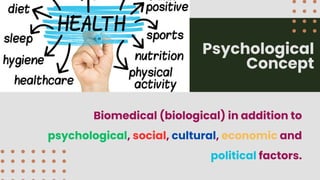
Biomedical (biological) in addition to
psychological, social, cultural, economic and
political factors.
Psychological
Concept
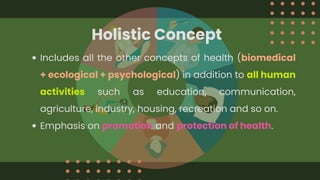
Includes all the other concepts of health (biomedical
+ ecological + psychological) in addition to all human
activities such as education, communication,
agriculture, industry, housing, recreation and so on.
Emphasis on promotion and protection of health.
Holistic Concept
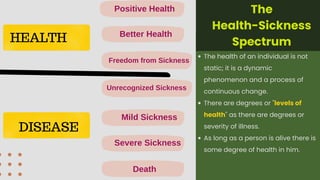
The health of an individual is not
static; it is a dynamic
phenomenon and a process of
continuous change.
There are degrees or "levels of
health" as there are degrees or
severity of illness.
As long as a person is alive there is
some degree of health in him.
Positive Health
Better Health
Freedom from Sickness
Unrecognized Sickness
Mild Sickness
Severe Sickness
Death
HEALTH
DISEASE
The
Health-Sickness
Spectrum
DIMENSIONS
OF HEALTH
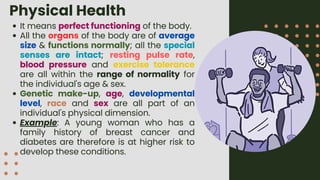
It means perfect functioning of the body.
All the organs of the body are of average
size & functions normally; all the special
senses are intact; resting pulse rate,
blood pressure and exercise tolerance
are all within the range of normality for
the individual's age & sex.
Genetic make-up, age, developmental
level, race and sex are all part of an
individual's physical dimension.
Example: A young woman who has a
family history of breast cancer and
diabetes are therefore is at higher risk to
develop these conditions.
Physical Health
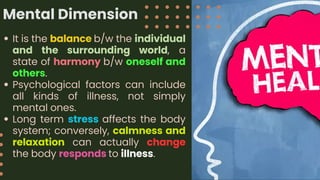
Mental Dimension
It is the balance b/w the individual
and the surrounding world, a
state of harmony b/w oneself and
others.
Psychological factors can include
all kinds of illness, not simply
mental ones.
Long term stress affects the body
system; conversely, calmness and
relaxation can actually change
the body responds to illness.
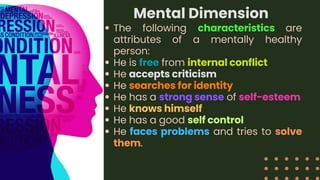
The following characteristics are
attributes of a mentally healthy
person:
He is free from internal conflict
He accepts criticism
He searches for identity
He has a strong sense of self-esteem
He knows himself
He has a good self control
He faces problems and tries to solve
them.
Mental Dimension
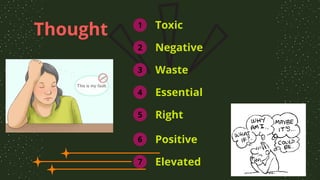
Toxic
Negative
Essential
Waste
Right
Thought
Positive
Elevated
7
1
2
4
3
5
6
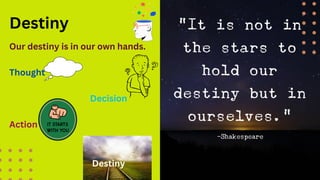
Our destiny is in our own hands.
Thought
Decision
Action
Destiny
Destiny
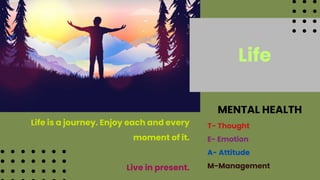
Life is a journey. Enjoy each and every
moment of it.
Live in present.
Life
MENTAL HEALTH
T- Thought
E- Emotion
A- Attitude
M-Management
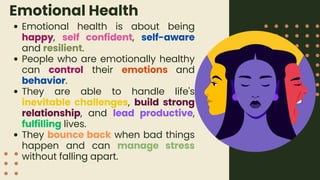
Emotional Health
Emotional health is about being
happy, self confident, self-aware
and resilient.
People who are emotionally healthy
can control their emotions and
behavior.
They are able to handle life's
inevitable challenges, build strong
relationship, and lead productive,
fulfilling lives.
They bounce back when bad things
happen and can manage stress
without falling apart.
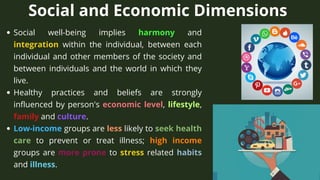
Social well-being implies harmony and
integration within the individual, between each
individual and other members of the society and
between individuals and the world in which they
live.
Healthy practices and beliefs are strongly
influenced by person's economic level, lifestyle,
family and culture.
Low-income groups are less likely to seek health
care to prevent or treat illness; high income
groups are more prone to stress related habits
and illness.
Social and Economic Dimensions
Spiritual Dimension
Spiritual dimension
includes principles and
ethics, the purpose of
life, religious beliefs and
values; all are important
components of the way
the person behaves with
health and illness.
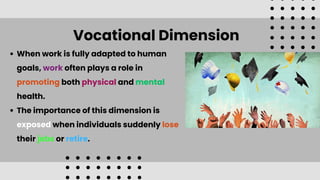
Vocational Dimension
When work is fully adapted to human
goals, work often plays a role in
promoting both physical and mental
health.
The importance of this dimension is
exposed when individuals suddenly lose
their jobs or retire.
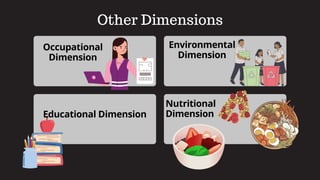
Occupational
Dimension
Educational Dimension
Environmental
Dimension
Nutritional
Dimension
Other Dimensions
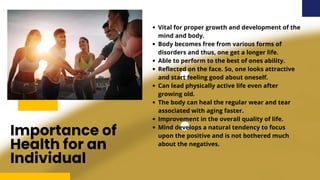
Vital for proper growth and development of the
mind and body.
Body becomes free from various forms of
disorders and thus, one get a longer life.
Able to perform to the best of ones ability.
Reflected on the face. So, one looks attractive
and start feeling good about oneself.
Can lead physically active life even after
growing old.
The body can heal the regular wear and tear
associated with aging faster.
Improvement in the overall quality of life.
Mind develops a natural tendency to focus
upon the positive and is not bothered much
about the negatives.
Importance of
Health for an
Individual
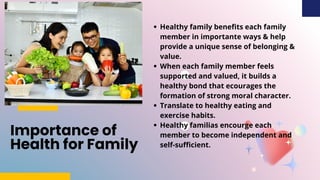
Healthy family benefits each family
member in importante ways & help
provide a unique sense of belonging &
value.
When each family member feels
supported and valued, it builds a
healthy bond that ecourages the
formation of strong moral character.
Translate to healthy eating and
exercise habits.
Healthy familias encourge each
member to become independent and
self-sufficient.
Importance of
Health for Family
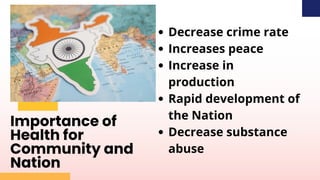
Decrease crime rate
Increases peace
Increase in
production
Rapid development of
the Nation
Decrease substance
abuse
Importance of
Health for
Community and
Nation
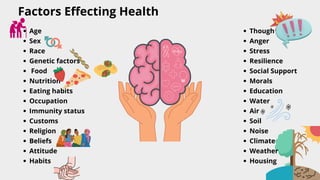
Age
Sex
Race
Genetic factors
Food
Nutrition
Eating habits
Occupation
Immunity status
Customs
Religion
Beliefs
Attitude
Habits
Factors Effecting Health
Though
Anger
Stress
Resilience
Social Support
Morals
Education
Water
Air
Soil
Noise
Climate
Weather
Housing
Factors Effecting Health Contd.
Hygiene
Personal Hygiene
Heat
Light
Radiation
Sleep and rest
Physical activity
Lifestyle
Intolerance
Perinatal events
Previous accidents
Industrialization
Urbanization
Socioeconomic conditions
Community life
Availability of health services
Barriers to health services-
Accessibility
1.
Ignorance
2.
Illiteracy
3.
Maldistribution
4.
Efficacy
5.
Efficiency
6.
Shortage of man power
7.
Factors Effecting Health Contd.
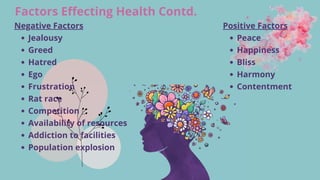
Negative Factors
Jealousy
Greed
Hatred
Ego
Frustration
Rat race
Competition
Availability of resources
Addiction to facilities
Population explosion
Positive Factors
Peace
Happiness
Bliss
Harmony
Contentment
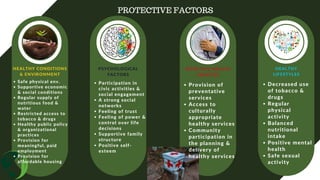
Safe physical env.
Supportive economic
& social conditions
Regular supply of
nutritious food &
water
Restricted access to
tobacco & drugs
Healthy public policy
& organizational
practices
Provision for
meaningful, paid
employment
Provision for
affordable housing
Participation in
civic activities &
social engagement
A strong social
networks
Feeling of trust
Feeling of power &
control over life
decisions
Supportive family
structure
Positive self-
esteem
Provision of
preventative
services
Access to
culturally
appropriate
healthy services
Community
participation in
the planning &
delivery of
healthy services
HEALTHY CONDITIONS
& ENVIRONMENT
PSYCHOLOGICAL
FACTORS
EFFECTIVE HEALTH
SERVICES
Decreased use
of tobacco &
drugs
Regular
physical
activity
Balanced
nutritional
intake
Positive mental
health
Safe sexual
activity
HEALTHY
LIFESTYLES
PROTECTIVE FACTORS
HEALTH
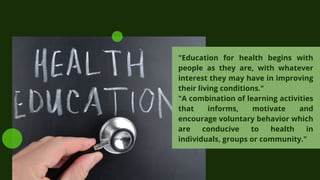
EDUCATION
Health education is a process which affects
changes in the health practices of people
and in the knowledge and attitude related
to such changes.
OR
Teaching processes providing basic
knowledge and practices of health, so as to
be interpreted into proper health behaviour.
Health education is the process
by which individuals & group of
people learn to
promote
maintain
restore health
"Education for health begins with
people as they are, with whatever
interest they may have in improving
their living conditions."
"A combination of learning activities
that informs, motivate and
encourage voluntary behavior which
are conducive to health in
individuals, groups or community."
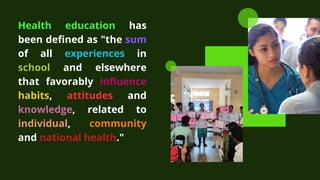
Health education has
been defined as "the sum
of all experiences in
school and elsewhere
that favorably influence
habits, attitudes and
knowledge, related to
individual, community
and national health."
WHO Definition
Like general education is concerned with
changes in knowledge, feelings and
behavior of people. In its most usual form,
it concentrates on developing such health
practices as are believed to bring about the
best possible state of well being.
Health Education
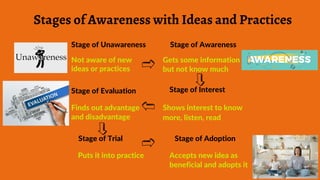
Finds out advantage
and disadvantage
Gets some information
but not know much
Stage of Interest
Stage of Trial
Stages of Awareness with Ideas and Practices
Not aware of new
ideas or practices
Shows interest to know
more, listen, read
Stage of Unawareness
Stage of Evaluation
Stage of Awareness
Puts it into practice Accepts new idea as
beneficial and adopts it
Stage of Adoption
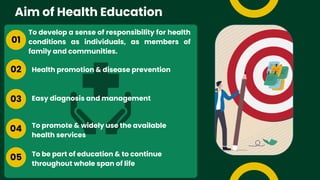
Aim of Health Education
01
02
03
04
To develop a sense of responsibility for health
conditions as individuals, as members of
family and communities.
Health promotion & disease prevention
Easy diagnosis and management
To promote & widely use the available
health services
05 To be part of education & to continue
throughout whole span of life
Objectives of Health Education
To make health an asset valued by the community.
1.
To increase the knowledge of the factors that affect health.
2.
To encourage behavior which promotes & maintains health.
3.
To enlist support for public health measures & when
necessary, to press for appropriate governmental action.
4.
To encourage appropriate use of health services especially
preventive services.
5.
To inform the public about medical advances, their uses &
their limitations.
6.
Health education is an essential component of any program to
improve the health of communities.
Effective planning of any health education program depends
on identifying the problems/needs of the people.
The introduction of new practices made fail if they are
incompatible with local beliefs and practices.
Principles of Health Education
Meet a felt need of the community.
Be simple to put into practice with the
existing knowledge & skills in the
community.
Fit in with existing lifestyle & culture & not
conflict with local belief.
Be locally affordable (money, material &
time)
Flexible & fit with people's circumstances
Ex. about nutrition should be based on foods
that are available locally, latrines build with
traditional method
Any proposal for a change of practice should:
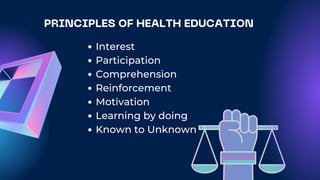
Principles of Health Education
Interest
Participation
Comprehension
Reinforcement
Motivation
Learning by doing
Known to Unknown
PRINCIPLES OF HEALTH EDUCATION
LEARNING BY DOING
"If I hear, I forget
If I see, I remember
If I do, I know"
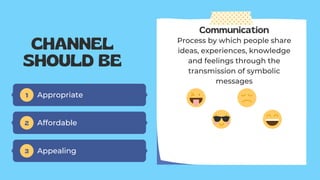
Appropriate
CHANNEL
SHOULD BE
Communication
Process by which people share
ideas, experiences, knowledge
and feelings through the
transmission of symbolic
messages
1
Affordable
2
Appealing
3
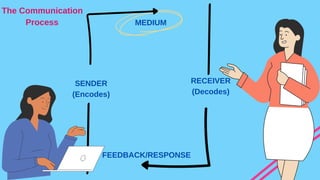
MEDIUM
FEEDBACK/RESPONSE
SENDER
(Encodes)
RECEIVER
(Decodes)
The Communication
Process
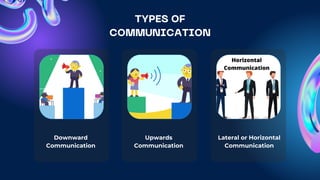
TYPES OF
COMMUNICATION
Downward
Communication
Upwards
Communication
Lateral or Horizontal
Communication
Methods of Health
Education
Methods of health education are the techniques or ways
in which series of activities are carried out to
communicates ideas, information and develop necessary
skills and attitudes.
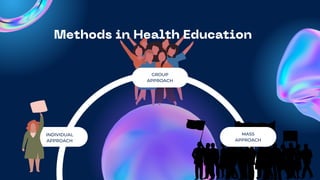
Methods in Health Education
INDIVIDUAL
APPROACH
GROUP
APPROACH
MASS
APPROACH
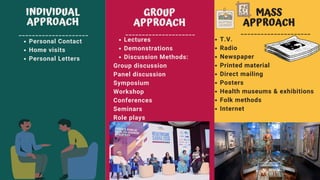
Lectures
Demonstrations
Discussion Methods:
Group discussion
Panel discussion
Symposium
Workshop
Conferences
Seminars
Role plays
INDIVIDUAL
APPROACH
GROUP
APPROACH
MASS
APPROACH
Personal Contact
Home visits
Personal Letters
T.V.
Radio
Newspaper
Printed material
Direct mailing
Posters
Health museums & exhibitions
Folk methods
Internet
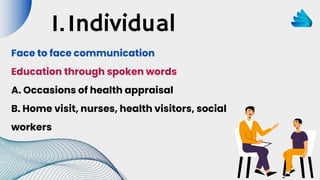
Individual
1.
Face to face communication
Education through spoken words
A. Occasions of health appraisal
B. Home visit, nurses, health visitors, social
workers
Interpersonal communication is a person to person,
two-way, verbal & nonverbal interaction that
includes the sharing of information & feelings
between individuals or in small groups that establish
trusting relationship.
Interpersonal Communication (IPC)
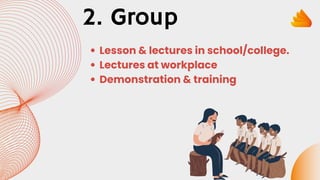
2. Group
Lesson & lectures in school/college.
Lectures at workplace
Demonstration & training
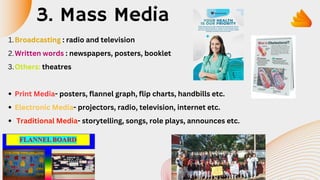
Broadcasting : radio and television
1.
Written words : newspapers, posters, booklet
2.
Others: theatres
3.
Print Media- posters, flannel graph, flip charts, handbills etc.
Electronic Media- projectors, radio, television, internet etc.
Traditional Media- storytelling, songs, role plays, announces etc.
3. Mass Media
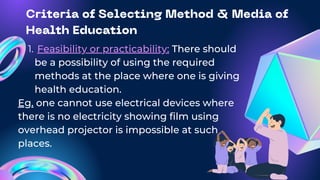
Feasibility or practicability: There should
be a possibility of using the required
methods at the place where one is giving
health education.
1.
Eg. one cannot use electrical devices where
there is no electricity showing film using
overhead projector is impossible at such
places.
Criteria of Selecting Method & Media of
Health Education
2. Nature of the audience: Proper
method should be used & selected by
considering the nature of the audience.
Criteria of Selecting Method & Media of
Health Education (contd.)
3. Accessibility: The method should be effective enough to
reach & influence each member of the total population where
one has to give message.
It should not happen that one part of a community has well
access to all sorts of methods & next part is avoided.
Criteria of Selecting Method & Media of
Health Education (contd.)
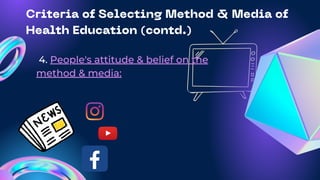
4. People's attitude & belief on the
method & media:
Criteria of Selecting Method & Media of
Health Education (contd.)
5. Subject or purpose of teaching:
One should select such sort of methods
which will help to fulfill the objectives &
needs of the people. It should be
selected according to the interest of
the people so that the audience will
eagarly participate.
Criteria of Selecting Method & Media of
Health Education (contd.)
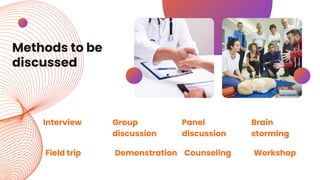
Interview Group
discussion
Panel
discussion
Brain
storming
Methods to be
discussed
Field trip Demonstration Counseling Workshop
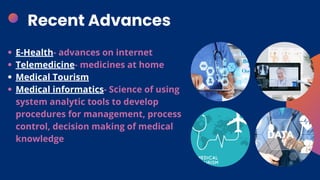
Recent Advances
E-Health- advances on internet
Telemedicine- medicines at home
Medical Tourism
Medical informatics- Science of using
system analytic tools to develop
procedures for management, process
control, decision making of medical
knowledge
Media
Media are the teaching aids by which
knowledge, info., & ideas are
communicated with view of dissemination
of message.
The teaching aids helps health educator to
impart knowledge to the audience.
The media or teaching aids are used to
create awareness & in enforcing learning.
They are used in different ways & at
different situations for individual, group
and mass teaching.
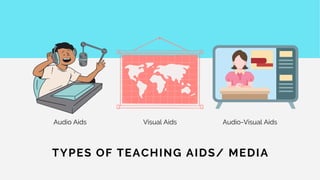
TYPES OF TEACHING AIDS/ MEDIA
Audio Aids Visual Aids Audio-Visual Aids
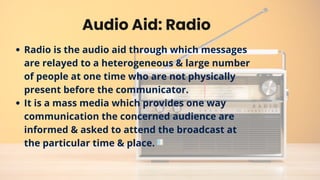
Radio is the audio aid through which messages
are relayed to a heterogeneous & large number
of people at one time who are not physically
present before the communicator.
It is a mass media which provides one way
communication the concerned audience are
informed & asked to attend the broadcast at
the particular time & place.
Audio Aid: Radio
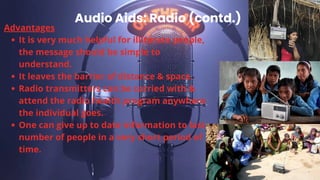
Advantages
It is very much helpful for illiterate people,
the message should be simple to
understand.
It leaves the barrier of distance & space.
Radio transmitters can be carried with &
attend the radio health program anywhere
the individual goes.
One can give up to date information to last
number of people in a very short period of
time.
Audio Aids: Radio (contd.)
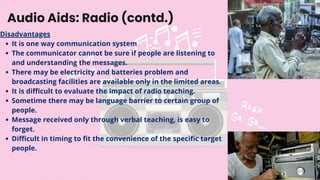
Disadvantages
It is one way communication system
The communicator cannot be sure if people are listening to
and understanding the messages.
There may be electricity and batteries problem and
broadcasting facilities are available only in the limited areas.
It is difficult to evaluate the impact of radio teaching.
Sometime there may be language barrier to certain group of
people.
Message received only through verbal teaching, is easy to
forget.
Difficult in timing to fit the convenience of the specific target
people.
Audio Aids: Radio (contd.)
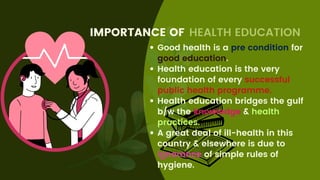
Good health is a pre condition for
good education.
Health education is the very
foundation of every successful
public health programme.
Health education bridges the gulf
b/w the knowledge & health
practices.
A great deal of ill-health in this
country & elsewhere is due to
ignorance of simple rules of
hygiene.
IMPORTANCE OF HEALTH EDUCATION
It is vital for proper growth & development of mind
and body.
Body becomes free from various forms of disorders
and thus, one get a longer life.
Life without suffering from any aches, pain, or
discomfort.
Able to perform to the best of our ability.
Reflected on our face, so we look attractive & start
feeling good about ourselves.
Can lead a physically active life even after growing
old.
The body can heal the regular wear & tear
associated with aging faster.
Importance of Health for
Individual
Improvement in the overall quality of our
life.
Mine develops a natural tendency to focus
upon the positives & is not bothered much
about the negative.
Can sleep well & do not have to start the
next day with a body ache or joint pain or
stomach upset.
Good health has a positive effect on the
productivity as an
employee/student/worker.
Importance of Health for
Individual (contd.)
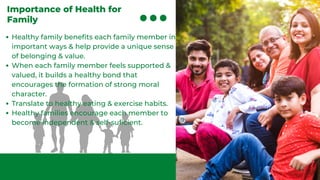
Importance of Health for
Family
Healthy family benefits each family member in
important ways & help provide a unique sense
of belonging & value.
When each family member feels supported &
valued, it builds a healthy bond that
encourages the formation of strong moral
character.
Translate to healthy eating & exercise habits.
Healthy families encourage each member to
become independent & self-suficient.
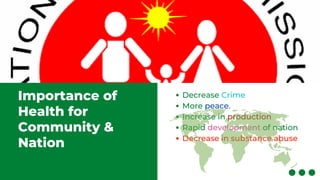
Decrease Crime
More peace.
Increase in production
Rapid development of nation
Decrease in substance abuse
Importance of
Health for
Community &
Nation
Hygiene
Hygiene is healthy habits that
include bathing, keeping the
mouth clean, keeping the skin
protected from the sun &
washing hands frequently
before handling edibles to
ensure the safe delivery of
food.
Hygiene is a set of practices
performed for the preservation
of health.
Hygiene (contd.)
Hygiene, science of preserving and promoting
the health of both the individuals and the
community.
According to WHO
Hygiene refers to conditions & practices that helps
to maintain health & prevent the spread of
diseases.
Medical hygiene therefore includes a specific set
of practices associated with this preservation of
health
Ex. environmental cleaning, sterilization of
equipment hand hygiene, water & sanitation &
safe disposal medical waste.
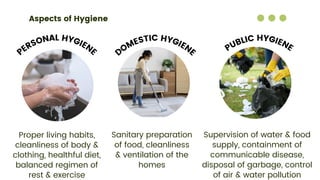
Aspects of Hygiene
Proper living habits,
cleanliness of body &
clothing, healthful diet,
balanced regimen of
rest & exercise
Sanitary preparation
of food, cleanliness
& ventilation of the
homes
Supervision of water & food
supply, containment of
communicable disease,
disposal of garbage, control
of air & water pollution
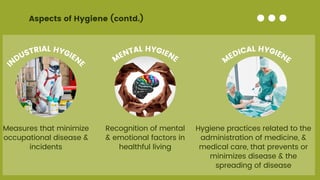
PERSONAL HYGIENE DOMESTIC HYGIENE PUBLIC HYGIENE
I
NDUSTRIAL HYGIEN
E
M
ENTAL HYGIENE
Aspects of Hygiene (contd.)
Measures that minimize
occupational disease &
incidents
Recognition of mental
& emotional factors in
healthful living
M
EDICAL HYGIENE
Hygiene practices related to the
administration of medicine, &
medical care, that prevents or
minimizes disease & the
spreading of disease
What is
Hygiene?
It is the act of keeping
the human body as
well as the
environment clean
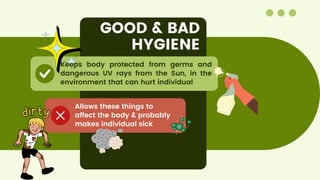
GOOD & BAD
HYGIENE
Allows these things to
affect the body & probably
makes individual sick
Keeps body protected from germs and
dangerous UV rays from the Sun, in the
environment that can hurt individual
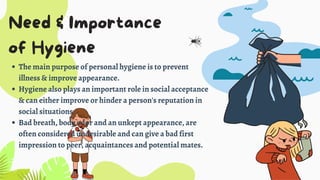
The main purpose of personal hygiene is to prevent
illness & improve appearance.
Hygiene also plays an important role in social acceptance
& can either improve or hinder a person's reputation in
social situations.
Bad breath, body odor and an unkept appearance, are
often considered undesirable and can give a bad first
impression to peer, acquaintances and potential mates.
Need & Importance
of Hygiene
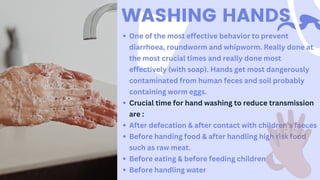
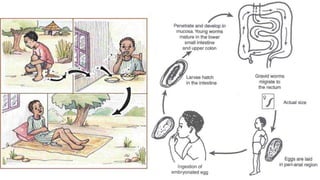
One of the most effective behavior to prevent
diarrhoea, roundworm and whipworm. Really done at
the most crucial times and really done most
effectively (with soap). Hands get most dangerously
contaminated from human feces and soil probably
containing worm eggs.
Crucial time for hand washing to reduce transmission
are :
After defecation & after contact with children's faeces
Before handing food & after handling high risk food
such as raw meat.
Before eating & before feeding children
Before handling water
WASHING HANDS
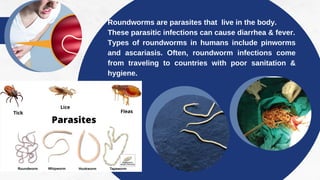
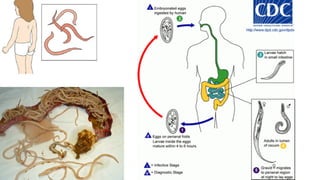
Roundworms are parasites that live in the body.
These parasitic infections can cause diarrhea & fever.
Types of roundworms in humans include pinworms
and ascariasis. Often, roundworm infections come
from traveling to countries with poor sanitation &
hygiene.
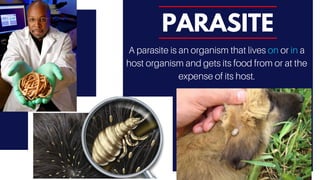
PARASITE
A parasite is an organism that lives on or in a
host organism and gets its food from or at the
expense of its host.
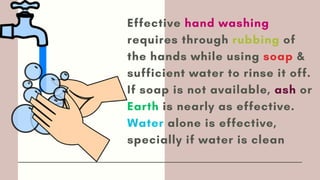
Effective hand washing
requires through rubbing of
the hands while using soap &
sufficient water to rinse it off.
If soap is not available, ash or
Earth is nearly as effective.
Water alone is effective,
specially if water is clean
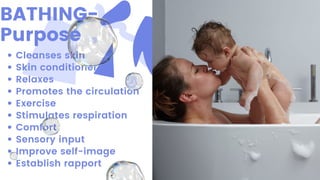
Cleanses skin
Skin conditioner
Relaxes
Promotes the circulation
Exercise
Stimulates respiration
Comfort
Sensory input
Improve self-image
Establish rapport
BATHING-
Purpose
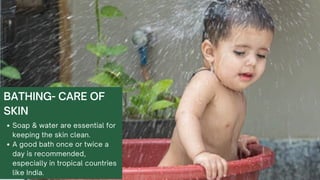
BATHING- CARE OF
SKIN
Soap & water are essential for
keeping the skin clean.
A good bath once or twice a
day is recommended,
especially in tropical countries
like India.
Those who are involved in active sports
or workout, sweat a lot. Therefore it is
recommended to take bath after the
workout.
A soap will do the job adequately.
One can also use a bath sponge for
scrubbing.
Back brushes & heel scrubbers are also
available in the market.
The genitals & anus needs to be cleaned well because of the natural
secretion of areas.
In unhygienic conditions, can cause irritation and infection.
Wash off well after soaping.
Drying with a clean towel is important.
Avoid sharing soaps & towel with anybody.
Change into clean underwear after bath.
Around middle age the skin tends to go dry a bit.
A moisturizing oil or cream can be used.
It is better to use this at night because if you go out in the sun or
commute on dusty road when the skin is wet, dust might stick to your
face & oil may also give you tan.
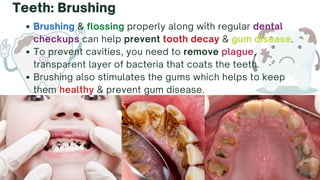
Brushing & flossing properly along with regular dental
checkups can help prevent tooth decay & gum disease.
To prevent cavities, you need to remove plague,
transparent layer of bacteria that coats the teeth.
Brushing also stimulates the gums which helps to keep
them healthy & prevent gum disease.
Teeth: Brushing
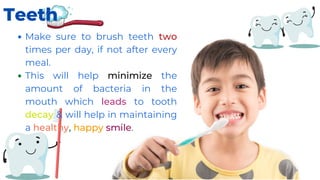
Teeth
Make sure to brush teeth two
times per day, if not after every
meal.
This will help minimize the
amount of bacteria in the
mouth which leads to tooth
decay & will help in maintaining
a healthy, happy smile.
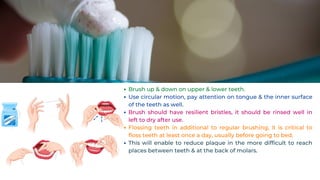
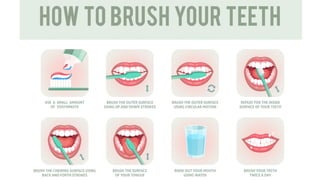
Brush up & down on upper & lower teeth.
Use circular motion, pay attention on tongue & the inner surface
of the teeth as well.
Brush should have resilient bristles, it should be rinsed well in
left to dry after use.
Flossing teeth in additional to regular brushing, it is critical to
floss teeth at least once a day, usually before going to bed.
This will enable to reduce plaque in the more difficult to reach
places between teeth & at the back of molars.
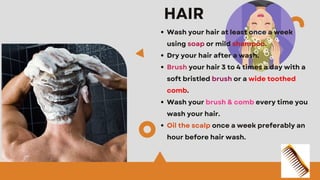
HAIR
Wash your hair at least once a week
using soap or mild shampoo.
Dry your hair after a wash.
Brush your hair 3 to 4 times a day with a
soft bristled brush or a wide toothed
comb.
Wash your brush & comb every time you
wash your hair.
Oil the scalp once a week preferably an
hour before hair wash.
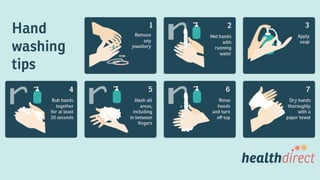
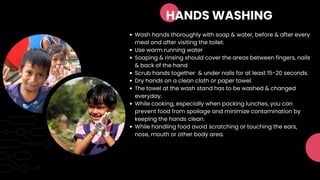
HANDS WASHING
Wash hands thoroughly with soap & water, before & after every
meal and after visiting the toilet.
Use warm running water
Soaping & rinsing should cover the areas between fingers, nails
& back of the hand
Scrub hands together & under nails for at least 15-20 seconds.
Dry hands on a clean cloth or paper towel.
The towel at the wash stand has to be washed & changed
everyday.
While cooking, especially when packing lunches, you can
prevent food from spoilage and minimize contamination by
keeping the hands clean.
While handling food avoid scratching or touching the ears,
nose, mouth or other body area.
If you need to use a handkercheif ot tissue,
wash your hands after that
Keep your nails short.
Nail Polish users should see that it does not
chip off into food.
Six stage of handwashing technique:
1. Palm to palm
2. Back of hands
3. Interdigital spaces
4. Fingertips
5. Thumb and wrist
6. Nails
HANDS WASHING (CONTD.)
CLEANING FINGERNAILS
Closely related to handwashing
Handwashing does not ensure
fingernails get cleaned.
Clean fingernails are particularly
important when food is consumed
or fed to infants using fingers.
Clean fingernails have an aesthetic
value.
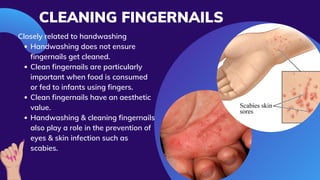
Handwashing & cleaning fingernails
also play a role in the prevention of
eyes & skin infection such as
scabies.
CLEANING FINGERNAILS (CONTD.)
When wiping infected eyes or scratching itching infected skin, bacteria
can settle on fingers & hence be transmitted.
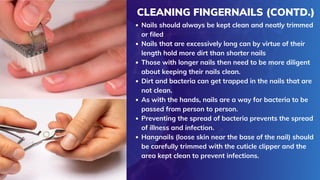
Keeping fingernails clean requires them to be kept short & brushed
regularly.
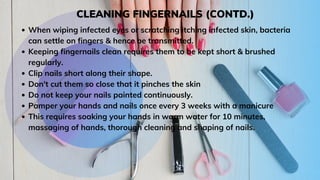
Clip nails short along their shape.
Don't cut them so close that it pinches the skin
Do not keep your nails painted continuously.
Pamper your hands and nails once every 3 weeks with a manicure
This requires soaking your hands in warm water for 10 minutes,
massaging of hands, thorough cleaning and shaping of nails.
CLEANING FINGERNAILS (CONTD.)
Nails should always be kept clean and neatly trimmed
or filed
Nails that are excessively long can by virtue of their
length hold more dirt than shorter nails
Those with longer nails then need to be more diligent
about keeping their nails clean.
Dirt and bacteria can get trapped in the nails that are
not clean.
As with the hands, nails are a way for bacteria to be
passed from person to person.
Preventing the spread of bacteria prevents the spread
of illness and infection.
Hangnails (loose skin near the base of the nail) should
be carefully trimmed with the cuticle clipper and the
area kept clean to prevent infections.
Other Personal Hygiene
Feet/shoes
Body Odor
Clothes
Menstrual Hygiene