Planning, Implementing, Monitoring &
Evaluating Health Education and
promotion programmes.
By: Beimnet Desalegn(BSc,MPH)
Email: bmte5mesi@gmail.com
9/21/2023 1
Contents
๏‚— Health Education/Promotion Planning
๏‚— Application of PRECEED-PROCEDE
Model
๏‚— Health Education/Promotion
Implementation
๏‚— Monitoring and Evaluation In HE/P
Program
9/21/2023 2
Definition of planning
๏‚— Planning: - is an anticipatory decision making
about what needs to be done, how it has to be
done, and with what resources.
๏‚— It is central to health education and health
promotion process.
9/21/2023 3
Why We Plan?
๏‚— It provides future direction
๏‚— It create efficient use of resources
๏‚— It provides a unifying framework
๏‚— It helps to adjust change environment
๏‚— It also facilitates a base for teamwork
Therefore, health promotion planning is said to
be the central process in achieving
HE/HP program goal and objectives
9/21/2023 4
๏‚— Remember that 80% of the Projects fail
due to poor objectives and misleading
or insufficient assumptions, not b/c of
poor implementation
9/21/2023 5
In general, what planning refers to:
๏‚— It is drawing feasible goal
๏‚— It is about drawing โ€œSMARTโ€ objectives
๏‚— It is about developing or drawing guiding
directions/strategies, and
๏‚— Developing action plan
9/21/2023 6
what we need and Consider in HE/HP
Program Planning
๏‚— Problem Identification and needs assessment
๏‚— Prioritization
๏‚— Formulation of goals and objectives
๏‚— Developing program components
๏‚— Identification of appropriate communication
methods and strategies
๏‚— Completing the action plan (write up)
๏‚— Implementation preparation
๏‚— Evaluation and Monitoring indicators and
plan
9/21/2023 7
Models for Program Planning in
Health Promotion
๏‚— Many different kind of planning models have
been developed to guide planning process
๏‚– PRECED-PROCEED
๏‚– MATCH
๏‚– CDCynergy
๏‚— Models serve as frames from which to build;
Provide structure & organization for the
planning process
8
PRECEDE-PROCEED
๏‚— The PRECEDE-PROCEEDE model is a framework for the
process of systematic development and evaluation of
health education programs
๏‚— It is the well-known and most frequently used model to
plan, implement and evaluate health education and
promotion programs.
9
PRECEDE-PROCEED
The model rests on two principles:
1. The principle of participation, which states
that success in achieving change is enhanced by
the active participation of members of the
target audience.
2. The important role of the environmental
factors as determinants of health and health
behavior.
10
PRECEDE
P = Predisposing
R = Reinforcing
E = Enabling
C = Constructs
E =Educational/Ecological
D = Diagnosis
E = Evaluation
PROCEED
P = Policy
R = Regulatory
O = Organizational
C = Constructs
E = Educational &
E =Environmental
D = Development
11
PRECEDE - PROCEED
โœ“Larry Green & Marshall Kreuter
โœ“PRECEDE created in early 1970s
โœ“PROCEED created in the 1980s
โœ“Best known & often used model
PRECEDE-PROCEED MODEL Diagram
12
Quality
of life
Phase 1
Social
Diagnosis
Health
Phase 2
Epidemiologic
al
Diagnosis
Health
education
Policy
regulation
organization
Public
Health
Phase
Administrative
& Policy
Diagnosis
Phase 6
Implementation
Phase 7
Process evaluation
Phase 8
Impact evaluation
Phase 9
Outcome evaluation
Predisposing
Reinforcing
Enabling
Phase 4
Educational &
Ecological
Diagnosis
Behavior
Environment
Phase 3
Behavioral &
Environmental
Diagnosis
Green & Kreutzer, Health Promotion Planning, 3rd ed., 1999.
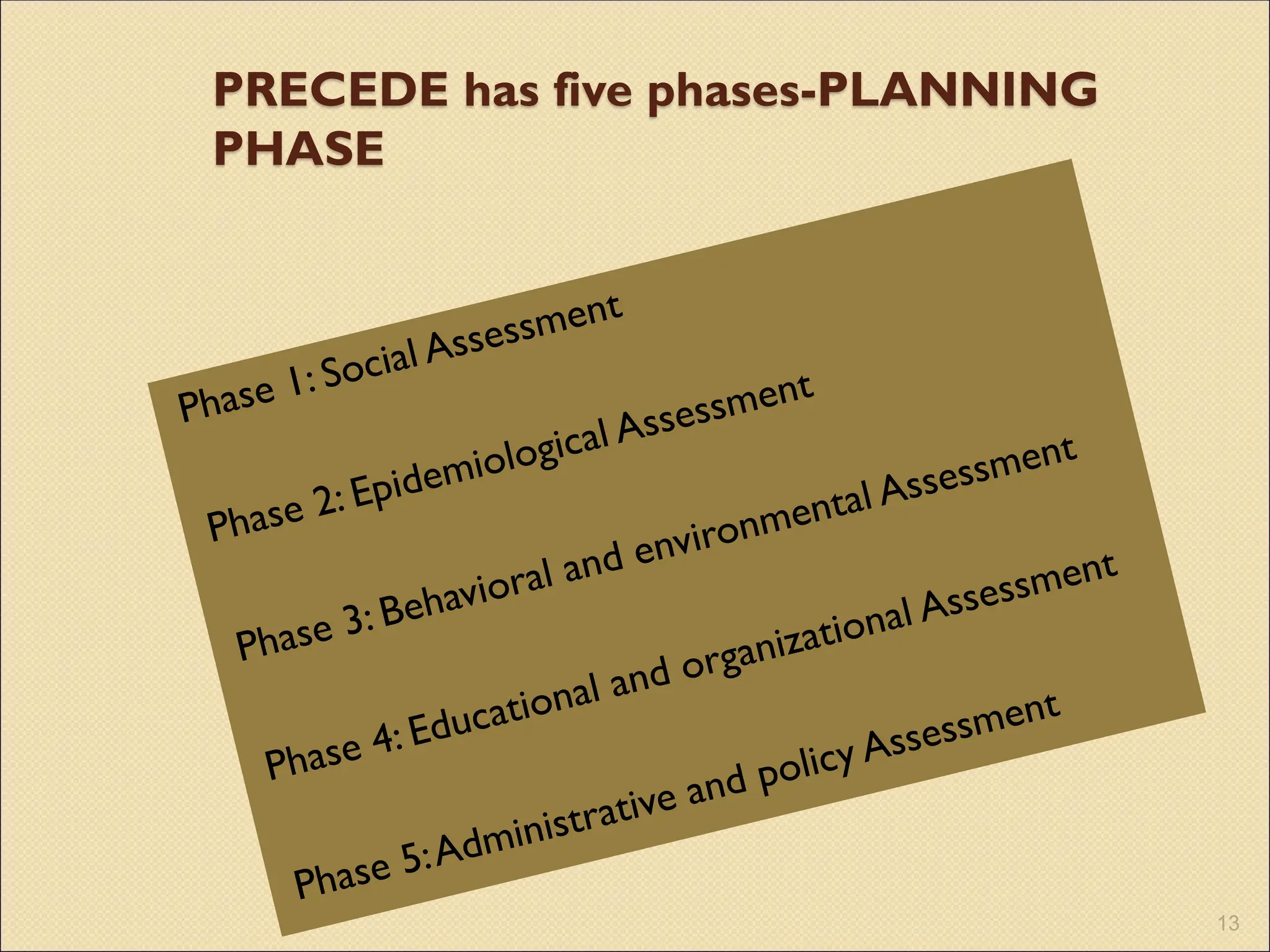
PRECEDE has five phases-PLANNING
PHASE
13
Phase 1 โ€“ Social Assessment
๏‚— Phase 1: seeks to subjectively define the Quality of life
(problems & priorities) of priority individuals or
population
๏‚— Identify social problems that impact quality of life
14
Quality of Life (the outcome)
Phase 1 : Social diagnosis
Phase 2 โ€“ Epidemiological Assessment
โžข Determine health issues associated with the quality of life.
โžข morbidity, mortality, risk factors, disability, incidence,
prevalence of disease
๏‚— Sources : Epidemiological data
15
Review
epidemiological data
Phase 2 : Epidemiological
Assessment
List of problems
Creating priorities
๏‚— Once a list of problems identified in phase 1 &
2, priority should be set among these problems
๏‚— For the selected health problem, develop
program goals and objectives
๏‚— Suppose, malaria is the health problem
identified in phase 1 & 2, then develop
program goal and health objective for
malaria.
16
Example of program or health objective for
malaria
๏‚— Goal : To reduce the burden of malaria in
Humbo woreda by 2024.
๏‚— Objective: To reduce the prevalence of
malaria in Humbo woreda from 45% to 10% by
the end of 2024.
17
Phase 3: Behavioral and Environmental
assessment
๏‚— This phase involves determining and
prioritizing behavioral and non behavioral
causes (personal and environmental
factors) which seem to be linked to
health problems selected in Phase 2.
18
Phase 3โ€ฆ.
19
โ€ข Behavioral assessment is the
analysis of behavioral links to
the problems that are identified
in the epidemiological or social
diagnosis.
1.Behavioral
assessment
โ€ข Environmental assessment is a
parallel analysis of factors in
the social and physical
environment other than specific
actions that could be linked to
behaviors.
2.Non-
behavioral
assessment
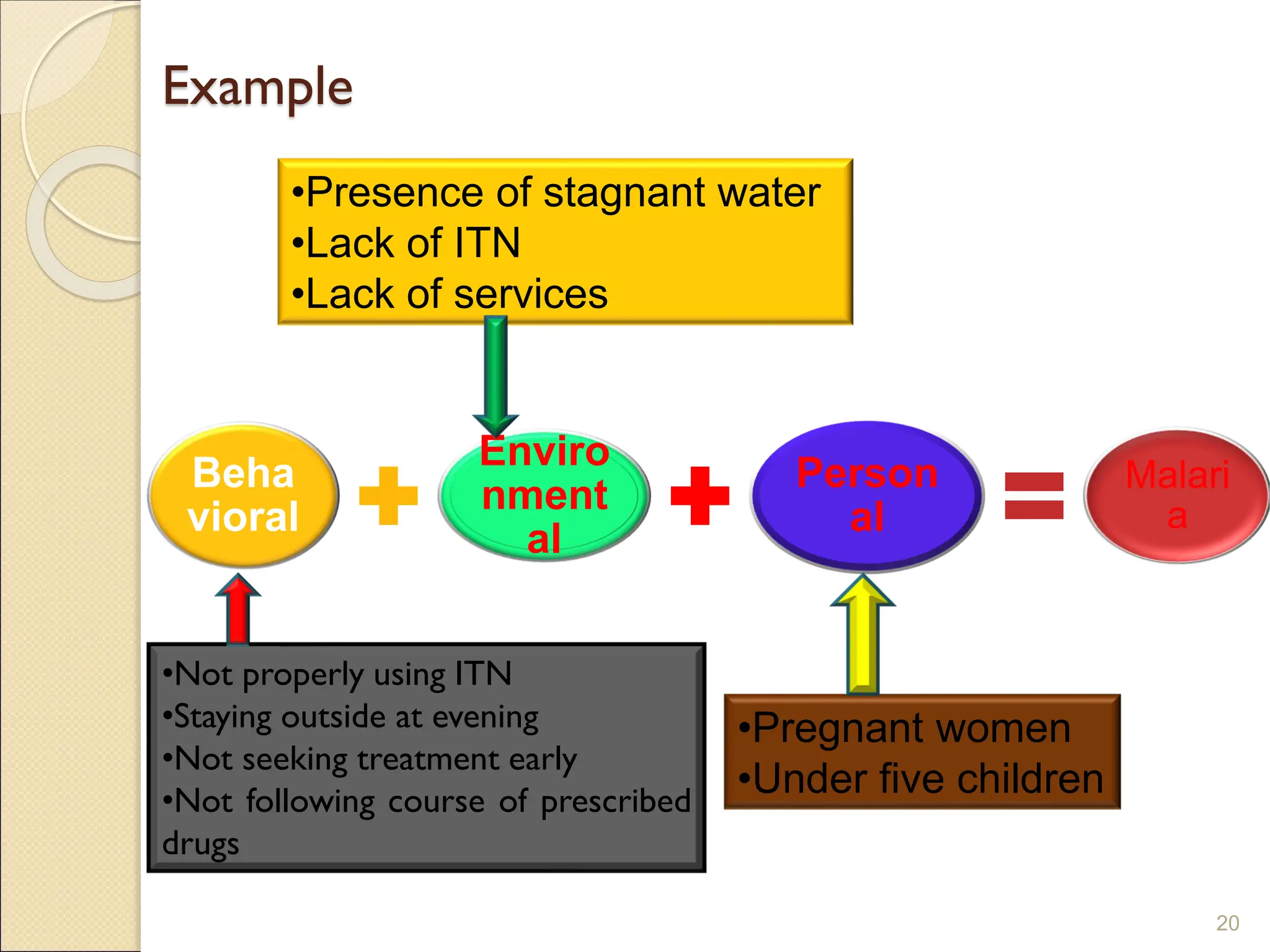
Example
20
Beha
vioral
Enviro
nment
al
Person
al
Malari
a
โ€ขNot properly using ITN
โ€ขStaying outside at evening
โ€ขNot seeking treatment early
โ€ขNot following course of prescribed
drugs
โ€ขPresence of stagnant water
โ€ขLack of ITN
โ€ขLack of services
โ€ขPregnant women
โ€ขUnder five children
Behavioral factors
๏‚— Perhaps, no program has sufficient resources to
deal with all behavioral factors identified!
๏‚— So, prioritization has optional !!!
๏‚— But, How to prioritize behavioral factors ??
๏‚— Consider the importance and changeability of
each behaviors !!!
21
Behavioral factors โ€ฆ.
โ€ข Evidence as it is clearly linked
to health problem
โ€ข How it prevalent in the
population
Importance
โ€ข Reasonable evidence whether
the behaviors is changed
โ€ข Review past experience
โ€ข Still in developmental stages
โ€ข Not deep rooted in culture
Changeability
22
Behavioral prioritization matrix
๏‚— Behavioral objectives are created from Quadrant 1&2
23
More Important Less Important
More
changeable
Quadrant 1
High priority for
program focus
Quadrant 3
Low priority except
for political reason
Less
changeable
Quadrant 2
Priority for innovative
program: Evaluation is
crucial
Quadrant 4
No program
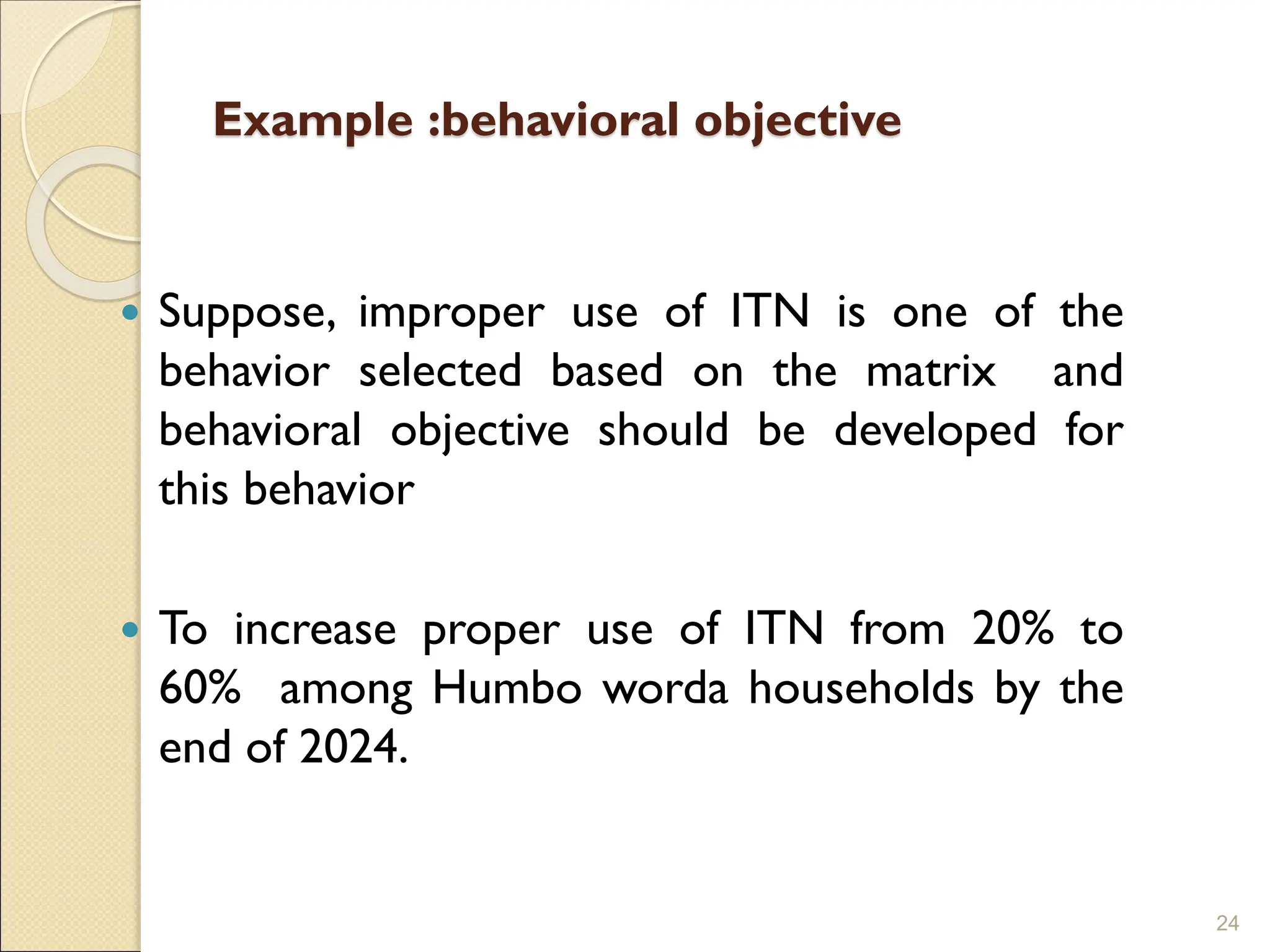
Example :behavioral objective
๏‚— Suppose, improper use of ITN is one of the
behavior selected based on the matrix and
behavioral objective should be developed for
this behavior
๏‚— To increase proper use of ITN from 20% to
60% among Humbo worda households by the
end of 2024.
24
Non-behavioral factors
๏‚— Just follow the same procedure to identify
environmental factors and prioritize it in
terms of changeability and importance
AND
๏‚— Write SMART, objectives for the
identified factors
25
Phase 4: Educational & Organizational
assessment
๏‚— Identifies causal factors that must be
changed to initiate and sustain the process of
behavioral and environmental change identified
in Phase 3
26
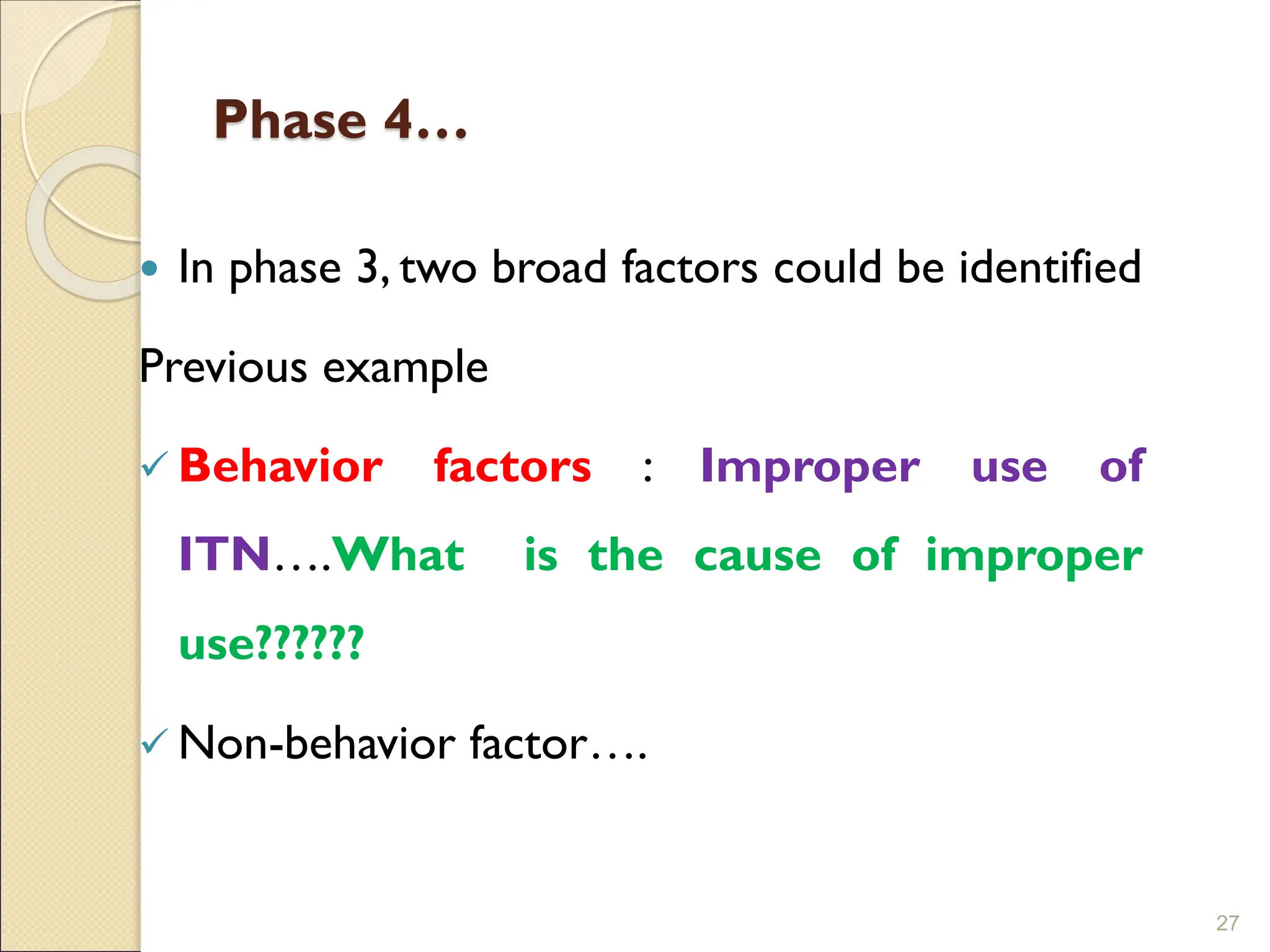
Phase 4โ€ฆ
๏‚— In phase 3, two broad factors could be identified
Previous example
โœ“ Behavior factors : Improper use of
ITNโ€ฆ.What is the cause of improper
use??????
โœ“ Non-behavior factorโ€ฆ.
27
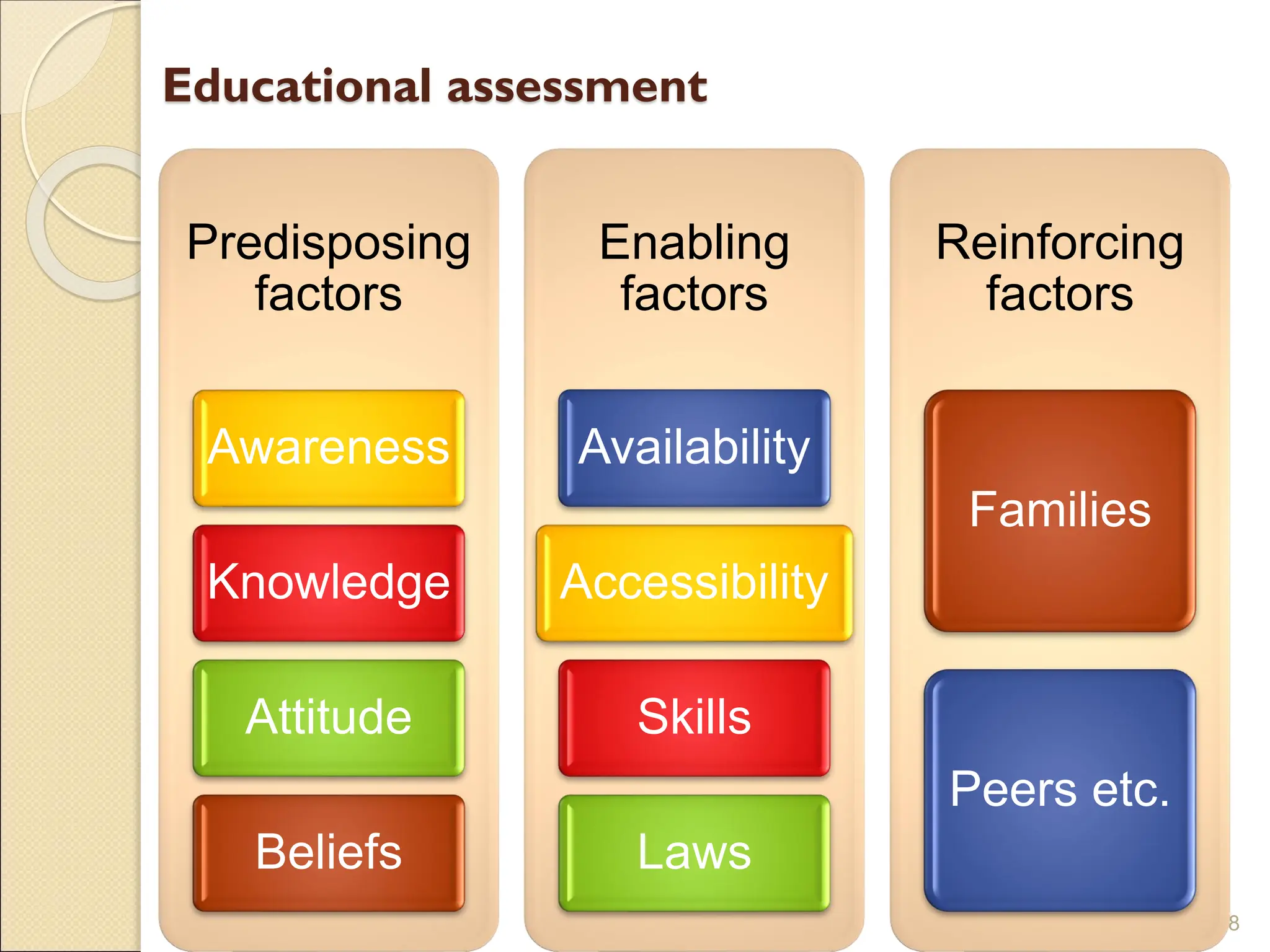
Educational assessment
28
Predisposing
factors
Awareness
Knowledge
Attitude
Beliefs
Enabling
factors
Availability
Accessibility
Skills
Laws
Reinforcing
factors
Families
Peers etc.
Establishing priorities within categories
๏‚— Within these three categories of determinants of
behavioral and environmental changes set priorities for
intervention in logical order according to importance
and changeability
29
Importance can be estimated in the following
parameters
1.
Prevalence
How
widespread
or frequent
is the
factor?
2.
Immediacy
Asks how
compelling
or urgent is
the factor ?
3. Necessity
Is factor
which its
absence or
presence is
must for
change to
occur
30
Rating factors in terms of Changeability
Knowledge
Beliefs
Attitude
Value
31
Learning and resource objectives
For each of the prioritized factors, develop
learning objectives and resource objectives
๏‚— Predisposing factors โ€ฆโ€ฆLearning objectives
๏‚— Reinforcing factors โ€ฆโ€ฆ.learning objectives
๏‚— Enabling factors โ€ฆโ€ฆโ€ฆ.resource objectives
32
Phase 5: Administrative and Policy
assessment
๏‚— Focuses on administrative and organizational concerns
which must be addressed prior to program
implementation
๏‚— Includes assessment of resources, budget development
and allocation, development of implementation
timetable, organization and coordination with others
๏‚— Analysis of policies, resources and circumstances
prevailing organizational situations that could hinder or
facilitate the development of the health program Policy
assessment
33
PRECEDE- phase ends with a Comprehensive
Intervention plan which is ready for
implementation and PROCEED begins !
34
Design a Comprehensive Intervention plan
Ready made
plan
PROCEED has four phases:
Phase 6: Implementation
Phase 7: Process evaluation
Phase 8: Impact evaluation
Phase 9: Outcome evaluation
35
Phase 6: Implementation
๏‚— Beginning of PROCEED
๏‚— The act of converting program objectives into
actions through policy changes, regulation and
organization.
๏‚— It is translating the goals, objectives and
methods into a community based health
education programs.
36
Phases 7 , 8, & 9 - Evaluation
โœ“ Phase 7: Process evaluation - measurements of
implementation process to control, assure, or improve
the quality of the program
โœ“ Phase 8: Impact evaluation - immediate observable
effects of program (changes in Knowledge, attitude,
beliefs, practice etc.)
โœ“ Phase 9: Outcome evaluation -long-term effects of
the program such as reduction in mortality, morbidity,
prevalence of disease, improved health status, life
expectancy
37
PRECEDE-PROCEED MODEL Diagram
38
Quality
of life
Phase 1
Social
Diagnosis
Health
Phase 2
Epidemiologic
al
Diagnosis
Health
education
Policy
regulation
organization
Public
Health
Phase
Administrative
& Policy
Diagnosis
Phase 6
Implementation
Phase 7
Process evaluation
Phase 8
Impact evaluation
Phase 9
Outcome evaluation
Predisposing
Reinforcing
Enabling
Phase 4
Educational &
Ecological
Diagnosis
Behavior
Environment
Phase 3
Behavioral &
Environmental
Diagnosis
Green
&
Kreutzer,
Health
Promotion
Planning,
3rd
ed.,
1999
Visit this model whenever you get terrible to conduct community diagnosis,
DTTP
9/21/2023 39

Health education and promotion programs

  • 1.
    Planning, Implementing, Monitoring& Evaluating Health Education and promotion programmes. By: Beimnet Desalegn(BSc,MPH) Email: bmte5mesi@gmail.com 9/21/2023 1
  • 2.
    Contents ๏‚— Health Education/PromotionPlanning ๏‚— Application of PRECEED-PROCEDE Model ๏‚— Health Education/Promotion Implementation ๏‚— Monitoring and Evaluation In HE/P Program 9/21/2023 2
  • 3.
    Definition of planning ๏‚—Planning: - is an anticipatory decision making about what needs to be done, how it has to be done, and with what resources. ๏‚— It is central to health education and health promotion process. 9/21/2023 3
  • 4.
    Why We Plan? ๏‚—It provides future direction ๏‚— It create efficient use of resources ๏‚— It provides a unifying framework ๏‚— It helps to adjust change environment ๏‚— It also facilitates a base for teamwork Therefore, health promotion planning is said to be the central process in achieving HE/HP program goal and objectives 9/21/2023 4
  • 5.
    ๏‚— Remember that80% of the Projects fail due to poor objectives and misleading or insufficient assumptions, not b/c of poor implementation 9/21/2023 5
  • 6.
    In general, whatplanning refers to: ๏‚— It is drawing feasible goal ๏‚— It is about drawing โ€œSMARTโ€ objectives ๏‚— It is about developing or drawing guiding directions/strategies, and ๏‚— Developing action plan 9/21/2023 6
  • 7.
    what we needand Consider in HE/HP Program Planning ๏‚— Problem Identification and needs assessment ๏‚— Prioritization ๏‚— Formulation of goals and objectives ๏‚— Developing program components ๏‚— Identification of appropriate communication methods and strategies ๏‚— Completing the action plan (write up) ๏‚— Implementation preparation ๏‚— Evaluation and Monitoring indicators and plan 9/21/2023 7
  • 8.
    Models for ProgramPlanning in Health Promotion ๏‚— Many different kind of planning models have been developed to guide planning process ๏‚– PRECED-PROCEED ๏‚– MATCH ๏‚– CDCynergy ๏‚— Models serve as frames from which to build; Provide structure & organization for the planning process 8
  • 9.
    PRECEDE-PROCEED ๏‚— The PRECEDE-PROCEEDEmodel is a framework for the process of systematic development and evaluation of health education programs ๏‚— It is the well-known and most frequently used model to plan, implement and evaluate health education and promotion programs. 9
  • 10.
    PRECEDE-PROCEED The model restson two principles: 1. The principle of participation, which states that success in achieving change is enhanced by the active participation of members of the target audience. 2. The important role of the environmental factors as determinants of health and health behavior. 10
  • 11.
    PRECEDE P = Predisposing R= Reinforcing E = Enabling C = Constructs E =Educational/Ecological D = Diagnosis E = Evaluation PROCEED P = Policy R = Regulatory O = Organizational C = Constructs E = Educational & E =Environmental D = Development 11 PRECEDE - PROCEED โœ“Larry Green & Marshall Kreuter โœ“PRECEDE created in early 1970s โœ“PROCEED created in the 1980s โœ“Best known & often used model
  • 12.
    PRECEDE-PROCEED MODEL Diagram 12 Quality oflife Phase 1 Social Diagnosis Health Phase 2 Epidemiologic al Diagnosis Health education Policy regulation organization Public Health Phase Administrative & Policy Diagnosis Phase 6 Implementation Phase 7 Process evaluation Phase 8 Impact evaluation Phase 9 Outcome evaluation Predisposing Reinforcing Enabling Phase 4 Educational & Ecological Diagnosis Behavior Environment Phase 3 Behavioral & Environmental Diagnosis Green & Kreutzer, Health Promotion Planning, 3rd ed., 1999.
  • 13.
    PRECEDE has fivephases-PLANNING PHASE 13
  • 14.
    Phase 1 โ€“Social Assessment ๏‚— Phase 1: seeks to subjectively define the Quality of life (problems & priorities) of priority individuals or population ๏‚— Identify social problems that impact quality of life 14 Quality of Life (the outcome) Phase 1 : Social diagnosis
  • 15.
    Phase 2 โ€“Epidemiological Assessment โžข Determine health issues associated with the quality of life. โžข morbidity, mortality, risk factors, disability, incidence, prevalence of disease ๏‚— Sources : Epidemiological data 15 Review epidemiological data Phase 2 : Epidemiological Assessment List of problems
  • 16.
    Creating priorities ๏‚— Oncea list of problems identified in phase 1 & 2, priority should be set among these problems ๏‚— For the selected health problem, develop program goals and objectives ๏‚— Suppose, malaria is the health problem identified in phase 1 & 2, then develop program goal and health objective for malaria. 16
  • 17.
    Example of programor health objective for malaria ๏‚— Goal : To reduce the burden of malaria in Humbo woreda by 2024. ๏‚— Objective: To reduce the prevalence of malaria in Humbo woreda from 45% to 10% by the end of 2024. 17
  • 18.
    Phase 3: Behavioraland Environmental assessment ๏‚— This phase involves determining and prioritizing behavioral and non behavioral causes (personal and environmental factors) which seem to be linked to health problems selected in Phase 2. 18
  • 19.
    Phase 3โ€ฆ. 19 โ€ข Behavioralassessment is the analysis of behavioral links to the problems that are identified in the epidemiological or social diagnosis. 1.Behavioral assessment โ€ข Environmental assessment is a parallel analysis of factors in the social and physical environment other than specific actions that could be linked to behaviors. 2.Non- behavioral assessment
  • 20.
    Example 20 Beha vioral Enviro nment al Person al Malari a โ€ขNot properly usingITN โ€ขStaying outside at evening โ€ขNot seeking treatment early โ€ขNot following course of prescribed drugs โ€ขPresence of stagnant water โ€ขLack of ITN โ€ขLack of services โ€ขPregnant women โ€ขUnder five children
  • 21.
    Behavioral factors ๏‚— Perhaps,no program has sufficient resources to deal with all behavioral factors identified! ๏‚— So, prioritization has optional !!! ๏‚— But, How to prioritize behavioral factors ?? ๏‚— Consider the importance and changeability of each behaviors !!! 21
  • 22.
    Behavioral factors โ€ฆ. โ€ขEvidence as it is clearly linked to health problem โ€ข How it prevalent in the population Importance โ€ข Reasonable evidence whether the behaviors is changed โ€ข Review past experience โ€ข Still in developmental stages โ€ข Not deep rooted in culture Changeability 22
  • 23.
    Behavioral prioritization matrix ๏‚—Behavioral objectives are created from Quadrant 1&2 23 More Important Less Important More changeable Quadrant 1 High priority for program focus Quadrant 3 Low priority except for political reason Less changeable Quadrant 2 Priority for innovative program: Evaluation is crucial Quadrant 4 No program
  • 24.
    Example :behavioral objective ๏‚—Suppose, improper use of ITN is one of the behavior selected based on the matrix and behavioral objective should be developed for this behavior ๏‚— To increase proper use of ITN from 20% to 60% among Humbo worda households by the end of 2024. 24
  • 25.
    Non-behavioral factors ๏‚— Justfollow the same procedure to identify environmental factors and prioritize it in terms of changeability and importance AND ๏‚— Write SMART, objectives for the identified factors 25
  • 26.
    Phase 4: Educational& Organizational assessment ๏‚— Identifies causal factors that must be changed to initiate and sustain the process of behavioral and environmental change identified in Phase 3 26
  • 27.
    Phase 4โ€ฆ ๏‚— Inphase 3, two broad factors could be identified Previous example โœ“ Behavior factors : Improper use of ITNโ€ฆ.What is the cause of improper use?????? โœ“ Non-behavior factorโ€ฆ. 27
  • 28.
  • 29.
    Establishing priorities withincategories ๏‚— Within these three categories of determinants of behavioral and environmental changes set priorities for intervention in logical order according to importance and changeability 29
  • 30.
    Importance can beestimated in the following parameters 1. Prevalence How widespread or frequent is the factor? 2. Immediacy Asks how compelling or urgent is the factor ? 3. Necessity Is factor which its absence or presence is must for change to occur 30
  • 31.
    Rating factors interms of Changeability Knowledge Beliefs Attitude Value 31
  • 32.
    Learning and resourceobjectives For each of the prioritized factors, develop learning objectives and resource objectives ๏‚— Predisposing factors โ€ฆโ€ฆLearning objectives ๏‚— Reinforcing factors โ€ฆโ€ฆ.learning objectives ๏‚— Enabling factors โ€ฆโ€ฆโ€ฆ.resource objectives 32
  • 33.
    Phase 5: Administrativeand Policy assessment ๏‚— Focuses on administrative and organizational concerns which must be addressed prior to program implementation ๏‚— Includes assessment of resources, budget development and allocation, development of implementation timetable, organization and coordination with others ๏‚— Analysis of policies, resources and circumstances prevailing organizational situations that could hinder or facilitate the development of the health program Policy assessment 33
  • 34.
    PRECEDE- phase endswith a Comprehensive Intervention plan which is ready for implementation and PROCEED begins ! 34 Design a Comprehensive Intervention plan Ready made plan
  • 35.
    PROCEED has fourphases: Phase 6: Implementation Phase 7: Process evaluation Phase 8: Impact evaluation Phase 9: Outcome evaluation 35
  • 36.
    Phase 6: Implementation ๏‚—Beginning of PROCEED ๏‚— The act of converting program objectives into actions through policy changes, regulation and organization. ๏‚— It is translating the goals, objectives and methods into a community based health education programs. 36
  • 37.
    Phases 7 ,8, & 9 - Evaluation โœ“ Phase 7: Process evaluation - measurements of implementation process to control, assure, or improve the quality of the program โœ“ Phase 8: Impact evaluation - immediate observable effects of program (changes in Knowledge, attitude, beliefs, practice etc.) โœ“ Phase 9: Outcome evaluation -long-term effects of the program such as reduction in mortality, morbidity, prevalence of disease, improved health status, life expectancy 37
  • 38.
    PRECEDE-PROCEED MODEL Diagram 38 Quality oflife Phase 1 Social Diagnosis Health Phase 2 Epidemiologic al Diagnosis Health education Policy regulation organization Public Health Phase Administrative & Policy Diagnosis Phase 6 Implementation Phase 7 Process evaluation Phase 8 Impact evaluation Phase 9 Outcome evaluation Predisposing Reinforcing Enabling Phase 4 Educational & Ecological Diagnosis Behavior Environment Phase 3 Behavioral & Environmental Diagnosis Green & Kreutzer, Health Promotion Planning, 3rd ed., 1999 Visit this model whenever you get terrible to conduct community diagnosis, DTTP
  • 39.