PRECEDE-PROCEED MODEL
OBJECTIVES
Define what PRECEDE-PROCEED model.
Identify phases of the model
List the assumptions
Generalize the core concepts of the model
OUTLINES
PRECEDE-PROCEED MODEL
Introduction
Phases
Assumptions
Precede model
Proceed model
Summary
References
PRECEDE-PROCEED
What is PRECEDE/PROCEED?
PRECEDE/PROCEED is a community-oriented,
participatory model for creating successful
community health promotion interventions.
Originators
Lawrence W . Green
Marshall W. Krueter
PRECEDE has five phases:
Phase 1: Social diagnosis
Phase 2: Epidemiological diagnosis
Phase 3: Behavioral and environmental
diagnosis
Phase 4: Educational and organizational
diagnosis
Phase 5: Administrative and policy diagnosis
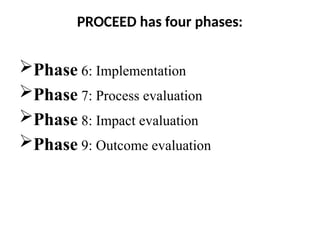
PROCEED has four phases:
Phase 6: Implementation
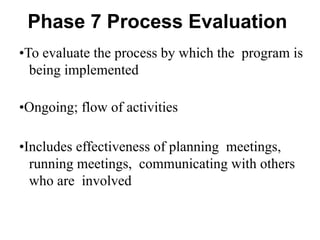
Phase 7: Process evaluation
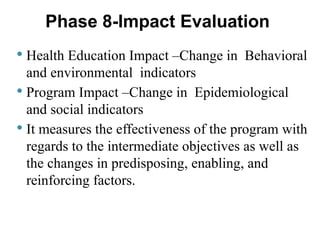
Phase 8: Impact evaluation
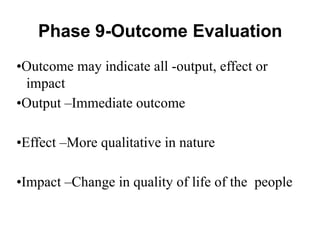
Phase 9: Outcome evaluation
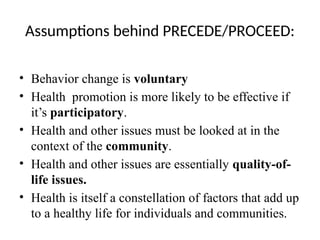
Assumptions behind PRECEDE/PROCEED:
• Behavior change is voluntary
• Health promotion is more likely to be effective if
it’s participatory.
• Health and other issues must be looked at in the
context of the community.
• Health and other issues are essentially quality-of-
life issues.
• Health is itself a constellation of factors that add up
to a healthy life for individuals and communities.
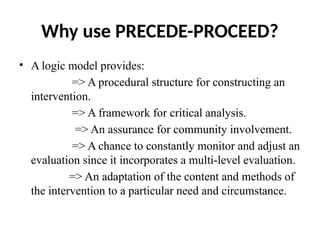
Why use PRECEDE-PROCEED?
• A logic model provides:
=> A procedural structure for constructing an
intervention.
=> A framework for critical analysis.
=> An assurance for community involvement.
=> A chance to constantly monitor and adjust an
evaluation since it incorporates a multi-level evaluation.
=> An adaptation of the content and methods of
the intervention to a particular need and circumstance.
PRECEDE model
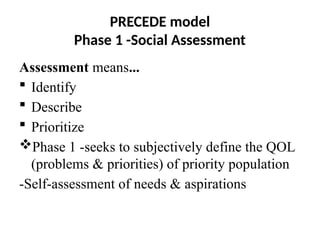
Phase 1 -Social Assessment
Assessment means...
 Identify
 Describe
 Prioritize
Phase 1 -seeks to subjectively define the QOL
(problems & priorities) of priority population
-Self-assessment of needs & aspirations
Methods for social diagnosis
• Community Forums
• Nominal Groups
• Focus Groups
• Surveys
• Interviews : key personnel , leaders…
• Literature Review –secondary information
Phase 2 –Epidemiological Assessment
• Epidemiology -study of the distribution & determinants of
disease
• Based on epidemiological Data
Epidemiological Data:
-Mortality
-Morbidity
-Disability
-Fertility
-Incidence rates
-Prevalence rates
Phase 3: Behavioral Diagnosis
• Focuses on behavioral and non-behavioral causes
(personal and environmental factors) which seem to be
linked to health problems defined in Phase 2.
A. Behavior of Interest (factors) Maybe…
 Behavior of the people whose health is in question
 Community Leaders
 Legislators
 Parents
 Teachers
 Health Professionals
B. Environmental or Non-Behavioral Factors
• Environmental Factors Include:
Determinants outside the person that can be modified to support
behavior, health, or quality of life.
a) Physical
b) Social
c) Economic
• Genetic Predisposition
• Age
• Gender
• Existing Disease
• Workplace
• Adequacy of Health Care Facilities
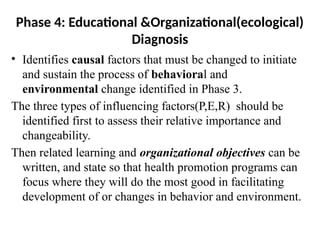
Phase 4: Educational &Organizational(ecological)
Diagnosis
• Identifies causal factors that must be changed to initiate
and sustain the process of behavioral and
environmental change identified in Phase 3.
The three types of influencing factors(P,E,R) should be
identified first to assess their relative importance and
changeability.
Then related learning and organizational objectives can be
written, and state so that health promotion programs can
focus where they will do the most good in facilitating
development of or changes in behavior and environment.
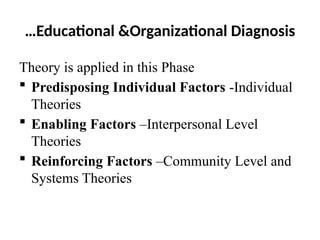
…Educational &Organizational Diagnosis
Theory is applied in this Phase
 Predisposing Individual Factors -Individual
Theories
 Enabling Factors –Interpersonal Level
Theories
 Reinforcing Factors –Community Level and
Systems Theories
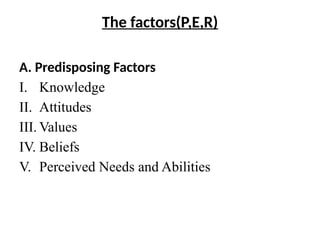
The factors(P,E,R)
A. Predisposing Factors
I. Knowledge
II. Attitudes
III. Values
IV. Beliefs
V. Perceived Needs and Abilities
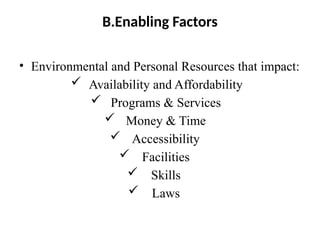
B.Enabling Factors
• Environmental and Personal Resources that impact:
 Availability and Affordability
 Programs & Services
 Money & Time
 Accessibility
 Facilities
 Skills
 Laws
C.Reinforcing factors
• Positive or Negative Feedback From:
Peers
Family
Health Care Workers
Law Enforcement
Media
Others
Phase 5: Administrative and Policy Diagnosis
• Focuses on administrative and organizational
concerns which must be addressed prior to
program implementation
• Includes:
Assessment of resources
Budget development and allocation
Development of implementation timetable
Organization and coordination with others
…Administrative and Policy Diagnosis
Administrative Diagnosis
• Analysis of policies, resources and
circumstances prevailing organizational
situations that could hinder or facilitate the
development of the health program
• Assesses the compatibility of your program
goals/objectives with those of the organization
and its administration
…Administrative and Policy Diagnosis
• Work in this phase is specific to the context of the
program and the sponsoring organization(s) and
requires political savvy as much as theoretical
or empirical knowledge
• Informed by theories, particularly community-
level theories
• Assess limitations and constraints
• Select the best combination of methods and
strategies
PROCEED Model
 Implementation & evaluation phase.
 Goes beyond educational interventions to the
political, managerial, and economic actions
necessary to make social system environments
more conducive to healthful lifestyles and a
more complete state of physical, mental and
social well- being for all
Phase 6:Implementation
Implementation -The act of converting program
objectives into actions through policy changes,
regulation and organization.
(Green & Kreuter, 1991, p.432)
• Beginning of PROCEED
• Selection of methods and strategies of the
intervention, for example, education &/or
other resources
• Program begins
Evaluation
•Clear and concise objectives are the foundation for
evaluation
•From two perspective –Health Program and Health
Education program
•Health Education Programs intermediate to Health
Programs
•Three types of evaluation –Diagnostic, Formative
& Summative
•Three areas of evaluation –process, impact and
outcome.
•To evaluate the process by which the program is
being implemented
•Ongoing; flow of activities
•Includes effectiveness of planning meetings,
running meetings, communicating with others
who are involved
Phase 7 Process Evaluation
 Health Education Impact –Change in Behavioral
and environmental indicators
 Program Impact –Change in Epidemiological
and social indicators
 It measures the effectiveness of the program with
regards to the intermediate objectives as well as
the changes in predisposing, enabling, and
reinforcing factors.
Phase 8-Impact Evaluation
•Outcome may indicate all -output, effect or
impact
•Output –Immediate outcome
•Effect –More qualitative in nature
•Impact –Change in quality of life of the people
Phase 9-Outcome Evaluation
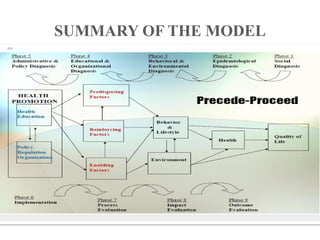
SUMMARY OF THE MODEL
REFERENCES
• American Journal of Health Promotion
• Green, W. Lawrence. Health Promotion
Planning an Educational & Environmental
Approach. Second edition. Mayfield Publishing
Company. 1991
Thank you

PRECED PROCEED MODEL IN HEALTH EDUCATION

  • 1.
  • 2.
    OBJECTIVES Define what PRECEDE-PROCEEDmodel. Identify phases of the model List the assumptions Generalize the core concepts of the model
  • 3.
  • 4.
    PRECEDE-PROCEED What is PRECEDE/PROCEED? PRECEDE/PROCEEDis a community-oriented, participatory model for creating successful community health promotion interventions. Originators Lawrence W . Green Marshall W. Krueter
  • 5.
    PRECEDE has fivephases: Phase 1: Social diagnosis Phase 2: Epidemiological diagnosis Phase 3: Behavioral and environmental diagnosis Phase 4: Educational and organizational diagnosis Phase 5: Administrative and policy diagnosis
  • 6.
    PROCEED has fourphases: Phase 6: Implementation Phase 7: Process evaluation Phase 8: Impact evaluation Phase 9: Outcome evaluation
  • 7.
    Assumptions behind PRECEDE/PROCEED: •Behavior change is voluntary • Health promotion is more likely to be effective if it’s participatory. • Health and other issues must be looked at in the context of the community. • Health and other issues are essentially quality-of- life issues. • Health is itself a constellation of factors that add up to a healthy life for individuals and communities.
  • 8.
    Why use PRECEDE-PROCEED? •A logic model provides: => A procedural structure for constructing an intervention. => A framework for critical analysis. => An assurance for community involvement. => A chance to constantly monitor and adjust an evaluation since it incorporates a multi-level evaluation. => An adaptation of the content and methods of the intervention to a particular need and circumstance.
  • 9.
    PRECEDE model Phase 1-Social Assessment Assessment means...  Identify  Describe  Prioritize Phase 1 -seeks to subjectively define the QOL (problems & priorities) of priority population -Self-assessment of needs & aspirations
  • 10.
    Methods for socialdiagnosis • Community Forums • Nominal Groups • Focus Groups • Surveys • Interviews : key personnel , leaders… • Literature Review –secondary information
  • 11.
    Phase 2 –EpidemiologicalAssessment • Epidemiology -study of the distribution & determinants of disease • Based on epidemiological Data Epidemiological Data: -Mortality -Morbidity -Disability -Fertility -Incidence rates -Prevalence rates
  • 12.
    Phase 3: BehavioralDiagnosis • Focuses on behavioral and non-behavioral causes (personal and environmental factors) which seem to be linked to health problems defined in Phase 2. A. Behavior of Interest (factors) Maybe…  Behavior of the people whose health is in question  Community Leaders  Legislators  Parents  Teachers  Health Professionals
  • 13.
    B. Environmental orNon-Behavioral Factors • Environmental Factors Include: Determinants outside the person that can be modified to support behavior, health, or quality of life. a) Physical b) Social c) Economic • Genetic Predisposition • Age • Gender • Existing Disease • Workplace • Adequacy of Health Care Facilities
  • 14.
    Phase 4: Educational&Organizational(ecological) Diagnosis • Identifies causal factors that must be changed to initiate and sustain the process of behavioral and environmental change identified in Phase 3. The three types of influencing factors(P,E,R) should be identified first to assess their relative importance and changeability. Then related learning and organizational objectives can be written, and state so that health promotion programs can focus where they will do the most good in facilitating development of or changes in behavior and environment.
  • 15.
    …Educational &Organizational Diagnosis Theoryis applied in this Phase  Predisposing Individual Factors -Individual Theories  Enabling Factors –Interpersonal Level Theories  Reinforcing Factors –Community Level and Systems Theories
  • 16.
    The factors(P,E,R) A. PredisposingFactors I. Knowledge II. Attitudes III. Values IV. Beliefs V. Perceived Needs and Abilities
  • 17.
    B.Enabling Factors • Environmentaland Personal Resources that impact:  Availability and Affordability  Programs & Services  Money & Time  Accessibility  Facilities  Skills  Laws
  • 18.
    C.Reinforcing factors • Positiveor Negative Feedback From: Peers Family Health Care Workers Law Enforcement Media Others
  • 19.
    Phase 5: Administrativeand Policy Diagnosis • Focuses on administrative and organizational concerns which must be addressed prior to program implementation • Includes: Assessment of resources Budget development and allocation Development of implementation timetable Organization and coordination with others
  • 20.
  • 21.
    …Administrative and PolicyDiagnosis Administrative Diagnosis • Analysis of policies, resources and circumstances prevailing organizational situations that could hinder or facilitate the development of the health program • Assesses the compatibility of your program goals/objectives with those of the organization and its administration
  • 22.
    …Administrative and PolicyDiagnosis • Work in this phase is specific to the context of the program and the sponsoring organization(s) and requires political savvy as much as theoretical or empirical knowledge • Informed by theories, particularly community- level theories • Assess limitations and constraints • Select the best combination of methods and strategies
  • 23.
    PROCEED Model  Implementation& evaluation phase.  Goes beyond educational interventions to the political, managerial, and economic actions necessary to make social system environments more conducive to healthful lifestyles and a more complete state of physical, mental and social well- being for all
  • 24.
    Phase 6:Implementation Implementation -Theact of converting program objectives into actions through policy changes, regulation and organization. (Green & Kreuter, 1991, p.432) • Beginning of PROCEED • Selection of methods and strategies of the intervention, for example, education &/or other resources • Program begins
  • 25.
    Evaluation •Clear and conciseobjectives are the foundation for evaluation •From two perspective –Health Program and Health Education program •Health Education Programs intermediate to Health Programs •Three types of evaluation –Diagnostic, Formative & Summative •Three areas of evaluation –process, impact and outcome.
  • 26.
    •To evaluate theprocess by which the program is being implemented •Ongoing; flow of activities •Includes effectiveness of planning meetings, running meetings, communicating with others who are involved Phase 7 Process Evaluation
  • 27.
     Health EducationImpact –Change in Behavioral and environmental indicators  Program Impact –Change in Epidemiological and social indicators  It measures the effectiveness of the program with regards to the intermediate objectives as well as the changes in predisposing, enabling, and reinforcing factors. Phase 8-Impact Evaluation
  • 28.
    •Outcome may indicateall -output, effect or impact •Output –Immediate outcome •Effect –More qualitative in nature •Impact –Change in quality of life of the people Phase 9-Outcome Evaluation
  • 29.
  • 30.
    REFERENCES • American Journalof Health Promotion • Green, W. Lawrence. Health Promotion Planning an Educational & Environmental Approach. Second edition. Mayfield Publishing Company. 1991
  • 31.

Editor's Notes

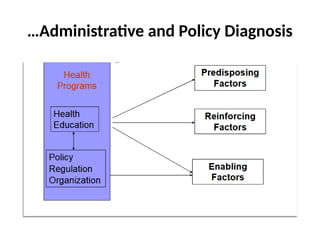
  • #5 Predisposing  Reinforcing and  Enabling  Constructs in  Educational  Diagnosis and  Evaluation
  • #6  Policy  Regulatory and  Organizational  Constructs in  Educational and  Environmental  Development.