09/05/2025 By MilionR (BSc, MScN) 1
Chapter 5
Health Education in special Settings
and Health Promotion
By Milion R.(BSc, MScN)
2.
09/05/2025 By MilionR (BSc, MScN) 2
Session Objectives
At the end of this session you will be able to:
Identify health education setting
Discuss Health promotion
Discuss Models for Program Planning in Health
Promotion (PRECEDE-PROCEED)
3.
09/05/2025 By MilionR (BSc, MScN) 3
Health Education Setting
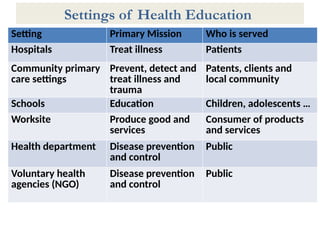
The most commonly used settings of health education can
be broadly categorized as three major settings:
1. Health Care settings,
2. School settings, and
3. Community settings.
4.
09/05/2025 By MilionR (BSc, MScN) 4
1. The Health care setting
Patient education is a type of Health Education
given at health care settings
Purpose
• To provide information, accept ,respect
• To elicit patient’s view about problem,
treatment and outcome
5.
09/05/2025 By MilionR (BSc, MScN) 5
Compliance
Compliance is willingness to follow doctors’ recommendations or
orders, and hence Non-compliance refers to failure or refusal to do so.
Non- compliance can occur into different forms:
Error of omission (on clients who are not currently seeking or receiving
medical care for their illness or condition- the undiagnosed), and
Error of commission (on clients who have symptoms or risk factors
that could warrant examination and health counseling – the
unscreened).
Both errors (types of errors) can be attributed to:-
• failure of health care professionals or
• failure of patients or
• failure of both professionals and patients.
6.
09/05/2025 By MilionR (BSc, MScN) 6
Methods of improving compliance
Compliance, generally, can be improved by identifying
causes of non-compliance and by acting up on them
accordingly.
The common causes of non- compliance that should be
prevented include:
– Language barriers
– Too costly procedures and equipment's
– Problems in understanding (due to literacy, ability to
concentrate,... etc)
– Undesirable side effects of treatments/medications
– Conflicts with health care providers
– Philosophical, cultural, and religious beliefs etc.
7.
09/05/2025 By MilionR (BSc, MScN) 7
2.The School Setting
• School health education is a type of health education
program which is undertaken in school settings :-
• starting from kindergarten (3-6 year).
Rationale of school health education
• There is potential for occurrence of epidemics and
spread of communicable diseases.
8.
09/05/2025 By MilionR (BSc, MScN) 8
3-The Community Setting
• The type of Health Education that is given at
community
• This setting includes home, public gatherings,
social organizations, campuses, work sites, etc.
9.
Settings of HealthEducation
Setting Primary Mission Who is served
Hospitals Treat illness Patients
Community primary
care settings
Prevent, detect and
treat illness and
trauma
Patents, clients and
local community
Schools Education Children, adolescents …
Worksite Produce good and
services
Consumer of products
and services
Health department Disease prevention
and control
Public
Voluntary health
agencies (NGO)
Disease prevention
and control
Public
09/05/2025 9
10.
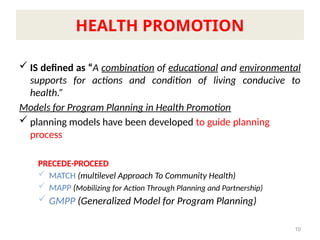
IS definedas “A combination of educational and environmental
supports for actions and condition of living conducive to
health.”
Models for Program Planning in Health Promotion
planning models have been developed to guide planning
process
PRECEDE-PROCEED
MATCH (multilevel Approach To Community Health)
MAPP (Mobilizing for Action Through Planning and Partnership)
GMPP (Generalized Model for Program Planning)
10
HEALTH PROMOTION
11.
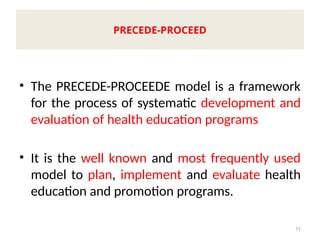
• The PRECEDE-PROCEEDEmodel is a framework
for the process of systematic development and
evaluation of health education programs
• It is the well known and most frequently used
model to plan, implement and evaluate health
education and promotion programs.
11
PRECEDE-PROCEED
12.
12
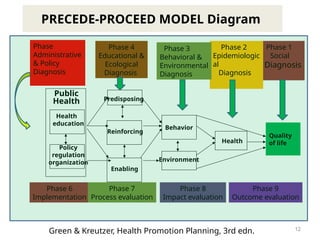
PRECEDE-PROCEED MODEL Diagram
Quality
oflife
Phase 1
Social
Diagnosis
Health
Phase 2
Epidemiologic
al
Diagnosis
Health
education
Policy
regulation
organization
Public
Health
Phase
Administrative
& Policy
Diagnosis
Phase 6
Implementation
Phase 7
Process evaluation
Phase 8
Impact evaluation
Phase 9
Outcome evaluation
Predisposing
Reinforcing
Enabling
Phase 4
Educational &
Ecological
Diagnosis
Behavior
Environment
Phase 3
Behavioral &
Environmental
Diagnosis
Green & Kreutzer, Health Promotion Planning, 3rd edn.
13.
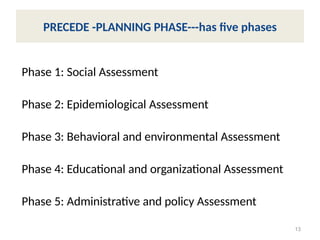
Phase 1: SocialAssessment
Phase 2: Epidemiological Assessment
Phase 3: Behavioral and environmental Assessment
Phase 4: Educational and organizational Assessment
Phase 5: Administrative and policy Assessment
13
PRECEDE -PLANNING PHASE---has five phases
14.
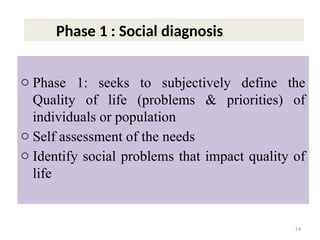
o Phase 1:seeks to subjectively define the
Quality of life (problems & priorities) of
individuals or population
o Self assessment of the needs
o Identify social problems that impact quality of
life
14
Phase 1 : Social diagnosis
15.
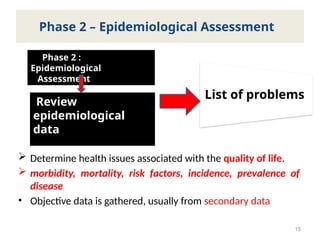
Determine healthissues associated with the quality of life.
morbidity, mortality, risk factors, incidence, prevalence of
disease
• Objective data is gathered, usually from secondary data
15
Phase 2 – Epidemiological Assessment
Review
epidemiological
data
Phase 2 :
Epidemiological
Assessment
List of problems
16.
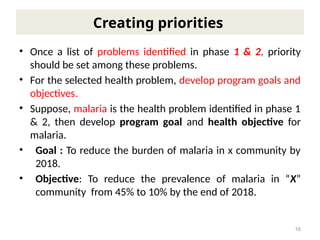
• Once alist of problems identified in phase 1 & 2, priority
should be set among these problems.
• For the selected health problem, develop program goals and
objectives.
• Suppose, malaria is the health problem identified in phase 1
& 2, then develop program goal and health objective for
malaria.
• Goal : To reduce the burden of malaria in x community by
2018.
• Objective: To reduce the prevalence of malaria in “X”
community from 45% to 10% by the end of 2018.
16
Creating priorities
17.
17
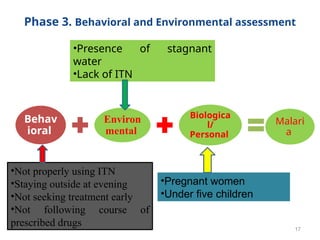
Phase 3. Behavioraland Environmental assessment
Behav
ioral
Environ
mental
Biologica
l/
Personal
Malari
a
•Not properly using ITN
•Staying outside at evening
•Not seeking treatment early
•Not following course of
prescribed drugs
•Presence of stagnant
water
•Lack of ITN
•Pregnant women
•Under five children
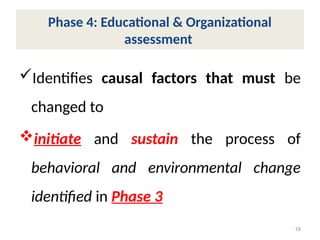
18.
Identifies causal factorsthat must be
changed to
initiate and sustain the process of
behavioral and environmental change
identified in Phase 3
18
Phase 4: Educational & Organizational
assessment
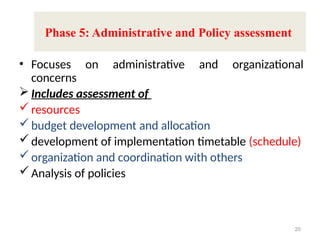
• Focuses onadministrative and organizational
concerns
Includes assessment of
resources
budget development and allocation
development of implementation timetable (schedule)
organization and coordination with others
Analysis of policies
20
Phase 5: Administrative and Policy assessment
21.
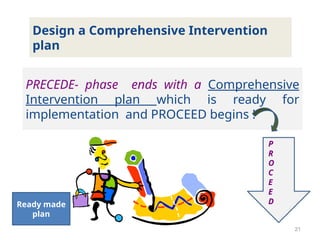
21
PRECEDE- phase endswith a Comprehensive
Intervention plan which is ready for
implementation and PROCEED begins !
Design a Comprehensive Intervention
plan
P
R
O
C
E
E
D
Ready made
plan
22.
Phase 6: Implementation
Phase7: Process evaluation
Phase 8: Outcome evaluation
Phase 9: Impact evaluation
22
PROCEED has four phases:
23.
Beginning of PROCEED
Theact of converting program objectives into actions
through policy changes, regulation and organization.
It is translating the goals, objectives and methods into a
community based health education programs.
23
Phase 6: Implementation
24.
Phase 7:Process evaluation - measurements of
implementation process to control, assure, or improve the
quality of the program
Phase 8: Outcome evaluation - immediate observable effects
of program (changes in Knowledge, attitude, beliefs, practice
etc.)
Phase 9: Impact evaluation -long-term effects of the program
such as reduction in mortality, morbidity, prevalence of
disease, improved health status.
24
Phases 7 , 8, & 9 - Evaluation