HEALTH CARE INDUSTRYHOSPITAL SERVICE MARKETING apollotelemedicnePresented by: Shruti DixitPGDMM-09-028
HEALTH CARE INDUSTRYHealth care is the treatment and prevention of illness.The health care industry treats patients who are injured, sick, disabled, or infirm. The delivery of modern health care depends on an expanding interdisciplinary team of trained professionals.
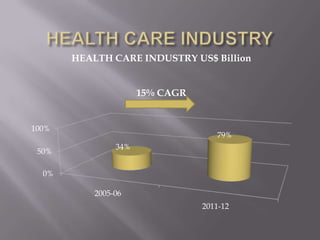
HEALTH CARE INDUSTRYSIZEThe Indian Healthcare market is estimated at about US $ 34 billion (2006) .The industry is expected to grow at 15% p.a., to reach US $ 79 billion by 2012. The large domestic market complemented by the inflow of medical tourists Medical tourists have increased almost 20-fold from 10,000 in 2000 to about 1,80,000–2,00,000 in 2006.
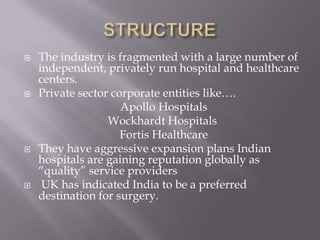
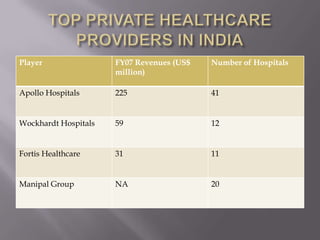
STRUCTUREThe industry is fragmented with a large number of independent, privately run hospital and healthcare centers. Private sector corporate entities like…. Apollo HospitalsWockhardt Hospitals  Fortis HealthcareThey have aggressive expansion plans Indian hospitals are gaining reputation globally as “quality” service providers  UK has indicated India to be a preferred destination for surgery.
TOP PRIVATE HEALTHCARE PROVIDERS IN INDIA
HEALTH CARE INDUSTRY
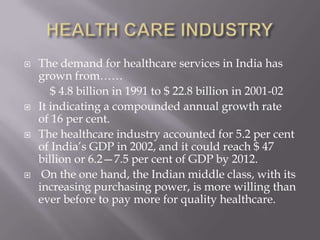
HEALTH CARE INDUSTRYThe demand for healthcare services in India has grown from……         $ 4.8 billion in 1991 to $ 22.8 billion in 2001-02It indicating a compounded annual growth rateof 16 per cent. The healthcare industry accounted for 5.2 per cent of India’s GDP in 2002, and it could reach $ 47 billion or 6.2—7.5 per cent of GDP by 2012. On the one hand, the Indian middle class, with its increasing purchasing power, is more willing than ever before to pay more for quality healthcare.
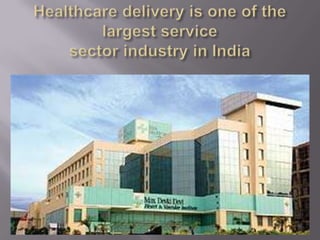
                                                                                                                          Healthcare delivery is one of the largest service sector industry in India
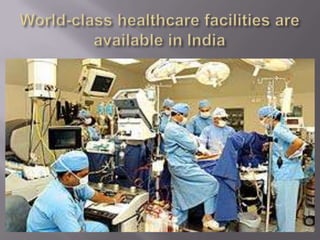
World-class healthcare facilities are available in India                                                              
HOSPITAL SERVICE MARKETING
HOSPITAL SERVICE MARKETINGHospital service marketingis a specialized field that deals with connecting patients, physicians, and hospitals in mutual relationships.Many people ask, "How can you 'market' a hospital?" But marketing a hospital or health system is no different than "marketing" any other non-profit organization.
HOSPITAL SERVICE MARKETINGPlus, historically, medicine in America has always been a business. In today's insurance and reimbursement environment, health care and hospital marketing is more needed than ever to ensure continuing viability of American medicine on the local level and to provide the high quality of individual health care that Americans have come to demand.With these ingredients, there is clearly a need for analysis, strategy and communication to make the most of limited resources while providing compassionate health care. This is what hospital marketing does.
HOSPITAL SERVICE MARKETING MIXProduct PricePromotion PlacePeopleProcessPhysical Evidence
PRODUCT  The product is the central component of any marketing mix.  It covers issues such as service package, core services and managing service offering and developing service offering. Hospitals today offer the following services:Emergency servicesAmbulance servicesDiagnostic servicesPharmacy services Causality services
PRICEIt is one of the most prominent elements in the marketing mix. Price charged must be able to target customers and it should co-ordinate with other elements of the marketing mix.  Price usually depends on treatment prescribed by the respective consultants and the facilities offered to the patient.A hospital does not believe in profit maximization, it aims at providing quality service for its customers at reasonable price.
PROMOTIONPromotion function of any service organization involves the transmission of message to present, past and potential customers.  Customers need to be made aware of the existence of the service offered.  Promotion includes advertising, personal selling, sales promotion and publicity.    Hospitals conduct camps in rural areas to give medical check ups  at a reasonable price so that the rural people approach the hospital again in the future.  They also sponsor frequent visits to the spastic society, old age homes, etc.  Hospitals generally advertise in health and fitness magazines.
PLACEIt refers to contact point between the customer and the service provider, who gets the benefit of the service.  This element in the marketing mix leads to the identification of a suitable location.The two major issues considered regarding the decision of a place are accessibility and availability of the service to customers.  Accessibility refers to the ease and convenience with which a service can be purchased, used or received.  Availability refers to the extent to which a service is obtainable or capable of being purchased, used and received.
PLACEFactors influencing the placing decision are market size and structure by geographical regions, number and types of competitors in the region, location of potentially attractive consumer segments, local infrastructure, good road access facilities and public transportation network.  A hospital must be ideally located and must be easily accessible to all.
PEOPLEThe People component reflects the important role played by individuals in the provision of services.  People are also an important element in the marketing mix.It is necessary that the staff in hospital are trained to offer quality patient care with human touch using state of the art technology.
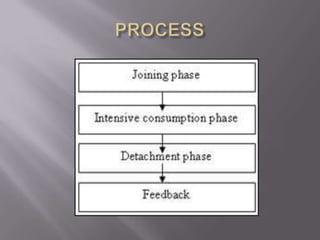
PROCESS
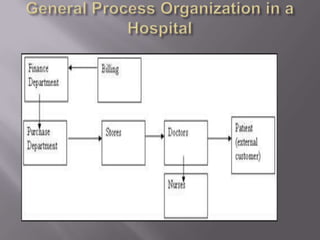
General Process Organization in a Hospital
PHYSICAL EVIDENCEIt is the environment in which the service is delivered with physical or tangible commodities and where the firm and the customer interact.  Physical evidence plays an important role in hospital services. It makes a huge impact on the customer.  Physical evidence offers customers means of evaluating the service.  Corporate image plays in important role in terms of physical evidence.  This can be developed through corporate relation programmes.
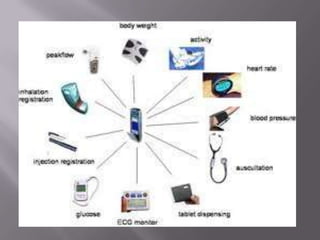
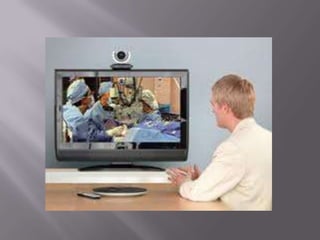
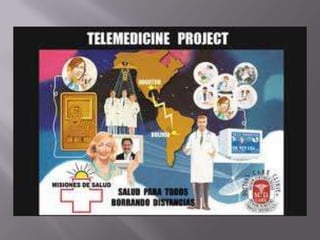
TELE MEDICINETelemedicine has been defined as the use of telecommunications to provide medical information and services. It may be as simple as two health professionals discussing a case over the telephone, or as sophisticated as using satellite technology to broadcast a consultation between providers at facilities in two countries, using videoconferencing equipment or robotic technology.
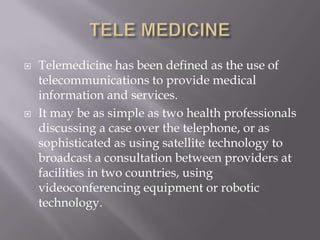
Telemedicine    Telemedicine generally refers to the use of ICT for the delivery of clinical care.
TelemedicineTYPES OF TELEMEDICINETelemedicine is practiced on the basis of two concepts:Real time (synchronous)Store & forward (asynchronous)
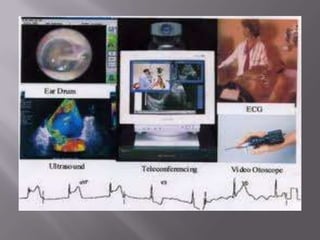
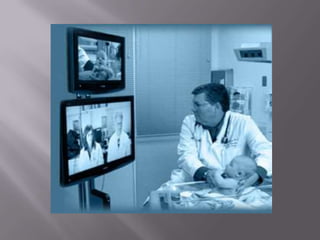
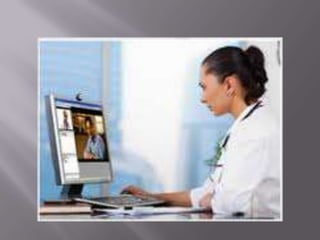
REAL TIME TELEMEDICINEReal time telemedicine could be as simple as a telephone call or complex as robotic surgery. It requires the presence of both parties at the same time and a communications link between them that allows a real time interaction to take place. Video- conferencing equipment is one of the most common forms of technologies used in synchronous telemedicine
STORE & FORWARD TELEMEDICINEStore-and-forward telemedicine involves acquiring medical data (like medical images, biosignals etc.) and then transmitting this data to a doctor or medical specialist at a convenient time for assessment offline. It does not require the presence of both parties at the same time.Dermatology, radiology and pathology are common specialties that are conductive to asynchronous telemedicine.
ADVANTAGES OF TELEMEDICINEProviding healthcare services via telemedicine offers many advantages. It can make specially care more accessible to underserved rural and urban populations.Video consultations from a rural clinic to a specialist can alleviate prohibitive travel and associated costs for patients.The use of telemedicine can also cut costs of medical care for those in rural areas.
BARRIERS TO TELEMEDICINEThere are still several barriers to the practice of telemedicine. Many states will not allow out-of-state physicians to practice unless licensed in their state.The centers for Medicare and Medicaid(CMS) still has several restrictions for Medicare telemedicine  reimbursement.
NEED OF TELEMEDICINE IN INDIAThe health of a nation is the product of many factors and forces that combine and interact. Economic growth, per capita income, literacy, education, age at marriage, birth rates, information on healthcare and nutrition ,access to safe drinking water, public and private health care infrastructure, access to preventive health and medical care.
NEED OF TELEMEDICINE IN INDIAIndia is a vast country gifted with rich and ancient historic background and geographically the nature has provided India with all the varieties like the mountain regions like Ladakh, deserts, green planes and far flung areas in the north east and offshore islands of Andaman’s and Lakshadweep.
NEED OF TELEMEDICINE IN INDIAA recent survey by the Indian Medical society has found75% of qualified consulting doctors practice in urban centers23% in semi urban areasOnly 2%from rural areas whereas majority f the patients come from rural areas.Hospital beds/ 1000 people is 0.19 in rural and 2.2 in urban areas.
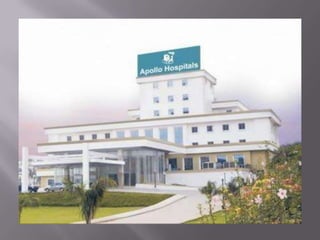
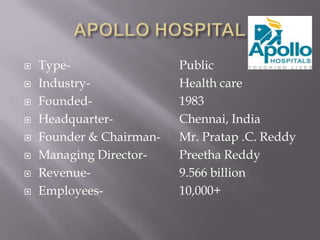
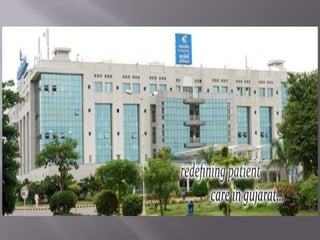
APOLLO HOSPITALType- 				PublicIndustry- 			Health careFounded- 			1983Headquarter-		 	Chennai, IndiaFounder & Chairman- 	Mr. Pratap .C. ReddyManaging Director- 	Preetha ReddyRevenue- 			9.566 billionEmployees-			10,000+
APOLLO HOSPITALApollo is the largest private healthcare provider in Asia and the third largest in the world, with hospitals in.. India, Sri Lanka, Bangladesh Ghana, Nigeria, Republic of Mauritius,  Qatar, Oman, Kuwait
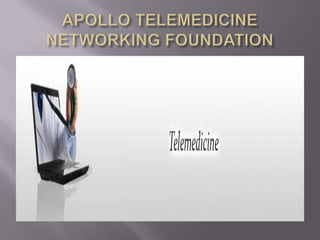
APOLLO TELEMEDICINE NETWORKING FOUNDATION
TELEMEDICINEApollo’s vision is to provide a successful working model of Telemedicine which self-propagates throughout GujaratRajasthan Madhya Pradesh. It provides a channel for continuous access to the most sophisticated medical support systems at all times. Further, Telemedicine improves patient care, enhance medical training, standardize clinical practice, stabilize costs and unite clinicians worldwide.
TELEMEDICINEApollo aims at extending super-special services to remote countries across the globe by proactively using technological developments and imaging techniques to create benchmark standards in the field of medicine and health.
Telemedicine platform can be used in a variety of applications as underSecond/Special OpinionA medical professional can get in touch with his peer or a specialist to discuss the patient treatment plans, particularly in complex cases and emergencies.Complex InterpretationsComplex medical cases often need more than one specialist's opinion to ensure accurate diagnosis. In these cases, the treating doctor at the remote site can interact with a team of specialists in another location for accurate diagnosis. Telemedicine applications such as Tele-Radiology, Tele-Pathology, Tele-Cardiology etc help to arrive at more comprehensive treatment plan.
Virtual Patient VisitsRelatives from across the globe can interact with their loved ones admitted in hospitals at remote locations. Healthcare Knowledge BaseTelemedicine networks can be leveraged to capture and store valuable healthcare information. This information can serve as a healthcare knowledge base and/or decision support system. 
Continuing Medical EducationTools like video conferencing systems can be used for conducting community development programs and also for imparting knowledge to the medical/ paramedical staff involved in the delivery of healthcare services. This can take shape in the form of grand-ward/rounds, preoperative rounds, clinico- pathological correlations etc.Disaster Management In natural calamities and disasters, Telemedicine station can be utilized to coordinate relief efforts aimed at the affected population.The Telemedicine station can be utilized to provide training in typical disease patterns in remote areas. For instance, if a particular area's population is susceptible to a certain disease, the physician can be trained to identify the symptoms and provide accurate treatment. This training can be done both online and offline.
Health care industry

Health care industry

  • 1.
    HEALTH CARE INDUSTRYHOSPITALSERVICE MARKETING apollotelemedicnePresented by: Shruti DixitPGDMM-09-028
  • 3.
    HEALTH CARE INDUSTRYHealthcare is the treatment and prevention of illness.The health care industry treats patients who are injured, sick, disabled, or infirm. The delivery of modern health care depends on an expanding interdisciplinary team of trained professionals.
  • 4.
    HEALTH CARE INDUSTRYSIZETheIndian Healthcare market is estimated at about US $ 34 billion (2006) .The industry is expected to grow at 15% p.a., to reach US $ 79 billion by 2012. The large domestic market complemented by the inflow of medical tourists Medical tourists have increased almost 20-fold from 10,000 in 2000 to about 1,80,000–2,00,000 in 2006.
  • 5.
    STRUCTUREThe industry isfragmented with a large number of independent, privately run hospital and healthcare centers. Private sector corporate entities like…. Apollo HospitalsWockhardt Hospitals Fortis HealthcareThey have aggressive expansion plans Indian hospitals are gaining reputation globally as “quality” service providers UK has indicated India to be a preferred destination for surgery.
  • 6.
    TOP PRIVATE HEALTHCAREPROVIDERS IN INDIA
  • 7.
  • 8.
    HEALTH CARE INDUSTRYThedemand for healthcare services in India has grown from…… $ 4.8 billion in 1991 to $ 22.8 billion in 2001-02It indicating a compounded annual growth rateof 16 per cent. The healthcare industry accounted for 5.2 per cent of India’s GDP in 2002, and it could reach $ 47 billion or 6.2—7.5 per cent of GDP by 2012. On the one hand, the Indian middle class, with its increasing purchasing power, is more willing than ever before to pay more for quality healthcare.
  • 9.
  • 10.
    World-class healthcare facilitiesare available in India                                                             
  • 11.
  • 12.
    HOSPITAL SERVICE MARKETINGHospitalservice marketingis a specialized field that deals with connecting patients, physicians, and hospitals in mutual relationships.Many people ask, "How can you 'market' a hospital?" But marketing a hospital or health system is no different than "marketing" any other non-profit organization.
  • 13.
    HOSPITAL SERVICE MARKETINGPlus,historically, medicine in America has always been a business. In today's insurance and reimbursement environment, health care and hospital marketing is more needed than ever to ensure continuing viability of American medicine on the local level and to provide the high quality of individual health care that Americans have come to demand.With these ingredients, there is clearly a need for analysis, strategy and communication to make the most of limited resources while providing compassionate health care. This is what hospital marketing does.
  • 14.
    HOSPITAL SERVICE MARKETINGMIXProduct PricePromotion PlacePeopleProcessPhysical Evidence
  • 15.
    PRODUCT  The productis the central component of any marketing mix.  It covers issues such as service package, core services and managing service offering and developing service offering. Hospitals today offer the following services:Emergency servicesAmbulance servicesDiagnostic servicesPharmacy services Causality services
  • 16.
    PRICEIt is oneof the most prominent elements in the marketing mix. Price charged must be able to target customers and it should co-ordinate with other elements of the marketing mix.  Price usually depends on treatment prescribed by the respective consultants and the facilities offered to the patient.A hospital does not believe in profit maximization, it aims at providing quality service for its customers at reasonable price.
  • 17.
    PROMOTIONPromotion function ofany service organization involves the transmission of message to present, past and potential customers.  Customers need to be made aware of the existence of the service offered.  Promotion includes advertising, personal selling, sales promotion and publicity.    Hospitals conduct camps in rural areas to give medical check ups  at a reasonable price so that the rural people approach the hospital again in the future.  They also sponsor frequent visits to the spastic society, old age homes, etc.  Hospitals generally advertise in health and fitness magazines.
  • 18.
    PLACEIt refers tocontact point between the customer and the service provider, who gets the benefit of the service.  This element in the marketing mix leads to the identification of a suitable location.The two major issues considered regarding the decision of a place are accessibility and availability of the service to customers.  Accessibility refers to the ease and convenience with which a service can be purchased, used or received.  Availability refers to the extent to which a service is obtainable or capable of being purchased, used and received.
  • 19.
    PLACEFactors influencing theplacing decision are market size and structure by geographical regions, number and types of competitors in the region, location of potentially attractive consumer segments, local infrastructure, good road access facilities and public transportation network.  A hospital must be ideally located and must be easily accessible to all.
  • 20.
    PEOPLEThe People componentreflects the important role played by individuals in the provision of services.  People are also an important element in the marketing mix.It is necessary that the staff in hospital are trained to offer quality patient care with human touch using state of the art technology.
  • 21.
  • 22.
  • 23.
    PHYSICAL EVIDENCEIt isthe environment in which the service is delivered with physical or tangible commodities and where the firm and the customer interact.  Physical evidence plays an important role in hospital services. It makes a huge impact on the customer.  Physical evidence offers customers means of evaluating the service.  Corporate image plays in important role in terms of physical evidence.  This can be developed through corporate relation programmes.
  • 25.
    TELE MEDICINETelemedicine hasbeen defined as the use of telecommunications to provide medical information and services. It may be as simple as two health professionals discussing a case over the telephone, or as sophisticated as using satellite technology to broadcast a consultation between providers at facilities in two countries, using videoconferencing equipment or robotic technology.
  • 29.
    Telemedicine Telemedicine generally refers to the use of ICT for the delivery of clinical care.
  • 30.
    TelemedicineTYPES OF TELEMEDICINETelemedicineis practiced on the basis of two concepts:Real time (synchronous)Store & forward (asynchronous)
  • 31.
    REAL TIME TELEMEDICINERealtime telemedicine could be as simple as a telephone call or complex as robotic surgery. It requires the presence of both parties at the same time and a communications link between them that allows a real time interaction to take place. Video- conferencing equipment is one of the most common forms of technologies used in synchronous telemedicine
  • 33.
    STORE & FORWARDTELEMEDICINEStore-and-forward telemedicine involves acquiring medical data (like medical images, biosignals etc.) and then transmitting this data to a doctor or medical specialist at a convenient time for assessment offline. It does not require the presence of both parties at the same time.Dermatology, radiology and pathology are common specialties that are conductive to asynchronous telemedicine.
  • 35.
    ADVANTAGES OF TELEMEDICINEProvidinghealthcare services via telemedicine offers many advantages. It can make specially care more accessible to underserved rural and urban populations.Video consultations from a rural clinic to a specialist can alleviate prohibitive travel and associated costs for patients.The use of telemedicine can also cut costs of medical care for those in rural areas.
  • 36.
    BARRIERS TO TELEMEDICINEThereare still several barriers to the practice of telemedicine. Many states will not allow out-of-state physicians to practice unless licensed in their state.The centers for Medicare and Medicaid(CMS) still has several restrictions for Medicare telemedicine reimbursement.
  • 37.
    NEED OF TELEMEDICINEIN INDIAThe health of a nation is the product of many factors and forces that combine and interact. Economic growth, per capita income, literacy, education, age at marriage, birth rates, information on healthcare and nutrition ,access to safe drinking water, public and private health care infrastructure, access to preventive health and medical care.
  • 38.
    NEED OF TELEMEDICINEIN INDIAIndia is a vast country gifted with rich and ancient historic background and geographically the nature has provided India with all the varieties like the mountain regions like Ladakh, deserts, green planes and far flung areas in the north east and offshore islands of Andaman’s and Lakshadweep.
  • 39.
    NEED OF TELEMEDICINEIN INDIAA recent survey by the Indian Medical society has found75% of qualified consulting doctors practice in urban centers23% in semi urban areasOnly 2%from rural areas whereas majority f the patients come from rural areas.Hospital beds/ 1000 people is 0.19 in rural and 2.2 in urban areas.
  • 42.
    APOLLO HOSPITALType- PublicIndustry- Health careFounded- 1983Headquarter- Chennai, IndiaFounder & Chairman- Mr. Pratap .C. ReddyManaging Director- Preetha ReddyRevenue- 9.566 billionEmployees- 10,000+
  • 44.
    APOLLO HOSPITALApollo isthe largest private healthcare provider in Asia and the third largest in the world, with hospitals in.. India, Sri Lanka, Bangladesh Ghana, Nigeria, Republic of Mauritius, Qatar, Oman, Kuwait
  • 45.
  • 46.
    TELEMEDICINEApollo’s vision isto provide a successful working model of Telemedicine which self-propagates throughout GujaratRajasthan Madhya Pradesh. It provides a channel for continuous access to the most sophisticated medical support systems at all times. Further, Telemedicine improves patient care, enhance medical training, standardize clinical practice, stabilize costs and unite clinicians worldwide.
  • 48.
    TELEMEDICINEApollo aims atextending super-special services to remote countries across the globe by proactively using technological developments and imaging techniques to create benchmark standards in the field of medicine and health.
  • 50.
    Telemedicine platform canbe used in a variety of applications as underSecond/Special OpinionA medical professional can get in touch with his peer or a specialist to discuss the patient treatment plans, particularly in complex cases and emergencies.Complex InterpretationsComplex medical cases often need more than one specialist's opinion to ensure accurate diagnosis. In these cases, the treating doctor at the remote site can interact with a team of specialists in another location for accurate diagnosis. Telemedicine applications such as Tele-Radiology, Tele-Pathology, Tele-Cardiology etc help to arrive at more comprehensive treatment plan.
  • 51.
    Virtual Patient VisitsRelativesfrom across the globe can interact with their loved ones admitted in hospitals at remote locations. Healthcare Knowledge BaseTelemedicine networks can be leveraged to capture and store valuable healthcare information. This information can serve as a healthcare knowledge base and/or decision support system. 
  • 52.
    Continuing Medical EducationToolslike video conferencing systems can be used for conducting community development programs and also for imparting knowledge to the medical/ paramedical staff involved in the delivery of healthcare services. This can take shape in the form of grand-ward/rounds, preoperative rounds, clinico- pathological correlations etc.Disaster Management In natural calamities and disasters, Telemedicine station can be utilized to coordinate relief efforts aimed at the affected population.The Telemedicine station can be utilized to provide training in typical disease patterns in remote areas. For instance, if a particular area's population is susceptible to a certain disease, the physician can be trained to identify the symptoms and provide accurate treatment. This training can be done both online and offline.