HEALTH
ASSESSMENT
INTRODUCTION
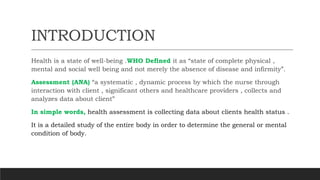
Health is a state of well-being .WHO Defined it as “state of complete physical ,
mental and social well being and not merely the absence of disease and infirmity”.
Assessment (ANA) “a systematic , dynamic process by which the nurse through
interaction with client , significant others and healthcare providers , collects and
analyzes data about client”
In simple words, health assessment is collecting data about clients health status .
It is a detailed study of the entire body in order to determine the general or mental
condition of body.
PURPOSES OF HEALTH
ASSESSMENT
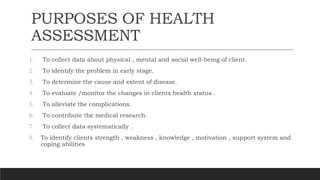
1. To collect data about physical , mental and social well-being of client.
2. To identify the problem in early stage.
3. To determine the cause and extent of disease.
4. To evaluate /monitor the changes in clients health status .
5. To alleviate the complications.
6. To contribute the medical research.
7. To collect data systematically .
8. To identify clients strength , weakness , knowledge , motivation , support system and
coping abilities
ASSESSING IS THE HEALTH
PROCESS THAT INVOLVES
 Health history
 Physical examination
HEALTH HISTORY
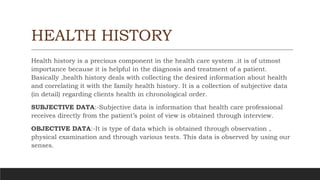
Health history is a precious component in the health care system .it is of utmost
importance because it is helpful in the diagnosis and treatment of a patient.
Basically ,health history deals with collecting the desired information about health
and correlating it with the family health history. It is a collection of subjective data
(in detail) regarding clients health in chronological order.
SUBJECTIVE DATA:-Subjective data is information that health care professional
receives directly from the patient’s point of view is obtained through interview.
OBJECTIVE DATA:-It is type of data which is obtained through observation ,
physical examination and through various tests. This data is observed by using our
senses.
EXAMPLES OF SUBJECTIVE AND OBJECTIVE DATA:-
 A patient complaints of fever and the health care givers check the temperature on
the thermometer.
 A patient complains of nausea and the health care giver can observe for gag reflex
induced with vomiting in the container/tray.
A patient complains of cold and shivering and health care giver observes his/her
body shaking due to shivering.
FACTORS AFFECTING THE
COLLECTION OF SUBJECTIVE DATA
1. Physical setting
2. Client’s personality and behavior
3. Communication skill
4. Problem
5. Nurses personality and behavior
6. Nurses knowledge and skill
FAVOURABLE CONDITIONS FOR
COLLECTING DATA
o A relaxed environment should be provided i.E. Introduce yourself to client, wish
him
o Call client with his name.
o Maintain eye to eye contact while communicating
o Sit comfortably by maintaining a distance.
o Environment :provide room temperature , noise free environment.
o Always treat client as human being
FORMAT OF HEALTH HISTORY
1) Biographic data
2) chief complaints
3) History of present illness
4) Past health history
5) Family health history
6) Occupational and environmental history
7) Psychosocial history
1) BIOGRAPHICAL DATA:- The data is collected as soon as nurse encounters the
client first time. It includes name, age ,gender, bed no., Ward , medical diagnosis
, surgery ,religion , education , occupation ,family and contact person.
2) CHIEF COMPLAINT :It is the brief statement of client’s problem for which client
seeks medical care.
 It should be written in clients statement.
 In case of multiple problems , ask client to indicate the priority of complaint.
 Write problem in chronological order.
Example:-Client is complaining of general weakness from one month , cough from
two weeks and fever from two days , headache today , headache X 1 day , fever X 2
days , cough X 14 days, General weakness X 30 days.
3) HISTORY RELATED TO PRESENT ILLNESS :- It includes the expansion of chief
complaints . Elaborate the present chief complaints in chronological order .It
should include location , quality ,quantity, chronology , setting , exaggerating
and relieving factors , associated symptoms ,effect on sleep , daily activities.
4) PAST HEALTH HISTORY :- It is the collecting information regarding clients
previous experience with any disease , surgery . It is the overall assessment of
clients health prior to present illness . Past health history includes:-allergies ,
medical disease , surgery , trauma , injury ,hospitalization ,childhood diseases
and immunization , obstetric history .
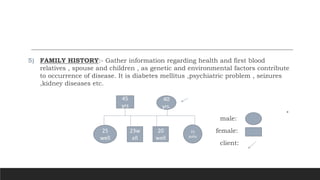
5) FAMILY HISTORY:- Gather information regarding health and first blood
relatives , spouse and children , as genetic and environmental factors contribute
to occurrence of disease. It is diabetes mellitus ,psychiatric problem , seizures
,kidney diseases etc.
male:
female:
client:
45
yrs
40
yrs.
25
well
15
polio
23w
ell
20
well
6) OCCUPATIONAL AND ENVIORNMENTAL HISTORY: - It includes collecting
data regarding client’s occupation , lifestyle in job , working environment etc .
Purpose of collecting such information is to identify the risk factors or diseases
producing substances in the environment .
7) PSYCHOSOCIAL HISTORY:- It includes collecting the data regarding client’s
awareness about himself , his relationship with other human beings. Focus of
data is on client’s education , lifestyle , personal relationships , working relations
, social relation , schooling etc.
PHYSICAL EXAMINATION
Physical examination is also known as medical examination or clinical examination
.It is a systematic approach for examining an individual and is performed in the
patients by health practitioner to find out the probable cause of possible sign and
symptoms related to patients current health problem . Physical examination is an
important part of health assessment .it provides objective data for identifying data
for identifying problems and making diagnosis.
METHODS OF PHYSICAL
EXAMINATION
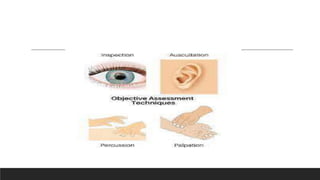
There are 4 techniques of physical examination.
 Inspection
 Palpation
 Percussion
Auscultation
INSPECTION
Inspect each body system using vision , smell and hearing to assess normal
conditions and deviations . Assess for color , size , location, movement , texture ,
symmetry , odors and sounds when you assess each body system.
PALPATION
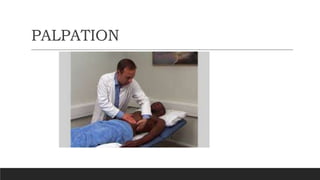
It requires you to touch the patient with different parts of hands by using varying
degree of pressure .There are two types of palpation.
I. Light palpation:-It is used to feel for surface abnormalities . Depress the skin
1-2 cm with finger pads for lightest touch possible . Assess for texture
tenderness , temperature , moisture etc.
II. Deep palpation:- This technique is used to feel internal organs and masses for
size , shapes , tenderness ,symmetry and mobility .Put pressure on the skin (4-5
cm), with firm deep pressure.
PALPATION
PERCUSSION
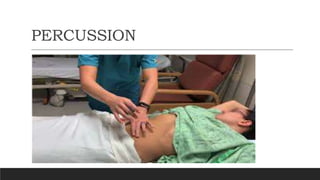
Percussion is used to evaluate the health of internal organs by observing their
tenderness and assess the amount of fluid in internal cavities. It is done to
determine the:
 Size ,consistency , borders of body organs.
 The presence and absence of fluid in body areas
Percussion of body parts produces a sound ,like playing a drum .
The sound is a sign of types of tissues within a body parts or organ.
• Lung sound is hollow(They are filled with air)
• Bone joints and liver sounds are solid (Solid organs)
PERCUSSION
AUSCULTATION
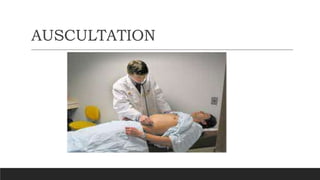
Auscultation is a method used to listen sounds of the body during physical examination
.
It is listening to sound using stethoscope .Health care provider listen to
person’s lungs ,heart and intestine to evaluate sounds:
 Frequency
 Intensity
 Duration
 Number
Quality
AUSCULTATION
PREPARATION OF CLIENT
Preparation of unit is important before starting physical examination of client. It
makes client relaxed , comfortable.
1. Time of examining must be convenient to both client as well as nurse. Because
examination is done in hurry .
2. LIGHT:-For the visualization of body area , lightening is very important . Make
sure, adequate light must be there during whole examination.
3. EQUIPMENT:-Before starting examination, all the equipment needed must be in
reach and in working condition . Client must be relaxed and sit or lie
comfortably on table / chair.
4. PRIVACY:- Providing privacy is very important part of examination .Never leave a
female patient alone even if doctor is doing examination .Always company her .
5. TEMPERATURE :-Room where physical examination will be done, should not
be too hot or cold .A warm environment /room temperature should be provided.
6. POSITIONS:-Several positions are used while performing physical examination
.So furniture should be there so that client can take position comfortably

HEALTH ASSESSMENT UNIT-9.pptx

  • 1.
  • 2.
    INTRODUCTION Health is astate of well-being .WHO Defined it as “state of complete physical , mental and social well being and not merely the absence of disease and infirmity”. Assessment (ANA) “a systematic , dynamic process by which the nurse through interaction with client , significant others and healthcare providers , collects and analyzes data about client” In simple words, health assessment is collecting data about clients health status . It is a detailed study of the entire body in order to determine the general or mental condition of body.
  • 3.
    PURPOSES OF HEALTH ASSESSMENT 1.To collect data about physical , mental and social well-being of client. 2. To identify the problem in early stage. 3. To determine the cause and extent of disease. 4. To evaluate /monitor the changes in clients health status . 5. To alleviate the complications. 6. To contribute the medical research. 7. To collect data systematically . 8. To identify clients strength , weakness , knowledge , motivation , support system and coping abilities
  • 4.
    ASSESSING IS THEHEALTH PROCESS THAT INVOLVES  Health history  Physical examination
  • 5.
    HEALTH HISTORY Health historyis a precious component in the health care system .it is of utmost importance because it is helpful in the diagnosis and treatment of a patient. Basically ,health history deals with collecting the desired information about health and correlating it with the family health history. It is a collection of subjective data (in detail) regarding clients health in chronological order. SUBJECTIVE DATA:-Subjective data is information that health care professional receives directly from the patient’s point of view is obtained through interview. OBJECTIVE DATA:-It is type of data which is obtained through observation , physical examination and through various tests. This data is observed by using our senses.
  • 6.
    EXAMPLES OF SUBJECTIVEAND OBJECTIVE DATA:-  A patient complaints of fever and the health care givers check the temperature on the thermometer.  A patient complains of nausea and the health care giver can observe for gag reflex induced with vomiting in the container/tray. A patient complains of cold and shivering and health care giver observes his/her body shaking due to shivering.
  • 7.
    FACTORS AFFECTING THE COLLECTIONOF SUBJECTIVE DATA 1. Physical setting 2. Client’s personality and behavior 3. Communication skill 4. Problem 5. Nurses personality and behavior 6. Nurses knowledge and skill
  • 8.
    FAVOURABLE CONDITIONS FOR COLLECTINGDATA o A relaxed environment should be provided i.E. Introduce yourself to client, wish him o Call client with his name. o Maintain eye to eye contact while communicating o Sit comfortably by maintaining a distance. o Environment :provide room temperature , noise free environment. o Always treat client as human being
  • 9.
    FORMAT OF HEALTHHISTORY 1) Biographic data 2) chief complaints 3) History of present illness 4) Past health history 5) Family health history 6) Occupational and environmental history 7) Psychosocial history
  • 10.
    1) BIOGRAPHICAL DATA:-The data is collected as soon as nurse encounters the client first time. It includes name, age ,gender, bed no., Ward , medical diagnosis , surgery ,religion , education , occupation ,family and contact person. 2) CHIEF COMPLAINT :It is the brief statement of client’s problem for which client seeks medical care.  It should be written in clients statement.  In case of multiple problems , ask client to indicate the priority of complaint.  Write problem in chronological order. Example:-Client is complaining of general weakness from one month , cough from two weeks and fever from two days , headache today , headache X 1 day , fever X 2 days , cough X 14 days, General weakness X 30 days.
  • 11.
    3) HISTORY RELATEDTO PRESENT ILLNESS :- It includes the expansion of chief complaints . Elaborate the present chief complaints in chronological order .It should include location , quality ,quantity, chronology , setting , exaggerating and relieving factors , associated symptoms ,effect on sleep , daily activities. 4) PAST HEALTH HISTORY :- It is the collecting information regarding clients previous experience with any disease , surgery . It is the overall assessment of clients health prior to present illness . Past health history includes:-allergies , medical disease , surgery , trauma , injury ,hospitalization ,childhood diseases and immunization , obstetric history .
  • 12.
    5) FAMILY HISTORY:-Gather information regarding health and first blood relatives , spouse and children , as genetic and environmental factors contribute to occurrence of disease. It is diabetes mellitus ,psychiatric problem , seizures ,kidney diseases etc. male: female: client: 45 yrs 40 yrs. 25 well 15 polio 23w ell 20 well
  • 13.
    6) OCCUPATIONAL ANDENVIORNMENTAL HISTORY: - It includes collecting data regarding client’s occupation , lifestyle in job , working environment etc . Purpose of collecting such information is to identify the risk factors or diseases producing substances in the environment . 7) PSYCHOSOCIAL HISTORY:- It includes collecting the data regarding client’s awareness about himself , his relationship with other human beings. Focus of data is on client’s education , lifestyle , personal relationships , working relations , social relation , schooling etc.
  • 14.
    PHYSICAL EXAMINATION Physical examinationis also known as medical examination or clinical examination .It is a systematic approach for examining an individual and is performed in the patients by health practitioner to find out the probable cause of possible sign and symptoms related to patients current health problem . Physical examination is an important part of health assessment .it provides objective data for identifying data for identifying problems and making diagnosis.
  • 15.
    METHODS OF PHYSICAL EXAMINATION Thereare 4 techniques of physical examination.  Inspection  Palpation  Percussion Auscultation
  • 16.
    INSPECTION Inspect each bodysystem using vision , smell and hearing to assess normal conditions and deviations . Assess for color , size , location, movement , texture , symmetry , odors and sounds when you assess each body system.
  • 17.
    PALPATION It requires youto touch the patient with different parts of hands by using varying degree of pressure .There are two types of palpation. I. Light palpation:-It is used to feel for surface abnormalities . Depress the skin 1-2 cm with finger pads for lightest touch possible . Assess for texture tenderness , temperature , moisture etc. II. Deep palpation:- This technique is used to feel internal organs and masses for size , shapes , tenderness ,symmetry and mobility .Put pressure on the skin (4-5 cm), with firm deep pressure.
  • 19.
  • 20.
    PERCUSSION Percussion is usedto evaluate the health of internal organs by observing their tenderness and assess the amount of fluid in internal cavities. It is done to determine the:  Size ,consistency , borders of body organs.  The presence and absence of fluid in body areas Percussion of body parts produces a sound ,like playing a drum . The sound is a sign of types of tissues within a body parts or organ. • Lung sound is hollow(They are filled with air) • Bone joints and liver sounds are solid (Solid organs)
  • 21.
  • 22.
    AUSCULTATION Auscultation is amethod used to listen sounds of the body during physical examination . It is listening to sound using stethoscope .Health care provider listen to person’s lungs ,heart and intestine to evaluate sounds:  Frequency  Intensity  Duration  Number Quality
  • 23.
  • 24.
    PREPARATION OF CLIENT Preparationof unit is important before starting physical examination of client. It makes client relaxed , comfortable. 1. Time of examining must be convenient to both client as well as nurse. Because examination is done in hurry . 2. LIGHT:-For the visualization of body area , lightening is very important . Make sure, adequate light must be there during whole examination. 3. EQUIPMENT:-Before starting examination, all the equipment needed must be in reach and in working condition . Client must be relaxed and sit or lie comfortably on table / chair.
  • 25.
    4. PRIVACY:- Providingprivacy is very important part of examination .Never leave a female patient alone even if doctor is doing examination .Always company her . 5. TEMPERATURE :-Room where physical examination will be done, should not be too hot or cold .A warm environment /room temperature should be provided. 6. POSITIONS:-Several positions are used while performing physical examination .So furniture should be there so that client can take position comfortably