HEADLIGHTS
VIBHAVARI GHADGE
ADAM, PUNE
20 FEB 2019
1
Head lights
2
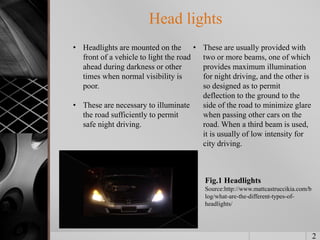
• Headlights are mounted on the
front of a vehicle to light the road
ahead during darkness or other
times when normal visibility is
poor.
• These are necessary to illuminate
the road sufficiently to permit
safe night driving.
• These are usually provided with
two or more beams, one of which
provides maximum illumination
for night driving, and the other is
so designed as to permit
deflection to the ground to the
side of the road to minimize glare
when passing other cars on the
road. When a third beam is used,
it is usually of low intensity for
city driving.
Fig.1 Headlights
Source:http://www.mattcastruccikia.com/b
log/what-are-the-different-types-of-
headlights/
Types of Headlights
a. Standard Headlights(Filament bulb)
b. Sealed-Beam Headlight(Halogen bulb )
c. HID (High Intensity Discharge)
Headlamps i.e. Xenon bulbs
d. LED headlights
3
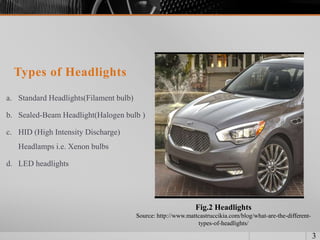
Fig.2 Headlights
Source: http://www.mattcastruccikia.com/blog/what-are-the-different-
types-of-headlights/
A. Standard Headlights
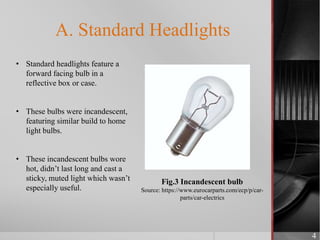
• Standard headlights feature a
forward facing bulb in a
reflective box or case.
• These bulbs were incandescent,
featuring similar build to home
light bulbs.
• These incandescent bulbs wore
hot, didn’t last long and cast a
sticky, muted light which wasn’t
especially useful.
4
Fig.3 Incandescent bulb
Source: https://www.eurocarparts.com/ecp/p/car-
parts/car-electrics
5
B. Sealed-Beam Headlight
• It is a two-beam headlamp system.
• Both these beams produce-
• a straight-ahead (upper or “country” driving beam) and
• a deflected (lower or “traffic” beam) in which the light from both
beams is deflected to the right side of the road and slightly
downward to minimize glare.
• The maximum intensity of country beam is specified at 75,000cp.
• The maximum intensity of traffic beam is specified at 50,000cp.
• Country beam is used only when there is no traffic.
• Example : Halogen type headlight
Halogen gases
6
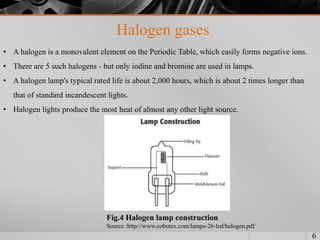
• A halogen is a monovalent element on the Periodic Table, which easily forms negative ions.
• There are 5 such halogens - but only iodine and bromine are used in lamps.
• A halogen lamp's typical rated life is about 2,000 hours, which is about 2 times longer than
that of standard incandescent lights.
• Halogen lights produce the most heat of almost any other light source.
Fig.4 Halogen lamp construction
Source :http://www.cobotex.com/lamps-26-led/halogen.pdf
7
Advantages of halogen headlights
1. They are inexpensive. A major reason most manufacturers use reflector-type
headlamps is their low cost of production.
2. They are smaller than projector units.
3. Halogen bulbs offer sufficiently bright light. Hence, in most conditions, there's
sufficient illumination without spending a lot of money.
Fig.5 Halogen bulb
Source : https://mycarneedsthis.com/best-halogen-headlight-bulbs-to-buy/
C. HID Headlamps
8
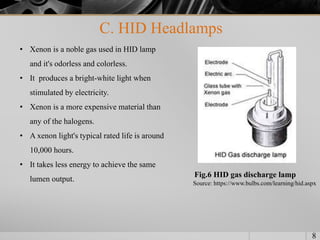
• Xenon is a noble gas used in HID lamp
and it's odorless and colorless.
• It produces a bright-white light when
stimulated by electricity.
• Xenon is a more expensive material than
any of the halogens.
• A xenon light's typical rated life is around
10,000 hours.
• It takes less energy to achieve the same
lumen output.
Fig.6 HID gas discharge lamp
Source: https://www.bulbs.com/learning/hid.aspx
9
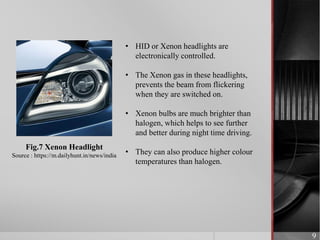
• HID or Xenon headlights are
electronically controlled.
• The Xenon gas in these headlights,
prevents the beam from flickering
when they are switched on.
• Xenon bulbs are much brighter than
halogen, which helps to see further
and better during night time driving.
• They can also produce higher colour
temperatures than halogen.
Fig.7 Xenon Headlight
Source : https://m.dailyhunt.in/news/india
10
Advantages of Xenon headlights :
1. Improved brightness
2. Better visibility in poorly lit conditions
• Instead of using filament, an electrical arc is
created between two electrodes that excites
a gas inside the headlamp which vaporizes
metallic salts that sustain the arc and emit
light.
• Xenon gas discharge.mp4
• More than 15,000volts are used to jump the
gap between the electrodes.
Fig.8 Xenon bulb
Source : https://google/images/PbcRnB
D.LED Headlight
11
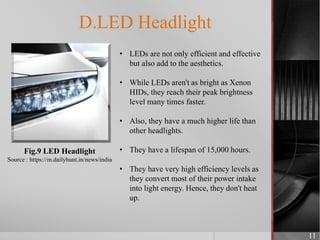
Fig.9 LED Headlight
Source : https://m.dailyhunt.in/news/india
• LEDs are not only efficient and effective
but also add to the aesthetics.
• While LEDs aren't as bright as Xenon
HIDs, they reach their peak brightness
level many times faster.
• Also, they have a much higher life than
other headlights.
• They have a lifespan of 15,000 hours.
• They have very high efficiency levels as
they convert most of their power intake
into light energy. Hence, they don't heat
up.
12
Advantages of LED headlights
1. LEDs produce a much more penetrating, illuminating white light.
2. LEDs are resistant to shock and vibration.
3. LED headlamps reduce oncoming driver perception of glare.
4. LEDs are mercury free, making them environmentally friendly unlike some
HID/xenon systems.
Disadvantages of LED headlights
1. They do create a small amount of heat at the emitter This creates a chance
for other parts be damaged.
2. LED headlights require cooling like fans and heat sinks to keep from
melting which is in not-so-cool area.
3. They Can be incredibly expensive.
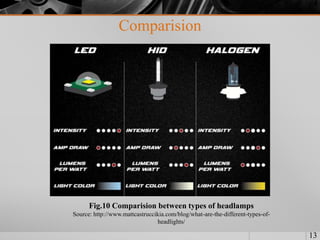
Comparision
13
Fig.10 Comparision between types of headlamps
Source: http://www.mattcastruccikia.com/blog/what-are-the-different-types-of-
headlights/
14
Fig.11 Difference between intensities of types of headlamps
Source: http://www.mattcastruccikia.com/blog/what-are-the-different-types-of-
headlights/
15
Practical difference between light intensities
Fig.12 Practical difference between light intensities
Source : www.youtube.com
THANK YOU
16

Headlights

  • 1.
  • 2.
    Head lights 2 • Headlightsare mounted on the front of a vehicle to light the road ahead during darkness or other times when normal visibility is poor. • These are necessary to illuminate the road sufficiently to permit safe night driving. • These are usually provided with two or more beams, one of which provides maximum illumination for night driving, and the other is so designed as to permit deflection to the ground to the side of the road to minimize glare when passing other cars on the road. When a third beam is used, it is usually of low intensity for city driving. Fig.1 Headlights Source:http://www.mattcastruccikia.com/b log/what-are-the-different-types-of- headlights/
  • 3.
    Types of Headlights a.Standard Headlights(Filament bulb) b. Sealed-Beam Headlight(Halogen bulb ) c. HID (High Intensity Discharge) Headlamps i.e. Xenon bulbs d. LED headlights 3 Fig.2 Headlights Source: http://www.mattcastruccikia.com/blog/what-are-the-different- types-of-headlights/
  • 4.
    A. Standard Headlights •Standard headlights feature a forward facing bulb in a reflective box or case. • These bulbs were incandescent, featuring similar build to home light bulbs. • These incandescent bulbs wore hot, didn’t last long and cast a sticky, muted light which wasn’t especially useful. 4 Fig.3 Incandescent bulb Source: https://www.eurocarparts.com/ecp/p/car- parts/car-electrics
  • 5.
    5 B. Sealed-Beam Headlight •It is a two-beam headlamp system. • Both these beams produce- • a straight-ahead (upper or “country” driving beam) and • a deflected (lower or “traffic” beam) in which the light from both beams is deflected to the right side of the road and slightly downward to minimize glare. • The maximum intensity of country beam is specified at 75,000cp. • The maximum intensity of traffic beam is specified at 50,000cp. • Country beam is used only when there is no traffic. • Example : Halogen type headlight
  • 6.
    Halogen gases 6 • Ahalogen is a monovalent element on the Periodic Table, which easily forms negative ions. • There are 5 such halogens - but only iodine and bromine are used in lamps. • A halogen lamp's typical rated life is about 2,000 hours, which is about 2 times longer than that of standard incandescent lights. • Halogen lights produce the most heat of almost any other light source. Fig.4 Halogen lamp construction Source :http://www.cobotex.com/lamps-26-led/halogen.pdf
  • 7.
    7 Advantages of halogenheadlights 1. They are inexpensive. A major reason most manufacturers use reflector-type headlamps is their low cost of production. 2. They are smaller than projector units. 3. Halogen bulbs offer sufficiently bright light. Hence, in most conditions, there's sufficient illumination without spending a lot of money. Fig.5 Halogen bulb Source : https://mycarneedsthis.com/best-halogen-headlight-bulbs-to-buy/
  • 8.
    C. HID Headlamps 8 •Xenon is a noble gas used in HID lamp and it's odorless and colorless. • It produces a bright-white light when stimulated by electricity. • Xenon is a more expensive material than any of the halogens. • A xenon light's typical rated life is around 10,000 hours. • It takes less energy to achieve the same lumen output. Fig.6 HID gas discharge lamp Source: https://www.bulbs.com/learning/hid.aspx
  • 9.
    9 • HID orXenon headlights are electronically controlled. • The Xenon gas in these headlights, prevents the beam from flickering when they are switched on. • Xenon bulbs are much brighter than halogen, which helps to see further and better during night time driving. • They can also produce higher colour temperatures than halogen. Fig.7 Xenon Headlight Source : https://m.dailyhunt.in/news/india
  • 10.
    10 Advantages of Xenonheadlights : 1. Improved brightness 2. Better visibility in poorly lit conditions • Instead of using filament, an electrical arc is created between two electrodes that excites a gas inside the headlamp which vaporizes metallic salts that sustain the arc and emit light. • Xenon gas discharge.mp4 • More than 15,000volts are used to jump the gap between the electrodes. Fig.8 Xenon bulb Source : https://google/images/PbcRnB
  • 11.
    D.LED Headlight 11 Fig.9 LEDHeadlight Source : https://m.dailyhunt.in/news/india • LEDs are not only efficient and effective but also add to the aesthetics. • While LEDs aren't as bright as Xenon HIDs, they reach their peak brightness level many times faster. • Also, they have a much higher life than other headlights. • They have a lifespan of 15,000 hours. • They have very high efficiency levels as they convert most of their power intake into light energy. Hence, they don't heat up.
  • 12.
    12 Advantages of LEDheadlights 1. LEDs produce a much more penetrating, illuminating white light. 2. LEDs are resistant to shock and vibration. 3. LED headlamps reduce oncoming driver perception of glare. 4. LEDs are mercury free, making them environmentally friendly unlike some HID/xenon systems. Disadvantages of LED headlights 1. They do create a small amount of heat at the emitter This creates a chance for other parts be damaged. 2. LED headlights require cooling like fans and heat sinks to keep from melting which is in not-so-cool area. 3. They Can be incredibly expensive.
  • 13.
    Comparision 13 Fig.10 Comparision betweentypes of headlamps Source: http://www.mattcastruccikia.com/blog/what-are-the-different-types-of- headlights/
  • 14.
    14 Fig.11 Difference betweenintensities of types of headlamps Source: http://www.mattcastruccikia.com/blog/what-are-the-different-types-of- headlights/
  • 15.
    15 Practical difference betweenlight intensities Fig.12 Practical difference between light intensities Source : www.youtube.com
  • 16.