Understanding Evaluation in Human Computer Interaction
4 APPROACHES
TO EXPERT
ANALYSIS
Evaluation
Through Expert
Analysis
Evaluation
Through User
Participation
Introductio
n
WHAT IS EVALUATION?
• Evaluation in HCI refers
to the process of
assessing the usability,
effectiveness, and
efficiency of a computer
system or interface.
Back to Agenda Page
GOALS OF EVALUATION
• To identify usability issues.
• To improve user satisfaction
and task performance.
• To ensure the system meets
user needs and goals.
Back to Agenda Page
IMPORTANCE OF EXPERT ANALYSIS IN
THE DESIGN EVALUATION PROCESS
• Evaluation is crucial at every stage of the
design process.
• It's best to evaluate the system before any
implementation begins.’
• Early design evaluation prevents costly
mistakes by allowing adjustments before
significant resources are invested.
• Expert analysis is often more cost-
effective than continuous user testing
during design.
Back to Agenda Page
4 APPROACHES TO EXPERT
ANALYSIS
• Cognitive Walkthrough
• Heuristic Evaluation
• Use of Models
• Use of Previous Work
Back to Agenda Page
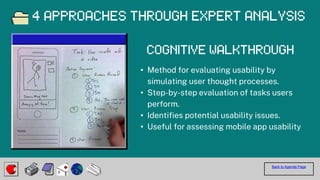
• Method for evaluating usability by
simulating user thought processes.
• Step-by-step evaluation of tasks users
perform.
• Identifies potential usability issues.
• Useful for assessing mobile app usability
Back to Agenda Page
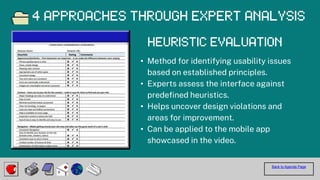
• Method for identifying usability issues
based on established principles.
• Experts assess the interface against
predefined heuristics.
• Helps uncover design violations and
areas for improvement.
• Can be applied to the mobile app
showcased in the video.
Back to Agenda Page
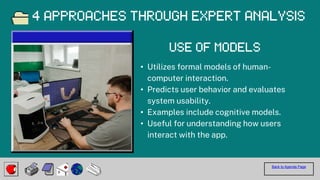
• Utilizes formal models of human-
computer interaction.
• Predicts user behavior and evaluates
system usability.
• Examples include cognitive models.
• Useful for understanding how users
interact with the app.
Back to Agenda Page
• Builds upon existing research and
knowledge.
• Incorporates insights from similar
evaluations or studies.
• Enhances understanding of usability
challenges and best practices.
• Provides context for evaluating the
mobile app's design.
Experimental Evaluation
• Participants
• Variables
• Hypotheses
• Experimental Design
• Statistical Measures
• Studies of Groups of
Users
Styles of Evaluation
• Laboratory
studies
• Field studies
Observational Techniques
• Think Aloud And Cooperative
Evaluation
• Protocol Analysis
• Automatic Protocol Analysis
Tools
• Post-task Walkthroughs
Query Techniques
• Interviews
• Questionnaires
Evaluation through Monitoring
Physiological Responses
• Eye Tracking for Usability Evaluation
• Physiological Measurements
Factors distinguishing evaluation techniques
• The stage in cycle at which the evaluation is
carried out (Design vs. implementation)
• The style of evaluation (Laboratory vs. field
studies)
• The level of subjectivity or objectivity of the
technique (Subjective vs. objective)
• The type of measures provided (Qualitative vs.
quantitative)
• The information provided
• The immediacy of the response
• The level of interference implied
• The resources required
https://kgcchathuranga
97.medium.com/hci-
human-computer-
interaction-ii-
ddf54c7242b7
https://youtu.be/HXuUfhgkbyI?si=9ocPg6qyP5JshIV
Z
https://cdn.fbsbx.com/v/t59.2708-
21/27868994_1359397517497444_130804
3121904320512_n.pdf/Dix_HumanCompu
terInteraction.pdf?_nc_cat=107&ccb=1-
7&_nc_sid=2b0e22&_nc_eui2=AeE2f4llyhN
uJneEZ6uravzYJte5phXmGucm17mmFeY
a52fOczJsxhuRGHTWijmMElrcI4crwgE0H
x1DbPMg0-
uB&_nc_ohc=Ixx_3mFqp8YAb6V-
Uma&_nc_ht=cdn.fbsbx.com&oh=03_AdW
kEPWg0O0hwaDAizpxlAc3aGTXHfW0ZFA
zv00DBFXQ5A&oe=661854C9&dl=1
https://images.sampletemplates.com
https://www.canva.com/des
ign/DAGB6nUAwjA/cM2glBx
c9k08CoK_C5bftg/edit
https
://i.yt
img.c
om

HCI(Human Computer Interaction)-PPT-REPORT.pptx