Talip Ozturk
talip@hazelcast.com
Agenda
• Introduc-on
• Code
Samples
• Demo
• Internals
• Q/A
What
is
Hazelcast?
• In‐Memory
Data
Grid
(IMDG)
• Clustering
and
highly
scalable
data
distribu-on

  solu-on
for
Java
• Distributed
Data
Structures
for
Java
• Distributed
Hashtable
(DHT)
and
more
Why
Hazelcast?
• Scale
your
applica-on
• Share
data
across
cluster
• Par--on
your
data
• Send/receive
messages
• Balance
the
load
• Process
in
parallel
on
many
JVM
Solu-ons
in
the
Market
•   Oracle
Coherence
•   IBM
WebSphere
eXtreme
Scale
/
ObjectGrid
•   TerracoPa
•   Gigaspaces
•   Gemstone
•   JBossCache/JGroups/Infinispan
Difference
• License
/
Cost
• Feature‐set
• Ease
of
use
• Main
focus
(distributed
map,
tuple
space,
cache,

  processing
vs.
data)
• Light/Heavy
weight
Introducing
Hazelcast
• Open
source
(Apache
License)
• Super
light,
simple,
no‐dependency
• Distributed/par--oned
implementa-on
of
map,
queue,

  set,
list,
lock
and
executor
service
• Transac-onal
(JCA
support)
• Topic
for
pub/sub
messaging
• Cluster
info
and
membership
events
• Dynamic
clustering,
backup,
fail‐over
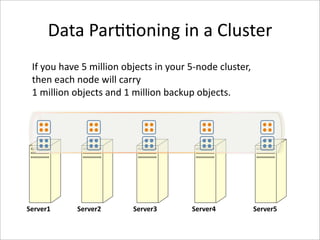
Data
Par--oning
in
a
Cluster
 If
you
have
5
million
objects
in
your
5‐node
cluster,

 then
each
node
will
carry
 1
million
objects
and
1
million
backup
objects.


Server1     Server2      Server3        Server4       Server5
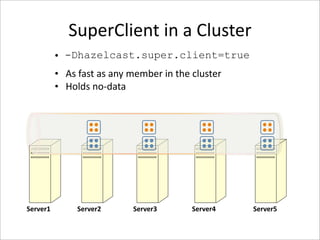
SuperClient
in
a
Cluster
          • -Dhazelcast.super.client=true
          •


As
fast
as
any
member
in
the
cluster
          •


Holds
no‐data


Server1        Server2      Server3       Server4    Server5
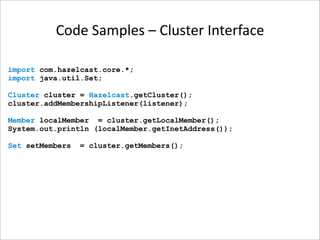
Code
Samples
–
Cluster
Interface

import com.hazelcast.core.*;
import java.util.Set;

Cluster cluster = Hazelcast.getCluster();
cluster.addMembershipListener(listener);

Member localMember = cluster.getLocalMember();
System.out.println (localMember.getInetAddress());

Set setMembers   = cluster.getMembers();
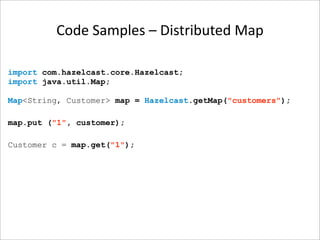
Code
Samples
–
Distributed
Map

import com.hazelcast.core.Hazelcast;
import java.util.Map;

Map<String, Customer> map = Hazelcast.getMap("customers");

map.put ("1", customer);

Customer c = map.get("1");
Code
Samples
–
Distributed
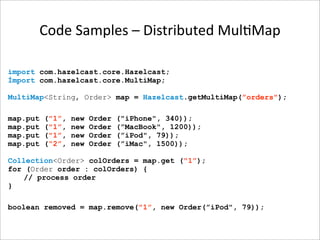
Mul-Map

import com.hazelcast.core.Hazelcast;
İmport com.hazelcast.core.MultiMap;

MultiMap<String, Order> map = Hazelcast.getMultiMap(”orders");

map.put   ("1”,   new   Order   ("iPhone", 340));
map.put   ("1”,   new   Order   (”MacBook", 1200));
map.put   ("1”,   new   Order   (”iPod", 79));
map.put   (“2”,   new   Order   (”iMac", 1500));

Collection<Order> colOrders = map.get ("1”);
for (Order order : colOrders) {
    // process order
}

boolean removed = map.remove("1”, new Order(”iPod", 79));
Code
Samples
–
Distributed
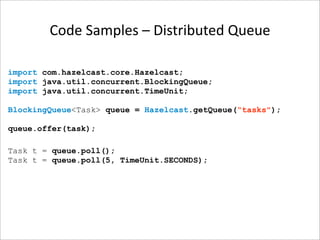
Queue

import com.hazelcast.core.Hazelcast;
import java.util.concurrent.BlockingQueue;
import java.util.concurrent.TimeUnit;

BlockingQueue<Task> queue = Hazelcast.getQueue(“tasks");

queue.offer(task);

Task t = queue.poll();
Task t = queue.poll(5, TimeUnit.SECONDS);
Code
Samples
–
Distributed
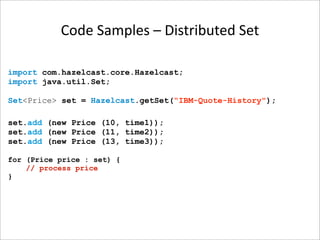
Set

import com.hazelcast.core.Hazelcast;
import java.util.Set;

Set<Price> set = Hazelcast.getSet(“IBM-Quote-History");

set.add (new Price (10, time1));
set.add (new Price (11, time2));
set.add (new Price (13, time3));

for (Price price : set) {
    // process price
}
Code
Samples
–
Distributed
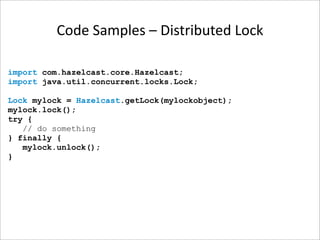
Lock

import com.hazelcast.core.Hazelcast;
import java.util.concurrent.locks.Lock;

Lock mylock = Hazelcast.getLock(mylockobject);
mylock.lock();
try {
   // do something
} finally {
   mylock.unlock();
}
Code
Samples
–
Distributed
Topic

import com.hazelcast.core.*;

public class Sample implements MessageListener {

       public static void main(String[] args) {
               Sample sample = new Sample();
               Topic topic = Hazelcast.getTopic ("default");
               topic.addMessageListener(sample);
               topic.publish ("my-message-object");
       }

       public void onMessage(Object msg) {
               System.out.println("Got msg :" + msg);
       }
}
Code
Samples
–
Distributed
Events
import   com.hazelcast.core.IMap;
import   com.hazelcast.core.Hazelcast;
import   com.hazelcast.core.EntryListener;
import   com.hazelcast.core.EntryEvent;

public class Sample implements EntryListener {
       public static void main(String[] args) {
             Sample sample = new Sample();
             IMap    map   = Hazelcast.getMap ("default");
             map.addEntryListener (sample, true);
             map.addEntryListener (sample, "key");
       }


         public void entryAdded(EntryEvent event) {
               System.out.println("Added " + event.getKey() + ":" + event.getValue());
         }


         public void entryRemoved(EntryEvent event) {
               System.out.println("Removed " + event.getKey() + ":" + event.getValue());
         }


         public void entryUpdated(EntryEvent event) {
               System.out.println("Updated " + event.getKey() + ":" + event.getValue());
         }
}
Code
Samples
–
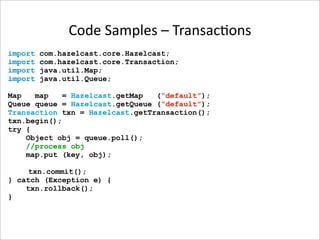
Transac-ons
import   com.hazelcast.core.Hazelcast;
import   com.hazelcast.core.Transaction;
import   java.util.Map;
import   java.util.Queue;

Map   map    = Hazelcast.getMap  (“default”);
Queue queue = Hazelcast.getQueue (“default”);
Transaction txn = Hazelcast.getTransaction();
txn.begin();
try {
    Object obj = queue.poll();
    //process obj
    map.put (key, obj);

     txn.commit();
} catch (Exception e) {
    txn.rollback();
}
Code
Samples
–
Executor
Service

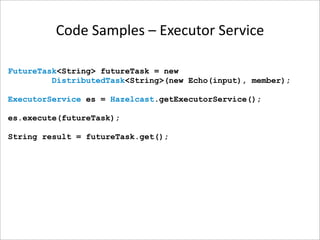
FutureTask<String> futureTask = new
         DistributedTask<String>(new Echo(input), member);

ExecutorService es = Hazelcast.getExecutorService();

es.execute(futureTask);

String result = futureTask.get();
Executor
Service
Scenario

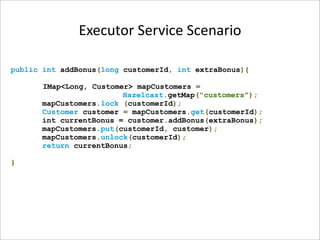
public int addBonus(long customerId, int extraBonus){

      IMap<Long, Customer> mapCustomers =
                        Hazelcast.getMap("customers");
      mapCustomers.lock (customerId);
      Customer customer = mapCustomers.get(customerId);
      int currentBonus = customer.addBonus(extraBonus);
      mapCustomers.put(customerId, customer);
      mapCustomers.unlock(customerId);
      return currentBonus;

}
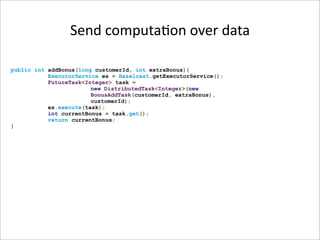
Send
computa-on
over
data
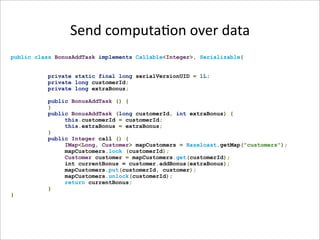
public class BonusAddTask implements Callable<Integer>, Serializable{


           private static final long serialVersionUID = 1L;
           private long customerId;
           private long extraBonus;

           public BonusAddTask () {
           }
           public BonusAddTask (long customerId, int extraBonus) {
                this.customerId = customerId;
                this.extraBonus = extraBonus;
           }
           public Integer call () {
                IMap<Long, Customer> mapCustomers = Hazelcast.getMap("customers");
                mapCustomers.lock (customerId);
                Customer customer = mapCustomers.get(customerId);
                int currentBonus = customer.addBonus(extraBonus);
                mapCustomers.put(customerId, customer);
                mapCustomers.unlock(customerId);
                return currentBonus;
           }
}
Send
computa-on
over
data

public int addBonus(long customerId, int extraBonus){
           ExecutorService es = Hazelcast.getExecutorService();
           FutureTask<Integer> task =
                        new DistributedTask<Integer>(new
                        BonusAddTask(customerId, extraBonus),
                        customerId);
           es.execute(task);
           int currentBonus = task.get();
           return currentBonus;
}
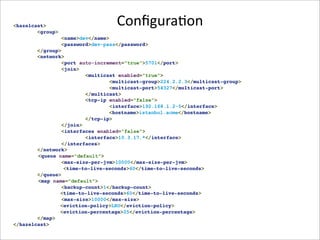
<hazelcast>                         Configura-on
        <group>
                  <name>dev</name>
                  <password>dev-pass</password>
        </group>
        <network>
                 <port auto-increment="true">5701</port>
                 <join>
                         <multicast enabled="true">
                                 <multicast-group>224.2.2.3</multicast-group>
                                 <multicast-port>54327</multicast-port>
                         </multicast>
                         <tcp-ip enabled="false">
                                 <interface>192.168.1.2-5</interface>
                                 <hostname>istanbul.acme</hostname>
                         </tcp-ip>
                 </join>
                 <interfaces enabled="false">
                         <interface>10.3.17.*</interface>
                 </interfaces>
        </network>
        <queue name="default">
                 <max-size-per-jvm>10000</max-size-per-jvm>
                  <time-to-live-seconds>60</time-to-live-seconds>
        </queue>
        <map name="default">
                 <backup-count>1</backup-count>
                <time-to-live-seconds>60</time-to-live-seconds>
                 <max-size>10000</max-size>
                <eviction-policy>LRU</eviction-policy>
                <eviction-percentage>25</eviction-percentage>
        </map>
</hazelcast>
DEMO
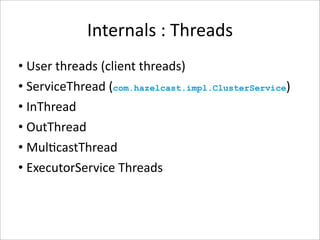
Internals
:
Threads
• User
threads
(client
threads)
• ServiceThread
(com.hazelcast.impl.ClusterService)
• InThread
• OutThread
• Mul-castThread
• ExecutorService
Threads
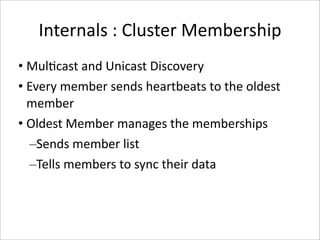
Internals
:
Cluster
Membership
• Mul-cast
and
Unicast
Discovery
• Every
member
sends
heartbeats
to
the
oldest

  member
• Oldest
Member
manages
the
memberships
  –Sends
member
list
  –Tells
members
to
sync
their
data
Internals
:
Serializa-on
• Op-mized
for
String, byte[], Long,     Integer

• Custom
serializa-on
with

  (com.hazelcast.nio.DataSerializable)
• Standard
Java
Serializa-on
Internals
:
Serializa-on
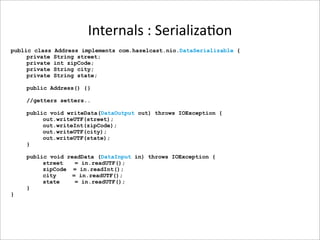
public class   Address implements com.hazelcast.nio.DataSerializable {
     private   String street;
     private   int zipCode;
     private   String city;
     private   String state;

    public Address() {}

    //getters setters..

    public void writeData(DataOutput out) throws IOException {
         out.writeUTF(street);
         out.writeInt(zipCode);
         out.writeUTF(city);
         out.writeUTF(state);
    }

    public void readData (DataInput in) throws IOException {
         street    = in.readUTF();
         zipCode = in.readInt();
         city     = in.readUTF();
         state     = in.readUTF();
    }
}
Internals
:
Serializa-on
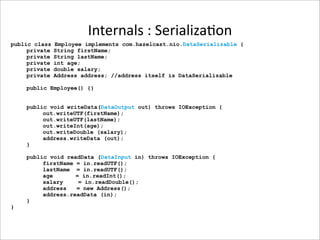
public class   Employee implements com.hazelcast.nio.DataSerializable {
     private   String firstName;
     private   String lastName;
     private   int age;
     private   double salary;
     private   Address address; //address itself is DataSerializable

    public Employee() {}


    public void writeData(DataOutput out) throws IOException {
         out.writeUTF(firstName);
         out.writeUTF(lastName);
         out.writeInt(age);
         out.writeDouble (salary);
         address.writeData (out);
    }

    public void readData (DataInput in) throws IOException {
         firstName = in.readUTF();
         lastName = in.readUTF();
         age       = in.readInt();
         salary     = in.readDouble();
         address   = new Address();
         address.readData (in);
    }
}
Internals
:
Serializa-on
• Hazelcast
doesn't
work
with
your
objects
directly
• Hazelcast
works
with
com.hazelcast.nio.Data only
• Data
is
the
binary
representa-on
of
your
object
• Data
is
a
list
of
re‐used
java.nio.ByteBuffers
Internals
:
ObjectPool
• Thread‐aware
object
pool
• Try
the
thread's
lock‐free
queue
first
• If
thread's
queue
is
full/empty,
go
to
the
global

  (concurrent)
queue
• See
com.hazelcast.impl.ThreadContext.ObjectPool

Internals
:
Sockets
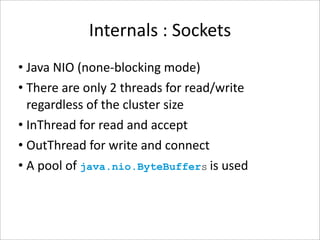
• Java
NIO
(none‐blocking
mode)
• There
are
only
2
threads
for
read/write

  regardless
of
the
cluster
size
• InThread
for
read
and
accept

• OutThread
for
write
and
connect

• A
pool
of
java.nio.ByteBuffers
is
used

Internals
:
Sockets
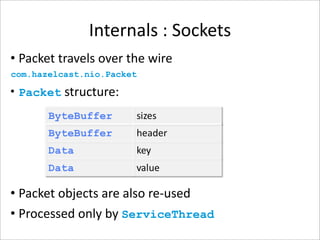
• Packet
travels
over
the
wire
com.hazelcast.nio.Packet

• Packet
structure:


• Packet
objects
are
also
re‐used
• Processed
only
by
ServiceThread
Internals
:
Map.put(key,
value)
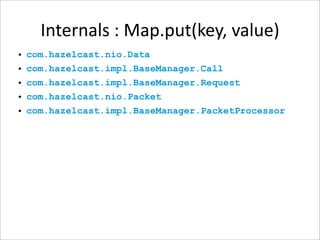
• com.hazelcast.nio.Data
• com.hazelcast.impl.BaseManager.Call
• com.hazelcast.impl.BaseManager.Request
• com.hazelcast.nio.Packet
• com.hazelcast.impl.BaseManager.PacketProcessor
Internals
:
Map.put(key,
value)
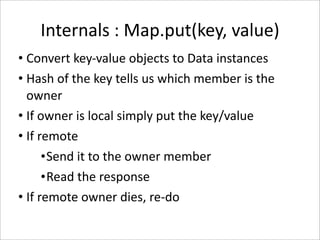
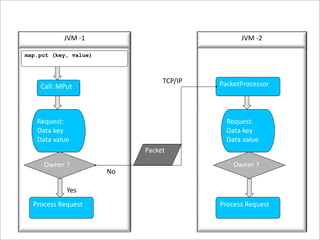
• Convert
key‐value
objects
to
Data
instances
• Hash
of
the
key
tells
us
which
member
is
the

  owner
• If
owner
is
local
simply
put
the
key/value
• If
remote

      •Send
it
to
the
owner
member
      •Read
the
response
• If
remote
owner
dies,
re‐do
Internals
:
Distributed
Map
• Fixed
number
of
blocks
(segments)
• Each
key
falls
into
one
of
these
blocks
• Each
block
is
owned
by
a
member
• Every
member
knows
the
block
owners
• blockId   = hash(keyData) % BLOCK_COUNT
• Block
ownership
is
reassigned
upon
membership

  change
• Blocks
and
keys
migrate
for
load‐balancing
Internals
:
Distributed
Queue
• The
oldest
member
creates
blocks
as
needed
• Every
member
knows
the
block
owners
• Items
are
added
into
the
blocks
• No
migra-on
happens;
short
lived
objects
• Each
member
holds
a
takeBlockId and

 putBlockId
• ‘Go‐Next’
if
the
target
is
wrong
or

block
is
full/
  empty
JVM
‐1                               JVM
‐2

map.put (key, value)


                                 TCP/IP   PacketProcessor
    Call:
MPut


   Request:                                 Request:
   Data
key                                 Data
key
   Data
value                               Data
value
                            Packet
     Owner
?                                  Owner
?
                       No

            Yes
  Process
Request                         Process
Request
Planned
Features
• Persistence
(Load/Store)
for
distributed
map
• Distributed
Search
and
Con-nues
Queries
• Distributed
java.util.concurrent.
 {DelayQueue, Semaphore, CountDownLatch}
• Distributed
Tuple
Space
• Pure
Java
and
C#
clients
Ques-ons?

• hPp://www.hazelcast.com

• hPp://code.google.com/p/hazelcast/
• hazelcast@googlegroups.com
• TwiPer
@oztalip
• hPp://www.linkedin.com/in/talipozturk

Hazelcast