




Clustering your
application with
Hazelcast
Talip Ozturk
@oztalip
Founder & CEO @hazelcast
Keywords
In-memory data grid
Distributed(Elastic) Cache
NoSQL
Clustering, Scalability, Partitioning
Cloud Computing
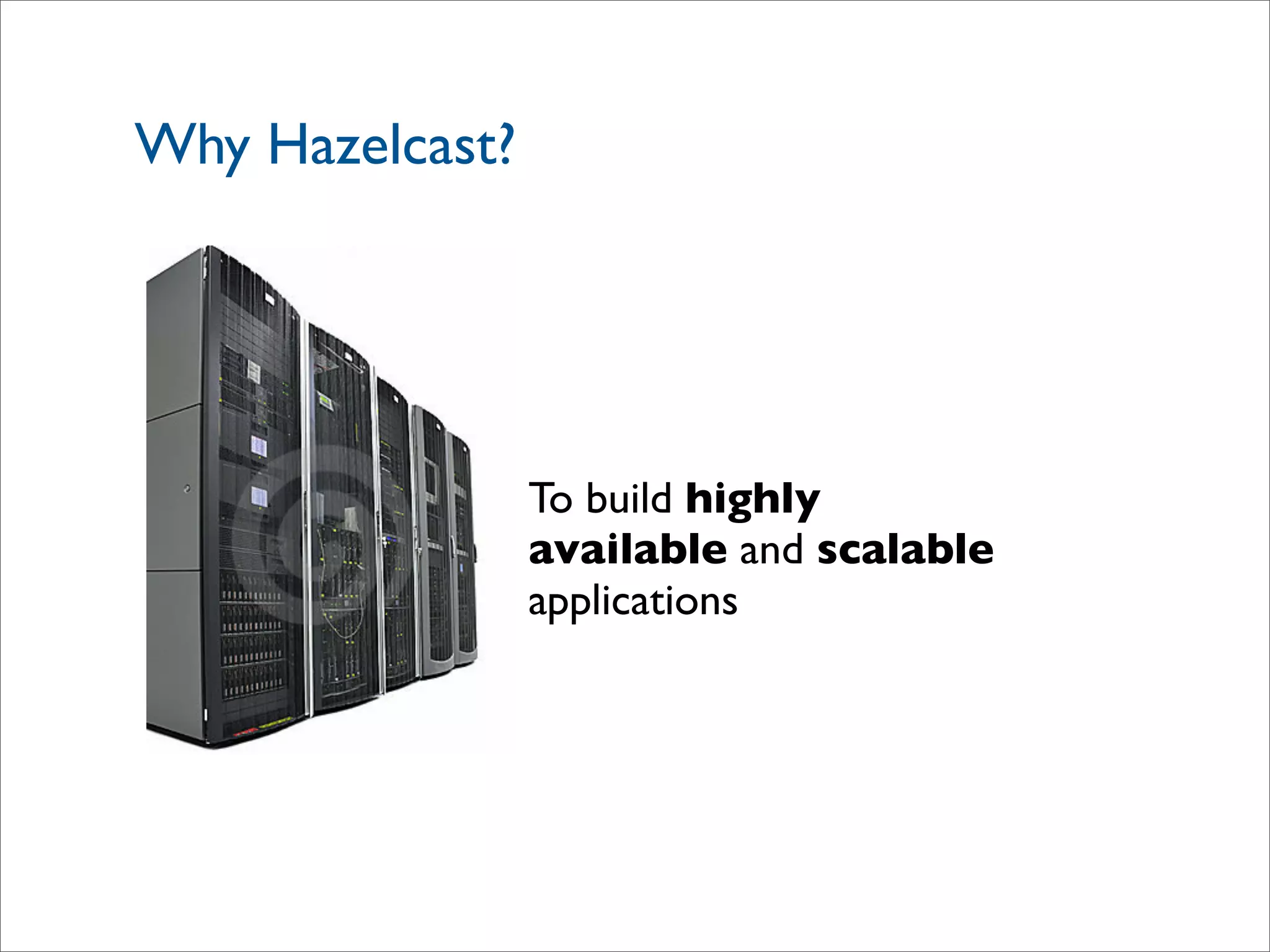
Why Hazelcast?
To build highly
available and scalable
applications
Who uses Hazelcast?
Financials
Telco
Gaming
e-commerce
Every sec. one Hazelcast node starts around the globe
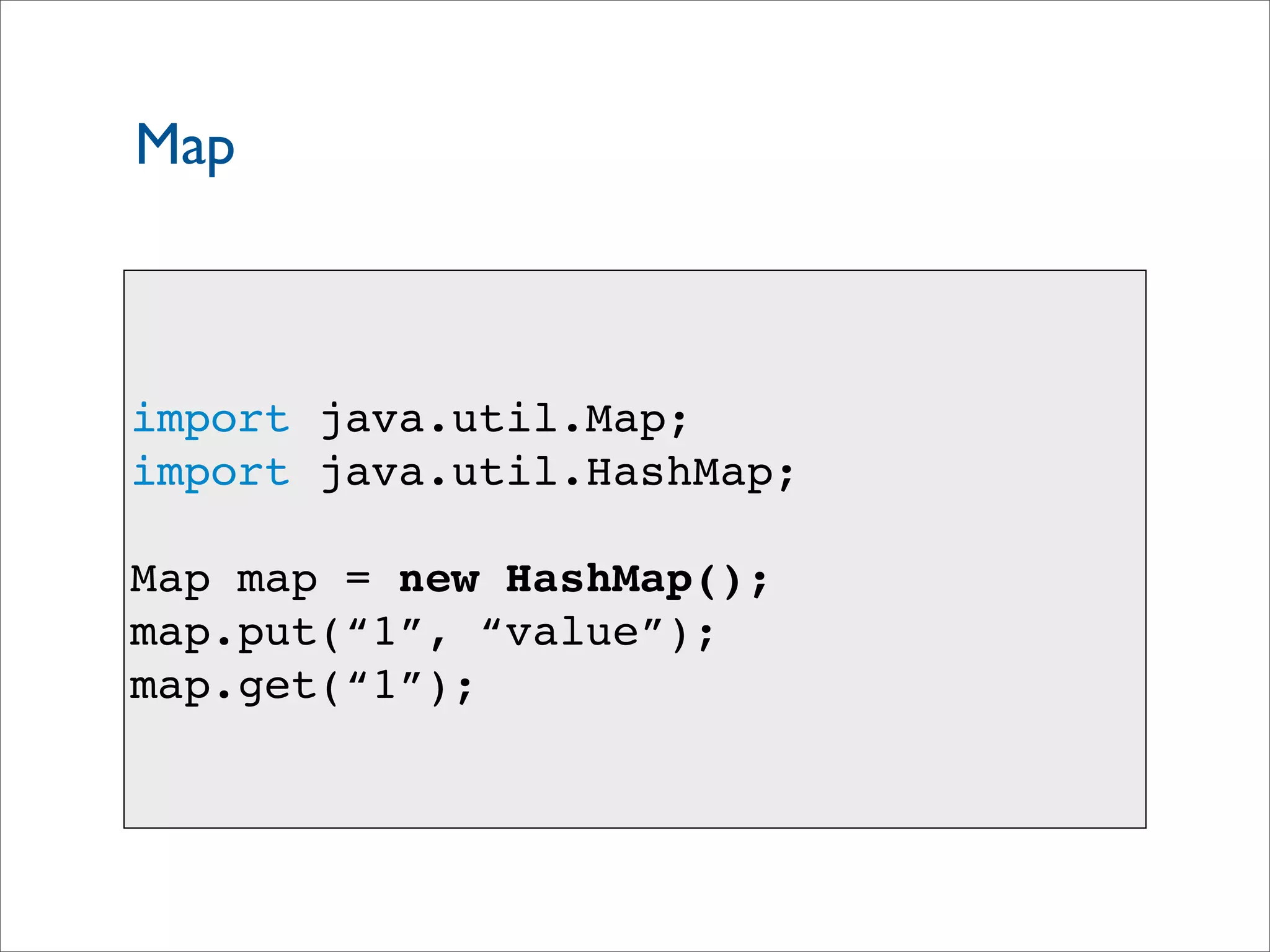
Map
import java.util.Map;
import java.util.HashMap;
Map map = new HashMap();
map.put(“1”, “value”);
map.get(“1”);
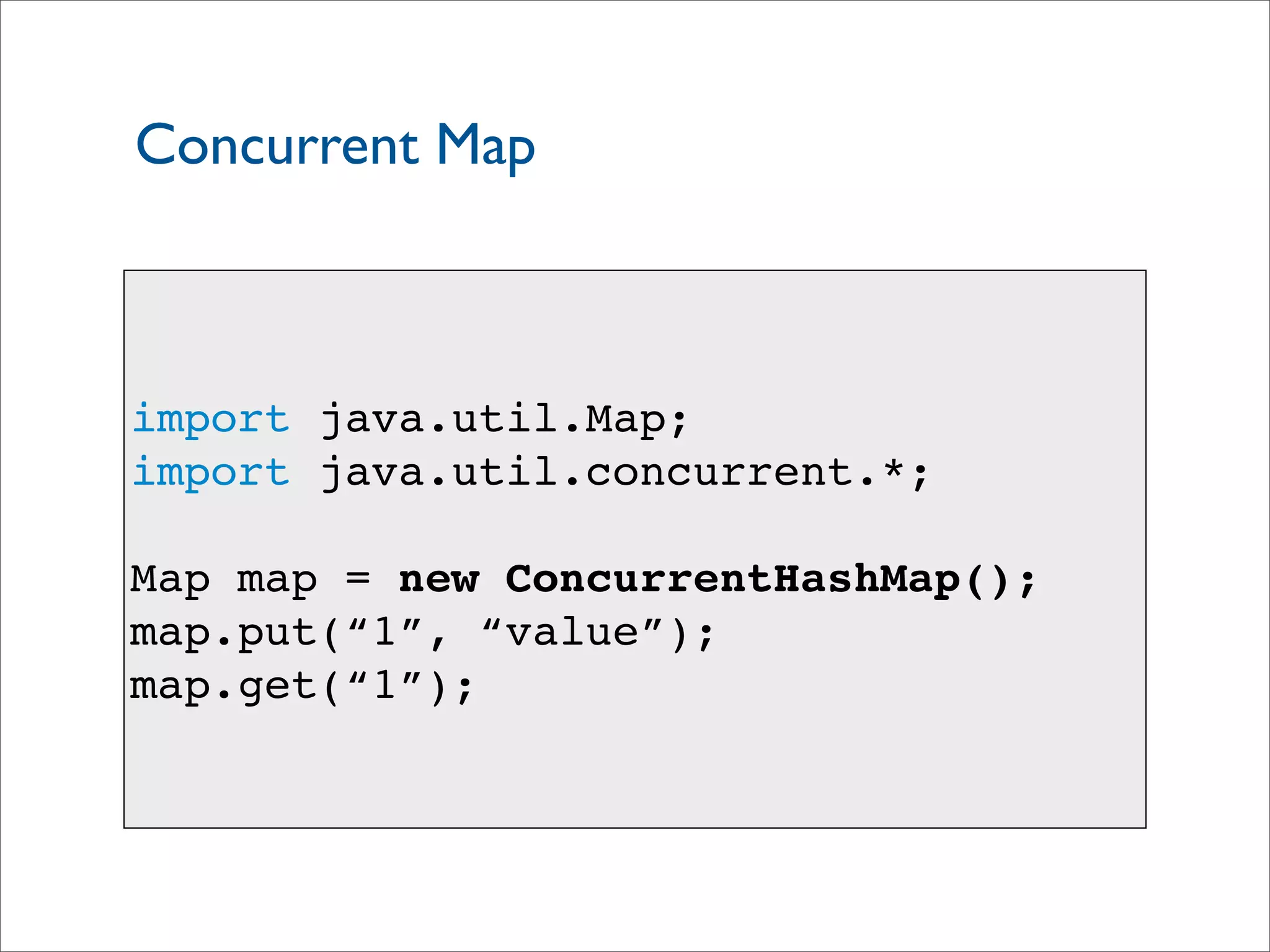
Concurrent Map
import java.util.Map;
import java.util.concurrent.*;
Map map = new ConcurrentHashMap();
map.put(“1”, “value”);
map.get(“1”);
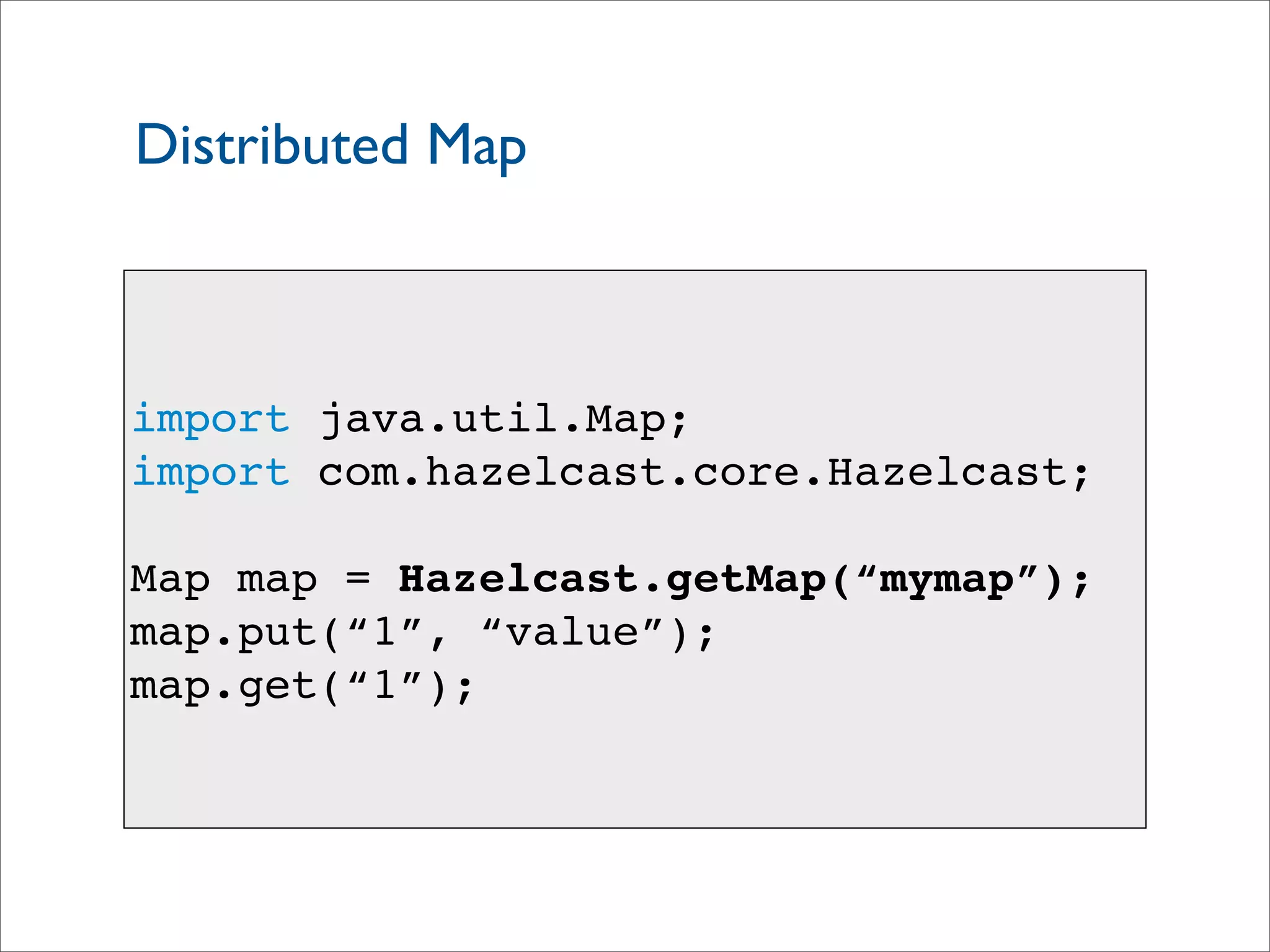
Distributed Map
import java.util.Map;
import com.hazelcast.core.Hazelcast;
Map map = Hazelcast.getMap(“mymap”);
map.put(“1”, “value”);
map.get(“1”);
Alternatives
Oracle Coherence
IBM Extreme Scale
VMware Gemfire
Gigaspaces
Redhat Infinispan
Gridgain
Terracotta
Difference
License/Cost
Feature-set
API
Ease of use
Main focus (distributed map, tuple space, cache,
processing vs. data)
Light/Heavy weight
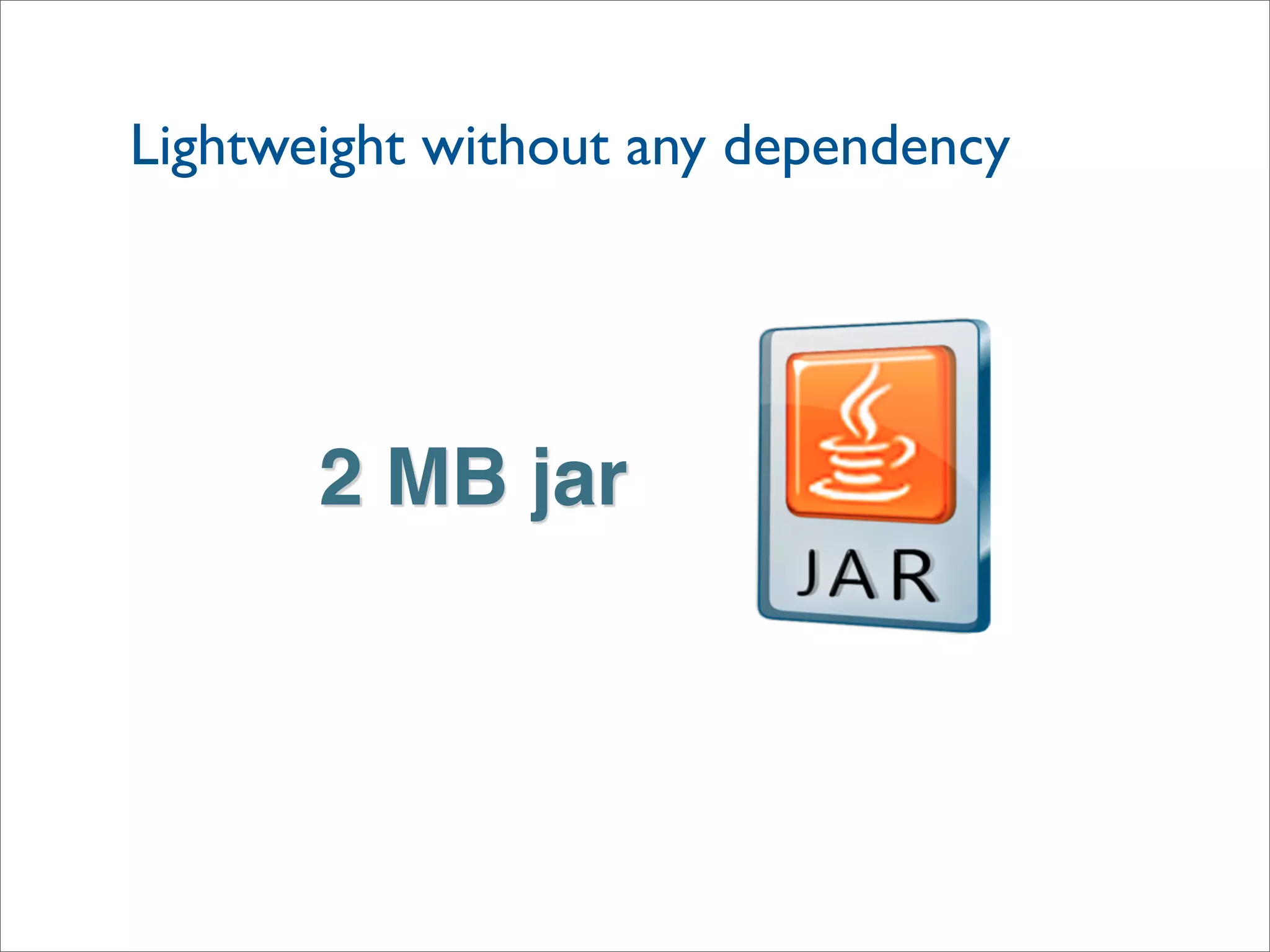
Apache License
2 MB jar
Lightweight without any dependency
Introducing Hazelcast
Map, queue, set, list, lock, semaphore, topic and
executor service
Native Java, C#, REST and Memcache Interfaces
Cluster info and membership events
Dynamic clustering, backup, fail-over
Transactional and secure
Use-cases
Scale your application
Share data across cluster
Partition your data
Send/receive messages
Balance the load
Process in parallel on many JVM
Where is the Data?
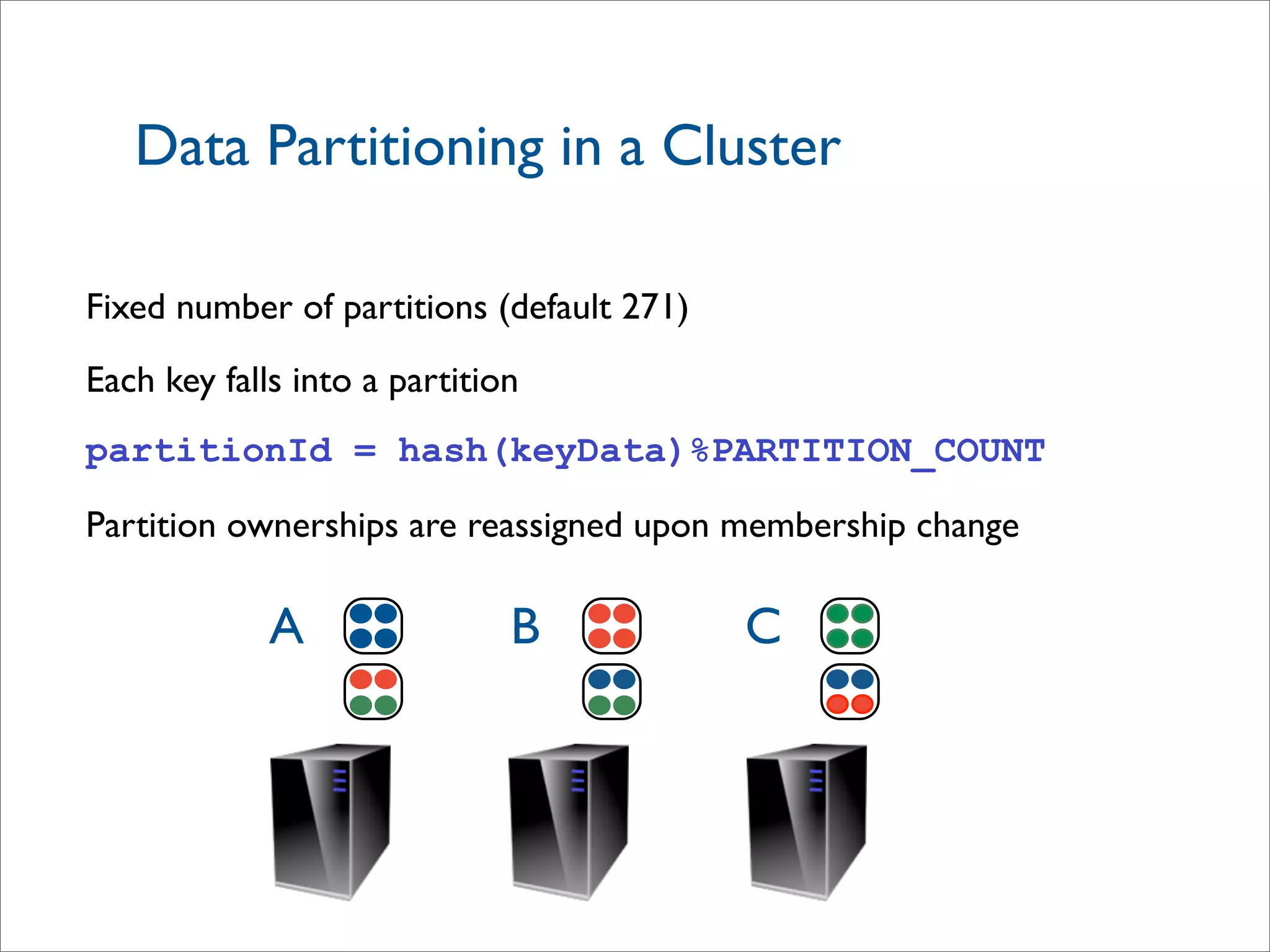
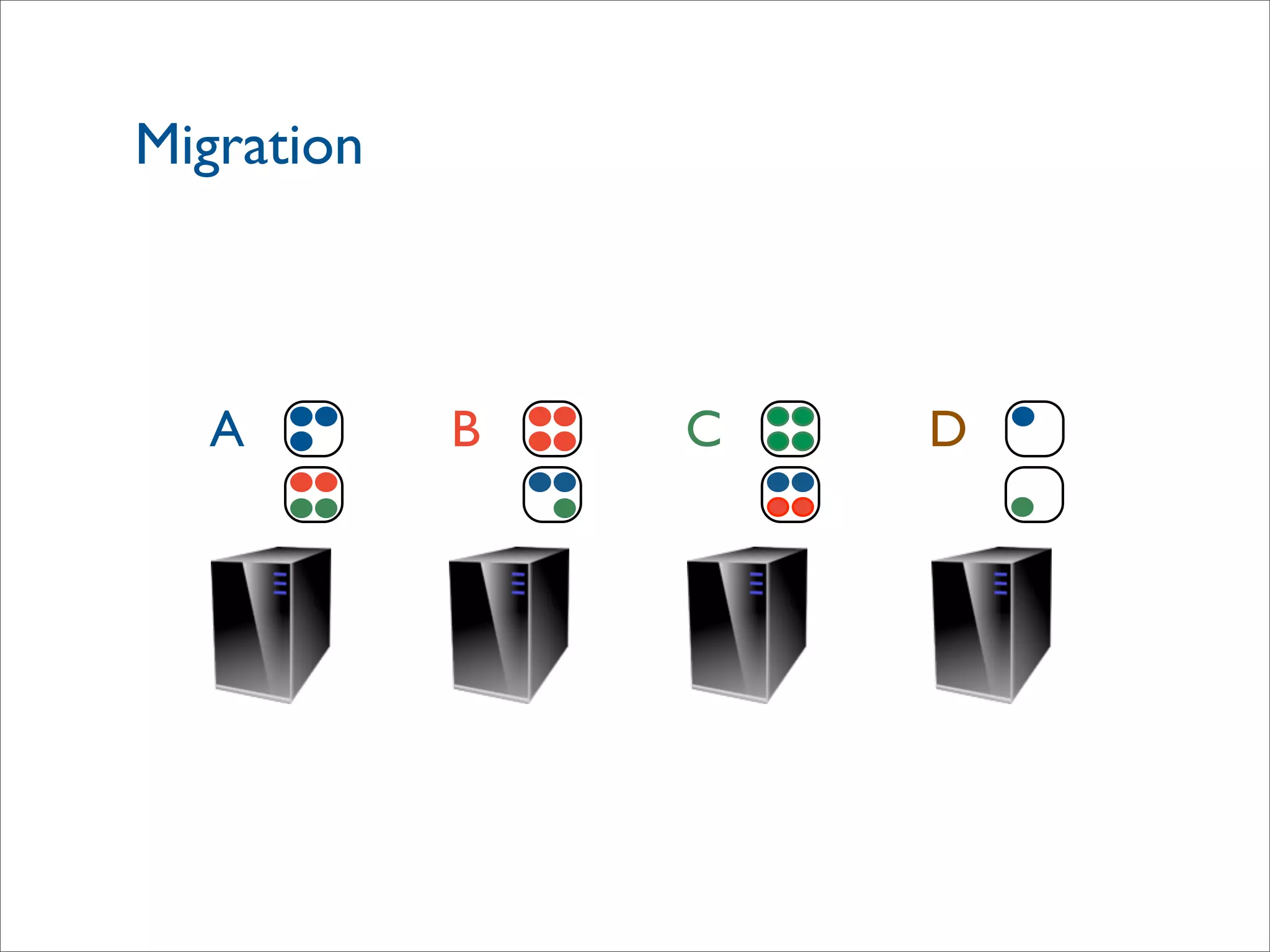
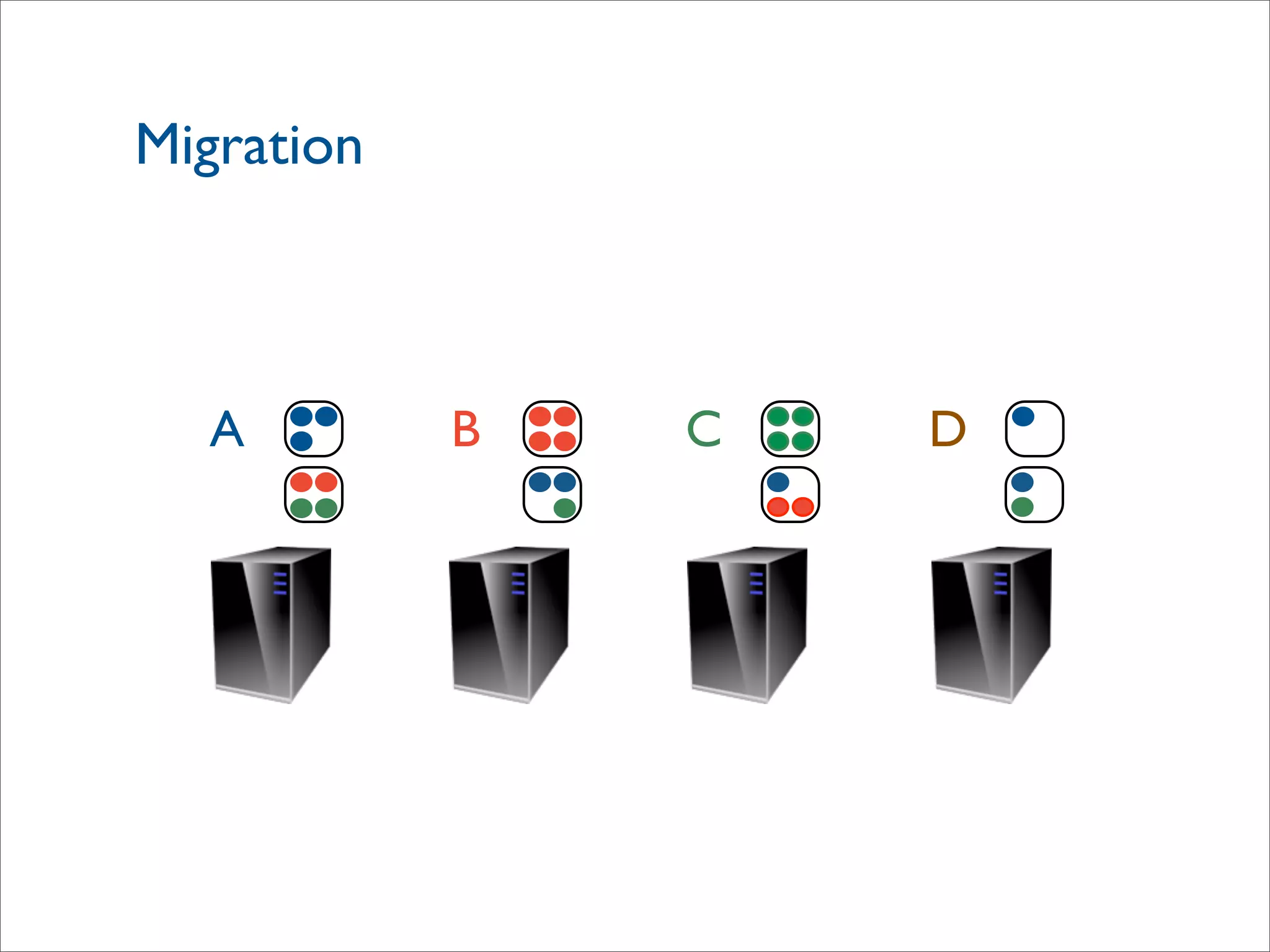
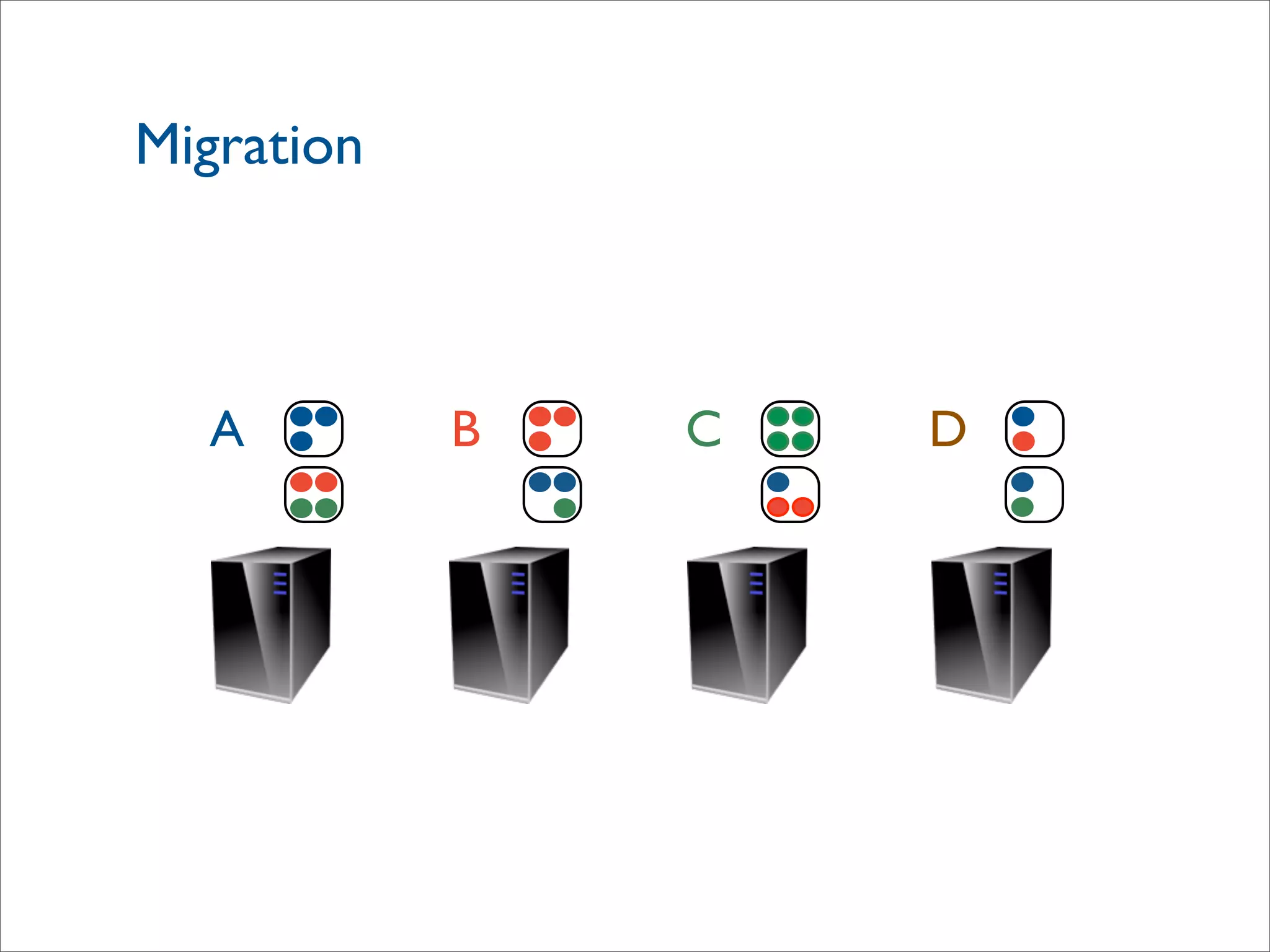
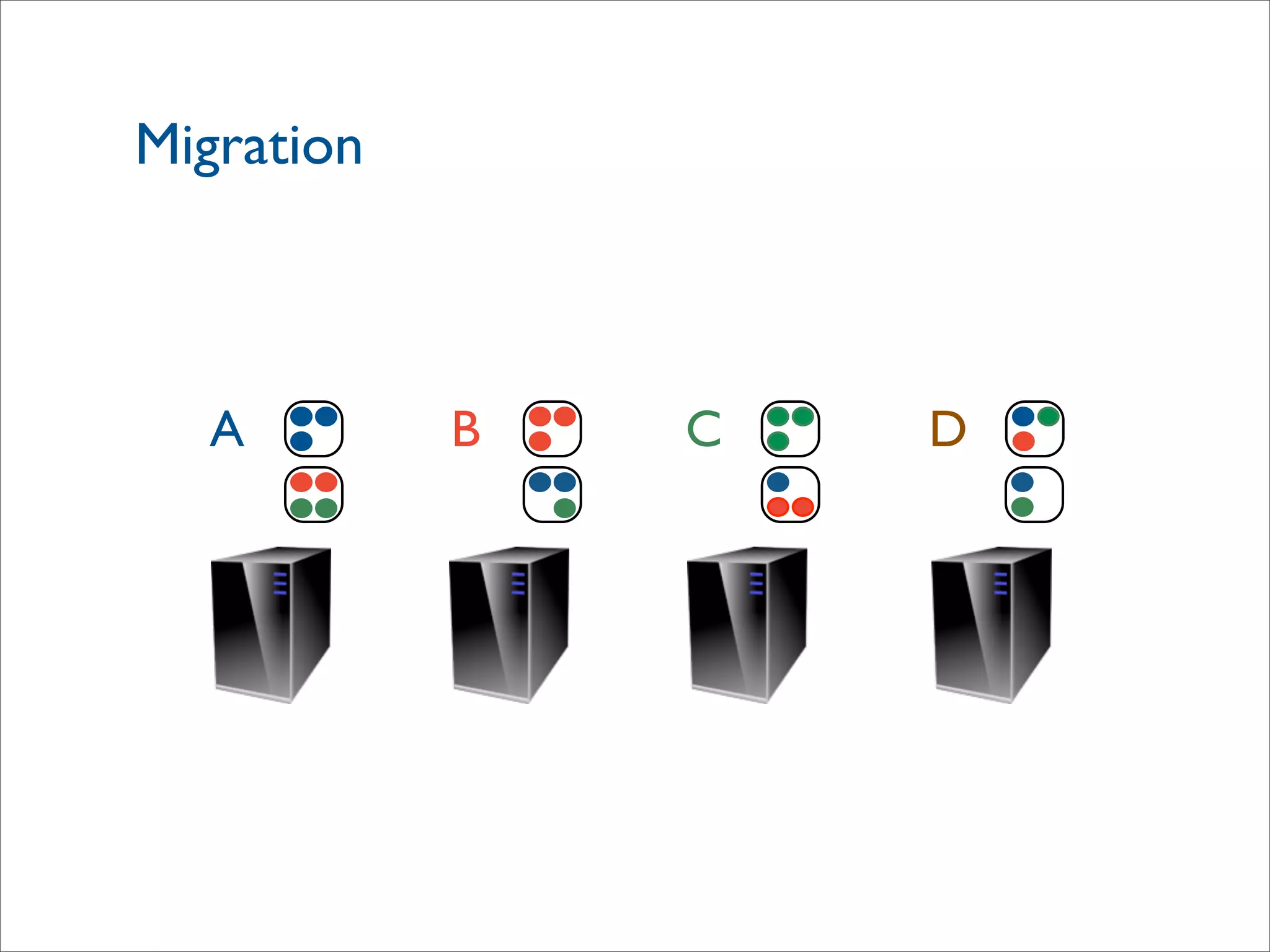
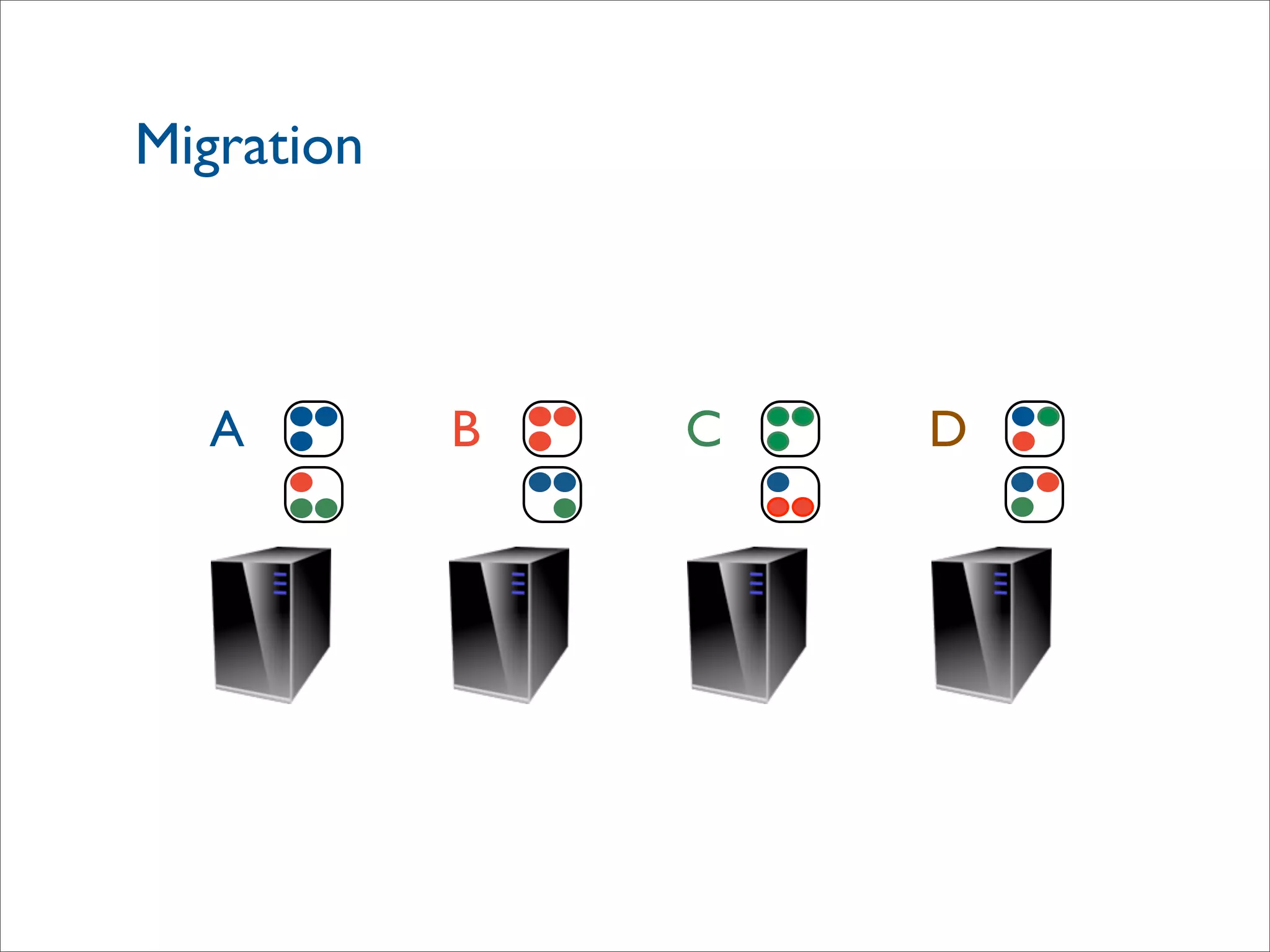
Data Partitioning in a Cluster
Fixed number of partitions (default 271)
Each key falls into a partition
partitionId = hash(keyData)%PARTITION_COUNT
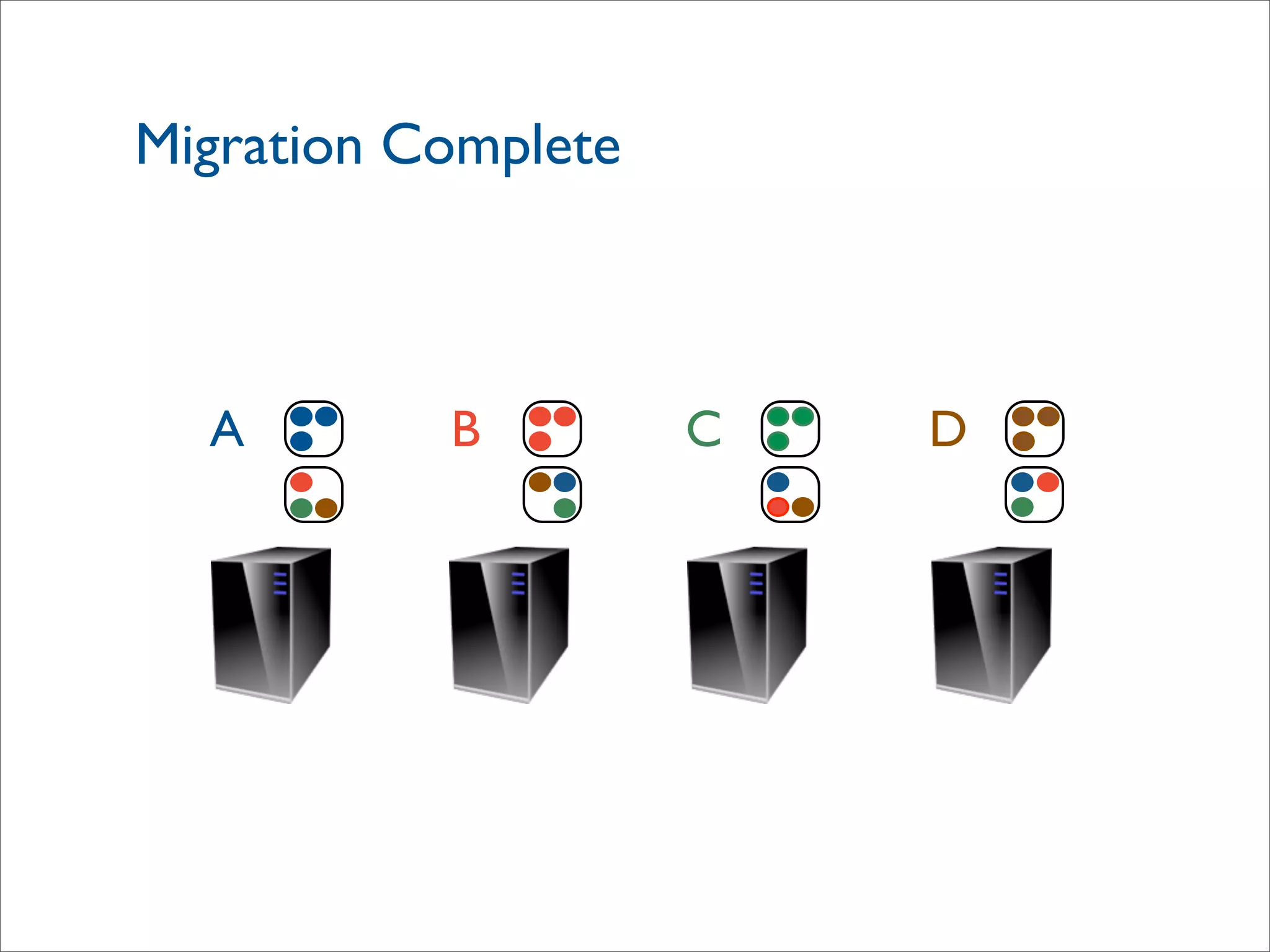
Partition ownerships are reassigned upon membership change
A B C
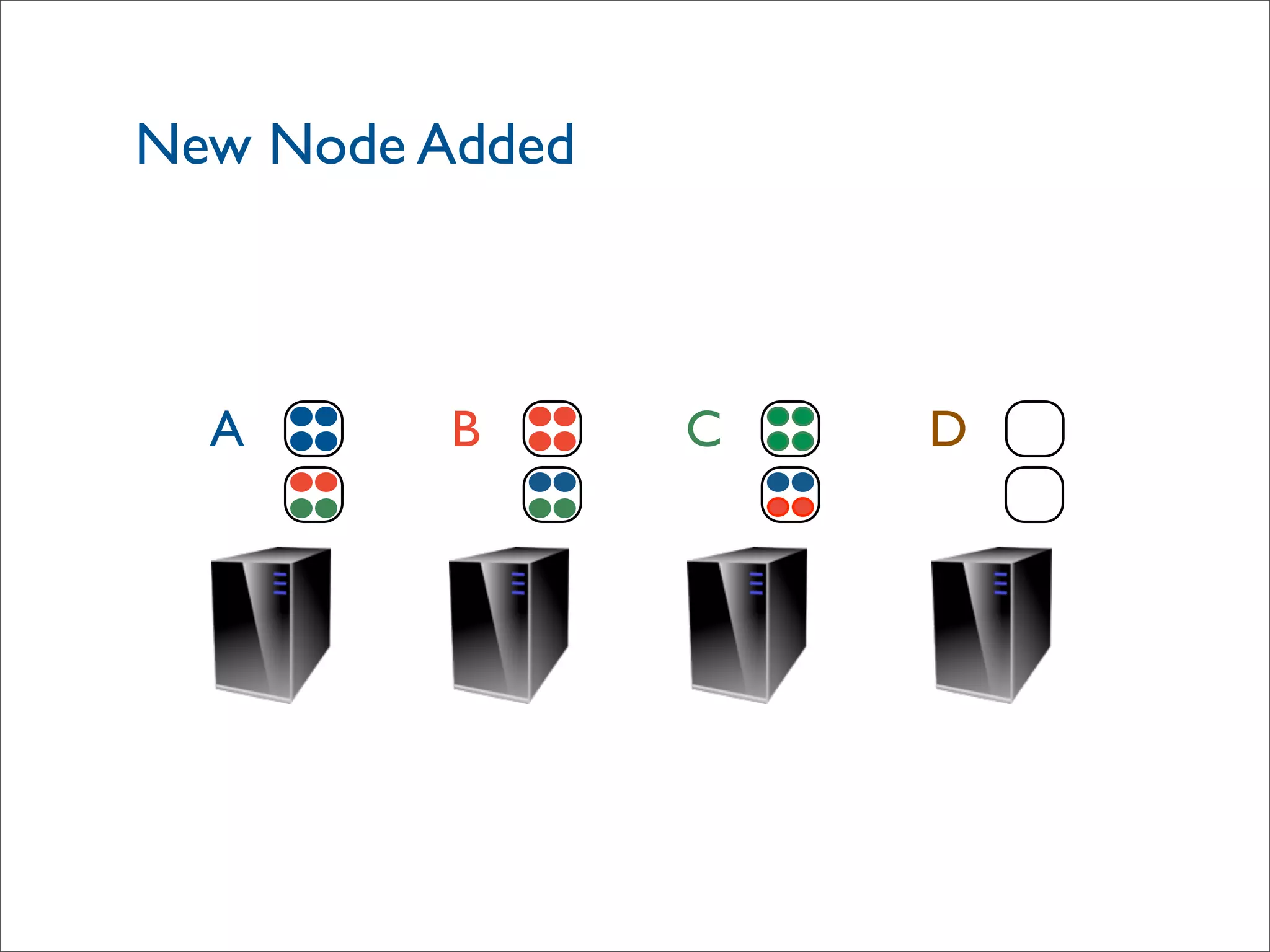
New Node Added
DA B C
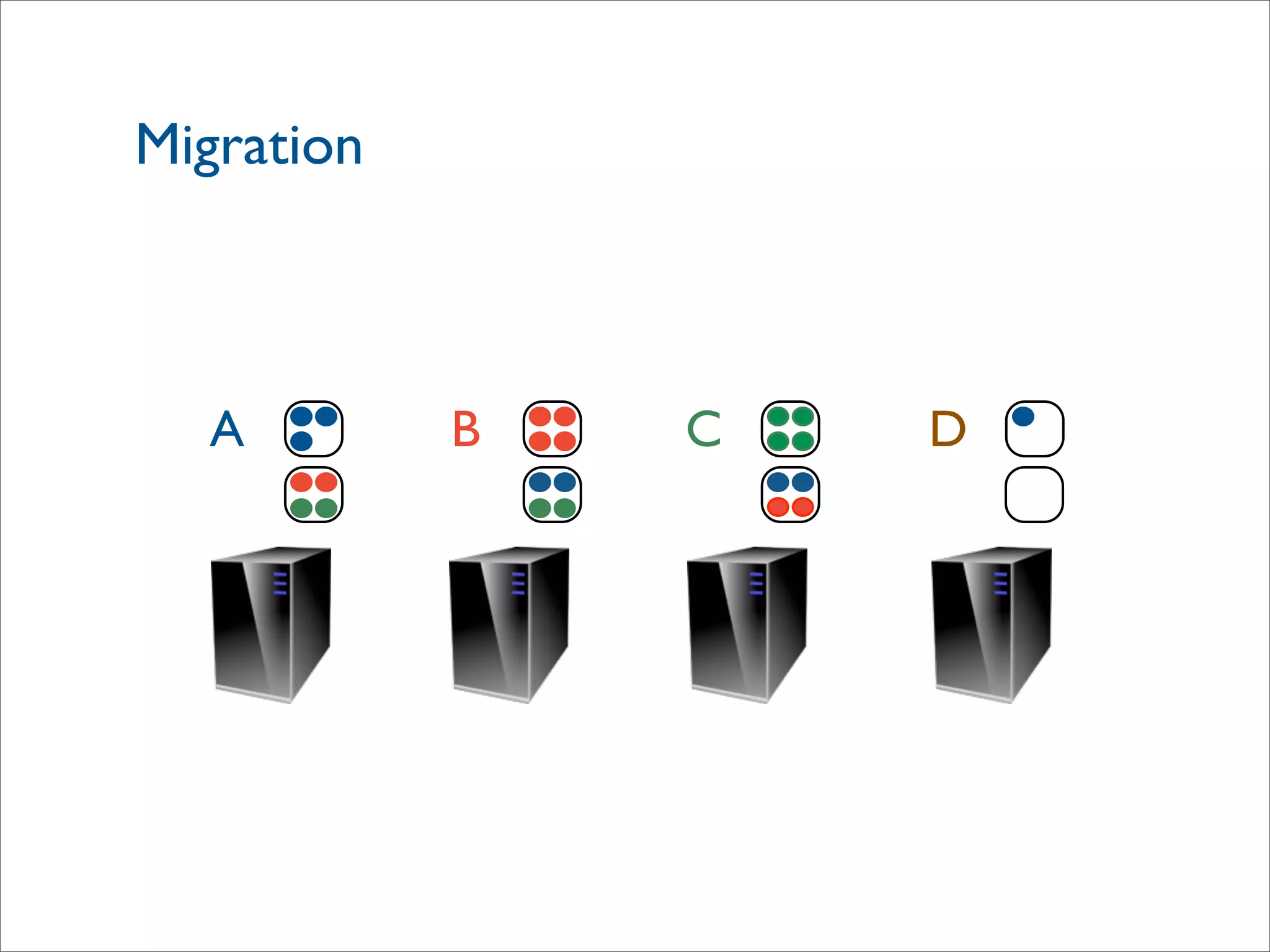
Migration
DA B C
Migration
DA B C
Migration
DA B C
Migration
DA B C
Migration
DA B C
Migration
DA B C
Migration Complete
DA B C
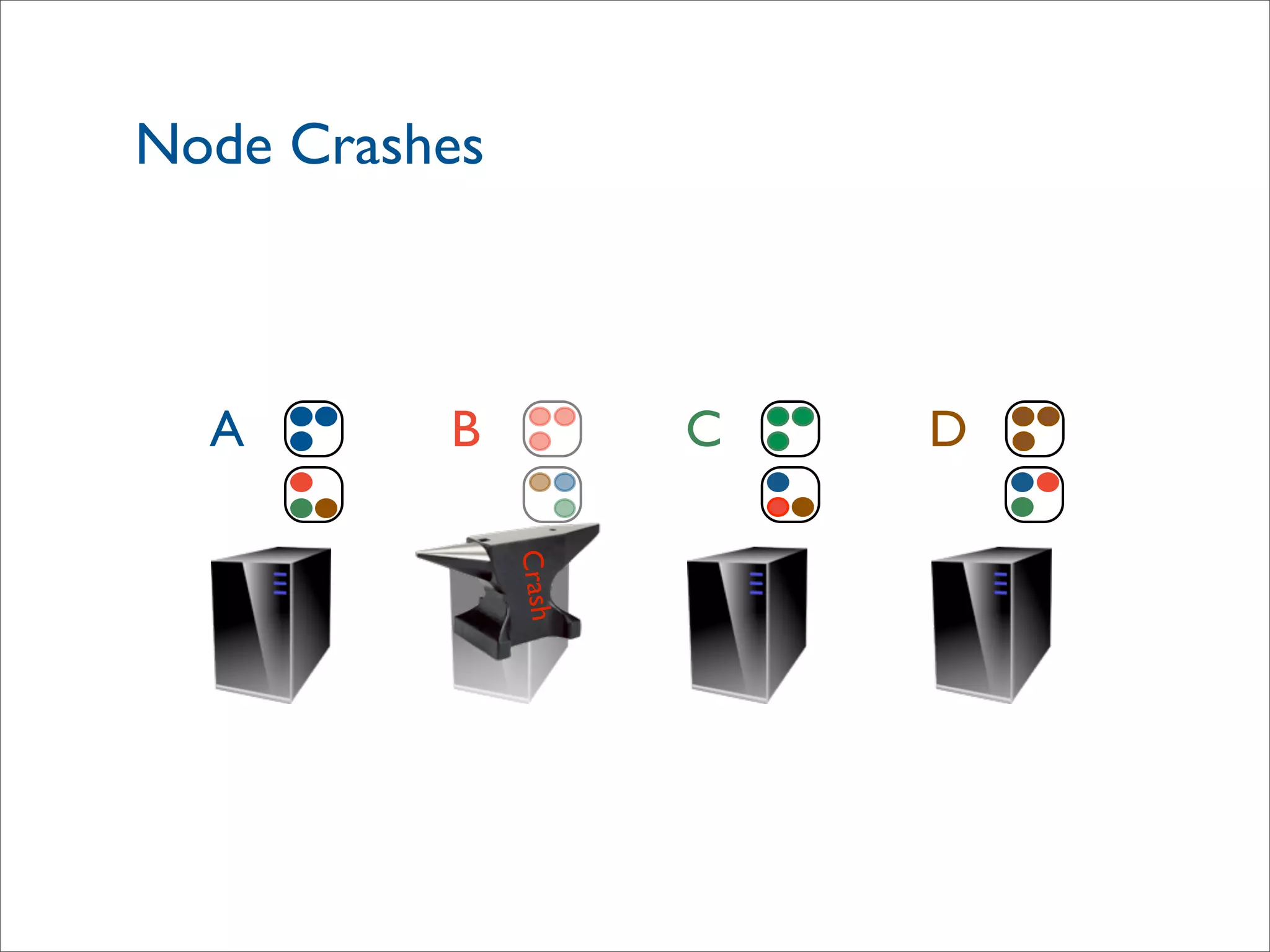
Node Crashes
DA B C
Crash
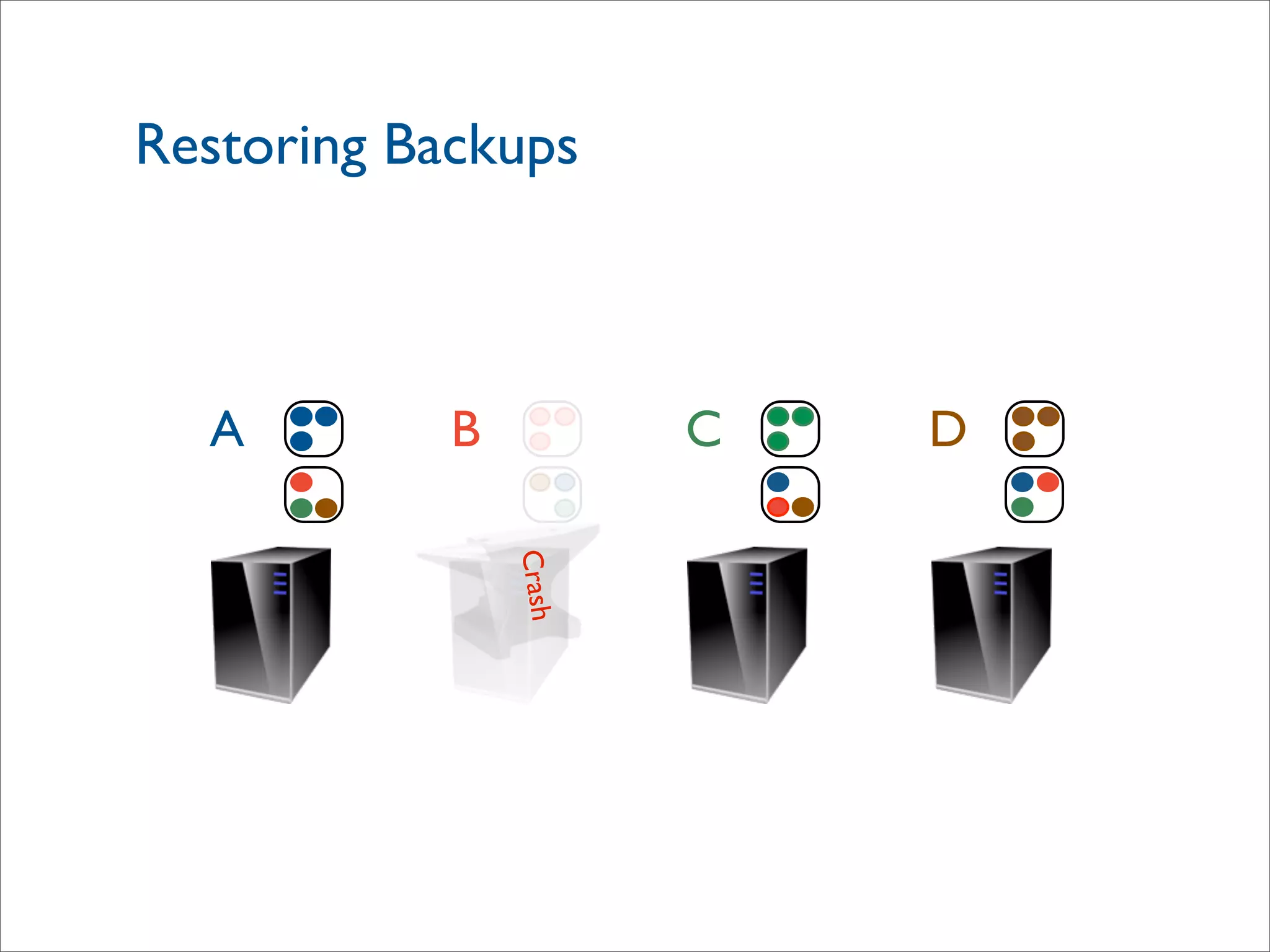
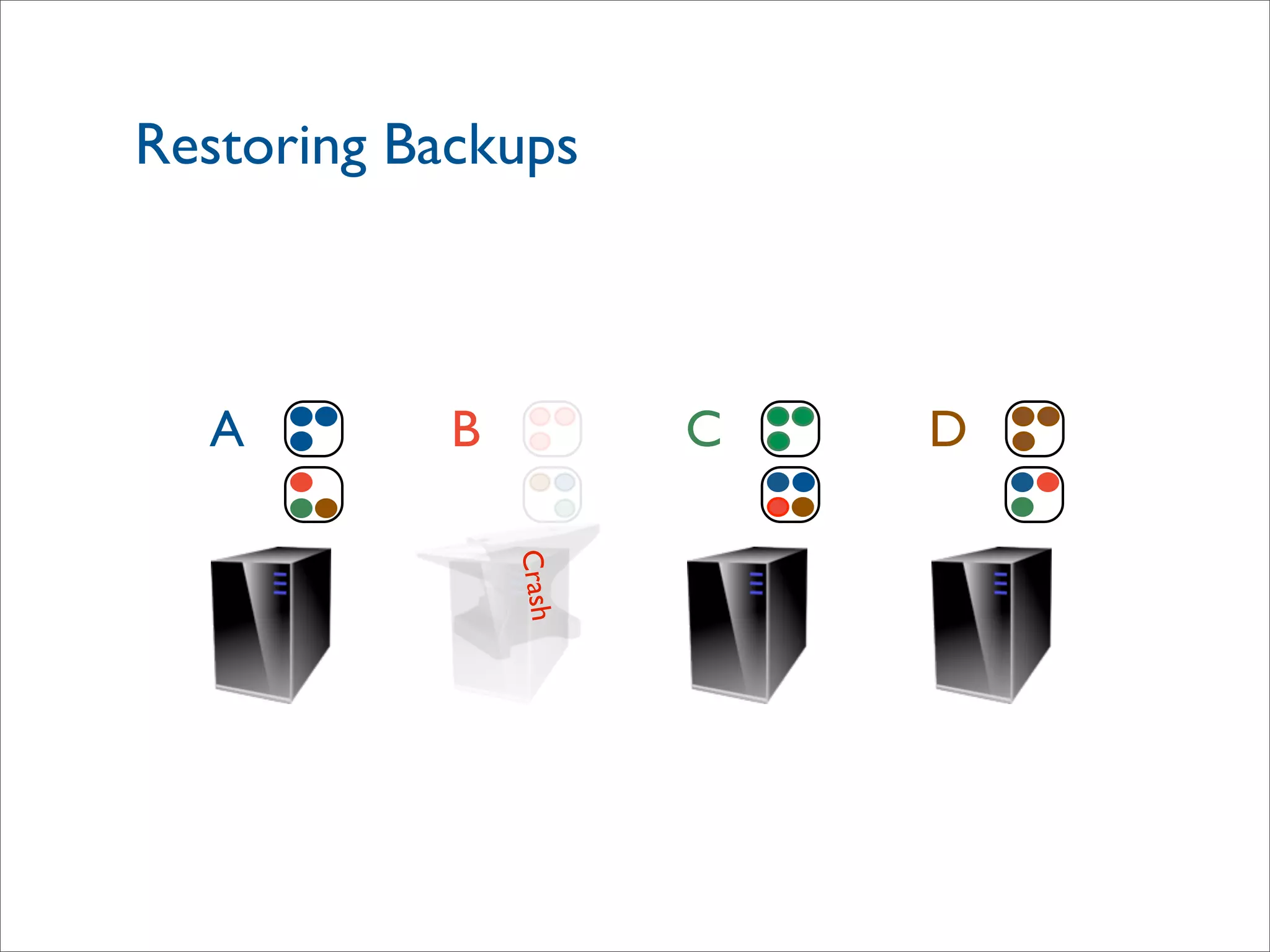
Restoring Backups
DA B C
Crash
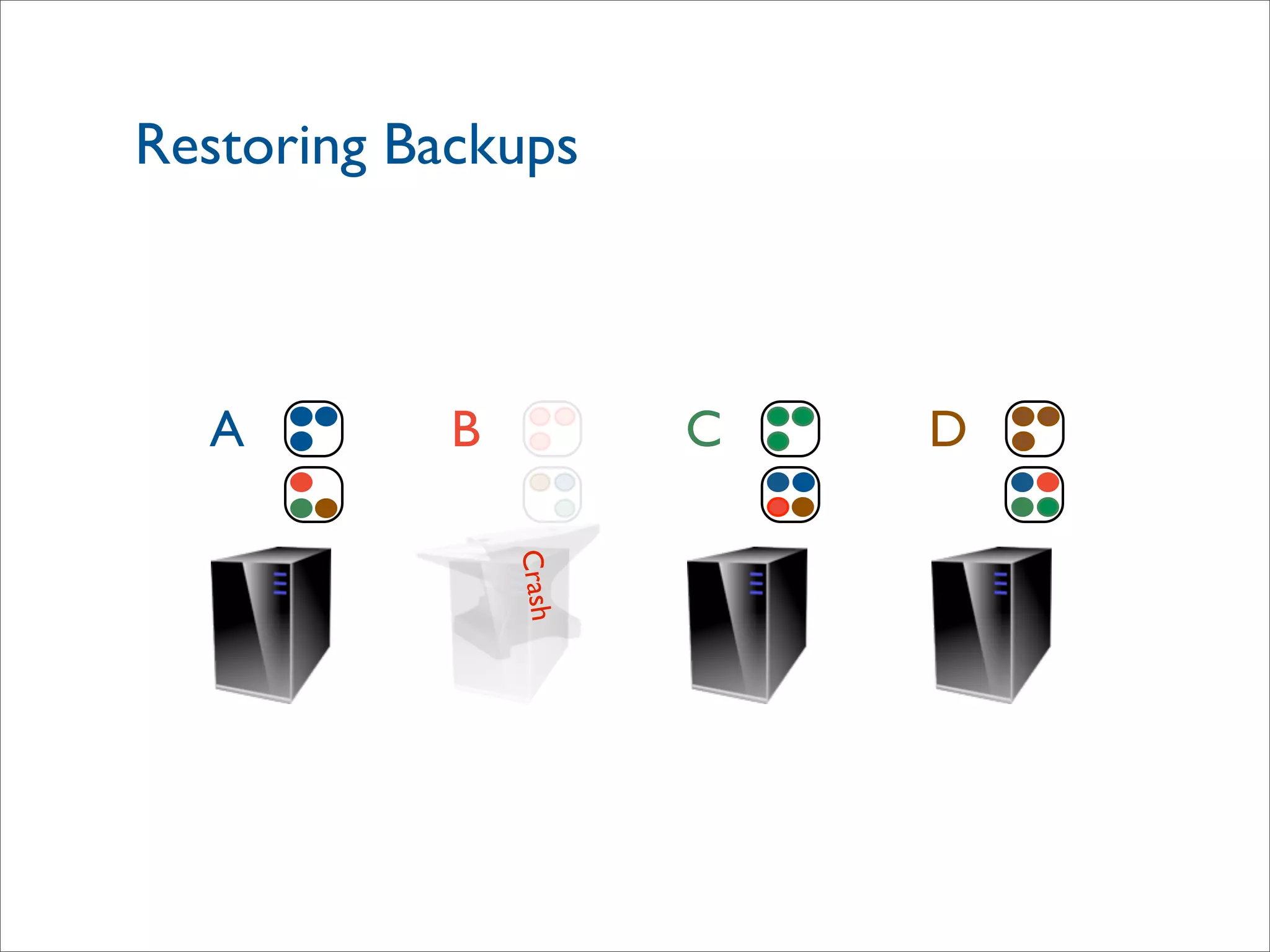
Restoring Backups
DA B C
Crash
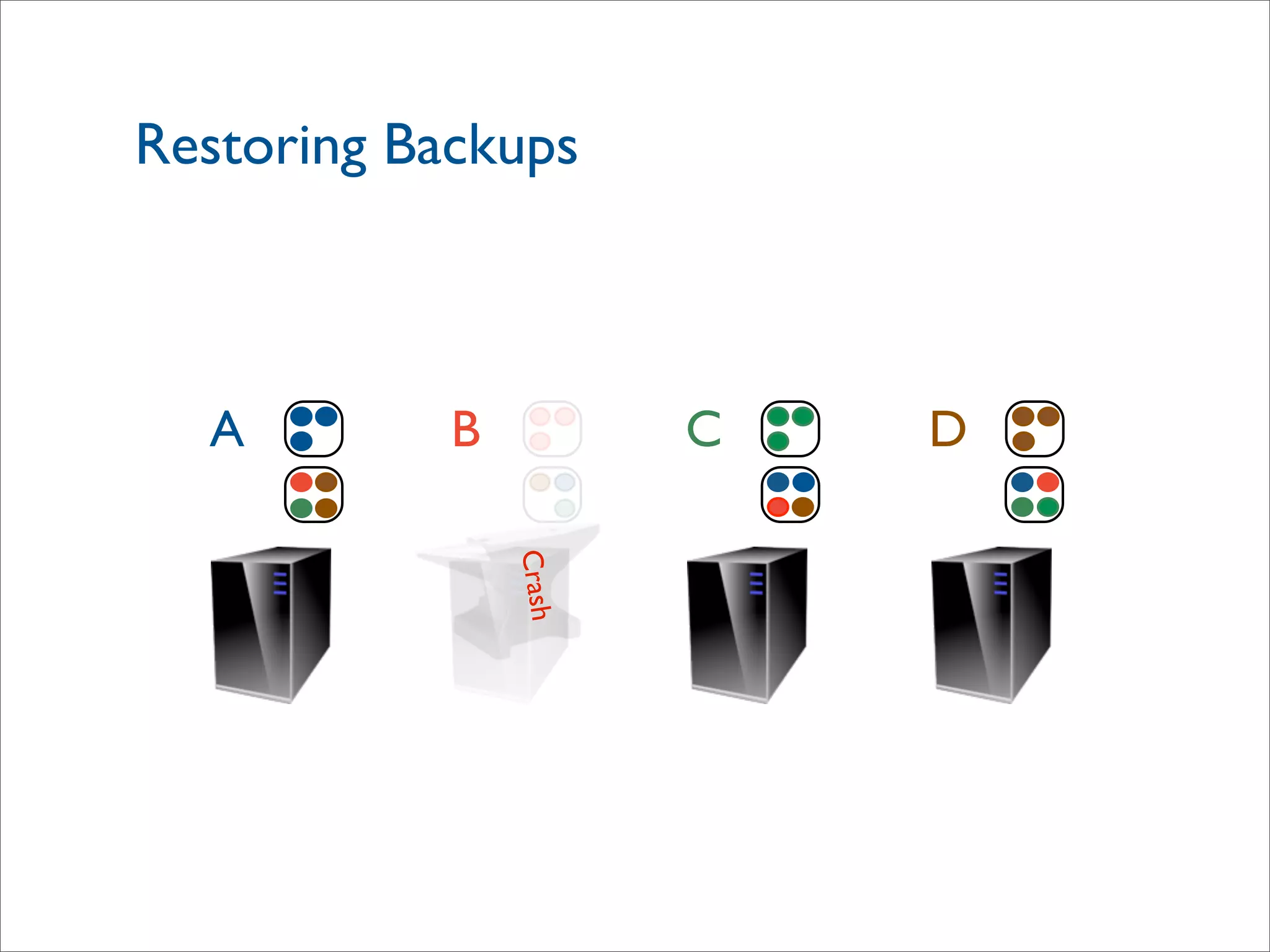
Restoring Backups
DA B C
Crash
Restoring Backups
DA B C
Crash
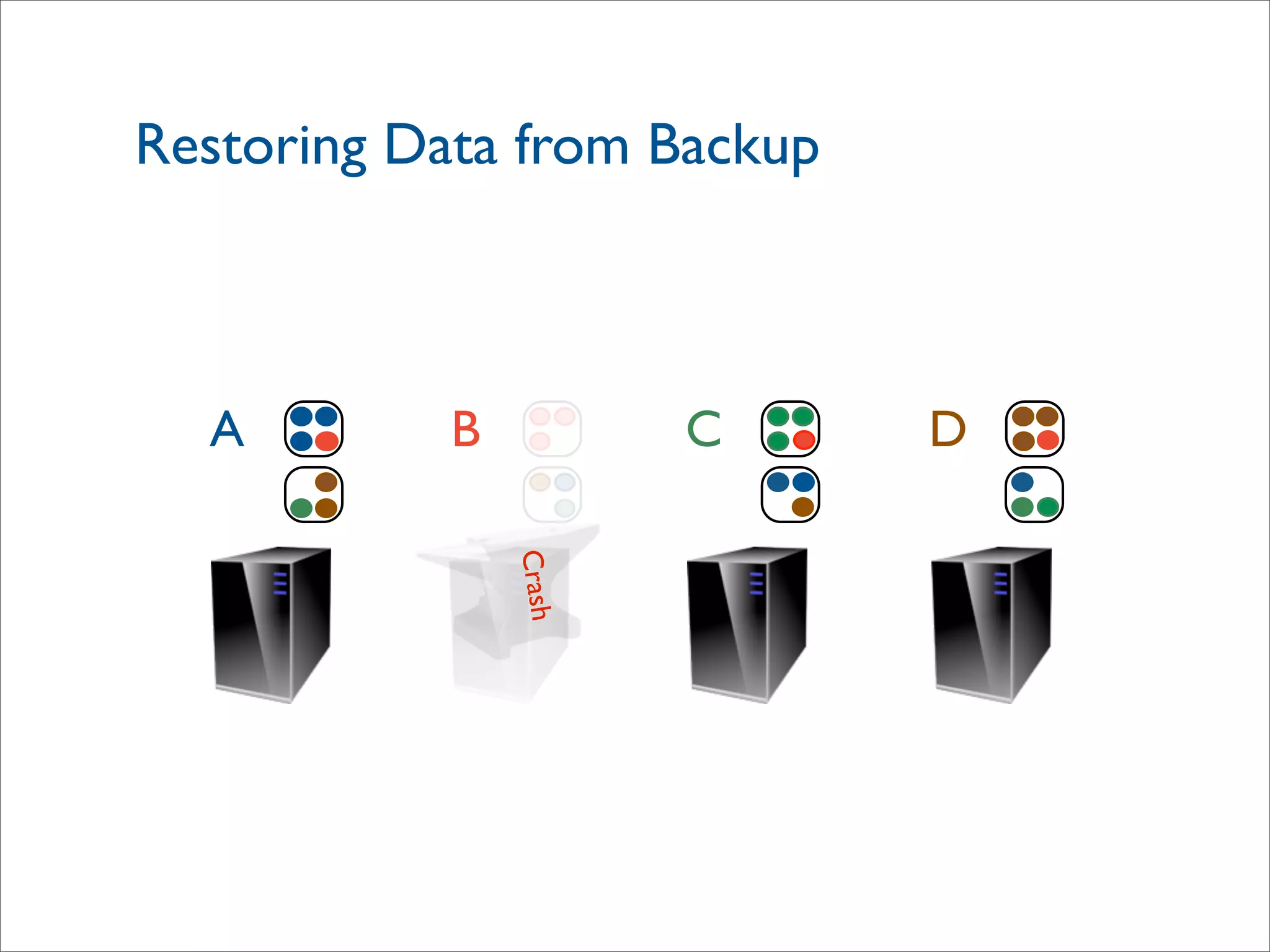
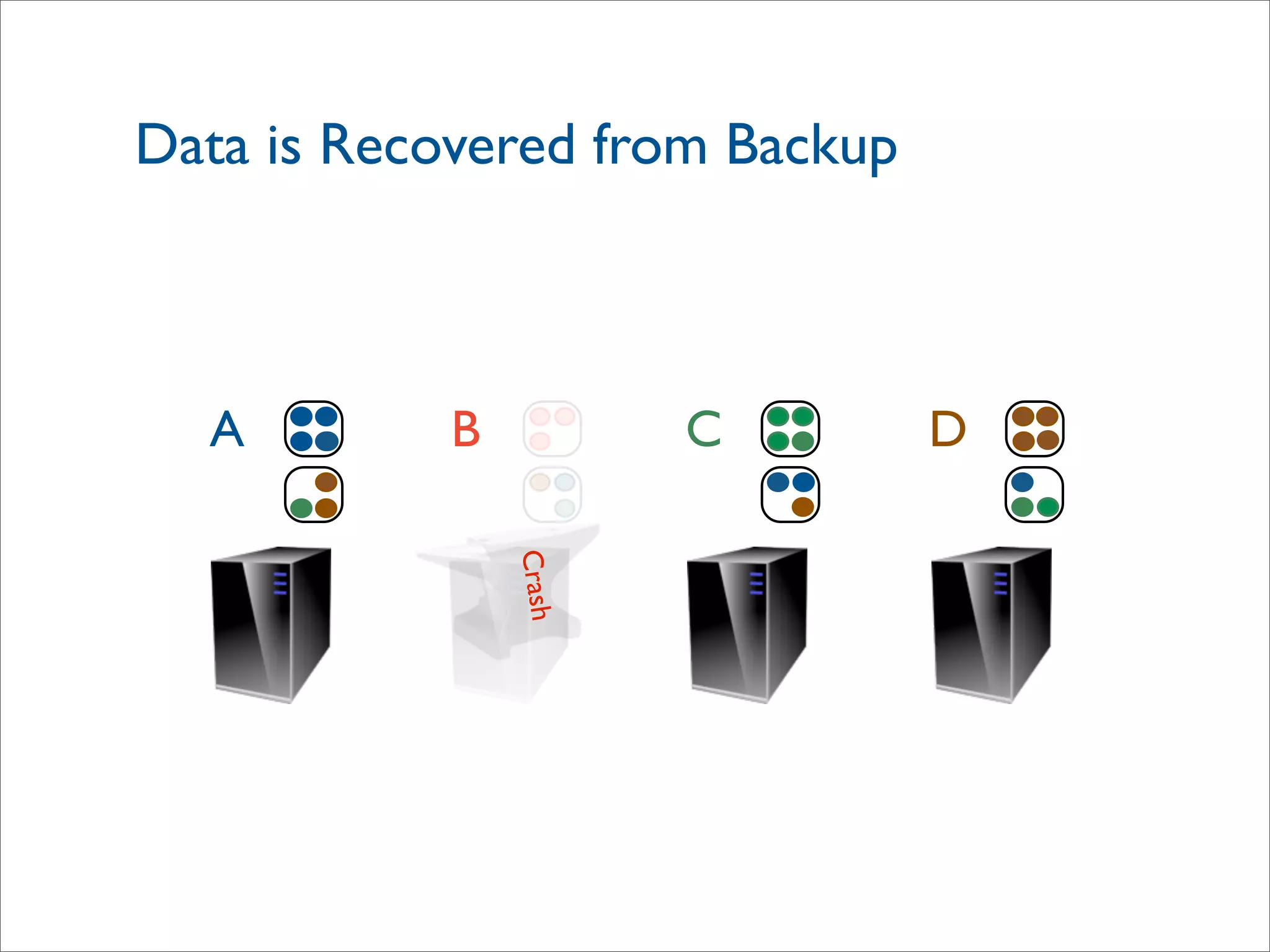
Restoring Data from Backup
DA B C
Crash
Data is Recovered from Backup
DA B C
Crash
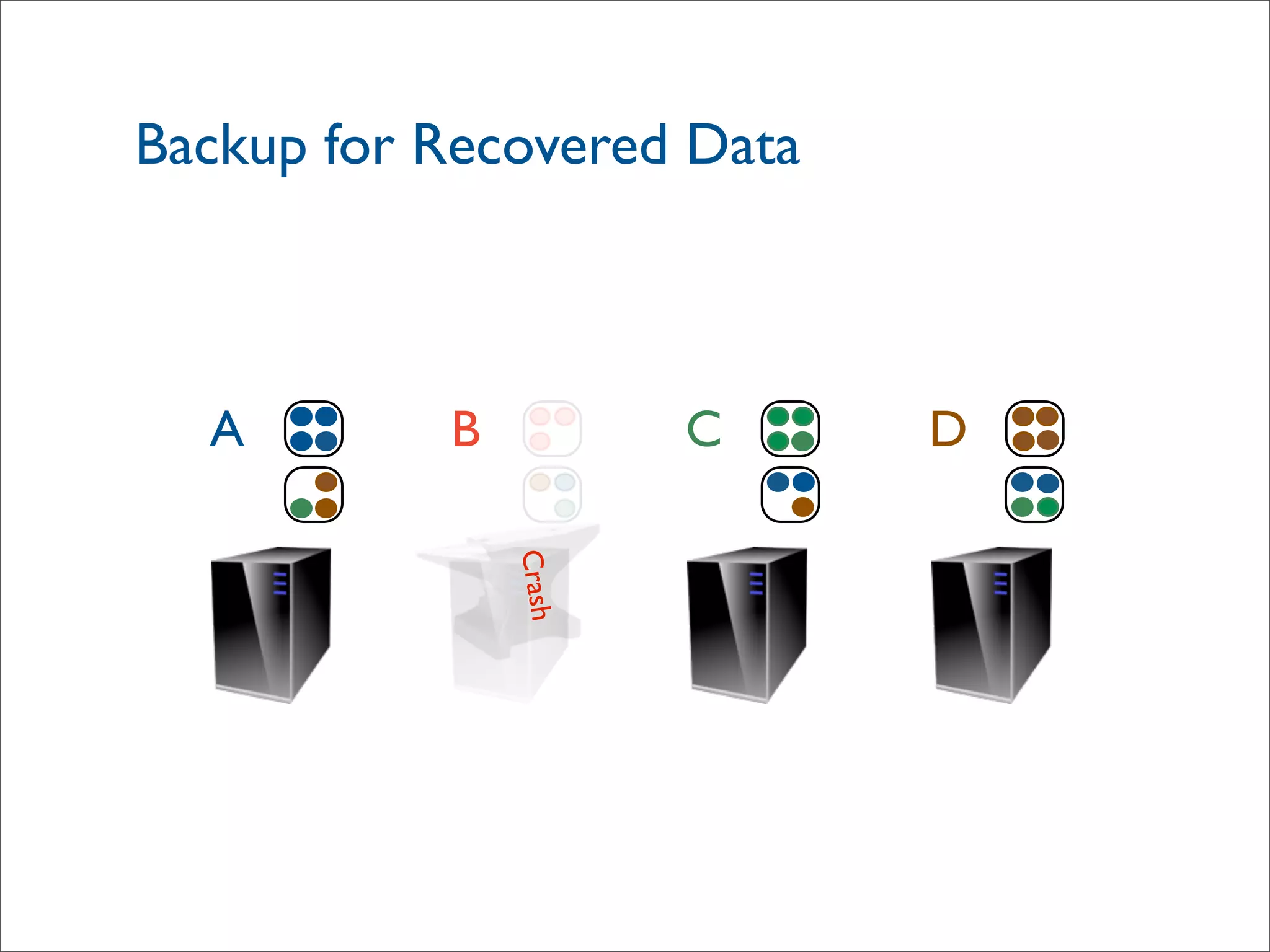
Backup for Recovered Data
DA B C
Crash
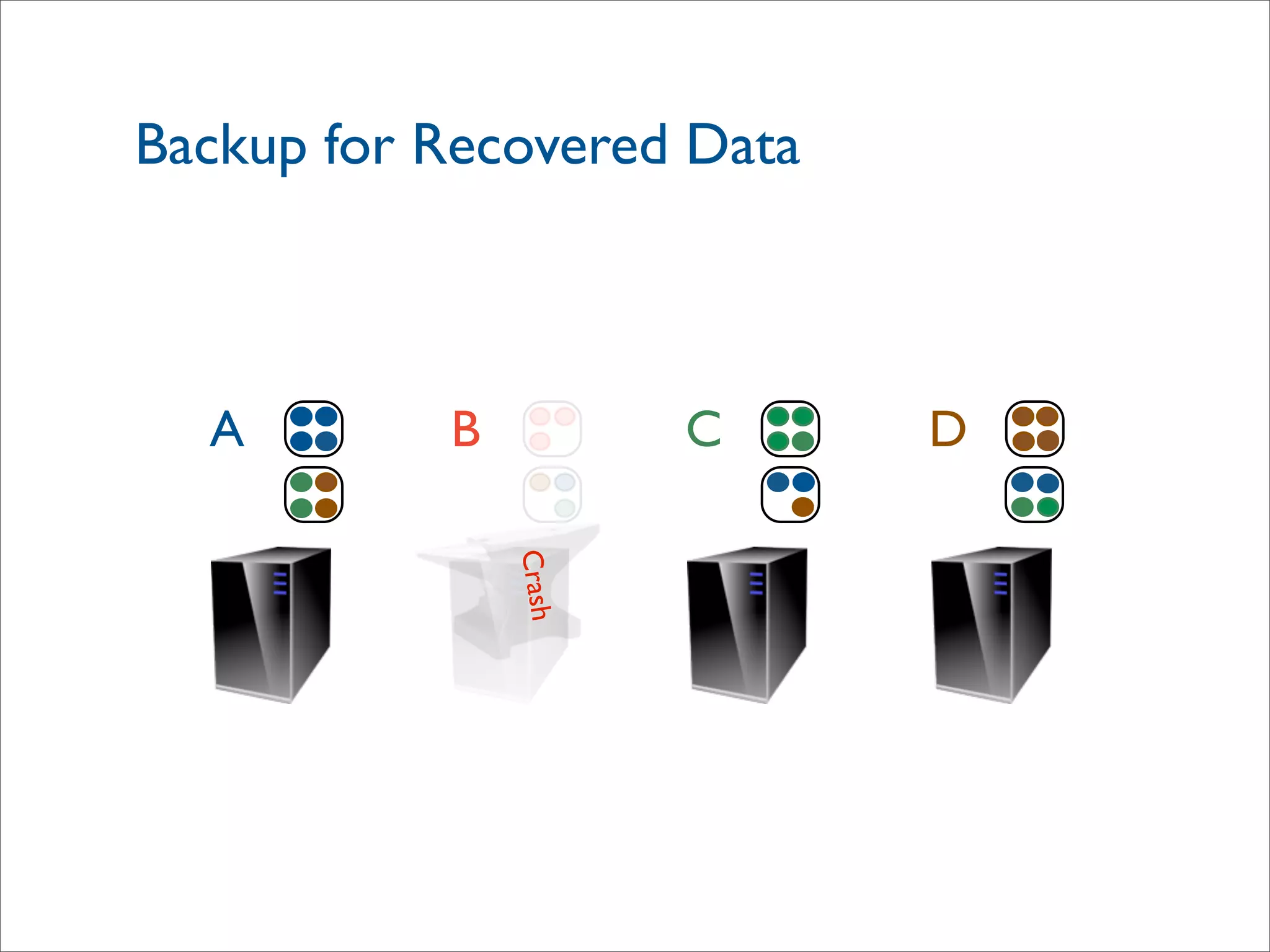
Backup for Recovered Data
DA B C
Crash
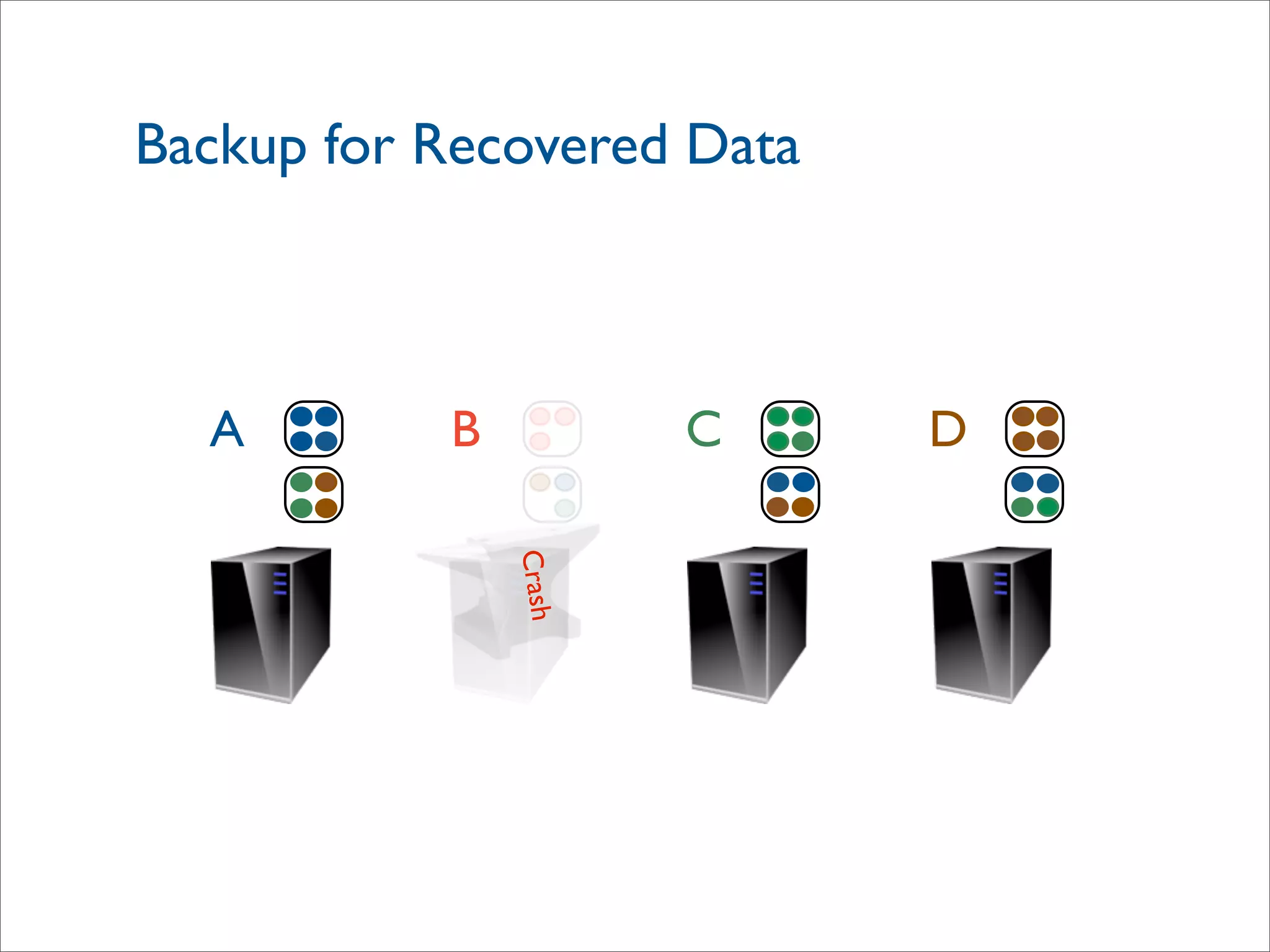
Backup for Recovered Data
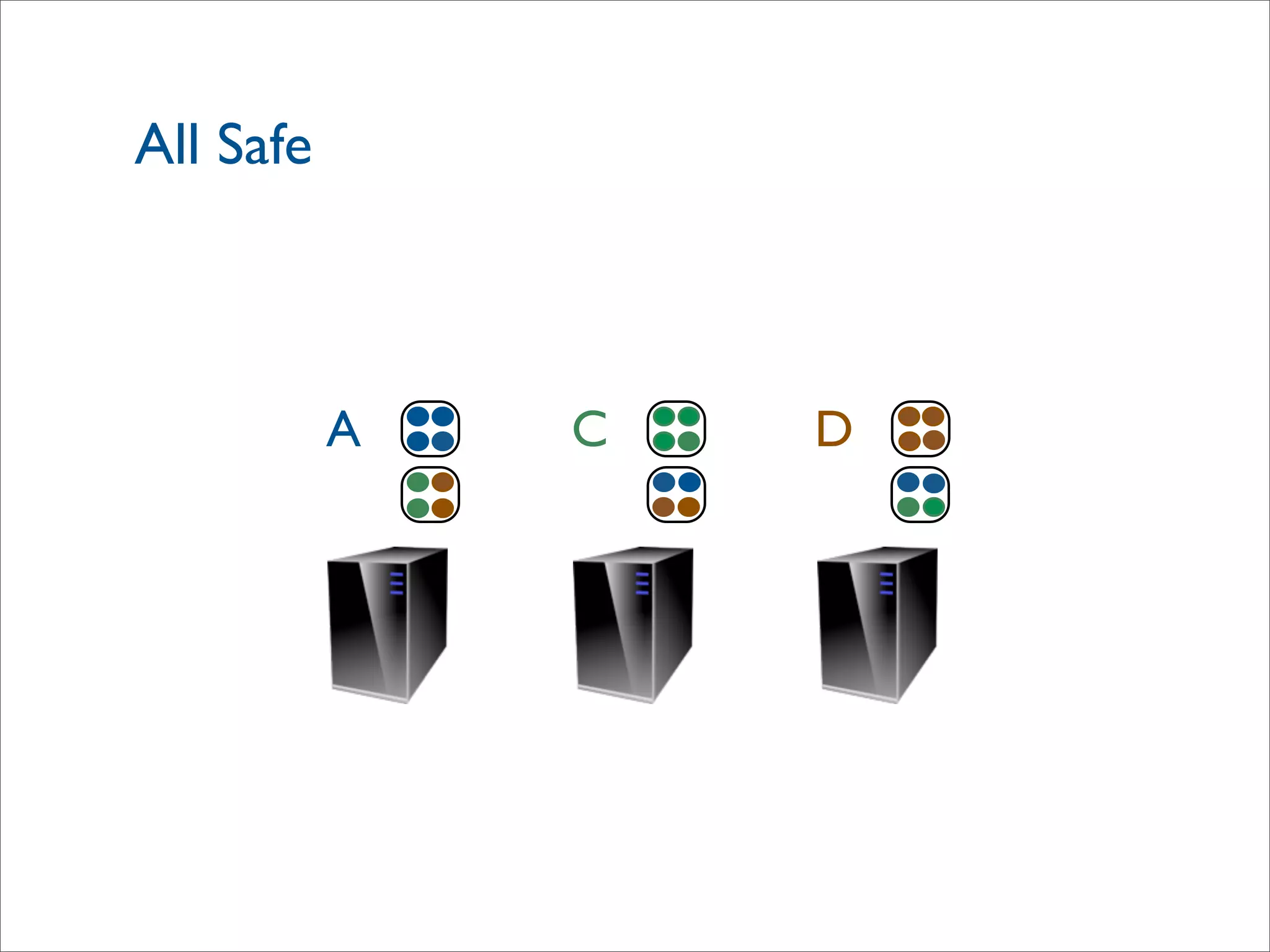
DA B C
Crash
All Safe
DA C
Node Types
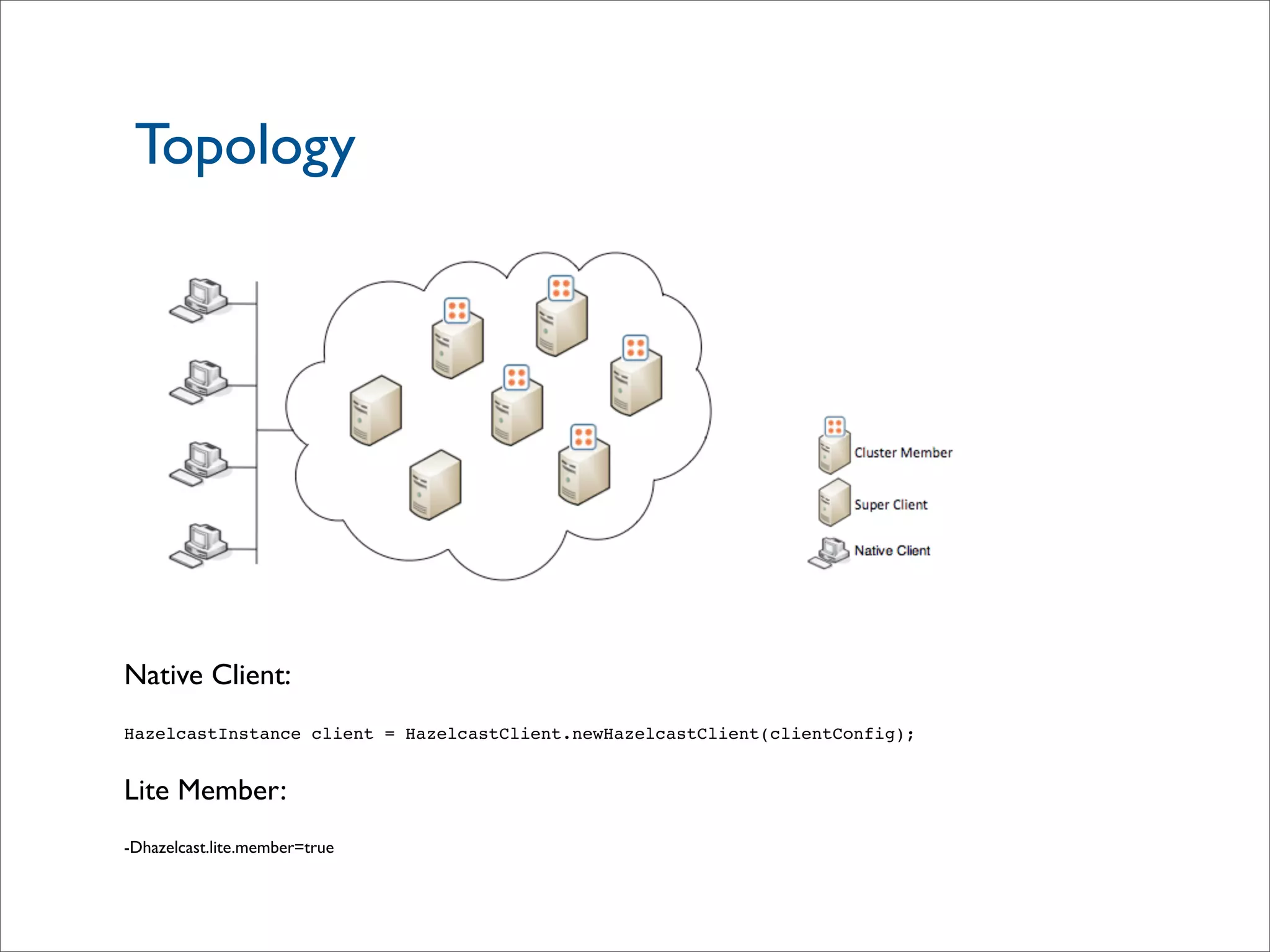
Topology
Native Client:
HazelcastInstance client = HazelcastClient.newHazelcastClient(clientConfig);
Lite Member:
-Dhazelcast.lite.member=true
Hazelcast
Enterprise
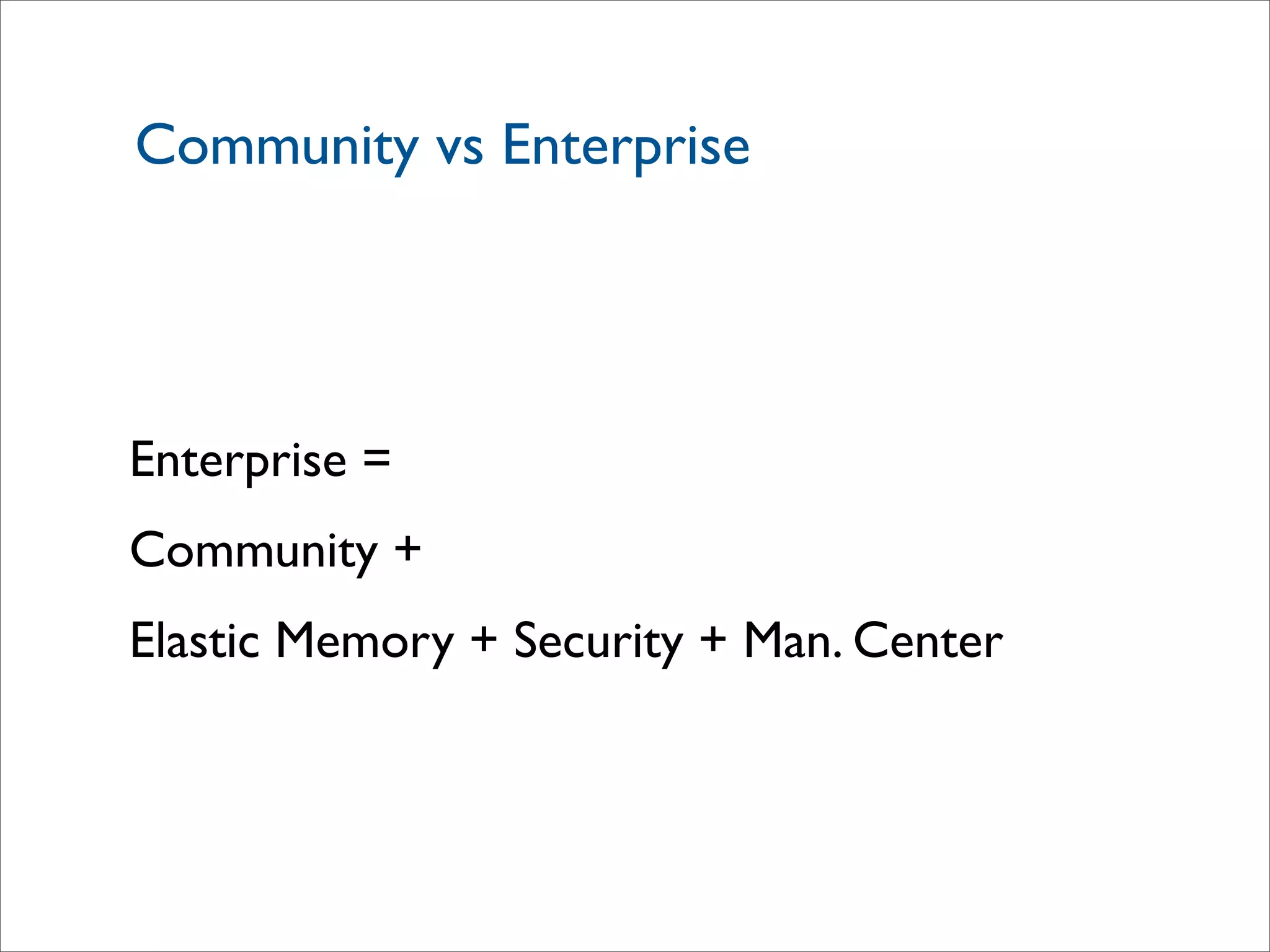
Community vs Enterprise
Enterprise =
Community +
Elastic Memory + Security + Man. Center
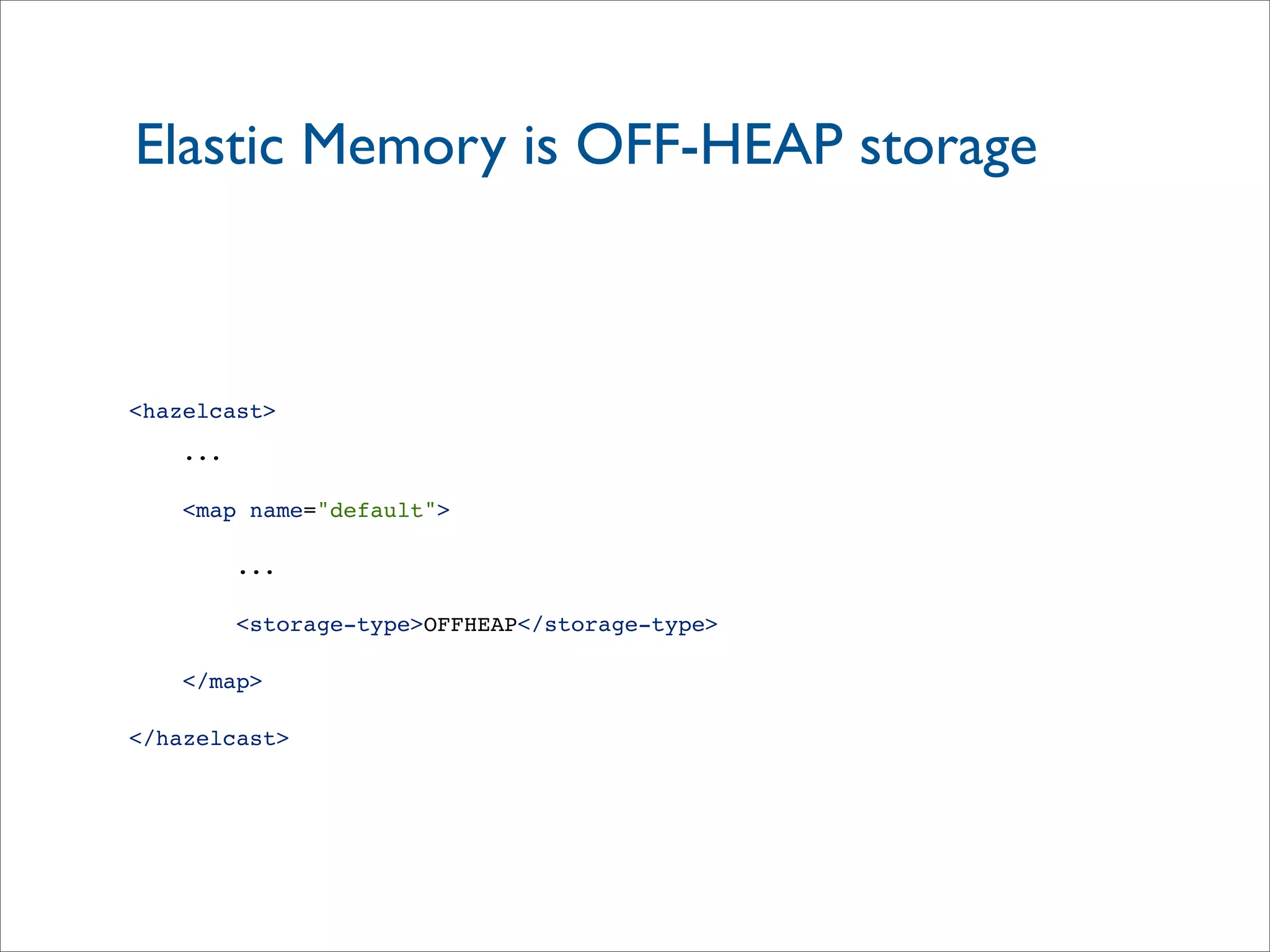
Elastic Memory is OFF-HEAP storage
<hazelcast>
...
<map name="default">
...
<storage-type>OFFHEAP</storage-type>
</map>
</hazelcast>
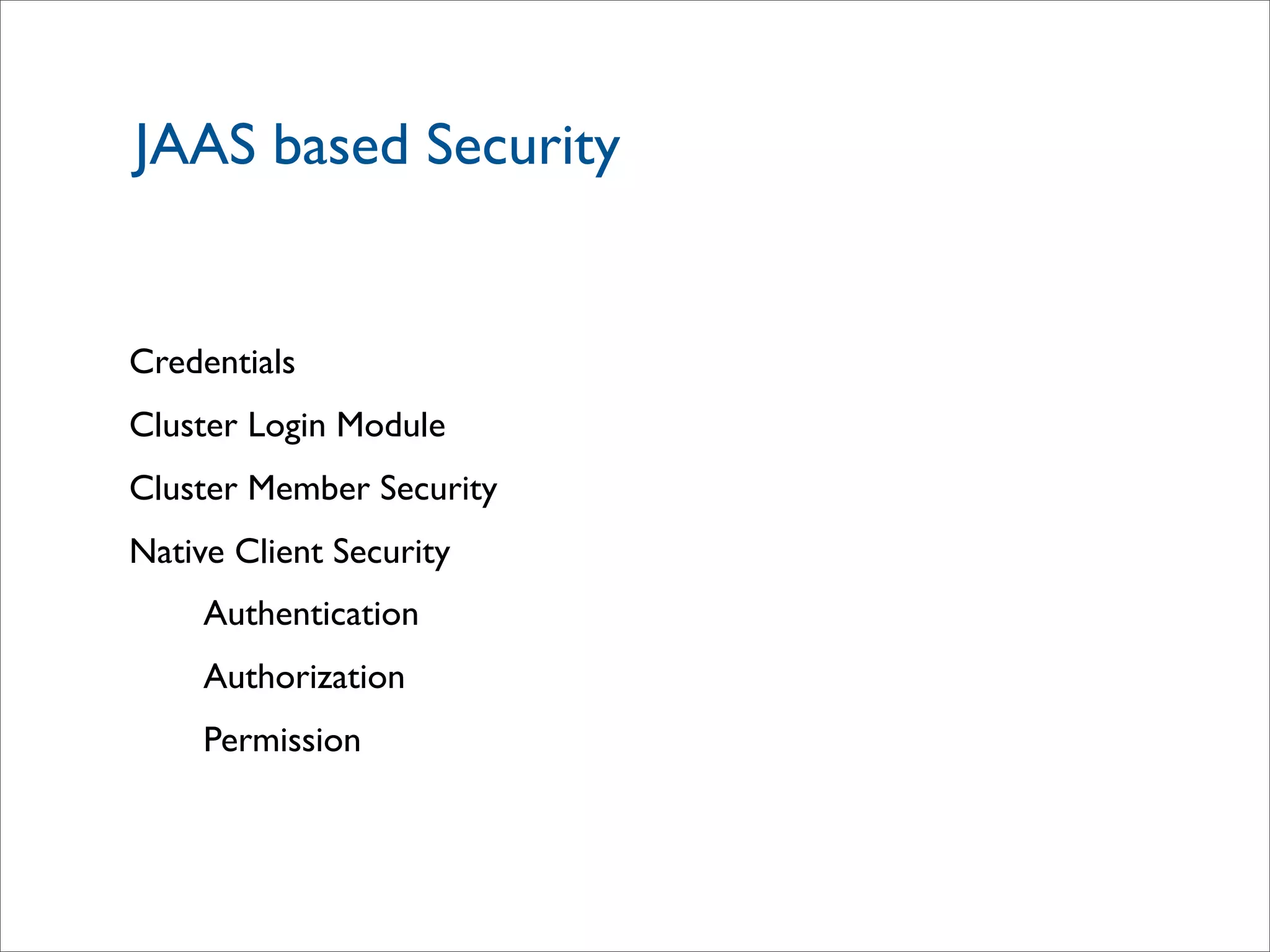
JAAS based Security
Credentials
Cluster Login Module
Cluster Member Security
Native Client Security
Authentication
Authorization
Permission
Code Samples
Hazelcast
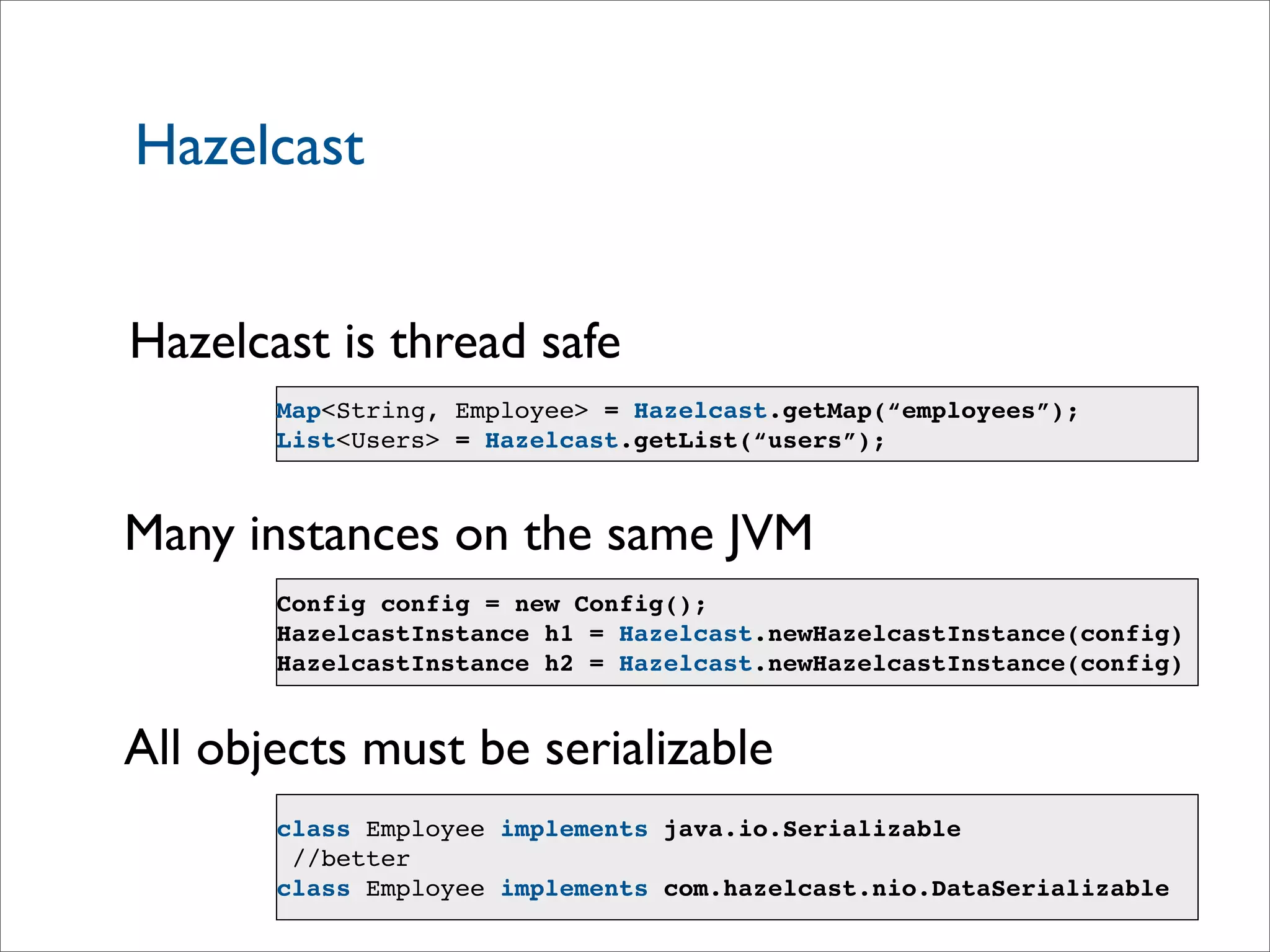
Hazelcast is thread safe
Many instances on the same JVM
Config config = new Config();
HazelcastInstance h1 = Hazelcast.newHazelcastInstance(config)
HazelcastInstance h2 = Hazelcast.newHazelcastInstance(config)
All objects must be serializable
class Employee implements java.io.Serializable
//better
class Employee implements com.hazelcast.nio.DataSerializable
Map<String, Employee> = Hazelcast.getMap(“employees”);
List<Users> = Hazelcast.getList(“users”);
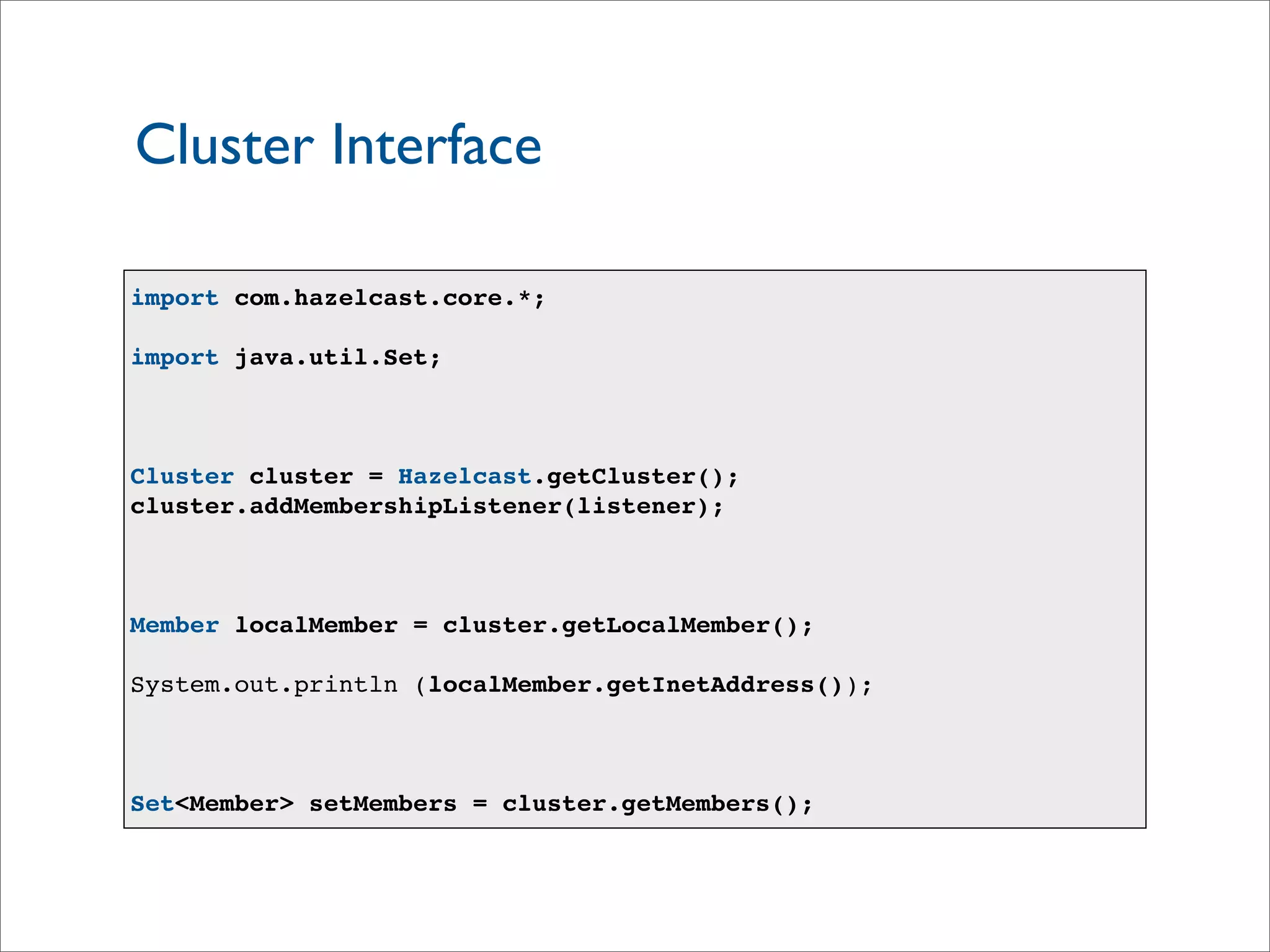
Cluster Interface
import com.hazelcast.core.*;
import java.util.Set;
Cluster cluster = Hazelcast.getCluster();
cluster.addMembershipListener(listener);
Member localMember = cluster.getLocalMember();
System.out.println (localMember.getInetAddress());
Set<Member> setMembers = cluster.getMembers();
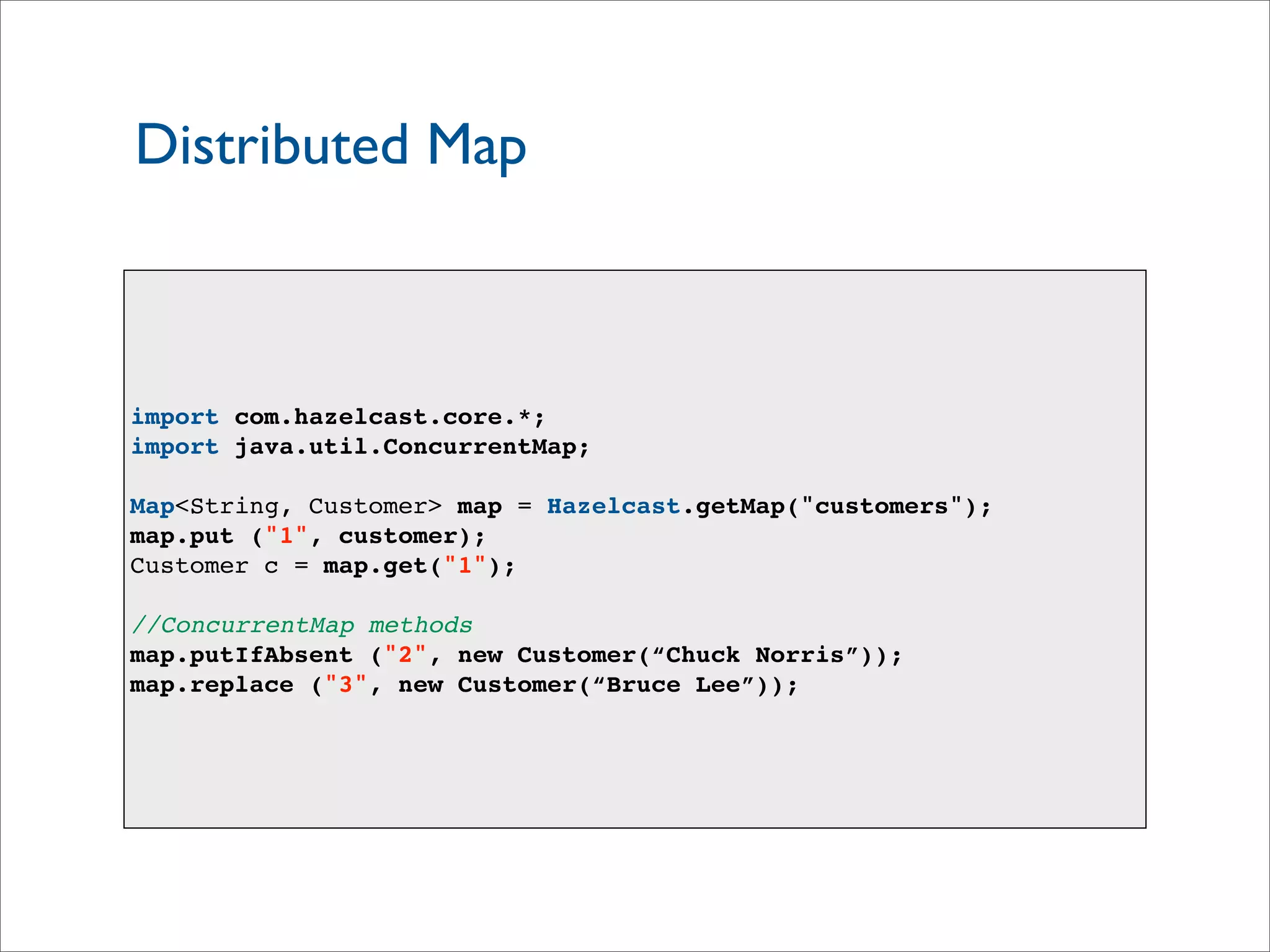
Distributed Map
import com.hazelcast.core.*;
import java.util.ConcurrentMap;
Map<String, Customer> map = Hazelcast.getMap("customers");
map.put ("1", customer);
Customer c = map.get("1");
//ConcurrentMap methods
map.putIfAbsent ("2", new Customer(“Chuck Norris”));
map.replace ("3", new Customer(“Bruce Lee”));
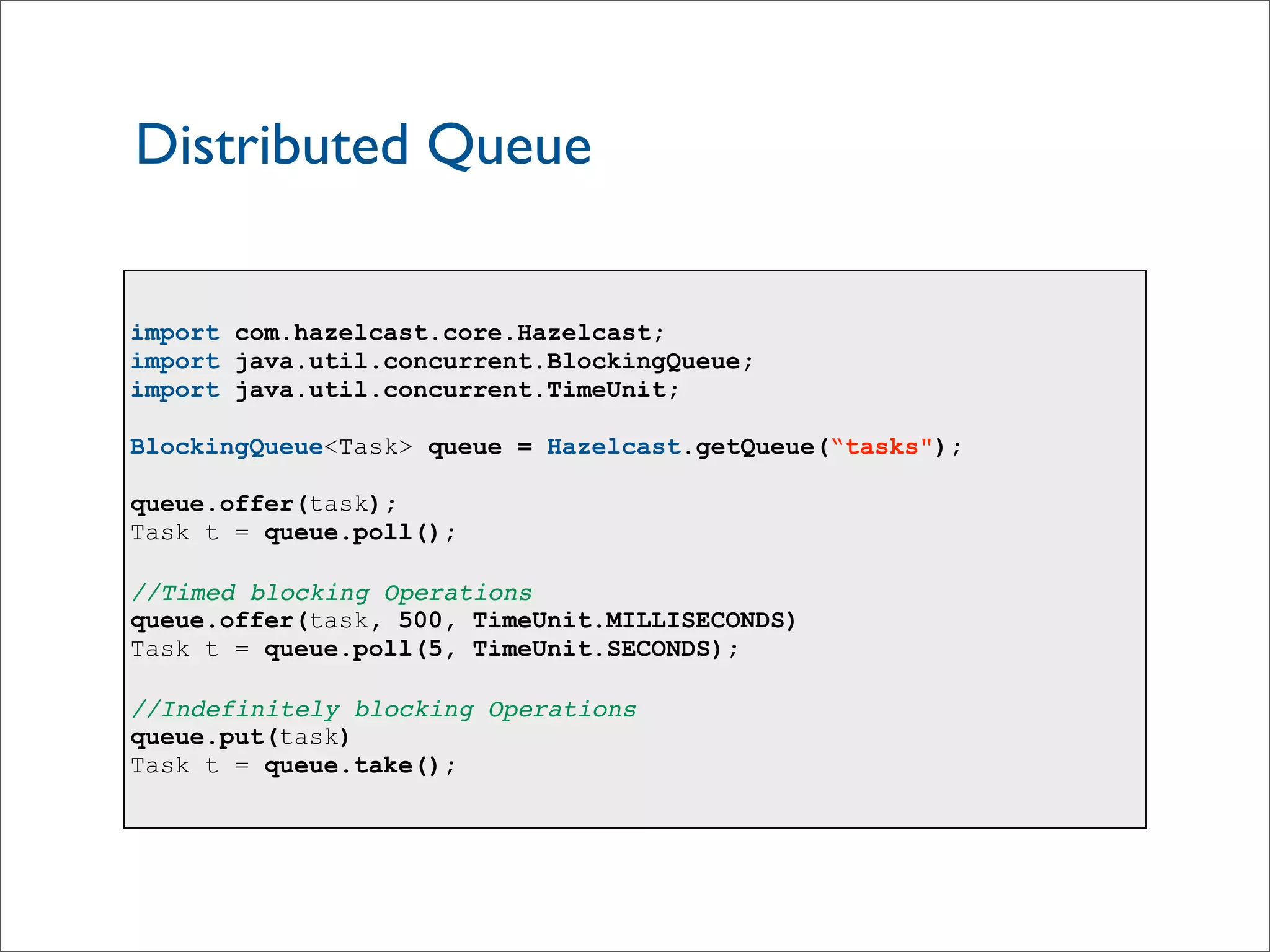
Distributed Queue
import com.hazelcast.core.Hazelcast;
import java.util.concurrent.BlockingQueue;
import java.util.concurrent.TimeUnit;
BlockingQueue<Task> queue = Hazelcast.getQueue(“tasks");
queue.offer(task);
Task t = queue.poll();
//Timed blocking Operations
queue.offer(task, 500, TimeUnit.MILLISECONDS)
Task t = queue.poll(5, TimeUnit.SECONDS);
//Indefinitely blocking Operations
queue.put(task)
Task t = queue.take();
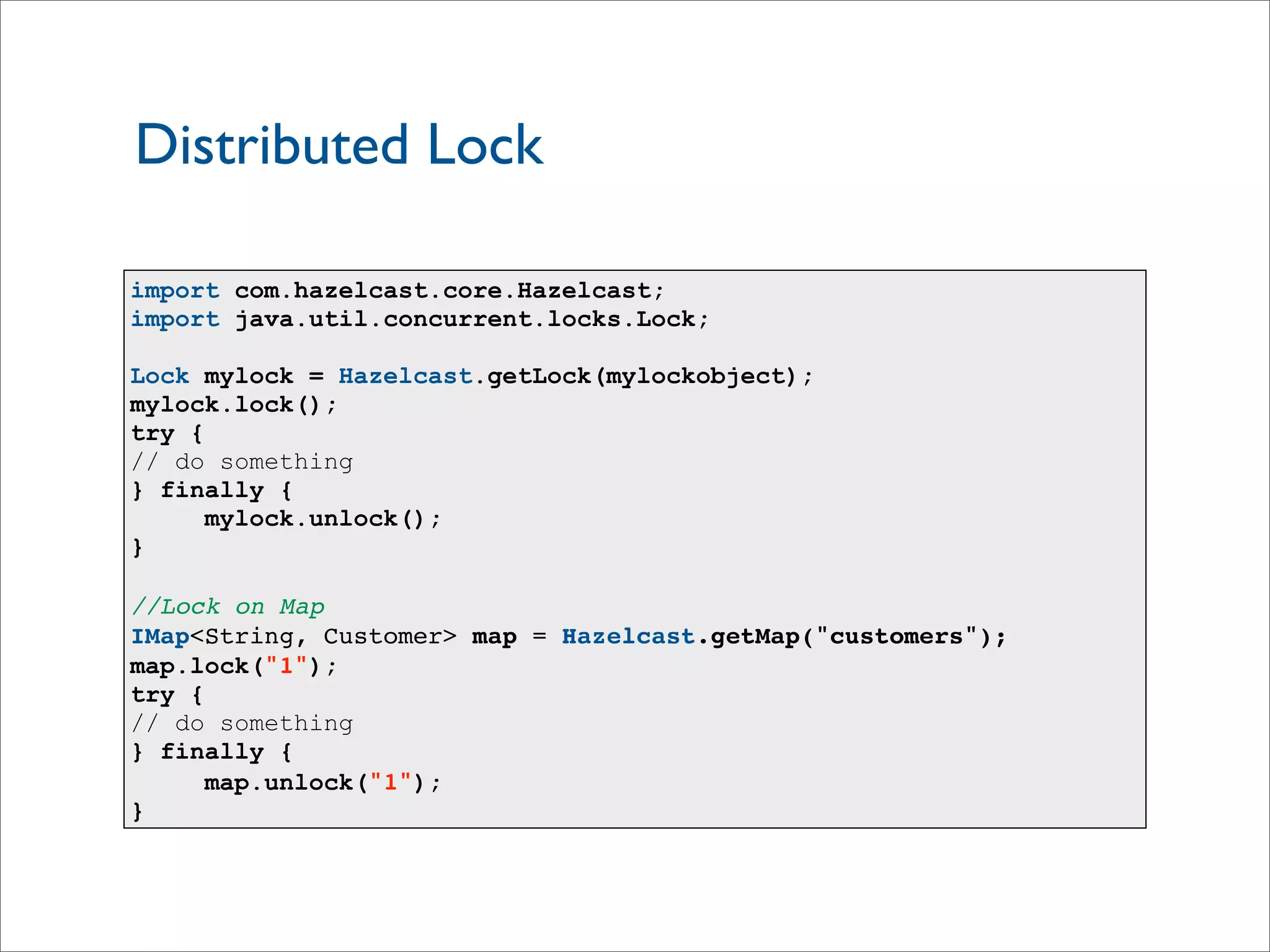
Distributed Lock
import com.hazelcast.core.Hazelcast;
import java.util.concurrent.locks.Lock;
Lock mylock = Hazelcast.getLock(mylockobject);
mylock.lock();
try {
// do something
} finally {
mylock.unlock();
}
//Lock on Map
IMap<String, Customer> map = Hazelcast.getMap("customers");
map.lock("1");
try {
// do something
} finally {
map.unlock("1");
}
Distributed Topic
import com.hazelcast.core.*;
public class Sample implements MessageListener {
public static void main(String[] args) {
Sample sample = new Sample();
ITopic<String> topic = Hazelcast.getTopic ("default");
topic.addMessageListener(sample);
topic.publish ("my-message-object");
}
public void onMessage(Object msg) {
System.out.println("Got msg :" + msg);
}
}
Distributed Events
import com.hazelcast.core.*;
public class Sample implements EntryListener {
public static void main(String[] args) {
Sample sample = new Sample();
IMap map = Hazelcast.getMap ("default");
map.addEntryListener (sample, true);
map.addEntryListener (sample, "key");
}
public void entryAdded(EntryEvent event) {
System.out.println("Added " + event.getKey() + ":" +
event.getValue());
}
public void entryRemoved(EntryEvent event) {
System.out.println("Removed " + event.getKey() + ":" +
event.getValue());
}
public void entryUpdated(EntryEvent event) {
System.out.println("Updated " + event.getKey() + ":" +
event.getValue());
}
}
Executor Service
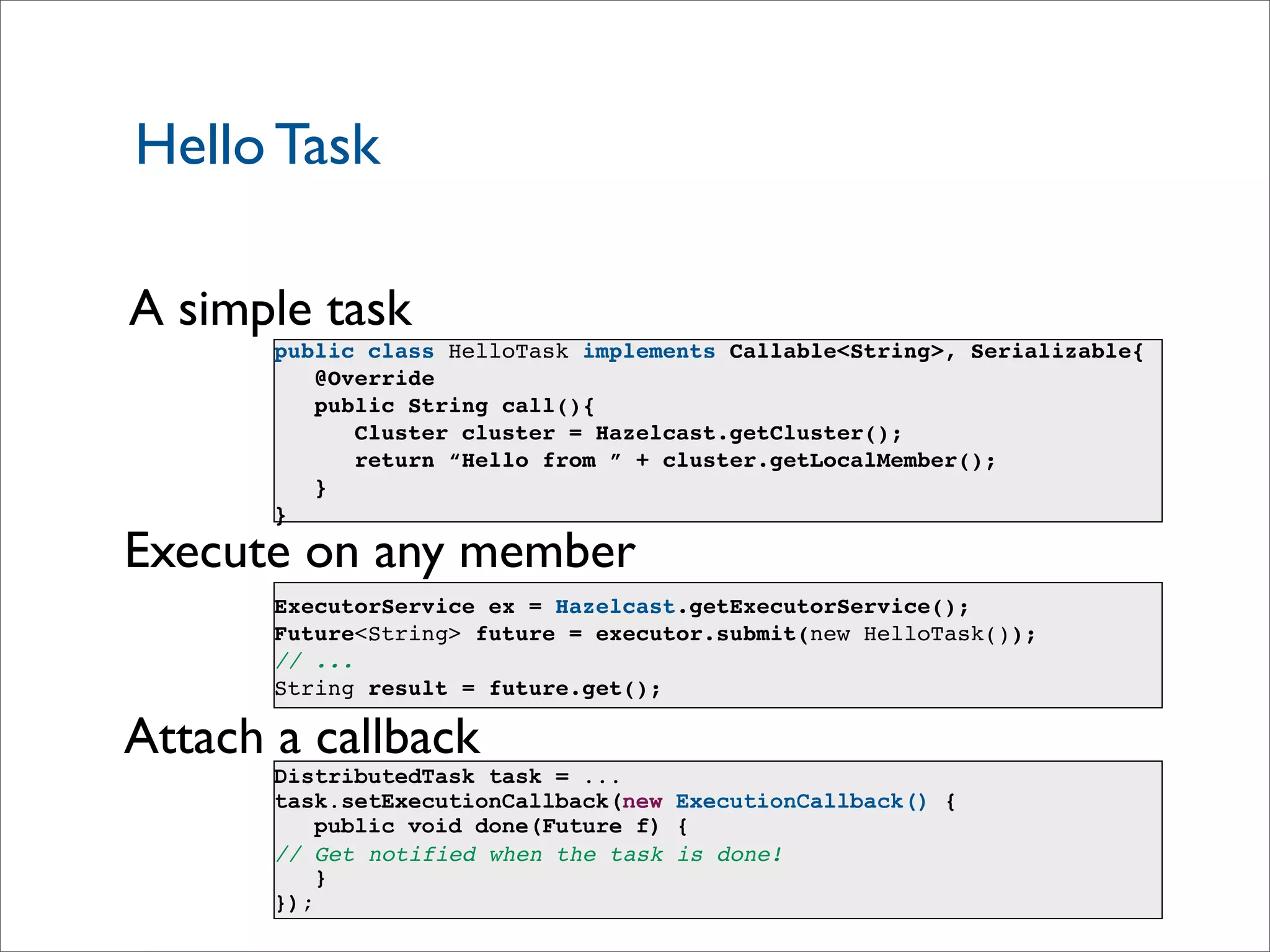
Hello Task
A simple task
Execute on any member
ExecutorService ex = Hazelcast.getExecutorService();
Future<String> future = executor.submit(new HelloTask());
// ...
String result = future.get();
Attach a callback
DistributedTask task = ...
task.setExecutionCallback(new ExecutionCallback() {
public void done(Future f) {
// Get notified when the task is done!
}
});
public class HelloTask implements Callable<String>, Serializable{
@Override
public String call(){
Cluster cluster = Hazelcast.getCluster();
return “Hello from ” + cluster.getLocalMember();
}
}
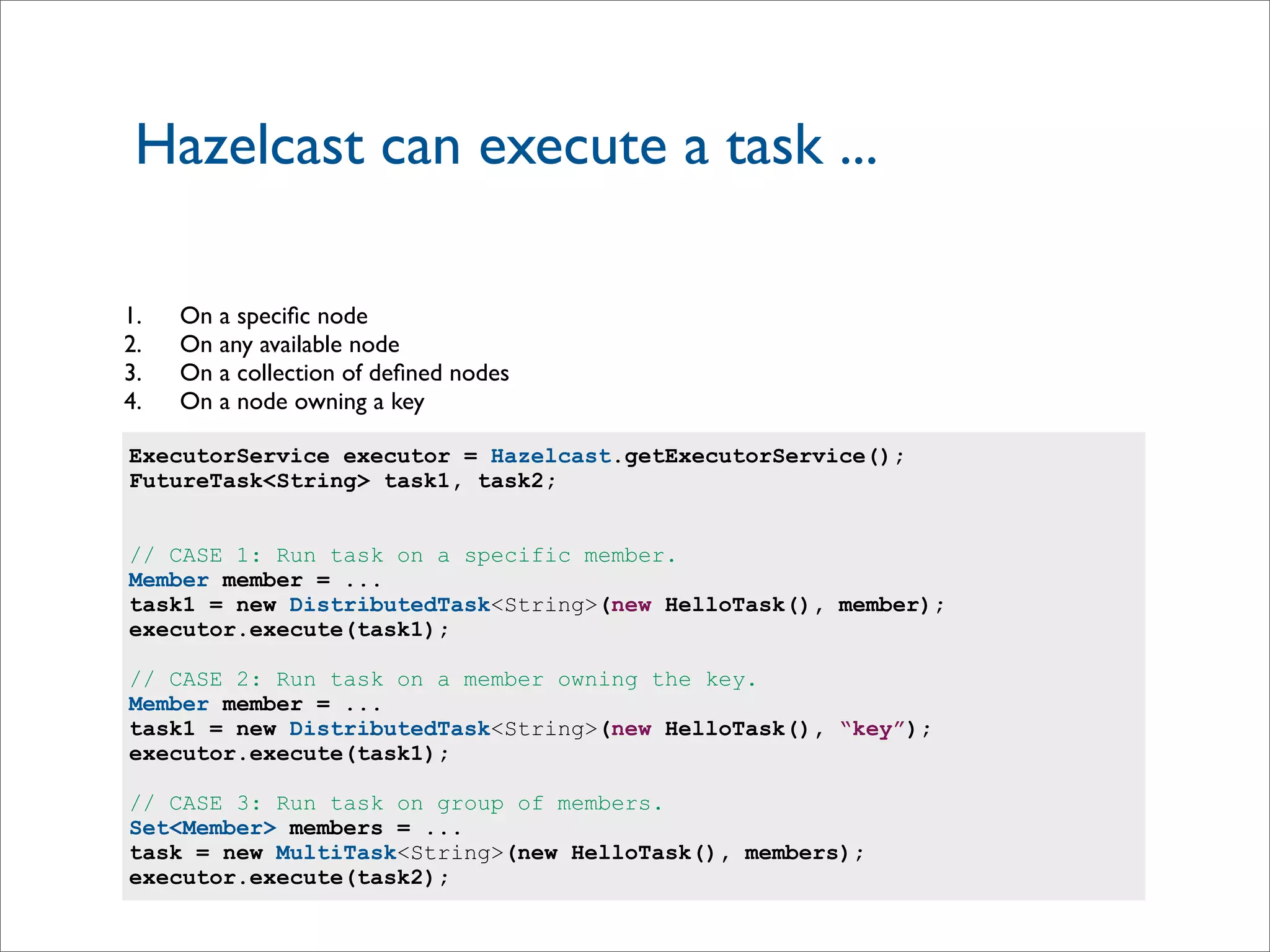
Hazelcast can execute a task ...
ExecutorService executor = Hazelcast.getExecutorService();
FutureTask<String> task1, task2;
// CASE 1: Run task on a specific member.
Member member = ...
task1 = new DistributedTask<String>(new HelloTask(), member);
executor.execute(task1);
// CASE 2: Run task on a member owning the key.
Member member = ...
task1 = new DistributedTask<String>(new HelloTask(), “key”);
executor.execute(task1);
// CASE 3: Run task on group of members.
Set<Member> members = ...
task = new MultiTask<String>(new HelloTask(), members);
executor.execute(task2);
1. On a specific node
2. On any available node
3. On a collection of defined nodes
4. On a node owning a key
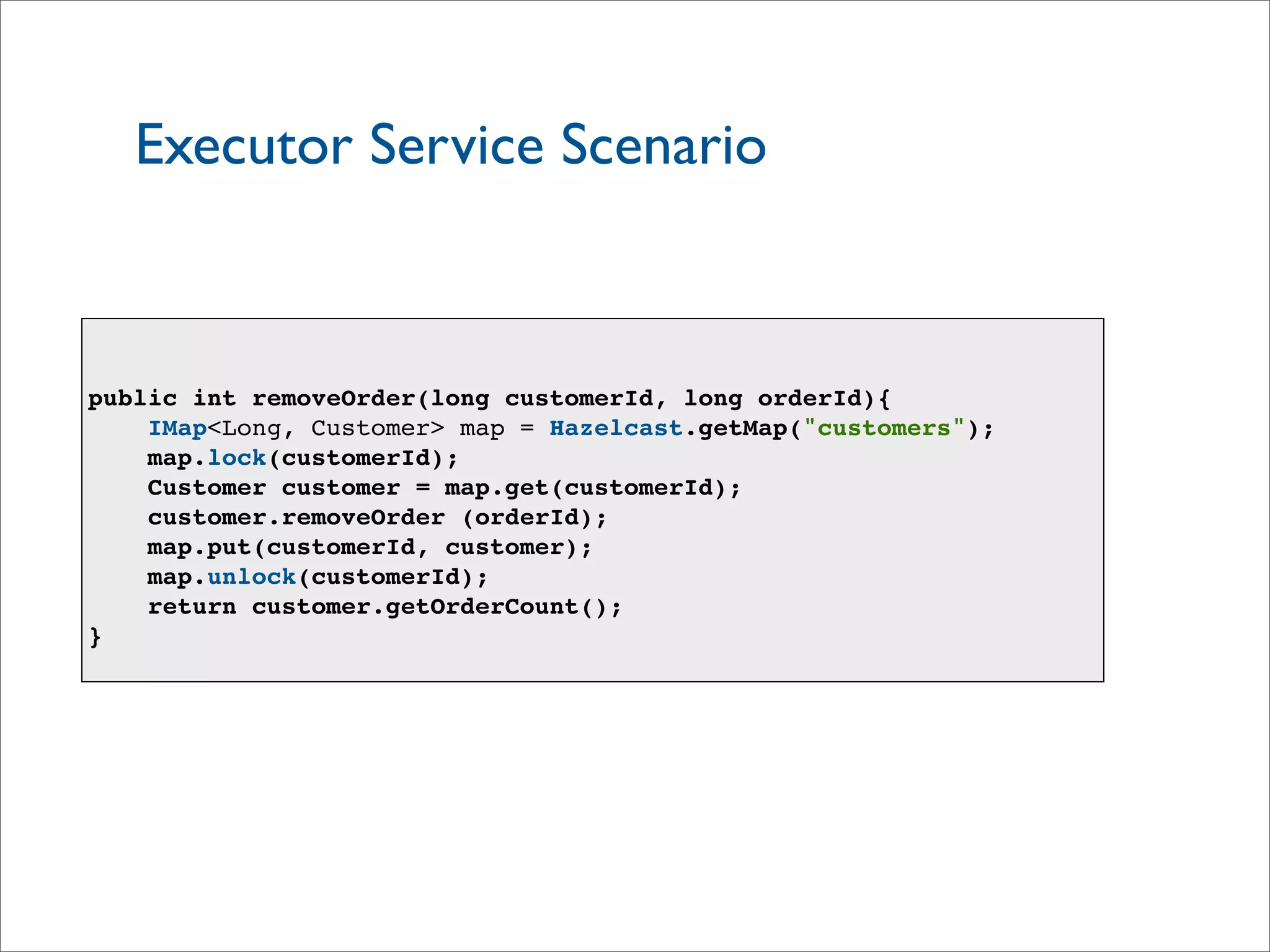
Executor Service Scenario
public int removeOrder(long customerId, long orderId){
IMap<Long, Customer> map = Hazelcast.getMap("customers");
map.lock(customerId);
Customer customer = map.get(customerId);
customer.removeOrder (orderId);
map.put(customerId, customer);
map.unlock(customerId);
return customer.getOrderCount();
}
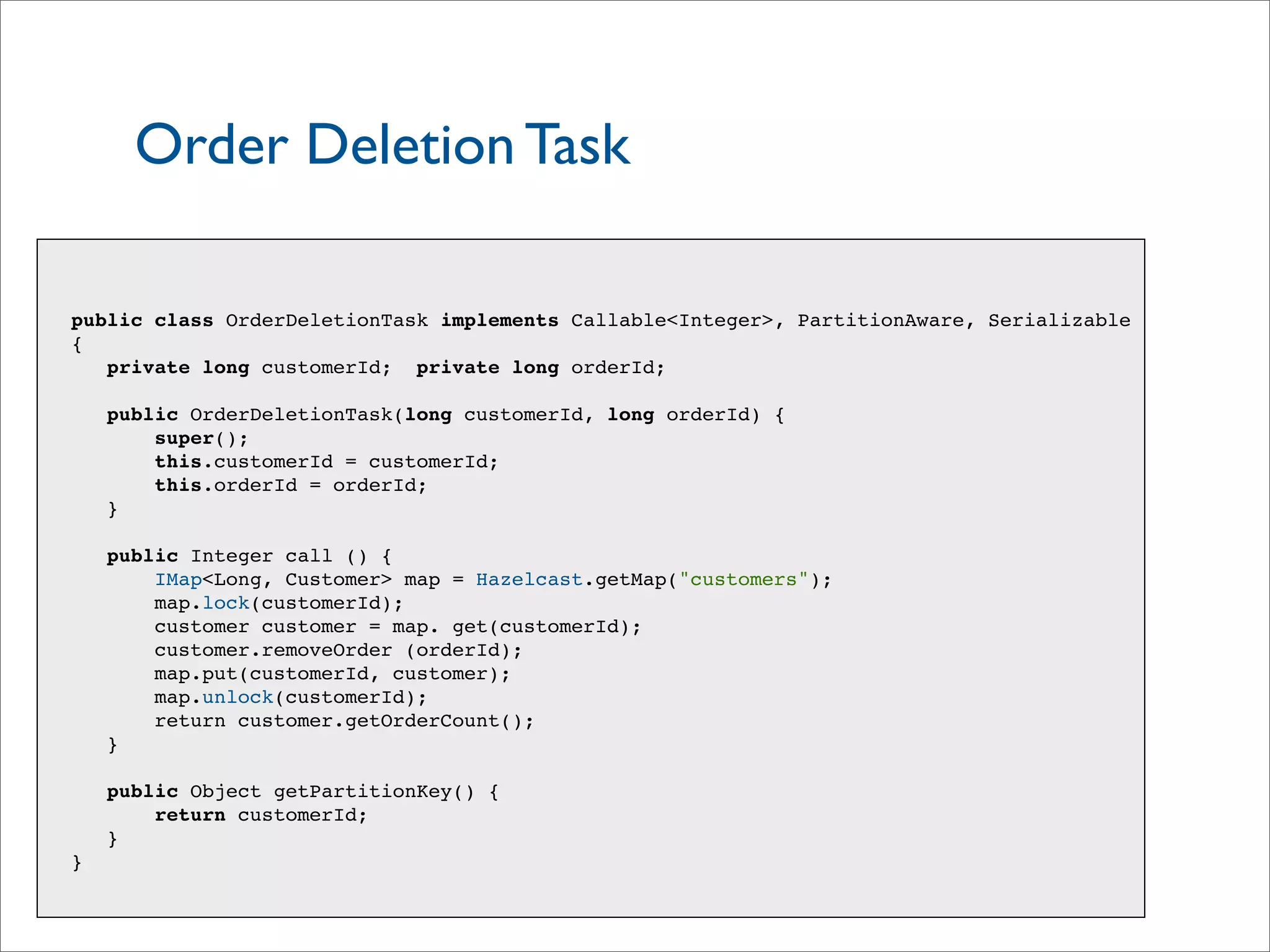
Order Deletion Task
public class OrderDeletionTask implements Callable<Integer>, PartitionAware, Serializable
{
private long customerId; private long orderId;
public OrderDeletionTask(long customerId, long orderId) {
super();
this.customerId = customerId;
this.orderId = orderId;
}
public Integer call () {
IMap<Long, Customer> map = Hazelcast.getMap("customers");
map.lock(customerId);
customer customer = map. get(customerId);
customer.removeOrder (orderId);
map.put(customerId, customer);
map.unlock(customerId);
return customer.getOrderCount();
}
public Object getPartitionKey() {
return customerId;
}
}
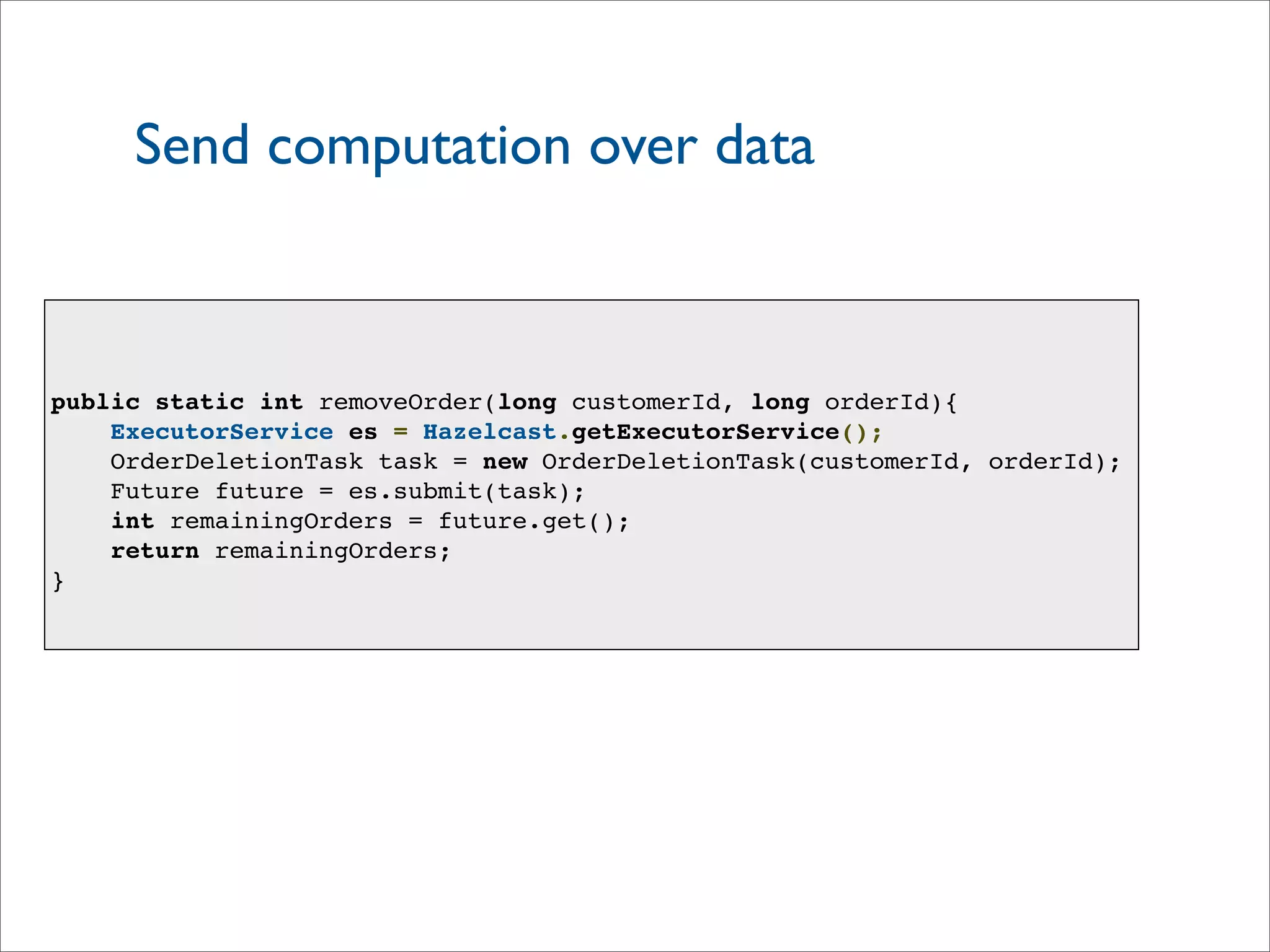
Send computation over data
public static int removeOrder(long customerId, long orderId){
ExecutorService es = Hazelcast.getExecutorService();
OrderDeletionTask task = new OrderDeletionTask(customerId, orderId);
Future future = es.submit(task);
int remainingOrders = future.get();
return remainingOrders;
}
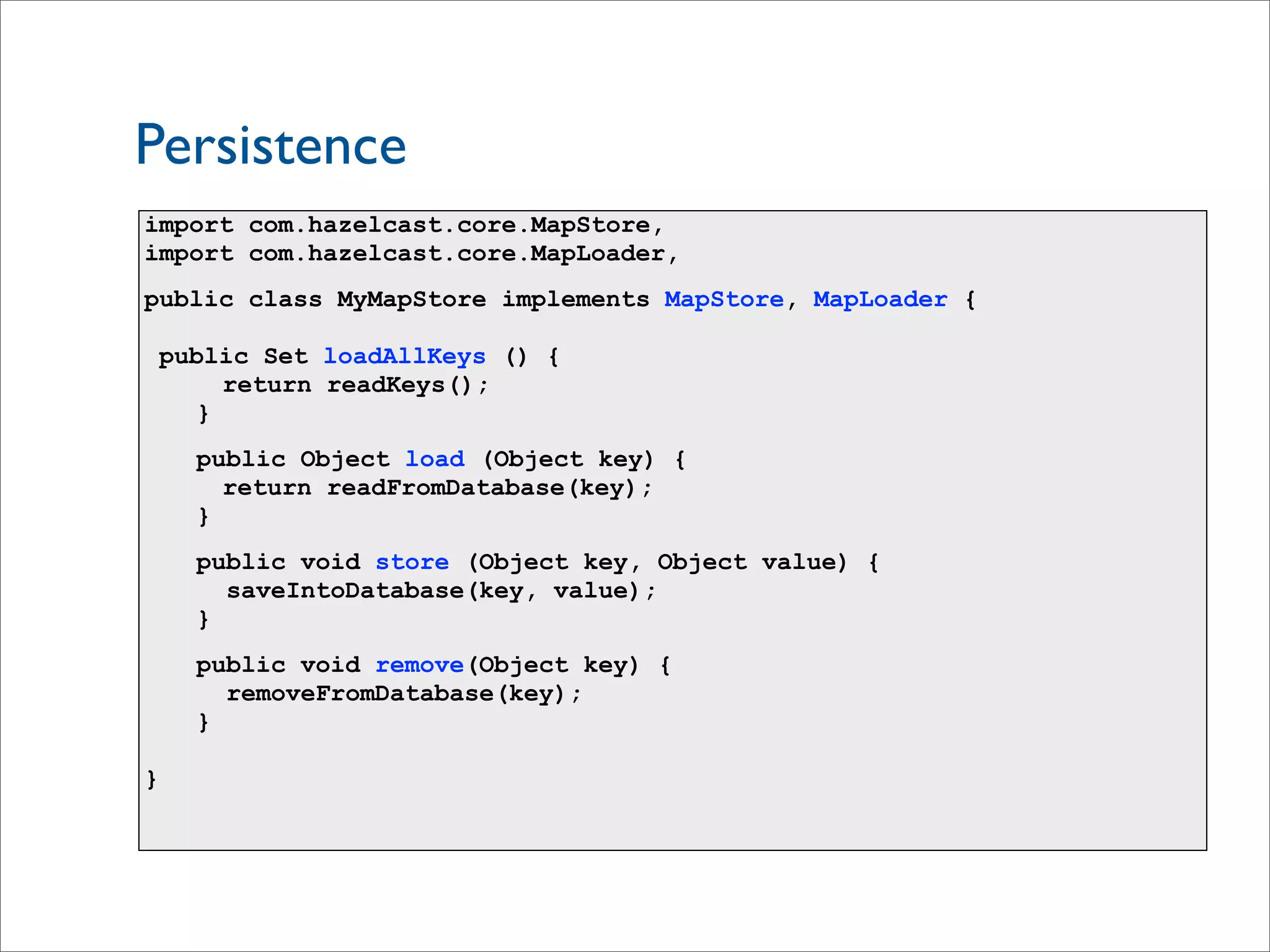
Persistence
import com.hazelcast.core.MapStore,
import com.hazelcast.core.MapLoader,
public class MyMapStore implements MapStore, MapLoader {
public Set loadAllKeys () {
return readKeys();
}
public Object load (Object key) {
return readFromDatabase(key);
}
public void store (Object key, Object value) {
saveIntoDatabase(key, value);
}
public void remove(Object key) {
removeFromDatabase(key);
}
}
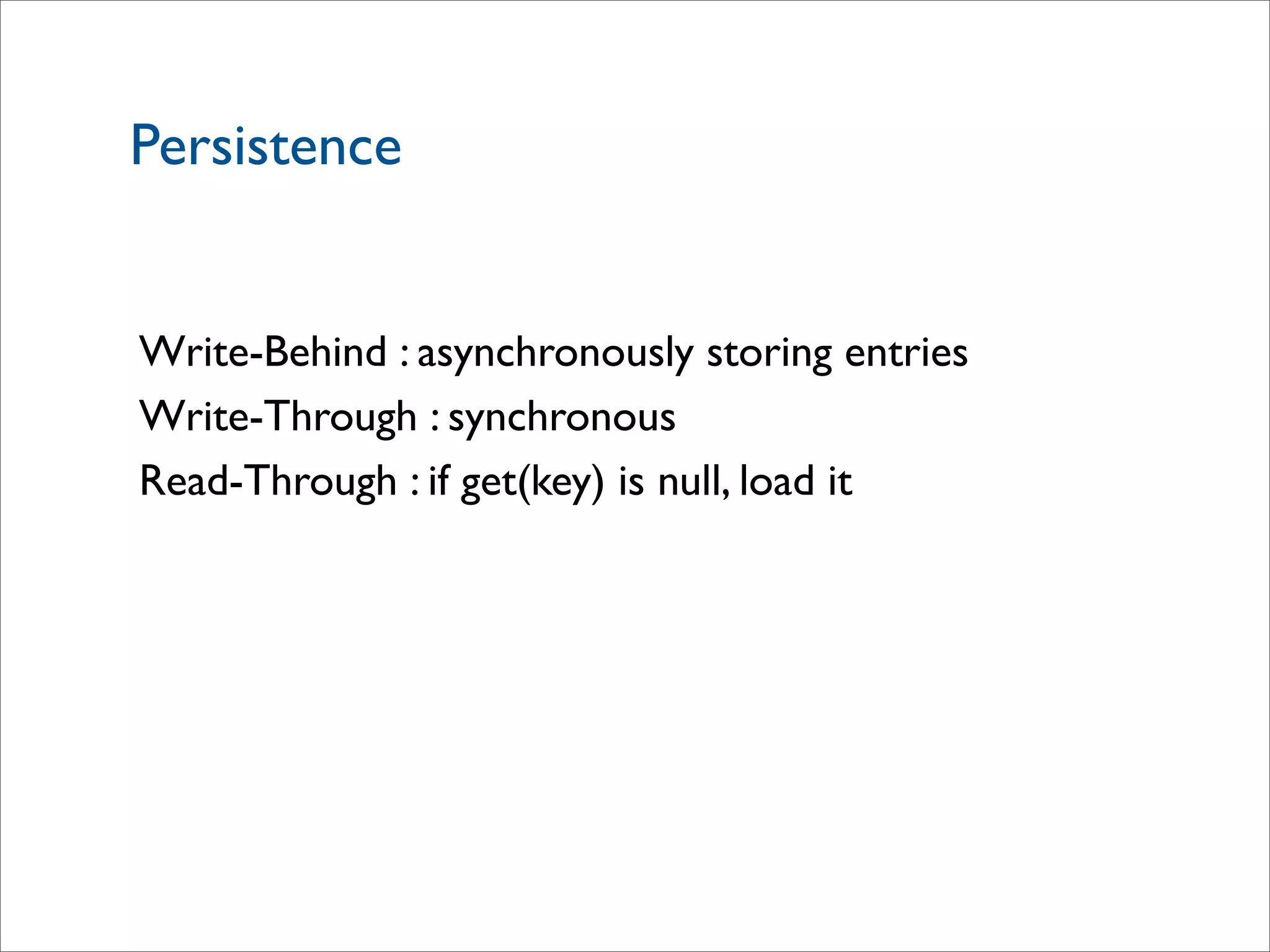
Persistence
Write-Behind : asynchronously storing entries
Write-Through : synchronous
Read-Through : if get(key) is null, load it
Persistence
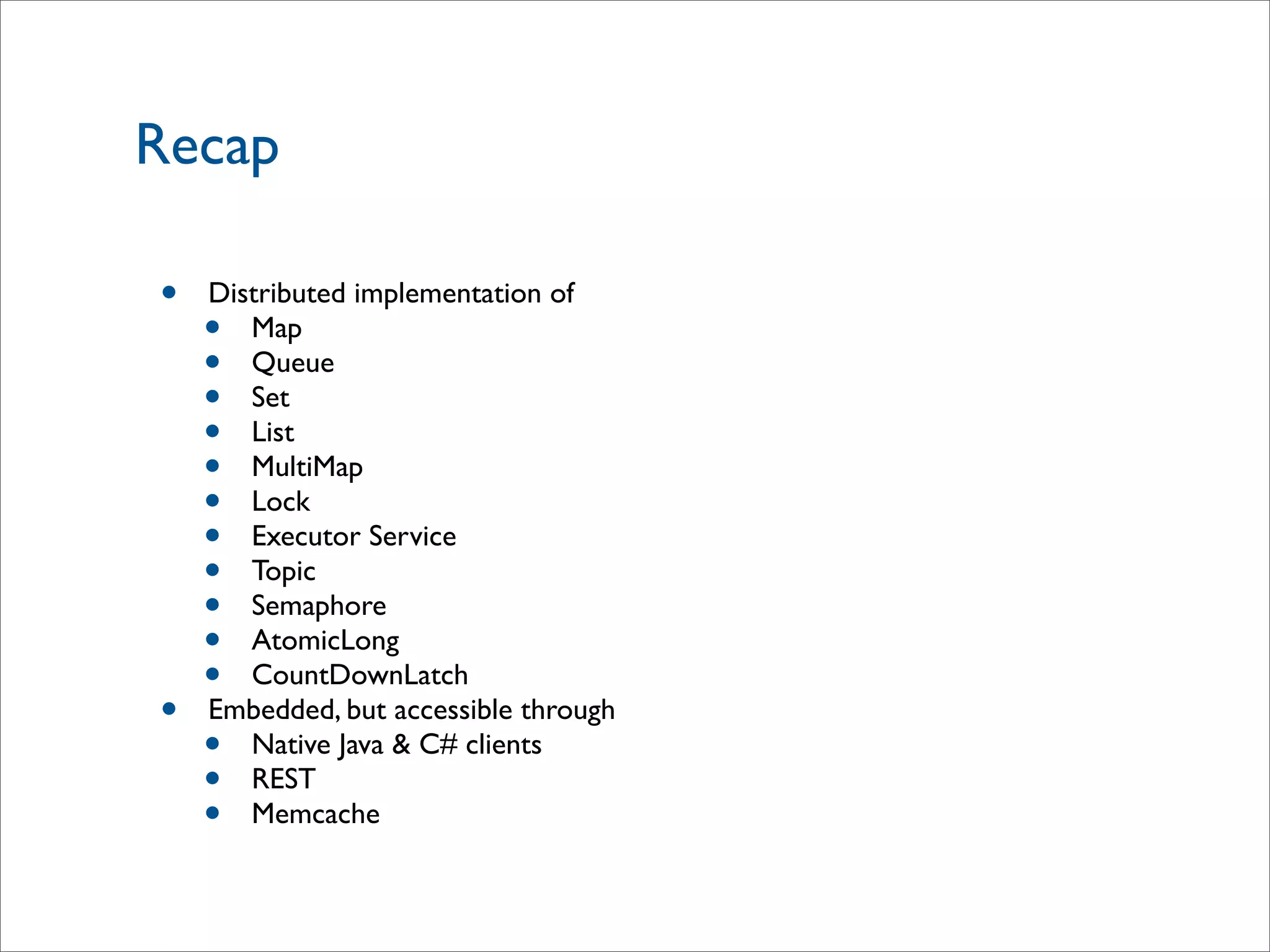
Recap
• Distributed implementation of
• Map
• Queue
• Set
• List
• MultiMap
• Lock
• Executor Service
• Topic
• Semaphore
• AtomicLong
• CountDownLatch
• Embedded, but accessible through
• Native Java & C# clients
• REST
• Memcache
Thank You!!
JOIN US!
github.com/hazelcast/
hazelcast@googlegroups.com
@hazelcast
Hazelcast Hackers Linkedin group

Clustering your Application with Hazelcast

  • 1.
    Clustering your application with Hazelcast TalipOzturk @oztalip Founder & CEO @hazelcast
  • 2.
    Keywords In-memory data grid Distributed(Elastic)Cache NoSQL Clustering, Scalability, Partitioning Cloud Computing
  • 3.
    Why Hazelcast? To buildhighly available and scalable applications
  • 4.
    Who uses Hazelcast? Financials Telco Gaming e-commerce Everysec. one Hazelcast node starts around the globe
  • 5.
    Map import java.util.Map; import java.util.HashMap; Mapmap = new HashMap(); map.put(“1”, “value”); map.get(“1”);
  • 6.
    Concurrent Map import java.util.Map; importjava.util.concurrent.*; Map map = new ConcurrentHashMap(); map.put(“1”, “value”); map.get(“1”);
  • 7.
    Distributed Map import java.util.Map; importcom.hazelcast.core.Hazelcast; Map map = Hazelcast.getMap(“mymap”); map.put(“1”, “value”); map.get(“1”);
  • 8.
    Alternatives Oracle Coherence IBM ExtremeScale VMware Gemfire Gigaspaces Redhat Infinispan Gridgain Terracotta
  • 9.
    Difference License/Cost Feature-set API Ease of use Mainfocus (distributed map, tuple space, cache, processing vs. data) Light/Heavy weight
  • 11.
  • 12.
    2 MB jar Lightweightwithout any dependency
  • 13.
    Introducing Hazelcast Map, queue,set, list, lock, semaphore, topic and executor service Native Java, C#, REST and Memcache Interfaces Cluster info and membership events Dynamic clustering, backup, fail-over Transactional and secure
  • 14.
    Use-cases Scale your application Sharedata across cluster Partition your data Send/receive messages Balance the load Process in parallel on many JVM
  • 15.
  • 16.
    Data Partitioning ina Cluster Fixed number of partitions (default 271) Each key falls into a partition partitionId = hash(keyData)%PARTITION_COUNT Partition ownerships are reassigned upon membership change A B C
  • 17.
  • 18.
  • 19.
  • 20.
  • 21.
  • 22.
  • 23.
  • 24.
  • 25.
  • 26.
  • 27.
  • 28.
  • 29.
  • 30.
    Restoring Data fromBackup DA B C Crash
  • 31.
    Data is Recoveredfrom Backup DA B C Crash
  • 32.
    Backup for RecoveredData DA B C Crash
  • 33.
    Backup for RecoveredData DA B C Crash
  • 34.
    Backup for RecoveredData DA B C Crash
  • 35.
  • 36.
  • 37.
    Topology Native Client: HazelcastInstance client= HazelcastClient.newHazelcastClient(clientConfig); Lite Member: -Dhazelcast.lite.member=true
  • 38.
  • 39.
    Community vs Enterprise Enterprise= Community + Elastic Memory + Security + Man. Center
  • 40.
    Elastic Memory isOFF-HEAP storage <hazelcast> ... <map name="default"> ... <storage-type>OFFHEAP</storage-type> </map> </hazelcast>
  • 41.
    JAAS based Security Credentials ClusterLogin Module Cluster Member Security Native Client Security Authentication Authorization Permission
  • 42.
  • 43.
    Hazelcast Hazelcast is threadsafe Many instances on the same JVM Config config = new Config(); HazelcastInstance h1 = Hazelcast.newHazelcastInstance(config) HazelcastInstance h2 = Hazelcast.newHazelcastInstance(config) All objects must be serializable class Employee implements java.io.Serializable //better class Employee implements com.hazelcast.nio.DataSerializable Map<String, Employee> = Hazelcast.getMap(“employees”); List<Users> = Hazelcast.getList(“users”);
  • 44.
    Cluster Interface import com.hazelcast.core.*; importjava.util.Set; Cluster cluster = Hazelcast.getCluster(); cluster.addMembershipListener(listener); Member localMember = cluster.getLocalMember(); System.out.println (localMember.getInetAddress()); Set<Member> setMembers = cluster.getMembers();
  • 45.
    Distributed Map import com.hazelcast.core.*; importjava.util.ConcurrentMap; Map<String, Customer> map = Hazelcast.getMap("customers"); map.put ("1", customer); Customer c = map.get("1"); //ConcurrentMap methods map.putIfAbsent ("2", new Customer(“Chuck Norris”)); map.replace ("3", new Customer(“Bruce Lee”));
  • 46.
    Distributed Queue import com.hazelcast.core.Hazelcast; importjava.util.concurrent.BlockingQueue; import java.util.concurrent.TimeUnit; BlockingQueue<Task> queue = Hazelcast.getQueue(“tasks"); queue.offer(task); Task t = queue.poll(); //Timed blocking Operations queue.offer(task, 500, TimeUnit.MILLISECONDS) Task t = queue.poll(5, TimeUnit.SECONDS); //Indefinitely blocking Operations queue.put(task) Task t = queue.take();
  • 47.
    Distributed Lock import com.hazelcast.core.Hazelcast; importjava.util.concurrent.locks.Lock; Lock mylock = Hazelcast.getLock(mylockobject); mylock.lock(); try { // do something } finally { mylock.unlock(); } //Lock on Map IMap<String, Customer> map = Hazelcast.getMap("customers"); map.lock("1"); try { // do something } finally { map.unlock("1"); }
  • 48.
    Distributed Topic import com.hazelcast.core.*; publicclass Sample implements MessageListener { public static void main(String[] args) { Sample sample = new Sample(); ITopic<String> topic = Hazelcast.getTopic ("default"); topic.addMessageListener(sample); topic.publish ("my-message-object"); } public void onMessage(Object msg) { System.out.println("Got msg :" + msg); } }
  • 49.
    Distributed Events import com.hazelcast.core.*; publicclass Sample implements EntryListener { public static void main(String[] args) { Sample sample = new Sample(); IMap map = Hazelcast.getMap ("default"); map.addEntryListener (sample, true); map.addEntryListener (sample, "key"); } public void entryAdded(EntryEvent event) { System.out.println("Added " + event.getKey() + ":" + event.getValue()); } public void entryRemoved(EntryEvent event) { System.out.println("Removed " + event.getKey() + ":" + event.getValue()); } public void entryUpdated(EntryEvent event) { System.out.println("Updated " + event.getKey() + ":" + event.getValue()); } }
  • 50.
  • 51.
    Hello Task A simpletask Execute on any member ExecutorService ex = Hazelcast.getExecutorService(); Future<String> future = executor.submit(new HelloTask()); // ... String result = future.get(); Attach a callback DistributedTask task = ... task.setExecutionCallback(new ExecutionCallback() { public void done(Future f) { // Get notified when the task is done! } }); public class HelloTask implements Callable<String>, Serializable{ @Override public String call(){ Cluster cluster = Hazelcast.getCluster(); return “Hello from ” + cluster.getLocalMember(); } }
  • 52.
    Hazelcast can executea task ... ExecutorService executor = Hazelcast.getExecutorService(); FutureTask<String> task1, task2; // CASE 1: Run task on a specific member. Member member = ... task1 = new DistributedTask<String>(new HelloTask(), member); executor.execute(task1); // CASE 2: Run task on a member owning the key. Member member = ... task1 = new DistributedTask<String>(new HelloTask(), “key”); executor.execute(task1); // CASE 3: Run task on group of members. Set<Member> members = ... task = new MultiTask<String>(new HelloTask(), members); executor.execute(task2); 1. On a specific node 2. On any available node 3. On a collection of defined nodes 4. On a node owning a key
  • 53.
    Executor Service Scenario publicint removeOrder(long customerId, long orderId){ IMap<Long, Customer> map = Hazelcast.getMap("customers"); map.lock(customerId); Customer customer = map.get(customerId); customer.removeOrder (orderId); map.put(customerId, customer); map.unlock(customerId); return customer.getOrderCount(); }
  • 54.
    Order Deletion Task publicclass OrderDeletionTask implements Callable<Integer>, PartitionAware, Serializable { private long customerId; private long orderId; public OrderDeletionTask(long customerId, long orderId) { super(); this.customerId = customerId; this.orderId = orderId; } public Integer call () { IMap<Long, Customer> map = Hazelcast.getMap("customers"); map.lock(customerId); customer customer = map. get(customerId); customer.removeOrder (orderId); map.put(customerId, customer); map.unlock(customerId); return customer.getOrderCount(); } public Object getPartitionKey() { return customerId; } }
  • 55.
    Send computation overdata public static int removeOrder(long customerId, long orderId){ ExecutorService es = Hazelcast.getExecutorService(); OrderDeletionTask task = new OrderDeletionTask(customerId, orderId); Future future = es.submit(task); int remainingOrders = future.get(); return remainingOrders; }
  • 56.
  • 57.
    import com.hazelcast.core.MapStore, import com.hazelcast.core.MapLoader, publicclass MyMapStore implements MapStore, MapLoader { public Set loadAllKeys () { return readKeys(); } public Object load (Object key) { return readFromDatabase(key); } public void store (Object key, Object value) { saveIntoDatabase(key, value); } public void remove(Object key) { removeFromDatabase(key); } } Persistence
  • 58.
    Write-Behind : asynchronouslystoring entries Write-Through : synchronous Read-Through : if get(key) is null, load it Persistence
  • 59.
    Recap • Distributed implementationof • Map • Queue • Set • List • MultiMap • Lock • Executor Service • Topic • Semaphore • AtomicLong • CountDownLatch • Embedded, but accessible through • Native Java & C# clients • REST • Memcache
  • 60.