Seminar paper:
Change Management
„The change management process can be divided into 3 phases. Please
describe these phases in detail, if possible using examples and experiences
in your company.“
Forwarded by registered mail: 2015 February, XXth
Associate professor: Prof. Bauer
SRH FernHochschule Riedlingen
Written partial exam: Organizational Culture and Change Management
Bachelor degree course: business psychology
Student:
Bianca Holzapfel
Bühlhöfe 11/1, 88377 Riedhausen
Matrikelnummer: 5503
Table of Contents
1 Preface..........................................................................................................1
2 Theoretical aspects...................................................................................2
2.1 Terms and definitions..................................................................................3
2.2 Lewin’s Three-Step Change Process.......................................................3
2.2.1 Unfreezing the organization........................................................................4
2.2.2 Moving / Changing.......................................................................................5
2.2.3 Refreezing the organization........................................................................5
2.3 Three-Step Change Process referring to Schüppel...............................5
3 Practical application/experience ...........................................................8
4 Critical review.............................................................................................10
5 Conclusion and prospects......................................................................10
List of figures ............................................................................................................13
Code ........................................................................................................................13
Sources and references..........................................................................................14
Declaration of academic honesty / Eidesstattliche Erklärung ...........................16
1
1 Preface
“Today the need to change is universal.“1 New information and
communications technologies offer important opportunities to companies, but
to create productive advantage, simultaneous changes in organizational
performance and behavior are required. A rapidly changing environment
leads to the situation that prior exception nowadays becomes the rule.2 “We
cannot stay put. We must change and adapt as our customers and markets
change and as our competitors evolve.“3
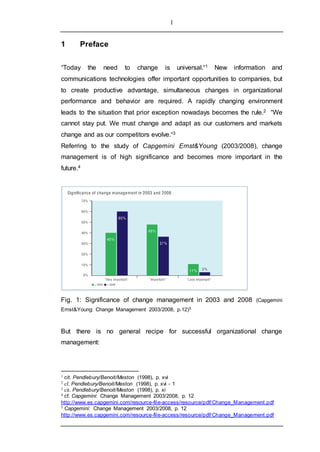
Referring to the study of Capgemini Ernst&Young (2003/2008), change
management is of high significance and becomes more important in the
future.4
Fig. 1: Significance of change management in 2003 and 2008 (Capgemini
Ernst&Young: Change Management 2003/2008, p.12)5
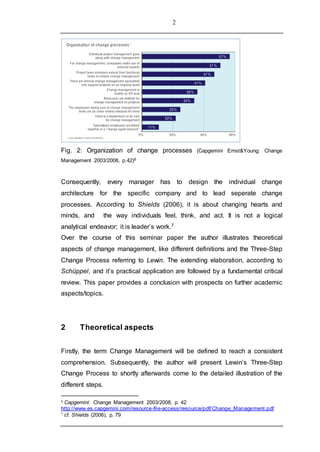
But there is no general recipe for successful organizational change
management:
1 cit. Pendlebury/Benoit/Meston (1998), p. xvi
2 cf. Pendlebury/Benoit/Meston (1998), p. xvi - 1
3 cit. Pendlebury/Benoit/Meston (1998), p. xi
4 cf. Capgemini: Change Management 2003/2008, p. 12
http://www.es.capgemini.com/resource-file-access/resource/pdf/Change_Management.pdf
5 Capgemini: Change Management 2003/2008, p. 12
http://www.es.capgemini.com/resource-file-access/resource/pdf/Change_Management.pdf
2
Fig. 2: Organization of change processes (Capgemini Ernst&Young: Change
Management 2003/2008, p.42)6
Consequently, every manager has to design the individual change
architecture for the specific company and to lead seperate change
processes. According to Shields (2006), it is about changing hearts and
minds, and the way individuals feel, think, and act. It is not a logical
analytical endeavor; it is leader’s work.7
Over the course of this seminar paper the author illustrates theoretical
aspects of change management, like different definitions and the Three-Step
Change Process referring to Lewin. The extending elaboration, according to
Schüppel, and it’s practical application are followed by a fundamental critical
review. This paper provides a conclusion with prospects on further academic
aspects/topics.
2 Theoretical aspects
Firstly, the term Change Management will be defined to reach a consistent
comprehension. Subsequently, the author will present Lewin’s Three-Step
Change Process to shortly afterwards come to the detailed illustration of the
different steps.
6 Capgemini: Change Management 2003/2008, p. 42
http://www.es.capgemini.com/resource-file-access/resource/pdf/Change_Management.pdf
7 cf. Shields (2006), p. 79
3
2.1 Terms and definitions
Change management means the continuous adjustment of company
strategies and structures in a changing environment.8 It covers conscious
and professional planning, structuring, consulting, supporting, and
management of change processes.9
The process of organizational change leads the company from a present
state to some desired future state in order to increase the ability to create
value and improve returns to the company’s stakeholders. The target of
change is to improve effectiveness at different levels: human resources,
functional resources, technological capabilities, and organizational
capabilities.10
“Change management is not an end in itself, but a tool used to address
fundamental change requirements in organizations“.11
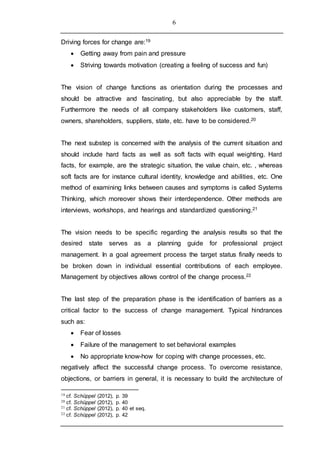
2.2 Lewin’s Three-Step Change Process
Organizational change processes can be divided into different phases. Kurt
Lewin’s three stage theory is widely used to design these processes of
organizational development.12
8 cf. Gabler Wirtschaftslexikon, keyword: Change Management.
http://wirtschaftslexikon.gabler.de/Archiv/2478/change-management-v9.html
9 cf. Berger/Chalupsky/Hartmann (2013), p.339
10 cf. Jones (2010), p. 292
11 cit.Thommen/Grösser (2013), p. 113
12 cf. Thommen/Grösser (2013), p. 111
4
Fig. 2: Three-stage model of the change process (own figure referring to Kiechl
(1995), p. 291)13
2.2.1 Unfreezing
The initial step for implementing change is the phase of unfreezing the
organization from its present state. Managers have to recognize the need for
change by perceiving a gap between desired and actual performance. They
should make a diagnosis of the status quo of the organization by collecting
information from people at all levels in the organization and from outsiders,
(f.e. customers and suppliers).14 The goal is to clarify that the current
situation obstructs business or proceedings of the organization with negative
effects on business success. This is one of several possibilities to reduce
resistance among the members of an organization. Employees need to
understand that old ways of thinking, processes, and structures have to be
changed so that the organization better survives competition. Communication
and thorough information of all those affected raise consciousness and
willingness to accept the intended change.15
13 cf. Kiechl (1995), p. 291
14 cf. Jones (2010), p. 311
15 cf. Thommen/Grösser (2013), p. 110 et seq.
1. Unfreezing
Unfreezing of the current
situation;
motivating for change
2. Moving
Transition to the new
equilibrium;
new behaviors are
formed
3. Refreezing
Refreezing of the new
equilibrium;
stabilizing and integrating
of the changes
Time
OldsituationNewsituation
5
2.2.2 Moving / Changing
After the unfreezing stage the organization has to go through the
transitioning or moving phase that is marked by the implementation of the
change. As during this period most employees are affected by emotions like
fear and uncertainty, managers should remind them of the reasons for the
change and the benefits for them once the change is fully implemented.
Furthermore, training, communication, and support are needed to help them
learn targeted behaviors, processes, and ways of thinking. So during this
phase the change becomes real; thus it is the hardest step to overcome.16
2.2.3 Refreezing
The final step of Lewin’s model of change symbolizes the stabilizing and
integrating of the changes. New structures, processes, and goals are
accepted and become the new status quo. It is especially important that
employees do not regress to their old ways of working prior to the
implementation of the change. The new norm needs to be embedded in the
organizational culture and maintained as the way of thinking and working that
is generally accepted. Moreover, reinforcement occurs by positive results.17
2.3 Three-Step Change Process referring to Schüppel
The preparation phase referring to Schüppel (2012) is comparable with
Lewin’s phase of unfreezing. He distinguishes four substeps:18
1. Vision Creation
2. Analysis of current state
3. Definition of desired state
4. Identification of barriers.
16 cf. Thommen/Grösser (2013), p. 113
17 cf. Thommen/Grösser (2013), p. 112 et seqq.
18 cf. Schüppel (2012), p. 39
6
Driving forces for change are:19
 Getting away from pain and pressure
 Striving towards motivation (creating a feeling of success and fun)
The vision of change functions as orientation during the processes and
should be attractive and fascinating, but also appreciable by the staff.
Furthermore the needs of all company stakeholders like customers, staff,
owners, shareholders, suppliers, state, etc. have to be considered.20
The next substep is concerned with the analysis of the current situation and
should include hard facts as well as soft facts with equal weighting. Hard
facts, for example, are the strategic situation, the value chain, etc. , whereas
soft facts are for instance cultural identity, knowledge and abilities, etc. One
method of examining links between causes and symptoms is called Systems
Thinking, which moreover shows their interdependence. Other methods are
interviews, workshops, and hearings and standardized questioning.21
The vision needs to be specific regarding the analysis results so that the
desired state serves as a planning guide for professional project
management. In a goal agreement process the target status finally needs to
be broken down in individual essential contributions of each employee.
Management by objectives allows control of the change process.22
The last step of the preparation phase is the identification of barriers as a
critical factor to the success of change management. Typical hindrances
such as:
 Fear of losses
 Failure of the management to set behavioral examples
 No appropriate know-how for coping with change processes, etc.
negatively affect the successful change process. To overcome resistance,
objections, or barriers in general, it is necessary to build the architecture of
19 cf. Schüppel (2012), p. 39
20 cf. Schüppel (2012), p. 40
21 cf. Schüppel (2012), p. 40 et seq.
22 cf. Schüppel (2012), p. 42
7
the change process explicitly towards these barriers. As a result, changes
have a higher acceptance when it comes to the implementation phase.23
The preparation phase is followed by the planning phase. Substeps are:24
1. The design of the architecture of change which should not be too
demanding, with due regard to the whole organization.
2. Planning of specific measures of change as a framework for the
integration that streamlines the communication towards the process
goal.
3. Implementation of a pilot process in a representative environment as
a practical change experience before installing the entire set of
measures. It helps to identify strengths and weaknesses by realisticly
planning resources and to generate early wins.
The execution phase referring to Schüppel (2012) is composed of:25
1. Execution/Monitoring of measures
2. Maintaining learning transfer.
The implementation of change means a continual management of potential
or existing objections. All those involved have to make their contribution to
achieve a successful change regarding the targeted goals. A professional
control is necessary to check the hard facts, (such as rate of errors, process
costs, production time etc.) ,and soft facts, (like staff and customer
satisfaction etc.) of the process.26
Developing adaptability and flexibility and the ability to anticipate change is
needed in today’s fast and constantly changing environment. Learning
processes can be divided into:27
1. Single-loop learning: comparison of information with the rules of the
superficial structure; correction of deviations
23 cf. Schüppel (2012), p. 42
24 cf. Schüppel (2012), p. 43
25 cf. Schüppel (2012), p. 39
26 cf. Schüppel (2012), p. 44 et seq.
27 cf. Schüppel (2012), p. 45 et seqq.
8
2. Double-loop learning: checking depth-structurally anchored norms and
standards for their relevance
3. Interactions with the environment: Monitoring and diagnosis of the
environment.
4. Deutero learning: reflection of previous learning processes; analysis of
successes and failures; promotion of organizational learning
processes
Learning to learn occurs on a meta-level: what, how, when and why learning.
Failures need to be evaluated as a real study of the causes of failure. The
result of a high level of learning is the possibility of creating systematic
learning strategies and a rapid adaption to a changing environment.28
Last but not least changing processes have to be accompanied by
communication measures. Backgrounds and goals need to be understood by
all those involved. In addition employees want to know their own roles, to
appraise effects on themselves, to estimate risks and chances and to see
successes and failures. That is why an active and involved style of
communication is necessary. Examples are project-jour-fixes, informal
meetings, staff meetings, business tv, etc.29
3 Practical application/experience
The author works in an engineering company, (with about 80 employees)
,which constructs special machines for forestry and industrial agriculture, (for
example: biomass harvesters and crawler type vehicles). Due to
environmental changes internal structures of departments had to be
adjusted. The former department of planning operation had to be liquidated,
corresponding work packages and operations had to be integrated into other
departments like purchasing and production as the operations scheduling
also became part of the manufacturing department. The decision for this
change was made by the upper management; the proposal instead was
28 cf. Schüppel (2012), p. 44 et seqq.
29 cf. Schüppel (2012), p. 47
9
made by the head of materials administration under the influence of the
scheduler/planner. The only persons involved beyond the upper
management have been the human resources representative, the team
leader of purchasing department and the scheduler/planner. The changes
affected not only all employees of the planning operation department and the
purchasing department, but also all cooperating departments like
manufacturing, sales and service etc. On top of this, the targeted change
implicated also reduction in staff. All decisions have been made covertly
between the persons and managers involved. To announce the targeted
changes officially, they arranged a meeting and gave factual information to
the employees of purchasing and planning operation department like:
reasons for the change, chances for the company, effects for the persons
concerned and further necessary steps (including staff reduction). Other
departments have not been informed in any way. The final outcome covered
for example:
 two lawsuits regarding the dismissals with the result of additional costs
for the company (such as compensation and lawyers’ fees)
 one resignation of a key personality of an adjacent department with
the result of additional costs, namely costs for recruiting and
integration and the loss of know-how and social personnel relations
 dissatisfaction of customers and suppliers because of modified
contact persons and processes
 dissatisfaction of several employees because of modified
workstreams, work places, and new structures for cross-functional
cooperation
 dissatisfaction of employees with the general way of doing or method
 lack of performance and overload of the scheduler/planner because of
personnel overestimation, and underestimation of effort, with the
result being health restrictions and negative impact of processes.
The example shows the significance of preparation and plannning phases as
well as the organizational communication. For instance, an in-depth analysis
obstructs overloading of employees by means of well-adjusted job
characteristics and personnel demands. Involvement of employees impedes
10
dissatisfaction and misunderstandings and is conducive to motivation,
cooperation and commitment. The same applies to customers and suppliers.
Employee satisfaction then again has direct implications to the business
success. Obstacles as mentioned above impair the standard operating
procedure and slow down the entire change process. Thus, the success of
the targeted change, but also the success of the entire business is in
jeopardy.
4 Critical review
The topic Change Management delivers a wide range of interesting and
important facts and details. Definitions appear similar but they are
nonetheless different in some aspects. Literature must be carefully selected
to find specific subjects that are needed for the targeted information and the
planned performance. To write a seminar paper in a foreign language poses
a challenge that is not to be underestimated. On the other hand to rise to this
challenge and to meet it helps one to grow in confidence.
5 Conclusion and prospects
“If you do what you’ve always done, you’ll get what you’ve always gotten.“30
To better survive in competition, organizations face a huge challenge: the
challenge of an ever-changing environment. To keep up with the times, a
well-structured, well-conceived and implemented change management, firmly
established in the organizational culture, is the answer to changing
requirements of customers, markets, stakeholders, shareholders, state,
employees, etc. As mentioned in the preceding paragraph, academic
research and literature provide a wide range of approaches, statistics,
methods, and models. Every organization need to be viewed as an individual
system with an individual structure, hierarchy, history, and culture, as well as
30 cit. Meier (2014), p.27 referring to Anthony Robbins.
11
a base of staff, customers, and other persons in the social, legal, and
financial environment. Every company has to find its own way of managing
change. The first question therefore is about the elementary structure of
change management. Depending on the type and complexity of change, a
project organization may be necessary or advantageous. Basic principles for
the handling of change set the framework for a change management
accepted with less resistance. Resistance and barriers to change arise out of
different aspects and are critical factors to the success of change
management. As changes always affect people, human aspects like basic
human needs, condition or fears etc. need to attract attention. Involvement,
but also positive organizational scholarship which puts emphasis on positive
drivers for willingness to change and commitment, (like organizational
morality or corporate citizenship behavior, integrity and resilience), appear to
be particularly promising31. The goal of communication is to inform people in
order to gain their support and to help them understand the value and
importance of adopting the new approach of the targeted change. It is
expected that they reach the same conclusion as the leader about what
needs to be done.32 Thus, it’s all about leadership. Successful leading
through all the phases of the change process is needed regardless of which
model is used. Gerschel/Polsky (2013) identified five soft requirements (in
addition to hard facts like technology, processes, and tools) for rapid change
efforts to be successful, which can be regarded as leadership tasks:33 34
 Building Business Acumen
 Fostering Innovation
 Overcoming Silo Thinking
 Energizing the Team
 Making It Personal
On top of that, to ensure learning transfer and to develop a learning
organization is of high importance and affects executive function. Due to the
rapidly changing environment, and as a provision for the future ,Jellison
31 cf. Becker/Labucay (2012), p. 20 et seqq.
32 cf. Jellison (2006), p. 43 et seq.
33 cf. Gerschel/Polsky (2013), p. 6 et seqq.
34 for brevity of this essay, the particular requirements can only be named. Interested readers
are requested to consult the original author.
12
(2006) suggests creating a culture of change observing the following
principles:35 36
 Surrounding people with information
 Practical creativity
 Everyone can contribute
 Experimentation and evolution
 Rewarding innovation
 Removing impediments
 Publicizing success
“Creating your small world“ (as Jellison (2006) calls it) means a long way to
develop the value of change in the organizational culture.37 Teaching values
seems to be a lifelong process: “...Most days it all seems unending and
unachievable. But, like Sisyphus, you must persist.“38
List of figures
35 cf. Jellison (2006), p. 197 et seqq.
36 for brevity of this essay, the particular principles can only be named. Interested readers
are requested to consult the original author.
37 cf. Jellison (2006), p. 213 et seq.
38 cit. Jellison (2006), p. 214
13
Fig. 1: Significance of change management in 2003 and 2008.......................5
Fig. 2: Organization of change processes...........................................................6
Fig. 3: Three-stage model of the change process ............................................9
Code
cf. confer
cit. citation
etc. et cetera (and so on)
et seq. et sequens (and the following one)
et seqq. et sequentes (and the following ones)
f.e. for example
fig. figure
14
Sources and references:
Books:
Becker, M./Labucay, I.: Organisationsentwicklung – Konzepte, Methoden und
Instrumente für ein modernes Change Management (2012), Schäffer-
Poeschel Verlag für Wirtschaft - Steuern – Recht GmbH, Stuttgart
Berger, M./Chalupsky, J./Hartmann, F.: Change Management – (Über-)
Leben in Organisationen, (2013), 7. Auflage, Verlag Dr. Götz Schmidt,
Gießen
Gerschel, A./Polsky, L.: Rapid Retooling – Developing World-Class
Organizations in a Rapidly Changing World (2013), ASTD (American Society
for Training & Development) Press, Alexandria
Jellison, J.: Managing the dynamics of change (2006), McGraw-Hill
Companies, New York
Jones, G.: Organizational Theory, Design and Change (2010), 6th edition,
Pearson Education Inc., New Jersey
Kiechl, R.: Management of Change. In: Thommen, J-P. (Hrsg.):
Management-Kompetenz (1995), Versus Verlag, Zürich
Meier, Th.: Closing beim Erstbesuch: Mit dem Hardselling-samtweich-Prinzip
ehrlich, fair und gezielt zum Verkaufsabschluss (2014), Springer-Verlag,
Berlin
Pendlebury, J./Benoit, G./Meston, F.: The Ten Keys to Successful Change
Management (1998), John Wiley & Sons Ltd., West Sussex
Schüppel, J.: Change Management in Organizational Culture and Change
Management (2012), SRH FernHochschule Riedlingen, Riedlingen
15
Shields, J.: Organization and Culture Change in Rouse, W (Hrsg).:
Enterprise Transformation, (2006), John Wiley & Sons, Inc., Hoboken, New
Jersey
Thommen, J-P./Grösser, S.: Organization and Change Management (2013),
Versus Verlag, Zürich
Internet:
Capgemini Ernst & Young: Change Management 2003/2008 – Significance,
strategies, trends. (abgefragt am 12.02.2015)
URL:http://www.es.capgemini.com/resource-file-
access/resource/pdf/Change_Management.pdf
Gabler Wirtschaftslexikon, Springer Gabler Verlag (Herausgeber)
Stichwort: Change Management. (abgefragt am 10.02.2015)
URL: http://wirtschaftslexikon.gabler.de/Archiv/2478/change-management-
v9.html
16
Declaration of academic
honesty /
Eidesstattliche Erklärung
Ich versichere, dass ich die vorliegende Arbeit ohne Hilfe Dritter und ohne
Benutzung anderer als der angegebenen Quellen und Hilfsmittel angefertigt
und die den benutzten Quellen wörtlich oder inhaltlich entnommenen Stellen
als solche kenntlich gemacht habe.
Diese Arbeit hat in gleicher oder ähnlicher Form noch keiner
Prüfungsbehörde vorgelegen.
24. Februar 2015
Datum, Unterschrift
von
Bianca Holzapfel
Bühlhöfe 11/1, 88377 Riedhausen
Studiengang Wirtschaftspsychologie
Matrikelnummer: 5503

Hausarbeit-ChangeManagement_B.Eng corrected

  • 1.
    Seminar paper: Change Management „Thechange management process can be divided into 3 phases. Please describe these phases in detail, if possible using examples and experiences in your company.“ Forwarded by registered mail: 2015 February, XXth Associate professor: Prof. Bauer SRH FernHochschule Riedlingen Written partial exam: Organizational Culture and Change Management Bachelor degree course: business psychology Student: Bianca Holzapfel Bühlhöfe 11/1, 88377 Riedhausen Matrikelnummer: 5503
  • 2.
    Table of Contents 1Preface..........................................................................................................1 2 Theoretical aspects...................................................................................2 2.1 Terms and definitions..................................................................................3 2.2 Lewin’s Three-Step Change Process.......................................................3 2.2.1 Unfreezing the organization........................................................................4 2.2.2 Moving / Changing.......................................................................................5 2.2.3 Refreezing the organization........................................................................5 2.3 Three-Step Change Process referring to Schüppel...............................5 3 Practical application/experience ...........................................................8 4 Critical review.............................................................................................10 5 Conclusion and prospects......................................................................10 List of figures ............................................................................................................13 Code ........................................................................................................................13 Sources and references..........................................................................................14 Declaration of academic honesty / Eidesstattliche Erklärung ...........................16
  • 3.
    1 1 Preface “Today theneed to change is universal.“1 New information and communications technologies offer important opportunities to companies, but to create productive advantage, simultaneous changes in organizational performance and behavior are required. A rapidly changing environment leads to the situation that prior exception nowadays becomes the rule.2 “We cannot stay put. We must change and adapt as our customers and markets change and as our competitors evolve.“3 Referring to the study of Capgemini Ernst&Young (2003/2008), change management is of high significance and becomes more important in the future.4 Fig. 1: Significance of change management in 2003 and 2008 (Capgemini Ernst&Young: Change Management 2003/2008, p.12)5 But there is no general recipe for successful organizational change management: 1 cit. Pendlebury/Benoit/Meston (1998), p. xvi 2 cf. Pendlebury/Benoit/Meston (1998), p. xvi - 1 3 cit. Pendlebury/Benoit/Meston (1998), p. xi 4 cf. Capgemini: Change Management 2003/2008, p. 12 http://www.es.capgemini.com/resource-file-access/resource/pdf/Change_Management.pdf 5 Capgemini: Change Management 2003/2008, p. 12 http://www.es.capgemini.com/resource-file-access/resource/pdf/Change_Management.pdf
  • 4.
    2 Fig. 2: Organizationof change processes (Capgemini Ernst&Young: Change Management 2003/2008, p.42)6 Consequently, every manager has to design the individual change architecture for the specific company and to lead seperate change processes. According to Shields (2006), it is about changing hearts and minds, and the way individuals feel, think, and act. It is not a logical analytical endeavor; it is leader’s work.7 Over the course of this seminar paper the author illustrates theoretical aspects of change management, like different definitions and the Three-Step Change Process referring to Lewin. The extending elaboration, according to Schüppel, and it’s practical application are followed by a fundamental critical review. This paper provides a conclusion with prospects on further academic aspects/topics. 2 Theoretical aspects Firstly, the term Change Management will be defined to reach a consistent comprehension. Subsequently, the author will present Lewin’s Three-Step Change Process to shortly afterwards come to the detailed illustration of the different steps. 6 Capgemini: Change Management 2003/2008, p. 42 http://www.es.capgemini.com/resource-file-access/resource/pdf/Change_Management.pdf 7 cf. Shields (2006), p. 79
  • 5.
    3 2.1 Terms anddefinitions Change management means the continuous adjustment of company strategies and structures in a changing environment.8 It covers conscious and professional planning, structuring, consulting, supporting, and management of change processes.9 The process of organizational change leads the company from a present state to some desired future state in order to increase the ability to create value and improve returns to the company’s stakeholders. The target of change is to improve effectiveness at different levels: human resources, functional resources, technological capabilities, and organizational capabilities.10 “Change management is not an end in itself, but a tool used to address fundamental change requirements in organizations“.11 2.2 Lewin’s Three-Step Change Process Organizational change processes can be divided into different phases. Kurt Lewin’s three stage theory is widely used to design these processes of organizational development.12 8 cf. Gabler Wirtschaftslexikon, keyword: Change Management. http://wirtschaftslexikon.gabler.de/Archiv/2478/change-management-v9.html 9 cf. Berger/Chalupsky/Hartmann (2013), p.339 10 cf. Jones (2010), p. 292 11 cit.Thommen/Grösser (2013), p. 113 12 cf. Thommen/Grösser (2013), p. 111
  • 6.
    4 Fig. 2: Three-stagemodel of the change process (own figure referring to Kiechl (1995), p. 291)13 2.2.1 Unfreezing The initial step for implementing change is the phase of unfreezing the organization from its present state. Managers have to recognize the need for change by perceiving a gap between desired and actual performance. They should make a diagnosis of the status quo of the organization by collecting information from people at all levels in the organization and from outsiders, (f.e. customers and suppliers).14 The goal is to clarify that the current situation obstructs business or proceedings of the organization with negative effects on business success. This is one of several possibilities to reduce resistance among the members of an organization. Employees need to understand that old ways of thinking, processes, and structures have to be changed so that the organization better survives competition. Communication and thorough information of all those affected raise consciousness and willingness to accept the intended change.15 13 cf. Kiechl (1995), p. 291 14 cf. Jones (2010), p. 311 15 cf. Thommen/Grösser (2013), p. 110 et seq. 1. Unfreezing Unfreezing of the current situation; motivating for change 2. Moving Transition to the new equilibrium; new behaviors are formed 3. Refreezing Refreezing of the new equilibrium; stabilizing and integrating of the changes Time OldsituationNewsituation
  • 7.
    5 2.2.2 Moving /Changing After the unfreezing stage the organization has to go through the transitioning or moving phase that is marked by the implementation of the change. As during this period most employees are affected by emotions like fear and uncertainty, managers should remind them of the reasons for the change and the benefits for them once the change is fully implemented. Furthermore, training, communication, and support are needed to help them learn targeted behaviors, processes, and ways of thinking. So during this phase the change becomes real; thus it is the hardest step to overcome.16 2.2.3 Refreezing The final step of Lewin’s model of change symbolizes the stabilizing and integrating of the changes. New structures, processes, and goals are accepted and become the new status quo. It is especially important that employees do not regress to their old ways of working prior to the implementation of the change. The new norm needs to be embedded in the organizational culture and maintained as the way of thinking and working that is generally accepted. Moreover, reinforcement occurs by positive results.17 2.3 Three-Step Change Process referring to Schüppel The preparation phase referring to Schüppel (2012) is comparable with Lewin’s phase of unfreezing. He distinguishes four substeps:18 1. Vision Creation 2. Analysis of current state 3. Definition of desired state 4. Identification of barriers. 16 cf. Thommen/Grösser (2013), p. 113 17 cf. Thommen/Grösser (2013), p. 112 et seqq. 18 cf. Schüppel (2012), p. 39
  • 8.
    6 Driving forces forchange are:19  Getting away from pain and pressure  Striving towards motivation (creating a feeling of success and fun) The vision of change functions as orientation during the processes and should be attractive and fascinating, but also appreciable by the staff. Furthermore the needs of all company stakeholders like customers, staff, owners, shareholders, suppliers, state, etc. have to be considered.20 The next substep is concerned with the analysis of the current situation and should include hard facts as well as soft facts with equal weighting. Hard facts, for example, are the strategic situation, the value chain, etc. , whereas soft facts are for instance cultural identity, knowledge and abilities, etc. One method of examining links between causes and symptoms is called Systems Thinking, which moreover shows their interdependence. Other methods are interviews, workshops, and hearings and standardized questioning.21 The vision needs to be specific regarding the analysis results so that the desired state serves as a planning guide for professional project management. In a goal agreement process the target status finally needs to be broken down in individual essential contributions of each employee. Management by objectives allows control of the change process.22 The last step of the preparation phase is the identification of barriers as a critical factor to the success of change management. Typical hindrances such as:  Fear of losses  Failure of the management to set behavioral examples  No appropriate know-how for coping with change processes, etc. negatively affect the successful change process. To overcome resistance, objections, or barriers in general, it is necessary to build the architecture of 19 cf. Schüppel (2012), p. 39 20 cf. Schüppel (2012), p. 40 21 cf. Schüppel (2012), p. 40 et seq. 22 cf. Schüppel (2012), p. 42
  • 9.
    7 the change processexplicitly towards these barriers. As a result, changes have a higher acceptance when it comes to the implementation phase.23 The preparation phase is followed by the planning phase. Substeps are:24 1. The design of the architecture of change which should not be too demanding, with due regard to the whole organization. 2. Planning of specific measures of change as a framework for the integration that streamlines the communication towards the process goal. 3. Implementation of a pilot process in a representative environment as a practical change experience before installing the entire set of measures. It helps to identify strengths and weaknesses by realisticly planning resources and to generate early wins. The execution phase referring to Schüppel (2012) is composed of:25 1. Execution/Monitoring of measures 2. Maintaining learning transfer. The implementation of change means a continual management of potential or existing objections. All those involved have to make their contribution to achieve a successful change regarding the targeted goals. A professional control is necessary to check the hard facts, (such as rate of errors, process costs, production time etc.) ,and soft facts, (like staff and customer satisfaction etc.) of the process.26 Developing adaptability and flexibility and the ability to anticipate change is needed in today’s fast and constantly changing environment. Learning processes can be divided into:27 1. Single-loop learning: comparison of information with the rules of the superficial structure; correction of deviations 23 cf. Schüppel (2012), p. 42 24 cf. Schüppel (2012), p. 43 25 cf. Schüppel (2012), p. 39 26 cf. Schüppel (2012), p. 44 et seq. 27 cf. Schüppel (2012), p. 45 et seqq.
  • 10.
    8 2. Double-loop learning:checking depth-structurally anchored norms and standards for their relevance 3. Interactions with the environment: Monitoring and diagnosis of the environment. 4. Deutero learning: reflection of previous learning processes; analysis of successes and failures; promotion of organizational learning processes Learning to learn occurs on a meta-level: what, how, when and why learning. Failures need to be evaluated as a real study of the causes of failure. The result of a high level of learning is the possibility of creating systematic learning strategies and a rapid adaption to a changing environment.28 Last but not least changing processes have to be accompanied by communication measures. Backgrounds and goals need to be understood by all those involved. In addition employees want to know their own roles, to appraise effects on themselves, to estimate risks and chances and to see successes and failures. That is why an active and involved style of communication is necessary. Examples are project-jour-fixes, informal meetings, staff meetings, business tv, etc.29 3 Practical application/experience The author works in an engineering company, (with about 80 employees) ,which constructs special machines for forestry and industrial agriculture, (for example: biomass harvesters and crawler type vehicles). Due to environmental changes internal structures of departments had to be adjusted. The former department of planning operation had to be liquidated, corresponding work packages and operations had to be integrated into other departments like purchasing and production as the operations scheduling also became part of the manufacturing department. The decision for this change was made by the upper management; the proposal instead was 28 cf. Schüppel (2012), p. 44 et seqq. 29 cf. Schüppel (2012), p. 47
  • 11.
    9 made by thehead of materials administration under the influence of the scheduler/planner. The only persons involved beyond the upper management have been the human resources representative, the team leader of purchasing department and the scheduler/planner. The changes affected not only all employees of the planning operation department and the purchasing department, but also all cooperating departments like manufacturing, sales and service etc. On top of this, the targeted change implicated also reduction in staff. All decisions have been made covertly between the persons and managers involved. To announce the targeted changes officially, they arranged a meeting and gave factual information to the employees of purchasing and planning operation department like: reasons for the change, chances for the company, effects for the persons concerned and further necessary steps (including staff reduction). Other departments have not been informed in any way. The final outcome covered for example:  two lawsuits regarding the dismissals with the result of additional costs for the company (such as compensation and lawyers’ fees)  one resignation of a key personality of an adjacent department with the result of additional costs, namely costs for recruiting and integration and the loss of know-how and social personnel relations  dissatisfaction of customers and suppliers because of modified contact persons and processes  dissatisfaction of several employees because of modified workstreams, work places, and new structures for cross-functional cooperation  dissatisfaction of employees with the general way of doing or method  lack of performance and overload of the scheduler/planner because of personnel overestimation, and underestimation of effort, with the result being health restrictions and negative impact of processes. The example shows the significance of preparation and plannning phases as well as the organizational communication. For instance, an in-depth analysis obstructs overloading of employees by means of well-adjusted job characteristics and personnel demands. Involvement of employees impedes
  • 12.
    10 dissatisfaction and misunderstandingsand is conducive to motivation, cooperation and commitment. The same applies to customers and suppliers. Employee satisfaction then again has direct implications to the business success. Obstacles as mentioned above impair the standard operating procedure and slow down the entire change process. Thus, the success of the targeted change, but also the success of the entire business is in jeopardy. 4 Critical review The topic Change Management delivers a wide range of interesting and important facts and details. Definitions appear similar but they are nonetheless different in some aspects. Literature must be carefully selected to find specific subjects that are needed for the targeted information and the planned performance. To write a seminar paper in a foreign language poses a challenge that is not to be underestimated. On the other hand to rise to this challenge and to meet it helps one to grow in confidence. 5 Conclusion and prospects “If you do what you’ve always done, you’ll get what you’ve always gotten.“30 To better survive in competition, organizations face a huge challenge: the challenge of an ever-changing environment. To keep up with the times, a well-structured, well-conceived and implemented change management, firmly established in the organizational culture, is the answer to changing requirements of customers, markets, stakeholders, shareholders, state, employees, etc. As mentioned in the preceding paragraph, academic research and literature provide a wide range of approaches, statistics, methods, and models. Every organization need to be viewed as an individual system with an individual structure, hierarchy, history, and culture, as well as 30 cit. Meier (2014), p.27 referring to Anthony Robbins.
  • 13.
    11 a base ofstaff, customers, and other persons in the social, legal, and financial environment. Every company has to find its own way of managing change. The first question therefore is about the elementary structure of change management. Depending on the type and complexity of change, a project organization may be necessary or advantageous. Basic principles for the handling of change set the framework for a change management accepted with less resistance. Resistance and barriers to change arise out of different aspects and are critical factors to the success of change management. As changes always affect people, human aspects like basic human needs, condition or fears etc. need to attract attention. Involvement, but also positive organizational scholarship which puts emphasis on positive drivers for willingness to change and commitment, (like organizational morality or corporate citizenship behavior, integrity and resilience), appear to be particularly promising31. The goal of communication is to inform people in order to gain their support and to help them understand the value and importance of adopting the new approach of the targeted change. It is expected that they reach the same conclusion as the leader about what needs to be done.32 Thus, it’s all about leadership. Successful leading through all the phases of the change process is needed regardless of which model is used. Gerschel/Polsky (2013) identified five soft requirements (in addition to hard facts like technology, processes, and tools) for rapid change efforts to be successful, which can be regarded as leadership tasks:33 34  Building Business Acumen  Fostering Innovation  Overcoming Silo Thinking  Energizing the Team  Making It Personal On top of that, to ensure learning transfer and to develop a learning organization is of high importance and affects executive function. Due to the rapidly changing environment, and as a provision for the future ,Jellison 31 cf. Becker/Labucay (2012), p. 20 et seqq. 32 cf. Jellison (2006), p. 43 et seq. 33 cf. Gerschel/Polsky (2013), p. 6 et seqq. 34 for brevity of this essay, the particular requirements can only be named. Interested readers are requested to consult the original author.
  • 14.
    12 (2006) suggests creatinga culture of change observing the following principles:35 36  Surrounding people with information  Practical creativity  Everyone can contribute  Experimentation and evolution  Rewarding innovation  Removing impediments  Publicizing success “Creating your small world“ (as Jellison (2006) calls it) means a long way to develop the value of change in the organizational culture.37 Teaching values seems to be a lifelong process: “...Most days it all seems unending and unachievable. But, like Sisyphus, you must persist.“38 List of figures 35 cf. Jellison (2006), p. 197 et seqq. 36 for brevity of this essay, the particular principles can only be named. Interested readers are requested to consult the original author. 37 cf. Jellison (2006), p. 213 et seq. 38 cit. Jellison (2006), p. 214
  • 15.
    13 Fig. 1: Significanceof change management in 2003 and 2008.......................5 Fig. 2: Organization of change processes...........................................................6 Fig. 3: Three-stage model of the change process ............................................9 Code cf. confer cit. citation etc. et cetera (and so on) et seq. et sequens (and the following one) et seqq. et sequentes (and the following ones) f.e. for example fig. figure
  • 16.
    14 Sources and references: Books: Becker,M./Labucay, I.: Organisationsentwicklung – Konzepte, Methoden und Instrumente für ein modernes Change Management (2012), Schäffer- Poeschel Verlag für Wirtschaft - Steuern – Recht GmbH, Stuttgart Berger, M./Chalupsky, J./Hartmann, F.: Change Management – (Über-) Leben in Organisationen, (2013), 7. Auflage, Verlag Dr. Götz Schmidt, Gießen Gerschel, A./Polsky, L.: Rapid Retooling – Developing World-Class Organizations in a Rapidly Changing World (2013), ASTD (American Society for Training & Development) Press, Alexandria Jellison, J.: Managing the dynamics of change (2006), McGraw-Hill Companies, New York Jones, G.: Organizational Theory, Design and Change (2010), 6th edition, Pearson Education Inc., New Jersey Kiechl, R.: Management of Change. In: Thommen, J-P. (Hrsg.): Management-Kompetenz (1995), Versus Verlag, Zürich Meier, Th.: Closing beim Erstbesuch: Mit dem Hardselling-samtweich-Prinzip ehrlich, fair und gezielt zum Verkaufsabschluss (2014), Springer-Verlag, Berlin Pendlebury, J./Benoit, G./Meston, F.: The Ten Keys to Successful Change Management (1998), John Wiley & Sons Ltd., West Sussex Schüppel, J.: Change Management in Organizational Culture and Change Management (2012), SRH FernHochschule Riedlingen, Riedlingen
  • 17.
    15 Shields, J.: Organizationand Culture Change in Rouse, W (Hrsg).: Enterprise Transformation, (2006), John Wiley & Sons, Inc., Hoboken, New Jersey Thommen, J-P./Grösser, S.: Organization and Change Management (2013), Versus Verlag, Zürich Internet: Capgemini Ernst & Young: Change Management 2003/2008 – Significance, strategies, trends. (abgefragt am 12.02.2015) URL:http://www.es.capgemini.com/resource-file- access/resource/pdf/Change_Management.pdf Gabler Wirtschaftslexikon, Springer Gabler Verlag (Herausgeber) Stichwort: Change Management. (abgefragt am 10.02.2015) URL: http://wirtschaftslexikon.gabler.de/Archiv/2478/change-management- v9.html
  • 18.
    16 Declaration of academic honesty/ Eidesstattliche Erklärung Ich versichere, dass ich die vorliegende Arbeit ohne Hilfe Dritter und ohne Benutzung anderer als der angegebenen Quellen und Hilfsmittel angefertigt und die den benutzten Quellen wörtlich oder inhaltlich entnommenen Stellen als solche kenntlich gemacht habe. Diese Arbeit hat in gleicher oder ähnlicher Form noch keiner Prüfungsbehörde vorgelegen. 24. Februar 2015 Datum, Unterschrift von Bianca Holzapfel Bühlhöfe 11/1, 88377 Riedhausen Studiengang Wirtschaftspsychologie Matrikelnummer: 5503