M i nPriincaiplte anud Srtreuctu re G e a r h e a d s 
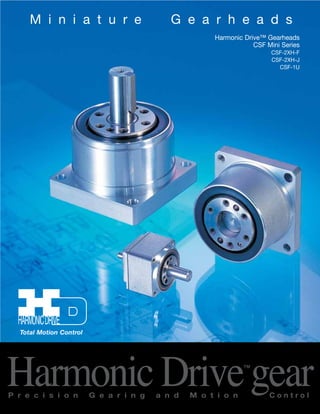
Harmonic Drive™ Gearheads 
CSF Mini Series 
CSF-2XH-F 
CSF-2XH-J 
CSF-1U 
Total Motion Control Harmonic Drive™gear P r e c i s i o n G e a r i n g a n d M o t i o n C o n t r o l
­­­­­­­­­­­2 
CSF Mini Series 
Harmonic Drive™ precision gear is the next 
generation in precision motion control. 
Harmonic Drive™ Precision Control Speed Reducers for compact models 
are available in this CSF Mini Series. 
Future 
Zero-Backlash, High Positional Accuracy, High Repeatability 
The innovative design of Harmonic Drive™ precision gear allows consistently high performance 
over the life of the gear. 
Compact, Lightweight, High Torque Capacity 
Harmonic Drive LLC’ patented “S” gear tooth profile achieves twice the torque, 
life and torsional stiffness as compared to gears of the same size by 
allowing up to 30% of the gear teeth to be engaged at all times. 
Compact 4-Point Contact Ball Bearing Mounted In Main Shaft 
A high performance 4-point contact output bearing supports the output 
flange/shaft. This bearing has excellent run-out characteristics and can 
support high radial, axial and moment loads. 
Wide Range Of Gear Ratios And Input/Output Configurations In 
Each Size 
Gear Ratios 30:1, 50:1, and 100:1 are available in each size. This allows 
servomotor and gearhead combinations to operate over a wide speed range. 
In addition, each size has 3 input/output shaft/flange configurations allowing 
convenient methods for attaching loads, motors, and pulleys. 
Sold & Serviced By: 
ELECTROMATE 
Toll Free Phone (877) SERVO98 
Toll Free Fax (877) SERV099 
www.electromate.com 
sales@electromate.com
Sold & Serviced By: 
Harmonic Drive LLC 800-921-3332 ­­­­­­­­­­­3 
Contents 
About Harmonic Drive™ Gear 
Principle and Structure . 04 
Driving Configuration . 05 
Application Example . 06 
Ordering Information Model and Code . 06 
Rating Table . 07 
Definition of Ratings . 07 
Strength and Life . 08 
Selection Procedure . 09 
Selection Example . 10 
Unit Type CSF-mini 
External Dimensions . 11 
Specification for Cross Roller Bearing . 12 
Output Bearing Ratings . 13 
Specifications of Output Bearings . 14 
Engineering Data 
Efficiency . 15 
No Load Running Torque . 17 
Starting Torque and Backdriving Torque . 19 
Positioning Accuracy . 19 
Torsional Stiffness . 20 
Recommended Tolerance for Assembly . 22 
Performance Data for Input Bearing . 23 
Installation of Case Side . 24 
Tolerances for Assembly . 25 
Warranty and Safety 
Warranty . 25 
Safety Guide . 26 
Harmonic Drive™ Gear 
ELECTROMATE 
Toll Free Phone (877) SERVO98 
Toll Free Fax (877) SERV099 
www.electromate.com 
sales@electromate.com
­­­­­­­­­­­4 
Principle and Structure 
90º 
When the Circular Spline is fixed and 
the Wave generator rotates clockwise, 
the Flexspline is elastically deformed 
and rotates counterclockwise relative to 
the Circular Spline. 
360º 
Sold & Serviced By: 
For each 360 degrees clockwise 
movement of the Wave Generator,the 
Flexspline moves counterclockwise by 
two teeth relative to the Circular Spline. 
0 º 
Circular Spline 
Wave Generator 
Flexspline 
The Flexspline is elliptically shaped by The 
Wave Generator and engaged with the 
Circular Spline at the major elliptical axis. 
The teeth completely disengage on the 
minor axis. 
This gearhead is easy to use and has both an input and 
output shaft. It also allows for pulleys to be used for the 
input and output to the gearhead. 
This gearhead is designed to be coupled directly to a servo-motor. 
It is available in 2 models. 2XH-F:Direct input coupling/ 
output Flange. 2XH-J: Direct input coupling/output Shaft. 
4 Point Contact Bearing 
Output (FS) 
Rotary System 
Flexspline 
Circular Spline 
Input (WG) 
Wave Generator 
4 Point Contact Bearing 
Output Flange 
Flexspline 
Circular Spline 
Wave Generator 
About Harmonic Drive™ strain wave gear principle and structure 
System Components 
The Wave Generator: A thin raced ball bearing fitted onto an elliptical plug serving as a high efficiency torque converter. 
The Flexspline: A non-rigid, thin cylindrical cup with external teeth on a slightly smaller pitch diameter than the Circular Spline. 
It fits over and is held in an elliptical shape by the Wave Generator. 
The Circular Spline: A rigid ring with internal teeth, engaging the teeth of the Flexspline across the major axis of the 
Wave Generator. 
GEARHEAD TYPE (IU) GEARHEAD TYPE (2XH) 
ELECTROMATE 
Toll Free Phone (877) SERVO98 
Toll Free Fax (877) SERV099 
www.electromate.com 
sales@electromate.com
Sold & Serviced By: 
Harmonic Drive LLC 
800-921-3332 
­­­­­­­­­­­5 
Driving Configurations 
A variety of different driving 
configurations are possible, as shown 
below. The reduction ratio given in 
the tables on page 10 and 11 correspond 
to arrangement 1, in which the Wave 
Generator acts as the input element, 
the Circular Spline is fixed and the 
Flexspline acts as the output element. 
Ratio = 
input speed 
output speed 
3. Reduction Gearing 
WG Fixed 
FS Input 
CS Output 
R + 1 
Ratio = R [Equation 3] 
Input and output in same direction. 
6. Speed Increaser Gearing 
FS Fixed 
CS Input 
WG Output 
1 
Ratio = R + 1 [Equation 6] 
Input and output in same direction. 
WG 
CS 
FS 
1. Reduction Gearing 
CS Fixed 
WG Input 
FS Output 
Ratio = — R 1 
[Equation 1] 
Input and output in opposite direction. 
4. Speed Increaser Gearing 
WG Fixed 
CS Input 
FS Output 
R 
Ratio = R + 1 [Equation 4] 
Input and output in same direction. 
7. Differential Gearing 
WG Control Input 
CS Main Drive-Input 
FS Main Drive-Output 
Numerous differential functions can 
be obtained by combinations of the 
speed and rotational direction of 
the three basic elements. 
2. Reduction Gearing 
FS Fixed 
WG Input 
CS Output 
R + 1 
Ratio = 1 [Equation 2] 
Input and output in same direction. 
5. Speed Increaser Gearing 
CS Fixed 
FS Input 
WG Output 
Ratio = — 1 R 
[Equation 5] 
Input and output in opposite direction. 
Driving Configurations 
[Equation 7] 
ELECTROMATE 
Toll Free Phone (877) SERVO98 
Toll Free Fax (877) SERV099 
www.electromate.com 
sales@electromate.com
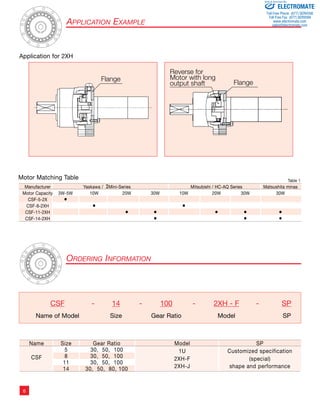
Application for 2XH 
Sold & Serviced By: 
ELECTROMATE 
Toll Free Phone (877) SERVO98 
Toll Free Fax (877) SERV099 
www.electromate.com 
sales@electromate.com 
Matching Table Table 1 
Manufacturer Yaskawa / Mini-Series Mitsubishi / HC-AQ Series Matsushita minas 
Motor Capacity 3W-5W 10W 20W 30W 10W 20W 30W 30W 
CSF-5-2X • 
CSF-8-2XH • • 
CSF-11-2XH • • • • • 
CSF-14-2XH • • •­Motor 
­­­­­­­­­­­6 
App lication Examp le 
Flange Flange 
M 
Ordering Information 
Reverse for 
Motor with long 
output shaft 
CSF - 14 - 100 - 2XH - F - SP 
Name of Model Size Gear Ratio Model SP 
Name Size Gear Ratio Model SP 
5 30, 50, 100 
8 30, 50, 100 
1U Customized specification 
CSF 
11 30, 50, 100 
2XH-F (special) 
14 30, 50, 80, 100 2XH-J shape and performance
Rating Table 
Sold & Serviced By: 
ELECTROMATE 
Toll Free Phone (877) SERVO98 
Toll Free Fax (877) SERV099 
www.electromate.com 
sales@electromate.com 
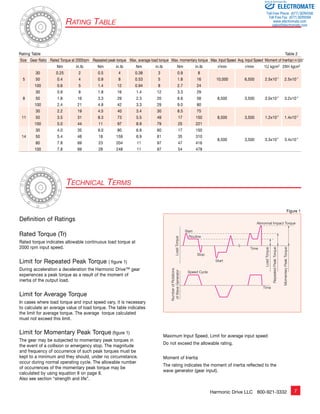
Rating Table Table 2 
Size Gear Ratio Rated Torque at 2000rpm Repeated peak torque Max. average load torque Max. momentary torque Max. Input Speed Avg. Input Speed Moment of Inertia(1/4 GD)2 
Nm in.lb Nm in.lb Nm in.lb Nm in.lb r/min r/min 1U kgcm2 2XH kgcm2 
Harmonic Drive LLC 800-921-3332 ­­­­­­­­­­­7 
Start 
Routine 
Abnormal Impact Torque 
Start 
Stop 
Speed Cycle 
Number of Rotations 
of Wave Generator 
Time 
Time 
Load Torque 
Repeated Peak Torque 
Load Torque 
Momentary Peak Torque 
30 0.25 2 0.5 4 0.38 3 0.9 8 
5 50 0.4 4 0.9 8 0.53 5 1.8 16 10,000 6,500 2.5x10⁻⁴ 2.5x10⁻⁴ 
100 0.6 5 1.4 12 0.94 8 2.7 24 
30 0.9 8 1.8 16 1.4 12 3.3 29 
8 50 1.8 16 3.3 29 2.3 20 6.6 58 8,500 3,500 3.0x10⁻³ 3.2x10⁻³ 
100 2.4 21 4.8 42 3.3 29 9.0 80 
30 2.2 19 4.5 40 3.4 30 8.5 75 
11 50 3.5 31 8.3 73 5.5 49 17 150 8,500 3,500 1.2x10⁻² 1.4x10⁻² 
100 5.0 44 11 97 8.9 79 25 221 
30 4.0 35 9.0 80 6.8 60 17 150 
14 50 5.4 48 18 159 6.9 61 35 310 
80 7.8 69 23 204 11 97 47 416 
8,500 3,500 3.3x10⁻² 3.4x10⁻² 
100 7.8 69 28 248 11 97 54 478 
Definition of Ratings 
Rated Torque (Tr) 
Rated torque indicates allowable continuous load torque at 
2000 rpm input speed. 
Limit for Repeated Peak Torque ( figure 1) 
During acceleration a deceleration the Harmonic Drive™ gear 
experiences a peak torque as a result of the moment of 
inertia of the output load. 
Limit for Average Torque 
In cases where load torque and input speed vary, it is necessary 
to calculate an average value of load torque. The table indicates 
the limit for average torque. The average torque calculated 
must not exceed this limit. 
Limit for Momentary Peak Torque (figure 1) 
The gear may be subjected to momentary peak torques in 
the event of a collision or emergency stop. The magnitude 
and frequency of occurrence of such peak torques must be 
kept to a minimum and they should, under no circumstance, 
occur during normal operating cycle. The allowable number 
of occurrences of the momentary peak torque may be 
calculated by using equation 8 on page 8. 
Also see section “strength and life”. 
Maximum Input Speed, Limit for average input speed 
Do not exceed the allowable rating. 
Moment of Inertia 
The rating indicates the moment of inertia reflected to the 
wave generator (gear input). 
Technical Terms 
Figure 1
Table 3 Ratcheting Torque Nm Buckling Torque Nm 
­­­­­­­­­­­8 
17 
16 
10 
9 
8 
7 
6 
5 
4 
3 
2 
1 
Sold & Serviced By: 
Figure 2 
Buckling Torque 
Racheting Torque 
Circular Spline 
Flexspline 
Momentary Peak Torque 
105 106 107 108 109 0 
Load Torque ( Rated Torque = 1 ) 
Total Number of Input Rotations 
1010 
Life of the Wave Generator 
Fatigue Strength of Flexspline 
Repeated Peak Torque 
Rated Torque 
Strength and Life 
The non-rigid Flexspline is subjected to repeated deflections, and its 
strength determines the torque capacity of the Harmonic Drive™ gear. 
The values given for Rated Torque at Rated Speed and for the allow-able 
Repeated Peak Torque are based on an infinite fatigue life for the 
Flexspline. 
The torque that occurs during a collision must be below the momentary 
peak torque (impact torque). The maximum number of occurrences is 
given by the equation below. 
Ratcheting phenomenon 
When excessive torque is applied while the gear is in motion, the teeth 
between the Circular Spline and Flexspline may not engage properly. 
This phenomenon is called ratcheting and the torque at which this 
occurs is called ratcheting torque. Ratcheting may cause the Flexspline 
to become non-concentric with the Circular Spline. 
(See figure 2 and 3 on page 8) Operating in this condition may result 
in shortened life and a Flexspline fatigue failure. 
Note! 
When ratcheting occurs, the teeth mesh abnormally as shown above. 
Vibration and Flexspline damage may occur. Once ratcheting occurs, 
the teeth wear excessively and the ratcheting torque may be lowered. 
The Life of a Wave Generator 
The normal life of a gear is determined by the life of the wave genera-tor 
bearing. The life may be calculated by using the input speed and the 
output load torque. 
Rated Lifetime Ln : (n = 10 or 50) 
L10 CSF : 7,000 CSG: 10,000 
L50 CSF : 35,000 CSG : 50,000 
Equation for the expected life of the wave generator under 
normal operating conditions is given by the equation below. 
[Equation 9] 
Lh = Ln • ( Tr )3• ( Nr ) 
Tav Nav 
Lh : Expected Life, hours 
Ln : Rated Lifetime at L10 or L50 
Tr : Rated Torque (Table 2) 
Nr : Rated input speed (2000 rpm) 
Tav : Average load torque on output side (page 9) 
Nav : Average input speed (page 9) 
[Equation 8] 
1.0 X 10⁴ n: Input speed before collision 
N = 
2 X n X t t: Time interval during collision 60 
Please note: 
If this number is exceeded, the Flexspline 
may experience a fatigue failure. 
This condition is called “dedoidal”. 
Relative Torque Rating 
The chart below shows the various torque specifications 
relative to rated torque. Rated Torque has been 
normalized to 1 for comparison. 
Size Gear Ratio 
Size All Ratio 
30 50 80 100 
5 2.7 3.2 – 3.5 5 9.8 
8 11 12 – 14 8 35 
11 29 34 – 43 11 90 
14 59 88 110 84 14 190 
Figure 3 
Strength and Life 
ELECTROMATE 
Toll Free Phone (877) SERVO98 
Toll Free Fax (877) SERV099 
www.electromate.com 
sales@electromate.com
Sold & Serviced By: 
ELECTROMATE 
Toll Free Phone (877) SERVO98 
Toll Free Fax (877) SERV099 
www.electromate.com 
sales@electromate.com 
Harmonic Drive LLC 800-921-3332 
­­­­­­­­­­­9 
T 
1 
T 
Selection Procedure 
2 
T 
3 
T 
4 
T 
n 
t 
1 t 
2 t 
3 t 
4 t 
n 
n 
1 
n 
2 
n 
3 
n 
4 
n 
n 
+ 
Torque 
_ 
rpm 
n 
1 n 
n are an average value. Time 
2 n 
Time 
OK 
OK 
OK 
OK 
OK 
NG 
NG 
NG 
NG 
NG 
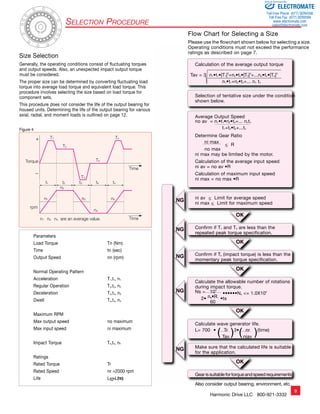
Size Selection 
Generally, the operating conditions consist of fluctuating torques 
and output speeds. Also, an unexpected impact output torque 
must be considered. 
The proper size can be determined by converting fluctuating load 
torque into average load torque and equivalent load torque. This 
procedure involves selecting the size based on load torque for 
component sets. 
This procedure does not consider the life of the output bearing for 
housed units. Determining the life of the output bearing for various 
axial, radial, and moment loads is outlined on page 12. 
Figure 4 
Parameters 
Load Torque Tn (Nm) 
Time tn (sec) 
Output Speed nn (rpm) 
Normal Operating Pattern 
Acceleration T1,t1, n1 
Regular Operation T2,t2, n2 
Deceleration T3,t3, n3 
Dwell T4,t4, n4 
Maximum RPM 
Max output speed no maximum 
Max input speed ni maximum 
Impact Torque Ts,ts, ns 
Ratings 
Rated Torque Tr 
Rated Speed nr =2000 rpm 
Life L10=L (hrs) 
Flow Chart for Selecting a Size 
Please use the flowchart shown below for selecting a size. 
Operating conditions must not exceed the performance 
ratings as described on page 7. 
Calculation of the average output torque 
Tav = 3 n1•t1•|T1|3+n2•t2•|T2|3+...nn•tn•|Tn|3 
n1•t1+n2•t2+... nn tn 
Selection of tentative size under the condition 
shown below. 
Average Output Speed 
no av = n1•t1•n2•t2+... nntn 
t1+t2•t2+...tn 
Determine Gear Ratio 
ni max < R 
no max 
ni max may be limited by the motor. 
Calculation of the average input speed 
ni av = no av •R 
Calculation of maximum input speed 
ni max = no max •R 
ni av < Limit for average speed 
ni max < Limit for maximum speed 
Confirm if T1 and T3 are less than the 
repeated peak torque specification. 
Confirm if Ts (impact torque) is less than the 
momentary peak torque specification. 
Calculate the allowable number of rotations 
during impact torque. 
Ns = 104 ••••••Ns <= 1.0X10⁴ 
2• ns•R •ts 
60 
Calculate wave generator life. 
L= 700 • ( Tr )3•( nr )(time) 
Tav niav 
Make sure that the calculated life is suitable 
for the application. 
Gear is suitable for torque and speed requirements 
Also consider output bearing, environment, etc.
­­­­­­­­­­­10 
Selection Examp le 
Sold & Serviced By: 
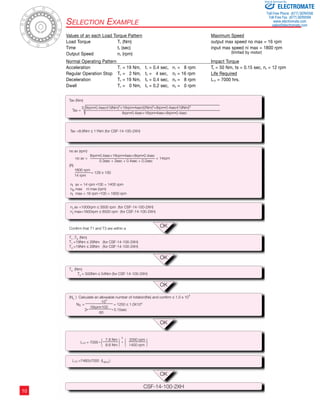
Values of an each Load Torque Pattern Maximum Speed 
Load Torque Tn (Nm) output max speed no max = 16 rpm 
Time tn (sec) input max speed ni max = 1800 rpm 
Output Speed nn (rpm) (limited by motor) 
Normal Operating Pattern Impact Torque 
Acceleration T1 = 19 Nm, t1 = 0.4 sec, n1 = 8 rpm Ts = 50 Nm, ts = 0.15 sec, ns = 12 rpm 
Regular Operation Stop T2 = 2 Nm, t2 = 4 sec, n2 = 16 rpm Life Required 
Deceleration T3 = 19 Nm, t3 = 0.4 sec, n3 = 8 rpm L10 = 7000 hrs. 
Dwell T4 = 0 Nm, t4 = 0.2 sec, n4 = 0 rpm 
Tav (Nm) 
3 8rpm•0.4sec•|19Nm|3+16rpm•4sec•|2Nm|3+8rpm•0.4sec•|19Nm|3 
Tav = 
8rpm•0.4sec+16rpm•4sec+8rpm•0.4sec 
Tav =8.6Nm  11Nm (for CSF-14-100-2XH) 
no av (rpm) 
8rpm•0.4sec+16rpm•4sec+8rpm•0.4sec 
no av = = 14rpm 
0.3sec + 3sec + 0.4sec + 0.2sec 
(R) 
1800 rpm 
= 129  100 
14 rpm 
n av = 14 rpm •100 = 1400 rpm 
n max ni max (rpm) 
n max = 16 rpm •100 = 1600 rpm 
n av =1000rpm  3500 rpm (for CSF-14-100-2XH) 
n max=1600rpm  8500 rpm (for CSF-14-100-2XH) 
Confirm that T1 and T3 are within a 
T 
1 ,T 
3 (Nm) 
T 
1 =19Nm  28Nm (for CSF-14-100-2XH) 
T 
3 =19Nm  28Nm (for CSF-14-100-2XH) 
T 
s (Nm) 
T 
s = 500Nm  54Nm (for CSF-14-100-2XH) 
(N 
OK 
OK 
OK 
s ) Calculate an allowable number of rotation(Ns) and confirm  1.0 x 10⁴ 
104 
N 
S = = 1250  1.0X10⁴ 
16rpm•100 
2• • 0.15sec 
60 
7.8 Nm 3 2000 rpm 
L 
10 = 7000 • ( ) • ( ) 8.6 Nm 1400 rpm 
L 
10 =74607000 (L 
B10 ) 
OK 
OK 
CSF-14-100-2XH 
i 
o 
i 
i 
i 
ELECTROMATE 
Toll Free Phone (877) SERVO98 
Toll Free Fax (877) SERV099 
www.electromate.com 
sales@electromate.com
External Dimensions 
Sold  Serviced By: 
ELECTROMATE 
Toll Free Phone (877) SERVO98 
Toll Free Fax (877) SERV099 
www.electromate.com 
sales@electromate.com 
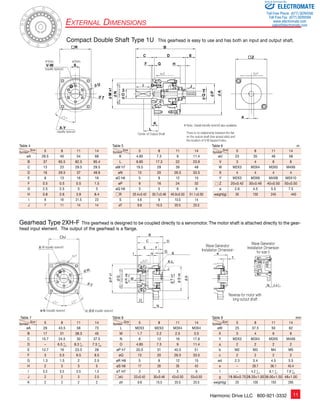
Compact Double Shaft Type 1U This gearhead is easy to use and has both an input and output shaft. 
Table 4 Table 5 Table 6 m 
Symbol 
Size 5 8 11 14 Symbol 
Size 5 8 11 14 
øA 26.5 40 54 68 K 4.85 7.3 9 11.4 øU 23 35 46 58 
B 37 65.5 82.5 95.4 L 9.85 17.3 22 23.9 V 3 4 6 6 
C 13 23 29.5 29.5 øM h7 19.5 29 39 48 W M2X3 M3X4 M3X5 M4X6 
D 16 29.5 37 49.9 øN 13 20 26.5 33.5 X 4 4 4 4 
E 8 13 16 16 øO h6 5 9 12 15 Y M2X3 M3X6 M4X8 M5X10 
F 0.5 0.5 0.5 1.5 øP 9 16 24 32 Z 20±0.42 30±0.46 40±0.50 50±0.50 
G 2.5 2.5 3 3 øQ h6 3 5 6 8 a 2.6 4.5 5.5 7.5 
H 0.8 2.6 3.9 8.4 R 20.4±0.42 30.7±0.46 40.9±0.50 51.1±0.50 weight(g) 35 130 240 440 
I 9 18 21.5 23 S 4.6 8 10.5 14 
J 7 11 14 14 øT 9.8 15.5 20.5 25.5 
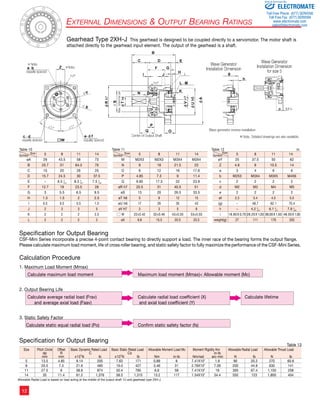
Gearhead Type 2XH-F This gearhead is designed to be coupled directly to a servomotor. The motor shaft is attached directly to the gear-head 
Table 7 Table 8 Table 9 mm 
Harmonic Drive LLC 800-921-3332 ­­­­­­­­­­­11 
Symbol 
input element. The output of the gearhead is a flange. 
Size 5 8 11 14 Symbol 
Size 5 8 11 14 
øA 29 43.5 58 73 L M2X3 M2X3 M3X4 M3X4 øW 25 37.5 50 62 
B 17 31 38.3 45 M 1.7 2.2 2.5 3.5 X 3 4 6 6 
C 15.7 24.5 30 37.5 N 6 12 16 17.6 Y M2X3 M3X4 M3X5 M4X6 
D – 6.5 0 
-0.3 8.3 0 
-0.7 7.5 0 
-0.8 O 4.85 7.3 9 11.4 a 2 2 2 2 
E 12.7 19 23.5 28 øP h7 20.5 31 40.5 51 b M2 M3 M4 M5 
F 3 5.5 6.5 9.5 øQ 13 20 26.5 33.5 c 2 2 2 2 
G 1.3 1.5 2 2.5 øR H6 5 9 12 15 ød 2.3 3.4 4.5 5.5 
H 2 3 3 5 øS h6 17 26 35 43 e – 28.7 36.1 45.4 
I 0.5 0.5 0.5 1.5 øT H7 3 3 5 6 f – 4.2 0 
-0.3 6.1 0 
-0.7 7.9 0 
-0.8 
J 2 2 3 2.5 øU 22±0.42 30±0.46 43±0.50 53±0.50 g 18.90±0.70 28.20±1.00 38.00±1.50 48±1.00 
K 2 2 2 2 øV 9.8 15.5 20.5 25.5 weight(g) 25 100 150 295
Sold  Serviced By: 
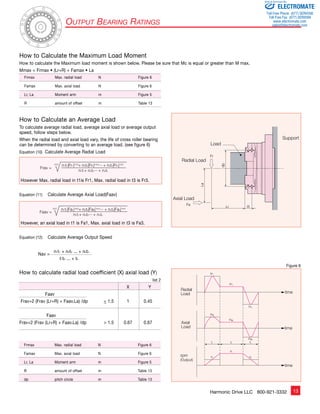
Gearhead Type 2XH-J This gearhead is designed to be coupled directly to a servomotor. The motor shaft is 
attached directly to the gearhead input element. The output of the gearhead is a shaft. 
Table 10 Table 11 Table 12 m 
Symbol 
Size 5 8 11 14 Symbol 
Specification for Output Bearing 
CSF-Mini Series incorporate a precise 4-point contact bearing to directly support a load. The inner race of the bearing forms the output flange. 
Please calculate maximum load moment, life of cross roller bearing, and static safety factor to fully maximize the performance of the CSF-Mini Series. 
Calculation Procedure 
1. Maximum Load Moment (Mmax) 
Specification for Output Bearing 
­­­­­­­­­­­12 
Calculate maximum load moment Maximum load moment (Mmax) Allowable moment (Mc) 
2. Output Bearing Life 
Calculate average radial load (Frav) Calculate radial load coefficient (X) Calculate lifetime 
and average axial load (Faav) and axial load coefficient (Y) 
3. Static Safety Factor 
Calculate static equal radial load (Po) Confirm static safety factor (fs) 
Size Pitch Circle Offset Basic Dynamic Rated Load Basic Static Rated Load Allowable Moment Load Mc Moment Rigidity Km Allowable Radial Load Allowable Thrust Load 
dp R C Co in-lb 
mm mm x102N lb x102N lb Nm in-lb Nm/rad arc-min N lb N lb 
5 13.5 4.85 9.14 205 7.63 171 0.89 8 7.41X10² 1.9 90 20.2 270 60.6 
8 20.5 7.3 21.6 485 19.0 427 3.46 31 2.76X10³ 7.09 200 44.9 630 141 
11 27.5 9 38.9 874 35.4 795 6.6 58 7.41X10³ 19 300 67.4 1,150 258 
14 35 11.4 61.2 1,376 58.5 1,315 13.2 117 1.34X10⁴ 34.4 550 123 1,800 404 
Allowable Radial Load is based on load acting at the middle of the output shaft 1U and gearhead type 2XH-J 
Size 5 8 11 14 
øA 29 43.5 58 73 M M2X3 M2X3 M3X4 M3X4 øY 25 37.5 50 62 
B 25.7 51 64.3 70 N 9 18 21.5 23 Z 4.6 8 10.5 14 
C 10 20 26 25 O 6 12 16 17.6 a 3 4 6 6 
D 15.7 24.5 30 37.5 P 4.85 7.3 9 11.4 b M2X3 M3X4 M3X5 M4X6 
E – 6.5 0 
-0.3 8.3 0 
-0.7 7.5 0 
-0.8 Q 9.85 17.3 22 23.9 c 2 2 2 2 
F 12.7 19 23.5 28 øR h7 20.5 31 40.5 51 d M2 M3 M4 M5 
G 3 5.5 6.5 9.5 øS 13 20 26.5 33.5 e 2 2 2 2 
H 1.3 1.5 2 2.5 øT h6 5 9 12 15 øf 2.3 3.4 4.5 5.5 
I 0.5 0.5 0.5 1.5 øU h6 17 26 35 43 (g) – 48.7 62.1 70.4 
J 2 3 3 5 øV H7 3 3 5 6 h – 4.2 0 
-0.3 6.1 0 
-0.7 7.9 0 
-0.8 
K 2 2 2 2.5 W 22±0.42 32±0.46 43±0.50 53±0.50 i 18.90 X 0.70 28.20 X 1.00 38.00 X 1.50 48.00 X 1.00 
L 2 2 2 2 øX 9.8 15.5 20.5 25.5 weight(g) 27 111 176 335 
Table 13 
External Dimensions  Output Bearing Ratings 
ELECTROMATE 
Toll Free Phone (877) SERVO98 
Toll Free Fax (877) SERV099 
www.electromate.com 
sales@electromate.com
Output Bearing Ratings 
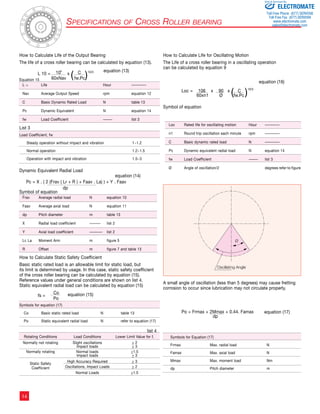
How to Calculate the Maximum Load Moment 
How to calculate the Maximum load moment is shown below. Please be sure that Mc is equal or greater than M max. 
Mmax = Frmax • (Lr+R) + Famax • La 
Load 
Fr 
Fr 
1 
Fa 
1 
Fr 
2 
Fa 
2 
Fr 
3 
Fa 
t 
1 t 
2 t 
3 
n 
2 
3 
Sold  Serviced By: 
Figure 6 
Harmonic Drive LLC 800-921-3332 ­­­­­­­­­­­13 
Frmax Max. radial load N Figure 6 
Famax Max. axial load N Figure 6 
Lr, La Moment arm m Figure 5 
R amount of offset m Table 13 
How to Calculate an Average Load 
To calculate average radial load, average axial load or average output 
speed, follow steps below. 
When the radial load and axial load vary, the life of cross roller bearing 
can be determined by converting to an average load. (see figure 6) 
Equation (10) Calculate Average Radial Load 
10/3 n1t1|Fr1|10/3+ n2t2|Fr2|10/3··· + nntn|Frn|10/3 
Frav = 
n1t1+ n2t2··· + nntn 
However Max. radial load in t1is Fr1, Max. radial load in t3 is Fr3. 
Equation (11) Calculate Average Axial Load(Faav) 
10/3 n1t1|Fa1|10/3+ n2t2|Fa2|10/3··· + nntn|Fan|10/3 
Faav = 
n1t1+ n2t2··· + nntn 
dp 
Radial Load 
La 
Axial Load 
Fa Lr R 
Support 
n 
1 n 
3 
Radial 
Load 
Axial 
Load 
rpm 
(Output) 
time 
time 
time 
However, an axial load in t1 is Fa1, Max. axial load in t3 is Fa3. 
Equation (12) Calculate Average Output Speed 
Nav = n1t1 + n2t2 ... + nntn 
t1t2 ... + tn 
How to calculate radial load coefficient (X) axial load (Y) 
Frmax Max. radial load N Figure 6 
Famax Max. axial load N Figure 6 
Lr, La Moment arm m Figure 5 
R amount of offset m Table 13 
dp pitch circle m Table 13 
list 2 
X Y 
Faav 
Frav+2 (Frav (Lr+R) + Faav.La) /dp  1.5 1 0.45 
Faav 
Frav+2 (Frav (Lr+R) + Faav.La) /dp  1.5 0.67 0.67 
ELECTROMATE 
Toll Free Phone (877) SERVO98 
Toll Free Fax (877) SERV099 
www.electromate.com 
sales@electromate.com
­­­­­­­­­­­14 
Specifications of Cross Roller bearing 
Ø 
Oscillating Angle 
How to Calculate Life of the Output Bearing 
The life of a cross roller bearing can be calculated by equation (13). 
equation (13) 
L 10 = 106 x ( C )10/3 
60xNav fw.Pc 
List 3 
Dynamic Equivalent Radial Load 
equation (14) 
Pc = X . ( 2 (Frav ( Lr + R ) + Faav . La) ) + Y . Faav 
dp 
Symbol of equation 
How to Calculate Static Safety Coefficient 
Basic static rated load is an allowable limit for static load, but 
its limit is determined by usage. In this case, static safety coefficient 
of the cross roller bearing can be calculated by equation (15). 
Reference values under general conditions are shown on list 4. 
Static equivalent radial load can be calculated by equation (15) 
equation fs = Co (15) 
Po 
list 4 
Sold  Serviced By: 
How to Calculate Life for Oscillating Motion 
The Life of a cross roller bearing in a oscillating operation 
can be calculated by equation 9 
equation (16) 
Loc = 106 x 90 x ( C )10/3 
60xn1 Ø fw.Pc 
Symbol of equation 
A small angle of oscillation (less than 5 degrees) may cause fretting 
corrosion to occur since lubrication may not circulate properly. 
equation (17) Po = Frmax + 2Mmax + 0.44. Famax 
dp 
Equation 15 
L 10 Life Hour –––––––– 
Nav Average Output Speed rpm equation 12 
C Basic Dynamic Rated Load N table 13 
Pc Dynamic Equivalent N equation 14 
fw Load Coefficient ––––– list 3 
Frav Average radial load N equation 10 
Faav Average axial load N equation 11 
dp Pitch diameter m table 13 
X Radial load coefficient –––––– list 2 
Y Axial load coefficient ––––––– list 2 
Lr, La Moment Arm m figure 5 
R Offset m figure 7 and table 13 
Loc Rated life for oscillating motion Hour –––––––– 
n1 Round trip oscillation each minute rpm –––––––– 
C Basic dynamic rated load N –––––––– 
Pc Dynamic equivalent radial load N equation 14 
fw Load Coefficient ––––– list 3 
Ø Angle of oscillation/2 degrees refer to figure 
Load Coefficient, fw 
Steady operation without impact and vibration 1~1.2 
Normal operation 1.2~1.5 
Operation with impact and vibration 1.5~3 
Symbols for equation (17) 
Co Basic static rated load N table 13 
Po Static equivalent radial load N refer to equation (17) 
Rotating Conditions Load Conditions Lower Limit Value for fs 
Normally not rotating Slight oscillations  2 
Impact loads  3 
Normally rotating Normal loads 1.5 
Impact loads  3 
High Accuracy Required  3 
Static Safety 
Oscillations, Impact Loads  2 
Coefficient 
Normal Loads 1.5 
Symbols for Equation (17) 
Frmax Max. radial load N 
Famax Max. axial load N 
Mmax Max. moment load Nm 
dp Pitch diameter m 
ELECTROMATE 
Toll Free Phone (877) SERVO98 
Toll Free Fax (877) SERV099 
www.electromate.com 
sales@electromate.com
Eff iciency 
Sold  Serviced By: 
ELECTROMATE 
Toll Free Phone (877) SERVO98 
Toll Free Fax (877) SERV099 
www.electromate.com 
sales@electromate.com 
­­­­­­­­­­­15 
1U-2XH 
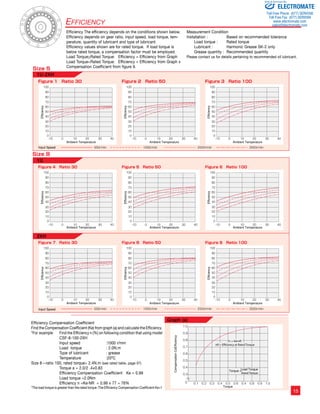
Efficiency The efficiency depends on the conditions shown below. 
Efficiency depends on gear ratio, input speed, load torque, tem-perature, 
quantity of lubricant and type of lubricant. 
Efficiency values shown are for rated torque. If load torque is 
below rated torque, a compensation factor must be employed. 
Load TorqueRated Torque: Efficiency = Efficiency from Graph 
Load TorqueRated Torque: Efficiency = Efficiency from Graph x 
Compensation Coefficient from figure 9. 
Figure 1 Ratio 30 Figure 2 Ratio 50 Figure 3 Ratio 100 
Efficiency 
-10 0 10 20 30 40 -10 0 10 20 30 40 -10 0 10 20 30 40 
Ambient Temperature Ambient Temperature Ambient Temperature 
1.0 
Ambient Temperature 
Compensation CoEfficiency 
0.9 
0.8 
0.7 
0.6 
0.5 
0.4 
0.3 
100 
90 
80 
70 
60 
50 
40 
30 
20 
10 
0 
Ambient Temperature 
Efficiency 
0 0.1 0.2 0.3 0.4 0.5 0.6 0.4 0.8 0.9 1.0 
Torque 
Graph (a) 
n = ke•nR 
nR = Efficiency at Rated Torque 
Size 5 
Size 8 
Ambient Temperature 
Efficiency 
100 
90 
80 
70 
60 
50 
40 
30 
20 
10 
0 
100 
90 
80 
70 
60 
50 
40 
30 
20 
10 
0 
100 
90 
80 
70 
60 
50 
40 
30 
20 
10 
0 
Ambient Temperature 
Efficiency 
-10 0 10 20 30 40 -10 0 10 20 30 40 -10 0 10 20 30 40 
Ambient Temperature 
Efficiency 
Input Speed 500r/min 1000r/min 2000r/min 3500r/min 
1U 
Figure 4 Ratio 30 Figure 5 Ratio 50 Figure 6 Ratio 100 
100 
90 
80 
70 
60 
50 
40 
30 
20 
10 
0 
Efficiency 
2XH 
100 
90 
80 
70 
60 
50 
40 
30 
20 
10 
0 
Efficiency 
Ambient Temperature 
Figure 7 Ratio 30 Figure 8 Ratio 50 Figure 9 Ratio 100 
Efficiency 
100 
90 
80 
70 
60 
50 
40 
30 
20 
10 
0 
100 
90 
80 
70 
60 
50 
40 
30 
20 
10 
0 
100 
90 
80 
70 
60 
50 
40 
30 
20 
10 
0 
Efficiency 
-10 0 10 20 30 40 -10 0 10 20 30 40 -10 0 10 20 30 40 
500r/min 1000r/min 2000r/min 3500r/min 
Input Speed 
Load Torque 
Rated Torque 
Torque = 
Efficiency Compensation Coefficient 
Find the Compensation Coefficient (Ke) from graph (a) and calculate the Efficiency. 
*For example Find the Efficiency n (%) on following condition that using model 
CSF-8-100-2XH 
Input speed :1000 r/min 
Load torque : 2.0N.m 
Type of lubricant : grease 
Temperature :20ºC 
Size 8—ratio 100, rated torque= 2.4N.m (see rated table, page 07) 
Torque a = 2.0/2 .4≠0.83 
Efficiency Compensation Coefficient Ke = 0.99 
Load torque =2.0Nm 
Efficiency n =Ke·NR = 0.99 x 77 = 76% 
*The load torque is greater than the rated torque :The Efficiency Compensation Coefficient Ke=1 
Measurement Condition 
Installation : Based on recommended tolerance 
Load torque : Rated torque 
Lubricant : Harmonic Grease SK-2 only 
Grease quantity : Recommended quantity 
Please contact us for details pertaining to recommended oil lubricant.
­­­­­­­­­­­16 
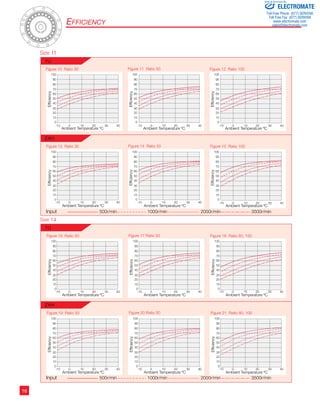
Eff iciency 
Size 11 
Figure 10 Ratio 30 
Size 14 
Figure 11 Ratio 50 Figure 12 Ratio 100 
Sold  Serviced By: 
Ambient Temperature ºC Ambient Temperature ºC Ambient Temperature ºC 
100 
90 
80 
70 
60 
50 
40 
30 
20 
10 
0 
-10 0 10 20 30 40 
Efficiency 
Ambient Temperature ºC Ambient Temperature ºC Ambient Temperature ºC 
100 
90 
80 
70 
60 
50 
40 
30 
20 
10 
0 
-10 0 10 20 30 40 
Efficiency 
100 
90 
80 
70 
60 
50 
40 
30 
20 
10 
0 
100 
90 
80 
70 
60 
50 
40 
30 
20 
10 
0 
-10 0 10 20 30 40 
Efficiency 
100 
90 
80 
70 
60 
50 
40 
30 
20 
10 
0 
-10 0 10 20 30 40 
Efficiency 
100 
90 
80 
70 
60 
50 
40 
30 
20 
10 
0 
-10 0 10 20 30 40 
Efficiency 
100 
90 
80 
70 
60 
50 
40 
30 
20 
10 
0 Efficiency 
-10 0 10 20 30 40 
1U 
2XH 
Efficiency 
100 
90 
80 
70 
60 
50 
40 
30 
20 
10 
0 
100 
90 
80 
70 
60 
50 
40 
30 
20 
10 
0 
Efficiency 
-10 0 10 20 30 40 
100 
90 
80 
70 
60 
50 
40 
30 
20 
10 
0 
-10 0 10 20 30 40 
Efficiency 
-10 0 10 20 30 40 
-10 0 10 20 30 40 
1U 
2XH 
100 
90 
80 
70 
60 
50 
40 
30 
20 
10 
0 
Efficiency 
100 
90 
80 
70 
60 
50 
40 
30 
20 
10 
0 
-10 0 10 20 30 40 
Efficiency 
Efficiency 
-10 0 10 20 30 40 
500r/min 1000r/min 2000r/min 3500r/min 
Input 
Input 
Ambient Temperature ºC Ambient Temperature ºC Ambient Temperature ºC 
Figure 13 Ratio 30 Figure 14 Ratio 50 Figure 15 Ratio 100 
Figure 16 Ratio 30 Figure 17 Ratio 50 Figure 18 Ratio 80, 100 
Figure 19 Ratio 30 Figure 20 Ratio 50 Figure 21 Ratio 80, 100 
Ambient Temperature ºC Ambient Temperature ºC Ambient Temperature ºC 
ELECTROMATE 
Toll Free Phone (877) SERVO98 
Toll Free Fax (877) SERV099 
www.electromate.com 
sales@electromate.com
No Load Running Torque 
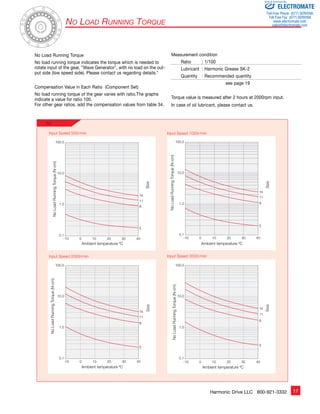
No load running torque indicates the torque which is needed to 
rotate input of the gear, Wave Generator, with no load on the out-put 
side (low speed side). Please contact us regarding details. 
Compensation Value in Each Ratio (Component Set) 
No load running torque of the gear varies with ratio.The graphs 
indicate a value for ratio 100. 
For other gear ratios, add the compensation values from table 34. 
Measurement condition 
Ratio : 1/100 
Lubricant : Harmonic Grease SK-2 
Quantity : Recommended quantity 
see page 19 
Sold  Serviced By: 
Torque value is measured after 2 hours at 2000rpm input. 
In case of oil lubricant, please contact us. 
14 
11 
8 
5 
-10 0 10 20 30 40 -10 0 10 20 30 40 
14 
11 
8 
Harmonic Drive LLC 800-921-3332 ­­­­­­­­­­­17 
1U 
Input Speed 1000r/min 
100.0 
10.0 
1.0 
0.1 
Input Speed 3500r/min 
Input Speed 500r/min 
100.0 
10.0 
1.0 
0.1 
Input Speed 2000r/min 
Size 
No Load Running Torque (N-cm) 
Ambient temperature ºC 
No Load Running Torque (N-cm) Ambient temperature ºC Ambient temperature ºC 
Size 
Size 
Size 
No Load Running Torque (N-cm) 
Ambient temperature ºC 
14 
11 
8 
5 
14 
11 
8 
5 
5 
100.0 
10.0 
1.0 
0.1 
100.0 
10.0 
1.0 
0.1 
-10 0 10 20 30 40 -10 0 10 20 30 40 
ELECTROMATE 
Toll Free Phone (877) SERVO98 
Toll Free Fax (877) SERV099 
www.electromate.com 
sales@electromate.com
­­­­­­­­­­­18 
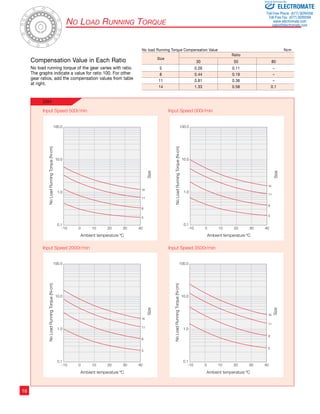
No Load Running Torque 
Compensation Value in Each Ratio 
No load running torque of the gear varies with ratio. 
The graphs indicate a value for ratio 100. For other 
gear ratios, add the compensation values from table 
at right. 
2XH 
Sold  Serviced By: 
No load Running Torque Compensation Value Ncm 
Size 
30 50 80 
5 0.26 0.11 – 
8 0.44 0.19 – 
11 0.81 0.36 – 
14 1.33 0.58 0.1 
Input Speed 500r/min Input Speed 000r/min 
No Load Running Torque (N-cm) 
14 
11 
8 
5 
14 
11 
8 
5 
Ratio 
-10 0 10 20 30 40 -10 0 10 20 30 40 
Ambient temperature ºC 
Size 
100.0 
No Load Running Torque (N-cm) Ambient temperature ºC 
10.0 
1.0 
0.1 
Input Speed 2000r/min Input Speed 3500r/min 
Size 
No Load Running Torque (N-cm) 
Ambient temperature ºC 
Size 
No Load Running Torque (N-cm) 
Ambient temperature ºC 
Size 100.0 
10.0 
1.0 
0.1 
100.0 
10.0 
1.0 
0.1 
100.0 
10.0 
1.0 
0.1 
14 
11 
8 
5 
14 
11 
8 
5 
-10 0 10 20 30 40 -10 0 10 20 30 40 
ELECTROMATE 
Toll Free Phone (877) SERVO98 
Toll Free Fax (877) SERV099 
www.electromate.com 
sales@electromate.com
Sold  Serviced By: 
ELECTROMATE 
Toll Free Phone (877) SERVO98 
Toll Free Fax (877) SERV099 
www.electromate.com 
sales@electromate.com 
Harmonic Drive LLC 800-921-3332 ­­­­­­­­­­­19 
Starting Torque 
Starting torque is the torque required to commence rotation of the 
input element (high speed side), with no load being applied to the 
output. The table below indicates the maximum values. The lower 
values are approximately 1/2 to 1/3 of the maximum values. 
Temperature is at 20 degree C. 
Positioning Accuracy 
The positioning accuracy of the gear represents a linearity error 
between the input and output angle. The position error is the 
difference between theoretical and actual output rotation angle. 
The positioning accuracy is measured for one complete output 
revolution using a high resolution measurement system. The 
measurements are carried out without reversing direction. 
The positioning accuracy is defined as the difference between 
the maximum positive and maximum negative deviation from 
the theoretical position. 
Typical Positional Accuracy Curve 
Component Type Backdriving Torque 
Backdriving torque is the torque required to commence 
rotation of input element (high speed side) when torque 
is applied on the output side (low speed side). The table 
below indicates the maximum values. The typical values 
are approximately 1/2 to 1/3 of the maximum values. The 
backdriving torque should not be relied upon to provide 
a holding torque to prevent the output from backdriving. 
A failsafe brake should be used for this purpose. 
Measurement condition: Ambient temperature 20ºC 
Values shown below vary depending on condition. 
Please use values as a reference. 
θer........................................ Positioning Accuracy 
θ1......................................... Input Angle 
θ2......................................... Actual Output Angle 
R.......................................... Gear Ratio ( i=l;R ) 
θer = θ2 – θ1 equation [18] 
R 
øer 
Starting Torque and Backdriving Torque 
Starting Torque Ncm 
Size 
Ratio 
30 50 80 100 
5 0.53 0.40 – 0.30 
8 1.3 0.80 – 0.59 
11 3.4 2.0 – 1.5 
14 6.4 4.1 2.8 2.5 
Positioning Accuracy arc-min 
Ratio 
Size 
5 8 11 14 
30 4 2 2 2 
50+ 3 2 1.5 1.5 
Back Driving Torque Nm 
Size 
Ratio 
30 50 80 100 
5 0.29 0.21 – 0.27 
8 0.70 0.55 – 0.75 
11 1.7 1.2 – 1.5 
14 2.4 1.6 1.6 1.8
Torsional Stiff ness 
Sold  Serviced By: 
ELECTROMATE 
Toll Free Phone (877) SERVO98 
Toll Free Fax (877) SERV099 
www.electromate.com 
sales@electromate.com 
Torsional Stiffness 
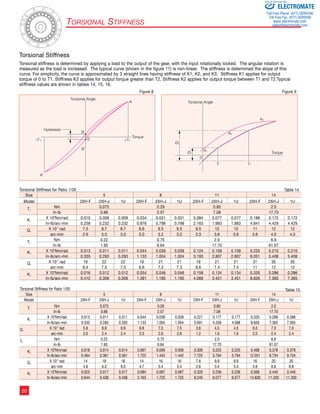
Torsional stiffness is determined by applying a load to the output of the gear, with the input rotationally locked. The angular rotation is 
measured as the load is increased. The typical curve (shown in the figure 11) is non-linear. The stiffness is determined the slope of this 
curve. For simplicity, the curve is approximated by 3 straight lines having stiffness of K1, K2, and K3. Stiffness K1 applies for output 
torque of 0 to T1. Stiffness K3 applies for output torque greater than T2. Stiffness K2 applies for output torque between T1 and T2.Typical 
stiffness values are shown in tables 14, 15, 16. 
Torsional Stiffness for Ratio 1/30 Table 14 
­­­­­­­­­­­20 
Hysteresis 
–T 
Torsional Angle 
0 0 
0 +T 
A 
A' 
B 
B' 
Figure 8 Figure 9 
Torque 
Torsional Angle 
Ø1 
K 
1 
T 
1 T 
2 
Ø 
2 
K 
2 
K 
3 
0 
Torque 
Size 5 8 11 14 
Model 2XH-F 2XH-J 1U 2XH-F 2XH-J 1U 2XH-F 2XH-J 1U 2XH-F 2XH-J 1U 
T1 
Nm 0.075 0.29 0.80 2.0 
In-lb 0.66 2.57 7.08 17.70 
Torsional Stiffness for Ratio 1/50 Table 15 
Size 5 8 11 14 
Model 2XH-F 2XH-J 1U 2XH-F 2XH-J 1U 2XH-F 2XH-J 1U 2XH-F 2XH-J 1U 
T1 
Nm 0.075 0.29 0.80 2.0 
In-lb 0.66 2.57 7.08 17.70 
K1 
X 104Nm/rad 0.013 0.011 0.011 0.044 0.039 0.039 0.221 0.177 0.177 0.335 0.286 0.286 
In-lb/arc-min 0.335 0.283 0.283 1.133 1.004 1.004 5.691 4.558 4.588 8.626 7.365 7.365 
Q1 
X 10-4 rad 5.6 6.9 6.9 6.6 7.5 7.5 3.6 4.5 4.5 6.0 7.0 7.0 
arc-min 2.0 2.4 2.4 2.3 2.6 2.6 1.2 1.6 1.6 2.0 2.4 2.4 
T2 
Nm 0.22 0.75 2.0 6.9 
In-lb 1.95 6.64 17.70 61.07 
K2 
X 104Nm/rad 0.018 0.014 0.014 0.067 0.056 0.056 0.300 0.225 0.225 0.468 0.378 0.378 
In-lb/arc-min 0.464 0.361 0.361 1.725 1.442 1.442 7.725 5.794 5.794 12.051 9.734 9.734 
Q2 
X 10-4 rad 14 18 18 14 16 16 7.6 9.9 9.9 16 20 20 
arc-min 4.8 6.0 6.0 4.7 5.4 5.4 2.6 3.4 3.4 5.6 6.8 6.8 
K3 
X 104Nm/rad 0.025 0.017 0.017 0.084 0.067 0.067 0.320 0.236 0.236 0.568 0.440 0.440 
In-lb/arc-min 0.644 0.438 0.438 2.163 1.725 1.725 8.240 6.077 6.077 14.626 11.330 11.330 
K1 
X 104Nm/rad 0.010 0.009 0.009 0.034 0.031 0.031 0.084 0.077 0.077 0.188 0.172 0.172 
In-lb/arc-min 0.258 0.232 0.232 0.876 0.798 0.798 2.163 1.983 1.983 4.841 4.429 4.429 
Q1 
X 10-4 rad 7.5 8.7 8.7 8.6 9.5 9.5 9.5 10 10 11 12 12 
arc-min 2.6 3.0 3.0 3.0 3.2 3.2 3.3 3.6 3.6 3.6 4.0 4.0 
T2 
Nm 0.22 0.75 2.0 6.9 
In-lb 1.95 6.64 17.70 61.07 
K2 
X 104Nm/rad 0.013 0.011 0.011 0.044 0.039 0.039 0.124 0.109 0.109 0.235 0.210 0.210 
In-lb/arc-min 0.335 0.283 0.283 1.133 1.004 1.004 3.193 2.807 2.807 6.051 5.408 5.408 
Q2 
X 10-4 rad 19 22 22 19 21 21 19 21 21 31 35 35 
arc-min 6.4 7.5 7.5 6.6 7.3 7.3 6.6 7.4 7.4 11 12 12 
K3 
X 104Nm/rad 0.016 0.012 0.012 0.054 0.046 0.046 0.158 0.134 0.134 0.335 0.286 0.286 
In-lb/arc-min 0.412 0.309 0.309 1.391 1.185 1.185 4.069 3.451 3.451 8.626 7.365 7.365
Sold  Serviced By: 
Torsional Stiffness for Ratio 1/80 Table 16 
Size 5 8 11 14 
Model 2XH-F 2XH-J 1U 2XH-F 2XH-J 1U 2XH-F 2XH-J 1U 2XH-F 2XH-J 1U 
T1 
Nm 0.075 0.29 0.80 2.0 
In-lb 0.66 2.57 7.08 17.70 
X 104Nm/rad 0.020 0.015 0.015 0.09 0.072 0.072 0.267 0.206 0.206 0.468 0.378 0.378 
In-lb/arc-min 0.515 0.386 0.386 2.318 1.854 1.854 6.875 5.305 5.305 12.051 9.734 9.734 
X 10-4 rad 3.7 5.0 5.0 3.2 4.1 4.1 3.0 3.9 3.9 4.3 5.3 5.3 
arc-min 1.3 1.7 1.7 1.1 1.4 1.4 1.0 1.3 1.3 1.5 1.8 1.8 
Nm 0.22 0.75 2 6.9 
In-lb 1.95 6.64 17.70 61.07 
X 104Nm/rad 0.027 0.018 0.018 0.104 0.08 0.08 0.333 0.243 0.243 0.601 0.46 0.46 
In-lb/arc-min 0.695 0.464 0.464 2.678 2.060 2.060 8.575 6.257 6.257 15.476 11.845 11.845 
X 10-4 rad 9.2 13 13 7.7 9.8 9.8 6.6 8.8 8.8 12 16 16 
arc-min 3.1 4.4 4.4 2.6 3.4 3.4 2.3 3.0 3.0 4.2 5.4 5.4 
X 104Nm/rad 0.030 0.020 0.020 0.120 0.089 0.089 0.432 0.291 0.291 0.700 0.516 0.516 
In-lb/arc-min 0.773 0.515 0.515 3.090 2.292 2.292 11.124 7.493 7.493 18.025 13.287 13.287 
Harmonic Drive LLC 800-921-3332 ­­­­­­­­­­­21 
K1 
Q1 
T2 
K2 
Q2 
K3 
Hysteresis Loss 
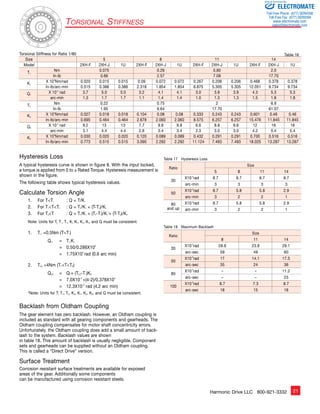
A typical hysteresis curve is shown in figure 8. With the input locked, 
a torque is applied from 0 to ± Rated Torque. Hysteresis measurement is 
shown in the figure. 
The following table shows typical hysteresis values. 
Calculate Torsion Angle 
1. For TT1 : Q = T/K1 
2. For T1TT2 : Q = T1/K1 + (T-T2)/K2 
3. For T2T : Q = T1/K1 + (T2-T1)/K1 
2 + (T-T2)/K3 
Note: Units for T, T1, T2, K, K1, K2, K3, and Q must be consistent. 
1. TL1 =0.5Nm (TT1) 
QL1 = TL1K1 
= 0.50/0.286X104 
= 1.75X10⁴ rad (0.6 arc min) 
2. TL2 =4Nm (T1TT2) 
QL2 = Q1+ (TL2-T1)K2 
= 7.0X10⁻⁴ +(4-2)/0.378X104 
= 12.3X10⁻⁴ rad (4.2 arc min) 
*Note: Units for T, T1, T2, K3, K1, K2, K3, and Q must be consistent. 
Backlash from Oldham Coupling 
The gear element has zero backlash. However, an Oldham coupling is 
included as standard with all gearing components and gearheads. The 
Oldham coupling compensates for motor shaft concentricity errors. 
Unfortunately, the Oldham coupling does add a small amount of back-lash 
to the system. Backlash values are shown 
in table 18. This amount of backlash is usually negligible. Component 
sets and gearheads can be supplied without an Oldham coupling. 
This is called a “Direct Drive” version. 
Surface Treatment 
Corrosion resistant surface treatments are available for exposed 
areas of the gear. Additionally some components 
can be manufactured using corrosion resistant steels. 
Table 17 Hysteresis Loss 
Table 18 Maximum Backlash 
Ratio 
Size 
8 11 14 
30 
X10-5rad 28.6 23.8 29.1 
arc-sec 59 49 60 
50 
X10-5rad 17 14.1 17.5 
arc-sec 35 24 36 
80 
X10-5rad – – 11.2 
arc-sec – – 23 
100 
X10-5rad 8.7 7.3 8.7 
arc-sec 18 15 18 
Ratio 
Size 
5 8 11 14 
30 
X10-4rad 8.7 8.7 8.7 8.7 
arc-min 3 3 3 3 
50 
X10-4rad 8.7 5.8 5.8 2.9 
arc-min 3 2 2 1 
80 X10-4rad 8.7 5.8 5.8 2.9 
and up arc-min 3 2 2 1 
Torsional Stiff ness 
ELECTROMATE 
Toll Free Phone (877) SERVO98 
Toll Free Fax (877) SERV099 
www.electromate.com 
sales@electromate.com
­­­­­­­­­­­22 
Recomm ended Tolerances for Ass embly 
Sold  Serviced By: 
Recommended Tolerances for Assembly 
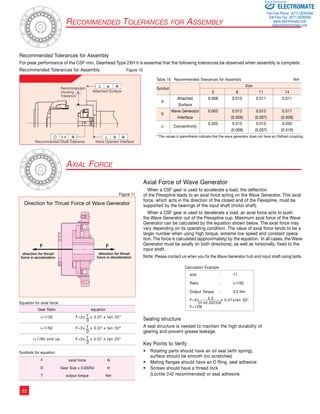
For peak performance of the CSF-min, Gearhead Type 2XH it is essential that the following tolerances be observed when assembly is complete. 
Recommended Tolerances for Assembly Figure 10 
Attached Surface 
Recommended 
Housing 
Tolerance 
F F 
direction for thrust 
force in deceleration 
direction for thrust 
force in acceleration 
A 
a A 
ø c A b A 
Recommended Shaft Tolerance Wave Operator Interface 
Axial Force of Wave Generator 
When a CSF gear is used to accelerate a load, the deflection 
of the Flexspline leads to an axial force acting on the Wave Generator. This axial 
force, which acts in the direction of the closed end of the Flexspline, must be 
supported by the bearings of the input shaft (motor shaft). 
When a CSF gear is used to decelerate a load, an axial force acts to push 
the Wave Generator out of the Flexspline cup. Maximum axial force of the Wave 
Generator can be calculated by the equation shown below. The axial force may 
vary depending on its operating condition. The value of axial force tends to be a 
larger number when using high torque, extreme low speed and constant opera-tion. 
The force is calculated (approximately) by the equation. In all cases, the Wave 
Generator must be axially (in both directions), as well as torsionally, fixed to the 
input shaft. 
Note: Please contact us when you fix the Wave Generator hub and input shaft using bolts. 
Sealing structure 
A seal structure is needed to maintain the high durability of 
gearing and prevent grease leakage. 
Key Points to Verify 
• Rotating parts should have an oil seal (with spring), 
surface should be smooth (no scratches) 
• Mating flanges should have an O Ring, seal adhesive 
• Screws should have a thread lock 
(Loctite 242 recommended) or seal adhesive. 
Direction for Thrust Force of Wave Generator 
Calculation Example 
size : 11 
Ratio : i=1/50 
Output Torque : 3.5 Nm 
F=2x 3.5 x 0.07xtan 30º 
(11x0.00254) 
F=10N 
Equation for axial force 
Gear Ratio equation 
i=1/30 F=2x T x 0.07 x tan 32º 
D 
i=1/50 F=2x T x 0.07 x tan 30º 
D 
i=1/80 and up F=2x T x 0.07 x tan 20º 
D 
Symbols for equation 
F axial force N 
D Gear Size x 0.00254 m 
T output torque Nm 
Table 19 Recommended Tolerances for Assembly Nm 
Size 
Symbol 
5 8 11 14 
a 
Attached 0.008 0.010 0.011 0.011 
Surface 
b 
Wave Generator 0.005 0.012 0.012 0.017 
Interface (0.006) (0.007) (0.008) 
c 
Concentricity 
0.005 0.015 0.015 0.030 
(0.006) (0.007) (0.016) 
* The values in parenthesis indicate that the wave generator does not have an Oldham coupling. 
Axial Force 
Figure 11 
ELECTROMATE 
Toll Free Phone (877) SERVO98 
Toll Free Fax (877) SERV099 
www.electromate.com 
sales@electromate.com
Sold  Serviced By: 
ELECTROMATE 
Toll Free Phone (877) SERVO98 
Toll Free Fax (877) SERV099 
www.electromate.com 
sales@electromate.com 
Rated Load Rated Load Rated Load Rated Load (mm) (mm) (N) lb 
Cr (N) lb Cor (N) lb Cr (N) lb Cor (N) lb 
5 SSLF-630DD 196 44 59 13 L-520WO2 176 40 54 12 10.8 9.25 8 2 
8 MR126 715 161 292 66 MR83 560 126 170 38 16.65 18 10 2 
11 689 1330 299 665 149 624 1300 292 485 109 20.6 21.9 20 4 
14 6900ZZ 2700 607 1270 285 605ZZ 1330 299 505 114 28.25 24.25 30 7 
Size14 
Bearing A Basic Dynamic Basic Static Bearing B0- Basic Dynamic Basic Static a b 
Size 8 Size11 Size 5 
Harmonic Drive LLC 800-921-3332 ­­­­­­­­­­­23 
Performance Data for Input bearing 
T a b l e 2 0 
Size Bearing A Bearing B 
Bearing B Bearing A 
a b 
Fa (N) 
Fr (N) 
40 
30 
20 
10 
0 2 4 6 8 10 
Performance Data for the Input Bearing 
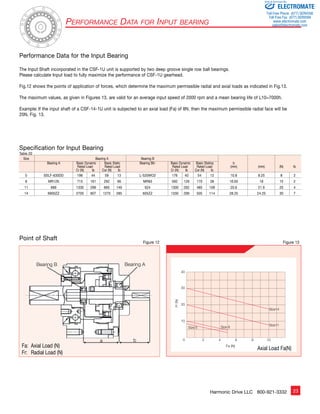
The Input Shaft incorporated in the CSF-1U unit is supported by two deep groove single row ball bearings. 
Please calculate Input load to fully maximize the performance of CSF-1U gearhead. 
Fig.12 shows the points of application of forces, which determine the maximum permissible radial and axial loads as indicated in Fig.13. 
The maximum values, as given in Figures 13, are valid for an average input speed of 2000 rpm and a mean bearing life of L10=7000h. 
Example: If the input shaft of a CSF-14-1U unit is subjected to an axial load (Fa) of 8N, then the maximum permissible radial face will be 
20N, Fig. 13. 
Specification for Input Bearing 
Point of Shaft 
Figure 12 Figure 13 
Fa: Axial Load (N) 
Fr: Radial Load (N) 
Axial Load Fa(N)
Sold  Serviced By: 
ELECTROMATE 
Toll Free Phone (877) SERVO98 
Toll Free Fax (877) SERV099 
www.electromate.com 
sales@electromate.com 
Size 5 8 11 14 
Table 21 
Number of Bolts 4 4 4 4 
Size of Bolt M2 M3 M4 M5 
Pitch Circle Diameter mm 23 35 46 58 
Clamp Torque 
Nm 0.25 0.85 2 3.96 
In.lb 0.03 0.09 17.70 35.05 
Length of Bolt mm 2.4 3.6 4.8 60 
Torque Transmission Nm 3.5 12 29 57 
Capacity In.lb 31 106 257 504 
***Recommended Bolt: JISB1176 socket head cap, screw strength range: JISB1051 over 12.9*** 
Size 5 8 11 14 
Table 22 
Number of Bolts 2 2 2 2 
Size of Bolt M2 M3 M4 M5 
Pitch Circle Diameter mm 25 37.5 50 62 
***Output Flange is prevented for grease leakage, re-sealing is not necessary. 
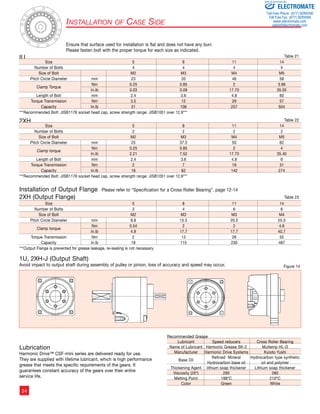
­­­­­­­­­­­24 
Installation of Case Side 
Ensure that surface used for installation is flat and does not have any burr. 
Please fasten bolt with the proper torque for each size as indicated. 
IU 
2XH 
Installation of Output Flange Please refer to “Specification for a Cross Roller Bearing”. page 12-14 
2XH (Output Flange) 
Size 5 8 11 14 
Number of Bolts 3 4 6 6 
Size of Bolt M2 M3 M3 M4 
Pitch Circle Diameter mm 9.8 15.5 20.5 25.5 
Clamp torque 
Nm 0.54 2 2 4.6 
In.lb 4.8 17.7 17.7 40.7 
Torque Transmission Nm 2 13 26 55 
Capacity In.lb 18 115 230 487 
1U, 2XH-J (Output Shaft) 
Avoid impact to output shaft during assembly of pulley or pinion, loss of accuracy and speed may occur. 
Lubrication 
Harmonic Drive™ CSF-mini series are delivered ready for use. 
They are supplied with lifetime lubricant, which is high performance 
grease that meets the specific requirements of the gears. It 
guarantees constant accuracy of the gears over their entire 
service life. 
Table 23 
Recommended Grease 
Lubricant Speed reducers Cross Roller Bearing 
Name of Lubricant Harmonic Grease SK-2 Multemp HL-D 
Manufacturer Harmonic Drive Systems Kyodo Yushi 
Base Oil 
Refined Mineral Hydrocarbon type synthetic 
Hydrocarbon base oil oil and polymer 
Thickening Agent lithium soap thickener Lithium soap thickener 
Viscosity (25º) 295 280 
Melting Point 198ºC 210ºC 
Color Green White 
Clamp torque 
Nm 0.25 0.85 2 4 
In.lb 2.21 7.52 17.70 35.40 
Length of Bolt mm 2.4 3.6 4.8 6 
Torque Transmission Nm 2 7 16 31 
Capacity In.lb 18 62 142 274 
***Recommended Bolt: JISB1176 socket head cap, screw strength range: JISB1051 over 12.9*** 
Figure 14
Sold  Serviced By: 
ELECTROMATE 
Toll Free Phone (877) SERVO98 
Toll Free Fax (877) SERV099 
www.electromate.com 
sales@electromate.com 
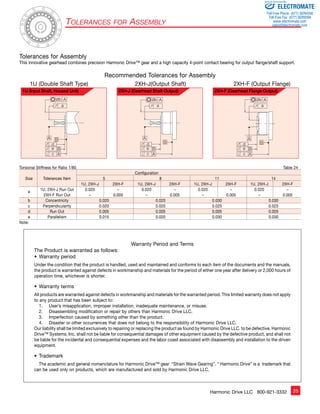
Tolerances for Assembly 
This innovative gearhead combines precision Harmonic Drive™ gear and a high capacity 4-point contact bearing for output flange/shaft support. 
1U (Input Shaft, Housed Unit) 2XH-J (Gearhead Shaft Output) 2XH-F (Gearhead Flange Output) 
ø øb A 
A 
B 
A 
de 
c 
a 
B 
Harmonic Drive LLC 800-921-3332 ­­­­­­­­­­­25 
Tolerances for Ass embly 
A 
A 
a 
ø 
B 
d 
b 
B 
A 
e 
c 
A 
B 
b A 
a 
B 
A 
de 
c 
Torsional Stiffness for Ratio 1/80 Table 24 
Configuration 
Size Tolerances Item 5 8 11 14 
1U, 2XH-J 2XH-F 1U, 2XH-J 2XH-F 1U, 2XH-J 2XH-F 1U, 2XH-J 2XH-F 
a 1U, 2XH-J Run Out 0.020 – 0.020 – 0.020 – 0.020 – 
2XH-F Run Out – 0.005 – 0.005 – 0.005 – 0.005 
b Concentricity 0.020 0.020 0.030 0.030 
c Perpendicularity 0.020 0.020 0.025 0.025 
d Run Out 0.005 0.005 0.005 0.005 
e Parallelism 0.015 0.020 0.030 0.030 
Note: 
Recommended Tolerances for Assembly 
1U (Double Shaft Type) 2XH-J(Output Shaft) 2XH-F (Output Flange) 
Warranty Period and Terms 
The Product is warranted as follows: 
• Warranty period 
Under the condition that the product is handled, used and maintained and conforms to each item of the documents and the manuals, 
the product is warranted against defects in workmanship and materials for the period of either one year after delivery or 2,000 hours of 
operation time, whichever is shorter. 
• Warranty terms 
All products are warranted against defects in workmanship and materials for the warranted period. This limited warranty does not apply 
to any product that has been subject to: 
1. User’s misapplication, improper installation, inadequate maintenance, or misuse. 
2. Disassembling modification or repair by others than Harmonic Drive LLC. 
3. Imperfection caused by something other than the product. 
4. Disaster or other occurrences that does not belong to the responsibility of Harmonic Drive LLC. 
Our liability shall be limited exclusively to repairing or replacing the product as found by Harmonic Drive LLC. to be defective. Harmonic 
Drive™ Systems, Inc. shall not be liable for consequential damages of other equipment caused by the defective product, and shall not 
be liable for the incidental and consequential expenses and the labor coast associated with disassembly and installation to the driven 
equipment. 
• Trademark 
The academic and general nomenclature for Harmonic Drive™ gear “Strain Wave Gearing”. “ Harmonic Drive” is a trademark that 
can be used only on products, which are manufactured and sold by Harmonic Drive LLC.
­­­­­­­­­­­26 
Safety Guide 
CSF-MINI 
SAFETY GUIDE 
Sold  Serviced By: 
• For actuators, motors, control units and drivers manufactured by Harmonic Drive LLC. 
• Read the manual thoroughly before designing the application, installation, maintenance or inspection of the actuator. 
• WARNING: Indicates a potentially hazardous situation, which, if not avoided, could result in death or serious personal injury. 
• CAUTION: Indicates a potentially hazardous situation, which, if not avoided, may result in minor or moderate personal injury 
and/or damage to the equipment. 
LIMITATION OF APPLICATIONS: 
The equipment listed in this document may not be used for the following applications: 
• Space equipment • Automobile, automotive parts 
• Aircraft, aeronautic equipment • Amusement equipment, sport equipment, game machines 
• Nuclear equipment • Machine or devices acting directly on the human body 
• Household apparatus • Instruments or devices to transport or carry people 
• Vacuum equipment • Apparatus or devices used in special environments 
Please consult us, if you intend to use our products in one of the areas mentioned above. 
Safety measures are essential to prevent accidents resulting in death, injury or damage of the 
equipment due to malfunction or faulty operation. 
Precautions When Using An Actuator and/or Driver 
CAUTIONS FOR ACTUATORS IN APPLICATION DESIGN 
The product must only be used indoors, where the following conditions are provided: 
• Ambient temperature: 0ºC to 40ºC 
• Ambient humidity: 20% to 80%RH (Non-condensating) 
• Vibration: Max 24.5 m/S2 
• No contamination by water, oil or foreign matters 
• No corrosive, inflammable or explosive gas 
Follow exactly the instructions in the relating manuals to install the product in the equipment. 
• Ensure exact alignment of motor shaft center and corresponding center in the application. 
• Failure to observe this caution may lead to vibration, resulting in damage of output elements. 
CAUTIONS FOR ACTUATORS IN OPERATIONS 
Do not exceed the allowable torque of the actuator. 
• Be aware, that if a load arm attached to the output hits by accident an obstacle, the output shaft may become uncontrollable. 
Never connect cables directly to a power supply socket. 
• An actuator must not be operated without a corresponding driver. 
• Failure to observe this caution may lead to injury, fire or damage of the actuator. 
Protect the actuator from impact and shocks 
• Do not use a hammer to position the actuator during installation 
• Failure to observe this caution could damage the encoder and may cause uncontrollable operation. 
• Avoid handling of the actuator by its cables. 
• Failure to observe this caution may damage the wiring, causing uncontrollable or faulty operation. 
ELECTROMATE 
Toll Free Phone (877) SERVO98 
Toll Free Fax (877) SERV099 
www.electromate.com 
sales@electromate.com
Sold  Serviced By: 
ELECTROMATE 
Toll Free Phone (877) SERVO98 
Toll Free Fax (877) SERV099 
www.electromate.com 
sales@electromate.com 
Harmonic Drive LLC 800-921-3332 ­­­­­­­­­­­27 
Safety Guide 
CAUTIONS FOR DRIVERS IN APPLICATION DESIGN 
Always use drivers under the following conditions: 
• Mount in a vertical position keeping sufficient distance to other devices to let heat generated by the driver radiate freely. 
• Ambient temperature: 0º to 50º 
• Ambient humidity: less than 95% RH (Non condensation) 
• No contamination by water, oil or foreign matters 
• No corrosive, inflammable or explosive gas Use sufficient noise suppressing means and safe grounding. 
• Keep signal and power leads separated. 
• Keep leads as short as possible. 
• Ground actuator and driver at one single point, minimum ground resistance class: D (less than 100 ohms) 
• Do not use a power line filter in the motor circuit. Pay attention to negative torque by inverse load. 
–Inverse load may cause damages of drivers. 
• Please consult our sales office, if you intent to apply products for inverse load. Use a fast-response type 
ground-fault detector designed for PWM inverters. 
• Do not use a time-delay-type ground-fault detector. 
CAUTIONS FOR DRIVERS IN OPERATIONS 
Never change wiring while power is active: 
• Make sure of power non-active before servicing the products. 
• Failure to observe this caution may result in electric shock or personal injury. 
Do not touch terminals or inspect products at least 5 minutes after turning OFF power. 
• Otherwise residual electric charges may result in electric shock. 
• Make installation of products not easy to touch their inner electric components. Do not make a voltage resistance test. 
• Failure to observe this caution may result in damage of the control unit. 
• Please consult our sales office, if you intent to make a voltage resistance test. 
• Do not operate control units by means of power ON/OFF switching. 
• Start/stop operation should be performed via input signals. 
• Failure to observe this caution may result in deterioration of electronic parts. 
DISPOSAL OF AN ACTUATOR, A MOTOR, A CONTROL UNIT AND/OR THEIR PARTS 
• All products or parts have to be disposed of as industrial waste. 
• Since the case or the box of drivers have a material indication, classify parts and dispose them separately. 
All products are warranted to be free from design or manufacturing defects for a period of one year from the date of shipment. 
Such items will be repaired or replaced at the discretion of Harmonic Drive LLC. The seller makes no warranty, expressed or 
implied, concerning the material to be furnished other than it shall be of the quality and specifications stated. The seller’s liability for 
any breach is limited to the purchase price of the product. All efforts have been made to assure that the information in this catalog 
is complete and accurate. However, Harmonic Drive LLC is not liable for any errors, omissions or inaccuracies in the reported data. 
Harmonic Drive LLC reserves the right to change the product specifications, for any reason, without prior notice.

Harmonic csf mini_catalog

  • 1.
    M i nPriincaiplteanud Srtreuctu re G e a r h e a d s Harmonic Drive™ Gearheads CSF Mini Series CSF-2XH-F CSF-2XH-J CSF-1U Total Motion Control Harmonic Drive™gear P r e c i s i o n G e a r i n g a n d M o t i o n C o n t r o l
  • 2.
    ­­­­­­­­­­­2 CSF MiniSeries Harmonic Drive™ precision gear is the next generation in precision motion control. Harmonic Drive™ Precision Control Speed Reducers for compact models are available in this CSF Mini Series. Future Zero-Backlash, High Positional Accuracy, High Repeatability The innovative design of Harmonic Drive™ precision gear allows consistently high performance over the life of the gear. Compact, Lightweight, High Torque Capacity Harmonic Drive LLC’ patented “S” gear tooth profile achieves twice the torque, life and torsional stiffness as compared to gears of the same size by allowing up to 30% of the gear teeth to be engaged at all times. Compact 4-Point Contact Ball Bearing Mounted In Main Shaft A high performance 4-point contact output bearing supports the output flange/shaft. This bearing has excellent run-out characteristics and can support high radial, axial and moment loads. Wide Range Of Gear Ratios And Input/Output Configurations In Each Size Gear Ratios 30:1, 50:1, and 100:1 are available in each size. This allows servomotor and gearhead combinations to operate over a wide speed range. In addition, each size has 3 input/output shaft/flange configurations allowing convenient methods for attaching loads, motors, and pulleys. Sold & Serviced By: ELECTROMATE Toll Free Phone (877) SERVO98 Toll Free Fax (877) SERV099 www.electromate.com sales@electromate.com
  • 3.
    Sold & ServicedBy: Harmonic Drive LLC 800-921-3332 ­­­­­­­­­­­3 Contents About Harmonic Drive™ Gear Principle and Structure . 04 Driving Configuration . 05 Application Example . 06 Ordering Information Model and Code . 06 Rating Table . 07 Definition of Ratings . 07 Strength and Life . 08 Selection Procedure . 09 Selection Example . 10 Unit Type CSF-mini External Dimensions . 11 Specification for Cross Roller Bearing . 12 Output Bearing Ratings . 13 Specifications of Output Bearings . 14 Engineering Data Efficiency . 15 No Load Running Torque . 17 Starting Torque and Backdriving Torque . 19 Positioning Accuracy . 19 Torsional Stiffness . 20 Recommended Tolerance for Assembly . 22 Performance Data for Input Bearing . 23 Installation of Case Side . 24 Tolerances for Assembly . 25 Warranty and Safety Warranty . 25 Safety Guide . 26 Harmonic Drive™ Gear ELECTROMATE Toll Free Phone (877) SERVO98 Toll Free Fax (877) SERV099 www.electromate.com sales@electromate.com
  • 4.
    ­­­­­­­­­­­4 Principle andStructure 90º When the Circular Spline is fixed and the Wave generator rotates clockwise, the Flexspline is elastically deformed and rotates counterclockwise relative to the Circular Spline. 360º Sold & Serviced By: For each 360 degrees clockwise movement of the Wave Generator,the Flexspline moves counterclockwise by two teeth relative to the Circular Spline. 0 º Circular Spline Wave Generator Flexspline The Flexspline is elliptically shaped by The Wave Generator and engaged with the Circular Spline at the major elliptical axis. The teeth completely disengage on the minor axis. This gearhead is easy to use and has both an input and output shaft. It also allows for pulleys to be used for the input and output to the gearhead. This gearhead is designed to be coupled directly to a servo-motor. It is available in 2 models. 2XH-F:Direct input coupling/ output Flange. 2XH-J: Direct input coupling/output Shaft. 4 Point Contact Bearing Output (FS) Rotary System Flexspline Circular Spline Input (WG) Wave Generator 4 Point Contact Bearing Output Flange Flexspline Circular Spline Wave Generator About Harmonic Drive™ strain wave gear principle and structure System Components The Wave Generator: A thin raced ball bearing fitted onto an elliptical plug serving as a high efficiency torque converter. The Flexspline: A non-rigid, thin cylindrical cup with external teeth on a slightly smaller pitch diameter than the Circular Spline. It fits over and is held in an elliptical shape by the Wave Generator. The Circular Spline: A rigid ring with internal teeth, engaging the teeth of the Flexspline across the major axis of the Wave Generator. GEARHEAD TYPE (IU) GEARHEAD TYPE (2XH) ELECTROMATE Toll Free Phone (877) SERVO98 Toll Free Fax (877) SERV099 www.electromate.com sales@electromate.com
  • 5.
    Sold & ServicedBy: Harmonic Drive LLC 800-921-3332 ­­­­­­­­­­­5 Driving Configurations A variety of different driving configurations are possible, as shown below. The reduction ratio given in the tables on page 10 and 11 correspond to arrangement 1, in which the Wave Generator acts as the input element, the Circular Spline is fixed and the Flexspline acts as the output element. Ratio = input speed output speed 3. Reduction Gearing WG Fixed FS Input CS Output R + 1 Ratio = R [Equation 3] Input and output in same direction. 6. Speed Increaser Gearing FS Fixed CS Input WG Output 1 Ratio = R + 1 [Equation 6] Input and output in same direction. WG CS FS 1. Reduction Gearing CS Fixed WG Input FS Output Ratio = — R 1 [Equation 1] Input and output in opposite direction. 4. Speed Increaser Gearing WG Fixed CS Input FS Output R Ratio = R + 1 [Equation 4] Input and output in same direction. 7. Differential Gearing WG Control Input CS Main Drive-Input FS Main Drive-Output Numerous differential functions can be obtained by combinations of the speed and rotational direction of the three basic elements. 2. Reduction Gearing FS Fixed WG Input CS Output R + 1 Ratio = 1 [Equation 2] Input and output in same direction. 5. Speed Increaser Gearing CS Fixed FS Input WG Output Ratio = — 1 R [Equation 5] Input and output in opposite direction. Driving Configurations [Equation 7] ELECTROMATE Toll Free Phone (877) SERVO98 Toll Free Fax (877) SERV099 www.electromate.com sales@electromate.com
  • 6.
    Application for 2XH Sold & Serviced By: ELECTROMATE Toll Free Phone (877) SERVO98 Toll Free Fax (877) SERV099 www.electromate.com sales@electromate.com Matching Table Table 1 Manufacturer Yaskawa / Mini-Series Mitsubishi / HC-AQ Series Matsushita minas Motor Capacity 3W-5W 10W 20W 30W 10W 20W 30W 30W CSF-5-2X • CSF-8-2XH • • CSF-11-2XH • • • • • CSF-14-2XH • • •­Motor ­­­­­­­­­­­6 App lication Examp le Flange Flange M Ordering Information Reverse for Motor with long output shaft CSF - 14 - 100 - 2XH - F - SP Name of Model Size Gear Ratio Model SP Name Size Gear Ratio Model SP 5 30, 50, 100 8 30, 50, 100 1U Customized specification CSF 11 30, 50, 100 2XH-F (special) 14 30, 50, 80, 100 2XH-J shape and performance
  • 7.
    Rating Table Sold& Serviced By: ELECTROMATE Toll Free Phone (877) SERVO98 Toll Free Fax (877) SERV099 www.electromate.com sales@electromate.com Rating Table Table 2 Size Gear Ratio Rated Torque at 2000rpm Repeated peak torque Max. average load torque Max. momentary torque Max. Input Speed Avg. Input Speed Moment of Inertia(1/4 GD)2 Nm in.lb Nm in.lb Nm in.lb Nm in.lb r/min r/min 1U kgcm2 2XH kgcm2 Harmonic Drive LLC 800-921-3332 ­­­­­­­­­­­7 Start Routine Abnormal Impact Torque Start Stop Speed Cycle Number of Rotations of Wave Generator Time Time Load Torque Repeated Peak Torque Load Torque Momentary Peak Torque 30 0.25 2 0.5 4 0.38 3 0.9 8 5 50 0.4 4 0.9 8 0.53 5 1.8 16 10,000 6,500 2.5x10⁻⁴ 2.5x10⁻⁴ 100 0.6 5 1.4 12 0.94 8 2.7 24 30 0.9 8 1.8 16 1.4 12 3.3 29 8 50 1.8 16 3.3 29 2.3 20 6.6 58 8,500 3,500 3.0x10⁻³ 3.2x10⁻³ 100 2.4 21 4.8 42 3.3 29 9.0 80 30 2.2 19 4.5 40 3.4 30 8.5 75 11 50 3.5 31 8.3 73 5.5 49 17 150 8,500 3,500 1.2x10⁻² 1.4x10⁻² 100 5.0 44 11 97 8.9 79 25 221 30 4.0 35 9.0 80 6.8 60 17 150 14 50 5.4 48 18 159 6.9 61 35 310 80 7.8 69 23 204 11 97 47 416 8,500 3,500 3.3x10⁻² 3.4x10⁻² 100 7.8 69 28 248 11 97 54 478 Definition of Ratings Rated Torque (Tr) Rated torque indicates allowable continuous load torque at 2000 rpm input speed. Limit for Repeated Peak Torque ( figure 1) During acceleration a deceleration the Harmonic Drive™ gear experiences a peak torque as a result of the moment of inertia of the output load. Limit for Average Torque In cases where load torque and input speed vary, it is necessary to calculate an average value of load torque. The table indicates the limit for average torque. The average torque calculated must not exceed this limit. Limit for Momentary Peak Torque (figure 1) The gear may be subjected to momentary peak torques in the event of a collision or emergency stop. The magnitude and frequency of occurrence of such peak torques must be kept to a minimum and they should, under no circumstance, occur during normal operating cycle. The allowable number of occurrences of the momentary peak torque may be calculated by using equation 8 on page 8. Also see section “strength and life”. Maximum Input Speed, Limit for average input speed Do not exceed the allowable rating. Moment of Inertia The rating indicates the moment of inertia reflected to the wave generator (gear input). Technical Terms Figure 1
  • 8.
    Table 3 RatchetingTorque Nm Buckling Torque Nm ­­­­­­­­­­­8 17 16 10 9 8 7 6 5 4 3 2 1 Sold & Serviced By: Figure 2 Buckling Torque Racheting Torque Circular Spline Flexspline Momentary Peak Torque 105 106 107 108 109 0 Load Torque ( Rated Torque = 1 ) Total Number of Input Rotations 1010 Life of the Wave Generator Fatigue Strength of Flexspline Repeated Peak Torque Rated Torque Strength and Life The non-rigid Flexspline is subjected to repeated deflections, and its strength determines the torque capacity of the Harmonic Drive™ gear. The values given for Rated Torque at Rated Speed and for the allow-able Repeated Peak Torque are based on an infinite fatigue life for the Flexspline. The torque that occurs during a collision must be below the momentary peak torque (impact torque). The maximum number of occurrences is given by the equation below. Ratcheting phenomenon When excessive torque is applied while the gear is in motion, the teeth between the Circular Spline and Flexspline may not engage properly. This phenomenon is called ratcheting and the torque at which this occurs is called ratcheting torque. Ratcheting may cause the Flexspline to become non-concentric with the Circular Spline. (See figure 2 and 3 on page 8) Operating in this condition may result in shortened life and a Flexspline fatigue failure. Note! When ratcheting occurs, the teeth mesh abnormally as shown above. Vibration and Flexspline damage may occur. Once ratcheting occurs, the teeth wear excessively and the ratcheting torque may be lowered. The Life of a Wave Generator The normal life of a gear is determined by the life of the wave genera-tor bearing. The life may be calculated by using the input speed and the output load torque. Rated Lifetime Ln : (n = 10 or 50) L10 CSF : 7,000 CSG: 10,000 L50 CSF : 35,000 CSG : 50,000 Equation for the expected life of the wave generator under normal operating conditions is given by the equation below. [Equation 9] Lh = Ln • ( Tr )3• ( Nr ) Tav Nav Lh : Expected Life, hours Ln : Rated Lifetime at L10 or L50 Tr : Rated Torque (Table 2) Nr : Rated input speed (2000 rpm) Tav : Average load torque on output side (page 9) Nav : Average input speed (page 9) [Equation 8] 1.0 X 10⁴ n: Input speed before collision N = 2 X n X t t: Time interval during collision 60 Please note: If this number is exceeded, the Flexspline may experience a fatigue failure. This condition is called “dedoidal”. Relative Torque Rating The chart below shows the various torque specifications relative to rated torque. Rated Torque has been normalized to 1 for comparison. Size Gear Ratio Size All Ratio 30 50 80 100 5 2.7 3.2 – 3.5 5 9.8 8 11 12 – 14 8 35 11 29 34 – 43 11 90 14 59 88 110 84 14 190 Figure 3 Strength and Life ELECTROMATE Toll Free Phone (877) SERVO98 Toll Free Fax (877) SERV099 www.electromate.com sales@electromate.com
  • 9.
    Sold & ServicedBy: ELECTROMATE Toll Free Phone (877) SERVO98 Toll Free Fax (877) SERV099 www.electromate.com sales@electromate.com Harmonic Drive LLC 800-921-3332 ­­­­­­­­­­­9 T 1 T Selection Procedure 2 T 3 T 4 T n t 1 t 2 t 3 t 4 t n n 1 n 2 n 3 n 4 n n + Torque _ rpm n 1 n n are an average value. Time 2 n Time OK OK OK OK OK NG NG NG NG NG Size Selection Generally, the operating conditions consist of fluctuating torques and output speeds. Also, an unexpected impact output torque must be considered. The proper size can be determined by converting fluctuating load torque into average load torque and equivalent load torque. This procedure involves selecting the size based on load torque for component sets. This procedure does not consider the life of the output bearing for housed units. Determining the life of the output bearing for various axial, radial, and moment loads is outlined on page 12. Figure 4 Parameters Load Torque Tn (Nm) Time tn (sec) Output Speed nn (rpm) Normal Operating Pattern Acceleration T1,t1, n1 Regular Operation T2,t2, n2 Deceleration T3,t3, n3 Dwell T4,t4, n4 Maximum RPM Max output speed no maximum Max input speed ni maximum Impact Torque Ts,ts, ns Ratings Rated Torque Tr Rated Speed nr =2000 rpm Life L10=L (hrs) Flow Chart for Selecting a Size Please use the flowchart shown below for selecting a size. Operating conditions must not exceed the performance ratings as described on page 7. Calculation of the average output torque Tav = 3 n1•t1•|T1|3+n2•t2•|T2|3+...nn•tn•|Tn|3 n1•t1+n2•t2+... nn tn Selection of tentative size under the condition shown below. Average Output Speed no av = n1•t1•n2•t2+... nntn t1+t2•t2+...tn Determine Gear Ratio ni max < R no max ni max may be limited by the motor. Calculation of the average input speed ni av = no av •R Calculation of maximum input speed ni max = no max •R ni av < Limit for average speed ni max < Limit for maximum speed Confirm if T1 and T3 are less than the repeated peak torque specification. Confirm if Ts (impact torque) is less than the momentary peak torque specification. Calculate the allowable number of rotations during impact torque. Ns = 104 ••••••Ns <= 1.0X10⁴ 2• ns•R •ts 60 Calculate wave generator life. L= 700 • ( Tr )3•( nr )(time) Tav niav Make sure that the calculated life is suitable for the application. Gear is suitable for torque and speed requirements Also consider output bearing, environment, etc.
  • 10.
    ­­­­­­­­­­­10 Selection Example Sold & Serviced By: Values of an each Load Torque Pattern Maximum Speed Load Torque Tn (Nm) output max speed no max = 16 rpm Time tn (sec) input max speed ni max = 1800 rpm Output Speed nn (rpm) (limited by motor) Normal Operating Pattern Impact Torque Acceleration T1 = 19 Nm, t1 = 0.4 sec, n1 = 8 rpm Ts = 50 Nm, ts = 0.15 sec, ns = 12 rpm Regular Operation Stop T2 = 2 Nm, t2 = 4 sec, n2 = 16 rpm Life Required Deceleration T3 = 19 Nm, t3 = 0.4 sec, n3 = 8 rpm L10 = 7000 hrs. Dwell T4 = 0 Nm, t4 = 0.2 sec, n4 = 0 rpm Tav (Nm) 3 8rpm•0.4sec•|19Nm|3+16rpm•4sec•|2Nm|3+8rpm•0.4sec•|19Nm|3 Tav = 8rpm•0.4sec+16rpm•4sec+8rpm•0.4sec Tav =8.6Nm 11Nm (for CSF-14-100-2XH) no av (rpm) 8rpm•0.4sec+16rpm•4sec+8rpm•0.4sec no av = = 14rpm 0.3sec + 3sec + 0.4sec + 0.2sec (R) 1800 rpm = 129 100 14 rpm n av = 14 rpm •100 = 1400 rpm n max ni max (rpm) n max = 16 rpm •100 = 1600 rpm n av =1000rpm 3500 rpm (for CSF-14-100-2XH) n max=1600rpm 8500 rpm (for CSF-14-100-2XH) Confirm that T1 and T3 are within a T 1 ,T 3 (Nm) T 1 =19Nm 28Nm (for CSF-14-100-2XH) T 3 =19Nm 28Nm (for CSF-14-100-2XH) T s (Nm) T s = 500Nm 54Nm (for CSF-14-100-2XH) (N OK OK OK s ) Calculate an allowable number of rotation(Ns) and confirm 1.0 x 10⁴ 104 N S = = 1250 1.0X10⁴ 16rpm•100 2• • 0.15sec 60 7.8 Nm 3 2000 rpm L 10 = 7000 • ( ) • ( ) 8.6 Nm 1400 rpm L 10 =74607000 (L B10 ) OK OK CSF-14-100-2XH i o i i i ELECTROMATE Toll Free Phone (877) SERVO98 Toll Free Fax (877) SERV099 www.electromate.com sales@electromate.com
  • 11.
    External Dimensions Sold Serviced By: ELECTROMATE Toll Free Phone (877) SERVO98 Toll Free Fax (877) SERV099 www.electromate.com sales@electromate.com Compact Double Shaft Type 1U This gearhead is easy to use and has both an input and output shaft. Table 4 Table 5 Table 6 m Symbol Size 5 8 11 14 Symbol Size 5 8 11 14 Symbol Size 5 8 11 14 øA 26.5 40 54 68 K 4.85 7.3 9 11.4 øU 23 35 46 58 B 37 65.5 82.5 95.4 L 9.85 17.3 22 23.9 V 3 4 6 6 C 13 23 29.5 29.5 øM h7 19.5 29 39 48 W M2X3 M3X4 M3X5 M4X6 D 16 29.5 37 49.9 øN 13 20 26.5 33.5 X 4 4 4 4 E 8 13 16 16 øO h6 5 9 12 15 Y M2X3 M3X6 M4X8 M5X10 F 0.5 0.5 0.5 1.5 øP 9 16 24 32 Z 20±0.42 30±0.46 40±0.50 50±0.50 G 2.5 2.5 3 3 øQ h6 3 5 6 8 a 2.6 4.5 5.5 7.5 H 0.8 2.6 3.9 8.4 R 20.4±0.42 30.7±0.46 40.9±0.50 51.1±0.50 weight(g) 35 130 240 440 I 9 18 21.5 23 S 4.6 8 10.5 14 J 7 11 14 14 øT 9.8 15.5 20.5 25.5 Gearhead Type 2XH-F This gearhead is designed to be coupled directly to a servomotor. The motor shaft is attached directly to the gear-head Table 7 Table 8 Table 9 mm Harmonic Drive LLC 800-921-3332 ­­­­­­­­­­­11 Symbol input element. The output of the gearhead is a flange. Size 5 8 11 14 Symbol Size 5 8 11 14 Symbol Size 5 8 11 14 øA 29 43.5 58 73 L M2X3 M2X3 M3X4 M3X4 øW 25 37.5 50 62 B 17 31 38.3 45 M 1.7 2.2 2.5 3.5 X 3 4 6 6 C 15.7 24.5 30 37.5 N 6 12 16 17.6 Y M2X3 M3X4 M3X5 M4X6 D – 6.5 0 -0.3 8.3 0 -0.7 7.5 0 -0.8 O 4.85 7.3 9 11.4 a 2 2 2 2 E 12.7 19 23.5 28 øP h7 20.5 31 40.5 51 b M2 M3 M4 M5 F 3 5.5 6.5 9.5 øQ 13 20 26.5 33.5 c 2 2 2 2 G 1.3 1.5 2 2.5 øR H6 5 9 12 15 ød 2.3 3.4 4.5 5.5 H 2 3 3 5 øS h6 17 26 35 43 e – 28.7 36.1 45.4 I 0.5 0.5 0.5 1.5 øT H7 3 3 5 6 f – 4.2 0 -0.3 6.1 0 -0.7 7.9 0 -0.8 J 2 2 3 2.5 øU 22±0.42 30±0.46 43±0.50 53±0.50 g 18.90±0.70 28.20±1.00 38.00±1.50 48±1.00 K 2 2 2 2 øV 9.8 15.5 20.5 25.5 weight(g) 25 100 150 295
  • 12.
    Sold ServicedBy: Gearhead Type 2XH-J This gearhead is designed to be coupled directly to a servomotor. The motor shaft is attached directly to the gearhead input element. The output of the gearhead is a shaft. Table 10 Table 11 Table 12 m Symbol Size 5 8 11 14 Symbol Size 5 8 11 14 Symbol Specification for Output Bearing CSF-Mini Series incorporate a precise 4-point contact bearing to directly support a load. The inner race of the bearing forms the output flange. Please calculate maximum load moment, life of cross roller bearing, and static safety factor to fully maximize the performance of the CSF-Mini Series. Calculation Procedure 1. Maximum Load Moment (Mmax) Specification for Output Bearing ­­­­­­­­­­­12 Calculate maximum load moment Maximum load moment (Mmax) Allowable moment (Mc) 2. Output Bearing Life Calculate average radial load (Frav) Calculate radial load coefficient (X) Calculate lifetime and average axial load (Faav) and axial load coefficient (Y) 3. Static Safety Factor Calculate static equal radial load (Po) Confirm static safety factor (fs) Size Pitch Circle Offset Basic Dynamic Rated Load Basic Static Rated Load Allowable Moment Load Mc Moment Rigidity Km Allowable Radial Load Allowable Thrust Load dp R C Co in-lb mm mm x102N lb x102N lb Nm in-lb Nm/rad arc-min N lb N lb 5 13.5 4.85 9.14 205 7.63 171 0.89 8 7.41X10² 1.9 90 20.2 270 60.6 8 20.5 7.3 21.6 485 19.0 427 3.46 31 2.76X10³ 7.09 200 44.9 630 141 11 27.5 9 38.9 874 35.4 795 6.6 58 7.41X10³ 19 300 67.4 1,150 258 14 35 11.4 61.2 1,376 58.5 1,315 13.2 117 1.34X10⁴ 34.4 550 123 1,800 404 Allowable Radial Load is based on load acting at the middle of the output shaft 1U and gearhead type 2XH-J Size 5 8 11 14 øA 29 43.5 58 73 M M2X3 M2X3 M3X4 M3X4 øY 25 37.5 50 62 B 25.7 51 64.3 70 N 9 18 21.5 23 Z 4.6 8 10.5 14 C 10 20 26 25 O 6 12 16 17.6 a 3 4 6 6 D 15.7 24.5 30 37.5 P 4.85 7.3 9 11.4 b M2X3 M3X4 M3X5 M4X6 E – 6.5 0 -0.3 8.3 0 -0.7 7.5 0 -0.8 Q 9.85 17.3 22 23.9 c 2 2 2 2 F 12.7 19 23.5 28 øR h7 20.5 31 40.5 51 d M2 M3 M4 M5 G 3 5.5 6.5 9.5 øS 13 20 26.5 33.5 e 2 2 2 2 H 1.3 1.5 2 2.5 øT h6 5 9 12 15 øf 2.3 3.4 4.5 5.5 I 0.5 0.5 0.5 1.5 øU h6 17 26 35 43 (g) – 48.7 62.1 70.4 J 2 3 3 5 øV H7 3 3 5 6 h – 4.2 0 -0.3 6.1 0 -0.7 7.9 0 -0.8 K 2 2 2 2.5 W 22±0.42 32±0.46 43±0.50 53±0.50 i 18.90 X 0.70 28.20 X 1.00 38.00 X 1.50 48.00 X 1.00 L 2 2 2 2 øX 9.8 15.5 20.5 25.5 weight(g) 27 111 176 335 Table 13 External Dimensions Output Bearing Ratings ELECTROMATE Toll Free Phone (877) SERVO98 Toll Free Fax (877) SERV099 www.electromate.com sales@electromate.com
  • 13.
    Output Bearing Ratings How to Calculate the Maximum Load Moment How to calculate the Maximum load moment is shown below. Please be sure that Mc is equal or greater than M max. Mmax = Frmax • (Lr+R) + Famax • La Load Fr Fr 1 Fa 1 Fr 2 Fa 2 Fr 3 Fa t 1 t 2 t 3 n 2 3 Sold Serviced By: Figure 6 Harmonic Drive LLC 800-921-3332 ­­­­­­­­­­­13 Frmax Max. radial load N Figure 6 Famax Max. axial load N Figure 6 Lr, La Moment arm m Figure 5 R amount of offset m Table 13 How to Calculate an Average Load To calculate average radial load, average axial load or average output speed, follow steps below. When the radial load and axial load vary, the life of cross roller bearing can be determined by converting to an average load. (see figure 6) Equation (10) Calculate Average Radial Load 10/3 n1t1|Fr1|10/3+ n2t2|Fr2|10/3··· + nntn|Frn|10/3 Frav = n1t1+ n2t2··· + nntn However Max. radial load in t1is Fr1, Max. radial load in t3 is Fr3. Equation (11) Calculate Average Axial Load(Faav) 10/3 n1t1|Fa1|10/3+ n2t2|Fa2|10/3··· + nntn|Fan|10/3 Faav = n1t1+ n2t2··· + nntn dp Radial Load La Axial Load Fa Lr R Support n 1 n 3 Radial Load Axial Load rpm (Output) time time time However, an axial load in t1 is Fa1, Max. axial load in t3 is Fa3. Equation (12) Calculate Average Output Speed Nav = n1t1 + n2t2 ... + nntn t1t2 ... + tn How to calculate radial load coefficient (X) axial load (Y) Frmax Max. radial load N Figure 6 Famax Max. axial load N Figure 6 Lr, La Moment arm m Figure 5 R amount of offset m Table 13 dp pitch circle m Table 13 list 2 X Y Faav Frav+2 (Frav (Lr+R) + Faav.La) /dp 1.5 1 0.45 Faav Frav+2 (Frav (Lr+R) + Faav.La) /dp 1.5 0.67 0.67 ELECTROMATE Toll Free Phone (877) SERVO98 Toll Free Fax (877) SERV099 www.electromate.com sales@electromate.com
  • 14.
    ­­­­­­­­­­­14 Specifications ofCross Roller bearing Ø Oscillating Angle How to Calculate Life of the Output Bearing The life of a cross roller bearing can be calculated by equation (13). equation (13) L 10 = 106 x ( C )10/3 60xNav fw.Pc List 3 Dynamic Equivalent Radial Load equation (14) Pc = X . ( 2 (Frav ( Lr + R ) + Faav . La) ) + Y . Faav dp Symbol of equation How to Calculate Static Safety Coefficient Basic static rated load is an allowable limit for static load, but its limit is determined by usage. In this case, static safety coefficient of the cross roller bearing can be calculated by equation (15). Reference values under general conditions are shown on list 4. Static equivalent radial load can be calculated by equation (15) equation fs = Co (15) Po list 4 Sold Serviced By: How to Calculate Life for Oscillating Motion The Life of a cross roller bearing in a oscillating operation can be calculated by equation 9 equation (16) Loc = 106 x 90 x ( C )10/3 60xn1 Ø fw.Pc Symbol of equation A small angle of oscillation (less than 5 degrees) may cause fretting corrosion to occur since lubrication may not circulate properly. equation (17) Po = Frmax + 2Mmax + 0.44. Famax dp Equation 15 L 10 Life Hour –––––––– Nav Average Output Speed rpm equation 12 C Basic Dynamic Rated Load N table 13 Pc Dynamic Equivalent N equation 14 fw Load Coefficient ––––– list 3 Frav Average radial load N equation 10 Faav Average axial load N equation 11 dp Pitch diameter m table 13 X Radial load coefficient –––––– list 2 Y Axial load coefficient ––––––– list 2 Lr, La Moment Arm m figure 5 R Offset m figure 7 and table 13 Loc Rated life for oscillating motion Hour –––––––– n1 Round trip oscillation each minute rpm –––––––– C Basic dynamic rated load N –––––––– Pc Dynamic equivalent radial load N equation 14 fw Load Coefficient ––––– list 3 Ø Angle of oscillation/2 degrees refer to figure Load Coefficient, fw Steady operation without impact and vibration 1~1.2 Normal operation 1.2~1.5 Operation with impact and vibration 1.5~3 Symbols for equation (17) Co Basic static rated load N table 13 Po Static equivalent radial load N refer to equation (17) Rotating Conditions Load Conditions Lower Limit Value for fs Normally not rotating Slight oscillations 2 Impact loads 3 Normally rotating Normal loads 1.5 Impact loads 3 High Accuracy Required 3 Static Safety Oscillations, Impact Loads 2 Coefficient Normal Loads 1.5 Symbols for Equation (17) Frmax Max. radial load N Famax Max. axial load N Mmax Max. moment load Nm dp Pitch diameter m ELECTROMATE Toll Free Phone (877) SERVO98 Toll Free Fax (877) SERV099 www.electromate.com sales@electromate.com
  • 15.
    Eff iciency Sold Serviced By: ELECTROMATE Toll Free Phone (877) SERVO98 Toll Free Fax (877) SERV099 www.electromate.com sales@electromate.com ­­­­­­­­­­­15 1U-2XH Efficiency The efficiency depends on the conditions shown below. Efficiency depends on gear ratio, input speed, load torque, tem-perature, quantity of lubricant and type of lubricant. Efficiency values shown are for rated torque. If load torque is below rated torque, a compensation factor must be employed. Load TorqueRated Torque: Efficiency = Efficiency from Graph Load TorqueRated Torque: Efficiency = Efficiency from Graph x Compensation Coefficient from figure 9. Figure 1 Ratio 30 Figure 2 Ratio 50 Figure 3 Ratio 100 Efficiency -10 0 10 20 30 40 -10 0 10 20 30 40 -10 0 10 20 30 40 Ambient Temperature Ambient Temperature Ambient Temperature 1.0 Ambient Temperature Compensation CoEfficiency 0.9 0.8 0.7 0.6 0.5 0.4 0.3 100 90 80 70 60 50 40 30 20 10 0 Ambient Temperature Efficiency 0 0.1 0.2 0.3 0.4 0.5 0.6 0.4 0.8 0.9 1.0 Torque Graph (a) n = ke•nR nR = Efficiency at Rated Torque Size 5 Size 8 Ambient Temperature Efficiency 100 90 80 70 60 50 40 30 20 10 0 100 90 80 70 60 50 40 30 20 10 0 100 90 80 70 60 50 40 30 20 10 0 Ambient Temperature Efficiency -10 0 10 20 30 40 -10 0 10 20 30 40 -10 0 10 20 30 40 Ambient Temperature Efficiency Input Speed 500r/min 1000r/min 2000r/min 3500r/min 1U Figure 4 Ratio 30 Figure 5 Ratio 50 Figure 6 Ratio 100 100 90 80 70 60 50 40 30 20 10 0 Efficiency 2XH 100 90 80 70 60 50 40 30 20 10 0 Efficiency Ambient Temperature Figure 7 Ratio 30 Figure 8 Ratio 50 Figure 9 Ratio 100 Efficiency 100 90 80 70 60 50 40 30 20 10 0 100 90 80 70 60 50 40 30 20 10 0 100 90 80 70 60 50 40 30 20 10 0 Efficiency -10 0 10 20 30 40 -10 0 10 20 30 40 -10 0 10 20 30 40 500r/min 1000r/min 2000r/min 3500r/min Input Speed Load Torque Rated Torque Torque = Efficiency Compensation Coefficient Find the Compensation Coefficient (Ke) from graph (a) and calculate the Efficiency. *For example Find the Efficiency n (%) on following condition that using model CSF-8-100-2XH Input speed :1000 r/min Load torque : 2.0N.m Type of lubricant : grease Temperature :20ºC Size 8—ratio 100, rated torque= 2.4N.m (see rated table, page 07) Torque a = 2.0/2 .4≠0.83 Efficiency Compensation Coefficient Ke = 0.99 Load torque =2.0Nm Efficiency n =Ke·NR = 0.99 x 77 = 76% *The load torque is greater than the rated torque :The Efficiency Compensation Coefficient Ke=1 Measurement Condition Installation : Based on recommended tolerance Load torque : Rated torque Lubricant : Harmonic Grease SK-2 only Grease quantity : Recommended quantity Please contact us for details pertaining to recommended oil lubricant.
  • 16.
    ­­­­­­­­­­­16 Eff iciency Size 11 Figure 10 Ratio 30 Size 14 Figure 11 Ratio 50 Figure 12 Ratio 100 Sold Serviced By: Ambient Temperature ºC Ambient Temperature ºC Ambient Temperature ºC 100 90 80 70 60 50 40 30 20 10 0 -10 0 10 20 30 40 Efficiency Ambient Temperature ºC Ambient Temperature ºC Ambient Temperature ºC 100 90 80 70 60 50 40 30 20 10 0 -10 0 10 20 30 40 Efficiency 100 90 80 70 60 50 40 30 20 10 0 100 90 80 70 60 50 40 30 20 10 0 -10 0 10 20 30 40 Efficiency 100 90 80 70 60 50 40 30 20 10 0 -10 0 10 20 30 40 Efficiency 100 90 80 70 60 50 40 30 20 10 0 -10 0 10 20 30 40 Efficiency 100 90 80 70 60 50 40 30 20 10 0 Efficiency -10 0 10 20 30 40 1U 2XH Efficiency 100 90 80 70 60 50 40 30 20 10 0 100 90 80 70 60 50 40 30 20 10 0 Efficiency -10 0 10 20 30 40 100 90 80 70 60 50 40 30 20 10 0 -10 0 10 20 30 40 Efficiency -10 0 10 20 30 40 -10 0 10 20 30 40 1U 2XH 100 90 80 70 60 50 40 30 20 10 0 Efficiency 100 90 80 70 60 50 40 30 20 10 0 -10 0 10 20 30 40 Efficiency Efficiency -10 0 10 20 30 40 500r/min 1000r/min 2000r/min 3500r/min 500r/min 1000r/min 2000r/min 3500r/min Input Input Ambient Temperature ºC Ambient Temperature ºC Ambient Temperature ºC Figure 13 Ratio 30 Figure 14 Ratio 50 Figure 15 Ratio 100 Figure 16 Ratio 30 Figure 17 Ratio 50 Figure 18 Ratio 80, 100 Figure 19 Ratio 30 Figure 20 Ratio 50 Figure 21 Ratio 80, 100 Ambient Temperature ºC Ambient Temperature ºC Ambient Temperature ºC ELECTROMATE Toll Free Phone (877) SERVO98 Toll Free Fax (877) SERV099 www.electromate.com sales@electromate.com
  • 17.
    No Load RunningTorque No Load Running Torque No load running torque indicates the torque which is needed to rotate input of the gear, Wave Generator, with no load on the out-put side (low speed side). Please contact us regarding details. Compensation Value in Each Ratio (Component Set) No load running torque of the gear varies with ratio.The graphs indicate a value for ratio 100. For other gear ratios, add the compensation values from table 34. Measurement condition Ratio : 1/100 Lubricant : Harmonic Grease SK-2 Quantity : Recommended quantity see page 19 Sold Serviced By: Torque value is measured after 2 hours at 2000rpm input. In case of oil lubricant, please contact us. 14 11 8 5 -10 0 10 20 30 40 -10 0 10 20 30 40 14 11 8 Harmonic Drive LLC 800-921-3332 ­­­­­­­­­­­17 1U Input Speed 1000r/min 100.0 10.0 1.0 0.1 Input Speed 3500r/min Input Speed 500r/min 100.0 10.0 1.0 0.1 Input Speed 2000r/min Size No Load Running Torque (N-cm) Ambient temperature ºC No Load Running Torque (N-cm) Ambient temperature ºC Ambient temperature ºC Size Size Size No Load Running Torque (N-cm) No Load Running Torque (N-cm) Ambient temperature ºC 14 11 8 5 14 11 8 5 5 100.0 10.0 1.0 0.1 100.0 10.0 1.0 0.1 -10 0 10 20 30 40 -10 0 10 20 30 40 ELECTROMATE Toll Free Phone (877) SERVO98 Toll Free Fax (877) SERV099 www.electromate.com sales@electromate.com
  • 18.
    ­­­­­­­­­­­18 No LoadRunning Torque Compensation Value in Each Ratio No load running torque of the gear varies with ratio. The graphs indicate a value for ratio 100. For other gear ratios, add the compensation values from table at right. 2XH Sold Serviced By: No load Running Torque Compensation Value Ncm Size 30 50 80 5 0.26 0.11 – 8 0.44 0.19 – 11 0.81 0.36 – 14 1.33 0.58 0.1 Input Speed 500r/min Input Speed 000r/min No Load Running Torque (N-cm) 14 11 8 5 14 11 8 5 Ratio -10 0 10 20 30 40 -10 0 10 20 30 40 Ambient temperature ºC Size 100.0 No Load Running Torque (N-cm) Ambient temperature ºC 10.0 1.0 0.1 Input Speed 2000r/min Input Speed 3500r/min Size No Load Running Torque (N-cm) Ambient temperature ºC Size No Load Running Torque (N-cm) Ambient temperature ºC Size 100.0 10.0 1.0 0.1 100.0 10.0 1.0 0.1 100.0 10.0 1.0 0.1 14 11 8 5 14 11 8 5 -10 0 10 20 30 40 -10 0 10 20 30 40 ELECTROMATE Toll Free Phone (877) SERVO98 Toll Free Fax (877) SERV099 www.electromate.com sales@electromate.com
  • 19.
    Sold ServicedBy: ELECTROMATE Toll Free Phone (877) SERVO98 Toll Free Fax (877) SERV099 www.electromate.com sales@electromate.com Harmonic Drive LLC 800-921-3332 ­­­­­­­­­­­19 Starting Torque Starting torque is the torque required to commence rotation of the input element (high speed side), with no load being applied to the output. The table below indicates the maximum values. The lower values are approximately 1/2 to 1/3 of the maximum values. Temperature is at 20 degree C. Positioning Accuracy The positioning accuracy of the gear represents a linearity error between the input and output angle. The position error is the difference between theoretical and actual output rotation angle. The positioning accuracy is measured for one complete output revolution using a high resolution measurement system. The measurements are carried out without reversing direction. The positioning accuracy is defined as the difference between the maximum positive and maximum negative deviation from the theoretical position. Typical Positional Accuracy Curve Component Type Backdriving Torque Backdriving torque is the torque required to commence rotation of input element (high speed side) when torque is applied on the output side (low speed side). The table below indicates the maximum values. The typical values are approximately 1/2 to 1/3 of the maximum values. The backdriving torque should not be relied upon to provide a holding torque to prevent the output from backdriving. A failsafe brake should be used for this purpose. Measurement condition: Ambient temperature 20ºC Values shown below vary depending on condition. Please use values as a reference. θer........................................ Positioning Accuracy θ1......................................... Input Angle θ2......................................... Actual Output Angle R.......................................... Gear Ratio ( i=l;R ) θer = θ2 – θ1 equation [18] R øer Starting Torque and Backdriving Torque Starting Torque Ncm Size Ratio 30 50 80 100 5 0.53 0.40 – 0.30 8 1.3 0.80 – 0.59 11 3.4 2.0 – 1.5 14 6.4 4.1 2.8 2.5 Positioning Accuracy arc-min Ratio Size 5 8 11 14 30 4 2 2 2 50+ 3 2 1.5 1.5 Back Driving Torque Nm Size Ratio 30 50 80 100 5 0.29 0.21 – 0.27 8 0.70 0.55 – 0.75 11 1.7 1.2 – 1.5 14 2.4 1.6 1.6 1.8
  • 20.
    Torsional Stiff ness Sold Serviced By: ELECTROMATE Toll Free Phone (877) SERVO98 Toll Free Fax (877) SERV099 www.electromate.com sales@electromate.com Torsional Stiffness Torsional stiffness is determined by applying a load to the output of the gear, with the input rotationally locked. The angular rotation is measured as the load is increased. The typical curve (shown in the figure 11) is non-linear. The stiffness is determined the slope of this curve. For simplicity, the curve is approximated by 3 straight lines having stiffness of K1, K2, and K3. Stiffness K1 applies for output torque of 0 to T1. Stiffness K3 applies for output torque greater than T2. Stiffness K2 applies for output torque between T1 and T2.Typical stiffness values are shown in tables 14, 15, 16. Torsional Stiffness for Ratio 1/30 Table 14 ­­­­­­­­­­­20 Hysteresis –T Torsional Angle 0 0 0 +T A A' B B' Figure 8 Figure 9 Torque Torsional Angle Ø1 K 1 T 1 T 2 Ø 2 K 2 K 3 0 Torque Size 5 8 11 14 Model 2XH-F 2XH-J 1U 2XH-F 2XH-J 1U 2XH-F 2XH-J 1U 2XH-F 2XH-J 1U T1 Nm 0.075 0.29 0.80 2.0 In-lb 0.66 2.57 7.08 17.70 Torsional Stiffness for Ratio 1/50 Table 15 Size 5 8 11 14 Model 2XH-F 2XH-J 1U 2XH-F 2XH-J 1U 2XH-F 2XH-J 1U 2XH-F 2XH-J 1U T1 Nm 0.075 0.29 0.80 2.0 In-lb 0.66 2.57 7.08 17.70 K1 X 104Nm/rad 0.013 0.011 0.011 0.044 0.039 0.039 0.221 0.177 0.177 0.335 0.286 0.286 In-lb/arc-min 0.335 0.283 0.283 1.133 1.004 1.004 5.691 4.558 4.588 8.626 7.365 7.365 Q1 X 10-4 rad 5.6 6.9 6.9 6.6 7.5 7.5 3.6 4.5 4.5 6.0 7.0 7.0 arc-min 2.0 2.4 2.4 2.3 2.6 2.6 1.2 1.6 1.6 2.0 2.4 2.4 T2 Nm 0.22 0.75 2.0 6.9 In-lb 1.95 6.64 17.70 61.07 K2 X 104Nm/rad 0.018 0.014 0.014 0.067 0.056 0.056 0.300 0.225 0.225 0.468 0.378 0.378 In-lb/arc-min 0.464 0.361 0.361 1.725 1.442 1.442 7.725 5.794 5.794 12.051 9.734 9.734 Q2 X 10-4 rad 14 18 18 14 16 16 7.6 9.9 9.9 16 20 20 arc-min 4.8 6.0 6.0 4.7 5.4 5.4 2.6 3.4 3.4 5.6 6.8 6.8 K3 X 104Nm/rad 0.025 0.017 0.017 0.084 0.067 0.067 0.320 0.236 0.236 0.568 0.440 0.440 In-lb/arc-min 0.644 0.438 0.438 2.163 1.725 1.725 8.240 6.077 6.077 14.626 11.330 11.330 K1 X 104Nm/rad 0.010 0.009 0.009 0.034 0.031 0.031 0.084 0.077 0.077 0.188 0.172 0.172 In-lb/arc-min 0.258 0.232 0.232 0.876 0.798 0.798 2.163 1.983 1.983 4.841 4.429 4.429 Q1 X 10-4 rad 7.5 8.7 8.7 8.6 9.5 9.5 9.5 10 10 11 12 12 arc-min 2.6 3.0 3.0 3.0 3.2 3.2 3.3 3.6 3.6 3.6 4.0 4.0 T2 Nm 0.22 0.75 2.0 6.9 In-lb 1.95 6.64 17.70 61.07 K2 X 104Nm/rad 0.013 0.011 0.011 0.044 0.039 0.039 0.124 0.109 0.109 0.235 0.210 0.210 In-lb/arc-min 0.335 0.283 0.283 1.133 1.004 1.004 3.193 2.807 2.807 6.051 5.408 5.408 Q2 X 10-4 rad 19 22 22 19 21 21 19 21 21 31 35 35 arc-min 6.4 7.5 7.5 6.6 7.3 7.3 6.6 7.4 7.4 11 12 12 K3 X 104Nm/rad 0.016 0.012 0.012 0.054 0.046 0.046 0.158 0.134 0.134 0.335 0.286 0.286 In-lb/arc-min 0.412 0.309 0.309 1.391 1.185 1.185 4.069 3.451 3.451 8.626 7.365 7.365
  • 21.
    Sold ServicedBy: Torsional Stiffness for Ratio 1/80 Table 16 Size 5 8 11 14 Model 2XH-F 2XH-J 1U 2XH-F 2XH-J 1U 2XH-F 2XH-J 1U 2XH-F 2XH-J 1U T1 Nm 0.075 0.29 0.80 2.0 In-lb 0.66 2.57 7.08 17.70 X 10⁴Nm/rad 0.020 0.015 0.015 0.09 0.072 0.072 0.267 0.206 0.206 0.468 0.378 0.378 In-lb/arc-min 0.515 0.386 0.386 2.318 1.854 1.854 6.875 5.305 5.305 12.051 9.734 9.734 X 10⁻⁴ rad 3.7 5.0 5.0 3.2 4.1 4.1 3.0 3.9 3.9 4.3 5.3 5.3 arc-min 1.3 1.7 1.7 1.1 1.4 1.4 1.0 1.3 1.3 1.5 1.8 1.8 Nm 0.22 0.75 2 6.9 In-lb 1.95 6.64 17.70 61.07 X 10⁴Nm/rad 0.027 0.018 0.018 0.104 0.08 0.08 0.333 0.243 0.243 0.601 0.46 0.46 In-lb/arc-min 0.695 0.464 0.464 2.678 2.060 2.060 8.575 6.257 6.257 15.476 11.845 11.845 X 10⁻⁴ rad 9.2 13 13 7.7 9.8 9.8 6.6 8.8 8.8 12 16 16 arc-min 3.1 4.4 4.4 2.6 3.4 3.4 2.3 3.0 3.0 4.2 5.4 5.4 X 10⁴Nm/rad 0.030 0.020 0.020 0.120 0.089 0.089 0.432 0.291 0.291 0.700 0.516 0.516 In-lb/arc-min 0.773 0.515 0.515 3.090 2.292 2.292 11.124 7.493 7.493 18.025 13.287 13.287 Harmonic Drive LLC 800-921-3332 ­­­­­­­­­­­21 K1 Q1 T2 K2 Q2 K3 Hysteresis Loss A typical hysteresis curve is shown in figure 8. With the input locked, a torque is applied from 0 to ± Rated Torque. Hysteresis measurement is shown in the figure. The following table shows typical hysteresis values. Calculate Torsion Angle 1. For TT1 : Q = T/K1 2. For T1TT2 : Q = T1/K1 + (T-T2)/K2 3. For T2T : Q = T1/K1 + (T2-T1)/K1 2 + (T-T2)/K3 Note: Units for T, T1, T2, K, K1, K2, K3, and Q must be consistent. 1. TL1 =0.5Nm (TT1) QL1 = TL1K1 = 0.50/0.286X104 = 1.75X10⁴ rad (0.6 arc min) 2. TL2 =4Nm (T1TT2) QL2 = Q1+ (TL2-T1)K2 = 7.0X10⁻⁴ +(4-2)/0.378X104 = 12.3X10⁻⁴ rad (4.2 arc min) *Note: Units for T, T1, T2, K3, K1, K2, K3, and Q must be consistent. Backlash from Oldham Coupling The gear element has zero backlash. However, an Oldham coupling is included as standard with all gearing components and gearheads. The Oldham coupling compensates for motor shaft concentricity errors. Unfortunately, the Oldham coupling does add a small amount of back-lash to the system. Backlash values are shown in table 18. This amount of backlash is usually negligible. Component sets and gearheads can be supplied without an Oldham coupling. This is called a “Direct Drive” version. Surface Treatment Corrosion resistant surface treatments are available for exposed areas of the gear. Additionally some components can be manufactured using corrosion resistant steels. Table 17 Hysteresis Loss Table 18 Maximum Backlash Ratio Size 8 11 14 30 X10-5rad 28.6 23.8 29.1 arc-sec 59 49 60 50 X10-5rad 17 14.1 17.5 arc-sec 35 24 36 80 X10-5rad – – 11.2 arc-sec – – 23 100 X10-5rad 8.7 7.3 8.7 arc-sec 18 15 18 Ratio Size 5 8 11 14 30 X10-4rad 8.7 8.7 8.7 8.7 arc-min 3 3 3 3 50 X10-4rad 8.7 5.8 5.8 2.9 arc-min 3 2 2 1 80 X10-4rad 8.7 5.8 5.8 2.9 and up arc-min 3 2 2 1 Torsional Stiff ness ELECTROMATE Toll Free Phone (877) SERVO98 Toll Free Fax (877) SERV099 www.electromate.com sales@electromate.com
  • 22.
    ­­­­­­­­­­­22 Recomm endedTolerances for Ass embly Sold Serviced By: Recommended Tolerances for Assembly For peak performance of the CSF-min, Gearhead Type 2XH it is essential that the following tolerances be observed when assembly is complete. Recommended Tolerances for Assembly Figure 10 Attached Surface Recommended Housing Tolerance F F direction for thrust force in deceleration direction for thrust force in acceleration A a A ø c A b A Recommended Shaft Tolerance Wave Operator Interface Axial Force of Wave Generator When a CSF gear is used to accelerate a load, the deflection of the Flexspline leads to an axial force acting on the Wave Generator. This axial force, which acts in the direction of the closed end of the Flexspline, must be supported by the bearings of the input shaft (motor shaft). When a CSF gear is used to decelerate a load, an axial force acts to push the Wave Generator out of the Flexspline cup. Maximum axial force of the Wave Generator can be calculated by the equation shown below. The axial force may vary depending on its operating condition. The value of axial force tends to be a larger number when using high torque, extreme low speed and constant opera-tion. The force is calculated (approximately) by the equation. In all cases, the Wave Generator must be axially (in both directions), as well as torsionally, fixed to the input shaft. Note: Please contact us when you fix the Wave Generator hub and input shaft using bolts. Sealing structure A seal structure is needed to maintain the high durability of gearing and prevent grease leakage. Key Points to Verify • Rotating parts should have an oil seal (with spring), surface should be smooth (no scratches) • Mating flanges should have an O Ring, seal adhesive • Screws should have a thread lock (Loctite 242 recommended) or seal adhesive. Direction for Thrust Force of Wave Generator Calculation Example size : 11 Ratio : i=1/50 Output Torque : 3.5 Nm F=2x 3.5 x 0.07xtan 30º (11x0.00254) F=10N Equation for axial force Gear Ratio equation i=1/30 F=2x T x 0.07 x tan 32º D i=1/50 F=2x T x 0.07 x tan 30º D i=1/80 and up F=2x T x 0.07 x tan 20º D Symbols for equation F axial force N D Gear Size x 0.00254 m T output torque Nm Table 19 Recommended Tolerances for Assembly Nm Size Symbol 5 8 11 14 a Attached 0.008 0.010 0.011 0.011 Surface b Wave Generator 0.005 0.012 0.012 0.017 Interface (0.006) (0.007) (0.008) c Concentricity 0.005 0.015 0.015 0.030 (0.006) (0.007) (0.016) * The values in parenthesis indicate that the wave generator does not have an Oldham coupling. Axial Force Figure 11 ELECTROMATE Toll Free Phone (877) SERVO98 Toll Free Fax (877) SERV099 www.electromate.com sales@electromate.com
  • 23.
    Sold ServicedBy: ELECTROMATE Toll Free Phone (877) SERVO98 Toll Free Fax (877) SERV099 www.electromate.com sales@electromate.com Rated Load Rated Load Rated Load Rated Load (mm) (mm) (N) lb Cr (N) lb Cor (N) lb Cr (N) lb Cor (N) lb 5 SSLF-630DD 196 44 59 13 L-520WO2 176 40 54 12 10.8 9.25 8 2 8 MR126 715 161 292 66 MR83 560 126 170 38 16.65 18 10 2 11 689 1330 299 665 149 624 1300 292 485 109 20.6 21.9 20 4 14 6900ZZ 2700 607 1270 285 605ZZ 1330 299 505 114 28.25 24.25 30 7 Size14 Bearing A Basic Dynamic Basic Static Bearing B0- Basic Dynamic Basic Static a b Size 8 Size11 Size 5 Harmonic Drive LLC 800-921-3332 ­­­­­­­­­­­23 Performance Data for Input bearing T a b l e 2 0 Size Bearing A Bearing B Bearing B Bearing A a b Fa (N) Fr (N) 40 30 20 10 0 2 4 6 8 10 Performance Data for the Input Bearing The Input Shaft incorporated in the CSF-1U unit is supported by two deep groove single row ball bearings. Please calculate Input load to fully maximize the performance of CSF-1U gearhead. Fig.12 shows the points of application of forces, which determine the maximum permissible radial and axial loads as indicated in Fig.13. The maximum values, as given in Figures 13, are valid for an average input speed of 2000 rpm and a mean bearing life of L10=7000h. Example: If the input shaft of a CSF-14-1U unit is subjected to an axial load (Fa) of 8N, then the maximum permissible radial face will be 20N, Fig. 13. Specification for Input Bearing Point of Shaft Figure 12 Figure 13 Fa: Axial Load (N) Fr: Radial Load (N) Axial Load Fa(N)
  • 24.
    Sold ServicedBy: ELECTROMATE Toll Free Phone (877) SERVO98 Toll Free Fax (877) SERV099 www.electromate.com sales@electromate.com Size 5 8 11 14 Table 21 Number of Bolts 4 4 4 4 Size of Bolt M2 M3 M4 M5 Pitch Circle Diameter mm 23 35 46 58 Clamp Torque Nm 0.25 0.85 2 3.96 In.lb 0.03 0.09 17.70 35.05 Length of Bolt mm 2.4 3.6 4.8 60 Torque Transmission Nm 3.5 12 29 57 Capacity In.lb 31 106 257 504 ***Recommended Bolt: JISB1176 socket head cap, screw strength range: JISB1051 over 12.9*** Size 5 8 11 14 Table 22 Number of Bolts 2 2 2 2 Size of Bolt M2 M3 M4 M5 Pitch Circle Diameter mm 25 37.5 50 62 ***Output Flange is prevented for grease leakage, re-sealing is not necessary. ­­­­­­­­­­­24 Installation of Case Side Ensure that surface used for installation is flat and does not have any burr. Please fasten bolt with the proper torque for each size as indicated. IU 2XH Installation of Output Flange Please refer to “Specification for a Cross Roller Bearing”. page 12-14 2XH (Output Flange) Size 5 8 11 14 Number of Bolts 3 4 6 6 Size of Bolt M2 M3 M3 M4 Pitch Circle Diameter mm 9.8 15.5 20.5 25.5 Clamp torque Nm 0.54 2 2 4.6 In.lb 4.8 17.7 17.7 40.7 Torque Transmission Nm 2 13 26 55 Capacity In.lb 18 115 230 487 1U, 2XH-J (Output Shaft) Avoid impact to output shaft during assembly of pulley or pinion, loss of accuracy and speed may occur. Lubrication Harmonic Drive™ CSF-mini series are delivered ready for use. They are supplied with lifetime lubricant, which is high performance grease that meets the specific requirements of the gears. It guarantees constant accuracy of the gears over their entire service life. Table 23 Recommended Grease Lubricant Speed reducers Cross Roller Bearing Name of Lubricant Harmonic Grease SK-2 Multemp HL-D Manufacturer Harmonic Drive Systems Kyodo Yushi Base Oil Refined Mineral Hydrocarbon type synthetic Hydrocarbon base oil oil and polymer Thickening Agent lithium soap thickener Lithium soap thickener Viscosity (25º) 295 280 Melting Point 198ºC 210ºC Color Green White Clamp torque Nm 0.25 0.85 2 4 In.lb 2.21 7.52 17.70 35.40 Length of Bolt mm 2.4 3.6 4.8 6 Torque Transmission Nm 2 7 16 31 Capacity In.lb 18 62 142 274 ***Recommended Bolt: JISB1176 socket head cap, screw strength range: JISB1051 over 12.9*** Figure 14
  • 25.
    Sold ServicedBy: ELECTROMATE Toll Free Phone (877) SERVO98 Toll Free Fax (877) SERV099 www.electromate.com sales@electromate.com Tolerances for Assembly This innovative gearhead combines precision Harmonic Drive™ gear and a high capacity 4-point contact bearing for output flange/shaft support. 1U (Input Shaft, Housed Unit) 2XH-J (Gearhead Shaft Output) 2XH-F (Gearhead Flange Output) ø øb A A B A de c a B Harmonic Drive LLC 800-921-3332 ­­­­­­­­­­­25 Tolerances for Ass embly A A a ø B d b B A e c A B b A a B A de c Torsional Stiffness for Ratio 1/80 Table 24 Configuration Size Tolerances Item 5 8 11 14 1U, 2XH-J 2XH-F 1U, 2XH-J 2XH-F 1U, 2XH-J 2XH-F 1U, 2XH-J 2XH-F a 1U, 2XH-J Run Out 0.020 – 0.020 – 0.020 – 0.020 – 2XH-F Run Out – 0.005 – 0.005 – 0.005 – 0.005 b Concentricity 0.020 0.020 0.030 0.030 c Perpendicularity 0.020 0.020 0.025 0.025 d Run Out 0.005 0.005 0.005 0.005 e Parallelism 0.015 0.020 0.030 0.030 Note: Recommended Tolerances for Assembly 1U (Double Shaft Type) 2XH-J(Output Shaft) 2XH-F (Output Flange) Warranty Period and Terms The Product is warranted as follows: • Warranty period Under the condition that the product is handled, used and maintained and conforms to each item of the documents and the manuals, the product is warranted against defects in workmanship and materials for the period of either one year after delivery or 2,000 hours of operation time, whichever is shorter. • Warranty terms All products are warranted against defects in workmanship and materials for the warranted period. This limited warranty does not apply to any product that has been subject to: 1. User’s misapplication, improper installation, inadequate maintenance, or misuse. 2. Disassembling modification or repair by others than Harmonic Drive LLC. 3. Imperfection caused by something other than the product. 4. Disaster or other occurrences that does not belong to the responsibility of Harmonic Drive LLC. Our liability shall be limited exclusively to repairing or replacing the product as found by Harmonic Drive LLC. to be defective. Harmonic Drive™ Systems, Inc. shall not be liable for consequential damages of other equipment caused by the defective product, and shall not be liable for the incidental and consequential expenses and the labor coast associated with disassembly and installation to the driven equipment. • Trademark The academic and general nomenclature for Harmonic Drive™ gear “Strain Wave Gearing”. “ Harmonic Drive” is a trademark that can be used only on products, which are manufactured and sold by Harmonic Drive LLC.
  • 26.
    ­­­­­­­­­­­26 Safety Guide CSF-MINI SAFETY GUIDE Sold Serviced By: • For actuators, motors, control units and drivers manufactured by Harmonic Drive LLC. • Read the manual thoroughly before designing the application, installation, maintenance or inspection of the actuator. • WARNING: Indicates a potentially hazardous situation, which, if not avoided, could result in death or serious personal injury. • CAUTION: Indicates a potentially hazardous situation, which, if not avoided, may result in minor or moderate personal injury and/or damage to the equipment. LIMITATION OF APPLICATIONS: The equipment listed in this document may not be used for the following applications: • Space equipment • Automobile, automotive parts • Aircraft, aeronautic equipment • Amusement equipment, sport equipment, game machines • Nuclear equipment • Machine or devices acting directly on the human body • Household apparatus • Instruments or devices to transport or carry people • Vacuum equipment • Apparatus or devices used in special environments Please consult us, if you intend to use our products in one of the areas mentioned above. Safety measures are essential to prevent accidents resulting in death, injury or damage of the equipment due to malfunction or faulty operation. Precautions When Using An Actuator and/or Driver CAUTIONS FOR ACTUATORS IN APPLICATION DESIGN The product must only be used indoors, where the following conditions are provided: • Ambient temperature: 0ºC to 40ºC • Ambient humidity: 20% to 80%RH (Non-condensating) • Vibration: Max 24.5 m/S2 • No contamination by water, oil or foreign matters • No corrosive, inflammable or explosive gas Follow exactly the instructions in the relating manuals to install the product in the equipment. • Ensure exact alignment of motor shaft center and corresponding center in the application. • Failure to observe this caution may lead to vibration, resulting in damage of output elements. CAUTIONS FOR ACTUATORS IN OPERATIONS Do not exceed the allowable torque of the actuator. • Be aware, that if a load arm attached to the output hits by accident an obstacle, the output shaft may become uncontrollable. Never connect cables directly to a power supply socket. • An actuator must not be operated without a corresponding driver. • Failure to observe this caution may lead to injury, fire or damage of the actuator. Protect the actuator from impact and shocks • Do not use a hammer to position the actuator during installation • Failure to observe this caution could damage the encoder and may cause uncontrollable operation. • Avoid handling of the actuator by its cables. • Failure to observe this caution may damage the wiring, causing uncontrollable or faulty operation. ELECTROMATE Toll Free Phone (877) SERVO98 Toll Free Fax (877) SERV099 www.electromate.com sales@electromate.com
  • 27.
    Sold ServicedBy: ELECTROMATE Toll Free Phone (877) SERVO98 Toll Free Fax (877) SERV099 www.electromate.com sales@electromate.com Harmonic Drive LLC 800-921-3332 ­­­­­­­­­­­27 Safety Guide CAUTIONS FOR DRIVERS IN APPLICATION DESIGN Always use drivers under the following conditions: • Mount in a vertical position keeping sufficient distance to other devices to let heat generated by the driver radiate freely. • Ambient temperature: 0º to 50º • Ambient humidity: less than 95% RH (Non condensation) • No contamination by water, oil or foreign matters • No corrosive, inflammable or explosive gas Use sufficient noise suppressing means and safe grounding. • Keep signal and power leads separated. • Keep leads as short as possible. • Ground actuator and driver at one single point, minimum ground resistance class: D (less than 100 ohms) • Do not use a power line filter in the motor circuit. Pay attention to negative torque by inverse load. –Inverse load may cause damages of drivers. • Please consult our sales office, if you intent to apply products for inverse load. Use a fast-response type ground-fault detector designed for PWM inverters. • Do not use a time-delay-type ground-fault detector. CAUTIONS FOR DRIVERS IN OPERATIONS Never change wiring while power is active: • Make sure of power non-active before servicing the products. • Failure to observe this caution may result in electric shock or personal injury. Do not touch terminals or inspect products at least 5 minutes after turning OFF power. • Otherwise residual electric charges may result in electric shock. • Make installation of products not easy to touch their inner electric components. Do not make a voltage resistance test. • Failure to observe this caution may result in damage of the control unit. • Please consult our sales office, if you intent to make a voltage resistance test. • Do not operate control units by means of power ON/OFF switching. • Start/stop operation should be performed via input signals. • Failure to observe this caution may result in deterioration of electronic parts. DISPOSAL OF AN ACTUATOR, A MOTOR, A CONTROL UNIT AND/OR THEIR PARTS • All products or parts have to be disposed of as industrial waste. • Since the case or the box of drivers have a material indication, classify parts and dispose them separately. All products are warranted to be free from design or manufacturing defects for a period of one year from the date of shipment. Such items will be repaired or replaced at the discretion of Harmonic Drive LLC. The seller makes no warranty, expressed or implied, concerning the material to be furnished other than it shall be of the quality and specifications stated. The seller’s liability for any breach is limited to the purchase price of the product. All efforts have been made to assure that the information in this catalog is complete and accurate. However, Harmonic Drive LLC is not liable for any errors, omissions or inaccuracies in the reported data. Harmonic Drive LLC reserves the right to change the product specifications, for any reason, without prior notice.