Harmonic Drive Gearing
PROJECT ON
PRESENTED BY:
RAJAT KUMAR PANIGRAHI
PRAKASH CH. SAHOO
DWARIKA PRASAD DASH
PRADOSH KUMAR NAYAK
GUIDED BY:
PROF. JAYDEV BALA
INTRODUCTION
Strain Wave Gearing (also known as "harmonic drive" because Harmonic Drive
gears are strain wave gears produced by the Harmonic Drive companies) is a special
type of mechanical gear system that can improve certain characteristics compared
to traditional gearing systems (such as Helical Gears or Planetary Gears)
Harmonic Drives (HD) were invented in the late 1950 by C. Walton Musser.
This mechanical transmission employs a continuous deflection wave along non
rigid gear to allow for gardual engagement of gear teeth.Because of this
unconventional gear tooth meshing action ,harmonic drives can deliver high reduction
ratios in a very small package.
The unique performance features of the hamonic drive have captured international
attention from designers as well as researchers.
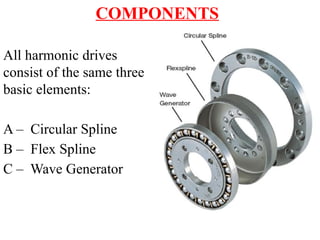
COMPONENTS
All harmonic drives
consist of the same three
basic elements:
A – Circular Spline
B – Flex Spline
C – Wave Generator
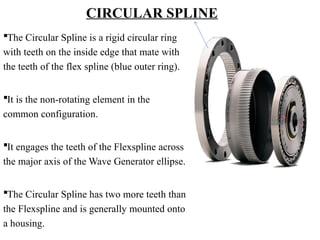
CIRCULAR SPLINE
The Circular Spline is a rigid circular ring
with teeth on the inside edge that mate with
the teeth of the flex spline (blue outer ring).
It is the non-rotating element in the
common configuration.
It engages the teeth of the Flexspline across
the major axis of the Wave Generator ellipse.
The Circular Spline has two more teeth than
the Flexspline and is generally mounted onto
a housing.
FLEX SPLINE
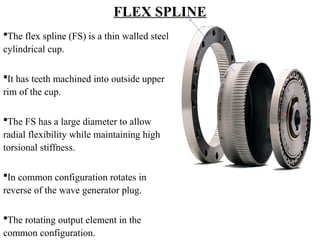
The flex spline (FS) is a thin walled steel
cylindrical cup.
It has teeth machined into outside upper
rim of the cup.
The FS has a large diameter to allow
radial flexibility while maintaining high
torsional stiffness.
In common configuration rotates in
reverse of the wave generator plug.
The rotating output element in the
common configuration.
WAVE GENERATOR
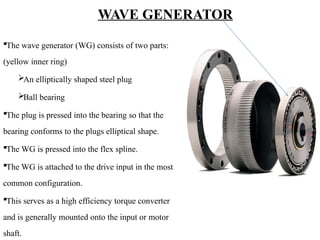
The wave generator (WG) consists of two parts:
(yellow inner ring)
An elliptically shaped steel plug
Ball bearing
The plug is pressed into the bearing so that the
bearing conforms to the plugs elliptical shape.
The WG is pressed into the flex spline.
The WG is attached to the drive input in the most
common configuration.
This serves as a high efficiency torque converter
and is generally mounted onto the input or motor
shaft.
MATERIALS USED
CIRCULAR SPLINE:
The different functions(tooth area,interface to mounting structure,etc.)
make corrosion prevention by surface coating very difficult, the use of
stainless steel is preferred.
The use of a thin lubricant film is not sufficient to avoid cold welding
between the Circular Spline and Flexspline, therefore these two parts are
made of different steel types.
FLEX SPLINE:
The Harmonic Drive Gear is designed so that the Flexspline operates in
its infinite fatigue life region.
This is ensured by using high performance steel or titanium and optimized shaping of the
tooth root and the contour of the cup itself.
The different tribological surfaces (teeth area and the interface to the Wave Generator) pose
additional requirements on the material selection and surface hardness and roughness.
A detailed test and qualification program is required before a new material can be
introduced.
WAVE GENERATOR:
The Wave Generator bearing is a specially designed thin wall bearing.
Due to the limitations of materials used for bearings and the special
design of the bearing the choice in most cases is 440C.
New materials such as Cronidur are under investigation.
WORKING PRINCIPLE
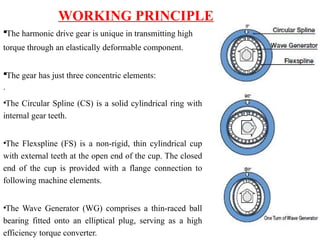
The harmonic drive gear is unique in transmitting high
torque through an elastically deformable component.
The gear has just three concentric elements:
·
•The Circular Spline (CS) is a solid cylindrical ring with
internal gear teeth.
•The Flexspline (FS) is a non-rigid, thin cylindrical cup
with external teeth at the open end of the cup. The closed
end of the cup is provided with a flange connection to
following machine elements.
•The Wave Generator (WG) comprises a thin-raced ball
bearing fitted onto an elliptical plug, serving as a high
efficiency torque converter.
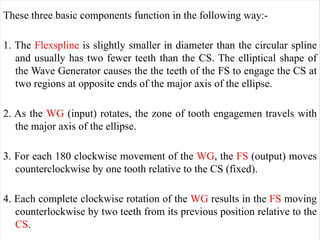
These three basic components function in the following way:-
1. The Flexspline is slightly smaller in diameter than the circular spline
and usually has two fewer teeth than the CS. The elliptical shape of
the Wave Generator causes the the teeth of the FS to engage the CS at
two regions at opposite ends of the major axis of the ellipse.
2. As the WG (input) rotates, the zone of tooth engagemen travels with
the major axis of the ellipse.
3. For each 180 clockwise movement of the WG, the FS (output) moves
counterclockwise by one tooth relative to the CS (fixed).
4. Each complete clockwise rotation of the WG results in the FS moving
counterlockwise by two teeth from its previous position relative to the
CS.
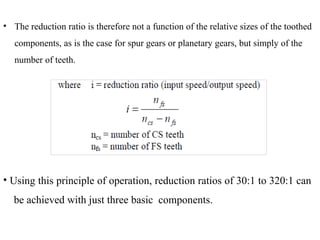
• The reduction ratio is therefore not a function of the relative sizes of the toothed
components, as is the case for spur gears or planetary gears, but simply of the
number of teeth.
• Using this principle of operation, reduction ratios of 30:1 to 320:1 can
be achieved with just three basic components.
MAJOR APPLICATIONS
Robotics:
Ground Robotics (chaos – Autonomous solutions)
Prosthetics /Cybernetics – (Cyberdyne, Honda)
Industrial Robotics (car manufacturing, silicon wafer production)
Aerospace:
Satellites, Aircraft
Medical Equipment (MRI equipment, microscope positioning)
Communications:
Radar and satellite tracking systems
ADVANTAGES
Simple construction (3 piece)
Light weight (up to 50% lighter than conventional reducers)
Compact (single stage, pancake style, coaxial input out put shafts)
High efficiency in gear ratios between 60:1 to 250:1 & efficiencies of
65% to 95% are achievable.
High positional accuracy (0.008º)
High torque-to-weight ratio (100:1, 160:1, 200:1)
Zero backlash
Infinite lifetime & constant performance
Cost effective
DISADVANTAGES
Gear reductions below 30:1 are limited because of the
possibility of fatiguing the flexspline.
Restricted to input power levels below 6000W.
Large models experience lower efficiency.
High ratio drives are non-backdrivable.
Must be careful of operating temperatures, and lubrication
techniques.
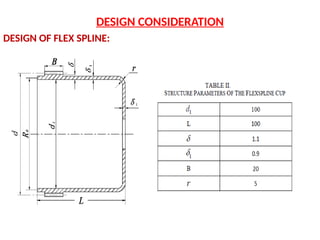
DESIGN CONSIDERATION
DESIGN OF FLEX SPLINE:
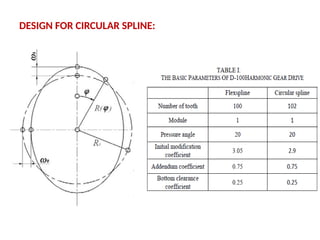
DESIGN FOR CIRCULAR SPLINE:
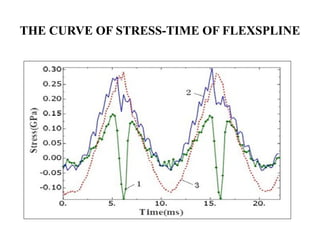
THE CURVE OF STRESS-TIME OF FLEXSPLINE
LUBRICATION
• For the wave generator bearing, perfluorinated oil e.g.
Fomblin Z25 or Brayco 815Z, is typically used. The
phenolic resin bearing retainer is impregnated with
oil in a vacuum environment.
• The gear teeth are typically lubricated with grease.
COST
•Harmonic Drives range in cost based on size, lubrication, and
configuration type.
•The drive costs a bit more than other reduction devices, but
the savings is made up by being able to reduce the
requirements for the motor and the savings in size and weight.
CONCLUSION
•Harmonic Drive gears have a long success story in demanding robotic applications.
•One area of particular interest is the development of lightweight gears. The latest
research results can reduce weight by more than 50 % without any reduction in
torque capacity or accuracy.
•This research is continuing with gears manufactured from titanium using special
surface treatments currently being tested. It is anticipated that this development can
lead to even better performance that that already achieved using composite or
aluminium components.
REFERENCE LIST
H., Dong, K. L.,Ting, and D., Wang, 2011, “Kinematic Fundamentals of Planar harmonic drives”,
ASME J. Mich.Des, 2011.01, pp.0110071-7.
Dynamic Simulation of Harmonic Gear Drives Considering Tooth Profiles Parameters
Optimization,By Huimin Dong, VOL. 7, NO. 6, JUNE 2012,Pg no 1429-1436
School of mechanical engineering, Dalian University of Technology, Dalian 116024, PR China.
K. Löffler, M. Gienger, F. Pfeiffer:
Sensor and Control Design of a Dynamically Stable
Biped Robot
Proc. of 2003 IEEE International Conference on
Robotics and Automation
Schäfer, B. Hirzinger, G.:
On Design, Dynamics and Simulation of Space
Robotics at DLR
Proc. of 2nd International Congress on Mechatronics,
Graz, 2003
Slatter, R.:
Leichtbaugetriebe für Roboter in der Raumfahrt
Antriebstechnik 41 (2002) Nr. 11

406913945-Harmonic-Drive-Gearing-pptx.pptx

  • 1.
    Harmonic Drive Gearing PROJECTON PRESENTED BY: RAJAT KUMAR PANIGRAHI PRAKASH CH. SAHOO DWARIKA PRASAD DASH PRADOSH KUMAR NAYAK GUIDED BY: PROF. JAYDEV BALA
  • 2.
    INTRODUCTION Strain Wave Gearing(also known as "harmonic drive" because Harmonic Drive gears are strain wave gears produced by the Harmonic Drive companies) is a special type of mechanical gear system that can improve certain characteristics compared to traditional gearing systems (such as Helical Gears or Planetary Gears) Harmonic Drives (HD) were invented in the late 1950 by C. Walton Musser. This mechanical transmission employs a continuous deflection wave along non rigid gear to allow for gardual engagement of gear teeth.Because of this unconventional gear tooth meshing action ,harmonic drives can deliver high reduction ratios in a very small package. The unique performance features of the hamonic drive have captured international attention from designers as well as researchers.
  • 3.
    COMPONENTS All harmonic drives consistof the same three basic elements: A – Circular Spline B – Flex Spline C – Wave Generator
  • 4.
    CIRCULAR SPLINE The CircularSpline is a rigid circular ring with teeth on the inside edge that mate with the teeth of the flex spline (blue outer ring). It is the non-rotating element in the common configuration. It engages the teeth of the Flexspline across the major axis of the Wave Generator ellipse. The Circular Spline has two more teeth than the Flexspline and is generally mounted onto a housing.
  • 5.
    FLEX SPLINE The flexspline (FS) is a thin walled steel cylindrical cup. It has teeth machined into outside upper rim of the cup. The FS has a large diameter to allow radial flexibility while maintaining high torsional stiffness. In common configuration rotates in reverse of the wave generator plug. The rotating output element in the common configuration.
  • 6.
    WAVE GENERATOR The wavegenerator (WG) consists of two parts: (yellow inner ring) An elliptically shaped steel plug Ball bearing The plug is pressed into the bearing so that the bearing conforms to the plugs elliptical shape. The WG is pressed into the flex spline. The WG is attached to the drive input in the most common configuration. This serves as a high efficiency torque converter and is generally mounted onto the input or motor shaft.
  • 7.
    MATERIALS USED CIRCULAR SPLINE: Thedifferent functions(tooth area,interface to mounting structure,etc.) make corrosion prevention by surface coating very difficult, the use of stainless steel is preferred. The use of a thin lubricant film is not sufficient to avoid cold welding between the Circular Spline and Flexspline, therefore these two parts are made of different steel types.
  • 8.
    FLEX SPLINE: The HarmonicDrive Gear is designed so that the Flexspline operates in its infinite fatigue life region. This is ensured by using high performance steel or titanium and optimized shaping of the tooth root and the contour of the cup itself. The different tribological surfaces (teeth area and the interface to the Wave Generator) pose additional requirements on the material selection and surface hardness and roughness. A detailed test and qualification program is required before a new material can be introduced.
  • 9.
    WAVE GENERATOR: The WaveGenerator bearing is a specially designed thin wall bearing. Due to the limitations of materials used for bearings and the special design of the bearing the choice in most cases is 440C. New materials such as Cronidur are under investigation.
  • 10.
    WORKING PRINCIPLE The harmonicdrive gear is unique in transmitting high torque through an elastically deformable component. The gear has just three concentric elements: · •The Circular Spline (CS) is a solid cylindrical ring with internal gear teeth. •The Flexspline (FS) is a non-rigid, thin cylindrical cup with external teeth at the open end of the cup. The closed end of the cup is provided with a flange connection to following machine elements. •The Wave Generator (WG) comprises a thin-raced ball bearing fitted onto an elliptical plug, serving as a high efficiency torque converter.
  • 11.
    These three basiccomponents function in the following way:- 1. The Flexspline is slightly smaller in diameter than the circular spline and usually has two fewer teeth than the CS. The elliptical shape of the Wave Generator causes the the teeth of the FS to engage the CS at two regions at opposite ends of the major axis of the ellipse. 2. As the WG (input) rotates, the zone of tooth engagemen travels with the major axis of the ellipse. 3. For each 180 clockwise movement of the WG, the FS (output) moves counterclockwise by one tooth relative to the CS (fixed). 4. Each complete clockwise rotation of the WG results in the FS moving counterlockwise by two teeth from its previous position relative to the CS.
  • 12.
    • The reductionratio is therefore not a function of the relative sizes of the toothed components, as is the case for spur gears or planetary gears, but simply of the number of teeth. • Using this principle of operation, reduction ratios of 30:1 to 320:1 can be achieved with just three basic components.
  • 13.
    MAJOR APPLICATIONS Robotics: Ground Robotics(chaos – Autonomous solutions) Prosthetics /Cybernetics – (Cyberdyne, Honda) Industrial Robotics (car manufacturing, silicon wafer production) Aerospace: Satellites, Aircraft Medical Equipment (MRI equipment, microscope positioning) Communications: Radar and satellite tracking systems
  • 14.
    ADVANTAGES Simple construction (3piece) Light weight (up to 50% lighter than conventional reducers) Compact (single stage, pancake style, coaxial input out put shafts) High efficiency in gear ratios between 60:1 to 250:1 & efficiencies of 65% to 95% are achievable. High positional accuracy (0.008º) High torque-to-weight ratio (100:1, 160:1, 200:1) Zero backlash Infinite lifetime & constant performance Cost effective
  • 15.
    DISADVANTAGES Gear reductions below30:1 are limited because of the possibility of fatiguing the flexspline. Restricted to input power levels below 6000W. Large models experience lower efficiency. High ratio drives are non-backdrivable. Must be careful of operating temperatures, and lubrication techniques.
  • 16.
  • 17.
  • 18.
    THE CURVE OFSTRESS-TIME OF FLEXSPLINE
  • 19.
    LUBRICATION • For thewave generator bearing, perfluorinated oil e.g. Fomblin Z25 or Brayco 815Z, is typically used. The phenolic resin bearing retainer is impregnated with oil in a vacuum environment. • The gear teeth are typically lubricated with grease.
  • 20.
    COST •Harmonic Drives rangein cost based on size, lubrication, and configuration type. •The drive costs a bit more than other reduction devices, but the savings is made up by being able to reduce the requirements for the motor and the savings in size and weight.
  • 21.
    CONCLUSION •Harmonic Drive gearshave a long success story in demanding robotic applications. •One area of particular interest is the development of lightweight gears. The latest research results can reduce weight by more than 50 % without any reduction in torque capacity or accuracy. •This research is continuing with gears manufactured from titanium using special surface treatments currently being tested. It is anticipated that this development can lead to even better performance that that already achieved using composite or aluminium components.
  • 22.
    REFERENCE LIST H., Dong,K. L.,Ting, and D., Wang, 2011, “Kinematic Fundamentals of Planar harmonic drives”, ASME J. Mich.Des, 2011.01, pp.0110071-7. Dynamic Simulation of Harmonic Gear Drives Considering Tooth Profiles Parameters Optimization,By Huimin Dong, VOL. 7, NO. 6, JUNE 2012,Pg no 1429-1436 School of mechanical engineering, Dalian University of Technology, Dalian 116024, PR China. K. Löffler, M. Gienger, F. Pfeiffer: Sensor and Control Design of a Dynamically Stable Biped Robot Proc. of 2003 IEEE International Conference on Robotics and Automation Schäfer, B. Hirzinger, G.: On Design, Dynamics and Simulation of Space Robotics at DLR Proc. of 2nd International Congress on Mechatronics, Graz, 2003 Slatter, R.: Leichtbaugetriebe für Roboter in der Raumfahrt Antriebstechnik 41 (2002) Nr. 11