Computer Hardware
1
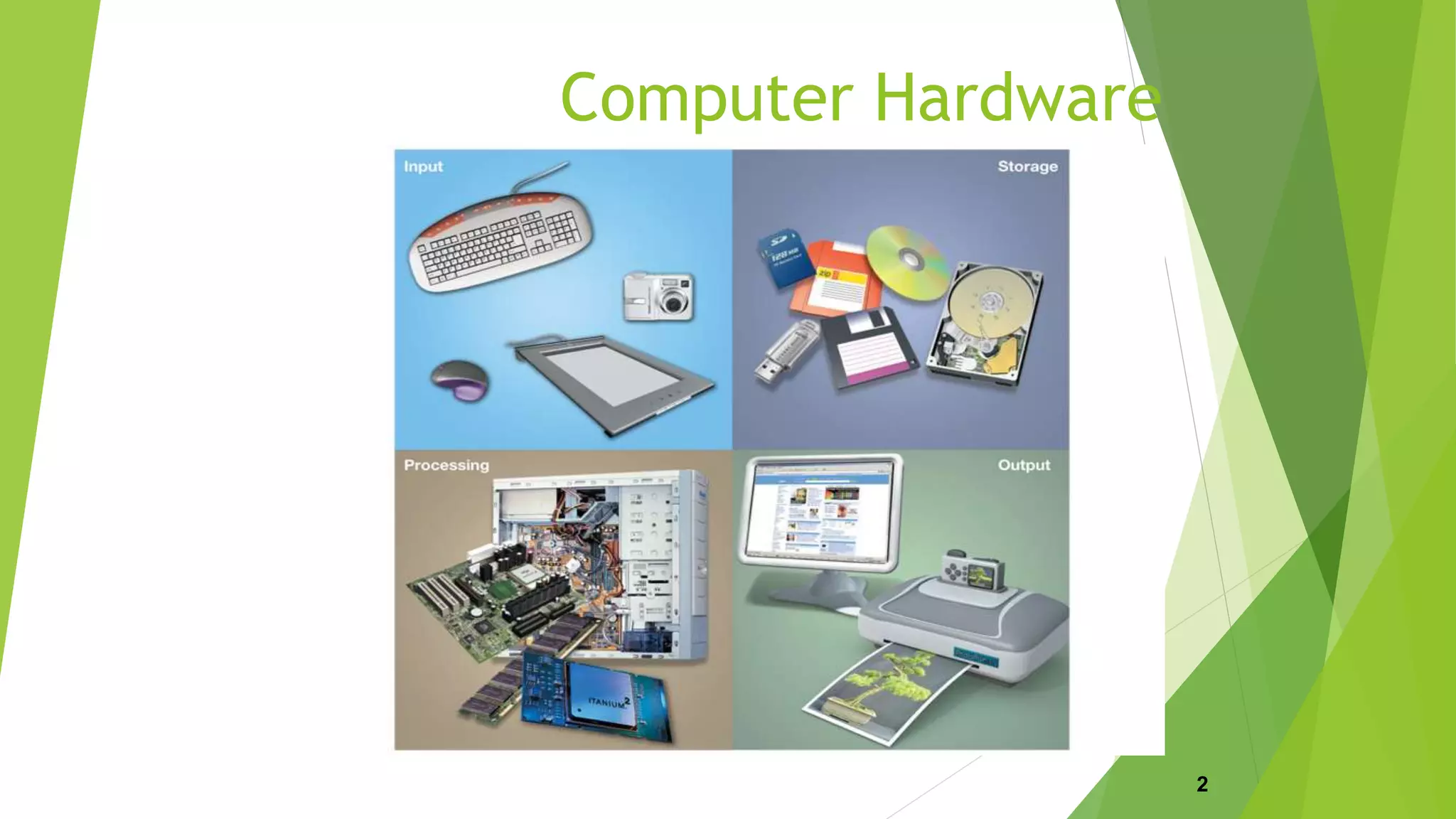
Computer Hardware
2
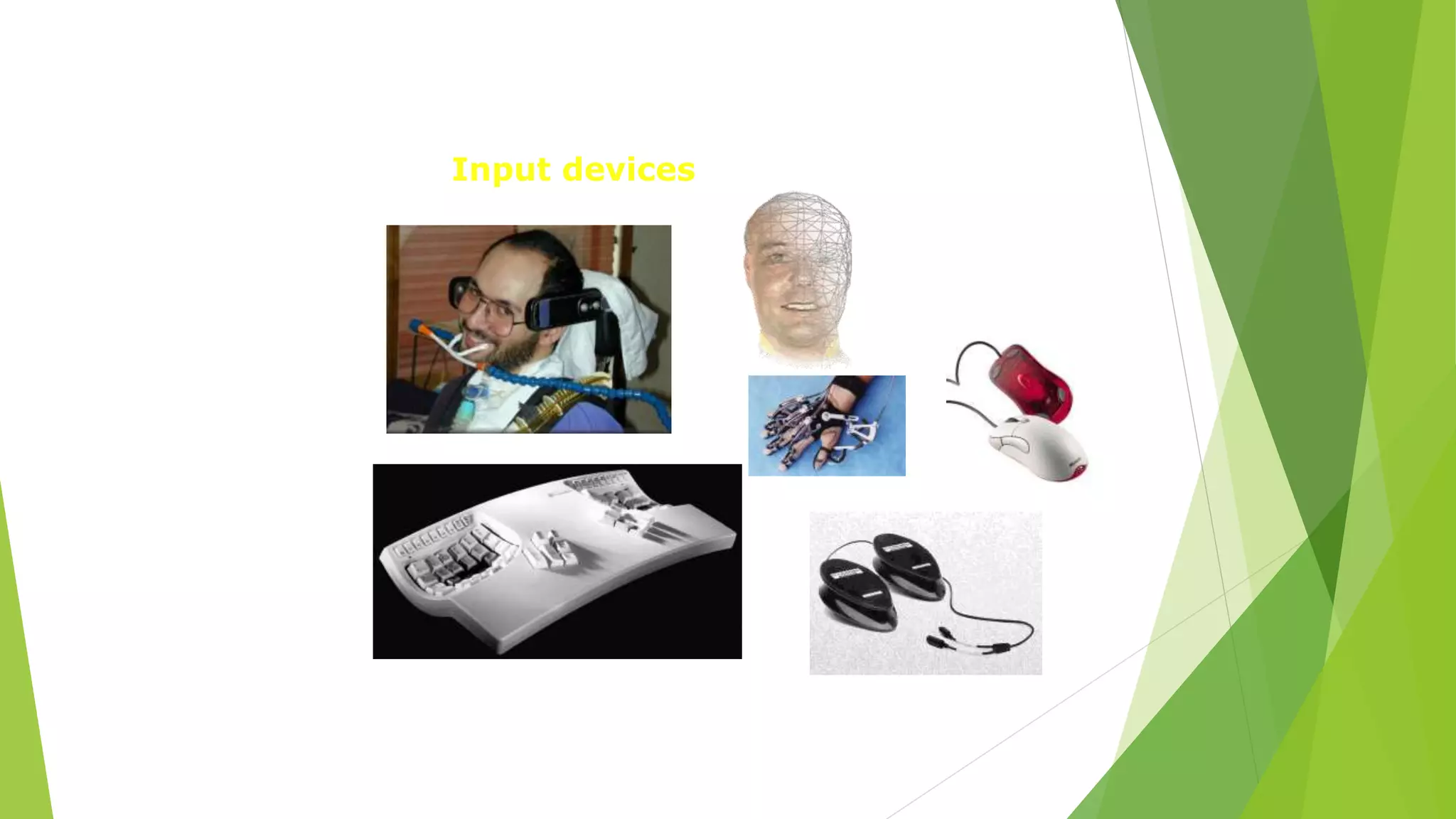
Input devices
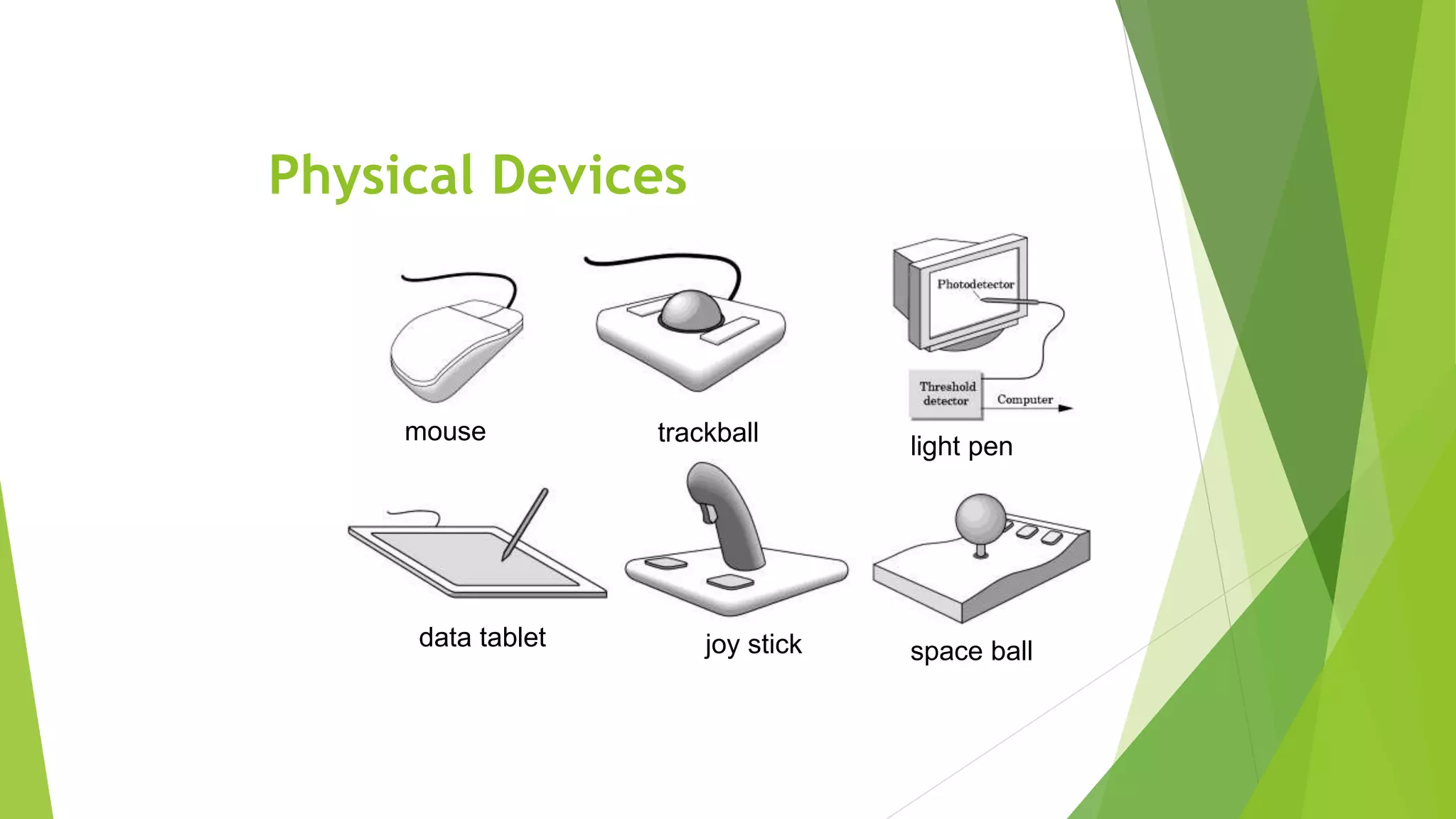
Physical Devices
mouse trackball light pen
data tablet joy stick space ball
Input Modes
 Input devices contain a trigger which can be used to send a signal to the operating
system
 Button on mouse
 Pressing or releasing a key
 When triggered, input devices return information (their measure) to the system
 Mouse returns position information
 Keyboard returns ASCII code
Incremental (Relative) Devices
Devices such as the data tablet return a position directly to the
operating system
Devices such as the mouse, trackball, and joy stick return
incremental inputs (or velocities) to the operating system
Must integrate these inputs to obtain an absolute position
Rotation of cylinders in mouse
Roll of trackball
Difficult to obtain absolute position
Can get variable sensitivity
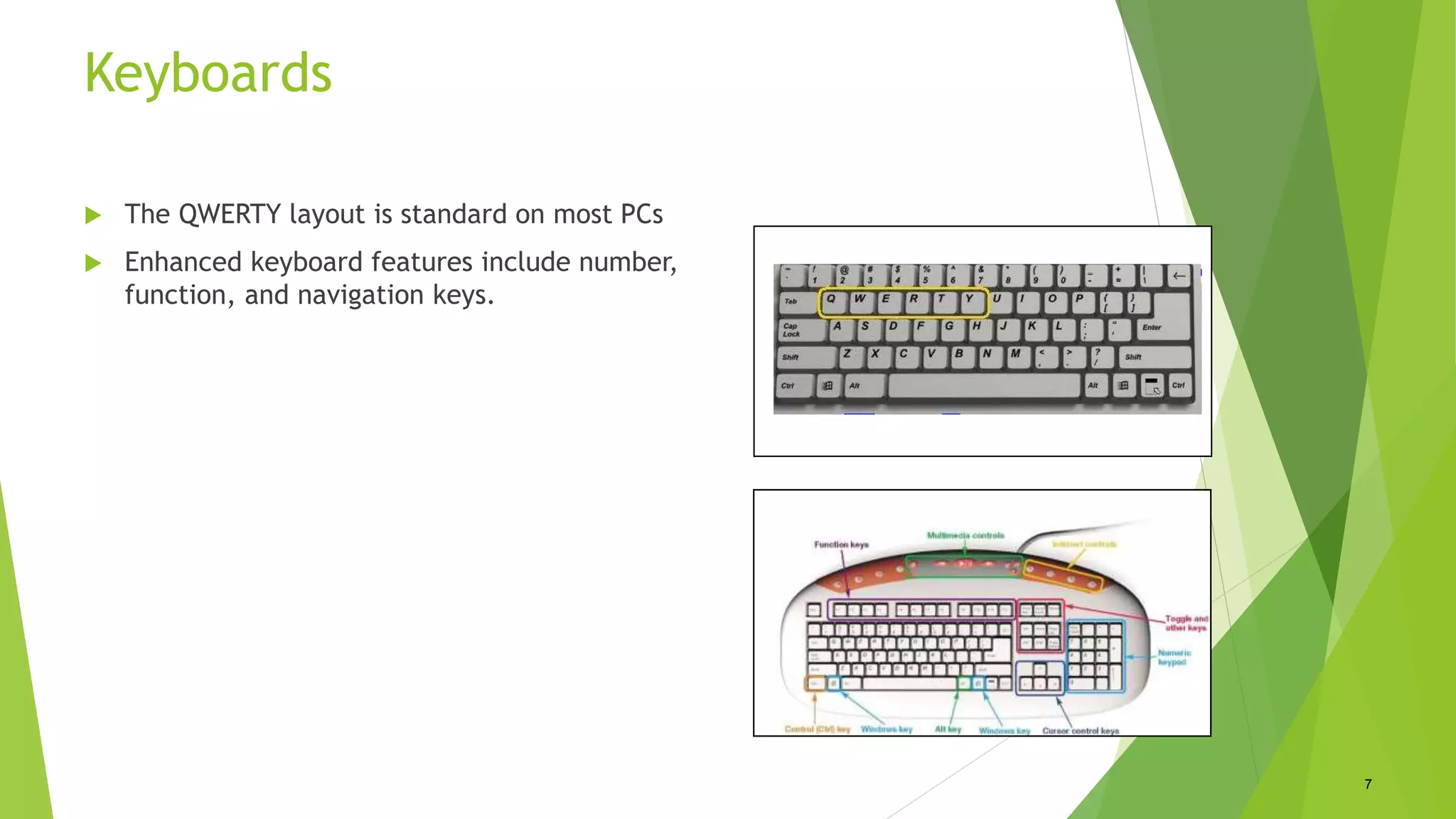
Keyboards
 The QWERTY layout is standard on most PCs
 Enhanced keyboard features include number,
function, and navigation keys.
7
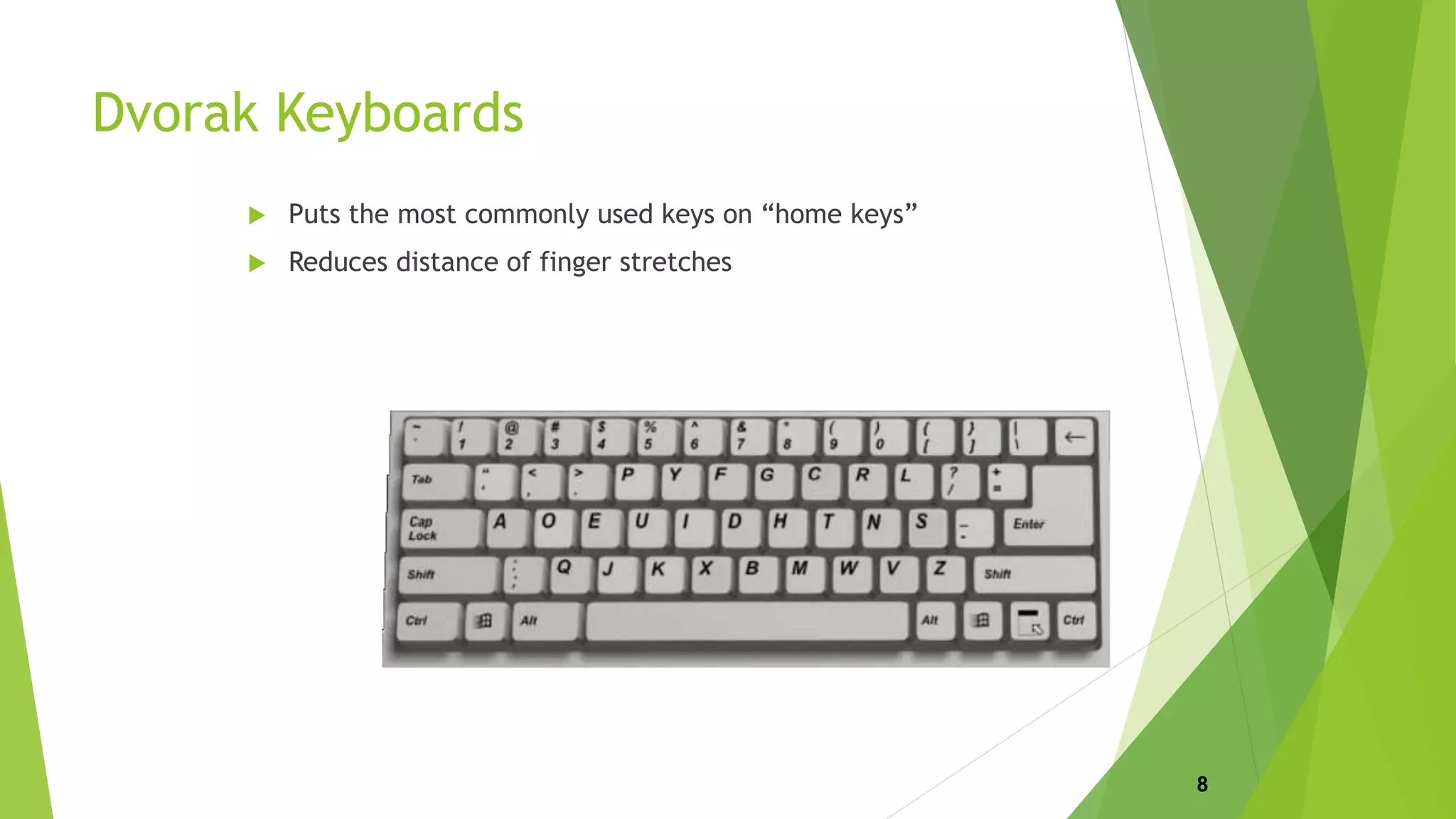
Dvorak Keyboards
 Puts the most commonly used keys on “home keys”
 Reduces distance of finger stretches
8
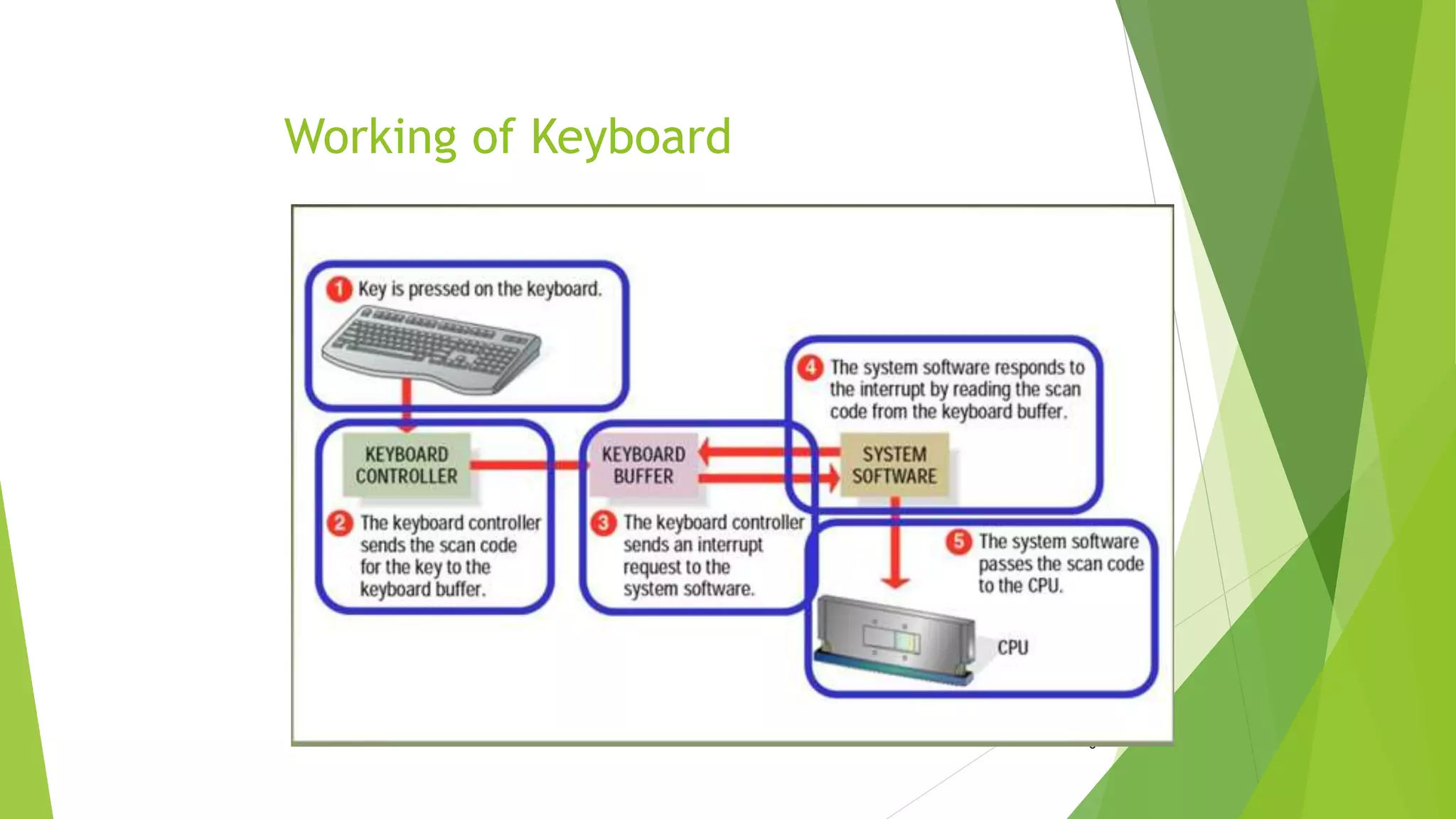
Working of Keyboard
9
Mouse
10
A pointing device that fits comfortably under the
palm of your hand
The most widely used pointing device on desktop
Computers
The mouse controls the movement of the pointer,
also called the mouse pointer, on the screen
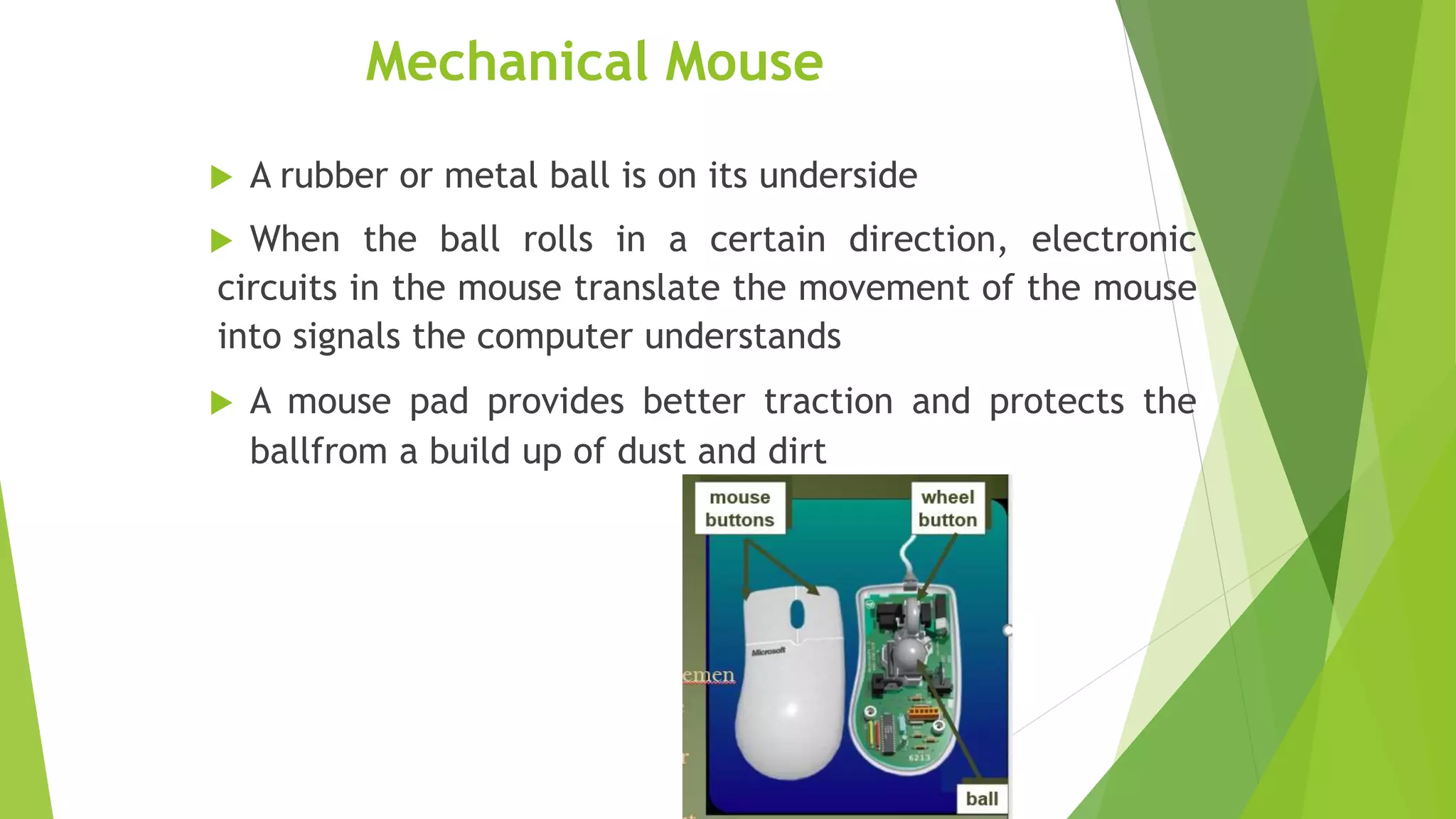
Mechanical Mouse
 A rubber or metal ball is on its underside
 When the ball rolls in a certain direction, electronic
circuits in the mouse translate the movement of the mouse
into signals the computer understands
 A mouse pad provides better traction and protects the
ballfrom a build up of dust and dirt
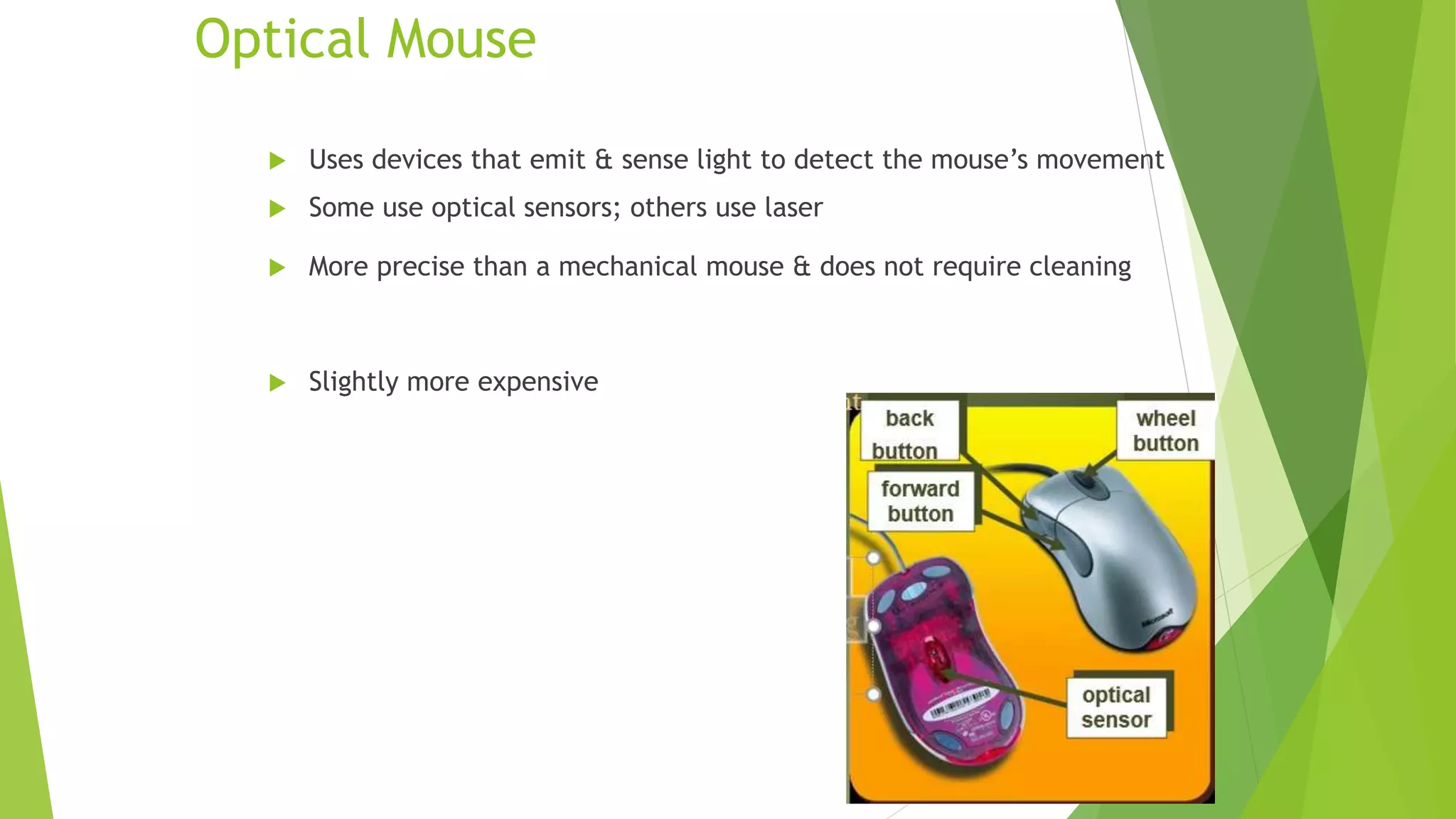
Optical Mouse
 Uses devices that emit & sense light to detect the mouse’s movement
 Some use optical sensors; others use laser
 More precise than a mechanical mouse & does not require cleaning
 Slightly more expensive
12
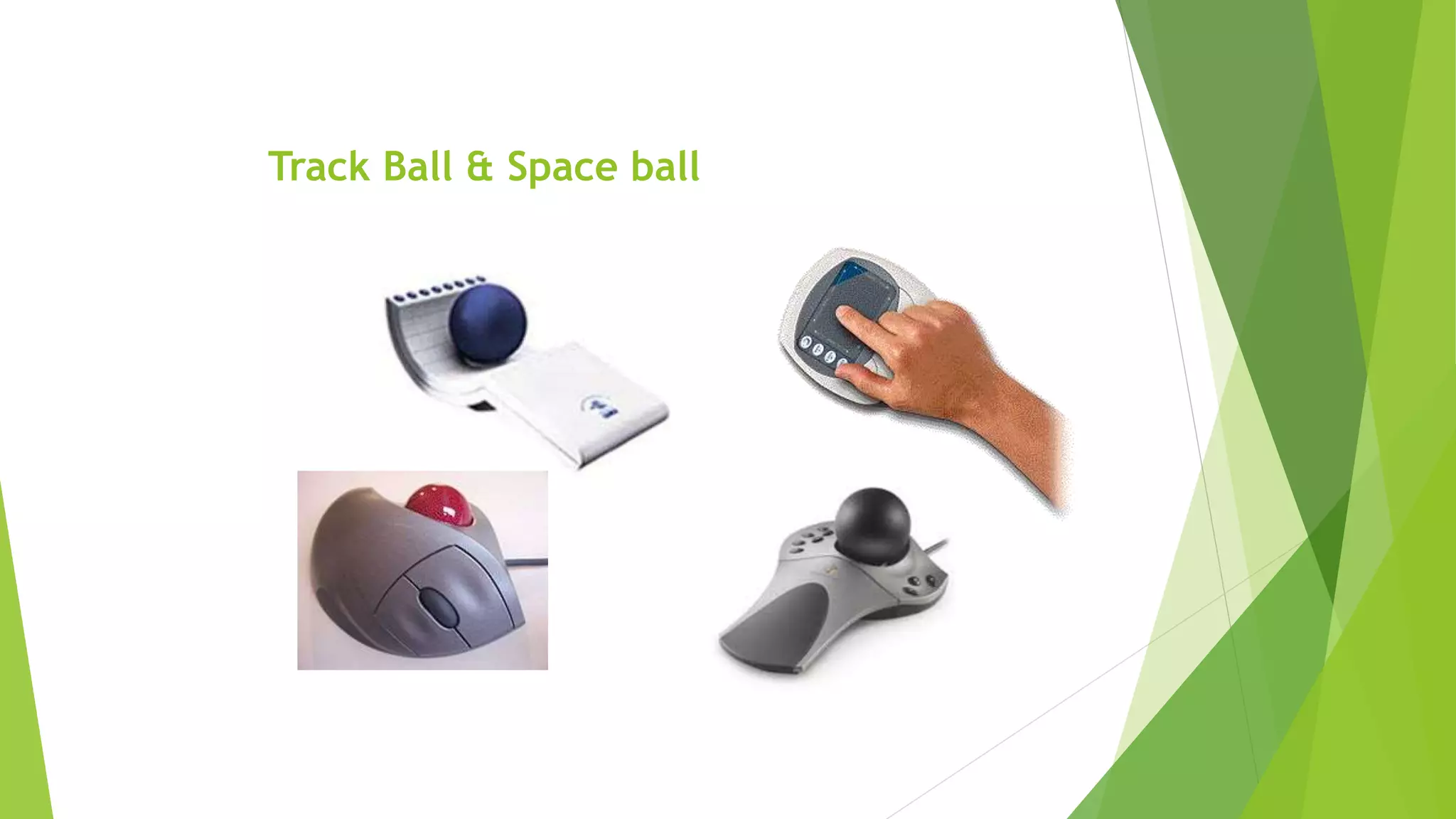
Track Ball & Space ball
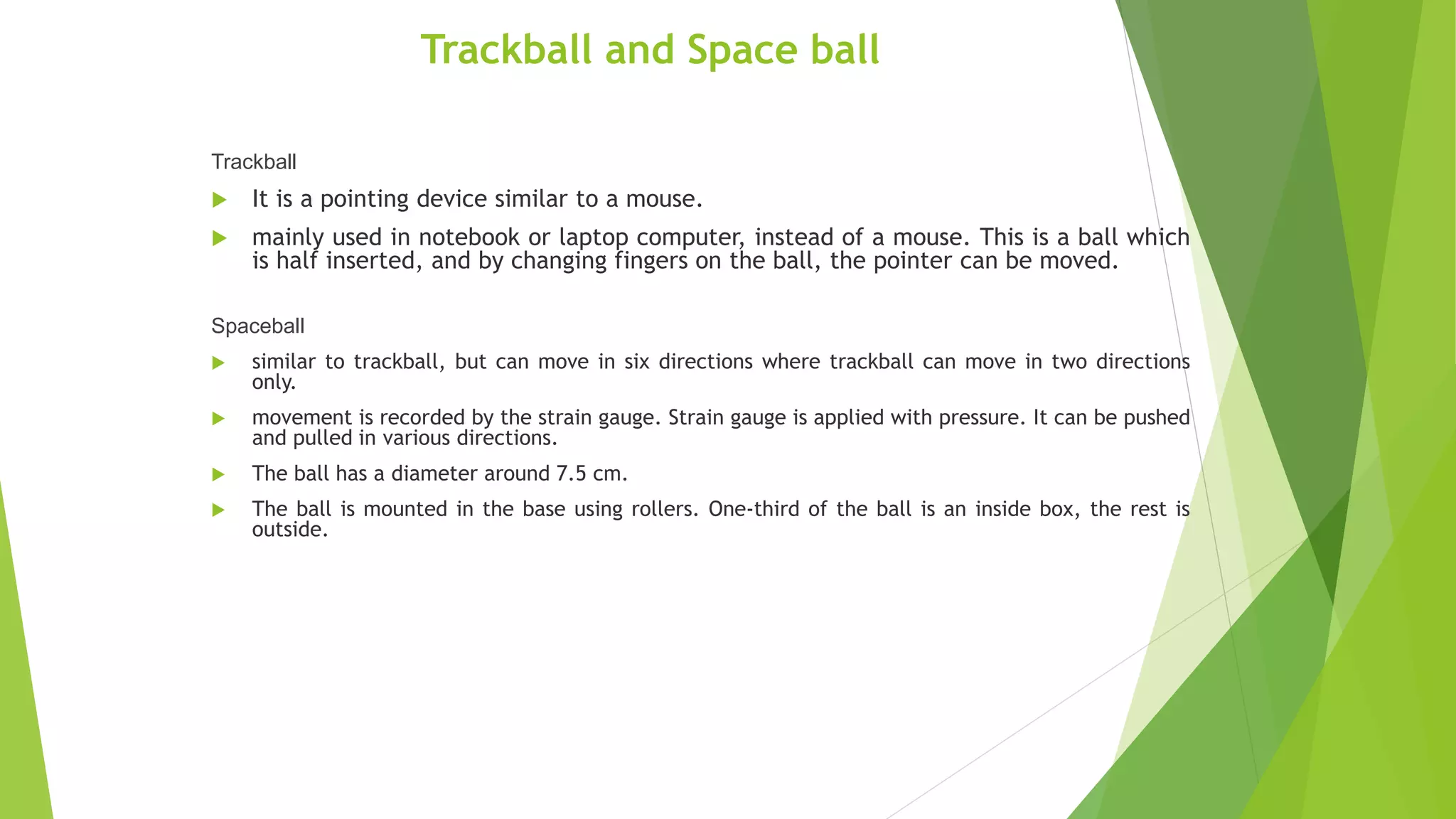
Trackball and Space ball
Trackball
 It is a pointing device similar to a mouse.
 mainly used in notebook or laptop computer, instead of a mouse. This is a ball which
is half inserted, and by changing fingers on the ball, the pointer can be moved.
Spaceball
 similar to trackball, but can move in six directions where trackball can move in two directions
only.
 movement is recorded by the strain gauge. Strain gauge is applied with pressure. It can be pushed
and pulled in various directions.
 The ball has a diameter around 7.5 cm.
 The ball is mounted in the base using rollers. One-third of the ball is an inside box, the rest is
outside.
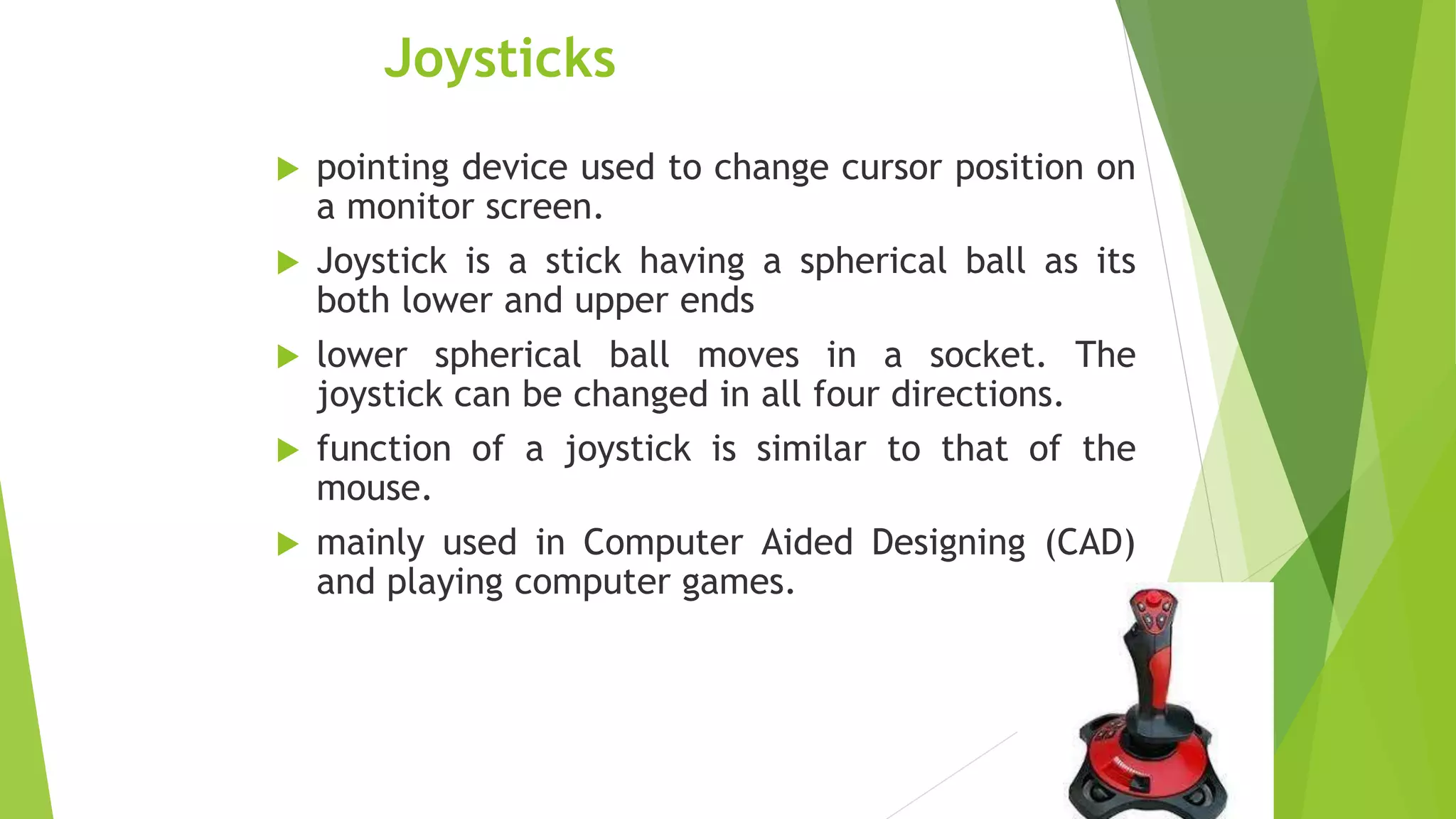
Joysticks
 pointing device used to change cursor position on
a monitor screen.
 Joystick is a stick having a spherical ball as its
both lower and upper ends
 lower spherical ball moves in a socket. The
joystick can be changed in all four directions.
 function of a joystick is similar to that of the
mouse.
 mainly used in Computer Aided Designing (CAD)
and playing computer games.
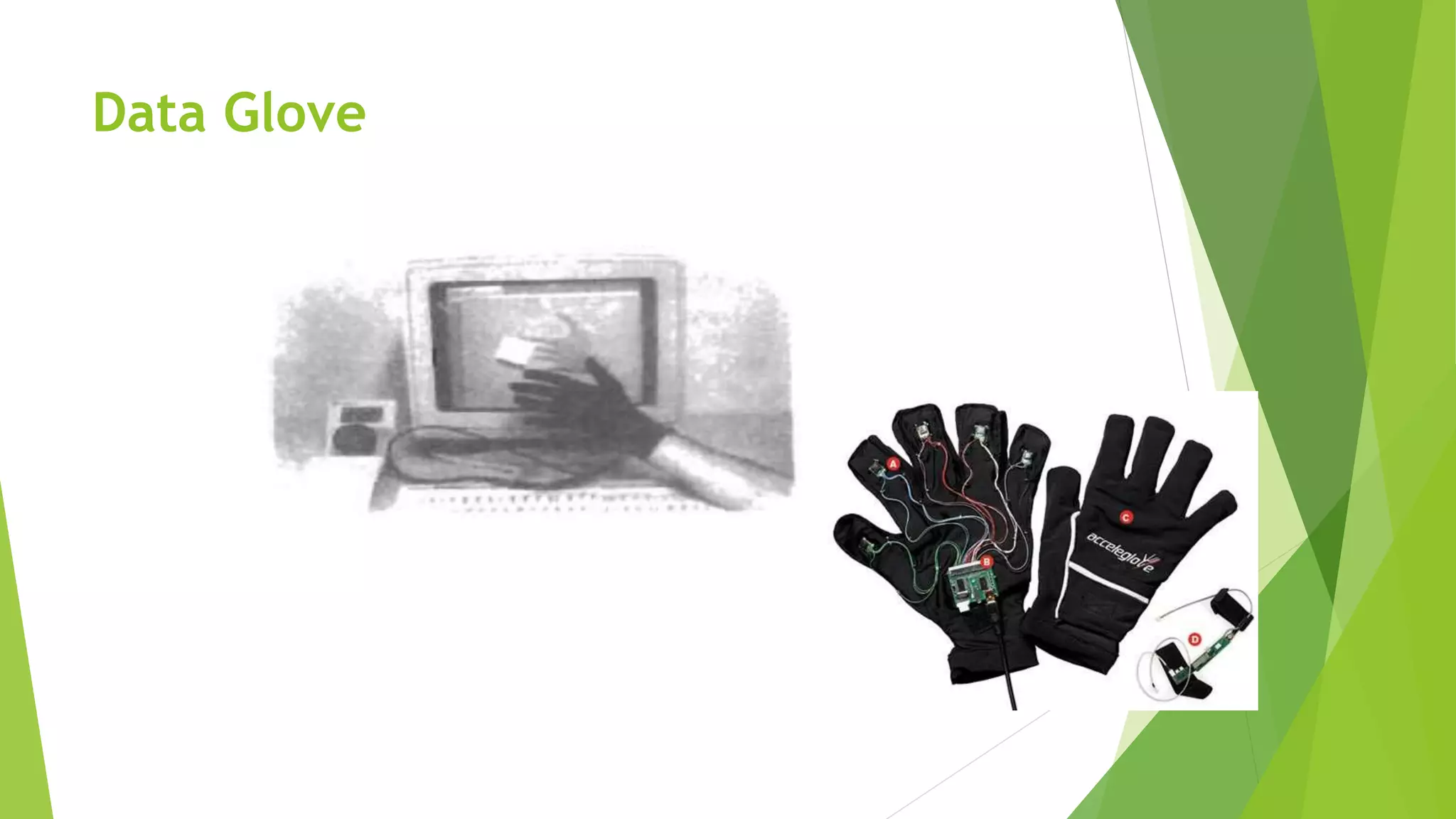
Data Glove
 input device essentially a glove worn on the hand that
contains various electronic sensors that monitor the
hand's movements and transform them into a form of
input
 applications such as virtual reality and robotics.
 Some datagloves enable and to apply fine-motion control.
 tactile sensing, allowing the user to seemingly feel a
virtual object
Data Glove
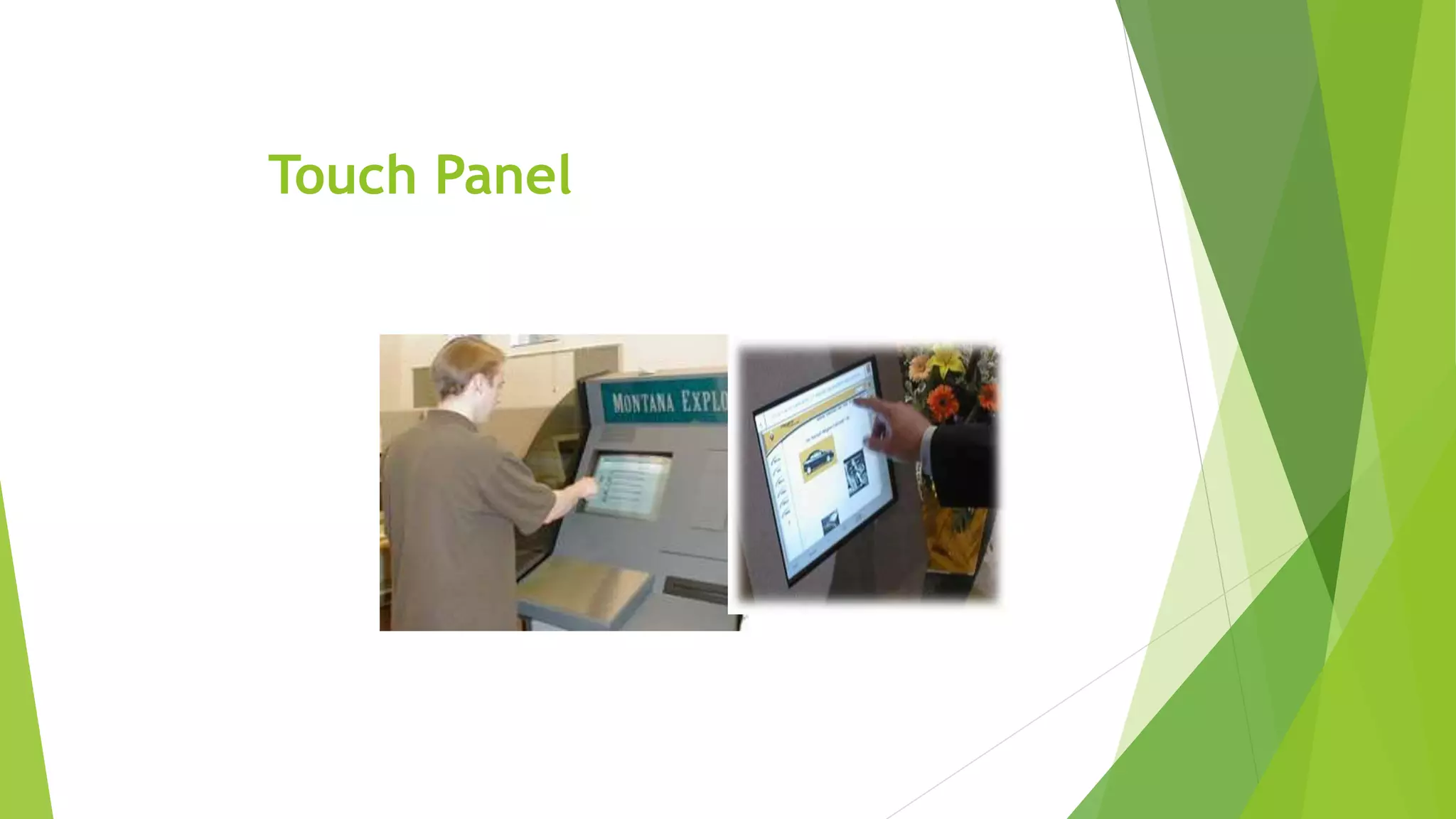
Touch Panel
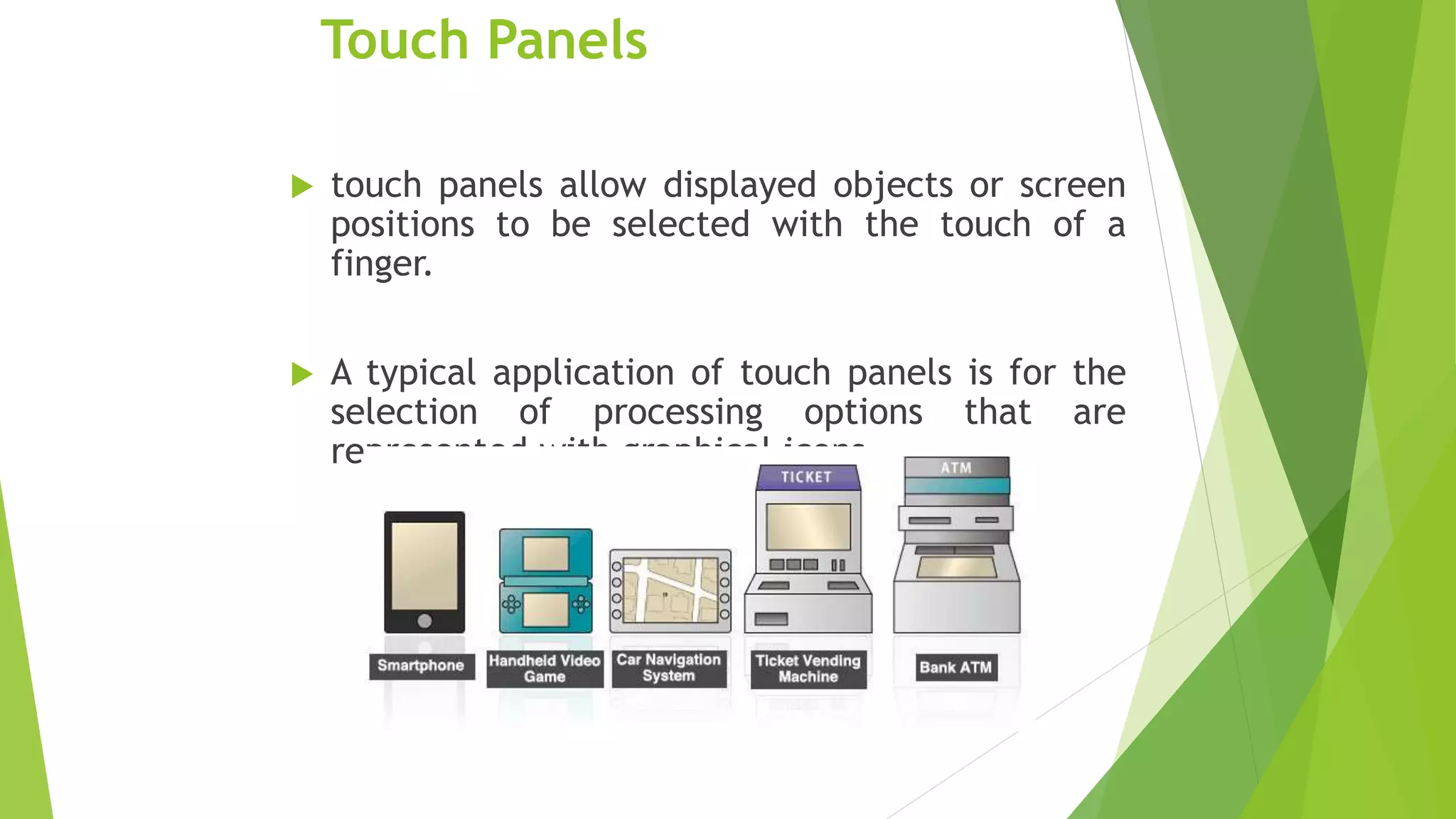
Touch Panels
 touch panels allow displayed objects or screen
positions to be selected with the touch of a
finger.
 A typical application of touch panels is for the
selection of processing options that are
represented with graphical icons.
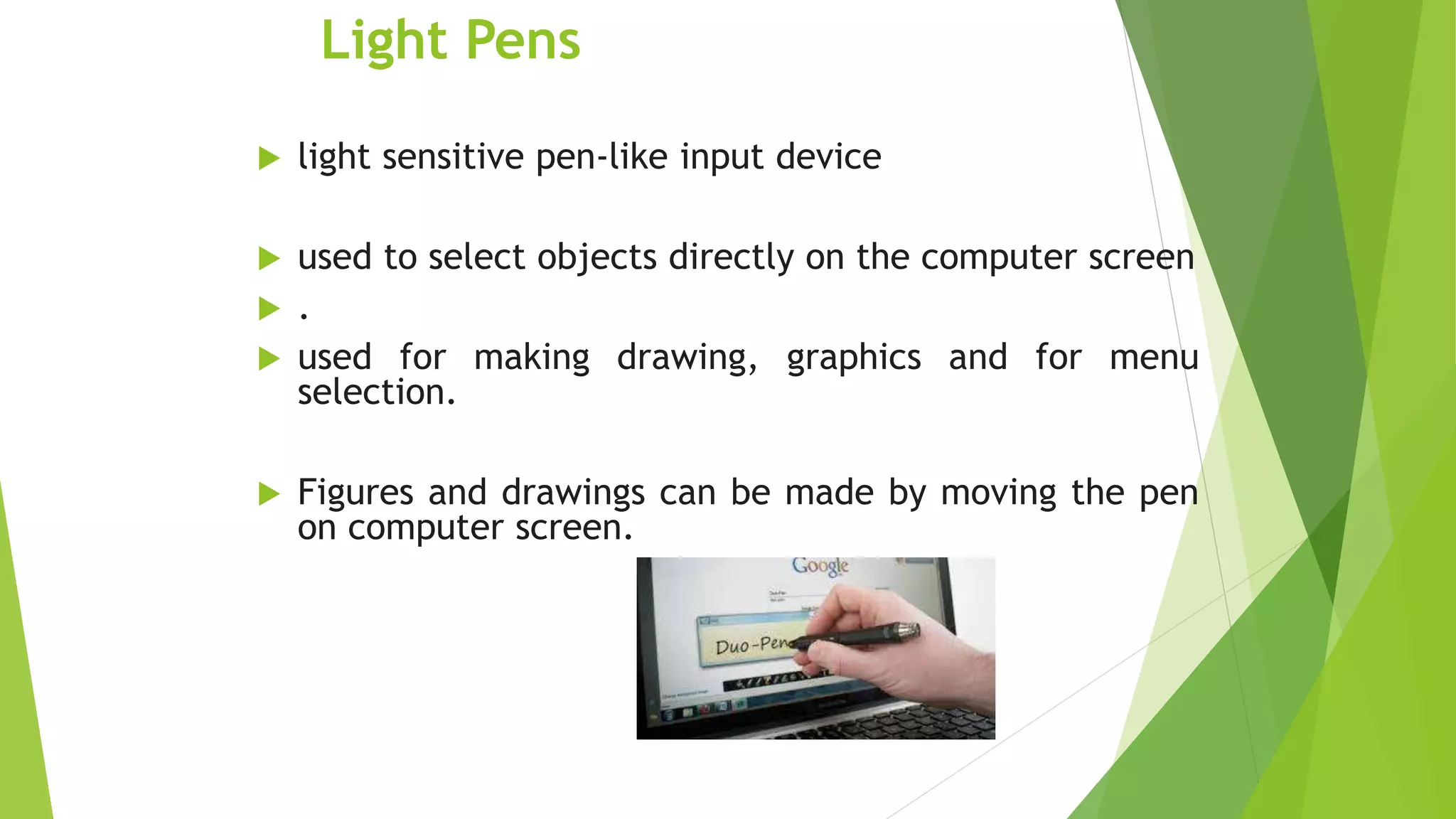
Light Pens
 light sensitive pen-like input device
 used to select objects directly on the computer screen
 .
 used for making drawing, graphics and for menu
selection.
 Figures and drawings can be made by moving the pen
on computer screen.
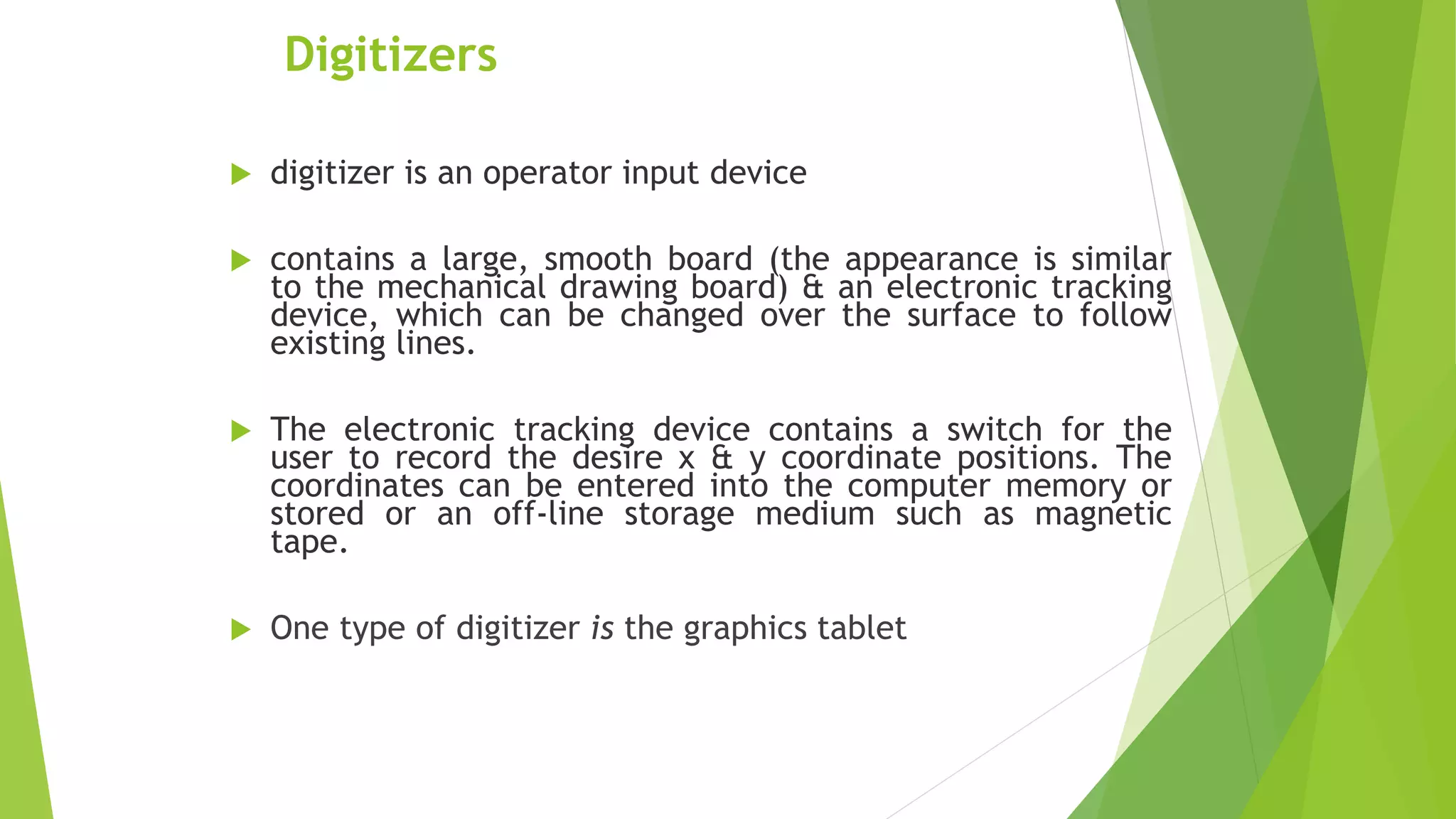
Digitizers
 digitizer is an operator input device
 contains a large, smooth board (the appearance is similar
to the mechanical drawing board) & an electronic tracking
device, which can be changed over the surface to follow
existing lines.
 The electronic tracking device contains a switch for the
user to record the desire x & y coordinate positions. The
coordinates can be entered into the computer memory or
stored or an off-line storage medium such as magnetic
tape.
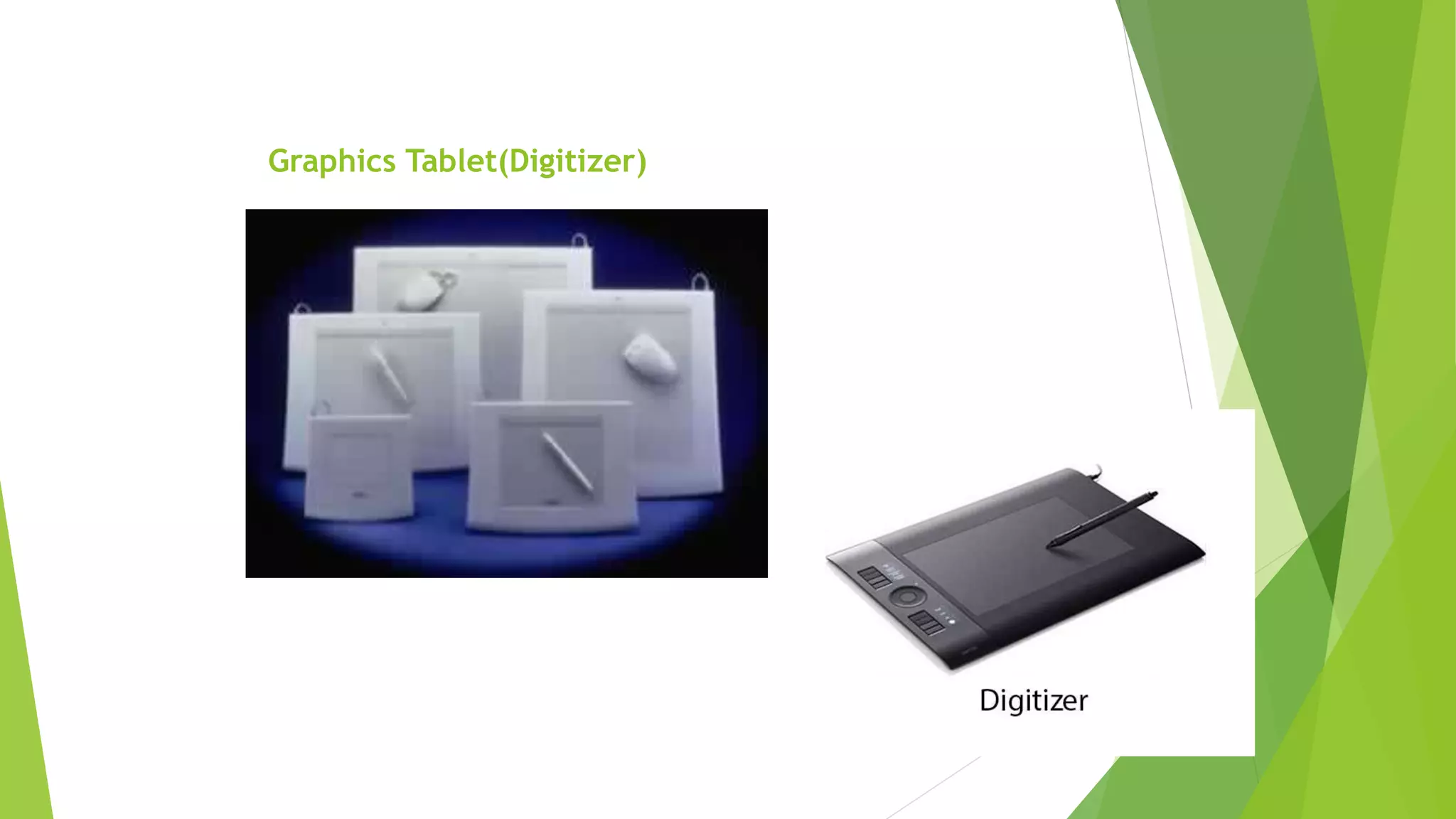
 One type of digitizer is the graphics tablet
Graphics Tablet(Digitizer)
Scanning Devices
 Copy data from a source
 Types of scanners
 Optical scanner
 Bar code readers
 Character and Mark recognition
23
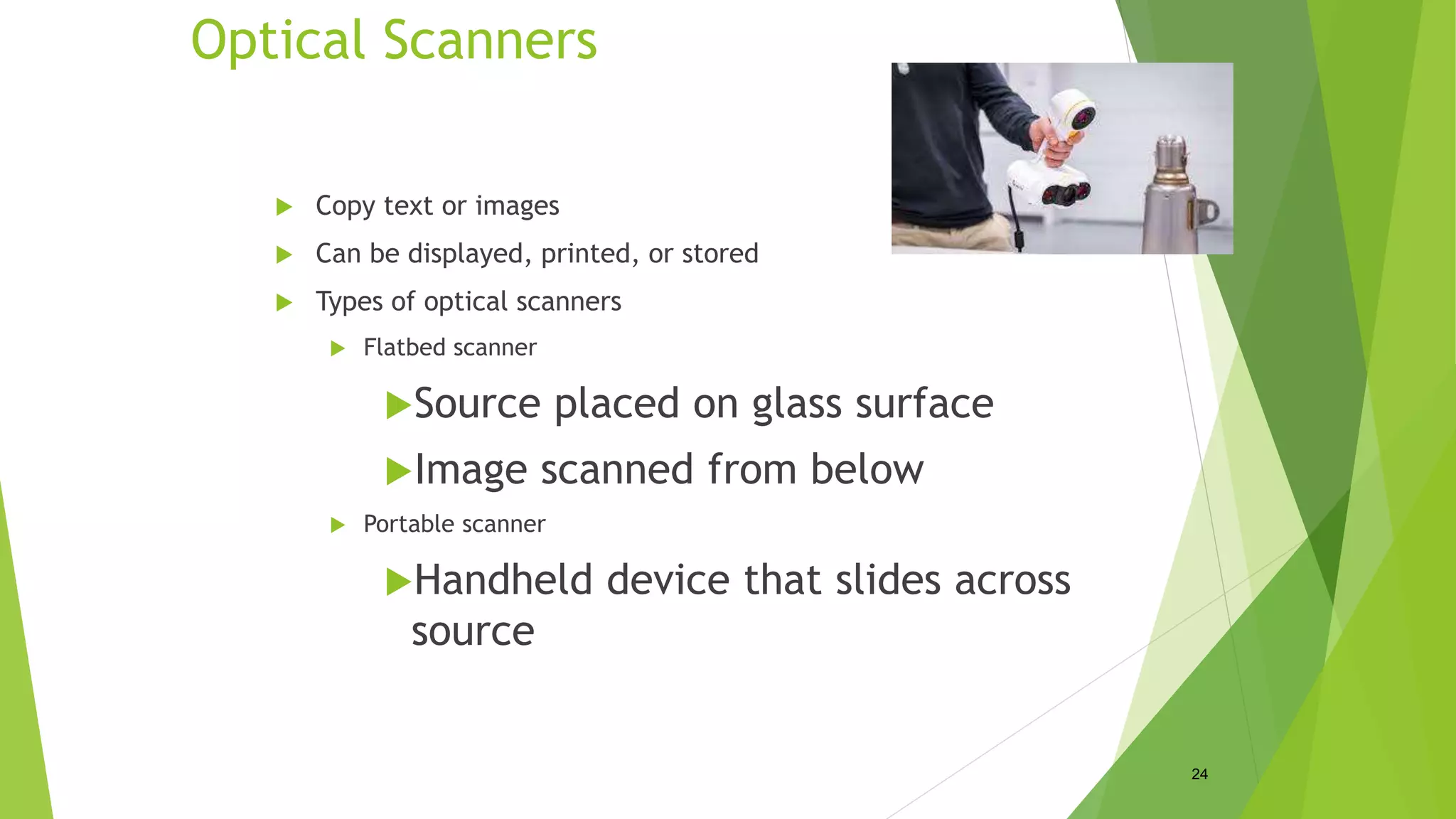
Optical Scanners
 Copy text or images
 Can be displayed, printed, or stored
 Types of optical scanners
 Flatbed scanner
Source placed on glass surface
Image scanned from below
 Portable scanner
Handheld device that slides across
source
24
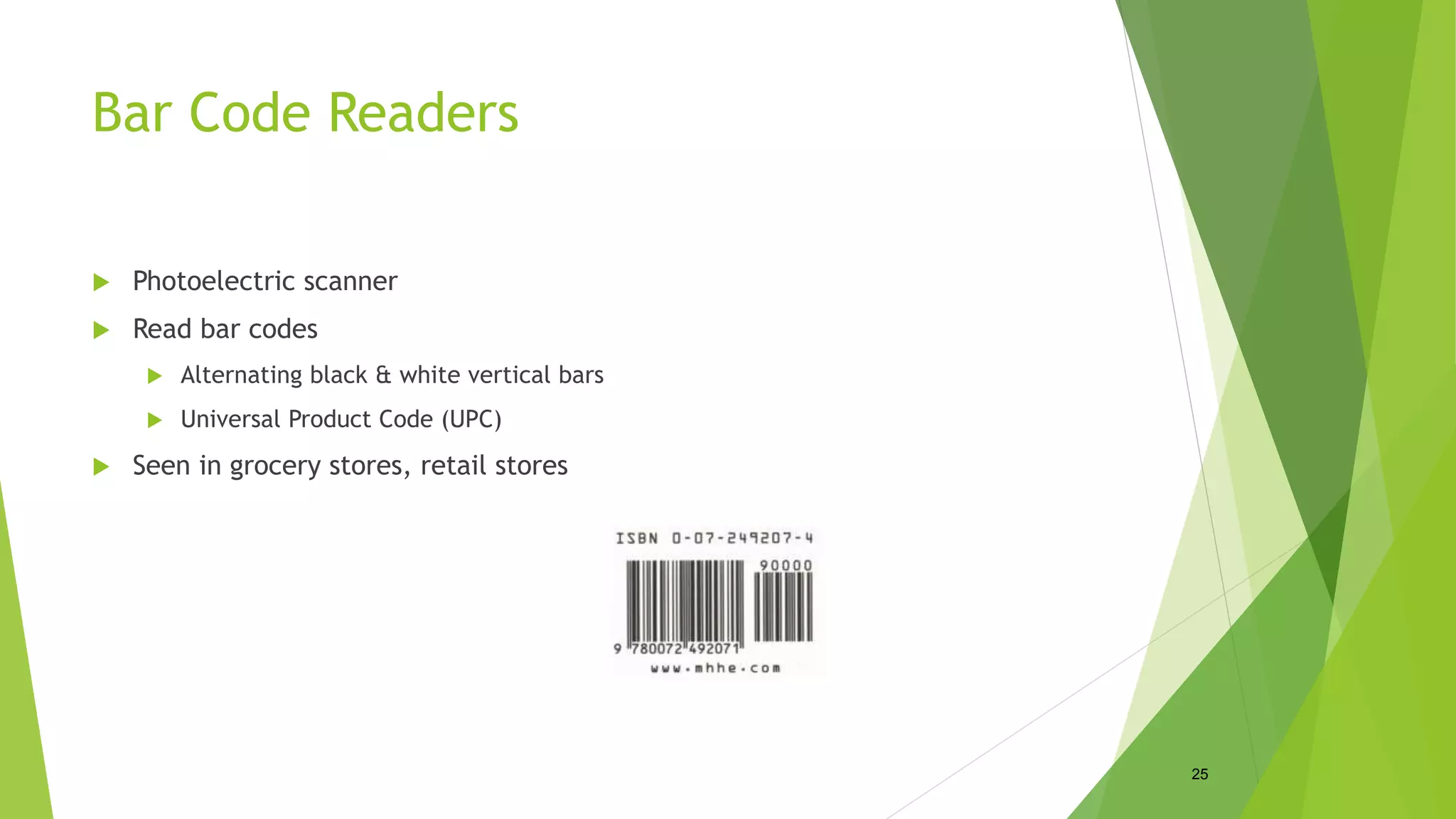
Bar Code Readers
 Photoelectric scanner
 Read bar codes
 Alternating black & white vertical bars
 Universal Product Code (UPC)
 Seen in grocery stores, retail stores
25
Character & Mark Recognition
 Magnetic-ink character recognition (MICR)
 Reads magnetically encoded characters
 Optical-character recognition (OCR)
 Reflects light off special preprinted characters
 Optical-mark recognition (OMR)
 Senses presence or absence of marks
26
Image Capturing Devices
 Create or capture original images
 Digital camera
 Image recorded digitally to memory
 Digital video cameras
 Capture motion
 Webcams
 Capture images for broadcast on Internet
27
Audio-Input Devices
 Convert sound into digital format
 Voice recognition system
 Operate computer by voice command
 Dictation
 Microphone, sound card, software
 Discrete
 Continuous
28
Voice Recognition Systems Types
 Recognize individual words based on sound
 Discrete-speech recognition
 Cannot distinguish same-sound words
 Continuous-speech recognition
 Can distinguish same-sound words
 Evaluates context of words
29
OUTPUT DEVICES
30
Output
 Processed data from a computer
 Text, graphics, photos, audio, video
 Common output devices
 Monitor
 Printer
 Plotter
 Voice
31
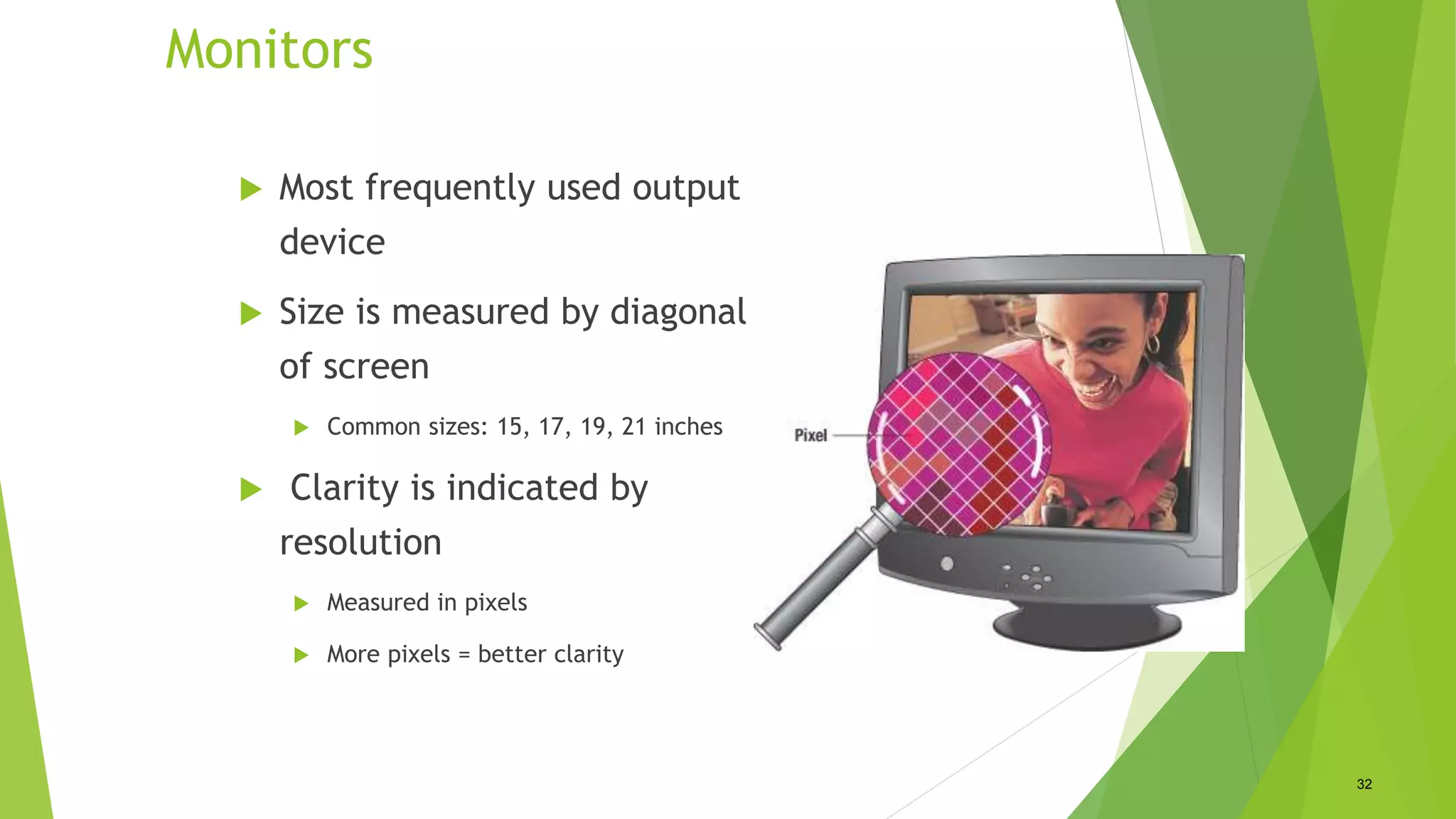
Monitors
 Most frequently used output
device
 Size is measured by diagonal
of screen
 Common sizes: 15, 17, 19, 21 inches
 Clarity is indicated by
resolution
 Measured in pixels
 More pixels = better clarity
32
Monitor Standards
 Resolution capabilities indicated by a monitor’s standard
 Super Video Graphics Array (SVGA)
 Extended Graphics Array (XGA)
 Super Extended Graphics Array (SXGA)
 Ultra Extended Graphics Array (UXGA)
33
Monitor Types
 Cathode-Ray Tubes (CRT)
Most common
 Flat-panel monitors
Passive-matrix
Active-matrix
 eBook readers
 Data projectors
 High-definition television (HDTV)
34
Printers
35
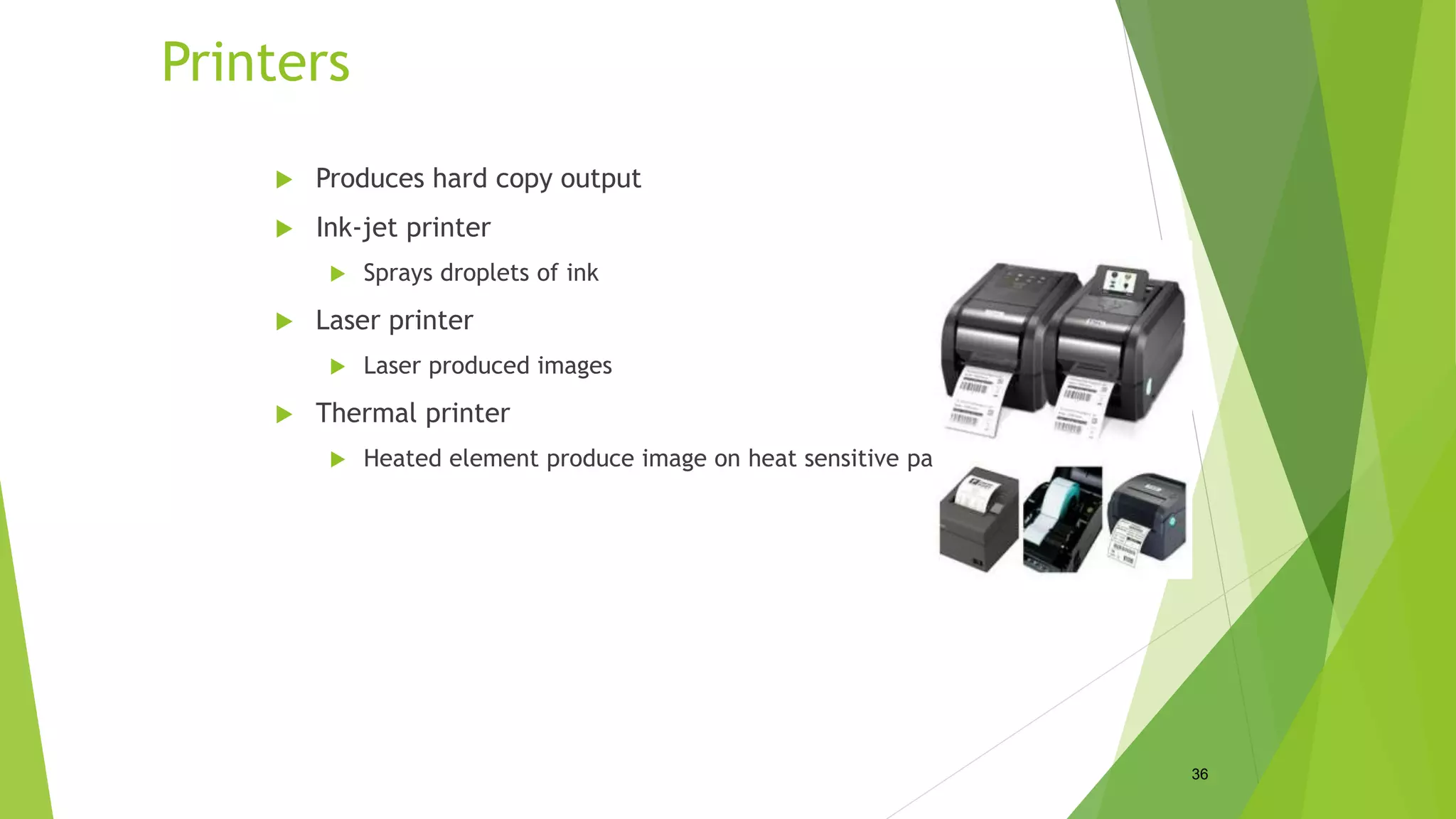
Printers
 Produces hard copy output
 Ink-jet printer
 Sprays droplets of ink
 Laser printer
 Laser produced images
 Thermal printer
 Heated element produce image on heat sensitive paper
36
Other Printers
 Dot-matrix
 Series of pins on print head
 Inexpensive, not high quality
 Chain printer
 Used on networks
 Plotter
 Maps, architectural drawings
 High quality, larger sized output
37
Audio Output Devices
 Translate computer data into understandable sounds
 MP3 files
 Components
 Sound card
 Speaker system or headphones
38
Combination Input/Output Devices
 Devices are combined into one device
 Save room
 Specialized applications
 Fax machine
 Multifunctional device
 Telephony
 Terminals
39
Fax Machine
 Facsimile transmission machine
 Sends and receives images across telephone lines
 Fax/modem board
 Give computer same capability
40
Multifunctional Device
 Combines
 Scanner
 Printer
 Fax machine
 Copying machine
 Cost effective
 Saves space
 Popular in small offices or home
41
Telephony
 Uses Internet rather than traditional communication lines
 Requires
Internet telephone
Internet
Special service provider
42
Terminals
 Devices connected to servers
 Input and output
 Types
 Dumb terminal
 Intelligent terminal
 Network terminal
 Internet terminal
43
44
45

hardware.pptx

  • 1.
  • 2.
  • 3.
  • 4.
    Physical Devices mouse trackballlight pen data tablet joy stick space ball
  • 5.
    Input Modes  Inputdevices contain a trigger which can be used to send a signal to the operating system  Button on mouse  Pressing or releasing a key  When triggered, input devices return information (their measure) to the system  Mouse returns position information  Keyboard returns ASCII code
  • 6.
    Incremental (Relative) Devices Devicessuch as the data tablet return a position directly to the operating system Devices such as the mouse, trackball, and joy stick return incremental inputs (or velocities) to the operating system Must integrate these inputs to obtain an absolute position Rotation of cylinders in mouse Roll of trackball Difficult to obtain absolute position Can get variable sensitivity
  • 7.
    Keyboards  The QWERTYlayout is standard on most PCs  Enhanced keyboard features include number, function, and navigation keys. 7
  • 8.
    Dvorak Keyboards  Putsthe most commonly used keys on “home keys”  Reduces distance of finger stretches 8
  • 9.
  • 10.
    Mouse 10 A pointing devicethat fits comfortably under the palm of your hand The most widely used pointing device on desktop Computers The mouse controls the movement of the pointer, also called the mouse pointer, on the screen
  • 11.
    Mechanical Mouse  Arubber or metal ball is on its underside  When the ball rolls in a certain direction, electronic circuits in the mouse translate the movement of the mouse into signals the computer understands  A mouse pad provides better traction and protects the ballfrom a build up of dust and dirt
  • 12.
    Optical Mouse  Usesdevices that emit & sense light to detect the mouse’s movement  Some use optical sensors; others use laser  More precise than a mechanical mouse & does not require cleaning  Slightly more expensive 12
  • 13.
    Track Ball &Space ball
  • 14.
    Trackball and Spaceball Trackball  It is a pointing device similar to a mouse.  mainly used in notebook or laptop computer, instead of a mouse. This is a ball which is half inserted, and by changing fingers on the ball, the pointer can be moved. Spaceball  similar to trackball, but can move in six directions where trackball can move in two directions only.  movement is recorded by the strain gauge. Strain gauge is applied with pressure. It can be pushed and pulled in various directions.  The ball has a diameter around 7.5 cm.  The ball is mounted in the base using rollers. One-third of the ball is an inside box, the rest is outside.
  • 15.
    Joysticks  pointing deviceused to change cursor position on a monitor screen.  Joystick is a stick having a spherical ball as its both lower and upper ends  lower spherical ball moves in a socket. The joystick can be changed in all four directions.  function of a joystick is similar to that of the mouse.  mainly used in Computer Aided Designing (CAD) and playing computer games.
  • 16.
    Data Glove  inputdevice essentially a glove worn on the hand that contains various electronic sensors that monitor the hand's movements and transform them into a form of input  applications such as virtual reality and robotics.  Some datagloves enable and to apply fine-motion control.  tactile sensing, allowing the user to seemingly feel a virtual object
  • 17.
  • 18.
  • 19.
    Touch Panels  touchpanels allow displayed objects or screen positions to be selected with the touch of a finger.  A typical application of touch panels is for the selection of processing options that are represented with graphical icons.
  • 20.
    Light Pens  lightsensitive pen-like input device  used to select objects directly on the computer screen  .  used for making drawing, graphics and for menu selection.  Figures and drawings can be made by moving the pen on computer screen.
  • 21.
    Digitizers  digitizer isan operator input device  contains a large, smooth board (the appearance is similar to the mechanical drawing board) & an electronic tracking device, which can be changed over the surface to follow existing lines.  The electronic tracking device contains a switch for the user to record the desire x & y coordinate positions. The coordinates can be entered into the computer memory or stored or an off-line storage medium such as magnetic tape.  One type of digitizer is the graphics tablet
  • 22.
  • 23.
    Scanning Devices  Copydata from a source  Types of scanners  Optical scanner  Bar code readers  Character and Mark recognition 23
  • 24.
    Optical Scanners  Copytext or images  Can be displayed, printed, or stored  Types of optical scanners  Flatbed scanner Source placed on glass surface Image scanned from below  Portable scanner Handheld device that slides across source 24
  • 25.
    Bar Code Readers Photoelectric scanner  Read bar codes  Alternating black & white vertical bars  Universal Product Code (UPC)  Seen in grocery stores, retail stores 25
  • 26.
    Character & MarkRecognition  Magnetic-ink character recognition (MICR)  Reads magnetically encoded characters  Optical-character recognition (OCR)  Reflects light off special preprinted characters  Optical-mark recognition (OMR)  Senses presence or absence of marks 26
  • 27.
    Image Capturing Devices Create or capture original images  Digital camera  Image recorded digitally to memory  Digital video cameras  Capture motion  Webcams  Capture images for broadcast on Internet 27
  • 28.
    Audio-Input Devices  Convertsound into digital format  Voice recognition system  Operate computer by voice command  Dictation  Microphone, sound card, software  Discrete  Continuous 28
  • 29.
    Voice Recognition SystemsTypes  Recognize individual words based on sound  Discrete-speech recognition  Cannot distinguish same-sound words  Continuous-speech recognition  Can distinguish same-sound words  Evaluates context of words 29
  • 30.
  • 31.
    Output  Processed datafrom a computer  Text, graphics, photos, audio, video  Common output devices  Monitor  Printer  Plotter  Voice 31
  • 32.
    Monitors  Most frequentlyused output device  Size is measured by diagonal of screen  Common sizes: 15, 17, 19, 21 inches  Clarity is indicated by resolution  Measured in pixels  More pixels = better clarity 32
  • 33.
    Monitor Standards  Resolutioncapabilities indicated by a monitor’s standard  Super Video Graphics Array (SVGA)  Extended Graphics Array (XGA)  Super Extended Graphics Array (SXGA)  Ultra Extended Graphics Array (UXGA) 33
  • 34.
    Monitor Types  Cathode-RayTubes (CRT) Most common  Flat-panel monitors Passive-matrix Active-matrix  eBook readers  Data projectors  High-definition television (HDTV) 34
  • 35.
  • 36.
    Printers  Produces hardcopy output  Ink-jet printer  Sprays droplets of ink  Laser printer  Laser produced images  Thermal printer  Heated element produce image on heat sensitive paper 36
  • 37.
    Other Printers  Dot-matrix Series of pins on print head  Inexpensive, not high quality  Chain printer  Used on networks  Plotter  Maps, architectural drawings  High quality, larger sized output 37
  • 38.
    Audio Output Devices Translate computer data into understandable sounds  MP3 files  Components  Sound card  Speaker system or headphones 38
  • 39.
    Combination Input/Output Devices Devices are combined into one device  Save room  Specialized applications  Fax machine  Multifunctional device  Telephony  Terminals 39
  • 40.
    Fax Machine  Facsimiletransmission machine  Sends and receives images across telephone lines  Fax/modem board  Give computer same capability 40
  • 41.
    Multifunctional Device  Combines Scanner  Printer  Fax machine  Copying machine  Cost effective  Saves space  Popular in small offices or home 41
  • 42.
    Telephony  Uses Internetrather than traditional communication lines  Requires Internet telephone Internet Special service provider 42
  • 43.
    Terminals  Devices connectedto servers  Input and output  Types  Dumb terminal  Intelligent terminal  Network terminal  Internet terminal 43
  • 44.
  • 45.