Mendel’s Laws
Mrs.Harkamaljit Kaur
Asst. Prof. In Botany
Mendel’s Laws
Law of Segregation  During gamete formation, the
alleles for each gene segregate from each other so
that each gamete carries only one allele for each
gene
Law of Dominance  Some alleles are dominant
while others are recessive; an organism with at least
one dominant allele will display the effect of the
dominant allele
Law of Independent Assortment  Genes for
different traits can segregate independently during
the formation of gametes
Mendel’s Experimental, Quantitative Approach
•
–
–
–
–
Advantages of pea plants for genetic study:
There are many varieties with distinct heritable
features, or characters (such as flower color);
character variants (such as purple or white
flowers) are called traits
Mating of plants can be controlled
Each pea plant has sperm-producing organs
(stamens) and egg-producing organs (carpels)
Cross-pollination (fertilization between different
plants) can be achieved by dusting one plant
with pollen from another
Copyright © 2008 Pearson Education Inc., publishing as Pearson Benjamin
Cummings
Fig. 14-2
TECHNIQUE
RESULTS
Parental
generation
(P) Stamens
Carpel
1
2
3
4
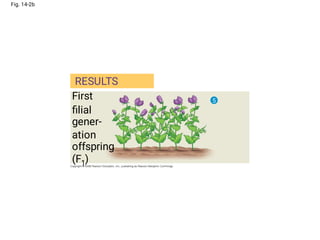
First
filial
gener-
ation
offspring
(F1)
5
Fig. 14-2b
First
filial
gener-
ation
offspring
(F1)
RESULTS
5
•
•
Mendel chose to track only those characters
that varied in an either-or manner
He also used varieties that were true-breeding
(plants that produce offspring of the same
variety when they self-pollinate)
Copyright © 2008 Pearson Education Inc., publishing as Pearson Benjamin
Cummings
•
•
•
•
In a typical experiment, Mendel mated two
contrasting, true-breeding varieties, a process
called hybridization
The true-breeding parents are the Parental
generation
The hybrid offspring of the P generation are
called the F1 generation
When F1 individuals self-pollinate, the F2
generation is produced
Copyright © 2008 Pearson Education Inc., publishing as Pearson Benjamin
Cummings
The Law of Segregation
•
•
•
When Mendel crossed contrasting, true-
breeding white and purple flowered pea plants,
all of the F1 hybrids were purple
When Mendel crossed the F1 hybrids, many of
the F2 plants had purple flowers, but some had
white
Mendel discovered a ratio of about three to one,
purple to white flowers, in the F2 generation
Copyright © 2008 Pearson Education Inc., publishing as Pearson Benjamin
Cummings
Fig. 14-3-1
EXPERIMENT
P Generation
(true-breeding
parents) Purple
flowers
White
flowers

Fig. 14-3-2
EXPERIMENT
P Generation
(true-breeding
parents) Purple
flowers
White
flowers

F1 Generation
(hybrids) All plants had
purple flowers
Fig. 14-3-3
EXPERIMENT
P Generation
(true-breeding
parents) Purple
flowers
White
flowers

F1 Generation
(hybrids) All plants had
purple flowers
F2 Generation
705 purple-flowered
plants
224 white-flowered
plants
•
•
•
•
Mendel reasoned that only the purple flower
factor was affecting flower color in the F1 hybrids
Mendel called the purple flower color a dominant
trait and the white flower color a recessive trait
Mendel observed the same pattern of inheritance
in six other pea plant characters, each
represented by two traits
What Mendel called a “heritable factor” is what
we now call a gene
Copyright © 2008 Pearson Education Inc., publishing as Pearson Benjamin
Cummings
Table 14-1
Mendel’s Model
•
•
•
Mendel developed a hypothesis to explain the 3:
1 inheritance pattern he observed in F2
offspring
Four related concepts make up this model
These concepts can be related to what we now
know about genes and chromosomes
Copyright © 2008 Pearson Education Inc., publishing as Pearson Benjamin
Cummings
•
•
•
•
The first concept is that alternative versions of
genes account for variations in inherited
characters
For example, the gene for flower color in pea
plants exists in two versions, one for purple
flowers and the other for white flowers
These alternative versions of a gene are now
called alleles
Each gene resides at a specific locus on a
specific chromosome
Copyright © 2008 Pearson Education Inc., publishing as Pearson Benjamin
Cummings
Fig. 14-4
Allele for purple flowers
Homologous
pair of
chromosomes
Locus for flower-color gene
Allele for white flowers
•
•
•
•
The second concept is that for each character
an organism inherits two alleles, one from each
parent
Mendel made this deduction without knowing
about the role of chromosomes
The two alleles at a locus on a chromosome
may be identical, as in the true-breeding plants
of Mendel’s P generation
Alternatively, the two alleles at a locus may
differ, as in the F1 hybrids
Copyright © 2008 Pearson Education Inc., publishing as Pearson Benjamin
Cummings
•
•
The third concept or the Law of Dominance is
that if the two alleles at a locus differ, then one
(the dominant allele) determines the organism’s
appearance, and the other (the recessive allele)
has no noticeable effect on appearance
In the flower-color example, the F1 plants had
purple flowers because the allele for that trait is
dominant
Copyright © 2008 Pearson Education Inc., publishing as Pearson Benjamin
Cummings
•
•
•
The fourth concept, now known as the law of
segregation, states that the two alleles for a
heritable character separate (segregate) during
gamete formation and end up in different
gametes
Thus, an egg or a sperm gets only one of the
two alleles that are present in the somatic cells
of an organism
This segregation of alleles corresponds to the
distribution of homologous chromosomes to
different gametes in meiosis
Copyright © 2008 Pearson Education Inc., publishing as Pearson Benjamin
Cummings
•
•
•
Mendel’s segregation model accounts for the 3:
1 ratio he observed in the F2 generation of his
numerous crosses
The possible combinations of sperm and egg
can be shown using a Punnett square, a
diagram for predicting the results of a genetic
cross between individuals of known genetic
makeup
A capital letter represents a dominant allele,
and a lowercase letter represents a recessive
allele
Copyright © 2008 Pearson Education Inc., publishing as Pearson Benjamin
Cummings
Fig. 14-5-1
P Generation
Appearance:
Genetic makeup:
Gametes:
Purple flowers White flowers
PP
P
pp
p
Fig. 14-5-2
P Generation
Appearance:
Genetic makeup:
Gametes:
Purple flowers White flowers
PP
P
pp
p
F1 Generation
Gametes:
Genetic makeup:
Appearance: Purple flowers
Pp
P p1/2
1/2
Fig. 14-5-3
P Generation
Appearance:
Genetic makeup:
Gametes:
Purple flowers White flowers
PP
P
pp
p
F1 Generation
Gametes:
Genetic makeup:
Appearance: Purple flowers
Pp
P p1/2
1/2
F2 Generation
Sperm
Eggs
P
P
PP Pp
p
p
Pp pp
3 1
Useful Genetic Vocabulary
•
•
•
An organism with two identical alleles for a
character is said to be homozygous for the
gene controlling that character
An organism that has two different alleles for a
gene is said to be heterozygous for the gene
controlling that character
Unlike homozygotes, heterozygotes are not
true-breeding
Copyright © 2008 Pearson Education Inc., publishing as Pearson Benjamin
Cummings
•
•
•
Because of the different effects of dominant
and recessive alleles, an organism’s traits do
not always reveal its genetic composition
Therefore, we distinguish between an
organism’s phenotype, or physical appearance,
and its genotype, or genetic makeup
In the example of flower color in pea plants,PP
andPp plants have the same phenotype
(purple) but different genotypes
Copyright © 2008 Pearson Education Inc., publishing as Pearson Benjamin
Cummings
Fig. 14-6
Phenotype
Purple
Purple3
Purple
Genotype
1 White
Ratio 3:1
(homozygous)
(homozygous)
(heterozygous)
(heterozygous)
PP
Pp
Pp
pp
Ratio 1:2:1
1
1
2
The Testcross
•
•
•
•
How can we tell the genotype of an individual
with the dominant phenotype?
Such an individual must have one dominant allele,
but the individual could be either homozygous
dominant or heterozygous
The answer is to carry out a testcross: breeding
the mystery individual with a homozygous
recessive individual
If any offspring display the recessive phenotype,
the mystery parent must be heterozygous
Copyright © 2008 Pearson Education Inc., publishing as Pearson Benjamin
Cummings
Fig. 14-7
TECHNIQUE
RESULTS
Dominant phenotype,
unknown genotype:
PP orPp ?
Predictions
Recessive phenotype,
known genotype:
pp

IfPP IfPp
or
Sperm Sperm
p p p p
P
P
P
p
Eggs Eggs
Pp
Pp Pp
Pp
Pp Pp
pp pp
or
All offspring purple 1/2 offspring purple and
1/2 offspring white
Fig. 14-7a
Dominant phenotype,
unknown genotype:
PP orPp ?
Predictions
Recessive phenotype,
known genotype:
pp

IfPP IfPp
or
Sperm Sperm
p p p p
P
P
P
p
Eggs Eggs
Pp
Pp Pp
Pp
Pp Pp
pp pp
TECHNIQUE
Fig. 14-7b
RESULTS
All offspring purple
or
1/2 offspring purple and
1/2 offspring white
The Law of Independent Assortment
•
•
•
Mendel derived the law of segregation by
following a single character
The F1 offspring produced in this cross were
monohybrids, individuals that are heterozygous
for one character
A cross between such heterozygotes is called a
monohybrid cross
Copyright © 2008 Pearson Education Inc., publishing as Pearson Benjamin
Cummings
•
•
•
Mendel identified his second law of inheritance
by following two characters at the same time
Crossing two true-breeding parents differing in
two characters produces dihybrids in the F1
generation, heterozygous for both characters
A dihybrid cross, a cross between F1 dihybrids,
can determine whether two characters are
transmitted to offspring as a package or
independently
Copyright © 2008 Pearson Education Inc., publishing as Pearson Benjamin
Cummings
Fig. 14-8
EXPERIMENT
RESULTS
P Generation
F1 Generation
Predictions
Gametes
Hypothesis of
dependent
assortment
YYRR yyrr
YR yr
YyRr

Hypothesis of
independent
assortment
or
Predicted
offspring of
F2 generation
Sperm
Sperm
YR
YR
yr
yr
Yr
YR
yR
Yr
yR
yr
YR
YYRR
YYRR YyRr
YyRr
YyRr
YyRr
YyRr
YyRr
YYRr
YYRr
YyRR
YyRR
YYrr Yyrr
Yyrr
yyRR yyRr
yyRr yyrr
yyrr
Phenotypic ratio 3:1
Eggs
Eggs
Phenotypic ratio 9:3:3:1
1/2
1/2
1/2
1/2
1/4
yr
1/4
1/4
1/4
1/4
1/4
1/4
1/4
1/4
3/4
9/16
3/16
3/16
1/16
Phenotypic ratio approximately 9:3:3:1315 108 101 32
Fig. 14-8a
EXPERIMENT
P Generation
F1 Generation
Predictions
Gametes
Hypothesis of
dependent
assortment
YYRR yyrr
YR yr
YyRr

Hypothesis of
independent
assortment
orPredicted
offspring of
F2 generation
Sperm
Sperm
YR
YR
yr
yr
Yr
YR
yR
Yr
yR
yr
YR
YYRR
YYRR YyRr
YyRr
YyRr
YyRr
YyRr
YyRr
YYRr
YYRr
YyRR
YyRR
YYrr Yyrr
Yyrr
yyRR yyRr
yyRr yyrr
yyrr
Phenotypic ratio 3:1
Eggs
Eggs
Phenotypic ratio 9:3:3:1
1/2
1/2
1/2
1/2
1/4
yr
1/4
1/4
1/4
1/4
1/4
1/4
1/4
1/4
3/4
9/16
3/16
3/16
1/16
Fig. 14-8b
RESULTS
Phenotypic ratio approximately 9:3:3:1315 108 101 32
•
•
•
•
Using a dihybrid cross, Mendel developed the
law of independent assortment
The law of independent assortment states that
each pair of alleles segregates independently
of each other pair of alleles during gamete
formation
Strictly speaking, this law applies only to genes
on different, nonhomologous chromosomes
Genes located near each other on the same
chromosome tend to be inherited together
Copyright © 2008 Pearson Education Inc., publishing as Pearson Benjamin
Cummings

Harakamaljit

  • 1.
  • 2.
    Mendel’s Laws Law ofSegregation  During gamete formation, the alleles for each gene segregate from each other so that each gamete carries only one allele for each gene Law of Dominance  Some alleles are dominant while others are recessive; an organism with at least one dominant allele will display the effect of the dominant allele Law of Independent Assortment  Genes for different traits can segregate independently during the formation of gametes
  • 3.
    Mendel’s Experimental, QuantitativeApproach • – – – – Advantages of pea plants for genetic study: There are many varieties with distinct heritable features, or characters (such as flower color); character variants (such as purple or white flowers) are called traits Mating of plants can be controlled Each pea plant has sperm-producing organs (stamens) and egg-producing organs (carpels) Cross-pollination (fertilization between different plants) can be achieved by dusting one plant with pollen from another Copyright © 2008 Pearson Education Inc., publishing as Pearson Benjamin Cummings
  • 4.
  • 5.
  • 6.
    • • Mendel chose totrack only those characters that varied in an either-or manner He also used varieties that were true-breeding (plants that produce offspring of the same variety when they self-pollinate) Copyright © 2008 Pearson Education Inc., publishing as Pearson Benjamin Cummings
  • 7.
    • • • • In a typicalexperiment, Mendel mated two contrasting, true-breeding varieties, a process called hybridization The true-breeding parents are the Parental generation The hybrid offspring of the P generation are called the F1 generation When F1 individuals self-pollinate, the F2 generation is produced Copyright © 2008 Pearson Education Inc., publishing as Pearson Benjamin Cummings
  • 8.
    The Law ofSegregation • • • When Mendel crossed contrasting, true- breeding white and purple flowered pea plants, all of the F1 hybrids were purple When Mendel crossed the F1 hybrids, many of the F2 plants had purple flowers, but some had white Mendel discovered a ratio of about three to one, purple to white flowers, in the F2 generation Copyright © 2008 Pearson Education Inc., publishing as Pearson Benjamin Cummings
  • 9.
  • 10.
    Fig. 14-3-2 EXPERIMENT P Generation (true-breeding parents)Purple flowers White flowers  F1 Generation (hybrids) All plants had purple flowers
  • 11.
    Fig. 14-3-3 EXPERIMENT P Generation (true-breeding parents)Purple flowers White flowers  F1 Generation (hybrids) All plants had purple flowers F2 Generation 705 purple-flowered plants 224 white-flowered plants
  • 12.
    • • • • Mendel reasoned thatonly the purple flower factor was affecting flower color in the F1 hybrids Mendel called the purple flower color a dominant trait and the white flower color a recessive trait Mendel observed the same pattern of inheritance in six other pea plant characters, each represented by two traits What Mendel called a “heritable factor” is what we now call a gene Copyright © 2008 Pearson Education Inc., publishing as Pearson Benjamin Cummings
  • 13.
  • 14.
    Mendel’s Model • • • Mendel developeda hypothesis to explain the 3: 1 inheritance pattern he observed in F2 offspring Four related concepts make up this model These concepts can be related to what we now know about genes and chromosomes Copyright © 2008 Pearson Education Inc., publishing as Pearson Benjamin Cummings
  • 15.
    • • • • The first conceptis that alternative versions of genes account for variations in inherited characters For example, the gene for flower color in pea plants exists in two versions, one for purple flowers and the other for white flowers These alternative versions of a gene are now called alleles Each gene resides at a specific locus on a specific chromosome Copyright © 2008 Pearson Education Inc., publishing as Pearson Benjamin Cummings
  • 16.
    Fig. 14-4 Allele forpurple flowers Homologous pair of chromosomes Locus for flower-color gene Allele for white flowers
  • 17.
    • • • • The second conceptis that for each character an organism inherits two alleles, one from each parent Mendel made this deduction without knowing about the role of chromosomes The two alleles at a locus on a chromosome may be identical, as in the true-breeding plants of Mendel’s P generation Alternatively, the two alleles at a locus may differ, as in the F1 hybrids Copyright © 2008 Pearson Education Inc., publishing as Pearson Benjamin Cummings
  • 18.
    • • The third conceptor the Law of Dominance is that if the two alleles at a locus differ, then one (the dominant allele) determines the organism’s appearance, and the other (the recessive allele) has no noticeable effect on appearance In the flower-color example, the F1 plants had purple flowers because the allele for that trait is dominant Copyright © 2008 Pearson Education Inc., publishing as Pearson Benjamin Cummings
  • 19.
    • • • The fourth concept,now known as the law of segregation, states that the two alleles for a heritable character separate (segregate) during gamete formation and end up in different gametes Thus, an egg or a sperm gets only one of the two alleles that are present in the somatic cells of an organism This segregation of alleles corresponds to the distribution of homologous chromosomes to different gametes in meiosis Copyright © 2008 Pearson Education Inc., publishing as Pearson Benjamin Cummings
  • 20.
    • • • Mendel’s segregation modelaccounts for the 3: 1 ratio he observed in the F2 generation of his numerous crosses The possible combinations of sperm and egg can be shown using a Punnett square, a diagram for predicting the results of a genetic cross between individuals of known genetic makeup A capital letter represents a dominant allele, and a lowercase letter represents a recessive allele Copyright © 2008 Pearson Education Inc., publishing as Pearson Benjamin Cummings
  • 21.
    Fig. 14-5-1 P Generation Appearance: Geneticmakeup: Gametes: Purple flowers White flowers PP P pp p
  • 22.
    Fig. 14-5-2 P Generation Appearance: Geneticmakeup: Gametes: Purple flowers White flowers PP P pp p F1 Generation Gametes: Genetic makeup: Appearance: Purple flowers Pp P p1/2 1/2
  • 23.
    Fig. 14-5-3 P Generation Appearance: Geneticmakeup: Gametes: Purple flowers White flowers PP P pp p F1 Generation Gametes: Genetic makeup: Appearance: Purple flowers Pp P p1/2 1/2 F2 Generation Sperm Eggs P P PP Pp p p Pp pp 3 1
  • 24.
    Useful Genetic Vocabulary • • • Anorganism with two identical alleles for a character is said to be homozygous for the gene controlling that character An organism that has two different alleles for a gene is said to be heterozygous for the gene controlling that character Unlike homozygotes, heterozygotes are not true-breeding Copyright © 2008 Pearson Education Inc., publishing as Pearson Benjamin Cummings
  • 25.
    • • • Because of thedifferent effects of dominant and recessive alleles, an organism’s traits do not always reveal its genetic composition Therefore, we distinguish between an organism’s phenotype, or physical appearance, and its genotype, or genetic makeup In the example of flower color in pea plants,PP andPp plants have the same phenotype (purple) but different genotypes Copyright © 2008 Pearson Education Inc., publishing as Pearson Benjamin Cummings
  • 26.
    Fig. 14-6 Phenotype Purple Purple3 Purple Genotype 1 White Ratio3:1 (homozygous) (homozygous) (heterozygous) (heterozygous) PP Pp Pp pp Ratio 1:2:1 1 1 2
  • 27.
    The Testcross • • • • How canwe tell the genotype of an individual with the dominant phenotype? Such an individual must have one dominant allele, but the individual could be either homozygous dominant or heterozygous The answer is to carry out a testcross: breeding the mystery individual with a homozygous recessive individual If any offspring display the recessive phenotype, the mystery parent must be heterozygous Copyright © 2008 Pearson Education Inc., publishing as Pearson Benjamin Cummings
  • 28.
    Fig. 14-7 TECHNIQUE RESULTS Dominant phenotype, unknowngenotype: PP orPp ? Predictions Recessive phenotype, known genotype: pp  IfPP IfPp or Sperm Sperm p p p p P P P p Eggs Eggs Pp Pp Pp Pp Pp Pp pp pp or All offspring purple 1/2 offspring purple and 1/2 offspring white
  • 29.
    Fig. 14-7a Dominant phenotype, unknowngenotype: PP orPp ? Predictions Recessive phenotype, known genotype: pp  IfPP IfPp or Sperm Sperm p p p p P P P p Eggs Eggs Pp Pp Pp Pp Pp Pp pp pp TECHNIQUE
  • 30.
    Fig. 14-7b RESULTS All offspringpurple or 1/2 offspring purple and 1/2 offspring white
  • 31.
    The Law ofIndependent Assortment • • • Mendel derived the law of segregation by following a single character The F1 offspring produced in this cross were monohybrids, individuals that are heterozygous for one character A cross between such heterozygotes is called a monohybrid cross Copyright © 2008 Pearson Education Inc., publishing as Pearson Benjamin Cummings
  • 32.
    • • • Mendel identified hissecond law of inheritance by following two characters at the same time Crossing two true-breeding parents differing in two characters produces dihybrids in the F1 generation, heterozygous for both characters A dihybrid cross, a cross between F1 dihybrids, can determine whether two characters are transmitted to offspring as a package or independently Copyright © 2008 Pearson Education Inc., publishing as Pearson Benjamin Cummings
  • 33.
    Fig. 14-8 EXPERIMENT RESULTS P Generation F1Generation Predictions Gametes Hypothesis of dependent assortment YYRR yyrr YR yr YyRr  Hypothesis of independent assortment or Predicted offspring of F2 generation Sperm Sperm YR YR yr yr Yr YR yR Yr yR yr YR YYRR YYRR YyRr YyRr YyRr YyRr YyRr YyRr YYRr YYRr YyRR YyRR YYrr Yyrr Yyrr yyRR yyRr yyRr yyrr yyrr Phenotypic ratio 3:1 Eggs Eggs Phenotypic ratio 9:3:3:1 1/2 1/2 1/2 1/2 1/4 yr 1/4 1/4 1/4 1/4 1/4 1/4 1/4 1/4 3/4 9/16 3/16 3/16 1/16 Phenotypic ratio approximately 9:3:3:1315 108 101 32
  • 34.
    Fig. 14-8a EXPERIMENT P Generation F1Generation Predictions Gametes Hypothesis of dependent assortment YYRR yyrr YR yr YyRr  Hypothesis of independent assortment orPredicted offspring of F2 generation Sperm Sperm YR YR yr yr Yr YR yR Yr yR yr YR YYRR YYRR YyRr YyRr YyRr YyRr YyRr YyRr YYRr YYRr YyRR YyRR YYrr Yyrr Yyrr yyRR yyRr yyRr yyrr yyrr Phenotypic ratio 3:1 Eggs Eggs Phenotypic ratio 9:3:3:1 1/2 1/2 1/2 1/2 1/4 yr 1/4 1/4 1/4 1/4 1/4 1/4 1/4 1/4 3/4 9/16 3/16 3/16 1/16
  • 35.
    Fig. 14-8b RESULTS Phenotypic ratioapproximately 9:3:3:1315 108 101 32
  • 36.
    • • • • Using a dihybridcross, Mendel developed the law of independent assortment The law of independent assortment states that each pair of alleles segregates independently of each other pair of alleles during gamete formation Strictly speaking, this law applies only to genes on different, nonhomologous chromosomes Genes located near each other on the same chromosome tend to be inherited together Copyright © 2008 Pearson Education Inc., publishing as Pearson Benjamin Cummings