FACTFILE: VEGETARIAN
(Hannah andChloe)
Definition:
‘Vegetarianism is the practice of abstaining from the consumption of meat – red
meat, poultry, seafood and the flesh of any other animal; it may also include
abstention from by-products of animal slaughter.’
http://en.wikipedia.org/wiki/Vegetarianism
Being a vegetarian is where a person chooses to not eat any kind of meat, this
being poultry, red meat, pork, fish, sea-food and any other living creature.
Vegetarians also do not eat foods that have by-products of animals included in
the ingredients, such as jelly, gelatin sweets, marshmellows, some types of
cheese etc.
Demographics:
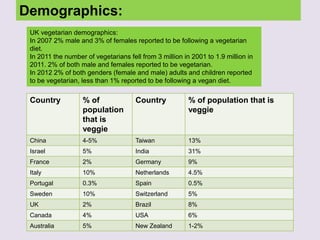
Country % of
population
that is
veggie
Country % of population that is
veggie
China 4-5% Taiwan 13%
Israel 5% India 31%
France 2% Germany 9%
Italy 10% Netherlands 4.5%
Portugal 0.3% Spain 0.5%
Sweden 10% Switzerland 5%
UK 2% Brazil 8%
Canada 4% USA 6%
Australia 5% New Zealand 1-2%
UK vegetarian demographics:
In 2007 2% male and 3% of females reported to be following a vegetarian
diet.
In 2011 the number of vegetarians fell from 3 million in 2001 to 1.9 million in
2011. 2% of both male and females reported to be vegetarian.
In 2012 2% of both genders (female and male) adults and children reported
to be vegetarian, less than 1% reported to be following a vegan diet.
Reasons:
Reasons to become a vegetarian varies from person to person, and each vegetarian
will have their own reasons for their choice, these reasons can be over-lapping, and
may change over time. Reasons can include, personal health, environmental reasons,
compassion for animals, belief in non-violence, religion, food preferences and spiritual
reasons.
One reason that I am going to expand on is personal health, as there is a lot of reliable,
true research that proves that a vegetarian diet has many health benefits and is better
than a meat inclusive diet. According to research vegetarians are at lower risk for
developing, heart disease, colorectal, ovarian and breast cancers, diabetes, obesity,
high blood pressure. These health benefits arise because a vegetarians diet is usually
lower in saturated fats and high in fibre, but a vegetarian diet can be high in fat if fried
foods, snacks and whole dairy products are included frequently.
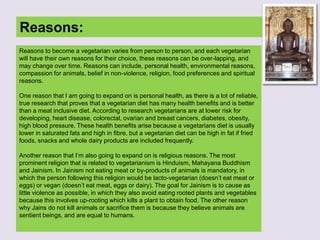
Another reason that I‟m also going to expand on is religious reasons. The most
prominent religion that is related to vegetarianism is Hinduism, Mahayana Buddhism
and Jainism. In Jainism not eating meat or by-products of animals is mandatory, in
which the person following this religion would be lacto-vegetarian (doesn‟t eat meat or
eggs) or vegan (doesn‟t eat meat, eggs or dairy). The goal for Jainism is to cause as
little violence as possible, in which they also avoid eating rooted plants and vegetables
because this involves up-rooting which kills a plant to obtain food. The other reason
why Jains do not kill animals or sacrifice them is because they believe animals are
sentient beings, and are equal to humans.
Companies:
There are many companies that now target or accompany a vegetarian life-style, whether that is being food, hair products, make-
up products or shoes and clothing. There are a few companies that target a vegetarian audience. For example Quorn, Linda
McCartney Foods, Vegetarian Society, VBites and Fry‟s. These companies provide people with vegetarian foods, including meat
alternatives and recipe ideas. They mainly target vegetarians, rather than just “meat avoiders” as they only provide vegetarian
foods, and some of them also discuss issues such as the environment that vegetarians and vegans may be particularly interested
in.
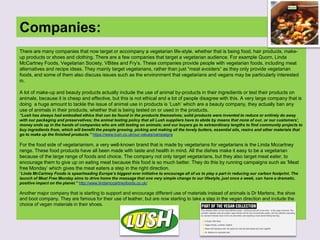
A lot of make-up and beauty products actually include the use of animal by-products in their ingredients or test their products on
animals, because it is cheap and effective, but this is not ethical and a lot of people disagree with this. A very large company that is
doing a huge amount to tackle the issue of animal use in products is „Lush‟ which are a beauty company, they actually ban any
use of animals in their products, whether that is being tested on or used in the products.
“Lush has always had embodied ethics that can be found in the products themselves; solid products were invented to reduce or entirely do away
with our packaging and preservatives; the animal testing policy that all Lush suppliers have to abide by means that none of our, or our customers',
money ends up in the hands of companies who are still testing on animals; and our buyers go to extraordinary lengths to find community projects to
buy ingredients from, which will benefit the people growing, picking and making all the lovely butters, essential oils, resins and other materials that
go to make up the finished products.” https://www.lush.co.uk/our-values/campaigns
For the food side of vegetarianism, a very well-known brand that is made by vegetarians for vegetarians is the Linda Mccartney
range. These food products have all been made with taste and health in mind. All the dishes make it easy to be a vegetarian
because of the large range of foods and choice. The company not only target vegetarians, but they also target meat eater, to
encourage them to give up on eating meat because this food is so much better. They do this by running campaigns such as „Meat
free Monday‟ which gives the meat eaters a step in the right direction.
“Linda McCartney Foods is spearheading Europe’s biggest ever initiative to encourage all of us to play a part in reducing our carbon footprint. The
launch of Meat Free Monday aims to drive home the message that one very simple change to our lifestyle, just once a week, can have a dramatic,
positive impact on the planet.” http://www.lindamccartneyfoods.co.uk/
Another major company that is starting to support and encourage different use of materials instead of animals is Dr Martens, the shoe
and boot company. They are famous for their use of leather, but are now starting to take a step in the vegan direction and include the
choice of vegan materials in their shoes.
Non vegetarian products:
Some products that may not be so obviously non vegetarian may contain meat or animal products.
Some food contains gelatine, which is the bone marrow from a pig or cow. It is used to give a jelly
texture to foods, so is used for jelly, jelly sweets and some other deserts with a similar texture.
Some E numbers are not suitable for vegetarians as they are made from animals. E120, or Cochineal
is made from crushed up small insects. This E number is used to intensify the red colour in some food,
like some types of sweets, toothpaste. E542 is made from animal bones.
In some cases wine and beer may not be vegetarian, e.g. Guinness, Chardonnay, Seyval Blanc,
Corazon. When producing wine they sometimes use gelatine, isinglass (fish bladders) and chitosan
(crustacean shells).
Some cheeses may not be vegetarian either. Cheeses such as Parmesan use something called rennet
(claves stomach). So this cheese and products containing this cheese such as Pesto are not suitable
for vegetarians.
Other non-vegetarian products (vegan) also include health and beauty products. Companies that make
shampoo and conditioner for hair, e.g. L‟Oreal and Herbal Essences include very violent and torturous
animal testing techniques for their products, with many animals suffering immensely and dying in the
testing process. Even though L‟Oreal have taken action to abolish this cruelty, in China there is still
inhumane animal testing going on and this can still be sold all over the world so there is no guarantee
that your shampoo wasn‟t tested on an animal.
Bibliography:
http://en.wikipedia.org/wiki/Vegetarianism_by_country
http://www.brown.edu/Student_Services/Health_Services/Health_Education/nu
trition_&_eating_concerns/being_a_vegetarian.php
http://en.wikipedia.org/wiki/Vegetarianism_and_religion
https://www.lush.co.uk/our-values/campaigns
http://www.lindamccartneyfoods.co.uk/
http://www.drmartens.com/uk/Mens/Mens-Shoes/Dr-Martens-Vegan-1461-
Shoe/p/14046001
https://www.vegsoc.org/cheese
http://www.dailymail.co.uk/femail/article-2115572/LOreal-donates-1-
2million-help-abolish-animal-testing-welfare-groups-say-company-
stop-practice-NOW.html
http://www.barnivore.com/
http://gentleworld.org/is-your-alcohol-vegan/
http://en.wikipedia.org/wiki/Vegetarianism
http://www.veggieglobal.com/nutriti
on/non-vegetarian-food-
additives.htm

fact file veggie

  • 1.
  • 2.
    Definition: ‘Vegetarianism is thepractice of abstaining from the consumption of meat – red meat, poultry, seafood and the flesh of any other animal; it may also include abstention from by-products of animal slaughter.’ http://en.wikipedia.org/wiki/Vegetarianism Being a vegetarian is where a person chooses to not eat any kind of meat, this being poultry, red meat, pork, fish, sea-food and any other living creature. Vegetarians also do not eat foods that have by-products of animals included in the ingredients, such as jelly, gelatin sweets, marshmellows, some types of cheese etc.
  • 3.
    Demographics: Country % of population thatis veggie Country % of population that is veggie China 4-5% Taiwan 13% Israel 5% India 31% France 2% Germany 9% Italy 10% Netherlands 4.5% Portugal 0.3% Spain 0.5% Sweden 10% Switzerland 5% UK 2% Brazil 8% Canada 4% USA 6% Australia 5% New Zealand 1-2% UK vegetarian demographics: In 2007 2% male and 3% of females reported to be following a vegetarian diet. In 2011 the number of vegetarians fell from 3 million in 2001 to 1.9 million in 2011. 2% of both male and females reported to be vegetarian. In 2012 2% of both genders (female and male) adults and children reported to be vegetarian, less than 1% reported to be following a vegan diet.
  • 4.
    Reasons: Reasons to becomea vegetarian varies from person to person, and each vegetarian will have their own reasons for their choice, these reasons can be over-lapping, and may change over time. Reasons can include, personal health, environmental reasons, compassion for animals, belief in non-violence, religion, food preferences and spiritual reasons. One reason that I am going to expand on is personal health, as there is a lot of reliable, true research that proves that a vegetarian diet has many health benefits and is better than a meat inclusive diet. According to research vegetarians are at lower risk for developing, heart disease, colorectal, ovarian and breast cancers, diabetes, obesity, high blood pressure. These health benefits arise because a vegetarians diet is usually lower in saturated fats and high in fibre, but a vegetarian diet can be high in fat if fried foods, snacks and whole dairy products are included frequently. Another reason that I‟m also going to expand on is religious reasons. The most prominent religion that is related to vegetarianism is Hinduism, Mahayana Buddhism and Jainism. In Jainism not eating meat or by-products of animals is mandatory, in which the person following this religion would be lacto-vegetarian (doesn‟t eat meat or eggs) or vegan (doesn‟t eat meat, eggs or dairy). The goal for Jainism is to cause as little violence as possible, in which they also avoid eating rooted plants and vegetables because this involves up-rooting which kills a plant to obtain food. The other reason why Jains do not kill animals or sacrifice them is because they believe animals are sentient beings, and are equal to humans.
  • 5.
    Companies: There are manycompanies that now target or accompany a vegetarian life-style, whether that is being food, hair products, make- up products or shoes and clothing. There are a few companies that target a vegetarian audience. For example Quorn, Linda McCartney Foods, Vegetarian Society, VBites and Fry‟s. These companies provide people with vegetarian foods, including meat alternatives and recipe ideas. They mainly target vegetarians, rather than just “meat avoiders” as they only provide vegetarian foods, and some of them also discuss issues such as the environment that vegetarians and vegans may be particularly interested in. A lot of make-up and beauty products actually include the use of animal by-products in their ingredients or test their products on animals, because it is cheap and effective, but this is not ethical and a lot of people disagree with this. A very large company that is doing a huge amount to tackle the issue of animal use in products is „Lush‟ which are a beauty company, they actually ban any use of animals in their products, whether that is being tested on or used in the products. “Lush has always had embodied ethics that can be found in the products themselves; solid products were invented to reduce or entirely do away with our packaging and preservatives; the animal testing policy that all Lush suppliers have to abide by means that none of our, or our customers', money ends up in the hands of companies who are still testing on animals; and our buyers go to extraordinary lengths to find community projects to buy ingredients from, which will benefit the people growing, picking and making all the lovely butters, essential oils, resins and other materials that go to make up the finished products.” https://www.lush.co.uk/our-values/campaigns For the food side of vegetarianism, a very well-known brand that is made by vegetarians for vegetarians is the Linda Mccartney range. These food products have all been made with taste and health in mind. All the dishes make it easy to be a vegetarian because of the large range of foods and choice. The company not only target vegetarians, but they also target meat eater, to encourage them to give up on eating meat because this food is so much better. They do this by running campaigns such as „Meat free Monday‟ which gives the meat eaters a step in the right direction. “Linda McCartney Foods is spearheading Europe’s biggest ever initiative to encourage all of us to play a part in reducing our carbon footprint. The launch of Meat Free Monday aims to drive home the message that one very simple change to our lifestyle, just once a week, can have a dramatic, positive impact on the planet.” http://www.lindamccartneyfoods.co.uk/ Another major company that is starting to support and encourage different use of materials instead of animals is Dr Martens, the shoe and boot company. They are famous for their use of leather, but are now starting to take a step in the vegan direction and include the choice of vegan materials in their shoes.
  • 6.
    Non vegetarian products: Someproducts that may not be so obviously non vegetarian may contain meat or animal products. Some food contains gelatine, which is the bone marrow from a pig or cow. It is used to give a jelly texture to foods, so is used for jelly, jelly sweets and some other deserts with a similar texture. Some E numbers are not suitable for vegetarians as they are made from animals. E120, or Cochineal is made from crushed up small insects. This E number is used to intensify the red colour in some food, like some types of sweets, toothpaste. E542 is made from animal bones. In some cases wine and beer may not be vegetarian, e.g. Guinness, Chardonnay, Seyval Blanc, Corazon. When producing wine they sometimes use gelatine, isinglass (fish bladders) and chitosan (crustacean shells). Some cheeses may not be vegetarian either. Cheeses such as Parmesan use something called rennet (claves stomach). So this cheese and products containing this cheese such as Pesto are not suitable for vegetarians. Other non-vegetarian products (vegan) also include health and beauty products. Companies that make shampoo and conditioner for hair, e.g. L‟Oreal and Herbal Essences include very violent and torturous animal testing techniques for their products, with many animals suffering immensely and dying in the testing process. Even though L‟Oreal have taken action to abolish this cruelty, in China there is still inhumane animal testing going on and this can still be sold all over the world so there is no guarantee that your shampoo wasn‟t tested on an animal.
  • 7.