Hands on:
The sexy side of JavaScript
(feat. node.js)
@pirafrankfpira.com Francesco Pira
Google #io16 Extended Catania
fpira.com
Who I am ?
• Web developer
• Co-founder @ fileshute.com
• VP @ Youth Hub Catania
• I like coding, learning new stuff,
meet new people (yay!)
Can JavaScript be sexy?
fpira.com
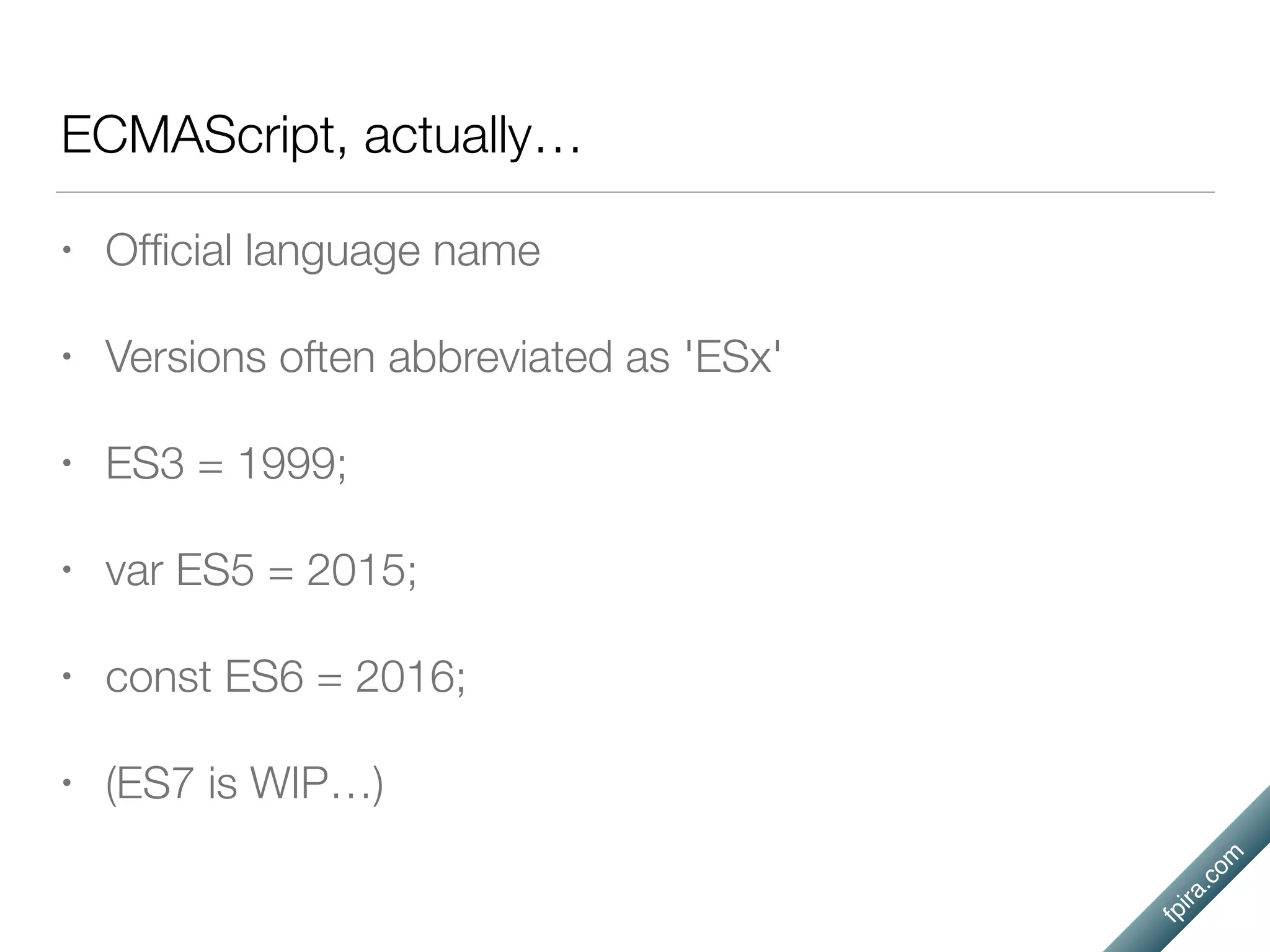
ECMAScript, actually…
• Official language name
• Versions often abbreviated as 'ESx'
• ES3 = 1999;
• var ES5 = 2015;
• const ES6 = 2016;
• (ES7 is WIP…)
JavaScript
for back-end developers
!==
fpira.com
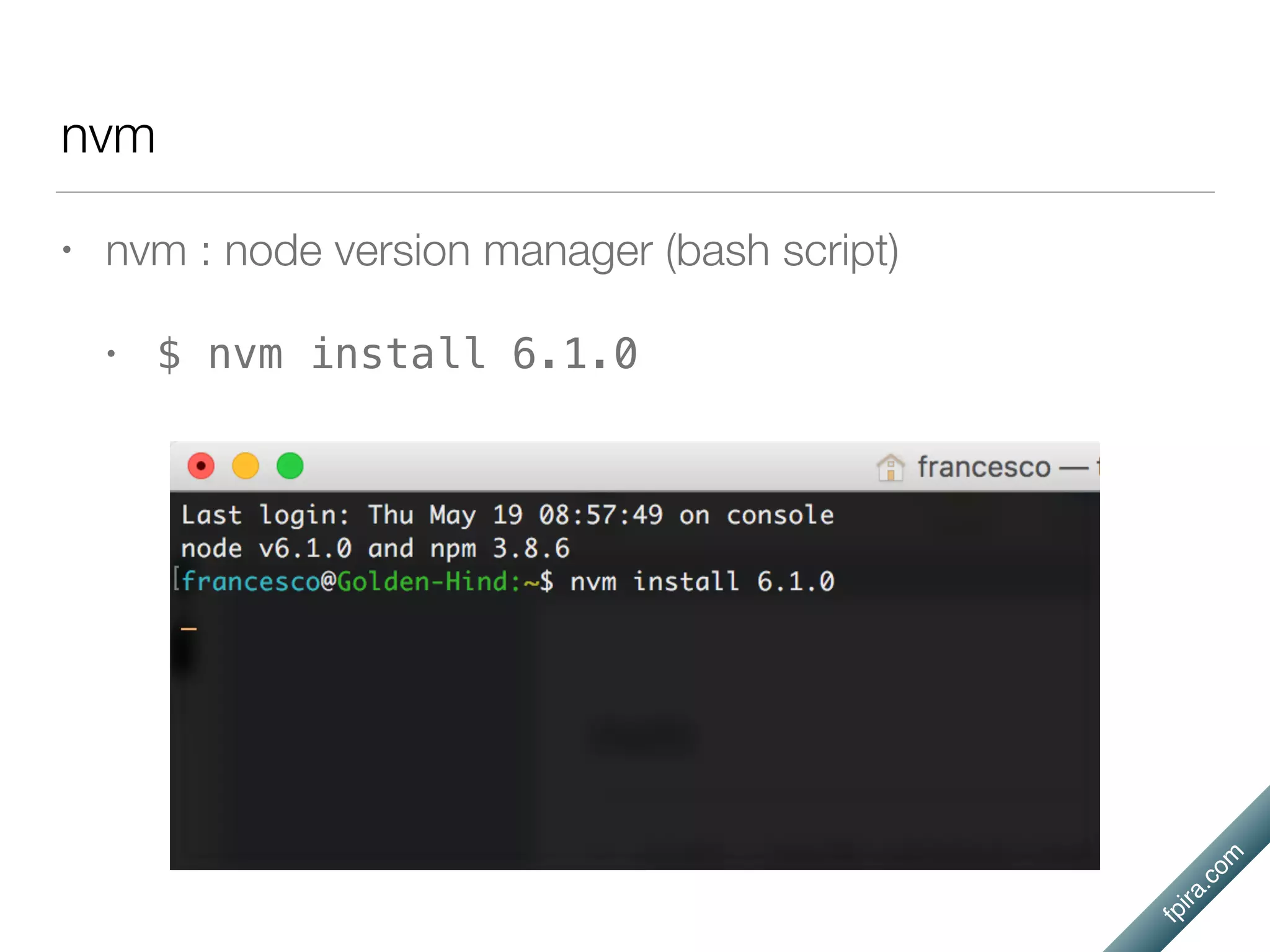
nvm
• nvm : node version manager (bash script)
• $ nvm install 6.1.0
fpira.com
Types
• Number (dp 64 bit)
• String
• Boolean
• Object
• function, Array,
• Date, RegExp
• Symbol (ES6+)
• NaN
• Special objects
• undefined
• null
fpira.com
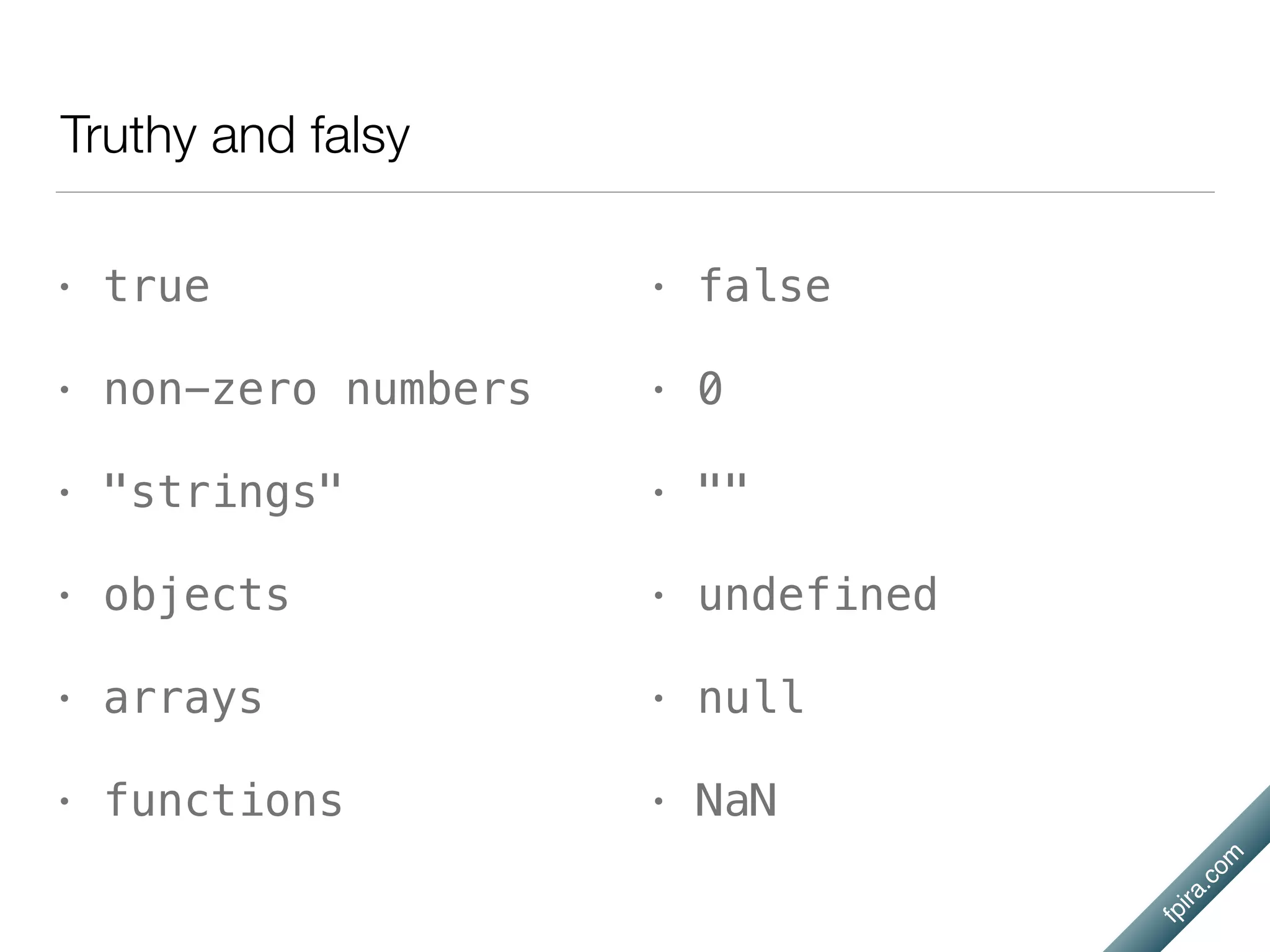
Truthy and falsy
• true
• non-zero numbers
• "strings"
• objects
• arrays
• functions
• false
• 0
• ""
• undefined
• null
• NaN
fpira.com
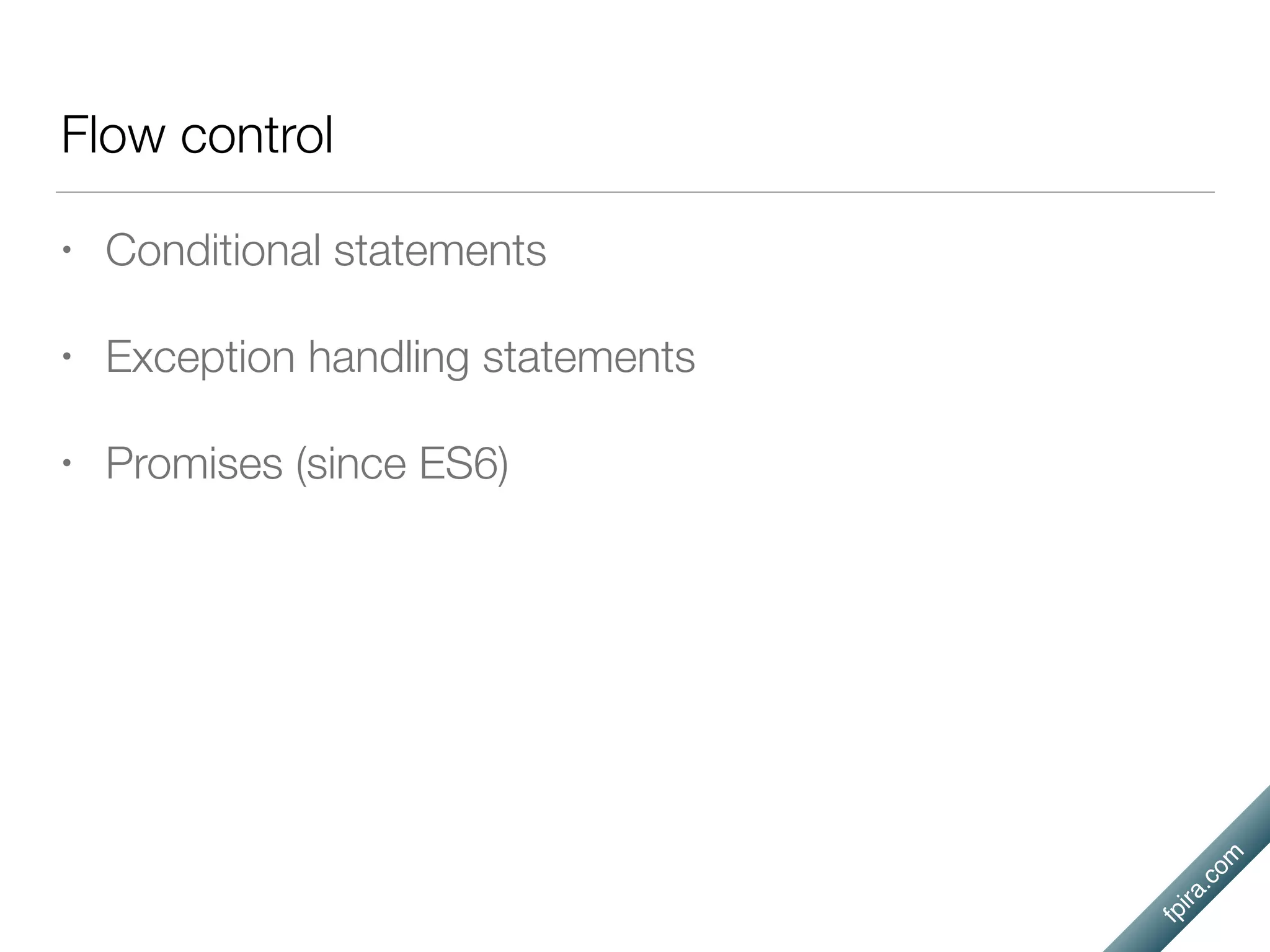
Flow control
• Conditional statements
• Exception handling statements
• Promises (since ES6)
fpira.com
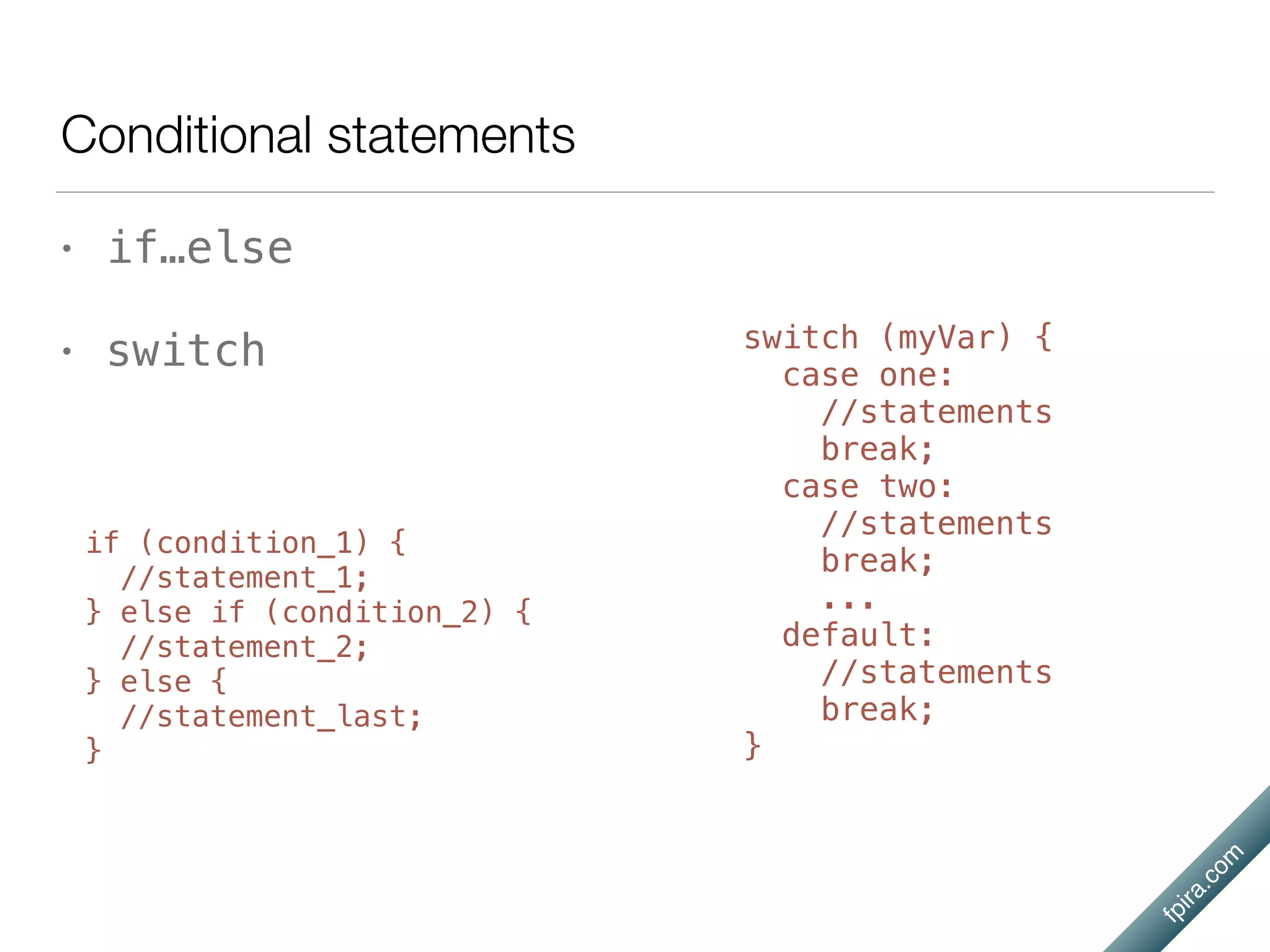
Conditional statements
• if…else
• switch
if (condition_1) {
//statement_1;
} else if (condition_2) {
//statement_2;
} else {
//statement_last;
}
switch (myVar) {
case one:
//statements
break;
case two:
//statements
break;
...
default:
//statements
break;
}
fpira.com
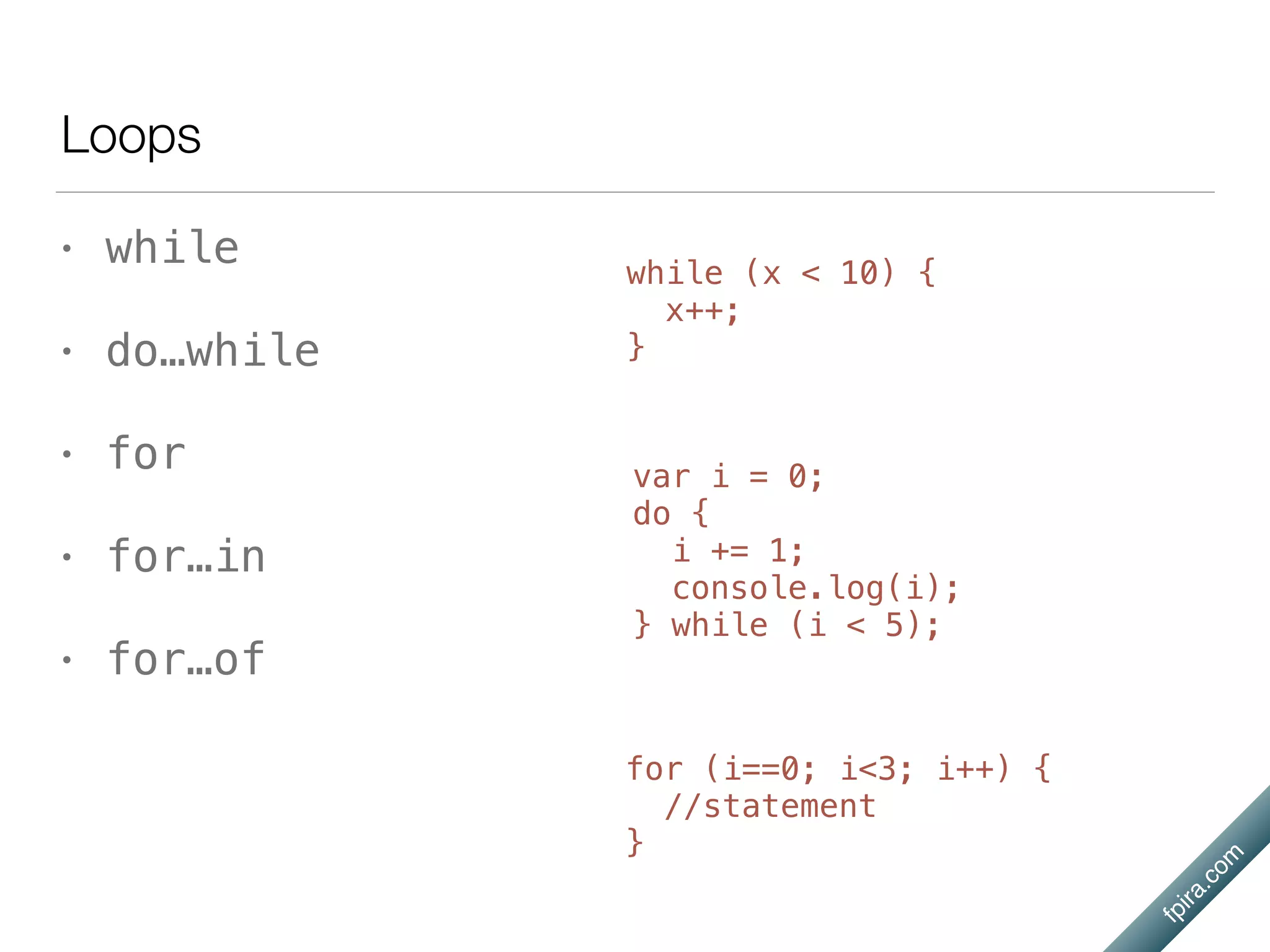
Loops
• while
• do…while
• for
• for…in
• for…of
for (i==0; i<3; i++) {
//statement
}
var i = 0;
do {
i += 1;
console.log(i);
} while (i < 5);
while (x < 10) {
x++;
}
fpira.com
for…in vs for…of
• for...in iterates over property names
• for...of iterates over property values
let arr = [3, 5, 7];
arr.foo = "hello";
for (let i in arr) {
console.log(i); // logs "0", "1", "2", "foo"
}
for (let i of arr) {
console.log(i); // logs "3", "5", "7"
}
fpira.com
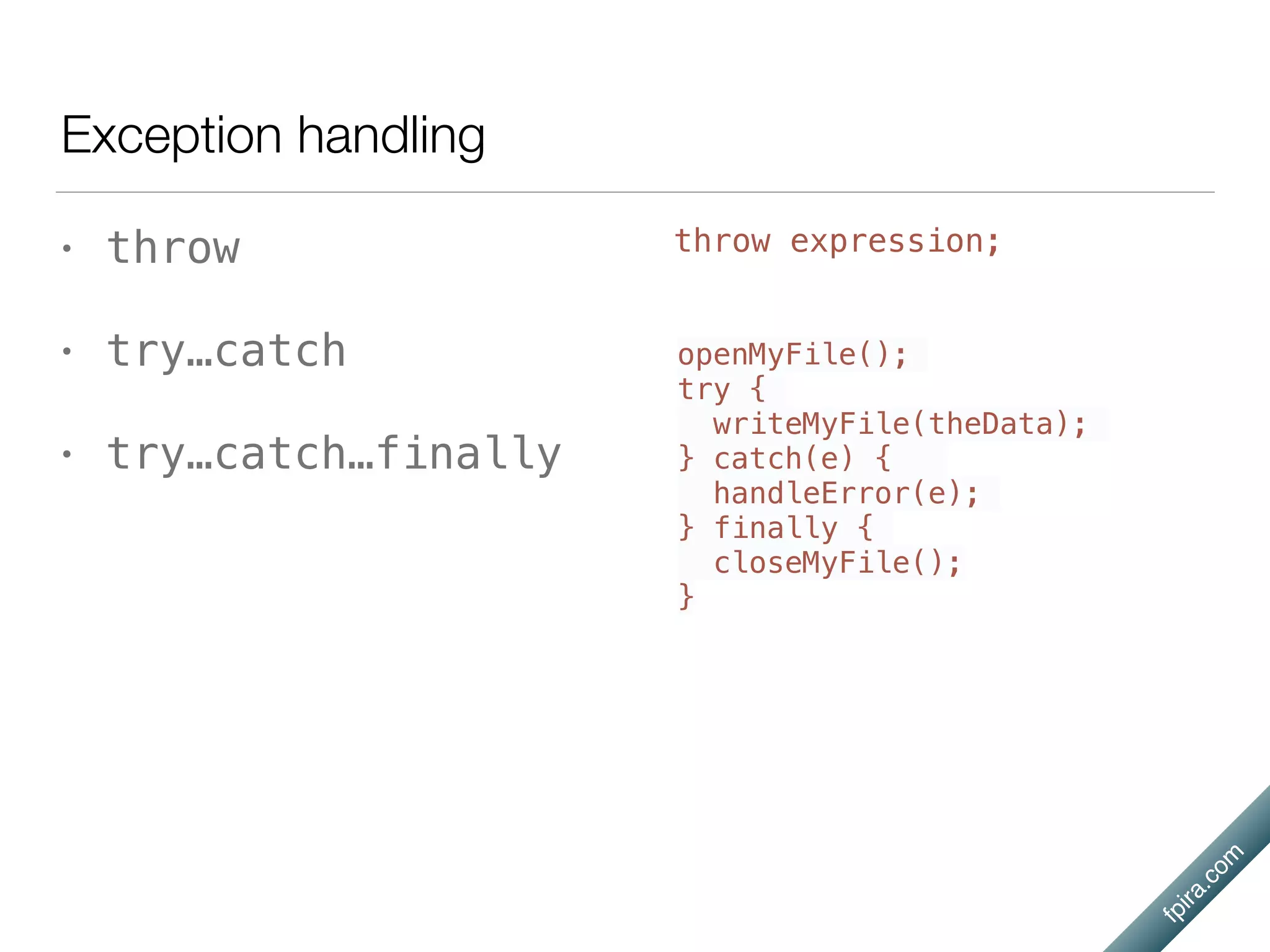
Exception handling
• throw
• try…catch
• try…catch…finally
openMyFile();
try {
writeMyFile(theData);
} catch(e) {
handleError(e);
} finally {
closeMyFile();
}
throw expression;
fpira.com
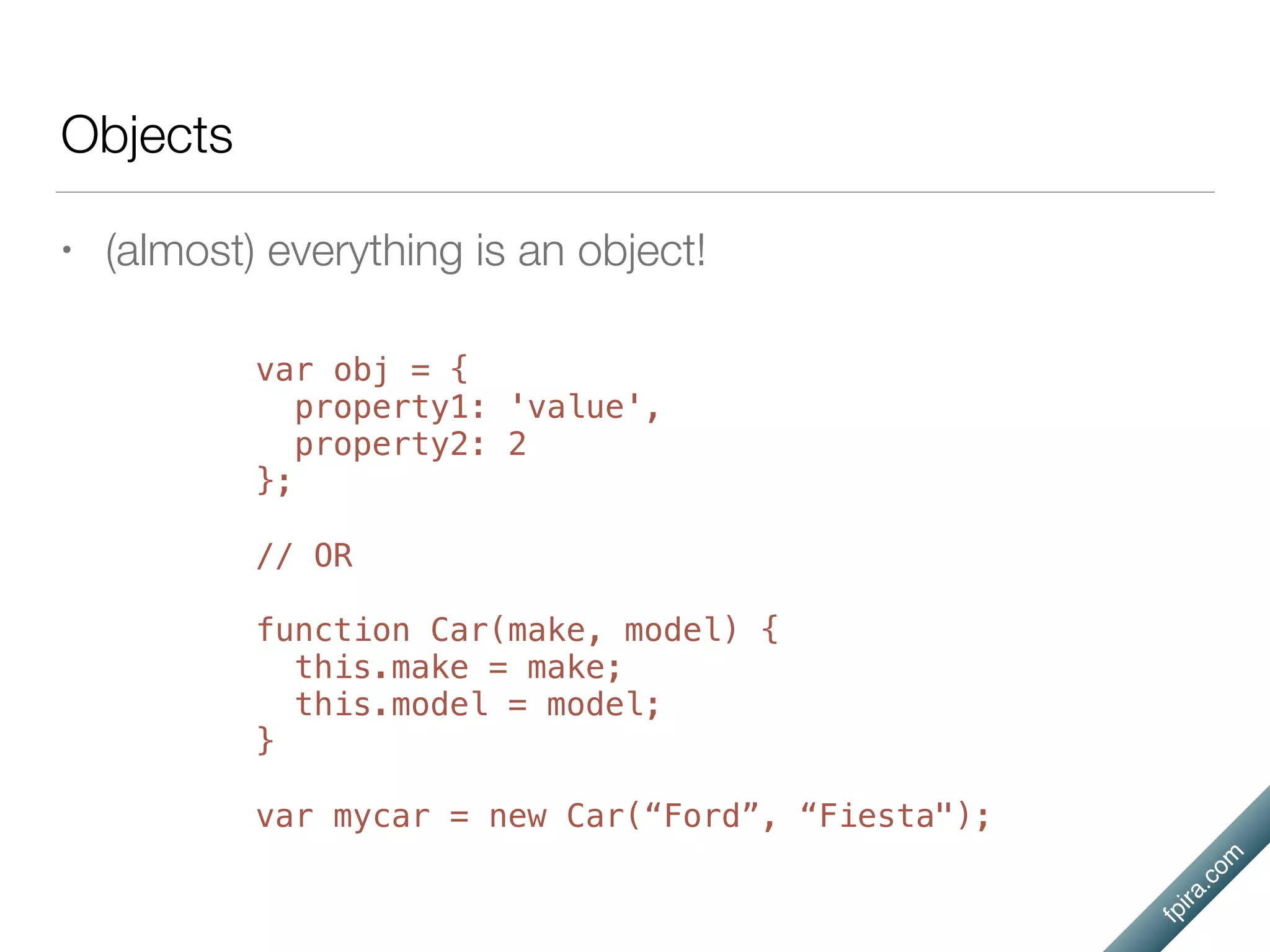
Objects
• (almost) everything is an object!
var obj = {
property1: 'value',
property2: 2
};
// OR
function Car(make, model) {
this.make = make;
this.model = model;
}
var mycar = new Car(“Ford”, “Fiesta");
fpira.com
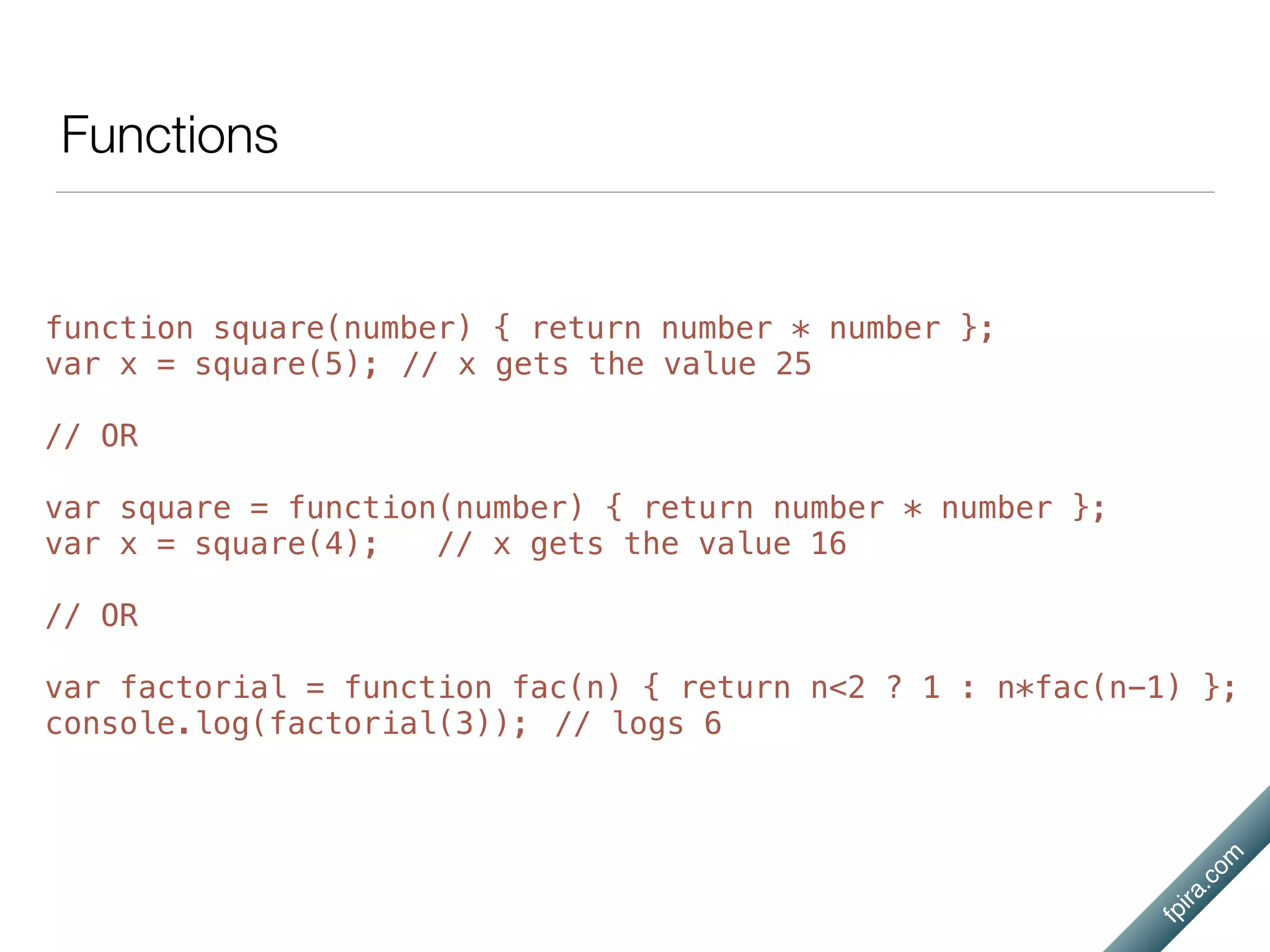
Functions
function square(number) { return number * number };
var x = square(5); // x gets the value 25
// OR
var square = function(number) { return number * number };
var x = square(4); // x gets the value 16
// OR
var factorial = function fac(n) { return n<2 ? 1 : n*fac(n-1) };
console.log(factorial(3)); // logs 6
fpira.com
JSON
• JS Object Notation
• Like 'English' for web
apps
• "key":value notation
• value can be any type
(even another object!)
{
"firstName": "John",
"lastName": "Smith",
"age": 25,
"address":
{
"streetAddress": "21 2nd Street",
"city": "New York",
"state": "NY",
"postalCode": "10021"
},
"phoneNumber":
[
{
"type": "home",
"number": "212 555-1234"
},
{
"type": "fax",
"number": "646 555-4567"
}
]
}
fpira.com
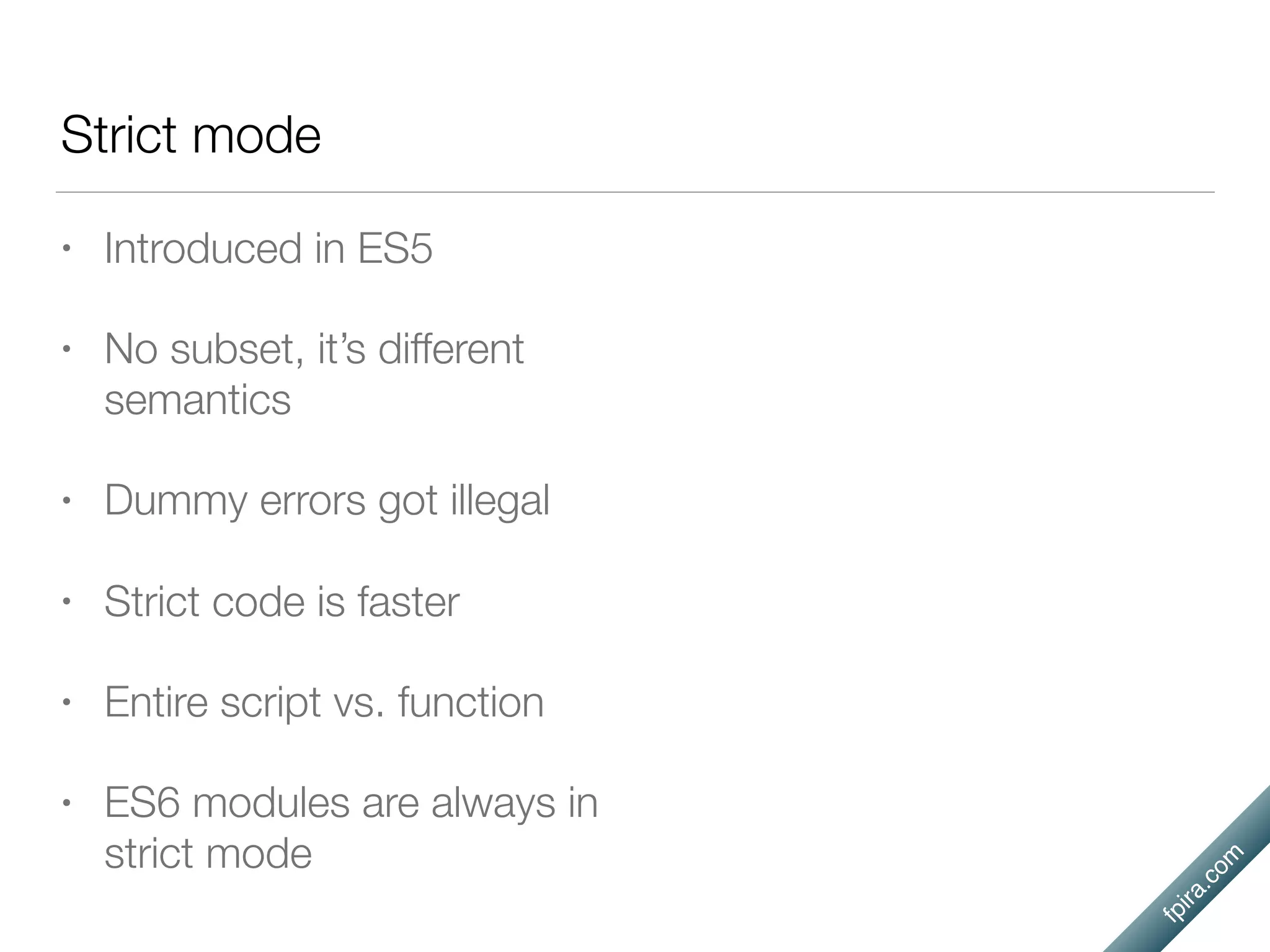
Strict mode
• Introduced in ES5
• No subset, it’s different
semantics
• Dummy errors got illegal
• Strict code is faster
• Entire script vs. function
• ES6 modules are always in
strict mode
fpira.com
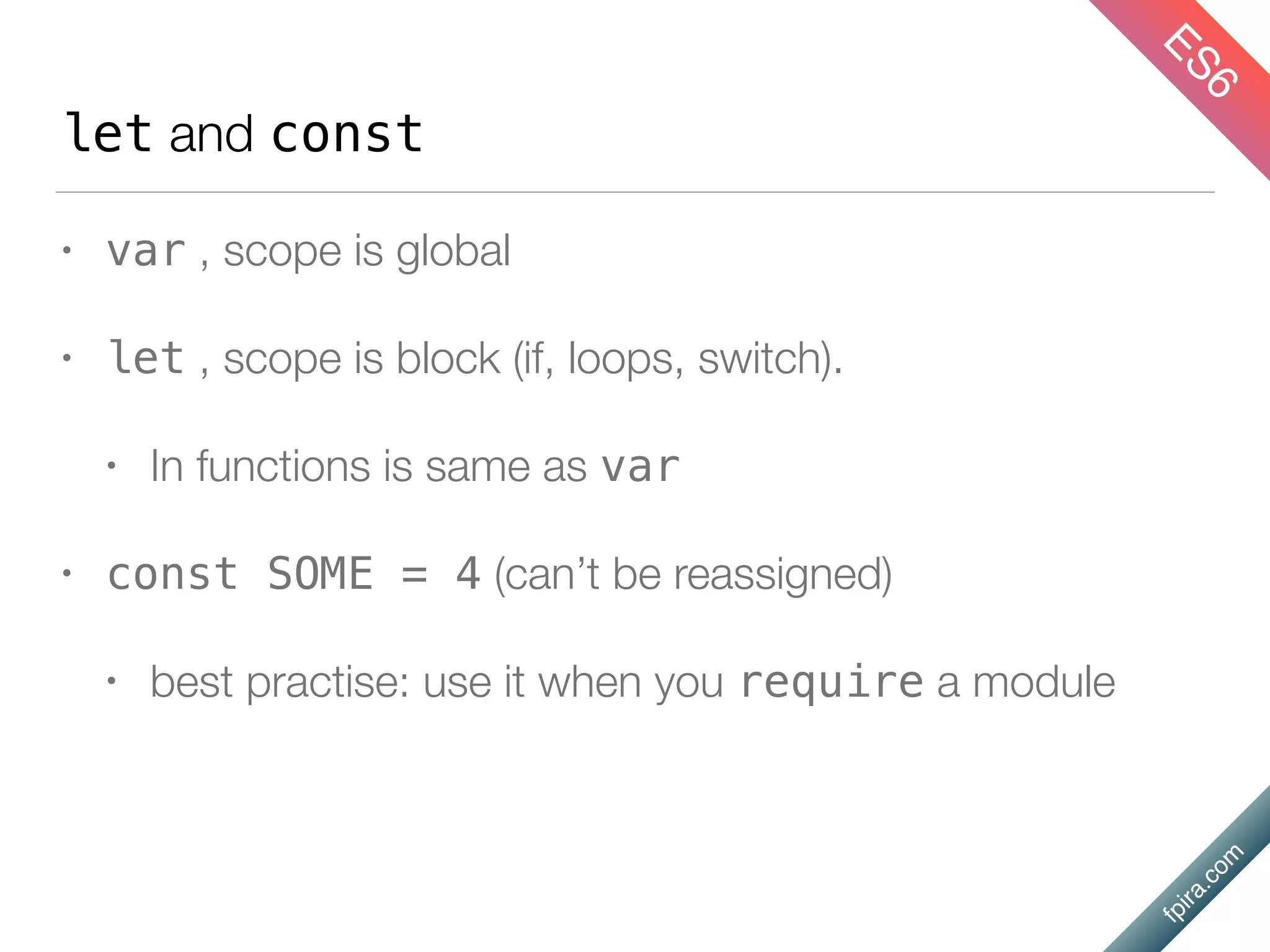
let and const
• var , scope is global
• let , scope is block (if, loops, switch).
• In functions is same as var
• const SOME = 4 (can’t be reassigned)
• best practise: use it when you require a module
ES6
fpira.com
Spread operator (…)
ES6
// Example 1
function myFunction(x, y, z) { }
var args = [0, 1, 2];
myFunction(...args); // arguments are 0,1,2
// Example 2
function myFunction(v, w, x, y, z) { }
var args = [0, 1];
myFunction(-1, ...args, 2, ...[3]); // arguments are -1,0,1,2,3
// Example 3
var parts = ['shoulders', 'knees'];
var lyrics = ['head', ...parts, 'and', 'toes'];
// lyrics is -> ['head', 'shoulders', 'knees', 'and', 'toes']
fpira.com
Destructuring
• Python-like
• Pretty useful
• works w/ Objects
• works w/ Arrays
• Can have defaults
• Defaults for functions
parameters
ES6
var foo = ["x", "y"];
var [one, two] = foo;
console.log(one); // "x"
console.log(two); // "y"
[a, b, ...rest] = [1, 2, 3, 4, 5]
console.log(a) // 1
console.log(b) // 2
console.log(rest) // [3, 4, 5]
({a, b} = {a:1, b:2})
console.log(a) // 1
console.log(b) // 2
var o = {p: 42, q: true};
var {p, q} = o;
console.log(p); // 42
console.log(q); // true
fpira.com
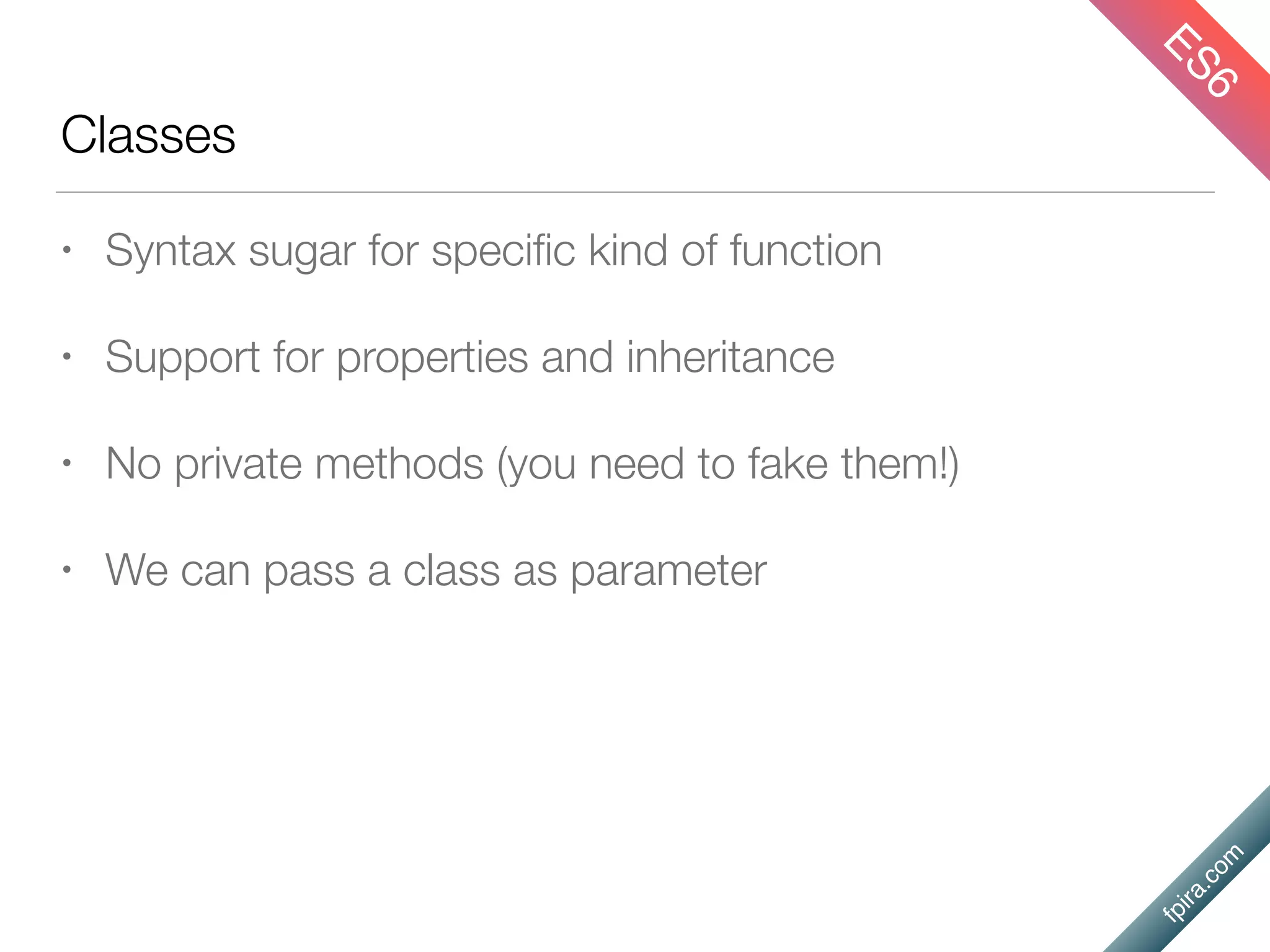
Classes
• Syntax sugar for specific kind of function
• Support for properties and inheritance
• No private methods (you need to fake them!)
• We can pass a class as parameter
ES6
fpira.com
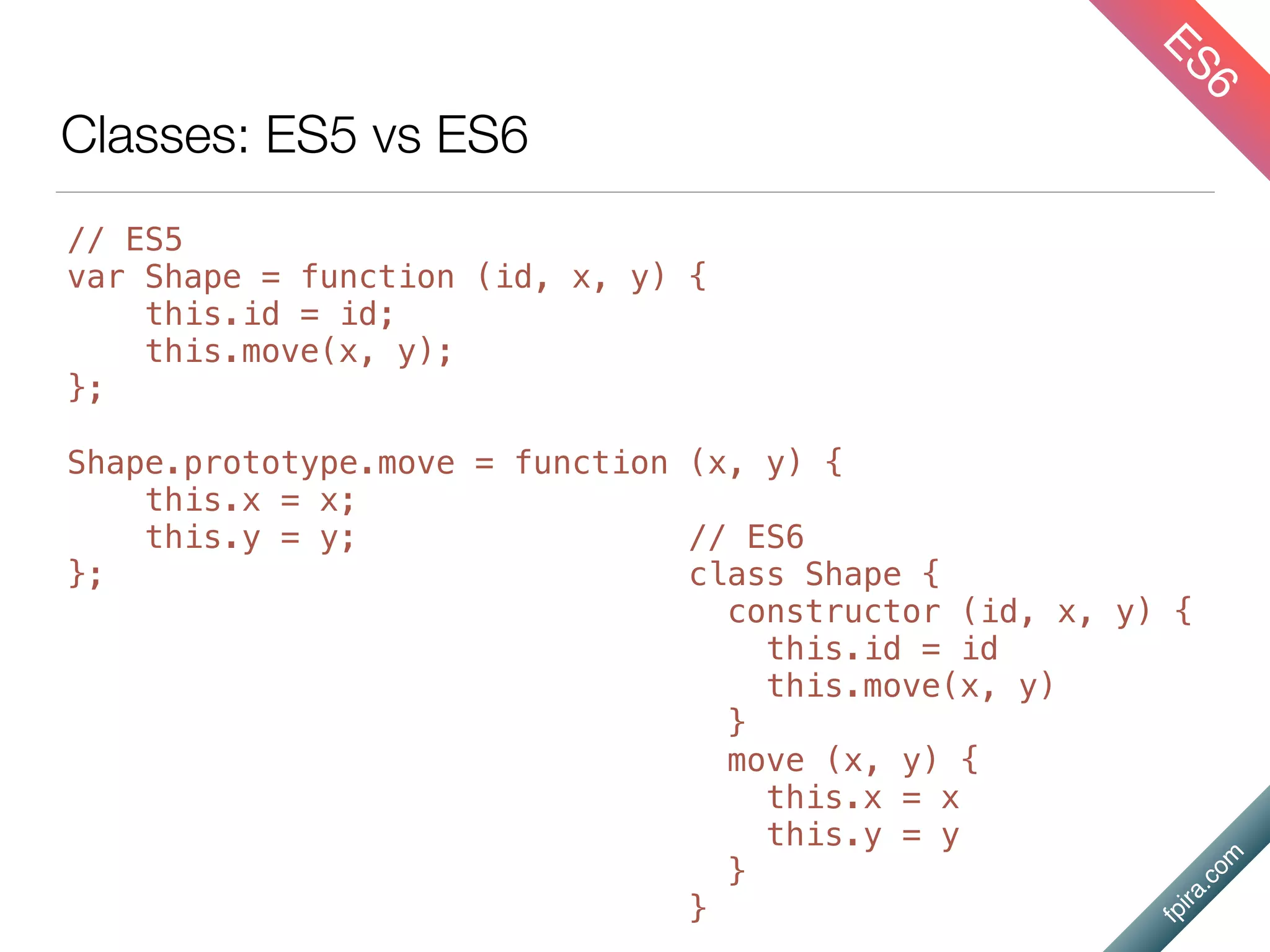
Classes: ES5 vs ES6
// ES6
class Shape {
constructor (id, x, y) {
this.id = id
this.move(x, y)
}
move (x, y) {
this.x = x
this.y = y
}
}
// ES5
var Shape = function (id, x, y) {
this.id = id;
this.move(x, y);
};
Shape.prototype.move = function (x, y) {
this.x = x;
this.y = y;
};
ES6
fpira.com
Arrow functions
• More concise
syntax
• this has same
scope of parent
• no arguments,
use spread operator
(…args)
• use ({}) for empty
objects
function (a, b) { return a * b; }
(a, b) => a * b
var that = this;
var helper = function () {
that.num = add(that.num, that.num);
};
function () { return arguments[0]; }
(...args) => args[0]
() => {} // undefined
() => ({}) // {}
ES6
fpira.com
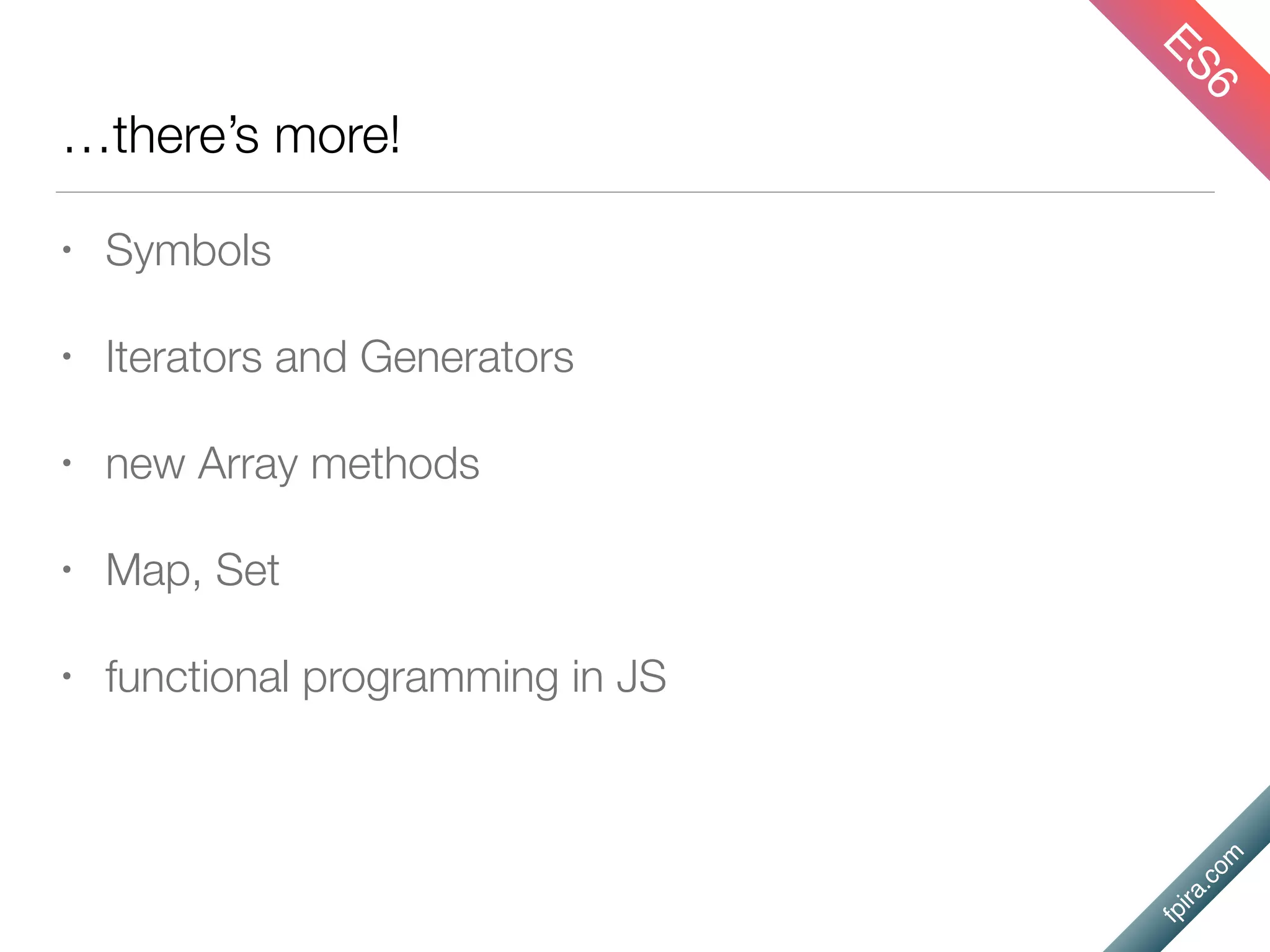
…there’s more!
• Symbols
• Iterators and Generators
• new Array methods
• Map, Set
• functional programming in JS
ES6
node.js
for back-end developers
fpira.com
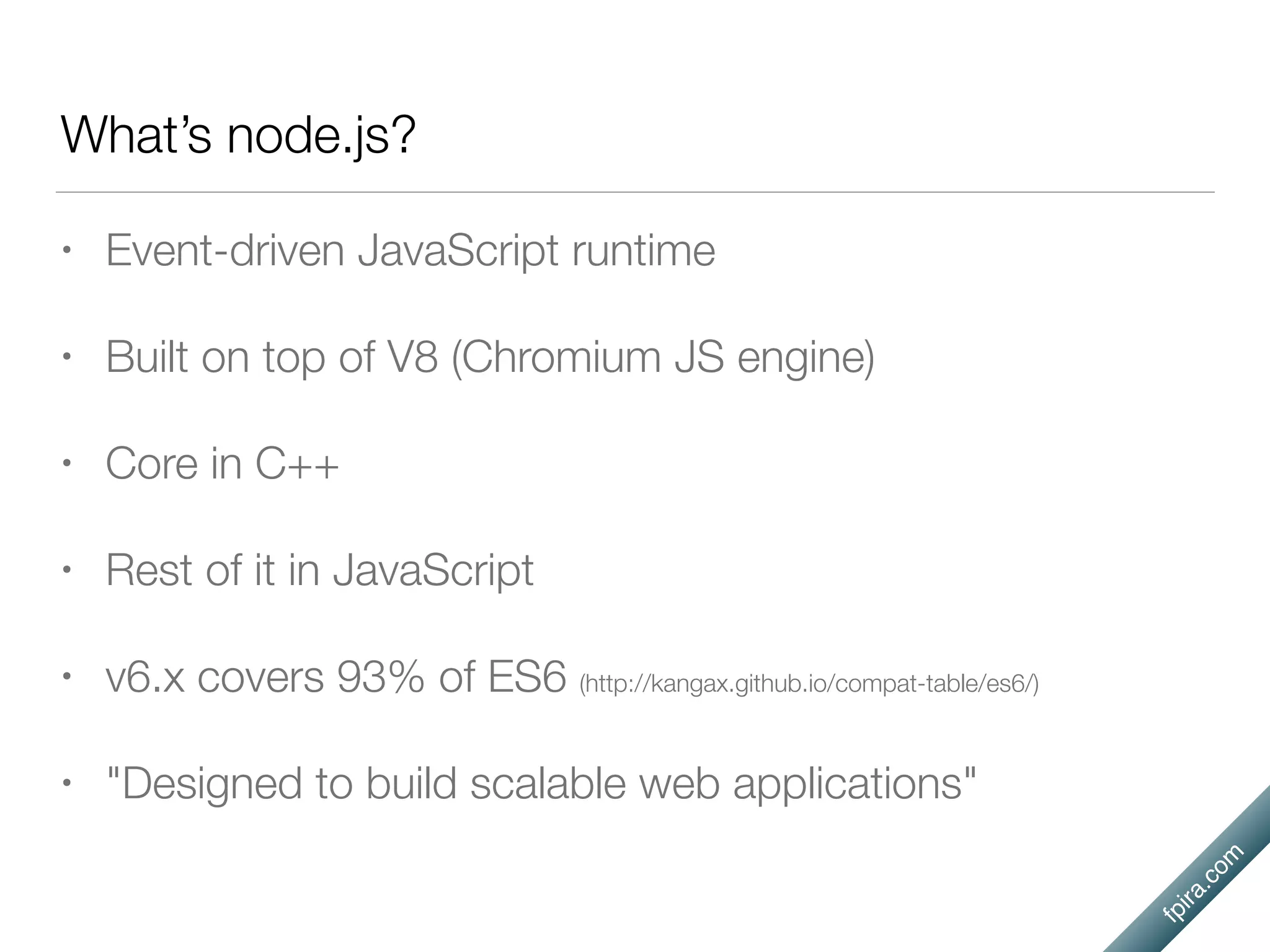
What’s node.js?
• Event-driven JavaScript runtime
• Built on top of V8 (Chromium JS engine)
• Core in C++
• Rest of it in JavaScript
• v6.x covers 93% of ES6 (http://kangax.github.io/compat-table/es6/)
• "Designed to build scalable web applications"
fpira.com
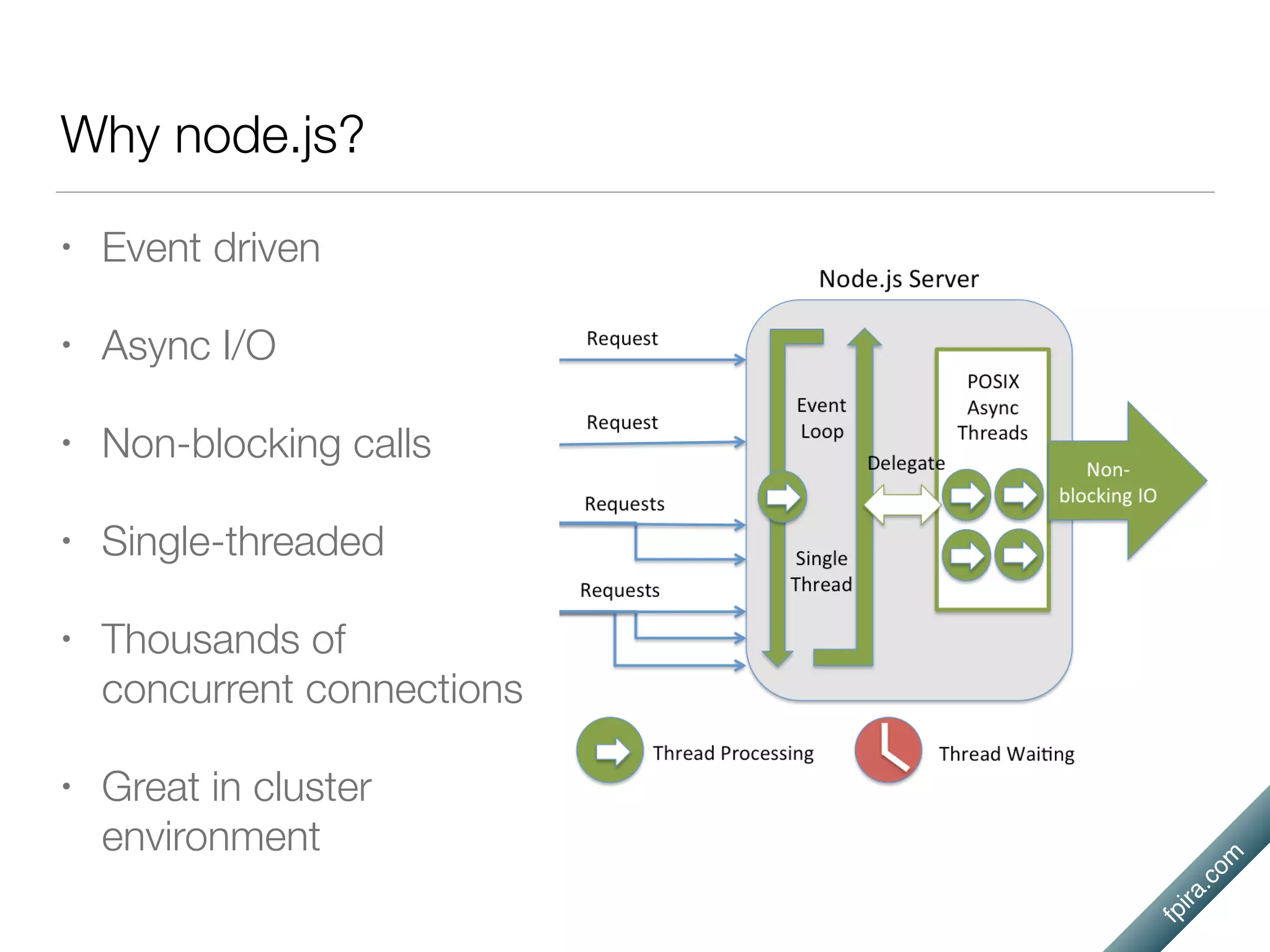
Why node.js?
• Event driven
• Async I/O
• Non-blocking calls
• Single-threaded
• Thousands of
concurrent connections
• Great in cluster
environment
fpira.com
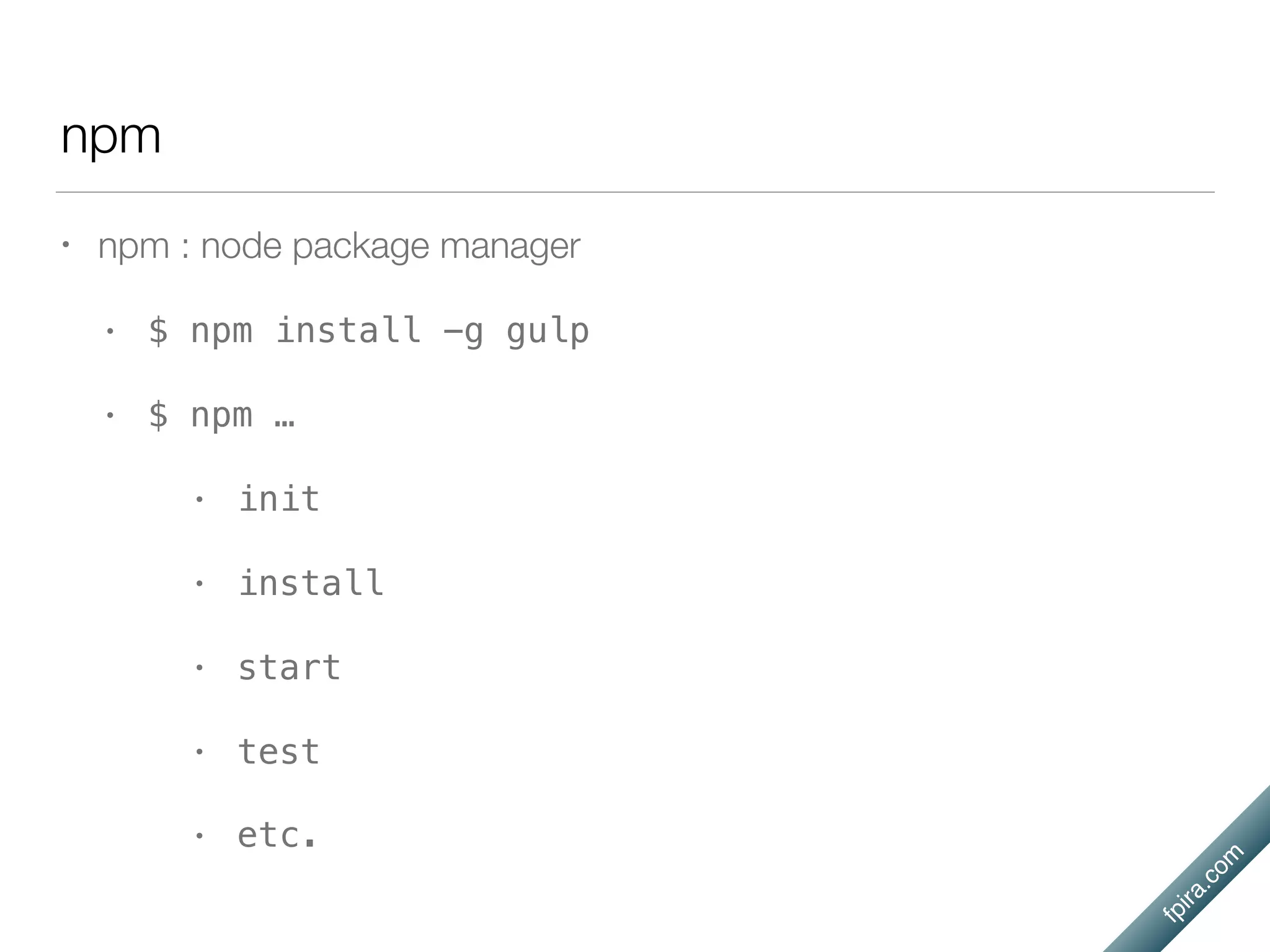
npm
• npm : node package manager
• $ npm install -g gulp
• $ npm …
• init
• install
• start
• test
• etc.
fpira.com
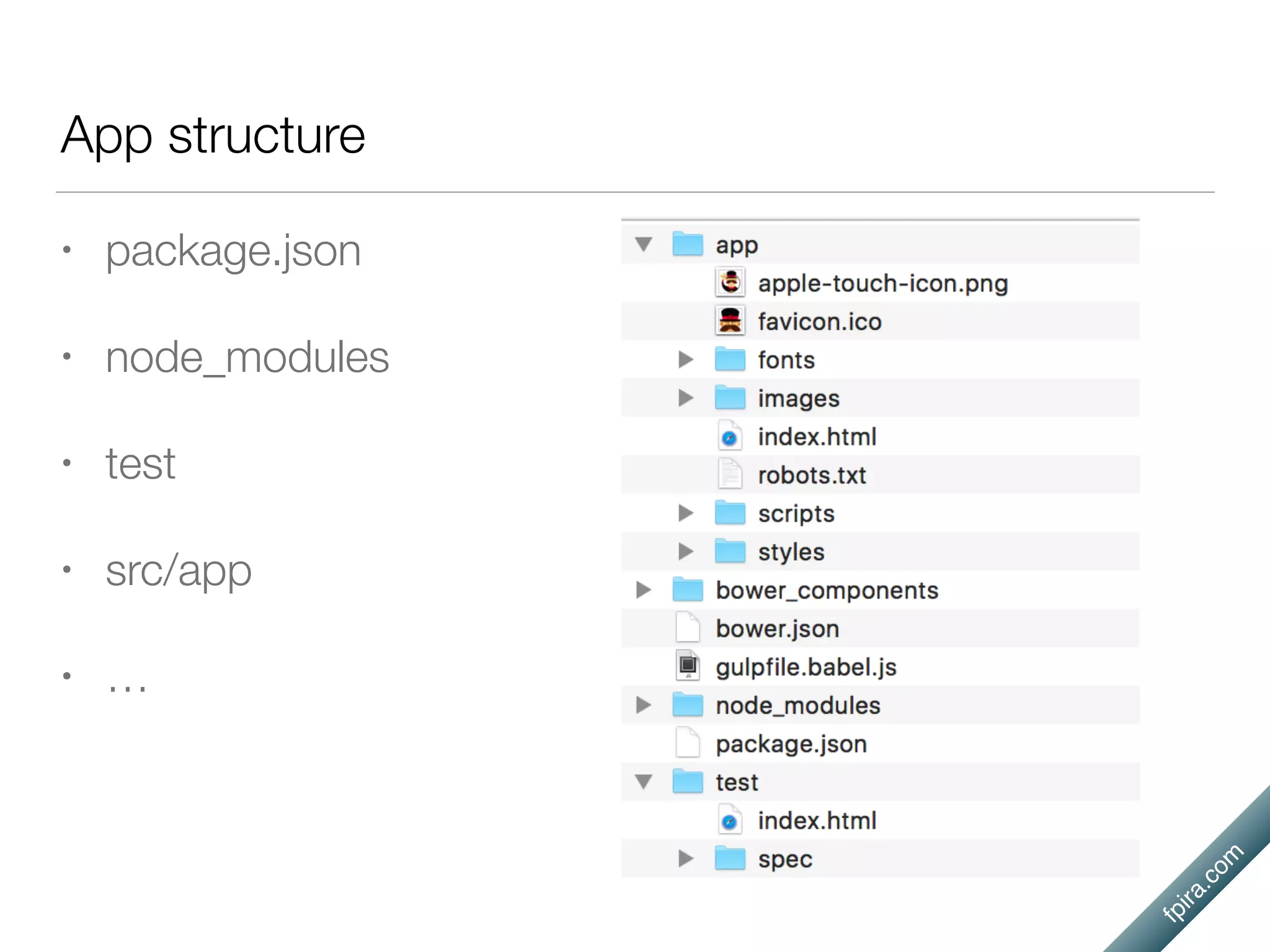
App structure
• package.json
• node_modules
• test
• src/app
• …
fpira.com
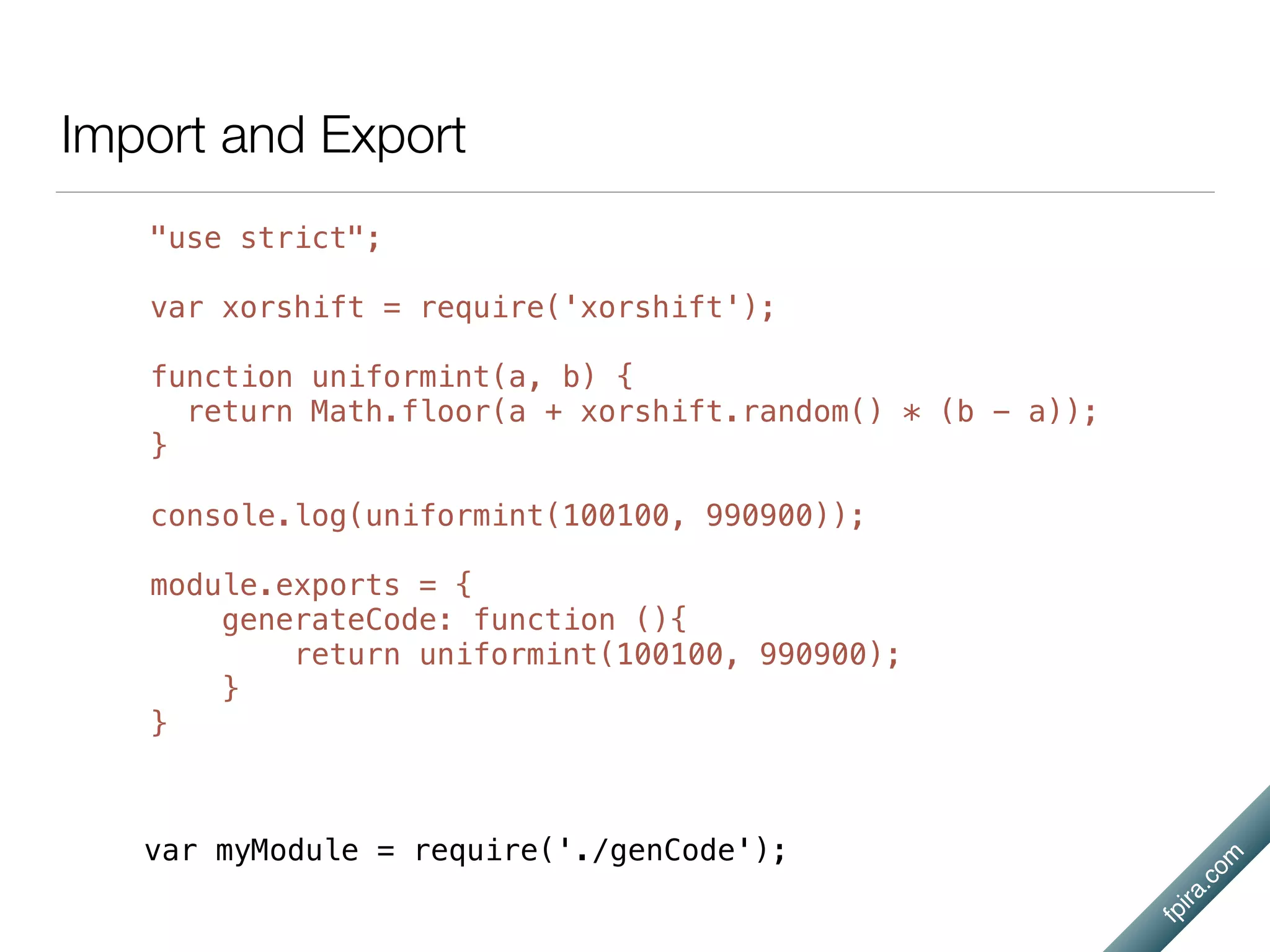
Import and Export
"use strict";
var xorshift = require('xorshift');
function uniformint(a, b) {
return Math.floor(a + xorshift.random() * (b - a));
}
console.log(uniformint(100100, 990900));
module.exports = {
generateCode: function (){
return uniformint(100100, 990900);
}
}
var myModule = require('./genCode');
fpira.com
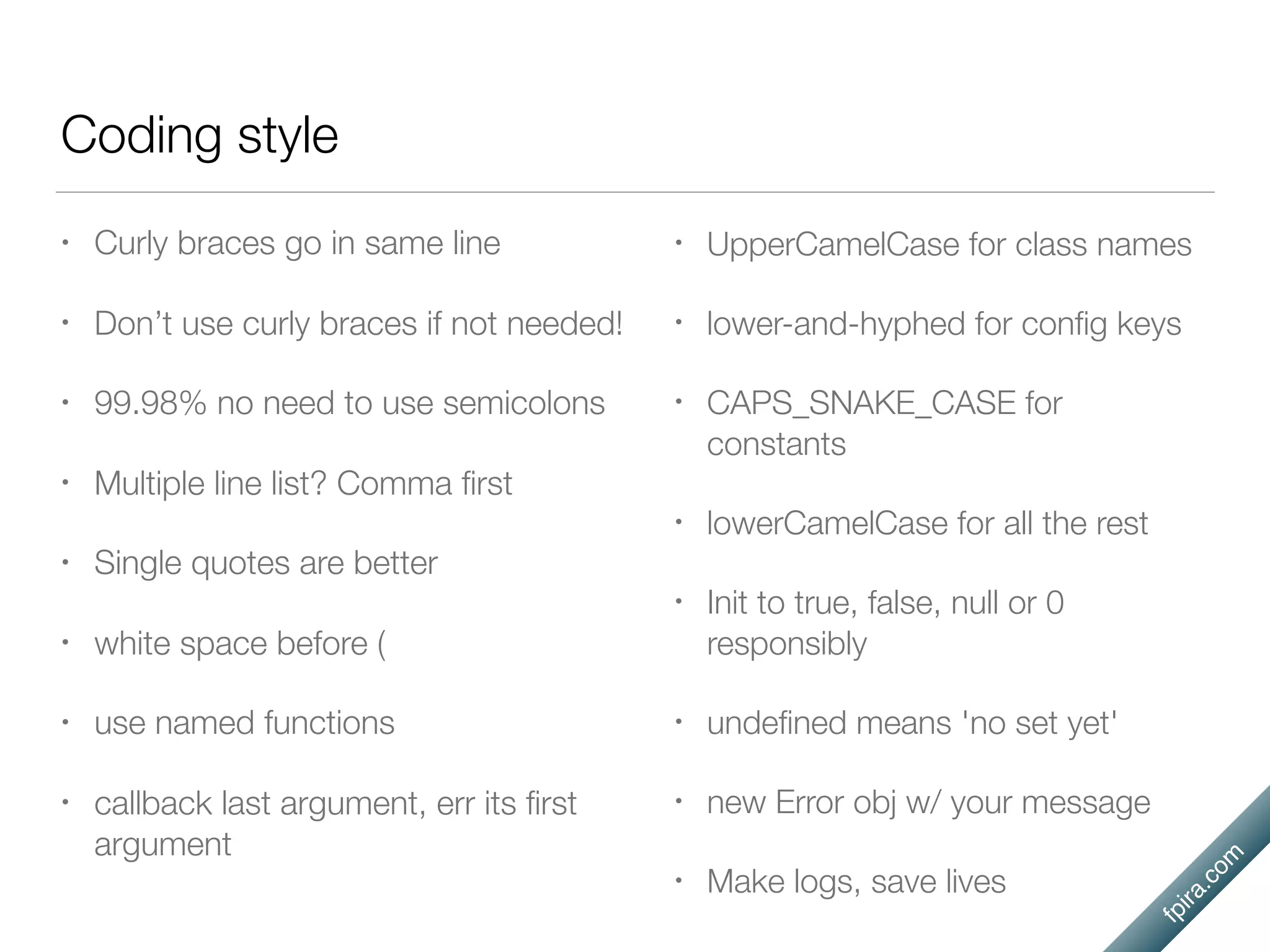
Coding style
• Curly braces go in same line
• Don’t use curly braces if not needed!
• 99.98% no need to use semicolons
• Multiple line list? Comma first
• Single quotes are better
• white space before (
• use named functions
• callback last argument, err its first
argument
• UpperCamelCase for class names
• lower-and-hyphed for config keys
• CAPS_SNAKE_CASE for
constants
• lowerCamelCase for all the rest
• Init to true, false, null or 0
responsibly
• undefined means 'no set yet'
• new Error obj w/ your message
• Make logs, save lives
fpira.com
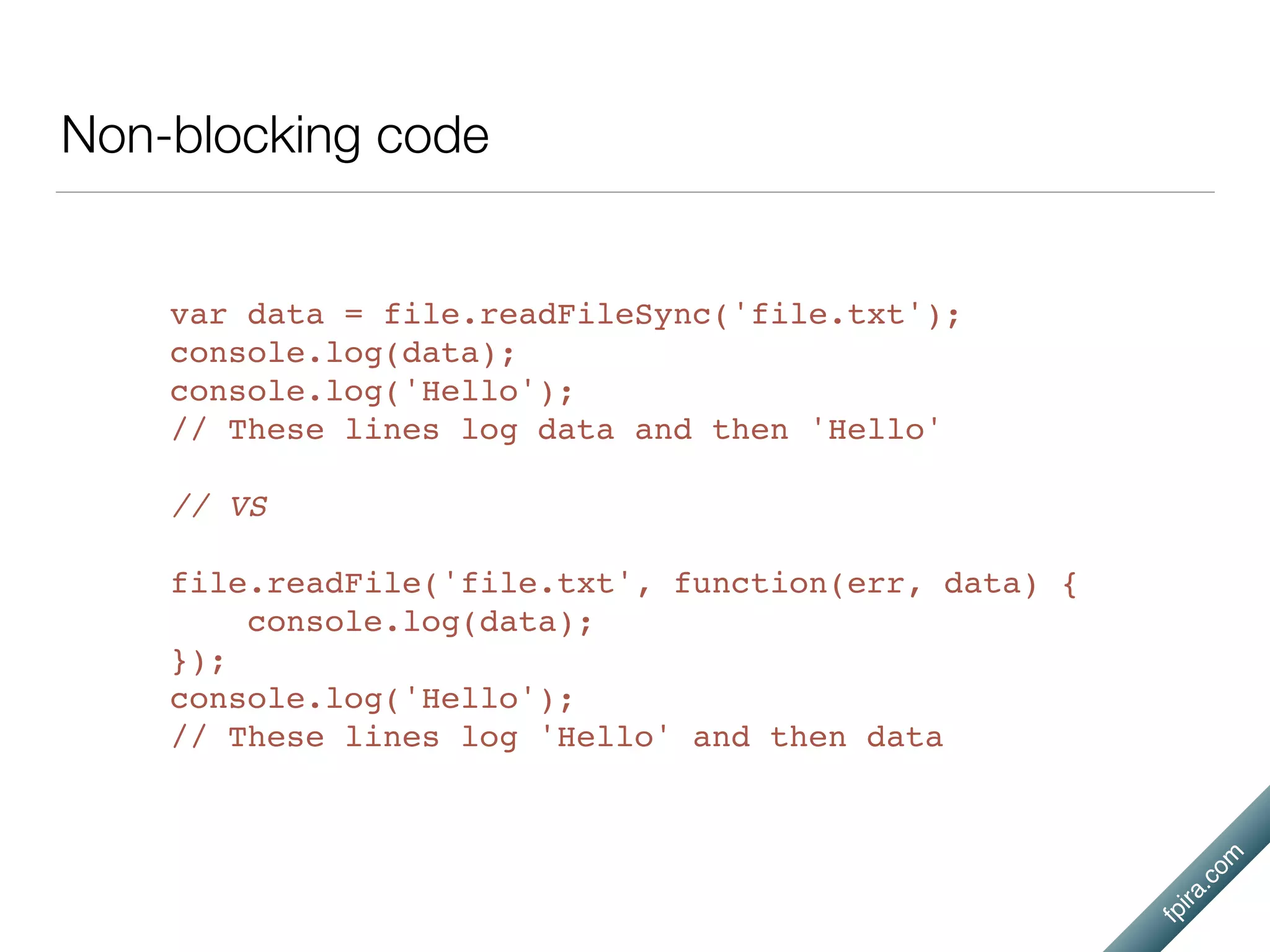
Non-blocking code
var data = file.readFileSync('file.txt');
console.log(data);
console.log('Hello');
// These lines log data and then 'Hello'
// VS
file.readFile('file.txt', function(err, data) {
console.log(data);
});
console.log('Hello');
// These lines log 'Hello' and then data
fpira.com
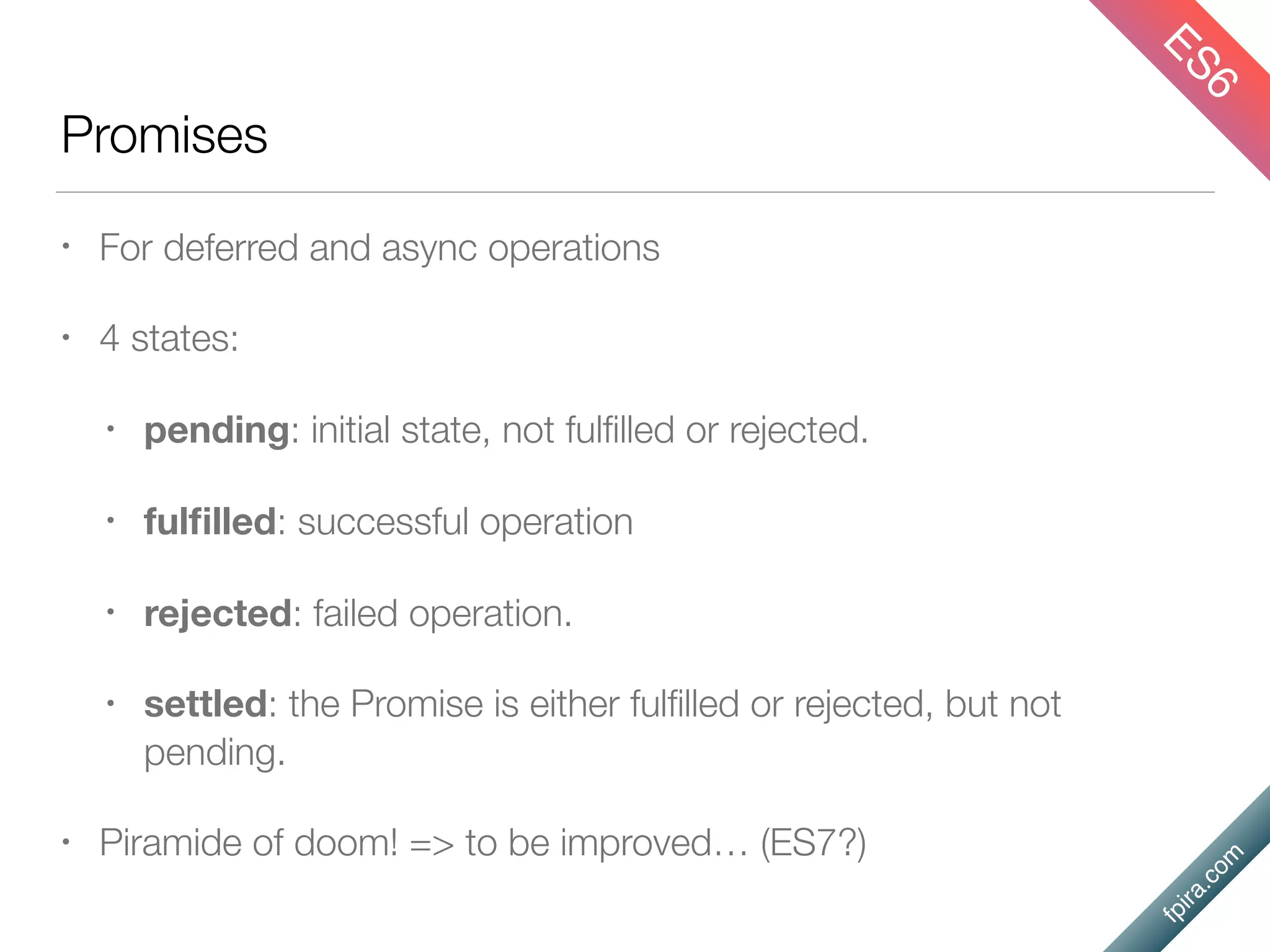
Promises
• For deferred and async operations
• 4 states:
• pending: initial state, not fulfilled or rejected.
• fulfilled: successful operation
• rejected: failed operation.
• settled: the Promise is either fulfilled or rejected, but not
pending.
• Piramide of doom! => to be improved… (ES7?)
ES6
fpira.com
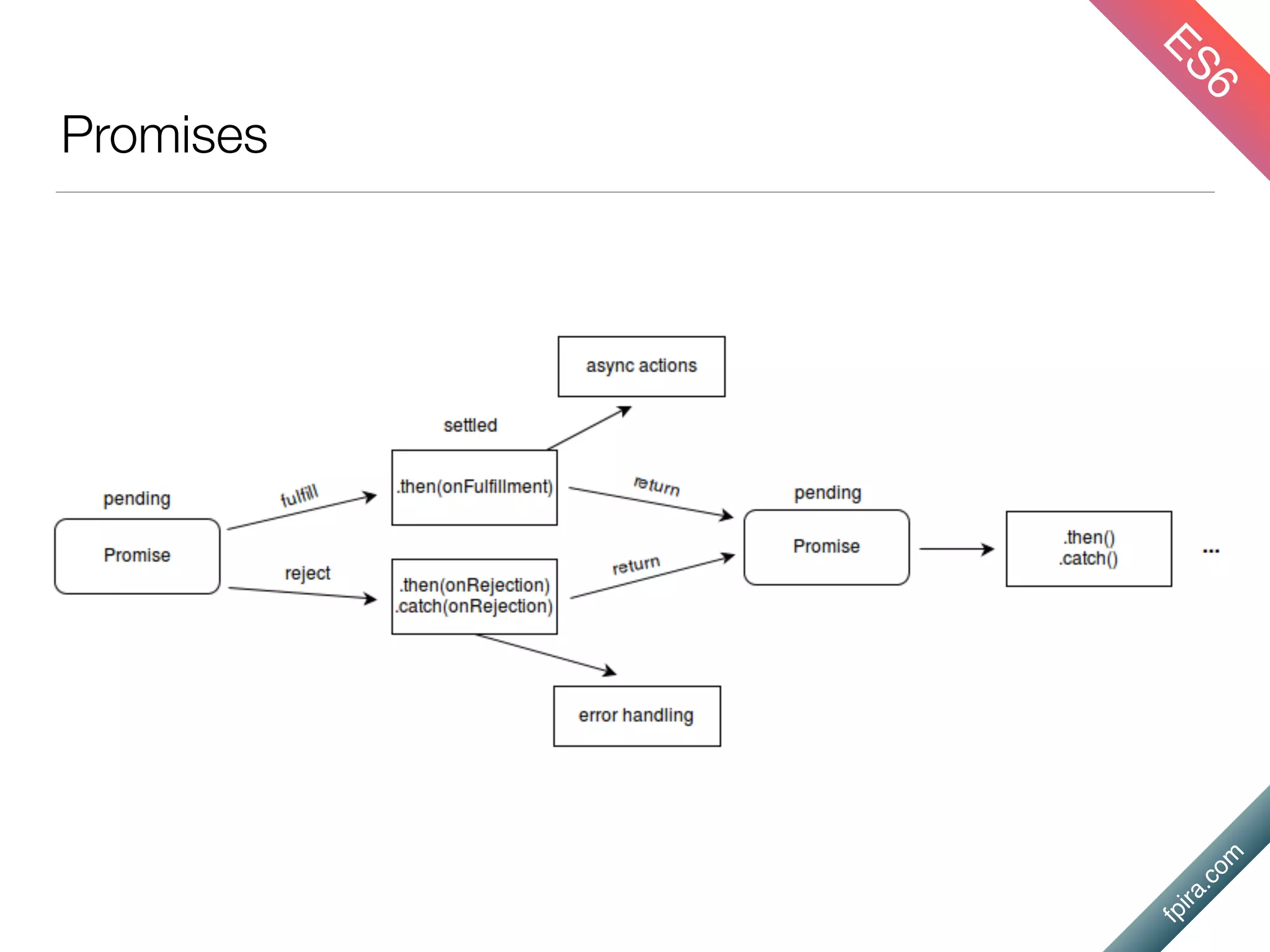
Promises
ES6
fpira.com
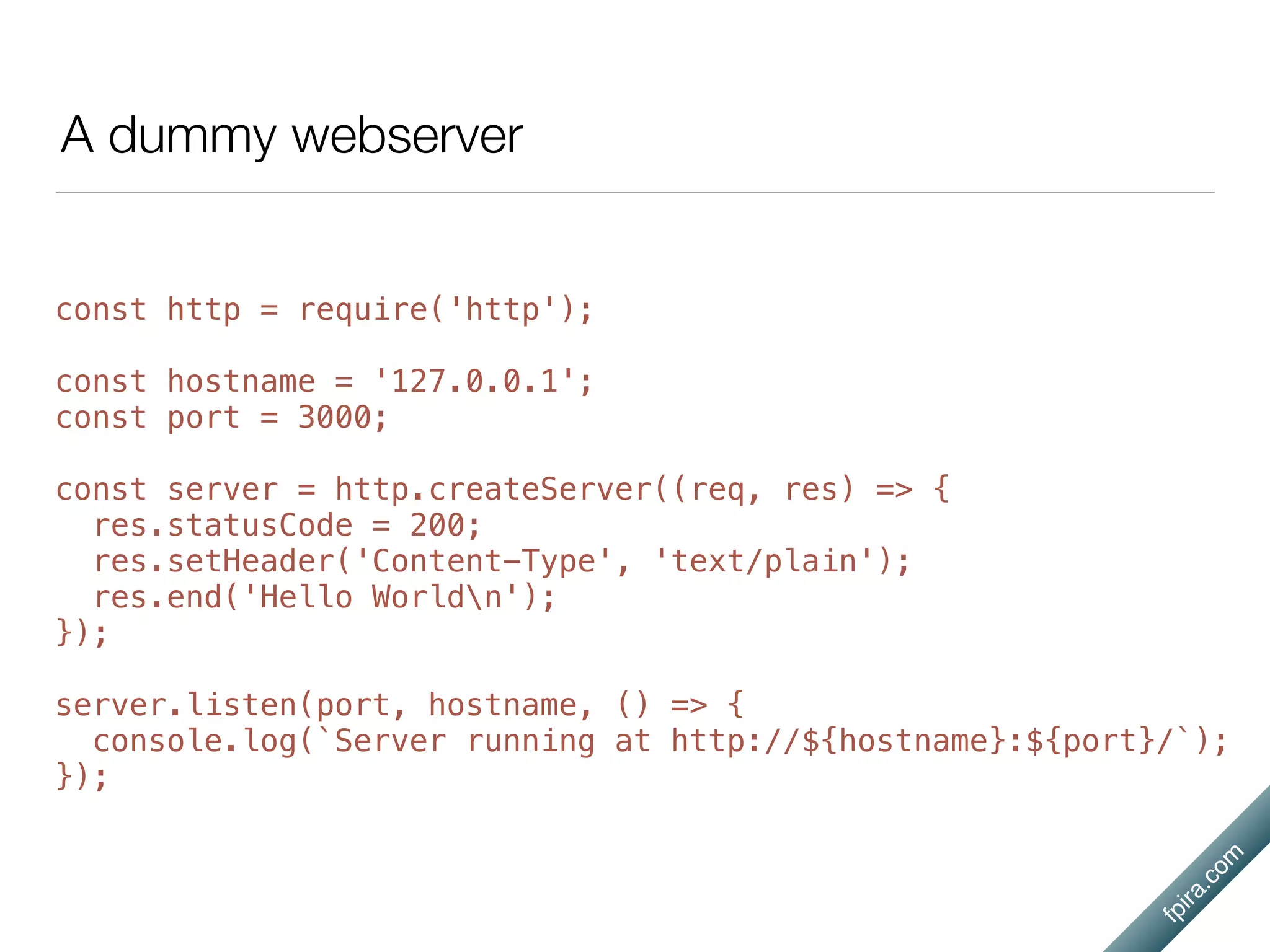
A dummy webserver
const http = require('http');
const hostname = '127.0.0.1';
const port = 3000;
const server = http.createServer((req, res) => {
res.statusCode = 200;
res.setHeader('Content-Type', 'text/plain');
res.end('Hello Worldn');
});
server.listen(port, hostname, () => {
console.log(`Server running at http://${hostname}:${port}/`);
});
fpira.com
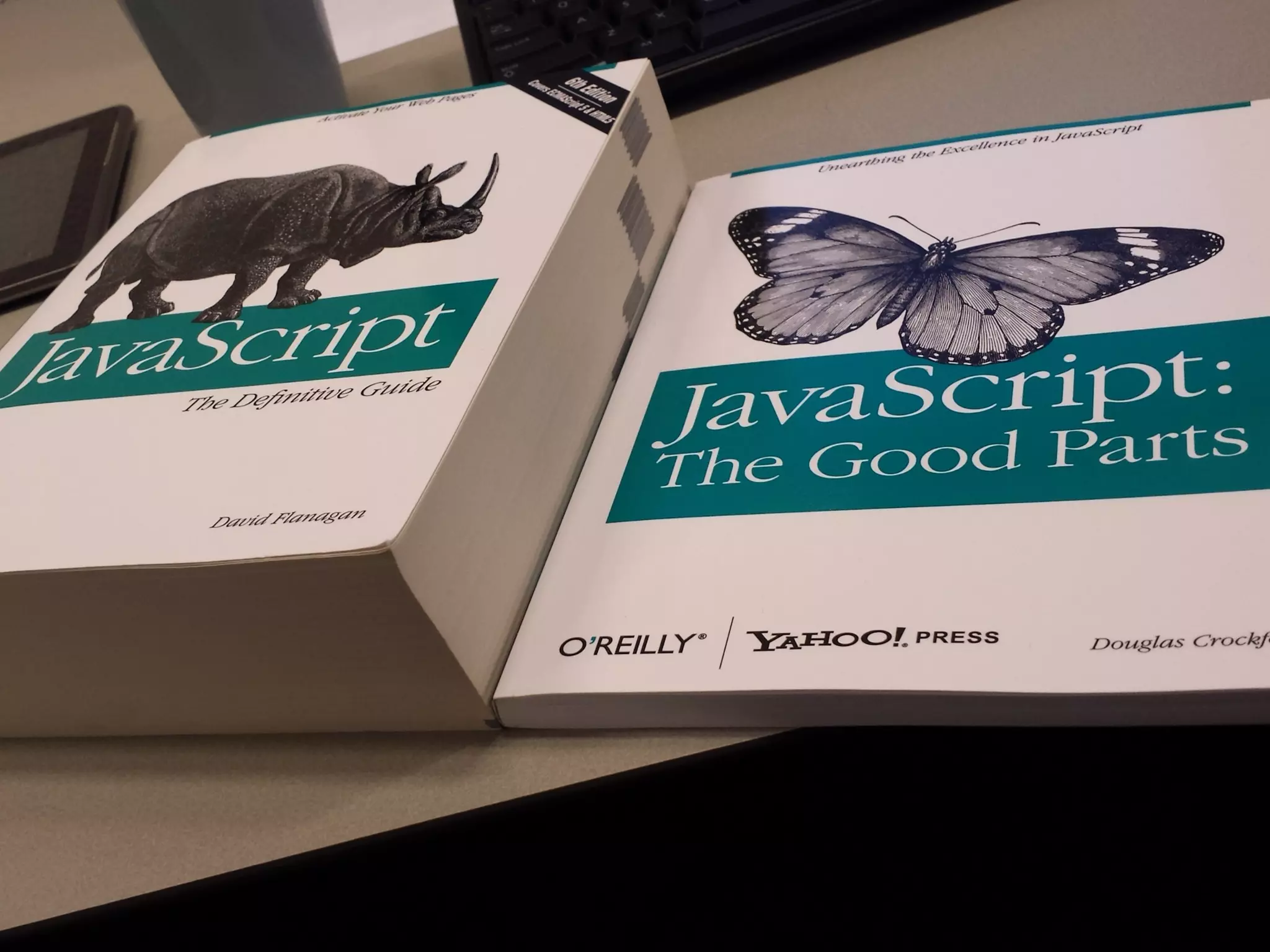
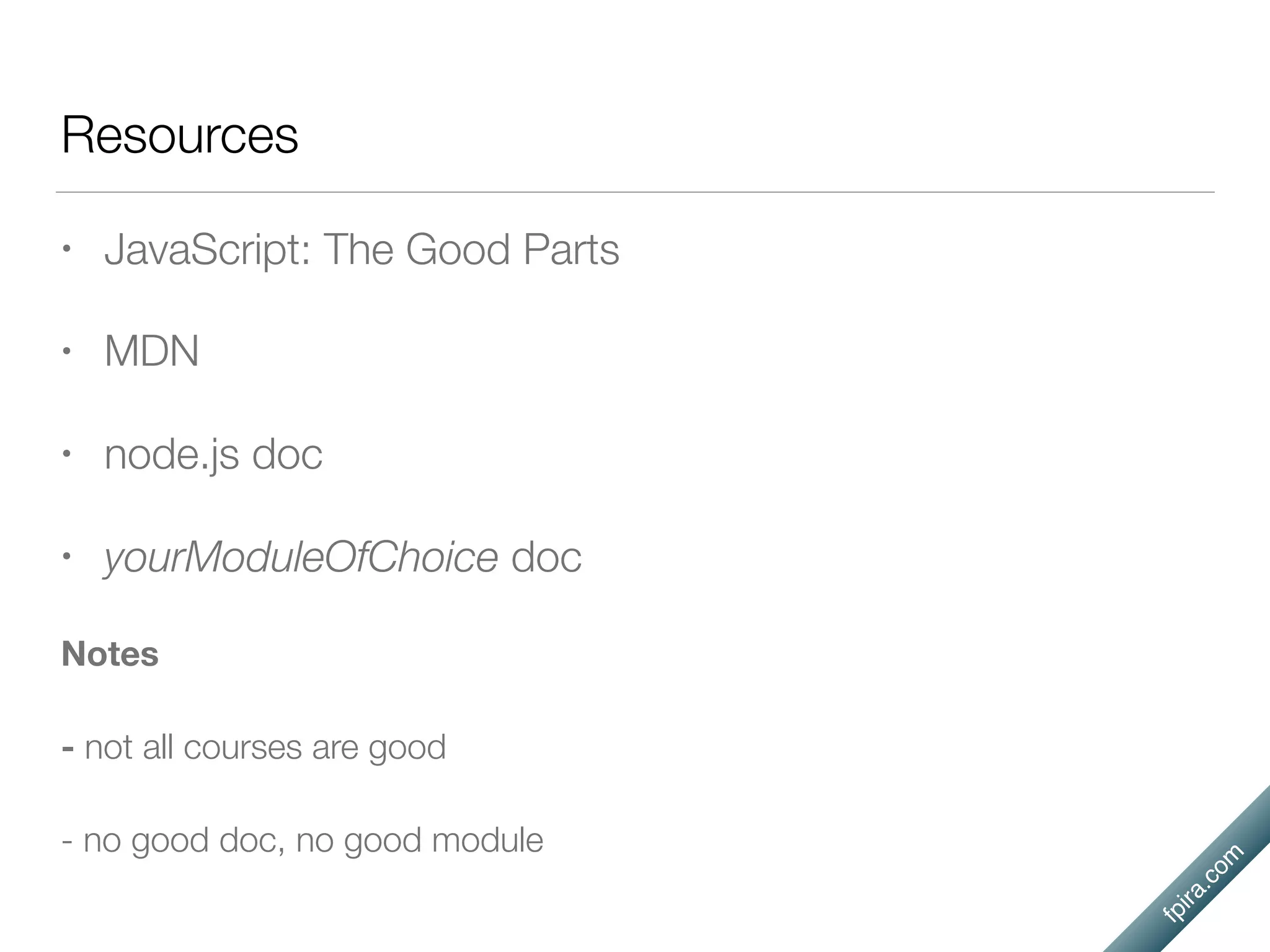
• JavaScript: The Good Parts
• MDN
• node.js doc
• yourModuleOfChoice doc
Notes
- not all courses are good
- no good doc, no good module
Resources
fpira.com
Next
• Read the doc!
• Explore Symbol, Map, Set, Iterators and Generators
• Write your first node.js project
• Try the Express web framework
• Understand Express middleware
• Get to know JS testing (Mocha and Jasmine)
fpira.com
Next (more)
• Gulp
• Babel
• TypeScript
• Read about JS functional programming
• (https://medium.com/@chetcorcos/functional-programming-for-javascript-
people-1915d8775504#.bawhglud6)
Thank you!
Questions?
@pirafrankfpira.com Francesco Pira

Hands on: The sexy side of JavaScript (feat. node.js)

  • 1.
    Hands on: The sexyside of JavaScript (feat. node.js) @pirafrankfpira.com Francesco Pira Google #io16 Extended Catania
  • 2.
    fpira.com Who I am? • Web developer • Co-founder @ fileshute.com • VP @ Youth Hub Catania • I like coding, learning new stuff, meet new people (yay!)
  • 3.
  • 5.
    fpira.com ECMAScript, actually… • Officiallanguage name • Versions often abbreviated as 'ESx' • ES3 = 1999; • var ES5 = 2015; • const ES6 = 2016; • (ES7 is WIP…)
  • 6.
  • 7.
  • 8.
    fpira.com nvm • nvm :node version manager (bash script) • $ nvm install 6.1.0
  • 9.
    fpira.com Types • Number (dp64 bit) • String • Boolean • Object • function, Array, • Date, RegExp • Symbol (ES6+) • NaN • Special objects • undefined • null
  • 10.
    fpira.com Truthy and falsy •true • non-zero numbers • "strings" • objects • arrays • functions • false • 0 • "" • undefined • null • NaN
  • 11.
    fpira.com Flow control • Conditionalstatements • Exception handling statements • Promises (since ES6)
  • 12.
    fpira.com Conditional statements • if…else •switch if (condition_1) { //statement_1; } else if (condition_2) { //statement_2; } else { //statement_last; } switch (myVar) { case one: //statements break; case two: //statements break; ... default: //statements break; }
  • 13.
    fpira.com Loops • while • do…while •for • for…in • for…of for (i==0; i<3; i++) { //statement } var i = 0; do { i += 1; console.log(i); } while (i < 5); while (x < 10) { x++; }
  • 14.
    fpira.com for…in vs for…of •for...in iterates over property names • for...of iterates over property values let arr = [3, 5, 7]; arr.foo = "hello"; for (let i in arr) { console.log(i); // logs "0", "1", "2", "foo" } for (let i of arr) { console.log(i); // logs "3", "5", "7" }
  • 15.
    fpira.com Exception handling • throw •try…catch • try…catch…finally openMyFile(); try { writeMyFile(theData); } catch(e) { handleError(e); } finally { closeMyFile(); } throw expression;
  • 16.
    fpira.com Objects • (almost) everythingis an object! var obj = { property1: 'value', property2: 2 }; // OR function Car(make, model) { this.make = make; this.model = model; } var mycar = new Car(“Ford”, “Fiesta");
  • 17.
    fpira.com Functions function square(number) {return number * number }; var x = square(5); // x gets the value 25 // OR var square = function(number) { return number * number }; var x = square(4); // x gets the value 16 // OR var factorial = function fac(n) { return n<2 ? 1 : n*fac(n-1) }; console.log(factorial(3)); // logs 6
  • 18.
    fpira.com JSON • JS ObjectNotation • Like 'English' for web apps • "key":value notation • value can be any type (even another object!) { "firstName": "John", "lastName": "Smith", "age": 25, "address": { "streetAddress": "21 2nd Street", "city": "New York", "state": "NY", "postalCode": "10021" }, "phoneNumber": [ { "type": "home", "number": "212 555-1234" }, { "type": "fax", "number": "646 555-4567" } ] }
  • 19.
    fpira.com Strict mode • Introducedin ES5 • No subset, it’s different semantics • Dummy errors got illegal • Strict code is faster • Entire script vs. function • ES6 modules are always in strict mode
  • 20.
    fpira.com let and const •var , scope is global • let , scope is block (if, loops, switch). • In functions is same as var • const SOME = 4 (can’t be reassigned) • best practise: use it when you require a module ES6
  • 21.
    fpira.com Spread operator (…) ES6 //Example 1 function myFunction(x, y, z) { } var args = [0, 1, 2]; myFunction(...args); // arguments are 0,1,2 // Example 2 function myFunction(v, w, x, y, z) { } var args = [0, 1]; myFunction(-1, ...args, 2, ...[3]); // arguments are -1,0,1,2,3 // Example 3 var parts = ['shoulders', 'knees']; var lyrics = ['head', ...parts, 'and', 'toes']; // lyrics is -> ['head', 'shoulders', 'knees', 'and', 'toes']
  • 22.
    fpira.com Destructuring • Python-like • Prettyuseful • works w/ Objects • works w/ Arrays • Can have defaults • Defaults for functions parameters ES6 var foo = ["x", "y"]; var [one, two] = foo; console.log(one); // "x" console.log(two); // "y" [a, b, ...rest] = [1, 2, 3, 4, 5] console.log(a) // 1 console.log(b) // 2 console.log(rest) // [3, 4, 5] ({a, b} = {a:1, b:2}) console.log(a) // 1 console.log(b) // 2 var o = {p: 42, q: true}; var {p, q} = o; console.log(p); // 42 console.log(q); // true
  • 23.
    fpira.com Classes • Syntax sugarfor specific kind of function • Support for properties and inheritance • No private methods (you need to fake them!) • We can pass a class as parameter ES6
  • 24.
    fpira.com Classes: ES5 vsES6 // ES6 class Shape { constructor (id, x, y) { this.id = id this.move(x, y) } move (x, y) { this.x = x this.y = y } } // ES5 var Shape = function (id, x, y) { this.id = id; this.move(x, y); }; Shape.prototype.move = function (x, y) { this.x = x; this.y = y; }; ES6
  • 25.
    fpira.com Arrow functions • Moreconcise syntax • this has same scope of parent • no arguments, use spread operator (…args) • use ({}) for empty objects function (a, b) { return a * b; } (a, b) => a * b var that = this; var helper = function () { that.num = add(that.num, that.num); }; function () { return arguments[0]; } (...args) => args[0] () => {} // undefined () => ({}) // {} ES6
  • 26.
    fpira.com …there’s more! • Symbols •Iterators and Generators • new Array methods • Map, Set • functional programming in JS ES6
  • 27.
  • 28.
    fpira.com What’s node.js? • Event-drivenJavaScript runtime • Built on top of V8 (Chromium JS engine) • Core in C++ • Rest of it in JavaScript • v6.x covers 93% of ES6 (http://kangax.github.io/compat-table/es6/) • "Designed to build scalable web applications"
  • 29.
    fpira.com Why node.js? • Eventdriven • Async I/O • Non-blocking calls • Single-threaded • Thousands of concurrent connections • Great in cluster environment
  • 30.
    fpira.com npm • npm :node package manager • $ npm install -g gulp • $ npm … • init • install • start • test • etc.
  • 31.
    fpira.com App structure • package.json •node_modules • test • src/app • …
  • 32.
    fpira.com Import and Export "usestrict"; var xorshift = require('xorshift'); function uniformint(a, b) { return Math.floor(a + xorshift.random() * (b - a)); } console.log(uniformint(100100, 990900)); module.exports = { generateCode: function (){ return uniformint(100100, 990900); } } var myModule = require('./genCode');
  • 33.
    fpira.com Coding style • Curlybraces go in same line • Don’t use curly braces if not needed! • 99.98% no need to use semicolons • Multiple line list? Comma first • Single quotes are better • white space before ( • use named functions • callback last argument, err its first argument • UpperCamelCase for class names • lower-and-hyphed for config keys • CAPS_SNAKE_CASE for constants • lowerCamelCase for all the rest • Init to true, false, null or 0 responsibly • undefined means 'no set yet' • new Error obj w/ your message • Make logs, save lives
  • 34.
    fpira.com Non-blocking code var data= file.readFileSync('file.txt'); console.log(data); console.log('Hello'); // These lines log data and then 'Hello' // VS file.readFile('file.txt', function(err, data) { console.log(data); }); console.log('Hello'); // These lines log 'Hello' and then data
  • 35.
    fpira.com Promises • For deferredand async operations • 4 states: • pending: initial state, not fulfilled or rejected. • fulfilled: successful operation • rejected: failed operation. • settled: the Promise is either fulfilled or rejected, but not pending. • Piramide of doom! => to be improved… (ES7?) ES6
  • 36.
  • 37.
    fpira.com A dummy webserver consthttp = require('http'); const hostname = '127.0.0.1'; const port = 3000; const server = http.createServer((req, res) => { res.statusCode = 200; res.setHeader('Content-Type', 'text/plain'); res.end('Hello Worldn'); }); server.listen(port, hostname, () => { console.log(`Server running at http://${hostname}:${port}/`); });
  • 38.
    fpira.com • JavaScript: TheGood Parts • MDN • node.js doc • yourModuleOfChoice doc Notes - not all courses are good - no good doc, no good module Resources
  • 39.
    fpira.com Next • Read thedoc! • Explore Symbol, Map, Set, Iterators and Generators • Write your first node.js project • Try the Express web framework • Understand Express middleware • Get to know JS testing (Mocha and Jasmine)
  • 40.
    fpira.com Next (more) • Gulp •Babel • TypeScript • Read about JS functional programming • (https://medium.com/@chetcorcos/functional-programming-for-javascript- people-1915d8775504#.bawhglud6)
  • 41.