Introduction to Scala
Jimin Hsieh - Speaker - https://tw.linkedin.com/in/jiminhsieh 

Pishen Tsai - TA - https://github.com/pishen
Vito Jeng - TA - vito@is-land.com.tw
Walter Chang - TA - https://twitter.com/weihsiu
https://gitter.im/ScalaTaiwan/ScalaTaiwan
Hackpad - https://goo.gl/SIfDk7
Agenda
❖ Why Scala?
❖ Scala concept
❖ Program with Scala
❖ Imperative
❖ Object-Oriented
❖ Functional
❖ Collections
❖ Summary of Scala
❖ Further Reading & Reference
❖ Special Thanks
Why Scala?
Why Scala?
Introduction to Scala, Aleksandar Prokopec
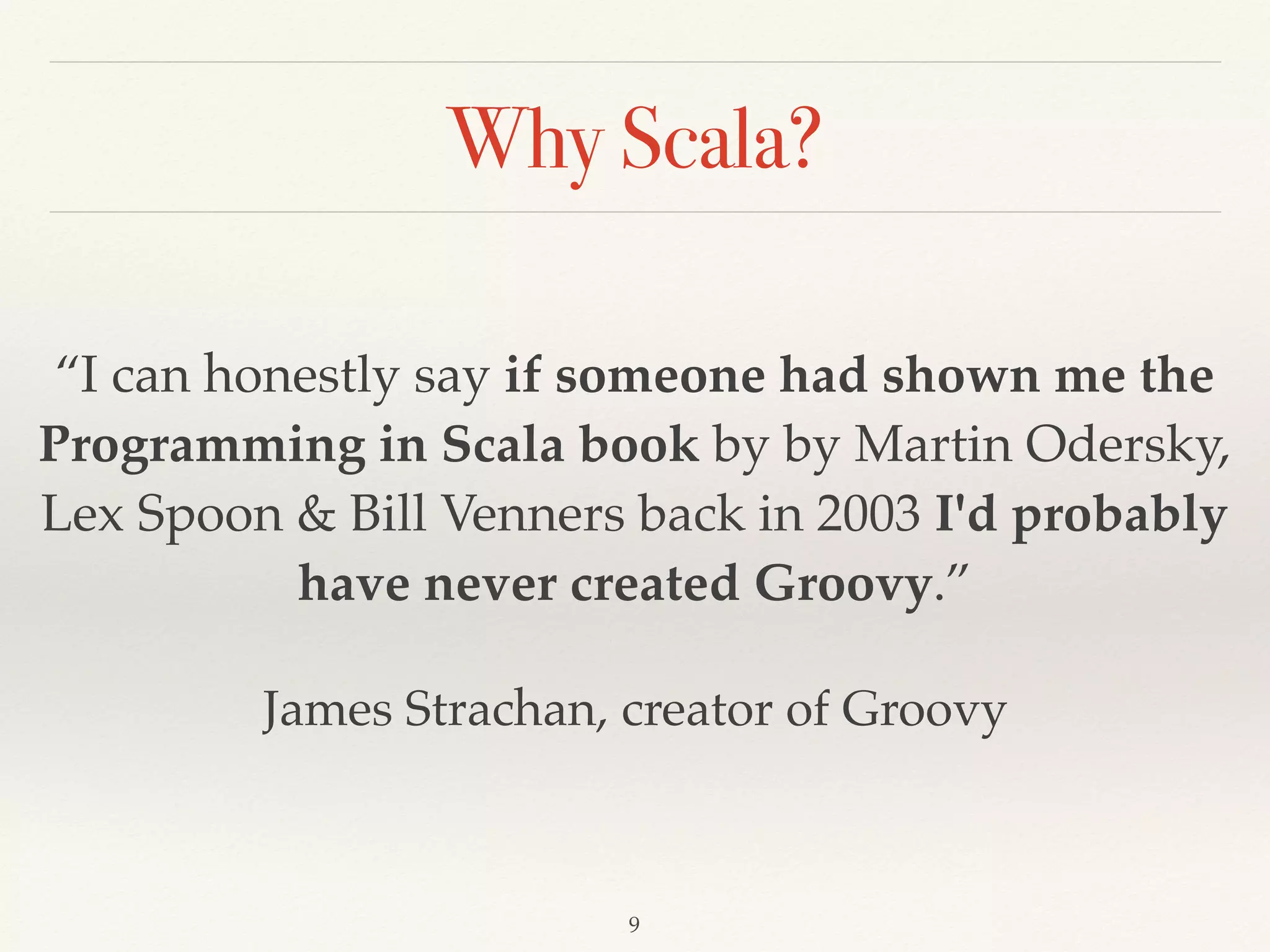
“I can honestly say if someone had shown
me the Programming in Scala book by
Martin Odersky, Lex Spoon & Bill Venners
back in 2003 I'd probably have never
created Groovy.”
James Strachan, creator of Groovy
http://macstrac.blogspot.tw/2009/04/scala-as-long-term-replacement-for.html
Why Scala?
Introduction to Scala, Aleksandar Prokopec
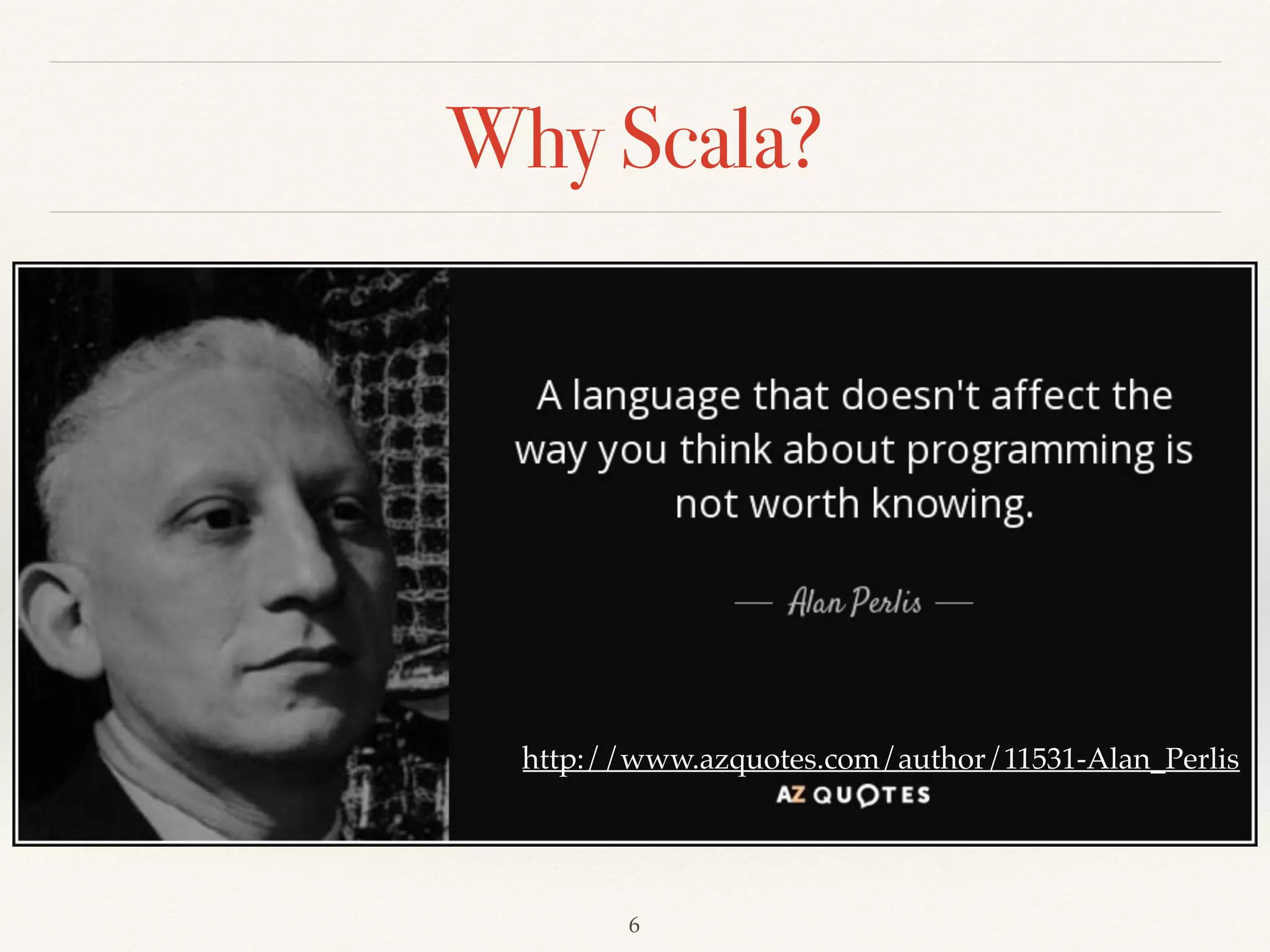
http://www.azquotes.com/author/11531-Alan_Perlis
Why Scala?
Introduction to Scala, Aleksandar Prokopec
http://www.azquotes.com/author/11531-Alan_Perlis
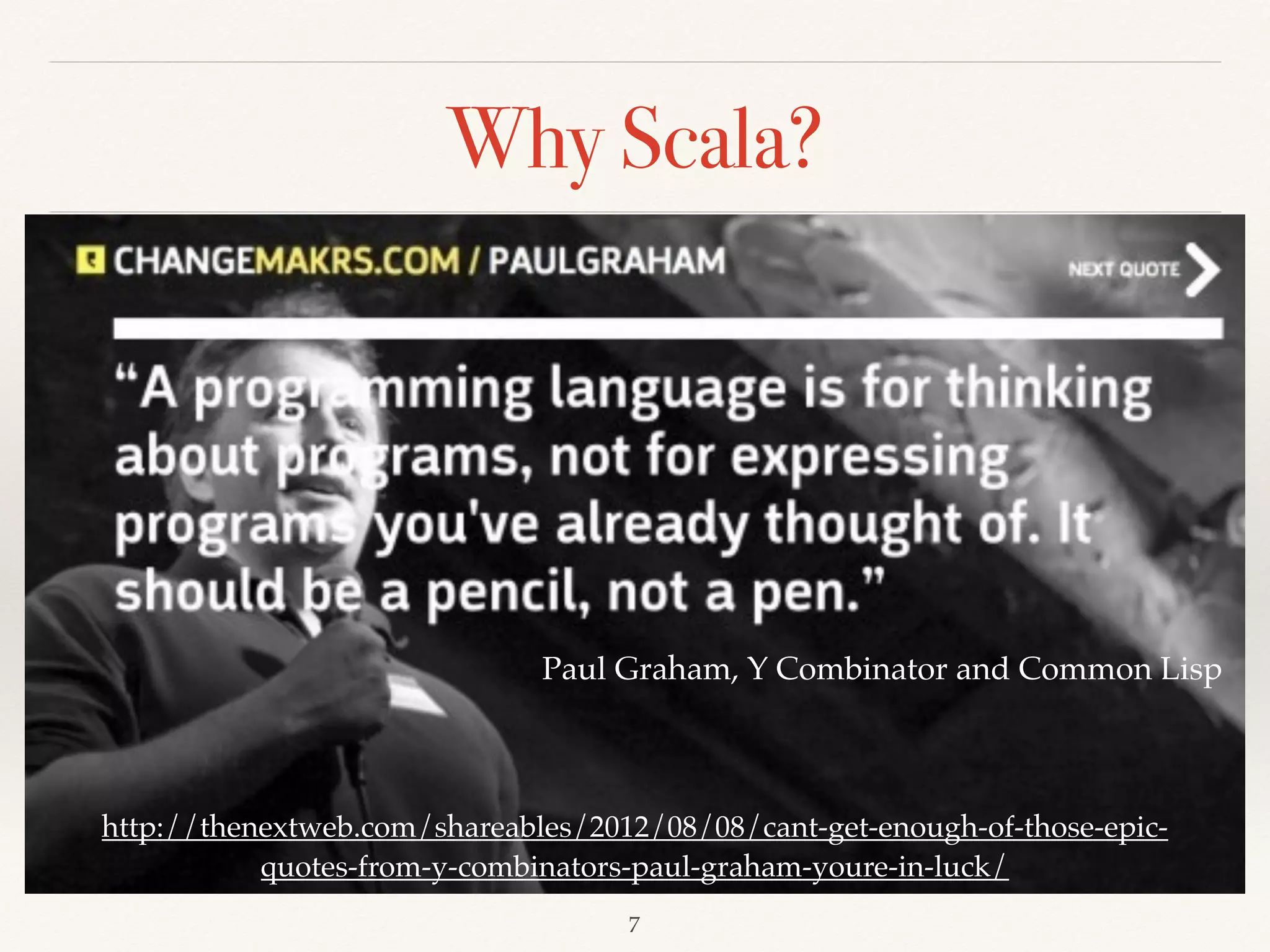
http://thenextweb.com/shareables/2012/08/08/cant-get-enough-of-those-epic-quotes-from-y-
combinators-paul-graham-youre-in-luck/
Why Scala?
Introduction to Scala, Aleksandar Prokopec
http://www.azquotes.com/author/11531-Alan_Perlis
http://thenextweb.com/shareables/2012/08/08/cant-get-enough-of-those-epic-quotes-from-y-
combinators-paul-graham-youre-in-luck/
High productive with type safety, more APIs than Java, and
almost same performance with Java
Scala concept
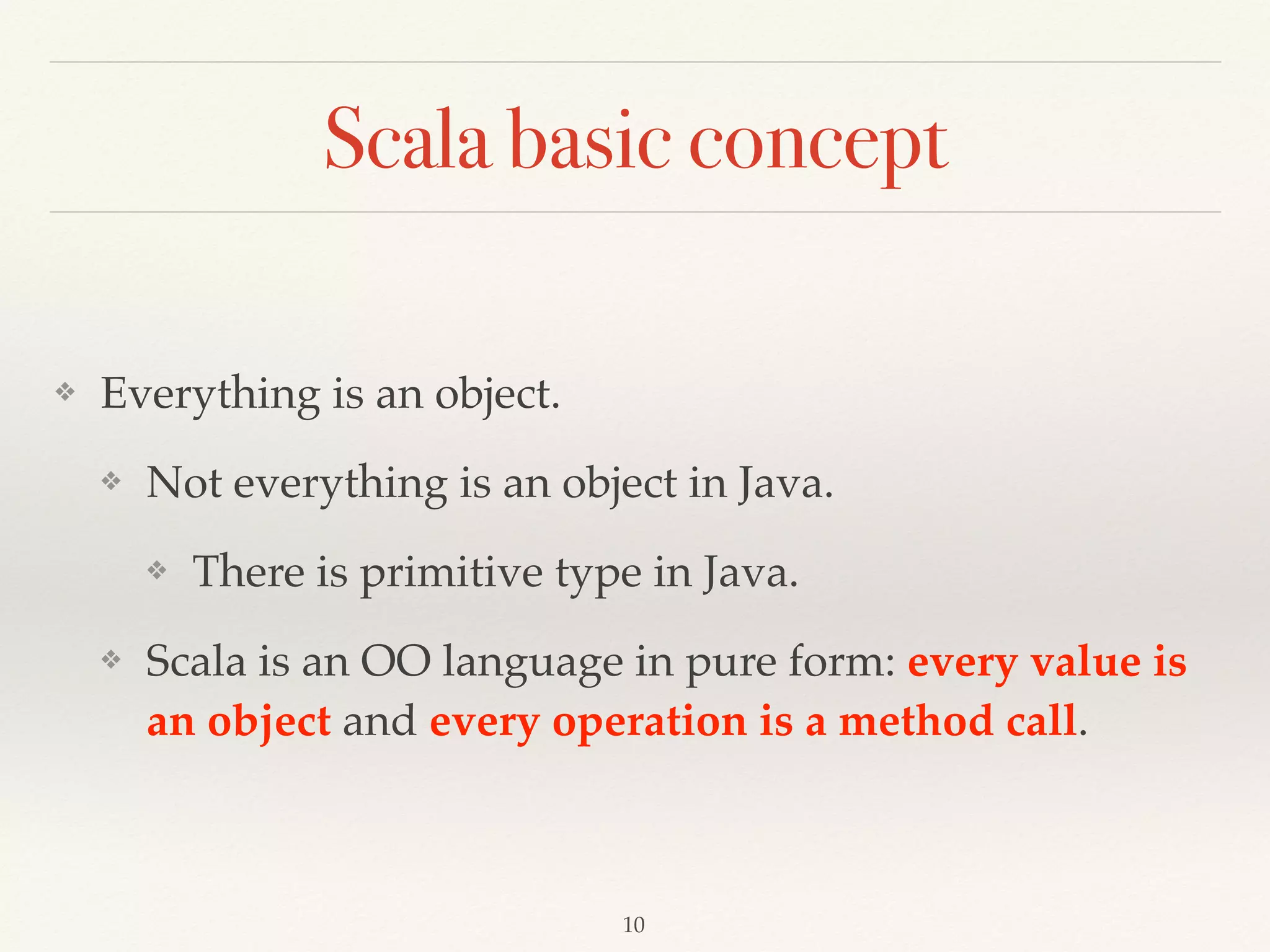
❖ Everything is an object.
❖ Not everything is an object in Java.
❖ There is primitive type in Java.
❖ int, float, boolean, char…etc
❖ Scala is an object-oriented language in pure form: every
value is an object and every operation is a method call.
❖ Numeric types and Function are object too.
❖ “+”, “-”, “*”, “/” are methods too.
Scala Class Hierarchy
Scala concept
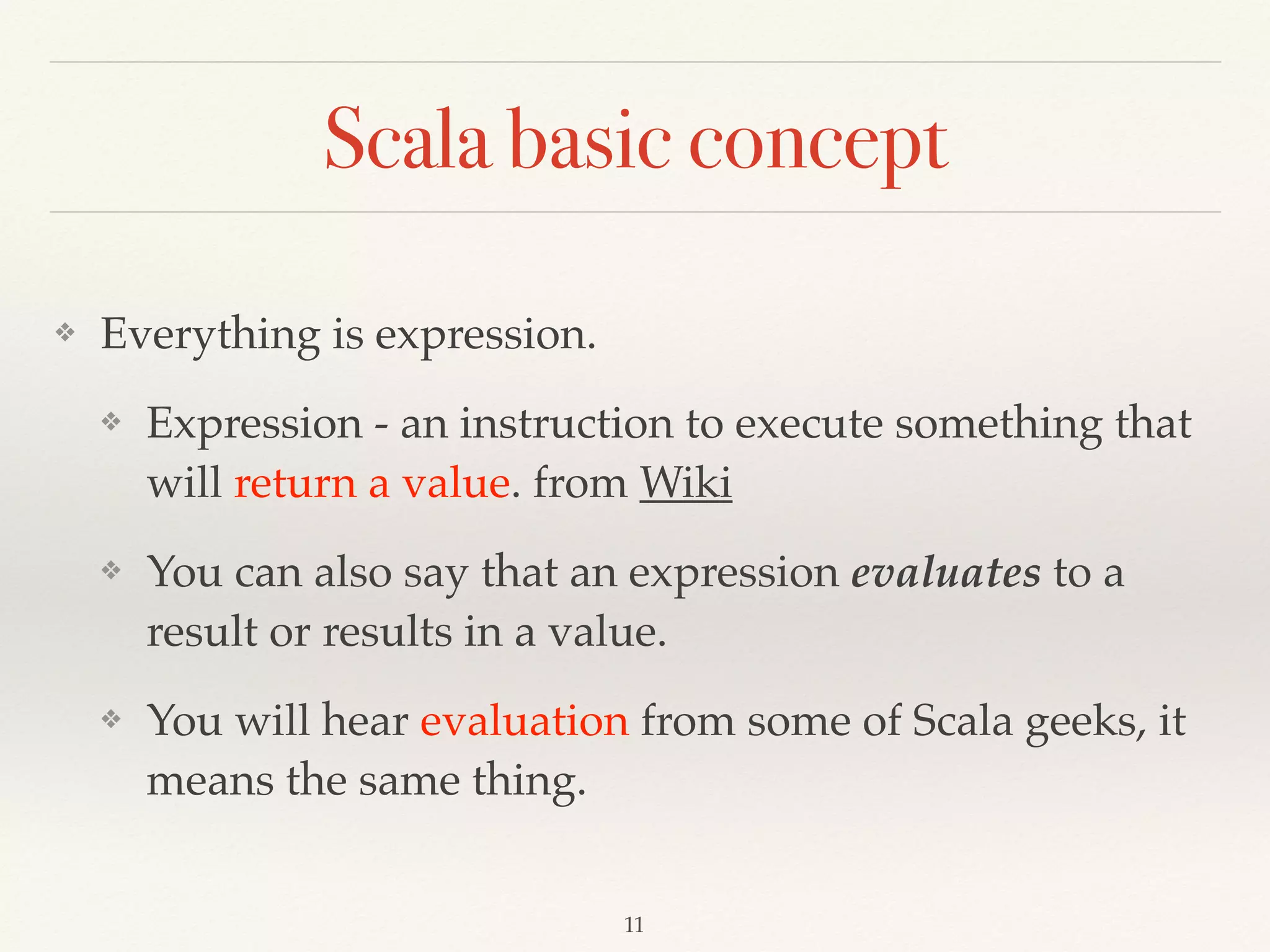
❖ Everything is expression.
❖ Expression - an instruction to execute something that
will return a value. from Wiki
❖ You can also say that an expression evaluates to a result
or results in a value.
❖ You will hear evaluation from some of Scala geeks, it
means the same thing.
Scala concept
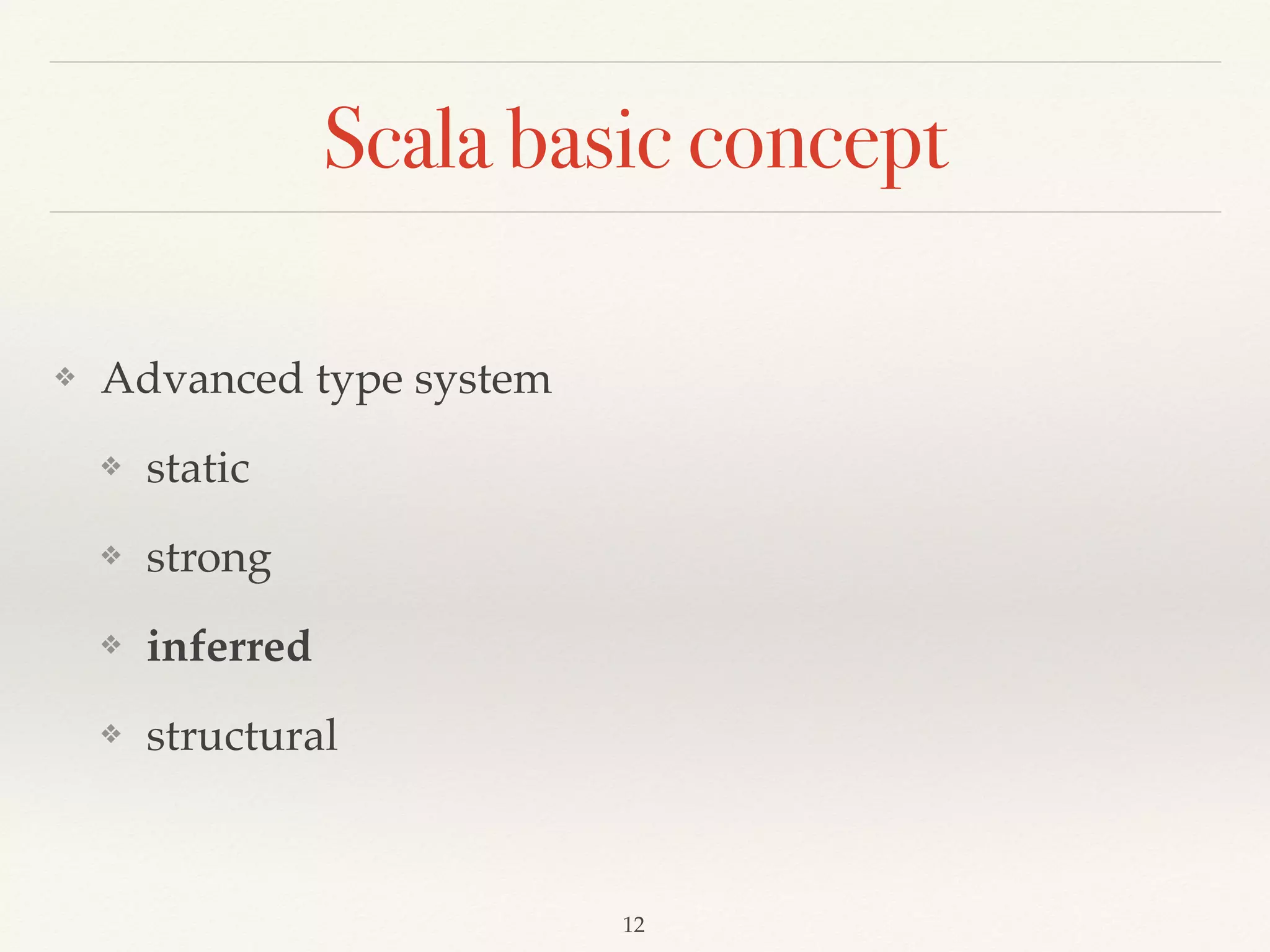
❖ Advanced type system
❖ static
❖ strong
❖ inferred
❖ structural
Scala concept
❖ Avoid to use null.
❖ Less error prone.
❖ NullPointerException
❖ You don’t need to use Null Object pattern.
Program with Scala(Main)
object Demo1 {

val todayEvent = "JCConf"

val workshop = "Introduction to Scala"

lazy val fun = (0 to 4).map(x => "fun").mkString(" ")


def main(args: Array[String]): Unit = {

println("Hello everybody!")

print("Welcome to " + todayEvent + "!n")

println("I hope you can enjoy this workshop - "

+ workshop + ". :P")

print("Scala is so much " + fun + "!")

}

}
Object with main method.
Demo1
Program with Scala(App)
object Demo2 extends App {

val todayEvent = "JCConf"

val workshop = "Introduction to Scala"

lazy val fun =

(0 to 4).map(x => "fun").mkString(" ")


println("Hello everybody!")

print("Welcome to " + todayEvent + "!n")

println("I hope you can enjoy this workshop - "

+ workshop + ". :P")

print("Scala is so much " + fun + "!")

}
Object with App trait.
Demo2
Program with Scala(REPL)
❖ REPL - Read-Evaluate-Print Loop
Program with Scala(REPL)
❖ $ scala -Dscala.color
Program with Scala(Worksheet)
❖ Work with worksheet.
❖ IntelliJ
❖ https://www.jetbrains.com/help/idea/2016.2/
working-with-scala-worksheet.html
❖ Scala IDE or Eclipse with Scala plugin
❖ https://www.youtube.com/watch?v=Forl4hpg7kA
Imperative
❖ var, val, semicolons
❖ If expressions
❖ def
❖ Block expressions
❖ While-Loop
❖ For-Loop
❖ Nested Function
❖ Recursion vs Tail-recursion
❖ Concept of Pattern Matching
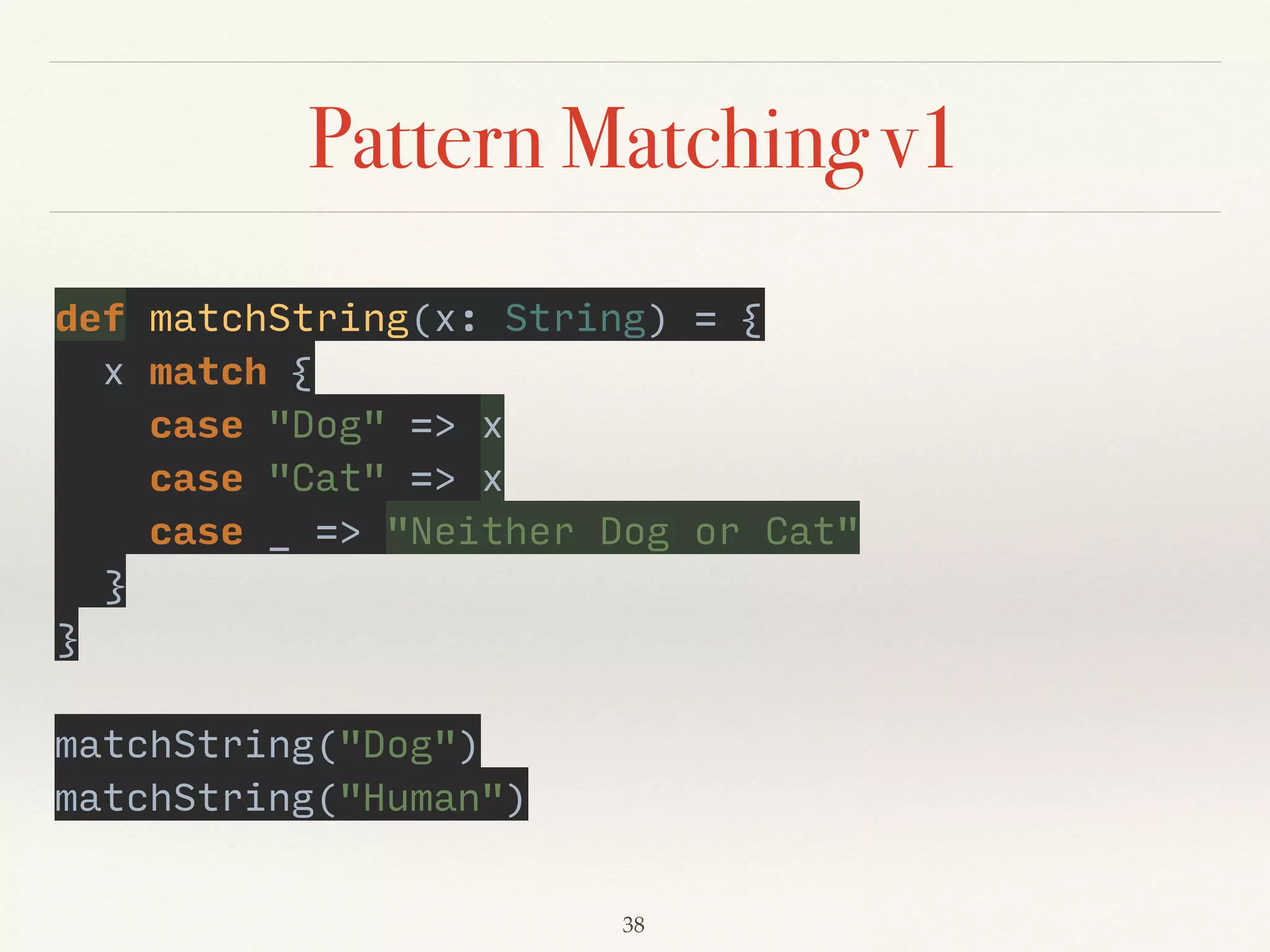
❖ Pattern Matching v1
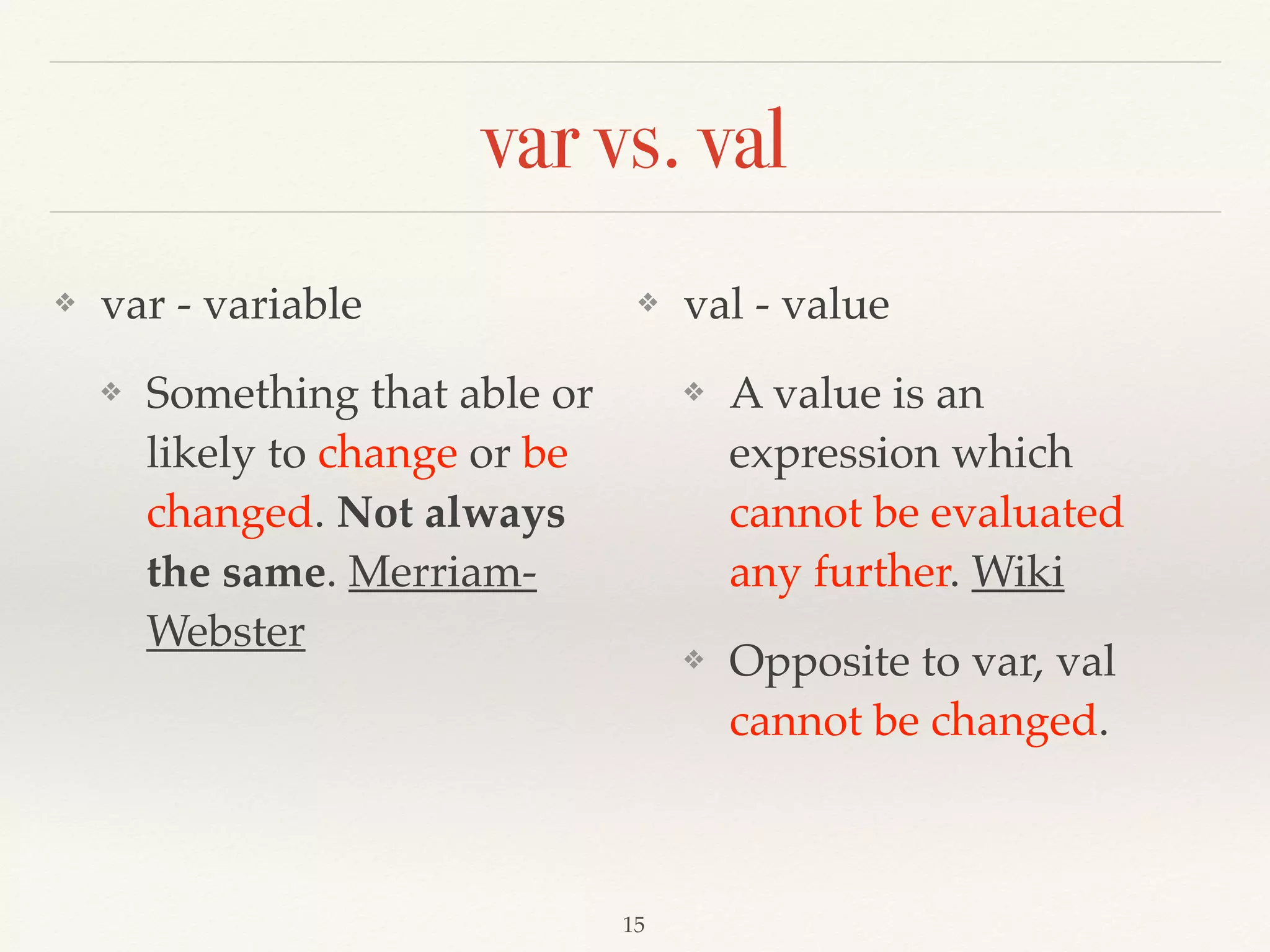
var vs. val
❖ var - variable
❖ Something that able or
likely to change or be
changed. Not always
the same. Merriam-
Webster
❖ val - value
❖ A value is an expression
which cannot be
evaluated any further.
Wiki
❖ Opposite to var, val
cannot be changed.
❖ It’s similar to final in
Java.
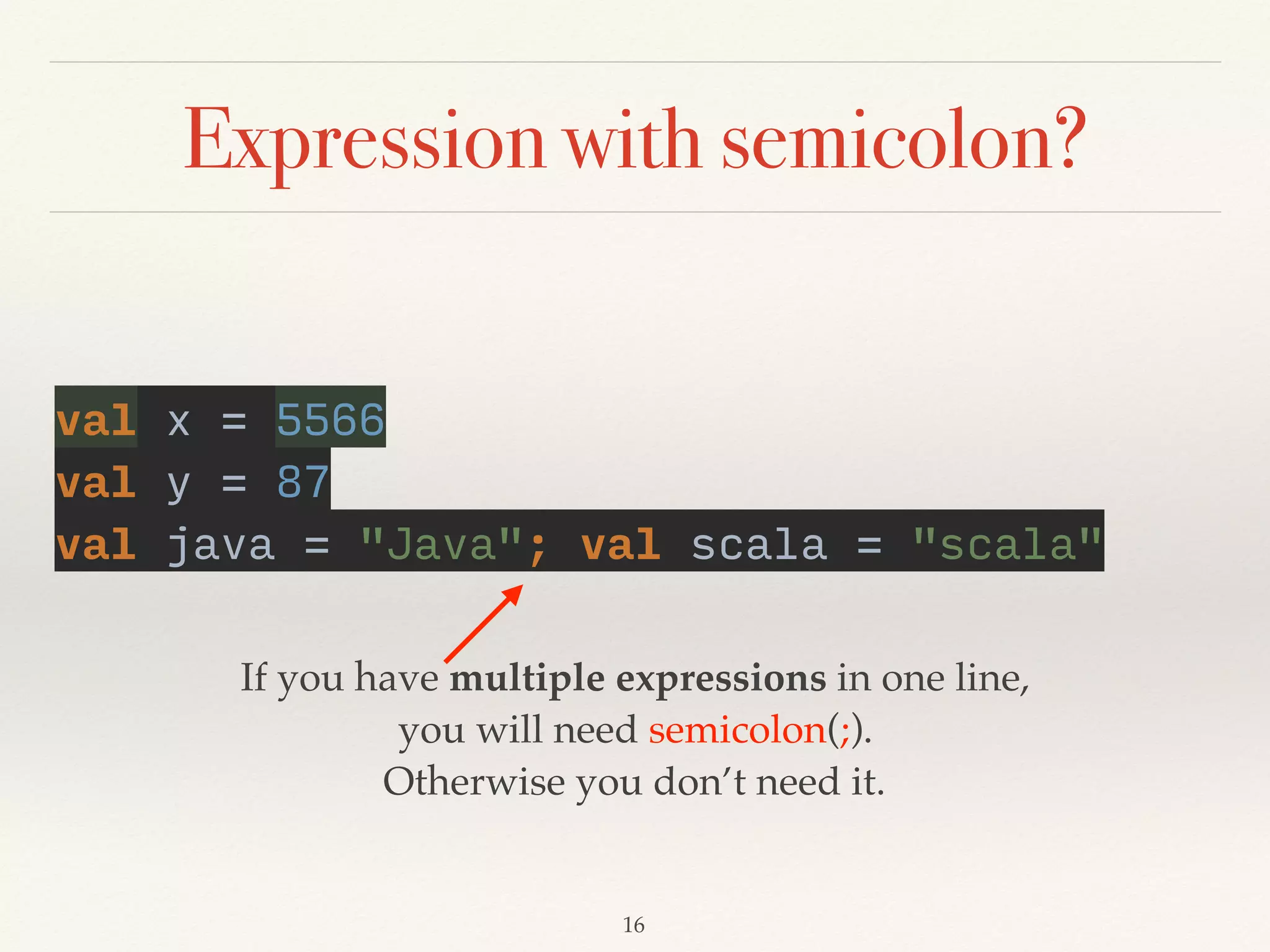
Expression with semicolon?
val x = 5566

val y = 87

val java = "Java"; val scala = "scala"
If you have multiple expressions in one line,

you will need semicolon(;).

Otherwise you don’t need it.
Demo01
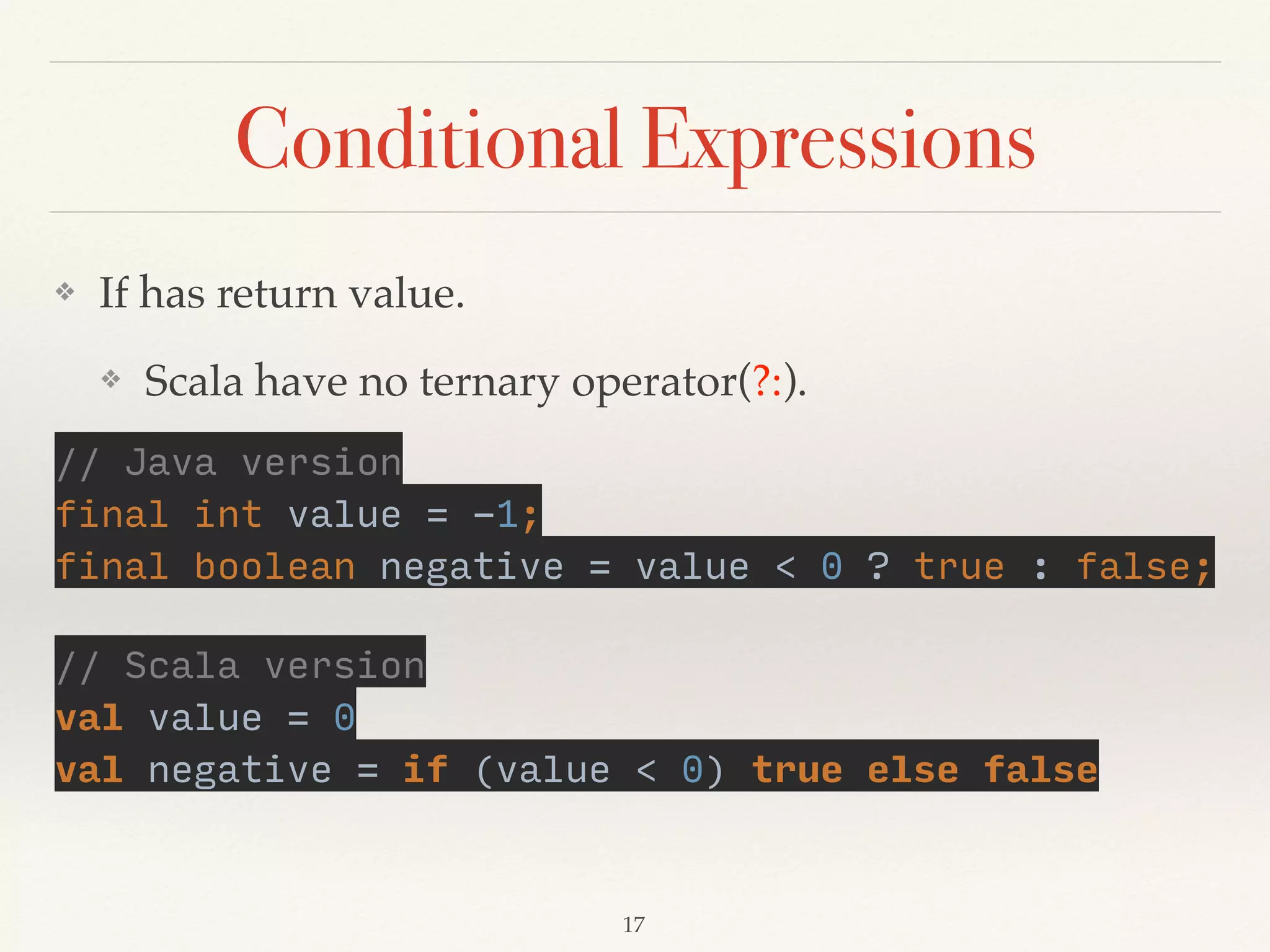
If expressions
❖ If has return value.(expression)
❖ Scala have no ternary operator(?:).
// Java version

final int value = -1;

final boolean negative = value < 0 ? true : false;
// Scala version

val value = 0

val negative = if (value < 0) true else false
Everything is an expression.
Demo02
def
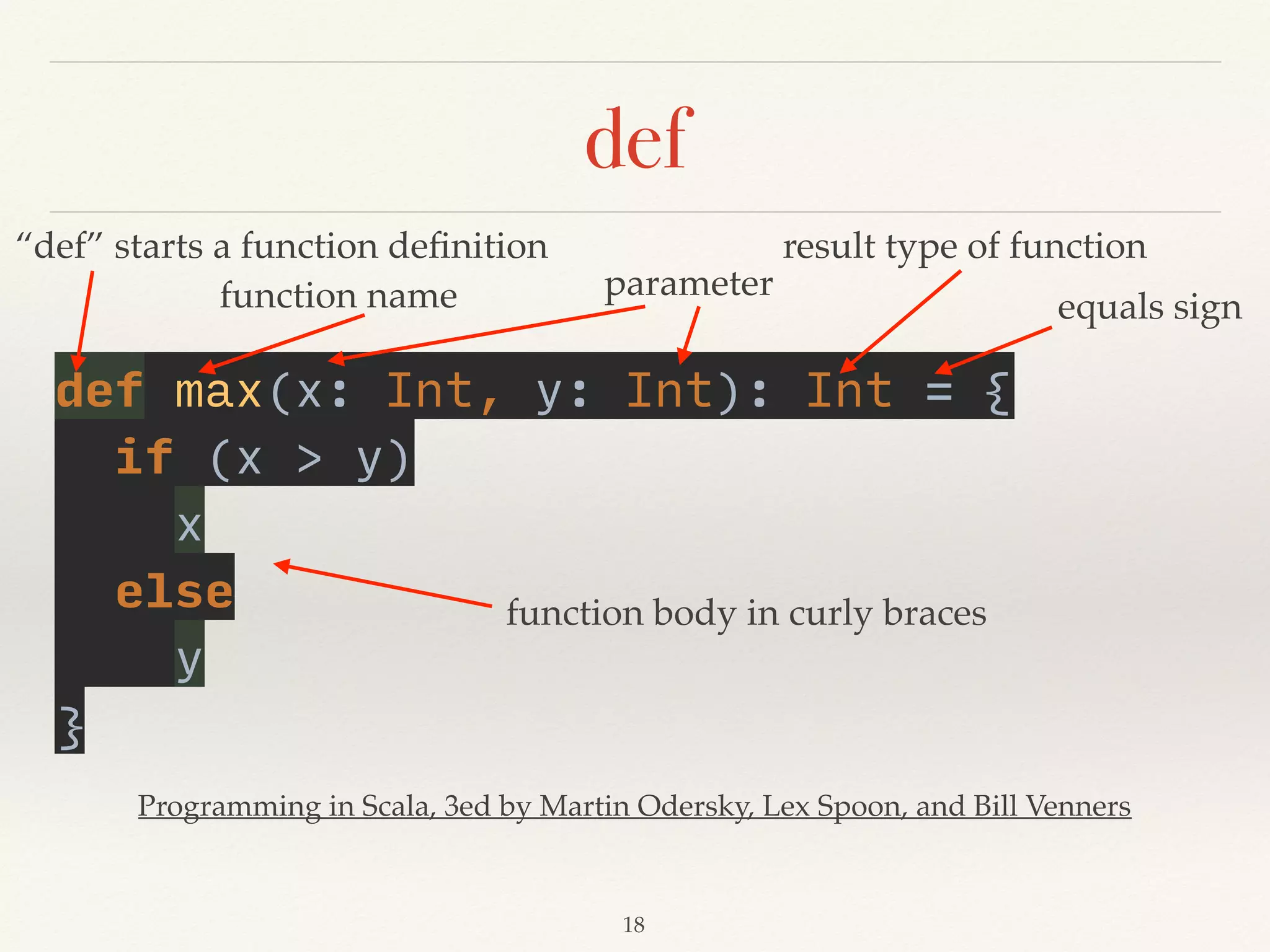
def max(x: Int, y: Int): Int = {

if (x > y)

x

else

y

}
Programming in Scala, 3ed by Martin Odersky, Lex Spoon, and Bill Venners
“def” starts a function definition
function name parameter
result type of function
equals sign
function body in curly braces
Demo03
def
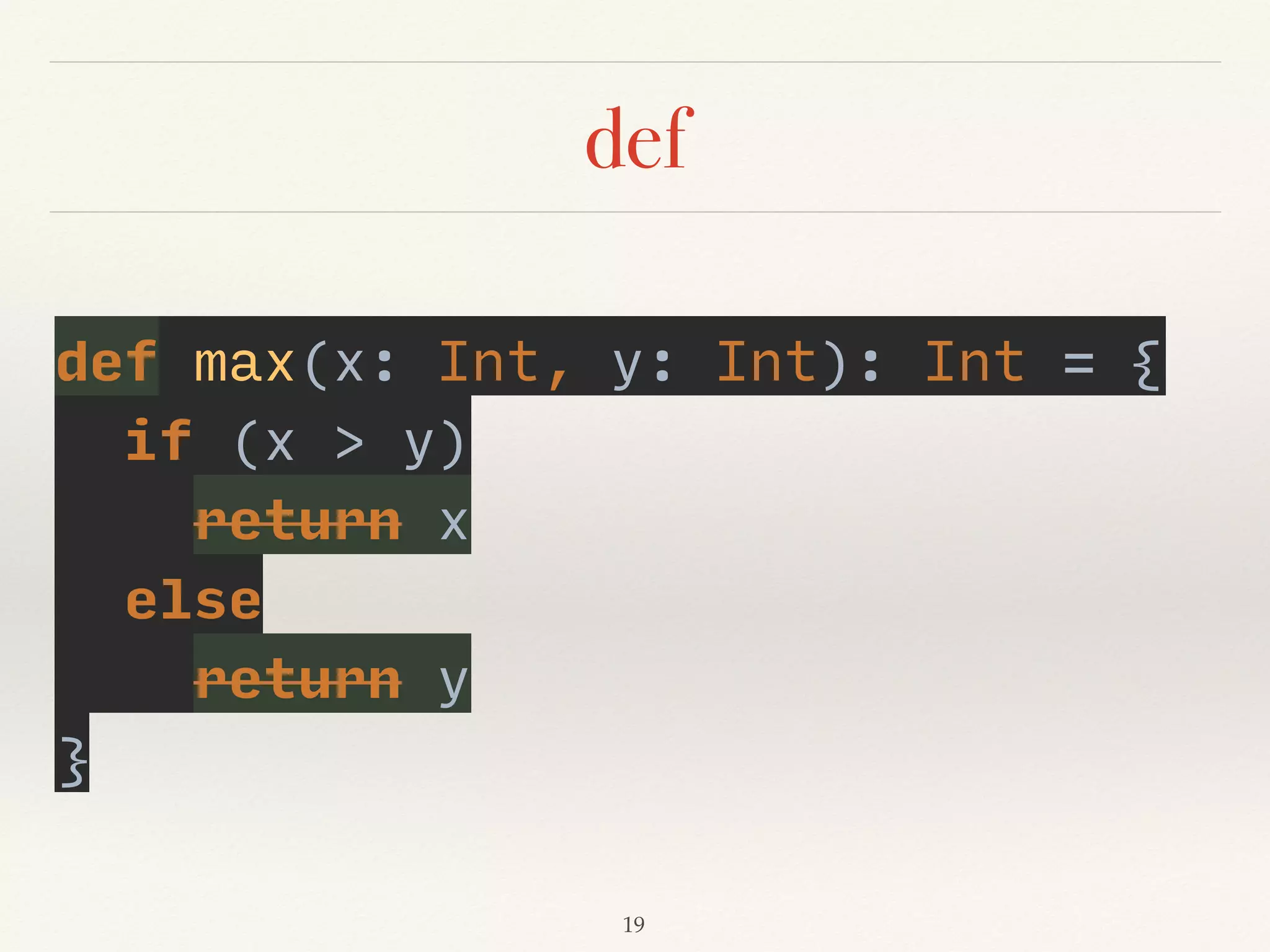
def max(x: Int, y: Int): Int = {

if (x > y)

return x

else

return y

}
Demo04
def
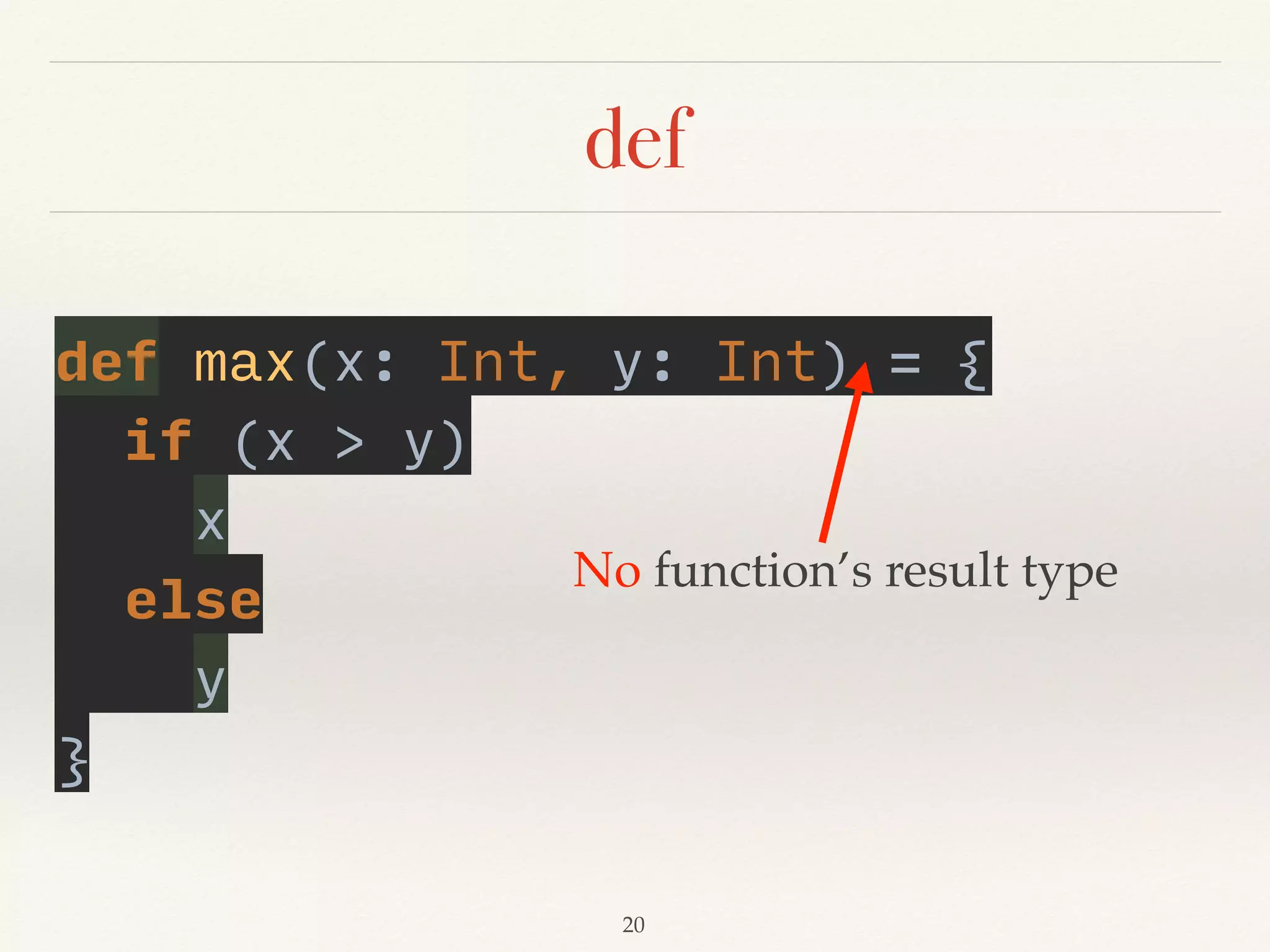
def max(x: Int, y: Int) = {

if (x > y)

x

else

y

}
No function’s result type
Demo05
def
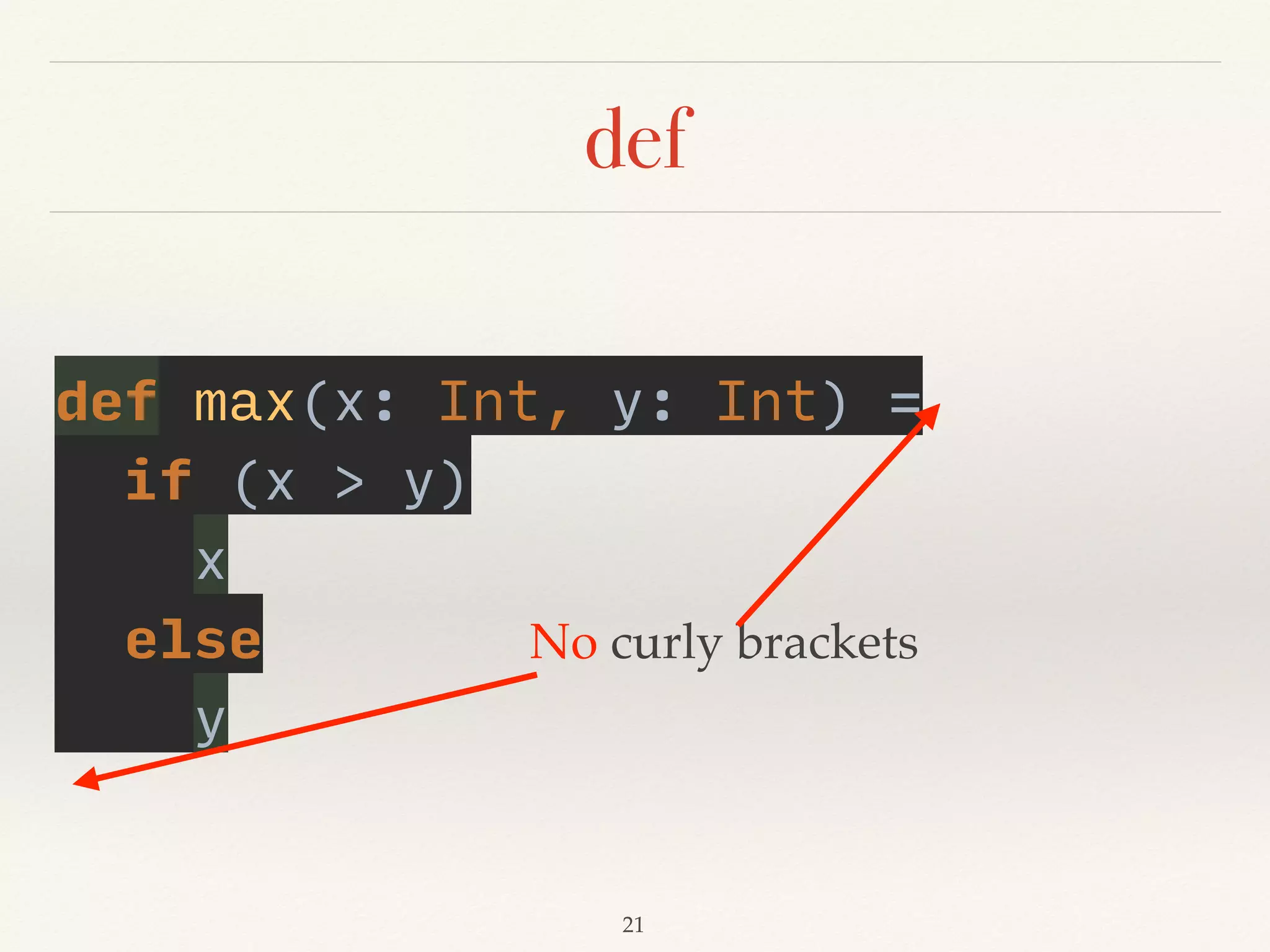
def max(x: Int, y: Int) =

if (x > y)

x

else

y
No curly brackets
Demo06
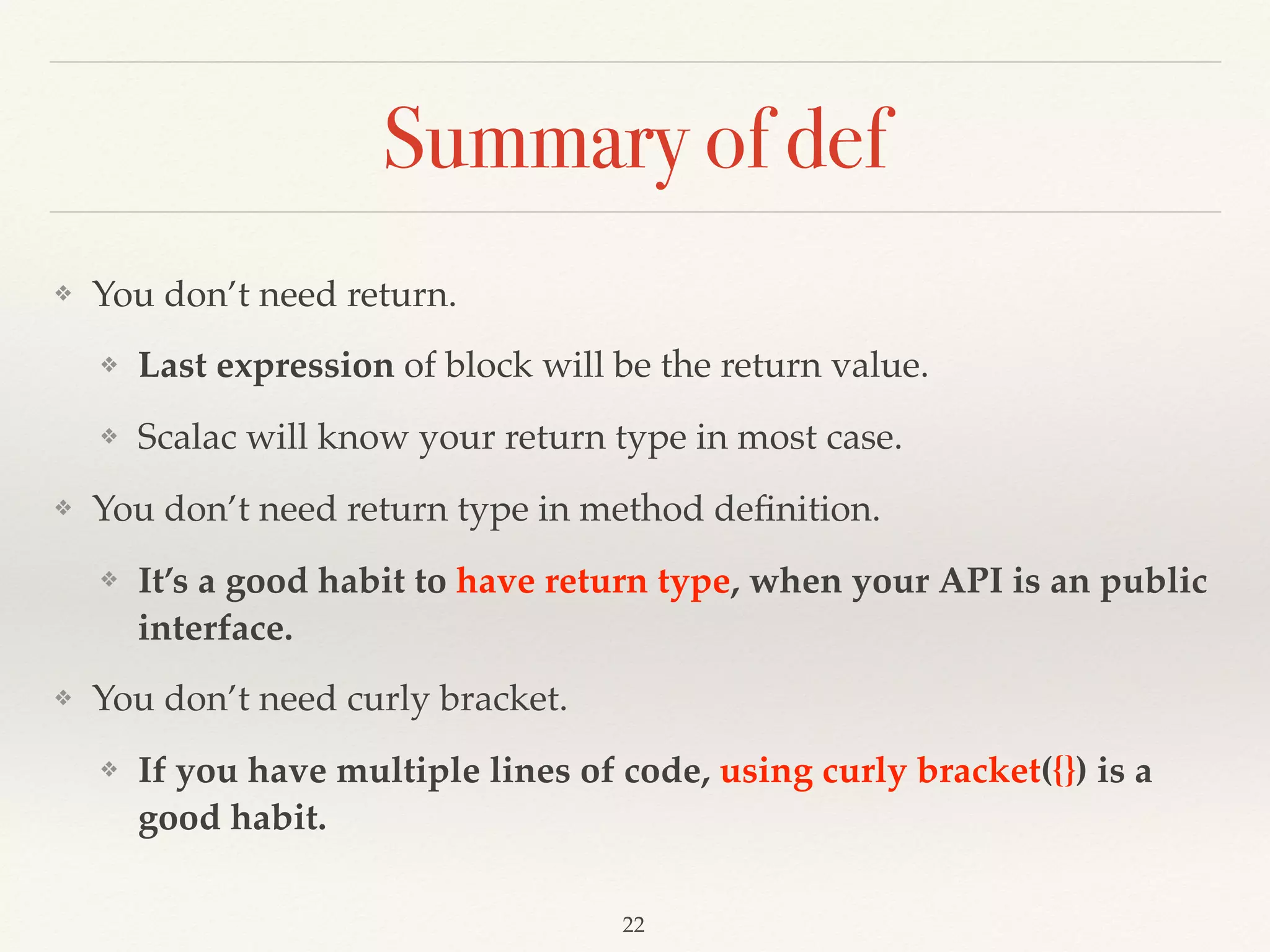
Summary of def
❖ You don’t need return.
❖ Last expression of block will be the return value.
❖ You don’t need return type in method definition.
❖ Scalac will know your return type in most case.
❖ It’s a good habit to have return type, when your API is a
public interface.
❖ You don’t need curly bracket.
❖ If you have multiple lines of code, using curly bracket({})
is a good habit.
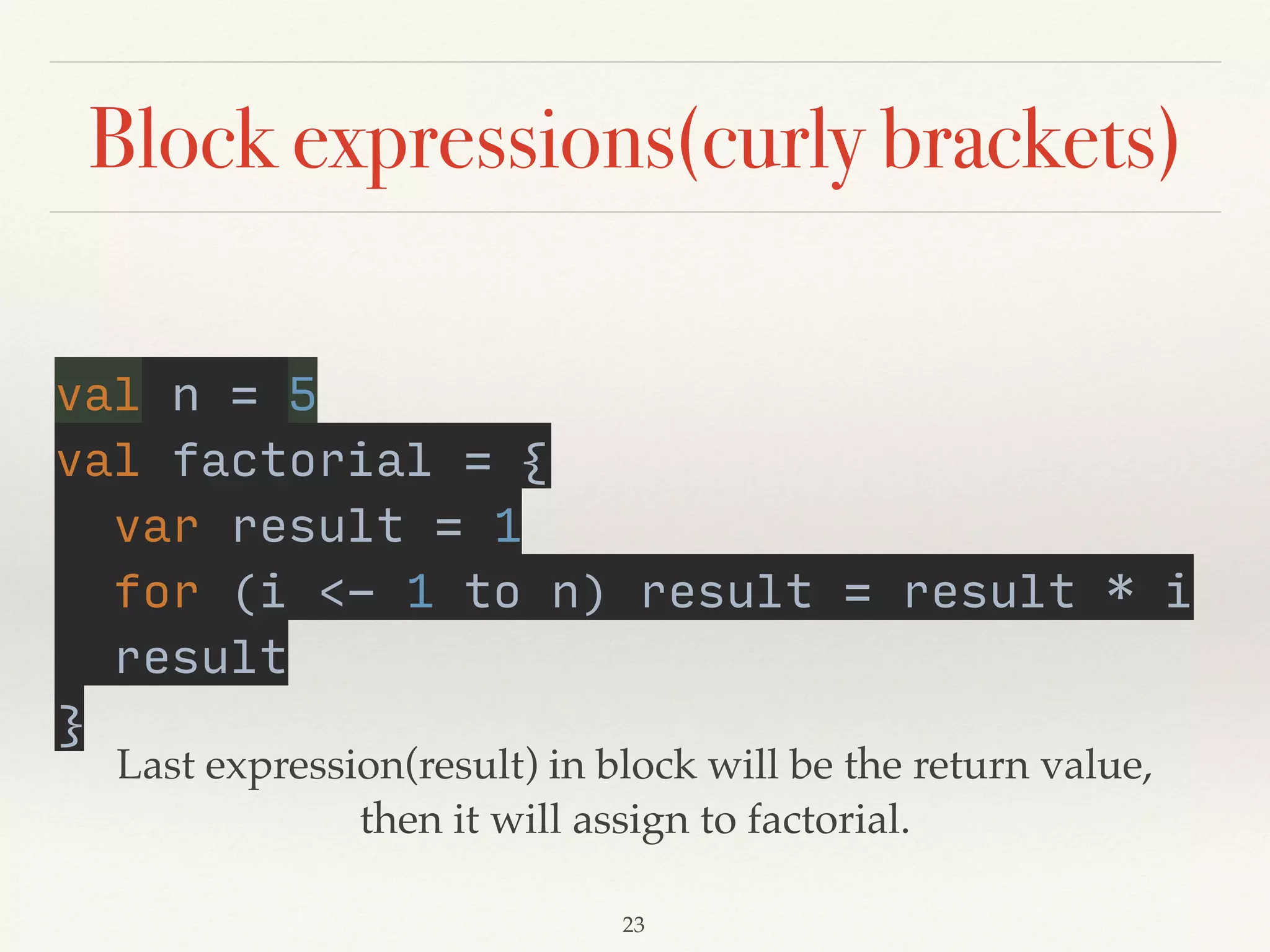
Block expressions(curly brackets)
val n = 5

val factorial = {

var result = 1

for (i <- 1 to n)

result = result * i

result

}
Last expression(result) in block will be the return value,
then it will assign to factorial.
Demo07
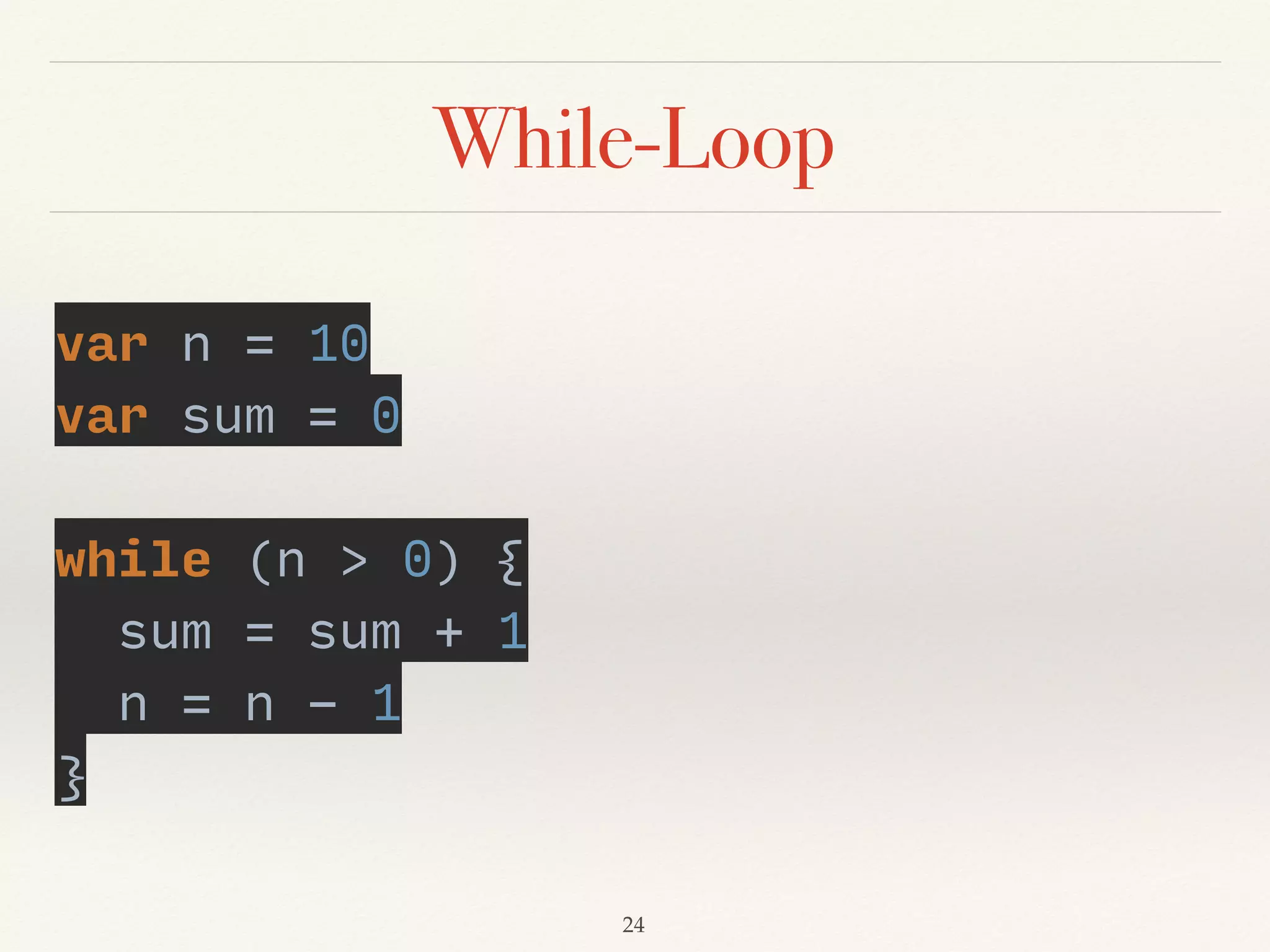
While-Loop
var n = 10

var sum = 0


while (n > 0) {

sum = sum + 1

n = n - 1

}
Demo08
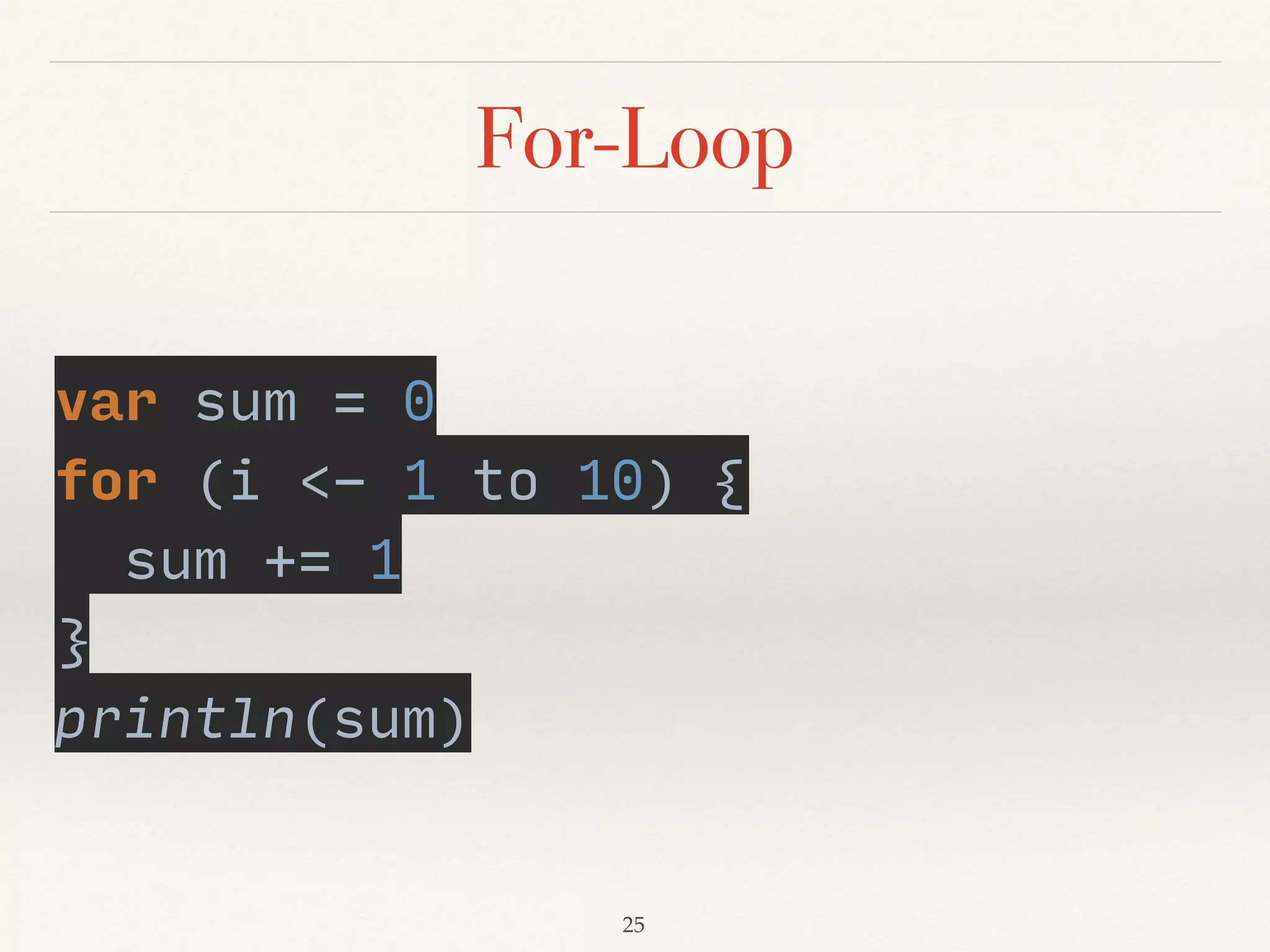
For-Loop
var sum = 0

for (i <- 1 to 10) {

sum += 1

}

println(sum)
Demo09
For-Loop
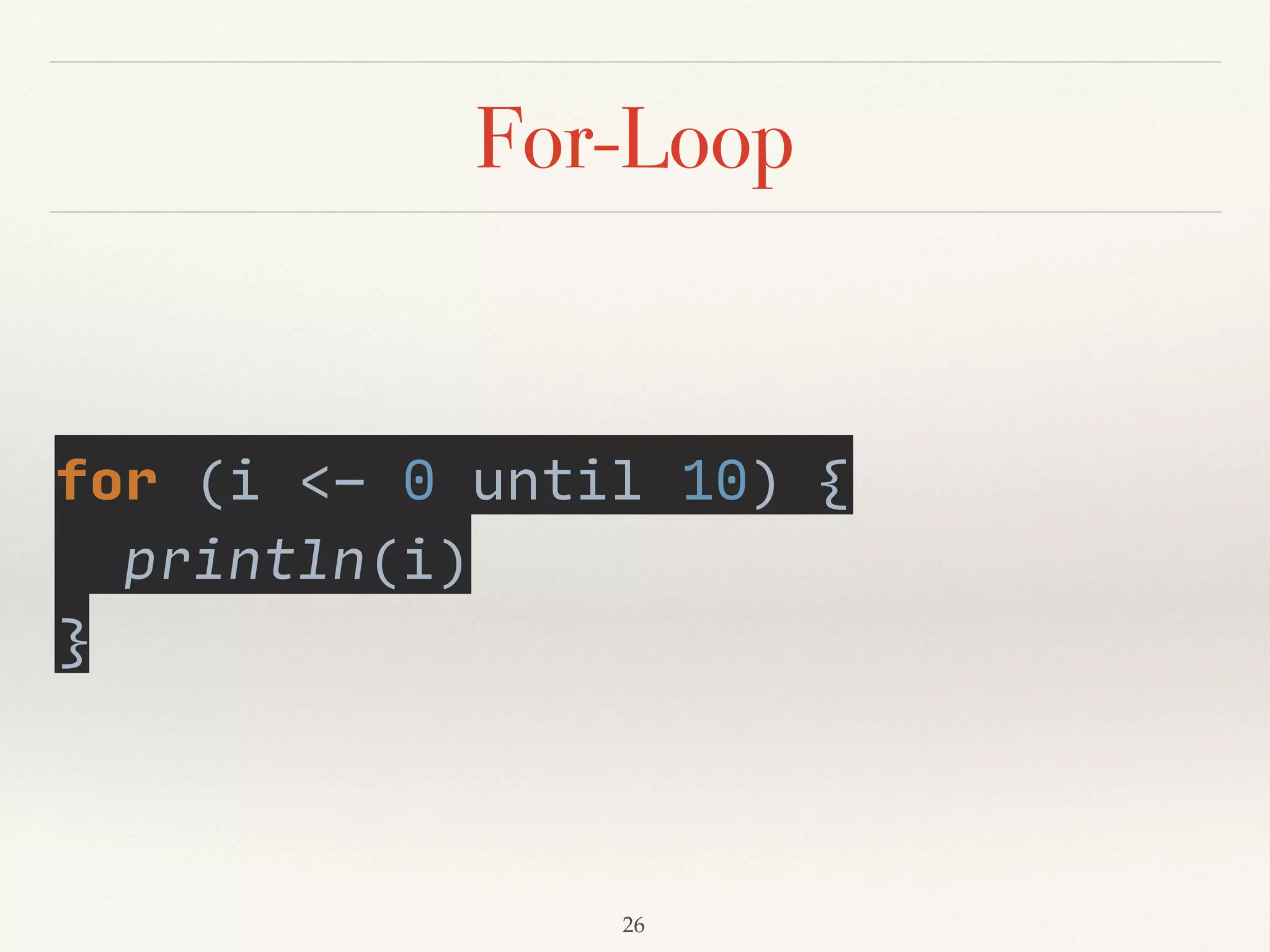
for (i <- 0 until 10) {

println(i)

}
Demo10
For-Loop
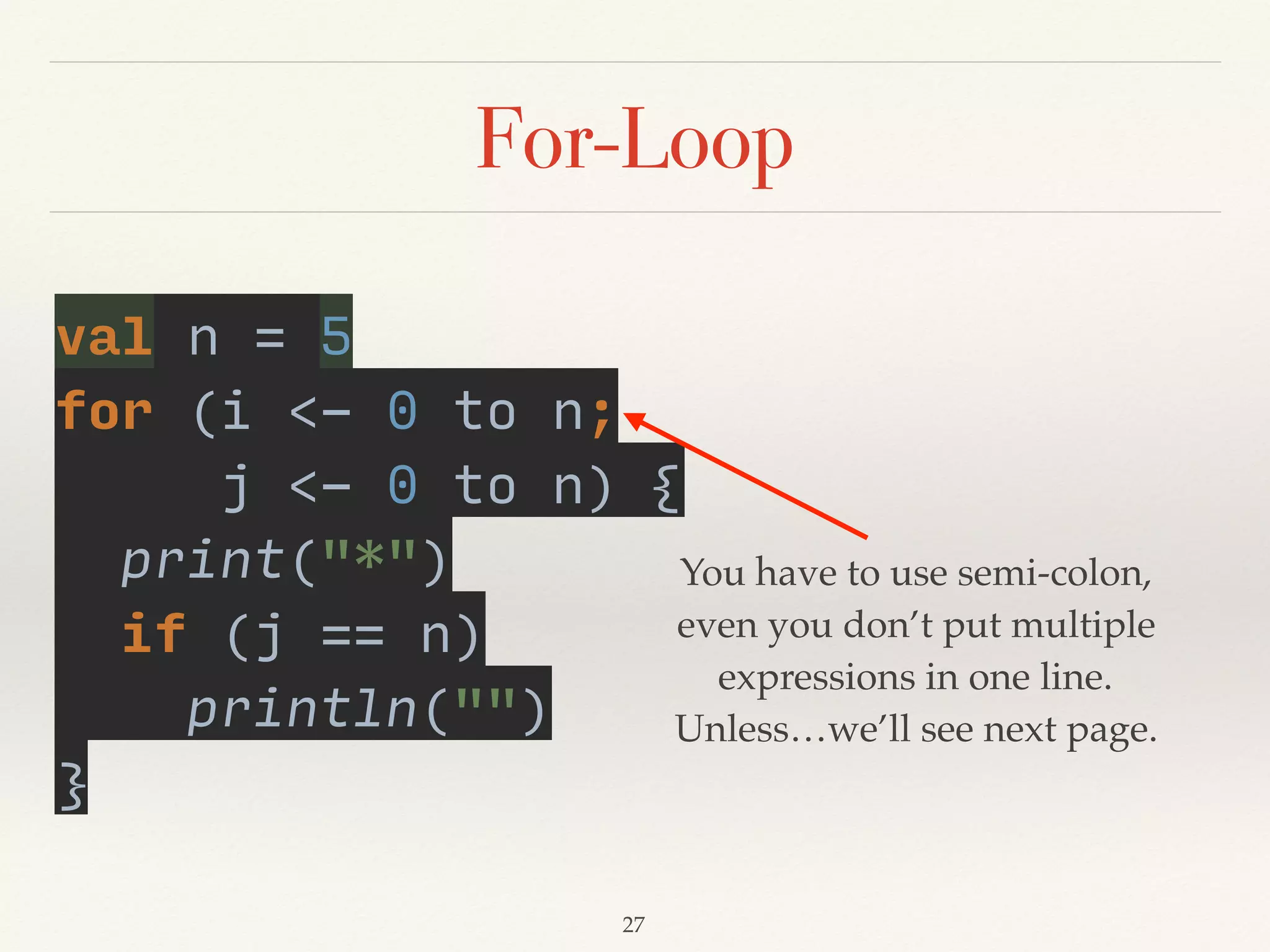
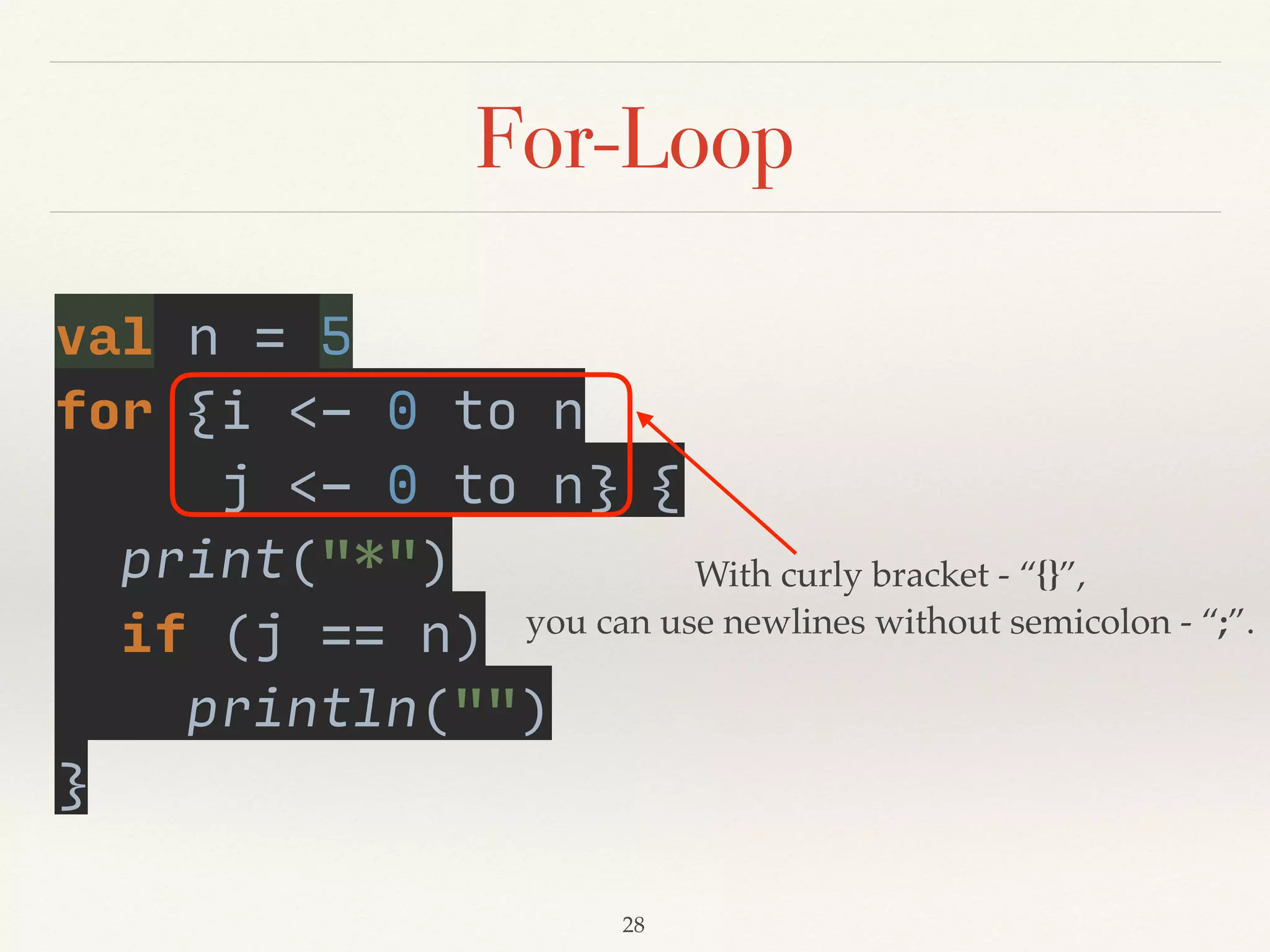
for (i <- 0 to n; j <- 0 to n) {

print("*")

if (j == n)

println("")

}
Demo11
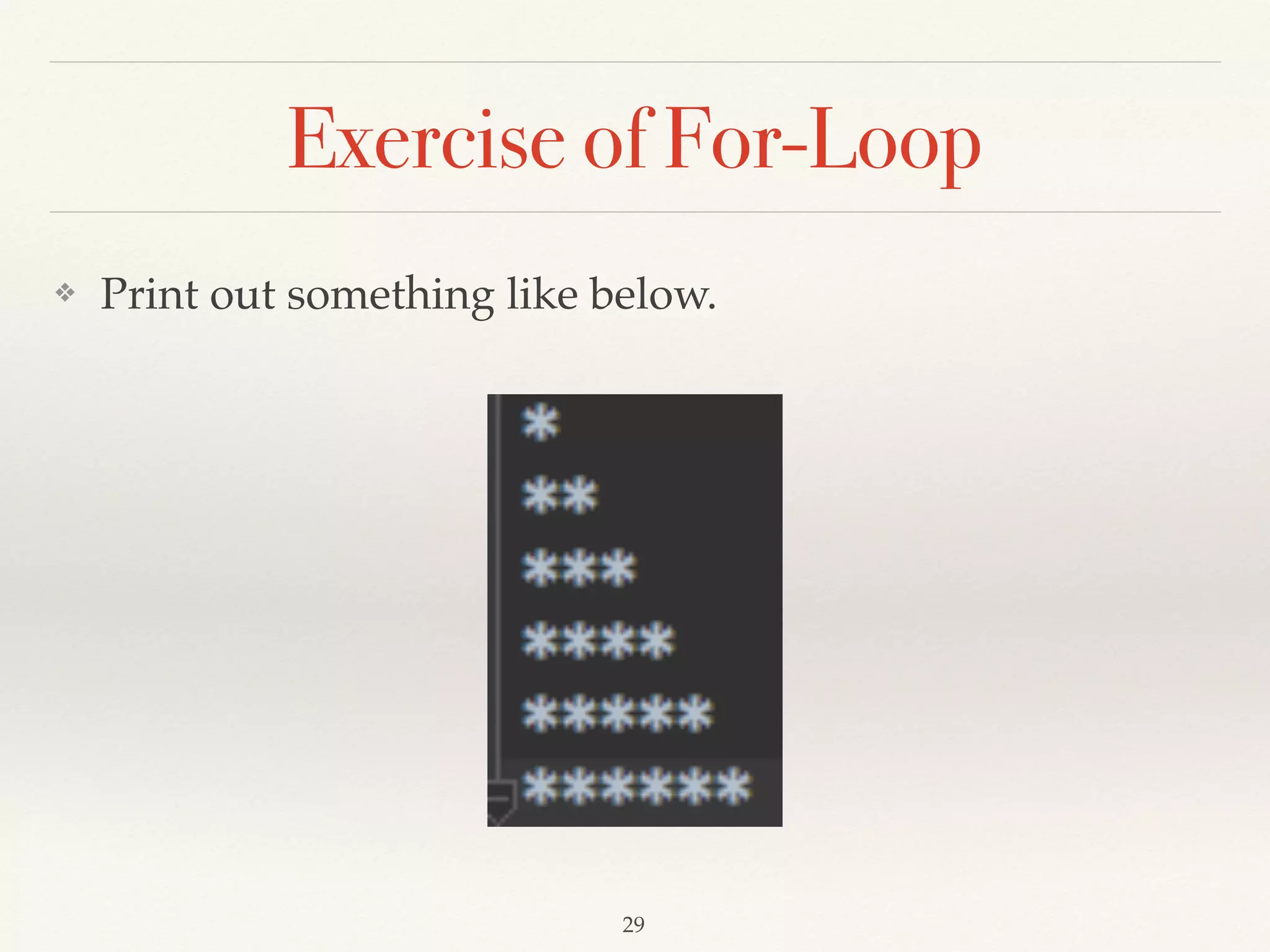
Exercise of For-Loop
❖ Print out something like below.
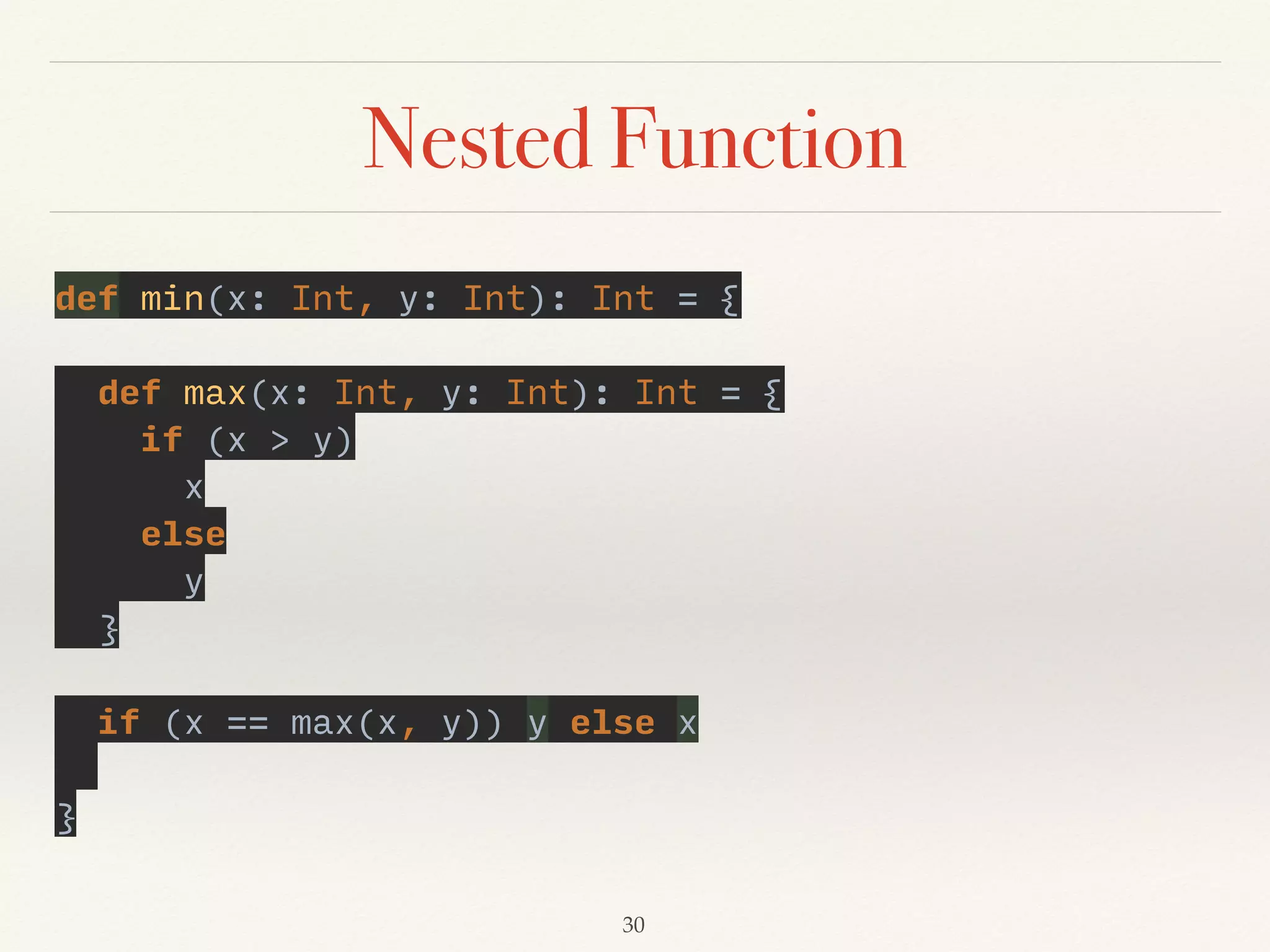
Nested Function
def min(x: Int, y: Int): Int = {

def max(x: Int, y: Int) = {

if (x > y) x

else y

}


if (x == max(x, y))

y

else

x

}
Demo12
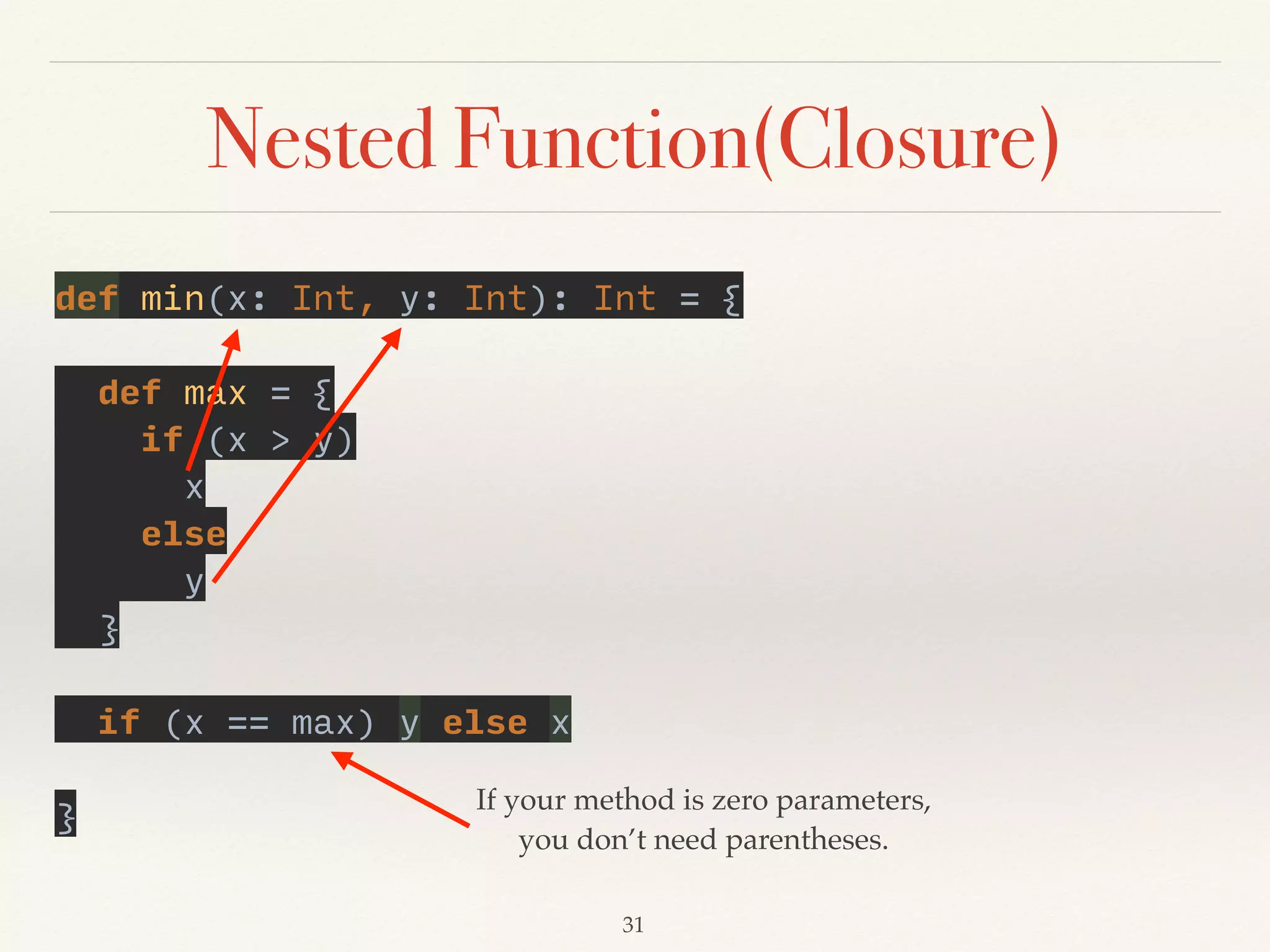
Nested Function(Closure)
def min(x: Int, y: Int): Int = {

def max = {

if (x > y) x

else y

}


if (x == max) y else x

} If your method is zero parameters,

you don’t need parentheses.
Demo13
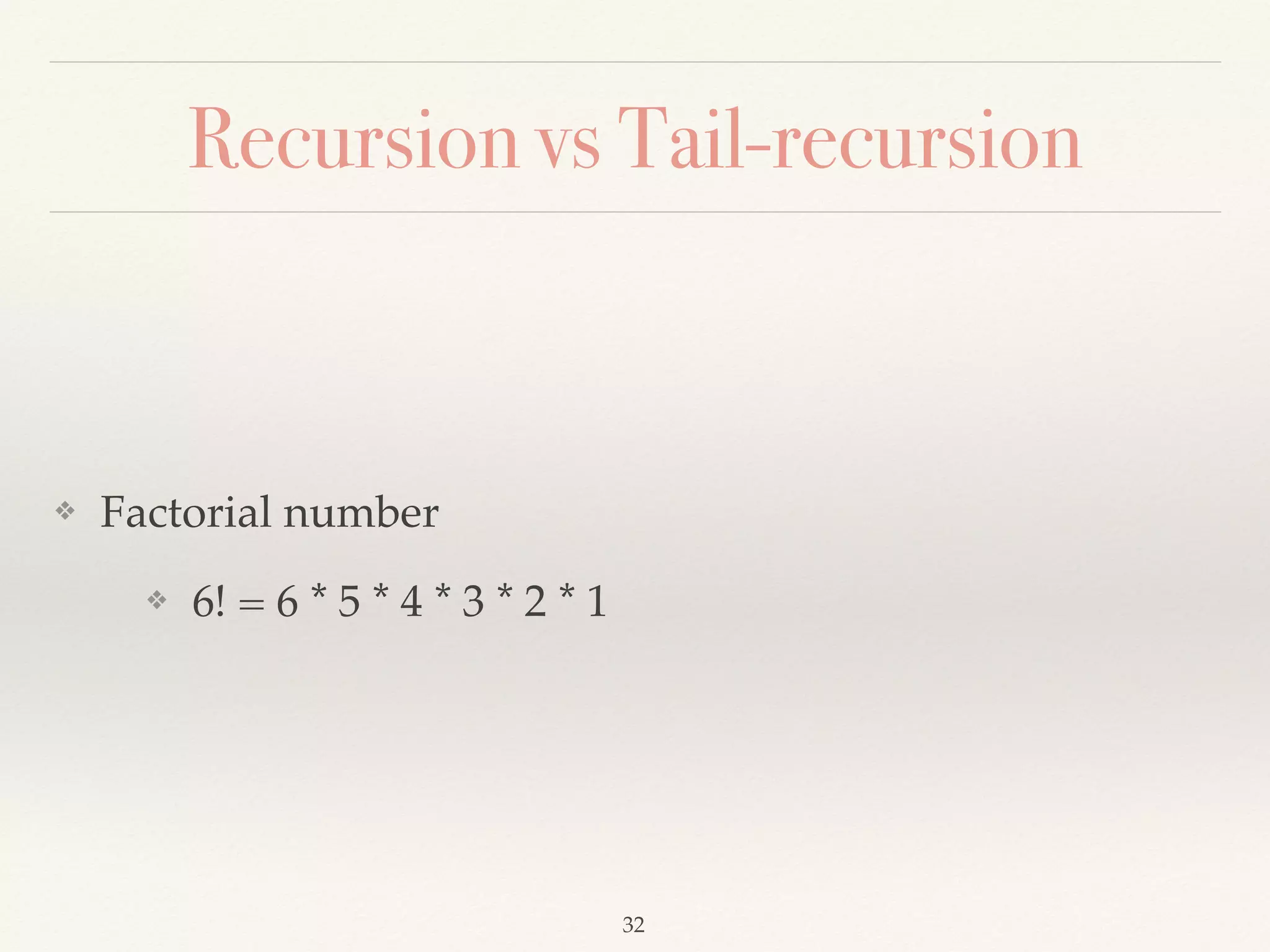
Recursion vs Tail-recursion
❖ Factorial number
❖ 6! = 6 * 5 * 4 * 3 * 2 * 1
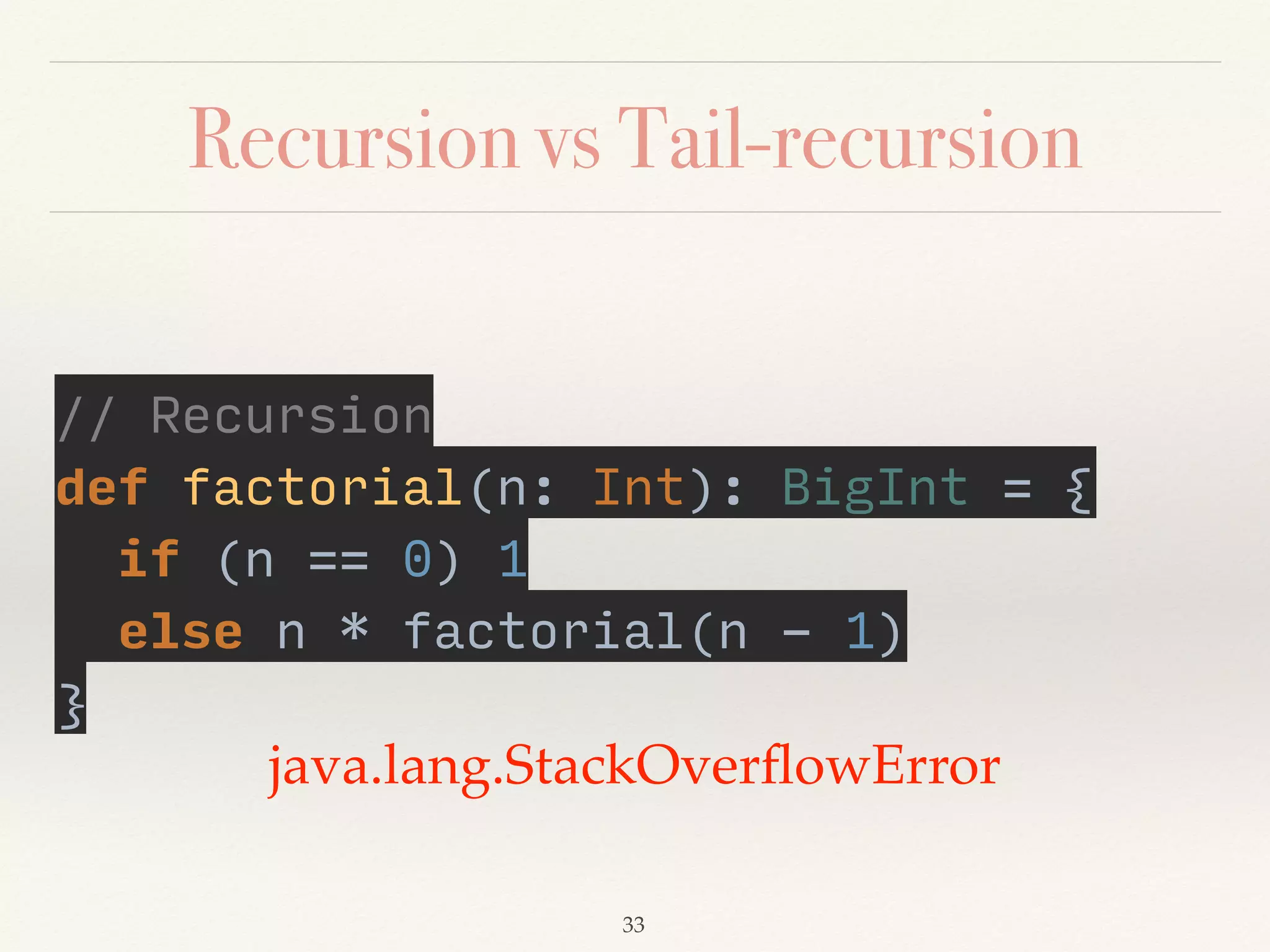
Recursion vs Tail-recursion
// Recursion

def factorial(n: Int): BigInt = {

if (n == 0) 1

else n * factorial(n - 1)

}


factorial(15000)
java.lang.StackOverflowError
Demo14
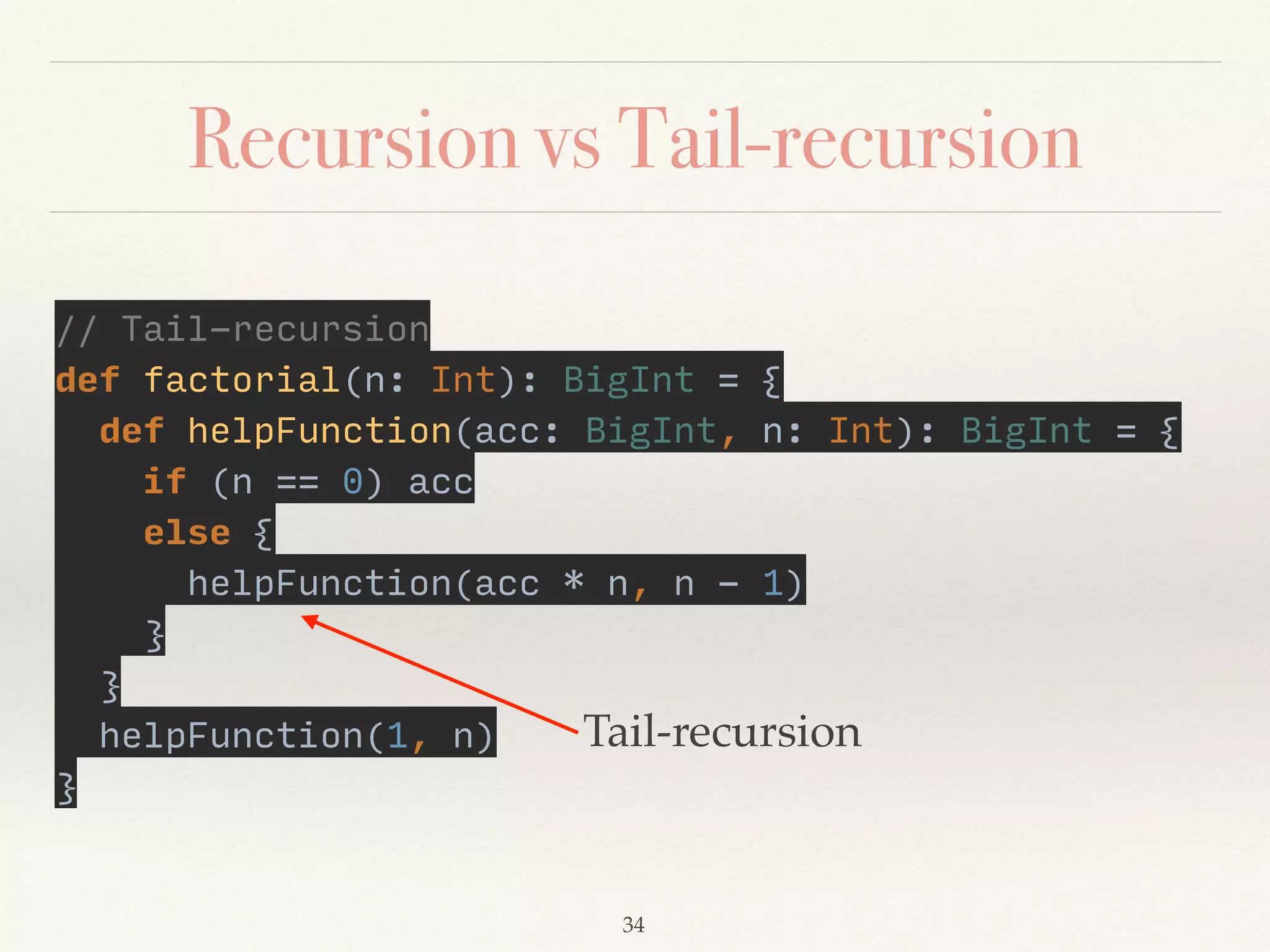
Recursion vs Tail-recursion
def factorial(n: Int): BigInt = {

// Tail-recursion

def helpFunction(acc: BigInt, n: Int): BigInt = {

if (n == 0)

acc

else

helpFunction(acc * n, n - 1)

}

helpFunction(1, n)

}


factorial(15000)
Scalac will translate tail-recursion to while-loop.
Tail-recursion
Demo15
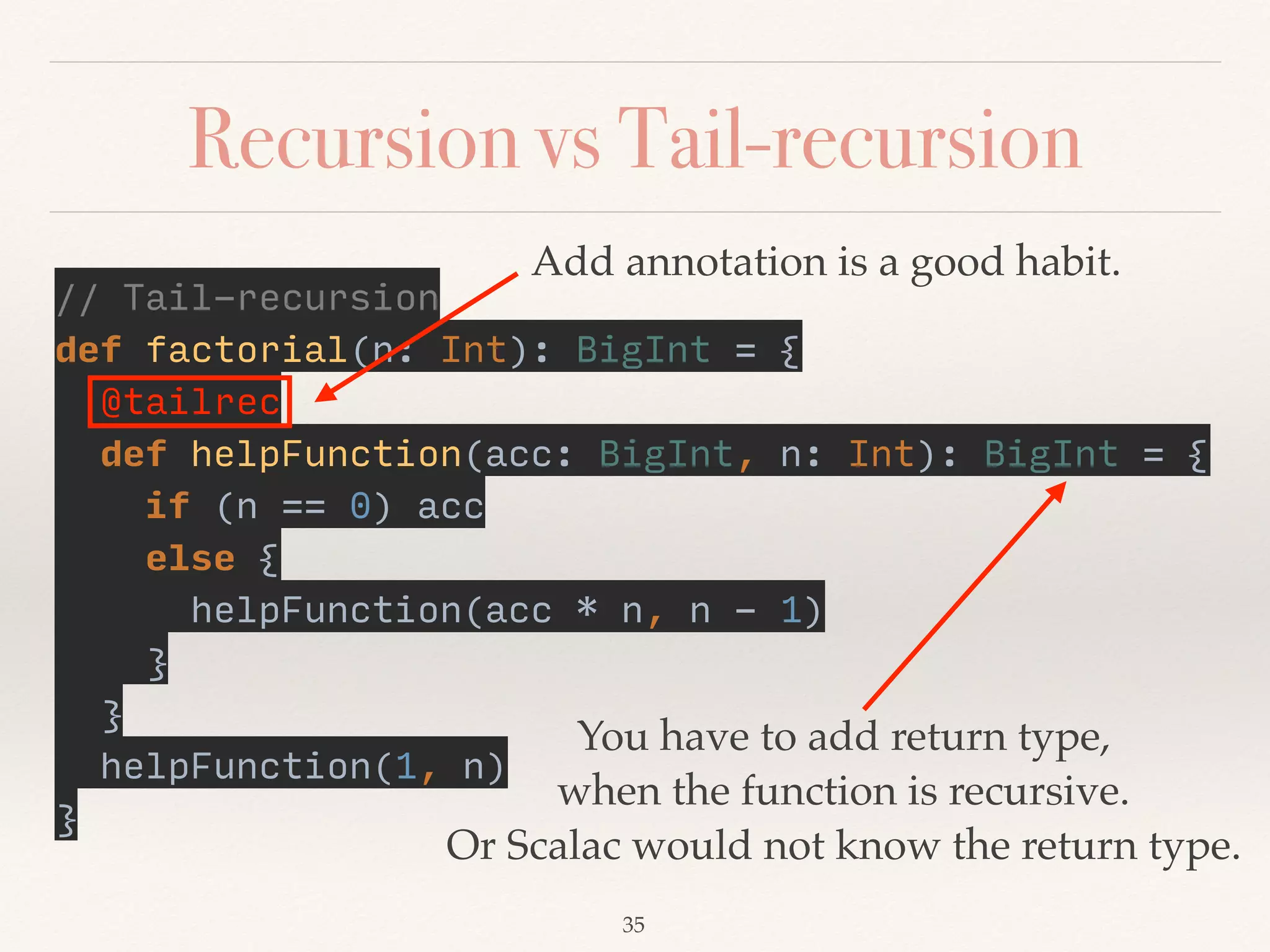
Recursion vs Tail-recursion
import scala.annotation.tailrec

def factorial(n: Int): BigInt = {

@tailrec

def helpFunction(acc: BigInt, n: Int): BigInt = {

if (n == 0)

acc

else

helpFunction(acc * n, n - 1)

}

helpFunction(1, n)

}
Add annotation is a good habit.

Compiler can check whether or not 

can be optimise.
You have to add return type, 

when the function is recursive. 

Or Scalac would not know the return type.
Demo16
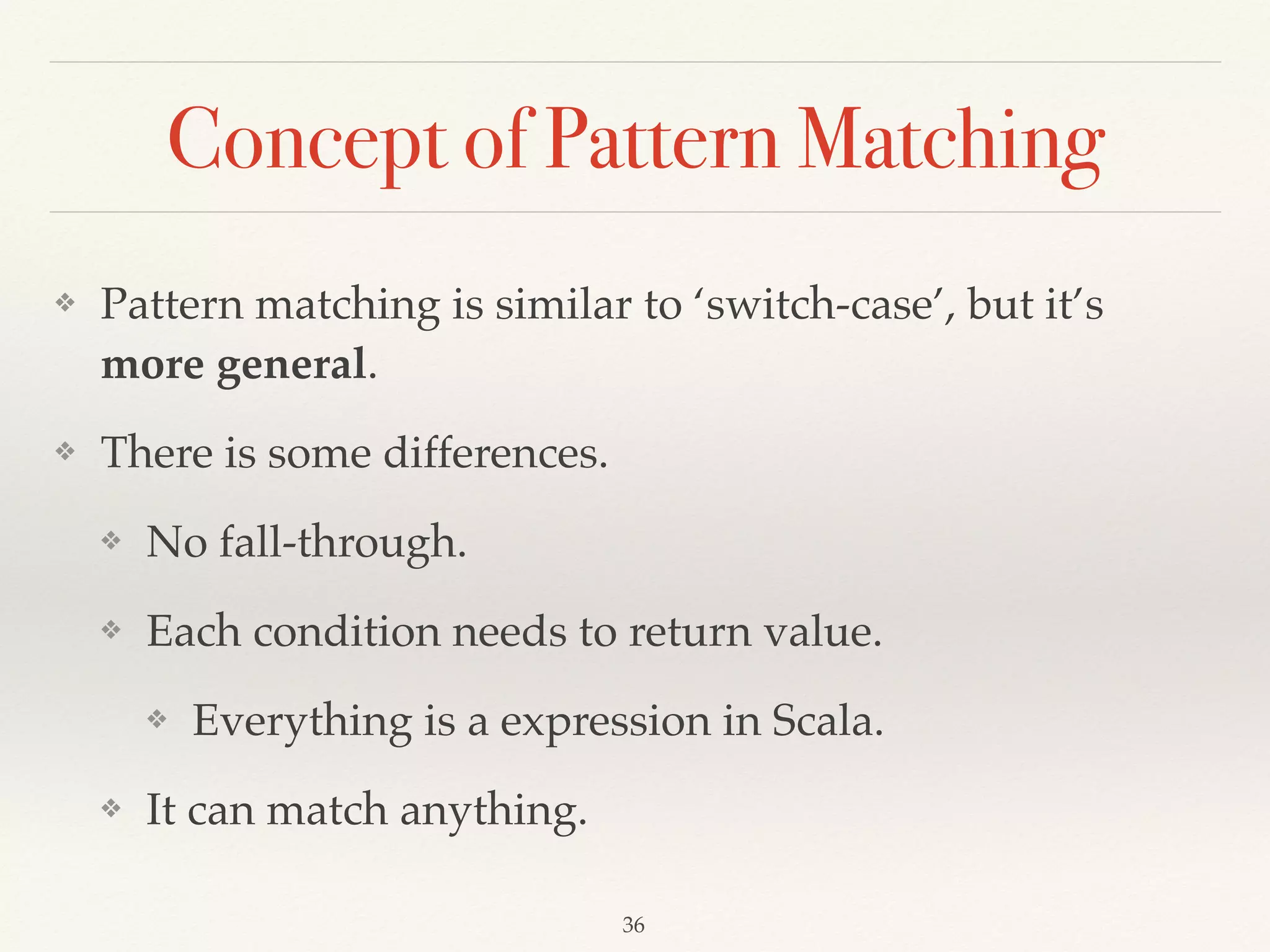
Concept of Pattern Matching
❖ Pattern matching is similar to “switch-case”, but it’s more
general.
❖ There are some differences.
❖ No fall-through.
❖ Each condition needs to return a value.
❖ Everything is a expression in Scala.
❖ It can match anything.
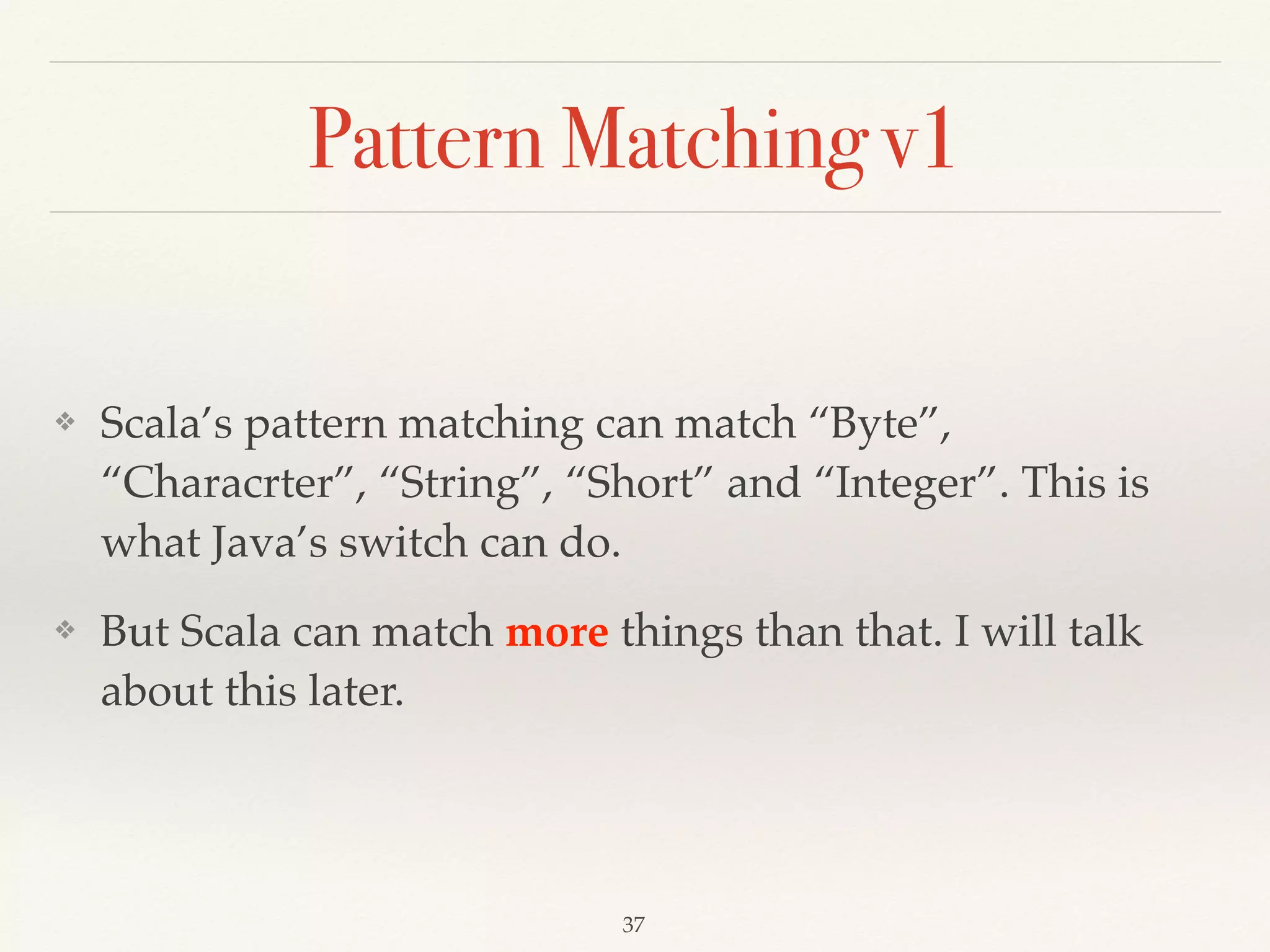
Pattern Matching v1
❖ Scala’s pattern matching can match “Byte”, “Character”,
“String”, “Short” and “Integer”. This is what Java’s switch
can do.
❖ But Scala can match more things than that. I will talk
about this later.
Pattern Matching v1
def matchString(x: String) = {
x match {

case "Dog" => x

case "Cat" => x

case _ => "Neither Dog or Cat"

}

}


matchString("Dog")

matchString("Human")
Demo17
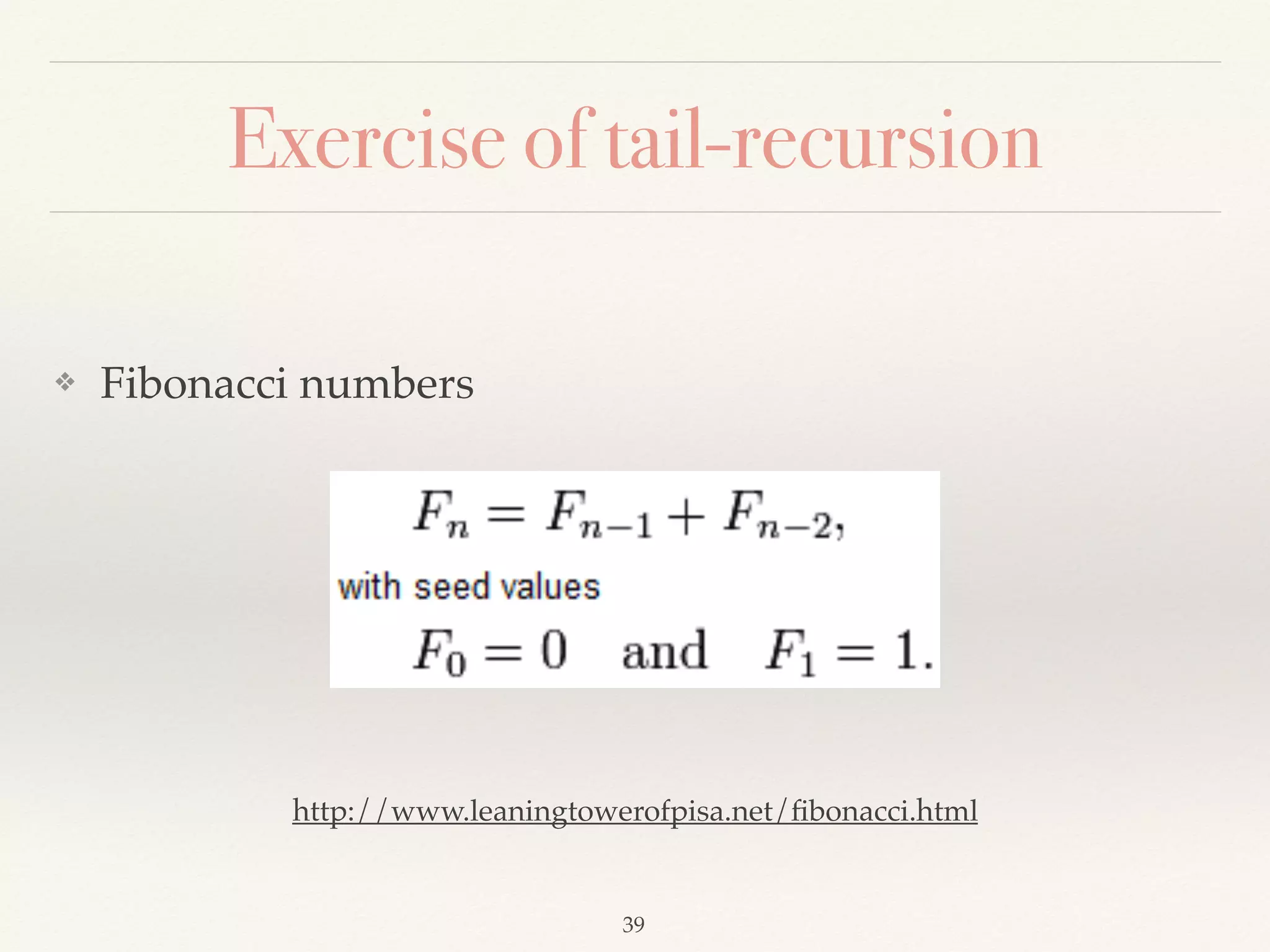
Exercise of tail-recursion
❖ Fibonacci numbers (0, 1, 1, 2, 3, 5…)
www.leaningtowerofpisa.net/fibonacci.html
Object-oriented
❖ Class
❖ Extends, With, Override
❖ Abstract Class
❖ Object, Companion Object
❖ Trait
❖ Access Modifiers
❖ Case class
❖ Pattern matching v2
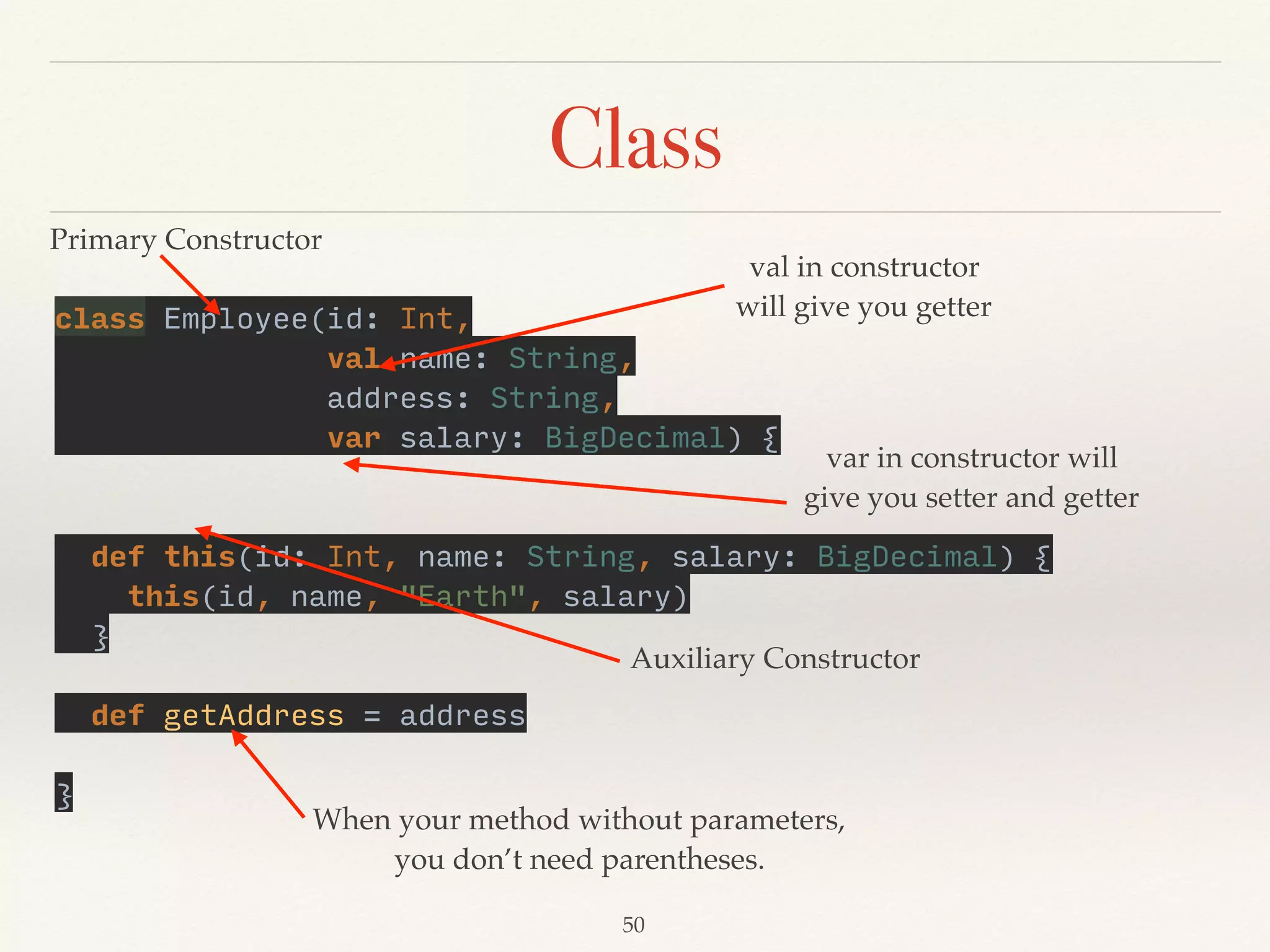
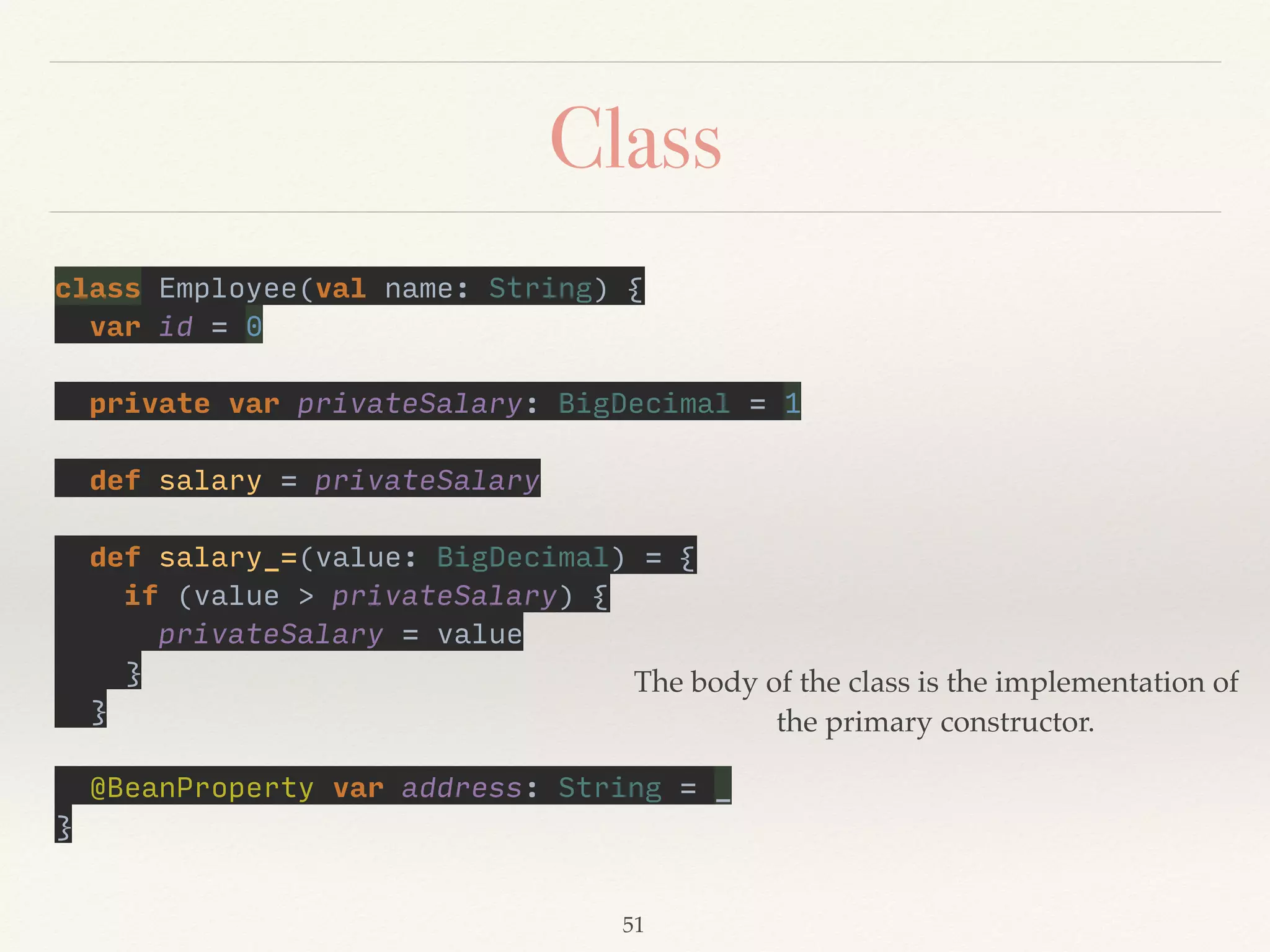
Class
class Employee(id: Int,

val name: String,

address: String,

var salary: BigDecimal) {

def this(id: Int, name: String, salary: BigDecimal) {

this(id, name, "Earth", salary)

}


def getAddress = address

}
Primary Constructor
val in constructor 

will give you getter
var in constructor will 

give you setter and getter
Auxiliary Constructor
When your method without parameters,

you don’t need parentheses.
Demo01
Extends, with, override
❖ Scala is single inheritance like Java.
❖ Scala - extends = Java - extends
❖ Scala - with = Java - implements
❖ Scala - override = Java - @Override
Abstract class
❖ Abstract class just likes normal class, but it can have
abstract methods and abstract fields which means
methods and fields without implementation.
❖ In Scala, you don’t need the keyword - abstract for
methods and fields in Abstract class. When you leave
methods and fields without body, it means abstract
methods and fields.
Abstract class
sealed abstract class Animal(val name: String) {

val footNumber: Integer

val fly: Boolean

def speak: Unit

}


class Dog(name: String) extends Animal(name) {

override val footNumber: Integer = 4

override val fly = false

override def speak: Unit = println("Spark")

}


class Bird(name: String) extends Animal(name) {

val footNumber: Integer = 2

val fly = true

def speak: Unit = println("chatter")

}
Sealed classes 

1. Subclasses should be 

in the same file.
2. Compiler can check 

you have covered all of cases
in pattern matching.
Demo02
Object
❖ Object is a singleton.
❖ It likes normal class.
❖ You have only one instance in your application’s life cycle.
❖ Singleton objects cannot take class parameters.
❖ Scala does not have static class members like Java but has object
instead.
❖ You don’t need to worry about how to write a thread-safe singleton.
❖ What’s advantage of Object?
❖ http://programmers.stackexchange.com/a/179402
Object
object MathUtil {

def doubleHalfUp(precision: Int,

origin: Double): Double = {

val tmp = Math.pow(10, precision)

Math.round(origin * tmp) / tmp

}

}
Demo03
Companion object
❖ It’s like normal object, but it shares the same name with
class name and locates with class in the same source file.
❖ The class and its companion object can access each other’s
private methods or fields.
Traits
❖ Traits are like interfaces in Java.
❖ You cannot pass class parameters
❖ But there are differences.
❖ It can contain fields and concrete methods.
❖ Traits can enrich a thin interface(mixin) which can
make a rich interface.
Trait - Mixin
trait Iterator[A] {

def hasNext: Boolean

def next: A

}


trait RichIterator[A]

extends Iterator[A] {

def foreach(f: A => Unit): 

Unit =

while (hasNext)

f(next)

}
class CharIterator(s: String)

extends Iterator[Char] {

var i = 0

def hasNext = i < s.length

def next = {

val c = s(i)

i += 1

c

}

}


val ci = new CharIterator("hello")

with RichIterator[Char]

ci.foreach(println)
https://scalafiddle.io/sf/i3KWOvf/0
Demo04
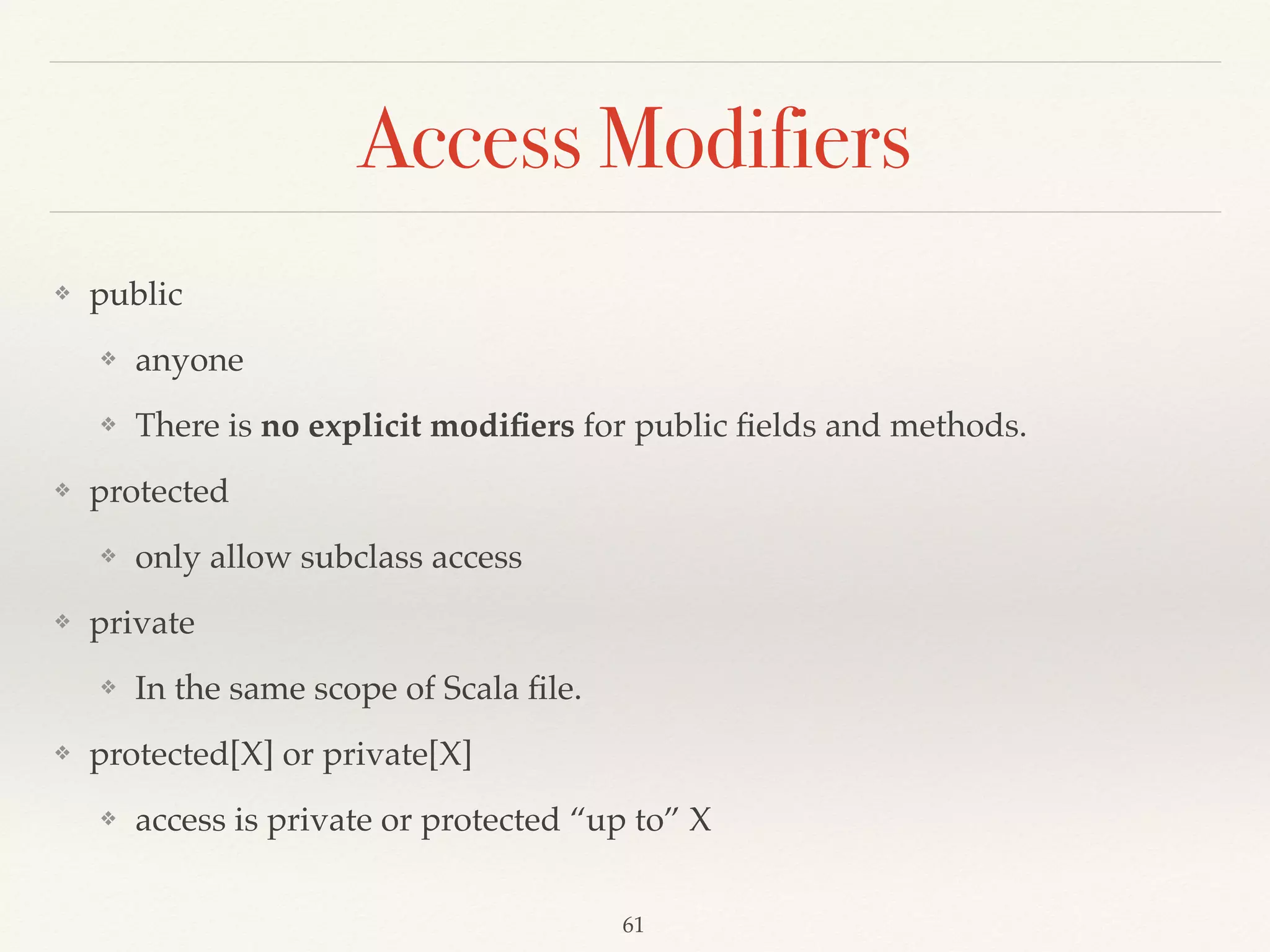
Access Modifiers
❖ public
❖ anyone
❖ There is no explicit modifiers for public fields and methods.
❖ protected
❖ only allow subclass access
❖ private
❖ In the same scope of Scala file.
❖ protected[X] or private[X]
❖ access is private or protected “up to” X
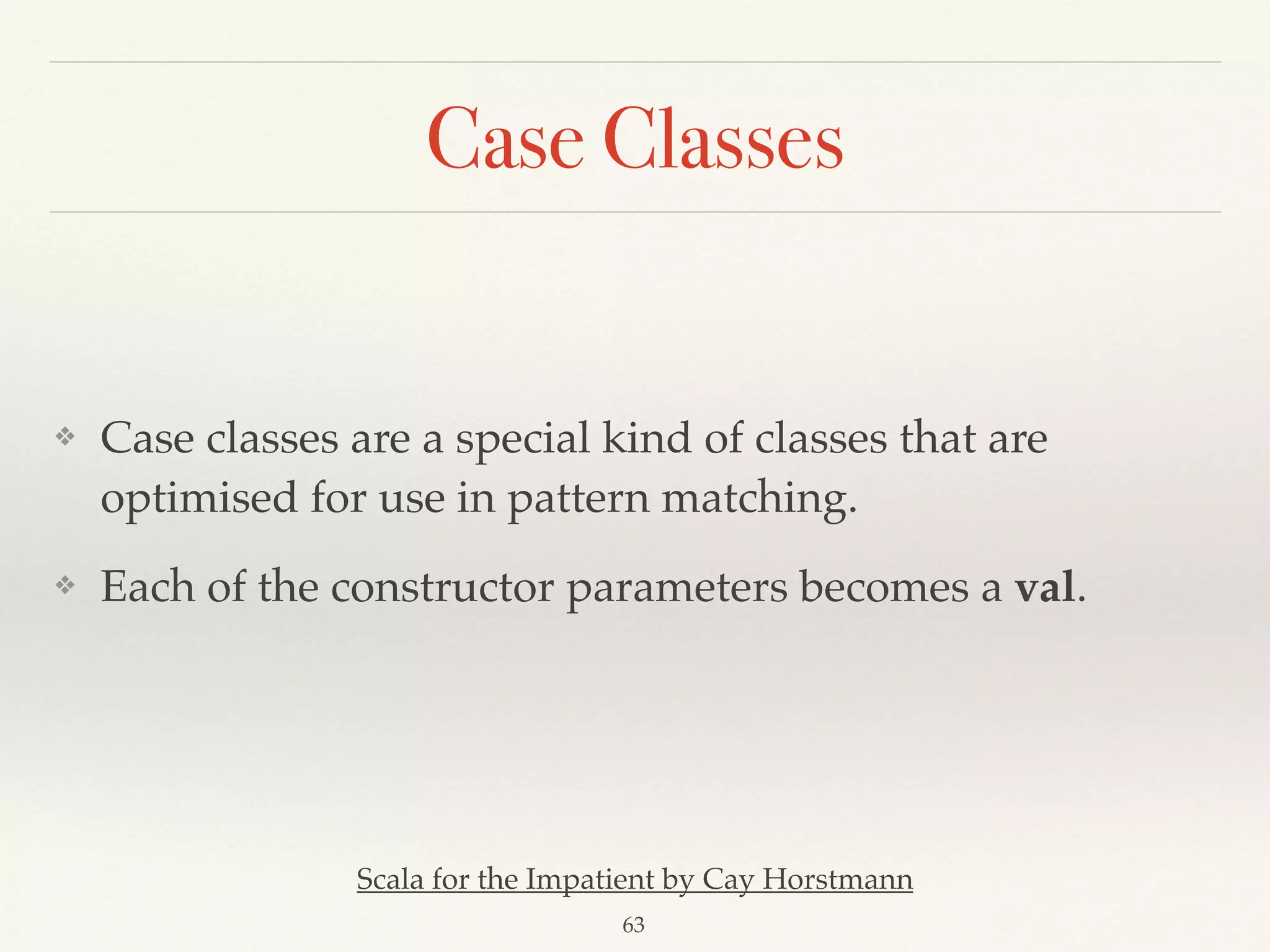
Case Classes
❖ Case classes are a special kind of classes that are
optimised for use in pattern matching.
❖ Each of the constructor parameters becomes a val.
Scala for the Impatient by Cay Horstmann
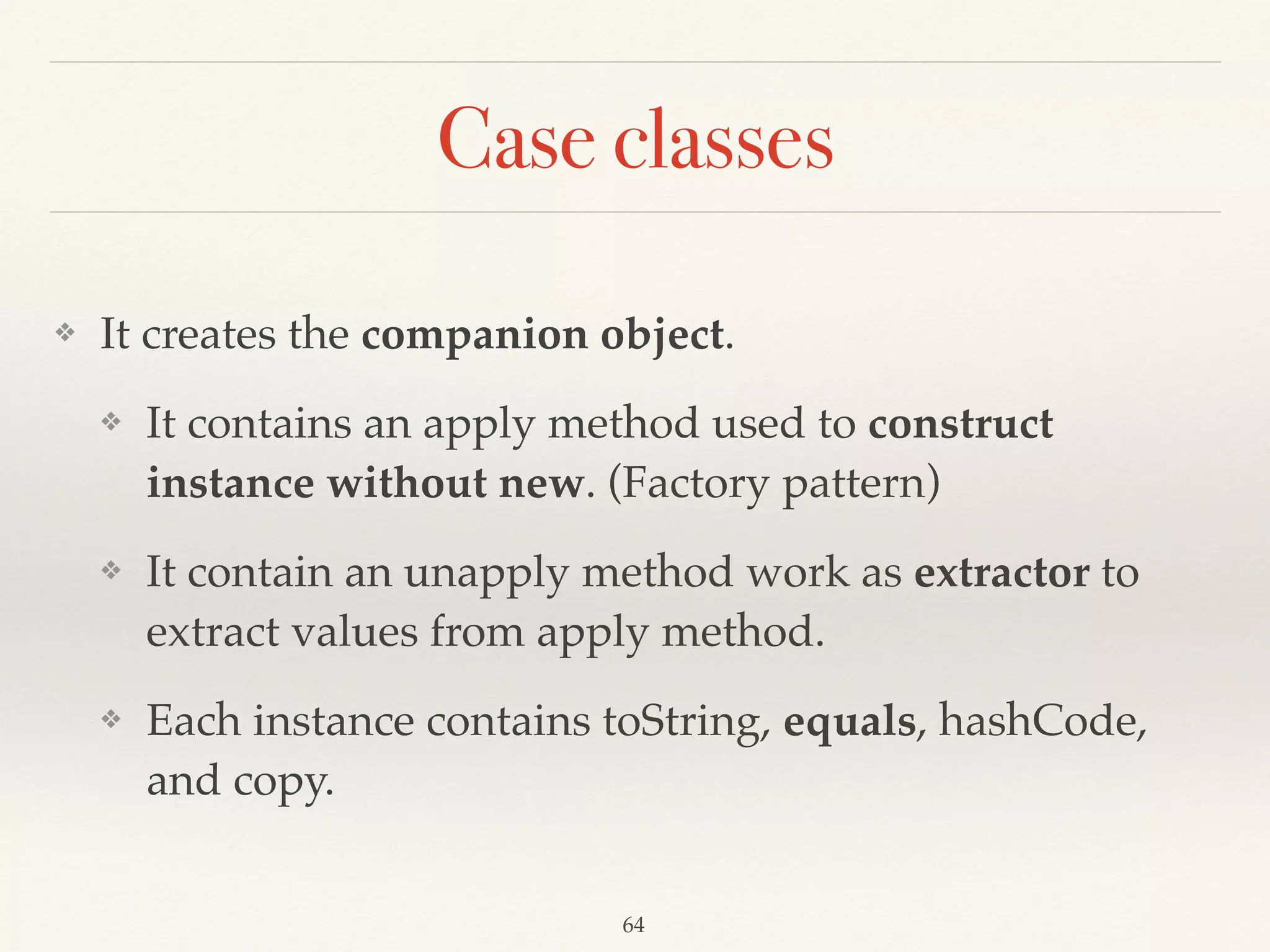
Case Classes
❖ It creates the companion object.
❖ It contains an apply method used to construct instance
without “new”. (Factory pattern)
❖ It contain an unapply method work as extractor to
extract values from apply method.
❖ Each instance contains toString, equals(==), hashCode,
and copy.
Scala for the Impatient by Cay Horstmann
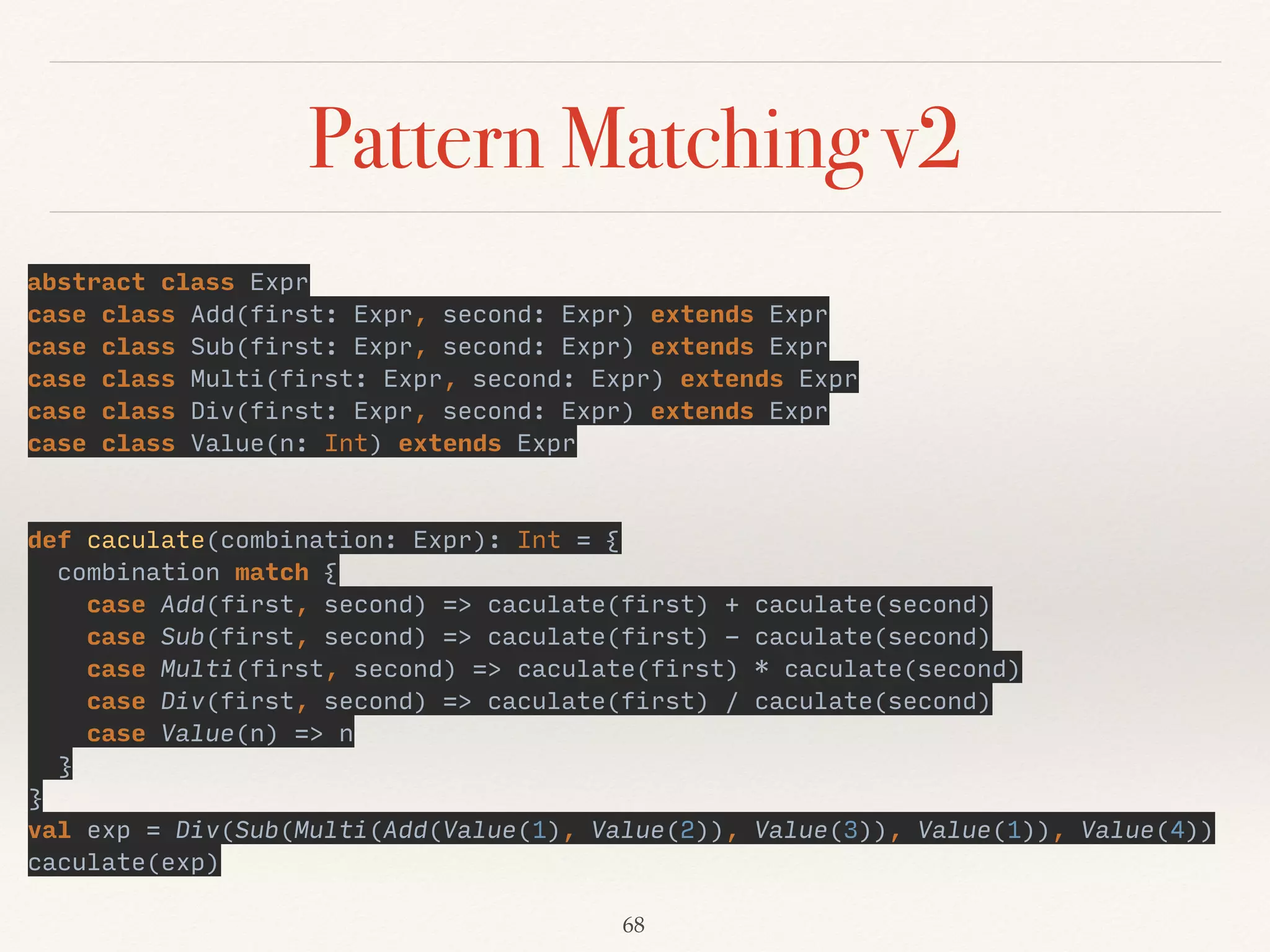
Pattern Matching v2
sealed abstract class Expr

case class Add(first: Expr, second: Expr) extends Expr

case class Sub(first: Expr, second: Expr) extends Expr

case class Multi(first: Expr, second: Expr) extends Expr

case class Div(first: Expr, second: Expr) extends Expr

case class Value(n: Int) extends Expr


def calculate(combination: Expr): Int = {

combination match {

case Add(first, second) => calculate(first) + calculate(second)

case Sub(first, second) => calculate(first) - calculate(second)

case Multi(first, second) => calculate(first) * calculate(second)

case Div(first, second) => calculate(first) / calculate(second)

case Value(n) => n

}

}

// (((2 + 1) * 3) - 1) / 4

val exp = Div(Sub(Multi(

Add(Value(1), Value(2)), Value(3)), Value(1)), Value(4))

calculate(exp)
Demo05
Pattern Matching v2
def calculate(combination: Expr): Int = {

combination match {

case Add(Multi(a, x), Multi(b, y)) if (x == y) =>

// (3 + 4) * 2

(calculate(a) + calculate(b)) * calculate(x)

case Add(first, second) =>

calculate(first) + calculate(second)

case Sub(first, second) =>

calculate(first) - calculate(second)

case Multi(first, second) =>

calculate(first) * calculate(second)

case Div(first, second) =>

calculate(first) / calculate(second)

case Value(n) =>

n

}

}

// ((3 * 2) + (4 * 2))

calculate(Add(Multi(Value(3), Value(2)), Multi(Value(4), Value(2))))
Demo06
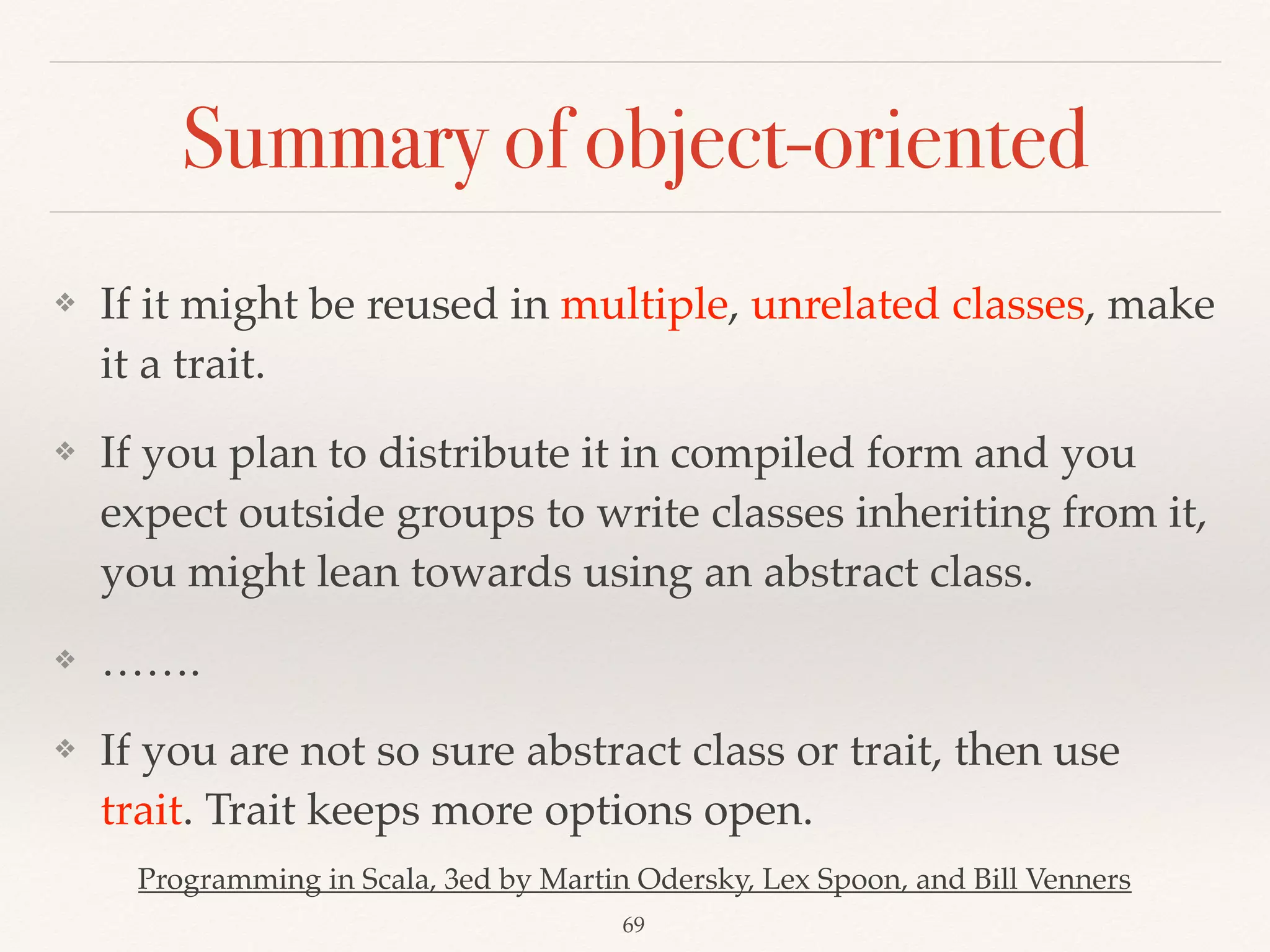
Summary of object-oriented
❖ If it might be reused in multiple, unrelated classes, make
it a trait.
❖ If you plan to distribute it in compiled form and you
expect outside groups to write classes inheriting from it,
you might lean towards using an abstract class.
❖ …….
❖ If you are not so sure abstract class or trait, then use trait.
Trait keeps more options open.
Programming in Scala, 3ed by Martin Odersky, Lex Spoon, and Bill Venners
Functional
❖ Functional concept
❖ First-class functions
❖ Anonymous functions
❖ High-order functions
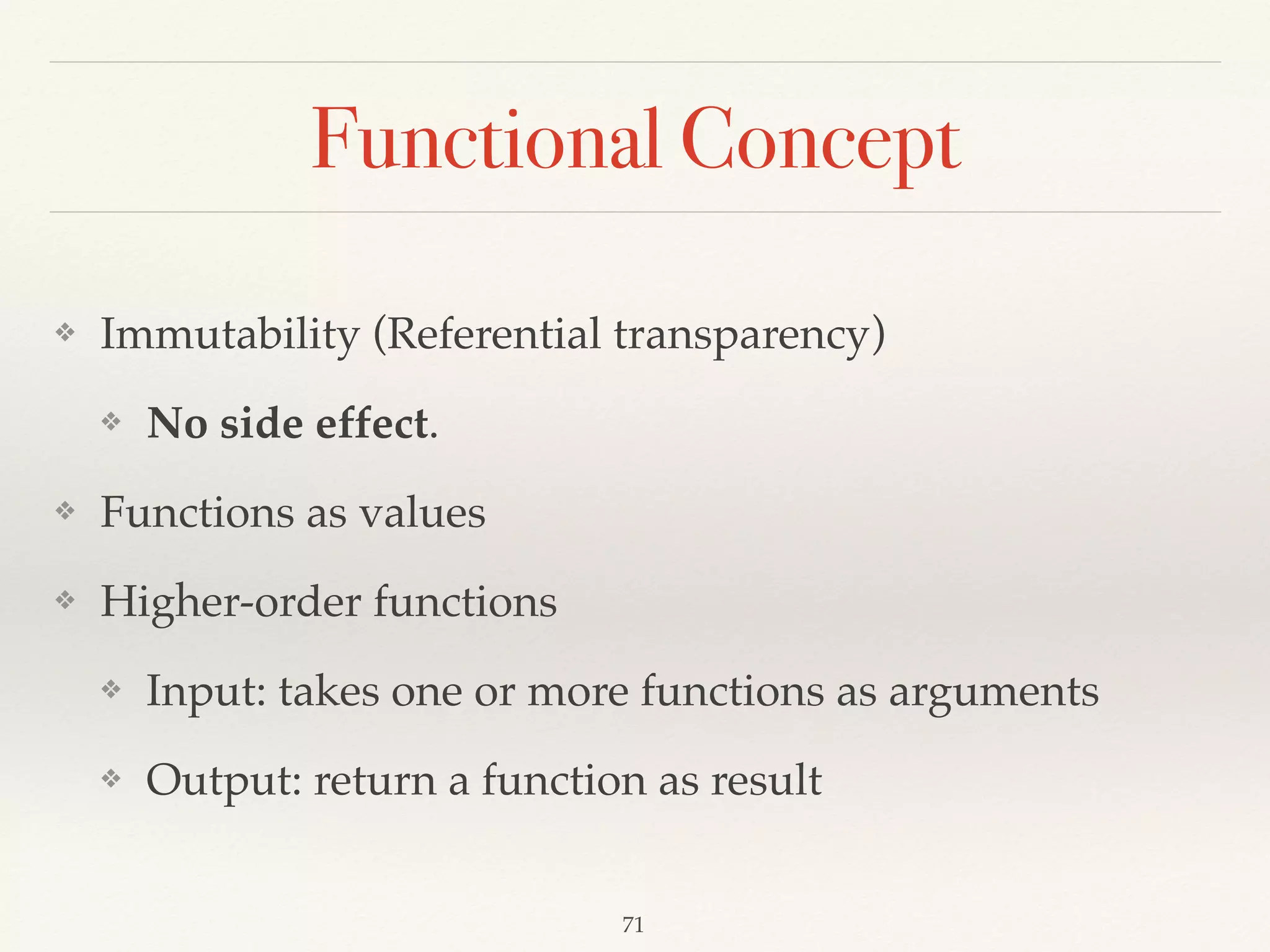
Functional Concept
❖ Immutability (Referential transparency)
❖ No side effect.
❖ Functions as values
❖ Functions as objects
❖ Higher-order functions
❖ Input: takes one or more functions as parameters
❖ Output: return a function as result
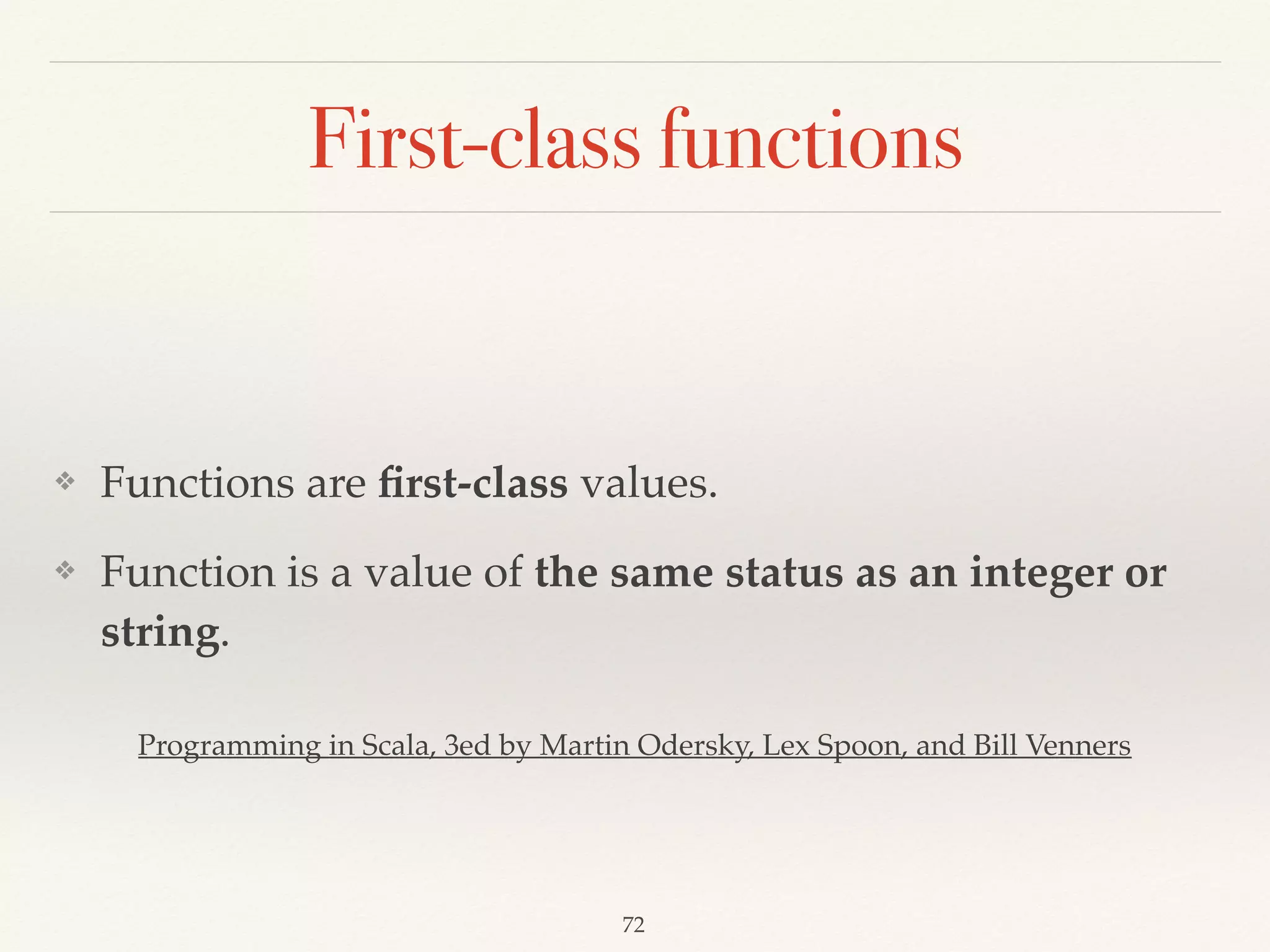
First-class functions
❖ Functions are first-class values.
❖ Function is a value of the same status as an integer or
string.
Programming in Scala, 3ed by Martin Odersky, Lex Spoon, and Bill Venners
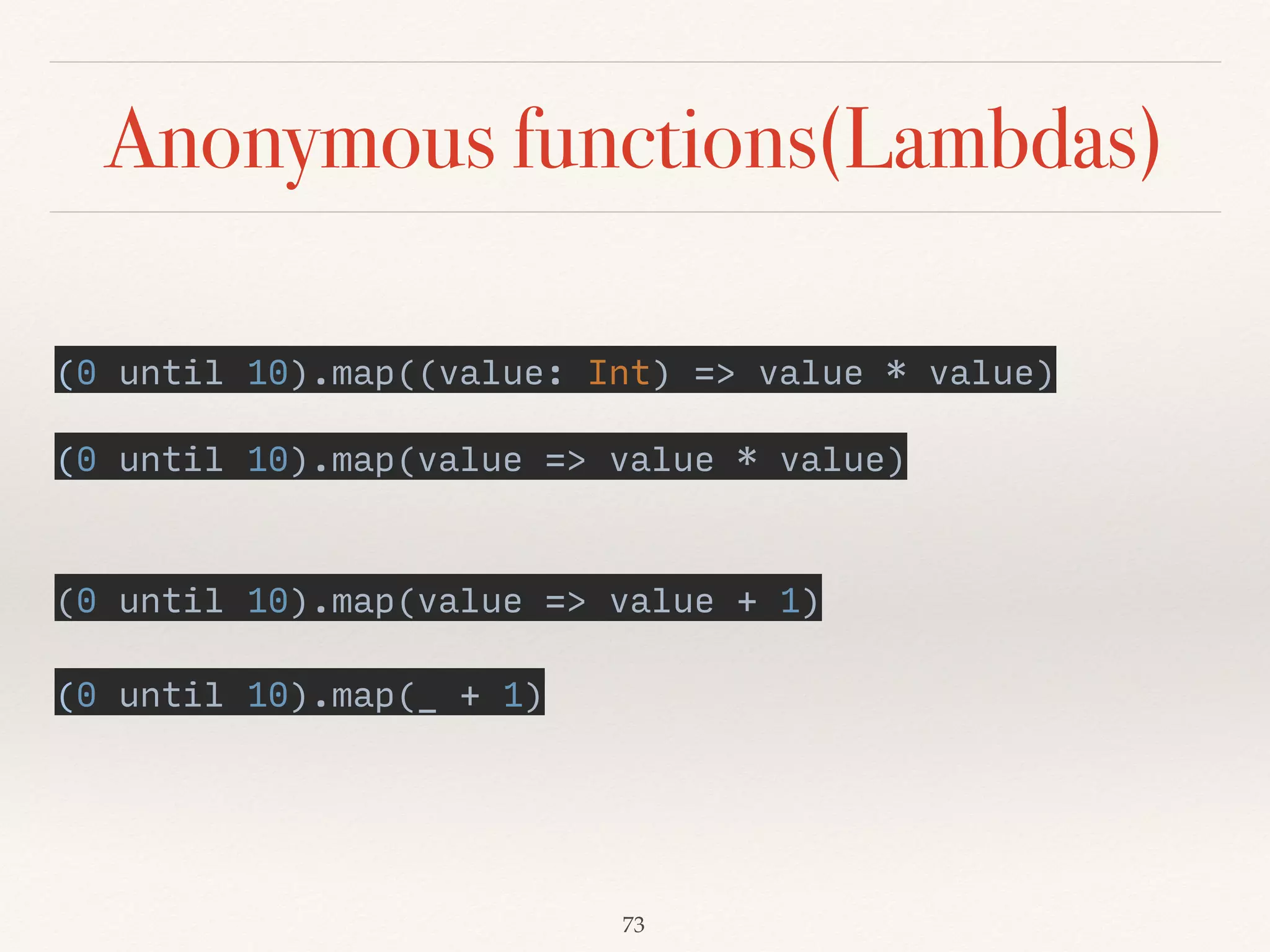
Anonymous functions(Lambdas)
(0 until 10).map((value: Int) => value * value)

(0 until 10).map(value => value * value)


(0 until 10).map(value => value + 1)

(0 until 10).map(_ + 1)
Placeholder syntax
Demo01
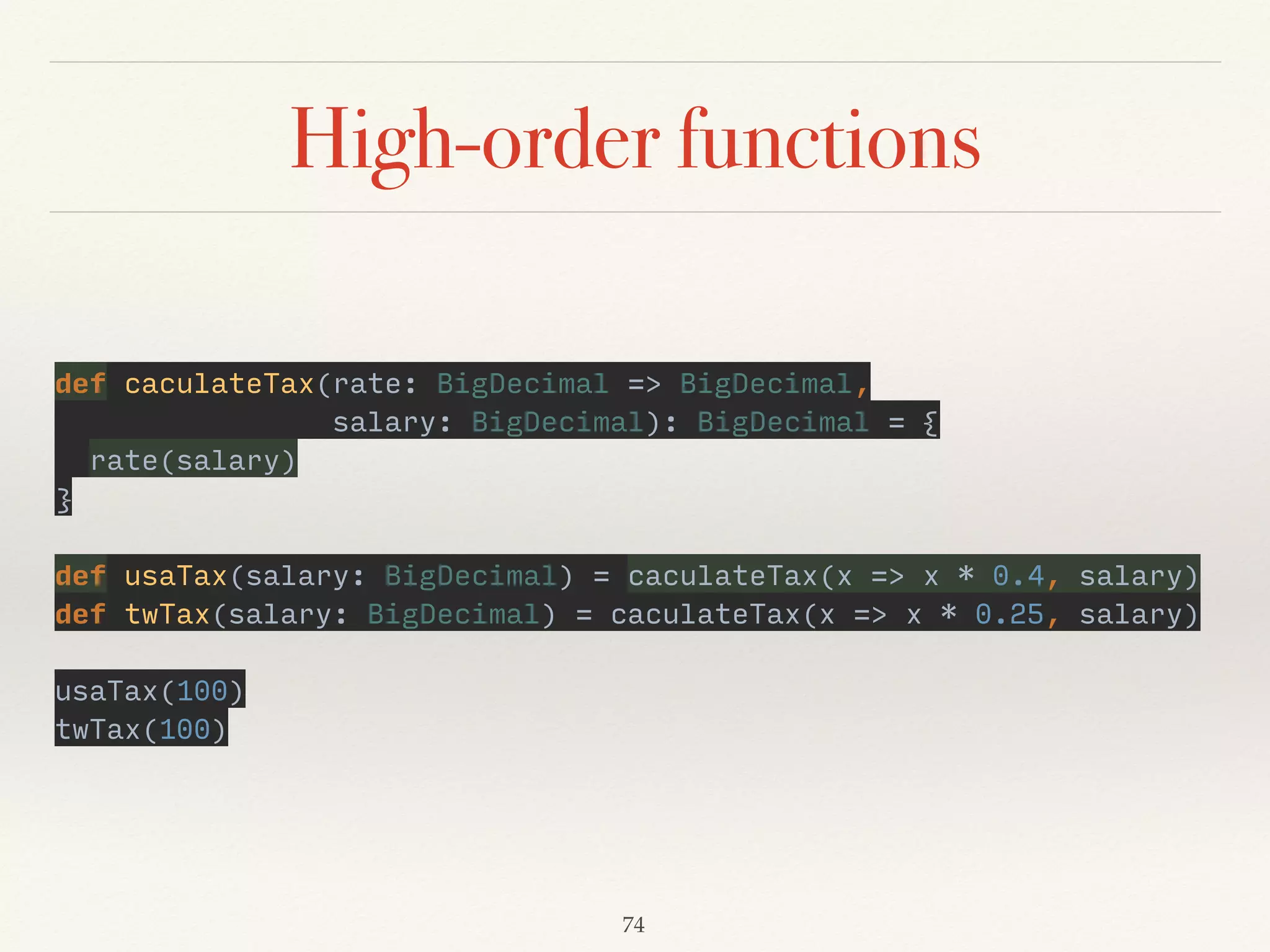
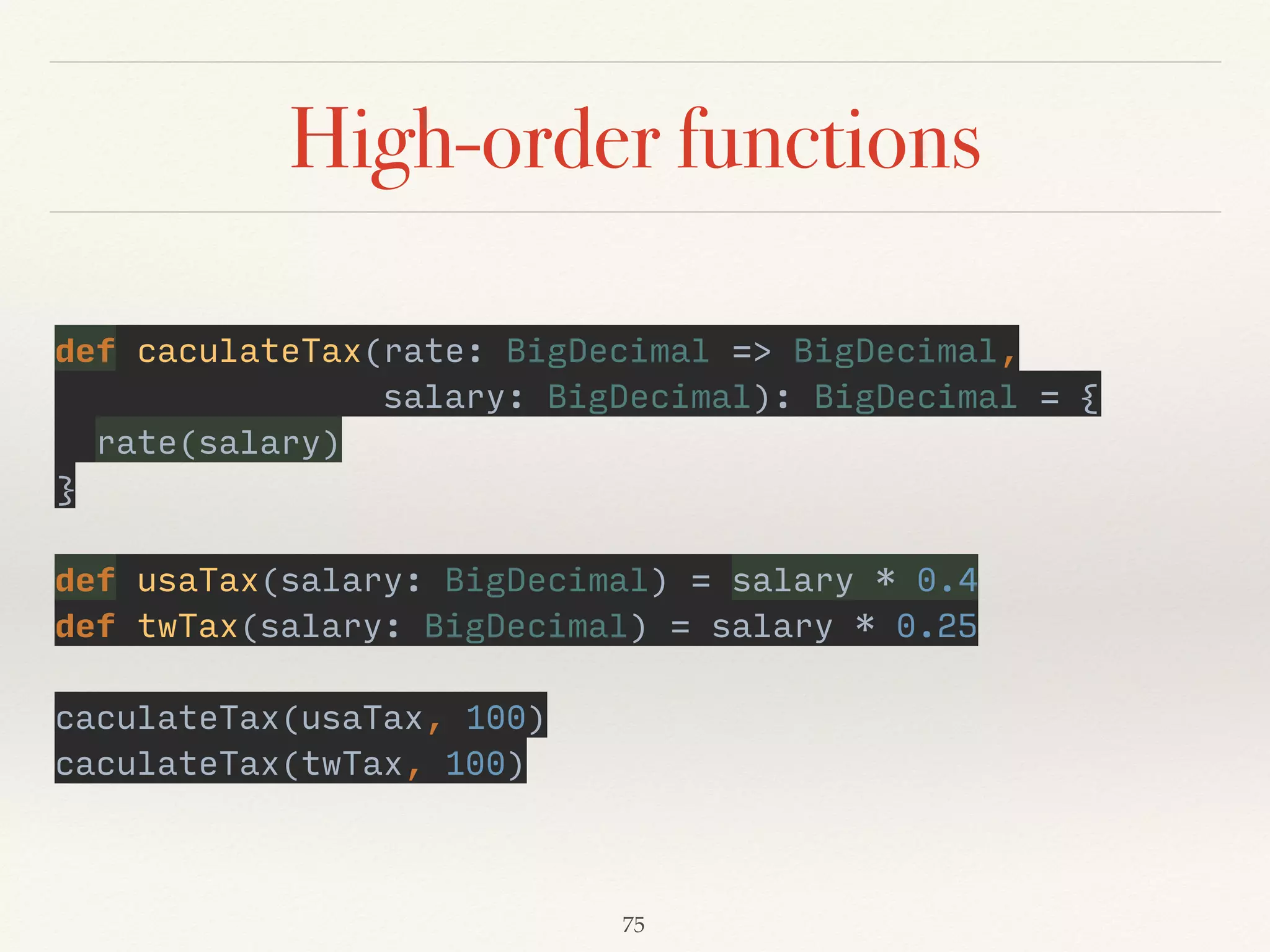
High-order functions
def calculateTax(rate: BigDecimal => BigDecimal,

salary: BigDecimal): BigDecimal = {

rate(salary)

}


val usaTax = (salary: BigDecimal) => {

if (salary > 413201)

salary * 0.396

else

salary * 0.3

}


val twTax: BigDecimal => BigDecimal = _ * 0.25


calculateTax(usaTax, 413202)

calculateTax(twTax, 100)
Demo02
High-order functions
def calculateTax(rate: BigDecimal => BigDecimal,

salary: BigDecimal): BigDecimal = {

rate(salary)

}


def usaTax(salary: BigDecimal) = {

calculateTax(x =>

if (x > 413201) x * 0.396

else x * 0.3,

salary)

}

def twTax(salary: BigDecimal) =

calculateTax(_ * 0.25, salary)


usaTax(413202)

twTax(100)
Demo03
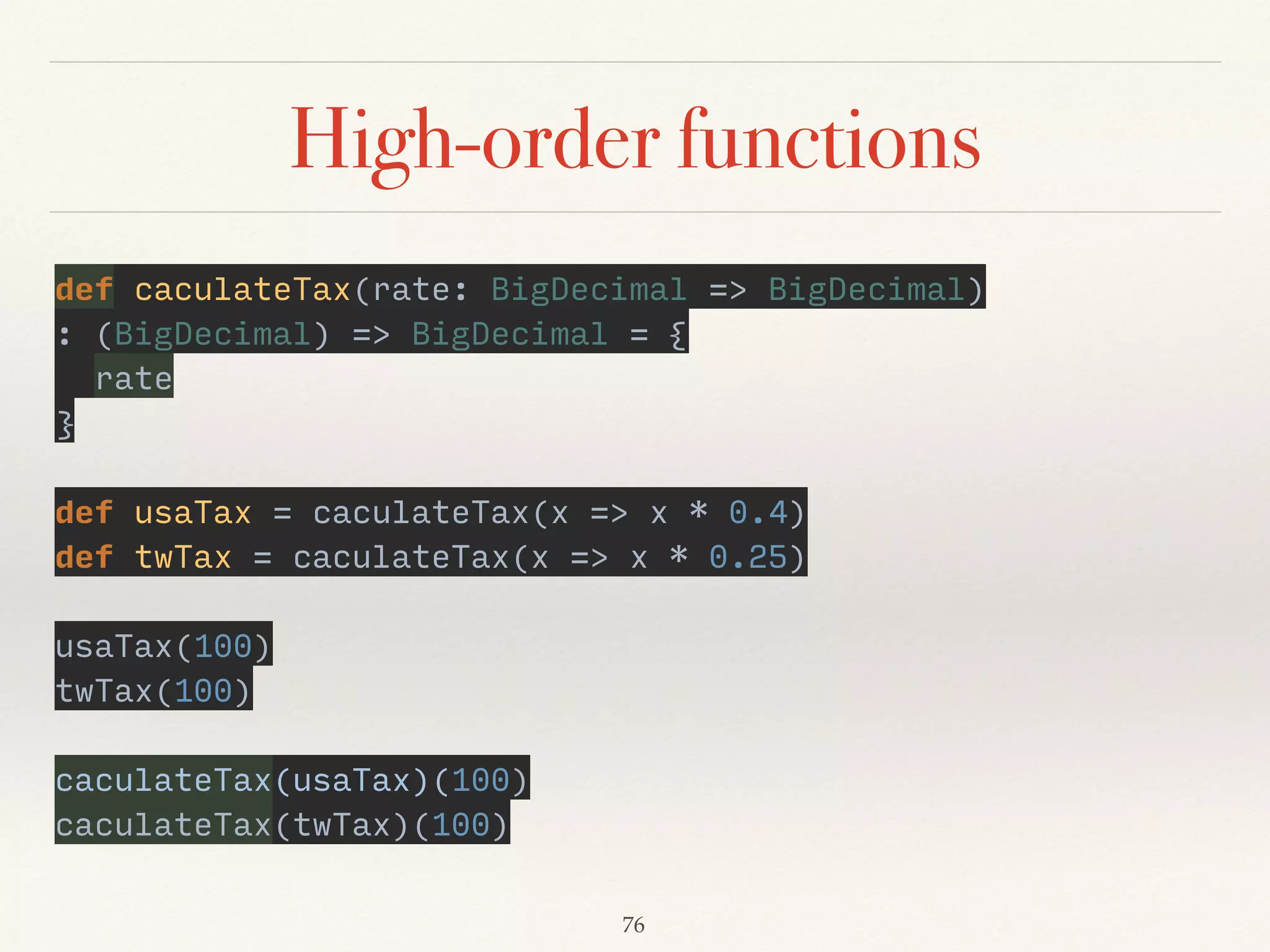
High-order functions
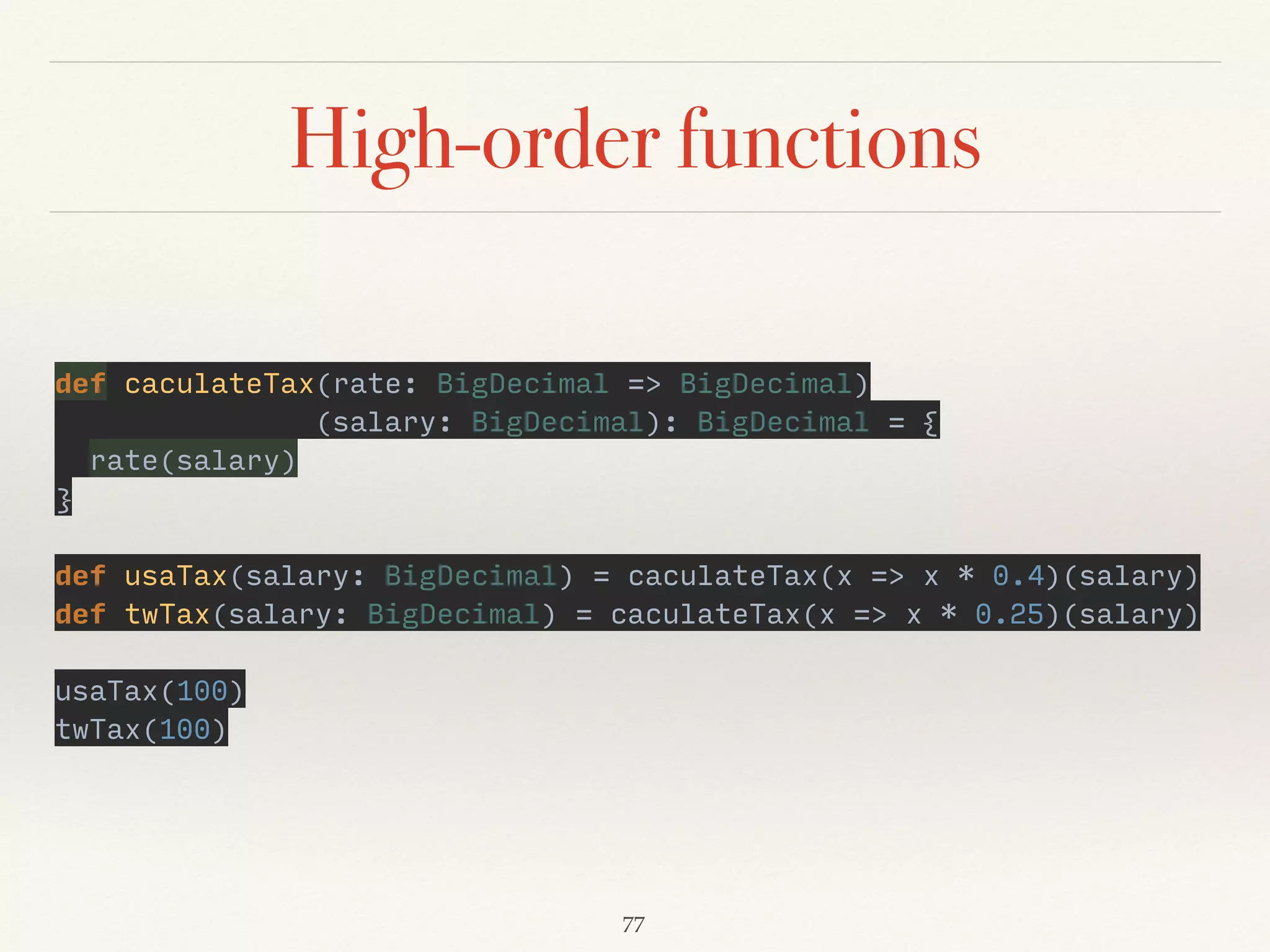
def calculateTax(rate: BigDecimal => BigDecimal)

: (BigDecimal) => BigDecimal = {

rate

}


def usaTax = calculateTax(x =>

if (x > 413201) x * 0.396

else x * 0.3

)

def twTax = calculateTax(x => x * 0.25)


usaTax(413202)

twTax(100)


calculateTax(usaTax)(413202)

calculateTax(twTax)(100)
Demo04
High-order functions - Curry
def calculateTax(rate: BigDecimal => BigDecimal)

(salary: BigDecimal): BigDecimal = {

rate(salary)

}


def usaTax(salary: BigDecimal) =

calculateTax(x =>

if (x > 413201) x * 0.396

else x * 0.3)(salary)

def twTax(salary: BigDecimal) =

calculateTax(x => x * 0.25)(salary)


usaTax(413202)

twTax(100)
Demo05
High-order functions - Partially Applied Function
// Curry

def calculateTax(rate: BigDecimal => BigDecimal)

(salary: BigDecimal): BigDecimal = {

rate(salary)

}


// First way of Partially Applied Function

def usaTax = calculateTax(

x =>

if (x > 413201) x * 0.396

else x * 0.3

)(_)

// Second way of Partially Applied Function

def twTax: BigDecimal => BigDecimal = calculateTax(_ * 0.25)


usaTax(413202)

twTax(100)
Demo06
placeholder
Exercise of High-order functions
def summation(fun: Int => Int, start: Int, end: Int): Int = ???


def number(n: Int): Int = ???

def cube(n: Int): Int = ???

// factorial number: 5 * 4 * 3 * 2 * 1

def factorial(n: Int): Int = ???


def sumNumber(start: Int, end: Int): Int = ???

def sumCubes(start: Int, end: Int): Int = ???

def sumFactorials(start: Int, end: Int): Int = ???
Functional Programming Principles in Scala, Martin Odersky
Exercise1
Exercise of High-order functions
// hint: nest function

def summation(fun: Int => Int): (Int, Int) => Int = ???


def sumNumber = ???

def sumCubes = ???

def sumFactorials = ???
Functional Programming Principles in Scala, Martin Odersky
Exercise2
Exercise of Curry
// Curry

def summation(fun: Int => Int)(start: Int, end: Int): Int = ???


def sumNumber = ???

def sumCubes = ???

def sumFactorials = ???
Functional Programming Principles in Scala, Martin Odersky
Exercise2
Collections
❖ Concept of Collections
❖ Collection Traits
❖ Hierarchy of Collections
❖ Immutable
❖ Mutable
❖ Immutable List
❖ Immutable HashMap
❖ Tuple
❖ Option
❖ Pattern Matching v3
❖ Time Complexity
Concept of Collections
❖ In most programming language, they only support mutable
collections.
❖ Scala supports mutable collections and immutable collections.
❖ It means you cannot change the data that inside of
collections.
❖ When you operate on a collection, it will return a new
collection than keep origin collection.
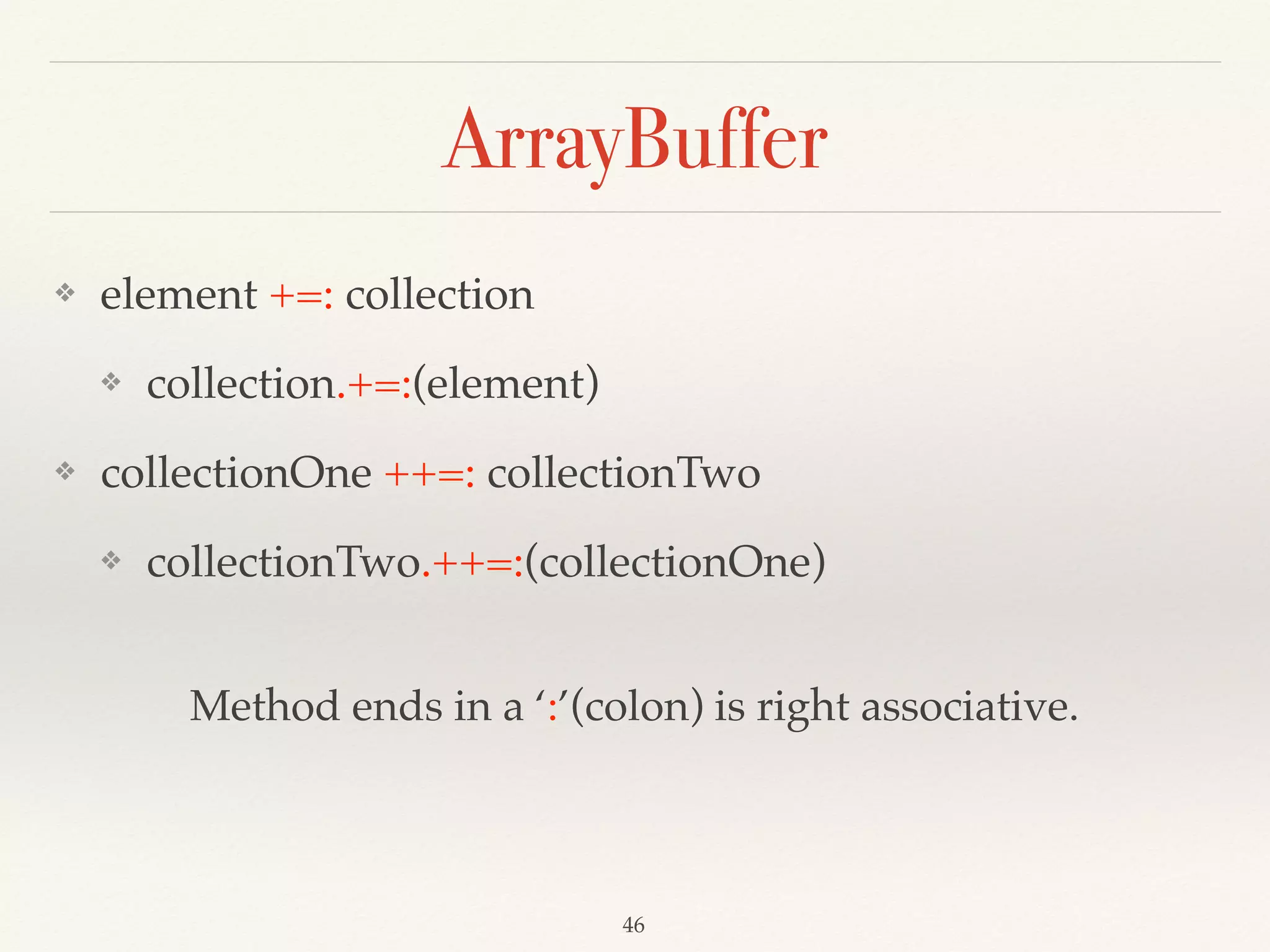
❖ Almost every method is left associativity.
❖ Unless method that ends in a “:“(colon) is right
associativity.
Concept of Collections
val var
Immutable Collection Best Not Bad
Mutable Collection Danger Very Danger
The Mutability Matrix of Pain by Jamie Allen
Hierarchy of Collections
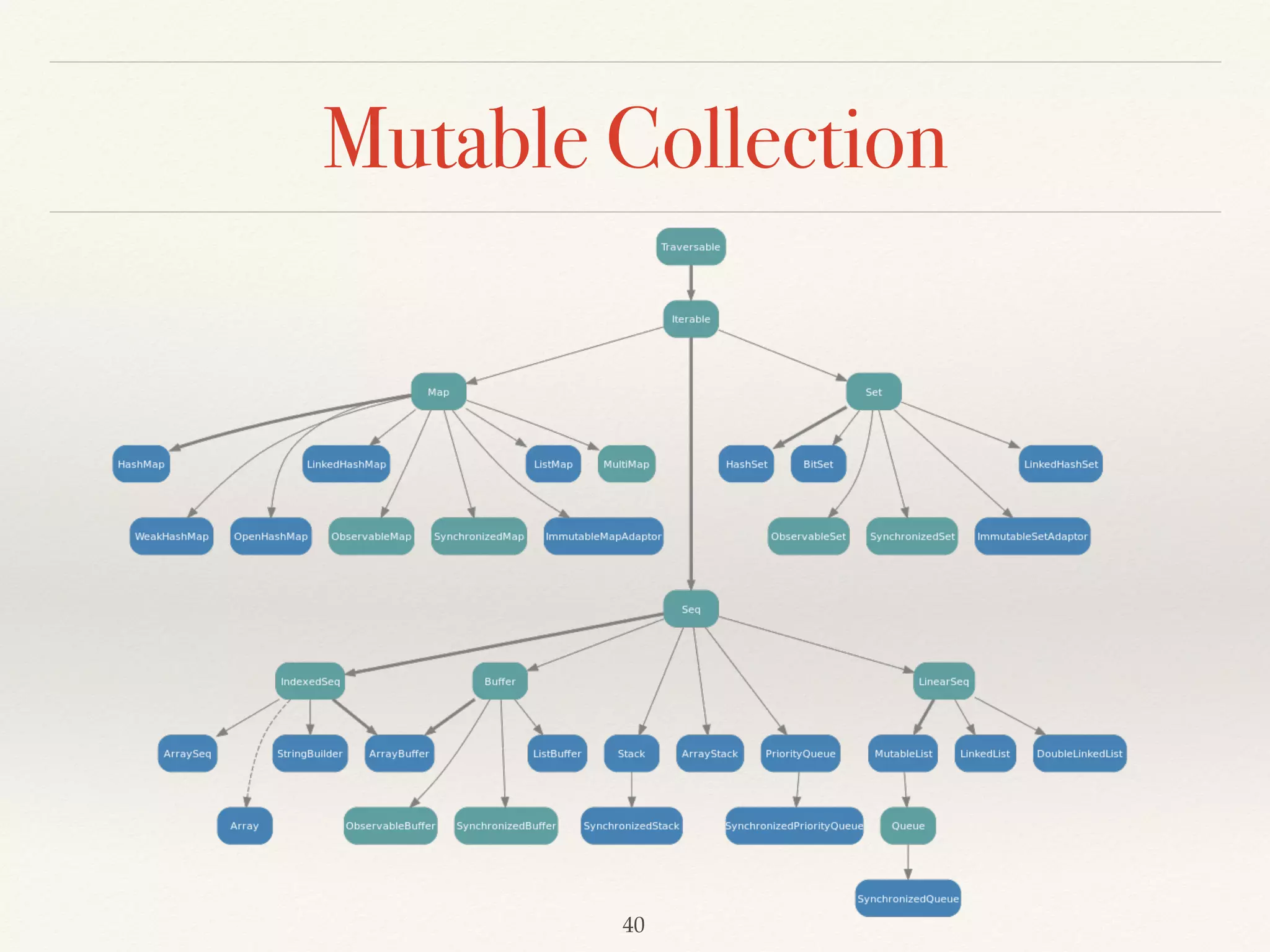
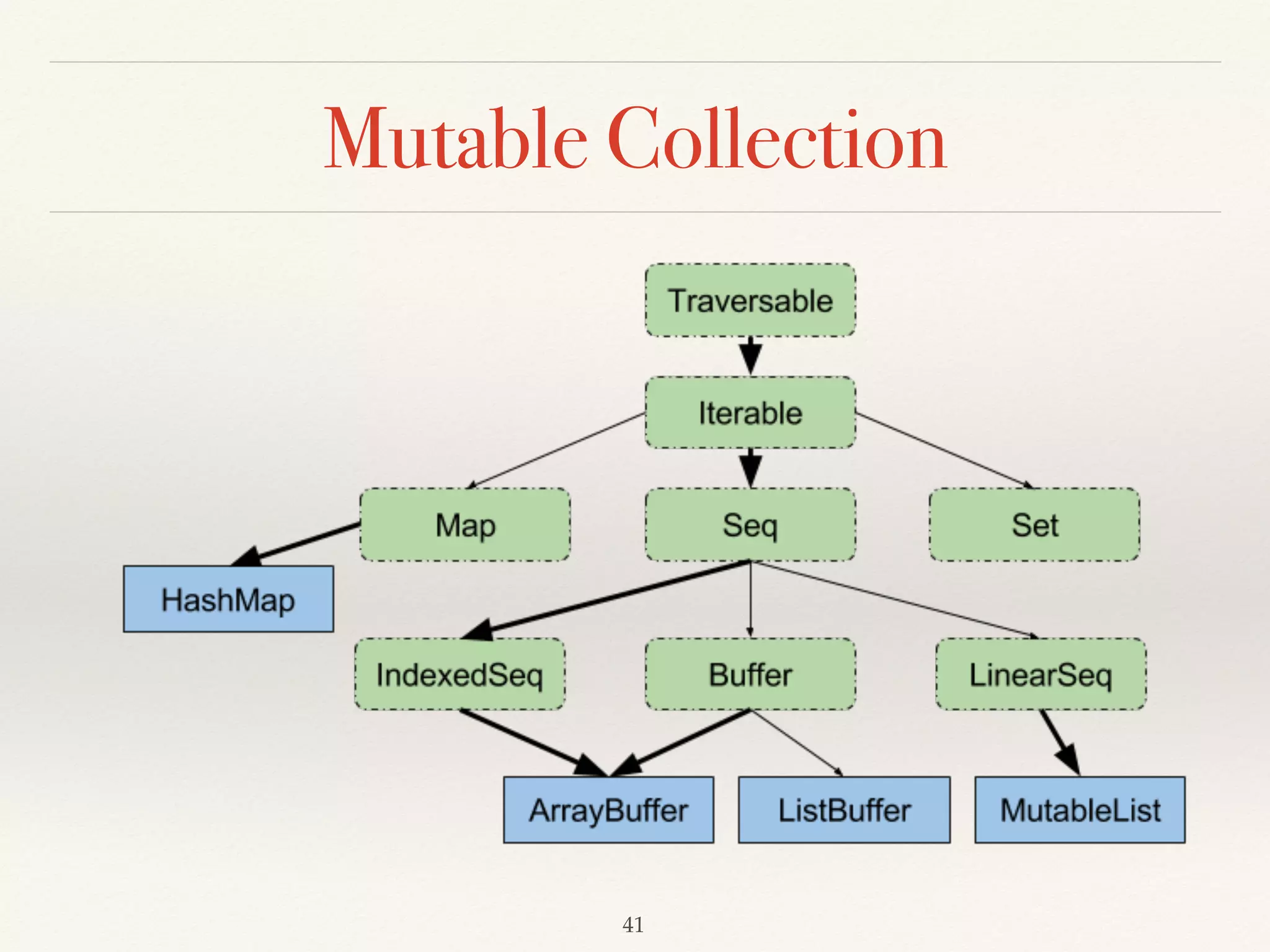
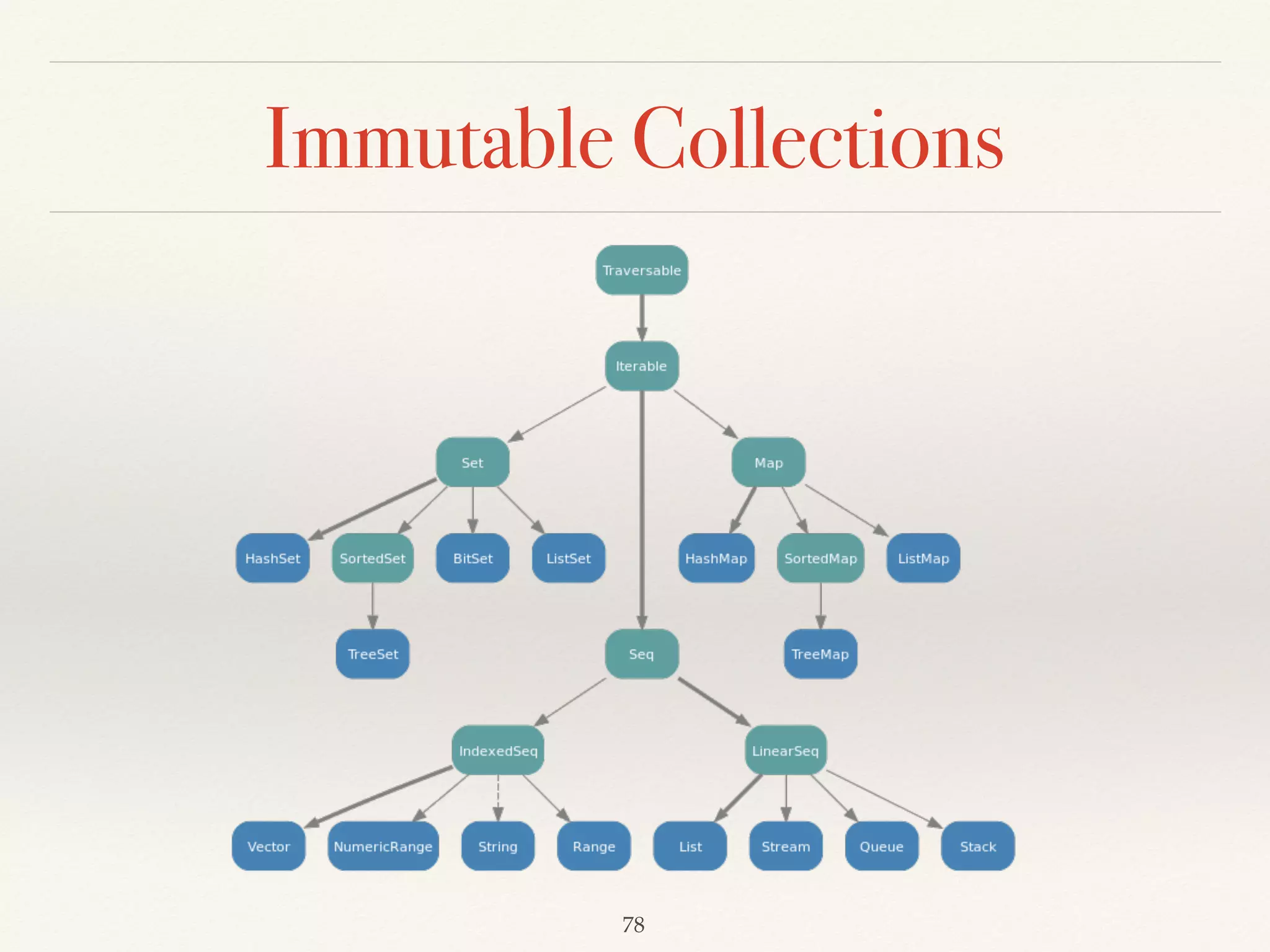
Collection Trait
❖ Traversable - traverse whole collection.
❖ Iterable - traverse whole collection with sooner stop.
❖ Seq
❖ IndexedSeq - Array
❖ LinearSeq - List
❖ Map - key pairs with value.
❖ Set - no duplicated item
Hierarchy of Immutable Collections
Hierarchy of Mutable Collection
Concept of Immutable List
❖ Nil
❖ The empty list.
❖ Avoid null.
Work with List
// Construct List

val list1 = List(1, 2, 3)

// Element prepends to List

val list2 = 1 :: 2 :: 3 :: Nil

val list3 = 1 :: (2 :: (3 :: Nil))

val list4 = Nil.::(3).::(2).::(1)

// List prepends to List

val list5 = List(5, 5, 6, 6) ::: List(8, 7)

val list6 = List(8, 7).:::(List(5, 5, 6, 6))
Demo01
pronounced “cons”
API of List
val list =

List(4, 3, 0, 1, 2)

list.head

list.tail

list.length

list.max

list.min

list.sum

list.contains(5)

list.mkString(",")

list.drop(2)

list.reverse
list.sortWith(_ > _)

list.map(x => x * 2)

list.map(_ * 2)

list.reduce((x, y) => x + y)

list.reduce(_ + _)

list.filter(x => x % 2 == 0)

list.filter(_ % 2 == 0)

list.groupBy(x => x % 2 == 0)

list.groupBy(_ % 2 == 0)

list.indices zip list

list.zipWithIndex
Demo02
List with high-order function
val list =

List(4, 3, 0, 1, 2)


val twoDim = list.map(_ + 1) ::

list.map(_ - 1) ::

list.map(_ * 2) ::

Nil

twoDim.flatten

// map + flatten

twoDim.flatMap(x => x.filter(_ % 2 == 1))
Demo03
Concept of Immutable HashMap
❖ Tuple
❖ Option
❖ Some
❖ None
Tuple
❖ Immutable
❖ Contain different type of
elements
❖ You don’t need Java-Bean
❖ It can contain to 22 elements.
❖ Tuple2 = Pair
val people =

("Martin", 58)

people._1

people._2
Demo04
Option
❖ Use to avoid null.
❖ Null is error prone.
❖ You code need to check
whether or not it is null.
❖ Option type will be Some or
None.
http://betehess.github.io/talks/2014/06/06-cata-visitor-adt#14
Work with HashMap
val countryCode =

Map("Taiwan" -> 886,

"United States" -> 1,

"Japan" -> 81)

val countryCode1 =

Map(("Taiwan", 886),

("United States", 1),

("Japan", 81))


// 886

countryCode("Taiwan")

// Some(886)

countryCode.get("Taiwan")
// NoSuchElementException

countryCode("Canada")

// None

countryCode.get("Canada")

// add

countryCode + ("China" -> 86)

// delete

countryCode - ("Japan")

// update

countryCode + ("Taiwan" -> 5566)

countryCode.getOrElse("China", 0)
Demo05
More Option
val list = List(0, 1, 2, 3, 4, 5)

def odd(n: Int) =

if (n % 2 == 1) Some(n)

else None

list.map(odd(_))

list.flatMap(odd(_))


val list1 =

List(Some(1), None, Some(2), None, Some(3))

Some(5566).map(x => x * 2)

list1.flatMap(x => x.map(y => y * 2))

list1.flatMap(_.map(_ * 2))
Demo06
Advanced Option
case class People(

id: String,

firstName: String,

lastName: String,

age: Int,

countries: List[String],

gender: Option[String]

)
object PeopleRepository {

private val peoples = Map(

1 -> People("1", "John", "Doe", 30,
List("TW", "USA"), Some("male")),

2 -> People("2", "Janie", "Doe", 10,
List("Japan"), Some("female")),

3 -> People("3", "", "Doe", 50, List("TW"),
None))


def find(id: Int): Option[People] =
peoples.get(id)

def getAll = peoples.values

}
// None

for {

people <- PeopleRepository.find(2)

gender <- people.gender

} yield gender

// Some(female)

for {

people <- PeopleRepository.find(3)

gender <- people.gender

} yield gender

// None

for {

people <- PeopleRepository.find(4)

gender <- people.gender

} yield gender
The Neophyte's Guide to Scala Part 5: The Option Type
Demo07
For-comprehensions
// List of People has TW passport
for {

people <- PeopleRepository.getAll

if (people.countries.contains("TW"))

} yield people


(for {

people <- PeopleRepository.getAll

country <- people.countries

} yield country).toSet
Demo08
Exercise of Collection
// only use collection's API(combinator)


// find the maximum number of Seq with fun

def larges(fun: Int => Int,

inputs: Seq[Int]): Int = ???


// find the maximum number of index of Seq with fun

def largesIndex(fun: Int => Int,

inputs: Seq[Int]): Int = ???
Scala for the Impatient by Cay Horstmann
Exercise1
Pattern Matching v3
val list = (0 to 5).toList

def sum(list: List[Int]): Int = {

list match {

case Nil => 0

case head :: tail => head + sum(tail)

}

}

sum(list)
Demo09
Pattern Matching v3
import scala.annotation.tailrec


val list = (0 until 9).toList

def sumTail(list: List[Int]): Int = {

@tailrec

def help(list: List[Int],

previous: Int): Int = list match {

case Nil => 0

case List(onlyOne) => previous + onlyOne

case head :: tail => help(tail, previous + head)

}

help(list, 0)

}

sumTail(list)
Demo10
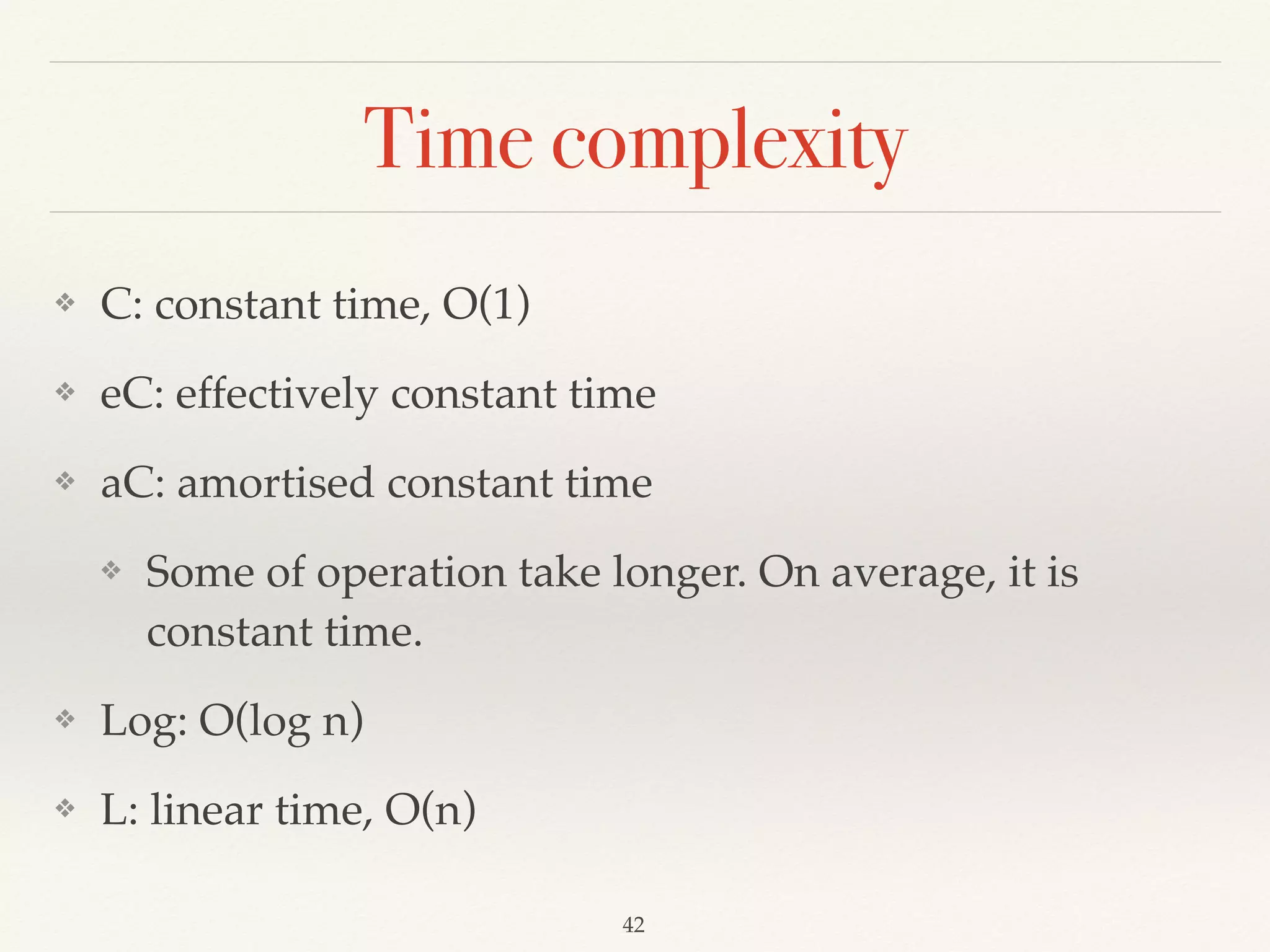
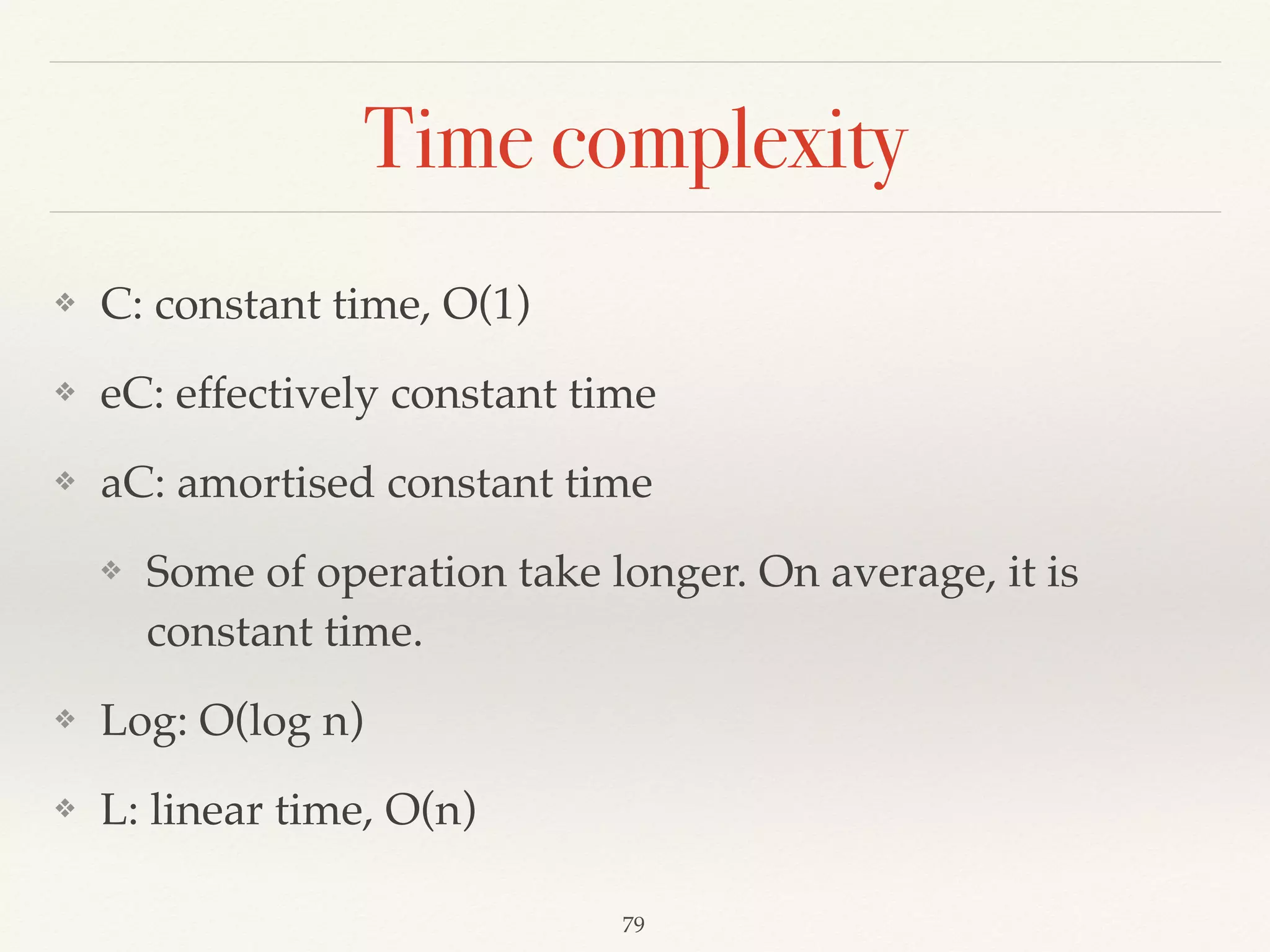
Time complexity
❖ C: constant time, O(1)
❖ eC: effectively constant time
❖ aC: amortised constant time
❖ Some of operation take longer. On average, it is
constant time.
❖ Log: O(log n)
❖ L: linear time, O(n)
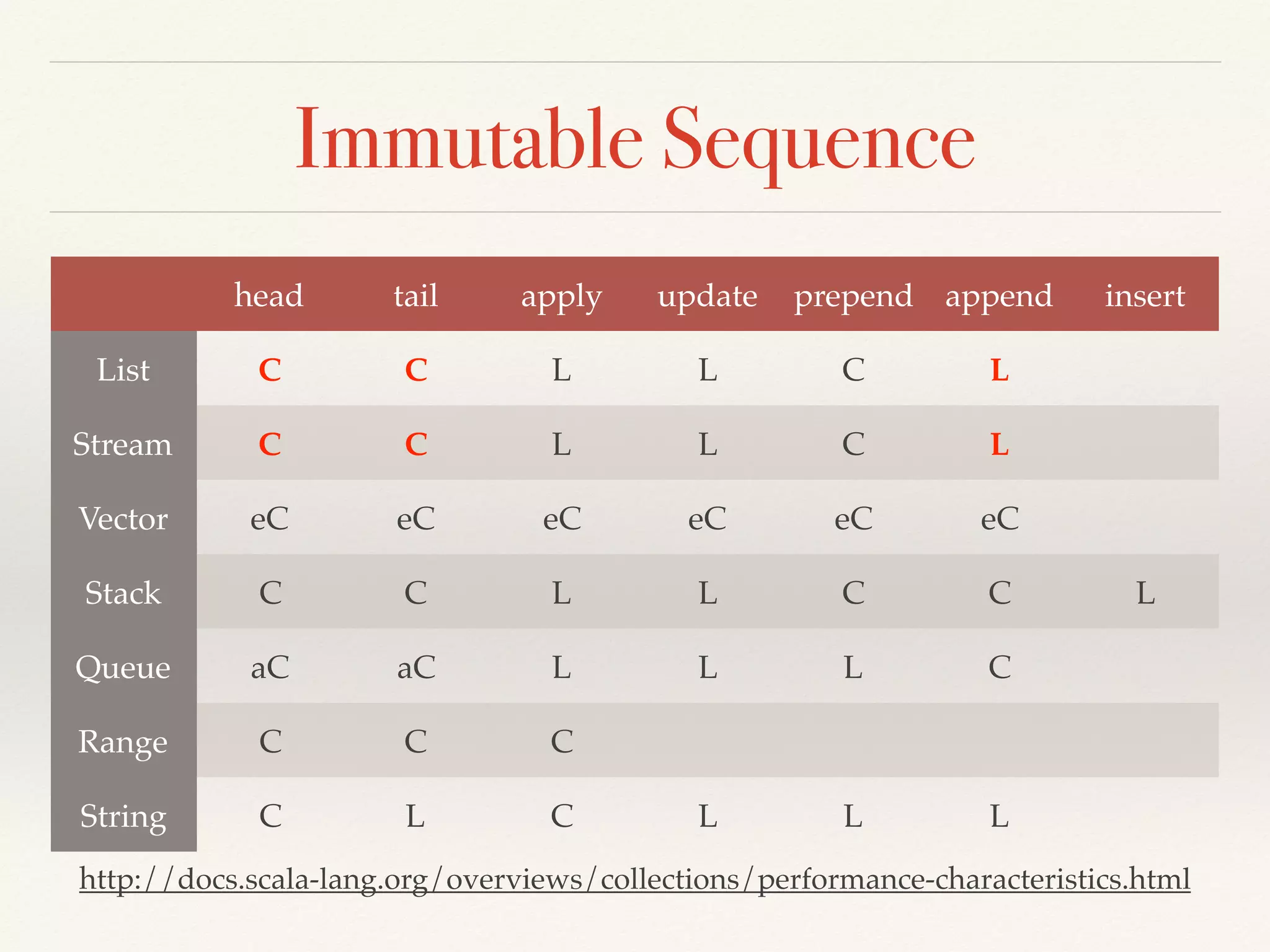
Collection Performance - Immutable Sequence
head tail apply update prepend append insert
List C C L L C L
Stream C C L L C L
Vector eC eC eC eC eC eC
Stack C C L L C C L
Queue aC aC L L L C
Range C C C
String C L C L L L
http://docs.scala-lang.org/overviews/collections/performance-characteristics.html
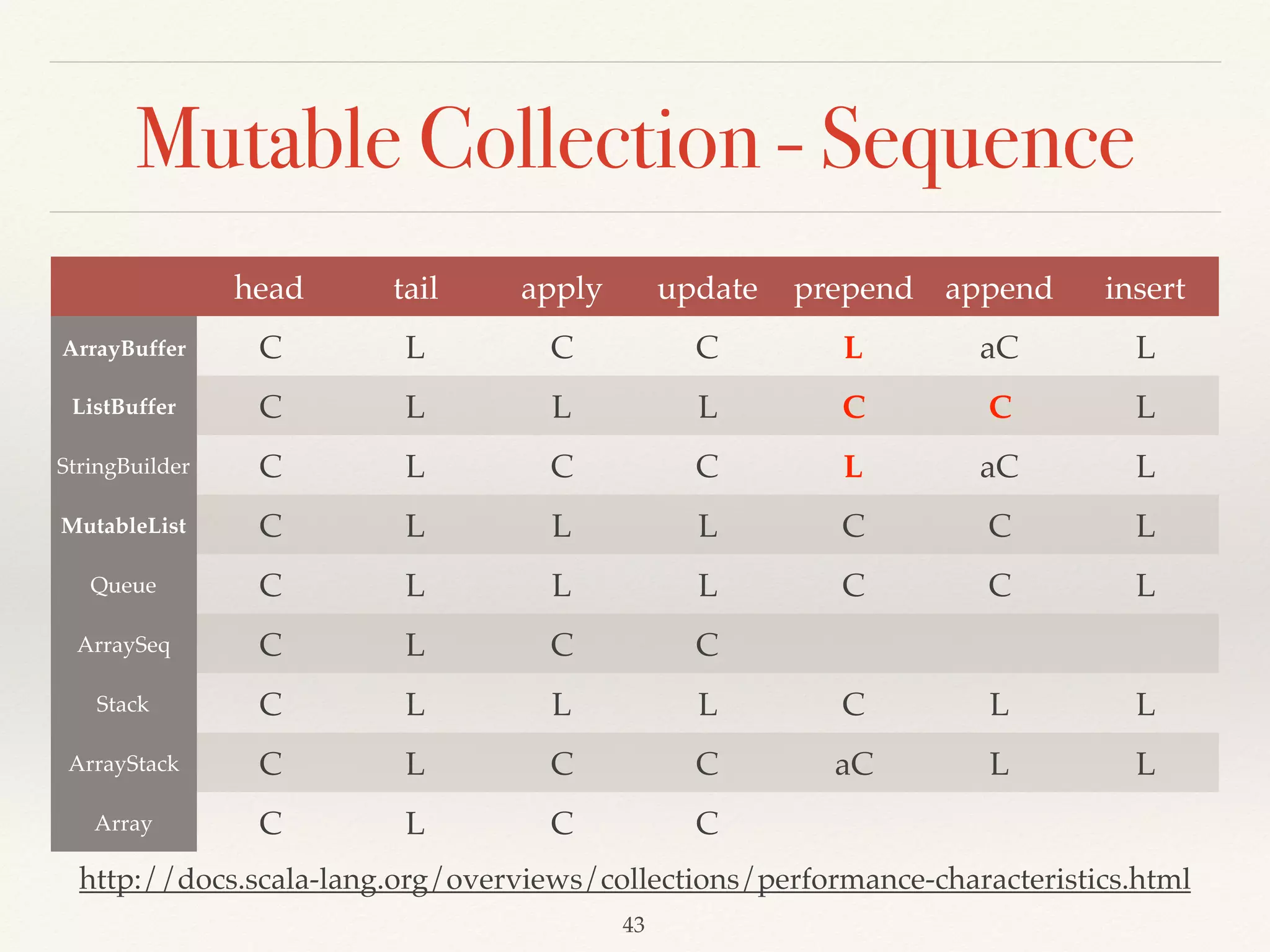
Collection Performance - Mutable Sequence
head tail apply update prepend append insert
ArrayBuffer C L C C L aC L
ListBuffer C L L L C C L
StringBuilder C L C C L aC L
MutableList C L L L C C L
Queue C L L L C C L
ArraySeq C L C C
Stack C L L L C L L
ArrayStack C L C C aC L L
Array C L C C
http://docs.scala-lang.org/overviews/collections/performance-characteristics.html
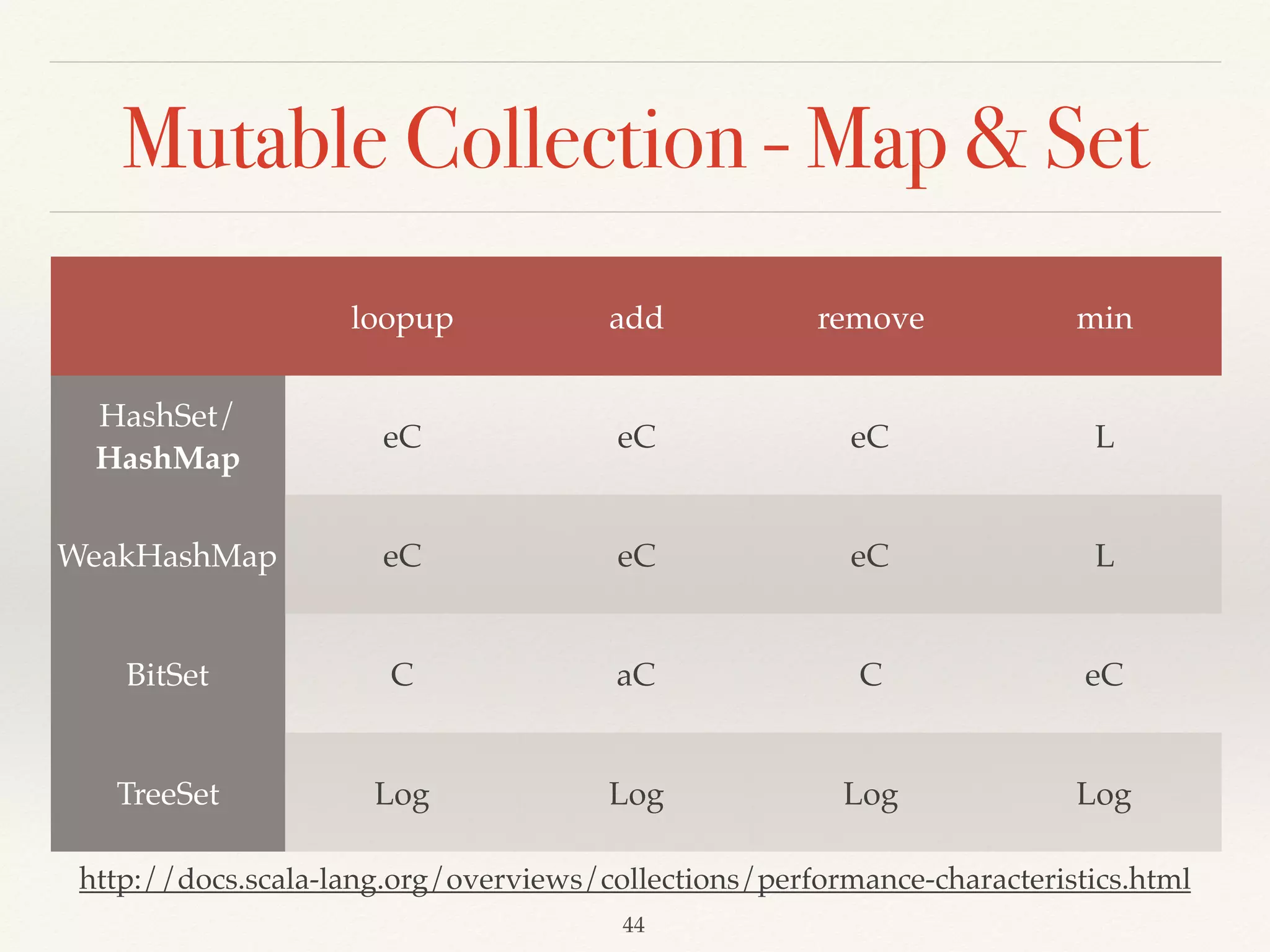
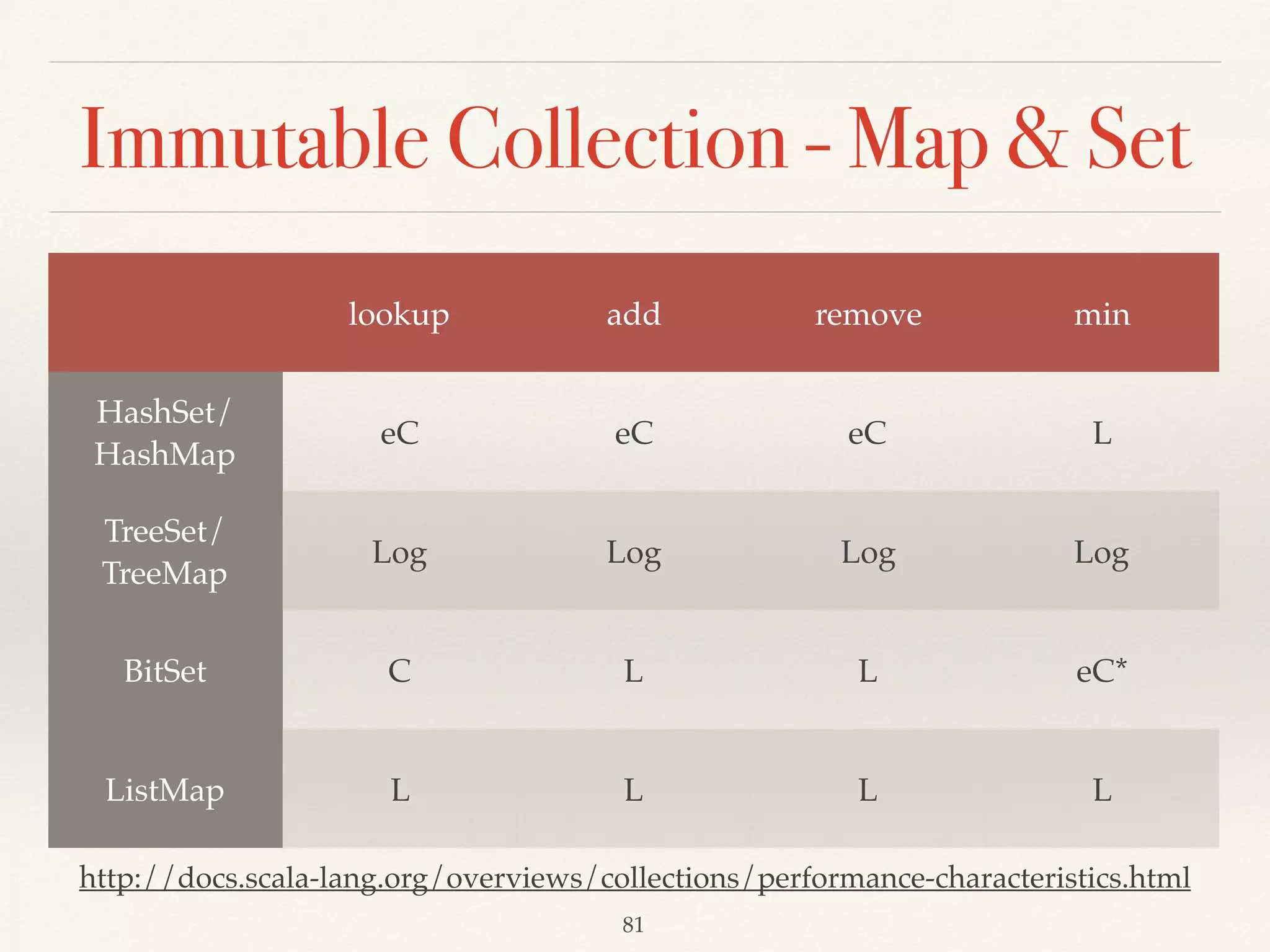
Collection Performance - Set & Map
lookup add remove min
immutable
HashSet/HashMap eC eC eC L
TreeSet/TreeMap Log Log Log Log
BitSet C L L eC*
ListMap L L L L
mutable
HashSet/HashMap eC eC eC L
WeakHashMap eC eC eC L
BitSet C aC C eC
TreeSet Log Log Log Log
http://docs.scala-lang.org/overviews/collections/performance-characteristics.html
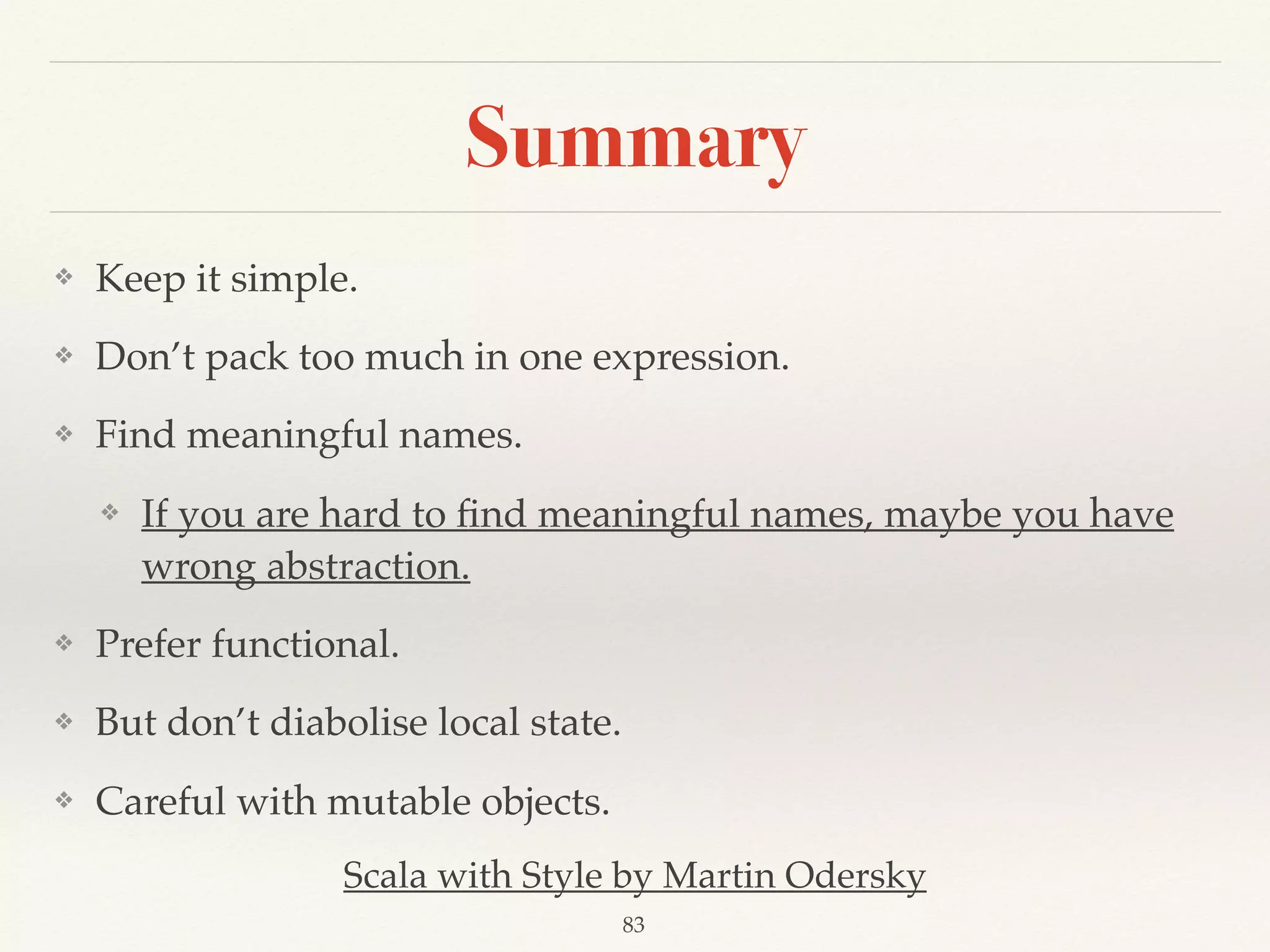
Summary of Scala
❖ Keep it simple.
❖ Don’t pack too much in one expression.
❖ Find meaningful names.
❖ If you are hard to find meaningful names, maybe you have
wrong abstraction.
❖ Prefer functional.
❖ But don’t diabolise local state.
❖ Careful with mutable objects.
Scala with Style by Martin Odersky
Further Reading & Reference
❖ Video
❖ Scala for the Intrigued by Venkat Subramaniam
❖ Scala with Style by Martin Odersky
❖ Online Tutorial
❖ Scala School by Twitter
❖ Creative Scala by Underscore
❖ Scala Official Tutorial
❖ Scala 101 by Lightbend
❖ Scala Exercises
❖ Other
❖ Scala 2.11.8 API Documentation
Further Reading & Reference
❖ Book
❖ Jason Swartz. Learning Scala. Available from http://shop.oreilly.com/
product/0636920030287.do
❖ Cay Horstmann. Scala for the Impatient. Available from http://
www.informit.com/store/scala-for-the-impatient-9780321774095
❖ (Beginning)
❖ Martin Odersky, Lex Spoon, and Bill Venners. Programming in Scala, 3rd.
Available from http://www.artima.com/shop/programming_in_scala_3ed
❖ (Beginning, Intermediate, Advance)
❖ Joshua D. Suereth. Scala in Depth. Available from https://
www.manning.com/books/scala-in-depth
❖ (Advance)
Further Reading
❖ SBT
❖ SBT Basic Concepts by Pishen Tsai
❖ SBT Official Document
❖ Design
❖ Functional Patterns in Scala by Walter Chang
❖ Functional Programming in Scala by Paul Chiusano and
Rúnar Bjarnason
❖ Test
❖ ScalaTest Official Guild
Further Reading
❖ Structure and Interpretation of Computer Programs by Harold
Abelson, Gerald Jay Sussman, Julie Sussman
❖ Books - https://mitpress.mit.edu/sicp/full-text/book/
book.html
❖ Videos - http://ocw.mit.edu/courses/electrical-engineering-
and-computer-science/6-001-structure-and-interpretation-of-
computer-programs-spring-2005/video-lectures/
❖ It’s not teach you Scala, but it teaches the principles of
computer programming. Even Martin’s Coursera courses
borrow concepts from this material.
Special Thanks
❖ (By Alphabet)
❖ Pishen Tsai
❖ https://github.com/pishen
❖ Vito Jeng
❖ https://github.com/vitojeng
❖ Walter Chang
❖ https://twitter.com/weihsiu
❖ Thanks for the most pull
requests!!!
❖ Zanyking
❖ http://zanyking.blogspot.tw

Introduction to Scala for JCConf Taiwan

  • 1.
    Introduction to Scala JiminHsieh - Speaker - https://tw.linkedin.com/in/jiminhsieh 
 Pishen Tsai - TA - https://github.com/pishen Vito Jeng - TA - vito@is-land.com.tw Walter Chang - TA - https://twitter.com/weihsiu https://gitter.im/ScalaTaiwan/ScalaTaiwan Hackpad - https://goo.gl/SIfDk7
  • 2.
    Agenda ❖ Why Scala? ❖Scala concept ❖ Program with Scala ❖ Imperative ❖ Object-Oriented ❖ Functional ❖ Collections ❖ Summary of Scala ❖ Further Reading & Reference ❖ Special Thanks
  • 3.
  • 4.
    Why Scala? Introduction toScala, Aleksandar Prokopec “I can honestly say if someone had shown me the Programming in Scala book by Martin Odersky, Lex Spoon & Bill Venners back in 2003 I'd probably have never created Groovy.” James Strachan, creator of Groovy http://macstrac.blogspot.tw/2009/04/scala-as-long-term-replacement-for.html
  • 5.
    Why Scala? Introduction toScala, Aleksandar Prokopec http://www.azquotes.com/author/11531-Alan_Perlis
  • 6.
    Why Scala? Introduction toScala, Aleksandar Prokopec http://www.azquotes.com/author/11531-Alan_Perlis http://thenextweb.com/shareables/2012/08/08/cant-get-enough-of-those-epic-quotes-from-y- combinators-paul-graham-youre-in-luck/
  • 7.
    Why Scala? Introduction toScala, Aleksandar Prokopec http://www.azquotes.com/author/11531-Alan_Perlis http://thenextweb.com/shareables/2012/08/08/cant-get-enough-of-those-epic-quotes-from-y- combinators-paul-graham-youre-in-luck/ High productive with type safety, more APIs than Java, and almost same performance with Java
  • 8.
    Scala concept ❖ Everythingis an object. ❖ Not everything is an object in Java. ❖ There is primitive type in Java. ❖ int, float, boolean, char…etc ❖ Scala is an object-oriented language in pure form: every value is an object and every operation is a method call. ❖ Numeric types and Function are object too. ❖ “+”, “-”, “*”, “/” are methods too.
  • 9.
  • 10.
    Scala concept ❖ Everythingis expression. ❖ Expression - an instruction to execute something that will return a value. from Wiki ❖ You can also say that an expression evaluates to a result or results in a value. ❖ You will hear evaluation from some of Scala geeks, it means the same thing.
  • 11.
    Scala concept ❖ Advancedtype system ❖ static ❖ strong ❖ inferred ❖ structural
  • 12.
    Scala concept ❖ Avoidto use null. ❖ Less error prone. ❖ NullPointerException ❖ You don’t need to use Null Object pattern.
  • 13.
    Program with Scala(Main) objectDemo1 {
 val todayEvent = "JCConf"
 val workshop = "Introduction to Scala"
 lazy val fun = (0 to 4).map(x => "fun").mkString(" ")
 
 def main(args: Array[String]): Unit = {
 println("Hello everybody!")
 print("Welcome to " + todayEvent + "!n")
 println("I hope you can enjoy this workshop - "
 + workshop + ". :P")
 print("Scala is so much " + fun + "!")
 }
 } Object with main method. Demo1
  • 14.
    Program with Scala(App) objectDemo2 extends App {
 val todayEvent = "JCConf"
 val workshop = "Introduction to Scala"
 lazy val fun =
 (0 to 4).map(x => "fun").mkString(" ")
 
 println("Hello everybody!")
 print("Welcome to " + todayEvent + "!n")
 println("I hope you can enjoy this workshop - "
 + workshop + ". :P")
 print("Scala is so much " + fun + "!")
 } Object with App trait. Demo2
  • 15.
    Program with Scala(REPL) ❖REPL - Read-Evaluate-Print Loop
  • 16.
    Program with Scala(REPL) ❖$ scala -Dscala.color
  • 17.
    Program with Scala(Worksheet) ❖Work with worksheet. ❖ IntelliJ ❖ https://www.jetbrains.com/help/idea/2016.2/ working-with-scala-worksheet.html ❖ Scala IDE or Eclipse with Scala plugin ❖ https://www.youtube.com/watch?v=Forl4hpg7kA
  • 18.
    Imperative ❖ var, val,semicolons ❖ If expressions ❖ def ❖ Block expressions ❖ While-Loop ❖ For-Loop ❖ Nested Function ❖ Recursion vs Tail-recursion ❖ Concept of Pattern Matching ❖ Pattern Matching v1
  • 19.
    var vs. val ❖var - variable ❖ Something that able or likely to change or be changed. Not always the same. Merriam- Webster ❖ val - value ❖ A value is an expression which cannot be evaluated any further. Wiki ❖ Opposite to var, val cannot be changed. ❖ It’s similar to final in Java.
  • 20.
    Expression with semicolon? valx = 5566
 val y = 87
 val java = "Java"; val scala = "scala" If you have multiple expressions in one line,
 you will need semicolon(;).
 Otherwise you don’t need it. Demo01
  • 21.
    If expressions ❖ Ifhas return value.(expression) ❖ Scala have no ternary operator(?:). // Java version
 final int value = -1;
 final boolean negative = value < 0 ? true : false; // Scala version
 val value = 0
 val negative = if (value < 0) true else false Everything is an expression. Demo02
  • 22.
    def def max(x: Int,y: Int): Int = {
 if (x > y)
 x
 else
 y
 } Programming in Scala, 3ed by Martin Odersky, Lex Spoon, and Bill Venners “def” starts a function definition function name parameter result type of function equals sign function body in curly braces Demo03
  • 23.
    def def max(x: Int,y: Int): Int = {
 if (x > y)
 return x
 else
 return y
 } Demo04
  • 24.
    def def max(x: Int,y: Int) = {
 if (x > y)
 x
 else
 y
 } No function’s result type Demo05
  • 25.
    def def max(x: Int,y: Int) =
 if (x > y)
 x
 else
 y No curly brackets Demo06
  • 26.
    Summary of def ❖You don’t need return. ❖ Last expression of block will be the return value. ❖ You don’t need return type in method definition. ❖ Scalac will know your return type in most case. ❖ It’s a good habit to have return type, when your API is a public interface. ❖ You don’t need curly bracket. ❖ If you have multiple lines of code, using curly bracket({}) is a good habit.
  • 27.
    Block expressions(curly brackets) valn = 5
 val factorial = {
 var result = 1
 for (i <- 1 to n)
 result = result * i
 result
 } Last expression(result) in block will be the return value, then it will assign to factorial. Demo07
  • 28.
    While-Loop var n =10
 var sum = 0
 
 while (n > 0) {
 sum = sum + 1
 n = n - 1
 } Demo08
  • 29.
    For-Loop var sum =0
 for (i <- 1 to 10) {
 sum += 1
 }
 println(sum) Demo09
  • 30.
    For-Loop for (i <-0 until 10) {
 println(i)
 } Demo10
  • 31.
    For-Loop for (i <-0 to n; j <- 0 to n) {
 print("*")
 if (j == n)
 println("")
 } Demo11
  • 32.
    Exercise of For-Loop ❖Print out something like below.
  • 33.
    Nested Function def min(x:Int, y: Int): Int = {
 def max(x: Int, y: Int) = {
 if (x > y) x
 else y
 }
 
 if (x == max(x, y))
 y
 else
 x
 } Demo12
  • 34.
    Nested Function(Closure) def min(x:Int, y: Int): Int = {
 def max = {
 if (x > y) x
 else y
 }
 
 if (x == max) y else x
 } If your method is zero parameters,
 you don’t need parentheses. Demo13
  • 35.
    Recursion vs Tail-recursion ❖Factorial number ❖ 6! = 6 * 5 * 4 * 3 * 2 * 1
  • 36.
    Recursion vs Tail-recursion //Recursion
 def factorial(n: Int): BigInt = {
 if (n == 0) 1
 else n * factorial(n - 1)
 }
 
 factorial(15000) java.lang.StackOverflowError Demo14
  • 37.
    Recursion vs Tail-recursion deffactorial(n: Int): BigInt = {
 // Tail-recursion
 def helpFunction(acc: BigInt, n: Int): BigInt = {
 if (n == 0)
 acc
 else
 helpFunction(acc * n, n - 1)
 }
 helpFunction(1, n)
 }
 
 factorial(15000) Scalac will translate tail-recursion to while-loop. Tail-recursion Demo15
  • 38.
    Recursion vs Tail-recursion importscala.annotation.tailrec
 def factorial(n: Int): BigInt = {
 @tailrec
 def helpFunction(acc: BigInt, n: Int): BigInt = {
 if (n == 0)
 acc
 else
 helpFunction(acc * n, n - 1)
 }
 helpFunction(1, n)
 } Add annotation is a good habit.
 Compiler can check whether or not 
 can be optimise. You have to add return type, 
 when the function is recursive. 
 Or Scalac would not know the return type. Demo16
  • 39.
    Concept of PatternMatching ❖ Pattern matching is similar to “switch-case”, but it’s more general. ❖ There are some differences. ❖ No fall-through. ❖ Each condition needs to return a value. ❖ Everything is a expression in Scala. ❖ It can match anything.
  • 40.
    Pattern Matching v1 ❖Scala’s pattern matching can match “Byte”, “Character”, “String”, “Short” and “Integer”. This is what Java’s switch can do. ❖ But Scala can match more things than that. I will talk about this later.
  • 41.
    Pattern Matching v1 defmatchString(x: String) = {
 x match {
 case "Dog" => x
 case "Cat" => x
 case _ => "Neither Dog or Cat"
 }
 }
 
 matchString("Dog")
 matchString("Human") Demo17
  • 42.
    Exercise of tail-recursion ❖Fibonacci numbers (0, 1, 1, 2, 3, 5…) www.leaningtowerofpisa.net/fibonacci.html
  • 43.
    Object-oriented ❖ Class ❖ Extends,With, Override ❖ Abstract Class ❖ Object, Companion Object ❖ Trait ❖ Access Modifiers ❖ Case class ❖ Pattern matching v2
  • 44.
    Class class Employee(id: Int,
 valname: String,
 address: String,
 var salary: BigDecimal) {
 def this(id: Int, name: String, salary: BigDecimal) {
 this(id, name, "Earth", salary)
 }
 
 def getAddress = address
 } Primary Constructor val in constructor 
 will give you getter var in constructor will 
 give you setter and getter Auxiliary Constructor When your method without parameters,
 you don’t need parentheses. Demo01
  • 45.
    Extends, with, override ❖Scala is single inheritance like Java. ❖ Scala - extends = Java - extends ❖ Scala - with = Java - implements ❖ Scala - override = Java - @Override
  • 46.
    Abstract class ❖ Abstractclass just likes normal class, but it can have abstract methods and abstract fields which means methods and fields without implementation. ❖ In Scala, you don’t need the keyword - abstract for methods and fields in Abstract class. When you leave methods and fields without body, it means abstract methods and fields.
  • 47.
    Abstract class sealed abstractclass Animal(val name: String) {
 val footNumber: Integer
 val fly: Boolean
 def speak: Unit
 }
 
 class Dog(name: String) extends Animal(name) {
 override val footNumber: Integer = 4
 override val fly = false
 override def speak: Unit = println("Spark")
 }
 
 class Bird(name: String) extends Animal(name) {
 val footNumber: Integer = 2
 val fly = true
 def speak: Unit = println("chatter")
 } Sealed classes 
 1. Subclasses should be 
 in the same file. 2. Compiler can check 
 you have covered all of cases in pattern matching. Demo02
  • 48.
    Object ❖ Object isa singleton. ❖ It likes normal class. ❖ You have only one instance in your application’s life cycle. ❖ Singleton objects cannot take class parameters. ❖ Scala does not have static class members like Java but has object instead. ❖ You don’t need to worry about how to write a thread-safe singleton. ❖ What’s advantage of Object? ❖ http://programmers.stackexchange.com/a/179402
  • 49.
    Object object MathUtil {
 defdoubleHalfUp(precision: Int,
 origin: Double): Double = {
 val tmp = Math.pow(10, precision)
 Math.round(origin * tmp) / tmp
 }
 } Demo03
  • 50.
    Companion object ❖ It’slike normal object, but it shares the same name with class name and locates with class in the same source file. ❖ The class and its companion object can access each other’s private methods or fields.
  • 51.
    Traits ❖ Traits arelike interfaces in Java. ❖ You cannot pass class parameters ❖ But there are differences. ❖ It can contain fields and concrete methods. ❖ Traits can enrich a thin interface(mixin) which can make a rich interface.
  • 52.
    Trait - Mixin traitIterator[A] {
 def hasNext: Boolean
 def next: A
 }
 
 trait RichIterator[A]
 extends Iterator[A] {
 def foreach(f: A => Unit): 
 Unit =
 while (hasNext)
 f(next)
 } class CharIterator(s: String)
 extends Iterator[Char] {
 var i = 0
 def hasNext = i < s.length
 def next = {
 val c = s(i)
 i += 1
 c
 }
 }
 
 val ci = new CharIterator("hello")
 with RichIterator[Char]
 ci.foreach(println) https://scalafiddle.io/sf/i3KWOvf/0 Demo04
  • 53.
    Access Modifiers ❖ public ❖anyone ❖ There is no explicit modifiers for public fields and methods. ❖ protected ❖ only allow subclass access ❖ private ❖ In the same scope of Scala file. ❖ protected[X] or private[X] ❖ access is private or protected “up to” X
  • 54.
    Case Classes ❖ Caseclasses are a special kind of classes that are optimised for use in pattern matching. ❖ Each of the constructor parameters becomes a val. Scala for the Impatient by Cay Horstmann
  • 55.
    Case Classes ❖ Itcreates the companion object. ❖ It contains an apply method used to construct instance without “new”. (Factory pattern) ❖ It contain an unapply method work as extractor to extract values from apply method. ❖ Each instance contains toString, equals(==), hashCode, and copy. Scala for the Impatient by Cay Horstmann
  • 56.
    Pattern Matching v2 sealedabstract class Expr
 case class Add(first: Expr, second: Expr) extends Expr
 case class Sub(first: Expr, second: Expr) extends Expr
 case class Multi(first: Expr, second: Expr) extends Expr
 case class Div(first: Expr, second: Expr) extends Expr
 case class Value(n: Int) extends Expr
 
 def calculate(combination: Expr): Int = {
 combination match {
 case Add(first, second) => calculate(first) + calculate(second)
 case Sub(first, second) => calculate(first) - calculate(second)
 case Multi(first, second) => calculate(first) * calculate(second)
 case Div(first, second) => calculate(first) / calculate(second)
 case Value(n) => n
 }
 }
 // (((2 + 1) * 3) - 1) / 4
 val exp = Div(Sub(Multi(
 Add(Value(1), Value(2)), Value(3)), Value(1)), Value(4))
 calculate(exp) Demo05
  • 57.
    Pattern Matching v2 defcalculate(combination: Expr): Int = {
 combination match {
 case Add(Multi(a, x), Multi(b, y)) if (x == y) =>
 // (3 + 4) * 2
 (calculate(a) + calculate(b)) * calculate(x)
 case Add(first, second) =>
 calculate(first) + calculate(second)
 case Sub(first, second) =>
 calculate(first) - calculate(second)
 case Multi(first, second) =>
 calculate(first) * calculate(second)
 case Div(first, second) =>
 calculate(first) / calculate(second)
 case Value(n) =>
 n
 }
 }
 // ((3 * 2) + (4 * 2))
 calculate(Add(Multi(Value(3), Value(2)), Multi(Value(4), Value(2)))) Demo06
  • 58.
    Summary of object-oriented ❖If it might be reused in multiple, unrelated classes, make it a trait. ❖ If you plan to distribute it in compiled form and you expect outside groups to write classes inheriting from it, you might lean towards using an abstract class. ❖ ……. ❖ If you are not so sure abstract class or trait, then use trait. Trait keeps more options open. Programming in Scala, 3ed by Martin Odersky, Lex Spoon, and Bill Venners
  • 59.
    Functional ❖ Functional concept ❖First-class functions ❖ Anonymous functions ❖ High-order functions
  • 60.
    Functional Concept ❖ Immutability(Referential transparency) ❖ No side effect. ❖ Functions as values ❖ Functions as objects ❖ Higher-order functions ❖ Input: takes one or more functions as parameters ❖ Output: return a function as result
  • 61.
    First-class functions ❖ Functionsare first-class values. ❖ Function is a value of the same status as an integer or string. Programming in Scala, 3ed by Martin Odersky, Lex Spoon, and Bill Venners
  • 62.
    Anonymous functions(Lambdas) (0 until10).map((value: Int) => value * value)
 (0 until 10).map(value => value * value)
 
 (0 until 10).map(value => value + 1)
 (0 until 10).map(_ + 1) Placeholder syntax Demo01
  • 63.
    High-order functions def calculateTax(rate:BigDecimal => BigDecimal,
 salary: BigDecimal): BigDecimal = {
 rate(salary)
 }
 
 val usaTax = (salary: BigDecimal) => {
 if (salary > 413201)
 salary * 0.396
 else
 salary * 0.3
 }
 
 val twTax: BigDecimal => BigDecimal = _ * 0.25
 
 calculateTax(usaTax, 413202)
 calculateTax(twTax, 100) Demo02
  • 64.
    High-order functions def calculateTax(rate:BigDecimal => BigDecimal,
 salary: BigDecimal): BigDecimal = {
 rate(salary)
 }
 
 def usaTax(salary: BigDecimal) = {
 calculateTax(x =>
 if (x > 413201) x * 0.396
 else x * 0.3,
 salary)
 }
 def twTax(salary: BigDecimal) =
 calculateTax(_ * 0.25, salary)
 
 usaTax(413202)
 twTax(100) Demo03
  • 65.
    High-order functions def calculateTax(rate:BigDecimal => BigDecimal)
 : (BigDecimal) => BigDecimal = {
 rate
 }
 
 def usaTax = calculateTax(x =>
 if (x > 413201) x * 0.396
 else x * 0.3
 )
 def twTax = calculateTax(x => x * 0.25)
 
 usaTax(413202)
 twTax(100)
 
 calculateTax(usaTax)(413202)
 calculateTax(twTax)(100) Demo04
  • 66.
    High-order functions -Curry def calculateTax(rate: BigDecimal => BigDecimal)
 (salary: BigDecimal): BigDecimal = {
 rate(salary)
 }
 
 def usaTax(salary: BigDecimal) =
 calculateTax(x =>
 if (x > 413201) x * 0.396
 else x * 0.3)(salary)
 def twTax(salary: BigDecimal) =
 calculateTax(x => x * 0.25)(salary)
 
 usaTax(413202)
 twTax(100) Demo05
  • 67.
    High-order functions -Partially Applied Function // Curry
 def calculateTax(rate: BigDecimal => BigDecimal)
 (salary: BigDecimal): BigDecimal = {
 rate(salary)
 }
 
 // First way of Partially Applied Function
 def usaTax = calculateTax(
 x =>
 if (x > 413201) x * 0.396
 else x * 0.3
 )(_)
 // Second way of Partially Applied Function
 def twTax: BigDecimal => BigDecimal = calculateTax(_ * 0.25)
 
 usaTax(413202)
 twTax(100) Demo06 placeholder
  • 68.
    Exercise of High-orderfunctions def summation(fun: Int => Int, start: Int, end: Int): Int = ???
 
 def number(n: Int): Int = ???
 def cube(n: Int): Int = ???
 // factorial number: 5 * 4 * 3 * 2 * 1
 def factorial(n: Int): Int = ???
 
 def sumNumber(start: Int, end: Int): Int = ???
 def sumCubes(start: Int, end: Int): Int = ???
 def sumFactorials(start: Int, end: Int): Int = ??? Functional Programming Principles in Scala, Martin Odersky Exercise1
  • 69.
    Exercise of High-orderfunctions // hint: nest function
 def summation(fun: Int => Int): (Int, Int) => Int = ???
 
 def sumNumber = ???
 def sumCubes = ???
 def sumFactorials = ??? Functional Programming Principles in Scala, Martin Odersky Exercise2
  • 70.
    Exercise of Curry //Curry
 def summation(fun: Int => Int)(start: Int, end: Int): Int = ???
 
 def sumNumber = ???
 def sumCubes = ???
 def sumFactorials = ??? Functional Programming Principles in Scala, Martin Odersky Exercise2
  • 71.
    Collections ❖ Concept ofCollections ❖ Collection Traits ❖ Hierarchy of Collections ❖ Immutable ❖ Mutable ❖ Immutable List ❖ Immutable HashMap ❖ Tuple ❖ Option ❖ Pattern Matching v3 ❖ Time Complexity
  • 72.
    Concept of Collections ❖In most programming language, they only support mutable collections. ❖ Scala supports mutable collections and immutable collections. ❖ It means you cannot change the data that inside of collections. ❖ When you operate on a collection, it will return a new collection than keep origin collection. ❖ Almost every method is left associativity. ❖ Unless method that ends in a “:“(colon) is right associativity.
  • 73.
    Concept of Collections valvar Immutable Collection Best Not Bad Mutable Collection Danger Very Danger The Mutability Matrix of Pain by Jamie Allen
  • 74.
  • 75.
    Collection Trait ❖ Traversable- traverse whole collection. ❖ Iterable - traverse whole collection with sooner stop. ❖ Seq ❖ IndexedSeq - Array ❖ LinearSeq - List ❖ Map - key pairs with value. ❖ Set - no duplicated item
  • 76.
  • 77.
  • 78.
    Concept of ImmutableList ❖ Nil ❖ The empty list. ❖ Avoid null.
  • 79.
    Work with List //Construct List
 val list1 = List(1, 2, 3)
 // Element prepends to List
 val list2 = 1 :: 2 :: 3 :: Nil
 val list3 = 1 :: (2 :: (3 :: Nil))
 val list4 = Nil.::(3).::(2).::(1)
 // List prepends to List
 val list5 = List(5, 5, 6, 6) ::: List(8, 7)
 val list6 = List(8, 7).:::(List(5, 5, 6, 6)) Demo01 pronounced “cons”
  • 80.
    API of List vallist =
 List(4, 3, 0, 1, 2)
 list.head
 list.tail
 list.length
 list.max
 list.min
 list.sum
 list.contains(5)
 list.mkString(",")
 list.drop(2)
 list.reverse list.sortWith(_ > _)
 list.map(x => x * 2)
 list.map(_ * 2)
 list.reduce((x, y) => x + y)
 list.reduce(_ + _)
 list.filter(x => x % 2 == 0)
 list.filter(_ % 2 == 0)
 list.groupBy(x => x % 2 == 0)
 list.groupBy(_ % 2 == 0)
 list.indices zip list
 list.zipWithIndex Demo02
  • 81.
    List with high-orderfunction val list =
 List(4, 3, 0, 1, 2)
 
 val twoDim = list.map(_ + 1) ::
 list.map(_ - 1) ::
 list.map(_ * 2) ::
 Nil
 twoDim.flatten
 // map + flatten
 twoDim.flatMap(x => x.filter(_ % 2 == 1)) Demo03
  • 82.
    Concept of ImmutableHashMap ❖ Tuple ❖ Option ❖ Some ❖ None
  • 83.
    Tuple ❖ Immutable ❖ Containdifferent type of elements ❖ You don’t need Java-Bean ❖ It can contain to 22 elements. ❖ Tuple2 = Pair val people =
 ("Martin", 58)
 people._1
 people._2 Demo04
  • 84.
    Option ❖ Use toavoid null. ❖ Null is error prone. ❖ You code need to check whether or not it is null. ❖ Option type will be Some or None. http://betehess.github.io/talks/2014/06/06-cata-visitor-adt#14
  • 85.
    Work with HashMap valcountryCode =
 Map("Taiwan" -> 886,
 "United States" -> 1,
 "Japan" -> 81)
 val countryCode1 =
 Map(("Taiwan", 886),
 ("United States", 1),
 ("Japan", 81))
 
 // 886
 countryCode("Taiwan")
 // Some(886)
 countryCode.get("Taiwan") // NoSuchElementException
 countryCode("Canada")
 // None
 countryCode.get("Canada")
 // add
 countryCode + ("China" -> 86)
 // delete
 countryCode - ("Japan")
 // update
 countryCode + ("Taiwan" -> 5566)
 countryCode.getOrElse("China", 0) Demo05
  • 86.
    More Option val list= List(0, 1, 2, 3, 4, 5)
 def odd(n: Int) =
 if (n % 2 == 1) Some(n)
 else None
 list.map(odd(_))
 list.flatMap(odd(_))
 
 val list1 =
 List(Some(1), None, Some(2), None, Some(3))
 Some(5566).map(x => x * 2)
 list1.flatMap(x => x.map(y => y * 2))
 list1.flatMap(_.map(_ * 2)) Demo06
  • 87.
    Advanced Option case classPeople(
 id: String,
 firstName: String,
 lastName: String,
 age: Int,
 countries: List[String],
 gender: Option[String]
 ) object PeopleRepository {
 private val peoples = Map(
 1 -> People("1", "John", "Doe", 30, List("TW", "USA"), Some("male")),
 2 -> People("2", "Janie", "Doe", 10, List("Japan"), Some("female")),
 3 -> People("3", "", "Doe", 50, List("TW"), None))
 
 def find(id: Int): Option[People] = peoples.get(id)
 def getAll = peoples.values
 } // None
 for {
 people <- PeopleRepository.find(2)
 gender <- people.gender
 } yield gender
 // Some(female)
 for {
 people <- PeopleRepository.find(3)
 gender <- people.gender
 } yield gender
 // None
 for {
 people <- PeopleRepository.find(4)
 gender <- people.gender
 } yield gender The Neophyte's Guide to Scala Part 5: The Option Type Demo07
  • 88.
    For-comprehensions // List ofPeople has TW passport for {
 people <- PeopleRepository.getAll
 if (people.countries.contains("TW"))
 } yield people
 
 (for {
 people <- PeopleRepository.getAll
 country <- people.countries
 } yield country).toSet Demo08
  • 89.
    Exercise of Collection //only use collection's API(combinator)
 
 // find the maximum number of Seq with fun
 def larges(fun: Int => Int,
 inputs: Seq[Int]): Int = ???
 
 // find the maximum number of index of Seq with fun
 def largesIndex(fun: Int => Int,
 inputs: Seq[Int]): Int = ??? Scala for the Impatient by Cay Horstmann Exercise1
  • 90.
    Pattern Matching v3 vallist = (0 to 5).toList
 def sum(list: List[Int]): Int = {
 list match {
 case Nil => 0
 case head :: tail => head + sum(tail)
 }
 }
 sum(list) Demo09
  • 91.
    Pattern Matching v3 importscala.annotation.tailrec
 
 val list = (0 until 9).toList
 def sumTail(list: List[Int]): Int = {
 @tailrec
 def help(list: List[Int],
 previous: Int): Int = list match {
 case Nil => 0
 case List(onlyOne) => previous + onlyOne
 case head :: tail => help(tail, previous + head)
 }
 help(list, 0)
 }
 sumTail(list) Demo10
  • 92.
    Time complexity ❖ C:constant time, O(1) ❖ eC: effectively constant time ❖ aC: amortised constant time ❖ Some of operation take longer. On average, it is constant time. ❖ Log: O(log n) ❖ L: linear time, O(n)
  • 93.
    Collection Performance -Immutable Sequence head tail apply update prepend append insert List C C L L C L Stream C C L L C L Vector eC eC eC eC eC eC Stack C C L L C C L Queue aC aC L L L C Range C C C String C L C L L L http://docs.scala-lang.org/overviews/collections/performance-characteristics.html
  • 94.
    Collection Performance -Mutable Sequence head tail apply update prepend append insert ArrayBuffer C L C C L aC L ListBuffer C L L L C C L StringBuilder C L C C L aC L MutableList C L L L C C L Queue C L L L C C L ArraySeq C L C C Stack C L L L C L L ArrayStack C L C C aC L L Array C L C C http://docs.scala-lang.org/overviews/collections/performance-characteristics.html
  • 95.
    Collection Performance -Set & Map lookup add remove min immutable HashSet/HashMap eC eC eC L TreeSet/TreeMap Log Log Log Log BitSet C L L eC* ListMap L L L L mutable HashSet/HashMap eC eC eC L WeakHashMap eC eC eC L BitSet C aC C eC TreeSet Log Log Log Log http://docs.scala-lang.org/overviews/collections/performance-characteristics.html
  • 96.
    Summary of Scala ❖Keep it simple. ❖ Don’t pack too much in one expression. ❖ Find meaningful names. ❖ If you are hard to find meaningful names, maybe you have wrong abstraction. ❖ Prefer functional. ❖ But don’t diabolise local state. ❖ Careful with mutable objects. Scala with Style by Martin Odersky
  • 97.
    Further Reading &Reference ❖ Video ❖ Scala for the Intrigued by Venkat Subramaniam ❖ Scala with Style by Martin Odersky ❖ Online Tutorial ❖ Scala School by Twitter ❖ Creative Scala by Underscore ❖ Scala Official Tutorial ❖ Scala 101 by Lightbend ❖ Scala Exercises ❖ Other ❖ Scala 2.11.8 API Documentation
  • 98.
    Further Reading &Reference ❖ Book ❖ Jason Swartz. Learning Scala. Available from http://shop.oreilly.com/ product/0636920030287.do ❖ Cay Horstmann. Scala for the Impatient. Available from http:// www.informit.com/store/scala-for-the-impatient-9780321774095 ❖ (Beginning) ❖ Martin Odersky, Lex Spoon, and Bill Venners. Programming in Scala, 3rd. Available from http://www.artima.com/shop/programming_in_scala_3ed ❖ (Beginning, Intermediate, Advance) ❖ Joshua D. Suereth. Scala in Depth. Available from https:// www.manning.com/books/scala-in-depth ❖ (Advance)
  • 99.
    Further Reading ❖ SBT ❖SBT Basic Concepts by Pishen Tsai ❖ SBT Official Document ❖ Design ❖ Functional Patterns in Scala by Walter Chang ❖ Functional Programming in Scala by Paul Chiusano and Rúnar Bjarnason ❖ Test ❖ ScalaTest Official Guild
  • 100.
    Further Reading ❖ Structureand Interpretation of Computer Programs by Harold Abelson, Gerald Jay Sussman, Julie Sussman ❖ Books - https://mitpress.mit.edu/sicp/full-text/book/ book.html ❖ Videos - http://ocw.mit.edu/courses/electrical-engineering- and-computer-science/6-001-structure-and-interpretation-of- computer-programs-spring-2005/video-lectures/ ❖ It’s not teach you Scala, but it teaches the principles of computer programming. Even Martin’s Coursera courses borrow concepts from this material.
  • 101.
    Special Thanks ❖ (ByAlphabet) ❖ Pishen Tsai ❖ https://github.com/pishen ❖ Vito Jeng ❖ https://github.com/vitojeng ❖ Walter Chang ❖ https://twitter.com/weihsiu ❖ Thanks for the most pull requests!!! ❖ Zanyking ❖ http://zanyking.blogspot.tw